South Carolina court blasts state’s environmental protection agency over poor oversight of leaking nuclear waste dump
For the second year in a row, the S.C. Court of Appeals has ripped the state’s environmental protection agency for failing to properly oversee a leak-prone nuclear waste dump in Barnwell County.
But this time, the appeals court isn’t telling regulators when to resolve problems at the 44-year-old site.
In an Aug. 12 ruling that disappointed landfill critics, the court backed away from requiring a specific timetable to improve conditions at Chem-Nuclear’s dump near the Savannah River.
Last year, the appeals court ordered the Department of Health and Environmental Control and site operator Chem-Nuclear to develop a written plan for correcting problems within 90 days. Both then appealed for a rehearing, which delayed the 90-day requirement and ultimately resulted in last week’s decision.
Sierra Club lawyer Bob Guild said this year’s decision leaves DHEC — the agency that has failed to properly manage the site — the discretion to react to the court ruling at its own leisure.
“We have an agency that has been lawless for years in not enforcing its own regulations, and now, the court is giving it another open-ended opportunity to review itself,’’ Guild said. “That is unfortunate. We are going to monitor this very carefully.’
Guild’s group filed suit 10 years ago in an attempt to force tougher disposal practices at the unlined landfill, where radioactive tritium leaks first were detected in the 1970s. A plume of tritium extends downhill from the site and has for years trickled into a creek that flows toward the nearby Savannah River.
Sierra Club officials say DHEC has been lax in making Chem-Nuclear follow rules at the disposal site through the years.
The appeals court acknowledged problems, saying that DHEC “failed to enforce the law of South Carolina’’ in monitoring the 235-acre landfill outside the town of Snelling.
The court said DHEC, as the agency overseeing Chem-Nuclear’s activities, did not enforce a handful of specific regulations established to protect the environment. It also said Chem-Nuclear had failed to follow some of the rules on nuclear waste disposal. Except for the timetable, the court’s decision last week was similar to last year’s ruling that took DHEC and Chem-Nuclear to task.
“It is important that DHEC enforce its own regulations and require Chem-Nuclear to take action to comply with the technical requirements,’’ the ruling said in sending the matter back to DHEC for consideration……….
An array of critics, however, say tritium is still toxic and often is a forerunner of other, more dangerous pollutants that will one day wash into groundwater. Leaks were discovered within a decade of the Barnwell County site’s opening in 1971, despite initial assurances from state regulators.
The disposal site once took low-level nuclear waste from atomic power plants, hospitals and other places from across the country. Today, the landfill is open only to South Carolina, Connecticut and New Jersey, and waste volumes have dropped sharply. But the Sierra Club has pressed ahead with its 2005 lawsuit, saying better disposal practices will prevent tritium leaks from getting any worse.
One of the major concerns centers on rain that falls into open burial trenches. Environmentalists for years have pushed the state to require the placement of tents or roofs atop the burial trenches. That would cut down on the amount of rain that pours in, picks up radioactive pollutants from the waste and leaks through the bottom of the landfill and into groundwater, they say.
The court said Chem-Nuclear had done nothing to keep rain out of the burial pits, even though a state regulation says it is supposed to minimize movement of water in the pits. And the court said DHEC had not forced the company to comply with the rule intended to keep rain out of the pits — or acted to prevent rain from leaking through the bottom and into groundwater………http://www.thestate.com/news/local/article31585892.html
Most churches support the Iran nuclear deal
American Churches and the Iran Nuclear Deal, Weekly Standard, AUG 20, 2015 • BY MARK TOOLEY Most church groups and prominent religious voices speaking to the Iran nuclear deal are supportive. Most notable among them is the U.S. Catholic Conference of Bishops. n April, Bishop Oscar Cantú of Las Cruces, who leads the U.S. Catholic bishops’ Committee on International Justice and Peace, wrote members of Congress to hail the accord as an “important step in advancing a peaceful resolution.” He quoted Pope Francis, who prayed that, “the framework…may be a definitive step toward a more secure and fraternal world.”………
In July, Bishop Cantú again wrote Congress to commend the “remarkable step with Iran in reaching this agreement” and urging Congress to “support these efforts to build bridges that foster peace and greater understanding.”
Liberal Evangelical activist Jim Wallis of Sojourners similarly hailed the accord for pursuing options that will “prevent further war with more dangerous weapons,” which is the “right course of action in a highly imperfect world.” He warned that “those who oppose deals like this often proclaim a binary world of simple good and evil, which we don’t have — and believing so is a dangerous illusion.”………https://www.weeklystandard.com/blogs/american-churches-and-iran-nuclear-deal_1015151.html
Savannah River Site’s MOX project needs $800 million a year
Review: MOX needs $800M a year http://www.aikenstandard.com/article/20150820/AIK0101/150829974/1121
Earlier this year, the Department of Energy commissioned the Red Team, a group led by Thom Mason, the director of the Oak Ridge National Laboratory, to evaluate cost projections and alternatives to the MOX method of plutonium disposition. The method includes the Mixed Oxide Fuel Fabrication Facility under construction at SRS.
The project is part of a nonproliferation agreement with Russia to dispose of 34 metric tons of weapons grade plutonium.
“The Red Team concluded that if the MOX pathway is to be successful, then annual funding for the whole program would have to increase from the current $400 million per year to $700 to 800 million per year over the next 2-3 years, and then remain at $700 to $800 million until all 34 metric tons are dispositioned,” officials wrote.
The Aiken Standard will have more on the MOX review in Friday’s paper.
WHOI Study Shows Fukushima Contaminated Sediment Moving Offshore
 Researchers deployed time-series sediment traps 115 kilometers (approximately 70 miles) southeast of the nuclear power plant at depths of 500 meters (1,640 feet) and 1,000 meters (3,280 feet). The two traps began collecting samples on July 19, 2011—130 days after the March 11th earthquake and tsunami—and were recovered and reset annually.
WOODS HOLE – Researchers from Woods Hole Oceanographic Institution have been studying the effects the Fukushima Nuclear Power Plant disaster in 2011 has had in the Pacific Ocean.
WHOI has recently released the results of a three-year study of sediment samples collected offshore in the American Chemical Society’s journal, Environmental Science and Technology.
The purpose of the study is to understand what happens to the Fukushima contaminants after they are buried on the seafloor off of coastal Japan.
The team, led by senior scientist and marine chemist Ken Buesseler, found that a small fraction of contaminated sea floor sediments off Fukushima are moved offshore by typhoons that resuspend radioactive particles in the water, which then travel laterally with Southeasterly currents into the Pacific Ocean.
Researchers used funnel-shaped traps to collect the data at depths of 500 meters and 1,000 meters starting 130 days after the disaster.
The research found radiocesium from the plant along with sediment with a high fraction of clay material in the samples. The clay material is characteristic of shelf and slope sediments and suggest a near shore source.
Buesseler says that more than 99 percent of the contaminated material from the plant moved with the water offshore and that less than 1 percent ended up on the sea floor as buried sediment.
Source: CapeCod.com
WHOI Study Shows Fukushima Contaminated Sediment Moving Offshore
Why is USA ignoring Israel’s nuclear arsenal?
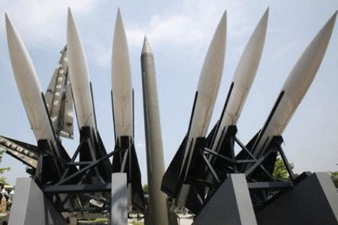
 Why is Israel’s nuclear arsenal not mentioned in Iran deal debate?, McClatchy DC
Israel has as many as 100 nuclear warheads and systems to deliver them
But U.S. officials don’t mention them under a 1969 agreement
Iranian nukes would challenge Israel’s unique Middle East position
BY JONATHAN S. LANDAY jlanday@mcclatchydc.com WASHINGTON , 19 Aug 15,
There’s one major issue that President Barack Obama, his supporters and his critics assiduously have avoided as they battle over the deal designed to prevent Iran from obtaining nuclear weapons: Israel’s own nuclear arsenal.
An open secret for decades, the Israeli stockpile is estimated at some 80-100 warheads, though Israel refuses to confirm or deny its existence under a policy of deliberate ambiguity. The arsenal was developed as the ultimate guarantor of the Jewish state’s survival against threats from its hostile neighborhood.
Yet as the sides joust over the Iran deal’s impact on Israel’s security, Obama has been silent on the Israeli arsenal as a potential deterrent against Iranian cheating on the accord. Opponents, led by Israeli Prime Minister Benjamin Netanyahu, haven’t touched the issue, either. And it hasn’t figured in the public hearings that Congress is holding as part of a 60-day review that will culminate in a Republican-led bid to kill the Iran accord next month.
To some experts, the fierce debate over whether the Iran deal endangers Israel or makes it safer will be incomplete and misleading as long as it skirts the Middle East’s only nuclear arms stockpile………http://www.mcclatchydc.com/news/nation-world/world/article31470917.html
Nuclear bombing of Japanese cities was not needed to end World War 2
 The Real Reason America Used Nuclear Weapons Against Japan. It Was Not To End the War Or Save Lives. True Activist.com August 6, 2015 by True Activist Atomic Weapons Were Not Needed to End the War or Save Lives. By Washington’s Blog / globalresearch.ca
Like all Americans, I was taught that the U.S. dropped nuclear bombs on Hiroshima and Nagasaki in order to end WWII and save both American and Japanese lives.
But most of the top American military officials at the time said otherwise.
The U.S. Strategic Bombing Survey group, assigned by President Truman to study the air attacks on Japan, produced a report in July of 1946 that concluded (52-56):
Based on a detailed investigation of all the facts and supported by the testimony of the surviving Japanese leaders involved, it is the Survey’s opinion that certainly prior to 31 December 1945 and in all probability prior to 1 November 1945, Japan would have surrendered even if the atomic bombs had not been dropped, even if Russia had not entered the war, and even if no invasion had been planned or contemplated.
General (and later president) Dwight Eisenhower – then Supreme Commander of all Allied Forces, and the officer who created most of America’s WWII military plans for Europe and Japan – said:
The Japanese were ready to surrender and it wasn’t necessary to hit them with that awful thing.
Newsweek, 11/11/63, Ike on Ike
Eisenhower also noted (pg. 380):……….
Why Were Bombs Dropped on Populated Cities Without Military Value?
Even military officers who favored use of nuclear weapons mainly favored using them on unpopulated areas or Japanese military targets … not cities.
For example, Special Assistant to the Secretary of the Navy Lewis Strauss proposed to Secretary of the Navy James Forrestal that a non-lethal demonstration of atomic weapons would be enough to convince the Japanese to surrender … and the Navy Secretary agreed (pg. 145, 325):……..
The Real Explanation?
History.com notes:
In the years since the two atomic bombs were dropped on Japan, a number of historians have suggested that the weapons had a two-pronged objective …. It has been suggested that the second objective was to demonstrate the new weapon of mass destruction to the Soviet Union. By August 1945, relations between the Soviet Union and the United States had deteriorated badly. The Potsdam Conference between U.S. President Harry S. Truman, Russian leader Joseph Stalin, and Winston Churchill (before being replaced by Clement Attlee) ended just four days before the bombing of Hiroshima. The meeting was marked by recriminations and suspicion between the Americans and Soviets. Russian armies were occupying most of Eastern Europe. Truman and many of his advisers hoped that the U.S. atomic monopoly might offer diplomatic leverage with the Soviets. In this fashion, the dropping of the atomic bomb on Japan can be seen as the first shot of the Cold War.
New Scientist reported in 2005:……….http://www.trueactivist.com/the-real-reason-america-used-nuclear-weapons-against-japan-it-was-not-to-end-the-war-or-save-lives/
Momentum growing in campaign to shut down Diablo Canyon Nuclear Plant
 Grassroots Pressure Escalates to Shut Down Diablo Canyon Nuke Plant, EcoWatch, 14 Aug 15 Harvey Wasserman | The two reactors at Diablo Canyon are the last ones still operating in California. And the grassroots pressure to shut them down is escalating.
Together grassroots activists have shut three California reactors at San Onofre, between Los Angeles and San Diego and one each at Rancho Seco, near Sacramento and at Humboldt, perched on an earthquake zone in the north.
But the two at the aptly named Diablo still run, much to the terror of the millions downwind………
the earthquake issue is now in the federal courts. So are questions about water usage. Diablo’s once-through cooling system dumps billions of gallons of over-heated water into the ocean every day, killing countless quantities of aquatic life. Two key California boards do havethe power to shut Diablo if they deny it further permission to violate state and federal water quality laws.
That issue is being fiercely contended on a state level. Decisions may come by the end of the year, at which point the battle will rise to a whole new level……
It’s also become clear that the sinking costs of renewables and efficiency have made Diablo’s energy extraneous. And that the jobs being created by the transition to green power will more than compensate for any lost at the nukes. Among other things, shut-down advocates are demanding that all key workers be retained at the reactors to make sure the decommissioning is done right………
Over 300 US rabbis urge Congress to support Iran nuclear deal
Hundreds of US rabbis voice support for Iran nuclear deal, 124 News, 19 Aug 15 IDF: deal could help rein in terrorist activities; US will not succeed to ‘intrude’ on Iran: Khamenei
More than 300 American rabbis wrote members of Congress Monday urging them to support the international nuclear deal with Iran, signalling the US Jewish community is split over the historic but controversial accord.
The religious leaders come from across the spectrum, but hail overwhelmingly from Judaism’s Conservative and Reform streams as well as other progressive Jewish movements, a spokesperson said.
“We encourage the members of the Senate and the House of Representatives to endorse this agreement,” the 340 rabbis wrote in a letter to Congress distributed by Ameinu, a progressive charitable Jewish organization.
“We are deeply concerned with the impression that the leadership of the American Jewish community is united in opposition to the agreement,” the rabbis added.
“We, along with many other Jewish leaders, fully support this historic nuclear accord”……..http://www.i24news.tv/en/news/international/82396-150817-fate-of-nuclear-deal-still-not-clear-iran-s-khamenei
North American Animal Decline Since Fukushima
The biological effects of Fukushima contamination are likely to extend far beyond Japan. The use of seawater to cool the reactors produced spherical, uranium peroxide clusters called buckyballs, which are noted for their durability and transportability.
Radioactive Sulfur-35 (35S) was detected in Southern California from 20-28 March 2011. The researchers concluded that neutron leakage transformed salt water chlorine (35Cl) into radioactive 35S through a process of multistage decay.
During roughly that same time period, separate researchers from California State Long Beach sampling kelp offshore found Iodine-131, which has an approximate eight day half-life. The researchers concluded that the iodine-131 was likely deposited by precipitation contaminated with Fukushima fallout.
Contamination transported by wind and precipitation is supplemented by dispersion of radionuclides by ocean currents. Research conducted by Stan-Sion, Enachescu, and Pietre identified arrival of the ocean-borne plume of radionuclides from the initial days of the Fukushima disaster in La Jolla, California, evidenced by a 2.5 factor increase in Iodine-129 and Iodine-127 activity peaking June 18 2013 (date collection ended July 2013).
More plumes of contaminated water are no doubt forthcoming given (1) ongoing dumping of water contaminated with tritium and (2) relentless leakage of water contaminated by the entire range of fission isotopes, with Strontium-90 emerging as particularly salient given spiking levels in Fukushima’s port during the spring of 2015.
Although there is no way of proving causation, a vast number of adverse mortality events occurring in sea life up and down the North American Pacific Coast raises questions about whether Fukushima and tsunami contamination may have interfered with the food cycle or increased susceptibility to disease.
In 2011 and unusual mortality events were reported for Alaskan walruses, seals, and polar bears, all of which were found to be “suffering from hair loss, skin sores, and unusually lethargic behavior.” No cause was ever identified. Unusual mortality events for California sea lions were reported by the NOAA in 2013, escalating to catastrophic losses in 2015.
Dolphin populations in California also experienced significant mortality events in 2013 and were found to have significantly impaired immune systems. Sardines in the Pacific Northwest experienced also experienced a significant reduction in numbers in 2013, with the November population estimate of 378,000 tons constituting a steep drop from the 1.5 million tons estimated in 2000. 378,000 tons represented the lowest reported in over ten years. The King Salmon population in Alaska declined 73 percent from 2011 to 2012 (Jim Carlton, Wall Street Journal (August 4, 2012) p. A3).
In 2014, starfish were afflicted with a devastating and inexplicable wasting disease up and down the coast of North America.
An unusual mortality event was reported for Alaskan whales in 2015. North American Pacific coast sea birds have also been impacted. Adverse mortality events have afflicted murres and shearwater. Autopsies indicated the shearwaters had a high parasite count and were starving. Auklets living along entire north American pacific coast have also experienced a steep population declines that were described as “just massive, massive, unprecedented” by Julia Parish, a seabird ecologist at the University of Washington who oversees the Coastal Observation and Seabird Survey Team.
Land animals in Alaska and California also experienced significant and inexplicable population declines.
Western Arctic caribou experienced a decline of 27 percent between 2011 and 2013. Monarch butterfly populations that migrate to a specific area in Mexico experienced a record low in 2013, with their numbers contained by 2.9 acres in 2013, compared to 12 acres between 2003 and 2012. In 2013 California race horses were afflicted with a mysterious affliction that caused them to drop dead suddenly. Bees in California also experienced a significant population decline in 2013: “A mysterious malady that has been killing honeybees en masse for several years appears to have expanded drastically in the last year, commercial beekeepers say, wiping out 40 percent or even 50 percent of the hives needed to pollinate many of the nation’s fruits and vegetables.” The moose population, already in decline prior to Fukushima, fell still further between 2010 and 2014 with one population in Minnesota cut in half between 2010 and 2014.
These data points suggest a trend of accelerating population declines in sea and land life that became very apparent in 2013.
NOAA officials and scientists queried by the media have not provided definitive answers, often describing the events as perplexing and befuddling. In 2015, large numbers of dying sea lions on California beaches heightened media inquiry.
The most commonly forwarded explanation for their condition was an unprecedented toxic algae bloom of Pseudo-nitzschia, often described as red tide, which produces a neurotoxin named domoic acid. Unusually warm water was figured as responsible for this algae bloom off the coast of California, but no research has been released about potential radionuclide contamination of the bloom, nor were radionuclide results of sampled deceased animals made publicly available, although another species of red tide aglae has been shown to bioaccumulate radionuclides.
Climate change is being forwarded as the generalized and encompassing cause for all animal mortality events, but this explanation ignores the potential contribution of other factors, especially radiation bioaccumulation effects in the wake of the Fukushima crisis.
Moreover, tritium and noble gasses produced by Fukushima (among other radionuclides), particularly Krypton-85, may have played a role in altering climatic and ocean conditions.
Atmospheric levels of Krypton-85 have increased tremendously throughout the atomic age, raising scientific concerns about atmospheric effects. A 1997 study found significant increases in Krypton-85 in the atmosphere from nuclear explosions and reprocessing, noting that in the mid-1940s there existed less than 5 disintegrations per minute (dpm) per liter of krypton, but by the end of that decade levels had risen to 100 dpm per liter. Samples from the 1990s measured “tens of thousands” of disintegrations per minute per liter. Krypton-85 increases air ionization and electrical conductivity.
A study on Krypton-85 published by the IAEA notes: “There are unforeseeable effects for weather and climate if the krypton-85 content of the earth atmosphere continues to rise. There may be a krypton-specific greenhouse effect and a collapse of the natural atmospheric-electrical field.” Concerns about Krypton-85 levels caused the EPA to announce new regulatory efforts in 2014.
Fukushima reactors 1 through 3 were estimated to have lost their full inventory of Krypton-85, resulting in a release of 44.1 PetaBecquerels, whereas Chernobyl produced 33 PetaBecquerels.
This estimate for Fukushima does not include emissions from the fuel in reactor 4’s spent fuel pool, although that pool was known to have lost water for at least five days. Remember that research from Stohl et al. on Fukushima’s noble gas releases concluded that unit 4 must have also contributed to releases.
The estimate of 44.1 PetaBecquerels of Krypton-85 also does not include ongoing noble gas emissions reported by TEPCO in 2012 and 2015.
Increased ionization of the atmosphere by Krypton-85 may have impacted atmospheric conditions, contributing to the “record drought” in the western US reported in the summer of 2012. Moreover, ionization from the decay of Krypton-85 and other radionuclides could also be contributing to ocean acidification. Many radionuclides, such as tritium and cesium, are water soluble and noble gasses saturate the sea surface, although colder temperatures increase uptake. Radioactive decay can cause oxidation, which promotes acidification. Some algae are better adapted to acidification, including red algae ones that produce domoic acid. Acidification of the world’s oceans was an escalating problem before the Fukushima disaster. The impacts of the unprecedented release of radionuclides, including Krypton-85, Tritium, and Cesium, from Fukushima may be contributing to an array of factors that together present “tipping points” for already stressed ocean life.
As noted in previous chapters, marine defaunation is escalating, reaching critical proportions in some species. Mass animal mortality events can be triggered by complex inputs whose synergies produce “tipping points.” A mass mortality event is defined as a:
rapidly occurring catastrophic demographic events that punctuate background mortality levels. Individual MMEs are staggering in their observed magnitude: removing more than 90% of a population, resulting in the death of more than a billion individuals, or producing 700 million tons of dead biomass in a single event. (1)
Although well documented, science lacks understanding of the major features and characterizations of MMEs, including causes and trends. Scientists studying MMEs have found they are increasing in number and seem connected to a rise in disease emergence, biotoxicity, and events resulting from multiple interacting stressors. MMEs with the largest magnitude resulted from multiple stressors, starvation and disease. Tipping points occur through the convergence of multiple stressors.
SCIENTIFIC ANALYSIS OF BIOACCUMULATION OF RADIONUCLIDES IN PACIFIC OCEAN LIFE NEEDED NOW!
SOURCE
[i] Samuel Fey, Adam Siepielski, Sébastien Nusslé, Kristina Cervantes-Yoshida, Jason Hwan, Eric Huber, Maxfield Fey, Alessandro Catenazzi, and Stephanie Carlson “Recent shifts in the occurrence, cause, and magnitude of animal mass mortality events,” PNAS (2014 early edition), www.pnas.org/cgi/doi/10.1073/pnas.1414894112., 1.
Source: Majia’s Blog
http://majiasblog.blogspot.fr/2015/08/north-american-animal-decline-since.html
America and Churchill planned huge pre emptive nuclear strike on USSR
 Unthinkable as it may seem, Churchill’s plan literally won the hearts and minds of US policy makers and military officials.
These “first-strike” plans developed by the Pentagon were aimed at destroying the USSR without any damage to the United States.
The 1949 Dropshot plan envisaged that the US would attack Soviet Russia and drop at least 300 nuclear bombs and 20,000 tons of conventional bombs on 200 targets in 100 urban areas, including Moscow and Leningrad (St. Petersburg)
the Kennedy administration introduced significant changes to the plan, insisting that the US military should avoid targeting Soviet cities and had to focus on the rival’s nuclear forces alone.
Post WW2 World Order: US Planned to Wipe USSR Out by Massive Nuclear Strike, Sputnik News. Ekaterina Blinova. 15 Aug 15, Was the US deterrence military doctrine aimed against the Soviet Union during the Cold War era really “defensive” and who actually started the nuclear arms race paranoia?
Interestingly enough, then British Prime Minister Winston Churchill had ordered the British Armed Forces’ Joint Planning Staff to develop a strategy targeting the USSR months before the end of the Second World War. The first edition of the plan was prepared on May 22, 1945. In accordance with the plan the invasion of Russia-held Europe by the Allied forces was scheduled on July 1, 1945.
Winston Churchill’s Operation Unthinkable The plan, dubbed Operation Unthinkable, stated that its primary goal was “to impose upon Russia the will of the United States and the British Empire. Even though ‘the will’ of these two countries may be defined as no more than a square deal for Poland, that does not necessarily limit the military commitment.” Continue reading
Obama can still do the Iran nuclear deal, despite Congress opposition
 President Obama can do Iran nuclear deal even if Congress rejects it Chicago Tribune, By Tribune wire reports contact the reporter , 16 Aug 15 President Obama doesn’t need a congressional OK to make a deal with Iran over its nuclear program. The September vote on the Iran nuclear deal is billed as a titanic standoff between President Barack Obama and Congress. Yet even if lawmakers reject the agreement, it’s not game-over for the White House.
A congressional vote of disapproval would not prevent Obama from acting on his own to start putting the accord in place. While he probably would take some heavy criticism, this course would let him add the foreign policy breakthrough to his second-term list of accomplishments.
Obama doesn’t need a congressional OK to give Iran most of the billions of dollars in relief from economic sanctions that it would get under the agreement, as long as Tehran honors its commitments to curb its nuclear program — at least for now.
“A resolution to disapprove the Iran agreement may have substantial political reverberations, but limited practical impact,” says Robert Satloff, executive director of the Washington Institute for Near East Policy. “It would not override President Obama’s authority to enter into the agreement.”
Lawmakers on their summer break are deciding how to vote. A look at the current state of play:
WHAT WILL HAPPEN IN SEPTEMBER?
With Republicans controlling both chambers of Congress, the House and Senate are expected to turn down the deal. Obama has pledged to veto such a resolution of disapproval, so the question has turned to whether Congress could muster the votes to override him, in what would be a stinging, bipartisan vote of no-confidence against the president. And Obama would forfeit the authority he now enjoys to waive sanctions that Congress has imposed.
But Democrats and Republicans have predicted that his expected veto will be sustained — that opponents lack the votes to one-up Obama……
WHAT CAN OBAMA DO ON HIS OWN? The president could suspend some U.S. sanctions. He could issue new orders to permit financial transactions that otherwise are banned now. On the financial sector, Obama could use executive orders to remove certain Iranians and entities, including nearly two dozen Iranian banks, from U.S. lists, meaning they no longer would be subject to economic penalties……….http://www.chicagotribune.com/news/nationworld/ct-iran-nuclear-deal-obama-20150816-story.html
Seabrook Nuclear Station’s 10-mile evacuation plan inadequate
Seabrook Station’s 10-mile evacuation zone draws scrutiny , SeaCoast Online, By Max Sullivan
msullivan@seacoastonline.com Aug. 16, 2015 The Massachusetts House of Representatives is considering a bill to extend the emergency planning zone surrounding Seabrook Station nuclear power plant. Some New Hampshire lawmakers support the idea and are considering similar legislation for the Granite State.
The bill, H.2031, would extend the zone to 50 miles out from Seabrook Station in Massachusetts only. There is currently a 10-mile radius around the nuclear plant. Within that radius, first responders receive special training, siren equipment and a supply of potassium iodide pills to be dispersed to counteract some of the health problems caused by exposure to radiation.
Potasium iodide can help block radioactive iodine from being absorbed by the thyroid gland, thus protecting this gland from radiation injury, according to the Centers for Disease Control.
Bill supporters note during the meltdown of the nuclear plant in Fukushima, Japan, American citizens were urged to evacuate at least 50 miles from the site.
The bill is currently in the Massachusetts Joint Committee on Public Health.
Massachusetts state Sen. Kathleen O’Connor Ives, a Democrat representing the First Essex District, wrote a letter in support of the bill and said she has concerns about the fact only three of her towns, Amesbury, Newburyport and Salisbury, fall within the 10-mile radius. The other towns she represents, Haverhill, Merrimac, Methuen and North Andover, do not have the same emergency resources, she said…….http://www.seacoastonline.com/article/20150816/NEWS/150819432
Judge’s ruling prioritises uranium industry over Grand Canyon’s health and environment
TAKE ACTION: Tell President Obama to protect the Grand Canyon from mining and share the message on Facebook
This uranium project could haunt the Grand Canyon region for decades to come,” said Katie Davis with the Center for Biological Diversity. “Uranium mining leaves a highly toxic legacy that endangers human health, wildlife and the streams and aquifers that feed the Grand Canyon. It’s disappointing to see the Forest Service prioritizing the extraction industry over the long-term protection of a place as iconic as the Grand Canyon.”
‘Beyond Unacceptable’: Judge OKs Uranium Mine at Grand Canyon s underground aquifers. Slamming ruling, conservationists warn of irreversible contamination of the canyon’s underground aquifers.By Reynard Loki / AlterNet August 12, 2015 In June, the Grand Canyon was named one of the “Most Endangered Places” in America by the National Trust for Historic Preservation. But the designation came just two months too late to possibly influence U.S. District Court Judge David Campbell. In April, he denied a request by the Havasupai tribe and a coalition of conservation groups to halt new uranium mining next to Grand Canyon National Park, just six miles from the Grand Canyon’s South Rim.
“We are very disappointed with the ruling by Judge Campbell in the Canyon Mine case,” said Havasupai Chairman Rex Tilousi. “We believe that the National Historic Preservation Act requires the Forest Service to consult with us and the other affiliated tribes before they let the mining company damage Red Butte, one of our most sacred traditional cultural properties.” He said that the Havasupai Tribal Council would appeal the decision.
Cleaning Up Contamination? Next to Impossible Continue reading
Lawsuit against USA government by young climate activists
Youth Sue Obama Administration For Allowing Climate Change, Violating Constitutional Rights
“We have a moral obligation to leave a healthy planet for future generations.” Huffington Post, 08/12/2015

Twenty-one young people from around the country filed a lawsuit against the Obama administration on Tuesday accusing the federal government of violating their rights by contributing to climate change through the promotion of fossil fuels.
The plaintiffs, who range in age from 8 to 19, filed their complaint in U.S. District Court in Oregon. The complaint lists numerous defendants, including President Barack Obama, Secretary of State John Kerry, the Department of Energy, the Department of the Interior, the Department of Transportation, the Department of Agriculture, the Department of Defense and the Environmental Protection Agency.
“Defendants have for decades ignored their own plans for stopping the dangerous destabilization of our nation’s climate system,” the plaintiffs said in their complaint, which was filed with the help of the Oregon-based nonprofit Our Children’s Trust. “Defendants have known of the unusually dangerous risk of harm to human life, liberty, and property that would be caused by continued fossil fuel use and increase [carbon dioxide] emissions.”
While setting new policies to reduce carbon emissions, the Obama administration has often touted an “all of the above” approach to energy policy that includes oil, natural gas, coal and renewable energy, the complaint continues. By continuing to promote the development and use of fossil fuels, the federal government violated their constitutional rights, the young plaintiffs allege.
“What we are providing is an opportunity for them to participate in the civic democratic process and go to the branch of government that can most protect their rights,” said Julia Olson, the lead counsel on the case………
In early August, Obama called climate change “one of the key challenges of our lifetime.”
“We’re the first generation to feel the effects of climate change and the last generation that can do something about it,” the president told an audience at an event in the White House’s East Room, where he unveiled new regulations on emissions from power plants.
But in the eyes of Olson and the plaintiffs, that’s not enough. They are asking for a court orderto force Obama to immediately implement a national plan to decrease atmospheric concentrations of carbon dioxide to 350 parts per million — a level many scientists agree is thehighest safe concentration permissible — by the end of this century. The concentration of carbon dioxide in the atmosphere has already hit 400 parts per million.
“It’s really important that the court step in and do their jobs when there’s such intense violation of constitutional rights happening,” Olson said.
The White House did not immediately respond to a request for comment. http://www.huffingtonpost.com/entry/youth-obama-climate-change-lawsuit_55cbc451e4b064d5910a7183
$4.1-million settlement to Hanford nuclear weapons site whistle-blower
Tamosaitis, who is well-known within the small community of experts in chemical mixing technology, had the largest national impact. The concerns he raised led the Energy Department to order a full-scale test of the mixing system, which has yet to be completed.
“The safety culture in the entire Energy Department complex is bad,” he said. “The Energy Department needs to clamp down on the contractors. It is systemwide.”
 Hanford nuclear weapons site whistle-blower wins $4.1-million settlement LA Times, By RALPH VARTABEDIAN contact the reporter Twitter: @rvartabedian When Walter Tamosaitis warned in 2011 that the Energy Department’s plans for a waste treatment plant at the former Hanford nuclear weapons complex were unsafe, he was demoted and put in a basement room with cardboard boxes and plywood for office furniture.
Tamosaitis had been leading a team of 100 scientists and engineers in designing a way to immobilize millions of gallons of highly toxic nuclear sludge as thick as peanut butter. The sludge, which could deliver a lethal dose of radiation to a nearby person within minutes, is stored in leaking underground tanks near the Columbia River in Washington state.
Two years later, Tamosaitis was fired after 44 years with San Francisco-based engineering firm URS, which was later acquired by Los Angeles-based AECOM. He filed a wrongful termination suit but encountered some initial legal setbacks, and it looked as if he had been blackballed from the industry.
But on Wednesday, Tamosaitis won a $4.1-million settlement from AECOM, among the largest known legal damages paid out to a whistle-blower in the Energy Department’s vast nuclear waste cleanup program. Continue reading
1 This Month
15 October. Joint Appeal for Nuclear Abolition Day -presentation to the UN on October 15 will be live on UNWebTV
Endorse the Nuclear Abolition Day Appeal
23-25 October – on Zoom – World BEYOND War’s annual global conference

To see nuclear-related stories in greater depth and intensity – go to https://nuclearinformation.wordpress.com
-
Archives
- October 2026 (149)
- September 2026 (339)
- August 2026 (330)
- July 2026 (355)
- June 2026 (287)
- May 2026 (306)
- April 2026 (356)
- March 2026 (251)
- February 2026 (267)
- January 2026 (308)
- December 2025 (358)
- November 2025 (359)
-
Categories
- 1
- 1 NUCLEAR ISSUES
- business and costs
- climate change
- culture and arts
- ENERGY
- environment
- health
- history
- indigenous issues
- Legal
- marketing of nuclear
- media
- opposition to nuclear
- PERSONAL STORIES
- politics
- politics international
- Religion and ethics
- safety
- secrets,lies and civil liberties
- spinbuster
- technology
- Uranium
- wastes
- weapons and war
- Women
- 2 WORLD
- ACTION
- AFRICA
- Atrocities
- AUSTRALIA
- Christina's notes
- Christina's themes
- culture and arts
- Events
- Fuk 2022
- Fuk 2023
- Fukushima 2017
- Fukushima 2018
- fukushima 2019
- Fukushima 2020
- Fukushima 2021
- general
- global warming
- Humour (God we need it)
- Nuclear
- RARE EARTHS
- Reference
- resources – print
- Resources -audiovicual
- Weekly Newsletter
- World
- World Nuclear
- YouTube
-
RSS
Entries RSS
Comments RSS

