Former Republican presidential candidate Michele Bachmann wants USA to bomb Iran

 Bachmann Calls For US To Bomb Iran’s Nuclear Hardware, The DC, 10 Sept 15 WASHINGTON — Former congresswoman and 2012 Republican presidential candidate Michele Bachmann called on the U.S. to bomb Iran’s nuclear hardware, which she said would “get the attention of these thugs in the Middle East.”
Bachmann, who spent part of her career on the House Intelligence Committee, spoke with The Daily Caller Wednesday while waiting for the rally against the Iran deal to begin. As the sun beat down on the crowd, Bachmann was resolute in her stance that the U.S. should seriously consider bombing Iran to stop their nuclear ambitions.
“As we stand here today, you can end this nuclear program today. All you do is deliver bombs on the nuclear hardware,” Bachmann told TheDC. “We’re not talking about bombing shopping centers and killing innocent kids in Iran. We’re talking about taking out weapons of death. That’s the nuclear hardware.”…….
Bachmann also wants the U.S. to pump more weapons into Israel and give them bunker-busting bombs and more access to United States aircraft carriers in case the Israelis want to launch a strike……. http://dailycaller.com/2015/09/10/bachmann-calls-for-us-to-bomb-irans-nuclear-hardware/#ixzz3lVWHVy8w
Outrageous decision of USA’s Nuclear Regulatory Commission (NRC) to cancel research on cancer-nuclear links
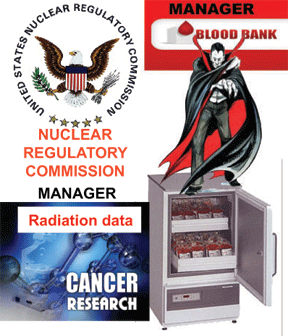 Vital cancer study canceled: NRC will hide the truth about nuclear reactor risks Beyond Nuclear today decried the outrageous decision by the U.S. Nuclear Regulatory Commission (NRC) to cancel a study that would have examined cancer incidence and mortalities and the connection to U.S. nuclear facilities.
“Study after study in Europe has shown a clear rise in childhood leukemia around operating nuclear power facilities, yet the NRC has decided to hide this vital information from the American public,” said Cindy Folkers, radiation and health specialist at Beyond Nuclear.
The study, initiated in 2009 and carried out under the auspices of the National Academy of Sciences (NAS), had completed Phase 1 and was looking at seven pilot nuclear sites around the country, a project that was estimated to cost $8 million.
“An $8 million price tag for the next phase of this study is a drop in the bucket for an agency with a $1 billion annual operating budget,” added Folkers. The NRC identified the “significant amount of time and resources needed and the agency’s current budget constraints” as its excuse for terminating the study.
Folkers noted that, in reality, nuclear industry manipulation, rather than budget constraints, could be behind the NRC’s sudden decision to abandon the NAS study.
In documents obtained by Beyond Nuclear it was revealed that NRC staff had been approached by the president of U.S. National Council on Radiation Protection and Measurements (NCRP), John Boice, offering a cheaper, faster and less sensitive study design to replace the NAS study, although the NRC has not yet agreed to accept the NCRP bid.
Read the full press release and feel free to circulate. http://www.beyondnuclear.org/home/2015/9/8/vital-cancer-study-canceled-nrc-will-hide-the-truth-about-nu.html
Nuclear Regulatory Commission prevents hearing on Fermi nuclear plant
 Nuclear regulators halt plans for Fermi 2 hearing BY TOM HENRY BLADE STAFF WRITER
http://www.toledoblade.com/Energy/2015/09/09/Nuclear-regulators-halt-plans-for-Fermi-2-hearing.html#Ge8j5KJYItT4iPTj.99 NEWPORT, Mich. — Anti-nuclear activists trying to stop DTE Energy’s Fermi 2 nuclear plant from getting a 20-year license extension were dealt a setback Tuesday when the U.S. Nuclear Regulatory Commission killed their plans for a special hearing about the plant’s continued operation.
The agency’s commissioners overruled a decision by the NRC’s Atomic Safety and Licensing Board to grant a hearing on three issues, or contentions, as regulators call them.
The plant’s operating license expires March 20, 2025.
Three environmental groups — Don’t Waste Michigan, Citizens Environment Alliance of Southwestern Ontario, and Beyond Nuclear — filed a request for a hearing with four proposed contentions challenging DTE’s application.Another environmental group, Citizens Resistance at Fermi 2, also known as CRAFT, filed a separate hearing request with fourteen proposed contentions.
Requests for the hearing were opposed by DTE and the NRC’s staff.
The NRC said its rules for allowing hearings on such contentions “are designed to ensure that only focused, well-supported issues are admitted for hearing.”
The coalition of groups said it plans to appeal the NRC’s decision in federal court.
The agency’s licensing board had granted a hearing on safety and environmental contentions regarding the common transmission line corridor shared by Fermi 2 and the proposed new Fermi 3 reactor.
Activists warned of a “domino effect” if either of those reactors or their high-level radioactive waste storage pools released radiation. Contact Tom Henry at: thenry@theblade.com, 419-724-6079, or via Twitter @ecowriterohio.
Exelon dithers about closing uneconomic nuclear power plants in Illinois
EXELON DELAYS CLOSURE DECISION ON 2 ILLINOIS NUCLEAR PLANTS http://abc7chicago.com/business/exelon-delays-closure-decision-on-2-illinois-nuclear-plants/977661/ September 10, 2015 Exelon Corp. says it is delaying for one year its decision about whether to close nuclear plants in the Quad Cities and Byron.
Chicago-based Exelon owns Illinois’ 11 nuclear reactors. It has previously said its generating stations in the Quad Cities, Byron and Clinton were in danger of closing.
Exelon said Thursday that it plans to continue operating its Quad Cities nuclear power plant through at least May 2018 and the Byron plant will operate through May 2019. The company said the Clinton station remains “economically challenged” and could be closed if conditions don’t improve.
Exelon president and CEO Chris Crane called the decision a “short-term-reprieve.” He said policy reforms are needed to level the clean energy playing field and position Illinois to meet EPA carbon reduction rules.
“Radiation is Good for You!” and Other Tall Tales of the Nuclear Industry
The U.S. Nuclear Regulatory Commission is considering a move to eliminate the “Linear No-Threshold” (LNT) basis of radiation protection that the U.S. has used for decades and replace it with the “radiation hormesis” theory—which holds that low doses of radioactivity are good for people.
The change is being pushed by “a group of pro-nuclear fanatics—there is really no other way to describe them,” charges the Nuclear Information and Resource Service (NIRS) based near Washington, D.C.
“If implemented, the hormesis model would result in needless death and misery,” says Michael Mariotte, NIRS president. The current U.S. requirement that nuclear plant operators reduce exposures to the public to “as low as reasonably achievable” would be “tossed out the window. Emergency planning zones would be significantly reduced or abolished entirely. Instead of being forced to spend money to limit radiation releases, nuclear utilities could pocket greater profits. In addition, adoption of the radiation model by the NRC would throw the entire government’s radiation protection rules into disarray, since other agencies, like the EPA, also rely on the LNT model.”
“If anything,” says Mariotte, “the NRC radiation standards need to be strengthened.”
The NRC has a set a deadline of November 19 for people to comment on the proposed change. The public can send comments to the U.S. government’s “regulations” website.
Comments can also be sent by regular mail to: Secretary, U.S. Nuclear Regulatory Commission, Washington, DC 20555-0001, Attention:Rulemakings and Adjudications Staff. Docket ID. Needed to be noted on any letter is the code NRC-2015-0057.
If the NRC agrees to the switch, “This would be the most significant and alarming change to U.S. federal policy on nuclear radiation,” reports the online publication Nuclear-News. “The Nuclear Regulatory Commission may decide that exposure to ionizing radiation is beneficial—from nuclear bombs, nuclear power plants, depleted uranium, x-rays and Fukushima,” notes Nuclear-News. ”No protective measures or public safety warnings would be considered necessary. Clean-up measures could be sharply reduced…In a sense, this would legalize what the government is already doing—failing to protect the public and promoting nuclear radiation.”
In the wake of the Manhattan Project, the U.S. crash program during World War II to build atomic bombs and the spin-offs of that program—led by nuclear power plants, there was a belief, for a time, that there was a certain “threshold” below which radioactivity wasn’t dangerous.
But as the years went by it became clear there was no threshold—that any amount of radiation could injure and kill, that there was no “safe” dose.
Low levels of radioactivity didn’t cause people to immediately sicken or die. But, it was found, after a “latency” or “incubation” period of several years, the exposure could then result in illness and death.
Thus, starting in the 1950s, the “Linear No-Threshold” standard was adopted by the governments of the U.S. and other countries and international agencies.
It holds that radioactivity causes health damage—in particular cancer—directly proportional to dose, and that there is no “threshold.” Moreover, because the effects of radiation are cumulative, the sum of several small exposures are considered to have the same effect as one larger exposure, something called “response linearity.”
The LNT standard has presented a major problem for those involved in developing nuclear technology notably at the national nuclear laboratories established for the Manhattan Project—Los Alamos, Oak Ridge and Argonne national laboratories—and those later set up as the Manhattan Project was turned into the U.S. Atomic Energy Commission.
On one hand, Dr. Alvin Weinberg, director of Oak Ridge National Laboratory, declared in New Scientist magazine in 1972: “If a cure for cancer is found the problem of radiation standards disappear.”
Meanwhile, other nuclear proponents began pushing a theory they named “radiation hormesis” that claimed that the LNT standard was incorrect and that a little amount of radioactivity was good for people.
A leader in the U.S. advocating hormesis has been Dr. T. D. Luckey. A biochemistry professor at the University of Missouri-Columbia and visiting scientist at Argonne National Laboratory, he authored the book Hormesis and Ionizing Radiation and Radiation Hormesis and numerous articles. In one, “Radiation Hormesis Overiew,” he contends: “We need more, not less, exposure to ionizing radiation. The evidence that ionizing radiation is an essential agent has been reviewed…There is proven benefit.” He contends that radioactivity “activates the immune system.” Dr. Luckey further holds: “The trillions of dollars estimated for worldwide nuclear waste management can be reduced to billions to provide safe, low-dose irradiation to improve our health. The direction is obvious; the first step remains to be taken.” And he wrote: “Evidence of health benefits and longer average life-span following low-dose irradiation should replace fear.”
A 2011 story in the St. Louis Post Dispatch quoted Dr. Luckey as saying “if we get more radiation, we’d live a more healthful life” and also noted that he kept on a shelf in his bedroom a rock “the size of a small bowling ball, dotted with flecks of uranium, spilling invisible rays” It reported that “recently” Dr. Luckey “noticed a small red splotch on his lower back. It looked like a mild sunburn, the first sign of too much radiation. So he pushed the rock back on the shelf, a few inches farther away, just to be safe.”
At Brookhaven National Laboratory (BNL), set up by the U.S. Atomic Energy Commission in 1947 to develop civilian uses of nuclear technology and conduct research in atomic science, a highly active proponent of hormesis has been Dr. Ludwig E. Feinendegen. Holding posts as a professor in his native Germany and a BNL scientist, he authored numerous papers advocating hormesis. In a 2005 article published in the British Journal of Radiology he wrote of “beneficial low level radiation effects” and asserted that the “LNT hypothesis for cancer risk is scientifically unfounded and appears to be invalid in favor of a threshold or hormesis.”
The three petitions to the NRC asking it scuttle the LNT standard and replace it with the hormesis theory were submitted by Dr. Mohan Doss on behalf of the organization Scientists for Accurate Radiation Information; Dr. Carol Marcus of the UCLA medical school; and Mark Miller, a health physicist at Sandia National Laboratories.
The Nuclear Information and Resource Service points out that the U.S. Environmental Protection Agency or EPA is fully supportive of LNT.
The agency’s reason for accepting LNT—and history of the standard—were spelled out in 2009 by Dr. Jerome Puskin, chief of its Radiation Protection Division.
The EPA, Dr. Puskin states, “is responsible for protecting the public from environmental exposures to radiation. To meet this objective the agency sets regulatory limits on radionuclide concentrations in air, water, and soil.” The agency bases its “protective exposure limits” on “scientific advisory bodies, including the U.S. National Academy of Sciences, the International Commission on Radiological Protection, the United Nations Scientific Committee on the Effects of Ionizing Radiation, and the National Council on Radiation Protection and Measurements, with additional input from its own independent review.” The LNT standard, he writes, “has been repeatedly endorsed” by all of these bodies.
“It is difficult to imagine any relaxation in this approach unless there is convincing evidence that LNT greatly overestimates risk at the low doses of interest,” Dr. Puskin goes on, and “no such change can be expected” in view of the determination of the National Academies of Sciences’ BEIR VII committee. (BEIR is for Biological Effects of Ionizing Radiation.)
BEIR VII found that “the balance of evidence from epidemiologic, animal and mechanistic studies tend to favor a simple proportionate relationship at low doses between radiation dose and cancer risk.”
As chair of the BEIR VII committee, Dr. Richard Monson, associate dean of the Harvard School of Public Health, said in 2005 on issuance of its report: “The scientific research base shows that there is no threshold of exposure below which low levels of ionizing radiation can be demonstrated to be harmless or beneficial.”
A European expert on radioactivity, Dr. Ian Fairlie, who as an official in the British government worked on radiation risks and has been a consultant on radiation matters to the European Parliament and other government entities, has presented detailed comments to the NRC on the petitions that it drop LNT and adopt the hormesis theory.
Dr. Fairlie says “the scientific evidence for the LNT is plentiful, powerful and persuasive.” He summarizes many studies done in Europe and the United States including BEIR VII. As to the petitions to the NRC, “my conclusion is that they do not merit serious consideration.” They “appear to be based on preconceptions or even ideology, rather than the scientific evidence which points in the opposite direction.”
An additional issue in the situation involves how fetuses and children “are the most vulnerable” to radiation and women “more vulnerable than men,” states an online petition opposing the change. It was put together by the organization Beyond Nuclear, also based near Washington, D.C. It is headed “Protect children from radiation exposure” and advises: “Tell NRC: A little radiation is BAD for you. It can give you cancer and other diseases.” It continues: “NRC should NOT adopt a ‘little radiation is good for you’ model. Instead, they should fully protect the most vulnerable which they are failing to do now.”
How might the commissioners of the NRC decide the issue? Like the Atomic Energy Commission which it grew out of, the NRC is an unabashed booster of nuclear technology and long devoted to drastically downplaying the dangers of radioactivity. A strong public stand—many negative comments—over their deciding that radioactivity is “good” for you could impact on their positions.
USA’s secret plans with Japan to dump radioactive trash into oceans
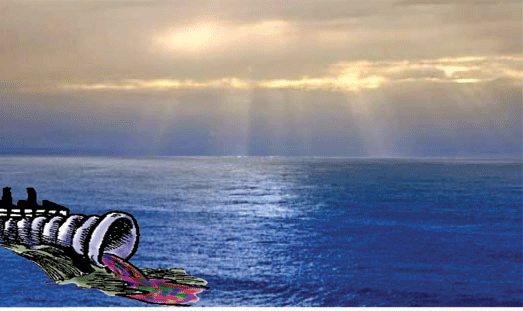 US tried to conspire with Japan to dump nuclear waste into world’s oceans, reveal documents http://www.naturalnews.com/033768_nuclear_waste_oceans.html# (NaturalNews) When nuclear energy production technology first began to emerge in the US in the 1950s, neither scientists nor the US government considered what would be done with nuclear reactors once it was time for them to be put out of commission. And recently-released documents reveal that, in an effort to hastily deal with this problem after the fact, the US government actually tried to conspire with Japan to gain secret approval for dumping decommissioned nuclear reactors into the world’s oceans.
In 1972, the United Nations (UN) had proposed the Convention on the Prevention of Marine Pollution by Dumping of Wastes and Other Matter, also known as the London Convention, to deal with the growing, global pollution problem. The agreement’s provisions sought to specifically regulate the environmental pollution that signing nations could and could not dump into the oceans, which of course included nuclear production materials.
But since a finalized version of the agreement had not yet been fully established, the US government took advantage of the situation by seeking to insert an exemption cause permitting the dumping of decommissioned nuclear reactors into the ocean. And since Japan had also been involved in developing its own nuclear energy program, the US thought it could gain additional support for the exemption clause from its Asian ally.
Though the US made no mention of any long-term plans to utilize the ocean as its nuclear dumping ground during the proposal, it now appears as though the country had every intention of using the ocean as a nuclear disposal facility. And since the London Convention clause still exists to this day, all other signing countries are free to dump their nuclear waste in the ocean as well.
Russia, a signing member of the London Convention, openly admitted back in 1993, for instance, that it dumps nuclear reactors and fuel into the ocean because it allegedly has no other safe way to dispose of such materials (http://www.independent.co.uk/news/world/russ…).
The International Atomic Energy Agency (IAEA), however, claims the US stopped dumping nuclear reactors into the ocean a long time ago. And US officials claim that decommissioned nuclear reactors are today buried in the ground rather than dumped into the ocean: http://www.naturalnews.com/033768_nuclear_waste_oceans.html#ixzz3kvbRF6Bi
St Louis suburb anger about radioactive landfill
 Anger builds at EPA over radioactive landfill, The HIll, By Timothy Cama – 08/29/15 Leaders in a St. Louis suburb are urgently calling on top Obama administration officials to quickly clean up a landfill with radioactive waste that they believe could catch fire.
The Environmental Protection Agency (EPA) has been working for 25 years on the West Lake Landfill in Bridgeton, Mo., which has housed barium sulfate waste from the Manhattan Project since the 1970s.
The EPA is still studying the site and considering a wide range of actions to contain the radioactive material under its Superfund program for cleaning severe environmental contamination.
“What we have is an emergency,” said Ed Smith, energy program director with the Missouri Coalition for the Environment. “It’s a slow-moving emergency.”
Dawn Chapman, an organize of local activist group Just Moms STL, along with Byron DeLear of Energy Equity Funding, called directly on President Obama to act in a recent St. Louis Post-Dispatch opinion piece.
Matt LaVanchy, a local fire department official, told radio station KTRS that he believes the fire could be less than 1,000 feet from the radioactive material, and is trying to train firefighters for possible outcomes.
“There’s a possibility, the potential, of radioactive material being carried away by the result of the smoldering or the combustion event,” he said.
Residents have been working closely with Sens. Claire McCaskill (D) and Roy Blunt (R) and Reps. Lacy Clay (D) and Ann Wagner (R), who have written multiple letters and taken other action to put pressure on the Obama administration to take care of the problem.
Beyond the fire risk, locals argue that the radioactive material could also be compromised by floods, tornadoes, earthquakes or other disasters.
Angered with what they see as EPA’s slow movement on the matter, local leaders want the Army Corps of Engineers to take over as the lead agency overseeing the radioactive waste……..
The Department of Energy and Exelon Corp., which used to own the company that processed the uranium thought to have produced the waste, are also potentially responsible for the cleanup. http://thehill.com/policy/energy-environment/252231-anger-builds-at-epa-over-radioactive-landfill
$457 million legal dispute over Kewaunee nuclear plant
To Dominion Resources Inc., its plant is all but worthless. But to Carlton, the Lake Michigan town where the plant pumped out electricity for four decades, it’s still worth $457 million. Those views put the two sides nearly half a billion dollars apart in valuing the facility for tax purposes, the Milwaukee Journal Sentinel reported this weekend (http://bit.ly/1LRWwqG ).
Town officials have expressed frustration that the site can’t be redeveloped until it changes hands. Dominion has up to 60 years to restore the site under federal nuclear regulations. Adding to the frustration is that the used nuclear fuel that powered the reactor remains on the site in concrete casks. Since there is no national disposal site for spent nuclear fuel, the lakefront property will continue to store the fuel indefinitely.
Pilgrim Nuclear Station on the brink of permanent shutdown
Pilgrim nuclear plant one step from shutdown by regulators, Cape Cod Times Pilgrim Nuclear Power Station is now at the bottom of the performance list of the nation’s 99 operating reactors, based on its forced shutdowns and equipment failures, and in a category just one step above mandatory shutdown by federal regulators. By Christine Legereclegere@capecodonline.com Sep 2, 2015 PLYMOUTH –
Only two other plants in the country are currently in that category: Arkansas Nuclear One and Arkansas Nuclear Two. Those two, like Pilgrim, are Entergy-owned.
The Nuclear Regulatory Commission announced the downgrade of the Pilgrim plant today. In a letter to Entergy, the Nuclear Regulatory Commission said the downgrade was due to the plant’s failure to adequately address the issues that have caused the plant’s high number of unplanned shutdowns.
A supplemental inspection will focus on the plant’s shortcomings, “including human performance, procedure quality and equipment performance.”
The results of the supplemental inspection will “provide the NRC with additional information to be used in deciding whether the continued operation of the facility is acceptable and whether additional regulatory actions are necessary to arrest the licensee/plant performance,” the NRC said……..U.S. Sen Edward Markey, D-Mass., issued a statement on Pilgrim’s dubious status. “For decades, I have raised concerns about Pilgrim’s operations, security preparedness, the safety of the surrounding communities in the event of a nuclear accident, and the willingness of Entergy to dedicate sufficient resources to run the reactor safely,” Markey wrote.
The senator noted Pilgrim is the same boiling water reactor design as those that suffered meltdowns at Fukushima. http://capecodtimes.com/article/20150902/NEWS11/150909865
Washington State sues US Energy Dept over Hanford workers made sick by toxic fumes
Washington state sues U.S. over toxic vapors at nuclear waste site, Reuters 2 Sept 15 SEATTLE | BY ERIC M. JOHNSON The U.S. government has failed to adequately safeguard crews involved in the decades-long cleanup of the Hanford Nuclear Reservation in Washington state, leaving workers sickened by exposure to toxic vapors, the state said in a lawsuit filed on Wednesday.
The 18-page complaint, filed in federal court in Spokane, cited more than 50 instances since January 2014 of workers being exposed to hazardous fumes at the sprawling World War Two-era site along the Columbia River.
One worker was treated last year for chemical pneumonitis, an inflammation of the lungs caused by chemical exposure, the complaint said.
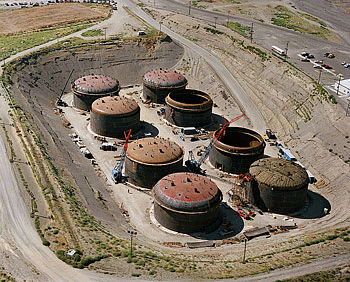
Hanford, occupying 586 square miles (1,517 sq km) in southeastern Washington, produced plutonium for the U.S. nuclear weapons program from 1943 to 1987 and now ranks as one of the most contaminated sites in North America.
The main activity there now is removal of 56 million gallons (212 million liters) of hazardous waste, much of it radioactive, kept in 177 underground storage tanks, a number of them with known leaks.
The U.S. Energy Department is responsible for cleanup at the site, including the hiring of contractors and workers to extract the waste from tanks for safe disposal.
As a result of lax safety practices amid leaks and releases of toxic vapors in the vicinity of the storage tanks, workers have been continually put at risk and left ill from chemical exposure, the lawsuit said.
“Enough is enough. The health risks are real, and the state is taking action today to ensure the federal government protects these workers now and in the future,” state Attorney General Bob Ferguson said.
Watchdog group Hanford Challenge said it believes several hundred workers have received medical treatment or evaluation due to exposures over the last 10 years.
The state is seeking a legally enforceable agreement requiring all tank-area workers to wear respiratory protection, among other safety improvements.
Ferguson announced last November that he intended to sue the federal government……….(Reporting by Eric M. Johnson; Editing by Steve Gorman and Eric Beech) http://www.reuters.com/article/2015/09/02/us-usa-nuclear-hanford-idUSKCN0R229720150902
Nuclear Regulatory Commission scraps public rulemaking on weak GE containments,
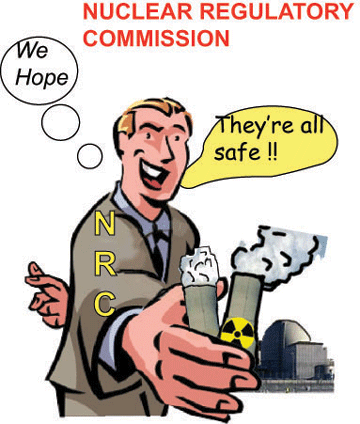 A Fukushima Lesson Unlearned: NRC scraps public rulemaking on weak GE containments, Enformable Paul Gunter 4 Sept 15 The United States Nuclear Regulatory Commission (NRC) typically begins its narrative on the “lessons learned” from the Fukushima Daiichi nuclear catastrophe with Japan’s March 11, 2011 accident. Not surprisingly, the agency has avoided addressing the most critical lesson recognized in the accident’s official investigative report by Japan’s National Diet. In their finding, the unfolding radiological catastrophe is “manmade” and the result of “willful negligence” of government, regulator and industry colluding to protect Tokyo Electric Power Company’s financial interests. Likewise, here in the US, addressing identical reactor vulnerabilities remain subject to a convoluted corporate-government strategy of “keep away” with public safety as the “monkey in the middle” going back more than four decades and, for now, three nuclear meltdowns later.
In the latest development, by a 3-1 vote issued on August 19, 2015, the majority of the four sitting Commissioners with NRC ruled not to proceed with their own proposed rulemaking and bar public comment and independent expert analyses on the installation of “enhanced” hardened containment vents on 30 U.S. reactors. In the event of a severe nuclear accident, roughly one-third of U.S. atomic power plants currently rely upon a flawed radiation protection barrier system at General Electric (GE) Mark I and Mark II boiling water reactors that are essentially identical to the destroyed and permanently closed units at Fukushima Daiichi. The nuclear catastrophe has resulted in widespread radioactive contamination, massive population relocation, severe economic dislocation and mounting costs projected into the hundreds of billions of dollars.
Fundamentally at fault, the GE Mark I and Mark II boiling water reactor “pressure suppression containment system” designed for internalizing such a nuclear accident is roughly one-sixth the volumetric size of pressurized water reactor containment designs like Three Mile Island. Under accident conditions, the reactor pressure vessel and the operation of the emergency core cooling system is depressurized into the “drywell” containment component which in turn routes steam, heat, combustible gases and radioactivity into the “wetwell” component where it is supposed to be quenched and scrubbed in a million gallons of water. The GE design was first identified as too small to contain potential accident conditions in 1972 by Atomic Energy Commission memos. The internal communications would eventually be released years later under the Freedom of Information Act after more GE reactors were granted operating licenses. The memos revealed that the undersized containment system is highly vulnerable to catastrophic failure from over-pressurization in the event of a severe accident. This long recognized chink in GE’s “defense-in-depth” armor was graphically confirmed with the global broadcast of the Fukushima explosions.
Fukushima further demonstrated that “voluntary” GE containment modifications requested by NRC in the early 1990’s are not reliable under real accident conditions. Most U.S. Mark I operators voluntarily installed a hardened vent on the “wetwell” or “torus” containment component. The same modification was installed in Japanese reactors including Fukushima Daiichi. The voluntary containment modifications in the U.S. were carried out under a NRC regulation (10 CFR 50.59) that avoids licensee disclosures in the public hearing process, claiming that the design changes did not raise significant safety issues. Other than the paper trail, even the NRC inspectors were not aware of the final as-built containment modifications…………
The Commission’s August 19th majority vote is effectively a gag order on the American public’s opportunity for formal input to fortify the continued operation of GE Mark I and Mark II reactors against the next nuclear catastrophe. Ironically, the international nuclear industry is simultaneously cashing in on the effort to restart Japan’s nuclear power plants where their Nuclear Regulation Authority has ordered state-of-the-art engineered external filters on severe accident capable hardened containment vents as a prerequisite to resume operation. On August 17, 2015, AREVA issued a press release announcing that it had just delivered it fourteenth filtered containment vent system to the Hamaoka Unit 4 reactor operated by Chubu Electric Power Company where 70% of the Japanese public no longer trust the industry and its regulator and remain opposed to any further nuclear power operations. http://enformable.com/2015/09/a-fukushima-lesson-unlearned-nrc-scraps-public-rulemaking-on-weak-ge-containments/
Radiation testing in 4 Bay area cities in USA, by low flying drones
 Low-Flying Government Helicopter Testing For Radiation In 4 Bay Area Cities http://sanfrancisco.cbslocal.com/2015/09/01/helicopter-flying-why-berkeley-san-francisco-oakland-pacifica-energy-radiation-flyover/ September 1, 2015 (CBS SF) — If you see a low-flying helicopter buzzing above the Bay Area this week, don’t freak out. It’s just the U.S. Department of Energy National Nuclear Security Administration (NNSA) testing for radiation.
The government helicopter may seen flying in a grid pattern at 300 feet or higher above Berkeley, San Francisco, Pacifica and Oakland between Tuesday, Sept. 1 and Sunday, Sept. 6.
According to a statement by the City of Berkeley, the federal government is partnering with the Lawrence Berkeley National Lab on a program “to improve the U.S. government’s ability to detect nuclear and radiological material.”
The city posted a notice about the flyover, along with the Bay Area flight schedule for this week.
A similar test measuring for naturally-occurring background radiation was done in August 2012.
NNSA was established by Congress in 2000 as a semi-autonomous agency within the U.S. Department of Energy “responsible for enhancing national security through the military application of nuclear science,”according to a press release.
Not one drop of nuclear waste treated after 25 years of costly Hanford project
The Waste Treatment and Immobilization Plant project there, known as WTP, is meant to exhume the waste, freeze it in glass, and give it a proper burial. But it’s been plagued by delays. It was expected to cost $4.3 billion and be built by 2011. Instead, the cost has swelled past $12 billion to date, with an estimated $7 billion in work left to be done. So far, not a drop of waste has been processed.
Nuclear cleanup project haunted by legacy of design failures and
whistleblower retaliation, Center for Public Integrity, Twenty-five years after the project began, the Waste Treatment and Immobilization Plant at Hanford is nearing a three-fold cost overrun, and not a single drop of waste has been treated By Patrick Malone 2 Sept 15
But it hasn’t fully turned the corner yet, according to recent comments by the federal officials now overseeing its operation. Continue reading
South Carolina electricity customers slugged for Over-Budget Nuclear Project
SCE&G Customers Paying for Over-Budget Nuclear Project Savannah Levins, WLTX September 2, 2015 COLUMBIA, SC (WLTX)– South Carolina Electric and Gas was approved to build two nuclear reactors back in 2009. The mission of the new devices: provide cleaner energy
The legislature, under the Baseload Review Act, agreed the company can increase customer bills every year to help pay for it. But now that the company is about a billion dollars over budget and years behind schedule, customers like environmental activist Tom Clements are getting frustrated.
“The rate payer, the customer, is saddled with 100% of the costs and all the risk of the project, and at the end of the day we don’t own anything,” he said. “We’ve paid for everything, we’ve taken all the risk, and we don’t own anything. But that;s courtesy of the legislature that passed what i think is an unjust law.”
On Wednesday, the Public Service Commission approved SCE&G’s request for an additional one billion in today’s dollars, and a four year extension to complete the project.
SCE&G Spokesperson Eric Boomhower says another customer rate increase of 2.8% is set to take effect in the end of October, and will continue to increase each year until the project is complete……..
Company representatives predict customers will continue to see annual increases averaging 2.2% until the project is completed.
That completion date, originally set at 2016, was pushed back on Wednesday to 2020. http://www.wltx.com/story/news/local/2015/09/02/sceg-customers-paying-over-budget-nuclear-project/71608720/
No to uranium mining – Virginia Beach City Council
 Another no vote on uranium The Virginian-Pilot© September 1, 2015 The Virginia Beach City Council is set tonight to vote — again — on a resolution opposing uranium mining in Virginia.
The issue is still, thankfully and for all practical purposes, dead. Mining uranium is still illegal in the commonwealth. The General Assembly’s 1982 ban is still in place despite years of extensive lobbying by the company wanting to mine ore in Pittsylvania County.
But because Virginia Uranium Inc. has recently challenged the legality of the ban and asked the federal courts to force the state to treat uranium mining like any other mining process, Virginia Beach is making doubly sure everyone knows the city opposes lifting the ban.
The Roanoke River Basin Association, which is downstream from the Virginia Uranium site, does, too. As do the cities of Norfolk, Chesapeake, Roanoke and Danville. The mining site is less than 50 miles upstream of the John H. Kerr Reservoir, which provides 93 percent of Lake Gaston’s inflow — a source of drinking water for much of South Hampton Roads. If Kerr Reservoir were contaminated, then Lake Gaston would be as well……..http://hamptonroads.com/2015/08/another-no-vote-uranium
1 This Month
15 October. Joint Appeal for Nuclear Abolition Day -presentation to the UN on October 15 will be live on UNWebTV
Endorse the Nuclear Abolition Day Appeal
23-25 October – on Zoom – World BEYOND War’s annual global conference

To see nuclear-related stories in greater depth and intensity – go to https://nuclearinformation.wordpress.com
-
Archives
- October 2026 (149)
- September 2026 (339)
- August 2026 (330)
- July 2026 (355)
- June 2026 (287)
- May 2026 (306)
- April 2026 (356)
- March 2026 (251)
- February 2026 (267)
- January 2026 (308)
- December 2025 (358)
- November 2025 (359)
-
Categories
- 1
- 1 NUCLEAR ISSUES
- business and costs
- climate change
- culture and arts
- ENERGY
- environment
- health
- history
- indigenous issues
- Legal
- marketing of nuclear
- media
- opposition to nuclear
- PERSONAL STORIES
- politics
- politics international
- Religion and ethics
- safety
- secrets,lies and civil liberties
- spinbuster
- technology
- Uranium
- wastes
- weapons and war
- Women
- 2 WORLD
- ACTION
- AFRICA
- Atrocities
- AUSTRALIA
- Christina's notes
- Christina's themes
- culture and arts
- Events
- Fuk 2022
- Fuk 2023
- Fukushima 2017
- Fukushima 2018
- fukushima 2019
- Fukushima 2020
- Fukushima 2021
- general
- global warming
- Humour (God we need it)
- Nuclear
- RARE EARTHS
- Reference
- resources – print
- Resources -audiovicual
- Weekly Newsletter
- World
- World Nuclear
- YouTube
-
RSS
Entries RSS
Comments RSS

