The very secretive Transatlantic Trade and Investment Partnership (TTIP)
 WHAT I DIDN’T READ IN THE TTIP READING ROOM , War On Want, 7 February 2016 Katja Kipping was one of the first German MPs to gain access to the new TTIP reading room opened in Berlin this week, and she has written up a report of her experience. We thought it was well worth translating from the original, ‘The Opposite of Transparency’.
TTIP, the EU-US free trade deal, has secrecy written all over it. Those responsible for it live in dread of any public scrutiny. If it was up to me, I would give everyone who’s interested the chance to make up their own minds on the text of the agreement in its current form. Sigmar Gabriel, Minister for Economic Affairs and a top cheerleader for TTIP, has now set up a reading room in his ministry where since the beginning of February German MPs can each spend two hours looking at those texts on which consensus has already been reached.
A political friend of mine asked me the day before whether she could come with me into the reading room. I had to say no. After a long, tough struggle with the government, at least MPs are able to read the text, but they are the only ones. We are not even allowed to take security-cleared specialists with us into the reading room. As for members of the public, who will ultimately have to bear the brunt of TTIP, they are to have no access whatsoever to the secret text. Not what transparency looks like in my book!
Access ‘granted’
Even the registration procedure for the reading room speaks volumes. Once I’d registered, I was sent the instructions on how to use the room. The first thing that I noticed was that the terms and conditions had already been the subject of negotiations between the European Commission and the USA. Get your head round that: TTIP isn’t even signed yet, and already individual countries have lost the right to decide who gets to read the texts, and on what terms.
The following extract from the rulebook for MPs who, like me, want to use the reading room reveals the attitude towards democracy that lurks behind TTIP: “You recognise and accept that in being granted access to the TTIP texts you are being extended an exceptional degree of trust.”
Now I’d always thought that elected MPs have a right to information. Yet the TTIP negotiators (and who gave them their legitimacy?) reckon they are GRANTING us access out of the goodness of their hearts. Access as a sign of exceptional trust. Whoever wrote that – did they really think that we MPs would feel flattered? To me it smacks more of totalitarianism. ‘Granting access’ and ‘extending trust’ is not the language you use if you really believe in democracy. ………
I read nothing to alleviate my concern that the US side wishes to make life more difficult for public and community enterprises and to secure better terms for transnational corporations in the battle for public tenders. I also read nothing to calm my fears that EU negotiators are prepared to sacrifice our social and environmental standards for the prospect of winning lucrative contracts for big European firms.
I read nothing that would lead me to reconsider my previous criticism that consumer protection plays no part in TTIP other than to proclaim free market competition to be the highest form of consumer protection that exists………
It is revealing in itself that the Ministry for Economic Affairs is prepared to go to such lengths in order to keep the text of TTIP under wraps. And they have every reason for doing so. Anyone who was going into these negotiations to enhance environmental protection, consumer protection and labour standards would have nothing to fear from transparency. Anyone who’s engaged in selling out democracy, on the other hand, is obviously going to want to avoid public scrutiny. If Sigmar Gabriel and the negotiators are really so convinced of the benefits of TTIP, why don’t they just make the text available to everyone online? http://www.waronwant.org/media/what-i-didn%E2%80%99t-read-ttip-reading-room
Massachusetts snowstorm causes Pilgrim nuclear station to be shut down
ENTERGY’S PILGRIM NUCLEAR POWER PLANT IS SHUT AS SNOWSTORM ENVELOPS MASSACHUSETTS, –Jim Ostroff, james.ostroff@platts.com Washington (Platts)–8 Feb 2016 Operators at Entergy’s 728-MW Pilgrim nuclear plant in Plymouth, Massachusetts, shut the unit early Monday morning as a precautionary measure, while a snowstorm swept through the state, a plant spokesman said.
The unit was operating at 12% of capacity just prior to being shut, according to the US Nuclear Regulatory Commission’s daily reactor status report Monday.
O’Brien declined to estimate when Pilgrim will restart and return to 100% capacity, saying this information “is market sensitive.”…(subscibers only ) http://www.platts.com/latest-news/electric-power/washington/entergys-pilgrim-nuclear-power-plant-is-shut-21901806?hootpostid=28068bc08898fb813f66296f084ba47f
Armed transport ships spotted in Panama Canal, headed for secret mission to later transport plutonium
 UK-Flagged Ships Set to Transport Plutonium from Japan to US Located in Panama Canal http://www.srswatch.org/uploads/2/7/5/8/27584045/srsw_news_on_plutonim_ships_in_canal_feb_6_2016.pdf Ships on Secret Mission to Carry 331 Kilograms of Plutonium to US DOE’s Savannah River Site in South Carolina as Part of Nuclear Security Summit Preparation; Plutonium to be Stranded at SRS
South Carolina takes legal action against DOE over unfinished Nuclear Fuel Project
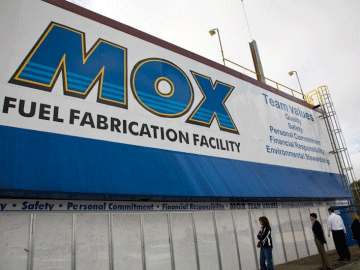
 SC Sues Energy Dept Over Unfinished Nuclear Fuel Project http://abcnews.go.com/US/wireStory/sc-sues-energy-dept-unfinished-nuclear-fuel-project-36812338 By MEG KINNARD, ASSOCIATED PRESS COLUMBIA, S.C. — Feb 9, 2016 South Carolina has again sued the federal government over an unfinished project to convert nuclear weapons components into reactor fuel, saying in a lawsuit filed Tuesday that the administration has acted unconstitutionally in failing to complete the mixed-oxide facility by a Jan. 1 deadline.
“The federal government has a responsibility to follow through with its promises,” state Attorney General Alan Wilson said in a statement provided to The Associated Press. “The Department of Energy has continually shown disregard for its obligations under federal law to the nation, the state of South Carolina and frankly the rule of law.”
Federal officials didn’t immediately return a message seeking comment.
The program is intended to turn weapons-grade plutonium into commercial nuclear reactor fuel to fulfill a nonproliferation deal with Russia. Under the agreement, Russia and the U.S. agreed to dispose of at least 34 metric tons apiece of weapons-grade plutonium, enough material for about 17,000 nuclear warheads, which would then be turned into commercial nuclear reactor fuel.
The project at the Savannah River Site, along the South Carolina-Georgia border, is years behind schedule and billions over its original budget. Because the facility wasn’t operational by a Jan. 1 deadline, the federal government was supposed to remove 1 metric ton of plutonium from South Carolina or pay fines of $1 million a day for “economic and impact assistance” — up to $100 million yearly — until either the facility meets production goals or the plutonium is taken elsewhere for storage or disposal.
The suit also seeks daily fines of $1 million and the plutonium removal.
The lawsuit has been expected. Last month, Gov. Nikki Haley told Wilson that she wanted to sue, also warning Energy Secretary Ernest Moniz in December that the state would be forced to sue if his agency didn’t start making payments. A clause in the law, however, makes the fine “subject to the availability of appropriations.”
The Obama administration has gradually scaled down funding for the project, proposing to mothball it in 2014, citing cost overruns and delays. That prompted a lawsuit, with the state saying the federal government had made a commitment to South Carolina and couldn’t use money intended to build the plant to shut it down.
The state ultimately dropped the suit when the administration committed to funding the project through that fiscal year. But the administration has since said it’s searching for an alternate, less expensive way to dispose of the plutonium, like immobilizing it in glass or processing it in different kinds of reactors.
In his budget submitted Tuesday, President Barack Obama included minimal funding for the mixed-oxide fuel project.
Kinnard can be reached at http://twitter.com/MegKinnardAP . Read more of her work athttp://bigstory.ap.org/content/meg-kinnard/
Whistleblower Bob Rowen took on corporate nuclear power in the 1970s
 The Not-So-Peaceful Atom Bob Rowen accidentally took on corporate nuclear power in the 1970s. Four decades later he remembers what it was like to be Humboldt County’s most infamous whistleblower. North Coast Journal, BY JAPHET WEEKS, 20 MARCH 2008 On a summer day in 1969,Bob Rowen, a nuclear control technician at the Humboldt Bay nuclear power plant, realized that for his employer, Pacific Gas and Electric, the bottom line was everything — it was even more important than the community’s safety.
It wasn’t the first time Rowen, a burly former Marine, had witnessed safety violations at the plant, but it was the first time he had the gumption to record the violation in a logbook, which would eventually be reviewed by the nuclear industry’s then government watchdog the Atomic Energy Commission (AEC).
As for PG&E management, they were getting pretty fed up. Rowen was proving to be a real pain in the ass. Continue reading
New Texas nuclear reactors not going to happen anytime soon, despite Fed approval
 Feds approve new nuclear reactors near Houston Fuel Fix, February 9, 2016 | By Jordan Blum The federal government on Tuesday approved the construction of two new nuclear reactors at the South Texas Project nuclear plant southwest of Houston.
But the massive cost of the project coupled with cheap Texas power prices mean that NRG Energy and its partners have no plans to build the new nuclear reactors anytime soon, if at all.
The partnership is continuing to look for new U.S. investors to eventually move the stalled project forward, said NRG spokesman David Knox. NRG said five years ago it wasn’t investing any more money in the expansion. Near that time, NRG estimated the project would cost about $14 billion with financing……..
The potential expansion project is through the Nuclear Innovation North America, or NINA, which is 90 percent owned by NRG and 10 percent by Toshiba. NINA owns 92.4 percent of the expansion. NRG has sought additional partners in the expansion since CPS Energy, once a 50 percent partner, reduced its stake to 7.6 percent.
After several years of review, the Nuclear Regulatory Commission said Tuesday it approved the issuance of the licenses to build two new nuclear reactors. The plant in Matagorda County already has two reactors. The South Texas Project, one of two nuclear power plants in Texas, opened in 1988, but is still one of the nation’s newer nuclear plants.
The project previously faced delays in the wake of the 2011 Fukushima nuclear disaster in Japan. The NRC said Tuesday the new licenses would include the agency’s upgraded post-Fukushima safety requirements. http://fuelfix.com/blog/2016/02/09/feds-approve-new-nuclear-reactors-near-houston/
The decline of the South Carolina Mixed Oxide Fuel Fabrication (MOX) Nuclear Reprocessing Facility
Half-Built Nuclear Fuel Plant in South Carolina Faces Test on Its Future, NYT, By JAMES RISEN FEB. 8, 2016 WASHINGTON — Time may finally be running out on the Mixed Oxide Fuel Fabrication Facility, a multibillion-dollar, over-budget federal project that has been hard to kill.
The Energy Department has already spent about $4.5 billion on the half-built plant near Aiken, S.C., designed to make commercial reactor fuel out of plutonium from nuclear bombs. New estimates place the ultimate cost of the facility at between $9.4 billion and $21 billion, and the outlay for the overall program, including related costs, could go as high as $30 billion.
Officials warn that the delays in the so-called MOX program are so bad that the plant may not be ready to turn the first warhead into fuel until 2040.
So in the budget that the Obama administration will present on Tuesday, the Energy Department proposes abandoning it. Energy officials want to spend only the money necessary to wind down the MOX program while the government shifts to a different method of disposing of the plutonium……..
The struggle is a case study in the difficulty of cutting unnecessary or wasteful federal programs, with the added twist that proponents of keeping the plant include some of the Republican Party’s most determined opponents of government spending, like Representative Joe Wilson, a South Carolina Republican whose district includes Aiken……..
Two companies involved with the plant’s construction are among Mr. Wilson’s biggest contributors, according to campaign records. Chicago Bridge and Iron, one of the two companies that own the main contractor for the facility, gave $10,000 to Mr. Wilson’s 2014 re-election campaign, and the other owner, Areva Group, donated $8,000, according to campaign records.
“Programs like this stay in the budget when they become jobs programs, and then senior members of Congress try to protect them, even if they have no redeeming value,” said David Hobson, a former Republican congressman from Ohio who said he tried and failed to kill the MOX program while he was in the House. “Where are all the budget hawks on this?”……..
The Obama administration has wanted to get rid of the program for years. In a budget request three years ago, it said the idea of making reactor fuel “may be unaffordable.” But Congress has repeatedly restored funding.
The plant is being built to comply with an agreement with Russia in 2000, when both countries said they would eliminate 34 metric tons of weapons-grade plutonium from their nuclear arsenals. Construction started during the George W. Bush administration, but has been plagued by long delays, cost overruns and little interest from commercial nuclear plants in buying the fuel that the plant was designed to produce.
Giving up on the plant means the administration will abandon plans to turn the weapons-grade plutonium into fuel for commercial nuclear reactors, and will instead switch to a process that dilutes the plutonium into nuclear waste.
The Energy Department would like to move that nuclear waste to a facility near Carlsbad, N.M., where it would be stored deep underground in salt formations. The administration says it can get rid of the weapons material under the alternative approach for about $300 million to $400 million a year, compared with $800 million to $1 billion a year under MOX………. http://www.nytimes.com/2016/02/09/us/politics/half-built-nuclear-fuel-plant-in-south-carolina-faces-test-on-its-future.html?_r=0
Nuclear lobby’s “makeover” of the industry’s bad reputation
The Not-So-Peaceful Atom Bob Rowen accidentally took on corporate nuclear power in the 1970s. Four decades later he remembers what it was like to be Humboldt County’s most infamous whistleblower. North Coast Journal, BY JAPHET WEEKS, 20 MARCH 2008 “……….The makeover is industry-wide. Proponents of nuclear power are touting it as our natural next step, a clean, endless supply of energy. And they’ve latched onto fears of global warming and concerns over the skyrocketing price of oil to usher energy consumers into a new nuclear century. They also argue that today’s reactors are far cleaner and more economic than the dirty, atavistic behemoths of yore.
In their promotional materials, the Nuclear Energy Institute, the leading lobby group for the U.S. nuclear industry, points out that America’s nuclear reactors already produce 20 percent of the electricity we use, and according to the Department of Energy, electricity demand will rise 45 percent by 2030.
In another brochure aimed at debunking myths about radiation, one section header reads, “Radiation: Helping All of Us.” The brochure, which features a nuclear family of four watching the sunset at the beach cites the 1991 National Cancer Institute report, which indicates no increased rate of mortality in communities with nuclear power plants.
But Manetas and Welch don’t buy the hype. They argue that a lack of economic viability has and always will be one of nuclear power’s biggest drawbacks. A nuclear power plant is very expensive to build, Manetas said, and even more expensive to decommission. The Humboldt facility is a case in point. It cost $33 million to construct and he estimates the price tag for decommissioning to be around $380 million. Every nuclear facility across the country has a lifespan of about 30 years. Manetas argues that without significant subsidies from the U.S. government, nuclear power plants wouldn’t be able to break even.
There are also hidden costs to nuclear energy like dealing with the waste it produces as well as extracting and processing the uranium required to run the plants in the first place. “Eventually power plants would be cannibalizing themselves,” Manetas said, “producing just enough energy to produce more power plants.”
As open as PG&E has become over the years to the local community, Manetas is still concerned that “floating over that is cooperate PG&E.” The company owns and operates one of California’s two remaining nuclear power plants, the Diablo Canyon facility in San Luis Obispo.
How would someone like Bob Rowen expect to be treated at a nuclear power plant today? Manetas speculates that “his ability to whistle-blow and make that information public … is more viable in today’s environment.”
Still, Manetas warns that there is a nation-wide nuclear renaissance underway, and the zeitgeist could quickly change back to what it was when Rowen first started working at the Humboldt Bay nuclear power plant. That was a time when the nuclear industry was anxious to prove that their energy prices could compete with those of fossil fuel plants, and they had few qualms about silencing their naysayers. http://www.northcoastjournal.com/humboldt/the-not-so-peaceful-atom/Content?oid=2126811
Should Georgia’s electricity customers get hit with the ballooning costs of Vogtle nuclear power plant?
 Are our Georgia Power bills set to be nuked? Feb. 8, 2016 By Matt Kempner – The Atlanta Journal-Constitution Warm up your checkbook and get your debit and credit cards ready. Reckoning day is coming on the most gigantic construction project in Georgia and, in particular, on its blown budget.
This spring the expansion of the Vogtle nuclear power plant near Augusta was supposed to be finished, with the first of two new reactors cranking out electricity for businesses and homes all over Georgia.
Not going to happen.
It’s not going to happen next year either. Best case at this point is that it will be more than three years late. And consultants for the state worry even that timeline is wishful thinking.
But elected state regulators – members of the Georgia Public Service Commission, which most Georgians probably don’t even know exists – recently decided it’s now time to try to figure out if customers of Georgia Power should be forced to swallow all the company’s costs, including what looks like at least $1.7 billion in higher-than-expected expenses. That could send monthly power bills up in years to come.
The alternative is that Georgia Power and its shareholders eat some or all of the overage.
Guess which option Georgia Power thinks is right?
Critics of the Vogtle project have for years demanded tough analysis of Vogtle spending, rather than waiting to do so when the project is essentially completed…….
Company executives didn’t like a column I wrote last year. Or an earlier news story about last-minute pay-for-performance changes that boosted bonuses for leaders at Georgia Power and parent Southern Company. Or a story showing how Georgia Power morphed from giving assurances about its original Vogtle cost projections to expressing surprise that anyone would be surprised by the project’s surging costs and delays.
Tough questions are reasonable and prudent. Let’s hope the PSC treats Vogtle costs as a topic worthy of rigorous scrutiny, not a way to try to bolster support for its past decisions.
Find Matt on Facebook (facebook.com/mattkempnercolumnist) and Twitter (@MattKempner) or email him atmkempner@ajc.com. http://www.myajc.com/news/business/are-our-georgia-power-bills-about-to-be-nuked/nqLhc/
Creeping costs for Duke Energy’s proposed Lee Nuclear Station
Planning costs for Duke Energy’s Lee nuclear plant creep toward $500M, Charlotte Business Journal,
Feb 3, 2016, Duke Energy’s pre-construction costs for its proposed Lee Nuclear Station are creeping toward the half-billion dollar mark with no clear indication when the company will decide whether to go ahead and build the project.
From July through December, Charlotte-based Duke (NYSE:DUK) has spent more than $21.5 million on Lee. That brings total spending to more than $471.1 million on the project since it was announced in 2007.
Even at the greatly slowed pace of spending in the last couple of years, the project costs are on track to exceed $500 million before the end of this year.
Duke expects to get a combined construction and operating license for the $12 billion-plus project from the U.S. Nuclear Regulatory Commission this year. But the company has declined to put any deadline on when it will decide whether to build the project or when it might go to the S.C. Public Service Commission for state authority to proceed with the project, which would be built in Gaffney…….
Of the total spent since the project was announced, more than a third of it, almost $173.8 million, is interest expense……. http://www.bizjournals.com/charlotte/blog/energy/2016/02/planning-costs-for-lee-nuclear-plant-creep-toward.html
Alarming levels of radioactivity in groundwater at Indian Point nuclear station
 Indian Point nuclear facility operator reports ‘alarming levels’ of radioactivity in plant’s groundwater; some wells increase 65,000% New York Daily News, BY DENIS SLATTERY NEW YORK DAILY NEWS, February 7, 2016,
Radioactive water overflowed into the groundwater at the upstate Indian Point nuclear power plant, officials said Saturday.
Gov. Cuomo said the plant’s operator, Entergy, reported “alarming levels” of radioactivity at three monitoring wells, with one well’s radioactivity increasing nearly 65,000%………
The site, roughly 35 miles north of New York City, has been under increased scrutiny from Cuomo and other officials following several incidents. In December, Cuomo ordered an investigation into Indian Point after a series of unplanned shutdowns, citing potential risks to both the city and surrounding suburbs.
Cuomo said the “latest failure at Indian Point is unacceptable.”
According to Neil Sheehan, a spokesman for the Nuclear Regulatory Commission, the leak occurred after a drain overflowed during a maintenance exercise while workers were transferring water containing high levels of radioactive contamination.
A sump pump that would normally filter the water into another treatment system was out of service, Sheehan said.
Other state officials also blasted the controversial nuclear facility’s most recent mishap.
Assemblywoman Ellen Jaffee (D-Suffern)said she was concerned not only for the surrounding community but also for the “impact this radioactive water may have on public health and our environment,” Jaffee added…….http://www.nydailynews.com/new-york/radioactive-water-leaks-groundwater-indian-point-article-1.2522670
President KENNEDY RESISTED ‘NUCLEAR CULTIST’ – Daniel Ellsberg
 PENTAGON PAPERS WHISTLEBLOWER: KENNEDY RESISTED ‘NUCLEAR CULTIST’ JOINT CHIEFS, Shadow Proof, Published in partnership with MintPress News., 4 Feb 16
MINNEAPOLIS — MintPress News is proud to host “Lied to Death,” a 13-part audio conversation between famed whistleblower Daniel Ellsberg and social justice activist Arn Menconi.
Menconi wrote that these interviews are a “mixture of historical, political science and Dan’s sixty-year scholarly analysis as a former nuclear planner for Rand Corporation.”
For more information on the interview and Ellsberg, see the introduction to this series.
Chapter 5: Vietnam War a ‘foreign-instigated war,’ ‘not a civil war’
In this chapter of “Lied to Death,” Daniel Ellsberg continues to explore President John F. Kennedy’s involvement with the Vietnam War and other military conflicts in Asia, including his resistance to the use of nuclear weapons and ground troops, a topic also discussed in Chapter 4.
The whistleblower revealed that most of the military leadership advising Kennedy were inherited from President Dwight D. Eisenhower. In general, they strongly encouraged Kennedy to commit to the use of ground troops and sought opportunities to use nuclear weapons. The Joint Chiefs of Staff, in particular, who Ellsberg calls “nuclear cultists,” believed that only the use of nuclear weapons would prevent a defeat similar to the one U.S. forces suffered in Korea.
Ellsberg says Kennedy resisted escalation of both the Vietnam War (which he argues could have expanded if Kennedy had committed ground troops earlier, per the Joint Chiefs’ guidance), and America’s covert war in Laos. However, Kennedy resisted the military due to its mishandling of the “Bay of Pigs invasion,” a failed 1961 mission to overthrow Fidel Castro.
According to Ellsberg, the military also repeatedly urged Kennedy to carry out a massive bombing campaign with the aim of cutting off Vietnamese rebels in South Vietnam from Communist weapons and supplies. Ultimately, Ellsberg argues, this would have been impossible: The guerilla forces occupying South Vietnam at the time depended largely on makeshift weapons, many of which had been stolen from U.S. soldiers or adapted from their unexploded munitions.
Ellsberg compares Kennedy’s resistance to committing ground troops to the current conflict with Daesh (an Arabic acronym for the terrorist group commonly referred to as ISIS or ISIL). He says President Barack Obama is under considerable pressure from the military to commit more ground forces in Iraq and Syria. Similarly, Daesh forces often use makeshift weapons or munitions stolen from the U.S.
The whistleblower emphasizes that Kennedy felt forced to accede to some of the military’s demands because his leadership of the country was quite fragile. Although remembered today as a very popular president, Kennedy won by a tight margin, amid widespread electoral irregularities and possible fraud………
Ellsberg remains a sought-after expert on military and world affairs, and an outspoken supporter of whistleblowers from Edward Snowden to Chelsea Manning. In 2011, he told the Chelsea Manning Support Network that Manning was a “hero,” and added:
I wish I could say that our government has improved its treatment of whistleblowers in the 40 years since the Pentagon Papers. Instead we’re seeing an unprecedented campaign to crack down on public servants who reveal information that Congress and American citizens have a need to know. https://shadowproof.com/2016/02/02/pentagon-papers-whistleblower-kennedy-resisted-nuclear-cultist-joint-chiefs/
$4.7 billion the present cost [and rising] of building Watts Bar nuclear reactor
 Cost of Watts Bar nuclear reactor rises to $4.7 billion http://newschannel9.com/news/local/cost-of-watts-bar-nuclear-reactor-rises-to-47-billion BY WTVC FRIDAY, FEBRUARY 5TH 2016 Rhea County — America’s first new power plant to be built in the 21st century may end up costing $200 million more than what it was budgeted last year.
The Tennessee Valley Authority directors voted in January to add $200 million more to the budget to the Unit 2 reactor at the Watts Bar Nuclear Plant, raising the completion budget to $4.7 billion since work was revived on the Westinghouse pressurized rector in 2007.
Watts Bar spokesman Mike Skaggs says the cost rose in part because of delays in completion and extra flood controls and emergency equipment required to prevent an accident like what happened at Fukushima, Japan.
The price for the new TVA plant is still below the projected expense of reactors being built at Plant Vogtle in Georgia, which are projected to top $10 billion.
New Mexico lawmakers consider hosting radioactive trash – nuclear spent fuel dump
 Measure supports storing spent nuclear fuel in New Mexico, Local News Santa Fe, Associated Press 4 Feb 16 New Mexico lawmakers are considering a pair of non-binding measures that would signal support for the development of a temporary storage facility to house spent nuclear fuel that has been piling up at reactors around the nation.
The Senate Conservation Committee approved one of the memorials on a 6-3 vote during Thursday’s meeting. The other is awaiting consideration by the full House.
environmentalists voiced concerns about New Mexico becoming the nation’s nuclear dumping ground.
“We don’t believe nuclear energy is a bright path into the future. We believe nuclear generation is a ticking time bomb,” said Dan Lorimier with the Sierra Club.
Southeast New Mexico is still rebounding from the closure of the government’s Waste Isolation Pilot Plant, where a chemical reaction inside a drum of waste from Los Alamos National Laboratory resulted in a radiation release in February 2014. Despite contamination of parts of the underground repository, the U.S. Department of Energy is aiming to resume some operations by the end of 2016…….
Federal officials have said the future of nuclear energy in the U.S. depends on the ability to manage and dispose of used nuclear fuel and high-level radioactive waste. The DOE has plans to begin considering locations for interim storage facilities as part of its plan to spur the use of nuclear power and develop the transportation and storage infrastructure needed to manage the waste.
Heaton acknowledged the application and license process could take a few years. http://www.santafenewmexican.com/news/local_news/measure-supports-storing-spent-nuclear-fuel-in-new-mexico/article_511a3cd7-f8d3-5e54-a0a3-db3dbd1d029e.html
Big, fat waste of lawmakers’ time: US Congress trying to block Iran nuclear accord
What makes such votes all the more myopic is that while some in Congress perform as if they are starring in a re-make of “Groundhog Day” set on Capitol Hill, the world has witnessed transformativebreakthroughs in U.S.-Iran relations over the past month.
The Iran accord is now fully implemented, with Iran dramatically shrinking its nuclear program. Iran defied all expectations on how quickly it would shrink-wrap its program. Tehran has already dismantled centrifuges, shipped out its stockpile of enriched uranium overseas and poured concrete in its Arak reactor, cutting off its ability to make plutonium for a bomb. For the first time in a decade, Iran doesn’t have enough fuel for a nuclear weapon. 53 national security leaders praised the agreement for subjecting Iran to “some of the most sweeping inspections and transparency obligations in history, many of which will remain in place for decades.”
And if that wasn’t enough good news to celebrate, five U.S. citizens who were jailed in Iranian prisons are now free, in a stunning display of what diplomacy can accomplish.
Yet despite these breakthroughs, Congress went ahead with an attempt to vote down the Iran accord. With the bill lacking enough votes to override the president’s promised veto or even guarantee Senate support, this is clearly nothing more than a poorly-executed partisan gimmick…….http://www.usnews.com/opinion/blogs/world-report/articles/2016-02-03/congress-vote-to-block-the-iran-nuclear-deal-hurts-real-progress
1 This Month
15 October. Joint Appeal for Nuclear Abolition Day -presentation to the UN on October 15 will be live on UNWebTV
Endorse the Nuclear Abolition Day Appeal
23-25 October – on Zoom – World BEYOND War’s annual global conference

To see nuclear-related stories in greater depth and intensity – go to https://nuclearinformation.wordpress.com
-
Archives
- October 2026 (129)
- September 2026 (339)
- August 2026 (330)
- July 2026 (355)
- June 2026 (287)
- May 2026 (306)
- April 2026 (356)
- March 2026 (251)
- February 2026 (267)
- January 2026 (308)
- December 2025 (358)
- November 2025 (359)
-
Categories
- 1
- 1 NUCLEAR ISSUES
- business and costs
- climate change
- culture and arts
- ENERGY
- environment
- health
- history
- indigenous issues
- Legal
- marketing of nuclear
- media
- opposition to nuclear
- PERSONAL STORIES
- politics
- politics international
- Religion and ethics
- safety
- secrets,lies and civil liberties
- spinbuster
- technology
- Uranium
- wastes
- weapons and war
- Women
- 2 WORLD
- ACTION
- AFRICA
- Atrocities
- AUSTRALIA
- Christina's notes
- Christina's themes
- culture and arts
- Events
- Fuk 2022
- Fuk 2023
- Fukushima 2017
- Fukushima 2018
- fukushima 2019
- Fukushima 2020
- Fukushima 2021
- general
- global warming
- Humour (God we need it)
- Nuclear
- RARE EARTHS
- Reference
- resources – print
- Resources -audiovicual
- Weekly Newsletter
- World
- World Nuclear
- YouTube
-
RSS
Entries RSS
Comments RSS

