Scott Pruitt, Anti Environment Chief, states that USA should exit Paris climate deal
 EPA chief Scott Pruitt tells ‘Fox & Friends’ U.S. should exit Paris climate deal, Think Progress, 14 Apr 17
He then left the interview to give the coal industry a boost. Environmental Protection Agency chief Scott Pruitt said Thursday during an appearance on Fox and Friends that the United States should exit the Paris climate agreement because the accord only serves the interests of Europe, China and India.
“Paris is something that we need to really look at closely because it is something we need to exit, in my opinion,” Pruitt told the Fox News show hosts. “It’s a bad deal for America”
Pruitt, a former Oklahoma attorney general with close ties to the state’s oil and gas industry, has labeled the agreement a “bad deal” in the past but had not previously called for the United States to withdraw from the accord……
President Donald Trump reportedly is expected to meet with his senior advisers to decide whether the Unites States should stay in the Paris climate agreement. It remains to be seen whether Trump’s daughter, Ivanka, will attend the meeting. Ivanka Trump reportedly favors the country meeting its Paris climate agreement obligations. https://thinkprogress.org/scott-pruitt-calls-for-exit-of-paris-agreement-cd3d04a5f780
American nuclear power industry prospects down the drain, after Westinghouse bankruptcy
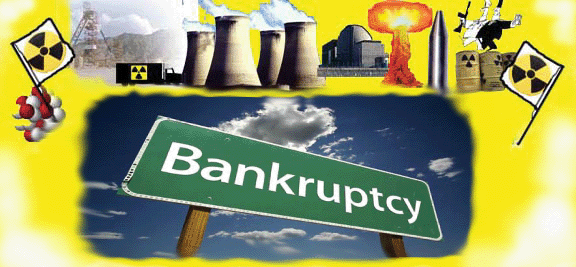 A Bankruptcy That Wrecked Global Prospects Of American Nuclear Energy, Forbes, Kenneth Rapoza The bankruptcy of Westinghouse Electric Company (WEC) has ruined its global ambitions. While the Pennsylvania-based company asserts that its March 29 filing for creditor protection doesn’t impact its businesses globally, very few seem to believe it as its Japanese parent company Toshiba Corp. warned on Tuesday that WEC may have nuked its future…….
“I see enormous difficulties ahead for Westinghouse,” says Simon Taylor, director of the Judge Business School at the University of Cambridge. Westinghouse was working on an over $20-billion Toshiba-controlled project in the north of England called Moorside, intending to build three of its pressurized water reactors known as the AP1000. Following the bankruptcy announcement, Engie, a French utility, exercised its option to sell its 40% interest to Toshiba, and quit the project. Now Toshiba is desperate to sell the fully-owned site to competitors as it doesn’t stand a single chance to raise money needed to build the plant.
Taylor thinks Westinghouse, one of the oldest names in U.S. electric power, will now have a harder time. China was their biggest hope.
“The Chinese, so far as I can tell, will never buy another AP1000 again,” Taylor says…….
[In India] . Experts doubt that any commercial contract could be signed until there is a clarity about Toshiba’s exit and Westinghouse’s own future while the calls to scrap the project altogether are gaining momentum…..
In Eastern Europe, Westinghouse prospects look even bleaker. Westinghouse has always relied in the U.S. geopolitical clout to get business there. In order to weaken Russia’s influence in the region Washington would all but force former communist countries into choosing WEC’s often untested offering or even scrapping competitors’ projects. But with all that political support the problem has always been in Westinghouse’s inability to finance its projects.
Westinghouse signed a contract in Bulgaria in 2014 for the construction of an AP1000 power plant at the Kozloduy site. There has been little progress since then as neither the client nor the vendor are capable of finding money for the project.
Back home, both of the two nuclear power plants being built in the U.S are AP1000s. Both are a combined $17 billion over budget.
Over the next 12 years, the U.S. has around 15 nuclear power plants on paper. Of those 12, five have been suspended, including Westinghouse’s planned 2029 project with Duke Energy in Florida to build two reactors. Their other Duke project, in South Carolina, is now delayed by at least three years and with this bankruptcy, will probably never get built. WEC’s two new AP1000 projects are licensed by Duke. “We’ve been monitoring Westinghouse and their other projects here and across the world…but we are not making any decisions to build and not going to speculate on that right now,” says Rita Sipe, a spokesperson for Duke Energy.
The Economist magazine speculated on April 1 that there would be ugly lawsuits in South Carolina and Georgia, adding that the future of the AP1000 “looks bleak”. Sadly, it was not an April Fool’s joke.
While it is certainly common in nuclear power plant construction to witness delays and cost over-runs, WEC seems to have carved out a niche of notoriety here. It’s finally bankrupted them.
“It’s hard to see who would be able, willing and permitted to buy WEC,” says Taylor. The Trump Administration says it is seeking a non-Chinese owner of Westinghouse. WEC is not yet talking about selling assets……https://www.forbes.com/sites/kenrapoza/2017/04/13/a-bankruptcy-that-wrecked-global-prospects-of-american-nuclear-energy/#608e8b7e17a1
Pentagon’s new killing systems for space
Why is America Sending an Aircraft Carrier Near North Korea?, National Interest, Kris Osborn, 12 Apr 17 “……….The Pentagon is also substantially increasing its arsenal of Ground Based Interceptors, or GBIs, currently stationed at Vandenberg AFB, Calif., and Ft. Greeley, Ala. The plan, first announced by former Defense Secretary Chuck Hagel several years ago, aims to increase the number of GBIs to 44 by 2017. GBIs are interceptor missiles designed to shoot up into space and destroy approaching enemy ICBMs.
Mann praised the Army soldiers who work on GBI preparation, maintenance and operation at Ft. Greely, explaining how they endure difficult weather conditions to serve America better protect the U.S. homeland.
Multi-Object Kill Vehicle:
The Pentagon’s Missile Defense Agency is in the early phases of engineering a next-generation “Star Wars”-type technology able to knock multiple incoming enemy targets out of space with a single interceptor, officials said.
“We will develop and test, by 2017, MOKV command and control strategies in both digital and hardware-in-the-Loop venues that will prove we can manage the engagements of many kill vehicles on many targets from a single interceptor. We will also invest in the communication architectures and guidance technology that support this game changing approach,” a Missile Defense Agency spokesman, told Scout Warrior last year.
Decoys or countermeasures are missile-like structures, objects or technologies designed to throw off or confuse the targeting and guidance systems of an approaching interceptor in order to increase the probability that the actual missile can travel through to its target.
If the seeker or guidance systems of a “kill vehicle” technology on a GBI cannot discern an actual nuclear-armed ICBM from a decoy – the dangerous missile is more likely to pass through and avoid being destroyed. MOKV is being developed to address this threat scenario.
The Missile Defense Agency has awarded MOKV development deals to Boeing, Lockheed and Raytheon as part of a risk-reduction phase able to move the technology forward, MDA officials said.
Steve Nicholls, Director of Advanced Air & Missile Defense Systems for Raytheon, told Scout Warrior last year that the MOKV is being developed to provide the MDA with “a key capability for its Ballistic Missile Defense System. The idea is to discriminate lethal objects from countermeasures and debris. The kill vehicle, launched from the ground-based interceptor extends the ground-based discrimination capability with onboard sensors and processing to ensure the real threat is eliminated.”
MOKV could well be described as a new technological step in the ongoing maturation of what was originally conceived of in the Reagan era as “Star Wars” – the idea of using an interceptor missile to knock out or destroy an incoming enemy nuclear missile in space. This concept was originally greeted with skepticism and hesitation as something that was not technologically feasible.
Not only has this technology come to fruition in many respects, but the capability continues to evolve with systems like MOKV. MOKV, to begin formal product development by 2022, is being engineered with a host of innovations to include new sensors, signal processors, communications technologies and robotic manufacturing automation for high-rate tactical weapons systems, Nicholls explained.
The trajectory of an enemy ICBM includes an initial “boost” phase where it launches from the surface up into space, a “midcourse” phase where it travels in space above the earth’s atmosphere and a “terminal” phase wherein it re-enters the earth’s atmosphere and descends to its target. MOKV is engineered to destroy threats in the “midcourse” phase while the missile is traveling through space.
An ability to destroy decoys as well as actual ICBMs is increasingly vital in today’s fast-changing technological landscape because potential adversaries continue to develop more sophisticated missiles, countermeasures and decoy systems designed to make it much harder for interceptor missile to distinguish a decoy from an actual missile.
As a result, a single intercept able to destroy multiple targets massively increases the likelihood that the incoming ICBM threat will actually be destroyed more quickly without needing to fire another Ground Based Interceptor.
Raytheon describes is developmental approach as one that hinges upon what’s called “open-architecture,” a strategy designed to engineer systems with the ability to easily embrace and integrate new technologies as they emerge. This strategy will allow the MOKV platform to better adjust to fast-changing threats, Nicholls said.
The MDA development plan includes the current concept definition phase, followed by risk reduction and proof of concept phases leading to a full development program, notionally beginning in fiscal year 2022, Raytheon officials explained.
MDA officials have told Scout Warrior that the MOKV program shows great promise for the future of missile defense technology.
While the initial development of MOKV is aimed at configuring the “kill vehicle” for a GBI, there is early thinking about integrating the technology onto a Standard Missile-3, or SM-3, an interceptor missile also able to knock incoming ICBMs out of space. The SM-3 is also an exo-atmopheric “kill vehicle,” meaning it can destroy short and intermediate range incoming targets; its “kill vehilce” has no explosives but rather uses kinetic energy to collide with and obliterate its target. The resulting impact is the equivalent to a 10-ton truck traveling at 600 mph, Raytheon statements said. http://nationalinterest.org/blog/the-buzz/why-america-sending-aircraft-carrier-near-north-korea-20136?page=2
Hans M. Kristensen on New START 2017: Russia Decreasing, US Increasing Deployed Warheads
 New START 2017: Russia Decreasing, US Increasing Deployed Warheads https://fas.org/blogs/security/2017/04/newstart2017/ Apr.03, 2017 By Hans M. Kristensen
The latest set of New START aggregate data released by the US State Department shows that Russia is decreasing its number of deployed strategic warheads while the United States is increasing the number of warheads it deploys on its strategic forces.

The Russian reduction, which was counted as of March 1, 2017, is a welcoming development following its near-continuous increase of deployed strategic warheads compared with 2013. Bus as I previously concluded, the increase was a fluctuation caused by introduction of new launchers, particularly the Borei-class SSBN.
The US increase, similarly, does not represent a buildup – a mischaracterization used by some to describe the earlier Russian increase – but a fluctuation caused by the force loading on the Ohio-class SSBNs.
Strategic Warheads
The data shows that Russia as of March 1, 2017 deployed 1,765 strategic warheads, down by 31 warheads compared with October 2016. That means Russia is counted as deploying 228 strategic warheads more than when New START went into force in February 2011. It will have to offload an additional 215 warheads before February 2018 to meet the treaty limit. That will not be a problem.
The number of Russian warheads counted by the New START treaty is only a small portion of its total inventory of warheads. We estimate that Russia has a military stockpile of 4,300 warheads with more retired warheads in reserve for a total inventory of 7,000 warheads.
The United States was counted as deploying 1,411 strategic warheads as of March 1, 2017, an increase of 44 warheads compared with the 1,367 strategic deployed warheads counted in October 2016. The United States is currently below the treaty limit and can add another 139 warheads before the treaty enters into effect in February 2018.
The number of US warheads counted by the New START treaty is only a small portion of its total inventory of warheads. We estimate that the United States has a military stockpile of 4,000 warheads with more retired warheads in reserve for a total inventory of 6,800 warheads.
Strategic Launchers
The New START data shows that Russia as of March 1, 2017 deployed 523 strategic launchers, an increase of 15 launchers compared with October 2016. That means Russia has two (2) more launched deployed today than when New START entered into force in February 2011.
Russia could hypothetically increase its force structure by another 177 launchers over the next ten months and still be in compliance with New START. But its current nuclear modernization program is not capable of doing so.
Under the treaty, Russia is allowed to have a total of 800 deployed and non-deployed strategic launchers. The data shows that it currently has 816, only 16 above the treaty limit. That means Russia overall has scrapped 49 total launchers (deployed and non-deployed) since New START was signed in February 2011.
The United States is counted as deploying 673 strategic launchers as of March 1, 2017, a decrease of eight (8) launchers compared with October 2016. That means the United States has reduced its force structure by 209 deployed strategic launchers since February 2011.
The US reduction has been achieved by stripping essentially all excess bombers of nuclear equipment, reducing the ICBM force to roughly 400, and making significant progress on reducing the number of launch tubes on each SSBN from 24 to 20.
The United States is below the limit for strategic launchers and could hypothetically add another 27 launchers, a capability it currently has. Overall, the United States has scrapped 304 total launchers (deployed and non-deployed) since the treaty entered into force in February 2011, most of which were so-called phantom launchers that were retired but still contained equipment that made them accountable under the treaty.
The United States currently is counted as having 820 deployed and non-deployed strategic launchers. It will need to destroy another 20 to be in compliance with New START by February 2018.
Conclusions and Outlook
Both Russia and the United States are on track to meet the limits of the New START treaty by February 2018. The latest aggregate data shows that Russia is again reducing its deployed strategic warheads and both countries are already below the treaty’s limit for deployed strategic launchers.
In a notorious phone call between Russian President Vladimir Putin and US President Donald Trump, the Russian president reportedly raised the possibility of extending the New START treaty by another five years beyond 2021. But Trump apparently brushed aside the offer saying New START was a bad deal. After the call, Trump said the United States had “fallen behind on nuclear weapons capacity.”
In reality, the United States has not fallen behind but has 150 strategic launchers more than Russia. The New START treaty is not a “bad deal” but an essential tool to provide transparency of strategic nuclear forces and keeping a lid on the size of the arsenals. Russia and the United States should move forward without hesitation to extend the treaty by another five years.
Additional resources:
- New START Aggregate Data (as of March 1, 2017)
- Status of World Nuclear Forces
US reaffirms Iran nuclear agreement

 http://www.argusmedia.com/news/article/?id=1440687 11 Apr 2017, Washington, 11 April (Argus) — The US administration’s new focus on crises in Syria and North Korea is highlighting a full retreat from President Donald Trump’s pledge to rescind the nuclear agreement his predecessor signed with Iran.
US secretary of state Rex Tillerson today reaffirmed support for the multilateral agreement — the Joint Comprehensive Plan of Action — that lifted restrictions on crude exports from Iran in January 2016. The EU, Russia and China also are parties to the agreement.
The G7 foreign ministers, meeting in Lucca, Italy, in a statement hailed the agreement’s “important contribution to the non-proliferation regime.” Implementation of the agreement will “build confidence that Iran’s nuclear program is exclusively peaceful in nature,” the ministers said.
The US’ approach to Iran so far has not departed greatly from the path former president Barack Obama’s administration paved following the lifting of the nuclear-related sanctions, even though Trump still denounces the deal. Trump imposed new sanctions on Iran following tests of ballistic missiles, just like his predecessor did. And the Pentagon continues to view Iran as a threat to US interests in the Middle East, including the freedom of navigation in the straits of Hormuz and Bab al-Mandeb.
Iran since the lifting of the nuclear-related sanctions increased production by more than 900,000 b/d to 3.8mn b/d in February.
Senior White House officials contend that Iran’s missile tests are evidence of a covert nuclear weapons program. Iran says its program is defensive in nature.
The US administration promised to push for a stronger international response to the missile tests than Obama did. But today’s G7 statement only expresses “deep regret” over the tests.
The need to coordinate sanctions programs with the EU is likely a key driver in the new administration’s approach. EU officials also persuaded US senators to delay advancing a widely supported bill to expand the scope of sanctions on Iran over the missile tests. The Senate Foreign Relations Committee will wait until after the Iranian presidential election on 19 May to schedule a vote on the bill, committee chairman Bob Corker (R-Tennessee) said.
The G7 statement calls on Russia and Iran, as allies of Syrian president Bashar al-Assad’s regime, to ensure Syria’s compliance with the UN convention banning the use of chemical weapons. But the US is directing the bulk of its criticism over Assad’s alleged use of chemical weapons against civilians at Russia.
New radiation detection system begins operations at Port of Los Angeles
 https://homelandprepnews.com/stories/21961-new-radiation-detection-system-begins-operations-port-los-angeles/ The U.S. Department of Homeland Security (DHS) recently announced that a new radiation detection system recently began operations at the Trans Pacific Container Service Corporation (TraPac) terminal at the Port of Los Angeles.
While all incoming cargo into the port is scanned by radiation detecting equipment, the new system automates the process to expedite trade and provide a needed layer of nuclear protection. Approximately two million containers pass through the TraPac terminal every single year.
The new process begins as rail-bound cargo is placed on conveyers by automated carriers. The system then transports the cargo through a radiation portal monitor for detection. If all cargo passes the security check, the cargo is then transported to rail carriers for transportation to its final destination.
TraPac originally envisioned the system as part of a move to automate scanning processes. At the same time, U.S. Customs and Border Protection needed a new means to scan ship-to-rail containers for radioactive materials. DHS then worked with the Pacific Northwest National Laboratory to test, evaluate, and approve the new system for live rail operations.
DHS said the new system offers a more efficient approach to preventing illicit radioactive materials from entering the country.
US: Nuclear waste mislabeled at Washington state site
Skagit Valley Herald, Apr 13, 2017 RICHLAND, Wash. (AP) — A shipment of nuclear waste from a commercial power plant located on the Hanford Nuclear Reservation in Washington state was improperly labeled when it was trucked to a commercial disposal site, the Nuclear Regulatory Commission said.
As a result, Energy Northwest, the consortium that operates the Columbia Generating Station nuclear plant, has been temporarily barred by state regulators from sending waste to the US Ecology disposal site located on leased Hanford land, the Tri-City Herald (http://bit.ly/2pyWwWi ) reported Thursday.
The Energy Northwest plant makes electricity and is located on the sprawling Hanford site, which is half the size of Rhode Island. Energy Northwest is separate from Hanford’s past mission of creating plutonium for the nation’s nuclear weapons, which ended in the 1980s. Plutonium production left Hanford with the nation’s largest collection of radioactive waste.
The incident occurred when a Nov. 9 shipment from the power plant to the disposal site turned out to be more radioactive than claimed on the shipping manifest, the newspaper said…….http://www.goskagit.com/news/state/us-nuclear-waste-mislabeled-at-washington-state-site/article_77794de4-a84d-5bcf-9acb-cadc1146f9b3.html
USA asks China “to take additional steps” to rein in the Kim Jong-Un regime.

 As N. Korea threatens nuclear attacks, U.S. calls on China ‘to take additional steps’ by WorldTribune Staff, April 11, 2017
As North Korea warned it has its “nuclear sight focused” on the United States, the Trump administration said it has called on China “to take additional steps” to rein in the Kim Jong-Un regime.
President Donald Trump tweeted on April 11: “I explained to the President of China that a trade deal with the U.S. will be far better for them if they solve the North Korean problem!”
Secretary of State Rex Tillerson, in an interview with ABC News on April 10, said: “I think we need to allow them (China) time to take actions and we will continue to be in very close discussions with them,” adding that the conversations between the two countries have been “very candid.”
North Korea’s official Rodong Sinmun newspaper said the country was prepared to respond to any aggression by the United States.
“Our revolutionary strong army is keenly watching every move by enemy elements with our nuclear sight focused on the U.S. invasionary bases not only in South Korea and the Pacific operation theatre but also in the U.S. mainland,” it said.
Pyongyang issued the warning as a U.S. Navy aircraft carrier strike group sailed towards the western Pacific……http://www.worldtribune.com/as-n-korea-threatens-nuclear-attacks-u-s-calling-on-china-to-take-additional-steps/
As Navy warships approach, North Korea threatens nuclear strike on USA
North Korea threatens U.S. with #nuclear strike as Navy warships approach https://www.dailydot.com/layer8/north-korea-threatens-nuclear-attack/ David Gilmour—\Apr 11 2017, North Korea this week threatened to launch a nuclear attack on the United States at the first sign of aggression from the U.S. Navy strike group that President Donald Trump ordered to the Korean peninsula.
It was always a mistake, trying to turn nuclear bomb project into (costly) nuclear power
 Nuclear Power’s Original Mistake: Trying to Domesticate the Bomb, Bloomberg View, APRIL 8, 2017
Florida’s nuclear plans in doubt, as Toshiba corporation looks like crashing
 Toshiba casts doubt on ability to stay in business after nuclear power push falters, Tampa Bay Times, New York Times, April 11, 2017 Toshiba, a pillar of the modern Japanese economy whose roots stretch back to the country’s industrial stirrings in the 19th century, warned on Tuesday that a disastrous foray into nuclear power may have crippled its business beyond repair.
In a stock-market filing in Japan, Toshiba said losses associated with Westinghouse Electric, its troubled U.S. nuclear power subsidiary, had created “substantial uncertainty” over its ability to continue as a going concern. The declaration lifts the stakes as Toshiba seeks outside investors for its coveted microchip business, a portion of which it is selling off to raise cash and stave off disaster.
Westinghouse’s woes have a strong tie to Florida.
Plans for two reactors that were supposed to be built by Westinghouse in Levy County, north of the Tampa Bay market, were shelved in 2014 by owner Duke Energy after early construction delays and massive run-ups in the anticipated price tag that approached $25 billion to complete the nuclear power plants.
As approved by state legislators and regulators, Duke Energy is able to charge its Florida ratepayers for about $1.5 billion in early construction costs for the Levy plant even though it will probably never be built. Duke Energy spent just enough on the plant site to receive a federal license last fall to proceed with the Levy facility, though the odds of restarting its construction appear slim and will further fade in time.
Florida Power & Light, a giant utility which serves most of southern Florida, has also delayed its planned Westinghouse nuclear expansion at its Turkey Point site near Miami…
“We will do what we can to avoid being delisted from the stock exchange,” Satoshi Tsunakawa, Toshiba’s chief executive, said at a news conference after apologizing to shareholders for Toshiba’s latest worrying turn.
The company reported financial details for the quarter that ended in December after multiple delays and disputes with its auditors.
The financial problems are mounting.
The auditors have refused to certify Toshiba’s accounts — a highly unusual signal of doubt about the company’s ability to recover its financial health.http://www.tampabay.com/news/business/energy/toshiba-casts-doubt-on-ability-to-stay-in-business-after-nuclear-power/2319917
Ohio Bill to subsidise nuclear power draws opponents and backers
 Generators, business groups line up against Ohio nuclear bill http://www.utilitydive.com/news/generators-business-groups-line-up-against-ohio-nuclear-bill/440178/ Peter Maloney
Dive Brief:
- provide financial support for FirstEnergy’s nuclear plants.
- Opponents include AARP, the Ohio Manufacturers’ Association, the Ohio branch of the American Petroleum Institute, the Alliance for Energy Choice, and the Electric Power Supply Association, a generator trade group. They say the subsidies would only serve to prop up FirstEnergy’s bottom line and oppose undue costs on consumers.
- Backers include the International Brotherhood of Electrical Worker Local 245 and FirstEnergy, who argue the plants are essential for the state’s economy and local tax bases.
- Dive Insight:
Measures to shore up nuclear power plants have been put in place in New York and Illinois and are under consideration in legislatures in Connecticut, Ohio and New Jersey.
And in all instances they have encountered resistance.
Non-nuclear generators say the measures in Illinois and New York will distort the economics of wholesale power markets. PJM Interconnection has also weighed in. In a March filling in federal court, PJM’s independent market monitor said Illinois zero emission credit (ZEC) would violate federal law.
A bill in Ohio, called a zero emission nuclear resource (ZEN) program, would provide emissions credits for FirstEnergy’s three nuclear plants.
- Sen. John Eklund (R), the bill’s sponsor, says the continued operation of those nuclear assets is “critical to the economic health of Ohio, and especially to the communities in which they are located.”
The IBEW takes a similar view, focusing on the livelihood of the 517 union workers at the plants, as well as the “thousands” of union contractors who depend on the plants.
But independent generators groups, such as EPSA, argue that bill would first and foremost improve the bottom line of FirstEnergy and distort price formation in organized markets.
The Ohio Manufacturers’ Association takes a similar line, arguing that the bill would allow FirstEnergy to prop up its business on the backs of Ohio consumers.” The group says it supports nuclear power as part of an all-of-the-above approach but calls the bill, SB 128, a “wolf in sheep’s clothing.”
AARP cites the opposition similar measures have attracted and calls them “scams” because they interfere with the working of wholesale energy markets.
The Federal Energy Regulatory Commission is due to address that market question in a technical conference at the beginning of next month focused on state generation subsidies.
Nuclear Plant Vogtle – a victim to Westinghouse bankrupty
 Nuclear boondoggle http://www.connectsavannah.com/savannah/nuclear-boondoggle/Content?oid=4465661 Westinghouse bankrupty adds yet another setback to the already-problematic Plant Vogtle expansionBy Jim Morekisjim@connectsavannah.com@jimmorekis A PAIR of new nuclear reactors at Georgia Power’s Plant Vogtle, about an hour north/northwest of us on the Savannah River, were supposed to be up and running two weeks ago and sending electricity to the regional grid.
Instead, the project is still less than 40 percent complete.
Originally budgeted at about $14 billion, the expansion at Plant Vogtle is now by some estimations least $6 billion over budget and counting, with no real end in sight.
That much we already knew. But the big news last month was that the manufacturer of the reactor units themselves, Toshiba-owned Westinghouse, has put its North American operations into Chapter 11 bankruptcy.
That’s right — the company making nuclear reactors upstream of us is going bankrupt. Sweet dreams!
None of this stopped the chief executive of Georgia Power’s parent firm, Southern Company, from getting a 34 percent pay raise last week. Thomas A. Fanning is now up to $15.8 million a year.
In the meantime, since 2011 almost ten percent of your monthly power bill goes not just to pay for the Vogtle expansion, but to pay for the financing costs. That’s thanks to special legislation, the Nuclear Financing Act, passed by the state legislature and then-Gov. Sonny Perdue in 2009.
See the line on your bill that says, “Nuclear Construction Cost Recovery?” That’s what you’ve been paying to finance the Vogtle expansion in advance.
(It comes to 9.7 percent of your billed kilowatt usage, not your whole monthly charge. In South Carolina they’ve got it even worse — a planned expansion of the V.C. Summer plant north of Columbia is costing each SCE&G customer more than double what we pay each month, and they don’t even get an itemized bill.)
The Nuclear Financing Act essentially stripped rate increase oversight of this project from elected regulators at the Public Service Commission (PSC). And customers are relieving Georgia Power of virtually all financial risk of its $6.1 billion share of the project cost, including interest on borrowed funds.
It’s quite a sweetheart deal for the subsidiary of Atlanta-based Southern Co., the nation’s second-largest utility.
It gets sweeter: As we reported back in 2010, the legislation has no cap for cost overruns, and doesn’t even have a way to refund customers if the project doesn’t even get completed at all.
What the hell is going on? Sadly, not much that wasn’t predicted over ten years ago when all this began.
“Most all the concerns previously brought to the Public Service Commission are now playing out in real time,” says Stephen Smith, executive director of Southern Alliance for Clean Energy (SACE). “The utilities have totally lost credibility and now we need regulators to do their jobs.”
In 2006, Southern Co. began seeking approval to double the number of reactors at Plant Vogtle. (The first duo, Units 1 and 2, was online by the late ‘80s.)
It was to be the first expansion of nuclear energy since the Three Mile Island nuclear disaster in 1979.
By 2009 the expansion plan had received approval from the PSC. If completed, the Vogtle expansion would make it the largest nuclear plant in the United States.
In 2012 — just a year after the nuclear disaster at Fukushima, Japan — the federal Nuclear Regulatory Council approved the planned use of two Westinghouse AP1000 reactors, a design the parent company says has greater safety parameters than the General Electric reactors at Fukushima.
As of this writing, not a single AP1000 has gone online yet; the first is set to go live at a Chinese plant later this year.
Project and reactor construction delays, and Westinghouse’s financial woes, are slowing new projects in China as well.
Since the Vogtle expansion was approved, the project has experienced one setback after another, all of them underwritten by Georgia Power customers, and almost all of them predicted by environmental watchdogs and media outlets such as this one.
In a grimly symbolic incident, in 2012 a reactor vessel set to contain one of the AP1000s literally fell off a train on the way to Burke County.
News of the accident, which involved no radioactive materials, didn’t reach the public until about a month later.
“Once again PSC staff time after time predicted delays well in advance of Southern Company admitting to them,” says Sara Barczak, High Risk Energy Choices Program Director for SACE.
“Once again there are revised commercial operation dates that represent another delay in the project.”
Originally, Unit 3 was supposed to be online April 2016. Then it was moved to July 2019. Completion for Unit 3 is now estimated to be Dec. 2019. Unit 4 was supposed to be online April 1, 2017. Then it was moved to July 2019. Completion for Unit 4 is now estimated to be to Dec. 2019.
The extreme delay, combined with a complicated pending litigation issue, prompted a new settlement agreement in the closing days of 2016, to reflect the new economic reality of the ballooning financing cost to ratepayers.
“There’s been a slight change in the financing situation because of the settlement reached at the end of the year,” explains Barczak.
“Interest is still going to be collected. But once the certified capital cost is reached, instead of being collected in advance it will go into a different type of accounting process,” she says.
“But customers will still be paying for financing costs far longer than expected, and ultimately will pay far more.”
Because of the huge delay, “Financing costs ended up representing the largest cost increases,” says Barczak.
“It’s like the longer you have a credit card not paid off, the higher the interest is. The interest ends up being what kills you.”
That’s why Barczak and other environmental watchdogs are frustrated with the settlement.
“Ratepayers are just going to pay for financing longer,” she says. “Because by 2017 both reactors were supposed to be operating by now, that advance payment will not be collected. There are no capital costs in the legislation.”
The 2016 settlement now targets a completed project date of Dec. 31 2020, but few observers have much trust in that target.
“This represents a 45-month delay. PSC public interest advocacy staff testified that even using a 45 month delay date, it was unlikely the new completion date can be achieved. It would require a threefold increase in productivity,” Barczak says.
“This forces customers to continue to pay for a facility where the utility cannot accurately predict the cost, and when or even if the facility will be completed, adds Stephen Smith of SACE.
Georgia Power originally said the financing plan would save customers over $300 million in the long run. But that was based on the original, now-obsolete timeline. Any savings realized are now more than outweighed by the cost overrun.
The Westinghouse bankruptcy adds yet another, and potentially very serious, layer of uncertainty to an already very uncertain project.
“Toshiba purchased Westinghouse in 2005-2006. They had developed a reactor design that most facilities across the country decided to go with,” Barczak explains.
“What panned out just recently is that Toshiba started losing big on these projects. They lost $6.3 billion on two projects combined,” she says.
“This bankruptcy has created a worst case scenario for electric power customers in Georgia and South Carolina. There are more questions than answers at this point,” says Smith.
“We see no path forward without some additional financial pain for customers.”
The bankruptcy is particularly tricky, says Tom Clements, executive director of SRS Watch.
“The loan guarantees for the Vogtle expansion run through Southern Co., not Westinghouse. Southern is not directly related to the bankruptcy,” says Clements.
“Once the bankruptcy court starts shifting costs around, you can’t predict what will happen,” he says.
Adding a twist is the fact that most of Westinghouse’s overseas operations aren’t included in the bankruptcy proceeding — raising suspicions that they are looking for a way to back out of the Vogtle deal.
“It’s pretty clear from their filings that they’re looking to us to take over this project,” said SCANA CEO Kevin Marsh, whose company is also contracting with Westinghouse for AP1000 reactors.
All of this is a far cry from the so-called “Nuclear Renaissance” at the turn of the 21st Century, when advances in technology were supposed to relieve the world of what at the time were high fossil fuel costs and an assumption of severe future scarcity.
With the Energy Policy Act of 2005 — a Bush-era initiative enthusiastically endorsed and enhanced during the Obama administration through generous loan guarantees — the future of U.S. energy looked to be a heavily nuclear one.
“After the Energy Policy Act of 2005 passed, over 30 new reactors were proposed, more than half in the Southeast,” Barczak says.
Then came the great recession of 2008, followed by a little thing called fracking.
Seemingly all of a sudden, the fossil fuel industry experienced a huge boom, both financially and in projected availability.
“We’ve seen the demise of the so-called nuclear renaissance,” says Barczak. “A lot of license applications for new nuclear plants were withdrawn.”
But not at Plant Vogtle.
At the time, the Congressional Budget Office was prophetic in its assessment of the state of the nuclear industry.
“If construction costs for new nuclear power plants proved to be as high as the average cost of nuclear plants built in the 1970s and 1980s or if natural gas prices fell back to the levels seen in the 1990s, then new nuclear capacity would not be competitive, regardless of the incentives provided by Energy Policy Act,” said a CBO report from 2008.
“Every single thing we said might happen did happen,” says Barczak. “Then Fukushima happened.”
The tsunami-induced failure of a reactor at the Fukushima Daichi plant, a disaster of such scope that its impacts aren’t fully measured six years later, wasn’t even a speed bump for the Vogtle expansion.
“We are committed to the project and completing the units on schedule and on budget,” said Southern Nuclear Co. spokesperson Beth Thomas at the time. “We’re certainly monitoring the events in Japan and our thoughts and prayers are with the people there.”
A lot of this momentum, Barczak says, it due to the unique situation of a utility building nuclear power plants with all the regulatory burden on the government, and most of the financial risk on ratepayers.
The Southeast, she says, “is in a weird situation in that we’re a regulated market but very weak on consumer protections. States like Georgia, Florida, and South Carolina all had legislators passing legislation to put extra burdens on consumers.”
The nuclear power industry, Barczak says, “isn’t exactly what you’d call a nimble industry. It can’t react to changes that sometimes happen very quickly. It’s based on the old model of, ‘OK you’re gonna have more people, so build a bigger power plant,’” she says.
“For the Southeast, if the coal paradigm seems to be going by the wayside, then we’re still in the nuclear paradigm.”
Noboby knows what happens next, though all eyes are on the bankruptcy court. With the precedent set for ratepayers to stay on the hook regardless of how much sunk cost is going into the Vogtle expansion, there is vanishing hope of a win/win solution for ratepayers.
Donald Trump the laughing stock of environmental protection staff
30-year veteran compares EPA chief’s climate denial to lies tobacco executives told Congress Mike Cox retired after three decades at the Environmental Protection Agency on March 31 with a scathing letter for EPA administrator Scott Pruitt.
Team Trump is apparently an open joke to their staff — something even the Reagan and Bush administrations never experienced. Morale has collapsed, Cox notes.
“I have worked under six administrations with political appointees leading EPA from both parties,” Cox wrote on his last day on the job. “This is the first time I remember staff openly dismissing and mocking the environmental policies of an administration and by extension you.”
The 60-year-old Cox, who worked on climate change for EPA’s Region 10, which covers Alaska and the northwest, was especially harsh on Pruitt’s science denial.
Cox called Pruitt’s claim on national TV that CO2 is not a primary contributor to recent global warming “shocking” — and directly compared it to the congressional hearing with the CEOs of the major tobacco companies where “all of the CEOs categorically denied that smoking causes lung cancer.”
What’s the result of this denial? “You will continue to undermine your credibility and integrity with EPA staff, and the majority of the public,” Cox wrote, “if you continue to question this basic science of climate change.”
In the five-page letter, Cox slams the president for the “false and misleading” claim that killing EPA carbon pollution standards will bring back coal jobs.
In a section on “indefensible budget cuts,” Cox slams Pruitt for standing by while the White House gutted the overall EPA budget. These cuts have real consequences for real people, he says.
Cox directly asks Pruitt:
- Why resources for Alaska Native Villages are being reduced when they are presented with some of the most difficult conditions in the country;
- why you would eliminate funds for the protection and restoration of the Puget Sound ecosystem which provides thousands of jobs and revenue for Washington State; and
- why you would reduce funds for a program that retrofits school buses to reduce diesel emission exhaust inhaled by our most vulnerable population — children.
The entire letter from Cox is a must read for anyone who cares about clean air, clean water, and our children’s future.
Trump and Xi did not discuss climate change: no need, China has taken over leadership in this
 China’s Xi Outshines Trump as the World’s Future Energy Leader, Failure by the two presidents to discuss climate change leaves China ahead, based on actions if not words, Scientific American By David Biello on April 11, 2017 “……Trump and China’s Pres. Xi Jinping apparently ignored climate change at their inaugural meeting last week. Although the two leaders apparently found time to discuss everything from North Korea’s nuclear capability to a potential reset of trade relations, climate change was never mentioned, even though Trump might have wanted to take the opportunity to directly fact check his Tweet from last year that China invented climate change to cripple U.S. manufacturing.
The silence was not a surprise, however, even if the focus of the summit was meant to be “global challenges around the world.” As Susan Thornton, acting assistant secretary for the Bureau of East Asian and Pacific Affairs at the U.S. State Department, predicted, “I don’t think that [climate change is] going to be a major part of the discussion in Florida.”
That’s too bad, because China and the U.S. remain the two biggest polluters when it comes to greenhouse gases. Cooperation on climate change provided a rare area of agreement between China and the U.S. during the Obama administration. And it was in large part due to the efforts of China and the U.S. that the nations of the world agreed to combat climate change in Paris in 2015.
It is also too bad for the U.S.—because, ironically, the silence leaves China as the world’s future energy leader. As many see the Trump regime abandoning U.S. leadership in the fight to restrain global warming, China seems willing to step up, at least in rhetoric. “What should concern us is refusing to face up to problems and not knowing what to do about them,” Xi said in a speech to the World Economic Forum in January. “The Paris Agreement is a hard-won achievement which is in keeping with the underlying trend of global development. All signatories should stick to it instead of walking away from it, as this is a responsibility we must assume for future generations.”
At the same time, the Chinese have taken the lead in producing clean energy—from topping the world in the production and installation of solar power to building an entire new series of nuclear power plants, making use of the latest technology. Trump’s avoidance of the climate change problem could leave U.S. industry at a competitive disadvantage……..
Trump has already signed an executive order forcing the U.S. Environmental Protection Agency to withdraw the Clean Power Plan, which would have cut pollution from power plants. He is rolling back other federal efforts to combat climate change, such as reducing methane pollution from oil and gas pipelines as well as promoting a budget that could eliminate funding for clean energy research. All of which undercuts any serious effort to meet the U.S. commitment under the Paris agreement to reduce greenhouse gas emissions by as much as 28 percent below 2005 levels by 2025.
Xi’s China, by contrast, plans to implement a national cap-and-trade system to reduce CO2 pollution this year. And there are already signs that decades-long growth in China’s coal burning has slowed or even stopped, potentially fulfilling the country’s Paris pledge to reach a peak in its pollution by 2030. This change of course is not just aimed at fending off climate change but also at reducing unhealthy air pollution that even government leaders in Beijing cannot avoid breathing…….
Nowhere remains safe from climate change. The U.S. is already feeling the effects, such as weird weather upsetting the plans of American farmers. Those effects will only get worse if nothing is done to stop dumping CO2 into the sky, much less to begin to reduce concentrations that have now reached more than 400 parts per million in the air—higher than that breathed by any members of our fellow Homo sapiens in the last 200,000 years. The global warming challenge is also intimately connected to the global challenges of feeding more than seven billion people, providing drinkable water as supplies dwindle and supplying electricity to billions of people who still do not have it. None of these challenges can be solved in isolation but rather require solutions like clean energy supergrids and microgrids that address energy poverty and reduce climate change pollution at the same time.
This also holds true even for the items that were on the U.S.–China agenda at Mar-a-Lago, such as the future of war-torn Syria after Trump ordered a cruise missile strike in response to that nation’s use of chemical weapons in its civil war. A shortage of water and food in Syria helped start the horrendous conflict there, forcing refugees to flee the war and the nation—in other words, a deadly fight and flight exacerbated by climate change. The conflict in Syria may serve as a warning from a future in which Trump continues to deny the facts about global warming. https://www.scientificamerican.com/article/chinas-xi-outshines-trump-as-the-worlds-future-energy-leader/
1 This Month





PLEASE OPPOSE HR 8255 AND S.3639 – bills would accelerate satellite deployment, with no environmental review or safeguards – https://ncstd5li.quorum.us/campaign/169331/
To see nuclear-related stories in greater depth and intensity – go to https://nuclearinformation.wordpress.com
-
Archives
- October 2026 (81)
- September 2026 (339)
- August 2026 (330)
- July 2026 (355)
- June 2026 (287)
- May 2026 (306)
- April 2026 (356)
- March 2026 (251)
- February 2026 (267)
- January 2026 (308)
- December 2025 (358)
- November 2025 (359)
-
Categories
- 1
- 1 NUCLEAR ISSUES
- business and costs
- climate change
- culture and arts
- ENERGY
- environment
- health
- history
- indigenous issues
- Legal
- marketing of nuclear
- media
- opposition to nuclear
- PERSONAL STORIES
- politics
- politics international
- Religion and ethics
- safety
- secrets,lies and civil liberties
- spinbuster
- technology
- Uranium
- wastes
- weapons and war
- Women
- 2 WORLD
- ACTION
- AFRICA
- Atrocities
- AUSTRALIA
- Christina's notes
- Christina's themes
- culture and arts
- Events
- Fuk 2022
- Fuk 2023
- Fukushima 2017
- Fukushima 2018
- fukushima 2019
- Fukushima 2020
- Fukushima 2021
- general
- global warming
- Humour (God we need it)
- Nuclear
- RARE EARTHS
- Reference
- resources – print
- Resources -audiovicual
- Weekly Newsletter
- World
- World Nuclear
- YouTube
-
RSS
Entries RSS
Comments RSS

