Trump’s Expected Pick for Top USDA Scientist Is Not a Scientist, Sam Clovis likely to be named undersecretary of the USDA department that manages research on everything from climate change to nutrition. Pro Publica, by Jessica Huseman , May 12, 2017, The USDA’s research section studies everything from climate change to nutrition. Under the 2008 Farm Bill, its leader is supposed to serve as the agency’s “chief scientist” and be chosen “from among distinguished scientists with specialized or significant experience in agricultural research, education, and economics.”
But Sam Clovis — who, according to sources with knowledge of the appointment and members of the agriculture trade press, is President Trump’s pick to oversee the section — appears to have no such credentials.
Clovis has never taken a graduate course in science and is openly skeptical of climate change. While he has a doctorate in public administration and was a tenured professor of business and public policy at Morningside College for 10 years, he has published almost no academic work.
Clovis is better known for hosting a conservative talk radio show in his native Iowa and, after mounting an unsuccessful run for Senate in 2014, becoming a fiery pro-Trump advocate on television……https://www.propublica.org/article/trumps-expected-pick-for-top-usda-scientist-is-not-a-scientist
May 15, 2017
Posted by Christina Macpherson |
climate change, politics, USA |
Leave a comment
Wind Is The New Power In America’s Heartland, Forbes, Chris Brown, 14 May 17, U.S. wind energy recently achieved a major milestone, which underscores a new reality that is generating power and jobs across America’s heartland. In February, low-cost clean electricity from wind turbines on the Great Plains supplied more than half (
52.1%) of all power on the grid serving Americans in a 14-state swath of the central U.S., stretching from Texas to Montana.
This was the first time a North American grid operator supplied a majority of its electricity from wind, powering millions of households. “Now we have the ability to reliably manage greater than 50%,” said Bruce Rew, vice president of operations, Southwest Power Pool (SPP). “It’s not even our ceiling.”
SPP understands the power of wind. They aren’t alone.
The CEO of Great River Energy Inc., which supplies 28 electric co-ops in Minnesota, recently said that “wind is quickly becoming the new base load, and to be viable going forward, all other sources must be flexible enough to be supplemental to the wind.”
ndeed, in 2016 wind topped hydroelectric as the #1 U.S. renewable energy in total capacity, enough to power 24 million homes. Wind capped a second straight year installing more than 8,000 megawatts and exceeded both natural gas and solar in new U.S. utility-scale capacity for 2015-2016 combined, the Federal Energy Regulatory Commission reported.
Wind is winning in energy markets because of its proven reliability and market-beating cost, which fell 66% since 2009. It’s now the cheapest source of new electric-generating capacity across much of the nation, attracting utilities such as Xcel Energy and MidAmerican Energy, and corporate buyers including Amazon, Google, Home Depot and GM.
Wind isn’t just becoming a major contributor to U.S. power – it’s a rapidly expanding base for U.S. jobs. Every year, the wind industry as a whole now supports more than 30 U.S. jobs for every new wind turbine, according to analysis of new economic impact data by Navigant Consulting. A modern wind turbine takes 18 full-time U.S. jobs to develop, manufacture, transport and construct, and creates 44 years of full-time employment, including long-term operations and maintenance, over its lifetime.
Nationwide, wind powers 102,500 jobs, driving economic development in the rural Midwest, Rust Belt and all 50 states. By 2020, projected wind-related jobs will rise to a quarter million, including jobs in communities surrounding wind farms and factories. Today, U.S. wind counts more than 1,000 utility-scale projects, 52,000 wind turbines and 500 factories.
That’s good news for America’s heartland, where wind power has arrived in a big way. Wind has bipartisan backing from large majorities because it’s delivering for Americans – in their wallets, workplace and homes:……https://www.forbes.com/sites/realspin/2017/05/10/wind-is-the-new-power-in-americas-heartland/#29e27e2c31a5
May 15, 2017
Posted by Christina Macpherson |
employment, renewable, USA |
Leave a comment
Jack Cohen-Joppa: McSally: Ask Pentagon to disclose depleted uranium target data. http://tucson.com/news/opinion/columnists/guest/jack-cohen-joppa-mcsally-ask-pentagon-to-disclose-depleted-uranium/article_9951f82c-0d54-5884-b54f-f5d467dcbfac.html 14 May 17, Jack Cohen-Joppa
Last year, Rep. Martha McSally’s office helped a military journalist and I confirm that for the first time since 2003, A-10s had fired their armor-piercing depleted uranium (DU) ammunition while attacking an ISIS convoy in Syria in November, 2015.
In February, I wrote to ask her assistance in getting the Pentagon to share with appropriate Iraqi and international authorities all of the locations where this radioactive ammunition has been used.
Twenty-six years ago during Operation Desert Storm, U.S. armed forces flying over Iraq fired nearly one million rounds of the special ammunition, totaling about 300 tons of refined depleted uranium. Another 125-plus tons of these radioactive bullets were fired during Operation Iraqi Freedom, the 2003 invasion of Iraq. The vast bulk of this ordnance came from the guns of the A-10 warplanes, while the remainder was fired from the Abrams tank, Bradley Fighting Vehicle and Marine AV-8B Harrier.
As a radioactive heavy metal, use of DU in industry is licensed from federally owned stockpiles. Public health officials recognize it as a chemical and radiological hazard. Industrial emissions are subject to regulation, and production facilities have been shut down due to off-site contamination. Protocols and procedures exist to protect the health and safety of those in industry and the military who manufacture and handle the uranium ammo until its use in combat.
Since 1991, the United States has been asked to provide international aid NGOs, United Nations agencies, and the government of Iraq with full information about where this ammunition was used. According to the World Health Organization, the International Atomic Energy Agency and the United Nations Environmental Program, this basic data is needed to help identify contaminated sites for remediation and the eventual removal of this toxic remnant of war.
Today, more than two decades later, our government has refused to fully disclose this information. The failure to disclose has a continuing political cost as well, because it counters any claim that the United States cares for the future of the Iraqi, and now also the Syrian, people.
It is known that such targeting information is available to disclose because a subset of the data was shared with the Dutch government for locations where Dutch coalition troops may have encountered DU contamination. NATO also released targeting data for DU use in the Balkans in 1999. Another limited set of targeting data from 2003 was uncovered recently in George Washington University’s National Security Archive.
I asked Representative McSally to add her voice to those demanding the Pentagon provide international authorities with comprehensive information regarding where DU was used by the A-10s and other platforms since 1991.
But now, three months later, neither McSally nor her office have replied to my letter, let alone provided an answer about her views on the matter. As a veteran A-10 commander now sitting on the House Armed Services Committee, her support for releasing this information would be significant, benefiting the health and safety of U.S. military personnel, international aid workers and the affected civilian populations for generations to come. I encourage all of her constituents to join me in asking her to support this request.
Jack Cohen-Joppa, a Tucson resident since 1986, is co-coordinator of the Nuclear Resister. Contact Jack at
jack@igc.org.
May 15, 2017
Posted by Christina Macpherson |
depleted uranium, USA |
Leave a comment
Hanford continues to have truckload of woes http://www.spokesman.com/stories/2017/may/12/hanford-continues-to-have-truckload-of-woes/If ever a place were cursed, it’s the Hanford Nuclear Reservation. The last thing cleanup managers needed was a new project.
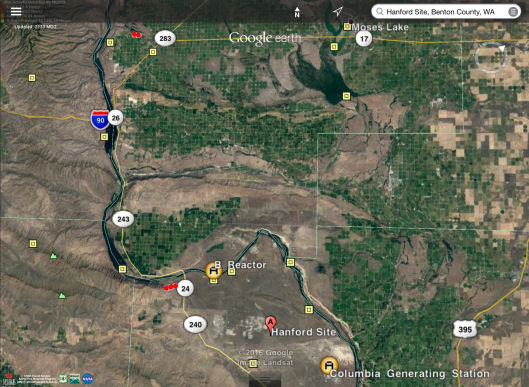
But the lifespan of rail car tunnels designed to temporarily store radioactive material is much shorter than the half-life of the waste itself, as witnessed by the 20-by-20-foot hole that was spotted above one of the caverns on Tuesday morning.
The two tunnels were built more than 50 years ago as a stopgap measure. Today, there is still no permanent solution as the cleanup drags on, with administration after administration claiming their commitment to safety as it pushes back deadlines.
The feds have spend $19 billion at Hanford, and the deadline for completion is 2060, or 115 years after the first plutonium for a nuclear explosion was produced. It’s a national embarrassment, with serious consequences for this region.
Workers are plugging the hole of the partially collapsed tunnel with a sand and soil mix. Fifty-four truckloads were dumped as of Wednesday night. No airborne radioactivity has been detected. The tunnel, constructed of wood and concrete, has stored eight rail cars filled with contaminated material since the 1960s, the Tri-City Herald reported. The other tunnel is larger, containing 28 rail cars filled with waste.
The fact that radioactive material is still being stored in such a way says everything about the failure of the federal government to come up with a permanent solution. A 2015 U.S. Department of Energy report said the tunnels were susceptible to earthquakes or deterioration, and the nearby Yakama Nation was warned, the Associated Press reported. The tribe says nothing was done.
Earlier reports also warned the tunnels would deteriorate due to time and radiation.
The state of Washington has filed a legal order outlining its expectations, including a plan for the safe storage of materials in those tunnels.
The tunnels aren’t even the worst of it. A total of 177 tanks with 56 million gallons of radioactive sludge are buried beneath Hanford and close to the Columbia River. At least 67 tanks have leaks. If the Columbia River were to be contaminated, it would be catastrophic for the entire Northwest.
The long-term plan has been to convert the waste into glass logs by a process known as vitrification. The logs would be put into permanent storage deep beneath Yucca Mountain in Nevada. But the planned $17 billion vitrification plant has been plagued by design and safety concerns. Politics has stymied the Yucca repository. Former Nevada Sen. Harry Reid, who served as Senate majority leader, blocked it.
In yet another twist, a recent Government Accountability Office report advises abandoning vitrification and encasing the waste in a cement-like mixture. It’s always something.
President Donald Trump’s initial budget increased U.S. Energy Department spending on cleanups, from $6.1 billion to $6.5 billion. New Secretary of Energy Rick Perry has much to learn about Hanford, and he will be counted on to follow up on the tunnel breach.
But it takes a truckload of faith to believe the curse will be lifted.
May 13, 2017
Posted by Christina Macpherson |
safety, USA, wastes |
Leave a comment

 Washington State Demands Nuclear Waste Storage Answers http://www.courthousenews.com/enforcement-action-calls-assessment-nuclear-waste-storage/ JAMIE HENNEMAN May 11, 2017 RICHLAND, Wash. (CN) — A state agency has taken legal action against the Department of Energy for the collapse of a containment tunnel at a nuclear site in Washington.
The tunnel, which housed eight rail cars of nuclear waste in Hanford – about 200 miles south of Seattle – left a 15-to-20-foot hole when it partially collapsed Tuesday. Although no one was hurt, some workers were evacuated and others sheltered in place while the air around the site was tested for radioactivity. Tests revealed that no radioactivity had leaked from the tunnel, and 50 truckloads of soil were brought in to plug the hole.
On Wednesday, the Washington State Department of Ecology (DOE) filed an enforcement action urging the federal government to immediately assess whether failure of other storage tunnels is likely and to submit a plan to the DOE for the safe storage of the materials as well as a plan for permanent cleanup.
“This alarming emergency compels us to take immediate action – to hold the federal government accountable to its obligation to clean up the largest nuclear waste site in the country,” DOE Director Maia Bellon said in a statement.
According to the Department of Energy, Hanford has produced more than 20 million pieces of uranium metal fuel for nine nuclear reactors along the Columbia River. The five plants at the Hanford site discharged an estimated 450 billion gallons of liquid waste in soil disposal sites and 53 million gallons of radioactive waste in 177 underground storage tanks. Most of the nation’s nuclear weapons, including the bomb dropped on Nagasaki, Japan, during World War II, used plutonium from Hanford.
The Hanford site stopped producing plutonium in the late 1980s, with cleanup efforts beginning in 1989. The cleanup currently employs approximately 11,000 workers.
“Our top priority is to ensure the safety of Hanford workers and the community,” Washington Gov. Jay Inslee said in a statement. “The collapse of this tunnel raises serious questions about how it happened and what can be done to make sure it doesn’t happen again. This enforcement order is necessary to make sure we get greater assurance about the condition of these tunnels and the Department of Energy’s plan to contain any further risks.”
In a press release, the DOE highlighted how the age of some of the storage areas at Hanford are of particular concern. The collapsed tunnel was built in 1956 of timber, concrete and steel and topped with eight feet of dirt. It was sealed with the nuclear-waste-filled rail cars in 1965.
“The infrastructure built to temporarily store radioactive waste is now more than a half-century old,” Bellon said. “The tunnel collapse is direct evidence that it’s failing. It’s the latest in a series of alarms that the safety and health of Hanford workers and our citizens are at risk.”
Workers returned to their jobs at Hanford on Thursday.
May 13, 2017
Posted by Christina Macpherson |
Legal, USA |
Leave a comment
 Are solar and wind really killing coal, nuclear and grid reliability? The Conversation, Joshua D. Rhodes, Postdoctoral Researcher of Energy, University of Texas at Austin, Michael E. Webber, Professor of Mechanical Engineering and Deputy Director of the Energy Institute, University of Texas at Austin, Thomas Deetjen, Graduate Research Assistant, University of Texas at Austin, Todd Davidson, Research Associate, Energy Institute, University of Texas at Austin May 12, 2017
 U.S. Secretary of Energy Rick Perry in April
requested a study to assess the effect of renewable energy policies on nuclear and coal-fired power plants.
Some energy analysts responded with confusion, as the subject has been extensively studied by grid operators and the Department of Energy’s own national labs. Others were more critical, saying the intent of the review is to favor the use of nuclear and coal over renewable sources.
So, are wind and solar killing coal and nuclear? Yes, but not by themselves and not for the reasons most people think. Are wind and solar killing grid reliability? No, not where the grid’s technology and regulations have been modernized. In those places, overall grid operation has improved, not worsened………
Wind and solar are making older generators less viable because their low, stable prices and emissions-free operation are desirable. And they aren’t hurting grid reliability the way critics had assumed because other innovations have happened simultaneously…….
How do renewables affect the bid stack? Renewable sources such as wind, solar and hydro have no fuel costs – sunlight, wind and flowing water are free. That means their marginal operational cost is near zero; the cost is essentially the same to operate one megawatt of wind as compared to the cost of operating 10 megawatts of wind since generators don’t need to buy fuel. That means as more wind and solar farms are installed, more capacity is inserted at the cheapest end of the bid stack.
This insertion pushes out other generators such as nuclear, natural gas and coal, causing some of them to no longer be dispatched into the grid – that is, they don’t supply power into the grid (or get paid). So as more renewables are installed, power markets dispatch fewer conventional options. And, because the marginal cost of these new sources is almost free, they substantially lower the cost for electricity. This is great news for consumers (all of us) as our bills decrease, but bad news for competitors (such as coal plant owners) who operate their plants less often and are paid less when the plants do operate.
What does all this mean? Natural gas and renewables are affecting coal in two ways. Natural gas is a direct competitor with coal because both can be dispatched – turned on – when a grid operator needs more power. That is helpful for grid reliability. But, as the cost of natural gas has fallen, coal has become less competitive because it is cheaper to operate a natural gas power plant.
The effect of renewables is slightly different: Wind and solar power are not dispatchable, so they cannot be turned on at a moment’s notice. But, when they do turn on, during windy evenings or sunny days in Texas, they operate at very low marginal cost and thus operate very competitively.
Research at UT Austin shows that while installing significant amounts of solar power would increase annual grid management costs by $10 million in ERCOT, it would reduce annual wholesale electricity costs by $900 million. The result of all this is that renewables compete with conventional sources of power, but they do not displace nearly as much coal as cheap natural gas. In fact, cheap gas displaces, on average, more than twice as much coal than renewables have in ERCOT.
What about nuclear?
Nuclear’s problems are largely self-inflicted. In short: The price to build nuclear is high, so we don’t build many nuclear plants these days. Since we don’t build, we don’t have the manufacturing capability. Since we don’t have the manufacturing capability, the price to build nuclear is high. Since the price to build nuclear is high, we don’t build nuclear these days…so on and so forth.
Today, cheap gas, having already beaten up on coal, is a threat to new nuclear power plants and less efficient, older plants. New natural gas combined cycle power plants can be built for about one-sixth the cost of a new nuclear plant, is almost twice as efficient and you can build them in smaller increments, making them easier to finance.
Market innovation and IT can fix reliability
Because wind energy comes and goes with the weather, it makes grid operators nervous. But wind forecasting has improved dramatically, giving more confidence to those who need to keep the lights on.
And, interestingly enough, the requirements for reserve capacity (backup power for when wind power dips) to manage the grid smoothly went down, not up, over the past few years in Texas, despite rapid growth in wind during Governor Perry’s tenure. That is, the costs for managing variability in the grid decreased……….
there is still more to do – information technology coupled with integrated hardware can help. Consider this: There are 7.7 million smart meters in Texas, most of them residential. We’ve estimated that installing 7 million controllable thermostats for just the households in Texas would cost $2 billion. Residential air conditioning is responsible for about 50 percent of peak demand in Texas in the summer. That means about 30 gigawatts of peak demand in Texas is just from residential air conditioners.
By dynamically managing our air conditioning loads – that is, adjusting thermostats to lower overall demand without impacting people’s comfort – we could reduce peak demand by 10 to 15 GW. That means we might not need $10 billion to $15 billion worth of power plants. Spending $2 billion to avoid $15 billion is a good deal for consumers. In fact, you could give the thermostat away for free and pay each household $700 for their trouble and it would still be cheaper than any power plant we can build.
In the end, Secretary Perry has posed good questions. Thankfully, because of lessons learned while he was governor of Texas, we already have answers: despite concerns to the contrary, incorporating wind and solar into the grid along with fast-ramping natural gas, smart market designs and integrated load control systems will lead to a cleaner, cheaper, more reliable grid.https://theconversation.com/are-solar-and-wind-really-killing-coal-nuclear-and-grid-reliability-76741
May 13, 2017
Posted by Christina Macpherson |
renewable, USA |
Leave a comment
 Intelligence community to Trump: When it comes to global warming, you’re wrong, Mashable, BY ANDREW FREEDMAN, 12 May 17 Each year the intelligence community puts together a “Worldwide Threat Assessment” report, and it inevitably scares the hell out of Congress and the public by detailing all the dangers facing the U.S. (Hint: there are a lot of them.)
This year’s report, published Thursday and discussed at a congressional hearing, makes for particularly disquieting reading.
While it focuses on the increasing danger that North Korea’s nuclear weapons program poses as well as cyberterrorism threats, one environmental concern stands out on the list: climate change. According to the new report, delivered to the Senate Intelligence Committee by Dan Coats, the director of national intelligence (DNI), warns that climate change is raising the likelihood of instability and conflict around the world.
This is surprising given the Trump administration’s open hostility to climate science findings.
“The trend toward a warming climate is forecast to continue in 2017,” the report states, noting that 2016 was the hottest year on record worldwide. Climate scientists have firmly tied this to human-caused emissions of greenhouse gases, though the report does not make that link.
“This warming is projected to fuel more intense and frequent extreme weather events that will be distributed unequally in time and geography. Countries with large populations in coastal areas are particularly vulnerable to tropical weather events and storm surges, especially in Asia and Africa,” the report states………..http://mashable.com/2017/05/11/trump-intel-report-cites-climate-change-risks/#iCN3X703iiqw
May 13, 2017
Posted by Christina Macpherson |
climate change, safety, USA |
Leave a comment
 Nuclear Generation Expected to Decline with Reactor Retirements http://www.power-eng.com/articles/2017/05/nuclear-generation-expected-to-decline-with-reactor-retirements.html
May 12, 2017 Far more nuclear generation capacity is expected to be retired rather than added through 2050, a study by the Energy Information Administration indicated.
Though 9.1 GW of new capacity is projected to be added, 29.9 GW is expected to be retired. The reactors already announced for closure include Palisades in 2018, Pilgrim Unit 1 in 2019, Oyster Creek Unit 1 in 2020, Indian Point Units 2 and 3 around 2020 and Diablo Canyon Units 1 and 2 in 2025 and 2026.
Though Quad Cities Units 1 and 2 and Clinton Unit 1 were set for retirement, financial incentives passed by the state of Illinois caused the operators of those plants to keep them open.
EIA assumes 25 percent of nuclear capacity now operating without announced retirement plans will be removed from service by 2050.
The four new reactors under construction at V.C. Summer and Vogtle are included in the assessment, EIA said their future process is uncertain due to the bankruptcy of Westinghouse Electric.
New nuclear power plants are licensed by the Nuclear Regulatory Commission for 40 years, though 90 percent of currently operating nuclear plants are either operating under or have applied for 20-year license renewals. Nearly all nuclear plants now in use began operation between 1970 and 1990.
EIA noted the capital investment needed to keep plants operating beyond 60 years is currently unknown and could vary significantly across the nuclear power fleet.
May 13, 2017
Posted by Christina Macpherson |
business and costs, USA |
Leave a comment
Local students advocate for nuclear Post Register, May 11, 2017 By KEVIN TREVELLYAN ktrevellyan@postregister.com
 Emma Redfoot and Kelley Verner noticed something when marching last year in Chicago in an effort to save two nuclear power plants from decommission
……….Fifty-four percent of Americans oppose nuclear energy, according to a 2016 Gallup poll, up from 43 percent in 2015. Last year was the first time the majority of the country opposed nuclear since Gallup started asking the question in 1994.
Public hesitance to embrace nuclear increases the need for advocacy, centrist [??] think tank Third Way communications adviser Suzanne Baker said. Baker previously was an INL spokeswoman.

“Nuclear is an often misunderstood technology,” she said. “And advocacy becomes an important way to help humanize and tell the story of the technology in a way that connects with people. Technical information is important and useful, but it doesn’t always tell us why something matters, and advocacy can do that.”…….
Advocacy can make a difference, Baker said. Following the Chicago pro-nuclear march, the Illinois House of Representatives passed a bill subsidizing operation of the unprofitable Clinton and Quad Cities nuclear generating stations.
Students for Nuclear is focusing its efforts on a handful of other plants that may face decommissioning in coming years. The group has about 70 members who attend colleges across the country.
Over the summer Redfoot and Verner will visit Pacific Northwest National Laboratory in Washington state to discuss nuclear advocacy. They’ll also speak at an American Nuclear Society meeting, and Redfoot will speak to the Association of Environmental Studies and Sciences.
The group also is in contact with the Idaho Conservation League and The Nature Conservancy……..
Redfoot and Verner are trying to bolster group membership with students who aren’t studying nuclear, and they’re gathering stories of those who are to add to the Students for Nuclear website.
They want to put faces to the technology……… Reporter Kevin Trevellyan can be reached at 542-6762 http://www.postregister.com/articles/featured-news-daily-email/2017/05/11/local-students-advocate-nuclear#
May 13, 2017
Posted by Christina Macpherson |
Education, USA |
Leave a comment
 Tillerson, at Arctic meeting, signs document affirming need for action on climate change, LA Times, William Yardley, 11 May 17, US Secretary of State Rex Tillerson signed his name Thursday to a document that affirms the need for international action against climate change, adding further uncertainty to the direction of climate policy under the Trump administration.
The document, signed by Tillerson and seven foreign ministers from Arctic nations meeting this week in Fairbanks, Alaska, says the participants concluded their meeting “noting the entry into force of the Paris agreement on climate change and its implementation, and reiterating the need for global action to reduce both long-lived greenhouse gases and short-lived climate pollutants.”
Called the Fairbanks Declaration, the document says the leaders signed it “recognizing that activities taking place outside the Arctic region, including activities occurring in Arctic states, are the main contributors to climate change effects and pollution in the Arctic, and underlining the need for action at all levels.”
The Trump administration has been in conflict for months over what to do about U.S. involvement in the landmark 2015 Paris climate accord, which commits nearly 200 nations to establishing goals to reduce emissions that lead to climate change.
Trump has repeatedly questioned climate science, calling climate change a hoax perpetrated by the Chinese and vowing during his campaign to “cancel” the Paris agreement……..
Tillerson, the former chief executive of Exxon, is among those who have argued that the U.S. should keep its commitment.
The Fairbanks Declaration does not affirm that the U.S. will honor the Paris accord. Nor does it explicitly state that human activity is causing climate change.
And Tillerson’s spoken remarks at the meeting made clear that the administration is divided. After vowing that the U.S. would “continue to be vigilant in protecting the fragile environment in the Arctic,” Tillerson said this about current U.S. climate policy:
“In the United States, we are currently reviewing several important policies, including how the Trump administration will approach the issue of climate change. We’re appreciative that each of you has an important point of view and you should know that we are taking the time to understand your concerns. We’re not going to rush to make a decision. ……..
No part of the world is warming faster than the Arctic.
Summer sea ice regularly shrinks to record lows, coastlines are eroding and wildfires are getting worse. Even the frozen tundra, a critical natural storage tank for carbon emissions, is no longer so frozen. Scientists reported this week that it is warming so rapidly that it now is emitting more carbon than it captures.
The Fairbanks Declaration includes several other references to climate change and taking action to mitigate it or adapt to it. It refers to “reiterating the importance of climate science to our understanding of the changing Arctic region and our activities in the Arctic environment.”……http://www.latimes.com/nation/la-na-arctic-council-20170511-story.html
May 13, 2017
Posted by Christina Macpherson |
ARCTIC, climate change, politics international, USA |
1 Comment
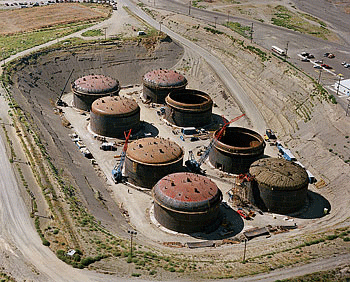 Nuclear Waste From the Cold War Is Being Stored in Unsafe Conditions. Time to Fix the Problem is Running Out, TIME, Nicholas K. Geranios and Manuel Valdes / AP, May 11, 2017 (RICHLAND, Wash.) — The collapse of a tunnel containing radioactive waste at the Hanford nuclear weapons complex underscored what critics have long been saying: The toxic remnants of the Cold War are being stored in haphazard and unsafe conditions, and time is running out to deal with the problem.
“Unfortunately, the crisis at Hanford is far from an isolated incident,” said Kevin Kamps of the anti-nuclear group Beyond Nuclear.
For instance, at the Savannah River Site in South Carolina, which opened in the 1950s and produced plutonium and tritium, the government is laboring to clean up groundwater contamination along with 40 million gallons of radioactive liquid waste stored in tanks that are decades past their projected lifespan. The job is likely to take decades.
In addition to the tunnel collapse discovered Tuesday, dozens of underground storage tanks at the Hanford Nuclear Reservation in Washington state — some dating to World War II — are leaking highly radioactive materials.
The problem is that the U.S. government rushed to build nuclear weapons during the Cold War with little thought given to how to permanently dispose of the resulting waste.
Safely removing it now is proving enormously expensive, slow-going, extraordinarily dangerous and so complex that much of the technology required simply does not exist. The cleanup has also been plagued with political and technical setbacks.
For example, the nation’s only underground nuclear waste repository, in New Mexico, closed to new shipments in 2014 after an improperly packed drum of waste ruptured. The site just recently reopened.
The U.S. Department of Energy spends about $6 billion a year on managing waste left from the production of nuclear weapons. “The temporary solutions DOE has used for decades to contain radioactive waste at Hanford have limited lifespans,” said Sen. Ron Wyden, an Oregon Democrat and frequent Hanford critic. “The longer it takes to clean up Hanford, the higher the risk will be to workers, the public and the environment.”
U.S. Energy Secretary Rick Perry acknowledged the problem with nuclear waste, saying the nation can no longer delay fixing the problem because lives are at stake.
During a tour Wednesday of the Los Alamos National Laboratory in New Mexico, Perry said the federal government has failed to remove the waste in a timely manner and he pledged to make progress.
A recently approved bipartisan federal budget deal for this fiscal year includes $2.3 billion for the ongoing Hanford cleanup, which matches the amount that Sen. Patty Murray, a Washington Democrat, worked to include last year. President Donald Trump is expected to release his 2018 proposal later this month.
Washington Gov. Jay Inslee said the state plans to issue an order making sure the federal government determines the cause of the tunnel collapse. The order will also require the Energy Department to assess if there’s an immediate risk of failures in any other tunnels and take actions to safely store waste in the tunnels until a decision is made about how to permanently handle the material.
Thousands of workers at Hanford were told to stay home as efforts began to plug the 400-square-foot (37-square-meter) sinkhole in the earth over the unoccupied storage tunnel…….http://time.com/4775268/tunnel-collapse-nuclear-waste-hanford/
May 12, 2017
Posted by Christina Macpherson |
safety, USA, wastes |
Leave a comment
 Collapsed tunnel sealed at U.S. nuclear site after accident, Chicago Tribune, Nicholas K. GeraniosAssociated Press, 11 May 17, Workers at a Washington state nuclear site where a tunnel filled with nuclear waste in railroad cars partially collapsed have safely sealed off a large sinkhole that emerged as a result of the collapse, U.S. Energy Secretary Rick Perry said Thursday.
Authorities also revealed that the 400-square foot (37-square meter) sinkhole they filled with soil could have been there since last weekend before it was discovered Tuesday. That’s because the area around the Hanford Nuclear Reservation’s waste-filled tunnels is not observed every day by workers who patrol the site’s sprawling grounds………
Washington state officials on Wednesday demanded that the federal Energy Department immediately assess the integrity of all the Hanford tunnels.
“The infrastructure built to temporarily store radioactive waste is now more than a half-century old,” said Maia Bellon, director of the state Department of Ecology, which oversees and regulates the federal government’s Hanford cleanup.
The 360-foot long (110-meter) rail tunnel that collapsed was built in 1956 from timber, concrete and steel and covered with 8 feet (2.4 meters) of dirt. Eight flatbed railroad cars loaded with radioactive material were parked there in 1965.
A much larger nearby tunnel built in 1964 has 28 railroad cars with radioactive waste.
The Energy Department was warned in a 2015 report it commissioned that both tunnels were vulnerable to a collapse from an earthquake or deterioration of tunnel building materials caused by intense radiation, the report said.
The nearby Yakama Nation said it has warned about the safety of the tunnels for several years.
“No preventative action was taken,” the tribe said in a statement.
The tribe also said the tunnels should be cleaned of radioactive waste and radiation long before a deadline of 2042 set by a cleanup agreement between the federal and state governments.
The cleanup of Hanford’s waste is expected to last until 2060 and cost an additional $100 billion over the $19 billion already spent. http://www.chicagotribune.com/news/nationworld/ct-nuclear-waste-tunnel-20170511-story.html
May 12, 2017
Posted by Christina Macpherson |
incidents, USA |
Leave a comment
CIA sets up Korea Mission Centre to address nuclear and ballistic missile threat, http://www.firstpost.com/world/cia-sets-up-korea-mission-centre-to-address-nuclear-and-ballistic-missile-threat-3437932.html12 May 17, Washington: The CIA has established a Korea Mission Centre to address “the nuclear and ballistic missile threat posed by” North Korea and its “unpredictable” leader Kim Jong-un, the US agency revealed in a statement.
The creation of the centre focusing on specific threats, will allow the Central Intelligence Agency to “harness the full resources, capabilities, and authorities” to deal with North Korea, CNN quoted the statement as saying late Wednesday.
The centre will put together CIA analysts and officers side by side in one location to tackle the threat from Pyongyang.
“The new Mission Centre draws on experienced officers from across the Agency and integrates them in one entity to bring their expertise and creativity to bear against the North Korea target,” the statement said.
Former CIA senior analyst John Nixon told CNN he expected the centre to issue “sitreps” — situation reports — for the intelligence community and President Donald Trump’s administration, possibly twice daily, indicating a round-the-clock watch by an office of significant size.
In the statement, CIA Director Mike Pompeo said the creation of the centre focuses the CIA’s efforts against the “serious threats” emerging from North Korea, which has ramped up both nuclear and missile tests in an effort to enhance its military capabilities.
There are 10 such existing centres in the CIA, and the new addition will be the most focused in terms of geographical area and remit — the Korean Peninsula currently falls under the jurisdiction of the Mission Centre for East Asia and Pacific.
May 12, 2017
Posted by Christina Macpherson |
USA, weapons and war |
Leave a comment
 Nuclear subsidies distort markets, hurt business, say FirstEnergy opponents http://www.cleveland.com/business/index.ssf/2017/05/nuclear_subsidies_distort_mark.html By John Funk, The Plain Dealer on May 10, 2017 CLEVELAND, Ohio — Business and consumer groups joined forces Tuesday to oppose FirstEnergy’s plan to change Ohio law to create new subsidies for the power company’s nuclear power plants.
On the opposite side, supporting FirstEnergy, were unions, a contractor’s group, and the Perry local school district, which benefits from taxes from the Perry nuclear power plant.
The Ohio Manufacturers’ Association, the Ohio Consumers’ Counsel, the Lordstown Energy Center, Dynegy, now the state’s largest owner of coal-fired power plants, the American Petroleum Institute and the Electric Power Supply Association were among more than a dozen groups testifying against enabling legislation before the Ohio House Public Utilities Committee.
“House Bill 178 or the Zero Emission Nuclear credit bill would provide an enormous subsidy to one nuclear operator for units that they contend are no longer economic to operate,” said Robert Flexon, CEO of Houston-based Dynegy Inc.
“Our economy will not grow and prosper by artificially keeping alive business that can no longer compete in the marketplace through expensive subsidies,” he told lawmakers. “That has been the case throughout American history. Were that not so, we’d still have buggy whip and icebox manufacturers and teletype and elevators operators.”
Later in an interview, Flexon said the zero emissions argument, meaning the plants deserve higher rates because they don’t produce carbon dioxide, is a “red herring.”
“The nuclear plants are deeply out of the money. You [the state] would be throwing billions of dollars down a nuclear waste hole. These plants can’t live without subsidies. Why do you want to put more bills on your citizens? It’s beyond me.”
Flexon was joined by William Siderewicz, president of Boston-based Clean Energy Future, which is building four gas turbine power plants at two northern Ohio locations, including Lordstown.
You would be throwing billions of dollars down a nuclear waste hole. These plants can’t live without subsidies.”
Calling for the House to “summarily reject” any form of the legislation, Siderewicz charged that FirstEnergy’s objective was not to save Davis-Besse and Perry nuclear power plants, but to prepare for selling the plants or closing them and paying for the decommissioning.
Former Republican lawmaker Jeff Jadobson, now a lobbyist, appeared before the committee on behalf of the Ohio Consumers’ Counsel and the Northeast Ohio Public Energy Council, which oppose the bill.
He said Ohio consumers are stuck with the 18th highest electric rate in the nation despite being “awash in shale oil and natural gas that have given us historically low gas prices” — which is leading to a building boom in new gas plants.
“But there is a problem that is preventing Ohio families and businesses from realizing the full benefits of lower prices in the market,” he said. “That problem is the continuing requests by Oho electric utilities — now years since the 1999 deregulation law’s transition period ended — for consumers to pay subsidies above the market price of electricity.”
He said FirstEnergy received $9.8 billion in subsidies between 2001 and 2010 to help it transition from the old regulated markets to competitive deregulated markets. And as of Jan. 1, the company has been permitted to collect an additional $204 million a year for up to five years in additional subsidies.
“FirstEnergy is back. Respectively, you should stop this cycle of subsidies and give consumers more of the benefit of competition intended under the 1999 law,” he told the lawmakers.
Earlier in the day, Chris Zeigler, executive director of the American Petroleum Institute’s Ohio division, and Erica Bowman, API chief economist, told reporters that FirstEnergy’s proposed subsidies could stall the development of the 10 or more gas turbine power plants proposed or already being built in Ohio. And in turn, that could stall further development of Ohio’s rich shale gas deposits.
Bowman also testified, concluding that API is strongly opposed to House Bill 178. It would skew markets by propping up uncompetitive nuclear generation, increase costs for ratepayers and job-creating industries, and discourage investment in natural gas production and gas-fired power plants. ”
Other opponents included the Ohio Environmental Council, AARP Ohio, the League of Women Voters of Ohio, Ohio Citizen Action the Environmental Defense Fund and the Nuclear Information and Resource Service.
FirstEnergy initially asked that lawmakers vote on the bill by June 30, but at this point that is not expected to happen.
All of the testimony is posted on the committee’s website.
May 12, 2017
Posted by Christina Macpherson |
business and costs, politics, USA |
Leave a comment
The utilities must make a decision by June 26 whether to build one or both of the reactors or scrap the plan entirely. Santee Cooper’s board of directors met in a private session Wednesday to get legal advice on the project but took no action…….
The utilities also are counting on an extension of federal tax credits for new nuclear projects to keep V.C. Summer alive. Those credits expire at the end of 2020, and it’s not certain the two reactors — which are only about one-third complete, according to a filing with the S.C. Public Service Commission — will be online by then. An effort to extend the tax credit deadline has gotten little traction in Congress.
May 12, 2017
Posted by Christina Macpherson |
business and costs, USA |
Leave a comment