Perry made the comments during a visit to Los Alamos National Laboratory in northern New Mexico, where nuclear research has been among the main focuses since the lab’s founding years…….Perry says nuclear power is a clean, resilient and reliable source of energy and that continued research in the field could end up leading to fresh discoveries that could have environmental benefits. http://www.kob.com/new-mexico-news/energy-secretary-rick-perry-tours-birthplace-of-atomic-bomb-los-alamos-national-laboratory-lanl/4479174/
Montana’s glaciers disappearing – shrinking, like many glaciers world-wide
 Glaciers rapidly shrinking and disappearing: 50 years of glacier change in Montana https://phys.org/news/2017-05-glaciers-rapidly-years-glacier-montana.html#jCphttp://phy.so/413641276 May 10, 2017 The warming climate has dramatically reduced the size of 39 glaciers in Montana since 1966, some by as much as 85 percent, according to data released by the U.S. Geological Survey and Portland State University. On average, the glaciers have reduced by 39 percent and only 26 glaciers are now larger than 25 acres, which is used as a guideline for deciding if bodies of ice are large enough to be considered glaciers.
The data include scientific information for the 37 named glaciers in Glacier National Park and two glaciers on U.S. Forest Service land. The retreat of glaciers is significant in Montana because of the impact shrinking glaciers can have on tourism, as well as being a visual indicator of mountain ecosystem change in the northern Rocky Mountains.
“The park-wide loss of ice can have ecological effects on aquatic species by changing stream water volume, water temperature and run-off timing in the higher elevations of the park,” said lead USGS scientist Dr. Daniel Fagre.
Portland State geologist Andrew G. Fountain partnered with USGS on the project. He said glaciers in mountain ranges throughout the United States and the world have been shrinking for decades.
“While the shrinkage in Montana is more severe than some other places in the U.S., it is in line with trends that have been happening on a global scale,” Fountain said.
Scientists used digital maps from aerial photography and satellites to measure the perimeters of the glaciers in late summer when seasonal snow has melted to reveal the extent of the glacial ice. The areas measured are from 1966, 1998, 2005 and 2015/2016, marking approximately 50 years of change in glacier area.
Site visits to glaciers were also made over several years to investigate portions that were covered by rock debris that are difficult to see with digital imagery. The mapped measurements of glaciers complement ground surveys of glaciers using GPS along with repeat photography that involves re-photographing historic photos of glaciers taken early last century when there were an estimated 150 glaciers larger than 25 acres in Glacier National Park.
“Tracking these small alpine glaciers has been instrumental in describing climate change effects on Glacier National Park to park management and the public,” said Lisa McKeon, USGS scientist who has been documenting glacier change since 1997.
This information is part of a larger, ongoing USGS glacier study of glaciers in Montana, Alaska and Washington to document mass balance measurements that estimate whether the total amount of ice is increasing or decreasing at a particular glacier. This information helps scientists understand the impact of large scale climate patterns on glaciers in distinctly different mountain environments.
The data for Glacier National Park’s named glaciers are available at the USGS ScienceBase website. Additional information about the glacier research can be found at the USGS Northern Rocky Mountain Science Center website and the USGS Benchmark Glacier program website.
Bill in USA Congress to ready USA for a nuclear attack emergency
Bipartisan bill allows Washington to prepare for nuclear attack https://mynorthwest.com/628630/bi-partisan-bill-allows-washington-to-prepare-for-nuclear-attack/ BY KIRO RADIO STAFF, Staff report | May 10, 2017 As North Korea threatens to nuke the United States, a new bill in the Legislature would allow Washington state to prepare for it.
Current state law requires an “all-hazard emergency plan for the natural, technological, or human-caused hazards which could affect” citizens. But a law passed in 1984 says that any such plan “may not include preparation for emergency evacuation or relocation of residents in anticipation of nuclear attack.”
A bill introduced by senators David Frockt, a Democrat, and Mark Miloscia, a Republican, would get rid of that language.
They say recent tensions between the U.S. and North Korea makes the idea timely.
Georgia Power officials consider fate of Vogtle Nuclear Power Plant construction – cancellation is an option
 Contractor Bankruptcy Looms at Georgia Nuclear Plant Hearing https://www.usnews.com/news/best-states/georgia/articles/2017-05-11/contractor-bankruptcy-looms-at-georgia-nuclear-plant-hearing
ATLANTA (AP) — Georgia Power executives say they’re considering all options in ongoing construction of a new nuclear plant near Augusta following March’s bankruptcy filing by the project’s lead contractor.
Rick Perry’s correct title- U.S. Secretary For The Nuclear Industry
 US energy secretary touts nuclear power, KOB4, May 10, 2017 ALAMOS, N.M. (AP) – U.S. Energy Secretary Rick Perry says he will advocate for nuclear power as often and as strongly as he can as the nation looks for ways to fuel its economy and limit the effects of electricity generation on the environment.
Another radioactive waste accident, this time at Hanford, shows nuclear dump sites are not under control
 Beyond Nuclear, TAKOMA PARK, MD, May 9, 2017 — A tunnel at the Hanford Nuclear Site in Washington State collapsed today on top of railcars stored there that contain “mixed” radioactive waste, an accident that local watchdog group, Hanford Challenge, describes as a “crisis.”
The tunnel is located next to the Plutonium Uranium Extraction Facility, also known as PUREX, and contains substances classified as “dangerous waste.” The collapse prompted an initial evacuation of workers in the area that then spread to a “take cover” order for the entire site.
The already embattled Hanford site was originally part of the Manhattan Project, and a major supplier of military plutonium. It houses 177 storage tanks containing liquid radioactive sludges, some of which have been leaking radioactive effluent that could eventually threaten the Columbia River. Cleanup at the site did not begin until 1989. The Hanford tunnel collapse may have been caused by soil subsidence due to vibrations from nearby road works.
“The current unfolding crisis at Hanford, the bursting barrel at Waste Isolation Pilot Plant (WIPP) in New Mexico in 2014, and the exploding radioactive waste dump in Beatty, Nevada in 2015, show that radioactive waste management is out of control,” said Kevin Kamps, Radioactive Waste Watchdog at Beyond Nuclear
”That’s why the Yucca Mountain dump in Nevada, the Canadian dump targeted at the Great Lakes shore, and the parking lot dumps in Texas and New Mexico must be blocked, to prevent future disasters,” Kamps added.
WIPP, a radioactive waste repository mainly for military waste and situated near Carlsbad, NM, suffered an accident on February 14, 2014. The explosion there released radioactivity that exposed workers who were stationed above ground at the time and forced an almost three-year shutdown of the site. The disaster cost $2 billion and counting. As at Hanford, a relatively minor event — the use of the wrong kitty litter for cleanup — was blamed for the WIPP accident, prompting serious questions about competence and safeguards at such critically dangerous sites.
A leak in a massive nuclear waste storage tank at Hanford in April 2016 was described as “catastrophic” by a former tank farm worker there, even as the U.S. Department of Energy tried to downplay the problem.
Most commercial radioactive waste is currently stored at reactor sites around the country. However, military radioactive waste has continued to pose an on-going storage nightmare. Beyond Nuclear advocates for commercial reactor waste to be stored on-site but in facilities known as Hardened On-Site Storage, or HOSS, and not in the risky pools and inadequate waste casks, as is the current practice. -30- Beyond Nuclear aims to educate and activate the public about the connections between nuclear power and nuclear weapons and the need to abandon both to safeguard our future.
Beyond Nuclear advocates for an energy future that is sustainable, benign and democratic. The Beyond Nuclear team works with diverse partners and allies to provide the public, government officials, and the media with the critical information necessary to move humanity toward a world beyond nuclear. Beyond Nuclear: 6930 Carroll Avenue, Suite 400, Takoma Park, MD 20912. Info@beyondnuclear.org. www.beyondnuclear.org.

Collapse of nuclear waste storage tunnel at Hanford
Tunnel collapses at Hanford; no radiation released, officials say http://www.king5.com/news/local/hanford/tunnel-collapses-at-hanford-no-radiation-released-officials-say/438227872 Hundreds of workers were told to take cover at the Hanford Nuclear Reservation after a tunnel full of highly contaminated materials collapsed Tuesday morning. But officials say no radiation was released and no workers were hurt.Officials say a collapsed patch of ground above the tunnel was larger than first believed. The U.S. Department of Energy said the collapse covered about 400 square feet (37.1 square meters) instead of the 16 square feet (1.4 square meters) first reported.
Nuclear waste storage tunnel caves-in at Hanford
Hundreds of workers were told to go into a “take cover” position after the tunnel in a plutonium uranium extraction (PUREX) plant collapsed.
The agency says the rail tunnels are hundreds of feet long, with about eight feet (2.4 meters) of soil covering them. The U.S. Department of Energy says the incident caused the soil above the tunnel to sink between 2 and 4 feet (half to 1.2 meters).
“I would underscore this is confined to a small area of the Hanford site,” Destry Henderson, deputy news manager for the Hanford Joint Information Center, told NBC News. “The facility does have radiological contamination right now but there is no indication of a radiological release,” Henderson said.
A manager sent a message to all personnel telling them to “secure ventilation in your building” and “refrain from eating or drinking.”
A source said “take cover” status was expanded to the entire site at 10:35 a.m. The source also said that crews doing road work nearby may have created enough vibration to cause the collapse, and that Vit Plant employees were in cover mode as well.
Scathing criticism of Trump’s foreign policy – from former US intelligence officers
 Dahr Jamail | Former US Intelligence Officers Scathingly Critique Trump’s So-Called Foreign Policy, May 08, 2017, By Dahr Jamail, Truthout | News Analysis
“……..As the Trump administration appears poised to become increasingly involved in Syria and the greater Middle East, what is life like under the bombs?………
As that conflict continues with no end in sight, in yet another direct contradiction to his campaign promises to avoid involvement in Middle East conflicts, Trump is now on the brink of plunging the US deeper into the morass of blood, destruction and suffering across the Middle East and beyond.
Several former intelligence officials spoke with Truthout about the Trump administration’s military escalations, and what his mistakes could mean for the world’s future.
Syria as a Distraction The former officials pointed to Trump’s escalation of US attacks on Syria as a distraction from investigations into his administration.
I think it’s clear that Donald Trump found it expedient to fire the 59 Tomahawk missiles at the Syrian air base on April 7 as a way to quell the media frenzy surrounding ‘Russiagate’ that was causing his approval ratings to tank,” Elizabeth Murray, who was formerly the deputy national intelligence officer for the Near East in the National Intelligence Council, told Truthout. Murray retired in 2010 after a 27-year career with the Central Intelligence Agency (CIA), where she served as a media and political analyst on Middle Eastern issues.
Murray believes Trump seized the opportunity to blame the Syrian government for the April 4 chemical weapon incident so that he could use it as a pretext to bomb.
“By giving his generals the green light to launch the missiles, he was able to silence media criticism, appease pro-war neoconservative elements and shore up his flagging image,” Murray explained……….
From Bad to Worse
According to Murray, in terms of the trajectory of developments in Syria and Iraq, it’s very difficult to be optimistic in the near term.
“What’s really disturbing is that US citizens are being prevented from knowing what is really going on with regard to US involvement in those countries,” she said. “The Trump administration has announced that the public will no longer be informed of new troop deployments to Iraq and Syria, while this was routinely disclosed under the previous administration.”
She sees that as an indication that US military activity in both countries is being ramped up in a clandestine manner; and since deploying ground troops to these countries is wildly unpopular, the Trump administration has decided to keep the American people in the dark………
Given that the US military does not report numbers of civilian casualties in Iraq, Syria and Afghanistan, it is impossible for Americans to hold their so-called leaders accountable when they are prevented from knowing what is even occurring.
“These kinds of policies will leave us dependent on journalists and whistleblowers willing to risk their lives and livelihoods to tell the truth,” Murray added. “Meanwhile, weapons manufacturers and Washington, DC-based ‘beltway bandits’ [the cottage industry of think tanks and contractors servicing the Defense Department and intelligence agencies] will continue to thrive under a foreign policy of endless wars.”………
Murray thinks face-to-face talks with North Korean leadership are required to de-escalate tensions, which Trump has gone out of his way to ratchet up. Additionally, she says Washington should scale back the ongoing hostile rhetoric and major military maneuvers it has been conducting in the region.
“If one reads the terrible history of US military intervention in North Korea, it’s easy to understand why Pyongyang is jittery and testing its ballistic missiles,” Murray said. She noted that a similar process of de-escalation should be employed with regard to Syria and Russia, adding that Iran should be included in these negotiations………http://www.truth-out.org/news/item/40490-former-us-intelligence-officers-scathingly-critique-trump-s-so-called-foreign-policy
Texas Nuclear Waste Bill is amended in a big win for environmentalists

 Big Win for Enviros in Texas as Nuclear Waste Bill Is Amended https://www.citizen.org/media/press-releases/big-win-enviros-texas-nuclear-waste-bill-amended
AUSTIN, Texas — Today marked a win for environmentalists and opponents of nuclear waste storage in Texas. Under pressure from his peers in the legislature, Texas Rep. Brooks Landgraf (R-Odessa) removed key provisions from his bill (CSHB 2662) proposing to expand storage capacity at the low-level radioactive waste site in Andrews County, Texas.
Public Citizen mobilized its members in Texas to oppose the bill.
“This was the latest attempt by Waste Control Specialists to expand its low-level radioactive waste site,” said Adrian Shelley, director of Public Citizen’s Texas office. “The company is in dire financial straits already, and digging another pit won’t change that. It would have created an expensive radioactive mess that the people of Texas would have been left to clean up.”
“The pared-back bill is a great victory for the health and safety of Texans,” said Karen Hadden, director of the SEED Coalition. The bill, which the House of Representatives approved, only commissions a study of storage capacity at the site.
The Senate companion bill, SB 1137, is pending in committee and contains the original language to expand nuclear waste storage capacity at the Andrews County site. But in floor comments, Landgraf, pledged to stick with his House version of the bill during future negotiations with the Senate.
“They can study this all they want,” added Shelley. “They’re going to find that it’s a bad idea.”
Recently opened Watts Bar 2 nuclear power plant already shut down for repairs
America’s first ’21st century #nuclear plant’ already has been shut down for repairs, LA Times, Michael Hiltzik Contact Reporter, May 8 2017, When the Tennessee Valley Authority’s Watts Bar 2 nuclear power plant was finally approaching completion the big public utility hailed it as “the nation’s first new nuclear generation of the 21st century.”
That was in October 2015, and the plant was thought to be only a few months away from going online. But it wasn’t until October 2016 that Watts Bar 2 began operating commercially. In March, just over five months later, the plant went offline — and it’s expected to remain offline at least into this summer, the TVA region’s peak period for electrical demand.
The 21st century is shaping up as not a good one for nuclear power, and Watts Bar Unit 2 may show why. The U.S. nuclear industry is running in neutral, except when it runs in reverse. Other than Watts Bar 2, the last new nuclear plant to enter American service is now nearly 20 years old — TVA’s 1996-vintage Watts Bar Unit 1.
California is on the verge of exiting the nuclear power field entirely, with the planned mothballing of Pacific Gas & Electric’s Diablo Canyon power plant. Diablo Canyon’s two reactors are to be shut down in 2024 and 2025 as part of a deal reached last year for the utility’s transition to other renewable sources. That deal followed the 2013 decision of Southern California Edison to permanently close San Onofre, the state’s only other nuclear power plant, following a botched attempt at its refurbishment.
The immediate cause of the Watts Bar shutdown is the failure of components of the unit’s condenser, which cools steam used to drive the generating turbines back into water. TVA took the plant off-line on March 23 and is still trying to pinpoint the cause of the condenser failure.
But the problems at Watts Bar arise from more than just a structural failure of the condenser. They’re also connected to the plant’s long gestation and to maladies endemic to the entire nuclear power industry.
Watts Bar 2 holds the world record for the longest gestation of any nuclear plant in history, having been listed as “under construction” for 43 years. Construction was launched in 1972 and suspended in 1985, when the plant already was 60% complete. By then, despite an initial cost estimate of about $400 million, some $1.7 billion had been spent. Construction resumed in 2007. The total cost is now estimated at $6.1 billion……..
Watts Bar, the so-called 21st century American nuclear plant, defines the crisis facing the U.S. nuclear industry. It’s stuck with outmoded technology and a management culture that exacerbates, rather than constrains, the technology’s safety issues. With every episode like this, the industry moves one step further away from making the case for its survival. http://www.latimes.com/business/hiltzik/la-fi-hiltzik-nuclear-shutdown-20170508-story.html
Protect our water! Indigenous opposition to uranium mining in South Dakota
Water is rallying cry for opponents at uranium-mine hearing, Rapid City Journal, Seth Tupper Journal staff, May 9, 2017 The spirit of a recent protest against a crude-oil pipeline energized opponents of a proposed southwest South Dakota uranium mine Monday during a public hearing.
Environmental Protection Agency dismisses at least five members of a major scientific review board
 E.P.A. Dismisses Members of Major Scientific Review Board MAY 7, 2017 WASHINGTON — The Environmental Protection Agency has dismissed at least five members of a major scientific review board, the latest signal of what critics call a campaign by the Trump administration to shrink the agency’s regulatory reach by reducing the role of academic research.
Eventual reuse of Vermont Yankee nuclear reactor not a realistic possibility
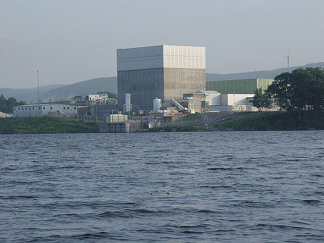 Vermont Yankee: Expert says faster reuse unrealistic amid national waste dilemma, Brattelboro Reformer, May 5, 2017 By Lissa Weinmann, BRATTLEBORO — Hopes for an expedited decommissioning and eventual reuse of the shuttered Vermont Yankee nuclear reactor are unrealistic and potentially misplaced, according to a radioactive waste policy expert and activists who will visit Brattleboro for a community discussion on “Nuclear Waste: The Road from Vermont Yankee to Texas” on Saturday, May 6, from 4:30 to 6 pm at the community room at the Brattleboro Food Co-op.
The presentation comes as federal and state authorities consider the sale of the plant to NorthStar Industries Inc., which has touted a faster decommissioning at a lower price than Entergy had planned.
Kevin Kamps, Radioactive Waste Watchdog for Maryland-based Beyond Nuclear, who has studied nuclear waste issues in the U.S. and globally for 25 years and is to be featured at the event, said he expects decommissioning will be hampered by deeper levels of radioactive contamination and reuse delayed by the continued presence of high level nuclear waste in dry cask storage on the Yankee site for many decades to come.
Kamps’ warning of a long wait amid hot controversy was underscored by testimony at an April 26 House Energy and Commerce Committee hearing on the draft Nuclear Waste Policy Amendments Act, which would break with current law to allow private companies like Waste Control Specialists, a Texas-based partner in the proposed Yankee sale, to build consolidated interim storage facilities to accept waste from the power plant site before a permanent deep geologic repository that could best contain lethal material for hundreds of thousands of years is available. ……
The Trump Administration’s congressional budget request in March 2017 includes “$120 million to restart licensing activities for the Yucca Mountain nuclear waste repository and initiate a robust interim storage program.” The nuclear industry in 2014 stopped paying a fee on nuclear energy generation to build a central repository; That $46 billion Nuclear Waste Fund falls far short of the “trillions” the DOE anticipates will be required to fund the facility.
WCS applied to the NRC in April 2016 for a license to construct and operate a centralized interim storage site adjacent to its lower-level radioactive dump (where thousands of tons of concrete and other waste from the Vernon site will be transported) in Andrews, Texas, stipulating that the DOE must bear sole and full liability for the waste even though, under current law, liability and title remain with the generators until the waste is taken away to an operating repository.
But the effort to quickly clean up the Vernon site was dealt a significant blow when Rod Baltzer, Waste Control Specialists president and chief executive officer, wrote a letter asking the NRC to “temporarily suspend” its review of the company’s application for a high-level waste dump. Baltzer cited a “magnitude of financial burdens.” The cost of the NRC review now is estimated at $7.5 million, “which is significantly higher than we originally anticipated,” he wrote.
“The bottom line for this push to interim storage is that nuclear companies want to reduce their liability for this highly problematic waste product as quickly as possible,” said Kamps. “Republican leaders in Congress and the nuclear companies who contribute to them want to weaken the law to allow privately owned de facto permanent parking lot dumps in Texas and New Mexico where liability for any problems is transferred to the U.S. taxpayer.”……..
UCS has yet to see an analysis demonstrating that the benefits of interim storage clearly outweigh the additional costs and risks associated with siting and licensing new storage facilities and the extra transportation that would be required,” Dr. Edwin Lyman, Senior Scientist at the Union of Concerned Scientists — a group that is not against nuclear power — testified to Congress, adding that interim sites raise the potential of terrorists getting bomb-making material.
“Transporting waste is the weakest link of a nonsensical interim plan that has nothing to do with finding a permanent repository,” Kamps said. “It plays musical chairs with deadly waste on US highways and rail lines, exposing millions of people to addition risk for no good reason.”
Advocates of interim storage say radioactive materials are transported all the time without incident, but Kamps said incidents do occur and that NorthStar partner Areva had acknowledged `numerous violations of surface contamination many hundreds of times above the allowable limits’ when transporting waste in France.
“CAN advocates for hardened on site storage to protect reactor communities until there is a scientifically sound and environmentally just solution for this toxic waste,” Katz said. “The communities targeted for nuclear waste are routinely rural, low income people of color and Native Americans. It is terrible to put people in the position of having to choose between short term economic survival and long term health and safety. Reactor and targeted communities need to work together to advocate for solutions that do the least harm.”……
Kamps says there is a reason that Entergy estimated $1.2 billion cleanup and NorthStar is estimating it will take less than half of that. “I have no doubt that the site is massively contaminated. We don’t know how long the underground pipes Entergy lied about having were leaking radioactive particles into the ground.”
Katz agreed. “NorthStar will find a much larger problem as all nuclear decommissionings have, but on a fixed contract, it will devise every trick in the book to limit cleanup,” so the public must remain vigilant, Katz said. “With Yankee Rowe and Connecticut Yankee, we had to bring documents to the state to show them that Yankee was putting the test wells exactly where the contamination wasn’t.”…….http://www.reformer.com/stories/vermont-yankee-expert-says-faster-reuse-unrealistic-amid-national-waste-dilemma,506578
Concern that Plymouth’s representatives will have little say in decommissioning process of the Pilgrim Nuclear Power Plant.
Nuclear Decommissioning Citizens Advisory Panel strategizes with selectmen, Wicked Local, Plymouth – The state’s Nuclear Decommissioning Citizens Advisory Panel will hold its first meeting in Plymouth on May 24, but there is already concern that that Plymouth’s representatives on the panel will have little say in the decommissioning process of the Pilgrim Nuclear Power Plant.
Based on the numbers alone, Plymouth’s interests should be well represented on the panel……..
Their basic mission, Grassie said, was to meet four times a year, advise the governor, general court and the public on the issues, “serve as a conduit of communications and encourage public involvement” and receive and issue reports.
Meanwhile, Grassie said, Entergy would hold its own meetings, including with the NRC, and making decisions including, as happened with the recently closed Entergy-owned Vermont Yankee nuclear plant, selling the decommissioning function to a separate entity altogether……..
The basic priorities that town officials and panelists will take are, however, becoming clear.
Because of safety concerns the town does not want spent fuel to be left in the pool inside the reactor building. Fortunately Entergy likely doesn’t want that either because, when the spent fuel is out of the pool they can dramatically reduce on-site staff and, therefore, reduce their management costs as well.
The town does not want spent fuel stored forever on site permanently. Unfortunately there is neither a temporary or permanent national spent fuel storage facility available at this time.
In the event that spent fuel in dry cask storage remains on site for the foreseeable future the town wants to be fairly compensated.
The town does not want to see the decommissioning fund used to pay for other costs associated with the continued presence of radioactive materials at the site. That has been happening at Vermont Yankee, where the decommissioning fund has been used to pay the tax payments charged by the host community……
The town wants the rights to the so-called “1,500 acres,” the largely pristine buffer around the plant that stretches from the waterfront around the plant, to the top of the Pine Hill.
The town wants a lot but the question on the minds of the panel members right now is simple: How can they influence the process effectively toward those goals?……..http://plymouth.wickedlocal.com/news/20170506/nuclear-decommissioning-citizens-advisory-panel-strategizes-with-selectmen
All too similar to Fukushima prefecture- Savannah River schools get education funding and resources from nuclear company
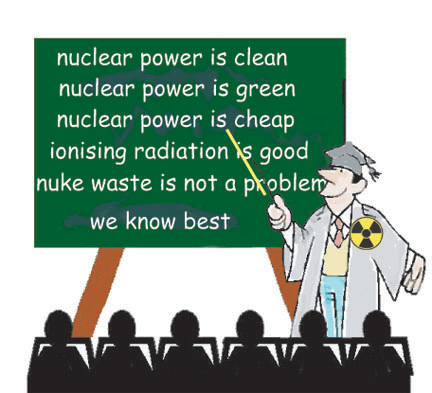 SRNS provides funding support for innovative education in Augusta area, Augusta Chronicle May 6, 2017, By Thomas Gardiner Staff Writer “…… The vision of the school’s faculty caught the attention of Savannah River Nuclear Solutions, which recently funded the school’s purchase of a new semester-long class called Science and Technology…….
According to a release from SRNS, the management and operations contract company at Savannah River Site, the funding paid for teacher registration, professional development, and the materials and software to make the Science and Technology class a reality.
“Jackson Middle School has purchased the Science and Technology class, funded by Savannah River Nuclear Solutions (SRNS),” Kishni Neville, STEM Coordinator said in the release. “Using the materials and information provided through this class, our seventh and eighth graders explore principles of applied chemistry, nanotechnology and physics.”
She said the Engineering Design Process, a relatively new academic philosophy at Jackson Middle, is an important element of nearly all their instruction…….
SRNS has thus far donated about $4,000 in support of Jackson Middle School. The organization also donates to other area educational activities through Aiken County’s Public Education partners and its Innovative teaching Mini Grants. The Mini Grants program started in 2009 and has awarded over $500,000 total to teachers in the Augusta area.
The program awards cash grants of $500, $750, and $1,000 to teachers implementing innovative ideas in elementary and middle school math and science curricula. The annual program is open to teachers in Aiken, Allendale, Bamberg, Barnwell, and Edgefield counties in South Carolina and Columbia and Richmond counties in Georgia. http://chronicle.augusta.com/news/2017-05-06/srns-provides-funding-support-innovative-education-augusta-area
1 This Month





PLEASE OPPOSE HR 8255 AND S.3639 – bills would accelerate satellite deployment, with no environmental review or safeguards – https://ncstd5li.quorum.us/campaign/169331/
To see nuclear-related stories in greater depth and intensity – go to https://nuclearinformation.wordpress.com
-
Archives
- October 2026 (81)
- September 2026 (339)
- August 2026 (330)
- July 2026 (355)
- June 2026 (287)
- May 2026 (306)
- April 2026 (356)
- March 2026 (251)
- February 2026 (267)
- January 2026 (308)
- December 2025 (358)
- November 2025 (359)
-
Categories
- 1
- 1 NUCLEAR ISSUES
- business and costs
- climate change
- culture and arts
- ENERGY
- environment
- health
- history
- indigenous issues
- Legal
- marketing of nuclear
- media
- opposition to nuclear
- PERSONAL STORIES
- politics
- politics international
- Religion and ethics
- safety
- secrets,lies and civil liberties
- spinbuster
- technology
- Uranium
- wastes
- weapons and war
- Women
- 2 WORLD
- ACTION
- AFRICA
- Atrocities
- AUSTRALIA
- Christina's notes
- Christina's themes
- culture and arts
- Events
- Fuk 2022
- Fuk 2023
- Fukushima 2017
- Fukushima 2018
- fukushima 2019
- Fukushima 2020
- Fukushima 2021
- general
- global warming
- Humour (God we need it)
- Nuclear
- RARE EARTHS
- Reference
- resources – print
- Resources -audiovicual
- Weekly Newsletter
- World
- World Nuclear
- YouTube
-
RSS
Entries RSS
Comments RSS

