Niagara region to learn about transport of nuclear waste, and its dangers
 Expert to speak on nuclear transporting https://www.niagarathisweek.com/news-story/7369046-expert-to-speak-on-nuclear-transporting/ Niagara District Council of Women welcome Gordon Edwards to Lincoln town hall Jun 13, 2017 by Luke Edwards Grimsby Lincoln News A U.S. judge has ruled the Department of Energy can proceed with its plan to import 6,000 gallons of liquid nuclear waste from Canada. The proposed route goes through Niagara.
LINCOLN — As shipments of highly radioactive nuclear waste begin making their way through the Niagara region, a local group is bringing in an expert to address what they say are some unanswered questions.
The Niagara District Council of Women will be welcoming Gordon Edwards to a meeting this Friday at Lincoln town hall. Edwards is a nuclear critic and president of the Canadian Coalition for Nuclear Responsibility, a non-profit group that focuses on military and civilian uses of nuclear, as well as non-nuclear alternatives.
Earlier this year a U.S. judge approved a plan to have nuclear waste transported from a research facility in Chalk River, Ont. through Niagara and across the Peace Bridge to Buffalo. The U.S. Department of Energy plans to import nearly 23,000 litres, or 6,000 gallons, of the waste.
According to the NDCW, many unanswered questions remain, including the nature of the liquid radioactive material, historical precedence for such transportation, possible alternatives and concerns over leakage or other dangers.
The meeting is expected to run from 9 a.m. to noon at town hall, 4800 South Service Rd. in Beamsville. For more information on the meeting, contact Gracia Janes at 905-468-2841, Ann Porter Bonilla at 905-973-1621 or Susan Pruyn at 905-892-5206.
Oyster Creek Reactor: Bad Nuclear Vibrations
Union of Concerned Scientists DAVE LOCHBAUM, DIRECTOR, NUCLEAR SAFETY PROJECT | JUNE 13, 2017, The Oyster Creek Nuclear Generating Station near Forked River, New Jersey is the oldest nuclear power plant operating in the United States. It began operating in 1969 around the time Neil Armstrong and Buzz Aldrin were hiking the lunar landscape.
Oyster Creek has a boiling water reactor (BWR) with a Mark I containment design, similar to the Unit 1 reactor at Fukushima Daiichi. Water entering the reactor vessel is heated to the boiling point by the energy released by the nuclear chain reaction within the core (see Figure 1). The steam flows through pipes from the reactor vessel to the turbines. The steam spins the turbines connected to the generator that produces electricity distributed by the offsite power grid. Steam discharged from the turbines flows into the condenser where it is cooled by water drawn from the Atlantic Ocean, or Barnegat Bay. The steam vapor is converted back into liquid form. Condensate and feedwater pumps supply the water collected in the condenser to the reactor vessel to repeat the cycle………
Bad Vibrations
In the early morning hours of November 20, 2016, the operators at Oyster Creek were conducting the quarterly test of the turbine control system. With the reactor at 95 percent power, the operator depressed a test pushbutton at 3:26 am per the procedure. The plant’s response was unexpected. The positions of the control valves and bypass valves began opening and closing small amounts causing the reactor pressure to fluctuate. Workers in the turbine building notified the control room operators that the linkages to the valves were vibrating. The operators began reducing the reactor power level in an attempt to stop the vibrations and pressure fluctuations.
The reactor automatically shut down at 3:42 pm from 92 percent power on high neutron flux in the reactor. Workers later found the linkage for control valve #2 had broken due to the vibrations and the linkage for control valve #4 had vibrated loose. The linkages are “mechanical arms” that enable the turbine control system to reposition the valves. The broken and loosened linkages impaired the ability of the control system to properly reposition the valves.
These mechanical malfunctions prevented the EHC system from properly controlling reactor pressure during the test and subsequent power reduction. The pressure inside the reactor vessel increased. In a BWR, reactor pressure increases collapse and shrink steam bubbles. Displacing steam void spaces with water increases the reactor power level. When atoms split to release energy, they also release neutrons. The neutrons can interact with other atoms to causing them to split. Water is much better than steam bubbles at slower down the neutrons to the range where the neutrons best interact with atoms. Put another way, the steam bubbles permit high energy neutrons to speed away from the fuel and get captured by non-fuel parts within the reactor vessel while the water better confines the neutrons to the fuel region.
The EHC system’s problem allowed the pressure inside the reactor vessel to increase. The higher pressure collapsed steam bubbles, increasing the reactor power level. As the reactor power level increased, more neutrons scurried about as more and more atoms split. The neutron monitoring system detected the increasing inventory of neutrons and initiated the automatic shut down of the reactor to avoid excessive power and fuel damage.
Workers attributed the vibrations to a design flaw. A component in the EHC system is specifically designed to dampen vibrations in the tubing providing hydraulic fluid to the linkages governing valve positions. But under certain conditions, depressing the test pushbutton creates a pressure pulse on that component. Instead of dampening the pressure piles, the component reacts in a way that causes the hydraulic system pressure to oscillate, creating the vibrations that damaged the linkages.
The component and damaged linkages were replaced. In addition, the test procedure was revised to avoid performing that specific portion of the test when the reactor is operating. In the future, that part of the turbine valve test will be performed during an outage.
Vibrations Re-Visited
It was not the first time that Oyster Creek was shut down due to problems performing this test. It wasn’t even the first time this decade…..http://allthingsnuclear.org/dlochbaum/oyster-creek-bad-vibrations
Renewable energy is beating nuclear power production in USA
 Renewable Energy Outproduces Nuclear In The U.S. [good graphs]
• The contribution from solar reached just over 2 percent
• The contribution from All Renewables exceeded that from Nuclear
• The combined contribution from Wind and Solar exceeded 10 percent
• The contribution from Non-Hydro Renewables exceeded 12 percent
………This year the increase in solar output in March seems significantly greater than in the previous three years. The solar generation capacity in the U.S. increased by over 57 percent for the year 2016 and data is not yet available from the Solar Energy Industries Association for the first quarter of 2017….http://oilprice.com/Alternative-Energy/Solar-Energy/Renewable-Energy-Outproduces-Nuclear-In-The-US.html
Is Britain unaware of the nuclear industry’s financial meltdown?
 The Nuclear Industry Is in Financial Meltdown, http://www.globalresearch.ca/the-nuclear-industry-is-in-financial-meltdown/5594253 By Ian Fairlie, Global Research, June 11, 2017 The Ecologist 9 June 2017 Most British politicians – waking up after a General Election which sent a strong message that the UK electorate don’t want railroading by its leaders – sail along blissfully innocent of nuclear’s impending denouement, not only in the rest of the world but in the UK too, writes IAN FAIRLIE.
The UK political situation on nuclear power is pretty uninspiring, apart from the Greens. Few political supporters of nuclear power appear to be aware that nuclear power is in free-fall around the world – especially in Western Europe and in the US, where many reactors are being closed without replacement.
Few seem aware of the legal, technical, regulatory, and economic difficulties faced by utilities in building the handful of new reactors and of the crippling costs of shutting down the many old ones. None appears aware of nuclear’s financial meltdown across the globe.
In a perceptive new article published by a prestigious US Ivy League University, Is Nuclear Power Coming To An End? Fred Pearce, a distinguished UK science writer, wrote:
“Now come the bankruptcies. In an astonishing hammer blow to a global industry in late March 2017, Westinghouse – the original developer of the workhorse of the global nuclear industry, the pressurized-water reactor (PWR), and for many decades the world’s largest provider of nuclear technology -filed for bankruptcy after hitting big problems with its latest reactor design, the AP1000.
“Largely as a result, its parent company, the Japanese nuclear engineering giant Toshiba, is also in dire financial straits and admits there is ‘substantial doubt’ about its ability to continue as a going concern.
“Meanwhile, France’s state-owned Électricité de France (EDF), Europe’s biggest builder and operator of nuclear power plants, is deep in debt thanks to its own technical missteps and could become a victim of the economic and energy policies of incoming President Emmanuel Macron.
“This is no short-term trend. While gas and renewables get cheaper, the price of nuclear power only rises. This is in large part to meet safety concerns linked to past reactor disasters like Chernobyl and Fukushima and to post-9/11 security worries, and also a result of utilities factoring in the costs of decommissioning their aging reactors.”
Pearce concludes by stating
“…the industry is in crisis. It looks ever more like a 20th-Century industrial dinosaur, unloved by investors, the public, and policymakers alike. The crisis could prove terminal.”
Most British politicians sail along blissfully innocent of nuclear’s impending denouement, not only in the rest of the world but in the UK too. The Government’s nuclear plans at Hinkley, Wylfa and Moorside are doubtful at best and moribund at worst.
First Anti-Nuclear Conference in 30 Years
We might shake our heads at the ignorance and irrationality of some of our senior politicians. However we should perhaps not despair too much, because on 17th June, CND is convening a one-day National Conference in London with a stellar array of speakers. No Need For Nuclear Conference
The Conference will explicitly discuss the incoherence and irrationality of the nuclear policies adopted by the main parties. Apart from Chernobyl or Fukushima anniversaries, this is the first anti-nuclear conference in the UK in about 30 years. As such, it marks the long overdue re-emergence of an important issue.
The UK anti-nuclear groups are relatively weak, under-resourced and fragmented, which means there has been little recent opposition to the Government’s irrational energy policies.
Perhaps this conference will help change that. No Need for Nuclear Conference booking:
- Buy your ticket on online
- Saturday 17 June 2017
- Conway Hall, 25 Red Lion Square
- London WC1R 4RL
Dr Ian Fairlie is an independent consultant on environmental radioactivity. He was formerly a senior scientist in the Civil Service and worked for the TUC as a researcher between 1975 and 1990.
US Senate’s move to impose new sanctions on Iran contradicts the nuclear deal

 Iran says US Senate bill contradicts nuclear deal http://en.trend.az/iran/
 politics/2765348.html, Tehran, Iran, June 11 By Mehdi Sepahvand
Iranian Deputy Foreign Minister Abbas Araqchi has said the US Senate’s move to impose new sanctions on Iran is contradicts the nuclear deal, officially called the Joint Comprehensive Plan of Action (JCPOA).
“We believe such legislation is contradictory to the principle of good will and successful implementation of the JCPOA,” he said, IRIB news agency reported June 11.
Araqchi censured the legislation as “shameful” and said it shows “confusion” and “wrong policies”.
He described the U.S. Senate’s status in condemning Iran for supporting terrorism is “farcical” and “shameful”.
The US Senate on Wednesday voted overwhelmingly to advance a bill that would impose new sanctions on Iran.
A senior Senate aide said the Iran sanctions measure could come up for a vote as soon as next week. The legislation would impose new sanctions on Iran over its defense missile program, support for resistance movements and claims of human rights violations against the country.
To become law, the measure would have to pass the Republican-led House of Representatives and be signed by President Donald Trump. So far, Washington has slapped two rounds of sanctions on Iran under the new US administration in breach of a nuclear accord.
Fire danger of America’s nuclear waste pools – underestimated by Nuclear Regulatory Commission (NRC)
 Study: US NRC Relied On Faulty Analysis To Justify Refusal To Adopt Catastrophic Nuclear Waste Fire Safety Measures, Clean Technica, June 11th, 2017 by James Ayre , A new study from Princeton University and the Union of Concerned Scientists has revealed that the US Nuclear Regulatory Commission (NRC) relies on faulty analysis to “justify its refusal to adopt a critical measure for protecting Americans from the occurrence of a catastrophic nuclear-waste fire at any one of dozens of reactor sites around the country.”
While the nuclear fallout from such an incident could contaminate an area twice the size of New Jersey, force the relocation of around 8 million people, and cause trillions of dollars in damages, the NRC apparently sees no issue with the current lack of safeguards — and is content with using faulty justifications for cover. I wonder why?
Frank von Hippel, a co-author of the new paper and a senior research physicist at Princeton’s Program on Science and Global Security (SGS), commented: “The NRC has been pressured by the nuclear industry, directly and through Congress, to low-ball the potential consequences of a fire because of concerns that increased costs could result in shutting down more nuclear power plants. Unfortunately, if there is no public outcry about this dangerous situation, the NRC will continue to bend to the industry’s wishes.”
Catastrophic nuclear fires like those mentioned above could be triggered at many of the nuclear power plants in the US through a variety of mechanisms, whether by large earthquakes or terrorism. The thing about this, though, is that simple regulatory measures could greatly reduce the likelihood and extent of such events — the problem is simply that they drive up costs and are thus unwanted by those in the industry and associated with it.
Since there are a number of nuclear energy proponents that comment on this site from time to time, I’ll use this opportunity to note that my main objection with nuclear is simply that there’s no way to separate it from human nature/stupidity. ……
Something that should be realized here is that while such an event would lead to total damages of around $2 trillion, according to the researchers, the nuclear industry itself would only be liable to cover around $13.6 billion, owing to the Price Anderson Act of 1957. In other words, as with the banking crisis, US tax payers would again be on the hook.
The authors of the new work note that states that provide nuclear subsidies can probably force the hands of some operators, requiring them to enact the suggested changes by threatening to withhold funding.
Co-author Edwin Lyman, a senior scientist at the Union of Concerned Scientists, concludes that: “In far too many instances, the NRC has used flawed analysis to justify inaction, leaving millions of Americans at risk of a radiological release that could contaminate their homes and destroy their livelihoods. It is time for the NRC to employ sound science and common-sense policy judgments in its decision-making process.”
The new research is detailed in a paper published in the journal Science. https://cleantechnica.com/2017/06/11/study-us-nrc-relied-faulty-analysis-justify-refusal-adopt-catastrophic-nuclear-waste-fire-safety-measures/
America’s Environment Chief Scott Pruitt’s early departure from G-7 climate talks
 U.S. Environment Chief Exits G-7 Climate Talks Before End, Bloomberg, by Jess Shankleman and Chiara Albanese, 11 June 17
-
EPA’s Scott Pruitt leaves Bologna for meeting with Trump
-
UN’s Solheim says Europe is ‘more united than ever’ on climate
U.S. environment chief Scott Pruitt headed home before the conclusion of a Group of Seven ministers’ meeting on climate in Italy to attend a cabinet meeting in Washington. Pruitt, who as Environmental Protection Agency administrator successfully campaigned for the U.S. to quit the landmark Paris climate agreement, left Bologna Sunday, the EPA said in an emailed statement. ….
Pruitt’s exit from the discussions may further impede plans by environment ministers at the two-day meeting. The delegates from Canada, France, Germany, Italy, Japan and the U.K. were intending to issue a statement on a range of green issues including climate change on Monday…. https://www.bloomberg.com/news/articles/2017-06-11/u-s-environment-chief-exits-g7-climate-talks-in-italy-early
In Ohio, the planned bailout of FirstEnergy’s nuclear stations has stalled in the Legislature.
 Bailout of 2 Ohio nuclear plants stalling at Statehouse http://www.news5cleveland.com/news/local-news/cleveland-metro/bailout-of-2-ohio-nuclear-plants-stalling-at-statehouse, Associated Press, Jun 10, 2017 CLEVELAND – A proposed bailout for Ohio’s two nuclear power plants that would lead to rate increases for FirstEnergy customers appears to be stalled in the Legislature.
USA government renews old bunkers, for political leaders and other top brass, in event of nuclear war

This is where the government will hide during a nuclear war, New York Post, 11 June 17 As nuclear threats loom from countries like Iran and North Korea, the US is knocking the dust off decades-old bunkers intended to protect government officials — and even start a new civilization — in the case of just such a nightmare event.
Journalist Garrett Graff takes readers through the 60-year history of the government’s secret Doomsday plans to survive nuclear war in his painstakingly researched book “Raven Rock: The Story of the U.S. Government’s Secret Plan to Save Itself — While the Rest of Us Die” (Simon & Schuster), out now.
He focuses on the Cold War-era government bunkers across the country that were built to house the President and various Washington elites — members of a so-called “shadow government” in the worst nuclear Armageddon scenario.
Since September 11, 2001, Congress has intensified their interest in and funding of top secret “Continuity of Government” (COG) in ways not seen since the Cold War. With hundreds of newly declassified documents, the book, currently in development with NBC as a TV show, includes never-before-heard intel on the country’s top secret bunkers — mythical places like Raven Rock and Mount Weather.
Raven Rock
Lillington, NC • For military
Built near Camp David to house the military, as a backup for the Pentagon — and perhaps even the President — during an emergency, Raven Rock has retained an air of secrecy ever since construction started in 1948……….
Peters Mountain
Appalachian Mountains, Virginia • For intelligence agencies………
Mount Weather
Bluemont, Va. • For civilian government
The President could end up at any of the Doomsday facilities, but in general terms Mount Weather is designed to hold the civilian leadership of the US government, including the President, the Supreme Court, Cabinet officials, and some senior congressional leaders……
NORAD Colorado Springs, Colo. • For air defense
Unlike Raven Rock and Mount Weather, the military’s North American Aerospace Defense Command (NORAD) was never kept secret from the public. “NORAD is specific to North American defense — it includes the command post responsible for defending both Canada and the US from air attacks, whether that’s terrorists, Russian bombers, or North Korean missiles,”…..
The most mysterious of all bunkers is this one, located right in the heart of our nation’s capital.
“There’s definitely a bunker under the White House, known as the Presidential Emergency Operations Center (PEOC), which is where Dick Cheney was rushed on September 11th and where he spent the day helping to lead the government’s response. …..http://nypost.com/2017/06/10/this-is-where-the-government-will-hide-during-a-nuclear-war/
USA nuclear weapons production, testing, and use, released carbon emissions – claims North Korea
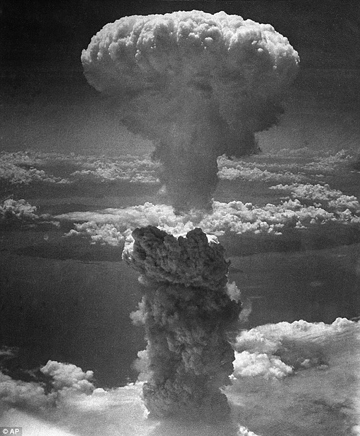 NORTH KOREA CLAIMS U.S. WAR AND NUCLEAR WEAPONS CAUSED CLIMATE CHANGE, NewsWeek, BY ON 6/10/17 North Korea has accused U.S. military and environmental policies of causing climate change and producing pollution around the world.
In a scathing report cited Friday by North Korea’s official Korean Central News Agency (KCNA), the state-run Institute for International Studies of the DPRK (an acronym for the country’s official title: the People’s Democratic Republic of Korea), asserted that the U.S.’s use of nuclear weapons, involvement in foreign conflicts and style of production had most harmed the environment since the Cold War. The study, attributed to researcher Kim Kum Hui and titled “The U.S. Is Chiefly to Blame for Global Environmental Pollution,” advised the U.S. to change course and safeguard the environment…..
North Korea’s report claimed that since the Cold War, the U.S. has forced other nations to adopt its model of “American-style development” under the guise of economic globalization. It said the U.S. alone accounted for 22.1 percent of the world’s carbon emissions in 2004. The figure appears to relatively coincide with conclusions established the following year by Washington-based think tank the World Research Institute. Research by the same organization says the U.S. contributed 14.4 percent in 2012, second only to China’s 25.36 percent. That same year, North Korea, an underdeveloped nation of around 25 million, was listed at .17 percent.
The report also laid into the military practices of the U.S., with which North Korea fought a war in the 1950s. The piece condemned the U.S.’s dropping of atomic bombs on the Japanese cities of Hiroshima and Nagasaki at the end of World War Two in 1945, as well as the government’s nuclear tests, which numbered 1,054 between 1945 and 1992, according to the Department of Energy…….
Despite North Korea’s traditionally dismissive nature toward international treaties, Pyongyang has at times been a vocal advocate of global cooperation on environmental issues. It signed the 2015 Paris Climate Agreement, which is geared toward reducing global greenhouse gas emissions, and deeply criticized Trump for pledging to withdraw from the non-binding, landmark treaty last week. North Korea has suffered from a number of deadly famines and floods that experts and international agencies have said indicate its vulnerability to climate change. http://www.newsweek.com/north-korea-us-war-nuclear-weapons-climate-change-623825
American government continues to plan for nuclear disaster action
 If a nuclear bomb goes off, this is the most important thing you can do to survive, DAVE MOSHER, JUN 12, 2017 “………A terrorist-caused nuclear detonation is one of 15 disasters scenarios that the federal government continues to plan for with state and city governments — just in case.
South Carolina electricity customers must pay up for nuclear reactors, whether or not they are actually built
 With $8.6 billion spent, fate of South Carolina nuclear reactors still unknown, Post and Courier, By Andrew Brown abrown@postandcourier.com Jun 11, 2017 COLUMBIA — If two of the Palmetto State’s largest utilities pull the plug on their nuclear power plant expansion, around half of all South Carolinians could be on the hook for $8.6 billion to pay for a project that might never produce a single kilowatt of electricity.
It’s possible that bankruptcy proceeds, corporate payments and sales of the nuclear reactor components would help defray some of the costs to ratepayers if work stops on the V.C. Summer Nuclear Station in Fairfield County.
It’s just as possible the partnering utilities — publicly operated Santee Cooper and investor-owned South Carolina Electric & Gas — could decide as early as this month to continue work on the two new reactors, which have been plagued with cost overruns, construction delays and the bankruptcy of the project’s lead contractor.
In the end, the power companies can lean on their customers to recover the costs of the nuclear reactors no matter what they decide. For SCE&G, a 2007 law passed by South Carolina lawmakers allows the Cayce-based utility to collect a 10 percent profit for investors, even if the V.C. Summer project is scrapped.
“We are stuck to a great degree. The public is in a very bad position here,” said Lynn Teague, vice president of the League of Women Voters of South Carolina, who has followed the project. “It’s a rotten situation for the ratepayers.”
SCE&G and Santee Cooper already have sunk $8.6 billion into the project — more than half of the expected $14 billion needed to finish the reactors. The new power sources would serve around 1.6 million homes and businesses across South Carolina’s 46 counties.
The utilities have already collected nearly $2 billion from electric customers since the project received approval in 2008, but all of that money has gone to covering finance costs and not to the concrete, steel and manpower used to build the reactors.
The average residential electric bill for a SCE&G customer has risen by $324 a year to pay for the ambitious energy project that was pitched as part of a new carbon-free age of nuclear power in the United States.
The power companies said they could announce by June 26 whether they would stop work all together or continue construction on one or both of the reactors.
The biggest threat to the project is Westinghouse, the primary contractor at the project north of Columbia in Jenkinsville. Westinghouse filed for bankruptcy protection at the end of March.
Officials with SCE&G and Santee Cooper say they are closely monitoring Westinghouse’s bankruptcy proceedings, where both are creditors to the failing company. ……
SCE&G is all but guaranteed to get the project covered by its electric customers because of legislation passed by the General Assembly at the request of the utility industry in 2007.
That law, known as the Base Rate Review Act, allowed SCE&G to start collecting money for construction costs while work was being completed instead of after the fact. SCE&G said that would save $1 billion for what started out as a $9.8 billion project that was scheduled to open in 2016.
But the law also helped shift almost all of the risk for the endeavor off SCE&G’s parent and its shareholders and onto the electricity customers.
The only way that SCE&G will eat any of costs of the project now is if state regulators find the utility failed to, as law says, “anticipate or avoid the allegedly imprudent costs” based on the information available at the time. …….. http://www.postandcourier.com/business/with-billion-spent-fate-of-south-carolina-nuclear-reactors-still/article_b5ea0a00-4d1a-11e7-9e76-fb2e0630d446.html
Georgia’s half-built nuclear power station – Toshiba to the rescue?
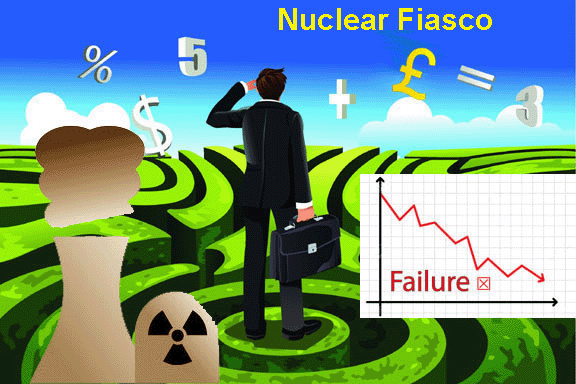 Toshiba rescues half-built Georgia nuclear plant, CNN Money , 11 June 17, Toshiba’s bankrupt nuclear unit left an uncertain future for two half-finished nuclear reactors in Georgia — but the company promised Saturday it will pour up to $3.68 billion into the project to finish it.The Tokyo-based company will pay out the billions to Georgia Power, a subsidiary of Southern Company, in installments between this coming October and January 2021.
Toshiba’s Westinghouse will still be involved with the project by way of lending engineering, licensing support, and the intellectual property rights needed for the project to Southern Company, the company said in a statement.
Toshiba’s nuclear construction efforts are at the heart of its current financial woes. Westinghouse was crippled by massive losses because the costs of its nuclear projects in the U.S. winded up “far surpassing estimates.”
Though Toshiba is known for making a vast array of product — from IT equipment to TVs and laptops — the nuclear program has dented profits so badly that the company said in April it has “substantial doubt” about its ability to stay in business.
Toshiba’s Westinghouse is also midway building two nuclear reactors in South Carolina, and the fate of that project still hangs in the balance. Toshiba said Saturday it’s “still in negotiations” with the project’s owners……http://money.cnn.com/2017/06/10/news/companies/toshiba-nuclear-plant-georgia-southern-co/index.html
American corporations hope to use Indian insurance companies, for nuclear build in India
GE, Westinghouse keen to take nuclear insurance from Rs 1,500-crore pool BY SHILPY SINHA, ET BUREAU JUN 12, 2017 MUMBAI:After years of stonewalling, India is poised to open up its nuclear liability cover to equipment suppliers, with GE and Westinghouse showing interest in taking insurance from the pool.
Secrecy on highly radioactive uranium in the nuclear waste dump in Parks Township.
Amount of nuclear waste in Parks Township could remain unknown until 2031, TRIB Live, MARY ANN THOMAS | Sunday, June 11, 2017 Secrecy, lack of documentation and inattention to warnings may have led the Army Corps of Engineers to grossly underestimate the amount of highly radioactive uranium in the nuclear waste dump in Parks Township.
1 This Month





PLEASE OPPOSE HR 8255 AND S.3639 – bills would accelerate satellite deployment, with no environmental review or safeguards – https://ncstd5li.quorum.us/campaign/169331/
To see nuclear-related stories in greater depth and intensity – go to https://nuclearinformation.wordpress.com
-
Archives
- October 2026 (74)
- September 2026 (339)
- August 2026 (330)
- July 2026 (355)
- June 2026 (287)
- May 2026 (306)
- April 2026 (356)
- March 2026 (251)
- February 2026 (267)
- January 2026 (308)
- December 2025 (358)
- November 2025 (359)
-
Categories
- 1
- 1 NUCLEAR ISSUES
- business and costs
- climate change
- culture and arts
- ENERGY
- environment
- health
- history
- indigenous issues
- Legal
- marketing of nuclear
- media
- opposition to nuclear
- PERSONAL STORIES
- politics
- politics international
- Religion and ethics
- safety
- secrets,lies and civil liberties
- spinbuster
- technology
- Uranium
- wastes
- weapons and war
- Women
- 2 WORLD
- ACTION
- AFRICA
- Atrocities
- AUSTRALIA
- Christina's notes
- Christina's themes
- culture and arts
- Events
- Fuk 2022
- Fuk 2023
- Fukushima 2017
- Fukushima 2018
- fukushima 2019
- Fukushima 2020
- Fukushima 2021
- general
- global warming
- Humour (God we need it)
- Nuclear
- RARE EARTHS
- Reference
- resources – print
- Resources -audiovicual
- Weekly Newsletter
- World
- World Nuclear
- YouTube
-
RSS
Entries RSS
Comments RSS

