 Science and Public Health Under Siege, UCA,KATHLEEN REST, EXECUTIVE DIRECTOR | JULY 24, 2017, My colleagues at the Union of Concerned Scientists (UCS) have released a report on how science—and public health—have been sidelined during the first six months of the Trump administration. The report documents a deliberate and familiar set of strategies that undermines the role of science, facts, and evidence in public policy and decision-making.
From a public health perspective, the short- and long-term impacts are truly frightening. The Trump administration—aided and abetted by a willing Congress—is actively pushing an ideological, anti-science agenda that will profoundly affect the health, safety, and security of children, families, and communities today, tomorrow, and for decades to come.
They claim their approach is pro-business, but on closer look, that isn’t true. It harms the many good business people who want to play by the rules and make a profit without harming the public or their workers. How? By giving an unfair advantage to unscrupulous businesses that will put profit ahead of public and worker safety and health.
Control, Alt, Delay: Public health protections on the chopping blockMercury, lead, arsenic, ozone, beryllium, silica, chlorpyrifos. These substances all have several things in common:
- They have all been found to contaminate our air, water, soil, and/or food, as well as some of our workplaces and community environments.
- Robust and often long-standing science has proven that exposure to them can cause serious health effects, including death.
- Government agencies charged with protecting our health and safety have established rules and standards to prevent or minimize our exposure to them. (Note: these and other public health safeguards are increasingly denigrated as unnecessary regulations by the Trump administration and some in Congress.)
- Exposure standards established years ago have been found to be insufficiently protective.
- The Trump administration has taken steps to weaken, delay, and subvert recent science-based safeguards that enhance public protection from these toxic substances.
Make no mistake. There is an all-out assault on the agencies charged with using independent, unconflicted science to protect our nation’s public health—and on the critical resources and infrastructure they need to do just that.
The proposed draconian cuts to budgets, staffing levels, and programs at agencies like the EPA, CDC, FEMA, NOAA, USDA, and OSHA speak for themselves. (And don’t even get me started on how current congressional efforts to reform health care will impact the health of our most vulnerable populations.)
But the real issue isn’t about protecting agency budgets or staff levels, essential as they are. It’s about protecting all of us from known (and emerging and future) threats to our health, safety, and well-being. What follows is just a snapshot of this administration’s siege on public health…….http://blog.ucsusa.org/kathleen-rest/six-months-into-the-trump-administration-science-and-public-health-under-siege
July 26, 2017
Posted by Christina Macpherson |
health, USA |
Leave a comment
Someone else can clean it up https://www.sandiegoreader.com/news/2017/jul/24/ticker-someone-else-can-clean-it/# General Atomics looks to offload uranium Superfund site in Colorado By Dave Rice, July 24, 2017 After more than a decade in mothballs, a subsidiary of San Diego’s General Atomics has indicated that it intends to offload the cleanup work at a uranium mine it owns in central Colorado. The Cañon City facility, owned by the Cotter Corporation, has sat dormant since 2006, and was declared a Superfund site in 1984.
Plans to reopen the mine stalled when state politicians demanded the company first address its existing violations. Last month it was discovered that waste from the Manhattan Project was dumped at the site — it’s unclear whether there was a intention to harvest uranium from the material or just create a convenient place to stash it.
Last week, Cotter announced that it would petition state health officials to
transfer its radioactive materials license to Colorado Legacy Land, a limited liability company established specifically to handle the cleanup effort. That wouldn’t entirely eliminate General Atomics’ liability, however — since their mining operations caused the contamination any failed cleanup burden would fall back to Cotter, which has allegedly been working on a cleanup plan since 2014.
If the transfer, expected to be completed sometime this fall, is successful, it’ll reduce, but not eliminate General Atomics’ portfolio of contaminated uranium mines that have fallen into disuse. Through another subsidiary, the company controls a New Mexico operationthat hasn’t been used in 25 years. In 2015, the firm fought efforts to begin cleanup efforts at that site, indicating that the intention was to reopen the mine once worldwide uranium prices return to profitable levels.
July 26, 2017
Posted by Christina Macpherson |
environment, USA |
Leave a comment
Trump’s new nuclear defense pick once wrote, “America must be ready to nuke first.” New Republic, Emily Atkin, 21 July 17 The White House announced a slew of nominations earlier this week to fill some of the many open positions in the administration. The last on the list was Guy B. Roberts, whom Trump tapped to be the assistant secretary for nuclear, chemical, and biological defense programs at the Department of Defense. In this role, Roberts will “prevent, protect against, and respond to weapons of mass destruction threats,” according to the DOD website. He’ll also advise the secretary of defense in “matters concerning nuclear, chemical, and biological defense programs.” ……..
July 26, 2017
Posted by Christina Macpherson |
politics, USA |
Leave a comment
 The Fallout, In St. Louis, America’s nuclear history creeps into the present, leaching into streams and bodies. Guernica, By Lacy M. Johnson, 10 July 2017, Dawn Chapman first noticed the smell on Halloween in 2012, when she was out trick-or-treating with her three young children in her neighborhood of Maryland Heights, Missouri, a small suburb of St. Louis…….
Joe Trunko from the Missouri Department of Natural Resources … told Dawn that there is a landfill near her home, that it is an EPA Superfund site contaminated with toxic chemicals, that there has been an underground fire burning there since 2010. “These things happen sometimes in landfills,” he said. “But this one is really not good.”
Joe told Dawn that this landfill fire measures six football fields across and more than a hundred and fifty feet deep; it is in the floodplain of the Missouri River, less than two miles from the water itself, roughly twenty-seven miles upstream from where the Missouri River joins the Mississippi River before flowing out to the sea. “But to be honest, it’s not even the fire you should be worrying about,” Joe continued. “It’s the nuclear waste buried less than one thousand feet away.”

Joe explained how almost fifty thousand tons of nuclear waste left over from the Manhattan Project was dumped in the landfill illegally in 1973…….
Weeks later, she found herself standing outside the chain-link fence that surrounds the landfill with half a dozen environmental activists who had gotten hold of some air-sampling equipment……..
Karen Nickel didn’t know much about the landfill—she’d only just learned about it a few weeks before—but she knew about the waste……
Karen did look into it and learned that many of her classmates and neighbors and childhood friends had died of leukemias and brain cancers and appendix cancers—rare in the general population, but, again, apparently common among those who live or had lived near the creek. It couldn’t possibly be a coincidence…..
When Dawn and Karen learned what the EPA had proposed years earlier, in their Record of Decision, they immediately pushed back. They called the media, gave interviews, started a Facebook page. “I remember getting so excited when we hit two hundred members,” Karen told me. “Now we have over seventeen thousand.” They all lobbied their representatives, their senators, City Council members, mayors…….
“We’re just moms!” Karen and Dawn would answer. “We’re just citizens concerned about the health and safety of our kids and our community!”
Soon after, Karen and Dawn, along with another resident, Beth Strohmeyer, officially formed Just Moms STL………
After a few weeks of making these graphs, they realized the fire wasn’t under control, it wasn’t going out. It was, in fact, moving toward the waste, inching toward the known edge, spreading through the old limestone quarry. Now one thousand feet away. Now seven hundred………
Robbin and Mike Dailey moved to this house in 1999, after their kids had moved out and started families of their own. It’s a relief their children never lived here, she tells me. In this neighborhood children fall ill. There are brain cancers and appendix cancers, leukemias and salivary-gland cancers. Up the street from Robin and Mike there’s a couple with lung and stomach cancer. They bought their home just after it was built in the late 1960s.
I ask what they think might happen if the fire ever reaches the waste. The question hangs in the air for a moment as the TV flickers from the far wall. “Look, we know it won’t explode,” Robbin explains. “We’re not stupid. We know that’s not how it works. But just because there’s no explosion doesn’t mean there won’t be fallout.”…….
I’ve looked at thousands of pictures of this landfill, aerial photos and historical photos, elevation photos and topographical maps, but nothing has prepared me to see it in person, this giant belching mound of tubes and pumps and pipes. There’s some kind of engineered cover over the dirt itself, which is supposed to suffocate the fire and capture the fumes. It looks like little more than a green plastic tarp patched together over a hundred acres of sagging hills.
“This is the burning side,” Robbin tells me. “The radwaste is on the other side.” The patchwork is topographical and bureaucratic: the burning side is the southern section of the landfill and falls under the jurisdiction of the Missouri Department of Natural Resources; the radioactive waste is mostly on the northern side, and under EPA jurisdiction. On the burning side, workers drive over the tarp on utility carts, wearing hard hats and work clothes. No gloves, no masks, no protection from the destruction buried underneath their feet……….https://www.guernicamag.com/the-fallout/
July 24, 2017
Posted by Christina Macpherson |
environment, PERSONAL STORIES, Reference, USA |
2 Comments
The reports don’t acknowledge these stories, these illnesses, those who are dying or dead. Most residents of St. Louis—including and especially the residents of predominantly African-American neighborhoods—don’t even know the contamination is there. …….
the half-life of Thorium 232: fourteen billion years, a half-life so long that by the time this element is safe for human exposure
a contradiction I can’t resolve: that the massive crime here began with a belief in a kind of care, a belief that protection comes only in the form of wars and bombs, and that its ultimate expression is a technology that can destroy in a single instant any threat to our safety with perfect precision and efficiency. But hundreds of thousands lost their lives to those bombs in Japan, and the fallout from building them has claimed at least as many lives right here at home.
The Fallout, In St. Louis, America’s nuclear history creeps into the present, leaching into streams and bodies. Guernica, By Lacy M. Johnson, 10 July 2017 “………Months ago, when a high-school friend reached out to me asking that I give my attention to this story, she told me that a company tasked decades ago with disposing of nuclear waste for the federal government had instead dumped thousands of barrels of the waste somewhere in North St. Louis County. The barrels were left exposed to the elements for decades, and the waste had leaked into the ground and into the water of a nearby creek……
When the federal government filed suit to acquire the property under eminent domain, officials refused to disclose the exact nature of the waste “for security reasons.” They assured the local government that the waste they’d be storing there wasn’t dangerous. They shook hands and signed papers. They looked people squarely in the eye.
During the next twenty years, truckload by truckload, the green patchwork of farm fields by the airfield turned into a foreign world. Mountains of raffinate rose up across from row after row of rusty black drums, stacked two or three high.

……..The reports tell only so much, only certain parts of certain versions of the story. The rest I have to piece together using articles in the local newspaper, phone calls with these residents, oral histories collected by others, newsletters from various companies celebrating one anniversary or another…..
In my pile of reports there is a series of letters from Cotter to the Atomic Energy Commission, in which Cotter tries to convince the government to take these wastes back. Commercial disposal would cost upwards of two million dollars (about twelve million dollars today). They couldn’t afford it. They knew that the AEC was using a quarry at the recently decommissioned second Mallinckrodt facility at Weldon Spring, roughly twenty miles southwest of the airport, as a dump for nuclear waste. They asked the AEC if they could use it, asked for guidance, and for help.
That help never came……
A lengthy investigation discovered that from August to October 1973, a private construction firm drove truckloads of the leached barium sulfate—along with roughly forty thousand tons of soil removed from the top eighteen inches of the Latty Avenue site—to West Lake Landfill, all around the clock, sometimes in the middle of the night. To the landfill operator it looked like dirt, so he waved the trucks in and charged them nothing, using it as landfill cover over the municipal refuse…..
the reports express the detection of this contamination in charts, as numbers and statistics. They’ve found contamination at the airport, in the drainage ditches leading away from the airport, and all along the creek—along the trucking routes, in ballfields and in parks and gardens and backyards, in driveways, in people’s basements and under their kitchen cabinets. Even now, as I write this, they are still trying to figure out just how far it has spread.
The reports measure the health risk of exposure to this contamination as an equation, with a threshold of acceptable risk. But what the reports don’t say is that the contamination has already done so much damage that cannot be measured or undone. The Mallinckrodt uranium workers are some of the most contaminated in the history of the atomic age. So contaminated, in fact, that in 2009 all former Mallinckrodt uranium workers were added as a “special exposure cohort” to the Energy Employees Occupational Illness Compensation Program Act. The act provides compensation and lifetime medical benefits to employees who became ill with any of twenty-two named cancers as a result of working in the nuclear-weapons industry. Because of this special cohort status, if a former Mallinckrodt worker develops any of these named illnesses, exposure to the uranium is assumed. But the people who live near the creek didn’t work for Mallinckrodt. They aren’t entitled to compensation or to medical benefits.
A woman named Mary Oscko, for instance, has lived her whole life in North St. Louis County, most of it near that small creek. Now she is dying of stage-four lung cancer, though she has never smoked a day in her life. Shari Riley, a nurse who lived near the creek, died recently of appendix cancer—rare in the general population, but several dozen cases have been reported among those who live or lived near the airport or along the creek. My friend—the one who contacted me about this story—never lived in St. Louis, but her mother grew up two houses away from that creek. My friend suspects that her mother’s exposure to the contamination as a child changed her DNA in ways she passed on to her children, which would explain why my friend was diagnosed with an aggressive form of cancer a few years ago, at the age of thirty-five. Could it also explain why my friend’s mother once gave birth to a set of conjoined twins? Conjoined twins are an anomaly in the general population, but these make the fourth set born to women who grew up near that creek. And those are just the ones we know about.

The reports don’t acknowledge these stories, these illnesses, those who are dying or dead. Most residents of St. Louis—including and especially the residents of predominantly African-American neighborhoods—don’t even know the contamination is there. …….
“My librarian,” Kay Drey tells me—has filed the EPA’s Record of Decision for the West Lake Landfill, and then on the drawer where I might find studies that contradict the EPA’s assessment that the radioactive waste in the landfill doesn’t pose a threat to residents—the radiological surveys of the site conducted in the 1970s and 1980s by the Nuclear Regulatory Commission and the Department of Energy, as well as more current studies by independent researchers. She explains that the radioactive waste buried in West Lake Landfill covers about twenty acres in two locations in one or many layers, estimated at two to fifteen feet thick, some of it mixed in with municipal refuse and some of it sitting right at the surface. It is in the trees surrounding the landfill and the vacuum bags in nearby homes. This waste contains not only uranium, but also thorium and radium, all long-lived, highly radio-toxic elements. And because Mallinckrodt removed most of the naturally occurring uranium from this ore, the Cotter Corporation, in effect, created an enriched thorium deposit when they dumped the residues at West Lake Landfill. “In fact,” Kay muses, “West Lake Landfill might now be the richest deposit of thorium in the world.”
Thorium and uranium in particular are among the radioactive primordial nuclides, radioactive elements that have existed in their current form since before Earth was formed, since before the formation of the solar system even, and will remain radioactive and toxic to life long after humans are gone. We’re sitting back in Kay’s dining room when she pulls out a tiny booklet labeled “Nuclear Wallet Cards.” What its intended purpose is, I don’t know, but Kay flips to the back to show me the half-life of Thorium 232: fourteen billion years, a half-life so long that by the time this element is safe for human exposure, the Appalachian Mountains will have eroded away, every ocean on Earth’s surface will have evaporated, Antarctica will be free of ice, and all the rings of Saturn will have decayed. Earth’s rotation will have slowed so much that days will have become twenty-five hours long, photosynthesis will have ceased, and multicellular life will have become a physical impossibility.
“You know, tritium is my favorite,” Kay tells me before I leave. It’s produced as a side effect of operating nuclear reactors and released into the air, or leaks into the waterways; it contaminates the water supply and condenses in our food. One official who worked at the nuclear reactor Kay had tried to prevent once told her that tritium was no big deal. “It only destroys DNA molecules.” A few years ago they found tritium in the groundwater in Callaway County. “There is no way to remove it,” she says…..
….the Weldon Spring site. After it was decommissioned, the plant—a second one run by Mallinckrodt—was found to be so contaminated that the Department of Energy eventually entombed the whole site in layers upon layers of clay and soil, gravel, engineered filters and limestone rocks, creating a mountain covering forty-five acres, containing approximately 1.5 million cubic yards of hazardous waste. With its own educational center located near the base, the containment dome has become a kind of memorial for a tragedy that hasn’t finished happening. The top of the dome is the highest point in the county.
“Oh, you don’t want to go there anyway,” Kay says, waving the idea away with her slender hand. “It’s leaking.”……..
a contradiction I can’t resolve: that the massive crime here began with a belief in a kind of care, a belief that protection comes only in the form of wars and bombs, and that its ultimate expression is a technology that can destroy in a single instant any threat to our safety with perfect precision and efficiency. But hundreds of thousands lost their lives to those bombs in Japan, and the fallout from building them has claimed at least as many lives right here at home.
There is no one to arrest for this, to send to jail, to fine or execute or drag to his humiliation in the city square. Even if Karen and Dawn win their fight and convince the government to remove every gram of radioactive waste in the landfill and the creek and the airport and the backyards and gardens here, people will still be sick. Thousands of them. Chronic exposure to radiation has changed their DNA, and they’ll likely pass those changes on to their children, and to their children’s children, and on and on through every generation. In this regard, no one is immune……..
The EPA Region 7 offices are located in a sprawling modern government building in a suburb of Kansas City. The small conference room just to the side of the main entrance is filled with a surprising number of people……
During our too-short conversation I learn that the EPA has over 1,300 sites in the Superfund program, and Region 7 alone has ninety-eight sites on the National Priorities List. Each of these communities is demanding that their toxic sites be scrubbed clean. ………https://www.guernicamag.com/the-fallout/
July 24, 2017
Posted by Christina Macpherson |
Reference, USA, wastes |
Leave a comment
 Dave Toke’s Blog 21st July 2017, Dramatic increase in Nevada solar output as big companies abandon utility
in favour of cheap renewables. Solar pv output in the US state of Nevada is
heading for a 60 per cent year-on-year increase in electricity output in
2017 compared to 2016 as Nevada increases its lead as the top US state for
installed solar pv per person.
Nevada, which is heading for getting 10 per
cent of its total electricity from solar pv in 2017 could be setting a
trend whereby business and residential consumers switch to solar simply
because it is the cheapest source of electricity. Of course it is very
sunny in Nevada – indeed a given solar panel will generate around twice as
much electricity per year in Nevada compared to Northern Europe.
But really what’s happening in Nevada is just an advanced guard for other places.
That’s because the costs of solar power continue to crash and so what is
happening in Nevada will happen in lots of other places very soon.
US monopoly electricity utilities are trying to fight back by charging fee
structures to consumers that reduce the benefits of installing solar pv.
But as much as they do that, the prospect of what are increasingly cheaper
battery systems to balance their load is making consumers more and more
independent from the conventional electricity generation and supply system.
Bill Ellard. a consultant for the US Solar Energy Society describes this as
a ‘death spiral’ for the US utilities. The more they fight solar, the more
expensive they become for consumers in general and the more people are
induced to go solar. Ellard favours developing more microgrid systems so
that energy requirements can be balanced more and more on a local level.
http://realfeed-intariffs.blogspot.co.uk/2017/07/dramatic-increase-in-nevada-solar.html
July 24, 2017
Posted by Christina Macpherson |
renewable, USA |
Leave a comment
Trump May Have Unintentionally Killed U.S. Nuclear Oil Price, By Leonard Hyman & William Tilles – Jul 22, 2017 “………Nuclear subsidies based on environmental criteria will probably remain in place in New York and Illinois. However, other states like Ohio and Pennsylvania are facing a similar dilemma of aging, uneconomic merchant nuclear base load generation in often economically depressed regions. The pressure to keep these plants open will be considerable. But they won’t be able to claim any benefit from the non-carbon emitting nature of nuclear power. That policy is being rewritten literally as we write.
We don’t blame the nuclear power industry for attempting to rebrand itself as providing energy and environmental improvement. However, the federal government has taken the latter rationale away from the industry. If carbon’s no longer a problem, who cares if relatively high cost nuclear power plants provide a solution? http://oilprice.com/Alternative-Energy/Nuclear-Power/Trump-May-Have-Unintentionally-Killed-US-Nuclear.html
July 24, 2017
Posted by Christina Macpherson |
politics, USA |
Leave a comment
 Trump asserts all agree he has ‘complete power’ to pardon, AP, By DARLENE SUPERVILLE, 22 July 17 WASHINGTON (AP) — President Donald Trump said Saturday that he has “complete power” to issue pardons, an assertion that comes amid investigations into Russian interference in last year’s presidential election. It was one of many topics that appeared to occupy the president’s mind as the day broke.
On a day when most people are ready to forget about the issues that nagged them during the week, Trump revved up. In an early morning flurry of 10 tweets, he commented about pardons, former presidential rival Hillary Clinton, son Don Jr., health care, the USS Gerald Ford, the attorney general and other issues.
Trump said in one of his 10 messages: “While all agree the U. S. President has the complete power to pardon, why think of that when only crime so far is LEAKS against us. FAKE NEWS.”
The Washington Post recently reported that Trump has inquired about the authority he has as president to pardon aides, relatives or even himself in connection with the widening investigation into Russian interference in the election and whether any Trump associates were involved…..
One of Trump’s attorneys, Jay Sekulow, said the president has not discussed the issue of pardons with his outside legal team…….https://apnews.com/0cfcfc0956a6445ba59cc2edef5a81a0/Trump-asserts-all-agree-he-has-%27complete-power%27-to-pardon
July 24, 2017
Posted by Christina Macpherson |
politics, USA |
Leave a comment
 By Keith Rogers Las Vegas Review-Journal, July 22, 2017 Air Force Secretary Heather Wilson sees a need to protect the space frontier and envisions bolstering the ranks of drone warfare all while preserving the vast Southern Nevada range that shrinks as fighter jets zip faster across it.
What she doesn’t see in her crystal ball is a nuclear-waste train rolling across the 2.9-million-acre Nevada Test and Training Range to reach the Department of Energy’s planned repository at Yucca Mountain, 100 miles northwest of Las Vegas.
“If Yucca Mountain becomes a storage area it needs to operate without impacting the ability of the country to defend itself,” Wilson said Friday in an exclusive interview with the Las Vegas Review-Journal. “There is no route across the range that would not impact testing and training.”
Even a rail corridor that closely parallels the range’s boundary in Nye County could raise encroachment issues, she said, comparing what Nellis Air Force Base has dealt with balancing jet noise complaints and national security as urban Las Vegas sprawled closer to it over the decades……..
n 2003, Air Force Secretary James Roche and Chief of Staff Gen. John P. Jumper wrote the House Armed Services Committee objecting to the Energy Department’s proposed Chalk Mountain route across the range. They said it would impact “mission-critical systems evaluations” as well as air combat training. They noted that 75 percent of all Air Force live munitions stateside are employed there.
Roving the range
The range’s role in testing of how new generation aircraft perform and can be detected or not by radar is also vital to the readiness.
Roche and Jumper also expressed concern for the fringe of the range citing “any modified routes into portions of the NTTR (Nevada Test and Training Range). Additionally, any overflight restrictions on aircraft operating in NTTR-associated airspace will negatively impact our readiness activities.”
The Chalk Mountain route, a short-cut option for rail shipments of spent nuclear fuel assemblies from the Midwest and eastern U.S., was later downgraded to “nonpreferred” by the Energy Department but is still part of the routes evaluated for the license application submitted to the Nuclear Regulatory Commission in 2008…….. https://www.reviewjournal.com/news/military/air-force-chief-objects-to-yucca-mountain-nuclear-routes/
July 24, 2017
Posted by Christina Macpherson |
safety, USA |
Leave a comment
Yes, Trump Could Pardon Himself. Then All Hell Would Break Loose, It’s never been tried. Here’s how it could blow up his presidency, or blow up the system. Politico, By RICHARD PRIMUS July 21, 2017 This week’s eye-popping constitutional question: Can President Trump pardon himself for criminal wrongdoing? With the Russia scandal swirling more intensely around the White House every week, the Washington Post reported Friday morning that the president might be considering pardoning himself and members of his family as a way of fending off legal consequences for whatever special counsel Robert Mueller’s investigation turns up.
A self-pardon would be something new in American history — and just the kind of departure from prior norms that typifies Trump. The Constitution doesn’t specify whether the president can pardon himself, and no court has ever ruled on the issue, because no president has ever been brazen enough to try it. Among constitutional lawyers, the dominant (though not unanimous) answer is “no,” in part because letting any person exempt himself from criminal liability would be a fundamental affront to America’s basic rule-of-law values.
But as a practical matter, it’s not a panel of legal experts that will decide this issue. It probably won’t be a court, either. Instead, the answer will be fought out at the highest levels of American politics. And in real life, if the president signed a document with the words “I pardon myself”—which he certainly could—it’s impossible to know what would happen next.
Given the political firestorm that a self-pardon might provoke and the broader norm-smashing context of the Trump administration, an attempted self-pardon could do anything from keeping Trump out of jail to bringing down his presidency and landing him in the dock. Or it could do nothing at all—which would be troubling, too. All we can know for sure is that it would take our system, once again, into uncharted territory.
Here’s one possible scenario. Suppose the president announces a self-pardon, and Republicans in Congress follow the script they’ve used until this point: They express concern at the behavior but make no serious move to punish the president for it. The legal effect of the pardon would then go untested for years. A pardon is a shield against a prosecution, and in the absence of a potential prosecution it has no work to do. As long as Trump is president, there won’t be any prosecution to put it to the test, because a sitting president probably can’t be prosecuted for a crime. Again, this isn’t a certainty—the Supreme Court has made clear that a sitting president can be sued in a civil suit, as Bill Clinton was by Paula Jones—but the dominant view on the criminal side is that a President must be impeached and removed from office before he can be a criminal defendant. So while Trump remains president, an attempted self-pardon would be like an umbrella that hasn’t been taken out in the rain: We don’t know yet whether it works, or how well………
another possible future, if Trump announces a self pardon: It could be the moment that Republicans in Congress decide he has finally stepped over the line. To be sure, Congress has shown no inclination to remove the president to this point, and maybe it never will. But as the Supreme Court noted long ago, a pardon suggests the existence of illegal behavior—and a self-pardon itself would represent such flagrant disrespect for rule-of-law values that if anything could push Congress toward impeaching and removing the president, this might.
In that case, Congress wouldn’t just be stripping Trump of his presidency: In all likelihood, it would be converting his ostensible pardon from a shield against prosecution into one more reason to move against him. After all, the decision to impeach would, in itself, all but establish that self-pardons are inconsistent with American constitutional norms. …..http://www.politico.com/magazine/story/2017/07/21/yes-trump-could-pardon-himself-then-all-hell-would-break-loose-215405
July 24, 2017
Posted by Christina Macpherson |
politics, USA |
1 Comment
 Trump to tap longtime coal lobbyist for EPA’s No. 2 spot, WP By Juliet Eilperin and Brady Dennis July 21 17, President Trump will nominate a prominent coal lobbyist and former Senate aide, Andrew Wheeler, to serve as the Environmental Protection Agency’s deputy administrator, according to two senior administration officials.
Wheeler, a principal at Faegre Baker Daniels Consulting, is a lobbyist for coal giant Murray Energy and served as a top aide for Sen. James M. Inhofe (R-Okla.) when Inhofe chaired the Senate Environment Committee. He has represented Murray Energy — whose chief executive, Bob Murray, is a prominent supporter of the president — since 2009.
In addition to tapping Wheeler, according to the officials, EPA Administrator Scott Pruitt is preparing to pick three conservatives to head three key divisions within the agency. Trump will nominate Bill Wehrum as associate administrator for the Office of Air and Radiation, Matt Leopold to serve as EPA general counsel and David Ross as assistant administrator for Office of Water……..
Tiernan Sittenfeld, the League of Conservation Voters’ senior vice president for government affairs, said in email, “With these nominations, President Trump is once again catering to his polluter allies and prioritizing their profits over our kids’ health.”……https://www.washingtonpost.com/news/energy-environment/wp/2017/07/21/trump-to-tap-longtime-coal-lobbyist-for-epas-number-two-spot/?utm_term=.ada170b0c8ef
July 24, 2017
Posted by Christina Macpherson |
climate change, politics, USA |
Leave a comment
 Iran nuclear deal still under threat — US must keep its end of the bargain, http://thehill.com/blogs/pundits-blog/foreign-policy/343139-iran-nuclear-deal-still-under-threat-us-must-keep-its-end BY BERNADETTE STADLER, 07/21/17
Earlier this week, the Trump administration certified for a second time that Iran remains in compliance with the Joint Comprehensive Plan of Action (JCPOA), more commonly known as the Iran Deal. However, media reportsindicate that  the president was deeply reluctant to certify Iran’s compliance and may not be willing to do so in the future.
The administration is required to certify Iran’s compliance every 90 days, and if it fails to do so, Congress is given a 60-day period during which it can re-impose sanctions or abandon the deal altogether. Some in Congress would jump at this opportunity to kill the deal. But if the United States violates or walks away from the nuclear deal, it will alienate our allies and partners who helped us negotiate the agreement, allow Iran to resume its nuclear weapons program, and damage U.S. national security.
Iran’s nuclear activity was the subject of much concern before the JCPOA effectively constrained the risk of an Iranian nuclear weapon. Before formal negotiations were started, it is estimated that Iran was mere weeksaway from “breaking out,” or having enough fissile material to create a nuclear weapon. Now, Iran is more than a year away from breaking out.
Iran’s obligations under the deal have been strict and verifiable. Under the agreement, Iran has forfeited its stockpile of medium-enriched uranium and has reduced its stockpile of low-enriched uranium by about 97 percent. It has removed two-thirds of its centrifuges, which are used to enrich uranium, and is prohibited from enriching uranium above 3.67 percent — far below the 90 percent enrichment required for use in nuclear weapons.
The JCPOA also blocks Iran’s pathway to a plutonium weapon by requiring Iran to render its plutonium reactor inoperable, redesign the Arak facility so that it cannot produce weapons-grade plutonium, and send all radioactive waste out of the country so that it cannot be reprocessed to create plutonium.
Critics of the deal have argued that it gives Iran a “clear path to the bomb” because some of the deal’s provisions will be phased out after a specified number of years. However, even after all of the so-called “sunset clauses” have expired, Iran has indefinitely signed up to the Additional Protocol, an agreement which permanently allows the International Atomic Energy Agency (IAEA) to conduct intrusive inspections on Iran’s nuclear facilities.
Iran’s compliance with the deal has been consistently verified by the IAEA and the intelligence agencies of other countries interested in the agreement. Even initial critics of the JCPOA, like Secretary of Defense James Mattis and Senate Foreign Relations Committee Chair Senator Bob Corker, agree that it is in the United States’ national security interest to adhere to it.
Still, as President Trump’s reluctance to certify Iran’s compliance illustrates, the deal remains under threat. In addition to the question of certifying compliance, the Trump administration is conducting an interagency review of the deal to determine whether to continue suspending nuclear-related sanctions on Iran. If the Trump administration decides to stop waiving these sanctions, it will constitute a material breach of the deal.
Similarly, Congress is in the process of passing a bill that would authorize sanctions against Iran for its ballistic missile tests and sponsorship of terrorism, neither of which are addressed by the nuclear deal. Negotiators intentionally excluded these issues from the JCPOA, because they correctly understood that the nuclear issue was the first and most pressing issue at hand. Congress can and should address Iran’s missile program and support for terrorism, but must be careful to do so in a way that will not violate the nuclear deal. Reapplying waived sanctions under the guise of targeting new activities or legislating well-intentioned but poorly thought-out mandates for how the Trump administration must punish Iran will jeopardize the agreement.
There is no doubt that intentionally abandoning or accidentally violating the JCPOA will be detrimental to U.S. national security. Iran would be able to keep billions of dollars in sanctions relief that it received as part of the deal, and could choose to block IAEA inspections at its nuclear facilities. The United States could reintroduce sanctions against Iran, but our allies have indicated they have no interest in renegotiating or reapplying sanctions. The United States would be on its own and Iran could restart its race to a nuclear bomb.
There is only one good option: Uphold our end of the Iran deal while closely watching to ensure that Iran upholds theirs. We can and should combat Iran’s destabilizing activities, but not at the cost of a nuclear deal that is making the United States and the world safer.
Bernadette Stadler is a Herbert Scoville Jr. Peace Fellow at the Center for Arms Control and Non-Proliferation, where she works on issues including North Korea’s nuclear and missile program, U.S.-Russian relations, and the Iran nuclear agreement.
July 22, 2017
Posted by Christina Macpherson |
Iran, politics international, USA |
Leave a comment
 Feds Say FPL Can Store Nuclear Waste Below Miami’s Drinking Water Because It’s “Not Likely” to Leak, Miami New Times, FRIDAY, JULY 21, 2017 BY JERRY IANNELLI, FLORIDA POWER & LIGHT’S TURKEY POINT NUCLEAR GENERATING STATION IS ALREADY LEAKING DANGEROUS SALT WATER INTO THE AQUIFERS THAT ARE MIAMI’S LARGEST SOURCE OF DRINKING WATER. Despite that alarming fact, the U.S. Nuclear Regulatory Commission (NRC) recently ruled that FPL can move forward with a plan to build two new nuclear reactors and store nuclear waste — including radioactive material — in an area just below those same aquifers.
Environmentalists warn a leak would threaten the water supply of 2.7 million people, but the feds last week ruled that such a leak is “not likely,” and that even if one were to occur, it “would likely be detected and resolved prior to any significant release to the Upper Floridan Aquifer,” one of Miami-Dade County’s two water stores.
The NRC’s Atomic Licensing Board even acknowledged that wastewater at past FPL injection sites had leaked due to poor construction but claimed that new engineering techniques meant that FPL’s new sites would be safe. The body also ruled that the concentrations of four harmful chemicals FPL wants to flush underground will not exceed current Environmental Protection Agency drinking-water limits………
Importantly, the legal challenge in question did not address the low-level radioactive waste FPL also plans to inject underground. (More on that in a second.)……
In addition to two environmental groups — the Southern Alliance for Clean Energy and the National Parks Conservation Association — the ruling directly contradicted the wishes of two South Florida city governments: The Village of Pinecrest and the entire City of Miami, which both begged the NRC to force FPL to rewrite its plans and find a different storage solution for the waste water. The Florida Keys Aqueduct Authority also independently has objected to FPL’s plans to expand Turkey Point, which environmentalists say sits too close to multiple protected wetland areas and drinking-water sources.
“FPL has failed to adequately demonstrate that the direct effect, indirect effects, and cumulative impact to the natural physical environment are ‘small,'” Assistant City of Miami Attorney Xavier Albán said at last May‘s NRC hearing. “The environmental impacts will not be ‘small.'”…..
Sara Barczak, SACE’s High-Risk Energy Choices Program Director, said that the ruling was expected from the NRC, which tends to side with power-plant operators over environmentalists.
“We are disappointed but not surprised by the Board’s decision, which doesn’t change the fact that these expensive, water-intensive reactors at Turkey Point are unneeded, poorly planned, and the builder, Westinghouse, is bankrupt,” Barczak said. “FPL’s proposal (is) speculative and clearly a bad economic deal for FPL customers.”………
SACE has 25 days to appeal the ruling, and Barczak says the group is currently weighing its options.
Nationally, power companies have begun to move away from building new nuclear plants, largely due to the fact that nuclear costs have gone up while costs for clean-energy technologies, including solar and wind power, continue to drop at steep rates. Environmental activists also note that nuclear is not a “clean” source of energy, as the uranium-mining process currently relies on fossil fuels and massive mining operations.
“We are reviewing the Board’s decision in order to determine our next steps,” Barczak said. “Regardless, FPL has many, many hurdles to clear and this is just one step in a very long process. Unfortunately, FPL customers have already unfairly been charged more than $300 million towards this increasingly speculative project and we believe that must stop and FPL’s shareholders must start shouldering the financial burden.”
A citizen-led petition to convince lawmakers to legislate against the plan now has more than 67,000 signatures. http://www.miaminewtimes.com/news/fpl-nuclear-waste-not-likely-to-leak-into-miamis-drinking-water-us-nuclear-regulatory-commission-rules-9513910
July 22, 2017
Posted by Christina Macpherson |
USA, wastes, water |
Leave a comment
 Hawaii is preparing for a North Korea nuclear attack, New York Post, 21 July 17, Officials in Hawaii are launching a campaign to help residents plan for a nuclear missile attack from North Korea — much to the dismay of the state’s tourism industry.
The Aloha State’s Emergency Management Agency is kicking off an educational campaign aimed at helping people figure out what to do if strongman Kim Jung Un decides to follow through with his threats, according to Hawaii News Now.
We need to tell the public what the state is doing,” agency chief Vern Miyagi said. “We do not want to cause any undue stress for the public; however, we have a responsibility to plan for all hazards.”
The plan, which will be unveiled in full on Friday, includes Cold War-style evacuation drills for school students and announcements that say “Get inside, stay inside, and stay tuned,” according to the Honolulu Star Advertiser.
The plan also includes tests of a new emergency siren on the first work day of every month, according to Hawaii News Now.
Tourism officials said the plan could be a blow to one of the state’s most important industries…….
Miyagi said the public should simply liken the preparation for a doomsday to the work being done to prepare for hurricanes and tsunamis……..http://nypost.com/2017/07/21/hawaii-is-preparing-for-a-north-korea-nuclear-attack/
July 22, 2017
Posted by Christina Macpherson |
USA, weapons and war |
Leave a comment
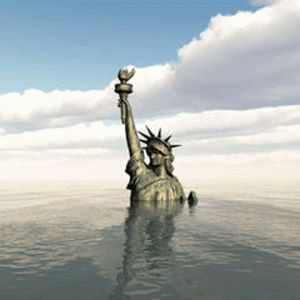
 This could be the next big strategy for suing over climate change.
Two California coastal counties and one beach-side city touched off a possible new legal front in the climate change battle this week, suing dozens of major oil, coal, and other fossil fuel companies for the damages they say they will incur due to rising seas.WP, By Chris Mooney and Brady Dennis July 20 2017, Two California coastal counties and one beach-side city touched off a possible new legal front in the climate change battle this week, suing dozens of major oil, coal, and other fossil fuel companies for the damages they say they will incur due to rising seas.
The three cases, which target firms such as Chevron, ExxonMobil, BP and Royal Dutch Shell, assert that the fossil fuel producers are collectively responsible for about 20 percent of global carbon dioxide emissions between 1965 and 2015. They claim that industry “knew or should have known” decades ago about the threat of climate change, and want companies to pay the costs of communities forced to adapt to rising seas.
“We’re already living the impact of sea level rise,” said Marin County Supervisor Kate Sears. She said a county vulnerability study found hundreds of county businesses and other assets could be at risk in coming years.
“This lawsuit is a natural next step in how we address the expense we’ve already had in planning for and trying to remediate the impacts of sea level rise, but also in addressing the impacts we expect in the future.”…….
The California cases are also proceeding under a legal doctrine called “public nuisance” (among other claims), which charges that under California common law, the companies have injured the counties and city by contributing to rising seas, and more frequent and severe flooding as a result.
But the difference is that this time, they are making state level nuisance claims rather than federal ones, which have already failed as courts pointed out that those worried about climate change had other recourses, such as EPA action.
The lawsuits were filed in California courts by Marin and San Mateo counties and the City of Imperial Beach, which sits south of San Diego near the Mexico border. Each cites specific damages expected from rising seas.
San Mateo cited worries about the flooding of the San Francisco Airport, along with up to $24 billion in assets being put at risk.
Marin County estimated nearly $16 billion of homes and businesses were threatened, and that with 6.7 feet of sea level rise, 7 percent of coastal roads would be “exposed to higher average sea level and storm threats at several locations.”
Imperial Beach cited the potential for “over $106 million” in property damages because of coastal erosion and argued the town has few resources to adapt to rising seas.
Vic Sher, a partner at the firm of Sher Edling who is helping lead the legal challenge, said the goal behind the lawsuits is to shift the “very real and very large costs of dealing with sea level rise” from ordinary citizens to the companies responsible for knowingly contributing to global warming.
He likened the cases to past litigation that sought to hold tobacco companies accountable for the public health toll of smoking, as well as efforts to force lead paint manufacturers to renovate homes where health risks remain……..
A strength of the lawsuit, note some legal observers, lies in the fact that sea level rise is easily measurable, constant (unlike climate-affected weather events), and very strongly linked to a warming planet. Moreover, analyses have become more and more precise when it comes to mapping which locations will be inundated, or subjected to greater flooding risks, for a given level of rising seas.
Bookbinder said there could be a time when the science is powerful enough to try to assess blame for other climate related changes, such as droughts, but that sea level rise is a stronger and simpler case right now. ……… https://www.washingtonpost.com/news/energy-environment/wp/2017/07/20/this-could-be-the-next-big-strategy-for-suing-over-climate-change/?utm_medium=twitter&utm_source=dlvr.it&utm_term=.af0543ecd151
July 22, 2017
Posted by Christina Macpherson |
climate change, Legal, USA |
Leave a comment