Vast areas of America’s land poisoned by mismanagement of military wastes
More than three decades ago, Congress banned American industries and localities from disposing of hazardous waste in these sorts of “open burns,’’ concluding that such uncontrolled processes created potentially unacceptable health and environmental hazards.
That exemption has remained in place ever since, even as other Western countries have figured out how to destroy aging armaments without toxic emissions.
Federal environmental regulators have warned for decades that the burns pose a threat to soldiers, contractors and the public stationed at, or living near, American bases.
“They are not subject to the kind of scrutiny and transparency and disclosure to the public as private sites are,”

 How The Pentagon’s Handling Of Munitions And Their Waste Has Poisoned America
Many nations have destroyed aging armaments without toxic emissions. The U.S., however, has poisoned millions of acres. Huffington Post, Co-published with ProPublica 20 July 17 RADFORD, Va. — Shortly after dawn most weekdays, a warning siren rips across the flat, swift water of the New River running alongside the Radford Army Ammunition Plant. Red lights warning away boaters and fishermen flash from the plant, the nation’s largest supplier of propellant for artillery and the source of explosives for almost every American bullet fired overseas.
Nearby, Belview Elementary School has been ranked by researchers as facing some the most dangerous air-quality hazards in the country. The rate of thyroid diseases in three of the surrounding counties is among the highest in the state, provoking town residents to worry that emissions from the Radford plant could be to blame. Government authorities have never studied whether Radford’s air pollution could be making people sick, but some of their hypothetical models estimate that the local population faces health risks exponentially greater than people in the rest of the region.
In the United States, outdoor burning and detonation is still the military’s leading method for dealing with munitions and the associated hazardous waste. It has remained so despite a U.S. Senate resolution a quarter of a century ago that ordered the Department of Defense to halt the practice “as soon as possible.” It has continued in the face of a growing consensus among Pentagon officials and scientists that similar burn pits at U.S. bases in Iraq and Afghanistan sickened soldiers.
Federal records identify nearly 200 sites that have been or are still being used to open-burn hazardous explosives across the country. Some blow up aging stockpile bombs in open fields. Others burn bullets, weapons parts and — in the case of Radford — raw explosives in bonfire-like piles. The facilities operate under special government permits that are supposed to keep the process safe, limiting the release of toxins to levels well below what the government thinks can make people sick. Yet officials at the Environmental Protection Agency, which governs the process under federal law, acknowledge that the permits provide scant protection.
Consider Radford’s permit, which expired nearly two years ago. Even before then, government records show, the plant repeatedly violated the terms of its open burn allowance and its other environmental permits. In a typical year, the plant can spew many thousands of pounds of heavy metals and carcinogens — legally — into the atmosphere. But Radford has, at times, sent even more pollution into the air than it is allowed. It has failed to report some of its pollution to federal agencies, as required. And it has misled the public about the chemicals it burns. Yet every day the plant is allowed to ignite as much as 8,000 pounds of hazardous debris.
“It smells like plastic burning, but it’s so much more intense,” said Darlene Nester, describing the acrid odor from the burns when it reaches her at home, about a mile and a half away. Her granddaughter is in second grade at Belview. “You think about all the kids.”
Internal EPA records obtained by ProPublica show that the Radford plant is one of at least 51 active sites across the country where the Department of Defense or its contractors are today burning or detonating munitions or raw explosives in the open air, often in close proximity to schools, homes and water supplies. The documents — EPA PowerPoint presentations made to senior agency staff — describe something of a runaway national program, based on “a dirty technology” with “virtually no emissions controls.” According to officials at the agency, the military’s open burn program not only results in extensive contamination, but “staggering” cleanup costs that can reach more than half a billion dollars at a single site.
The sites of open burns — including those operated by private contractors and the Department of Energy — have led to 54 separate federal Superfund declarations and have exposed the people who live near them to dangers that will persist for generations.
In Grand Island, Nebraska, groundwater plumes of explosive residues spread more than 20 miles away from the Cornhusker Army Ammunition Plant into underground drinking water supplies, forcing the city to extend replacement water to rural residents. And at the Redstone Arsenal, an Army experimental weapons test and burn site in Huntsville, Alabama, perchlorate in the soil is 7,000 times safe limits, and local officials have had to begin monitoring drinking water for fear of contamination.
Federal environmental regulators have warned for decades that the burns pose a threat to soldiers, contractors and the public stationed at, or living near, American bases. Local communities – from Merrimac, Wisconsin, to Romulus, New York – have protested them. Researchers are studying possible cancer clusters on Cape Cod that could be linked to munitions testing and open burns there, and where the groundwater aquifer that serves as the only natural source of drinking water for the half-million people who summer there has been contaminated with the military’s bomb-making ingredients……..
ProPublica reviewed the open burns and detonations program as part of an unprecedented examination of America’s handling of munitions at sites in the United States, from their manufacture and testing to their disposal. We collected tens of thousands of pages of documents, and interviewed more than 100 state and local officials, lawmakers, military historians, scientists, toxicologists and Pentagon staff. Much of the information gathered has never before been released to the public, leaving the full extent of military-related pollution a secret.
“They are not subject to the kind of scrutiny and transparency and disclosure to the public as private sites are,” said Mathy Stanislaus, who until January worked on Department of Defense site cleanup issues as the assistant administrator for land and emergency management at the EPA.
Our examination found that open burn sites are just one facet of a vast problem. From World War I until today, military technologies and armaments have been developed, tested, stored, decommissioned and disposed of on vast tracts of American soil. The array of scars and menaces produced across those decades is breathtaking: By the military’s own count, there are 39,400 known or suspected toxic sites on 5,500 current or former Pentagon properties. EPA staff estimate the sites cover 40 million acres — an area larger than the state of Florida — and the costs for cleaning them up will run to hundreds of billions of dollars.
The Department of Defense’s cleanups of the properties have sometimes been delegated to inept or corrupt private contractors, or delayed as the agency sought to blame the pollution at its bases on someone else. Even where the contamination and the responsibility for it are undisputed, the Pentagon has stubbornly fought the EPA over how much danger it presents to the public and what to do about it, letters and agency records show.
Chapter 1. Rules With Exceptions……..
Chapter 2. Debating the Dangers…….
Chapter 3. Awakening to Threats…….
Chapter 4. Risks and Choices……. alternatives only seem to be deployed after communities have mobilized to fight the burning with a vigor that has proven elusive in many military towns. “Sometimes it’s easier for everybody to just lie low and keep doing what they are doing,” Hayes added. “Short term thinking is the problem. In the immediate, it costs them nothing to keep burning.”
The success in Louisiana could be the start of a shift in momentum. In the 2017 Defense Department funding bill, Sen. Mitch McConnell, the majority leader, supported an amendment ordering the National Academy of Sciences to evaluate alternatives to open burning. ………
For Devawn Bledsoe, the foot dragging and decades of delay have led to profound disillusionment. For a long time, she thought her responsibility was to bring light to the issue. Now she thinks it takes more than that. “There’s something so immoral about this,” she said. “I really thought that when enough people in power — the Army, my Army — understood what was going on, they would step in and stop it.”
“It’s hard to see people who ought to know better look away.”
Nina Hedevang, Razi Syed and Alex Gonzalez, students in the NYU Arthur L. Carter Journalism Institute graduate studies program, contributed reporting for this story. Other students in the program who also contributed were Clare Victoria Church, Lauren Gurley, Clare Victoria Church, Alessandra Freitas and Eli Kurland. http://www.huffingtonpost.com.au/entry/open-burns-ill-winds_us_5970112de4b0aa14ea770b08
Marshallese people evacuated from their islands now face harsh situation in Oklahoma
 The U.S. Tested 67 Nuclear Bombs in Their Country. Now They’re Dying in Oklahoma. Narratively, by Zoë Carpenter , 20 July 17 After a series of military experiments devastated their homeland, Marshall Islands residents were permitted to immigrate to the U.S. But they didn’t know their American dream came with a catch
One breezy evening in April, on a weekend with no funeral, Mote’s kitchen filled with steam and the snapping sound of hot oil. He’d driven a hundred miles the previous day, to Oklahoma City, to buy bitter melon and small fish that he placed delicately into the frying pan with a pair of tongs. They were among the things he missed from the Marshall Islands, where he grew up. Fresh seafood is hard to find in the dry, windy city where he lives now – Enid, Oklahoma, a hunkered-down prairie town at the eastern edge of the Great Plains…….
Many leave the islands in search of the same things as other migrants – work, education, health care. But an unusual shadow trails the Marshallese. Following the Second World War, the United States used the islands as a testing ground for its nuclear weapons program, detonating more than 60 bombs over a dozen years. The largest, the “Castle Bravo” test, blew a crater 6,510 feet wide in the lagoon of Bikini Atoll and ignited a fireball visible from 250 miles away. Children on neighboring islands played in the ashy fallout, which fell like snow from the sky.
Today, thanks to a treaty signed when the Marshall Islands gained independence from the U.S. in 1986, Marshallese citizens are allowed to live and work in the States. Between 2000 and 2010, the number here grew by 237 percent. This mass migration is driven in part by poverty and lack of services in the islands. But it’s also a legacy of the U.S. occupation and the various damages it left behind. And it’s accelerated by climate change, which has started to drown the low-lying archipelago……
Mote and many other Marshallese in the U.S. live in a precarious state of in-between. Granted residency but not citizenship, the Marshallese have virtually no political influence and rank as the single poorest ethnic group in the U.S. In 1996, the Personal Responsibility and Work Opportunity Reconciliation Act of 1996 (or welfare reform) eliminated federal health care funding for Marshallese by excluding them from the group of “qualified aliens” who are eligible for benefits. That means that Marshallese citizens who live, work and pay taxes in the U.S. are ineligible for Medicaid and Medicare unless states opt to provide it. Oklahoma has not done so.
Mote loves Enid, but life is more difficult than he anticipated. Rent and groceries are expensive, and there is the problem of the funerals. Few of the elderly Marshallese in the city live into their 70s, according to Mote and other residents I spoke with. Instead, they’re dying young – of diabetes, kidney failure and heart disease, illnesses they might have been able to manage under other circumstances. Often they leave behind families saddled with medical debt.
Mote described the struggle in his community as part of a legacy of broken promises made by the U.S. – promises that the islanders displaced by the nuclear program would be able to return; that those relocated or sickened would be provided for; that the testing was for “the good of mankind.” America tested 67 nuclear bombs in the islands, Mote reminded me. “Then they’re just going to let us die over here?”
…………Inside the clinic I met Daina Joseia, a 63-year-old woman wearing a loose, floral-print dress of a style worn by many Marshallese women. Joseia smiled easily, but she seemed frail and tired. She moved to Enid in 1999, seeking care for various physical ailments – too many for me to write down, she said. Once she arrived, she found she couldn’t afford insurance. She often feels scared or ashamed to see a doctor because she’s uninsured, but she’s sick enough that she can’t avoid it. She has a lot of bills to pay. The day we met, Joseia had a large sore on her back.
Joseia believes her ill health might be connected to something she saw in the islands when she was a little girl: an enormous flash of light, she told me through an interpreter, “a real bright color, like a fire.” It wasn’t until she was an adult that she understood what she’d seen.
Between 1946 and 1958, the United States tested 67 nuclear bombs on or near two atolls at the northern end of the Marshall Islands – an area that became known as the Pacific Proving Grounds. The largest weapons test, a hydrogen bomb set off on Bikini Atoll in 1954, detonated with more than a thousand times the power of the bomb dropped on Hiroshima during World War II. Though Bikini Atoll had been evacuated, the wind blew radioactive fallout onto several inhabited islands, and perhaps much further away. (A few days later, a doctor in Tennessee reported that cattle in the state showed unusually high levels of radioactivity in their thyroids.) Officially, the U.S. claimed only three inhabited islands were seriously affected by fallout from Bravo. But an internal report declassified in the 1990s suggested that radiation from that and subsequent tests may have affected as many as 13 atolls.
On neighboring islands, many health effects were immediate: radiation burns, damage to stomach linings, low blood cell counts. Others surfaced gradually in the following months and years. Rates of leukemia, breast cancer, and thyroid cancer rose. Children were born deformed, or had their growth stunted.
“In a nation that lacks a single oncologist or cancer treatment facility, the Marshallese experience extremely high rates of cancer; degenerative conditions associated with radiation exposure; miscarriage and infertility; and, the birth of congenitally deformed children,” environmental anthropologist Barbara Rose Johnston wrote in a 2013 report on the legacy of the tests. According to a 2012 report by a special rapporteur for the U.N., those health issues were “exacerbated by near-irreversible environmental contamination,” which in turn led to “indefinite displacement” for many Marshallese.
According to Dr. Neal Palafox, a cancer specialist at the University of Hawaii who worked in the Marshall Islands for nearly a decade, the weapons testing damaged more than flesh and bone. It constituted a form of cultural trauma, too. Palafox believes the U.S. chose to conduct the testing where it did because residents had little power to push back. “Not for a second does anybody believe that there was any kind of informed consent,” Palafox said in an interview. There is some evidence the U.S. knew that the winds had shifted before the Bravo test in a direction that endangered inhabited islands, yet proceeded anyway. Afterward, many of the people most heavily exposed to the Bravo fallout became test subjects in Project 4.1, a classified medical study of radiation exposure run by the U.S. government. Later in 1954, the Congress of the Marshall Islands requested a halt to the testing, which the U.S. rejected on the grounds that the islanders “had no medical reason to expect any permanent after-effects on the general health of the inhabitants.”
Joseia remembers the sickness that followed the bright light. She remembers women giving birth to babies that “didn’t look like human beings.” One man I met in Enid described infants born looking “like jellyfish.” Another woman, Joelynn Karben, told me she remembered infants born after the nuclear tests as incoherent lumps of flesh, like bunches of grapes. Her own brother was born missing part of his skull, and her mother died from what she thinks was thyroid cancer.
The bombings are deeply etched in the islands’ collective memory, and some people I met in Enid blamed them for all manner of illnesses. It’s impossible to say which, if any, of Joseia’s health issues are directly related. The sore she had on her back the day we met was actually a symptom of her diabetes, a nurse told me later – though that, too, is linked to the U.S. military presence in the islands, specifically to the dietary changes that accompanied imports of processed, sugary foods.
More than 90 percent of the food in the Marshall Islands is imported from the U.S. now. Before the U.S. occupation, the Marshallese ate mostly fish, breadfruit, coconut, and pandanus, a knobby fruit resembling a large pinecone. World War II and the nuclear testing that followed damaged local crops and created a stigma around local foods, which residents of islands affected by fallout had been warned by the U.S. not to eat. Some people were forced to relocate to desolate islands where growing food was impossible. Imported white rice, canned meats, refined sugar, and other cheap, processed foods filled the gap. Diabetes rates soared.
In Enid, it seemed like almost everyone I met had diabetes. In fact, the Marshallese have the second highest rate of Type II diabetes in the world. While the illness can be controlled, it becomes gruesome if not properly managed. Complications can escalate to blindness, nerve damage, and serious infections, which can require amputation.
Joseia’s diabetes is acute. Her kidneys are failing, and she needs dialysis. But there’s nowhere for her to get it in Enid without insurance. When her condition gets bad enough she can be admitted to an emergency room – but only in a crisis……..
Marshallese also bear the rare burden of radiation-related illness. Cancer killsmore Marshallese citizens than any other disease but diabetes, and according to a 2004 report by the U.S. National Cancer Institute, it is likely some radiation-related cancers have yet to develop or be diagnosed in people who lived on the islands between 1948 and 1970………
Mote is an optimistic guy, and a relentless jokester. He claims that “tired” is not part of his vocabulary. He hesitates to speak badly about anyone.
But watching Enid’s Marshallese families get sick so often, listening to them fret about coming up with rent money, going to all the funerals – it does wear on him. He constantly fields requests for help, but there’s only so much he can do; his toehold in the city bureaucracy is still tenuous. He’d like to run for a seat on the city council, but without citizenship he’s ineligible. Mote believes that if Oklahomans understood more about the history and culture of the islands, they might be more sympathetic to the plight of their people. But he also acknowledges that Enid, which is more than 80 percent white, “has a lot of issues with race” to overcome first.
“I don’t want to blame someone,” Mote said, when I asked what he thought the U.S. owed the Marshallese. “But yes, I feel frustrated sometimes, to see all these people getting sick every day, dying every day… If the state is not going to help us, and the government is not listening to us, who will help us?” He went on, “Do we just scatter our stuff and leave Oklahoma?”…….http://narrative.ly/how-years-of-ruthless-nuclear-testing-in-the-south-pacific-forged-americas-most-impoverished-ethnic-group/
Chicago at last to clean up its radioactive thorium pollution
 Chicago park will finally be cleansed of radioactive waste, By MATTHEW MESSNER (@MESSNERMATTHEW) • July 20, 2017
Chicago has a bit of a thorium problem.
The radioactive element, once heavily used in the making of gas light mantels, can now be found in contaminated superfund sites across the city. One of those sites also happens to be the long-delayed and much-anticipated DuSable Park in the downtown Streeterville neighborhood. While the park is on the Chicago Park District’s website, it has not been programmed or developed in any way. Now, 30 years after its founding, the park is set to finally be cleared of its radioactive waste, enabling its development into a usable public space……
Time to abandon the V.C. Summer nuclear project and avoid $10 billion more in costs
 Report: Summer nuke could cost up to $10B more, should be abandoned, Utility Dive Peter MaloneyJuly 20, 2017
Dive Brief:
- A report by Institute for Energy and the Environment at Vermont Law School finds that continuing construction on the V.C. Summer nuclear project could add as much as $10 billion to South Carolina ratepayers’ bills.
- The report argues for the abandonment of the project, saying that even though $9 billion has already been spent or committed, dropping Summer now would save significant amounts of money. The paper provides a preview of the testimony the Sierra Club and Friends of the Earth plan to present to the South Carolina Public Service Commission in October.
- A separate report filed with regulators by plant owners Santee Cooper and South Carolina Electric & Gas last year found that Santee’s reserve margin could reach up to 44% once the reactors are completed, and SCE&G’s could hit 27% before declining, according to The State.
Dive Insight:
The V.C. Summer nuclear project being built by South Carolina Electric & Gas and Santee Cooper was already over budget and behind schedule when Westinghouse Electric, the project’s equipment supplier and contractor, went bankrupt.
The owners now face the tough decision of whether or not to push ahead with project.
The report from the Vermont Institute, “The Failure of the Nuclear Gamble in South Carolina,” argues that the project should be abandoned and ratepayers should be issued refunds because of imprudence on the part of SCE&G…….http://www.utilitydive.com/news/report-summer-nuke-could-cost-up-to-10b-more-should-be-abandoned/447482/
Utah’s White Mesa Uranium Mill – will the State allow further pollution from this site?
Don’t let this uranium mill repeat history http://www.hcn.org/articles/opinion-pollution-a-uranium-mill-in-utah-threatens-to-repeat-a-history-of-pollution The White Mesa Mill’s license is up for renewal under the Trump administration. July 19, 2017 Tucked inside the Trump administration’s proposed budget is $703 million in funding for nuclear weapons. Although that’s about 30 percent less than last year, you would hardly know it here in the heart of Utah’s canyon country, where the nation’s last operating conventional uranium mill — the White Mesa Mill — is forging ahead.
Energy Fuels has influential friends, including high-powered lobbyists Andrew Wheeler, who worked on the Trump campaign and was involved with transition planning, and Mary Bono, the former California congresswoman and widow of Sonny Bono. So far, Utah seems to be welcoming the permit renewal as an economic boon for rural San Juan County, though the mill is staunchly opposed by its nearest neighbors — the Ute Mountain Ute Tribe and White Mesa residents who are mostly tribal members. Few have forgotten what happened to two towns and surrounding communities after uranium mills there were shuttered.
When the Monticello uranium mill closed, the environmental mess it left behind became two federal Superfund sites, one of which encompassed the entire community of Monticello. A $250 million taxpayer-funded cleanup effort ensued, even as cancers, respiratory problems, reproductive issues, allergies and birth defects plagued the residents of this small uranium town. In decades earlier, child and adolescent leukemia clusters appeared in the community. Residents suspected these ailments were linked to long-term uranium exposure, and a 2007 Utah Department of Health study found the mill to be a “plausible” cause of elevated rates of certain cancers.
Already, the problems that have emerged at the White Mesa Mill look a lot like the problems plaguing Monticello and Moab. The shallow groundwater aquifer underneath the mill is contaminated with heavy metals, and the bond posted by the company to fund cleanup is laughably low — about $22 million, which is less than a fifth of professional cleanup-cost estimates.
In both 2012 and 2013, the mill’s own reports show that it emitted more radon — a cancer-causing air pollutant — than the Clean Air Act allows. And in 2015, 2016 and 2017, radioactive spills occurred as materials were transported to the mill for processing. Numerous cases of cancer have been reported in White Mesa, although no epidemiological studies have begun.
Still, Utah regulators seem unconvinced that the risks are real, and now, the state has opened the mill’s license renewal to public comment. With Energy Fuels lobbying in Utah and in Washington, D.C., Americans have only until July 31, 2017, to urge regulators to stop continued environmental injustice at White Mesa. Email comments to dwmrcpublic@utah.gov with the subject line: “Public Comment on White Mesa RML Renewal” or submit comments by mail to Scott Anderson, Director, Division of Waste Management and Radiation Control, P.O. Box 144880, Salt Lake City, UT 84114-4850.
Donald Trump’s policies mean serious damage to climate science research
‘Frightening’: Senior climate scientist warns of potential Donald Trump damage http://www.smh.com.au/environment/climate-change/frightening-senior-climate-scientist-warns-of-potential-donald-trump-damage-20170719-gxe3xm.html, Peter Hannam, 20 July 17 Budget cuts to key US climate programs proposed by President Donald Trump are “frightening” for the global science community, threatening to set back recent advances, a leading international researcher says.
Valerie Masson-Delmotte, co-chair of the Intergovernmental Panel on Climate Change working group, said the planned cuts were “a major worry” given America’s outsized contribution to the global research.
“I cannot hide the huge anxieties about the strength of research capacities in the US in the coming years,” Dr Masson-Delmotte said.
Geosciences, including climate research, face cuts of as much as 40 per cent, including the scrapping for four climate-related satellites. “It’s a major worry given the weight of the US scientific communities” in this field, she said.
US work includes as much as 30 per cent of ocean climate research, and running core data centres used by international researchers. Such cuts, if applied, would be difficult for US universities – or other nations – to fill.
Cuts proposed by Australia’s CSIRO in monitoring of the Southern Ocean stirred similar concerns last year before a public outcry prompted the Turnbull government to step in to create a special climate centre with longer-term funding guaranteed.
China has significantly increased its ocean monitoring and climate modelling work “but it is not sufficient to cover what would happen if such a big player as the US would reduce their effort”, said Dr Masson-Delmotte, who is also a senior scientist at France’s Laboratoire des Sciences du Climat et de l’Environnement at the Institut Pierre Simon Laplace.
While researchers continue to expand knowledge of how the rise in greenhouse gases is causing a build-up in planetary heat, important gaps remain.
Research priorities include increasing observations in remote regions, such as Antarctica, where melting ice could trigger global sea-level rises of metres over centuries if the giant sheets collapse.
More understanding is also needed about feedback processes, which could amplify climate change and trigger abrupt shifts such as in ocean circulation patterns.
A third priority is the development of models that can correctly project the changes, particularly on a regional scale.
The sixth IPCC assessment report is due to be completed in 2021, with special reports on the impacts of a 1.5-degree warming, the cryosphere, and climate change effects on land set for release in the next two years.
America’s intended new sanctions on Iran may violate the nuclear agreement


 As Relations Worsen, Iran Says U.S. Sanctions May Violate Nuclear Deal, NYT, J ULY 18, 2017Mohammad Javad Zarif, the foreign minister of Iran, charged on Tuesday that the Trump administration’s attempt to reimpose sanctions on his country was a violation of the accord signed two years ago that sharply limited Iran’s ability to produce nuclear material in return for its reintegration into the world economy.
Trump administration confirms Iran is following nuclear agreement, but still intends new sanctions on Iran
 US sanctions 18 Iranian entities day after certifying nuclear deal compliance
Trump administration targets groups and individuals over non-nuclear behavior, after confirming that Iran is following nuclear agreement but breaching its ‘spirit’, Guardian, 18 Jul 17, The Trump administration announced on Tuesday new sanctions on 18 Iranian individuals, groups and networks over non-nuclear behavior, such as support for ballistic missiles development.
The move came a day after the administration certified to Congress that Iran is technically complying with the nuclear deal and can continue enjoying nuclear sanctions relief.
The treasury department is targeting seven groups and five people that aided Iran’s military or its elite Revolutionary Guard. The sanctions also target what the US says is a transnational criminal group based in Iran and three people associated with it, and the state department is also targeting two more groups associated with Iran’s ballistic missiles program.
The sanctions freeze any assets the targets may have in the US and prevent Americans from doing business with them.
Late on Monday, the administration insisted that Tehran would face consequences for breaching “the spirit” of the nuclear deal. Donald Trump, who lambasted the 2015 pact as a candidate, has given himself more time to decide whether to dismantle the deal or let it stand.
Officials said the US was working with allies to try to fix the deal’s flaws, including the expiration of some nuclear restrictions after a decade or more. The officials also signalled the new sanctions.
Trump, secretary of state Rex Tillerson and “the entire administration judge that Iran is unquestionably in default of the spirit” of the agreement, one official said. That assessment carries no legal force; Trump’s certification that Iran is technically complying clears the way for sanctions to remain lifted.
Monday’s late-night announcement capped a day of frenzied, last-minute decision-making by the president, exposing deep and lingering divisions within his administration about how to deal with a top national security issue.
National security advisers, including Tillerson and defense secretary James Mattis, recommended Trump preserve the deal for now in a meeting last Wednesday, according to the New York Times. An anonymous official told the Times that Trump spent 55 minutes of the meeting saying he did not want to certify Iran’s compliance. On Monday, a planned press briefing was cancelled at short notice as internal White House arguments continued.
Since early last week, Trump’s administration had been prepared to make the certification, a quarterly requirement. Trump first told Congress in April that Iran was indeed complying. With no final decision on his broader Iran policy, the White House had planned to let the status quo stand for another three months.
Iran will continue receiving the same sanctions relief that it did under former president Barack Obama………
Scuttling the deal would put further distance between Trump and foreign leaders who are already upset over his move to withdraw from the Paris global climate change accord. Other powers that brokered the nuclear deal along with the US have said there’s no appetite for renegotiating it. https://www.theguardian.com/world/2017/jul/18/iran-is-complying-with-nuclear-deal-but-is-in-default-of-its-spirit-says-us
NASA to develop nuclear power on Mars
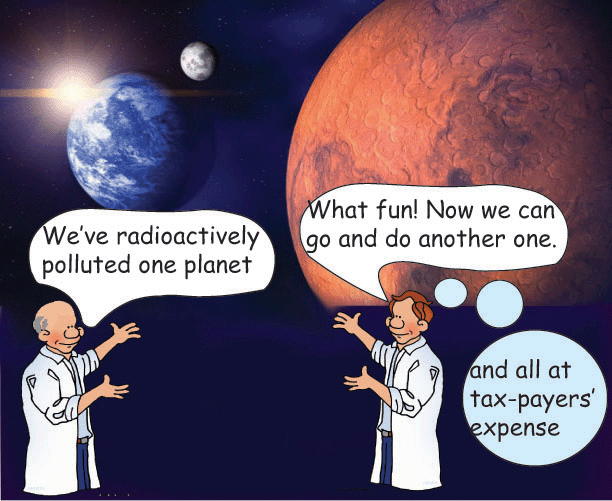
NASA Seeks Nuclear Power On Mars https://www.pastemagazine.com/articles/2017/07/nuclear-power-to-be-generated-on-mars.html By Natalie Wickstrom | July 18, 2017 According to recent reports, NASA has decided to pursue nuclear reactor development on Mars once more after abandoning the project nearly 50 years ago.
This news may not come as a surprise to some, as it had already been announced that NASA was looking to send a human to Mars in the near future. That being the case, it would seem only logical that the next step would be figuring out how to guarantee some sort of energy supply for whatever contingent of the human race ends up inhabiting the planet.
The answer to this potential energy dilemma may come in the form of nuclear fission reactors, small reactors that split uranium atoms to generate heat and subsequently, electric power.
During the 1960s, NASA tested a fission reactor as part of the Systems for Nuclear Auxiliary Power program, or SNAP. These tests developed two types of nuclear power systems, both of which are still powering space probes and other reactors in space to this day. SNAP-10A, the first—and only—nuclear power plant to operate in space under U.S. control generated some 500 watts of electrical power before experiencing equipment failure that has left it orbiting in space to this day.
Though nuclear power development has been on NASA’s agenda for more than half a century now, various issues stemming from financial and political conditions However, the agency’s “Game Changing Development” backed a goal of building and testing a small reactor by fall of 2017.
If the tests are successful, this could mean that NASA could have a guaranteed method of powering an archetype of a space station designed for Mars’ red clay surface. However, until that point, it remains to be seen as to whether or not energy options such as nuclear power—or even solar power, for that matter—could be viable to support life in space.
Will Small Nuclear Reactors be the great white hope for the ailing nuclear industry? Probably not.

The reactor that could kick-start the nuclear sector comes in a very small package, True Viral New 17.07.2017 “………..we won’t know how economically the plants can really operate until they’re up and running. And a shift toward smaller but more numerous nuclear reactors could raise new kinds of proliferation dangers, some observers warn.
The grand promise of commercial SMRs is that they would be compact enough to prefabricate in factories and ship to their destination, where they could be stacked together to produce whatever level of energy generation is needed. …….
A number of other companies and research institutions are pursuing so-called fourth-generation SMR technologies, including molten-salt and high-temperature gas. But in general, those face tougher technical challenges, as well as regulatory ones, and may take longer to develop.
NuScale’s main financial backer is the large engineering firm Fluor, which took a majority stake in the company in 2011. In 2013, the U.S. Department of Energy awarded the company $217 million under the SMR Licensing Technical Support Program. But the Trump administration’s budget proposal includes sharp cuts to the DOE’s nuclear programs, which could jeopardize the company’s ability to secure the remaining $47 million of that grant…….
a number of Republican lawmakers urged President Trump in a letter in May to support the development of SMRs…….
Despite the promise of SMRs, the technology is not a sure bet. Notably, even if capital outlays are considerably lower, that doesn’t necessarily mean it will yield competitive electricity costs, particularly against low-cost natural gas.
Some players have reportedly already pulled back from SMRs, including Westinghouse and Babcock & Wilcox, at least in part because of competition from cheaper energy sources.
“The cost per megawatt-hour doesn’t necessarily come down just because you’re building a smaller plant,” says Ryan Fitzpatrick, deputy director of the clean-energy program at the think tank Third Way. “There have to be cost savings derived through other processes.”
Those could include things like shorter construction times and new design features that reduce regulatory expenses. But the key to driving down costs would be setting up factories to crank out a lot of reactors, says Neil Todreas, a professor of nuclear science and engineering at MIT…..
That, however, may present a bit of a chicken-and-egg challenge: securing financing to build the plants will probably require a lot of orders, but it would be hard for a company to obtain those orders before it could reliably produce reactors cheaply.
In addition, the Union of Concerned Scientists has raised separate questions about how safe and secure the plants will really be. Among other issues, the group noted that a widely distributed network of smaller but more numerous reactors could make it harder to safeguard nuclear material that, among other dangers, can be used to make dirty bombs.
In the end, SMRs may or may not end up being the ideal or most economical way to add significant nuclear generation to the grid. But in a nation where it’s become nearly impossible to build any new nuclear plants, it could simply be the technology needed to get the industry moving forward again at all, Todreas says.
“I am not sure there will be a march toward small modular reactors across the U.S. for decades, or that they will completely replace large power plants,” he says. “But certainly in the near term, they’re very important for the health of nuclear power in the U.S.” In the end, SMRs may or may not end up being the ideal or most economical way to add significant nuclear generation to the grid. But in a nation where it’s become nearly impossible to build any new nuclear plants, it could simply be the technology needed to get the industry moving forward again at all, Todreas says.
“I am not sure there will be a march toward small modular reactors across the U.S. for decades, or that they will completely replace large power plants,” he says. “But certainly in the near term, they’re very important for the health of nuclear power in the U.S.”
An inconvenient report on USA’s energy grid: will the Trump team “disappear it”?
 Coal, nuclear and renewable bombshells from Trump’s grid study, REneweconomy, By Joe Romm on 18 July 2017, Think Progress On Saturday, we reported that a leaked draft of Energy Secretary Rick Perry’s grid study obtained by Bloomberg debunks his attack on renewable energy.
ThinkProgress has now obtained a copy of that draft, and it has many more surprises — or, rather, findings that are fairly well known to energy experts but may come as an unpleasant surprise to Perry and the White House.
For instance, a large fraction of America’s aging fleet of coal and nuclear plants are simply not economic to operate anymore.
It is widely feared Perry’s team of Trump appointees will simply erase the the study’s inconvenient truths before it  finalreport is released to the public.
The release of the study has been delayed several weeks — and the findings in the draft might explain why.
The study was specifically requested to back up Perry’s claims that EPA regulations, along with renewable power sources like solar and wind power, were undermining the U.S. electric grid’s reliability by forcing the premature closure of “baseload” (24–7) power sources like coal and nuclear.
But the leaked July draft concludes the grid is as reliable than ever.
As for baseload plant retirements, factors like environmental regulations and renewable energy subsidies “played minor roles compared to the long-standing drop in electricity demand relative to previous expectation and years of low electric prices driven by high natural gas availability.”
The draft report finds that since 2002, “most baseload power plant retirements have been the victims of overcapacity and relatively high operating cost but often reflect the advanced age of the retiring plants.”
Overcapacity is a major cause of the turmoil in electricity markets. The report explains that because the grown in electricity demand has flattened since 2008, it is harder for “less competitive plants” to survive………
since renewables keep dropping in price, we can expect more and more penetration.
It’s really no surprise that DOE staff would conclude renewables are not threatening grid reliability. After all, many countries around the world, such as Germany, have integrated far higher percentages of solar and wind than we have, while maintaining high reliability.
The only surprise remaining is how many of these findings Trump’s political appointees will erase. http://reneweconomy.com.au/coal-nuclear-renewable-bombshells-trumps-grid-study-42788/
New report recommends closure of nuclear power project in South Carolina
Report urges end of nuclear power project in South Carolina, The Eagle, By SEANNA ADCOX Associated Press, Jul 18, 2017 , COLUMBIA, S.C. (AP) — South Carolina’s utility regulators should stop the construction of nuclear reactors already years behind schedule and return billions in cost overruns to consumers, according to a report released by environmentalists Tuesday
The Public Service Commission could save utility customers up to $10 billion by “pulling the plug” on South Carolina Electric & Gas’ two new nuclear reactors at the V.C. Summer Nuclear Station in Jenkinsville, about 30 miles northwest of Columbia, and ordering at least some prepaid costs refunded, according to the report funded by the Sierra Club and Friends of the Earth.
“It’s now time for South Carolina to admit failure,” said the report’s author, Mark Cooper with Vermont Law School’s Institute for Energy and the Environment. “It was a mistake. It was an expensive mistake. It can become a catastrophic mistake if we don’t stop now.”
SCE&G owns 55 percent of the reactors, while state-owned utility Santee Cooper owns the other 45 percent. Since 2009, SCE&G customers have funded the reactors through a series of rate hikes approved by commissioners. Construction now accounts for 18 percent of residential customers’ electric bills.
The utility’s plans are uncertain. Westinghouse, the contractor building the reactors, filed for bankruptcy protection earlier this year. SCE&G’s parent company, SCANA, has said abandoning the project is an option. SCANA CEO Kevin Marsh told commissioners in April that other options include finishing one or both reactors. Roughly one-third of the project is complete, said SCANA executive Steve Byrne.
A company spokeswoman did not respond Tuesday to requests for comment……http://www.theeagle.com/news/nation/report-urges-end-of-nuclear-power-project-in-south-carolina/article_64893f12-d60c-5c1d-b1a7-86e7b3c80de0.html
America neglects Guam atomic test victims – hopes they all die?
July 17 2017 Terry R Scheidt Seems like Terry is the only responder, is there anyone else, It is July 2017, been writing to Trump to use his EO but he never responds either. Boy is this America?
January 12, 2014 Aloha, It is now 01/2014 (24 years) since RECA was enacted. We are still waiting for justice. Our country denied, deceived, has no integrity or values by denying victims of radiation they caused. The justice system denied and dismissed most litigation cases claiming the Congress had to enact better laws to address radiation.
They claimed radiation does not cause cancer, of course we know better in the PACIFIC, Micronesia, Guam, Johnston
Island and many other location. The unfortunate thing is 70 years have passed and many have already died which is our countries hope.
May 13, 2017 It is now May 2017, yes Terry is still alive and still seeking equity, HA. Our delegates never heard such a word, denial is more like it. I will advocate for loyalty till I die. Hard to believe our nation does things I thought only others did.
I was a range rat, many friends on Midway, Eniwetok, Wake, French Frigate Shoals, Christmas, Johnston, Jarvis, Canton damn so many.
*************************************************************************************************************
 Way back in 2010, we made a small post about the the plight of residents of Guam, who were suffering from illnesses resulting from radiation exposure. Research presented to the National Academy of Science and National Research Council described the effects on this community, of atmospheric testing of nuclear weapons. The Pacific Association for Radiation Survivors, a nonprofit organization, was lobbying U.S. Congress to include Guam in the Radiation Exposure Compensation Act Program, so that they could receive help and compensation for their radiation-induced illnesses.
Well, what happened about this?
Thanks to one reader of this website, we have been kept up to date over the years:
TERRY R SCHEIDT by Terry R Scheidt January 6, 2011 I WAS A 1962 JOHNSTON ISLAND PARTICIPANT. I WAS AT GROUND ZERO AND EXPOSED TO HIGH LEVELS OF RADIATION FOR WHICH I GOT CANCER. I HAVE NOT BEEN COMPENSATED UNDER THE DOE/EEOICPA ACT BECAUSE I DID NOT WORK FOR DOE. I WAS DENIED. I RECEIVED UNEQUAL COMPENSATION FROM DOJ (RECA) BUT AT A MUCH LESSER AMOUNT THAN DOE (EEOICPA). NO MEDICAL AND LESS THAN HALF THAT OF DOE. PLEASE SUPPORT HR 5119/S3224.
April 23, 2011 Do our representatives really care? Why have both HR5119/S3224 both died in committee. Our government does not live up to responsibility. They cause us harm than ignore us as if we do not exist. Aloha.
April 26, 2011 I am a 1962 ground zero victim of the Johnston Island PPG. Senators Pangelinan, Udalls and Rep Lujan have done nothing. All legislation died in committee. They turned their backs on us again. Shame.
June 25, 2012 Continue reading
Climate change is a ‘Direct Threat’ to Security – USA’s Republican dominated Congress

In Landmark Move, GOP Congress Calls Climate Change ‘Direct Threat’ to Security
Extreme weather and rising seas threaten bases from Virginia to Guam. For the first time, a Republican House has voted to recognize that. Foreign Policy, BY JULY 14, 2017 BETHANY.ALLEN @BETHANYALLENEBR
USA govt funding Westinghouse and universities to advance nuclear innovation
 Westinghouse and partners get $7.5m funding from DOE for nuclear research, EBR 13 July 2017 The U.S. Department of Energy (DOE) has selected Westinghouse Electric Company and university research partners to receive a total of $7.5m in funding to advance nuclear innovation in a number of areas.
For one of the projects, Westinghouse is investigating the neutron radiation effects on zirconium alloys produced via the additive manufacturing process (3D printing) for light water reactors……The funding that Westinghouse received is part of DOE’s more than $66 million in funding for nuclear energy-related and infrastructure research in 28 states through the Nuclear Energy University Program (NEUP), Nuclear Science User Facilities (NSUF) and Nuclear Energy Enabling Technology (NEET) program. http://nuclear.energy-business-review.com/news/westinghouse-and-partners-win-75-million-for-nuclear-innovation-from-the-department-of-energy-5870951
1 This Month





PLEASE OPPOSE HR 8255 AND S.3639 – bills would accelerate satellite deployment, with no environmental review or safeguards – https://ncstd5li.quorum.us/campaign/169331/
To see nuclear-related stories in greater depth and intensity – go to https://nuclearinformation.wordpress.com
-
Archives
- October 2026 (74)
- September 2026 (339)
- August 2026 (330)
- July 2026 (355)
- June 2026 (287)
- May 2026 (306)
- April 2026 (356)
- March 2026 (251)
- February 2026 (267)
- January 2026 (308)
- December 2025 (358)
- November 2025 (359)
-
Categories
- 1
- 1 NUCLEAR ISSUES
- business and costs
- climate change
- culture and arts
- ENERGY
- environment
- health
- history
- indigenous issues
- Legal
- marketing of nuclear
- media
- opposition to nuclear
- PERSONAL STORIES
- politics
- politics international
- Religion and ethics
- safety
- secrets,lies and civil liberties
- spinbuster
- technology
- Uranium
- wastes
- weapons and war
- Women
- 2 WORLD
- ACTION
- AFRICA
- Atrocities
- AUSTRALIA
- Christina's notes
- Christina's themes
- culture and arts
- Events
- Fuk 2022
- Fuk 2023
- Fukushima 2017
- Fukushima 2018
- fukushima 2019
- Fukushima 2020
- Fukushima 2021
- general
- global warming
- Humour (God we need it)
- Nuclear
- RARE EARTHS
- Reference
- resources – print
- Resources -audiovicual
- Weekly Newsletter
- World
- World Nuclear
- YouTube
-
RSS
Entries RSS
Comments RSS

