USA government in confusion over funding of MOX nuclear facility
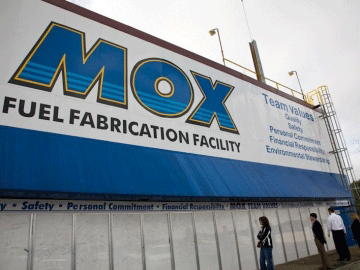 Trump administration opposes House measure funding MOX nuclear facility http://www.janes.com/article/72606/trump-administration-opposes-house-measure-funding-mox-nuclear-facility,Daniel Wasserbly – IHS Jane’s Defence Weekly, 26 July 2017
Key Points
- The White House ‘strongly opposes’ a House effort to continue funding the MOX plutonium disposition programme
- House and Senate appropriators are at odds over funding the controversial facility
The White House is backing a US Department of Energy (DoE) request, once again, for Congress to terminate a multi-billion-dollar project aimed at disposing weapon-grade plutonium, the Mixed Oxide Fuel Fabrication Facility (MFFF).
MFFF has suffered significant cost and schedule issues but is strongly supported by South Carolina’s congressional delegation and there are few easy options to replace the facility. It has survived repeated White House and DoE efforts during the Obama administration to curtail or terminate the programme, and last year even survived Russia’s suspension of the arms control agreement that underpins the project.
The Trump administration, in its fiscal year 2018 (FY 2018) budget request for the DoE, asked for USD270 million “to terminate the Mixed Oxide [MOX] Fuel Fabrication Facility with an orderly and safe closure of the facility”. It also asked for USD9 million in FY 2018 to pursue a ‘dilute and dispose’ method as an alternative for plutonium disposition. The Obama administration asked for, but did not receive, the same thing last year.
So far, during a tumultuous FY 2018 budget process, Senate appropriators appear to back the White House’s request to end MOX but House appropriators want the programme to continue.
In a 24 July ‘statement of administration policy’, the White House said it “strongly objects to continued construction of the Mixed Oxide [MOX] Fuel Fabrication Facility” as directed in the House appropriations bill. That legislation is still being finalised and must be reconciled with the Senate version before being enacted by the president. The White House did not indicate that it would consider a veto.
If Trump were to order a pre-emptive nuclear strike on China, U.S. Pacific Fleet commander would launch it
US admiral stands ready to obey a Trump nuclear strike order CANBERRA, Australia (AP) 28 July 17 — The U.S. Pacific Fleet commander said Thursday he would launch a nuclear strike against China next week if President Donald Trump ordered it, and warned against the military ever shifting its allegiance from its commander in chief.
Adm. Scott Swift was responding to a hypothetical question at an Australian National University security conference following a major joint U.S.- Australian military exercise off the Australian coast. The drills were monitored by a Chinese intelligence-gathering ship off northeast Australia.
Asked by an academic in the audience whether he would make a nuclear attack on China next week if Trump ordered it, Swift replied: “The answer would be: Yes.”
“Every member of the U.S. military has sworn an oath to defend the constitution of the United States against all enemies foreign and domestic and to obey the officers and the president of the United States as commander and chief appointed over us,” Swift said.
He added: “This is core to the American democracy and any time you have a military that is moving away from a focus and an allegiance to civilian control, then we really have a significant problem.”
Pacific Fleet spokesman Capt. Charlie Brown later said Swift’s answer reaffirmed the principle of civilian control over the military.
“The admiral was not addressing the premise of the question, he was addressing the principle of civilian authority of the military,” Brown said. “The premise of the question was ridiculous.”
The biennial Talisman Saber exercise involved 36 warships including the aircraft carrier USS Ronald Reagan, 220 aircraft and 33,000 military personnel……. https://apnews.com/e7a5db2a77b94ce78f6ef13b6562b8e2/US-admiral-stands-ready-to-obey-a-Trump-nuclear-strike-order
Hanford nuclear waste site – a national disaster they don’t want to talk about.
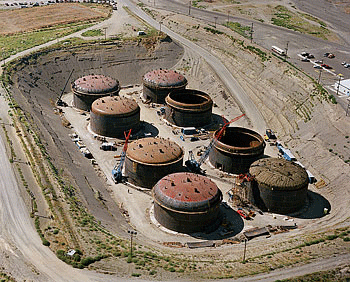
“Nobody in the world has waste like ours,” says one of my guides as we enter the site. No one has so much strontium 90, for instance, which behaves a lot like calcium and lodges inside the bones of any living creatures it penetrates, basically forever. Along with chromium and tritium and carbon tetrachloride and iodine 129 and the other waste products of a plutonium factory it is already present in Hanford’s groundwater. There are other nuclear-waste sites in the United States, but two-thirds of all the waste is here. Beneath Hanford a massive underground glacier of radioactive sludge is moving slowly, but relentlessly, toward the Columbia River.
The place is now an eerie deconstruction site, with ghost towns on top of ghost towns. Much of the old plutonium plant still stands: the husks of the original nine reactors, built in the 1940s, still line the Columbia River, like grain elevators. Their doors have been welded shut, and they have been left to decay—for another century.
Only one stakeholder in the place wanted to know what was going on beneath its soil: the tribes.
 WHY THE SCARIEST NUCLEAR THREAT MAY BE COMING FROM INSIDE THE WHITE HOUSE, Vanity Fair, BY MICHAEL LEWIS, September 2017 “………By the early 1940s the United States government understood that for democracy to survive it needed to beat Hitler to the atom bomb, and that the race had two paths—one required enriched uranium, the other plutonium. In early 1943, the United States Army was evicting everyone from an area in Eastern Washington nearly half the size of Rhode Island and setting out to create plutonium in order to build a nuclear bomb. The site of Hanford was chosen for its proximity to the Columbia River, which could supply the cooling water while its dams provided the electricity needed to make plutonium. Hanford was also chosen for its remoteness: the army was worried about both enemy attacks and an accidental nuclear explosion. Hanford was, finally, chosen for its poverty. It was convenient that what would become the world’s largest public-works project arose in a place from which people had to be paid so little to leave.
More or less overnight Hanford went from the business of making plutonium to the even more lucrative business of cleaning it up. In its last years of production the plutonium plant employed around 9,000 people. It still employs 9,000 people and pays them even more than it used to. “It’s a good thing that we live in a country that cares enough to take the time it will take, and spend the money it will spend, to clean up the legacy of the Cold War,” said MacWilliams. “In Russia they just drop concrete on the stuff and move on.”
The Department of Energy wires 10 percent of its annual budget, or $3 billion a year, into this tiny place and intends to do so until the radioactive mess is cleaned up. And even though what is now called the Tri-Cities area is well populated and amazingly prosperous—yachts on the river, $300 bottles of wine in the bistros—the absolute worst thing that could happen to it is probably not a nuclear accident. The worst thing that could happen is that the federal government loses interest in it and slashes the D.O.E.’s budget—as President Trump has proposed to do. And yet Trump won the county in which Hanford resides by 25 points. Continue reading
Lawsuit aims to stop construction of the problem-plagued Uranium Processing Facility (UPF)

 Public Interest Organizations File Lawsuit Against New Nuclear Bomb Plant http://www.ladailypost.com/content/public-interest-organizations-file-lawsuit-against-new-nuclear-bomb-plant, by Carol A. Clark July 26, 2017, OREPA News: WASHINGTON, D.C. ― The Oak Ridge Environmental Peace Alliance (OREPA), Nuclear Watch New Mexico, and the Natural Resources Defense Council filed a federal lawsuit July 20, to stop construction of the problem-plagued Uranium Processing Facility (UPF) until a legally required environmental review is completed.
American new sanctions against Iran – designed to kill off the nuclear agreement
New US sanctions aim to kill Iran nuclear deal – expert https://en.trend.az/iran/nuclearp/2781079.html26 July 2017 Baku, Azerbaijan, By Farhad Daneshvar – Trend:
The US decision to impose fresh sanctions on Iran is a violation of a nuclear deal reached in 2015 between Tehran and the six major powers including the United States, a Norway-based Iranian financial analyst told Trend.
Elaborating on the recent decision by US House of Representatives to slap new sanctions on Iran, Mehrdad Seyed Asgari said that the new sanctions provide the US with a chance to covertly kill or avert the nuclear accord.
In this particular case aborting the deal means that the US will refuse to properly implement the articles of the Joint Comprehensive Plan of Action (JCPOA aka nuclear deal) aimed at placing the administration of President Hassan Rouhani under tremendous pressure.
Sanctions have been imposed on Iran with an aim to divide the country’s economic system in two parts of “white and black”, he mentioned.
Since the American lawmakers believe that sanctions work as a powerful tool, they appear to continue increasing pressure on Iran through introducing new sanctions.
The recent bill passed by the US House of Representatives on introducing new sanctions on Iran is very likely to become a law, he concluded.
The lawmakers voted overwhelmingly on Tuesday to slap new sanctions on Iran, Russia and North Korea.
The legislation in order to become a law still needs to be signed by President Donald Trump
Thomas Perez, chairman of the Democratic National Committee, callously disregarded nuclear workers’ health
Florida Power & Light nuclear plans contested by regulators and community and business groups
The dispute, detailed in documents filed last week at the Florida Public Service Commission, pits FPL against consumer representatives, the city of Miami and business and environmental groups.
At least in part, it involves an FPL strategy to continue pursuing a crucial license for the reactors and then pausing for what could be years before making decisions about whether to move forward with the project. The utility is asking the Public Service Commission to allow it to recoup costs from customers in the future for the licensing and other expenses.
But opponents of the request argue FPL has not submitted a needed study that would show whether the nuclear project is feasible. They say the utility should not be given approval to continue adding millions of dollars in costs and billing customers later……..
“FPL’ s position begs a basic policy question: If FPL cannot produce a feasibility analysis showing that pursuing the reactors makes economic sense for customers, why would the (Public Service) Commission saddle customers with more risk and costs?” said a document filed last week by the Southern Alliance for Clean Energy, one of the opposition groups.
People’s health, and the environment are hit hard by uranium mining in Utah
Tucked inside the Trump administration’s proposed budget is $703 million in funding for nuclear weapons. Although that’s about 30 percent less than last year, you would hardly know it here in the heart of Utah’s canyon country, where the nation’s last operating conventional uranium mill—the White Mesa Mill—is forging ahead.
The mill sits on an arid mesa just a few miles east of the newly established Bears Ears National Monument, with Monument Valley to the south and Canyonlands National Park to the north, and is owned by a subsidiary of the Canadian energy giant Energy Fuels Resources, which also owns and operates uranium mines around the Grand Canyon. Today, despite a litany of risks, Energy Fuels Resources is asking Utah to renew the mill’s license, which expired in 2007 and has been in “timely renewal” ever since.
Energy Fuels has influential friends, including high-powered lobbyists Andrew Wheeler, who worked on the Trump campaign and was involved with transition planning, and Mary Bono, the former California congresswoman and widow of Sonny Bono. So far, Utah seems to be welcoming the permit renewal as an economic boon for rural San Juan County, though the mill is staunchly opposed by its nearest neighbors—the Ute Mountain Ute Tribe and White Mesa residents who are mostly tribal members. Few have forgotten what happened to two towns and surrounding communities after uranium mills there were shuttered.
When the Monticello uranium mill closed, the environmental mess it left behind became two federal Superfund sites, one of which encompassed the entire community of Monticello. A $250 million taxpayer-funded cleanup effort ensued, even as cancers, respiratory problems, reproductive issues, allergies and birth defects plagued the residents of this small uranium town.
Decades earlier, child and adolescent leukemia clusters appeared in the community. Residents suspected these ailments were linked to long-term uranium exposure, and a 2007 Utah Department of Health study found the mill to be a “plausible” cause of elevated rates of certain cancers.
In both Moab and Monticello, uranium mills have permanently contaminated the groundwater and poisoned surface water—both scarce resources in the arid West. Adding insult to injury, the Moab mill owner declared bankruptcy and stuck taxpayers with the cleanup bill. The site still isn’t completely cleaned up, and with cuts to the Department of Energy’s budget, cleanup could be delayed indefinitely. Why, despite this history of mismanagement just up the road from White Mesa, do state regulators seem content to let history repeat itself?
Already the problems that have emerged at the White Mesa Mill look a lot like the problems plaguing Monticello and Moab. The shallow groundwater aquifer underneath the mill is contaminated with heavy metals, and the bond posted by the company to fund cleanup is laughably low—about $22 million, which is less than a fifth of professional cleanup-cost estimates.
If Utah regulators fail to stand up for the public interest now, the Ute Mountain Ute Tribe, southeastern Utahns and ultimately American taxpayers risk paying a high price. But nowhere are the risks higher than in White Mesa. The tribal community is immediately down-gradient and often downwind from the mill. Community members describe finding rainbow-colored meat when butchering animals hunted near the mill site. When the wind blew from the direction of the mill, people kept their children inside, reporting that they smelled strong chemical odors.
In both 2012 and 2013, the mill’s own reports show that it emitted more radon—a cancer-causing air pollutant—than the Clean Air Act allows. And in 2015, 2016 and 2017, radioactive spills occurred as materials were transported to the mill for processing. Numerous cases of cancer have been reported in White Mesa, although no epidemiological studies have begun.
Still, Utah regulators seem unconvinced that the risks are real, and now the state has opened the mill’s license renewal to public comment. With Energy Fuels lobbying in Utah and in Washington, D.C., Americans have only until July 31, 2017, to urge regulators to stop continued environmental injustice at White Mesa. At the very least, state regulators should require Energy Fuels to post a substantial bond to guarantee that the company pays for the mill’s cleanup. It’s time to stop asking taxpayers to pay for an industry’s toxic mess.
Stephanie Malin is a contributor to Writers on the Range, the op ed service of High Country News (hcn.org). She is the author of The Price of Nuclear Power: Uranium Communities and Environmental Justice and is an assistant professor at Colorado State University.
Lawmakers are forcing taxpayers to go nuclear.

Taxpayers shouldn’t have to bail out the nuclear industry: David Williams Press Journal 27 July 17 Lawmakers are forcing taxpayers to go nuclear.
Now that nuclear energy is becoming less competitive nationwide, lawmakers are responding by using Americans’ hard-earned dollars to bail out floundering nuclear plants.
But government handouts are no way to protect consumers. Rather than favor certain energy sources over others, lawmakers should let consumers benefit from a competitive, level energy playing field.
Many nuclear companies are struggling to compete with other forms of energy. As a result, nuclear bailouts are becoming the norm.
Consider Illinois. Last year, Chicago-based Exelon — the owner of Three Mile Island — announced that without government intervention, its power plants in Clinton and the Quad Cities would be forced to shut down. So legislators cooked up the Future Energy Jobs Act, which will throw a $200 million a year lifeline to Exelon — allowing its plants to limp on.
And they’ll pay for that bailout with the largest tax-rate increase in U.S. history. The scheme would hit Illinois residents with an extra $16.4 billion in energy costs. All told, the plan would forgo $14.7 billion in economic activity and $429 million in local and state tax revenue, costing Illinois up to 44,000 jobs……
In New York, Gov. Andrew Cuomo approved a similar plan to spend $7.6 billion to save struggling nuclear plants. Exelon is purchasing an additional plant in the Empire State on the condition that the state’s government help pick up the tab by raising utility rates.
That’ll cost New Yorkers big time. Indeed, experts estimate the plan will rob New Yorkers of $3.4 billion over the first five years — and more in the long term. New York and federal taxpayers will also feel the pinch when energy costs for state and federal buildings increase.
The bailouts don’t stop there. Now that nuclear companies have locked down funding models in Illinois and New York, they’re getting ready to turn to other states for more money.
In Ohio, for instance, another power company, FirstEnergy, is looking to sell its floundering plants near Cleveland and Toledo. Exelon is considering moving in — asking the state for a little help in taking over the facilities. Nuclear companies are also eyeing handouts in Pennsylvania, New Jersey and Connecticut.
These other states should look to New York and Illinois as cautionary tales. Throwing taxpayer-subsidized lifelines to nuclear energy will hurt energy markets across America, resulting in poorer service, less choice, and higher utility rates for customers.
Indeed, if all nuclear plants in the northeast and mid-Atlantic win similar subsidies, it could cost ratepayers an astounding $3.9 billion a year, according to a report by Bloomberg Intelligence…….
David Williams is president of the Taxpayers Protection Alliance, a nonprofit, nonpartisan organization dedicated to educating the public on the government’s effects on the economy. http://www.pressandjournal.com/stories/taxpayers-shouldnt-have-to-bail-out-the-nuclear-industry-david-williams,16140
USA nuclear ship closed 45 years ago – but still no funds to decommission it
Aboard the NS Savannah, America’s first (and last) nuclear merchant ship, Years after shutdown, Savannah still waits for funding for its reactor decommissioning. Ars Technica, SEAN GALLAGHER – 7/26/2017 Constructed at a cost of $46.9 million ($386.8 million in 2016 dollars) and launched on July 21, 1959, the Savannah was the world’s first nuclear cargo ship and the second nuclear-powered civilian ship (coming just two years after the Soviet nuclear icebreaker Lenin). Owned by the US Maritime Administration (MARAD) and operated by commercial cargo companies, for nearly a decade she carried cargo and passengers around the world. She also acted as a floating herald for America’s seemingly inevitable, cool Atomic Age future. Savannah boasted all the latest conveniences, including one of the world’s first microwave ovens.
Citizens concerned about Palisades nuclear wastes
Citizens ask about spent nuclear fuel storage, closure of Palisades, Kalamazoo News 27 July 17 By Brad Devereaux bdeverea@mlive.com SOUTH HAVEN, MI — Inspectors and experts on radioactive material and decommissioning nuclear power plants spoke with the public during an open house about Palisades Nuclear Plant.
Out of site, out of mind – America’s foul military waste pollution in Louisiana
 The U.S. military burns millions of pounds of munitions in a tiny, African-American corner of Louisiana. The town’s residents say they’re forgotten in the plume, by Abrahm Lustgarten, ProPublica, Photography by Ashley Gilbertson/VII Photo, special to ProPublica July 21, 2017 COLFAX, LOUISIANA— Two years ago, the U.S. military had an embarrassment on its hands: A stockpile of aging explosives blew up at a former Army ammunition plant in Minden, Louisiana, sending a cloud of debris 7,000 feet into the sky
Facing an uproar, the Army turned to a familiar partner to help placate the residents of Minden: A private facility in Colfax, 95 miles south, operated by Clean Harbors, a longtime Defense Department contractor and one of the largest hazardous waste handlers in North America.
The Colfax plant is the only commercial facility in the nation allowed to burn explosives and munitions waste with no environmental emissions controls, and it has been doing so for the military for decades. And so while the Army ultimately commissioned a special incinerator to dispose of most of the Minden explosives, more than 350,000 pounds of them were shipped here. Over the ensuing months, the munitions were burned on the grounds of the plant, fueling raging fires that spewed smoke into the air just hundreds of yards from a poor, largely black community.
Beyond the story of the Minden explosives, the Clean Harbors facility here has become an important clearinghouse for military-related waste as the Department of Defense and its contractors struggle to deal with hazardous byproducts from weapons manufacturing and huge stockpiles of aging munitions. For years, defense-related firms have burned this waste at their own facilities, stubbornly clinging to the practice even as it has been outlawed in parts of Europe and Canada. But the permits to do so have become harder to get, the terms less flexible, and, increasingly, the pollution unacceptable to surrounding communities. Clean Harbors offers a legal way to get rid of dangerous materials from a wide range of sites that can’t or don’t want to handle them on their own.
In 2015 alone, 700,000 pounds of military-related munitions and explosives were trucked to Colfax, where both Clean Harbors and the military have so far been able to outmaneuver a community with abundant concerns but little money, and even less political influence, to fight back.
The Department of Defense did not respond to questions regarding its use of the Clean Harbors burn facility in Colfax, or environmental concerns related to it.
That such material is being shipped anywhere appears to contradict the military’s longstanding claim that these wastes are too dangerous to move, so they must be burned in the open where they were made or used. Yet every year, military bases and defense contractors send munitions or other explosive material to Colfax, packing explosives into cardboard boxes, shuffling them onto 18-wheelers and driving them sometimes thousands of miles across the country. Delivery manifests filed with Louisiana regulators detail the variety of materials: rocket fuel from a missile factory near Los Angeles; hand grenades from a munitions factory in Arkansas; detonating fuses from Cincinnati; solid propellant from an Aerojet Rocketdyne factory in Virginia; explosive lead from a North Carolina military aircraft factory; warhead rockets from a Lockheed Martin facility in Alabama.
Once received, they are burned on a set of 20 metal-lined pans on a parking-lot-like patch of concrete with “no risk to human health or the environment,” according to Clean Harbor’s senior vice president for compliance and regulatory affairs, Phillip Retallick.
The burns take place several times each day, and when they do, they turn parts of Colfax into a virtual war zone.
“It’s like a bomb, shaking this trailer,” said Elouise Manatad, who lives in one of the dozen or so mobile homes speckling the hillside just a few hundred yards from the facility’s perimeter. The rat-tat-tat of bullets and fireworks crackles through the woods and blasts rattle windows 12 miles away. Thick, black smoke towers hundreds of feet into the air, dulling the bright slices of sky that show through the forest cover. Manatad’s nephew Frankie McCray — who served two tours at Camp Victory in Iraq — runs inside and locks the door, huddling in the dark behind windows covered in tinfoil.
Like most of the people who live there, Manatad and McCray find it difficult to believe the booms and clouds aren’t also exacting some sort of toxic price.
Colfax is a rough-hewn, mostly black town of 1,532 people that hugs a levee separating it from the surging mud and wild alligators of the Red River. Fleeing former slaves once camped under thatched tents in the bayou, and a historic marker serves as a reminder that more than 150 “negroes” were once massacred here. Another monument, in the graveyard a few steps away, praises the three white men who also died, as “heroes … fighting for white supremacy.”……
Last November, state environment officials parked an air monitoring van on Bush road a few doors down from Elouise Manatad’s trailer. Manatad says they never told her what they were doing or what they’d found, but lab samples obtained from the state show environmental regulators detected notable levels of acrolein, a highly toxic vapor commonly associated with open burns of munitions. A division of the U.S. Centers for Disease Control and Prevention describes acrolein as having a “suffocating odor” and causing severe respiratory problems and heart attacks — even at low doses and for as long as 18 months after exposure.
The lab reports also showed low levels of other volatile organic compounds, including benzene, known to cause cancer, and which the World Health Organization warns has “no safe level of exposure.”
Soil, groundwater and stream beds sampled on the Clean Harbors site over the past few months have also been found to contain an array of extremely harmful substances likely connected with the burning of munitions waste. Underground water supplies sampled this spring show perchlorate, a type of rocket fuel, at more than 18 times Louisiana’s trigger levels for additional screening and eight times greater than what California, which sets stringent regulatory limits on perchlorate in groundwater, permits. RDX and HMX, both military explosive compounds, were also detected. Soil tested near the fence line of the facility contained dioxin — a chemical that builds up in fish and affects the human immune, reproductive and nervous systems — at three times the limits that trigger a state safety review. Silt scraped from a stream bed that runs toward the plant’s fence line and a nearby farm contained lead at nearly four times the level that triggers additional state screening.
State inspections also found Clean Harbors in violation of a number of regulations, including handling hazardous waste in unpermitted ways, failing to make repairs to its burn pads, and discharging unauthorized pollutants in violation of its state water permit………
Neither the Louisiana Chemical Industry Alliance nor representatives from Southern Strategies, the lobbying firm hired by Clean Harbors, responded to requests for comment for this story.
In Colfax, the fight endures. The state is pressing for more water and air samples. It is threatening Clean Harbors with sanctions for some of its violations. Its health department has promised to continue watching the issue. But almost nobody — especially Manatad and others living pressed up against the Clean Harbors fence line — expects officials to force Clean Harbors to stop burning altogether.
“I’m pretty sure if they was living in an environment like this they wouldn’t be pleased either, because it’s not safe,” said Annie Tolbert, 80, resting from the heavy heat in her fenced-in porch. Tolbert takes a puff of steroids from an inhaler, prescribed for her severe asthma. “They are not going to listen to us because we are black.”
“But we are citizens, too.”
New Documentary Film on St. Louis Nuclear Waste Site and Landfill Fire
 Fall Film Festival includes Documentary on St. Louis Nuclear Waste Site and Landfill Fire, Huntington News, July 23, 2017
HBO documentary, “Atomic Homefront” at St. Louis Filmmakers Showcase
New York’s nuclear power subsidies upheld by judge
 U.S. judge refuses to halt New York nuclear power plant subsidies, Reuters, JULY 26, 2017 Jonathan Stempel, NEW YORK – A federal judge on Tuesday dismissed a lawsuit by energy companies and trade groups to stop New York Governor Andrew Cuomo from providing billions of dollars in subsidies to prop up struggling nuclear power plants in the state.
U.S. District Judge Valerie Caproni in Manhattan rejected claims that federal law preempted New York and its Public Service Commission from offering credits to promote clean energy and reduce reliance on fossil-fueled or gas plants.
The plaintiffs said the credits could boost electric bills for New York’s “captive ratepayers” by $7.6 billion over 12 years, and violate the “dormant” Commerce Clause by impeding Congress’ power to regulate commerce among states.
But the judge said New York’s “zero-emissions credits” program was “plainly related to a matter of legitimate state concern”: the production of clean energy, and reduction of emissions from other energy that could add to global warming……..
Audrey Zibelman, in her role as PSC chair, was the lead defendant. Nuclear generators receiving the credits and their owners, including Exelon Corp, also sided with the governor.
Cuomo endorsed the subsidies in connection with his “Clean Energy Standard” announced last August, which required that half of New York’s electricity come from renewable energy sources such as wind and solar by 2030.
The case is Coalition for Competitive Electricity et al v. Zibelman et al, U.S. District Court, Southern District of New York, No. 16-08164.
Reporting by Jonathan Stempel in New York; editing by Grant McCool https://www.reuters.com/article/us-new-york-nuclearpower-idUSKBN1AA2VF
USA’s Land-Based Nuclear Missiles simply not financially or politically sustainable
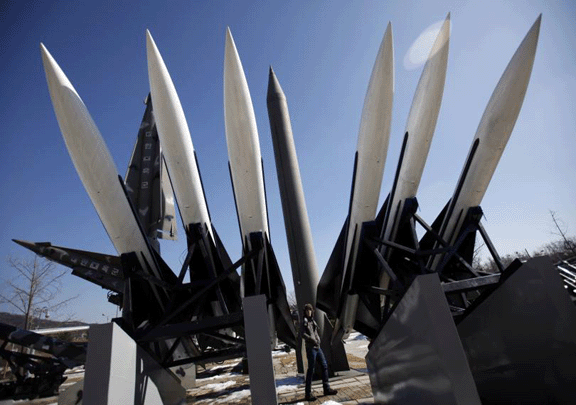 Why The U.S. Must Get Rid Of Its Land-Based Nuclear Missiles, Foxtrot Alpha, Terrell Jermaine Starr, 7/18/17 The Cold War is over. And so is the need for America’s land-based Intercontinental Ballistic Missiles. Not only are the costs of maintaining 450 Minuteman-III missiles unsustainable, keeping them in the nuclear arsenal is hardly practical. Maintaining hundreds of outdated, budget-draining Minuteman-IIIs when the Pentagon has the more accurate, multi-dimensional Trident II that can be shot from Ohio-class submarines that are virtually undetectable makes little sense.
1 This Month





PLEASE OPPOSE HR 8255 AND S.3639 – bills would accelerate satellite deployment, with no environmental review or safeguards – https://ncstd5li.quorum.us/campaign/169331/
To see nuclear-related stories in greater depth and intensity – go to https://nuclearinformation.wordpress.com
-
Archives
- October 2026 (74)
- September 2026 (339)
- August 2026 (330)
- July 2026 (355)
- June 2026 (287)
- May 2026 (306)
- April 2026 (356)
- March 2026 (251)
- February 2026 (267)
- January 2026 (308)
- December 2025 (358)
- November 2025 (359)
-
Categories
- 1
- 1 NUCLEAR ISSUES
- business and costs
- climate change
- culture and arts
- ENERGY
- environment
- health
- history
- indigenous issues
- Legal
- marketing of nuclear
- media
- opposition to nuclear
- PERSONAL STORIES
- politics
- politics international
- Religion and ethics
- safety
- secrets,lies and civil liberties
- spinbuster
- technology
- Uranium
- wastes
- weapons and war
- Women
- 2 WORLD
- ACTION
- AFRICA
- Atrocities
- AUSTRALIA
- Christina's notes
- Christina's themes
- culture and arts
- Events
- Fuk 2022
- Fuk 2023
- Fukushima 2017
- Fukushima 2018
- fukushima 2019
- Fukushima 2020
- Fukushima 2021
- general
- global warming
- Humour (God we need it)
- Nuclear
- RARE EARTHS
- Reference
- resources – print
- Resources -audiovicual
- Weekly Newsletter
- World
- World Nuclear
- YouTube
-
RSS
Entries RSS
Comments RSS


While the plant is slated to be shut down in October 2018, the Nuclear Regulatory Commission will remain involved to oversee safety compliance as the reactor fuel is removed and the plant enters decommissioning.
During a July 26 meeting in South Haven, citizens asked NRC officials about the clean-up and expressed concerns about the process to shutter the facility.
Benton Harbor resident Bette Pierman said she wanted answers from the NRC about what the site would be like for future generations. She wanted to know if any radioactive materials would be transported off-site during decommissioning, and said she worries the infrastructure is not in place to transport radioactive materials…….
Corinne Carey of Grand Rapids sat in the front row during some of the presentations by NRC officials, recording on a video camera. She said the plant should have been closed “a long time ago,” and now she’s concerned about the details of the clean-up and wants to make sure it’s done right.
“Who knows what’s going to happen to it? Is the radioactive waste going to remain on site?” she said.
She worries that a plane could hit a site where spent nuclear fuel is to be stored.
“What is the world we’re turning over to (our grandchildren)?” she said.
Decommissioning experts spoke about the process that can take up to 60 years that involves removing radioactive material and cleaning materials at the site and putting spent fuel into safe storage……..
Security measures will remain in place as long as spent fuel is stored on the site, the NRC said. The spent fuel is in a different category than other radioactive materials found on site, and will not decay to a safe level in the near future.
“The contents inside is extremely radioactive,” Edwards said about spent fuel that is usually stored in a dry cask some time after a plant shutdown. It emits lethal doses if left unshielded……..http://www.mlive.com/news/kalamazoo/index.ssf/2017/07/citizens_ask_about_radioactivi.html