Piketon’s village government opposes USA D4pt of Energy’s plans for radioactive waste dump

 Piketon, DOE spar over proposed on-site waste site, ChillicotheGazette, PIKETON – As those involved with cleanup operations at the former Portsmouth Gaseous Diffusion Plant in Piketon celebrate the most recent funding allocated for work to create an on-site waste disposal facility, officials within Piketon’s village government are stepping up efforts to prove that work should be stopped.
City of Broomfield and WCRA oppose DOE’s plan to breach a Rocky Flats dam: risk of radioactively polluting waterways
Rocky Flats dam removal dredges up contamination concerns, Boulder Weekly ,By Josh Schlossberg -June 29, 2017, The City of Broomfield and the Woman Creek Reservoir Authority (WCRA), a political subdivision and public corporation of the State of Colorado, are opposed to a U.S. Department of Energy (DOE) plan to breach a dam on a pond collecting surface water flowing from Rocky Flats, the former nuclear weapons facility site 10 miles south of Boulder.
DOE has contended that the dam on Pond C-2 is “no longer necessary to site operations” and wants to remove it sometime between 2018-2020 to return surface water flow to Woman Creek, thereby enhancing streamside wildlife habitat and encouraging wetlands. Removal would cause “no significant impact,” as determined by an environmental assessment conducted under the National Environmental Policy Act (NEPA).
Getting rid of the dam would also cut DOE costs related to inspection, reporting and upkeep, which WCRA estimates to be around $17,000 per year.
Yet according to a 2016 document prepared for WCRA by Boulder-based Hydros Consulting Inc., removal of the dam would “represent an irreversible loss of an effective contingency to protect downstream water quality” in Standley Lake, the drinking water supply for Westminster, Northglenn and Thornton, also used for irrigation, fishing, boating and water skiing.
Alan King, director of public works for the City and County of Broomfield, wrote in his June 2010 correspondence with DOE that the breach would “clearly increase the potential for uncontrolled releases of contaminated surface water off-site that would negatively impact downstream watersheds and expose downstream communities to additional risks.”
Pond C-2 is located on the border of the former Rocky Flats facility site 1.25 miles upstream of the Woman Creek Reservoir, the latter of which was built in 1996 to capture Rocky Flats runoff and keep it from reaching Standley Lake. The pond is currently operated in “batch-and-release mode,” where it is allowed to fill to roughly half capacity, and then discharged up to two times per year, according to DOE’s Environmental Assessment.
“Significant [plutonium] and [americium] contamination remains in surface soils on the DOE-retained land in the Woman Creek drainage, particularly on the 903Pad Hillside, with [radioactive] mass loading to Pond C-2 comparable to pre-closure conditions,” Hydros Consulting documented.
The 903Pad is an area of Rocky Flats where more than 5,000 buried barrels of liquid radioactive waste leaked, contaminating an estimated 261,000 square feet of soil before they were removed, according to the Colorado Department of Public Health and Environment (CDPHE).
GS51 is a surface water sampling location within the former facility site just south of the 903Pad and upstream of a ditch which DOE says flows “quite infrequently” into Pond C-2. On October 4, 2013, a month after the flood of 2013, GS51 “recorded elevated levels of plutonium in excess of the applicable standard,” according to a September 2015 memo from the Town of Superior Trustees to the Rocky Flats Stewardship Council.
King noted that Pond C-2 also receives runoff from several other areas that have “residual contamination.”
“Elevated readings for uranium have been recorded in this pond, and DOE-LM acknowledges that it is not 100 percent natural uranium,” wrote King.
On April 4, 2016, water samples collected on Woman Creek reached 0.313pCi/L (picocuries per liter) for plutonium and 0.17pCi/L for americium, “the first sample over 0.15pCi/L in more than 20 years of sampling…” according to Hydros Consulting.
Surface water samples “indicate that solids transported in runoff … have, at times, been above the Site closure cleanup target for surface soils” of 50pCi/g (picocuries per gram), occurring “in four out of five of the most recent years,” mostly attributed to plutonium.
Playing with fire
Typical events aside, the City of Broomfield and WCRA fear that a wildfire or landslide in contaminated areas within Rocky Flats may result in further downstream contamination…….http://www.boulderweekly.com/news/breach-of-trust/
Astonishingly secretive process – New York’s very costly nuclear bailout
 Public deserves truth about nuclear bailout http://www.timesunion.com/opinion/article/
 Commentary-Public-deserves-truth-about-nuclear-11717763.php, By Blair Horner, July 29, 2017
It’s been one year since Gov. Andrew Cuomo quietly foisted an estimated $7.6 billion electric utility rate hike on the people of New York to bail out three aging, upstate nuclear power plants. Since then, we’ve learned a lot about how bad that deal was, but we still don’t know much about how the administration cooked it up.
Here’s what we know: The deal is the result of an astonishingly secretive process. True, some hearings were held, but on a proposed bailout ranging from $59 million to $660 million. After the process wrapped up, the administration jacked up the price into the billions, without any meaningful public process to debate its merits.
The Cuomo administration didn’t release an estimate for the entire cost of the 12-year plan, so the independent Public Utility Law Project crunched the numbers and found it could be as much as $7.6 billion. That stunning transfer of wealth to the single corporation owning the plants may well be the largest in New York’s history.
The first two years of the bailout are estimated to cost ratepayers $964,900,000, an average of more than $1.3 million per day.
Since the bailout hit utility bills on April 1, New Yorkers have paid nearly $163 million extra to prop up these plants. That’s a huge amount of money in a state like New York, already burdened with some of the highest utility rates in the country, and where 800,000 ratepayers are behind on their utility bills.
Included in that $163 million is close to $10 million in extra charges being footed by Niagara Mohawk residential ratepayers, based on the PULP analysis.
Albany County, for example, is slated to pay up to $225,543 more per year for the bailout. Albany’s school district may pay up to $87,552 more per year and Albany Medical Center up to $537,843 per year.
Despite the massive scale of the bailout, New Yorkers still don’t know what alternatives the Cuomo administration considered to meet our energy needs. But there are clearly other paths to study. For example, the analysis released this month by energy expert Amory Lovins, which criticizes the growing trend toward subsidizing costly, uneconomical nuclear power plants.
Lovins, once named one of Time Magazine’s 100 Most Influential People, found that bailouts like the kind New York just implemented could be avoided by closing unprofitable nuclear plants and reinvesting their operating costs into energy efficiency, such as better insulation, windows, and appliances.
Because energy efficiency reduces demand and is so much cheaper per kWh than the energy produced by a nuclear plant, it could replace the power generated by the nuclear plant and replace some of the power generated by coal or gas, all for the same price as one kWh of nuclear energy.
Lovins’ independent analysis contradicts the Cuomo administration’s assertions that the bailout is the only way New York can reduce carbon emissions and meet its energy needs.
To “celebrate” the one-year anniversary of the bailout, let’s hope the administration finally conducts a comprehensive public review of all the alternatives to spending billions to keep old, unprofitable nuclear power plants running.
It’s not too late to reverse course and invest in 21st-century, clean, efficient power sources. New York ratepayers deserve to have their money bankroll job-creating technologies that help attack the problem of energy pollution, not kick the can 12 years down the road.
Blair Horner is executive director the New York Public Interest Research Group.
V.C. Summer Nuclear Station expansion might not be saved by Toshiba’s $2.2 billion in guarantees
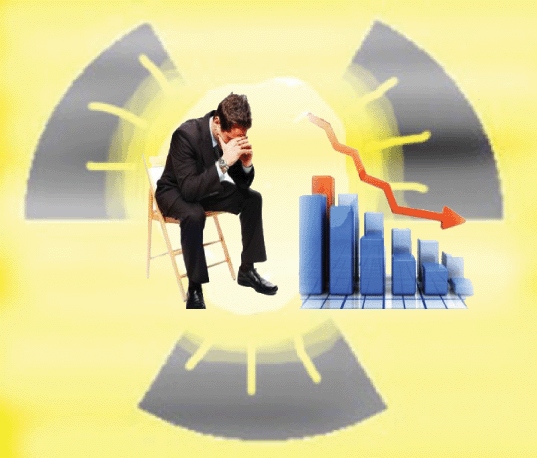 Guarantee may not be enough to save troubled V.C. Summer nuclear project, Jul 27, 2017, John Downey,Charlotte Business Journal Toshiba Corp. has agreed to pay S.C. Electric & Gas and Santee Cooper almost $2.2 billion in guarantees for their spending on the V.C. Summer Nuclear Station expansion.
But that will not be enough to cover the expected increase in costs for completing the troubled project, the two utilities say. So while observers call the settlement encouraging, there are deepening questions about whether it will be economically feasible to finish the expansion.
That decision — which now appears to involve a more-than-$16-billion question — could come as early as next week…….
it is also clear that the costs to complete the project are going to be very high. The joint statements says “the additional cost to complete both units … will materially exceed prior (Westinghouse) estimates as well as the anticipated guarantee settlement payments from Toshiba.”
If the price is beyond the $14 billion estimate in 2015 and the $2.2 billion in the guarantees, it puts the total cost north of $16 billion.
In order for the companies to decide to complete the project, they will need to determine that it would cost more to abandon the project now and build an alternative power plant (or plants) to replace the electricity that would have been produced by Summer.
The joint statement also notes that the utilities stand to lose an important tax break — which makes a $2 billion difference in costs to customers —if the projects are not completed by Jan. 1, 2021.
“At this point, the project owners believe that the units could not be brought online until after this date,” the companies say…..https://www.bizjournals.com/charlotte/news/2017/07/27/toshiba-guaranty-may-not-be-enough-to-save-the.html
To deal with global threats, public awareness must be raised – Ralph Nader
 Can the World Defend Itself from Omnicide?, Common Dreams, by Ralph Nader, 27 July 17, Notice how more frequently we hear scientists tell us that we’re “wholly unprepared” for this peril or for that rising fatality toll? Turning away from such warnings may reduce immediate tension or anxiety, but only weakens the public awareness and distracts us from addressing the great challenges of our time, such as calamitous climate change, pandemics, and the rise of a host of other self-inflicted disasters…….
Negotiations are not even underway for a cyberwarfare treaty among nations. The sheer scale and horrific implications of this weaponry seems to induce societies to bury their heads in the sand.  Former ABC TV host of Nightline, Ted Koppel, discusses this emerging threat in his recent, acclaimed book, “Lights Out: A Cyberattack, A Nation Unprepared”:
Former Secretary of Defense and CIA Director, Leon Panetta, says Koppel’s book is “an important wake-up call for America.” Yet neither he nor the enormous military-industrial complex, of which he remains a supportive part, are doing much of anything about this doomsday threat to national security. The big manufacturers are too busy demanding ever more taxpayer money for additional nukes, aircraft carriers, submarines, fighter planes, missiles and other weaponry of an increasingly bygone age………
Our present educational systems – from Harvard Law School, MIT to K-12 – are not rising to these occasions for survival. Our mass media, wallowing in trivia, entertainment, advertisements and political insults, is not holding the politicians accountable to serious levels of public trust and societal safety. Time for new movements awakening our best angels to foresee and forestall. Do any potential leaders at all levels want to be first responders? https://www.commondreams.org/views/2017/07/27/can-world-defend-itself-omnicide
Trump trying to provoke Iran into violating the nuclear agreement
 Trump Seeks Way to Declare Iran in Violation of Nuclear Deal, NYT, JULY 27, 2017 President Trump, frustrated that his national security aides have not given him any options on how the United States can leave the Iran nuclear deal, has instructed them to find a rationale for declaring that the country is violating the terms of the accord.
Educating the American public on surviving a nuclear attack
 North Korea prompts US cities to prepare for a nuclear attack, SMH, Ralph Vartabedian and W.J. Hennigan, 29 July 17, Fleets of big black trucks, harbor boats and aircraft, equipped with radiation sensors and operated by specially trained law enforcement teams, are ready to swing into action in Los Angeles for a catastrophe that nobody even wants to think about: a North Korean nuclear attack.
American cities have long prepared for a terrorist attack, even one involving nuclear weapons or a “dirty bomb,” but North Korea’s long-range missile and weapons programs have now heightened concerns along the West Coast over increasing vulnerability to a strike……..
This month, Wellerstein and other researchers launched Reinventing Civil defence, a nonprofit project that over the next two years will examine how best to reeducate the American public on the nuclear threat – one that never went away. It is being funded by a $US500,000 ($626,000) grant from Carnegie Corporation of New York.
“If we live in a world where a nuclear detonation is possible, and we do, then people should be informed on what that means,” he said. “It’s something that’s been nonexistent in our society since the late 1980s.”
The reluctance to prepare reflects what LoPresti calls a “generational PTSD” from the decades of living under the threat of instant thermonuclear war. “It is not something people are comfortable talking about,” he said……
The main responsibility would lie with the Federal Emergency Management Agency, which declined to provide an official to discuss the issue and did not answer written questions.
Some arms control experts say it would be a mistake to launch a full-scale civil defence effort in response to North Korea. Wright, the expert at the Union of Concerned Scientists, said such a response would send the wrong message that North Korean dictator Kim Jong Un has put a dent in US confidence.
Jeffrey Lewis, a nuclear weapons analyst with the James Martin Center for Nonproliferation Studies in Monterey, California, said Kim presents the same threat that existed throughout most of the last century. “He’s ruthless, but he’s not crazy,” Lewis said. “There’s reason to be cautious. But it’s not a reason to start digging bomb shelters.”
But Levin, the Ventura County health director, argues that doing nothing is equally wrong. The key point of the Ventura plan is to ask residents not flee, but to “get inside and stay inside” immediately after a detonation.
The county’s plan was developed with technical assistance from Brooke Buddemeier, a nuclear weapons effects expert at the Lawrence Livermore National Laboratory. He has made the case that sheltering indoors for just 24 hours after a detonation provides significantly reduced exposure.
“Talking about nuclear detonation is not one of those topics you can bring up at a cocktail party,” Buddemeier said. “But a little knowledge can save a lot of lives.” http://www.smh.com.au/world/north-korea-prompts-us-cities-to-prepare-for-a-nuclear-attack-20170727-gxkdu2.html
New York City’s toxic thorium contamination to finally be cleaned up
 Government Announces Cleanup Plan for NYC Radioactive Site THE ASSOCIATED PRESS (VERENA DOBNIK) July 28, 2017, New York (AP) — The federal government on Thursday announced its plan to clean up a Superfund site in New York City where radioactive material was once processed to develop the atomic bomb.
The U.S. Environmental Protection Agency said the $39 million job, which could take years, will force out businesses still operating on a block in Queens where buildings, the soil and sewers were contaminated with radioactive material. Protective measures have been in place since 2012.
The source of the industrial waste was the Wolff-Alport Chemical Company that operated on Irving Avenue in the Ridgewood neighborhood from 1920 to 1954, according to Elias Rodriguez, the EPA spokesman in New York. The company processed monazite sand, extracting from it a radioactive element called thorium for the federal government as part of a program that began with the top-secret Manhattan Project that led to the testing of the first nuclear weapons during World War II in New Mexico.
The now-defunct company disposed of thorium waste on its property and into the Queens sewer.
Given the contaminated waste, the owner of the Celtic Custom NYC motorcycle repair shop, Sandy Frayman, said on Thursday that he wouldn’t want to stay, “but we’re worried what’s going to happen to us.”…….
The public is invited to voice concerns to the federal agency — either by email, regular mail and telephone, or by showing up for an open public hearing on Aug. 16 at a nearby day care center…..
Following an EPA evaluation, buildings will be razed and excavation will start to remove more than 24,000 cubic yards (18,000 cubic meters) of contaminated soil, sediment and debris.
An exact date for the cleanup will be set when the evaluation is completed. https://www.bloomberg.com/news/articles/2017-07-27/government-announces-cleanup-plan-for-nyc-radioactive-site
Toshiba to pay $2.2 billion to get out of SCANA’s troubled South Carolina nuclear project
 Toshiba reaches $2.2 billion deal over SCANA’s South Carolina nuclear project http://www.reuters.com/article/us-toshiba-accounting-westinghouse-scana-idUSKBN1AC3DN (Reuters) – Toshiba Corp has agreed to pay $2.168 billion to walk away from two unfinished nuclear reactors in South Carolina being built by its Westinghouse subsidiary, according to a statement by the owners of project.
SCANA Corp (SCG.N) and its partner, state-owned utility Santee Cooper, said Toshiba will make the payments in installments beginning in October and ending in September 2022.
Toshiba’s Westinghouse Electric Co filed for bankruptcy in March, overwhelmed by the cost overruns at the VC Summer plant in South Carolina and a similar unfinished nuclear project known as Vogtle in Georgia. The projects are years behind schedule.
The agreement allows Toshiba and its Westinghouse unit to exit the nuclear construction business and caps Toshiba’s liability for guaranteeing that Westinghouse complete the VC Summer contract.
Toshiba reached a similar agreement for $3.7 billion in June with the utilities, led by a unit of Southern Co (SO.N), that own the Vogtle project.
Toshiba has warned that losses from Westinghouse threaten its future and it is considering bids for its flash memory chip unit, worth around $18 billion, to raise capital.
The owners of the VC Summer project said on Thursday they expect the cost of completing the project will “materially exceed” Westinghouse’s estimates and the payments due from Toshiba. They said they hope to decide soon whether they will continue with the two projects, modify them or abandon them.
Westinghouse is expected to deliver this week a five-year business plan to its lender, an affiliate of Apollo Global Management (APO.N). That plan will help shape bids for Westinghouse, which has attracted the interest of U.S. private equity firms.
As part of that plan, Westinghouse is expected to reach an agreement with SCANA under which it will continue to provide engineering and other services. Westinghouse has a similar agreement in place with the owners of the Vogtle plant.
Westinghouse asked the U.S. Bankruptcy Court in Manhattan, New York, on Wednesday to give it until Dec. 6 to file a plan of reorganization. The company said it needed more time in part due to talks with SCANA.
The request will be heard by the court on Sept. 7.
The Georgia and South Carolina plants were the first new nuclear power projects in the United States in three decades.
However, the projects have been dogged by design problems, disagreements with regulators and poor quality work by Westinghouse’s partners.
UK govt funds Kansas University for nuclear engineering
 K-State receives two federal nuclear energy grants, Mercury, Kansas, 28 July 17, Two new grants awarded to K-State may help the university attract the best students and faculty in nuclear engineering.
The Nuclear Regulatory Commission, a federal nuclear energy commission, awarded K-State’s mechanical and nuclear engineering department two grants totaling about $843,000. The commission awarded a $450,000 grant to help develop young faculty members’ careers and a $393,820 grant to continue the department’s nuclear research fellowship program for graduate students…….
The fellowship grant will cover tuition and fees for students pursuing graduate studies in nuclear engineering…..
A previous fellowship grant from the NRC helped the university recruit three doctoral students in nuclear engineering who plan to graduate in 2018, according to the university. The continuation of the program will assist the university in increasing the number of doctoral graduates in nuclear engineering, which is a direct measure of the success of the department, Bindra said.
“These grants will really help take our department to the next level,” Bindra said. “I am excited to see K-State’s nuclear engineering graduate program become one of the best in the nation.” http://themercury.com/news/k-state-receives-two-federal-nuclear-energy-grants/article_92f0ae82-d76a-5b22-9aca-c6357c72eb34.html
First Energy presses lawmakers for new customer-paid subsidies for nuclear reactors
 FirstEnergy nuclear charges crucial to operating or selling Davis-Besse, Perry, says CEO, Cleveland.com 28 July 17 , By John Funk, The Plain Dealer, AKRON — FirstEnergy’s top executive says the company will continue to press Ohio lawmakers for new customer-paid subsidies for its nuclear power plants even though it may not own them in the future……
USA drought continues
Drought Still Growing Across the U.S. https://www.hoosieragtoday.com/drought-still-growing-across-the-u-s/By Hoosier Ag Today -Jul 27, 2017 The latest Drought Monitor shows soils continuing to dry out and crops suffering as drought and abnormal drynessexpand and intensify across the Plains, Midwest, northern Rockies, and Virginia. Montana saw the most severe level of drought, called exceptional drought, grow by 10 points in a week. Twelve percent of the state is in exceptional drought and 24 percent is under extreme conditions. In neighboring North Dakota, 8 percent of the state is in exceptional drought. Another 30 percent of the state is in extreme drought. In the Corn Belt, drought conditions have shown up in Iowa. The state’s moderate drought grew to 34 percent. All states east of the Mississippi River are drought-free for now, but patches of abnormal dryness mean it could change as early as next week.
USDA meteorologist Brad Rippey says drought conditions are intensifying across the central United States. The Corn Belt has seen double-digit percentage increases. Drought coverage is growing around the nation, with the current drought monitor showing over 32 percent of the country in some form of drought.
Wildfire season made worse by climate change
 How Climate Change Is Making Wildfire Season Worse, Here and Now, July 27, 2017 This summer there have been dozens of fires burning in the West, which has been experiencing record-high temperatures.
Nuclear danger as Trump government guts science, removes Department of Energy’s skilled personnel
The department trains every international atomic-energy inspector; if nuclear power plants around the world are not producing weapons-grade material on the sly by reprocessing spent fuel rods and recovering plutonium, it’s because of these people
Since Perry was confirmed, his role has been ceremonial and bizarre. He pops up in distant lands and tweets in praise of this or that D.O.E. program while his masters inside the White House create budgets to eliminate those very programs.
Trump’s budget … cuts funding to the national labs in a way that implies the laying off of 6,000 of their people. It eliminates all research on climate change. It halves the funding for work to secure the electrical grid from attack or natural disaster
 WHY THE SCARIEST NUCLEAR THREAT MAY BE COMING FROM INSIDE THE WHITE HOUSE Donald Trump’s secretary of energy, Rick Perry, once campaigned to abolish the $30 billion agency that he now runs, which oversees everything from our nuclear arsenal to the electrical grid. The department’s budget is now on the chopping block. But does anyone in the White House really understand what the Department of Energy actually does? And what a horrible risk it would be to ignore its extraordinary, life-or-death responsibilities? BY MICHAEL LEWIS SEPTEMBER 2017 “………..Two weeks after the election the Obama people inside the D.O.E. read in the newspapers that Trump had created a small “Landing Team.” According to several D.O.E. employees, this was led by, and mostly consisted of, a man named Thomas Pyle, president of the American Energy Alliance, which, upon inspection, proved to be a Washington, D.C., propaganda machine funded with millions of dollars from ExxonMobil and Koch Industries. Pyle himself had served as a Koch Industries lobbyist and ran a side business writing editorials attacking the D.O.E.’s attempts to reduce the dependence of the American economy on carbon……….
…..There was a reason Obama had appointed nuclear physicists to run the place: it, like the problems it grappled with, was technical and complicated……..
Pyle, according to D.O.E. officials, eventually sent over a list of 74 questions he wanted answers to. His list addressed some of the subjects covered in the briefing materials, but also a few not:
Can you provide a list of Department employees or contractors who attended any of the Conference of the Parties (under the United Nations Framework Convention on Climate Change) in the last five years?”
That, in a nutshell, was the spirit of the Trump enterprise. “It reminded me of McCarthyism,” says Sherwood-Randall……..
The one concrete action the Trump administration took before Inauguration Day was to clear the D.O.E. building of anyone appointed by Obama…….
Since Perry was confirmed, his role has been ceremonial and bizarre. He pops up in distant lands and tweets in praise of this or that D.O.E. program while his masters inside the White House create budgets to eliminate those very programs. His sporadic public communications have had in them something of the shell-shocked grandmother trying to preside over a pleasant family Thanksgiving dinner while pretending that her blind-drunk husband isn’t standing naked on the dining-room table waving the carving knife over his head.
Meanwhile, inside the D.O.E. building, people claiming to be from the Trump administration appear willy-nilly, unannounced, and unintroduced to the career people. “There’s a mysterious kind of chain from the Trump loyalists who have shown up inside D.O.E. to the White House,” says a career civil servant. “That’s how decisions, like the budget, seem to get made. Not by Perry.”…….
Because of that lack of communication, nothing is being done. All policy questions remain unanswered.”……..
Another permanent employee, in another wing of the D.O.E., says, “The biggest change is the grinding to a halt of any proactive work. There’s very little work happening. There’s a lot of confusion about what our mission was going to be. For a majority of the workforce it’s been demoralizing.”
Over and over again, I was asked by people who worked inside the D.O.E. not to use their names, or identify them in any way, for fear of reprisal…..
…….The D.O.E. ran the 17 national labs—Brookhaven, the Fermi National Accelerator Lab, Oak Ridge, the Princeton Plasma Physics Lab, and so on. “The office of science in D.O.E. is not the office of science for D.O.E.,” said MacWilliams. “It’s the office of science for all science in America. I realized pretty quickly that it was the place where you could work on the two biggest risks to human existence, nuclear weapons and climate change.”…….
Indeed, if you are seeking to preserve a certain worldview, it actually helps to gut science. Trump’s budget, like the social forces behind it, is powered by a perverse desire—to remain ignorant. Trump didn’t invent this desire. He is just its ultimate expression. http://www.vanityfair.com/news/2017/07/department-of-energy-risks-michael-lewis
USA Labor Department tactic: delay compensation as long as possible – nuclear workers die
Longtime critics of the program’s administration point to numerous examples not only of claimants dying after years of waiting for their compensation but of spouses who refiled for survivorship claims dying while waiting for their compensation awards.
 Labor Department Whistleblower: Agency Officials Intentionally Denied or Delayed Pay-Outs to Nuclear Workers in Hopes They Would Die Government attorney who raised red flags said Perez, other Obama officials ignored his complaints about hostility toward nuclear-worker claims, Washington Free Beacon
A senior attorney at the Labor Department is accusing agency officials of writing and manipulating regulations to intentionally delay and deny congressionally mandated compensation to nuclear-weapons workers who suffered from sicknesses—and in some cases died—as a result of their work building the nation’s Cold War nuclear arsenal.
The attorney, Stephen Silbiger, says Labor Department leadership under former Labor Secretary Tom Perez ignored years of his complaints about the “open hostility” he said some officials exhibited toward claimants, many of whom are too poor and sick to fight the agency’s denials and red tape in federal court.
When Congress passed the law creating the compensation program in 2000, a bipartisan group of lawmakers promised these nuclear workers a claimant-friendly path to compensating them or their families for illnesses related to the country’s nuclear build-up and their exposure to toxins at bombing-making facilities.
Under the law, the Energy Employees Occupational Illness Compensation Program Act (EEOICPA), qualified workers or their survivors who were diagnosed with certain types of cancer or other diseases from exposure to toxic substances at covered facilities are entitled to between tens of thousands and hundreds of thousands of dollars in compensation to help pay medical bills and loss of wages due to their illnesses, with a cap of $400,000.
However, Silbiger and other critics say government officials often purposely thwarted workers’ attempts to seek the compensation by writing regulations that made qualification much more stringent than Congress intended, failing to disclose all the application rules, changing eligibility rules midstream, and delaying compensation for years until the sick workers died.
“There’s explicit hostility toward claimants, and this has become a game for bureaucrats to see how clever they can be in manipulating the statute and the regs to deny benefits to indigent claimants,” Silbiger told the Washington Free Beacon in his first public complaint about the program’s administrators.
Silbiger says the problems with the compensation program parallel some of those at the heart of decades of Veterans Affairs Department corruption and abuse.
“The problem in the VA is that nobody would confront these people [poorly administrating the VA medical service]—it’s very similar,” he said. “Nobody really cares about the program—these people have no real constituency. They’re rural, they’re elderly, they have no political clout, so they’re ignored.”
Silbiger, an attorney in the Labor Department’s Solicitor’s Office, which is charged with meeting the agency’s legal service demands, says that President Donald Trump and Labor Secretary Alexander Acosta now have a chance to fix the problems.
Two Labor Department spokesman did not respond to repeated emails seeking answers to a list of Free Beacon questions about the program, including whether there is a current claimant backlog, exactly how many claimants have received compensation versus how many have filed for it, and why top officials never took action in response to Silbiger’s complaints.
The Democratic National Committee, which Perez now chairs, also did not respond to a request for comment after acknowledging receipt of the questions……….
Longtime critics of the program’s administration point to numerous examples not only of claimants dying after years of waiting for their compensation but of spouses who refiled for survivorship claims dying while waiting for their compensation awards.
Some of Silbiger’s complaints echo recent allegations from the Alliance of Nuclear Workers Advocacy Groups (ANWAG), although the two parties said they do not know each other and have not conferred on the topic or anything else.
In a letter to the Labor Department Inspector General Scott Dahl dated July 12, ANWAG called for an immediate and full investigation into the administrators’ handling of the claims “to determine if unethical or illegal regulatory procedures occurred which may have resulted in unjustified denial of claims.”………
ANWAG, however, remains deeply concerned about other recent eligibility rules changes, they say make it more difficult to qualify for compensation. In its July 12 letter to the Labor Department’s inspector general, ANWAG argued that that changes to the rules EEOIC program administrators made earlier this year are illegal because they were never formally adopted through the rulemaking process and were used to deny claims months and even years before officially proposed.
“We do not take this step lightly,” ANWAG stated in its letter, noting that it represents more than 100 advocates across the country helping sick nuclear workers and their survivors receive compensation Congress promised them.
“We believe government employees responsible for implementing EEOICPA have abused their power, ignored the laws of the land [and] failed to comply with executive orders requiring that agencies operate in a transparent manner,” ANWAG wrote, noting that the Labor Department received nearly 500 comments during the rulemaking promise with many commenters voicing their objection to the proposed changes, including those dealing with changes to eligibility for wage-loss compensation.
The new rules require that a worker must identify the “trigger month” in which he first became disabled and that the worker must be employed during that “trigger month” to receive any wage-loss compensation.
ANWAG argued that the new rule did not take into account that the symptoms of the illness could have begun long before a worker left their position and long before reaching a definitive doctor diagnosis of their illness.
“Since DOL regulations accepts [sic] that a worker was injured the last day he or she worked at a facility, it seems logical that DOL would only need to review the medical records they relied upon to accept a disease and compare those records (such as date of diagnosis or documentation of symptoms consistent with the disease before a formal diagnosis was rendered) to the Social Security Administration’s quarterly wages to determine when the worker first lost wages due to [a] covered disease,” the organization wrote.
To make matters worse, the Labor Department revised the rule for wage-loss claims to reflect this more stringent standard in July 2015, four months before they issued proposed rules to do so, the group said. It cited a case in which EEOICP administrators used the same language about the new “trigger month” requirement.
ANWAG also cited a case of the EEOICP officials using this “unauthorized wording” to deny a wage-loss claim seven years ago, in February 12, 2009.
The group also referred to the Lucero decision to back up their argument that the Labor Department is narrowly and illegally interpreting the law Congress passed to compensate nuclear workers for their illnesses in a timely and even-handed way.
“It is ANWAG’s position that DEEOIC has, at least in the changes made for wage-loss claims, overstepped their authority by restricting the ability to claim loss of wages to a very narrow time period,” Barrie wrote.
“Congress understood that many workers suffered from occupational disease which went often not correctly diagnosed for months after the symptoms appeared,” she argued.
“The statute clearly lays out the manner for which DEEOIC is to figure out amount of wage loss. It does not give DEEOIC the authority to limit wage loss to only workers who were employed during the same month they were diagnosed with a covered condition.” http://freebeacon.com/issues/labor-department-whistleblower-agency-officials-intentionally-denied-or-delayed-pay-outs-to-nuclear-workers-in-hopes-they-would-die/
1 This Month





PLEASE OPPOSE HR 8255 AND S.3639 – bills would accelerate satellite deployment, with no environmental review or safeguards – https://ncstd5li.quorum.us/campaign/169331/
To see nuclear-related stories in greater depth and intensity – go to https://nuclearinformation.wordpress.com
-
Archives
- October 2026 (74)
- September 2026 (339)
- August 2026 (330)
- July 2026 (355)
- June 2026 (287)
- May 2026 (306)
- April 2026 (356)
- March 2026 (251)
- February 2026 (267)
- January 2026 (308)
- December 2025 (358)
- November 2025 (359)
-
Categories
- 1
- 1 NUCLEAR ISSUES
- business and costs
- climate change
- culture and arts
- ENERGY
- environment
- health
- history
- indigenous issues
- Legal
- marketing of nuclear
- media
- opposition to nuclear
- PERSONAL STORIES
- politics
- politics international
- Religion and ethics
- safety
- secrets,lies and civil liberties
- spinbuster
- technology
- Uranium
- wastes
- weapons and war
- Women
- 2 WORLD
- ACTION
- AFRICA
- Atrocities
- AUSTRALIA
- Christina's notes
- Christina's themes
- culture and arts
- Events
- Fuk 2022
- Fuk 2023
- Fukushima 2017
- Fukushima 2018
- fukushima 2019
- Fukushima 2020
- Fukushima 2021
- general
- global warming
- Humour (God we need it)
- Nuclear
- RARE EARTHS
- Reference
- resources – print
- Resources -audiovicual
- Weekly Newsletter
- World
- World Nuclear
- YouTube
-
RSS
Entries RSS
Comments RSS


Chuck Jones, president and CEO, also revealed that FirstEnergy is preparing to talk to creditors of its subsidiary, FirstEnergy Solutions, the company that owns the corporation’s old, uncompetitive power plants, which have been losing money.
FirstEnergy Solutions’ debt and the declining value of its power plants has made it a potential liability as it negotiates with its creditors amidst rumors of an eventual bankruptcy, and FirstEnergy has tried to distance itself from the subsidiary……
As for the special, customer-paid charges to help Davis-Besse, Perry and Beaver Valley, Pa., nuclear power plants, Jones said he doubted anybody could operate them without special subsidies. The problem is that they cannot compete with gas turbine plants and, at times, with wind power.
“I’m not sure [they] will run unless there is something done either federally or by the state of Ohio to ensure they get a different financial return model,” Jones said.
The company previously said the nuclear charges would increase customer bills by about 5 percent. Subject to periodic review by state regulators, the charges would run for 17 years.
Selling the nuclear plants is part of the company’s overall plan “to exit the commodity-exposed generation business,” Jones said. In other words, if the company cannot have its power prices set by a state utility commission, it does not want to be in the generating business. ……
Jones also made it clear during the conference that FirstEnergy’s campaign to persuade Ohio lawmakers to approve a nuclear plant subsidy would continue no matter what the U.S. Department of Energy recommends.
The Trump administration in April asked the DOE to figure out whether wind, solar and natural gas power plants are forcing the premature retirement of very large old coal and nuclear power plants, and whether those closings might de-stabilize the nation’s high-voltage power grid……. http://www.cleveland.com/business/index.ssf/2017/07/firstenergy_nuclear_charges_cr.html