[As North Korea intensifies missile program, U.S. opens $11 billion base in the South ]……….https://www.washingtonpost.com/world/national-security/us-displays-military-firepower-after-pyongyangs-latest-icbm-test/2017/07/30/35840ffa-7542-11e7-9eac-d56bd5568db8_story.html?utm_term=.0a08144384a5
Congressman Mark Sanford effectively gave go-ahead to South Carolina nuclear boondoggle project
According to state law, governors have five business days upon receiving a ratified bill from the S.C. General Assembly to either sign or veto the measure in question. If they do nothing, the bill becomes law at the end of the fifth business day.
when a governor chooses this option, they are effectively signing the bill. Which is exactly what Sanford did back in 2007.
SC #NukeGate: Mark Sanford Has A Problem https://www.fitsnews.com/2017/08/02/sc-nukegate-mark-sanford-has-a-problem/ By FITS , 3 Aug 17, You would think the failure of a multi-billion nuclear power project in the Midlands region of South Carolina (a.k.a. #NukeGate) wouldn’t be a problem for a politician hailing from the Palmetto State’s coastal regions.
But in this case you’d be wrong …

For those of you just waking up from a 72-hour nap, South Carolina was rocked by the news that a proposed nuclear power facility in Jenkinsville, S.C. would no longer be built. The decision to kill the V.C. Summer nuclear project – which wiped out 5,000 jobs and threw the state’s energy future into turmoil – was made by the Palmetto State’s government-run utility, Santee Cooper.
That decision has created a nightmare for SCANA – a private sector utility that was partnering with Santee Cooper on the project.
SCANA had raised rates on consumers to help subsidize the construction of these reactors – while Santee Cooper was in the process of raising rates to support its obligations related to the project. Just a week before deciding to walk away from the V.C. Summer project, in fact, Santee Cooper specifically cited “costs associated with nuclear construction and other system improvements” as one of the stated rationales for its proposed rate increases.
Talk about sandbagging …
Anyway, as we’ve noted previously people are pissed. They want answers. They want to see their bills lowered. And they want their money back.
They also want to know how on earth their government allowed this to happen …
All of which brings us to congressman Mark Sanford and a little piece of state law known as Act 16 of 2007, a.k.a. the so-called “Base Load Review Act.”
Passed during Sanford’s second term as governor of South Carolina, this legislation permitted utilities in the Palmetto State to raise rates on consumers for the purpose of financing the construction of – among other things – nuclear facilities.
Basically, this law was the gateway through which hundreds of millions of dollars of ratepayer money flowed toward the V.C. Summer project.
So did Sanford sign this law? No, he did not. Did he veto it? No, he did not.
Hold up … are we messing around with our readers here?
Because this hardly seems the time for that …
What’s the joke? Where’s the punch line?
There is no joke – nor is there a punch line. In the Palmetto State, there is a third option. According to state law, governors have five business days upon receiving a ratified bill from the S.C. General Assembly to either sign or veto the measure in question. If they do nothing, the bill becomes law at the end of the fifth business day.
For those of you who’ve forgotten, this was the “out” taken by former S.C. governor Nikki Haley back in 2011 when she got crossed up on an “economic development” deal involving online distributor Amazon.
As we noted then – and will remind our readers now – when a governor chooses this option, they are effectively signing the bill. Which is exactly what Sanford did back in 2007. This particular piece of legislation hit his desk in the S.C. State House on April 26 of that year – a Thursday. Sanford did nothing with the bill, and so on the following Thursday – May 3, 2007 – it became law without his signature.
Could a decision made a decade ago cost him his congressional seat?
State representative Katie Arrington – who is considering running against Sanford for South Carolina’s first congressional district (map) next spring – took note of the former governor’s decision on her Twitter page.
In responding to the outrage against Santee Cooper and SCANA, Arrington tweeted “you should also be just as upset with Mark Sanford for allowing a law that put ratepayers on the hook.”
Is she correct? Yes …
As the fallout from this failed nuclear project continues cascading across the Palmetto political landscape, expect to see Sanford face his fair share of criticism related to this deal (and justifiably so).
New energy storage technology – cheaper than lithium-ion batteries
Times 2nd Aug 2017, Google’s parent company Alphabet is turning to salt and antifreeze to
provide energy storage that could be cheaper than lithium-ion batteries.
The technology giant’s secretive X division is working on a way to store
energy from renewable sources that would otherwise be wasted because of the
time mismatch between supply and demand.
The system was designed by Robert Laughlin, a Nobel prize-winning physicist of Stanford University. It takes
in energy in the form of electricity and converts it into hot and cold air,
using a heat pump. These streams heat molten salt and cool the antifreeze
respectively. The process can be reversed to release the energy as the warm
and cold air meet, creating gusts that drive a turbine and feed power back
into the grid.
Scientists had already shown that the technology could store
energy. Alphabet’s engineers have designed a version that works at lower
temperatures, however, which reduces costs and makes it commercially
viable. https://www.thetimes.co.uk/edition/news/cheaper-batteries-powered-by-antifreeze-designed-by-google-s-parent-company-alphabet-vpclt3jpn
Bill for compensation for Mohave County residents made ill by exposure to radiation
Bill hopes to compensate Mohave County residents impacted by nuclear tests http://www.12news.com/news/local/arizona/bill-hopes-to-compensate-mohave-county-residents-impacted-by-nuclear-tests/461398687, A bill introduced Friday aims to help people in Mohave County, Arizona, who have health problems because of the government’s nuclear testing in Nevada.
Trump prepared for war against North Korea: “thousands will die over there: not here in USA”
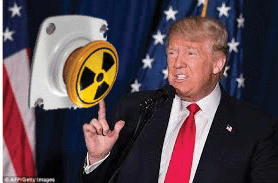 Sen. Lindsey Graham: Trump Says War With North Korea an Option, NBC News 2 Aug 17, There will be war between the United States and North Korea over the rogue nation’s missile program if it continues to aim intercontinental ballistic missiles at America, Sen. Lindsey Graham, R-S.C., said President Donald Trump has told him.
“He has told me that. I believe him,” the lawmaker said Tuesday on TODAY. “If I were China, I would believe him, too, and do something about it.”
Graham said that Trump won’t allow the regime of Kim Jong Un to have an ICBM with a nuclear weapon capability to “hit America.”
“If there’s going to be a war to stop [Kim Jong Un], it will be over there. If thousands die, they’re going to die over there. They’re not going to die here. And He has told me that to my face,” Graham said.
“And that may be provocative, but not really. When you’re president of the United States, where does your allegiance lie? To the people of the United States,” the senator said.
Military experts have said there are no good options for peacefully stopping North Korea, although the National Security Council has previously presented Trump with possibilities that could include putting American nukes in South Korea or killing Kim Jong Un.
Graham said military experts are “wrong” that no good options exist.
“There is a military option to destroy North Korea’s program and North Korea itself,” he added. Ultimately, a conflict in the region that would likely ensnare China and South Korea could claim millions of lives……..http://www.nbcnews.com/news/north-korea/sen-lindsey-graham-trump-says-war-north-korea-option-n788396
Disagreement on Iran nuclear policy between Trump and his Secretary of State Rex Tillerson

 Tillerson says he and Trump disagree over Iran nuclear deal, https://www.reuters.com/article/us-usa-trump-russia-retaliation-economy-idUSKBN1AH4S1 Yeganeh Torbati, 2 Aug 17, WASHINGTON (Reuters) – U.S. Secretary of State Rex Tillerson acknowledged on Tuesday that he and President Donald Trump disagree over the 2015 Iran nuclear deal, and said the two men discuss how to use the international agreement to advance administration policies.
Trump at times vowed during the 2016 presidential election campaign to withdraw from the agreement, which was signed by the United States, Russia, China and three European powers to curb Iran’s nuclear program in return for lifting most Western sanctions.
Trump has preserved the deal for now, although he has made clear he did so reluctantly after being advised to do so by Tillerson.
“He and I have differences of views on things like JCPOA, and how we should use it,” Tillerson said at a State Department briefing, using the acronym for the deal, formally called the Joint Comprehensive Plan of Action (JCPOA).
Tillerson said that Washington could “tear it up and walk away” or stay in the deal and hold Iran accountable to its terms, which he said would require Iran to act as a “good neighbor.”
Critics say the deal falls short in addressing Iran’s support for foreign fighters in Iraq and Syria, arms shipments around the Middle East and ballistic missile tests.
The White House did not immediately respond to a request for comment on Tillerson’s remarks.
Trump said in an interview with the Wall Street Journal last month that he predicts Iran will be judged “noncompliant” with the Iran deal at the next deadline in October, and that he would have preferred to do so months ago.
Tillerson expressed a more nuanced view of the deal’s potential benefits on Tuesday.
“There are a lot of alternative means with which we use the agreement to advance our policies and the relationship with Iran, and that’s what the conversation generally is around with the president as well,” Tillerson said.
European officials would likely be reluctant to re-impose sanctions, especially the broader measures that helped drive Iran to negotiate over its nuclear program in the first place, he said.
New U.S. sanctions on Iran in July were a breach of the nuclear deal and Tehran had lodged a complaint with the body that oversees the pact’s implementation, a senior Iranian politician said.
Tillerson acknowledged that the United States is limited in how much it can pressure Iran on its own and said it was important to coordinate with the other parties to the agreement.
“The greatest pressure we can put to bear on Iran to change the behavior is a collective pressure,” he said. Reporting by Yeganeh Torbati; editing by Grant McCool
A blow to USA nuclear industry in abandonment of two new South Carolina reactors , already costing $9 billion
 U.S. Nuclear Comeback Stalls as Two Reactors Are Abandoned, NYT 31 July 17 JULY 31, 2017, In a major blow to the future of nuclear power in the United States, two South Carolina utilities said on Monday that they would abandon two unfinished nuclear reactors in the state, putting an end to a project that was once expected to showcase advanced nuclear technology but has since been plagued by delays and cost overruns.
Negligent packaging and transport of radioactive materials by U.S nuclear labs
 Nuclear labs endanger public with radioactive mail, USA Today At least 25 times in the past five years, nuclear weapons contractors have improperly packaged or shipped plutonium capable of being used in a nuclear weapon, conventional explosives and highly toxic chemicals, according to government documents.
Climate denial in charge in USA government
 Dahr Jamail | Scientists Warn of “Biological Annihilation” as Warming Reaches Levels Unseen for 115,000 Years, July 31, 2017 By Dahr Jamail, Truthout | Report“…..Denial and Reality
There’s never a dull moment in the denial world these days.
In Florida, that state’s extremist ACD-denying Gov. Rick Scott signed legislation making it easier for Florida residents to challenge science that is taught in public schools, so if an ACD-denying parent doesn’t like a science textbook that teaches the basic physics of how greenhouse gases work, the book could end up being banned.
Trump-appointed EPA Administrator Scott Pruitt, an ACD denier and pink slipped 38 members of the EPA’s Board of Scientific advisors, which is merely a drop in the bucket compared to dozens of other major environmental roll-backs the Trump administration has pulled off thus far, including forcing NOAA [National Oceanic and Atmospheric Administration] to erase human activity references to greenhouse gases in its Annual Greenhouse Gas Index.
Thankfully, reality continues to thrive in other parts of the world: …..http://www.truth-out.org/news/item/41425-biological-annihilation-trillion-ton-icebergs-warming-levels-unseen-for-115-000-years
One utility in Georgia now holds the fate of America’s nuclear industry
Fate of U.S. Nuclear Now Hinges on One Utility in Georgia,Bloomberg, By Jim Polson
August 2, 2017
-
Nuclear revival rests with Southern after Scana scraps project
-
Regulator urges Southern to make final decision by year-end
With a multibillion-dollar nuclear project in South Carolina dead, the fate of America’s nuclear renaissance now rests on one utility: Southern Co. Scana Corp. dropped plans for two reactors Monday, leaving the two that Southern is building at the Vogtle plant in Georgia as the only ones under construction in the U.S. And even they are under threat: The utility had to take over management of the project from its bankrupt contractor Westinghouse Electric Co., and the plant is still years behind schedule and billions over budget. Now it must decide whether to finish them.
Southern calling it quits could prove to be the final nail in the coffin for the long-awaited U.S. nuclear renaissance that has failed to materialize in the aftermath of Japan’s Fukushima nuclear accident. In 2012, Southern and Scana became the first companies to gain approval to build U.S. reactors in more than 30 years — only to find themselves in troubling times for the industry.
On top of construction setbacks and ballooning costs, nuclear plants are reeling under intense competition from cheap natural gas and renewables that have spurred states led by New York to go as far as offering subsidies for existing reactors to keep them open……. https://www.bloomberg.com/news/articles/2017-08-01/fate-of-new-nuclear-in-u-s-now-rests-on-one-utility-in-georgia
Injustice: Mohave County downwinders wait ?forever for compensation for radiation induced illnesses
Clock ticking for righting injustice to county’s downwinders http://www.havasunews.com/opinion/our-view-clock-ticking-for-righting-injustice-to-county-s/article_67ca1e70-7680-11e7-a1d7-7f9b1c5a1866.html Jul 31, 2017
USA flexes its military muscle, following North Korea’s latest missile test
U.S. displays military firepower after Pyongyang’s latest ICBM test, WP, The United States pointedly showed off its military prowess over the Pacific and the Korean Peninsula on Sunday in response to North Korea’s launch Friday of a missile capable of reaching the U.S. mainland, a test Pyongyang said was a “stern warning” for Washington to back off from threats and more sanctions.
Wikileaks’ misleading story about USA’s Special Counsel Robert Mueller
 Wikileaks Says Robert Mueller Gave Russia Nuclear Material – But That’s Not The Whole Story, Senior Editor, HuffPost UK, 29 July 17 Wikileaks has released a classified US State Department from 2009 that appears to prove Special Counsel Robert Mueller, head of the Trump/Russia probe, once supplied the Russians with nuclear material.
The claim, if true, would be a hugely damaging revelation that would throw the whole investigation into chaos and incri
Only it isn’t and Wikileaks knows it.
The text and tweet released by Wikileaks more than suggests Mueller is guilty of a serious crime, passing on nuclear material to the USA’s superpower rival.
6. (S/Rel Russia) Action request: Embassy Moscow is requested to alert at the highest appropriate level the Russian Federation that FBI Director Mueller plans to deliver the HEU sample once he arrives to Moscow on September 21. Post is requested to convey information in paragraph 5 with regard to chain of custody, and to request details on Russian Federation’s plan for picking up the material. Embassy is also requested to reconfirm the April 16 understanding from the FSB verbally that we will have no problem with the Russian Ministry of Aviation concerning Mueller’s September 21 flight clearance.
But the section it omitted from the tweet changes the entire context of Mueller’s actions.
It reads:
2. (S/NF) Background: Over two years ago Russia requested a ten-gram sample of highly enriched uranium (HEU) seized in early 2006 in Georgia during a nuclear smuggling sting operation involving one Russian national and several Georgian accomplices. The seized HEU was transferred to U.S. custody and is being held at a secure DOE facility. In response to the Russian request, the Georgian Government authorised the United States to share a sample of the material with the Russians for forensic analysis.
This text is included in the document linked to in the tweet but it’s clear many people did take it at face value…….http://www.huffingtonpost.co.uk/entry/wikileaks-russia_uk_597df631e4b02a4ebb75ffec
China now out of favour with Donald Trump

 Donald Trump says China does ‘nothing’ to thwart North Korea’s nuclear quest Trump has previously used conciliatory and at times fawning language to refer to China’s President Xi, but the honeymoon appears to be over, Guardian, Tom Phillips 30 July 17, Donald Trump has launched his latest Twitter assault on China, accusing its Communist party leaders of doing “NOTHING” to help the United States thwart North Korea’s quest for nuclear weapons.
“I am very disappointed in China,” Trump wrote. “Our foolish past leaders have allowed them to make hundreds of billions of dollars a year in trade, yet … they do NOTHING for us with North Korea, just talk.
“We will no longer allow this to continue. China could easily solve this problem!” he added.
The comments came after Kim Jong-un celebrated his country’s second intercontinental ballistic missile (ICBM) test late on Friday, in what North Korean state media described as a warning to the “beast-like US imperialists”.
On Saturday, the US secretary of state, Rex Tillerson, accused Russia and China of being North Korea’s “principal economic enablers” and claimed they bore “unique and special responsibility” for its “belligerent” pursuit of nuclear weapons.
Conservative news outlets in the US appeared to relish Trump’s decision to assail Beijing for its alleged role in North Korea’s missile and nuclear programs.
“Trump rips China on Twitter,” ran a Fox News headline……..
There were reports, later, that two US B-1 bombers fly over the Korean peninsula in response to North Korea’s missile test. https://www.theguardian.com/us-news/2017/jul/30/donald-trump-says-china-does-nothing-to-thwart-north-koreas-nuclear-quest
No one would survive a USA-Russia nuclear war- Putin warns
PUTIN WARNS U.S.-RUSSIA NUCLEAR WAR WOULD LEAVE NO SURVIVORS, Newsweek 6/7/17Russian President Vladimir Putin has dismissed the idea that the U.S. would claim victory in a conflict with Russia, noting that “nobody would survive” such a clash.
The Putin Interviews | Vladimir Putin & Oliver Stone Discuss NATO
Speaking to U.S. movie director Oliver Stone for The Putin Interviews, a four-part series on Showtime, Putin shared a negative view of U.S. military action and its NATO alliance. “NATO is a mere instrument of U.S. foreign policy,” Putin says in a clip of the interview, aired by the Showtime channel. “It has no allies, it has only vassals. Once a country becomes a NATO member, it is hard to resist the pressures of the United States.”
Nuclear weapons wastes polluting America’s soil: 12 hotspots

 The Invisible War On American Soil, Topic, 29 July 17 Photographs by Nina Berman
War is a dirty, dirty business. Beyond the damage inflicted on the battlefields themselves, every part of a military operation marks the earth. From munitions factories to massive supply lines, collateral costs abound.GIVEN THE SIZE OF OUR DEFENSE BUDGETS, it should come as no surprise that the United States military is one of the planet’s most prolific and chronic polluters. Perhaps more surprising is that this impacts life within the U.S. as well as overseas. Vast stretches of the American landscape are contaminated by the business of war and armed aggression; it’s littered with unexploded ordnance, toxic chemicals, depleted uranium, radioactive particles, and more.
In this essay, we examine seven such sites of environmental damage wrought by the nation’s military and its weapons contractors. The places range from sites in New Mexico, where nuclear weapons have been produced, to the Passaic River in New Jersey, where dioxin from Agent Orange used during the Vietnam War has poisoned the riverbed. As the technology of warfare changes, so has its impact, with current contamination coming from the skies—such as on Whidbey Island, Washington, where Navy testing of EA-18G Growler planes might be making residents ill.
Acid Canyon; Los Alamos, New Mexico……
Trinity Site; White Sands Missile Range, New Mexico……
Haystack Mine; Haystack Mountain, New Mexico……
White Sands Missile Range Museum; New Mexico……
Luis Lopez Cemetery; New Mexico……
San Antonio, New Mexico…….
Fort Wingate, New Mexico …..
Whidbey Island, Washington…..
Big Oaks National Wildlife Refuge; Madison, Indiana…..
Near the Starmet Superfund site; Concord, Massachusetts…..
Passaic River; Lyndhurst, New Jersey…..
Tularosa, New Mexico….. https://www.topic.com/the-invisible-war-on-american-soil
1 This Month





PLEASE OPPOSE HR 8255 AND S.3639 – bills would accelerate satellite deployment, with no environmental review or safeguards – https://ncstd5li.quorum.us/campaign/169331/
To see nuclear-related stories in greater depth and intensity – go to https://nuclearinformation.wordpress.com
-
Archives
- October 2026 (74)
- September 2026 (339)
- August 2026 (330)
- July 2026 (355)
- June 2026 (287)
- May 2026 (306)
- April 2026 (356)
- March 2026 (251)
- February 2026 (267)
- January 2026 (308)
- December 2025 (358)
- November 2025 (359)
-
Categories
- 1
- 1 NUCLEAR ISSUES
- business and costs
- climate change
- culture and arts
- ENERGY
- environment
- health
- history
- indigenous issues
- Legal
- marketing of nuclear
- media
- opposition to nuclear
- PERSONAL STORIES
- politics
- politics international
- Religion and ethics
- safety
- secrets,lies and civil liberties
- spinbuster
- technology
- Uranium
- wastes
- weapons and war
- Women
- 2 WORLD
- ACTION
- AFRICA
- Atrocities
- AUSTRALIA
- Christina's notes
- Christina's themes
- culture and arts
- Events
- Fuk 2022
- Fuk 2023
- Fukushima 2017
- Fukushima 2018
- fukushima 2019
- Fukushima 2020
- Fukushima 2021
- general
- global warming
- Humour (God we need it)
- Nuclear
- RARE EARTHS
- Reference
- resources – print
- Resources -audiovicual
- Weekly Newsletter
- World
- World Nuclear
- YouTube
-
RSS
Entries RSS
Comments RSS

