Pilgrim operators reduced the reactor’s power to 70 percent of its maximum Thursday due to rising ocean water temperatures. The temperature of the seawater used to cool the reactor cannot exceed 75 degrees under standards set by the Nuclear Regulatory Commission.
“We took action when it reached 71 degrees to ensure we did not challenge the limit,” said Patrick O’Brien, spokesman for Entergy, Pilgrim’s owner and operator.
Pilgrim draws up to 500 million gallons daily from Cape Cod Bay. The water cools the reactor and the turbine, passing through a network of thousands of tubes.
The seawater being discharged by the nuclear reactor is considerably hotter than the water drawn in — as much as 30 degrees hotter. The locations of the water intake structure and discharge structure at Pilgrim are separated by a jetty to help prevent the warm discharge water from migrating to the intake area and boosting the water temperature there.
“Previously, during storm monitoring, operations identified the potential for ocean conditions that would require preemptive actions and a power reduction as salt service water temperatures rose,” O’Brien said in his email. “Once predetermined criteria were met, operators commenced power reduction.”
Nuclear plants are about one-third efficient, explained David Lochbaum, director of the Nuclear Safety Program for the Union of Concerned Scientists.
“Of the three units of energy produced by the reactor core, one third goes out onto the transmission lines as electricity, and two thirds gets rejected to the nearby body of water,” Lochbaum said. “Reducing the reactor power level reduces the amount of heat energy carried away by the discharge flow, thus also reducing the amount of warm water sneaking around the jetty to re-enter the plant.”
The reactor will remain at reduced power until ocean temperatures allow for its return to full power operation, O’Brien said. — Follow Christine Legere on Twitter: @ChrisLegereCCT.
The presidents of Japan and South Korea welcomed Trump’s announcement of new sanctions against North Korea but privately questioned whether his threat to “totally destroy” the country would lead to the diplomacy they prefer.
Arab and Iranian leaders sat stone-faced during Trump’s bellicose address on Tuesday — while several other world leaders reacted with bemusement, chagrin and confusion to his often-contradictory comments.
Netanyahu could be observed laughing and grinning as Trump described the hard-fought international nuclear accord with Iran as the “worst deal ever” and an “embarrassment” to the United States.
Far from taming his enemies, Trump seems to have inflamed tensions further as the world faces a nuclear-armed North Korea and worries about a deal designed to prevent Iran from building a bomb.
South Korea’s Yonhap News Agency reported Thursday night that North Korea’s foreign minister, Ri Yong Ho, said in New York that his country may test a hydrogen bomb in the Pacific Ocean to fulfill leader Kim Jong Un’s vow to take the “highest level” action.
The Partial Nuclear Test Ban Treaty, which the United States and the Soviet Union signed in 1963, forbade atmospheric and underwater testing of nuclear weapons. No confirmed ocean tests have occurred since then, but North Korea is not a signatory.
North Korea conducted an underground test of what it called a hydrogen bomb on Sept. 3. An ocean test could severely damage the environment as well as expand the security crisis…….
During the weeklong General Assembly, Trump, invoking his reality-TV flair for drama, said he had made a decision on whether to walk away from the Iranian deal, but he would not yet reveal it.
His administration recently continued lifting sanctions against Iran, which was part of the agreement. But next month, Trump must issue a separate certification to Congress on whether Iran is complying with the deal, an every-90-day requirement under U.S. law.
Several administration officials have suggested Trump will not certify compliance even though the U.N.’s nuclear watchdog, the International Atomic Energy Agency, has found Iran in compliance eight times since the deal was signed in 2015. http://www.latimes.com/nation/la-fg-trump-un-assess-20170922-story.html
Moon and Trump agree on South Korea purchase of state-of-the-art US weaponry during summit
Hankyoreh Sep.22,2017The deal is reportedly set to include nuclear powered submarines
South Korean President Moon Jae-in and US President Donald Trump agreed on Sept. 21 on a plan for South Korea to introduce state-of-the-art US weaponry or develop its own to counter North Korea’s recent nuclear and missile provocations. Later the same day, Moon had a luncheon and trilateral summit with Trump and Japanese Prime Minister Shinzo Abe, where the three agreed that the entire international community “must apply the maximum intensity sanctions and pressure so that North Korea cannot withstand it anymore and must come to the table for dialogue.” ……http://english.hani.co.kr/arti/english_edition/e_northkorea/812155.html
North Korea: Trump and Kim call each other mad, BBC, 22 September 2017
Kim Jong-un has said remarks by “deranged” US President Donald Trump have convinced him he is right to develop weapons for North Korea.
In an unprecedented personal statement, Mr Kim said Mr Trump would “pay dearly” for a UN speech where he threatened to “totally destroy” the North if the US was forced to defend itself.
Mr Trump responded that the “madman… will be tested like never before”.
The two countries have engaged in ever more heated rhetoric in recent months.
Mr Kim ended his statement by saying he would “surely and definitely tame the mentally deranged US dotard with fire”.
China responded to the war of words, warning that the situation was “complicated and sensitive”.
“All relevant parties should exercise restraint instead of provoking each other,” said Foreign Minister spokesman Lu Kang.
Russia also urged restraint, with Foreign Minister Sergei Lavrov describing the rhetoric between the two leaders as a “kindergarten fight between children”……http://www.bbc.com/news/world-asia-41356836
President Trump at the United Nations: Editorial Board Roundtable, Cleveland,com 22 Sept 17
“…………The reception to Trump’s speech fell along political lines. Nile Gardiner, an analyst at the conservative Heritage Foundation, told CNN that it was a “groundbreaking speech,” while Democratic Sen. Dianne Feinstein of California panned it as “missing an opportunity” to deal with North Korea.
So was Trump on the mark? The edtorial board roundtable offers its opinions and we wait to hear yours in the comments.
If only every international problem could be solved by flicking a red button and unilaterally turning belligerent nations into a pile of radioactive rubble. They can’t be. The world does better when nations work together. The path forward is slow, frustrating, often annoying diplomacy with our allies — and our enemies. Trump’s bluster is dangerous.
Thomas Suddes, editorial writer:
The speech was an embarrassment to our country.
Ted Diadiun, editorial board member:
There’s nothing wrong with a nationalist approach from a U.S. president. Donald Trump was elected at least in part by people who were weary of eight years of Barack Obama’s “Blame America First” posturing. As for the rest of Trump’s speech, the only thing more troubling than believing he is descending to schoolyard belligerence in threatening something he has no intention of carrying out — is that he is not.
Elizabeth Sullivan, director of opinion, cleveland.com:
“That’s just common sense,” Haley said, responding to a question on what Trump meant by the comment. “We don’t want war. That’s the last thing anyone wants. We don’t want loss of life.”
Trump turned heads during his first address to the United Nations on Tuesday, calling Kim Jong Un “Rocket Man” and saying if pushed to defend itself or our allies the U.S. “will have no choice but to totally destroy North Korea.”
However, the ambassador echoed the president’s remarks during a press briefing Thursday, saying that if the rogue nation were to attack the U.S. or one of its allies, “The U.S. will respond. Period.”
Haley added the new sanctions announced earlier in the day against North Korea were the latest attempt at a diplomatic solution and push for them to come to the negotiating table: “Until then, that’s just the reality. If they were to strike the United States, of course, we would have to respond back.”
The president signed an executive order Thursday placing new sanctions on the Kim Jong Un-led nation. “A new executive order will cut off sources of revenue that fund North Korea’s efforts to develop the deadliest weapons known to humankind,” Trump said while announcing the order.
HAWAII READYING FOR NUCLEAR ATTACK IN SECRET MEETING TO AVOID PANIC, NewsWeek, BY CHRISTAL HAYESThe state of Hawaii prepped for a nuclear attack in a meeting this week, but wouldn’t allow the public to attend and kicked out a photojournalist who snapped a picture.
Dozens of lawmakers met behind closed doors and talked about how to ready the state for an attack, including planned tests of alarms that would notify people they had 12 to 15 minutes to seek shelter, according to the Honolulu Civil Beat.
The presentation given at the meeting was marked “for official use only” and showed where North Korea could target and how bad the impact would be, Hawaii Representative Gene Ward told the news organization.
Ward added that officials don’t “want to spook any of the public”—which includes 1.4 million residents and 8 million tourists who visit the state annually.
Hawaii has been preparing for an attack for months, as military experts estimate a missile would take 20 minutes to reach the island from North Korea.
Hawaii Emergency Management Agency officials have said the chances of a nuclear attack are still “extremely small,” but the “unpredictable leadership” of North Korea means they should be prepared. They plan to have a public meeting and will start testing the attack alarms in November, but there are no plans to build any fallout shelters……..http://www.newsweek.com/nuclear-hawaii-trump-north-korea-kim-jong-un-669502
The Oscar winner, 42, met with then-president-elect Trump, 71, in December, only to have the POTUS disregard their conversation once he took office.
“We presented him with a comprehensive plan to tackle climate change, while also simultaneously harnessing the economic potential of green jobs,” DiCaprio recalled at the Yale Climate Conference on Tuesday (via The Hartford Courant). “We talked about how the United States has the potential to lead the world in clean-energy manufacturing and research and development.”
Once in office, Trump pledged to withdraw from the Paris climate accord, which regulates greenhouse emissions, and appointed climate change skeptic Scott Pruitt to head the Environmental Protection Agency.
The moves left staunch environmentalist DiCaprio nonplussed.
“We should not have people in office who do not believe in facts and truths and modern science that are able to manipulate and risk the entire future of this entire generation,” he fumed. “We are at that turning point right now, and we are going to look back at this point in history, and frankly this administration, and certain people are going to be vilified for not taking action. They really are. And it’s up to this generation, it’s up to all of you to get involved and make a difference.”
But in reality, the Trump administration is changing many of the nitty-gritty but vital things the federal government does that affect the quality of life of anyone living or working in the United States. As became clear during Trump’s first 100 days, the administration is systematically dismantling consumer, labor, and environmental protections, as well as de-funding studies that might make the case for new rules. In July it said that it plans to suspend, discontinue, or change 860 rules and regulations, many of which were proposed at the tail-end of Barack Obama’s presidency.
A new onslaught may be on the way. Yesterday (Sept. 21), Trump appointed a new head of the Consumer Product Safety Commission (CPSC): Dana Baiocco, a lawyer who built her career on defending companies against lawsuits on asbestos deaths and airline crashes. The commission’s former head, Eliot Kaye, had refused to follow an early White House order to eliminate two regulations for every new one passed, because it “would be counter to our safety mission.” If Trump’s past appointees are an indicator, Baiocco, who starts her new job on Oct. 27, is less likely to have such qualms……..
As the changes pile up, we’re keeping track of what’s been rolled back and what seems in danger of being weakened or eliminated. Here are the most important changes so far.
Worker protections…..
Fair wages…….
Health and safety……..
Consumer protections…..
Environmental Protections…….
Polluting the air. In March, Trump repealed Obama’s “Clean Power Plan,” which required states to slash carbon emissions from power plants. (He did this after naming coal industry-backed lawyers and talking heads to his cabinet.) The plan was crafted to prevent climate change, but it would also have prevented thousands of premature deaths due to air pollution, the EPA calculated, and prevented 90,000 asthma attacks a year.
Whistleblower helps secure $2 million settlement over contract rigging at Hanford,Thomas Clouse , The Spokesman Review, Sept. 22, 2017 A whistleblower has been paid $470,000 out of a $2 million settlement after successfully challenging what she and government prosecutors say was a shell company at the Hanford Nuclear Reservation.
The subcontractor charged with setting up the shell company, Federal Engineers & Constructors, worked under the huge, three-headed joint venture Washington Closure Hanford (WCH), which between 2005 and 2016 received a multibillion-dollar contract from the U.S. Department of Energy to operate the site. The contract paid for cleanup following decades of plutonium production.
WCH was comprised of engineering powerhouses AECOM, Bechtel National and CH2M Hill, which were required as part of the contract to funnel a percentage of those funds to small, disadvantaged and women-owned businesses.
In 2009, Federal Engineers & Constructors awarded a $2 million contract to Sage Tec. Sage Tec, however, was owned by Laura Shikashio – the wife of former company vice president Larry Burdge. “Ms. Shikashio knowingly misrepresented Sage Tec to be a qualified disadvantaged small business in order to be eligible for” the contract, court records state.
Federal prosecutors wrote that Sage Tec should not have received the contract and instead “was a pass-through front company for FE&C, which performed substantially all of the work on WCH’s improperly awarded subcontracts,” court records state………
Scana Plunges to Lowest in Almost Two Years on Criminal Probe, Bloomberg, By
Mark Chediak,
Scana received federal subpoena related to canceled reactors
Utility faces questions on how much customers will be billed
Scana Corp. slid to the lowest level in almost two years as the U.S. began a criminal investigation into the $21 billion nuclear power project in South Carolina that the utility owner abandoned two months ago.
The U.S. Attorney’s office in South Carolina is carrying out a grand jury probe that involves agents at the Federal Bureau of Investigation, a Sept. 7 subpoena disclosed on Friday by Scana’s partner on the nuclear project, Santee Cooper, shows. The government asked for copies of correspondence, notes and reports related to the V.C. Summer nuclear plant, including a study engineering firm Bechtel Corp. drafted last year suggesting Scana was aware of challenges plaguing the project since early last year.
Scana declined on Friday to release the subpoena it had received or comment on the one Santee Cooper disclosed. Shares of the utility owner were down as much as 3.2 percent at $55.33 as of 2:46 p.m. New York time, the lowest since October 2015.
The federal probe and intensifying backlash from South Carolina legislators doesn’t bode well for Scana as the utility owner seeks to recoup billions of dollars it spent on the project from South Carolina’s utility customers. The company’s battle to recover costs may become a flash point in the debate over who should pay for nuclear power projects that have failed to be built across the U.S. in the past decade…….https://www.bloomberg.com/news/articles/2017-09-22/a-failed-21-billion-u-s-nuclear-project-still-haunting-scana
America’s ‘doomsday’ plane will be Donald Trump’s HQ if nuclear war breaks out with North Korea, news.com.au , 21 Sept 17 TAKE a look on board the “doomsday” plane which will protect Donald Trump’s team if nuclear war becomes a reality. THESE incredible photos reveal the inner workings of the ‘Doomsday’ planes — America’s secretive set of jets designed to wage nuclear war from the skies.
The specially-designed aircraft follow President Donald Trump wherever he travels in Air Force One in case nuclear war erupts, reports The Sun.
Known officially as National Airborne Operation Centres, they allow US leaders and wartime hawks to issue directives and wage war from the sky.
The Boeing E-4Bs costs around $A311 million each to create and $A201,000 per hour to operate.
They also feature a vast array of defence mechanisms, including the ability to withstand electromagnetic pulses.
The jets’ crews also use traditional analog flight instruments to navigate as they are less susceptible to cyber attack.
Donald Trump threatens to ‘totally destroy’ North Korea in UN speech
President castigates ‘a small group of rogue regimes’
Iran nuclear deal ‘an embarrassment to the United States’, Guardian, Julian Borger 20 Sept 17, Donald Trump has threatened to “totally destroy” North Korea, in a bellicose first address to the United Nations general assembly in which he lashed out at a litany of US adversaries and called on “righteous” countries to confront them.
The speech was greeted in the UN chamber mostly with silence and occasional outbreaks of disapproving murmurs, as Trump castigated a succession of hostile regimes.
“If the righteous many do not confront the wicked few, then evil will triumph,” the president said.
He first singled out North Korea, recounting its history of kidnapping, oppression, and missile and nuclear tests.
“The US has great strength and patience,” Trump said. But he added: “If it is forced to defend ourselves or our allies, we will have no choice but to totally destroy North Korea.”
As alarmed murmurs spread around the hall, Trump had another barb. Using his newly adopted epithet for Kim Jong-un, Trump said: “Rocket Man is on a suicide mission for himself and for his regime.”……….
Trump said the Iran nuclear deal, signed by the US under the Obama administration with five other countries two years ago, was “one of the worst and most one-sided transactions the United States has ever entered into”.
“Frankly, that deal is an embarrassment to the United States,” he said. “I don’t think you’ve heard the last of it – believe me.”
Trump must decide by 15 October on whether to certify Iranian compliance or not. His threatened withdrawal of presidential endorsement could lead to Congress reimposing nuclear-related sanctions and the collapse of the agreement.
Like much of the 41-minute speech, Trump’s reference to the Iran deal was met by stony silence. The deal is overwhelmingly supported by UN member states, including most of Washington’s closest allies……..
Trump is also almost entirely isolated on climate change. Unlike the other opening speakers, including the UN secretary general, António Guterres, Trump made no mention in his speech of an issue that most other leaders in the chamber consider to be the greatest threat to the world.
When his turn to speak came, Macron insisted that though the Paris climate accord, which Trump said he would leave, could be improved, “it will not be renegotiated”. He said he “profoundly respected” the US decision but said “the door will always be open to them”.
Kushner, Bannon, Flynn Pushed Huge Nuclear Power Deal In Middle East For Profit, In Secrethttps://www.dailykos.com/stories/2017/9/16/1699095/-Kushner-Bannon-Flynn-Pushed-Huge-Nuclear-Power-Deal-In-Middle-East-For-Profit-In-Secret, By ursulafaw Sep 17, 2017 It’s no wonder that Mike Flynn asked the House and the Senate for immunity and has refused to voluntarily testify before the Senate twice, the last time being Tuesday. On Wednesday Democrats in the House Foreign Affairs and Oversight Committee reported that Flynn failed to disclose that he worked for oil companies and had attended a meeting on their behalf promoting a U.S.-Russian Saudi financed program to build nuclear reactors in the Arab world. This took place in 2015 and it is one of the meetings that Mike Flynn failed to disclose on his security clearance application.
He also failed to disclose the $25,000 he was paid for his services and all this information was forwarded by Democrats on to Robert Mueller to decide whether it’s a prosecutable offense, according to Rachel Maddow. Last night Maddow interviewed Anthony Cormier, a Pulitzer Prize winning journalist working for BuzzFeed, who also yesterday broke a story about another meeting that Mike Flynn conveniently forgot, a meeting he took with Jared Kushner and Steve Bannon January 5 with the King of Jordan. Both Kushner and Flynn left that meeting off their security clearance applications and details of Bannon’s application are as yet unknown.
This is smoking hot. The Wall Street Journal says Flynn’s disclosure forms “indicate that [his] year-and-a-half work on the project ended in December 2016, but Mr. Flynn in fact remained involved in the project once he joined the Trump administration in January, discussing the plan and directing his National Security Council staff to meet with the companies involved, the former staffers said.” BuzzFeed:
The meeting — details of which have never been reported — is the latest in a series of secret, high-stakes contacts between Trump advisers and foreign governments that have raised concerns about how, in particular, Flynn and senior adviser Jared Kushner handled their personal business interests as they entered key positions of power. And the nuclear project raised additional security concerns about expanding nuclear technology in a tinderbox region of the world. One expert compared it to providing “a nuclear weapons starter kit.”
On the morning of Jan. 5, Flynn, Kushner, and former chief strategist Steve Bannon greeted King Abdullah II at the Four Seasons hotel in lower Manhattan, then took off in a fleet of SUVs and a sedan to a different location. […]
While it is not unusual for an incoming administration to meet with foreign dignitaries during the transition, Trump surrogates have repeatedly failed to acknowledge these contacts. Attorney General Jeff Sessions at first said he did not discuss campaign matters with Russian officials, only to later acknowledge at least two conversations with Russian Ambassador Sergey Kislyak. The United Arab Emirates set up a meeting between a military contractor close to the Trump administration and a Russian close to President Vladimir Putin. And this week, CNN reported that Abu Dhabi’s crown prince, Sheikh Mohammed bin Zayed al-Nahyan, visited with Flynn, Kushner, and Bannon without alerting the American government beforehand.
The meeting with the king of Jordan had extremely high stakes: a discussion with the head of a key American ally that might have included plans about spreading nuclear power to one of the world’s least stable regions, possibly with the help of one of America’s main geopolitical enemies, Russia. The revelation of the meeting comes as Abdullah plans to visit the United States next week and speak with Trump.
If this sounds like the kind of thing that’s going to keep you up at night, you’re not alone. “Any proposal to introduce dozens of nuclear reactors to the Middle East, particularly Saudi Arabia, raises many proliferation red flags,” the Arms Control Association’s Daryl Kimball told BuzzFeed. “The Saudis do not need nuclear power and them gaining access could lead to dangerous consequences down the road.” Giving a country nuclear energy capacity, as the Marshall Plan would, “is like giving a country a nuclear weapons starter kit,” the nonprofit Center for Arms Control and Non-Proliferation’s Alexandra Bell said.
On the bright side, Flynn, Bannon, and Kushner are completely transparent, highly qualified people who we can definitely trust with national security.
And don’t forget, Kushner and Bannon both still work for the White House. Sweet dreams.
The flurry of military drills came after Pyongyang fired another mid-range ballistic missile over Japan on Friday and the reclusive North conducted its sixth and most powerful nuclear test on Sept. 3 in defiance of United Nations sanctions and other international pressure.
A pair of U.S. B-1B bombers and four F-35 jets flew from Guam and Japan and joined four South Korean F-15K fighters in the latest drill, South Korea’s defense ministry said.
The joint drills were being conducted “two to three times a month these days”, Defence Minister Song Young-moo told a parliamentary hearing on Monday.
In Beijing, the official Xinhua news agency said China and Russia began naval drills off the Russian far eastern port of Vladivostok, not far from the Russia-North Korea border. Those drills were being conducted between Peter the Great Bay, near Vladivostok, and the southern part of the Sea of Okhotsk, to the north of Japan, it said.
The drills are the second part of China-Russian naval exercises this year, the first part of which was staged in the Baltic in July. Xinhua did not directly link the drills to current tension over North Korea.
China and Russia have repeatedly called for a peaceful solution and talks to resolve the issue.
On Sunday, however, U.S. Ambassador to the United Nations Nikki Haley said the U.N. Security Council had run out of options on containing North Korea’s nuclear program and the United States might have to turn the matter over to the Pentagon.














“…………The reception to Trump’s speech fell along political lines. Nile Gardiner, an analyst at the conservative Heritage Foundation, told CNN that it was a “groundbreaking speech,” while Democratic Sen. Dianne Feinstein of California panned it as “missing an opportunity” to deal with North Korea.
So was Trump on the mark? The edtorial board roundtable offers its opinions and we wait to hear yours in the comments.
Sharon Broussard, chief editorial writer, cleveland.com:
If only every international problem could be solved by flicking a red button and unilaterally turning belligerent nations into a pile of radioactive rubble. They can’t be. The world does better when nations work together. The path forward is slow, frustrating, often annoying diplomacy with our allies — and our enemies. Trump’s bluster is dangerous.
Thomas Suddes, editorial writer:
The speech was an embarrassment to our country.
Ted Diadiun, editorial board member:
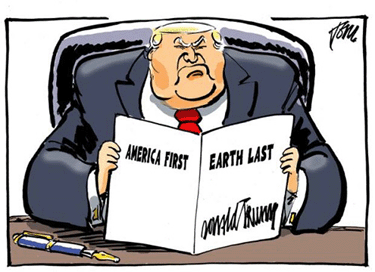
There’s nothing wrong with a nationalist approach from a U.S. president. Donald Trump was elected at least in part by people who were weary of eight years of Barack Obama’s “Blame America First” posturing. As for the rest of Trump’s speech, the only thing more troubling than believing he is descending to schoolyard belligerence in threatening something he has no intention of carrying out — is that he is not.
Elizabeth Sullivan, director of opinion, cleveland.com:
President Trump isn’t putting America first when his rhetoric and actions push us toward war with a nuclear-armed state. …….. http://www.cleveland.com/opinion/index.ssf/2017/09/president_trump_at_the_united.html