-
Scana decision may signal ‘beginning of the end’ of industry
-
Half of operating reactors could be retired in 17 years
-
The U.S. nuclear power industry could be out of business by the middle of the century.
The entire existing fleet of reactors may disappear by 2055 when the last operating license expires, S&P Global Ratings said in a report. That’s assuming there will be no license extensions. Half of the country’s 99 nuclear units may be retired in 17 years, S&P said.The report comes on the heels of a decision by Scana Corp. to abandon plans to build two new reactors in South Carolina after costs soared to more than $20 billion and the contractor Westinghouse Electric Co. went bankrupt. Nuclear operators have been shutting plants as their profits have been eroded by generators burning cheap natural gas and by weak demand for electricity.
Propping up stagnant nuclear industry with govt subsidies is simply bad energy policy
The push now is for the industry to receive special subsidies to remain economically viable
Nuclear power has been doomed by cost escalation, while gas, efficiency, and renewables continue to get cheaper. And subsidizing nuclear plants isn’t popular in the states where ratepayers would have to foot the bill
Simply put, political intervention in the U.S. electric power system distorts the market and is bad energy policy.
 Nuclear Subsidies Are Bad Energy Policy, https://www.forbes.com/sites/judeclemente/2017/09/29/nuclear-subsidies-are-bad-energy-policy/#669a1ac17b2c Forbes, ,
I cover oil, gas, power, LNG markets, linking to human development , 29 Sept 17, “The nuclear species is going extinct,” Mycle Schneider, lead author, World Nuclear Industry Status Report, September 12, 2017
The “nuclear renaissance” that we have long waited for is falling short. In the wake of the 2011 Fukushima disaster, the number of new projects has drastically dropped. Among other things, they’ve been plagued by huge cost overruns, lower cost competitors, public fear, an aging workforce, rare required materials, and often unmanageable waste problems.
According to the World Nuclear Industry Status Report, the number of construction starts of nuclear reactors worldwide has sunk from a high of 15 in 2010, to 10 in 2013, to 8 in 2015, to 3 in 2016, and to just 1 in the first half of 2017. And most tellingly, premature nuclear shutdowns are occurring in even the richest nations.
Here in the U.S., a massive supply of low cost natural gas from shale, established low and stable cost coal fleets, and mushrooming wind and solar farms have left many nuclear plants unprofitable. Down from 104 just a few years ago, there are now 99 nuclear reactors in the country. It’s a rapidly aging fleet, with the average age for a U.S. nuclear plant now 36 years. This is obsolete by modern technology standards and closing in on the end of 40-year operating licenses. In fact, nearly 20% of our nuclear fleet is over 42 years old.
On March 29, 2017, Westinghouse, the only company that was actually building nuclear plants in the country, declared bankruptcy. And in July, after $9-10 billion had already been spent on construction, two South Carolina utilities abandoned two new Westinghouse reactors that were just 40% complete.
Even the two states proudest of their anti-CO2 agenda, which as I document here and here are inevitably turning to more natural gas, are joining in. California has shuttered San Onofre Nuclear Generating Station in the South, and Diablo Canyon nuclear power plant in the north will close by 2025. New York will shut down the Indian Point nuclear plant near NYC by 2021.
The push now is for the industry to receive special subsidies to remain economically viable. The idea really started in Illinois, where Exelon said that without subsidies, it would have to shutter three nuclear plants after the company lost $700 million in the last few years operating the plants.
And Exelon has also threatened to close other nuclear units in New York and its Three-Mile Island nuclear plant in Pennsylvania, which became infamous with a partial meltdown in 1979. It’s become uncompetitive: Three-Mile Island didn’t clear PJM capacity auction in May and has lost $300 million over the last eight years.
Legislatures in New York and Illinois have approved as much as $10 billion in special subsidies through zero-emission credit programs to keep older nuclear plants operational. Pennsylvania, Ohio, New Jersey, and Connecticut are considering similar special subsidies.
Naturally, competitors have filed lawsuits claiming that nuclear subsidy schemes intrude on federal authority over wholesale energy prices. Subsidies give an unfair, seemingly manufactured advantage to nuclear generators in regional wholesale markets. Zero-Emission Credits distort energy price formation and increase uncertainty.
And we know that state and/or federal governments “choosing winners and losers” through direct subsidies bring higher utility bills for our homes and businesses. One study here finds that higher utility costs from the nuclear subsidy program in Illinois would eliminate 43,000 jobs in the state by 2030 and slash state revenues by $420 million.
All across our energy space, American homes and businesses win when there’s more free market competition, not less. This helps explain why at 12-13 cents per kWh, we enjoy some of the lowest power rates in the world and why nearly two-thirds of the states have deregulated electricity and/or natural gas in recent years. While gas will continue to remain abundant with low prices (I document that here), nuclear subsidies could continue to grow as plants inevitably age: U.S. nuclear capacity has been flat in the 105 gigawatt range since 1990.
Nuclear power has been doomed by cost escalation, while gas, efficiency, and renewables continue to get cheaper. And subsidizing nuclear plants isn’t popular in the states where ratepayers would have to foot the bill. Recent headlines tell the story:
- “Subsidies for Nuclear Reactor Projects Waste Taxpayer Money,” U.S. News & World Report, August 17, 2017 (here)
- “Poll: Overwhelming majority of Pennsylvanians oppose nuclear bailout by Legislature,” The Beaver County Times, August 16, 2017 (here)
- “Nuclear Subsidies Distort Competition And Increase Power Prices,” Investors.com, May 31, 2017 (here)
- “Manufacturers oppose proposed $7 billion nuclear power subsidy,” Albany Business Review, August 1, 2016 (here)
Simply put, political intervention in the U.S. electric power system distorts the market and is bad energy policy. Carnegie Mellon University’s Electricity Industry Center has documented this fact for years, here. Now our main source of electricity, the fast growing incremental market share of gas is mostly why U.S. CO2 emissions are at their lowest levels in decades (here). Since 2000, gas has about doubled its total generation to 1,200 TWh, while nuclear has stagnated in the 750-800 TWh range. Indeed, the Federal Energy Regulatory Commission’s mission to be “fuel neutral” speaks against nuclear subsidies. This would support gas because it’s the most affordable of the most reliable sources (see Figure below on original ).
Trump offers $3.7 billion to save Georgia’s troubled Vogtle nuclear power project
 Trump govt offers nuclear plant $3.7B support
Market Watch : Sept 29, 2017 The Trump administration on Friday offered an additional $3.7 billion in loan guarantees to a troubled nuclear power plant project in Georgia that is billions over budget and years behind schedule, raising the total federal loan guarantees to $12 billion.
Energy Secretary Rick Perry said it was important for the U.S. government to support the Alvin W. Vogtle Electric Generating Plant, which would be the first new nuclear reactors built in the country in more than three decades…….
It is the only remaining nuclear plant under construction in the U.S., after Scana Corp. in July pulled the plug on a similar project using Westinghouse reactors in South Carolina. That facility also encountered delays and cost increases, which raised its projected completion costs above $25 billion…….http://www.marketwatch.com/story/trump-govt-offers-nuclear-plant-37b-support-2017-09-29
Hawaii residents ordered to ‘prepare for North Korea nuclear attack’
World War 3 threat: Hawaii residents ordered to ‘prepare for North Korea nuclear attack’ OFFICIALS in Hawaii have have told islanders to prepare for a nuclear attack from North Korea, saying it was time to take the threat from King Jong-un “seriously”.The Independent, By ROSS LOGANAuthorities held a secret meeting last week to discuss contingency plans in the event of Pyongyang launching a deadly missile at the US islands.
North Korean dictator Kim Jong-un has threatened to drop a hydrogen bomb over the Pacific Ocean amid fears Pyongyang has developed a nuclear missile capable of reaching Hawaii.
A document shared at the private talks, and obtained by local paper Honolulu Civil Beat, featured chapter headings such as “Enhance missile launch notification process between U.S. Pacific Command and the State Warning Point.”
The US state, in the middle of the Pacific Ocean, will also begin testing a warning siren system in November, giving residents between 12 and 15 minutes to take refuge.
Resident wil then be advised to stay indoors for 72 hours after an attack.
State representative Gene Ward told the Washington Post: “Now it’s time to take it seriously.”
He said the plan was “not to be an alarmist but to be informing people.”…….http://www.express.co.uk/news/world/859098/world-war-3-north-korea-nuclear-strike-hawaii-prepares-bomb-shelters
The U.S. nuclear power industry could be out of business by the middle of the century.
 Entire U.S. Nuclear Power Fleet Could Disappear in 38 Years: S&P https://www.bloomberg.com/news/articles/2017-09-25/entire-u-s-nuclear-power-fleet-could-disappear-in-38-years-s-p
By Mark Chediak
Entire U.S. Nuclear Power Fleet Could Disappear in 38 Years: S&P https://www.bloomberg.com/news/articles/2017-09-25/entire-u-s-nuclear-power-fleet-could-disappear-in-38-years-s-p
By Mark Chediak
South Carolina Attorney General calls for criminal probe of Scana Corp’s nuclear project
Scana Says S.C. Is Seeking Criminal Probe of Nuclear Project, Bloomberg, By Jim Polson and Mark Chediak, 26 September 2017,
-
Cost recovery for project ‘constitutionally suspect;’ A.G.
-
Utility owner intends to cooperate with all government probes
-
South Carolina’s attorney general called for a criminal probe into Scana Corp.’s handling of the canceled V.C. Summer nuclear expansion project, adding that it may not be entitled to charge customers for the plant.
Attorney General Alan Wilson was joined by state legislators in calling on the South Carolina Law Enforcement Division to open a probe, Scana said Tuesday in a filing. Separately, Wilson questioned the state law that allows utilities to recover the costs of unfinished or abandoned power plants. Scana said it will fully cooperate “with any potential government investigation.”…..https://www.bloomberg.com/news/articles/2017-09-26/scana-says-s-c-is-seeking-criminal-probe-of-nuclear-project
Japan and USA to continue agreement on nuclear fuel reprocessing
Nikkei Asian Review 25th Sept 2017, Japan and the U.S. will likely let their existing nuclear cooperation
agreement renew automatically when the pact expires next July, enabling
Tokyo to continue reprocessing spent nuclear fuel.
President Donald Trump’s administration has no intention of ending or renegotiating the deal, a
spokesperson at the U.S. State Department told The Nikkei Saturday. Since
the Japanese government has been seeking the pact’s renewal, there is now a
good chance that the treaty will simply remain in force without any
modifications.
https://asia.nikkei.com/Politics-Economy/International-Relations/US-to-renew-nuclear-pact-with-Japan
Peak contamination levels from Fukushima off North America now known
http://www.enn.com/ecosystems/article/52701 From: University of Victoria
September 29, 2017, For the first time since 2011, peak contamination levels in Pacific Canadian waters from Japan’s Fukushima Daiichi nuclear disaster are known, says a University of Victoria scientist who has been monitoring levels since the meltdown of three reactors at the plant.
Releases of radioactive elements from the Fukushima Daiichi Nuclear Power Plant accident in 2011 were the largest unplanned discharges of radioactivity into the ocean. The disaster, triggered by a 15-metre tsunami caused by a magnitude-9 earthquake, created widespread concern over the potential impact on marine life and human health.
“Contamination from Fukushima never reached a level where it was a significant threat to either marine or human life in our neighborhood of the North Pacific,” says UVic chemical oceanographer Jay Cullen.
Continue reading at University of Victoria.
Former CIA analyst says that USA has no other choice: must accept a nuclear North Korea
No choice for US but to accept a nuclear North Korea, ex-CIA analyst says http://www.scmp.com/news/china/diplomacy-defence/article/2113296/no-choice-us-accept-nuclear-north-korea-and-more
28 Sept 17,US acceptance of a nuclear North Korea might include a nuclear-armed South Korea, said Su Mi Terry, who served under former US president George W. Bush. The US has no choice but to accept the nuclearisation of North Korea and China may need to live with a South Korea that is nuclear-armed or at least more heavily weaponised than the US’s ally is now, said a northeast Asia analyst formerly with the CIA.
US acceptance of a nuclear North Korea would need to come with military measures that include at minimum a robust missile defence system in South Korea regardless of how China might react to such a scenario, Su Mi Terry, who served as a senior North Korea analyst in the CIA under former President George W. Bush, told the South China Morning Post.
“We can be creative about containment and deterrence,” Terry, now a senior adviser at Bower Group Asia, a consultancy specialising in Asia-Pacific issues, said in an interview.
A containment and deterrence policy “doesn’t have to mean that we just sit around and say ‘that’s OK’. It may mean missile defence. It may mean ultimately after North Korea acquires its capability to attack the United States with a nuclear-tipped ICBM, it may mean that South Korea will have to go nuclear”.
Terry’s remarks reflect what some analysts are saying about realistic outcomes for the stand-off on the Korean Peninsula, but run counter to the official line in Washington and Beijing.
While the US and China have cooperated on passing unanimously a series of sanctions against Pyongyang and condemnations of the country’s nuclear weapons programme, the deployment of a US missile defence system in South Korea has stirred China’s anger.
In addition to her role at Bower Group, Terry is also a senior research scholar at the Columbia University’s Weatherhead East Asian Institute
China has consistently opposed the deployment of the US’s Terminal High Altitude Defense (THAAD) system in South Korea, saying it would do little to deter the missile threat from North Korea while allowing the US military to use its radar to look deep into China’s territory and at its missile systems.
The US and South Korea have resisted such calls, arguing that THAAD is a defensive system only. Yet, an effective missile defence for South Korea would likely require even more than the existing THAAD deployment.
The likelihood that the US and China will clash over containment and deterrence options has risen following a volley of militaristic threats between US President Donald Trump and Kim.
North Korea “will have to continue with the provocations, they will have to continue and complete their [nuclear] programme because Kim Jong-un has made it personal and Trump has made it personal”, Terry said.
“You see Kim Jong-un’s statement which came out after Trump made his UN speech. I’ve never seen anything like that, where he says he takes it personally, writing in the first person on the front page of Rodong Shimbun (an official North Korean government newspaper) and putting his name to it. There’s no way Kim Jong-un is going to back down from that. If he was going to back down he would not have made it so personal.”
Terry was referring to Kim’s response to a threat Trump made in his speech to the United Nations General Assembly last week to “totally destroy” North Korea. Kim said in his response carried by state media: “I will surely and definitely tame the mentally deranged US dotard with fire.”
China and the US remain engaged in finding a solution to their concerns around North Korea, with both sides aiming for denuclearisation.
US Secretary of State Rex Tillerson left Washington for Beijing on Thursday and will be there until October 1 for talks that will include Pyongyang’s nuclear and missile programmes.
Tillerson and his Chinese counterparts “will discuss a range of issues, including [President Donald Trump’s] planned travel to the region, the denuclearisation of the Korean Peninsula and trade and investment”, the US State Department said in an announcement earlier this week.
Most Americans oppose pre-emptive strike on North Korea: they trust military, not Trump
Poll: Far more trust generals than Trump on N. Korea, while two-thirds oppose preemptive strike, WP, Two-thirds of Americans oppose launching a preemptive military strike against North Korea, with a majority trusting the U.S. military to handle the escalating nuclear crisis responsibly but not President Trump, a new Washington Post-ABC News poll finds.
Roughly three-quarters of the public supports tougher economic sanctions on North Korea in an attempt to persuade it to give up its nuclear weapons, while just about one-third think the United States should offer the isolated country foreign aid or other incentives.
The Post-ABC poll finds 37 percent of adults trust Trump either “a great deal” or “a good amount” to responsibly handle the situation with North Korea, while 42 percent trust the commander in chief “not at all.” By comparison, 72 percent trust U.S. military leaders, including 43 percent saying they trust them “a great deal.”
A scant 8 percent of Americans surveyed think North Korean leader Kim Jong Un can act responsibly.
The large gap in confidence between Trump and the U.S. military, as measured in the new poll, comes as Defense Secretary Jim Mattis, Secretary of State Rex Tillerson and other national security officials have emphasized a diplomatic approach to North Korea. Although Mattis has made clear that the United States is prepared and willing to retaliate to any attack with overwhelming force, he also has shied away from the rhetorical bombast employed by his boss……The large gap in confidence between Trump and the U.S. military, as measured in the new poll, comes as Defense Secretary Jim Mattis, Secretary of State Rex Tillerson and other national security officials have emphasized a diplomatic approach to North Korea. Although Mattis has made clear that the United States is prepared and willing to retaliate to any attack with overwhelming force, he also has shied away from the rhetorical bombast employed by his boss………https://www.washingtonpost.com/politics/poll-far-more-trust-generals-than-trump-on-n-korea-while-two-thirds-oppose-preemptive-strike/2017/09/23/5cc4377c-9fbb-11e7-8ea1-ed975285475e_story.html?utm_term=.3996af118419
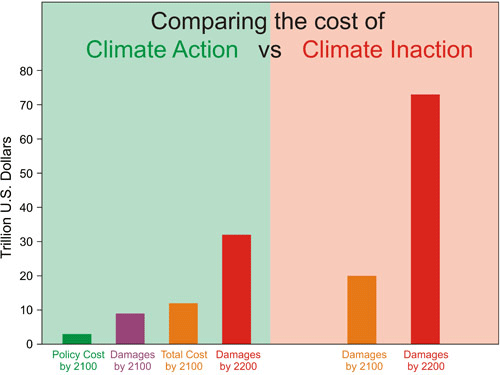
Hundreds of $billions a year – the hidden costs of climate change
 Hidden Costs of Climate Change Running Hundreds of Billions a Year, A new report warns of a high price tag on the impacts of global warming, from storm damage to health costs. But solutions can provide better value, the authors say. National Geographic
Extreme weather, made worse by climate change, along with the health impacts of burning fossil fuels, has cost the U.S. economy at least $240 billion a year over the past ten years, a new report has found.
And yet this does not include this past month’s three major hurricanes or 76 wildfires in nine Western states. Those economic losses alone are estimated to top $300 billion, the report notes. Putting it in perspective, $300 billion is enough money to provide free tuition for the 13.5 million U.S. students enrolled in public colleges and universities for four years.
In the coming decade, economic losses from extreme weather combined with the health costs of air pollution spiral upward to at least $360 billion annually, potentially crippling U.S. economic growth, according to this new report, The Economic Case for Climate Action in the United States, published online Thursday by the Universal Ecological Fund.
SanOnofre’s unique and dangerous state – of Stranded Nuclear Wastes
 Can $46 billion buy a permanent home for nuclear waste stored at San Onofre, other sites? http://www.ocregister.com/2017/09/27/can-46-billion-buy-a-home-for-nations-nuclear-waste-not-yet/ By TERI SFORZA | tsforza@scng.com | Orange County Register, 27 Sept 17, Congress members shifted on the dais during a meeting this week in Washington, D.C. on the long-term possibility of creating a national spot to store nuclear waste.
“To put it bluntly,” said Anthony O’Donnell, chair of the National Association of Regulatory Utility Commissioners, “the state and local governments have the federal government’s waste, and the federal government has our money.”
O’Donnell joined David Victor, chair of San Onofre’s Community Engagement Panel, and other experts in chiding a U.S. House Oversight and Government Reform subcommittee for the federal government’s failure to find a permanent home for nuclear waste, despite collecting $46 billion from electricity customers to do just that.
San Onofre’s unique and dangerous status – as a shuttered reactor with 3.6 million pounds of “stranded” waste, stored between the ocean and a highway, in a densely populated area, atop earthquake faults – was repeatedly raised as an impetus for action.
“People see the site being dismantled, but the waste remaining,” Victor said. “They think, ‘We paid the government to remove it, and it’s not being removed.’ That’s a palpable anger.”
Victor urged Congress to move swiftly toward licensing temporary storage sites and developing transportation plans and infrastructure for moving the waste, even as it gears up to revive Nevada’s Yucca Mountain as a permanent site.
“It’s really important not to put all our eggs in one basket,” Victor said, conjuring Nevada’s staunch opposition to becoming America’s nuclear waste dump. The state has no nuclear power plants.
Americans have spent billions with nothing to show for it, O’Donnell and others said.
Electricity ratepayers have poured that $46 billion into the Nuclear Waste Fund, and gotten nothing.
Taxpayers have paid out another $6 billion to utilities that have sued the federal government — and won — over the fed’s failure to haul away the waste as promised.
The Department of Energy says the legal bills for breach-of-contract could total $25 billion, but the nuclear industry estimates it could cost as much as $50 billion.
“The cost of inaction is high,” warned Chuck Smith, Aiken County councilmember and chair of the Energy Communities Alliance from South Carolina
Rep. Darrell Issa, R-Vista, stressed the need for swift action, as did Rep. William Lacy Clay, D-St. Louis. San Onofre is not alone in its peril, Clay said: In his district, radioactive waste is buried close to an active underground fire.
“This is a moral imperative,” Clay said. “The U.S. government created a nuclear waste problem 75 years ago. It has a clear and unavoidable responsibility to finally clean it up.”
After the hearing, Victor said that the stars were aligning to advance a nuclear waste disposal bill in the House over the coming weeks. Next, he said, will come the Senate.
Read Victor’s testimony, and that of the other witnesses, here.
There is a diplomatic way to resolve the North Korea nuclear crisis


 The nuclear threat can be contained by diplomacy, These issues are manageable if they are given the right degree of priority, John Sawers Ft.com 25 Sep 17 “……… North Korea is the issue of the day. The objective of a denuclearised Korean peninsula, pursued by the previous US administrations, is no longer an achievable goal.
The best that can be hoped for is the suspension of nuclear and missile testing in return for security assurances and practical aid. Sanctions are designed to draw Kim Jong Un into a negotiation with that aim, and to pressure China to take a more active part. But it is very hard to see President Kim pulling back now. And China is more concerned about a new US-led war in Korea or the north collapsing and sending millions of refugees into China, than it is about living with a nuclear armed Pyongyang.
The US only really has two strategic options: contain and deter the threat; or destroy it, which would require regime change. There are always military options. But all who have studied the secret Pentagon plans are sobered by the scale of loss of life in South Korea these would entail. There is also a risk of China reluctantly coming to the aid of the north as it did in the 1950s.
Realistically, it seems the only practical option is containment. That requires missile defence systems to create uncertainty that nuclear-tipped missiles would ever get through to their target, and to deter any use of such weapons by being clear that North Korea would be destroyed if it ever tried to use them.
Mr Kim may be hard for us to comprehend, but he is a rational actor and he is certainly not suicidal. US concern about this isn’t exaggerated by the Trump administration: it has a serious problem on its hands.
However much we may view containment as the only sensible answer, there are still dangers of miscalculation. Mr Kim may be tempted to use his nuclear arsenal to hold others to ransom. There is also a proliferation threat. We have seen how Pyongyang has used its nuclear technology as an export earner. In 2007, the Israelis destroyed a secret nuclear reactor in the Syrian desert that had been designed and built by the North Koreans. Is it conceivable that a future terrorist organisation might be able to obtain such a device? Unlikely. But if they had the means, then Pyongyang would be the first place to go to get it. Pakistan’s ambivalent relationship with terrorist organisations adds to the dangers.
One country where our nuclear weapons concerns had eased is Iran. The nuclear agreement has its weaknesses, especially that it only applies for 10 years. But it is worth having, and Tehran is complying by its technical requirements. If Donald Trump walks from the nuclear deal — as he threatened at the UN last week — then before long he could find he has another North Korea to deal with, this one in the Gulf.
The outlook on nuclear weapons might look grim. But as we showed in the cold war, these issues are manageable with skilful diplomacy and the right investments in defence. We just have to give it the right degree of priority. When I was at MI6, and before that our negotiator with Iran on its nuclear programme, I was always mindful of the nuclear threat. The only issue that can seriously threaten our way of life must be among our top international security priorities. The writer is chairman of Macro Advisory Partners and a former chief of MI6, the British Secret Intelligence Service https://www.ft.com/content/02c58f70-9c80-11e7-8b50-0b9f565a23e1
Leaders of USA and North Korea continue to trade threats and insults
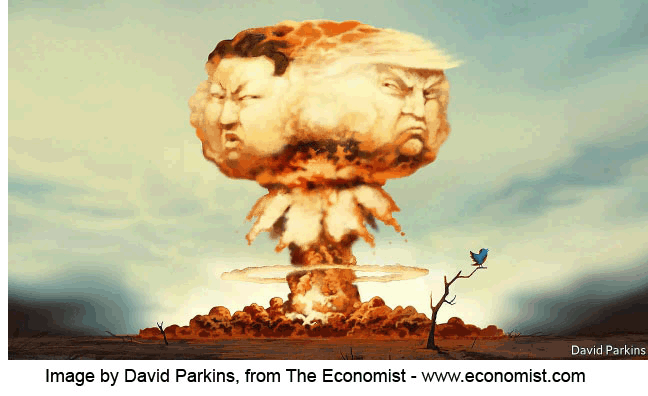 Kim Jong-un ‘won’t be around much longer’ http://www.skynews.com.au/news/politics/international/2017/09/24/trump-insult-makes-attack–inevitable—korea.html Donald Trump has made fresh threats against the North Korean regime after it branded him a ‘mentally deranged megalomaniac’.
The US President warned Pyongyang’s foreign minister that if he if ‘he echoes thoughts’ of the country’s leader Kim Jong Un they both ‘won’t be around much longer’.
He was responding after Ri Yong Ho told the United Nations General Assembly on Saturday that targeting the US mainland with its rockets was inevitable after ‘Mr Evil President’ made an ‘irreversible mistake’ by calling Mr Kim ‘rocket man’.
Describing Mr Trump as a ‘mentally deranged person full of megalomania,’ Mr Ri went on to tell the annual gathering of world leaders that the country was now ‘only a few steps away from the final gate of completion of the state’s nuclear force’.
Hitting back on Twitter, Mr Trump wrote: ‘Just heard Foreign Minister of North Korea speak at UN If he echoes thoughts of Little Rocket Man, they won’t be around much longer!’
Shortly before Mr Ri was scheduled to speak at the assembly, the Pentagon announced a fleet of US bombers and fighter jets had flown off North Korea’s coast, in what it called a ‘clear message’ to Pyongyang.
Pentagon spokeswoman Dana White said it underlined the range of military options available to the US.
Putting plutonium or other materials too close together could cause a nuclear reaction.
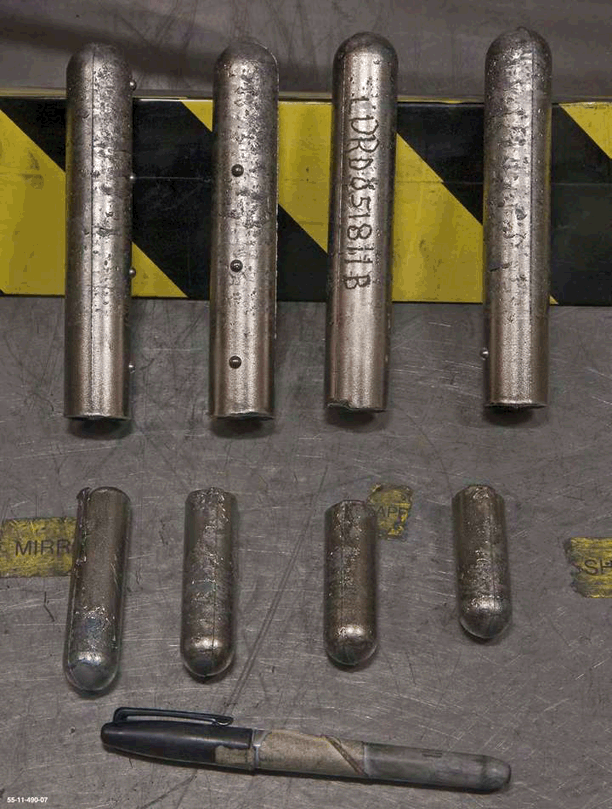 Oversight panel: Nuclear lab workers violated safety rules
Putting plutonium or other materials too close together could cause a nuclear reaction. Daily Herald, , September 23, 2017 SANTA FE, N.M. — A national laboratory’s workers producing a shell for a triggering device for nuclear weapons violated safety rules in August by storing too much material at one location in a facility for plutonium, a highly radioactive material, a federal oversight panel reported.
The Defense Nuclear Facilities Safety Board memorandum called the Aug. 18 incident at the Los Alamos National Laboratory a “criticality safety event” and said workers there discovered the placement error made by a casting crew three days later when they moved the grapefruit-sized shell again.
The workers at that point failed to follow proper procedures for reporting the Aug. 21 action, the safety board said in a one-page memorandum dated Sept. 1. The report doesn’t specify whether the shell itself contained plutonium.
The Albuquerque Journal and Santa Fe New Mexican reported Saturday on the safety board’s memorandum.
Michael Golay, a professor of nuclear science and engineering at the Massachusetts Institute of Technology who has served on the U.S. Nuclear Regulatory Commission’s research review committee, told the New Mexican there are strict controls on the use of nuclear materials because putting plutonium or other materials too close together could cause a nuclear reaction.
Golay said he could not comment on the specific conditions at Los Alamos……..
Los Alamos — the birthplace of the atomic bomb and still a premier nuclear research facility — is resuming production of the plutonium triggering devices, which are called cores and which haven’t been made since 2011. The Energy Department wants to ramp up production.
While Los Alamos officials have said the plutonium facility is operating safely and that improvements have been made in recent years, the oversight board earlier this year found that many of the safety systems in place at Los Alamos date to the 1970s and needed to be upgraded…….https://www.heraldnet.com/nation-world/oversight-panel-nuclear-lab-workers-violated-safety-rules/
Latest escalation in nuclear tension – North Korea and USA – what happens next?
How We Got to North Korea’s Pacific Nuclear Test Threat and What Comes Next It would be the first above-ground detonation in decades and would send tensions into uncharted territory. The Drive
BY JOSEPH TREVITHICK, SEPTEMBER 22, 2017 In ever escalating war of words between the United States and Kim Jong-un’s totalitarian regime in North Korea has reached an entirely new level since President Donald Trump threatened to “totally destroy” the Hermit Kingdom in a speech to the United Nations General Assembly. It seems all but guaranteed that the rhetoric will lead to new North Korean provocations, but what’s unprecedented and potentially game-changing is that they could potentially include a full demonstration of a nuclear-armed ballistic missile, or at least an above-ground nuclear weapon test, either which in turn would similarly demand some form of American response.
This latest escalation in tensions between the U.S. government and North Korean officials began on Sept. 19, 2017, when Trump addressed the United Nations General Assembly for the first time with fiery remarks, lashing out at not only North Korea, but also Iran, Cuba, Venezuela, and other critics of American foreign policy more broadly. He vowed to put the United States interests first in all matters and encouraged the other assembled leaders to do the same. But he reserved some of the most incendiary comments for Kim, who he has now nicknamed “Rocket Man,” and his regime.
“The United States has great strength and patience, but if it is forced to defend itself or its allies, we will have no choice but to totally destroy North Korea,” he declared. “Rocket Man is on a suicide mission for himself and for his regime. The United States is ready, willing and able, but hopefully this will not be necessary.”
This particular statement drew “audible gasps” from some of the world leaders in attendance, according to The Associated Press. The North Korean delegation had already walked out in protest before Trump even began speaking……..
The string of threats, especially Nikki Haley’s comments, suggest the United states and its allies could easily handle the increasingly worrisome situation with military force if it runs out of other options. This of course is entirely untrue and major conflict with North Korea would be devastating for all the involved parties.
Not surprisingly, this has not prompted a change in the behavior of the North Korean regime or Premier Kim. As we at The War Zone have noted for months, these statements feed into the country’s existing paranoid and propaganda that the United States and its allies are actively looking to destroy it and forcefully eliminate its government.
It has only appeared to give North Korea more of a reason to continue to develop advanced ballistic missiles and nuclear weapons to achieve some relative parity with the United States in order, if nothing else, to preserve the regime’s very existence. Kim said as much himself in a televised rebuttal on Sept. 21, 2017……
Trump continued the cycle on Sept. 22, 2017, as part of a series of Tweets on various topics. “Kim Jong Un of North Korea, who is obviously a madman who doesn’t mind starving or killing his people, will be tested like never before!” he posted on the social media site.
If his remarks in front of the United Nations seemed likely to generate a North Korean response, the Tweet sounded closer to a direct challenge. Given Kim’s immediate response to Trump’s threat of total destruction, it seems he will have little room but to make a provocative move in response to this new “test.”
After Kim’s own televised address, North Korean Foreign Minister Ri Yong Ho had already said the North Korean response could include detonating a hydrogen bomb in or over the Pacific Ocean. Earlier in September 2017, North Korea tested what experts believe to be a working thermonuclear device…….
In the future, North Korea may simply need to conduct nuclear weapons tests outside of its own borders since the Punggye-ri underground test site may simply not be able to survive the strain of more powerful thermonuclear designs. The nuclear test earlier in September 2017 appeared to cause the tunnel containing the device to collapse, highlighting the limits of underground testing.
Even if the atmospheric test went as intended, it could be difficult to be entirely sure there would be no inadvertent casualties and the resulting fallout could easily fall on civilian mariners or populated areas……..
despite Nikki Haley’s and H.R. McMaster’s insistence that there are available military options to respond to these growing provocations, as well as Trump’s vague threats, any direct action would be fraught with its own dangers. One of the most likely courses of action, shooting down the missile, carries significant risks as the impact of the interceptor could trigger the device or the radioactive debris could fall over populated areas.
Perhaps more importantly to the viability of America’s still largely unproven ballistic missile defense shield, if the intercepting weapon misses or otherwise fails to achieve the desired effect, it would expose a serious vulnerability to not just North Korea, but the rest of the world…..
In particular, systems that engage the missile as it comes falling back down to earth, such as the Terminal High Altitude Air Defense (THAAD) system, have a very narrow window to achieve a “kill.” Furthermore, this means that personnel manning the interceptors would likely be in the direct path the incoming weapon, and if it was fully armed, a nuclear test.
There is very little room for failure in any of these scenarios. Even if the shoot down were to go smoothly, it is possible that it could trigger a larger and immensely destructive conflict on the Korean Peninsula or throughout East Asia. The War Zone’s Tyler Rogoway has highlighted these various issues previously in a deep dive into the United States’ available options in responding to North Korea’s continued provocations……..
All of these options still come with their own risks, though, and there’s still no indication that they would convince Kim to change course. If the North Korean regime’s primary goal is its own survival, it is perfectly rational for them to continue to demonstrate their resolve to respond in kind to American threats.
And despite his comments, Trump’s first step, on Sept. 21, 2017, was to sign a new executive order penalizing any individual or business doing business with North Korea. This follows a trend of steady sanctions against actors and firms outside of North Korea that the United States accuses of enabling the reclusive country’s government.
Trump and other members of his administration repeatedly question Kim’s mental stability, but as we at The War Zone have noted before, he clearly has a coherent plan. We’re still not sure that U.S. government has developed a thought-out strategy to dissuade him from his chosen path.
Contact the author: jtrevithickpr@gmail.com http://www.thedrive.com/the-war-zone/14561/how-we-got-to-north-koreas-pacific-nuclear-test-threat-and-what-comes-next
1 This Month





PLEASE OPPOSE HR 8255 AND S.3639 – bills would accelerate satellite deployment, with no environmental review or safeguards – https://ncstd5li.quorum.us/campaign/169331/
To see nuclear-related stories in greater depth and intensity – go to https://nuclearinformation.wordpress.com
-
Archives
- October 2026 (67)
- September 2026 (339)
- August 2026 (330)
- July 2026 (355)
- June 2026 (287)
- May 2026 (306)
- April 2026 (356)
- March 2026 (251)
- February 2026 (267)
- January 2026 (308)
- December 2025 (358)
- November 2025 (359)
-
Categories
- 1
- 1 NUCLEAR ISSUES
- business and costs
- climate change
- culture and arts
- ENERGY
- environment
- health
- history
- indigenous issues
- Legal
- marketing of nuclear
- media
- opposition to nuclear
- PERSONAL STORIES
- politics
- politics international
- Religion and ethics
- safety
- secrets,lies and civil liberties
- spinbuster
- technology
- Uranium
- wastes
- weapons and war
- Women
- 2 WORLD
- ACTION
- AFRICA
- Atrocities
- AUSTRALIA
- Christina's notes
- Christina's themes
- culture and arts
- Events
- Fuk 2022
- Fuk 2023
- Fukushima 2017
- Fukushima 2018
- fukushima 2019
- Fukushima 2020
- Fukushima 2021
- general
- global warming
- Humour (God we need it)
- Nuclear
- RARE EARTHS
- Reference
- resources – print
- Resources -audiovicual
- Weekly Newsletter
- World
- World Nuclear
- YouTube
-
RSS
Entries RSS
Comments RSS

