De Smog Blog, By Itai Vardi September 19, 2017 President Trump’s nominee to head the Federal Energy Regulatory Commission (FERC) has, as a corporate attorney, personally represented a host of energy and utility companies, many of which do business that is directly impacted by FERC’s decisionmaking. According to Kevin McIntyre’s financial disclosure — obtained by DeSmog and published here for the first time — these include major utilities, fracking companies, pipeline builders, and international energy corporations.
McIntyre is a lawyer who co-leads the global energy practice for the legal and lobbying firm Jones Day, and is currently awaiting final Senate confirmation of his appointment to the nation’s top energy regulatory body. That confirmation may come as soon as this week.
McIntyre’s financial disclosure, submitted recently to the Office of Government Ethics, reveals that in the past two years alone he has represented various energy and utility companies. Some of these companies are regulated by FERC or have projects seeking FERC approval.
The list includes the following entities:
Ameren Corporation, a St. Louis, Missouri-based utility and power generation company. Ameren delivers electricity and distributes gas to over 1 million customers in Missouri and Illinois. The company owns several power-generating plants running on coal, gas, and oil. It also operates nuclear, hydroelectric, and renewable facilities.
American Electric Power Service Corporation (AEP), a large Columbus, Ohio-based electric utility supplying customers throughout the Midwest and Southwest US. The company owns about 60 power generating facilities, of which coal-fueled plants account for approximately 47 percent of AEP’s generating capacity, while natural gas represents 27 percent and nuclear 7 percent.
Lakeside Energy LLC, a Chicago-based energy holding firm that targets independent power generating and renewables industries.
Navajo Transitional Energy Company, a Farmington, New Mexico-based coal mining company owned by the Navajo Nation. The company supplies coal to the nearby Four Corners power plant.
SCANA Corporation, a Cayce, South Carolina-based energy holding company engaged primarily in electric and gas utility operations in the Carolinas and Georgia. The company also owns nuclear, hydroelectric, coal, and renewable power generating facilities.
TECO, a Tampa-based electric and gas utility providing services to customers in Florida and New Mexico. TECO is a subsidirary of Canadian energy and services giant Emera, which owns $29 billion in assets in North America and the Caribbean.
Traverse Midstream Partners, an Edmond, Oklahoma-based pipeline company with stakes in the Rover pipeline and Ohio River System pipeline. In both pipelines, Traverse partners with Energy Transfer Partners, the company behind the Dakota Access pipeline.
Ascent Resources, an Oklahoma City-based oil and gas exploration and production company that focuses on fracking in the Utica and Marcellus shales in Ohio and West Virginia.
Enable Midstream Partners, an Oklahoma City-based oil and gas gathering, processing, and transmitting company with operations in Oklahoma and Arkansas. One of Enable’s current proposed pipeline projects, the Central Arkansas Pipeline Expansion (CAPE), will require FERC approval.
EDF Energy Services LLC, a Houston-based subsidiary of French utility EDF, the company provides electricity, natural gas products and services to large-scale, energy-intensive commercial and industrial consumers in the US and Canada.
PT. Xintia Indonesia, an Indonesian company providing drilling equipment and services to the oil and gas industry.
SOCAR Trading S.A., a Geneva Switzerland-based company which is the marketing and development subsidiary of SOCAR, the state oil company of Azerbaijan. SOCAR Trading markets the bulk of Azeri crude exports.
Total Petrochemical & Refining USA, Inc., a Houston-based subsidiary of French oil and gas major Total involved in the production of various petrochemical materials with facilities in Texas and Louisiana.
Iberdrola Renovables Mexico S.A. de C.V., a Mexican subsidiary of Spanish electric utility giant Iberdrola, focusing on renewable energy investments in Mexico.
Concern Over Industry Ties
After a number of resignations and term expirations, as of this past June the FERC‘s bench had dwindled down to one single commissioner. The Trump administration has nominated four new candidates to restore the quorum needed for FERC to make key decisions.
Industry representatives lauded the reestablishment of a quorum on the commission, which can now approve the logjam of pending energy projects.
Critics, however, have sounded the alarm about some of the new appointees’ industry ties. Protesters with the group Beyond Extreme Energy had disrupted two Senate confirmation hearings in recent months.
They’ve pointed out that the newest FERC appointees Neil Chatterjee and Rob Powelson have ties to fossil fuel companies and utilities. While Chatterjee previously worked as an energy policy advisor to Senate Majority Leader Mitch McConnell (R-KY), Powelson developed a close relationship with the industry as a state utilities regulator.
Kevin McIntyre’s financial disclosure adds fuel to these concerns. McIntyre did not respond to a request for comment.
Tyson Slocum, director of the energy program at the government watchdog group Public Citizen, says the disclosure is cause for further concern. “I do think FERC has had problems of not accommodating the public interest as much as is spelled out in its statutory requirements,” Slocum says. “And McIntyre’s list of clients does not appear to include public interest clients, whereas today there is much opportunity for lawyers to represents such clients as well.”
Slocum adds that as co-lead of Jones Day’s energy practice, McIntyre is probably privy to other kinds of key information about energy clients, beyond those entities listed as the ones he personally represented at the firm.
“This complicates the question of potential conflicts beyond the list he provided in the disclosure since there’s uncertainty as to that kind of information he may hold,” Slocum says.
Senate Passes Defense Bill That Would Bolster Nuclear Weapons Programs TruthOut September 19, 2017By Mike Ludwig, Truthout The Senate approved a massive defense policy bill by a vote of 89 to 9 on Monday that is raising concerns about nuclear weapons proliferation amid rising tensions between the United States and countries such as North Korea and Russia.
The Senate version of the National Defense Authorization Act (NDAA), an annual piece of “must-pass” legislation that shapes dozens of policies at the Pentagon, would authorize $640 billion in discretionary defense spending and an additional $60 billion for overseas military operations, such as the ongoing war efforts in Iraq, Afghanistan and Syria.
What’s the value of $700 billion? It’s more than twice the size of Denmark’s entire economy, and the same amount of money that the government spent bailing out banks during the financial collapse in 2008. Both the Senate and House versions of the bill name amounts that exceed President Trump’s request for military funding by tens of billions of dollars.
The numbers put forth in the defense authorization bill set the bar for future defense spending legislation and policy determinations. As an authorization bill, this legislation does not actually permit the expenditure of those funds; an appropriations bill is needed for that.
The bill authorizes billions of dollars for nuclear weapons and nonproliferation programs, including $65 million for developing a cruise missile that nonproliferation groups fear could derail the 1987 Intermediate-Range Nuclear Forces (INF) Treaty, a landmark nuclear treaty between the US and Russia.
Critics say increasing spending on the US nuclear arsenal could trigger other countries to invest in their own capabilities and add to the number of highly destructive weapons on the planet.
“We [are] already investing in nuclear weapons to a tune of about $20 million a year, so we really have to ask ourselves what the point of an increased investment would be, considering these are weapons that should never be used,” said Lindsay Koshgarian, director of the National Priorities Project, a group that tracks military spending, in an interview with Truthout.
The US has accused Russia of violating the INF Treaty by developing and fielding a land-based cruise missile with nuclear capabilities, a charge Russia has denied. The Senate’s version of NDAA authorizes research and development of a mid-range, road-mobile cruise missile system that could carry a nuclear warhead, similar to the missile Russia allegedly developed.
The Senate Armed Services Committee claims that the money could only be used for research and development of the missile, not testing and deployment, so it would not violate the treaty in the way that Russia allegedly has. Rather, the committee says, it would close a “capability” gap opened by Russia.
However, developing such a weapon would suck money away from nonproliferation programs while sowing divisions within NATO and giving Russia an excuse to reject the treaty and deploy large numbers of noncompliant missiles without constraint, according to the Arms Control Association.
Senators Elizabeth Warren (D-Massachusetts) and Mike Lee (R-Utah) added an amendment to the bill that requires the defense secretary to submit a report to Congress on the rationale and strategic implications for developing such a weapon before the $65 million can be spent. Warren also included an amendment asking the Department of Defense to consider existing treaty obligations in an upcoming Nuclear Posture Review. The House rejected similar measures offered by Rep. Earl Blumenauer (D-Oregon).
The House version of the bill provides $25 million to develop conventional (non-nuclear) land-based cruise missiles and requires the president to submit a report on Russian compliance with the INF treaty within 15 months. If Russia is determined to be out of compliance, the treaty would no longer bind the US, effectively dissolving a decades-old nonproliferation agreement between the two countries that control about 90 percent of the world’s nuclear weapons.
The House bill would also block funding for extending the 2010 New Strategic Arms Reduction Treaty, a nuclear nonproliferation agreement considered a bright spot in US-Russia relations, unless Russia returns to compliance with the INF Treaty.
Senators Elizabeth Warren (D-Massachusetts) and Mike Lee (R-Utah) added an amendment to the bill that requires the defense secretary to submit a report to Congress on the rationale and strategic implications for developing such a weapon before the $65 million can be spent. Warren also included an amendment asking the Department of Defense to consider existing treaty obligations in an upcoming Nuclear Posture Review. The House rejected similar measures offered by Rep. Earl Blumenauer (D-Oregon).
The House version of the bill provides $25 million to develop conventional (non-nuclear) land-based cruise missiles and requires the president to submit a report on Russian compliance with the INF treaty within 15 months. If Russia is determined to be out of compliance, the treaty would no longer bind the US, effectively dissolving a decades-old nonproliferation agreement between the two countries that control about 90 percent of the world’s nuclear weapons.
The House bill would also block funding for extending the 2010 New Strategic Arms Reduction Treaty, a nuclear nonproliferation agreement considered a bright spot in US-Russia relations, unless Russia returns to compliance with the INF Treaty…….
The US defense budget easily dwarfs that of any other country on the planet, and the NDAA would authorize an annual budget for the Pentagon that is even larger than the ones it received during the height of the wars in Iraq and Afghanistan. The Pentagon already receives more than half of federal discretionary spending, but if Congress were to honor the White House’s requests for domestic cuts, the portion of the discretionary budget that is earmarked for defense could top 68 percent.
However, since the bill does not actually appropriate any money, Congress faces difficult budget negotiations going forward. Democrats typically use defense spending as leverage to maintain or increase funding for domestic programs. If the funding levels specified in the NDAA were to be approved, a 2011 law that placed limits on military spending would need to be lifted or otherwise circumvented, because the bill outlines spending that would easily exceeds those limits.http://www.truth-out.org/news/item/41984-senate-passes-defense-bill-that-would-bolster-nuclear-weapons-programs
World Leaders Urge Trump Not To Pull Out Of Iran Nuclear Pact, NPR September 21, 20177: Heard on Morning Edition Mary Louise Kelly talks to former Obama adviser Ben Rhodes, who warns if President Trump pulls out of the deal, it will alienate allies, and Iran may restart its nuclear program.
MARY LOUISE KELLY, HOST:President Trump says he has made up his mind what to do about the Iran nuclear deal. He wouldn’t tell reporters what he’s decided, but he’s made no secret in past of how he feels about Iran and in particular how he feels about the nuclear deal reached in 2015 under Barack Obama
………KELLY: What would be the consequences of the U.S. exiting the nuclear deal?
RHODES: Well, we would be totally isolated from the rest of the world including our closest allies. The constraints on Iran’s nuclear program would no longer be enshrined in a deal. And essentially Iran could restart its nuclear program, precipitating a second nuclear crisis in the Middle East to the one we have with North Korea, and we could be left with the decision, the United States, as to whether to allow Iran to go forward with its nuclear program or to start another war in the Middle East. And we thought this was the best way to prevent a nuclear weapon and to prevent another war………
The judgment of the U.S. intelligence community, the IAEA, the monitoring mechanism, our closest allies, even the Trump administration itself has certified twice that Iran is complying with this deal. That is a matter of fact. It’s not a subjective matter. And so therefore to be threatening to decertify Iranian compliance, as President Trump has done, flies in the face of the facts and, frankly, alienates us from our closest European allies and, frankly, gives international opinion – pushes it in the direction of Iran, which is exactly what we don’t want……..
KELLY: One quick development – one development to quickly ask you about, which is this. Some news organizations are reporting today that President Trump may decide to throw the matter to Congress, let Congress decide whether to reimpose sanctions. Is that a good idea? Is that one way forward?RHODES: No. I – you know, I think that creates some degree of chaos. If he doesn’t certify, the matter does go to Congress. And the fact of the matter is you’ll have the rest of the world wondering where the United States is on this question. And I think that’s a very dangerous thing, especially when he’s trying to deal with the same countries, Iran – with Russia and China to deal with North Korea. He should be – focus his attention on North Korea now, not creating a second crisis with Iran………http://www.npr.org/2017/09/21/552548128/world-leaders-urge-trump-not-to-pull-out-of-iran-nuclear-pac
FT 17th Sept 2017, Westinghouse will emerge from bankruptcy protection “very soon” but its
future ownership remains shrouded in doubt as Toshiba mulls a potential
sale of its US nuclear business. José Gutiérrez, chief executive of
Westinghouse, said the company “was in a much better situation” than
many people imagined and hoped to emerge from the US Chapter 11 process
once a restructuring plan was agreed “in the next few months”.
However, he acknowledged that Toshiba must first decide what it wants to do with the
company, with options including a sale of the whole business or parts of
it. Toshiba has said it is “actively considering” a sale of
Westinghouse as it battles to prevent the business from dragging down the
rest of the Japanese conglomerate.
Analysts say political barriers will narrow down an already limited field of potential buyers, with Chinese and
Russian companies almost certainly unacceptable to Washington. Europe’s
biggest nuclear companies, Areva and EDF of France, are facing their own
financial turmoil and competitors such as General Electric in the US,
Hitachi in Japan and Kepco in South Korea are not rushing to rescue their
rival. https://www.ft.com/content/a9bb6e08-9a19-11e7-b83c-9588e51488a0
A conservative-leaning court just issued a surprise ruling on climate change and coal mining
In a rebuke to Trump, the federal court said greenhouse gas emissions need to be considered in lease approvals. Vox by Umair IrfanLate last week, a federal court knocked down plans to expand coal mining in the Western US, adding to a growing body of rulings against the Trump administration’s efforts to push climate change off the agenda.
The surprising decision from the United States Court of Appeals for the 10th Circuit, which has jurisdiction in Colorado, Kansas, Utah, New Mexico, Oklahoma, and Wyoming, told the Bureau of Land Management to redo its math on greenhouse gas emissions from coal leases and sent the approval of these leases back to a lower court.
Under the National Environmental Policy Act, federal agencies have to consider how a given proposal both affects climate change and is affected by climate change.
The 10th Circuit is the highest court to rule on climate change accounting so far, and its opinion undercuts President Donald Trump’s efforts to resuscitate the dying US coal industry.
“It’s reaffirming what a lot of people already knew: Government has to take a hard look at what their environmental impacts are,” said Sam Kalen, a law professor at the University of Wyoming. “Cases like this are sending signal that regardless of what the administration wants to do, the law says you have to take a look at these issues.”
In March, President Trump lifted President Barack Obama’s moratorium on coal leasing and stopped a comprehensive review of federal coal policy, with the goal of spurring more coal mining.
At issue are four proposed leases in the Powder River Basin, a 14-million-acre region spanning Wyoming and Montana containing 40 percent of US coal deposits and responsible for 13 percent of the country’s greenhouse gas emissions, according to the Sierra Club, one of the groups joining the lawsuit against BLM………
With tensions growing, people have looked into bunkers, a concept that dates to federal government directives from early in the Cold War. On its website, the Department of Homeland Security says that “shielding” is among the factors that a person can use to protect him or herself from the radiation or fallout from a nuclear blast, and that “taking shelter during a nuclear blast is absolutely necessary.” The agency identifies two types of shelters: blast shelters, which protect against initial radiation, heat and fire, and fallout shelters, with thick walls and a roof that can absorb the radiation from fallout particles. “The heavier and denser the materials—thick walls, concrete, bricks, books and earth—between you and the fallout particles, the better,” the guidance says.
Ron Hubbard, president of the California-based company Atlas Survival Shelters, told the Miami Herald in August that he expects to sell 1,000 shelters by the end of 2017 and that he plans to open a new 400,000-square-foot plant in Dallas. “We are back in the 1960s again,” he said. The company also told Fox Business Network that in 30 days it sold more than 30 shelters, more than it would have sold all year six years ago. The company sells different types of shelters, from ones made of corrugated pipe to hardened concrete bunkers.
Another manufacturer, Gary Lynch, of the Texas-based Rising S Bunkers, told the Miami Herald in August that the company had sold 67 shelters so far in 2017, compared with nine in all of 2016. That company’s shelters range from $39,500 to $8.4 million. The most expensive one, called the Aristocrat Luxury Bunker, sleeps more than 50 and has a sauna, a swimming pool and hot tub, a game room with billiard tables, a bowling alley, a movie theater and a gun range.
A similar trend in bunkers is happening in Japan, which is also facing the threat from North Korea, Bloomberg Businessweekreported in July. The Japanese are importing shelters from companies in the U.S. and Israel.
“It does seem that there are some very significant investments that are going into this,” Jeff Schlegelmilch, deputy director of the National Center for Disaster Preparedness at Columbia University’s Earth Institute, tells Newsweek. “Certainly there are investors who are making pretty large bets that this is a market that is going to grow.” As for their effectiveness, he adds, “it depends on who’s building them and how well they’re building them…. I suspect there’s a little bit of you-get-what-you-pay for.”
For people in urban areas such as New York City who don’t have access to underground areas to build shelters, companies such as Gaffco Ballistics build safe rooms with “bio-defense” capabilities. Tom Gaffney, CEO of that company, tells Newsweek that trend dates back six or seven years. Such rooms contain air-filtration systems that can “offer protection from the effects of nuclear, chemical and biological gases for an extended period of time,” according to the Gaffco Ballistics website. People inside those safe rooms can monitor in real time the contamination levels of the air outside. Gaffney estimates that he’s received a 20 to 30 percent increase in calls and emails since May or June.
Some of the interest predates the recent tensions with North Korea. In 2014, the Ventura County Health Care Agency in California posted a video online containing “steps you and your family should take to protect yourselves in the event of a nuclear explosion.” Schlegelmilch says that over the past one or two decades people have expressed interest in such shelters to deal not only with nuclear threats, but also biological ones.
“There’s more of an awareness out there,” says Gaffney of Gaffco Ballistics.
On Wednesday at the United Nations, the Treaty on the Prohibition of Nuclear Weapons will open for signature. For signatories, this treaty prohibits nuclear weapons altogether. Its explicit goal is a universal norm against all forms of participation in the nuclear weapons industry.
Designing, testing, producing, possessing, threatening with, deploying and using nuclear weapons are to be banned. Crucially, assistance or encouragement in these illegal acts will also be banned, as will stationing of nuclear weapons, both of which impact U.S. nuclear alliances, including NATO. Signatory states will be required to enact administrative and penal sanctions against anyone involved with the nuclear weapons industry.
The ban treaty was negotiated against heavy opposition from the U.S. and other nuclear weapon states — they obviously won’t sign. In the end, the text was approved by 122 countries. It is likely to enter into force next year and to gradually gain adherents thereafter, a process that will keep U.S. nuclear “modernization” in the news around the world.
In all this, whither Santa Fe? While the City Different seeks a positive international reputation, the metro area hosts the world’s most lavishly funded labs and production facilities for soon-to-be-outlawed nuclear weapons.
So far, our congressional delegation, following Los Alamos National Laboratory, wants to restart production of plutonium warhead cores (“pits”). The new pits are “needed” solely for building a new kind of (untested and redundant) warhead the U.S. Navy doesn’t want. The U.S. Air Force has secretly admitted the same. Pits in existing weapons are all in fine condition and will remain so for decades.
As a dubious reward for its enduring loyalty to the Los Alamos lab, the Santa Fe metro area has long hosted the state’s largest nuclear waste dump, visible from high ground anywhere from Eldorado to Truchas. Area G is now stuffed to the gills and might finally close at the end of this month. Then again, the lab may expand the site.
A plutonium factory for outlawed weapons and a nuclear waste dump. That’s a city “different” all right.
Actually, Los Alamos seeks two unnecessary plutonium programs, not just pit production but also the messy and dangerous processing of tons of surplus pits for disposal at the Waste Isolation Pilot Plant. Instead of this, permanently demilitarizing pits without opening them up, followed by direct disposal, would be adequate, cheap, safe and quick. The lab need not and should not be involved, no matter what plan the Department of Energy chooses.
Without new warheads (that the rest of the world hates), the labs would shrink. Los Alamos would not need to make pits, let alone build underground workshops (estimated cost: $300,000 per square foot).
Why have silo-based intercontinental ballistic missiles at all? Former Secretary of Defense William Perry and former U.S. Strategic Command Commander (and later, vice chairman of the Joint Chiefs of Staff) James Cartwright are among those who believe the U.S. would be more secure without any ICBMs.
We agree. By 2030 or so, U.S. ICBMs will age out. Former President Barack Obama began (and Trump continues) a huge program to replace them. Department of Defense estimates the new missiles, equipment and software will cost between $85 billion and $150 billion, a fiscal disaster comparable to Hurricane Harvey. Building missiles creates no productive infrastructure, mitigates no climate change and creates few jobs.
That sum, wisely invested in leveraging more renewable energy, would go a long way toward ending coal burning in the U.S. while building nonexportable jobs, skills and communities.
The new missiles are just part of the Obama-Trump plan to replace every single nuclear weapon system, reliably estimated to cost more than $1 trillion. These are not the “deployments” our children need. The world is crying out for fresh priorities that will give their children and our world a chance. Will our congressional delegation listen?
Greg Mello is director of the Los Alamos Study Group, a nuclear disarmament-focused nonprofit, based in Albuquerque.
North Korea: UN has ‘exhausted’ its options and America may hand issue to Pentagon, Nikki Haley says, ABC News 18 Sept 17 The US ambassador to the United Nations says the UN Security Council has run out of options to contain North Korea’s nuclear program, adding Washington may have to turn the matter over to the Pentagon.
Key points:
Ms Haley says if North Korea continues it “will be destroyed”
Donald Trump calls Kim Jong-un “rocket man” and praises sanctions effects
Security adviser HR McMaster says preparing a military option is becoming necessary
“We have pretty much exhausted all the things that we can do at the Security Council at this point,” Nikki Haley told CNN, adding that she was perfectly happy to hand the North Korea issue over to Defence Secretary James Mattis.
“If North Korea keeps on with this reckless behaviour, if the United States has to defend itself or defend its allies in any way, North Korea will be destroyed,” she said………
Military options available to Mr Trump range from a sea blockade aimed at enforcing sanctions to cruise missile strikes on nuclear and missile facilities to a broader campaign aimed at overthrowing leader Kim Jong-un.
“The world will never accept a nuclear-armed North Korea,” U.S. Ambassador Nikki Haley told the U.N., after the sanctions passed the Security Council on Monday. She added: “If the North Korean regime does not halt its nuclear program, we will act to stop it ourselves.”
But some analysts believe that this approach to the North Korean nuclear crises is dangerously deluded.
A decade or so ago, it still may have been possible to use sanctions or the threat of military force to compel North Korea to give up its nuclear programs, argues Zhao Chu, an independent, Shanghai-based analyst, former soldier and former editor of World Outlook, a foreign affairs magazine.
But Zhao warns that the situation has now fundamentally changed, and that trying to fly through a window of opportunity that has already closed is a very bad idea. Pyongyang can hardly be expected to give up the nuclear ace in the hole that it worked so long to acquire.
Then again, perhaps the window of opportunity for military action was never open, argues Lyle Goldstein, an associate professor in the Strategic Research Department at the U.S. Naval War College in Newport, Rhode Island. This is because the South Korean capital, “Seoul was always so vulnerable” to North Korean conventional artillery attacks, which could cause mass casualties.
Analysts say North Korea looked at the fate of other authoritarian regimes, particularly Libya under Moammar Gadhafi and Iraq under Saddam Hussein, and concluded that their lack of nuclear weapons left them vulnerable to being toppled by the U.S. and its allies.
Pyongyang now believes — correctly or not — that, by acquiring the ability to carry out a nuclear strike against the U.S., it has taken a crucial step toward assuring its own survival.
“You could credit the Kim regime with taking regime change off the table,” says the U.S. Naval War College’s Goldstein.
Another way of looking at it is that North Korea has now gained a valuable bargaining chip. And while it is unlikely to give it away for nothing, it may be willing to trade it for some sort of security guarantee, or some form of payment, whether in food or energy.
A grimmer possibility, of course, is that it might just sell it to raise much-needed cash.
Here, Goldstein sees an opportunity to strike a bargain with North Korea to resolve the crisis. He says that years of using all sticks and no carrots have not yielded the required results, and it’s time for some creative thinking.
Goldstein rejects the idea that the only way to improve North Korea is through regime change. “There are plenty of obnoxious regimes around the world,” he says, “and more than a few are allies of the United States.”…..
“I think we should take a pragmatic attitude and tolerate a nuclear North Korea,” Zhao concludes. “Why did the U.S. and China tolerate India and Pakistan going nuclear? Because they had no better options.”
All that’s left to do, Zhao says, is to try to prevent North Korea from proliferating nuclear technology, help it to avoid nuclear accidents, and set up unofficial dialogues to get scholars, if not officials, discussing possible solutions.
MIKE FLYNN’S NUCLEAR SIDE-HUSTLE GETS EVEN SHADIER
Two weeks before the inauguration, Flynn reportedly met the king of Jordan while pushing a deal to build nuclear reactors . . . in Jordan. Vanity Fair , BY BESS LEVIN SEPTEMBER 15, 2017 Remember Mike Flynn? The ex-national security adviser who was forced to resign after he forgot to mention some conversations he’d had with Russian ambassador Sergey Kislyak? Whose unfair persecution at the hands of James Comey was allegedly one of the reasons Donald Trump fired his own F.B.I. director? Who received $600,000 in a lobbying deal from a Turkish man with business ties to Russia, and who subsequently BLOCKED A PLAN TO ATTACK ISIS that the Turkish government opposed, all without ever registering a foreign agent or disclosing his lobbying deals? He’s back in the news today, and if you were hoping it was for something fun like Flynn announcing that he is joining the next season of Dancing with the Stars, you will be disappointed.
BuzzFeed News reports that two weeks before Donald Trump was inaugurated, Flynn and soon-to-be White House advisers Steve Bannon and Jared Kusher had a secret morning meeting with Jordan’s King Abdullah II, during the same period in which Flynn was pushing “a multibillion-dollar deal to build nuclear reactors in Jordan and other Middle East nations.” (Like 100 other foreign contacts he initially failed to disclose, Kushner’s initial security clearance form failed to mention this particular meeting.) According to BuzzFeed, topics discussed included “Israeli-Palestinian relations, intelligence sharing between America and Jordan on Syria, ISIS,” and a nuclear project called the Marshal Plan, a $200 billion project which initially involved U.S. companies building reactors in Jordan and other Middle East nations, with security handled by a Russian state-owned firm called Rosoboron, which, incidentally, is currently facing the possibility of U.S. sanctions.
People close to the three Trump advisers say that the nuclear deal was not discussed. But a federal official with access to a document created by a law enforcement agency about the meeting said that the nuclear proposal, known as the Marshall Plan, was one of the topics the group talked about.
According to Politico, Flynn was paid at least $25,000 in his capacity as a consultant on the plan by one of the American companies involved. According to the Wall Street Journal, Flynn’s disclosure forms “indicate that [his] year-and-a-half work on the project ended in December 2016, but Mr. Flynn in fact remained involved in the project once he joined the Trump administration in January, discussing the plan and directing his National Security Council staff to meet with the companies involved, the former staffers said.” (Flynn’s lawyer declined to comment to the Journal, as did the White House.)
If this all sounds like the type of thing that’s going to keep you up at night, you’re not alone. “Any proposal to introduce dozens of nuclear reactors to the Middle East, particularly Saudi Arabia, raises many proliferation red flags,” the Arms Control Association’s Daryl Kimball told BuzzFeed. “The Saudis do not need nuclear power and them gaining access could lead to dangerous consequences down the road.” Giving a country nuclear energy capacity, as the Marshall Plan would, “is like giving a country a nuclear weapons starter kit,” the nonprofit Center for Arms Control and Non-Proliferation’s Alexandra Bell said…..https://www.vanityfair.com/news/2017/09/mike-flynns-nuclear-side-hustle-gets-even-shadier
US must stop North Korea threats, says China, as Kim Jong-un aims for military ‘equilibrium’
Chinese ambassador says America needs to do ‘much more’ to achieve cooperation as Kim Jong-un speaks of goal of equalling US military might, Guardian, Tom Phillips , 16 Sept The United States must stop threatening North Korea’s leader if a peaceful solution to the nuclear crisis is to be found, China’s ambassador to Washington has said, as Kim Jong-un reiterated his country’s aim to reach military “equilibrium” with the US.
Cui Tiankai told reporters in Washington: “They [the US] should refrain from issuing more threats. They should do more to find effective ways to resume dialogue and negotiation.”
“Honestly, I think the United States should be doing … much more than now, so that there’s real effective international cooperation on this issue.”
North Korea’s state news agency, KCNA on Saturday quoted Kim as saying: “Our final goal is to establish the equilibrium of real force with the US and make the US rulers dare not talk about military option.”
US national security advisor HR McMaster said: “We have been kicking the can down the road and we’re out of road. For those who have been commenting about the lack of a military option – there is a military option. Now, it’s not what we prefer to do, so what we have to do is call on all nations to do everything we can to address this global problem, short of war.”
The Chinese ambassador was speaking after Pyongyang fired a missile over Japan for the second time in two weeks a move the UN security council said it “strongly condemned”.
Obama-complex Fuels Trump and Netanyahu’s Fight Against Iran Nuclear Deal, Haaretz, Chemi Shalev Sep 17, 2017
Both were slighted by the former U.S. president and both are seeking payback by expunging his signature foreign policy achievement.
Donald Trump is obsessed with Barack Obama. The U.S. president never misses an opportunity to insult and taunt his predecessor. Trump does his best to diminish Obama’s achievements as he endeavors to erase them from the history books as well. His task is naturally easier in foreign affairs and national security, where his independent authority is wider. He withdrew from the Trans Pacific Partnership, backed away from the Paris Accord on global warming and scaled back Obama’s rapprochement with Cuba.
But just as repealing Obamacare was and remains the principle objective in expunging Obama’s legacy on the domestic front, so is Obama’s nuclear accord with Iran seen as the red flag that won’t let Trump rest until he tears it to shreds.
The hostility between the 45th president and the 44th, unprecedented in recent presidential history, is the product of Trump’s feelings of inferiority, his narcissistic personality and his cynical political exploitation of American racism, which he may or not share…….
he can’t stand the fact that as a direct consequence of his problematic presidency, most of the world misses Obama today more than it appreciated him when he was in office.
Benjamin Netanyahu shares Trump’s Obama-complex but seeks to exploit it as well. Obama handed Netanyahu a stinging defeat, perhaps the worst of his career, when he moved the Iran nuclear deal through Congress, notwithstanding Netanyahu’s objections and despite his controversial speech before a joint session in March 2015. Obama didn’t hide his disappointment from Netanyahu, though there is a marked difference in his assessment of Trump and of the Israeli prime minister; the latter, as Obama has often conceded, is intelligent. What Netanyahu and Trump have in common, among other things, is their inability to accept criticism, their tendency to turn critics into enemies and their fervent wish to wipe the smile off what they see as Obama’s condescending face.
This is the backdrop to the meeting in New York on Monday between Trump and Netanyahu, the two senior members of the Obama Victims Club, who are both seeking payback by trying to erase his signature foreign policy achievement. In principle, the two are unlikely to disagree.
US warns of military option if North Korea nuclear and missile tests continue
UN ambassador and national security adviser float possibility if new sanctions fail: ‘We have been kicking the can down the road and we’re out of road’, Guardian, Julian Borger , Justin McCurry and Tom Phillips , 16 Sept 17, The US has warned it could revert to military options if new sanctions fail to curb North Korean missile and nuclear tests, after Pyongyang fired a missile over Japan for the second time in two weeks.
The US ambassador to the UN, Nikki Haley, and the national security advisor, HR McMaster, told reporters that the latest set of UN sanctions – imposed earlier this week after North Korea’s sixth nuclear test – would need time to take effect, but they suggested that after that, the US would consider military action……..
In a unanimous statement late on Friday, the UN Security Council said it “strongly condemned” the missile launch, but did not threaten further sanctions on Pyongyang.
The missile flew further than any missile tested by the regime, triggering emergency sirens and text alerts minutes before it passed over the northern Japanese island of Hokkaido on Friday morning.
Flight data shows the missile travelled higher and further than the one involved in the 29 August flyover of Japan, suggesting the regime is continuing to make advances in its missile and nuclear weapons programmes.
A new UN security council session was called on Friday to address North Korean defiance, but Haley said there was little more that UN measures could do to change Pyongyang’s behaviour…….
when he was asked about a possible US military response, Mattis said: “I don’t want to talk about that yet.”…..
Many strategic analysts argue there is no feasible military option for curtailing North Korean nuclear and missile development, as any pre-emptive attack would be likely to trigger a devastating barrage on Seoul, without any guarantee that all Pyongyang’s missiles and nuclear weapons would be put out of action……..
The Chinese foreign ministry spokeswoman Hua Chunying said Beijing objected to North Korea’s latest launch but believed diplomacy was the only way to solve the “complicated, sensitive and grim” problem.
“The top priority is now to prevent any provocative acts,” Hua told reporters.
But Hua rejected the theory – advanced, among others, by Trump and Theresa May, the British prime minister – that Beijing held the key to thwarting Kim Jong-un’s nuclear and missile ambitious.
“China is not the focus. China is not the driving force behind the escalating situation. And China is not the key to resolving the issue,” Hua said.
Hua said China had already made “great sacrifices” and “paid a high price” in its bid to help rein in Pyongyang: “China’s willingness and its efforts to fulfill its relevant international responsibilities cannot be questioned.”
In an online editorial, the Communist party-controlled Global Times newspaper said it was the US and South Korea, not China, that needed “to guide North Korea into a new strategic direction” through dialogue.
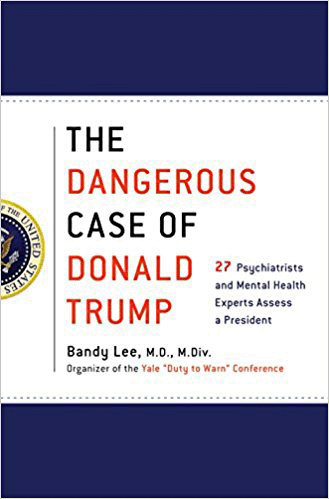
“A Duty to Warn” and the Dangerous Case of Donald Trump Renowned psychiatrist says despite “Goldwater Rule,” mental health experts have unique responsibility when someone in power may be dangerous, Common Dreams by Bill Moyers, Robert Jay Lifton , 15 Sept 17
There will not be a book published this fall more urgent, important, or controversial than than The Dangerous Case of Donald Trump, the work of 27 psychiatrists, psychologists and mental health experts to assess President Trump’s mental health. They had come together last March at a conference at Yale University to wrestle with two questions. One was on countless minds across the country: “What’s wrong with him?” The second was directed to their own code of ethics: “Does Professional Responsibility Include a Duty to Warn” if they conclude the president to be dangerously unfit?
As mental health professionals, these men and women respect the long-standing “Goldwater rule” which inhibits them from diagnosing public figures whom they have not personally examined. At the same time, as explained by Dr. Bandy X Lee, who teaches law and psychiatry at Yale School of Medicine, the rule does not have a countervailing rule that directs what to do when the risk of harm from remaining silent outweighs the damage that could result from speaking about a public figure — “which in this case, could even be the greatest possible harm.” It is an old and difficult moral issue that requires a great exertion of conscience. Their decision: “We respect the rule, we deem it subordinate to the single most important principle that guides our professional conduct: that we hold our responsibility to human life and well-being as paramount.”
Hence, this profound, illuminating and discomforting book undertaken as “a duty to warn.”
Here is my interview with Robert Jay Lifton — Bill Moyers………
“And that’s what I call malignant normality. What we put forward as self-evident and normal may be deeply dangerous and destructive. I came to that idea in my work on the psychology of Nazi doctors — and I’m not equating anybody with Nazi doctors, but it’s the principle that prevails — and also with American psychologists who became architects of CIA torture during the Iraq War era. These are forms of malignant normality. For example, Donald Trump lies repeatedly. We may come to see a president as liar as normal. He also makes bombastic statements about nuclear weapons, for instance, which can then be seen as somehow normal. In other words, his behavior as president, with all those who defend his behavior in the administration, becomes a norm. We have to contest it, because it is malignantnormality. For the contributors to this book, this means striving to be witnessing professionals, confronting the malignancy and making it known”……..
“the only reality he’s capable of embracing has to do with his own self and the perception by and protection of his own self. And for a president to be so bound in this isolated solipsistic reality could not be more dangerous for the country and for the world. In that sense, he does what psychotics do. Psychotics engage in, or frequently engage in a view of reality based only on the self. He’s not psychotic, but I think ultimately this solipsistic reality will be the source of his removal from the presidency.”………https://www.commondreams.org/views/2017/09/15/duty-warn-and-dangerous-case-donald-trump
A nation serious about mitigating natural disasters like the ones we’ve just seen can’t afford to let this moment slip away. NRDC, September 15, 2017Jeff Turrentine “…….I’ve witnessed the debate over when is—and when isn’t—the appropriate time to discuss the role that climate change may have played in calamitous natural disasters such as Hurricanes Harvey and Irma and the raging wildfires that have now destroyed more than eight million acres in the American West. On one side of the debate, we have those who believe it’s wrongheaded and offensive to be bringing up climate change while so many people are still mourning loved ones, sorting through debris, and picking up the pieces of their shattered lives. On the other side, we have those who believe we simply can’t afford to postpone the conversation—that any delay is tantamount to abdication.
For the people in this second group, humanity finds itself “confronted with the fierce urgency of the now,” in the words of Martin Luther King, Jr. Confronted, that is to say, with evidence of an actual crisis in progress, as opposed to a predicted crisis taking place somewhere down the line. And that partially explains the frustration felt by many at the position taken by EPA administrator Scott Pruitt and his allies, who decry any discussion of climate change in the immediate aftermaths of Harvey and Irma. It’s hard to swallow an accusation that the “double-C phrase” is “insensitive to mention,” coming from the figurehead who takes every available opportunity to side with the oil and gas industry over the public and to weaken rather than strengthen environmental protections. Rather than a plea for compassion, it sounds much more like yet another muted threat from a climate denier……..
Like Tom Bossert, Scott Pruitt, and Donald Trump, Americans everywhere are seeing the effects of climate change right before their eyes. But unlike them, we aren’t disinclined to study, analyze, dissect, or discuss the causes. Because if there’s anything at all that we can be doing to reduce the chances of another crisis, we’re on board.