After the mass shooting in Las Vegas, the NRA is pulling ads supporting Republican candidates in Virginia, but not for long. The NRA is cynically pulling campaign ads in the wake of the mass shooting in Las Vegas — but only temporarily.
The gun extremists appear to believe that the country only needs eight days to forget about the worst mass shooting in modern American history, allowing them to exploit the gun issue to assist an ally.
According to Medium Buying, a firm that tracks ad spending, the NRA’s Political Victory Fund has postponed running ads that it planned to run in Virginia. Instead, the NRA will begin running its advertising on Oct. 10.
The group has endorsed Republican Ed Gillespie for Governor, along with his running mate Jill Vogel. The NRA is also backing John D. Adams, the Republican candidate for Attorney General.
The NRA praised Gillespie in an endorsement release in August, hailing him as “a leader in the growing national movement to expand our Second Amendment freedoms.”
Ralph Northam, the Democrat in the governor’s race, is an Army veteran and a hunter who has described himself as “a staunch advocate for commonsense gun safety laws.”
The NRA has often gone silent after mass shootings, as it has this time, with the hopes that it can wait out grief after the tragedy. Then, when the conditions are more favorable for its violent messages, the NRA promotes advertising that calls on gun owners to confront protesters with a “clenched fist.”
As the NRA cowers and tries to wait out the situation, groups like Moms Demand Action for Gun Sense In America are stepping up. Founder Shannon Watts released a statement on the shooting.
“I am sickened and heartbroken that, once again, American families will be torn apart by gun violence,” she said. “My thoughts are with the victims and their loved ones, whose lives will never be the same.”
She added, “While details are still unfolding, one thing is for sure: It doesn’t have to be this way. Americans should be able to go to concerts, to night clubs, to elementary schools and movie theaters without worrying about the threat of gun violence. While we grieve for the 50 people shot and killed and the more than 400 who are hospitalized, we must also act in their honor. Gun violence is preventable.”
The NRA doesn’t want anything done about gun violence in America because their ideal world is one in which the country is awash in firearms, no matter the risk to children and families. They go silent while still intending to back candidates who will enact their agenda unquestioningly.
But millions of Americans want something to be done, to stop attacks like the ones in Las Vegas, Charleston, Newtown, and so many other American cities and towns. And they will not be silenced.
The American Impulse to Equate Guns With Freedom and Masculinity With Violence Is Killing Us
And Trump is exactly the wrong leader for this reality. The Nation, 3 Oct 17 By Joan WalshOn Sunday morning, the president of the United States humiliated his secretary of state, derided diplomacy as “wasting time,” mocked North Korea’s national leader as “Little Rocket Man,” and renewed his macho threat to “do what needs to be done” to thwart North Korea’s nuclear program—at the UN last month he said he might “need” to “destroy” the country. As always, analysts struggled to make sense of Trump’s tweets—geopolitically, psychologically—but the conclusion seemed inescapable that he is itching for a military conflict with a nuclear-armed adversary.
On Sunday night, a 64-year-old retiree by the name of Stephen Paddock took at least 10 rifles, some of them semi-automatic or automatic weapons, to the 32nd floor of the gilded Mandalay Bay resort casino, and gunned down hundreds of people, killing at least 50, in the deadliest mass shooting in modern American history…….There is no connection between Trump’s threat and Paddock’s massacre, except a profound lack of empathy, a toxic male willingness to indulge grievances (we don’t yet know Paddock’s, but we soon will) with violence, and an obsession with the display of absolute power……
There is something deeply wrong with the American male identification of guns as a symbol of freedom. We need to translate that correctly: By this definition, it is the capacity for brutal violence that is also a symbol, maybe even a prerequisite, of freedom. Of almost strictly male freedom, we must emphasize. This set of values wasn’t invented by the madman in the White House; he is just a symptom of a country and an electorate that value guns over children’s lives. ……..Once again, the National Rifle Association has blood on its hands. At one time a respectable organization of gun owners promoting proper gun use and gun safety, three decades ago the NRA began to turn itself into a trade association for big gun manufacturers, and a purveyor of canny right-wing paranoia designed to spur gun sales. ……..
the NRA spent $30 million to elect Trump, who spoke at its national convention and praised LaPierre as a patriot.
Trump repaid the NRA’s investment by signing a bill that lifted Obama-era limits on gun sales to the mentally ill…….
On Monday morning, Trump again repaid the NRA’s $30 million investment with a pathetically passive statement that described the Las Vegas massacre as though it were a natural disaster, never once mentioning the weapons of hell that caused it. He called it “an act of pure evil,” extolled the bravery of police and first responders, and made appeals for love, prayers, and unity. He displayed his trademark lack of empathy about the victims’ families: …..https://www.thenation.com/article/the-american-impulse-to-equate-guns-with-freedom-and-masculinity-with-violence-is-killing-us/
Although Mattis said he supported U.S. President Donald Trump’s review of the agreement curbing Iran’s nuclear program, the defense secretary’s view was nonetheless far more positive than that of Trump, who has called the deal agreed between Iran and six world powers in 2015 an “embarrassment”.
Trump is weighing whether the deal serves U.S. security interests as he faces a mid-October deadline for certifying that Iran is complying with the pact, a decision that could sink an agreement strongly supported by the other powers that negotiated it.
“If we can confirm that Iran is living by the agreement, if we can determine that this is in our best interest, then clearly we should stay with it,” Mattis told a Senate hearing. ”I believe …, absent indications to the contrary, it is something that the president should consider staying with,” Mattis added.
Earlier, when Mattis was asked whether he thought staying in the deal was in the U.S. national security interest, he replied: “Yes, senator, I do.”
The White House had no immediate comment on Mattis’ remarks, which once again highlighted the range of views on key policy issues within the Trump administration.
If Trump does not recertify by Oct. 15 that Iran is in compliance, Congress would have 60 days to decide whether to reimpose sanctions on Tehran suspended under the accord.
Proposed federal bill would give millions to cities storing nuclear waste, Chicago TribuneMary McIntyre, News-Sun, 3 Oct 17, A bill that could provide millions of dollars annually to cities throughout the country storing nuclear waste had its beginning in Zion.
U.S. Sen. Tammy Duckworth D-Ill., and U.S. Rep. Brad Schneider, D-Deerfield, spoke Sunday in Hosea Park to announce the proposed STRANDED (Sensible, Timely Relief for America’s Nuclear Districts’ Economic Development) Act, federal legislation which they said was developed with the help of Zion Mayor Al Hill.
“Zion is the impetus,” Schneider said.
The bicameral bill will be introduced by Schneider in the House and Duckworth in the Senate, and would pay communities storing nuclear waste $15 per kilogram annually. Currently, Zion has 1,020 metric tons of waste stored on its lakefront from the closed nuclear plant, which operated from 1973 to 1998. That would mean Zion would get more than $15 million a year under the proposal.
Hill referred to the potential economic value of the lakefront property were it not for the waste. “The 300-pound gorilla along the lakefront are the spent fuel rods which single-handedly prohibits future development of the site, and robs the Zion area of dollars, jobs and economic vitality,” Hill said.
In addition to the payments, the bill would commission a study by the Department of Energy to consider other options for land with stranded nuclear waste, a task force for such communities to help them find grants, tax credits for new homebuyers in those communities and business incentives for new companies to open in those communities.
U.S. Rep. Brad Schneider, D-Deerfield, speaks Sunday in Hosea Park to announce the proposed STRANDED Act, federal legislation that would provide money to communities storing nuclear waste.
Cities storing nuclear waste throughout the country would be paid under the bill, Schneider said.
NORTH KOREA BENEFITS FROM NUCLEAR WEAPONS. GET USED TO IT. War on the Rocks, Markl S Bell, 2 Oct 17It isoftensaidthatnuclear weapons offer little beyond the ability to deter. But if nuclear weapons deter, they also necessarily offer benefits to states that go well beyond simply deterring attack. North Korea today is in the process of reaping those benefits, and this will constrain American foreign policy in the region. As much as American policymakers might want to wish this away, it is better to adjust the sails than to hope the wind disappears. War with North Korea should now be off the table and the denuclearization of North Korea is similarly unrealistic. If the United States wants to tamp down the current crisis, it needs to get used to North Korean nuclear weapons and the constraints they impose on U.S. foreign policy.
It is true that nuclear weapons deter. But because they deter attack, they also act as a shield that reduces the risks and costs of pursuing a host of other foreign policy behaviors. My researchshows that nuclear weapons can facilitate a range of objectives that states of all stripes may find attractive. Possessing nuclear weapons can allow states to act more independently of allies, engage in aggression, expand their position and influence, reinforce and strengthen alliances, or stand more firmly in defense of the status quo. States with nuclear weapons are aware of these benefits, and use nuclear weapons to pursue them. This applies as much to democratic states committed to the status quo as it does to authoritarian or revisionist states.
Consider the case of Britain. A declining, status quo state when it acquired nuclear weapons in the 1950s, Britain was increasingly dependent on the United States for its security, facing growing challenges to its role as the preeminent power in the Middle East, while its commitments to allies were becoming increasingly uncredible. What did it do when it acquired nuclear weapons? As I show in a 2015 International Securityarticle, Britain used nuclear commitments instead of conventional military commitments (which it could no longer afford) to reassure allies that were increasingly skeptical of Britain’s ability to come to their aid. Similarly, Britain’s nuclear weapons reduced the risks of acting more independently of the United States and of using military force to resist challenges to its position in the Middle East……..
Today, North Korea is taking advantage of its nuclear weapons, just as past nuclear states have done. What’s good for the goose is good for the gander. So, if North Korean nuclear weapons are useful even if they never get used, what might Kim Jong Un’s regime want to use them for?
North Korea faces serious military threats from South Korea and the United States. South Korea is vastly more economically powerful and has the support of the most powerful state the world has ever known. Since the end of the Cold War, the United States —unconstrained by the absence of a peer competitor — has shown a repeated inclination to pursue regime change around the world, labelled North Korea as part of the “Axis of Evil”, imposed punishing sanctions on North Korea, and kept tens of thousands of forces stationed in the region……
North Korea would like to be able to stop the United States from flying military aircraft close to its territory (particularly the B-1B Lancer flights from Guam) and weaken the U.S.-South Korean alliance. It would like to show that Washington’s threats of regime change or military intervention on the Korean peninsula are empty talk, and demonstrate that the United States is unable to shoot down its missiles. And North Korea may want to be able to more credibly threaten military action against South Korea. All of these make good strategic sense for North Korea as it seeks to reduce the threats it faces and strengthen its position on the Korean peninsula in the face of massive U.S. conventional military superiority.
How do North Korean nuclear weapons help it achieve these goals? By raising the dangers of escalation, North Korea seeks to drive wedges between the United States and South Korea and raise fears of “decoupling” as well as to make it riskier for the United States to fly planes close to its airspace or engage militarily on the Korean peninsula. North Korea launches missiles, daring the United States to try (and quite likely fail) to shoot them down; it refuses to back down when challenged; and it raises the possibility of more provocative nuclear tests.
These actions are predictable, because they advance North Korean national interests. But they are also dangerous, raising the risk of escalation. This is a feature, not a bug, of North Korean strategy. Raising escalation risks is exactly how North Korea hopes to convince the United States to back off and, therefore, to improve its position on the Korean peninsula. And in the process of such escalation, North Korea might be entirely rational to use nuclear weapons first if things got bad enough.
What should the United States do?
North Korea would like to be able to stop the United States from flying military aircraft close to its territory (particularly the B-1B Lancer flights from Guam) and weaken the U.S.-South Korean alliance. It would like to show that Washington’s threats of regime change or military intervention on the Korean peninsula are empty talk, and demonstrate that the United States is unable to shoot down its missiles. And North Korea may want to be able to more credibly threaten military action against South Korea. All of these make good strategic sense for North Korea as it seeks to reduce the threats it faces and strengthen its position on the Korean peninsula in the face of massive U.S. conventional military superiority.
How do North Korean nuclear weapons help it achieve these goals? By raising the dangers of escalation, North Korea seeks to drive wedges between the United States and South Korea and raise fears of “decoupling” as well as to make it riskier for the United States to fly planes close to its airspace or engage militarily on the Korean peninsula. North Korea launches missiles, daring the United States to try (and quite likely fail) to shoot them down; it refuses to back down when challenged; and it raises the possibility of more provocative nuclear tests.
These actions are predictable, because they advance North Korean national interests. But they are also dangerous, raising the risk of escalation. This is a feature, not a bug, of North Korean strategy. Raising escalation risks is exactly how North Korea hopes to convince the United States to back off and, therefore, to improve its position on the Korean peninsula. And in the process of such escalation, North Korea might be entirely rational to use nuclear weapons first if things got bad enough.
What should the United States do?
Any serious policy demands a dose of reality. Denuclearization and regime change are no longer achievable without risking tens (and potentially hundreds) of thousands of American lives. North Korea has nuclear weapons, benefits from having them, and has no interest in giving them up. Denying this reality is not only delusional, but encourages North Korea to take more belligerent actions, accelerate its nuclear program further, and exacerbate the spiral of escalation.
A better approach would be to seek limited concessions from North Korea in exchange for limited concessions by the United States. For example, as James Acton has proposed, North Korea might agree to eschew missile tests over the territory of South Korea and Japan, if the United States limited flights of B1-B bombers close to North Korean territory. Such a deal would acknowledge that North Korea’s capabilities impose constraints on U.S. foreign policy and grant North Korea benefits. At the same time, it reduces the risks of miscalculations or accidental escalation, diminishing North Korean fears of a surprise attack by the United States, and lending some stability to U.S.-North Korean relations. And if North Korea violated the deal, the U.S. could easily resume those flights……..
Ultimately, there are no free lunches in international politics. If the United States wants North Korea to constrain its nuclear program, it will need to offer North Korea something in exchange. And if the United States tries to pursue regime change or denuclearize North Korea by force, it must accept that North Korean nuclear capabilities allow it to force the United States to pay a high price for doing so. Mark S. Bell is an assistant professor in the Political Science Department at the University of Minnesota. https://warontherocks.com/2017/10/north-korea-benefits-from-nuclear-weapons-get-used-to-it/
The health ramifications of the tests are unknown. Lisa Martino-Taylor, an associate professor of sociology at St. Louis Community College who wrote “Behind the Fog: How the U.S. Cold War Radiological Weapons Program Exposed Innocent Americans,” acknowledged that tracing diseases like cancer to specific causes is difficult.
But three congressmen who represent areas where testing occurred — Democrats William Lacy Clay of Missouri, Brad Sherman of California and Jim Cooper of Tennessee — said they were outraged by the revelations.
Martino-Taylor used Freedom of Information Act requests to obtain previously unreleased documents, including army records. She also reviewed already public records and published articles. In an interview, she said she found that a small group of researchers, aided by leading academic institutions, worked to develop radiological weapons and later “combination weapons” using radioactive materials along with chemical or biological weapons.
Her book, published in August, was a follow-up to her 2012 dissertation that found the government conducted secret testing of zinc cadmium sulfide in a poor area of St. Louis in the 1950s and 1960s. The book focuses on the mid-1940s to the mid-1960s.
An army spokeswoman declined comment, but Martino-Taylor’s 2012 report on testing in St. Louis was troubling enough to spur an army investigation. The investigation found no evidence that the St. Louis testing posed a health threat.
Martino-Taylor said the offensive radiological weapons program was a top priority for the government. Unknowing people at places across the U.S. as well as parts of England and Canada were subjected to potentially deadly material through open-air spraying, ingestion and injection, Martino-Taylor said.
“They targeted the most vulnerable in society in most cases,” Martino-Taylor said. “They targeted children. They targeted pregnant women in Nashville. People who were ill in hospitals. They targeted wards of the state. And they targeted minority populations.”
The tests in Nashville in the late 1940s involved giving 820 poor and pregnant white women a mixture during their first pre-natal visit that included radioactive iron, Martino-Taylor said. The women were chosen without their knowledge. Blood tests were performed to determine how much radioactive iron had been absorbed by the mother, and the babies’ blood was tested at birth. Similar tests were performed in Chicago and San Francisco, Martino-Taylor said.
Cooper’s office plans to seek more information from the Army Legislative Liaison, said spokesman Chris Carroll.
“We are asking for details on the Pentagon’s role, along with any cooperation by research institutions and other organizations,” Carroll said. “These revelations are shocking, disturbing and painful.”
In California, investigators created a radiation field inside a building at North Hollywood High School during a weekend in the fall of 1961, Martino-Taylor said. Similar testing was performed at the University of California, Los Angeles and at a Los Angeles Police Department building.
Sherman said he wants a survey of people who graduated from the school around the time of the testing to see if there was a higher incidence of illness, including cancer. He also said he will seek more information from the Department of Energy.
“What an incredibly stupid, reckless thing to do,” said Sherman, whose district includes North Hollywood High School.
Among those who recall the testing is Mary Helen Brindell, 73. She was playing baseball in a St. Louis street in the mid-1950s when a squadron of green planes flew so low overhead that she could see the face of the lead pilot. Suddenly, the children were covered in a fine powdery substance that stuck to skin moistened by summer sweat.
Brindell has suffered from breast, thyroid, skin and uterine cancers. Her sister died of a rare form of esophageal cancer.
“I just want an explanation from the government,” Brindell said. “Why would you do that to people?”
Clay said he was angered that Americans were used as “guinea pigs” for research.
“I join with my colleagues to demand the whole truth about this testing and I will reach out to my Missouri Delegation friends on the House Armed Services Committee for their help as well,” Clay said in a statement.
St. Louis leaders were told at the time that the government was testing a smoke screen that could shield the city from aerial observation in case of Soviet attack. Evidence now shows radioactive material, not just zinc cadmium sulfide, was part of that spraying, Martino-Taylor said.
Doris Spates, 62, was born in 1955 on the 11th floor of the Pruitt-Igoe low-income high-rise where the army sprayed material from the roof. Her father died suddenly three months after her birth. Four of her 11 siblings died from cancer at relatively young ages. She survived cervical cancer and suffers from skin and breathing problems.
“It makes me angry,” Spates said. “It is wrong to do something like that to people who don’t have any knowledge of it.”
According to Martino-Taylor, other testing in Chicago; Berkeley, California; Rochester, New York; and Oak Ridge, Tennessee, involved injecting people with plutonium-239.
She said her book shines a light on the team of mostly young scientists tasked with developing radiological weapons. They worked in a closed world with virtually no input from anyone “who could say, ‘This isn’t right,’ or put some sort of moral compass on it,” she said.
She hopes her book prompts more people to investigate.
“We haven’t gotten any answers so far,” Martino-Taylor said. “I think there’s a lot more to find out.”
Are Trump’s tweets undercutting U.S. diplomacy? Beyond apparent policy disagreements between the president and Rex Tillerson, the State Department struggles to absorb mixed signals. The Atlantic, KRISHNADEV CALAMUR 3 OCT 17, President Trump’s tweets Sunday, declaring it a waste of time to try to negotiate with North Korea, appeared to contradict the sentiments of his own chief diplomat, who is at least formally taking the lead on the administration’s North Korea policy. It wasn’t the first time the two men seemed to express different positions on significant foreign-policy issues. But there’s a deeper story beyond whatever temperamental or policy gulf may exist between Trump and Tillerson as individuals—and that is how the contradictions affect the sprawling foreign-policy apparatus Tillerson is supposed to run.
“One can never be sure whether the policies we’re working on will be supported by the president or not,” a State Department official, who was not authorized to speak to the press and asked for anonymity, told me. “It creates a great deal of uncertainty and obviously further harms morale in an environment in which morale is already very low.”……
at the State Department, reports about poor morale have abounded since Tillerson assumed his position in February. The secretary was described as aloof, his plans to reorganize the State Department were criticized, and the Trump administration’s proposal to cut the department’s budget by 30 percent was met with horror. A hiring freeze at the department, combined with the fact that most of the senior positions requiring Senate confirmation are still vacant, have also resulted in multiple news reports about dysfunction.
Added to all this is the perception that Trump doesn’t care about the work the State Department is doing. The president has not only appeared to contradict Tillerson publicly on Qatar, NATO, and Iran—besides North Korea—he has also appeared to suggest that his “America First” message is not simpatico with multilateral cooperation with America’s traditional allies.
At one point, he thanked Russia for its expulsion of U.S. diplomats in retaliation for a similar step by the Obama administration, as well as its seizure of Russian compounds in the U.S., because, in Trump’s words, “we’re trying to cut down our payroll.”…..https://www.theatlantic.com/international/archive/2017/10/trump-tillerson/541671/
Will these rockets be powered by plutonium? And if so, what happens if there’s an accident, and one plunges into a city?
LANL engineer looks for partners for cheap space flight, LA Monitor, By Tris DeRoma, October 2, 2017
Joseph Archer wants to start a company to take ordinary citizens into space With all the millions of dollars spent on space tourism today, the Los Alamos National Laboratory radiological safety employee has a plan to do it more efficiently, and cheaper.
His first step is to get a group of investors together who are genuinely enthusiastic and interested in the idea…..The project will involve launching a one-ton payload into space within a year of the company’s formation. He estimates he could do it for an amount between $200,000-$600,000.
“As a group of retired professional and technical types, there is little doubt that we can accomplish such a modest objective,” he said in his statement……..
In his argument, he talks a lot about how the Germans were able to accomplish much with little when they built the V-2 rocket in World War II.
One Los Alamos resident, Alan Hack, said in a letter to the Los Alamos Monitor that there was a huge difference between the wartime German program and what’s happening today in civilian space travel.
“Comparing costs to manufacture the V-1 ignores that it was built by slave labor from the captured countries as the Nazi regime did not have enough German labor to meet the huge demands for war production. Your manned rocket cannot be as cheap as you estimate,” Hack said…..http://www.lamonitor.com/content/lanl-engineer-looks-partners-cheap-space-flight
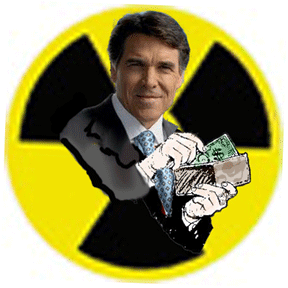
The Energy 202: Rick Perry manages to unite oil, gas, wind and solar — against him, WP By Dino GrandoniOctober 3
As he did nearly a year ago to win the presidency, Donald Trump has done the seemingly impossible and brought together disparate coalitions of unlikely interests. This week, it happened again when Trump managed to unite an unlikely band of fossil-fuel and renewable-energy advocates.
These 11 energy associations are working together. Together, that is, against the Trump administration’s latest energy policy directive.
On Monday, a coalition of 11 energy lobbying groups asked the Federal Energy Regulatory Commission to delay issuing and enforcing a new rule issued by the Energy Department. EnergySecretary Perry had asked for FERC to streamline the rulemaking process but the groups want time to weigh in during the traditional comment period.
The coalition attracted some strange bedfellows, including renewable-energy lobbyists such as the American Wind Energy Association and the Solar Energy Industries Association and oil and gas heavyweights such as the Natural Gas Supply Association and the American Petroleum Institute……..
In a letter and proposed regulation, Perry asked FERC to consider issuing new rules to ensure that nuclear and coal-fired plants are compensated not only for the electricity they provide to homes and businesses, but for the reliability they add to the grid…….
What the groups have on their side: While technically housed under the Energy Department, FERC is an independent agency. In the case of Perry’s recommendations, the 5-member commission has the leeway to accept or reject them wholesale. By allowing no more than three commissioners to be from the same party, the commission is supposedly untethered from party influence.
Nuclear – Power The Extraordinary – New Ad Campaign Touting Marvels of Atomic Technology, Forbes, Rod Adams, 30 Sept 17,The Nuclear Energy Institute (NEI) announced in early September that was starting a new advertising campaign with completely reimagined creative materials.Using the general tagline of “Nuclear. Power the Extraordinary” the U.S. nuclear industry’s trade organization will be speaking “to the critical role that nuclear technology plays in our lives. With dramatic visuals, the new campaign captures the far-reaching benefits that nuclear technology brings to air quality, economic vitality, public health and exploration of new worlds.”……..
Since taking over as NEI’s President and CEO last year, Maria Korsnick has emphasized the importance of taking a new approach to maximizing nuclear energy’s “immense potential.” She has stressed the need for the industry to advocate for itself.
“I am truly passionate about the role that nuclear energy can play for our nation and the world. I consider it the unsung hero of our energy mix…My focus is to get nuclear energy recognized as an essential part of the nation’s industrial and electrical infrastructure.”……..
Trump says North Korea talks are ‘waste of time’ President contradicts Tillerson’s statement that lines of communication are open Ft.com by Demetri Sevastopulo in Washington, 2 Oct 17 Donald Trump dismissed the prospect of talks with Pyongyang as pointless barely a day after his secretary of state said the US was using new channels of communication to weigh the possibility of negotiations with North Korea about its nuclear programme. “I told Rex Tillerson, our wonderful Secretary of State, that he is wasting his time trying to negotiate with Little Rocket Man,” Mr Trump tweeted on Sunday morning. “Save your energy Rex, we’ll do what has to be done!”.
In a second tweet later in the day, he added: “Being nice to Rocket Man hasn’t worked in 25 years, why would it work now? Clinton failed, Bush failed, and Obama failed. I won’t fail.”
The US president’s interventions came after Mr Tillerson told reporters during a visit to China that Washington had three direct channels of communication with North Korea……..
Richard Haass, president of the US Council on Foreign Relations, slammed Mr Trump for undercutting his secretary of state. “Potus truly misguided here-& SecState should resign,” he tweeted on Sunday. Ian Bremmer, head of Eurasia Group, a risk consultancy, said the president’s comments were the “stupidest tweet on national security I’ve ever seen from a sitting head of state”………
After Mr Trump used a speech at the UN to describe Mr Kim as “Rocket Man . . . on a suicide mission” and threatened to “totally destroy” North Korea, Mr Kim responded by calling the US president a “mentally deranged dotard” while his foreign minister said Pyongyang would consider detonating a hydrogen bomb over the Pacific Ocean…….
To send a strong signal to Mr Kim, the US has been conducting increasingly frequent high-profile exercises around the Korean peninsula, sometimes with Japan and South Korea. Last weekend, US warplanes flew farther north from the demilitarised zone — that separates South and North Korea — than at any point in the 21st century. In combination with the military warnings, Washington is leading a global campaign to ratchet up economic pressure on North Korea in an effort to squeeze the regime, cut off funding for weapons programmes, and force Pyongyang to the negotiating table. The UN has recently imposed two sets of harsh sanctions that — combined with previous measures — embargo 90 per cent of North Korean exports. The US has also imposed unilateral sanctions and has punished Chinese and Russian companies that have been accused of facilitating weapons development in North Korea.https://www.ft.com/content/cd2087a0-a5f1-11e7-ab55-27219df83c97 Follow Demetri Sevastopulo on Twitter: @dimi
Donald Trump to reward ‘reliable’ coal, nuclear power plants, THE AUSTRALIAN , TIMOTHY PUKO, The Wall Street Journal
The Trump administration is urging independent energy regulators to change how electricity is priced, proposing new rules that would bolster revenue for coal-fired and nuclear power plants.
The Energy Department is mandating that the Federal Energy Regulatory Commission consider new rules that would effectively raise power prices to pay more to plants considered more resilient. The department suggests nuclear and coal-fired plants as potential recipients, and charges FERC with tweaking electricity markets so they give more of a reward to plants that have at least three months of fuel on site and can run uninterrupted through extreme weather, disasters or other emergencies.
Nuclear and coal-burning technologies were probably the only ones able to meet the requirements, experts said. Under the proposal, eligible plants would get paid enough to cover their costs and a “fair return on equity” whenever they run, even though they sell into competitive markets.
FERC, which regulates wholesale power markets, is under no obligation to make these changes, only to consider them. FERC officials were reviewing the proposal, a spokeswoman said. Any changes made would likely be implemented by the grid operators that run deregulated power markets under FERC’s oversight.
This type of intervention from the Energy Department is rare, according to energy lawyers and analysts. It appeared the department hadn’t made a similar request since 1979 when, at the height of that decade’s oil crisis, it encouraged FERC to help transition the country to natural gas and away from fuel oil, said David Doot, a lawyer at Day Pitney, which has been researching the topic.
The move is the administration’s latest attempt to support fossil-fuel businesses. It has worked to roll back or delay rules its officials say were unwieldy and unfair attempts by the Obama administration to promote renewable power.
But environmentalists and other critics see the trend as a political effort to follow up a Trump presidential campaign heavy on promises to the fossil-fuel industry and denials of climate change. Some critics claimed it was a bailout for failing nuclear and coal businesses, and criticised the proposal for blocking out options like batteries and smart-grid technologies that also could increase reliability.
Nuclear and coal-fired plants have become an urgent target because dozens have closed nationwide and others are threatened. Those plants, often referred to as baseload, have been the country’s primary source of power for decades, raising questions about how reliably the nation’s grid would function if those plants shrink to become only a minor source of power……
Nuclear Shutdown News chronicles the decline and fall of the nuclear power industry in the US and abroad and highlights the efforts of those who are working for a nuclear free world. Here is our September 217 report.
As Hurricanes Batter the Caribbean and Southeast US, Nuke Plants in Texas And Florida Refuse To Shut Down, Heightening Risk To Already Devastated Communities.
On September 19 the Austin (TX) American-Statesman ran this story “South Texas Project stayed open during Hurricane Harvey.” South Texas Project is a nuclear plant with two reactors near Bay City, TX on the Gulf Coast, 90 miles from Houston.It has been operating since the late 1980s. Austin Energy is one of three utilities that owns it.
The newspaper article’s subtitle was “Some question decision to keep Texas nuclear plant open during Harvey.”
The American Statesman reported, “An evacuation of surrounding areas and flooding fears kept the plant’s storm crew in the plant for nine days.” But management had planned for a stay of only three days and the A-E also reported “the Colorado River is only two miles away” and “it was forecast to crest a week after the storm hit.”
Fortunately the floodwaters didn’t reach the plant, so the nuke kept operating at 100%.
But Kathy Hedden, director of Sustainable Energy and Economic Development (SEED) told the American-Statesman “the risk wasn’t worth keeping the plant running.” And although winds “topped off at 40 mph–well below the 73 mph that would have triggered mandatory shutdown for the nuke, the paper reported. “tornadoes touched down just miles from the site.”
Kathy Hedden asserted “The South Texas Plant nuclear reactors, 90 miles south of Houston, could have shut down to ensure our health and safety, but instead played radioactive roulette. They prioritized profit and continued operating. Picture a nuclear disaster on top of that.”
The situation was much the same in Florida as Hurricane Flora roared in. Florida Power & Light, owner of the Turkey Point and St. Lucie nuke plants, each with two reactors, was preparing to shut them down during the storm. But when winds fell to less than hurricane force, and the utility wasn’t required by law to take them offline, FPL kept them running full force, except when a faulty valve at one Turkey Point reactor closed it down.
By the way, both reactors at Turkey Point are over 40 years old, as is one of St. Lucie’s.
On September 11 Newsweek reported that FPL had been “operating during Irma although the plant had not met federal safety requirements implemented after Fukushima.”
The Fukushima catastrophe in March 2011 followed a severe earthquake and tsunami, resulting in the meltdown of three of its reactors and a disaster that continues today.
Although nuclear plants produce electricity, they are also dependent on outside sources for electrical power as well. If the grid is down, the risk of serious accidents can increase.Newsweek consulted two nuclear experts on this matter.
David Lochbaum is director of the Nuclear Safety Project at the Union of Concerned Scientists. “The pump room is the Achilles Heel at Turkey Point,” he commented. “Without Cooling Water during an accident, workers must deploy backup to the backup system. At Fukushima workers were unable to accomplish this task in time to prevent the reactor core from overheating.”
And Maggie Gundersen, co-founder of Fairewind Energy and Education, like Lochbaum a former high level nuclear employee, added “”When there’s a possibility to lose power, why would you take the risk of that? That’s just hubris and a hug risk to the population.”
State troubled by Vermont Yankee rubble plan, Vt Digger, By Mike Faher, Oct 1 2017 BRATTLEBORO – State regulators and anti-nuclear activists are taking a stand against a proposal to reuse large amounts of Vermont Yankee’s concrete as fill when the plant is decommissioned.
The latest objections to the so-called “rubblization” plan come from the Vermont Agency of Natural Resources and the state Public Service Department. Officials want to know whether concrete from the retired nuclear plant is safe for burial on the Vernon property.
“We want to feel comfortable … that the material is truly clean,” said Chuck Schwer, director of the agency’s Waste Management and Prevention Division…….
The restoration of the Vermont Yankee site appears to be the biggest point of contention. At issue is how much NorthStar, after satisfying the NRC’s radiological cleanup requirements, will safely restore the site for future reuse……..
even after decommissioning, Vermont Yankee’s spent fuel will remain on site under 24-hour security surveillance until the federal government develops a central repository for high level nuclear waste.
“I wouldn’t say you wouldn’t be able to live there. I’m just not sure people would want to,” State said.
Whatever the property’s future, NorthStar’s plan to bury rubble on site is coming under intense scrutiny……..
Schwer told the advisory panel that, contrary to Entergy’s claims, the full extent of radiation contamination at Vermont Yankee remains a mystery. And officials say it’s not yet clear how NorthStar will address contamination before crushing and burying the concrete.
Schwer wrote in testimony filed with the utility commission that if tainted concrete is buried, “there is the potential that residual contamination could remain undetected below the surface, spread over time and pose a risk to public health and the environment.”…… https://vtdigger.org/2017/10/01/state-troubled-vermont-yankee-rubble-plan/#.WdFrqI-CzGg
Predicted collapse reignites worker safety concerns at WIPP, Adrian C Hedden, Carlsbad Current-Argus Sept. 29, 2017 Worker safety could yet again become a concern at the Waste Isolation Pilot Plant.
A rock collapse in a portion of the plant’s underground mine where nuclear waste is permanently emplaced is expected in four to six weeks.
The collapse is expected in Room 6 of Panel 7 in the underground, which was off limits to workers for at almost a year before a Thursday announcement by the U.S. Department of Energy of a potential collapse.
Since it was sealed, no ground control measures took place in Room 6………
Rick Fuentes, president of the United Steelworkers Union Local 12-9477, which represents WIPP waste handlers, said the mine is safe for now.
But Fuentes worried that the underground can be unpredictable, and a collapse could occur sooner than expected.
“We’re not going to take any chances,” Fuentes said. “The underground is unpredictable. It could move faster.”……..
“When you deal with mother nature, it’s hard to know what will happen,” Fuentes said. “Day in and day out we have to stay on our A-game to ensure workers are safe.”
When measurements show the ground is unstable or if stability deteriorates at a dangerous rate, Fuentes said all underground activity will cease until conditions become safe.
 NRA pulls attack ads, hopes everyone forgets about mass slaughter in 8 days https://shareblue.com/nra-pulls-attack-ads-hopes-everyone-forgets-about-mass-slaughter-in-8-days/