Musk said on Twitter Thursday that Tesla has already used a combination of its solar panels and Powerpack batteries to power a couple of small islands. He said that there is “no scalability limit” and that Tesla could build a similar system in Puerto Rico.
The island of Ta’u in American Samoa can run entirely on solar energy thanks to a Tesla microgrid that consists of 5,328 solar panels and 60 Powerpack batteries. Tesla also built a massive solar farm on the Hawaiian island of Kauai that can account for 20% of the island’s peak electricity load.
New research shows disastrous outcomes for nearby US allies if North Korea strikes
SEOUL• As United States President Donald Trump threatens to destroy North Korea, even some of his closest aides have warned of the potentially disastrous effects of a war.
New research published on the 38 North website points to just how catastrophic the impact might be on the regime’s neighbours.
If North Korean leader Kim Jong Un were to launch a nuclear attack on Seoul and Tokyo – both within striking distance of his weapons – as many as 2.1 million people could die and another 7.7 million could be injured, according to the 38 North report.
The analysis by Mr Michael Zagurek Jr, a consultant specialising in databases and computer modelling, is based on North Korea’s current estimated weapons technology and bomb strength.
Mr Zagurek assumes that Mr Kim has a baseline arsenal of 20 to 25 warheads and the capacity to put them on ballistic missiles.
Concerns about a nuclear conflict in North Asia have increased as Mr Kim accelerates his programme of acquiring weapons capable of hitting continental US, and as Mr Trump threatens preemptive military action.
While the chance of a direct attack on US allies Japan and South Korea remains slim, Mr Zagurek said history was replete with miscalculation by “rational actors” during crisis situations.
North Korean Foreign Minister Ri Yong Ho last month said the regime’s possible next steps include testing a hydrogen bomb over the Pacific Ocean.
According to Mr Zagurek, it is possible that another nuclear test, an intercontinental ballistic missile test, or a missile test that has the payload impact area too close to US bases in Guam might see Washington react with force.
US options could include attempting to shoot down the test missiles or possibly attacking the North’s missile testing, nuclear-related sites, missile deployment areas or the Kim regime itself. In turn, the North Korean leadership might perceive such an attack as an attempt to remove the Kim family from power and, as a result, could retaliate with nuclear weapons, he added.
North Korea’s older warheads have yields in the 15-25-kilotonne range, around the size of the bombs that devastated Hiroshima and Nagasaki in 1945.
Fatality estimates rise significantly if North Korea were able to strike with bombs similar to the one it tested on Sept 3, which had a likely yield of 108-205 kilotonnes, Mr Zagurek said.
Mattis says staying in Iran deal is in U.S. national security interest, https://www.axios.com/mattis-says-staying-in-iran-deal-is-in-u-s-national-security-interest-2492432687.html4 Oct 17Defense Secretary Mattis was asked Tuesday at a Senate Armed Services Committee hearing whether he believes it is in America’s “national security interest at this time to remain” in the Iran nuclear deal. After a lengthy pause, Mattis replied to Sen. Angus King: “Yes Senator, I do.”
Why it matters: Trump has an October 15 deadline to certify Iran’s compliance with the deal, or decline to do so. Trump has slammed the pact as “the worst deal ever”, and has been wrestling with whether to take a step toward ending it. This also puts Mattis directly at odds with Iran hawks like John Bolton who are urging Trump to rip up the deal, and say it’s a disaster for national security.
Trump plans to declare that Iran nuclear deal is not in the national interest, WP, By Anne GearanOctober 5 President Trump plans to announce next week that he will “decertify” the international nuclear deal with Iran, saying it is not in the national interest of the United States and kicking the issue to a reluctant Congress, people briefed on an emerging White House strategy for Iran said Thursday.
The move would mark the first step in a process that could eventually result in the resumption of U.S. sanctions against Iran, which would blow up a deal limiting Iran’s nuclear activities that the country reached in 2015 with the U.S. and five other nations.
Trump is expected to deliver a speech, tentatively scheduled for Oct. 12, laying out a larger strategy for confronting the nation it blames for terrorism and instability throughout the Middle East.
Under what is described as a tougher and more comprehensive approach, Trump would open the door to modifying the landmark 2015 agreement he has repeatedly bashed as a raw deal for the United States. But for now he would hold off on recommending that Congress reimpose sanctions on Iran that would abrogate the agreement, said four people familiar with aspects of the president’s thinking.
Rick Perry’s new coal subsidy could wreck America’s power markets, The Hill, BY HAL HARVEY, — 10/05/17 When old, established industries are threatened by new, better technologies, they often go running to Washington for special protections. It is an old practice, generally taxing the common good for private interests. Unfortunately, the U.S. Department of Energy has set a new record for gall in this practice in a fairly stunning move that would impose a new tax on electricity consumers and roil America’s power markets for years to come.
Here’s the story: Renewable energy — especially wind and solar — has plummeted in price. Today a new wind farm, for example, is often cheaper than just the operating costs of an old coal power plant. Cheap natural gas creates additional price threats to existing coal or nuclear. And these favorable economics for renewables and gas don’t even count the public benefits they create through clean air, reduced greenhouse gas emissions and avoided fuel price spikes.
This transition motivated DOE’s recent study of grid reliability, after coal and nuclear owners warned that closing their plants and adding renewables would cause blackouts. It turns out, though, even DOE’s study found this wasn’t the case, and that clean energy works just fine on our grid.
So, across the country, in power grids where economic dispatch reigns, renewables are booming, and coal plants are shutting down. This is not a “war on coal” nor is this reality susceptible to change through political pro-coal statements. It is free-market economics, plain and simple.
What can the owners of these old power plants do? They posit changing the rules, so instead of simply being paid for electricity, they get paid for “other attributes” as well, including a novel term among utilities, “fuel-secure power plants.” The idea is that having a pile of coal next to your uneconomical power plant should be richly rewarded, bringing your 1970s technology back into the black.
At first blush, this may seem sensible. Surely having a deep inventory of on-site fuel, be it a pile of coal, nuclear fuel or water behind the dam benefits the grid? Well, it turns out that reliable power is better delivered by a diversity of sources, rather than a few huge power plants. It also turns out that wind, for example, is often more reliable than coal. ……..
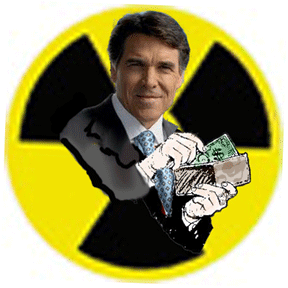
Energy Secretary Rick Perry has ignored this evidence, and proposed a rule to the Federal Energy Regulatory Commission to subsidize the oldest power plants on the grid. His request is anti-innovation, anti-economy, and anti-environment. It is a wholesale repudiation of the free market. And it flatly contradicts Texas’ experience………
Rick Perry’s plan to subsidize coal and nuclear plants is bonkers, By keeping uncompetitive plants open, it would blow up energy markets. VOX by David Roberts@drvoxdavid@vox.comThe Trump administration has not typically put a premium on transparency or fealty to empirical fact. So it was somewhat puzzling when the Department of Energy released its long-awaited study of power grid reliability in August and it looked … mostly normal.
By all accounts, DOE’s experts were allowed to work on it unimpeded. Its conclusions lined up with the broad consensus in the energy field: The loss of coal plants has not diminished grid reliability; in fact, the grid is more reliable than ever. Reliability can be improved further through smart planning and a portfolio of flexible resources. Regulators should work on ways to better compensate reliability in competitive energy markets.
The summary bits of the report added a bit of political spin, but the analytic work and core conclusions were solid — and very much not in line with the administration’s position, which is that reliability is immediately threatened and coal and nuclear plants are necessary to preserve it.
Where, wondered the more cynical observers [waves], was the hackery? Where was the political interference to prop up a favored industry, the blithe disregard of expert knowledge? This is not the Trump administration we’ve come to know and … know.
Well, it turns out, we just needed a little patience. The hackery has landed. Repeat: The hackery has landed.
Unfortunately, the hackery comes obscured by a thick cloak of acronyms — it’s an NOPR from DOE about ISOs that contradicts NERC, FFS — so it takes a little unpacking.
Here’s the short summary: Perry wants utilities to pay coal and nuclear power plants for all their costs and all the power they produce, whether those plants are needed or not.
That may sound a little blunt and ridiculous to you, but don’t worry. Once you understand some of the background and the technical details, you will see that it is in fact more blunt and ridiculous than you could have imagined.
DOE has lurched, on this subject, from minimum to maximum hackery. Even in our new Trumpian world, it is astounding.
Let’s walk through it.
DOE to FERC: address a crisis we determined does not exist
Remember, the administration’s position is that, as Perry put it in his memo requesting a grid study, “regulatory burdens, as well as mandates and tax and subsidy policies, are responsible for forcing the premature retirement of baseload power plants.”
Suffice it to say, he’s not referring to the regulations, mandates, tax, and subsidy policies that benefit coal and nuclear plants. He means renewable energy subsidies, which he says “create acute and chronic problems for maintaining adequate baseload generation and have impacted reliable generators of all types.”
Putting it more explicitly, the administration’s claim is twofold: First, that power plants with large amounts of fuel on-site — coal and nuclear, basically — are necessary to grid reliability, and second, that those plants are unfairly being driven out of business by subsidies to renewable energy.
The problem is, neither claim is true, which poses something of a dilemma for Perry, who has been put in charge of an agency filled with genuine technical experts. And sure enough, DOE’s grid study found, as many other studies before it have, that a) the loss of coal and nuclear plants has not diminished reliability, and b) it is cheap natural gas, not renewable energy subsidies, that has driven coal and nuclear out of business.
Whether through ignorance or cleverness, Perry stumbled on a different communications strategy. He seems to have realized that he didn’t need to mess with the study at all. Why bother? He could simply pretend that it supported the administration’s position. The media would he-said, she-said it for a day or two and then move on. He simply behaved as though the study had confirmed his claims.
Which brings us to last Friday, when DOE proposed a new rule for the electricity system, premised on the very suppositions its own grid study disproved. To wit:
The resiliency of the nation’s electric grid is threatened by premature retirements of power plants that can withstand major fuel supply disruptions caused by natural or man-made disasters and, in those critical times, continue to provide electric energy, capacity, and essential grid reliability services. These fuel-secure resources are indispensable for the reliability and resiliency of our electric grid — and therefore indispensable for our economic and national security. It is time for the Commission to issue rules to protect the American people from energy outages expected to result from the loss of this fuel-secure generation capacity.
Again, this is all wrong. Having fuel on-site does little for resilience. The plants are not indispensable. No one expects energy outages if baseload plants continue closing.
Nonetheless, based on these faulty premises, DOE issued a Notice of Proposed Rulemaking (NOPR) to the Federal Regulatory Energy Commission (FERC), suggesting that FERC adopt a rule forcing utilities in competitive energy markets to pay the full cost of plants that have 90 days’ worth of fuel on-site.
This is a deeply messed-up thing to do, on so many levels it’s difficult to know where to begin. It is the crudest imaginable intervention on coal’s behalf.
But let’s start with a quick note on the authorities involved here.
FERC will determine the fate of this monstrosity
When Congress consolidated various agencies into DOE with the Department of Energy Organization Act of 1977, it deliberately maintained a separate regulatory authority (the Federal Power Commission, renamed FERC).
A quirk of the law allows DOE to propose rules to FERC — an authority is has used only rarely, and for fairly small matters.
But FERC is independent. It is not under DOE’s authority and does not have to do what DOE proposes.
It is highly unlikely to adopt this rule as-is. (It would effectively be impossible, for reasons we’ll discuss.) But it’s also unlikely to ignore the NOPR. These are, after all, both Trump administration agencies, run by Trump appointees.
So what exactly FERC does with the NOPR — what balance of expertise and hackery it brings to bear — will determine the actual impacts of this thing.
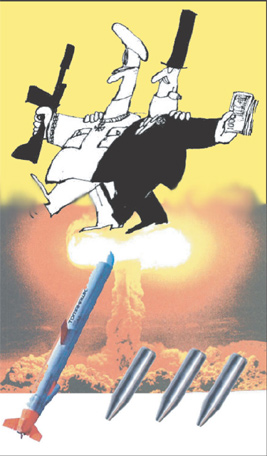
The enormous cost of more nuclear weapons Is the expansion of our nuclear arsenal in America’s best interest, or is it just Trump’s latest boastful display? Salon, GUY T. SAPERSTEIN, KELSEY ABKIN 2017-10-05 This article originally appeared on AlterNet.
To put this into perspective, this number exceeds the combined total federal spending for education; training, employment, and social services; agriculture; natural resources and the environment; general science, space, and technology; community and regional development (including disaster relief); law enforcement; and energy production and regulation.
As long as other countries continue to harbor nuclear weapons, we will do the same. And vise versa. As Donald Trump said at the start of his campaign, “If countries are going to have nukes, we’re going to be at the top of the pack.”
This sentiment followed him into his presidency. The Trump administration just last week considered proposing additional, smaller, more tactical nuclear weapons that would cause less damage than traditional thermonuclear bombs. However, these mini-nukes are not some new, profound proposal. We have had nuclear weapons capable of being dialed down to the power of “mini nukes” since the 80’s. The 15-kiloton bomb dropped on Hiroshima would now be classified as a “mini-nuke” yet its destruction was monumental. Adding more, smaller nukes is an unnecessary, potentially dangerous addition. Proponents of the proposal claim these “mini-nukes” would give military commanders more options; critics, however, contend that it will also make the use of atomic arms more likely. Christine Parthemore, International Affairs Fellow at the Council on Foreign Relations, says, “Our investments should be careful lowering our threshold of use.” Further, the proposed addition will only add trouble to the already fraught international conversation opposing nuclear weapons.
As former Secretary of State George Shultz so eloquently put it, “proliferation begets proliferation.” One state’s nuclear acquisitions only drive its adversaries to follow suit. The reality is adding to our nuclear arsenal will only force our international opponents to defensively order a mad dash for the bomb.
In today’s political arena, as Russia remains volatile and North Korea’s threat grows, is funding the expansion of our nuclear arsenal in the country’s best interest or just Trump’s latest boastful display of American power?
Having a nuclear arsenal is supposed to ensure the raw principle behind nuclear deterrence: You won’t destroy us because we can destroy you. As Andrew Weber, Former Assistant Secretary of Defense & former Director of the Nuclear Weapons Council, says, “The sole purpose of having a nuclear arsenal is to deter an attack on the United States of America.”
This cold war era mindset relies on the relationship between acting and reacting. With the recognition that retaliation is likely, if not guaranteed, nuclear weapons are supposed to restrain the possibility of action on behalf of nuclear leaders. They are supposed to make them cautious, regardless of which states we are talking about or how many weapons they might possess.
According to a 2017 report by the Arms Control Association, The United States currently maintains an arsenal of about 1,650 strategic nuclear warheads deployed on Intercontinental Ballistic Missiles (ICBMs), Submarine-Launched Ballistic Missiles (SLBMs), and Strategic Bombers and some 180 tactical nuclear weapons at bomber bases in five European countries.
The ICBM is arguably the most controversial piece of America’s nuclear triad, yet in August, the Air Force announced major new contracts for a revamp of the American nuclear force: $1.8 billion for initial development of a highly stealthy nuclear cruise missile, and nearly $700 million to begin replacing the 40-year-old Minuteman missiles in silos across the United States.
This plan was born from the Obama administration but enthusiastically hightailed by Trump. Obama’s reasoning was that as our weapons became increasingly safe, their numbers could be reduced.
However, Trump’s reasoning has proven to be different. His threat that North Korea will be met with “fury and fire” combined with his proposals of mini-nukes only propel the notion that he is not following past leaders in enforcing a no first strike policy.
Report Advertisement
The danger of revamping this shaky leg of the nuclear triad is in part due to Trump’s demonstrated impulsiveness. As Andrew Weber explains, “There is a 2-3 minute threat of the land-based missiles and it is impossible for the target to determine whether the weapon has a nuclear or conventional tip.” An impulsive president with nuclear codes capable of starting a nuclear war in 2-3 minutes using a weapon that must fly over Russia and has the possibility of mistaken identity, is essentially a recipe for disaster………
Ultimately, there is no military option that would not entail a mind-bogging gamble with the lives of millions of Americans, Japanese and especially South Koreans……
Now is not the time to build up our nuclear arsenal and respond to threats with military action, especially as we face an already threatened North Korea. It is crucial now more than ever not to proliferate the use of nuclear weapons. The goal is to deter and when it comes to deterrence, more is not better, especially when it is so incredibly expensive. https://www.salon.com/2017/10/05/the-enormous-cost-of-more-nuclear-weapons_partner/
Donald Trump’s demonisation of Iran is dishonest and dangerous, Guardian, Michael Axworthy, 6 Oct 17, The Iran nuclear deal is doing what it was designed to do. It is a force for stability in the unstable Middle East, and to endanger it is irresponsible “…….as we get further into Trumpworld, the more disturbing and dangerous a place it seems to be. And in a strange way, it seems he is not really president at all, but still running for president, still trying to convince people he deserves to be there. He is preoccupied with his predecessor and his policies, and with competing against his record, whether it is the size of the crowd at his inauguration, Obamacare, or now, the Iran nuclear deal that was negotiated while Obama was in office.
With all the difficulties of the world at the moment – a dangerous confrontation with North Korea, the looming threat of trade wars and consequent economic slump, and a Middle East region strewn with failed states, unresolved conflicts and misery, to name just a few – the Iran nuclear deal is a rare example of a recent diplomatic initiative that has actually enhanced stability.
The Joint Comprehensive Plan of Action (the full title of the agreement) is working. The International Atomic Energy Authority (IAEA), responsible for overseeing its verification and inspection provisions, is satisfied that it is working and that Iran is meeting its JCPOA commitments. The other countries that are party to the agreement, the UK, Germany, France China and Russia, agree with the IAEA and are satisfied too. But Donald Trump is not satisfied.
The JCPOA doesn’t do things it was never framed to do, of course. It doesn’t address missile development – its negotiators judged that to attempt that would be too much, and would make an already difficult negotiation (which many pundits around the world said would never be successful), impossible to bring to a successful outcome………
Trump’s demonisation of Iran is dishonest. The instability of the region is not in any significant measure the consequence of Iranian actions. To blame Iran for terrorism in the region is misleading at best – most terrorism there, and most of the Islamist terrorism worldwide, is inspired by extreme versions of Sunni Islam, not by the Shia Islam of Iran and the Iranian regime.
The Republican right in the US, historically, has disliked arms control agreements, largely because they involve compromise by both sides and therefore fall short of what might appear the ideal from a narrow US perspective. But that is the nature of diplomacy too. Treaties have to be negotiated; only in exceptional circumstances can you dictate terms. Some commentators in the US have called the JCPOA a flawed agreement, but it is only flawed agreement from that skewed and immature perspective.
The JCPOA is doing what it was designed to do: limit Iran’s ability to make a bomb. It is a force for stability in the chronically unstable Middle East, and to endanger it is irresponsible. Not just the IAEA and most of the world, but most of Trump’s own military and civilian advisers, all agree on that. From their near silence on the matter, the deal’s previous enemies in Saudi Arabia now seem to agree too.
If Trump decertifies the deal – which seems to be his intention in the next few days – he weakens it, but gives responsibility for reimposing sanctions, which would wreck the agreement, to the US Congress.
To do that would be an abdication of his responsibility as president. It would be the action of a spoilt child who breaks the toys in the kindergarten because the adults won’t agree to do what he wants them to do. And if Trump abdicates responsibility in this way, the logical next step is that he should have the responsibility taken away from him.
More dirt caves in during work to stabilize Hanford nuclear waste tunnelBY ANNETTE CARY, acary@tricityherald.com, OCTOBER 04, 2017 Work to fill a Hanford nuclear waste tunnel that partially collapsed started, and then stopped, overnight Tuesday after some of the dirt used to initially stabilize the tunnel began to cave into it.
The minor cave-in early Wednesday morning was around a box where workers were injecting grout, a concrete-like material, into the tunnel.
No radiological readings above those anticipated were detected, and none of the workers were at risk, according to the Department of Energy.
A PUREX plant tunnel holding eight rail cars loaded with highly radioactively contaminated equipment was discovered partially collapsed on May 9. A sand and soil mixture was poured into the 20-by-20-foot hole the next day……..
Behind the Backlash to Energy Secretary Rick Perry’s Demand for Coal-Nuclear Market Intervention, Almost everyone outside the coal and nuclear industries wants FERC to turn down DOE’s grid market rule. Here’s why.
Greentech Media, by Jeff St. John , October 05, 2017 Energy Secretary Rick Perry’s demand for market-disrupting price supports for coal and nuclear power plants has broken multiple rules for how energy policy is made, from upending the facts to subverting regular order. And it’s being pushed through on a hyper-fast, 60-day review period that’s not only unjustified by the Department of Energy report it cites as justification, but “practically and legally impossible” to meet.
This is a collection of the critiques that have emerged since Friday’s shock DOE filing with the Federal Energy Regulatory Commission. In a rarely used notice of public rule making (NOPR), DOE asked FERC to create market rules to provide compensation for power plants that, among other features, have a 90-day supply of fuel on hand — something that only coal and nuclear power plants can do.
The NOPR cited the grid reliability study ordered by Perry in April to argue that baseload power plants need compensation to shore up grid reliability. But as we covered when it was released in July, the report doesn’t actually support that conclusion, stealing some of the thunder from clean energy and environmental groups’ arguments that the report was a Trojan horse for pro-coal and nuclear power policies all along.
U.S. PREPARES NEW MISSILES FOR JAPAN AFTER NORTH KOREA THREATENS NUCLEAR WAR, newsweek BY TOM O’CONNORThe U.S. has moved closer to selling dozens of state-of-the-art missiles to Japan as part of President Donald Trump’s pledge to boost military support for Pacific allies opposed to nuclear-armed North Korea.
The State Department’s Defense Security Cooperation Agency said Wednesday it would back the Japanese government’s request for up to 56 AIM 120C-7 Advanced Medium Range Air-to-Air Missiles (AMRAAMs). The sale, which is estimated at $113 million and requires congressional approval, would also reportedly include various logistical, technical, engineering and weapons support services. It comes as Japan reconsiders its traditionally pacifist post-World War II stance on defense in the face of threats from North Korea, which has shot two missiles over Japanese territory in the past two months.
The proposed sale will provide Japan a critical air defense capability to assist in defending the Japanese homeland and U.S. personnel stationed there,” the agency said in a statement.
“Japan will have no difficulty absorbing these additional munitions into the Japan Air Self-Defense Force,” it added…….
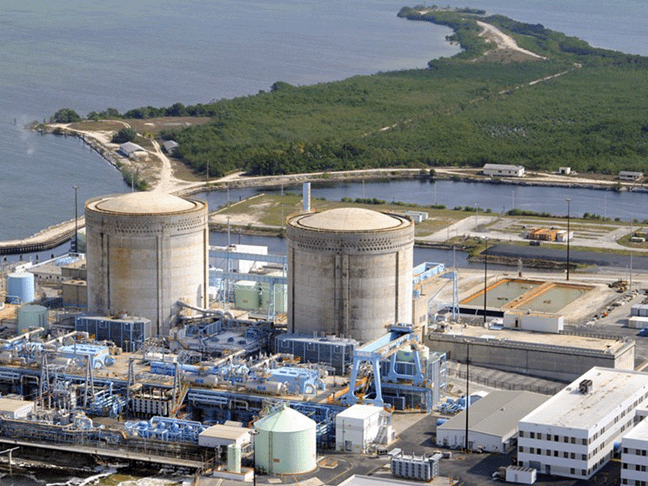
State Senator Says FPL Isn’t Preparing Miami’s Nuclear Plant for Sea-Level Rise, Miami New Times, JERRY IANNELLI | OCTOBER 5, 2017 The Turkey Point Nuclear Generating Station is built directly on the waterfront in Homestead — a location that has exposed the plant to serious natural disasters. The power plant survived Hurricane Andrew in 1992, but the storm’s 175 mph winds knocked out communication lines, disabled the emergency fire-safety system, and “severely cracked” an exhaust stack that could have destroyed the plant’s back-up power system if the stack had toppled, according to the Union of Concerned Scientists.
So while Florida Power & Light (FPL) proposes expanding Turkey Point and building two more reactors there, Miami state Sen. Jose Javier Rodriguez is asking for safer measures to prepare for sea-level rise and major hurricanes — or for FPL to drop the expansion plans altogether. This past August 23, Rodriguez sent the U.S. Nuclear Regulatory Commission (NRC), which regulates nuclear power plants, a letter demanding that FPL add greater sea-level-rise protections to its development plan.
Rodriguez made the letter public this week because the NRC had scheduled a hearing today to move forward with Turkey Point’s expansion plans; Hurricane Irma delayed the meeting, but it’s still expected to happen by the end of December. Rodriguez is asking the NRC to continue to delay ruling on the plan’s approval until FPL addresses the concerns of environmentalists and activists.
“They’re only taking into account one foot of sea-level rise in the future,” Rodriguez tells New Times. “Some projections — we’re hopeful those projections are wrong — but some projections are orders of magnitude higher than that.”…….
n his August letter to the NRC, Rodriguez laid out three specific concerns, which clean-energy activists opposed to FPL’s expansion plans have voiced repeatedly: First, Rodriguez said Turkey Point’s Combined Operating License application (COL) accounts for only a foot of sea-level rise by 2100 even though the National Oceanic and Atmospheric Administration warned last January that the seas could rise as much as 8.2 feet in that time period.
Second, Rodrigeuz said he was upset the plan covered only the new reactors — Units 6 and 7 — that FPL plans to build and does not propose any changes for the existing reactors. Those are the same reactors attached to cooling canals that leak low-level radioactive waste into Biscayne Bay and salt water into Miami’s drinking-water aquifer. Environmentalists have long complained that Turkey Point sits too close to protected parks and drinking-water sources.
Third, the lawmaker added he thought FPL’s applications did not properly account for what might happen to spent nuclear fuel rods that the plants produce. ….
“That also is obviously a huge concern all over the country,” Rodriguez says. “There really isn’t a plan for how these nuclear facilities store their waste.”
Anti-nuclear activists argue that if safely storing spent rods is this difficult, nuclear plants simply should not be built. Investigative comedian John Oliver earlier this yrar devoted a long segment on his HBO show Last Week Tonight to the nuclear-waste storage problem:
FPL recently won the right to store low-level radioactive waste from the expansion site underground in a rocky zone, but some environmental activists worry the waste might leak into Miami’s largest source of drinking water, the Biscayne Aquifer. Lawyers for the City of Miami asked the NRC to force FPL to rewrite its plan, but NRC regulators say FPL has done enough to mitigate those concerns.
Komo news, by NICHOLAS K. GERANIOS, Associated Press SPOKANE, Wash. (AP) 5 Oct 17, – Workers at the Hanford Nuclear Reservation have started injecting grout into a partially collapsed tunnel that contains radioactive wastes left over from the production of nuclear weapons, the U.S. Department of Energy said Wednesday.
The grout is intended to improve the stability of the 360-foot-long (110 meters) tube, which dates to 1956, and help prevent any radioactivity from escaping into the environment.
It will take an estimated 650 truckloads of grout to fill the tunnel adjacent to the closed Plutonium Uranium Extraction Plant, which produced most of the plutonium for the nation’s nuclear arsenal, the agency said. The complicated work should be completed by the end of the year……..
The roof of the tunnel, which was sealed in 1965, partially collapsed on May 9, forcing about 3,000 workers to shelter in place for several hours……
The site now contains the nation’s greatest volume of radioactive defense wastes. Cleanup of the site is expected to last until 2060 and cost $100 billion.
The grout will be injected into the tunnel at night. It is engineered to flow easily and will cover the contents, including eight contaminated railroad cars that carry waste.
The tunnel being filled with grout is one of two near the PUREX plant that contain contaminated rail cars and other radioactive waste.
The department concluded earlier this year that there is a high risk that the second, much larger, tunnel could also collapse.
The Energy Department has said that the two sealed tunnels “do not meet current structural codes and standards.”
The larger tunnel was built of metal and concrete in 1964. It is approximately 1,700 feet (510 meters) long and is covered with eight feet (2.5 meters) of soil to prevent radiation from escaping. Inside are 28 flat-bed rail cars containing nuclear waste, including giant storage vessels and other large equipment from plutonium production. That tunnel was sealed in 1996 and has not been entered since. http://komonews.com/news/local/650-truckloads-of-grout-to-fill-collapsed-radioactive-tunnel-at-hanford
Consensus on Site 300 contamination Tracy Press October 4, 2017 By Michael Ellis Langley
A citizen watchdog group and the Environmental Protection Agency agree that continued funding is the only way to make sure a polluted test site near Tracy is fully cleaned up.
Tri-Valley Communities Against a Radioactive Environment, a private organization that monitors work at Lawrence Livermore National Laboratory, hosted a town hall Thursday evening with the EPA. The group is concerned about contamination of an 11-square-mile facility along Corral Hollow Road southwest of Tracy called Site 300. The site is managed by the Department of Energy and has been used for years for experiments to test America’s nuclear arsenal.
Donald Trump described the Las Vagas shooter as “demented”, but Trump was happy to sign a Bill that will permit mentally ill people to have guns. Also he’s supporting a move to permit silencers – (that would have enabled to Las Vaegas shooter to kill many more people)
The rule, which was finalized in December, added people receiving Social Security checks for mental illnesses and people deemed unfit to handle their own financial affairs to the national background check database.
Had the rule fully taken effect, the Obama administration predicted it would have added about 75,000 names to that database.
President Barack Obama recommended the now-nullified regulation in a 2013 memo following the mass shooting at Sandy Hook Elementary School, which left 20 first graders and six others dead. The measure sought to block some people with severe mental health problems from buying guns.
The original rule was hotly contested by gun rights advocates who said it infringed on Americans’ Second Amendment rights. Gun control advocates, however, praised the rule for curbing the availability of firearms to those who may not use them with the right intentions.
Both the House and Senate last week passed the new bill, H.J. Res 40, revoking the Obama-era regulation.
Trump signed the bill into law without a photo op or fanfare. The president welcomed cameras into the oval office Tuesday for the signing of other executive orders and bills. News that the president signed the bill was tucked at the bottom of a White House email alerting press to other legislation signed by the president.
The National Rifle Association “applauded” Trump’s action. Chris Cox, NRA-ILA executive director, said the move “marks a new era for law-abiding gun owners, as we now have a president who respects and supports our arms.”
Everytown For Gun Safety President John Feinblatt said he expected more gun control rollbacks from the Trump administration. In a statement to NBC News, he called the action “just the first item on the gun lobby’s wish list” and accused the National Rifle Association of “pushing more guns, for more people, in more places.”
Sen. Chris Murphy, D-Conn., a leading gun control advocate in Congress, called out Republicans over the move.
“Republicans always say we don’t need new gun laws, we just need to enforce the laws already on the books. But the bill signed into law today undermines enforcement of existing laws that Congress passed to make sure the background check system had complete information,” he said in an emailed statement.