Trump’s plan for the Iran nuclear deal runs straight through a diplomatic minefield
President Donald Trump is expected to tell Congress that the Iran nuclear deal is not in the country’s national security interest.
The Trump administration will try to coerce Iranians and Europeans back to the negotiating table to secure a tougher deal and address other issues.
Some say American financial might will allow Trump to prevail, while others say he has slim odds of getting what he wants and risks inadvertently blowing up the deal.
President Donald Trump has made up his mind about how he will seek to toughen an historic international accord to limit Iran’s nuclear program, according to the White House.
“The president’s reached a decision on an overall Iran strategy. He wants to make sure that we have a broad policy to deal with that, not just one part of it,” White House Press Secretary Sarah Huckabee Sanders told reporters on Tuesday.
Trump will elaborate on details of the plan later this week, Sanders added. The Washington Post previously reported the president will deliver his decision on Thursday.
University of Hawaii students and staff probably did a double take at the subject line of an email that arrived in their email inboxes Monday.”In the event of a nuclear attack,” it said.
The email is part of a broad state campaign to better prepare residents and visitors for the unlikely but not impossible threat of a nuclear missile attack that North Korea poses to the islands.
“In light of concerns about North Korea missile tests, state and federal agencies are providing information about nuclear threats and what to do in the unlikely event of a nuclear attack and radiation emergency,” the UH email said.
The email also told students and faculty to be aware of emergency sirens and to follow instructions on “sheltering in place.”
The informational message comes amid rising tensions with North Korea, and as the president indicates that diplomatic efforts may have stalled.
Trump spent the better part of the weekend on Twitter angrily condemning Corker, accusing him of being behind the P5+1 nuclear deal with Iran, and saying he’s not running for another term in office because “he doesn’t have the guts.”
Corker said that top administration officials are constantly trying to protect Trump from his own interests, and much of the work of today’s White House is “a situation of trying to contain him.”
Corker went on to say Trump’s irresponsible outbursts should be concerning to all Americans, and that he’s treating the presidency like it’s a reality television show. He also said Trump’s Twitter outbursts have in several instances harmed diplomatic efforts of Secretary of State Rex Tillerson.
While Trump has yet to respond to Corker’s latest comments, the last thing he’d said earlier in the day was that he expects Corker to “be a negative voice and stand in the way of our great agenda.”
Sen. Corker’s comments are an unprecedentedly public rebuke of Trump from his own party, but are seen as reflective of some other Republican leaders who are uncomfortable with Trump’s volatile behavior. It may also be a bigger problem than Trump expects if he’s totally alienated Corker, as the Republican majority in the Senate is small, and losing a top leader’s public loyalty could easily cost him some close votes.
North Korean leader Kim Jong Un says his nuclear weapons are a “powerful deterrent” which guarantee North Korea’s sovereignty, hours after US President Donald Trump said “only one thing will work” in dealing with the isolated country…..
Among serious strategists, “madmen” are not afraid to fail, or blow up the world and themselves. That is not their preferred outcome, but they are prepared to take massive risks for specific purposes.President Donald Trump seems not to know this history, nor do most of his advisers. He appears, however, drawn to the same strategy as Nixon. Trump has many incentives to try and convince foreign adversaries that he is “mad,” in hopes that they will back down from long-standing defiant behaviors without heavy costs to the United States. He wants big victories with small sacrifices—a good “deal”—and nuclear threats call out as the obvious instrument.Kim will continue to defy Trump and make the president look like a “dotard”—a wise word choice. A failed bluff is indeed worse than no bluff at all. Trump will not be willing or able to follow through on his nuclear threats, but he will divert attention with new threats in other places, perhaps in Iran. That is his standard mode of behavior. The president will continue to make empty promises, fail to deliver, and then start again. That is his true madnessDONALD TRUMP AND THE ‘MADMAN’ PLAYBOOK , WIRED 9 Oct 17, JEREMI SURI, AS THE THREATS exchanged between the leaders of the United States and North Korea escalate, President Donald Trump’s rhetoric seems to draw from the “madman” playbook employed by President Richard Nixon during the Vietnam War. Trump should not expect the results to be any better, and they might be much worse. American leaders should be extremely wary of the risks of flagrant nuclear brinksmanship.
The paradox of American nuclear power is that the nation’s overwhelming arsenal is almost unusable. The damage created by a single nuclear strike would be so great, it would undermine most American strategic purposes. The public revulsion, even from Washington’s closest allies, would make the United States a global outcast. And American nuclear action would justify others contemplating the same, tearing apart 50 years of global non-proliferation efforts.
These are the circumstances that motivated Chinese leader Mao Zedong to call the United States a “paper tiger” during the Cold War. Mao never took American nuclear threats against his country seriously, as he proved when he attacked US soldiers on the Korean Peninsula, in Indochina, and in other settings. Mao believed that nuclear weapons constrained the United States more than its adversaries. President John F. Kennedy agreed, and began a process of broadening American conventional capabilities (“flexible response”) to create non-nuclear options for combatting aggressors, like Mao.
President Richard Nixon inherited the unwinnable conventional war in Vietnam that Kennedy’s flexible capabilities facilitated. Nixon recognized that military options below the nuclear level enabled self-destructive quagmires, as the country sent thousands of soldiers to fight communists in distant, inhospitable lands. The “Nixon Doctrine” promised to reduce the use of American conventional forces. The president looked for a way to rely more heavily on nuclear weapons, converting their overwhelming firepower into diplomatic and military leverage, without actually irradiating foreign territories.
The destructive power of nuclear weapons remained out of proportion with American political aims, and foreign leaders continued to doubt American will to use them, but Nixon was determined to make his biggest bombs into better bullying tools. As he told Henry Kissinger and other advisers on numerous occasions, he would convince American adversaries that he had strong “guts,” and personal “will in spades” to get tough where predecessors had backed down
Nixon had to show that the limits on how his predecessors thought about nuclear weapons did not apply to him. He was prepared to think about the unthinkable. He would be less predictable and more experimental. He would act a little “mad,” or at least create uncertainty about whether he still followed the accepted rules of behavior for the leader of the free world.
Among serious strategists, “madmen” are not afraid to fail, or blow up the world and themselves. That is not their preferred outcome, but they are prepared to take massive risks for specific purposes. To be mad is not to be irrational. There is a steely rationality in the willingness to combine extreme force with potential suicide. The madman strategist is ready to press the nuclear button if the adversary doesn’t back down. The adversary will give in, according to the logic, because the potential damage is just too devastating, and he thinks the madman might be serious.
During the Cold War, leading American game theorists modeled this behavior. Noble Prize-winning economist Thomas Schelling called it the “threat that leaves something to chance.” Daniel Ellsberg of Pentagon Papers fame spoke of the “political uses of madness.” Henry Kissinger worked closely with Schelling and Ellsberg during his two decades at Harvard University, and he brought this thinking to the White House.
In the first year of the Nixon administration, Kissinger and the president implemented a madman strategy to scare the Soviets into helping the United States extricate itself victoriously from Vietnam. …..
The Nixon-Kissinger madman strategy failed because Soviet and North Vietnamese leaders, like Mao Zedong in China, recognized that the United States had much more to lose than gain from turning the Vietnam War into a nuclear conflict. Nixon could make Indochina unlivable, but he could not save the South Vietnamese government, or America’s reputation as a bulwark of freedom, by feigning madness. All the major actors saw through Nixon’s bluff.
President Donald Trump seems not to know this history, nor do most of his advisers. He appears, however, drawn to the same strategy as Nixon. Trump has many incentives to try and convince foreign adversaries that he is “mad,” in hopes that they will back down from long-standing defiant behaviors without heavy costs to the United States. He wants big victories with small sacrifices—a good “deal”—and nuclear threats call out as the obvious instrument……..
Like Nixon, Trump wants his adversary to fear he might be mad. He hopes that will prompt Kim to back down. As in the past, however, there is no reason to believe that will happen. …….
Kim will continue to defy Trump and make the president look like a “dotard”—a wise word choice. A failed bluff is indeed worse than no bluff at all. Trump will not be willing or able to follow through on his nuclear threats, but he will divert attention with new threats in other places, perhaps in Iran. That is his standard mode of behavior. The president will continue to make empty promises, fail to deliver, and then start again. That is his true madness. https://www.wired.com/story/donald-trump-madman-strategy-north-korea-nuclear-weapons/
Anti-war nuns to bring message of nuclear disarmament https://www.stripes.com/news/us/anti-war-nuns-to-bring-message-of-nuclear-disarmament-1.491495#.WdqS44-CzGgBy DEBBIE KELLEY | The Gazette | Associated Press October 7, 2017 COLORADO SPRINGS, Colo. — As political tensions mount over North Korea’s ballistic missile testing, two elderly Roman Catholic nuns who have spent decades sounding the plea for peace say they are more hopeful than ever that nuclear weapons — not the world — will be annihilated.
“We trust, we believe, we know that we are well on the way to a nuclear-free world and future,” said Sister Ardeth Platte, a Dominican nun.
Platte, 81, and Sister Carol Gilbert, 69, live at the Catholic Worker-affiliated Jonah House in Baltimore. They gained attention in Colorado in the past for pouring blood on a nuclear missile silo in Weld County and anti-war civil disobedience at Colorado Springs military bases.
Fifteen years later, they are returning to deliver the message that nuclear disarmament is at hand.
“We’re in an extremely dangerous time,” Platte said. “A strike could be launched from Colorado within 15 minutes and go 7,000 miles to its target within half an hour. It would be total devastation.”
At 3:30 p.m. on Oct. 9, they’ll present to Peterson Air Force Base personnel a copy of the new United Nations’ Treaty on the Prohibition of Nuclear Weapons.
They’ll repeat the action at 2:45 p.m. Oct. 10 at Schriever Air Force Base.
“We want the citizens of Colorado to know about this treaty,” Gilbert said. “The treaty would make nuclear weapons illegal.”
“We’re coming as peacemakers and peace advocates, to teach and show our concern,” Platte said. “Our politicians could be heroes of these times, if they start working with nations rather than against nations.”
Leading up to the Colorado Springs events, Platte and Gilbert will conduct a vigil at the N-8 missile silo in Weld County, where in October 2002 they poured blood on a Minuteman III missile loaded with a 20 kiloton nuclear bomb, one of 49 high-trigger nuclear weapons stored in Colorado. Their action symbolized taking it offline.
They were convicted of sabotage and received harsh sentences: 41 months for Platte and 33 for Gilbert.
In September 2000, Platte, Gilbert and three other Catholic nuns were arrested for civil disobedience at Peterson Air Force Base and jailed. The charges were subsequently dropped. They’ve also served time in other states for nonviolent acts of civil disobedience.
Prison provided the opportunity to do their best Christian ministry, Gilbert said. “We feel it is the closest that we can be with the poor of this country because jails and prisons are warehouses for the poor,” she said. “You learn people who have nothing are so generous in sharing, you learn what a waste the prison industrial complex is.”
The work of Platte and Gilbert has been “very significant,” said Bill Sulzman, founder of Colorado Springs-based Citizens for Peace in Space, an activist group that opposes the use of space for war-related activities.
“It’s unique in the sense that it’s primarily a moral argument against nuclear weapons and the phenomenon of modern-day war,” he said. “Not supporting it is one thing, actively opposing it is another.”
As part of a non-governmental organization, the International Campaign to Abolish Nuclear Weapons, the nuns attended a United Nations conference in New York, when on July 7, 122 countries — two-thirds of the 193-member states — adopted the Prohibition of Nuclear Weapons Treaty. It’s the first legally binding multilateral agreement for nuclear disarmament in 20 years.
The treaty came after months of negotiations, which the United States, Russia, Great Britain, France, North Korea and other nations did not attend.
To date, 53 countries have signed the treaty, and three ratified the document, which prohibits developing, testing, producing, manufacturing, acquiring, possessing and stockpiling nuclear weapons or other nuclear explosive devices, as well as the use or threat of use of such weapons.
The treaty opened for signatures at U.N. headquarters in New York on Sept. 20; the Vatican was the first to sign and ratify the treaty. The agreement would become law 90 days after at least 50 countries ratify it.
The sisters are optimistic that the treaty is the weapon needed to abolish nuclear capability.
“I’ve been working on this issue for 50 years, and this is the greatest hope I’ve had,” Platte said. “We finally have a tool, a treaty that declares criminality to the possession and threat of using nuclear weapons.”
Even if the United States, Russia and other countries with nuclear warheads never get on board, “it won’t matter because there will be great pressure by other nations,” Platte said. “People are much wiser as we come closer and closer to nuclear holocaust.”
The tactic has worked in the past, she said. At one time there were 70,000 weapons of mass destruction worldwide, now there are 15,000-16,000, due to disarmament.
“This is just the beginning of the implementation — we have gained real momentum,” Platte said.
The atomic bombs the United States dropped on Hiroshima and Nagasaki, Japan, in August 1945 were small compared to today’s weapons of mass destruction, the sisters said.
If a nuclear war were to happen now, “that is the elimination of the planet,” Platte said.
Nuclear weapons are the only weapons of mass destruction not universally prohibited. Biological weapons, chemical weapons, land mines and cluster munitions are banned under international law.
“We believe that the way to solve nations not having nuclear weapons is the total elimination,” Platte said. “It’s time to get rid of them.”
Warnings from First Americans: Insidious Changes Are Underway that Will Affect Us All, In These Times, BY STEPHANIE WOODARD , 5 Oct 17,The worst mass shooting in recent years. Escalating threats of nuclear war. Catastrophic hurricanes. Calamities and fear rock the nation these days. Meanwhile, public servants are chartering private jets, and the president’s frenzied tweetstorms create yet more chaos and division. As the tweeter-in-chief seeks sycophantic praise (or anything to divert our attention from Robert Mueller’s accelerating investigation), serious policy changes have been proposed, or are underway, in numerous aspects of American life.
For an update, Rural America In These Times spoke to Native Americans—people whose survival requires being extremely well informed about what all branches of the federal government are up to. From their vantage point as sovereign entities with direct government-to-government relationships with the United States, the tribes have a unique perspective on issues including voting rights, the economy, the extractive industries’ hold over this administration and more.
In each case below, they explain how powerfully and comprehensively this administration’s misguided policies would impinge on each and every one of us. After all, “everything is connected,” as Timbisha Shoshone Tribal Historic Preservation Officer Barbara Durham puts it.
Fire on the mountain
Kim Jong-un can relax! We have already nuked ourselves and are looking into a great way to poison ourselves even more with radioactive waste. In June, Department of Energy (DOE) Secretary Rick Perry suggested using the Nevada National Security Site, aka the Nevada Test Site, as an interim waste dump and at the same time reopening licensing procedures for nearby Yucca Mountain. Under Perry’s plan, the mountain, revered as a sacred site by area tribes, would eventually become the permanent repository for spent nuclear fuel and other radioactive material.
The waste would travel via roads and railroads through communities throughout the country as it made its way to Nevada. Once it arrived, its home would be deep inside the earthquake-prone mountain. The DOE’s Final Environmental Impact Statement (FEIS) for the project admits that Yucca Mountain may be shaken by “ground motion” and that “beyond-the-design” events could collapse the waste facility.
The Timbisha Shoshone government blasted the Perry proposal, citing the groundwater contamination that the Nuclear Regulatory Commission has said will likely occur, even without earthquakes. …….
The United States faces one more very large barrier at Yucca Mountain, adds Bob. In 1863, Shoshone tribal heads and United States representatives signed the Treaty of Ruby Valley, which declared friendship between the parties and guaranteed the tribes a homeland that encompasses most of Nevada and massive chunks of Idaho, Oregon, California and Utah. The federal government seemed to forget all about the agreement for decades, though of course there were distractions—the Civil War, Lincoln’s assassination, the Sioux defending their homelands and more. After the United States woke up to the gigantic gap in the national map, it tried unsuccessfully for decades to pay off the Shoshone tribes.
“We respect the treaty,” says Bob. “And we don’t want the nuclear waste.”
DOE offers one bright spot in all the controversy: According to the FEIS, Yucca Mountain is “highly unlikely” to erupt as a volcano.
This land is whose land?
The Trump administration is trying to shovel vast and pristine portions of the United States into the maw of the extractive industries, such as mining concerns and fossil-fuel companies…..
Equality redefined
It’s not just Russians anymore. Attacks against voting rights are proliferating beyond Putin’s pals hacking into state election systems or manipulating public opinion via social media. With the Trump administration’s all-out assault on ballot-box access, non-Natives are getting a taste of what Native people have long experienced, according to OJ Semans, the Rosebud Sioux executive director of Four Directions, a nonprofit that advocates for equal rights.
‘Enough is enough’ nuclear waste http://www.postandcourier.com/opinion/editorials/enough-is-enough-nuclear-waste/article_5875b0fc-aadc-11e7-baa8-13314076fcb5.html8 Oct 17South Carolina has been generally accommodating to the federal government’s nuclear waste disposal needs over the decades, based on the promise that the highly radioactive material would be eventually shipped out of Savannah River Site to a permanent storage facility. Unfortunately, the federal government hasn’t been willing to live up to its part of the bargain.
So the SRS Citizens Advisory Board recently said “enough is enough” in response to federal plans to ship a ton of uranium from Germany through the port of Charleston then by rail to the Aiken facility. While the board’s role is advisory, its decision can have a major impact on federal policy. For example, a federal committee examining nuclear waste disposal options during the Obama administration backed off a plan in 2013 to formalize SRS’ use as a waste treatment and disposal site when the citizens panel balked.
The uranium was originally sent to Germany for research purposes as part of the U.S. Atoms for Peace Program — and the U.S. government agreed to take it back when Germany was finished with it. No question, SRS has the experience and the capability to process the material so it can’t be used to produce a nuclear weapon, but CAB reasonably balked at the transfer.
“The proposal will unnecessarily add to an already large burden of … high-level radioactive waste storage at SRS with no established path for disposal,” the CAB stated in its response to the Department of Energy request. “DOE failures to faithfully keep pace with its SRS cleanup commitments impede the acceptability of this deficient proposal by the citizens of South Carolina.”
Among those failures are the previous administration’s unwillingness to continue funding a plant to process weapons grade plutonium into fuel for commercial nuclear reactors. The federal government agreed to build the mixed-oxide facility as a condition of sending 34 tons of plutonium to SRS. The decision to abandon the project came after the plutonium already had been shipped to SRS.
Meanwhile, the planned permanent storage site for high level nuclear waste at Yucca Mountain, Nevada, was shut down in 2011 by the then-chairman of the Nuclear Regulatory Commission, with the Obama administration’s approval. There are ongoing efforts to restart the project on which $15 billion has already been spent since the 1980s.
Meanwhile, South Carolina, Aiken County and Washington state have ongoing lawsuits against the DOE for failing to meet its promises on nuclear waste. The state also is attempting to get payment of $200 million in fines that the federal government agreed to remit if it failed to send a specified volume of nuclear waste out of the state by 2016. It reneged on that promise, too.
So don’t blame the SRS Citizens Advisory Board for being less than accommodating to the federal government’s latest radioactive waste disposal plan. As CAB member Larry Powell said, “I would just like to see less of this fuel coming into SRS, especially when there’s no exit plan out of state.”
South Carolina should emphasize its opposition to becoming the dump site for federal nuclear waste at every possible turn — in the courts, in Congress and by state government. The state has assumed more than its share of responsibility for nuclear defense production and waste management since the early years of the Cold War. The federal government should have to live up to its promises to the state.
The US Defense Department takes climate change seriously, PRI , Living on Earth, October 08, 2017, Adam WernickWhile President Donald Trump has dismissed climate change as a hoax, the Department of Defense is focused on understanding and preparing for continued climate disruption and the security threats it poses in a warming world.
The US experienced three large-scale disasters in succession — hurricanes Harvey, Irma and Maria — which has strained our resources, our politics and the infrastructure that helps bring aid to battered areas. Even in an era of highly polarized politics, however, the US remains a fairly stable government system. When these disasters hit other places that aren’t so stable, they can create regional and even international security problems.
“One of the components of climate change that makes it a threat or a risk to national security is [that] it can make already tenuous, or frankly bad, places much worse and, occasionally, catastrophically so,” says retired Rear Adm. David Titley. Titley led the US Navy’s task force on climate change and is now a professor of meteorology at Pennsylvania State University.
“So much depends on local governance, on the inherent strength and resilience of the communities affected,” Titley says. “This is why you see people like Defense Secretary Mattis talk so strongly about the need for not only the military to be funded, but for adequate funding for US Agency for International Development, or USAID; for our State Department to be adequately funded and adequately manned, because the military can come in initially and try to help stabilize the situation, but the US military is not going to be the one that rebuilds these societies.”……
Titley notes that James Mattis was “pretty clear on this early on in his tenure as Secretary of Defense.” His answers to written questions from congressional leaders indicated he understands that the climate is changing and that “those changes, if unmanaged, compose a risk to US security operations and US Department of Defense.”……
[Defense Secretary] Mattis’s acceptance of climate change as a security risk allows others in the department, including the Joint Chiefs of Staff, to begin to plan for its effects, he says.
“For a lot of the readiness of the Department of Defense, it doesn’t even really matter why [the climate] is changing,” he adds. The department’s internal message, he says, is “‘we know it’s changing; we know it’s changing pretty quickly, and we’d better be ready for that, because if we just plan for the past we’re going to be surprised,’— and that’s not where the Department of Defense wants to be.”
Richland nuclear plant OK’d to ship radioactive waste, BY ANNETTE CARY acary@tricityherald.com, OCTOBER 07, 2017, Energy Northwest has had its privileges to ship radioactive waste to a commercial disposal site on the Hanford nuclear reservation reinstated.
Twice over the past 12 months, it sent waste from the nuclear power plant near Richland to US Ecology with manifests that didn’t match the shipments.
Most recently, the wrong manifest accompanied a July 20 shipment. The Washington State Department of Health temporarily suspended Energy Northwest’s authorization to use US Ecology, which is about 10 miles from the Columbia Generating Station on leased land at the Hanford nuclear reservation…….
The Nuclear Regulatory Commission took no action on the July incident
However, the NRC issued a “white” violation finding against the plant for a more serious shipping incident in November 2016 that involved improperly packaged waste. A “white” designation in the NRC’s color-coded system indicates low to moderate safety significance.
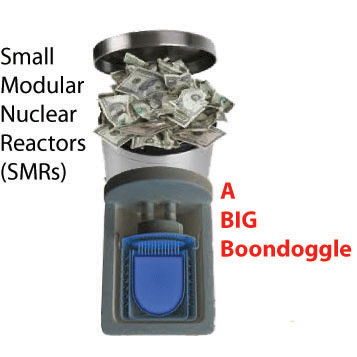
SMR Supply Chains, Costs, are Focus of Key Developments, Neutron Bytes, Dan Yurman October 4, 2017
Small modular reactors won’t be able to compete with natural gas plants combined with renewables unless and until they get enough orders to justify building factories to manufacture them in a mass production environment.
Holtec Opens SMR Manufacturing Center in New Jersey
In September Holtec announced the grand opening of a $360M, 50 acre SMR manufacturing center in Camden, N.J. The firm was incentivized by the State of New Jersey to locate there with $260M in tax breaks. According to Holtec the Camden plant will eventually employ up to 1,000 people……….
Dr. Singh, Holtec’s President and CEO, declared the factory to be “Ground Zero” for the renaissance of nuclear energy and heavy manufacturing in America.
“It will serve as the launching pad for the regeneration of manufacturing in the United States.”
He added, “We will build nuclear reactors here, and they will sail from the port of Camden to hundreds of places around the world.”
Is Holtec Headed for Ukraine to Manufacture SMRs for Europe & Asia?
The maturing of an American supply chain to support mass production of components for SMRs might develop, but not all of it may be in the U.S. Holtec International, is reportedto be in talks about planning to arrange the production of small modular reactors (SMRs) for nuclear power plants in Ukraine, and for export to Europe and Asia.
The Interfax wire service report, which was not confirmed by Holtec, comes on the heels of the firm’s grand opening of a $360M nuclear energy component manufacturing center in Camden, NJ. It is the second report in three months providing details of Holtec International’s discussions with Energoatom. However, a spokesperson for Holtec declined to comment on these discussions as reported by Interfax.
The Intefax report quotes Energoatom National Nuclear Energy Generating Company of Ukraine President Yuriy Nedashkovsky who said,
“There is a very interesting offer made by Holtec International CEO Kris Singh to President of Ukraine Petro Poroshenko – to create a hub in Ukraine, distributing small modular reactors to Europe, Asia and Africa, with the localization of production and a large number of equipment at Ukrainian enterprises.”
According to Nedashkovsky, Ukraine’s Turboatom has already been involved in the project, as it has the required turbines in its production line.
“This project has already been developed conceptually. The launch of licensing procedures (in the U.S.) is expected next year, and an active phase of construction – approximately in 2023.” Nedashkovsky added.
Talking of the long-term prospects, Nedashkovsky noted that the demand for small modular reactors after 2025 was estimated to grow over time.
Is the Ukraine SMR Story Ahead of Holtec’s Headlights?
What’s unclear is whether Nedashkovsky was speaking off-the-top-of-his-head, commenting officially on behalf of Holtec International, Continue reading →
Piketon continues to fight radioactive disposal site , By Nikki Blankenship – nblankenship@aimmediamidwest.co NEWS 4 Oct 17,PIKETON –The Department of Energy (DOE) confirmed at Monday night’s Piketon Village Council meeting that concerns expressed by Piketon Mayor Billy Spencer, members of Council, various other public officials and members of Citizens Against Radioactive Dump (CARD) are valid. The DOE’s local site lead Joel Bradburne and Manager of the Portsmouth/Paducah Project Office for DOE Robert Edwards were both present at the meeting to answer questions from community members who expressed frustrations, claiming that the DOE has repeatedly lied to the them.Over recent months, the Village of Piketon has urged the DOE to reconsider the on-site waste disposal facility that the department feels is a solution to the waste problem at the Piketon plant. Thus far, options have been to do nothing, ship waste off-site or create a place on-site to dump it.
During the meeting, DOE representatives explained that it is expected to cost an estimated $1 billion less to dispose of the waste on-site. The facility would be 100-acre dump that DOE representatives state would hold low-level contaminants from site cleanup.
Earlier this year, Piketon hired an third-party consultant to evaluate plans for the site. The conclusion brought about several concerns that Piketon officials addressed directly during Monday night’s meeting.
The first concern was that there are fragments in the bedrock which could allow for waste to contaminant underground water sources, proximity to Piketon residents and compliance with the Toxic Substances Control Act provision mandating that the bottom of a landfill line system be installed at least 50 feet from historic high-water tables.
According to the results of the study, data from DOE states the depth of groundwater in some areas of the landfill site is as shallow as 21 feet below the surface.
“We worry about our water,” Spencer stated during the meeting.
Spencer and other frustrated Piketon officials and residents demanded DOE address these concerns……….
The waste disposal facility (referenced as a radioactive dump by opponents) is expected to be ready to accept waste as early as late 2021.
SMR Supply Chains, Costs, are Focus of Key Developments, Neutron Bytes, Dan Yurman October 4, 2017 “…….Westinghouse Says It Remains Committed To UK SMR Development
(NucNet) Westinghouse Electric Company said last week it remains committed to developing a 225-MW small modular reactor (SMR) that the company believes will allow the UK to move from buyer to global provider of SMR technology.
The company said in a statement that more than 85% of its SMR’s design, license and procurement scope can be delivered by the UK. The fuel would be manufactured at its Springfields facility in northern England.
“This is a special offering that only Westinghouse, with UK partners, can deliver,” the statement said.
Media reports in the UK have suggested that ministers are ready to approve the development of a fleet of SMRs to help guard against electricity shortages as older nuclear power stations are decommissioned………
Westinghouse said it filed for bankruptcy protection in the US to protect its core businesses and give the company time to restructure for continuing operation.