Rumblings in USA’s Republicans in Congress over concern about global warming
The Senate’s top climate advocate explains why Congress is doing nothing about global warming
“Trajectory points on the horizon aren’t part of our battle”: Sheldon Whitehouse on Democrats’ climate strategy. VOX, by Combating climate change couldn’t be further from the Senate’s legislative agenda, but one Democratic senator claims a deal to enact a carbon tax may be closer than many realize.
Sen. Sheldon Whitehouse (D-RI), widely seen as the Senate’s most active advocate on climate change, says he is in routine communication with “six to 10” Senate Republicans who, he says, privately support his carbon tax bill but are unwilling to publicly back it. Only one Senate Republican, South Carolina’s Lindsey Graham, is willing to publicly support that idea.
In an interview with Vox, Whitehouse talked excitedly about the former Republican officeholders and George W. Bush officials who have formally voiced their support as well.
“If you want to have a valid Republican Party 10 years from now, you can’t have a generation of people that grows up seeing the Republican Party as climate deniers,” Whitehouse said in an interview, explaining his confidence that Republicans will move to address an issue their party’s president has called a “Chinese hoax.”
The issue is getting new attention as several severe hurricanes have made landfall in the US, causing expensive and lasting damage in Texas, Florida, and Puerto Rico. After the hurricane in Florida, one Republican mayor said: “If this isn’t climate change, I don’t know what is.”……. https://www.vox.com/policy-and-politics/2017/10/16/16394818/sheldon-whitehouse-congress-climate
‘Repowering’ wind farms as wind turbine efficiency leaps ahead
New wind turbine efficiency so great utilities ‘repowering’ farms early https://electrek.co/2017/10/16/new-wind-turbine-efficiency-so-great-utilities-repowering-farms-early/ John Fitzgerald Weaver – Oct. 16th 2017 @SolarInMASS
Warren Buffett owned MidAmerican Energy is upgrading wind turbines in Iowa early in their lifetimes in order to take advantage of the newest innovations in gear boxes and blades. Since only small parts of the already developed wind farms need be upgraded – these moves will increase the profitability of the farms. Wind turbines are evolving at a fast enough pace that waiting for standard end of life (30 years) means leaving money on the table.

I estimate an additional $51M/year in revenue from MidAmerican’s repowering.
John Hensley, deputy director for industry data and analysis at the American Wind Energy Association, says 700MW of wind power has been repowered in the USA. MidAmerican stated that they’re upgrading 1,000MW of their 4,000MW of wind (in Iowa). Their project will take through 2020 to complete.
As the article above notes – Wind projects started before 2017 qualified for the full production tax credit of 2.4 cents per kilowatt hour. The credit falls to 80 percent of that for projects started in 2017; 60 percent for those started in 2018; and 40 percent for those started in 2019. Most of the life of these system upgrades will be long after the wind production credit diminishes.
Interestingly –
After refurbishing some of the turbines at the Diablo Winds project in the Altamont Pass in California, researchers found that the fatality rates fell by 54 percent for raptors and 66 percent for all birds.
MidAmerican estimates that repowering the farms would increase output from the turbines by 19-28%. Annually, wind farms lower in output by about 1.7% per year. The lifetime of a wind farm has historically been around 30 years.
Electrek’s Take
With capacity factors around 40% on the newest projects (33% on older projects) – combined with 1,000MW of upgraded hardware – there will be an additional 613 million kWh/year coming from these turbines. The average American home uses about 10,000kWh/year for comparison. If the average price of electricity in Iowa (before taxes) is around .0835¢/kWh, then that’s $51M a year in new revenue. If this 1GW of wind cost $1B to install – that’s an extra 5% return on investment per year after accounting for the cost of upgrades (roughly of course).
This expanding evolution – adding future revenue to projects via strategic plant repowering in an age of fast maturing hardware – changes operations and maintenance in renewable technology giving those building today’s utility-scale power plants an improved tool to lower up front pricing. These towers are being repowered in their 14th to 11th years (plus or minus a few depending on order). There is a spreadsheet inside of MidAmerican which did some calculus to determine when money earning and repowering cost curves intersected – and that intersection was when the new investment was acted on. Thirty years with a constant declining power output will now change to developers signing contracts with large manufacturers at time of original construction to upgrade hardware in 8 to 10 years. These contracts will depend on developers and finance houses trusting that these manufacturers can continue the technological march forward in an aggressive manner.
Repowering is an old concept – but it’s getting more headlines today in renewables because large number of systems are hitting that age and the burning pace of technological innovation.
Idaho National Laboratory – promoter and also umpire for nuclear reactors’ safety
National lab is cheerleader and umpire for reactors’ future Peter Behr, E&E News reporter, SCOVILLE, Idaho — Nuclear power for the grid was born here in 1951, when an experimental reactor’s football-sized core sent current flowing to a quartet of lightbulbs at the isolated government laboratory on Idaho’s southeast desert.
And the nuclear industry’s future may be written here, as well — at least key parts of it — inside the Energy Department’s Idaho National Laboratory testing complex.
INL’s scientists, with colleagues at other DOE labs, are keeping a close watch on the health of the nation’s commercial nuclear reactors, most of them built before the mid-1980s in the flush of excitement about nuclear energy that would be “too cheap to meter,” as an early promoter predicted. How long can the plants keep going before critical steel, concrete and wiring systems are overcome by the aging effects of heat, radiation and mechanical stresses?
And now, with the nuclear industry struggling to compete against low-cost natural gas generation, INL is also stepping up a search for ways to lower reactor operating costs, from research on “accident tolerant” reactor fuels to designing more efficient control rooms and using technology to reduce reactor safety inspection time and costs……..
The NRC has licensed 84 reactors to continue operating beyond the initial 40-year span for an additional 20 years. Nine more relicensing applications are pending, and four reactors are expected to apply, the NRC said……..
The Energy Department’s 2016 report on the reactor longevity campaign notes the potential for damaging surprises. The specialized stainless steel alloys chosen for reactors in the 1960s had many plus factors, DOE said, but concerns, as well. Reactor radiation can add to stress-related corrosion cracking, threatening structural integrity. DOE researchers noted this year that “limited information is known about the long-term performance” of these alloys. Concrete structures have borne thermal shock and radiation, and reactor wiring has lived in harsh environments. Aging issues are “expected to become more severe” as time passes, DOE said.
An essential test process at Idaho and other DOE labs is to bombard sample reactor materials with enormous radiation levels inside test reactors, accelerating stress testing to mimic impacts of operations far beyond 40 years.
“It’s possible plants could run into aging problems that were too expensive to fix, and the operators would decide to shut it down,” Wagner said.
“Nearly all of the fleet will go offline between 2029 and 2055” if plants cannot operate beyond 60 years, Wagner said. “That may seem like a long time away, but it’s really not when you consider replacing that level of assets.”…….https://www.eenews.net/stories/1060063769
Florida: PSC regulators say no to FPL nuclear fees without financial analysis
Susan Salisbury, Palm Beach Post Staff Writer,Without a required feasibility analysis to show that two new proposed nuclear reactors are a good deal for customers, Florida Power & Light Co. cannot collect costs incurred after 2016, the Florida Public Service Commission decided Tuesday.
PSC commissioners unanimously agreed with a staff recommendation that because FPL failed to submit a required financial analysis, costs incurred for the two reactors from Jan. 1, 2017 going forward cannot be collected through nuclear power-related fees customers pay.
Since 2009 Juno Beach-based FPL has sought an operating license from the U.S. Nuclear Regulatory Commission for the proposed 2,200-megawatt Turkey Point 6 and 7 reactors which could cost as much as $21.8 billion. They might never be built, or no sooner than 2031, at the same facility where FPL already has two operating reactors overlooking Biscayne Bay south of Miami.
Still, customers have already paid close to $282 million in costs associated with the two reactors. And FPL wanted permission to continue charging customers with an exemption from having to file a feasibility study.
The Southern Alliance for Clean Energy, the Office of Public Counsel, the Florida Retail Federation and the Florida Industrial Power Users Group all urged the commission to deny FPL’s request for an exemption.
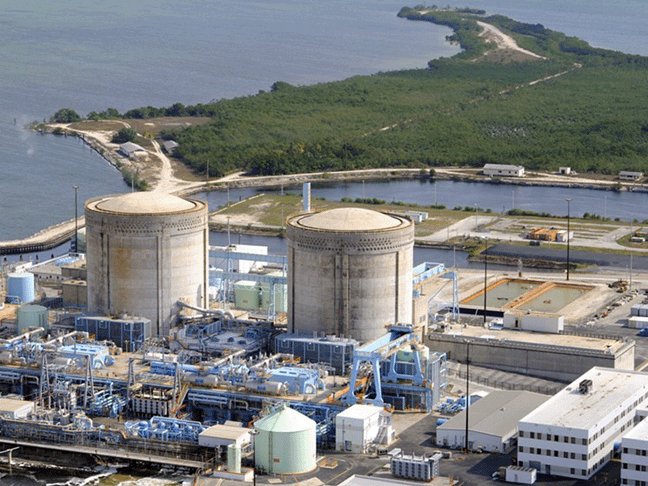
The PSC agreed, but the company can collect costs from customers if and when it does provide the required report as long as the report shows the project makes financial sense, the commission said. The utility could also seek to collect the costs some other way, such as through base rates…….
SACE said Tuesday it has other concerns, including that FPL has never committed to a binding price for the reactors or to construct them at all.
“FPL customers have already paid $300 million into the proposed Turkey Point expansion project that will almost certainly never be built. Two nuclear reactors of the same design in South Carolina were recently cancelled after the projected cost soared to over $25 billion dollars,” Smith said.
The Commission approved recovery of the utility’s costs for 2015 and 2016 that included $46,978,739 for the Turkey Point project. Customers will be receiving a credit next year of $7,305,202. http://www.palmbeachpost.com/business/psc-regulators-say-fpl-nuclear-fees-without-financial-analysis/LucoyuUttLqnHM9JYAFW6N/
Russian bribery plot in advance of USA-Russia nuclear deal
FBI uncovered Russian bribery plot before controversial nuclear deal http://nypost.com/2017/10/17/fbi-uncovered-russian-bribery-plot-before-controversial-nuclear-deal/By Bob Fredericks The FBI had evidence that Russian nuclear industry officials engaged in bribery, kickbacks, extortion and money laundering designed to grow Vladimir Putin’s energy business in the US before the Obama administration approved a deal in 2010 giving Moscow control of a large swath of American uranium, a new report said Tuesday.
The feds used a confidential US witness working inside the Russian nuclear industry to gather records, make secret recordings and intercept emails as early as 2009 that showed Moscow had compromised an American uranium trucking firm with bribes and kickbacks, The Hill reported.
“The Russians were compromising American contractors in the nuclear industry with kickbacks and extortion threats, all of which raised legitimate national security concerns. And none of that evidence got aired before the Obama administration made those decisions,” a person who worked on the case told The Hill.
Russian nuclear officials also sent millions of dollars to the US designed to benefit the Clinton Foundation while then-Secretary of State Hillary Clinton served on a government body that smoothed the way for the sale of the US uranium interests.
U.S. Securities and Exchange Commission subpoena SCANA over failed nuclear project
 Stock market regulators subpoena SCANA over failed nuclear project, Post and Courier, By John McDermott and Thad Moore jmcdermott@postandcourier.comtmoore@postandcourier.com Oct 17, 2017
The nation’s top stock market regulator is investigating SCANA Corp.’s failed nuclear construction project, piling onto the growing stack of legal challenges and criminal probes now dogging South Carolina’s largest company.
The U.S. Securities and Exchange Commission, which oversees the stock market, has asked SCANA for documents tied to its effort to expand the V.C. Summer Nuclear Station north of Columbia. The company disclosed the investigation to its investors Tuesday.
Cayce-based SCANA, which owns South Carolina Electric & Gas, said the SEC’s subpoena was connected to “an investigation they are conducting relating to the new nuclear project.” The SEC declined to comment on the probe or its focus.
The state-owned power company Santee Cooper, meantime, hasn’t received a subpoena from the SEC, spokeswoman Mollie Gore said. Santee Cooper owned a minority stake in the project, which cost some $9 billion before it was abandoned in July.
The SEC inquiry is one of several investigations into the project, which was once heralded as the beginning of an American nuclear renaissance with a pair of new reactors in Fairfield County.
SCANA and Santee Cooper have already received a subpoena from a federal grand jury in Columbia, and the State Law Enforcement Division has opened a criminal inquiry into potential fraud surrounding the project. The state Legislature has formed two panels looking into what went wrong……..
The plunge has inspired at least three shareholders to sue SCANA, accusing the company and its executives of breaking securities laws by hiding the project’s problems from investors. The allegations have focused in part on the so-called Bechtel report, a highly critical audit that questioned the reactors’ viability in 2016.
And while legal challenges have piled up for SCANA, the SEC has already been involved on the edges of the V.C. Summer project.
Market regulators have been looking into the project’s lead contractor, Westinghouse, and how it recorded the project’s finances before filing for bankruptcy earlier this year, court filings show. The SEC has also been investigating the accounting practices of Westinghouse’s Japanese parent company, Toshiba…..http://www.postandcourier.com/business/stock-market-regulators-subpoena-scana-over-failed-nuclear-project/article_38641046-b33e-11e7-9e1d-cb3032a33e2f.html
2017 – a catastrophic year for the nuclear industry – downturn in China, USA, and globally
 More disastrous news for the nuclear power industry. In 2017 alone:
– clear signs of a major nuclear slow-down in China – the last remaining hope for the industry.
– the US nuclear power industry is in the middle of a full-blown crisis
– a seriously anti-nuclear government has been elected in South Korea
– Taiwan has reaffirmed a nuclear phase-out by 2025
– the South African nuclear power program was ruled illegal by the High Court and probably won’t be revived
– Switzerland voted in a referendum to phase out nuclear power (while all of Germany’s reactors will be closed by the end of 2022 and all of Belgium’s will be closed by the end of 2025).
– huge problems in the UK and France
– India’s nuclear power program is going nowhere and the government has implicitly acknowledged that plans for French EPR reactors and US AP1000 reactors will likely be shelved
– Japan’s nuclear power program remains in a miserable state
– Russia’s Rosatom has acknowledged that the pipeline for new reactors is fast drying up
Meanwhile, the growth of renewables has been spectacular and will grow even faster over the coming years. Renewables will be producing 3 times as much electricity as nuclear power by 2022.
—————————————————————————————————————————
Nuclear power’s deepening crisis, Jim Green, 16 Oct 2017, www.onlineopinion.com.au/view.asp?article=19354&page=0
This year has been catastrophic for nuclear power and just when it seemed the situation couldn’t get any worse for the industry, it did. There are clear signs of a nuclear slow-down in China, the only country with a large nuclear new-build program.
China’s nuclear slow-down is addressed in the latest World Nuclear Industry Status Report and also in an August 2017 article by former World Nuclear Association executive Steve Kidd. China’s nuclear program “has continued to slow sharply”, Kidd writes, with the most striking feature being the paucity of approvals for new reactors over the past 18 months. China Nuclear Engineering Corp., the country’s leading nuclear construction firm, noted earlier this year that the “Chinese nuclear industry has stepped into a declining cycle” because the “State Council approved very few new-build projects in the past years”.
Kidd continues: “Other signs of trouble are the uncertainties about the type of reactor to be utilised in the future, the position of the power market in China, the structure of the industry with its large state owned enterprises (SOEs), the degree of support from top state planners and public opposition to nuclear plans.”
Over-supply has worsened in some regions and there are questions about how many reactors are needed to satisfy power demand. Kidd writes: “[T]he slowing Chinese economy, the switch to less energy-intensive activities, and over-investment in power generation means that generation capacity outweighs grid capacity in some provinces and companies are fighting to export power from their plants.”
Kidd estimates that China’s nuclear capacity will be around 100 gigawatts (GW) by 2030, well below previous expectations. Forecasts of 200 GW by 2030, “not unusual only a few years ago, now seem very wide of the mark.” And even the 100 GW estimate is stretching credulity ‒nuclear capacity will be around 50 GW in 2020 and a doubling of that capacity by 2030 won’t happen if the current slow-down sets in.
Kidd states that nuclear power in China may become “a last resort, rather as it is throughout most of the world.” The growth of wind and solar “dwarfs” new nuclear, he writes, and the hydro power program “is still enormous.”
Chinese government agencies note that in the first half of 2017, renewables accounted for 70% of new capacity added (a sharp increase from the figure of 52% in calendar 2016), thermal sources (mainly coal) 28% and nuclear just 2%. Earlier this month, Beijing announced plans to stop or delay work on 95 GW of planned and under-construction coal-fired power plants, so the 70% renewables figure is set for a healthy boost.
Crisis in the US
The plan to build two AP1000 reactors in South Carolina ‒ abandoned in July after A$11.5 ‒ 13.3 billion was spent on the partially-built reactors ‒ is now the subject of multiple lawsuits and investigations including criminal probes. Westinghouse, the lead contractor, filed for bankruptcy protection in March. Westinghouse’s parent company Toshiba is selling its most profitable business (memory chips) to stave off bankruptcy.
The cost of the two reactors in South Carolina was estimated at A$12.4 billion in 2008 and the latest estimate ‒ provided after the decision to abandon the project ‒ was A$31.6 billion. Cost increases of that scale are the new norm for nuclear. Cost estimates for two French reactors under construction in France and Finland have tripled.
Pro-nuclear commentator Dan Yurman discussed the implications of the decision to abandon the VC Summer project in South Carolina in a September 11 post:
“It is the failure of one of the largest capital construction projects in the US Every time another newspaper headline appears about what went wrong at the VC Summer project, the dark implications of what it all means for the future of the nuclear energy industry get all the more foreboding. … Now instead of looking forward to a triumph for completion of two massive nuclear reactors generating 2300 MW of CO2 emission free electricity, the nation will get endless political fallout, and lawsuits, which will dominate the complex contractual debris, left behind like storm damage from a hurricane, for years to come.”
The only other nuclear new-build project in the US ‒ two partially-built AP1000 reactors in Georgia ‒ is hanging on by a thread. Georgia’s Public Service Commission is reviewing a proposal to proceed with the reactors despite the bankruptcy filing of the lead contractor (Westinghouse), lengthy delays (5.5 years behind schedule) and a doubling of the cost estimate (the original estimate was A$17.9 billion and the latest estimates range from A$32.5 ‒ 38.4 billion for the two reactors).
No other reactors are under construction in the US and there is no likelihood of any construction starts in the foreseeable future. The US reactor fleet is one of the oldest in the world ‒ 44 out of 99 reactors have been operating for 40 years or more ‒ so decline is certain. Six reactors have been shut down in the US over the past five years and many others are on the chopping block.
Indicative of their desperation, some nuclear advocates in the US (and to a lesser extent the UK) are openly acknowledging the contribution of nuclear power (and the civil nuclear fuel cycle) to the production of nuclear weapons and using that as an argument to sharply increase the massive subsidies the nuclear power industry already receives. That’s a sharp reversal from their usual furious denial of any connections between the ‘peaceful atom’ and the proliferation of Weapons of Mass Destruction.
Global downturn
Elsewhere, the nuclear industry is in deep malaise and has suffered any number of set-backs this year. Pro-nuclear lobby groups are warning about nuclear power’s “rapidly accelerating crisis“, a “crisis that threatens the death of nuclear energy in the West“, and noting that “the industry is on life support in the United States and other developed economies“.
The French nuclear industry is in its “worst situation ever” according to former EDF director Gérard Magnin. The only reactor under construction in France is six years behind schedule, the estimated cost has escalated from A$5 billion to A$16 billion, and the regulator recently announced that the pressure vessel head of the reactor will need to be replaced by 2024 following a long-running quality-control scandal. The two French nuclear utilities face crippling debts (A$56.5 billion in the case of EDF) and astronomical costs (up to A$151 billion to upgrade ageing reactors, for example), and survive only because of repeated government bailouts.
In South Africa, a High Court judgement on April 26 ruled that much of the country’s nuclear new-build program is without legal foundation. There is little likelihood that the program will be revived given that it is shrouded in corruption scandals and President Jacob Zuma will leave office in 2019 (if he isn’t ousted earlier).
Public support for South Korea’s nuclear power program has been in free-fall in recent years, in part due to a corruption scandal. Incoming President Moon Jae-in said on June 19 that his government will halt plans to build new nuclear power plants and will not extend the lifespan of existing plants beyond 40 years.
In June, Taiwan’s Cabinet reiterated the government’s resolve to phase out nuclear power by 2025.
In the UK, nuclear industry lobbyist Tim Yeo says the compounding problems facing the industry “add up to something of a crisis for the UK’s nuclear new-build programme.” The estimated cost of the only two reactors under construction was recently increased to A$46.2 billion (A$23.1 billion each) and they are eight years behind schedule.
India’s nuclear industry keeps promising the world and delivering very little ‒ nuclear capacity is 6.2 GW and nuclear power accounted for 3.4% of the country’s electricity generation last year.
In Japan, Fukushima clean-up and compensation cost estimates have doubled and doubled again and now stand at A$245 billion. Only five reactors are operating in Japan, compared to 54 before the March 2011 Fukushima disaster.
In Russia, Rosatom’s deputy general director Vyacheslav Pershukov said in June that the world market for new nuclear power plants is shrinking, and the possibilities for building new large reactors abroad are almost exhausted. He said Rosatom expects to be able to find customers for new reactors until 2020-2025 but “it will be hard to continue.”
In Switzerland, voters supported a May 21 referendum on a package of energy policy measures including a ban on new nuclear power reactors. Thus Switzerland has opted for a gradual nuclear phase-out and all reactors will probably be closed by the early 2030s, if not earlier (while all of Germany’s reactors will be closed by the end of 2022 and all of Belgium’s will be closed by the end of 2025).
Globally, the industry’s biggest problem is the ageing of the current fleet of reactors. The International Atomic Energy Agency (IAEA) estimates that just to maintain current capacity of 392 GW, about 320 new reactors (320 GW) would have to be built by 2050 to replace retired reactors. That’s 10 new reactors each year. A nuclear ‘renaissance’ has supposedly been underway over the past decade yet on average only five reactors have come online each year.
Comparison with renewables
The IAEA has released the 2017 edition of its International Status and Prospects for Nuclear Power report series. It states that the share of nuclear power in total global electricity generation has decreased for 10 years in a row, to under 11% in 2015, yet “this still corresponds to nearly a third of the world’s low carbon electricity production.” In other words, renewables (24.5%) generate more than twice as much electricity as nuclear power (10.5%) and the gap is growing rapidly.
Five years from now, renewables will likely be generating three times as much electricity as nuclear reactors. The International Energy Agency (IEA ‒ not to be confused with the IAEA) recently released a five-year global forecast for renewables, predicting capacity growth of 43% (920 GW) by 2022. The latest forecast is a “significant upwards revision” from last year’s forecast, the IEA states, largely driven by expected solar power growth in China and India.
The IEA forecasts that the share of renewables in global power generation will reach 30% in 2022, up from 24% in 2016. By 2022, nuclear’s share will be around 10% and renewables will be out-generating nuclear by a factor of three. Non-hydro renewable electricity generation has grown eight-fold over the past decade and will probably surpass nuclear by 2022, or shortly thereafter, then leave nuclear power in its wake as renewables expand and the ageing nuclear fleet atrophies.
For the moment, America is staying in the Iran nuclear agreement
US to stay in Iran deal for now: officials, (Reuters) THE AUSTRALIAN, RICHARD COWAN AND DAVID MORGAN, 16 OCT 17, Senior Trump administration officials say the United States is committed to remaining part of the Iran nuclear accord for now, despite President Donald Trump’s criticisms of the deal and his warnings that he might pull out.
Nikki Haley, US ambassador to the United Nations, says Tehran is complying with the 2015 nuclear accord intended to increase Iran’s accountability in return for the lifting of some economic sanctions.
“I think right now, you’re going to see us stay in the deal,” Haley told NBC’s Meet the Press.
In a speech on Friday, Trump laid out an aggressive approach on Iran and said he would not certify it is complying with the nuclear accord, despite a determination by the UN’s nuclear watchdog that Tehran is meeting its terms.
The Republican president threw the issue to the US Congress, which has 60 days to decide whether to reinstate US sanctions. He warned that if “we are not able to reach a solution working with congress and our allies, then the agreement will be terminated”.
So far, none of the other signatories to the deal – Britain, France, Germany, Russia, China, Iran and the European Union – have cited serious concerns, leaving the US isolated…… http://www.theaustralian.com.au/news/latest-news/us-to-stay-in-iran-deal-for-now-officials/news-story/48e6f041c87304d1a8dabd4de8ef27c8
Trump will provoke ‘nuclear arms race’ over North Korea – says Hillary Clinton
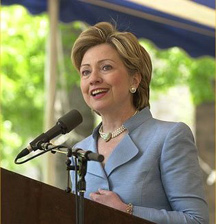 Hillary Clinton: Trump will provoke ‘nuclear arms race’ over North Korea, Guardian, 15 Oct 17,
Former secretary of state refuses to say if successor Tillerson should go, as she decries Trump approach to Iran nuclear deal. Hillary Clinton has denounced Donald Trump’s bellicose language toward North Korea, believing his verbal aggression has rattled American allies and will set off a nuclear arms race in the region.
Clinton, who was secretary of state under Barack Obama from 2009 to 2013, stressed that she preferred a diplomatic solution; suggested Trump’s inflammatory rhetoric played into Kim Jong-un’s hands; and bemoaned Trump’s public undercutting of his secretary of state, Rex Tillerson, regarding his attempts to work with China and establish talks with Pyongyang.
“Diplomacy, preventing war, creating some deterrents is slow, hard-going, difficult work,” said Clinton, who declined to answer when asked if Tillerson should resign. “And you can’t have impulsive people or ideological people who basically say, ‘Well, we’re done with you.”’
On Friday Bob Corker, the Tennessee Republican who chairs the Senate foreign relations committee, continued his war of words with the president when he told the Washington Post Trump had “castrated” Tillerson.
Donald Trump’s 3 dysfunctional decisions regarding Iran and North Korea
 Trump’s trifecta: thoughtless Iran folly strains his partners’ patience http://www.smh.com.au/federal-politics/political-news/trumps-trifecta-thoughtless-iran-folly-strains-his-partners-patience-20171014-gz0zgu.html, Mark Kenny 16 Oct 17,
While there are concerns over Iran’s behaviour (mostly outside the agreement’s purview, but not entirely), its nuclear retreat is a real-time, real-world example of how coordinated international pressure, coupled with a willingness to
While the Obama Administration was the locomotive force behind the 2015 agreement, it was a settlement between Tehran and the five permanent members of the United Nations Security Council – China, France, Britain, Russia and the US – with the European Union tagging along.
Thus, it is a multi-lateral instrument annexed to UN Security Council resolution 2231, the text of which welcomes inter alia diplomatic efforts by the five plus Iran “to reach a comprehensive, long-term and proper solution to the Iranian nuclear issue, culminating in the Joint Comprehensive Plan of Action [JCPOA]”.
It also notes explicitly “Iran’s reaffirmation in the JCPOA that it will under no circumstances ever seek, develop or acquire any nuclear weapons”.
Over the weekend, Trump threw that process into new uncertainty, by demanding that Congress and America’s allies introduce new tests for Iran’s compliance, including by dragging in elements outside the nuclear purview.
In so doing Trump has achieved the dysfunctional trifecta by: (i) putting the JCPOA deal at risk, and thus potentially increasing the prospect of Tehran’s return to a nuclear weapons path, (ii) showing contempt for America’s closest allies by demonstrating that he will act unilaterally against their interests at a whim, and (iii) signalling to North Korea, Iran, and any other adversary that there is little point in negotiating because even after a deal is made and complied with, the US can simply renege.
Tweet that.
Are the remains of an experimental reactor buried on the Niagara Falls storage site?
A wide range of radioactive material was dumped cavalierly on site during the Second World War and the decades that followed: plutonium, uranium, thorium, cesium, polonium, strontium, and other dangerous materials. On site today, buried with that steel ball, is what is assumed to be irradiated graphite and almost 4,000 tons of radioactive radium-226, the largest repository in the western hemisphere, representing a staggering quantity of radiation.
—isotopes of plutonium, uranium, cesium, polonium, and other elements that are produced only inside nuclear reactors and by nuclear explosions—
It was known as the Radiological Warfare, or RW, program, and under its auspices scientists studied what materials could best be weaponized, what health consequences they would have on an enemy,
 The Bomb That Fell On Niagara: The Sphere Artvoice Weekly Edition » Issue v7n39 (09/24/2008), by Geoff Kelly & Louis Ricciuti
Are the remains of an experimental reactor buried on the Niagara Falls storage site?
This is going to seem complicated and take a long way to get where it’s going. So here’s the gist, right upfront: Possibly, in Lewiston, are buried the remnants of an experimental nuclear reactor dating from the 1940s. This reactor would have been part of a secret program to weaponize poisonous materials—a program with roots in the study of poison gases in the First World War and whose culmination is found today in the use of depleted uranium munitions around the world.
Sure, it sounds like a plot inspired by Dr. Strangelove. But read on.
Amid the radioactive slurry and scrap interred in the 10-acre interim containment facility at the Niagara Falls Storage Site in Lewiston is a curiosity: a hollow industrial steel ball, 38 feet in diameter.
You won’t find that house-sized steel ball on any waste materials manifest, at least not on any manifest released to the public by the US Army Corp of Engineers, which is the site’s caretaker, or the US Department of Energy, which owns the site and the hazardous waste buried there.
The ball exists in aerial photographs taken of the site in the mid 1940s, however, and it appears to have been rediscovered in a 2002 electric resistivity underground imaging study performed by defense contracting giant SAIC.
In those aerial photos, the ball sits some distance from the main cluster of buildings; the nearest structure is a concrete silo, which eventually became a receptacle for high-energy radium wastes, a legacy of local industry’s central role in the Manhattan Project and the Atomic Energy Commission, which produced the first atomic bombs.
The Army Corps say there is no documentary record of the ball having been removed from the site. And the 2002 electric imaging scans suggest that a steel sphere, 38 feet in diameter, just like the one in the photos, is buried about a quarter mile from the ball’s original location, on the developed portion of a vast, former federal reservation called the Lake Ontario Ordnance Works. The LOOW came online officially in 1942, a 7,500-acre facility cobbled together from farm fields by the Department of War. Its initial use, according to the site’s official history, was a TNT factory. That factory closed, however, after nine months, at the height of the Second World War. The factory and all its infrastructure—miles of massive pipes, a water and power grid sufficient to sustain a city of 100,000 people, dozens of industrial buildings—were declared surplus.
The LOOW’s actual uses have been a mystery, whose plots and subplots have been revealed slowly and grudgingly by an unforthcoming federal government. ……..
Various sectors of the vast compound became dumping grounds for toxic radiological and chemical waste produced in Niagara Falls factories, as well as laboratories and reactors nationwide, working first on the atom bomb project and later on other Atomic Energy Commission and defense- and intelligence-related projects. A wide range of radioactive material was dumped cavalierly on site during the Second World War and the decades that followed: plutonium, uranium, thorium, cesium, polonium, strontium, and other dangerous materials. On site today, buried with that steel ball, is what is assumed to be irradiated graphite and almost 4,000 tons of radioactive radium-226, the largest repository in the western hemisphere, representing a staggering quantity of radiation.
Beginning in 1980, these wastes—originally dumped in open pools, seeping out of corroded barrels, or just piled on open ground—were consolidated by the DOE into a temporary containment structure on the 119-acre Niagara Falls Storage Site.
The existence on the LOOW of particularly exotic transuranics (that is, above uranium on the periodic table) and fission materials—isotopes of plutonium, uranium, cesium, polonium, and other elements that are produced only inside nuclear reactors and by nuclear explosions—has begged an explanation for decades. The Army Corps says that these transuranics and fission materials arrived at the LOOW with waste from the Navy’s Knolls Atomic Power Laboratory near Schenectady. But the waste from Knolls doesn’t explain all the transuranics and fission materials found on the LOOW, according to some experts, and it doesn’t explain how widespread and how much.
That steel sphere buried among this collection of radiological waste suggests another, simpler explanation: Could that steel ball—a Hortonsphere, named for the inventor of the process of its fabrication—been a component in an early model of an experimental ball-and-pile reactor? One in which exotic materials were created or irradiated, all in the service of a federal weapons program that sought to find new and lethal applications of the materials created in Niagara Falls for the Manhattan Project and beyond?
“I’d have to say yes,” says Tedd Weyman, of the Uranium Medical Research Centre, based in Toronto.
Occam’s Razor
Weyman is a physicist and his group, UMRC, studies the effects of uranium, transuranium elements, and radionuclides produced by the process of uranium decay and fission. UMRC is especially interested in the health effects of depleted uranium, whether it enters the environment as a result of munitions use or as waste.
Weyman examined the aerial photographs of the ball and silo, the list of transuranics and fission materials found on site, and the electric imaging scan that seemed to show that same ball from the photos buried alongside radioactive waste. He reviewed documents that describe the history of the LOOW site and of Niagara Falls industry over the past 60 or so years: the metals and chemicals and devices created in nearby factories, the experimental programs undertaken by defense and intelligence agencies beginning in the 1940s. He considered the size of the Hortonsphere, which he said is consistent with a ball reactor, and its placement in relation to the silo, which is consistent with the pile in a ball and pile reactor—that is, the source of the reactor’s “fuel” and critical reactions.
Weyman then listened to the explanations the Army Corps offered for the ball and the transuranics and fission products: that the ball was used to store anhydrous ammonia used in making TNT and the transuranics and fission products came from Knolls. He concluded that an on-site reactor was a far simpler explanation.
“They’re fission products,” Weyman says of the residues found on site…..
On the subject of the history of the LOOW site and the environmental dangers it poses, the Army Corps has been less than reliable when discussing the documentary evidence. In 2000, for example, when offered evidence that plutonium-tainted waste from medical experiments conducted at the University of Rochester had been buried on the LOOW site, the Corps denied such evidence existed. Eventually, they allowed both that the evidence existed and that the plutonium-tainted waste had been found on site…….
Occam’s Razor is the principle that the simplest explanation is most often the correct one. There’s that anomaly, exactly the diameter of the ball in question, which is exactly the size and manufacture of a ball reactor vessel. It is interred alongside radioactive waste. It originally sat near a silo, which once stored radioactive waste; a 1944 photo of the site looks like a photo of a ball and pile reactor of that era. And there are transuranics and fission materials buried nearby, as well as irradiated graphite, whose nature, quantity, and location aren’t completely explained by the Knolls hypothesis.
“If it quacks, is it not a duck?” Weyman says. “It’s quacking pretty loud.”……….
It was known as the Radiological Warfare, or RW, program, and under its auspices scientists studied what materials could best be weaponized, what health consequences they would have on an enemy, how best to deliver and disperse radioactive materials to a battle zone, and how much to use. This research was more secretive, but here too the expertise of local industries proved valuable. In a brochure from the postwar era, Bell Aircraft (later Bell Aerospace) bragged of its research in area weapons: that is, devices that disperse materials across a battlefield. Niagara Sprayer (a.k.a. FMC, the Middleport company that manufactured Agent Orange) created specialized compounds and nozzles for spraying agricultural metals, powders, and insecticides.
And over at the LOOW site, there was a mammoth federal reserve on which exotic radioactive wastes were accumulating.
Bob Nichols, the San Francisco-based writer who came to the same conculsion as Weyman about the ball buried on the NFSS, specializes in the history of this second track of research. He draws a straight line that connects the radiological warfare program to American research into poison gases, such as mustard gas and chlorine gas (both of which were produced in Niagara County), during the First World War; that line passes through the Manhattan Project along the way, and continues to the present-day use of depleted uranium munitions, which release a cloud of poisonous ceramicized uranium particles as a form of gas when they vaporize on impact.
Nichols explains that the first track—the building of more and better nuclear weapons—created vast stores of radiological waste materials. “The question back then was what on earth to do with it,” he said………
Whatever took place on the former LOOW site in the first decades of the Cold War may have evolved and—like so many local industries—moved away. But its legacy is in the dirt, air, and water. It’s interred under that clay cap. It’s in the region’s higher-than-expected rates of cancer, diabetes, and other illnesses. History should matter to the Corps as much as it matters to those who live in its aftermath.
For more documents and photographs related to the article, visit AV Daily at Artvoice.com. http://artvoice.com/issues/v7n39/the_sphere.html
Trump’s anti-Iran speech, decertifying nuclear agreement, will cause problems with America’s European allies
 Iran nuclear deal: Trump decertifies Obama-era agreement and accuses Tehran of spreading ‘death and chaos’ The President’s more confrontational strategy toward Iran is likely to complicate relations with European allies, Independent UK, Alexandra Wilts Washington DC , 14 Oct 17, Donald Trump has struck a blow against the 2015 Iran nuclear agreement – in defiance of other world powers – by choosing not to certify that Tehran is complying with the deal.
During a speech at the White House, Mr Trump accused the “fanatical regime” in the Iranian capital of spreading “death, destruction and chaos around the globe” as he again called the nuclear pact “one of the worst” agreements the US has ever entered into.
However, he stopped short of scrapping the agreement altogether, saying he wanted his administration to work with Congress and other nations to address the “deal’s many serious flaws”. ……Federica Mogherini, the EU’s foreign policy chief and one of the deal’s chief negotiators, said the agreement will remain valid regardless of Mr Trump’s decision. ……
The move by Mr Trump was part of his “America First” approach to international agreements which has led him to withdraw the United States from the Paris climate accord and the Trans-Pacific Partnership trade talks and renegotiate the North American Free Trade Agreement with Canada and Mexico……
Mr Trump’s more confrontational strategy toward Iran is likely to complicate relations with European allies while strengthening ties with Israel.A vocal opponent of the agreement when it was signed, Israeli Prime Minister Benjamin Netanyahu welcomed Mr Trump’s “courageous” decision.
“I congratulate President Trump for his courageous decision today. He boldly confronted Iran’s terrorist regime,” the prime minister said in a video statement he released in English.
But both UK Prime Minister Theresa May and French President Emmanuel Macron this week had tried to persuade Mr Trump to re-certify the deal. Ms May has called the agreement “vital”, while Mr Macron has said it is “essential for peace”. …….
Russia’s foreign ministry said there was no place in international diplomacy for threatening and aggressive rhetoric such as that displayed by Mr Trump and said such methods were “doomed to fail”, in a statement issued after Mr Trump’s speech……
John McLaughlin, a former acting CIA director under Republican President George W Bush, called the decertification of the Iran deal one of Mr Trump’s “worst decisions”.
The decision “feeds Iran hardliners, splits allies, shreds US credibility, roils congress [and is a] gift to Russia,” he wrote on Twitter. http://www.independent.co.uk/news/world/americas/us-politics/iran-nuclear-deal-donald-trump-decertifies-agreement-2015-policy-obama-a7999451.html
Fact checking Donald Trump’s statements on Iran
 AP FACT CHECK: Trump’s statements on Iran http://www.dailymail.co.uk/wires/ap/article-4978836/AP-FACT-CHECK-Trumps-statements-Iran.html
By Associated Press 14 October 2017, WASHINGTON (AP) – President Donald Trump offered a questionable reading of Iran’s past economic condition Friday when he blamed the Obama administration for lifting sanctions just as Iran’s government was facing “total collapse.”
A look at some of his points in remarks Friday that denounced Iran’s behavior but stopped short of fulfilling his campaign promise to get the U.S. out of the multinational deal that eased sanctions on Iran in return for a suspension of its nuclear program:
THE FACTS: An imminent collapse of Iran’s economy was highly unlikely, according to international economists and U.S. officials.
International penalties on Iran in response to its nuclear program did drive its economy into crisis earlier this decade. But even before the nuclear deal, Iran had cut budget expenditures and fixed its balance of payments. It was still exporting oil and importing products from countries such as Japan and China.
The multinational deal froze Iran’s nuclear program in return for an end to a variety of oil, trade and financial sanctions on Tehran. Iran also regained access to frozen assets held abroad. The deal was conceivably an economic lifeline for the state, but international economists as well as U.S. officials did not foresee an imminent economic collapse at the time.
Among those experts, Patrick Clawson at the Washington Institute for Near East Policy said Iran’s leaders worried about the potential for social unrest at the time, but that the economy was sustainable.
TRUMP: “The Iranian regime has committed multiple violations of the agreement. For example, on two separate occasions, they have exceeded the limit of 130 metric tons of heavy water.”
THE FACTS: Iran is meeting all of its obligations under the deal, according to International Atomic Energy Agency investigators, who noted some minor violations that were quickly corrected.
Trump is right that Iran exceeded the limit on heavy water in its possession on two occasions. Both times, international inspectors were able to see that Iran made arrangements to ship the excess out of the country so that it could come back into compliance.
Deal supporters argue this shows the agreement works. Deal opponents say that because Iran sells the surplus on the open market, Iran is therefore being rewarded for violating the deal.
Trump and other critics of the agreement point in particular to Iran’s continuing missile tests, which may or may not defy the U.N. Security Council resolution that enshrined the deal. But those tests do not violate the deal itself.
TRUMP on the deal: “It also gave the regime an immediate financial boost and over $100 billion its government could use to fund terrorism. The regime also received a massive cash settlement of $1.7 billion from the United States, a large portion of which was physically loaded onto an airplane and flown into Iran.”
THE FACTS: The “financial boost” was from money that was Iran’s to begin with. It was not a payout from the U.S. or others but an unfreezing of Iranian assets held abroad.
The $1.7 billion from the U.S. is a separate matter. That dates to the 1970s, when Iran paid the U.S. $400 million for military equipment that was never delivered because the government was overthrown and diplomatic relations ruptured.
The rupture left people, businesses and governments in each country indebted to partners in the other, and these complex claims took decades to sort out in tribunals and arbitration. For its part, Iran paid settlements of more than $2.5 billion to American people and businesses.
The day after the nuclear deal was implemented, the U.S. and Iran announced they had settled the claim over the 1970s military equipment order, with the U.S. agreeing to pay the $400 million principal along with $1.3 billion in interest. Find AP Fact Checks at http://apne.ws/2kbx8bd
‘NO” to resuscitation of nuclear reactors – they should be closed, and then autopsied
Six US reactors — at five sites — have closed since 2013. Seven more remain on target to close within the next eight years, some of them as soon as 2019. A handful more had announced planned shutdowns, then received bailouts to prolong their existence, even though the plants are uneconomical and in dangerously degraded states due to aging and other factors. Wear and tear is a concern with any aging technology, but the risk factor goes up dramatically when nuclear power plants, filled with radioactive materials, are at issue.
Given the complexity of nuclear plants, their aging parts, rubber-stamped operating license extensions and their vulnerability to catastrophic failure, it makes sense to examine the “dead” reactors for a more reliable safety assessment of the potential failings of the “living” reactors. But the nuclear industry and its regulator, the US Nuclear Regulatory Commission (NRC), has successfully avoided this common-sense safety procedure for decades. Given the regularity with which US nuclear reactors are shutting down — a statistic that will likely only increase over time — we have quite a few closed reactors already, and plenty more in the pipeline. This is a perfect opportunity to conduct a full investigation into the extent of decay inherent in the nuclear plants still running.
Nuclear Reactors Can Cost More to Decommission Than to Build
When reactors close, they don’t just disappear. They must be decommissioned. This is a long, complicated and, above all, outrageously expensive process. For example, the Yankee Rowe Nuclear Power Plant in Massachusetts, which operated from 1960 to 1992, cost $39 million to build. Its decommissioning took 15 years and cost $608 million.
Vermont Yankee, shuttered at the end of 2014, is currently looking at a price tag of at least $1.24 billion in decommissioning costs. But this is an estimate from its owner, Entergy. The real figure could be a lot higher.
Decommissioning involves the removal and, theoretically, the decontamination of equipment, structures and portions of the facility containing radioactive contaminants. This allows the property to be released from NRC oversight and terminates the NRC license. The high-level radioactive waste, essentially the irradiated nuclear fuel, currently has nowhere to go and remains on site in dry storage casks. But decommissioned sites can remain radioactively contaminated long after the reactors close. One such example is Big Rock Point on the shoreline of Lake Michigan, where plutonium-239 is still to be found in the high-level wastes and radioactive contamination at the site.
To date, the decommissioning of a US reactor does not include an examination of the site and materials. Instead, the evidence of the effects of aging and material degradation are buried with the dismantled reactor. This “autopsy” could reveal those effects and provide potentially life-saving insights into the risks run by operating reactors. Furthermore, it would also verify (or dispute) quality assurance documentation for the fabrication process of installed safety-related nuclear components.
For example, it is now known that 17 of our operating nuclear reactors contain key safety parts that might be dangerously flawed. These large components were manufactured at the French Le Creusot forge, which was not only caught producing and selling substandard components, but tried to cover up its loss of quality control as well. This revelation resulted in the shutdown of 17 French reactors with Creusot components late last year as well as the forge itself, which was only reopened in July.
Fortunately, one of the US reactors that reportedly has a Creusot part is now permanently closed — the Crystal River nuclear generating station on Florida’s west coast. An autopsy of Crystal River would not only provide safety insights into the potential jeopardy at the 17 reactors still operating with suspect Creusot parts, it would also deliver general intelligence about the state of our entire operating reactor fleet.
An autopsy would take an enhanced look at the remaining material integrity of safety-related structures and components, particularly those that are difficult to reliably assess in operating reactors. This would include destructive analysis by cutting up large components like the reactor pressure vessel for an assessment of radiation-induced cracking, embrittlement and stress corrosion cracking. Sections of the concrete containment and “spent” nuclear fuel storage structures could be tested for the same aging effects that weaken concrete in bridges and dams.
Captured Regulators May Not Act to Examine Flaws in Closed Reactors
Rest assured no such examinations will happen voluntarily. One of us, Paul Gunter, now with Beyond Nuclear, joined 10 safe energy groups in 1995 to petition the NRC to conduct autopsies on embrittled reactor pressure vessels at the permanently closed Yankee Rowe, Trojan, San Onofre and Rancho Seco nuclear power stations.
The groups wanted the NRC to archive material specimens and set a benchmark on age-degradation for the rest of the operating industry. The NRC and industry didn’t want to know and rejected the petition.
This would seem to contradict the NRC’s mandate, proclaimed on its website as “protecting people and the environment.” Behind closed doors, the agency instead works tirelessly on behalf of the nuclear industry, protecting the corporate bottom line with almost evangelical zeal. The NRC has, for example, never denied a license extension to an operating reactor, no matter how blatant the safety risks. In December 2015, the NRC relicensed the Davis-Besse reactor in Ohio, despite the worsening cracking of the containment, without requiring the owners to repair a flaw so serious that a containment failure could lead to a meltdown.
Such capitulations have only one agenda — to save the nuclear industry money. Decommissioning costs are already so burdensome that Entergy is looking at a decommissioning option called SAFSTOR for its Vermont Yankee plant, which would essentially mothball the reactor for 60 years. By then, Entergy — already struggling financially — could be long gone, dodging the gigantic decommissioning bill altogether.
In order, therefore, not to demand expensive fixes of an industry in financial freefall, the NRC has a stellar track record of not enforcing its own safety orders, even though these might actually protect people and the environment. But the bigger cost that the NRC is seeking to avoid is the truth.
An autopsy might scientifically reveal just what a perilous, pre-meltdown condition most of our nuclear power plants are in. Such evidence would expose the NRC’s reckless bias in allowing US reactors to operate without essential safety fixes. It’s a gamble that saves the industry money, but which could cost thousands of lives or more.
Such revelations would also put a serious dent in the NRC’s efforts to extend the operating licenses of its remaining reactor fleet out to 60 and even a terrifying 80 years as the agency is now planning to do.
And the safety vulnerabilities uncovered by an autopsy might actually frighten people. They would start to question whether nuclear power was actually as safe as the NRC and the industry say it is, especially when they learn just how many things could go wrong. They might actually see the industry’s “safe and reliable” mantra for the lie that it is.
That’s exactly the kind of publicity the NRC and the industry don’t want. It’s this cost, more than that of the autopsy itself, that they are really trying to avoid. Because, for an inherently dangerous industry, the price of the truth is just too high http://www.truth-out.org/opinion/item/42228-nuclear-power-plants-should-be-closed-and-autopsied-not-resuscitated
Paul Gunter is the director of the Reactor Oversight Project at Beyond Nuclear.
Linda Pentz Gunter is an international specialist at Beyond Nuclear. She writes columns on the follies and false representations of nuclear energy and the link between nuclear power and nuclear weapons. Her views also appear on the Beyond Nuclear Twitter site.
RELATED STORIES
Nuclear Power Is on the Wane, Despite Efforts of High-Profile Boosters
Nuclear Power Is Not “Green Energy”: It Is a Fount of Atomic Waste
Nuclear Regulators’ Flawed Analysis Leaves Millions at Risk From Radioactive Fires
Nancy Pelosi pushing U.S. Congress to outlaw pre-emptive nuclear strike
Pelosi Says Congress Should Weigh Policy Change on Nuclear Arms https://www.voanews.com/a/pelosi-says-congress-should-weigh-policy-change-nuclear-arms/4067891.html WASHINGTON 13 Oct 17,
House Minority Leader Nancy Pelosi is pushing Congress to pass a measure saying that the U.S. would not fire its nuclear weapons unless another country did so first.
But the California Democrat insisted Thursday that her suggestion had nothing to do with President Donald Trump, even though it came in the wake of Trump’s warnings to North Korea and his reported suggestion that the nation’s nuclear arsenal should increase in size.
Pelosi said the current policy was outdated and any changes would apply to all presidents in the future.
Pelosi raised the issue at her weekly press conference, telling reporters, “There is interest in the U.S. establishing itself as no first use, no first nuclear use.”
1 This Month





PLEASE OPPOSE HR 8255 AND S.3639 – bills would accelerate satellite deployment, with no environmental review or safeguards – https://ncstd5li.quorum.us/campaign/169331/
To see nuclear-related stories in greater depth and intensity – go to https://nuclearinformation.wordpress.com
-
Archives
- October 2026 (67)
- September 2026 (339)
- August 2026 (330)
- July 2026 (355)
- June 2026 (287)
- May 2026 (306)
- April 2026 (356)
- March 2026 (251)
- February 2026 (267)
- January 2026 (308)
- December 2025 (358)
- November 2025 (359)
-
Categories
- 1
- 1 NUCLEAR ISSUES
- business and costs
- climate change
- culture and arts
- ENERGY
- environment
- health
- history
- indigenous issues
- Legal
- marketing of nuclear
- media
- opposition to nuclear
- PERSONAL STORIES
- politics
- politics international
- Religion and ethics
- safety
- secrets,lies and civil liberties
- spinbuster
- technology
- Uranium
- wastes
- weapons and war
- Women
- 2 WORLD
- ACTION
- AFRICA
- Atrocities
- AUSTRALIA
- Christina's notes
- Christina's themes
- culture and arts
- Events
- Fuk 2022
- Fuk 2023
- Fukushima 2017
- Fukushima 2018
- fukushima 2019
- Fukushima 2020
- Fukushima 2021
- general
- global warming
- Humour (God we need it)
- Nuclear
- RARE EARTHS
- Reference
- resources – print
- Resources -audiovicual
- Weekly Newsletter
- World
- World Nuclear
- YouTube
-
RSS
Entries RSS
Comments RSS

