The Sway of the Nuclear Arms Industry Over Donald Trump and Congress Is Terrifying “The devastation is very important to me.” Mother Jones WILLIAM HARTUNGNOV. 18, 2017 This story originally appeared on TomDispatch.com. “……..Another way the nuclear weapons industry (and the rest of the military-industrial complex) tries to control and focus public debate is by funding hawkish think tanks. The advantage to weapons makers is that those institutions and their “experts” can serve as front groups while posing as objective policy analysts. Think of it as intellectual money laundering.
One of the most effective industry-funded think tanks in terms of promoting costly, ill-advised policies has undoubtedly been Frank Gaffney’s Center for Security Policy. In 1983, when President Ronald Reagan first announced his Strategic Defense Initiative (a.k.a. “Star Wars”), the high-tech space weapons system that was either meant to defend the country against a future Soviet first strike or—depending on how you looked at it—free the country to use its nuclear weapons without fear of retaliation, Gaffney was its biggest booster. More recently, he has become a prominent purveyor of Islamophobia, but the impact of his promotional work for Star Wars continues to be felt in weapons contracts to this day.
Just as George W. Bush was entering the White House, another industry-backed think tank, the National Institute for Public Policy, released a report on nuclear weapons policy that would be adopted almost wholesale for the new administration’s first key nuclear posture review. It advocated such things as increasing the number of countries targeted by US nukes and building a new, more “usable” bunker-busting nuclear weapon. At that time, NIPP had an executive from Boeing on its board. Its director was Keith Payne, who would become infamous in the annals of nuclear policy for co-authoring a 1980 article at Foreign Policy entitled “Victory Is Possible,” suggesting that the United States could actually win a nuclear war, losing “only” 30 million to 40 million people. This is the kind of expert the nuclear weapons complex funded to promulgate its views.
Then there’s the Lexington Institute, a think tank that never met a weapons system it didn’t like. Lexington front man Loren Thompson is frequently quoted in news stories on defense issues, but it is rarely disclosed that he is funded by Lockheed Martin, Northrop Grumman, and other nuclear weapons contractors.
Just as George W. Bush was entering the White House, another industry-backed think tank, the National Institute for Public Policy, released a report on nuclear weapons policy that would be adopted almost wholesale for the new administration’s first key nuclear posture review. It advocated such things as increasing the number of countries targeted by US nukes and building a new, more “usable” bunker-busting nuclear weapon. At that time, NIPP had an executive from Boeing on its board. Its director was Keith Payne, who would become infamous in the annals of nuclear policy for co-authoring a 1980 article at Foreign Policy entitled “Victory Is Possible,” suggesting that the United States could actually win a nuclear war, losing “only” 30 million to 40 million people. This is the kind of expert the nuclear weapons complex funded to promulgate its views.
Then there’s the Lexington Institute, a think tank that never met a weapons system it didn’t like. Lexington front man Loren Thompson is frequently quoted in news stories on defense issues, but it is rarely disclosed that he is funded by Lockheed Martin, Northrop Grumman, and other nuclear weapons contractors.
Examples include Secretary of Defense James Mattis, a former board member at General Dynamics; White House Chief of Staff John Kelly, who worked for a number of defense firms and was an adviser to DynCorp, a private security firm that has done everything from (poorly) training the Iraqi police to contracting with the Department of Homeland Security; former Boeing executive and now Deputy Secretary of Defense Patrick Shanahan; former Lockheed Martin executive John Rood, nominated as undersecretary of defense for policy; former Raytheon Vice President Mark Esper, newly confirmed as secretary of the Army; Heather Wilson, a former consultant to Lockheed Martin, who is now secretary of the Air Force; Ellen Lord, a former CEO for the aerospace company Textron, who is undersecretary of defense for acquisition; and National Security Council Chief of Staff Keith Kellogg, a former employee of the major defense and intelligence contractor CACI, where he dealt with “ground combat systems” among other things.
Keep in mind that these high-profile industry figures are just the tip of the iceberg when it comes to the corporate revolving door that has been installed in the Pentagon for decades, as journalist Lee Fang has documented in the Intercept.
Given the composition of his national security team and Trump’s love of all things nuclear, what can we expect from his administration on this front? In addition to the $1.7 trillion nuclear build-up, Trump’s impending nuclear posture review seems to include proposals for dangerous new weapons like a “low-yield,” purportedly more usable nuclear warhead. He’s spoken privately with his team about expanding the arsenal in a staggering fashion—the equivalent of a 10-fold increase. He’s wholeheartedly embraced missile defense spending, pledging to put billions of dollars more into that overfunded, under-producing set of programs. And of course, he is assiduously trying to undermine the Iran nuclear deal, one of the most effective arms control agreements of recent times, and so threatening to open the door to a new nuclear arms race in the Middle East.
Unless the nuclear spending spree being pushed by President Trump as the best thing since the invention of golf is stopped thanks to public opposition, the rise of an antinuclear movement, or congressional action, we’re in trouble. The nuclear weapons lobby will again have won the day—just as it did almost 60 years ago, despite the opposition of a popular president and decorated war hero.
And Donald Trump, “bone spurs” and all, is no Dwight D. Eisenhower.
Problems persist a decade after discovery of chronic radioactive leaks Chicago Sun Times, 11/19/2017, Brett Chase and Madison Hopkins | Better Government Association More than a decade after the discovery of chronic leaks led to national outrage, a $1.2 million government settlement and a company vow to guard against future accidents, an investigation by a government watchdog group found.
Since 2007, there have been at least 35 reported leaks, spills or other accidental releases in Illinois of water contaminated with radioactive tritium, a byproduct of nuclear power production and a carcinogen at high levels, a Better Government Association review of federal and state records shows.
No fines were issued for the accidents, all of which were reported by the company.
The most recent leak of 35,000 gallons occurred over two weeks in May and June at Exelon’s Braidwood plant, southwest of Chicago. The same facility was the focus of a community panic in the mid-2000s after a series of accidents stirred debate over the safety of aging nuclear plants.
A 2014 incident at Exelon’s Dresden facility in Grundy County involved the release of about 500,000 gallons of highly radioactive water. Contamination was later found in the plant’s sewer lines and miles away in the Morris, Ill., sewage treatment plant……..
Industry watchdogs and government whistleblowers contend oversight is compromised by a cozy relationship between companies and the NRC.
Government regulators concede they must balance the safety needs of aging plants, which require more maintenance, versus ordering cost-prohibitive upgrades at facilities that inherently are just a slip-up away from catastrophe.
No player in the nuclear industry is bigger than Exelon, the Chicago-based energy company that last year reported $31 billion in revenue and operates 14 nuclear plants in Illinois, New York, New Jersey, Pennsylvania and Maryland.
Five of the six Illinois plants reported leaks over the last decade, records show. Clinton, in DeWitt County, had no leaks and Byron, in Ogle County, reported only one that contained low levels of radioactivity…….
At least seven of the 35 documented accidents since 2007 involved contamination of groundwater. Other contamination was found in sewers and other water systems where it isn’t supposed to be………
The BGA investigation also found:
Of the 35 documented incidents, 27 occurred at Dresden. Following the big 2014 leak, which emanated from an aboveground storage tank, Exelon asked a state inspector whether the public would have access to the incident report under open records laws, a state report showed.
An NRC report on the 2007 Quad Cities leak noted radiation levels went “well beyond that seen anywhere else in the industry” and that plant staff estimated the leak had been active for years before it was discovered.
In 2010, Exelon’s Marseilles generating plant in LaSalle County reported a spill from a storage tank, initially estimated at more than 150 gallons but later classified as “unknown.” Groundwater tritium tests later showed levels 59 times the EPA’s drinking water limit. Exelon said no tritium left the plant’s boundaries, but records show plant workers continued to monitor a body of highly contaminated groundwater sitting on plant property at least five years after the accident.
In 2009, Dresden reported another hole in a storage tank led to a leak of as much as 272,000 gallons of radioactive water. Onsite groundwater testing showed levels of tritium 160 times higher than allowed under federal standards for drinking water.
Ultimately, the larger problem is that President Trump’s policy objectives are unattainable.
Denuclearization is a non-starter from North Korea’s perspective because Kim believes – not without reason – that nuclear weapons are a matter of regime survival, having seen what happens to leaders in countries like Libya when they give up their nuclear programs.
As long as President Trump insists on “complete, verifiable and total denuclearization,” Washington is walking America down a path that leads to (likely nuclear) military conflict
It would be both foolish and naïve to think that all the tough talk coming out of the Trump administration is simply meant to intimidate North Korean dictator Kim Jong Un into giving up his nuclear weapons and long-range missiles.
The three so-called “adults in the room” who are apparently the strongest voices influencing President Trump’s foreign policy are National Security Advisor H.R. McMaster, Secretary of Defense James Mattis and White House Chief of Staff John Kelly.
Mattis is an active duty lieutenant general in the Army. Mattis and Kelly are retired Marine Corps generals. Their common experience is commanding ground forces in the Iraq War. If they are shaping the Trump administration’s North Korea policy, it stands to reason that their views would have a decidedly military tilt.
If President Trump decides to take military action, what might it look like?
Any unprovoked U.S. military action would be a preventive strike. That is, a military strike intended to prevent North Korea from acquiring a future capability to attack the U.S. That is different from a preemptive strike that is launched to stop an imminent military attack from an adversary.
So what military options are truly available to President Trump?
Option 1: Preventive nuclear strikes.
It’s impossible to completely rule out the possibility – however remote – that the U.S. might use nuclear weapons in a preventive strike against North Korea.
If North Korea’s nuclear program and weapons are in deeply buried and hardened bunkers, nuclear weapons might be the only way to destroy them with a high rate of confidence. A relatively little-known fact is that the United States has a nuclear bunker buster: the B61-11 low- yield nuclear gravity bomb.
About 50 B61-11 bombs are believed to be deployed. Theoretically, the B61-11 could be mated with GPS guidance to make it a precision strike weapon. Also, the B61-11 could theoretically be outfitted with the BLU-113 hardened steel-tipped warhead to penetrate more than 30 feet of concrete.
But wouldn’t using nuclear weapons be beyond the pale?
Under ordinary circumstances, yes. But the Trump administration may not believe these are ordinary circumstances. If the administration assumes military conflict with North Korea is inevitable and views North Korea as 1945 Japan, the rationale would be very similar: Using nuclear weapons would bring about a quick resolution and would save thousands of lives that would otherwise be lost in a conventional conflict. As a point of reference, more than 30,000 U.S. soldiers died in the Korean War.
Needless to say, the nuclear option would be a big gamble. If we were not 100 percent successful, we would have to expect that North Korea would retaliate with its full range of conventional and nuclear weapons.
While the U.S. homeland would not be threatened, both South Korea and Japan would be. And the nearly 35,000 U.S. military personnel stationed in South Korea would certainly be at risk – as would the estimated 200,000 or more U.S. citizens living in South Korea.
Option 2: Decapitation strikes by bombers or submarines.
Another big gamble would be a decapitating air and missile strike. This would be military action based on the belief that if North Korea’s leadership – Kim Jong Un and his most loyal top military and civilian leaders – could be killed, the regime would implode and collapse.
Success would depend on near-perfect intelligence about all the targets’ whereabouts. Moreover, we would have to assume that many of them – including Kim himself – would be in deeply buried and hardened bunkers that would be difficult to destroy, even with precision conventional missiles and bombs.
And we know from experience that we were not able to immediately take out Saddam Hussein and the other 54 “most wanted Iraqis” when we invaded Iraq in 2003.
If a decapitating strike failed, we would have to assume that North Korea would retaliate and we would be drawn into a protracted ground war.
At a minimum, North Korea would likely unleash a conventional artillery barrage on Seoul, which has a population of 10 million. While such an attack might not level Seoul, it would still cause significant damage and extract untold casualties. Kim might launch his nuclear weapons, believing he had nothing to lose.
Option 3: Conventional ground attack with hundreds of thousands troops.
So that leaves a conventional ground attack, which would likely be preceded and backed up by air and missile strikes.
Given the experience of McMaster, Mattis, and Kelly – as well as the fact that the chairman of the Joint Chiefs of Staff, Gen. Joseph Dunford, is a Marine – such an option makes sense and seems more likely. After all, expeditionary war is exactly what these generals know how to do.
However, almost all the experts believe that any such war would be drawn out and costly –perhaps as many as 20,000 deaths per day in South Korea.
And remember, Kim Jong Un would have the nuclear option at his disposal, along with his chemical and biological weapons. Such is the risk of any military action against a nuclear-armed country.
Option 4: Deterrence.
But the U.S. does have another military option. It just doesn’t involve the actual use of military force. It’s called deterrence.
North Korea has had nuclear weapons for at least a decade and has not used them against either South Korea or Japan. Presumably this is because of the threat of a U.S. nuclear response looms over Pyongyang’s head. If that’s the case, even in the worst case scenario of North Korea having the ability to launch a missile at the continental United States, deterrence would still hold.
Deterrence worked when America and the Soviet Union had thousands of warheads pointed at each other. Supposedly crazy or irrational leaders with nuclear weapons – such as Josef Stalin in the Soviet Union and Mao Zedong in China – were successfully deterred.
Indeed, Kim Jong Un would have to be suicidal to actually attack the U.S., knowing that we could respond with utterly devastating force that could result in his death and the total annihilation of his country. However, the Kim dynasty has repeatedly demonstrated its larger interest is its own survival and perpetuating the regime.
Ultimately, the larger problem is that President Trump’s policy objectives are unattainable.
Denuclearization is a non-starter from North Korea’s perspective because Kim believes – not without reason – that nuclear weapons are a matter of regime survival, having seen what happens to leaders in countries like Libya when they give up their nuclear programs.
As long as President Trump insists on “complete, verifiable and total denuclearization,” Washington is walking America down a path that leads to (likely nuclear) military conflict
Downing North Korean Missiles Is Hard. So the U.S. Is Experimenting. Buried in an emergency funding request to Congress lie hints of new ways to confront Pyongyang, like cyberweapons and armed drones. NYT ,By DAVID E. SANGER and WILLIAM J. BROADWASHINGTON — Concerned that the missile defense system designed to protect American cities is insufficient by itself to deter a North Korean attack, the Trump administration is expanding its strategy to also try to stop Pyongyang’s missiles before they get far from Korean airspace.
Sea level rise factors into nuclear waste discussion Pilgrim advisory panel reviews issues related to dry cask storage. Cape Cod Times, PLYMOUTH , 17 Nov 17,— Entergy Corp.’s plan to store more than 4,000 highly radioactive spent fuel assemblies in massive casks about 25 feet above mean sea level at Pilgrim Nuclear Power Station raised considerable concern among members of the Nuclear Decommissioning Citizens Advisory Panel at a meeting Wednesday.
Concerns ranged from the potential for the metal-lined casks to corrode over time and leak, to the possibility that sea level rise could put them underwater in a storm.
The spent fuel will likely be stored in multipurpose dry casks, manufactured by Holtec, that are 18 feet tall and 11 feet in diameter. Once filled, they weigh 173 tons. The casks will stand on two concrete pads outside the reactor. The first pad is already in place and holds eight loaded dry casks. It can accommodate about 38.
The second pad is yet to be built and its location is still under study. It will likely be close to the first. Highly radioactive metal now in the reactor’s core also will be stored in casks, Entergy representative Joseph Lynch said.
The plant is scheduled to shut down permanently by May 31, 2019. The 21-member advisory panel was appointed to advise the governor on matters related to the plant’s decommissioning.
The reactor’s location on the coast of Plymouth raises issues such as flooding potential and cask corrosion.
Lynch provided data, based on the company’s most recent flood study, that showed a Category 5 hurricane, with waves swelling to 9 feet, could raise the sea level to 22.4 feet.
Although Lynch said the data demonstrated “we have margins,” panel members and members of the public who attended the meeting said those margins were too tight…….
Rising sea levels should be factored into planning, said Duxbury resident James Lampert. “I’m concerned, and this panel should be concerned, that we’re always taking today’s snapshot,” Lampert said. “There’s no plan to move any of this stuff. You have to assume these casks may be on the two pads for 50 or 100 years.”
Lampert asked how much of the fuel was so-called “high burn-up” — a question Lynch could not answer. According to the Nuclear Regulatory Commission website, high burn-up spent fuel is hotter and more radioactive…….
Dry cask storage of lower burn-up spent nuclear fuel has been done since 1986, but dry storage of high burn-up spent fuel is more recent, according to the U.S. Office of Nuclear Energy website. About 200 dry casks have now been loaded with at least some high burn-up fuel, the site says, and almost all spent nuclear fuel being loaded in the United States is now high burn-up.
NRC spokesman Neil Sheehan declined “for security reasons” to say how much spent fuel at Pilgrim is high burn-up.
Lampert also asked the panel to review a study by research scientist Gordon Thompson on weapons capable of penetrating dry casks.
Mary Lampert, president of the citizens group Pilgrim Watch, called projections that plants already closed, such as Vermont Yankee, would be free of stored fuel by 2052 “fantasy,” since there is still no national repository to permanently handle spent fuel.
Gov. Charlie Baker and the decommissioning panel should be looking at the worst-case scenario, she said.
The multipurpose dry casks made by Holtec are not the best choice, she said.
“Holtec casks are designed for the short term,” she said. “Diablo Canyon’s casks are showing early signs of stress corrosion.”
Although the casks are permitted for 20 years by the NRC, they will likely be relicensed for 40 or even 60 years, Lynch said.
Bulletin of Atomic Scientists 16th Nov 2017,In an August 2017 report, former Energy Secretary Ernest Moniz argues for federal subsidies to prop up the US nuclear power industry on the novel
grounds that the industry is vital to our national security.
One of his principal conclusions is that to have an effective nonproliferation policy
we need to be selling lots of reactors internationally. The conclusion is
dead wrong but, unfortunately, it’s also influential.
The current energy secretary, Rick Perry, picked up the argument. In October 12 testimony, he
told Congress that “we have to support this industry,” because, among other
things, it is important to the success of our nonproliferation policy.
What kind of reactor exports might this entail? The Energy Department’s acting
assistant secretary for nuclear energy, Edward McGinnis, told an
International Atomic Energy Agency (IAEA) conference in Abu Dhabi on
November 1 that the United States wants “to spur exports of nuclear energy
plants and equipment, including to the conference’s host nation UAE and Saudi Arabia.”
That, after all, is where the export opportunities are—in
the Middle East, Asia, and Africa, among countries taking their first steps
into nuclear energy. Most don’t have the required financial resources and
would need massive loans.
Some, like Saudi Arabia, or perhaps Turkey,
appear to have more on their mind than electricity generation. The trouble
is that power programs based on the most common type of nuclear power
plant, the light water reactor, give a country a large leg up on creating a
nuclear weapons option if that is what it wants. As a result, more nuclear
reactors in more countries increase proliferation risks. Whatever the
advantages of this technology, nonproliferation is not one of them. https://thebulletin.org/exporting-power-reactors-no-way-fight-proliferation11282
We should dismantle our nuclear stash, not expand it, WHYY, By Aaron Kase, November 17, 2017
There is no better time than today to re-evaluate our country’s nuclear stance toward the rest of the world. Tensions with Russia are rising. China grows ever more powerful. And North Korea claims it has the capacity to reach the United States with a nuclear weapon, and it is willing to use it.
In that context, the United States is considering a large-scale weapon modernization program, upgrading the bombs and their delivery systems over the next several decades. Some reporting even suggests that the president has called for a tenfold increase of our arsenal. Although the proposition doesn’t have serious policy ramifications, it does represent a mindset that more is better when it comes to nuclear weapons.
Our nuclear deterrent force, one might think, is more important than ever, including the collection of 400 intercontinental ballistic missile — or ICBM — silos scattered throughout the country, ready to launch death and destruction at a moment’s notice. Conventional wisdom holds that all three legs of the triad — ICBMs, bombers and submarines — are necessary to prevent our adversaries from launching an attack on American soil. However, it’s increasingly clear that there’s no need to update the ICBM force at all, and, in fact, we would be better off dismantling the missiles that we currently have.
“Deterrence is so widely baked into American consciousness that it’s not even questioned,” says Ryan Snyder, a visiting research fellow at the Arms Control Association. “We have all these weapons to deter attacks on us.”
But, he points out, there’s no deterrence objective that ICBMs accomplish that our fleet of submarines and bombers can’t handle just as well. In the macabre scenario that we decided it necessary to launch a strike on another country, there is more than enough firepower on the subs and planes to target any plausible sites in Russia, China, North Korea, and Iran combined, with more weapons left over. No rational actor would strike the U.S. first under those conditions, and, if we aren’t dealing with rational actors, there’s no reason the ICBMs would stop them…..
a key problem with the ICBM force — the silos are just sitting there, on our homeland, and would be the first targets if Russia launched an attack to try to limit our retaliatory capabilities. Therefore if we suspect missiles are on their way toward American soil, we have to launch our own within half an hour or risk their destruction. That makes the system and, by extension, the world, critically vulnerable to a computer glitch or false alarm. It’s happened before.
By the same token, if Russia or another country even suspects we are preparing a first strike from our missile silos, it’s plausible they could launch their own to pre-empt it, detonating nuclear explosions across the country. That’s not an appealing scenario, to put it mildly.
To reduce the odds of any of these events, the best tack is to limit the number of nuclear weapons in the world, whether they are controlled by the U.S. government or others. And if the nation wants to take a realistic stance on nonproliferation, consider how little credibility we have to convince other countries not to develop weapons without making efforts to reduce the number and volatility of our own stash. “You don’t get to simply go around the world and say we have nuclear weapons and you don’t get to have them,” Snyder says. “I don’t think that’s a sustainable plan.”
Instead, we’re more likely to incite another arms race if we keep pouring money into our weapons, leading to a world with more nukes, not less. “We have to have a strategy that works toward trying to get rid of this kind of stuff,” Snyder continues. “That strategy is probably impossible without the United States making a unilateral reduction.”
On a less visceral level, the expense is another consideration. The plan to update our arsenal is estimated by various sources to cost between $1 trillion and $1.46 trillion, and that’s before we get into the inevitable delays and overruns. Up to $140 billion of that is geared toward new ICBMs, money that could be far better spent on other defense or domestic needs.
Finally, amid the discussions of technical capabilities and dollars and cents, don’t lose sight of the human component, taking into account the millions and millions of people who would be incinerated in the event of an all-out war, not to mention the very real possibility of rendering the planet uninhabitable to human life. Any action we can take to reduce those odds is the only rational way to go. What difference does it make if Russia has a few hundred more weapons than we do if everyone ends up dead anyway? https://whyy.org/articles/dismantle-nuclear-stash-not-expand/
Probe Finds Ongoing Radioactive Leaks at Illinois Nuclear Plants VOA News, 17 Nov 17, Radioactive waste continues to pour from Exelon’s Illinois nuclear power plants more than a decade after the discovery of chronic leaks led to national outrage, a $1.2 million government settlement and a company vow to guard against future accidents, an investigation by a government watchdog group found.
Since 2007, there have been at least 35 reported leaks, spills or other accidental releases in Illinois of water contaminated with radioactive tritium, a byproduct of nuclear power production and a carcinogen at high levels, a Better Government Association review of federal and state records shows.
No fines were issued for the accidents, all of which were self-reported by the company.
The most recent leak of 35,000 gallons (132,000 liters) occurred over two weeks in May and June at Exelon’s Braidwood plant, southwest of Chicago. The same facility was the focus of a community panic in the mid-2000s after a series of accidents stirred debate over the safety of aging nuclear plants.
A 2014 incident at Exelon’s Dresden facility in Grundy County involved the release of about 500,000 gallons (1,900,000 liters) of highly radioactive water. Contamination was later found in the plant’s sewer lines and miles away in the Morris, Illinois, sewage treatment plant.
Another leak was discovered in 2007 at the Quad Cities plant in Cordova. It took eight months to plug and led to groundwater radiation readings up to 375 times of that allowed under federal safe drinking water standards.
Exelon had threatened to close the Quad Cities plant, but relented last year after Gov. Bruce Rauner signed bailout legislation authorizing big rate hikes……..
David Lochbaum, an analyst with the nonprofit Union of Concerned Scientists, says “Leaks aren’t supposed to happen. Workers and the public could be harmed. There is a hazard there.”
Among the 61 nuclear power plants operating in the U.S., more than half have reactors that are at or near the end of their originally expected lifespans — including the Dresden and Quad Cities plants.
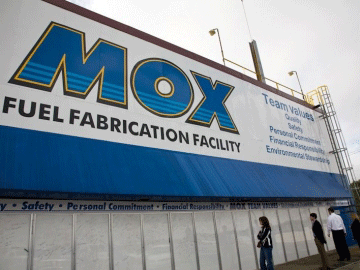
Associated Press Augusta Chronicle, 17 Nov 17 WASHINGTON — Congress on Thursday sent President Donald Trump a sweeping defense policy bill authorizing a $700 billion budget for the military, including $340 million for MOX at Savannah River Site. The defense authorization bill for 2018 sailed through the Senate by voice vote. The House had approved the measure earlier this week.
Public Watchdogs Files Lawsuit to Stop Burial of Spent Nuclear Waste at SONGS San Clemente Times, By Staff, November 16, 2017 By Eric Heinz
An organization that scrutinizes government activity is making a last effort to prevent the storage of spent nuclear fuel rods at San Onofre.
Public Watchdogs, a nonprofit organization based in La Mesa, filed a lawsuit in federal court on Wednesday against the United States government, the Department of Defense and Secretary James Mattis, as well as Southern California Edison, the operators of San Onofre Nuclear Generating Station (SONGS), and San Diego Gas and Electric to prevent the storage of more than 3.6 million pounds of radioactive fuel rods.
The lawsuit claims that under Public Law 88-82, a declaration from 1963 that allows the secretary of the Navy to authorize a permit for the nuclear power plant, storage of the spent nuclear waste was not authorized in the law.
The Navy owns the land where SONGS and Camp Pendleton are established.
Public Watchdogs is seeking an injunction that would find the “storage of spent nuclear fuel at SONGS is not authorized by, and is outside the scope of the authority granted to the Federal Defendants under, Public Law 88-82,” as well as “an order or judgment enjoining Federal Defendants from authorizing SCE and SDGE from storing spent nuclear fuel at SONGS and further enjoining SCE and SDGE from storing spent fuel at SONGS……. http://www.sanclementetimes.com/public-watchdogs-files-lawsuit-stop-burial-spent-nuclear-waste-songs/
Feinstein seeks contact with FBI informant in Russia nuclear bribery case, The Hill
BY JOHN SOLOMON – 11/16/17Sen. Dianne Feinstein (D-Calif.) has sought access to an undercover informant who helped the FBI chronicle bribery, kickbacks and money laundering inside Moscow’s nuclear industry as part of an Obama-era Russia corruption case.
Heather Sawyer, the general counsel for Feinstein — the top Democrat on the Senate Judiciary Committee — sent an email this week to the lawyer for the former FBI informant, William Campbell, seeking to be included in conversations involving the committee.
Sen. Chuck Grassley (R-Iowa), the chairman of the committee, secured an agreement with the Justice Department to allow Campbell to talk to Congress about the evidence he gathered for the FBI from 2009 to 2014 when he worked as a consultant for Tenex, a subsidiary of Russia’s state-owned commercial nuclear arm Rosatom.
Campbell’s work led to the indictments of three major players, including Tenex official Vadim Mikerin, a key Russian nuclear figure inside the United States who was sentenced to 48 months in prison in December 2015.
Grassley wants to know what the FBI did with the evidence it first gathered in 2009 that Mikerin and others inside the Russian nuclear industry were engaged in illegal activity.
The GOP chairman also wants to know whether the Obama administration was alerted to the illegal activity before it approved the sale of U.S. uranium assets to Rosatom and made other favorable decisions worth billions of dollars to Russia’s nuclear industry………
SCE&G proposes gas, solar for Summer replacement , WNN, 17 November 2017
South Carolina Electric & Gas Company (SCE&G) has unveiled a proposal that would see some of the capacity that should have been provided by the VC Summer nuclear power plant project replaced with gas and solar generation. The company’s shareholders would absorb the net construction costs of the abandoned nuclear project.
The proposal issued yesterday by the Scana Corporation subsidiary provides about $4.8 billion in benefits to SCE&G customers, and will require approval from South Carolina’s Public Service Commission (PSC).
SCE&G proposes acquiring a 540 MWe gas-fired power plant to replace “more than” 40% of the power that was projected to be provided from the two-unit Summer plant. The $180 million purchase price of the gas-fired plant will be borne by Scana shareholders, who will also forego any shareholder return over the life of the plant. The company said it will also add about 100 MWe of large-scale solar capacity to its system.
Electric rates for SCE&G’s customers – commercial, industrial and residential – will roll back to where they would have been in March 2015, which represents a reduction of about 3.5%. Scana shareholders will absorb the net nuclear construction costs through lower earnings over 50 years, which the company says will account for about $2.9 billion of the total $4.8 billion.
NASA reveals ‘nuclear engine’ that could provide power to the first humans on Mars
NASA plans to test the Kilopower engines on Earth this year
Will use a uranium rector the size of a toilet roll to create heat
High efficiency Stirling engine would then convert this to electricity, By Mark Prigg For Dailymail.com, 15 November 2017 |NASA’s Space Technology Mission Directorate (STMD) has provided multi-year funding to the Kilopower project.
The technology could produce from one to 10 kilowatts of electrical power, continuously for 10 years or more. The average U.S. household runs on about five kilowatts of power.
Testing is due to start in November and go through early next year, with NASA partnering with the Department of Energy’s (DOE) Nevada National Security Site to appraise fission power technologies.
‘The Kilopower test program will give us confidence that this technology is ready for space flight development.
‘We’ll be checking analytical models along the way for verification of how well the hardware is working,’ said Lee Mason, STMD’s principal technologist for Power and Energy Storage at NASA Headquarters.
NASA is set to begin testing a radical ‘nuclear engine’ that could provide power for astronauts on the Martian surface.
Dubbed the ‘Kilopower’ it would use a uranium rector the size of a toilet roll to create heat.
In a show of power, Japan, US begin joint naval drills off Korean Peninsula Trump’s harsh rhetoric, coupled with the North Korean regime’s ongoing weapons tests, have escalated regional tension to unprecedented levels
IANS | Tokyo Business Standard, November 16, 2017Japan and the US on Thursday began joint naval drills south of the Korean Peninsula in a show of power against North Korea.
The US sent its nuclear-powered aircraft carrier Ronald Reagan, three destroyers and around 14,000 troops to participate in the drills that will be conducted until November 26 in waters near the Okinawa archipelago, the US Navy said in a statement cited by Efe news.
Below is a statement by Lisbeth Gronlund, senior scientist and co-director of the Global Security Program at the Union of Concerned Scientists.
“I strongly support this effort to change U.S. nuclear weapons policy. The United States should take all steps possible to prevent a nuclear war—by increasing the threshold for deliberate use and reducing the risk of accidental use.
“Under current policy, the United States would consider using nuclear weapons first against Russia, China and North Korea. Deliberately starting a nuclear war with any of these countries would be disastrous. The United States would increase its own security and that of the rest of the world by eliminating the option of using nuclear weapons first and declaring that the only purpose of its nuclear weapons is to deter—and, if necessary, respond to—nuclear attacks on itself and its allies.”