Communities in Texas, Florida, other coastal states at risk
Credit rating agency says it’s adding climate to credit risks
Coastal communities from Maine to California have been put on notice from one of the top credit rating agencies: Start preparing for climate change or risk losing access to cheap credit.
In a report to its clients Tuesday, Moody’s Investors Service Inc. explained how it incorporates climate change into its credit ratings for state and local bonds. If cities and states don’t deal with risks from surging seas or intense storms, they are at greater risk of default.
“What we want people to realize is: If you’re exposed, we know that. We’re going to ask questions about what you’re doing to mitigate that exposure,” Lenny Jones, a managing director at Moody’s, said in a phone interview. “That’s taken into your credit ratings.”
In its report, Moody’s lists six indicators it uses “to assess the exposure and overall susceptibility of U.S. states to the physical effects of climate change.” They include the share of economic activity that comes from coastal areas, hurricane and extreme-weather damage as a share of the economy, and the share of homes in a flood plain.
Despite promising to “drain the swamp” of vested interests and lobbyists, it became clear Trump was intent on refilling it with figures and ideas from the well-established network of conservative and neoliberal think-tanks.
Last month, Trump thanked one of those groups personally, with an address to the Heritage Foundation’s annual meeting.
But those think tanks, and the people who lead and run them, have strong links to another influential group that has been trying to bend governments around the world to a particular ideology for almost 70 years.
The Mont Pelerin Society (MPS) was established in 1947 by economist and philosopher Friedrich von Hayek — a man considered by many to be the godfather of modern free market thinking.
Mont Pelerin Society Membership List
Some scholars have described it as the “neoliberal thought collective” with its ideas heavily influencing the political administrations of Margaret Thatcher in the UK and Ronald Reagan in the US, and many world leaders since.
DeSmog has obtained a 2013 Mont Pelerin Society membership list, showing the group continues to boast influential members including former judges, former country leaders, wealthy industrialists, academics and think tank operatives in 62 countries from Argentina to Zimbabwe.
According to the Mont Pelerin Society, its members “see danger in the expansion of government, not least in state welfare, in the power of trade unions and business monopoly, and in the continuing threat and reality of inflation.”
Members continue to meet at annual conferences and regional meetings, often held in appealing locations. The next meeting will be held in Sweden’s capital, Stockholm.
High profile members include former Australian Prime Minister John Howard, petrochemical billionaire Charles Koch and former Czech Republic president Vaclav Klaus.
When Donald Trump won the election, one of the first people appointed onto his transition team was the Heritage Foundation’s Ed Feulner. Feulner joined MPS in 1972 – the year before he joined fellow Republican Paul Weyrich to start the Heritage Foundation.
Feulner was also president of MPS from 1996 to 1998 and has previously served as MPS treasurer.
In October, Trump gave a keynote address to the Heritage Foundation’s annual President’s Club Meeting.
“Heritage has been instrumental in providing the Trump administration with sound policies and experts who now serve in key government positions,” wrote Feulner in an email announcing Trump’s appearance………
Heritage, a conservative libertarian think tank, was also described by Politico as Trump’s “shadow transition team” as its fellows and staffers took up roles for the president.
In February, New Republic wrote how the Heritage Foundation was shaping Trump’s administration and was set to play a “key role in steering domestic policy” for the coming years.
MPS is also heavily linked with the Atlas Network — a co-ordinating group of more than 460 think tanks and operatives in 96 countries.
Atlas president Alejandro Chafuen joined MPS in 2010 and the current chair of Atlas, Linda Whetsone, is the daughter of the network’s founder, Sir Antony Fisher.
DeSmog’s analysis of Mont Pelerin Society’s membership shows scores of members who are affiliated with the same network of think tanks that have fought against policies to cut greenhouse gas emissions.
When Trump is gutting environmental regulations, pulling out of international climate agreements and pledging to cut welfare support and social security, it starts to look a lot like the world MPS members have been pushing for over decades.
MacLean found what George Monbiot calls the “missing link” that helps to explain the radicalisation of governments from the US to the UK and beyond. In an abandoned building on the campus of George Mason University, MacLean found the paper trail of the life’s work of James McGill Buchanan, including confidential letters with Charles Koch that confirm millions of Koch’s dollars flowed to GMU in support of Buchanan’s work.
Buchanan — who was a member and past-president of the Mont Pelerin Society — developed a strategy along with MPSmember Charles Koch and other elite industrialists to construct a network of neoliberal think tanks that, as MacLean writes and documents, have infected democracies with radical right wing policy ideas designed to shield and benefit the wealthy elite, and to disempower the majority of citizens.
Buchanan served on the advisory board of the Exxon- and Koch-funded Independent Institute, and as a Distinguished Senior Fellow of the Cato Institute, which Charles Koch co-founded with Murray Rothbard and Edward Crane. Crane is a long-standing member of MPS, and Rothbard is credited as having suggested to Charles Koch that he study the leadership of Vladimir Lenin and to view government as “our enemy.”
A ‘preventive strike’ against North Korea would trigger ‘nuclear retaliation’
On Tuesday, North Korea test fired what experts believe is its most advanced long range, nuclear-capable missile yet.
In response, Sen. Lindsey Graham told CNN “If we have to go to war to stop this we will.”
A preventive strike against North Korea is not feasible and would have devastating consequences. The best path is still diplomacy. Lt. Col. Daniel L. Davis, USA, Ret. CNBC , 1 December 17,
On Tuesday, North Korea test fired what experts believe is its most advanced long range, nuclear-capable missile yet. In response, U.S. Sen. Lindsey Graham (R-SC) bluntly told CNN’s that Trump will not allow North Korea to even possess a nuclear missile capable of hitting the U.S.”If we have to go to war to stop this we will,” he said. “We’re headed towards a war if things don’t change.”If Sen. Graham’s binary choice accurately reflects the president’s thinking, then war will come, and millions could die, including thousands of Americans. Such a war is too costly to seriously consider absent an imminent attack.
It is difficult to overstate the negative consequences that would result should President Trump order any type of “preventive” military strike—that is, an attack to deprive them of a capability rather than to stop an actual, imminent launch—against North Korea.
Choe Kang-il, Deputy Director General for North American affairs at North Korea’s foreign ministry recently told the New York Times, “If the United States even hints at a strike on North Korea, we will proceed with a preemptive attack on the U.S.”In case some are tempted to think these threats are merely bluster by the Kim regime, they were echoed almost precisely last month in congressional testimony by the highest ranking North Korean official ever to defect.
Former diplomat Thae Yong-ho told members of Congress North Korean officers are trained to fire their weapons “without any further instructions from the general command if anything happens on their side.” Their response would be immediate and devastating.
Consider the most dangerous course of action: this latest test, reportedly fired from a mobile launcher, indicates North Korea has the ability to launch nuclear-tipped missiles. If the United States tries to take out launch points, or even a massive and sustained bombing campaign in an attempt to destroy their ability to retaliate, we will inflict extraordinary damage—but it is unlikely our attacks would successfully penetrate all their mountain bunkers.
That leaves the possibility that Kim Jong-un would order a mobile launcher to emerge from its protective bunker, and in retaliation, send a nuclear missile crashing into Guam, Hawaii, or Seattle.
Such an act would not be a fringe possibility were the U.S. to launch any type of “preventive” armed attack; it would be a likely outcome.
The window of opportunity to strike North Korea without risk of nuclear retaliation closed many years ago. For more than a decade, it has been impossible to take out North Korea’s ability to launch conventional and nuclear retaliatory strikes against our allies—the only recent development is that our homeland may now also be at risk of a counterstrike.
White House May Share Nuclear Power Technology With Saudi Arabia, The overture follows an intense and secretive lobbying push involving Michael Flynn, Tom Barrack, Rick Gates and even Iran-Contra figure Robert McFarlane. Pro Publica by Isaac Arnsdorf, The Trump administration is holding talks on providing nuclear technology to Saudi Arabia — a move that critics say could upend decades of U.S. policy and lead to an arms race in the Middle East.
The Saudi government wants nuclear power to free up more oil for export, but current and former American officials suspect the country’s leaders also want to keep up with the enrichment capabilities of their rival, Iran.
Saudi Arabia needs approval from the U.S. in order to receive sensitive American technology. Past negotiations broke down because the Saudi government wouldn’t commit to certain safeguards against eventually using the technology for weapons.
Now the Trump administration has reopened those talks and might not insist on the same precautions. At a Senate hearing on Nov. 28, Christopher Ford, the National Security Council’s senior director for weapons of mass destruction and counterproliferation, disclosed that the U.S. is discussing the issue with the Saudi government. He called the safeguards a “desired outcome” but didn’t commit to them.
Abandoning the safeguards would set up a showdown with powerful skeptics in Congress. “It could be a hell of a fight,” one senior Democratic congressional aide said.
The idea of sharing nuclear technology with Saudi Arabia took an unlikely path to the highest levels of government. An eccentric inventor and a murky group of retired military brass — most of them with plenty of medals but no experience in commercial nuclear energy — have peddled various incarnations of the plan for years.
Many U.S. officials didn’t think the idea was serious, reputable or in the national interest. “It smelled so bad I said I never wanted to be anywhere close to that,” one former White House official said. But the proponents persisted, and finally found an opening in the chaotic early days of the Trump administration, when advisers Michael Flynn and Tom Barrack championed the idea……
In 2008, the Saudi government made a nonbinding commitment not to pursue enrichment and reprocessing. They then entered negotiations with the U.S. for a pact on peaceful nuclear cooperation, known as a 123 agreement, after a section of the Atomic Energy Act of 1954. A 123 agreement is a prerequisite for receiving American technology.
The talks stalled a few years later because the Saudi government backed away from its pledge not to pursue enrichment and reprocessing, according to current and former officials. “They wouldn’t commit, and it was a sticking point,” said Max Bergmann, a former special assistant to the undersecretary of state for arms control and international security at the time those negotiations occurred……..
The Obama administration held firm with the Saudis because it’s one thing to cap nuclear technology where it already exists, but it’s longstanding U.S. policy not to spread the technology to new countries. As Saudi Arabia and Iran — ideological and religious opponents — increasingly squared off in a battle for political sway in the Middle East, Republicans argued that the Obama administration had it backwards: It was enshrining hostile Iran’s ability to enrich uranium while denying the same to America’s ally Saudi Arabia.
One such critic of Obama’s Iran policy was Michael Flynn, a lieutenant general who was forced out as head of the Defense Intelligence Agency in 2014. Flynn quickly took up a variety of consulting assignments and joined some corporate boards. One of the former was an advisory position for a company called ACU Strategic Partners, which, according to a later financial disclosure, paid Flynn more than $5,000.
Flynn was one of many retired military officers whom ACU recruited. ACU’s chief was a man named Alex Copson, who is most often described in press accounts as a “colorful British-American dealmaker.” Copson reportedly made a fortune inventing a piece of diving equipment, may or may not have been a bass player in the band Iron Butterfly, and has been touting wildly ambitious nuclear-power plans since the 1980s. (He didn’t answer repeated requests for comment.)
By 2015, Copson was telling people he had a group of U.S., European, Arab and Russian companies that would build as many as 40 nuclear reactors in Egypt, Jordan and Saudi Arabia. Copson’s company pitched the Obama administration, but officials figured he didn’t really have the backers he claimed. “They would say ‘We have Rolls-Royce on board,’ and then someone would ask Rolls-Royce and they would say, ‘No, we took a meeting and nothing happened,’” recalled a then-White House official.
In his role with ACU, Flynn flew to Egypt to convince officials there to hold off on a Russian offer (this one unrelated to ACU) to build nuclear power plants. Flynn tried to persuade the Egyptian government to consider Copson’s proposal instead, according to documents released by Rep. Elijah Cummings, the ranking Democrat on the House Oversight and Government Reform Committee. Flynn also tried to persuade the Israeli government to support the plan and spoke at a conference in Saudi Arabia. (The trip would later present legal problems for Flynn because he didn’t report contacts with foreign officials on his application to renew his security clearance, according to Cummings. Cummings referred the information to Robert Mueller, the special counsel investigating Trump’s associates and Russia’s interference in the 2016 election. Flynn’s lawyer declined to comment.)
Copson’s outfit eventually splintered. A retired admiral named Michael Hewitt, who was to head up the security services part of the project, struck out on his own in mid-2016. Flynn went with him.
Hewitt’s new company is called IP3 International, which is short for “International Peace Power & Prosperity.” IP3 signed up other prominent national security alumni including Gens. Keith Alexander, Jack Keane and James Cartwright, former Middle East envoy Dennis Ross, Bush Homeland Security adviser Fran Townsend, and Reagan National Security adviser Robert “Bud” McFarlane.
IP3’s idea was a variation on ACU’s. Hewitt swapped out one notional foreign partner for another (Russia was out, China was in), then later shifted to an all-American approach. That idea resonated with the U.S. nuclear-construction industry, which never recovered from the Three Mile Island disaster in the 1970s and was looking to new markets overseas.
But nuclear exports are tightly controlled because the technology is potentially so dangerous. A 123 agreement is only the first step for a foreign country that wants to employ U.S. nuclear-power technology. In addition, the Energy Department has to approve the transfer of technology related to nuclear reactors and fuel. The Nuclear Regulatory Commission licenses reactor equipment, and the Commerce Department reviews exports for equipment throughout the rest of the power plant.
IP3 — whose sole project to date is the Saudi nuclear plan — never went through those normal channels. Instead, the company went straight to the top.
At the start of the Trump administration, IP3 found an ally in Tom Barrack, the new president’s close friend and informal adviser and an ultra-wealthy investor in his own right. During the campaign, Barrack wrote a series of white papers proposing a new approach to the Middle East in which economic cooperation would theoretically reduce the conditions for breeding terrorism and lead to improved relations.
Barrack wasn’t familiar with nuclear power as an option for the Middle East until he heard from Bud McFarlane. McFarlane, 80, is most remembered for his role in the defining scandal of the Reagan years: secretly selling arms to Iran and using the money to support Nicaraguan rebels. He pleaded guilty to withholding information from Congress but was pardoned by George H.W. Bush.
Nevertheless, Barrack was dazzled by McFarlane and his IP3 colleagues. “I was like a kid in a candy shop — these guys were all generals and admirals,” Barrack said in an interview. “They found an advocate in me in saying I was keen on trying to establish a realignment of U.S. business interests with the Gulf’s business interests.”
McFarlane followed up the meeting by emailing Flynn in late January, according to six people who read the message or were told about it. McFarlane attached two documents. One outlined IP3’s plan, describing it as consistent with Trump’s philosophy. The second was a draft memo for the president to sign that would officially endorse the plan and instruct his cabinet secretaries to implement it. Barrack would take charge of the project as the interagency coordinator. Barrack had discussions about becoming ambassador to Egypt or a special envoy to the Middle East but never committed to such a role. (McFarlane disputed that account but repeatedly declined to specify any inaccuracies. IP3 declined to comment on the memos.)
Flynn, now on the receiving end of IP3’s lobbying, told his staff to put together a formal proposal to present to Trump for his signature, according to current and former officials.
The seeming end run sparked alarm. National Security Council staff brought the proposal to the attention of the agency’s lawyers, five people said, because they were concerned about the plan and how it was being advanced. Ordinarily, before presenting such a sensitive proposal to the president, NSC staff would consult with experts throughout government about practical and legal concerns. Bypassing those procedures raised the risks that private interests might use the White House to their own advantage, former officials said. “Circumventing that process has the ability not only to invite decisions that aren’t fully vetted but that are potentially unwise and have the potential to put our interests and our people at risk,” said Ned Price, a former CIA analyst and NSC spokesman.
Even after those concerns were raised, Derek Harvey, then the NSC’s senior director for the Middle East, continued discussing the IP3 proposal with Barrack and his representative, Rick Gates, according to two people. Gates, a longtime associate of former Trump campaign chief Paul Manafort, worked for Barrack on Trump’s inaugural committee and then for Barrack’s investment company, Colony NorthStar.
By then, Barrack was no longer considering a government position. Instead, he and Gates were seeking investment ideas based on the administration’s Middle East policy. Barrack pondered the notion, for example, of buying a piece of Westinghouse, the bankrupt U.S. manufacturer of nuclear reactors. (Harvey, now on the staff of the House intelligence committee, declined to comment through a spokesman. In October, Mueller charged Manafort and Gates with 12 counts including conspiracy against the U.S., unregistered foreign lobbying, and money laundering. They both pleaded not guilty. Gates’ spokesman didn’t answer requests for comment.)
Ultimately, it wasn’t the NSC staff’s concerns that stalled IP3’s momentum. Rather, Jared Kushner, the president’s son-in-law and senior aide tasked with reviving a Middle East peace process, wanted to table the nuclear question in favor of simpler alliance-building measures with the Saudis, centered on Trump’s visit in May, according to a person familiar with the discussions. (A spokesperson for Kushner, asked for comment, had not provided one at the time this article was published; we’ll update the article if he provides one later.)
In recent months, the proposal has stirred back to life as the Saudi government kicked off a formal process to solicit bids for their first reactors. In October, the Saudis sent a request for information to the U.S., France, South Korea, Russia and China — the strongest signal yet that they’re serious about nuclear power.
The Saudi solicitation also gave IP3 the problem its solution was searching for. The company pivoted again, narrowing its pitch to organizing a consortium of U.S. companies to compete for the Saudi tender. IP3 won’t say which companies it has signed up. IP3 also won’t discuss the fees it hopes to receive if it were part of a Saudi nuclear plan, but it’s vying to supply cyber and physical site security for the plants. “IP3 has communicated its strategy to multiple government entities and policy makers in both the Obama and Trump administrations,” the company said in a statement. “We view these meetings and any documents relating to them as private, and we won’t discuss them.”
The Saudi steps lit a fire under administration officials. Leading the charge is Rick Perry, the energy secretary who famously proposed eliminating the department and then admitted he didn’t understand its function. (It includes dealing with nuclear power and weapons.) Perry had also heard IP3’s pitch, a person familiar with the situation said. In September, Perry met with Saudi delegates to an international atomic energy conference and discussed energy cooperation, according to a photo posted on his Facebook page. Perry’s spokeswoman didn’t answer requests for comment.
Other steps followed. Soon after, a senior State Department official flew to Riyadh to restart formal 123 negotiations, according to an industry source. (A State Department spokeswoman declined to comment.) In November, Energy and State Department officials joined a commercial delegation to Abu Dhabi led by the Nuclear Energy Institute, the industry’s main lobby in Washington. Assistant Secretary for Nuclear Energy Edward McGinnis said the administration wants to revitalize the U.S. nuclear energy industry, including by pursuing exports to Saudi Arabia. The Department of Commerce’s International Trade Administration and the Energy Department are organizing another industry visit in December to meet with Saudi officials, according to a notice obtained by ProPublica. And in the days before Thanksgiving, senior U.S. officials from several agencies met at the White House to discuss the policy, according to current and former officials.
The Trump administration hasn’t stated a position on whether it will let the Saudis have enrichment and reprocessing technology. An NSC spokesman declined to comment. But administration officials have begun sounding out advisers on how Congress might react to a deal that gives the Saudis enrichment and reprocessing, a person familiar with the discussions said.
Senators have started demanding answers. At the Nov. 28 hearing before the Senate Foreign Relations Committee, Ford, the NSC nonproliferation official who has been nominated to lead the State Department’s Bureau of International Security and Nonproliferation, testified that preliminary talks with the Saudis are underway but declined to discuss the details in public. As noted, Ford wouldn’t commit to barring the Saudi government from obtaining enrichment and reprocessing technology. “It remains U.S. policy, as it has been for some time, to seek the strongest possible nonproliferation protections in every instance,” he told the senators. “It is not a legal requirement. It is a desired outcome.” Ford added that the Iran deal makes it harder to insist on limiting other countries’ capabilities.
Sen. Ed Markey, the Massachusetts Democrat who led the questioning of Ford on this topic, seemed highly resistant to the idea of the U.S. helping Saudi Arabia get nuclear technology. “If we continue down this pathway,” he said, “then there’s a recipe for disaster which we are absolutely creating ourselves.” Markey also accused the administration of neglecting its statutory obligation to brief the committee on the negotiations. (The White House declined to comment.)
Any agreement, in this case with Saudi Arabia, would not require Senate approval. However, should an agreement be reached, Congress could kill the deal. The two houses would have 90 days to pass a joint resolution disapproving it. The committee’s ranking Democrat, Ben Cardin, suggested they wouldn’t accept a deal that lacked the same protections as the ones in the UAE’s agreement. “If we don’t draw a line in the Middle East, it’s going to be all-out proliferation,” he said. “We need to maintain the UAE’s standards in our 123 agreements. There’s just too many other countries that could start proliferating issues that could be against our national interest.”
Bob Corker, the committee’s chairman, has been a stickler on nonproliferation in the past; he criticized the Obama administration for not being tough enough. Corker isn’t running for reelection and has criticized Trump for being immature and reckless in foreign affairs, so he’s unlikely to shy away from a fight. (A spokesman declined to comment.) “The absence of a consistent policy weakens our nuclear nonproliferation efforts, and sends a mixed message to those nations we seek to prevent from gaining or enhancing such capability,” Corker said at a hearing in 2014. “Which standards can we expect the administration to reach for negotiating new agreements with Jordan or Saudi Arabia?” https://www.propublica.org/article/white-house-may-share-nuclear-power-technology-with-saudi-arabia
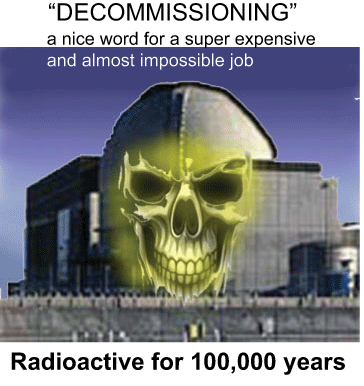
Nuclear Regulatory Commission releases first step in new decommissioning regulations https://dailyenergyinsider.com/news/9290-nuclear-regulatory-commission-releases-first-step-new-decommissioning-regulations/ November 30, 2017 by Chris Galford The Nuclear Regulatory Commission (NRC) recently completed the regulatory basis it will use for the proposal of new decommissioning regulations for commercial nuclear power reactors next year. The NRC staff have determined that new regulations are necessary in a number of areas, including emergency preparedness, physical security, cyber security, drug and alcohol testing, training requirements for certified fuel handlers, decommissioning trust funds, financial protection requirements, indemnity agreements, and how the backfit rule is applied. Many of these revolve around the decommissioning process.
Not all of these require new rules, however. NRC staff has recommended that some are simply in need of updated guidance or inspection procedures. In the case of the management of spent fuel and environmental reporting, though, they have likewise recommended greater clarity among requirements. Staff in requirements, aging management of plant systems, structures, and components, as well as the active role state and local governments are expected to play in decommissioning scenarios, could all be affected.
This process of this new regulatory basis has been underway since November 2015, and the results are now publicly available.
Michael Flynn’s role in Middle Eastern nuclear project could compound legal issues, Chicago Tribune, 27 Nov 17 Michael Kranish, Tom Hamburger and Carol D. LeonnigWashington Post In June 2015, retired lieutenant general Michael Flynn took a little-noticed trip to Egypt and Israel, paid for by a U.S. company he was advising. The company hoped to build more than two dozen nuclear plants in the region in partnership with Russian interests.
Flynn’s quiet involvement in that project – and his failure to disclose his ties to the effort – could complicate the legal issues facing President Trump‘s former national security adviser, who has signaled he may be willing to cooperate with special counsel Robert Mueller.
Congressional Democrats say that Flynn may have violated federal law by failing to disclose the Middle Eastern trip in his security clearance renewal application in 2016. A top House Republican declined the Democrats’ request for a congressional inquiry but referred the allegations to the special counsel.
Last month, Mueller revealed that his wide-ranging investigation into Russian interference in the 2016 election has led to charges against three former Trump campaign officials. One of them, foreign policy adviser George Papadopoulos, has been cooperating, according to court filings.
There are now signs that Flynn – whose international dealings have been the subject of intense interest by the special counsel – may also be willing to share information with prosecutors. Last week, his attorney shut down communications with Trump’s legal team, a development many interpreted as suggesting possible cooperation with Mueller.
Investigators for the special counsel have been examining whether Flynn hid foreign business dealings, particularly work he did for Turkish interests during the campaign, according to people familiar with the probe.
The nuclear venture is yet another instance in which Flynn appeared to have a personal stake in an international project while he was advising Trump in 2016, giving prosecutors one more potential avenue to pressure him to cooperate.
A spokesman for Mueller declined to comment. An attorney for Flynn declined to comment.
“General Flynn’s actions are part of a broader pattern of concealing his foreign contacts, payments, travel, and work on behalf of foreign interests,” said Rep. Elijah Cummings of Maryland, the ranking Democrat on the House Oversight Committee. “The bigger question is this: What did President Trump know and why did he disregard all the red flags?”
The White House declined to comment.
Flynn served as an adviser to two Washington-based companies pursuing efforts to build nuclear power plants in the Middle East: ACU Strategic Partners, which proposed a partnership with Russian interests, and IP3/IronBridge, which later launched a separate endeavor that initially proposed working with China to build the infrastructure, according to federal documents and company officials………
It is a criminal offense to knowingly omit material information requested by federal officials conducting such a review.
An attorney for Flynn’s company told the committee that it would not provide documents about the Middle Eastern nuclear project unless it is subpoenaed, according to the letter.
Trey Gowdy, chairman of the House Oversight Committee, declined to issue a subpoena and instead referred the Democrats’ concerns to Mueller and Deputy Attorney General Rod J. Rosenstein.
“Much of what is sought by my Democratic colleagues — if properly investigated charged and proven beyond a reasonable doubt — would carry criminal penalties,” Gowdy wrote in his Oct. 18 letter, posted by the committee. “Congress does not, and cannot, prosecute crimes.”…….
Flynn, who was fired by President Obama from his post as director of the Defense Intelligence Agency in 2014, became involved in ACU’s project in 2015, part of a group of former top military and diplomatic officials and nuclear experts the company assembled to help push its plan.
The idea: to build several dozen “proliferation-proof” nuclear power plants across Persian Gulf states. The plan relied heavily on Russian interests, which would help build the plants, as well as possibly take possession of spent fuel that could be used to build a nuclear weapon, according to people familiar with the project.
ACU’s managing director, Alex Copson, had been promoting variations of building nuclear facilities with Russian help for more than two decades, according to news reports. Copson did not respond to requests for comment, and ACU’s counsel, Don Gross, declined to comment.
ACU officials declined to identify its investors or answer questions on the record from The Post about whether it has foreign backing………
Around June 2016, according to his financial disclosure, Flynn ended his association with ACU and began advising a company called IP3/IronBridge, co-founded by retired Rear Adm. Michael Hewitt, a former ACU adviser.
IP3 initially proposed partnering with China and other nations on building nuclear power plants, rather than Russia, according to a company spokesman, who said the China component has since been dropped.
In August 2016, the company produced a PowerPoint presentation that included Flynn’s photo and former government title on a page titled, “IP3/IronBridge: Formidable US Leadership.” The document was labeled as a “Presentation to His Majesty King Salman Bin Abdul Aziz” of Saudi Arabia and displayed the seals of Saudi Arabia and the United States. The presentation was obtained by Democrats on the House Oversight committee, who made it public……..http://www.chicagotribune.com/news/nationworld/politics/ct-michael-flynn-middle-east-nuclear-project-20171127-story.html
It was supposed to be a trip to paradise, instead it sealed their fatehttp://www.abc.net.au/news/2017-11-28/the-toxic-legacy-of-a-deadly-paradise/9168422 These soldiers were ordered to clean up the toxic legacy of America’s nuclear program, now they’re dying, and their Government has abandoned them.Foreign Correspondent, By Mark Willacy When Jim Androl landed on a remote central Pacific atoll to take part in the biggest nuclear clean-up in United States history, the only extra items his military superiors gave him were some flea powder and a pamphlet on how to avoid heat stroke.
The army did have special radiation suits and respirators for handling the left-over atomic waste on the atoll, but the young soldiers were only allowed to wear them on special occasions.
“The [protective suits] were for photo ops,” the former communications specialist with the US Army’s 84th Engineer Battalion recalls.
“I know once when I believe 60 Minutes was there, they did [let us wear them]. We were just issued our normal warm weather gear … shorts, tee-shirts, hats and jungle boots and that’s it.”
Androl was one of about 4,000 US troops sent to Enewetak Atoll in the Marshall Islands between 1977 and 1979 to scrape up the contaminated remnants of the United States’ atomic testing program.
The US government decided to use soldiers for the clean-up, because employing specialist nuclear workers would have doubled the cost.
“I’d never even heard of Enewetak. I never knew that there were 43 nuclear tests out there,” Androl, who was 22-years old when he was deployed to the atoll, says.
Some of those bombs were the among the most powerful ever detonated, and they left behind a toxic legacy that will live on for thousands of years.
“One of the attempted nuclear weapons explosions didn’t work,” Michael Gerrard, the director of the Earth Institute at New York’s Columbia University, says. “So the plutonium was just broken apart by the conventional explosion, leading to about 400 little chunks of plutonium that were spread around the atoll.”
The plutonium on Enewetak has a radioactive half-life of more than 24,000 years, and the US clean-up troops were ordered to place the shattered pieces into plastic bags and dump them into a crater left behind by an old atomic bomb test.
One-millionth of a gram of plutonium is potentially harmful, and can cause cancer decades after first exposure.
“They’d have us walk around and pick up loose pieces, and just gather up whatever we could, throw it in a pile,” Androl says.
It’s estimated that 85,000 cubic metres of radioactive material was collected and dumped, including contaminated soil, concrete, and military equipment.
“It was a very dirty operation,” Ken Kasik, another of the men sent to Enewetak as part of the clean-up, says. “[The veterans are] all sick, they’re all dying, and it’s because of the radiation.”
Kasik can barely rise from his chair to greet me when I arrive to see him.
We were supposed to meet at his home in Hawaii.
But by the time I land, he is seriously ill in the intensive care unit in Honolulu’s Straub Medical Centre, and is tethered to drips and monitoring machines.
“About three-and-a-half years ago I had so many cancers on me, I couldn’t work anymore. They ripped me apart,” he says.
This time it’s not cancer that has forced Ken Kasik to be rushed to the ICU, but a brain aneurism he says is directly linked to his time on Enewetak and the atomic fall-out there.
“When those bombs go off, in Enewetak, that’s coral sand,” Kasik says. “That just gets pulverised and comes back down as baby powder, and it was on everything, everywhere. The guys would come home, take off their sunglasses, [and their faces] would be white.”
“I never had any clue that dust could literally get into your lungs,” Jim Androl says from his home in the suburbs of Las Vegas. “You breathe it, you drink it, you eat it, you swim in it. Every day for six months, 24/7.”
The problem for Enewetak clean-up veterans like Androl and Kasik, is that successive United States governments have refused to recognise them and their comrades as atomic veterans. This means they cannot access health benefits or radiation exposure compensation.
Other atomic veterans, like those involved in the original atomic testing program in the Pacific in the 1940s and 1950s that left behind the waste on Enewetak and Bikini atolls, were covered for more than 20 specific types of cancers.
“Our boys worked six-month tours on a dirty island, and the government says, ‘You were never there’,” Kasik says. “We were never acknowledged…we don’t exist.”
Like Kasik, Androl has suffered serious health problems over the years that he blames on his six-month tour at Enewetak.
“He had his gall bladder out … two weeks [later] they found a seven-and-a-half-pound tumour, cancerous tumour in his abdomen,” Androl’s wife Bev says.
“I suffer from roughly 40 to 45 residuals from the cancer,” Androl says. “I’ve got pancreatitis, I’ve got a spot on my liver that they’re watching.”
As well as cancers, veterans complain of brittle bones and even of birth defects in their children.
The US military insists there is no connection between veterans’ illnesses and the clean-up on Enewetak, saying their radiation exposure was well within safe limits.
A two-year campaign by Enewetak veterans to get Congress to give them medical benefits has been unsuccessful.
“I think mostly they’re trying to get health coverage, medical care because they’ve got terrible bills. Really high bills from hospitals, because of their treatment,” Giff Johnson, the publisher of the Marshall Islands Journal, the country’s only newspaper, says.
There has never been a formal study of the health of these men, many of whom are now in their late 50s and early 60s.
But an unofficial social media survey of more than 400 Enewetak clean-up veterans found that 20 percent had reported cancers of some type.
The life they live is a far cry from the photos Ken Kasik took at the time, of young men in their prime.
“It just breaks our heart, You know, they’re dying before they’re 60. It’s ridiculous,” Bev Androl says.
The Marshall Islands is once again grappling with its nuclear legacy, as the threat of climate change threatens to break open the dome.
“God, there’s been so many [who have died],” Androl says of his former comrades. “We just lost one two weeks ago. We lost one about six months before that. They told me I’d be dead by now. We’re nobody, we don’t matter, our family’s lives don’t matter.”
The people of the Marshall Islands also suffered terrible heath impacts from 12 years of atomic testing in their homeland, including increased rates of thyroid and other cancers, as well as birth defects.
Whole islands were evacuated, and many people are still not allowed to return to live in their home villages decades on.
Like the US clean-up veterans, the Marshallese who suffered were never properly compensated.
A nuclear claims tribunal set up by the Marshall Islands and the United States awarded more than $2 billion dollars to victims of the atomic testing program — less than $4 million was ever paid.
“America dumped all of their worst rubbish to the Marshallese, and abandoned them with it. And we don’t want to hear about it,” Kasik says.
Hawaii brings back Cold War-era nuclear warning sirens amid fears of North Korea strike, WP, By Brittany Lyte and Cleve R. Wootson Jr.November 27 KILAUEA, Hawaii— As nuclear tensions between North Korea and the United States grow, officials in Hawaii are walking a delicate line — planning for a catastrophe while assuring residents and tourists alike that they can keep sipping beverages from coconuts without alarm.
The “without alarm” part gets harder Friday.
That is when the government is set to bring back a statewide nuclear attack siren, a relic of the Cold War that will notify islanders that a missile is headed toward them. Officials will test the system for the first time just before lunchtime Friday, according to the Honolulu Star-Advertiser.
IF astronauts do succeed in the long trek to Mars, will they by then have enough intelligence left to actually operate the nuclear reactor, given that scientists have found that space travel damages astronauts’ brains?
What is NASA’s plan if the rocket taking the plutonium -fulled reactor crashes on an Earth city?
NASA, DEPARTMENT OF ENERGY TESTING ‘KILOPOWER’ SPACE NUCLEAR REACTOR, Space Flight Insider COLLIN SKOCIK, 26 Nov 17 In preparing for possible missions to the Red Planet in the near future, NASA’s Space Technology Mission Directorate (STMD) has been given the go-ahead to test a small nuclear reactor that could one day run equipment on the Martian surface.
The Kilopower project is working to advance a design for a compact, low-cost, and scalable nuclear fission power system for missions that require lots of power, such as a human mission to Mars. The technology uses a fission reactor with a uranium-235 reactor core to generate heat, which is then transferred via passive sodium heat pipes to Stirling engines. Those engines use that heat to create pressure, which moves a piston – much as old coal-powered ships used steam pressure to run their pistons. When coupled to an alternator, the Stirling engine produces electricity.
“What we are striving to do is give space missions an option beyond RTGs [radioisotope thermoelectric generators], which generally provide a couple hundred watts or so,” Lee Mason, STMD’s principal technologist for Power and Energy Storage at NASA Headquarters in Washington, D.C., said in a NASA news release. “The big difference between all the great things we’ve done on Mars, and what we would need to do for a human mission to that planet, is power.”
Mason said the new technology could provide kilowatts of power and even be upgraded to provide hundreds of kilowatts or even megawatts of power.
“We call it the Kilopower project because it gives us a near-term option to provide kilowatts for missions that previously were constrained to use less,” Mason said. “But first things first, and our test program is the way to get started.”
THE TEST PROGRAM
The next step for Kilopower project hardware is to be subjected to a full-power test for some 28 hours.
“The upcoming Nevada testing will answer a lot of technical questions to prove out the feasibility of this technology, with the goal of moving it to a Technology Readiness Level of 5,” said lead researcher Marc Gibson, “It’s a breadboard test in a vacuum environment, operating the equipment at the relevant conditions.”
Mason acknowledges the contributions of the Department of Energy and the National Nuclear Security Administration’s infrastructure, as well as the Los Alamos National Laboratory in New Mexico.
The huge reactors—California’s last—sit on a bluff above the Pacific, west of San Luis Obispo, among a dozen earthquake faults. They operate just 45 miles from the San Andreas. That’s half the distance from the fault that destroyed four reactors in Fukushima, Japan, in 2011. Diablo’s wind-blown emissions could irradiate the Los Angeles megalopolis in less than six hours if an earthquake destroyed the plant.
The death toll could be in the millions, the property damage in the trillions of dollars. The owner of the plant, Pacific Gas & Electric (PG&E), would not be legally liable.
Last year, a deal to shut down Diablo’s two reactors in 2024 and 2025 was struck by the state, PG&E, surrounding communities and some environmental groups. Diablo’s federal licenses expire in those years, and PG&E agreed not to seek renewals. The power, it said, could be replaced with wind turbines and solar panels.
But the $1.7 billion in rate hikes stipulated in the deal still must be approved by California’s Public Utilities Commission (PUC). A proposed decision by administrative law Judge Peter Allen would limit them to less than $200 million.
The PUC must now factor Allen’s decision into how much it allows PG&E to charge. If it honors Allen’s opinion, the company must then decide whether it will continue to operate the reactors, which increasingly look like money losers.
The company’s standing is not exactly sterling. Massive fires that swept through Northern California in October killed at least 43 people, turning some 5,700 structures and whole forests, rural communities and parts of Santa Rosa into smoldering ash (the Trump administration has just omitted from its latest budget any federal aid to the region).
The San Jose Mercury News has speculated that PG&E may have been responsible for the conflagration by failing to maintain power lines that were blown over in a windstorm. Local fire departments were already complaining that trees and underbrush were being sparked by poles and wires PG&E had failed to maintain, though maintenance is required by law.
PG&E now faces a firestorm of lawsuits that could soar well into the billions. Criminal prosecution is also possible.
In 2010, a fire killed eight people and torched an upscale San Bruno neighborhood. The cause was badly maintained gas lines—for which PG&E had been cited repeatedly. Fines exceeded $1.4 billion, but criminal prosecution remains unresolved.
Other costly lapses have plagued PG&E through the years. Some involve Diablo itself, which opened in the mid-1980s amid America’s biggest “No Nukes” civil disobedience campaign, involving thousands of arrests.
Linda Seeley of San Luis Obispo’s Mothers for Peace says the company faces impossible hurdles in dealing with its thousands of tons of radioactive waste. In addition, she notes, “Many very expensive components in the two reactors must be replaced far before the proposed 2024-5 shutdown dates. Our concern is that PG&E may try to sneak through without paying to maintain the reactors even at basic safety levels.”
Michael Peck, a former Nuclear Regulatory Commission in-house inspector at Diablo, has warned that the reactors cannot survive a major earthquake and should close immediately. He has since been transferred to Chattanooga, Tenn.
“Diablo may no longer be profitable,” Seeley has said on my “California Solartopia” show on radio station KPFK. “The cost of wind and solar has dropped so fast it may not pay PG&E to run those plants anymore, even without doing the basic maintenance.”
Because much of Diablo’s aging workforce is retiring or looking elsewhere for job security, PG&E wants subsidies to retain skilled staff to run the place. Judge Allen specifically rejected much of the rate hike designed to meet that crisis.
California’s State Lands Commission is being sued by the World Business Academy, a Santa Barbara think tank, over key leases granted in the 1970s. The commission granted PG&E a waiver on conducting legally required environmental impact statements (gubernatorial candidate Gavin Newsom was among those who voted in favor). Should the business academy win its suit, or should the PUC honor Allen’s decision, and PG&E alter its timetable, those leases might be revisited. Without them, Diablo would almost certainly be forced to shut.
Challenges have also been raised over approval by the California Coastal Commission of Diablo’s cooling system.
Seeley and other activists have asked the public to pressure the PUC, state agencies and politicians like Newsom to shut Diablo sooner rather than later.
“Until they can specify the exact date and time the San Andreas and those other faults will go off,” Seeley said in a recent phone interview, “nobody should feel safe.”
Special Report: In modernizing nuclear arsenal, U.S. stokes new arms race, Scot Paltrow WASHINGTON (Reuters), 21 Nov 17 – President Barack Obama rode into office in 2009 with promises to work toward a nuclear-free world. His vow helped win him the Nobel Peace Prize that year.
The next year, while warning that Washington would retain the ability to retaliate against a nuclear strike, he promised that America would develop no new types of atomic weapons. Within 16 months of his inauguration, the United States and Russia negotiated the New Strategic Arms Reduction Treaty, known as New START, meant to build trust and cut the risk of nuclear war. It limited each side to what the treaty counts as 1,550 strategic nuclear warheads.
By the time Obama left office in January 2017, the risk of Armageddon hadn’t receded. Instead, Washington was well along in a modernization program that is making nearly all of its nuclear weapons more accurate and deadly.
And Russia was doing the same: Its weapons badly degraded from neglect after the Cold War, Moscow had begun its own modernization years earlier under President Vladimir Putin. It built new, more powerful ICBMs, and developed a series of tactical nuclear weapons.
The United States under Obama transformed its main hydrogen bomb into a guided smart weapon, made its submarine-launched nuclear missiles five times more accurate, and gave its land-based long-range missiles so many added features that the Air Force in 2012 described them as “basically new.” To deliver these more lethal weapons, military contractors are building fleets of new heavy bombers and submarines.
President Donald Trump has worked hard to undo much of Obama’s legacy, but he has embraced the modernization program enthusiastically. Trump has ordered the Defense Department to complete a review of the U.S. nuclear arsenal by the end of this year.
Reuters reported in February that in a phone conversation with Russian President Vladimir Putin, Trump denounced the New START treaty and rejected Putin’s suggestion that talks begin about extending it once it expires in 2021.
Some former senior U.S. government officials, legislators and arms-control specialists – many of whom once backed a strong nuclear arsenal — are now warning that the modernization push poses grave dangers.
“REALLY DANGEROUS THINKING”
They argue that the upgrades contradict the rationales for New START – to ratchet down the level of mistrust and reduce risk of intentional or accidental nuclear war. The latest improvements, they say, make the U.S. and Russian arsenals both more destructive and more tempting to deploy. The United States, for instance, has a “dial down” bomb that can be adjusted to act like a tactical weapon, and others are planned.
“The idea that we could somehow fine tune a nuclear conflict is really dangerous thinking,” says Kingston Reif, director of disarmament and threat reduction policy at the Arms Control Association, a Washington-based think tank.
One leader of this group, William Perry, who served as defense secretary under President Bill Clinton, said recently in a Q&A on YouTube that “the danger of a nuclear catastrophe today is greater than it was during the Cold War.”
Perry told Reuters that both the United States and Russia have upgraded their arsenals in ways that make the use of nuclear weapons likelier. The U.S. upgrade, he said, has occurred almost exclusively behind closed doors. “It is happening without any basic public discussion,” he said. “We’re just doing it.”
………. A BUDGET BUSTER?
The U.S. modernization effort is not coming cheap. This year the Congressional Budget Office estimated the program will cost at least $1.25 trillion over 30 years. The amount could grow significantly, as the Pentagon has a history of major cost overruns on large acquisition projects.
As defense secretary under Obama, Leon Panetta backed modernization. Now he questions the price tag.
“We are in a new chapter of the Cold War with Putin,” he told Reuters in an interview, blaming the struggle’s resumption on the Russian president. Panetta says he doubts the United States will be able to fund the modernization program. “We have defense, entitlements and taxes to deal with at the same time there are record deficits,” he said.
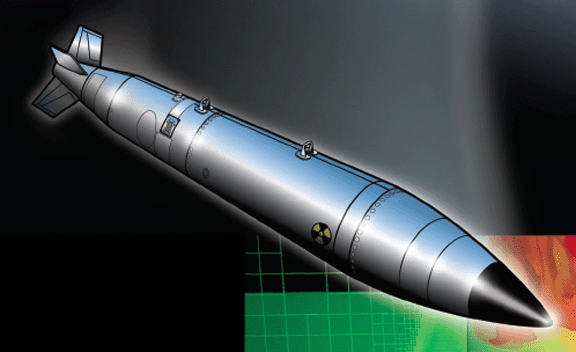
Special Report: In modernizing nuclear arsenal, U.S. stokes new arms race, Scot Paltrow, WASHINGTON (Reuters), 21 Nov 17 “………..One example of an old weapon transformed into a more dangerous new one is America’s main hydrogen bomb. The Air Force has deployed the B61 bomb on heavy bombers since the mid-1960s. Until recently, the B61 was an old-fashioned gravity bomb, dropped by a plane and free-falling to its target.
THE MOST EXPENSIVE BOMB EVER
Now, the Air Force has transformed it into a controllable smart bomb. The new model has adjustable tail fins and a guidance system which lets bomber crews direct it to its target. Recent models of the bomb had already incorporated a unique “dial-down capacity”: The Air Force can adjust the explosion. The bomb can be set to use against enemy troops, with a 0.3 kiloton detonation, a tiny fraction of the Hiroshima bomb, or it can level cities with a 340-kiloton blast with 23 times the force of Hiroshima’s. Similar controls are planned for new cruise missiles.
The new B61 is the most expensive bomb ever built. At $20.8 million per bomb, each costs nearly one-third more than its weight in 24 karat gold. The estimated price of the planned total of 480 bombs is almost $10 billion.
……… RUSSIA‘S DIRTY DRONE
Russia, too, is hard at work making deadlier strategic weapons. Ploughshares estimates that both sides are working on at least two dozen new or enhanced strategic weapons.
……… A Russian military official in 2015 disclosed a sort of doomsday weapon, taking the idea of a “dirty bomb” to a new level. Many U.S. analysts believe the disclosure was a bluff; others say they believe the weapon has been deployed.
The purported device is an unmanned submarine drone, able to cruise at a fast 56 knots and travel 6,200 miles. The concept of a dirty bomb, never used to date, is that terrorists would spread harmful radioactive material by detonating a conventional explosive such as dynamite. In the case of the Russian drone, a big amount of deadly radioactive material would be dispersed by a nuclear bomb.
The bomb would be heavily “salted” with radioactive cobalt, which emits deadly gamma rays for years. The explosion and wind would spread the cobalt for hundreds of miles, making much of the U.S. East Coast uninhabitable.
A documentary shown on Russian state TV said the drone is meant to create “areas of wide radioactive contamination that would be unsuitable for military, economic, or other activity for long periods of time.”
The Sway of the Nuclear Arms Industry Over Donald Trump and Congress Is Terrifying
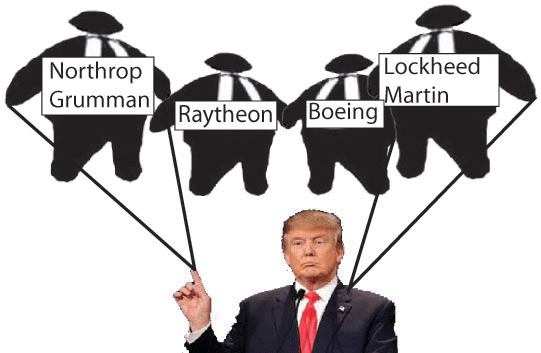
“The devastation is very important to me.” Mother Jones WILLIAM HARTUNGNOV. 18, 2017 This story originally appeared on TomDispatch.com. ……… in every sense of the term, our nuclear arsenal already represents overkill on an almost unimaginable scale. Independent experts from US war colleges suggest that about 300 warheads would be more than enough to deter any country from launching a nuclear attack on the United States.It may not surprise you to learn that there’s nothing new about the influence the nuclear weapons lobby has over Pentagon spending priorities. The successful machinations of the makers of strategic bombers and intercontinental ballistic missiles, intended to keep tax dollars flowing their way, date back to the dawn of the nuclear age and are the primary reason President Dwight D. Eisenhower coined the term “military-industrial complex” and warned of its dangers in his 1961 farewell address.
Without the development of such weapons, that complex simply would not exist in its present form. The Manhattan Project, the vast endeavor that produced the first workable nukes during World War II, was one of the largest government-funded research and manufacturing projects in history. Today’s nuclear warhead complex is still largely built around facilities and locations dating back to that time…….
Eisenhower couldn’t have been more clear-eyed about all of this. He saw the missile gap for the fiction it was or, as he put it, a “useful piece of political demagoguery” for his opponents. “Munitions makers,” he insisted, “are making tremendous efforts towards getting more contracts and in fact seem to be exerting undue influence over the senators.”
Once Kennedy took office, it became all too apparent that there was no missile gap, but by then it hardly mattered. The damage had been done. Billions of dollars more were flowing into the nuclear-industrial complex to build up an American arsenal of ICBMs already unmatched on the planet.
The techniques that the arms lobby and its allies in government used more than half a century ago to promote sky-high nuclear weapons spending continue to be wielded to this day. The 21st-century arms complex employs tools of influence that Kennedy and his compatriots would have found familiar indeed—including millions of dollars in campaign contributions that flow to members of Congress and the continual employment of 700 to 1,000 lobbyists to influence them; that’s nearly two arms lobbyists for every member of Congress. Much of this sort of activity remains focused on ensuring that nuclear weapons of all types are amply financed and that the funding for the new generations of the bombers, submarines, and missiles that will deliver them stays on track.
When traditional lobbying methods don’t get the job done, the industry’s argument of last resort is jobs—in particular, jobs in the states and districts of key members of Congress. This process is aided by the fact that nuclear weapons facilities are spread remarkably widely across the country. There are labs in California and New Mexico; a testing and research site in Nevada; a warhead assembly and disassembly plant in Texas; a factory in Kansas City, Missouri, that builds nonnuclear parts for such weapons; and a plant in Oak Ridge, Tennessee, that produces weapon-grade uranium. There are factories or bases for ICBMs, bombers, and ballistic missile submarines in Connecticut, Georgia, Washington State, California, Ohio, Massachusetts, Louisiana, North Dakota, and Wyoming. Such a nuclear geography ensures that a striking number of congressional representatives will automatically favor more spending on nuclear weapons.
In reality, the jobs argument is deeply flawed. As the experts know, virtually any other activity into which such funding flowed would create significantly more jobs than Pentagon spending. A study by economists at the University of Massachusetts, for example, found infrastructure investment would create one and one-half times as many jobs as Pentagon funding and education spending twice as many.
In most cases it hasn’t seemed to matter that the jobs claims for weapons spending are grotesquely exaggerated and better alternatives litter the landscape. The argument remains remarkably potent in states and communities that are particularly dependent on the Pentagon. Perhaps unsurprisingly, members of Congress from such areas are disproportionately represented on the committees that decide how much will be spent on nuclear and conventional weaponry………. http://www.motherjones.com/politics/2017/11/devastation-very-important-nuclear-weapons-industry-donald-trump-1/
Is the Trump Administration Planning a First Strike on North Korea? Saturday, November 18, 2017 By Gareth Porter, Truthout | News Analysis Ever since the Trump administration began a few months ago to threaten a first strike against North Korea over its continued missile tests, the question of whether it is seriously ready to wage war has loomed over other crises in US foreign policy.
The news media have avoided any serious effort to answer that question, for an obvious reason: The administration has an overriding interest in convincing the North Korean regime of Kim Jong-un that Trump would indeed order a first strike if the regime continues to test nuclear weapons and an intercontinental ballistic missile (ICBM). Therefore, most media have shied away from digging too deeply into the distinction between an actual policy of a first strike and a political ruse intended to put pressure on Pyongyang.
The use of military threat for “diplomatic coercion” is such a basic tool of US policy in dealing with weaker adversaries that it is almost taken for granted in Washington. Even diplomats who have been deeply involved in negotiating with North Korea are supportive of using that threat as part of a broader diplomatic strategy. Robert Gallucci, the State Department official who negotiated the “Agreed Framework” with North Korean officials in 1994, noted in an email to Truthout, “We do want the North to understand that their actions could lead the US to a preventive strike — wise or not.”
The linkage between the Trump administration’s threat of a “military option” and US diplomatic pressure on North Korea was clear from its first suggestion that it might carry out a first strike. That suggestion came on April 13, immediately upon the completion of the administration’s policy review on North Korea, when NBC News reported that “multiple senior intelligence officials” had said that the administration was “prepared to launch a preemptive strike” if officials “became convinced that North Korea is about to follow through with a nuclear weapon test.” A story in the Washington Post published the following day offered a slightly different version: The administration was “prepared to respond to another North Korean nuclear test” and had “a range of options at its disposal” but would not “telegraph its response in advance.”
However, an unnamed military official told the Associated Press that same day that the policy that had been approved by the National Security Council did not envision the use of force in response to a nuclear or missile test, thus revealing that the leaks involving the threat of a preemptive or retaliatory attack over North Korean testing were part of a clumsy effort at “coercive diplomacy.”……
The Trump administration could seek to increase the pressure on North Korea still further by making one or more moves preparing for — but short of — war. For example, it could bring more US ground troops into South Korea or Japan. However, the North Korean regime might well interpret that move as a signal that the US intends to attack and invade the North, since that would seem to be precisely the purpose of moving reinforcements into the theater. In fact, according to Jackson, the North Koreans told US diplomats during the 1994 crisis that they had studied carefully the US large-scale troop movements in preparation for the first Gulf War in 1990-91, and warned that they would respond to a move like that one in their region by launching their own preemptive attack.
It isn’t yet possible to know definitely whether the Trump administration intends to strike first against North Korea. The official threats of such a strike can be discounted as obviously related to an elaborate — if somewhat crude — psychological warfare campaign. But more twists and turns in US policy can be expected in the coming months, and the desperate desire to coerce Pyongyang may also have given rise to wishful thinking on the part of McMaster and, more dangerously, Trump himself, about deterring that regime’s response to a US first strike. That in turn could still pose a grave threat of yet another unnecessary and terrible war. http://www.truth-out.org/news/item/42640-is-the-trump-administration-planning-a-first-strike-on-north-korea
US nuclear general says would resist ‘illegal’ Trump strike order, CNBC, 19 Nov 17 The top U.S. nuclear commander said on Saturday that he would resist President Donald Trump if he ordered an “illegal” launch of nuclear weapons.
Air Force General John Hyten, commander of the U.S. Strategic Command (STRATCOM), told an audience at the Halifax International Security Forum in Nova Scotia, Canada that he had given a lot of thought to what he would say if he received such an order.
“I think some people think we’re stupid,” Hyten said in response to a question about such a scenario. “We’re not stupid people. We think about these things a lot. When you have this responsibility, how do you not think about it?”
Hyten, who is responsible for overseeing the U.S. nuclear arsenal, explained the process that would follow such a command.
As head of STRATCOM “I provide advice to the president, he will tell me what to do,” he said in his remarks, retransmitted in a video posted on the forum’s Facebook page.
“And if it’s illegal, guess what’s going to happen? I’m going to say, ‘Mr. President, that’s illegal.’ And guess what he’s going to do? He’s going to say, ‘What would be legal?’ And we’ll come up with options, of a mix of capabilities to respond to whatever the situation is, and that’s the way it works. It’s not that complicated.”……. https://www.cnbc.com/2017/11/19/us-nuclear-general-says-would-resist-illegal-trump-strike-order.html