Nuclear industry wants power to self-assess plants, Cape Cod Times Christine Legere Dec 4, 2017 The federal agency in charge of overseeing the nation’s 99 commercial nuclear reactors is looking at ways to make its engineering inspection program more efficient, and one suggestion being entertained would allow plant operators to inspect, or “self-assess,” their own operations.
Nuclear watchdogs are speaking out against the proposal, arguing that inspection of plant systems should remain in the hands of an independent organization like the Nuclear Regulatory Commission to protect safety and ensure public confidence…….
charge of overseeing the nation’s 99 commercial nuclear reactors is looking at ways to make its engineering inspection program more efficient, and one suggestion being entertained would allow plant operators to inspect, or “self-assess,” their own operations.
Nuclear watchdogs are speaking out against the proposal, arguing that inspection of plant systems should remain in the hands of an independent organization like the Nuclear Regulatory Commission to protect safety and ensure public confidence.
A Duxbury citizens group called Pilgrim Watch also pushed for keeping the plant inspections in the hands of the NRC.
“Pilgrim provides the perfect example why NRC nuclear safety inspections are necessary and why industry self assessments would be dangerous,” stated Pilgrim Watch in its letter to the working group.
Pilgrim is one of three plants in the country classified in Column 4, a category established by the NRC for the worst performers. The plant is expected to be permanently shut down by May 31, 2019.
Referencing Pilgrim’s current classification, Yarmouth Port resident James Garb wrote that the plant’s decline is the result of lack of attention to safety matters and failure to perform safety procedures properly.
“How could you possibly expect a nuclear plant to conduct honest, effective safety inspections?” Garb wrote. “We certainly couldn’t.”……
Congressman William Keating, D-Mass., will oppose efforts toward self-assessment.
“We are currently reaching out to the NRC for any information on a potential self-policing proposal, which I would vehemently oppose,” said Keating in a statement provided by his office.
David Lochbaum, director of the Nuclear Safety Program for the Union of Concerned Scientists, said his organization expects that self-assessments will be one of the options the work group presents to the Nuclear Regulatory Commission once their study is complete.
Radioactive Waste And The Hidden Costs Of The Cold War, Forbes, David Rainbow, Assistant Professor, Honors College, University of Houston, 4 Dec 17, Hanford,a dusty decommissioned plutonium production site in eastern Washington state, is one of the most polluted places in the country. The disaster is part of the inheritance of the Cold War.
A few months ago, a 110-meter-long tunnel collapsed at the site, exposing an old rail line and eight rail cars filled with contaminated radioactive equipment. This open wound in the landscape, which was quickly covered over again, is a tiny part of an environmental and human health catastrophe that steadily unfolded there over four decades of plutonium production. Big Cold War fears justified big risks. Big, secretive, nuclear-sized risks.
Hanford and other toxic reminders of the Cold War should serve as a cautionary tale to those who have a say in mitigating geopolitical tensions today, as well as to those who promote nuclear energy as an environmentally sustainable source of electricity. The energy debate must balance the downside – not just the risk of a nuclear meltdown but also the lack of a permanent repository for the still-dangerous spent fuel rods – with the environmental benefits of a source of electricity that produces no greenhouse gases. People on both sides of the issue have a vested interest in how the current geopolitical tussling over nuclear weapons plays out……
Nuclear refinement at Hanford began as a part of the Manhattan Project during World War II, the highly secretive plan to develop a nuclear bomb.
Initially, the drive to mobilize for war justified substantial costs, among them significant damage to human and environmental health in the U.S. resulting from the nuclear program. Hanford was integral to the program: its plutonium fell on Nagasaki. But after the end of the war, the scale of production at the site increased to a fevered pitch thanks to the ensuing competition for global influence between the U.S. and the Soviet Union that became the Cold War.
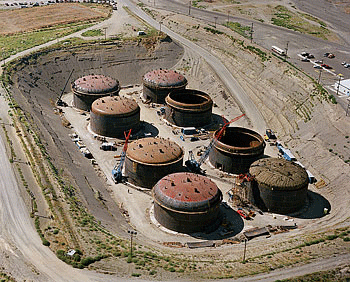
Our gargantuan stockpiles of nuclear arms demanded gargantuan quantities of plutonium. Forty-five years of work at Hanford – from 1943 to 1987 – yielded 20 million uranium metal plugs used to generate 110,000 tons of fuel. The process also generated 53 million gallons of radioactive waste, now stored in 177 underground tanks at the facility, and created 450 billion gallons of irradiated waste water that was discharged onto “soil disposal sites,” meaning it went into the ground. Some of the irradiated discharge simply ran back to where it had originally been taken from, the nearby Columbia River. The Office of Environmental Management at the Department of Energy is currently overseeing a cleanup project involving 11,000 people. It is expected to take several decades and cost around $100 billion.
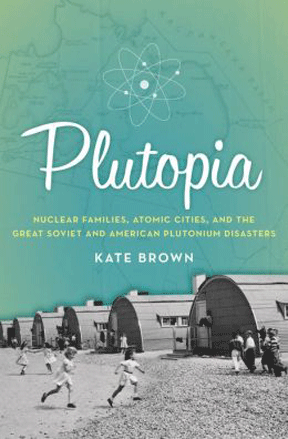
Kate Brown’s award-winning book, “Plutopia: Nuclear Families, Atomic Cities, and the Great Soviet and American Plutonium Disasters,” is a history of the Hanford plant and its Soviet doppelgänger, a plant in the Ural Mountains called Maiak. Brown points out that over the course of a few decades, the two nuclear sites spewed two times the radiation emitted in the Chernobyl explosion. Yet few Americans at the time, even those involved in plutonium production, realized this was going on or how dangerous it was.
Naturally, the hidden nature of the project meant that information was hard to come by. As Brown shows, even the experts, managers and scientists involved directly in overseeing the production process knew little about the seriousness of the risk. Doctors studying the effects of radiation on people didn’t have access to the research related to environmental pollution. Scientists studying fish die-offs had no way of connecting their findings to the deteriorating immune systems of humans in the same areas. Most poignantly, researchers measuring the effectiveness of nuclear bombs on the enemy did not communicate with researchers measuring the threat of nuclear bombs on the workers making them.
Consequences for the workers were grave. Hanford and Maiak’s hidden mega-pollution was collateral damage in the fight to win the Cold War. Russia, like the U.S., is still living with the damage, and trying to bury it, too.
Within two days of the tunnel collapse at the Hanford site this past May, workers filled the breach with 53 truckloads of dirt and narrowly avoided a radiological event. However, these eight railcars are hardly the only waste left behind in the U.S. from our cold conflict with the Soviet Union, in which our willingness to risk human and environmental health was proportionate to our fears. It’s going to be a while before it’s all cleaned up. In the meantime, hopefully our leaders will work to keep the new Cold War from getting any worse. https://www.forbes.com/sites/uhenergy/2017/12/04/the-hidden-costs-of-cold-war/#a3593c1136ff
Air drills put region on ‘brink of nuclear war’, warns North Korea, 9 News, By Richard Wood
The comments by North Korea represent rising escalation on the Korean peninsula and came as US National Security Adviser HR McMaster declared the possibility of war was “increasing” daily. Pyongyang described the drill as ‘warmongering’.
The five-day air drill called Vigilant Ace kicks off today over the Korean peninsula and involves 230 advanced warplanes from the South Korean and US air forces.
Commentary by Pyongyang’s Rodong Sinmun newspaper, carried by North Korea’s state media agency, criticised the exercise as a “dangerous provocation” propelling the region to “the brink of nuclear war”.
A total of 12,000 US personnel from the marines, navy and air force will take part in Vigilant Ace, reports The Wall Street Journal.
The aircraft flying from eight bases include the hi-tech F-22 Raptor and F-35 Lightning.
Both aircraft are more than a match for anything in North Korea’s largely Soviet-era air force and are cloaked in stealth coating, making them virtually invisible to enemy radar. Flying at 1930km/h, the F-35s can carry nuclear bombs and bunker-busting munitions, regarded as vital for targeting and destroying North Korea’s complex of military tunnels……. https://www.9news.com.au/world/2017/12/04/11/54/us-and-south-korean-air-drills-risk-war-north-warns
Those of us in the field of emergency preparedness shudder with the realization that a growing number of nations are joining the global thermonuclear arms race.
This reality is fraught with consequences that most people do not recognize, and frankly do not want to know.
In a nutshell, thermonuclear weapons, colloquially known as H-bombs, produce much larger yields of destructive power than the nuclear weapons that countries tested in the early days of nuclear weapon development.
For example, the nuclear bombs that the U.S. dropped on Japan in 1945 were in the 15 to 20 kiloton yield. This means that they had the destructive power of an equivalent of 15,000 to 20,000 tons of dynamite.
In addition to killing about 100,000 people, these weapons cause thousands of traumatic injuries, thousands of radiation injuries and hundreds of thermal burn victims.
Compare that to a thermonuclear weapon which is in the range of 75 to 49,000 kilotons of destructive power. Used on a densely populated urban center like New York City or Tokyo, just one weapon would kill millions of people and produce millions of casualties.
Those numbers are devastating enough, but the real nightmare is that the number of thermal burn casualties greatly multiply with a thermonuclear weapon relative to a simple nuclear weapon.
A typical serious thermal burn injury in a well staffed hospital takes three to four medical personnel per patient to provide adequate care. When we have hundreds of thousands of surviving burn patients due to an urban thermonuclear detonation, we are not going to be able to treat even a tiny fraction of them.
Until now, only wealthy and advanced nations – the United States, Russia, China, the United Kingdom, France and Israel – were able to produce these massively destructive thermonuclear weapons.
Now, with poor and unstable North Korea joining the thermonuclear club, other small nations may realize that this previously difficult threshold may be within their technical reach.
Even worse, nations around the world know that the Earth is getting to be a much more dangerous place when a nation like North Korea has such weapons, and many will perceive that their national safety now depends on procuring these terrible devices as well.
In academic journals and in the media, there is talk of Indiaacquiring thermonuclear weapons on the fast track, which will pressure Pakistan to do the same. The sense of urgency is even touching nations that previously eschewed the development of nuclear weapons.
Even Japan – which by its constitution is significantly restricted in its armaments and has no nuclear weapons at all – could use its enormous stockpile of nuclear waste to rapidly develop an equally enormous stockpile of thermonuclear weapons.
Despite repeated headlines about the growing possibility of nuclear war, most people, curiously, avoid thinking or talking about it. In over a thousand lectures on nuclear war medical response, I find even medical audiences do not want to address the issue.
In fact, I recently published an assessment of U.S. and Asian emergency medical responders’ hypothetical response to a nuclear event which found a striking lack of knowledge about patients affected by radiation after nuclear war and a strong reluctance to treat them, even though it is far less dangerous than treating infectious disease patients.
This fear of radiation is just as pronounced in the general population. We had a very hard time getting the medical and public health community to adequately address this issue even when we were focused on the smaller, Hiroshima-sized weapons, where it is feasible to mount a credible response. Now, we have to discuss the grim prospect of responding to the global thermonuclear arms race that we are now in – and currently losing.
While nuclear nonproliferation remains a top priority, the preparation for responding to the actual use of these terrible weapons is now a regrettable necessity that we must confront.
Cham Dallas is the director of the Institute for Disaster Management at the University of Georgia.
Air drills put region on ‘brink of nuclear war’, warns North Korea, 9 News, By Richard Wood
The comments by North Korea represent rising escalation on the Korean peninsula and came as US National Security Adviser HR McMaster declared the possibility of war was “increasing” daily. Pyongyang described the drill as ‘warmongering’.
The five-day air drill called Vigilant Ace kicks off today over the Korean peninsula and involves 230 advanced warplanes from the South Korean and US air forces.
Commentary by Pyongyang’s Rodong Sinmun newspaper, carried by North Korea’s state media agency, criticised the exercise as a “dangerous provocation” propelling the region to “the brink of nuclear war”.
A total of 12,000 US personnel from the marines, navy and air force will take part in Vigilant Ace, reports The Wall Street Journal.
The aircraft flying from eight bases include the hi-tech F-22 Raptor and F-35 Lightning.
Both aircraft are more than a match for anything in North Korea’s largely Soviet-era air force and are cloaked in stealth coating, making them virtually invisible to enemy radar. Flying at 1930km/h, the F-35s can carry nuclear bombs and bunker-busting munitions, regarded as vital for targeting and destroying North Korea’s complex of military tunnels……. https://www.9news.com.au/world/2017/12/04/11/54/us-and-south-korean-air-drills-risk-war-north-warns
Mideast nuclear plan backers bragged of support of top Trump aide Michael Flynn http://www.smh.com.au/world/mideast-nuclear-plan-backers-bragged-of-support-of-top-trump-aide-michael-flynn-20171201-gzxau2.html, Warren Strobel, Nathan Layne and Jonathan Landay, 3 Dec 17, Washington: Backers of a US-Russian plan to build nuclear reactors across the Middle East bragged after the US election they had backing from Donald Trump’s national security adviser Michael Flynn for a project that required lifting sanctions on Russia, documents reviewed by Reuters show.
The documents, which have not previously been made public, reveal new aspects of the plan, including the proposed involvement of a Russian company currently under US sanctions to manufacture nuclear equipment. That company, major engineering and construction firm OMZ OAO, declined to comment.
The documents do not show whether Flynn, a retired Army lieutenant general, took concrete steps to push the proposal with Trump and his aides. But they do show that Washington-based nuclear power consultancy ACU Strategic Partners believed that both Flynn, who had worked as an adviser to the firm as late as mid-2016, and Trump were firmly in its corner.
“Donald Trump’s election as president is a game changer because Trump’s highest foreign policy priority is to stabilise US relations with Russia which are now at a historical low-point,” ACU’s managing director, Alex Copson, wrote in a November 16, 2016 email to potential business partners, eight days after the election.
White House officials did not immediately respond to an email seeking comment. ACU declined comment and also declined to make Copson available for an interview. Previously they told a congressional committee that they had not had any dealings with Flynn since May 2016, before Trump became the Republican Party’s presidential candidate.
Flynn’s lawyer, Robert Kelner, did not respond to a request for comment.
Flynn pleaded guilty on Friday to lying to the FBI about a discussion with the former Russian ambassador to Washington, Sergey Kislyak, in late December 2016 regarding sanctions.
The documents also show that ACU proposed ending Ukraine’s opposition to lifting sanctions on Russia by giving a Ukrainian company a $US45 billion contract to provide turbine generators for reactors to be built in Saudi Arabia and other Mideast nations.
The contract to state-owned Turboatom, and loans to Ukraine from Gulf Arab states, would “require Ukraine to support lifting US and EU sanctions on Russia,” Copson wrote in the November 16 email.
A Turboatom spokeswoman said she did not have an immediate comment on the matter.
The email was titled “TRUMP/PUTIN ME Marshall plan CONCEPT.” ME stands for Middle East. The title, evoking the post-World War Two plan to rebuild Western European economies, reflected the hopes of the plan’s backers that Trump and Russian President Vladimir Putin could cooperate on a project that would boost Middle East economies.
The ACU documents reviewed by Reuters include emails, business presentations and financial estimates and date from late autumn 2016.
As part of their investigation into the Trump election campaign’s ties to Russia, Special Counsel Robert Mueller and Democrats on the House of Representatives Oversight Committee are probing whether Flynn promoted the Middle East nuclear power project as national security adviser in Trump’s White House.
Flynn resigned after just 24 days as national security adviser after it became known he had lied to Vice President Mike Pence by telling him he had not discussed US sanctions on Russia with Kislyak in late December.
In response to questions about the emails and documents, ACU referred Reuters to letters written in June and September by ACU scientist Thomas Cochran to the House Oversight Committee.
In those letters, Cochran had laid out the project’s strategy, describing a “ready-to-go” consortium that included French, Russian, Israeli and Ukrainian interests, without naming specific companies.
The nuclear reactor plan aimed to provide Washington’s Middle East allies with nuclear power in a way that didn’t risk nuclear weapons proliferation and also helped counter Iranian influence, improve dismal US-Russian relations, and revive the moribund US nuclear industry, according to the documents seen by Reuters.
The Wall Street Journal and the Washington Post reported this week that Flynn pushed a version of the nuclear project within the White House by instructing his staff to rework a memo written by a former business associate into policy for Trump to sign.
Two US officials familiar with the issue told Reuters the policy document Flynn prepared for Trump’s approval proposed working with Russia on a nuclear reactor project but did not specifically mention ACU. The officials, who spoke on condition of anonymity, said they did not know if Trump had read the memo or acted upon it.
On November 18, 2016, 10 days after Trump won the presidential election, ACU’s Copson received an email from nuclear non-proliferation expert Reuben Sorensen saying that he had updated Flynn on the nuclear project’s status. Sorensen’s role in the project was not clear from the emails.
“Flynn is getting closer to (being named) National Security Advisor. Expect an announcement soon. This is a big win for the ACU project,” Sorensen wrote.
“Spoke with him via backchannels earlier this week. He has always believed in the vision of the ACU effort … We need to let him get settled into the new position, but update him shortly thereafter,” Sorensen added.
Reuters could not independently confirm a briefing took place. Sorensen did not reply to an email seeking comment.
US seeking new missile defence sites on West Coast as North Korea nuclear attack fears grow, congressmen say Pressure grows on government to respond to increasing likelihood Kim Jong-Un regime has missiles that could hit mainland America, Independent Mike Stone 3 Dec 17 The US agency tasked with protecting the country from missile attacks is scouting theWest Coast for places to deploy new anti-missile defences, two Congressmen said on Saturday, as North Korea’s missile tests raise concerns about how the United States would defend itself from an attack.
West Coast defences would likely include Terminal High Altitude Area Defense (THAAD) anti-ballistic missiles, similar to those deployed in South Korea to protect against a potential North Korean attack.
An environmental activist from Northern California has announced his candidacy for governor and his top campaign platform is to break up the troubled state utilities commission.
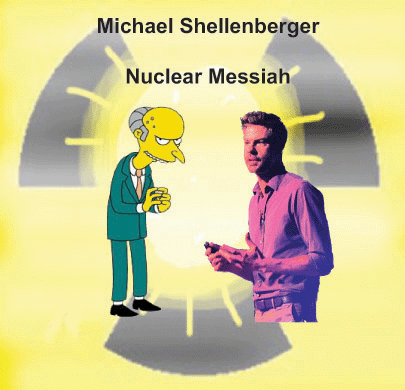
Michael Shellenberger, founder of the pro-nuclear group Environmental Progress, said Gov. Jerry Brown and the California Public Utilities Commission are responsible for creating some of the highest energy rates in the United States.
He also blames Brown and the utility regulators he appointed for the “corrupt” deal that assigned customers $3.3 billion in costs related to the premature shutdown of the San Onofre nuclear plant and said he wants to secure a cleaner energy future by promoting nuclear power.
Shellenberger listed eight key pledges he said would lower energy costs, reduce poverty, improve education and promote cleaner sources of power. His first pledge is: “Break up the corrupt California Public Utilities Commission (CPUC), release secret emails and prosecute the criminals.”
The commission was the subject of a criminal investigation by former Attorney General Kamala Harris, although it’s unclear where the probe stands under her successor, Xavier Becerra. The investigation centered on emails showing potentially improper communications between regulators and the utility companies they are supposed to oversee. San Diego consumer attorney Mike Aguirre has a number of lawsuits against the commission, including one demanding release of more emails.
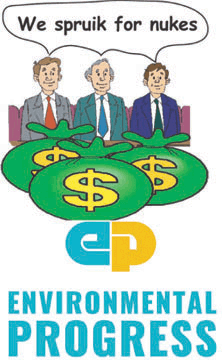
A resident of Berkeley, Shellenberger is the founder and president of Environmental Progress, a nonprofit group that advocates for nuclear power across the country and world. The group is committed to preserving the Diablo Canyon nuclear plant on California’s central coast that has been scheduled for closure.
A resident of Berkeley, Shellenberger is the founder and president of Environmental Progress, a nonprofit group that advocates for nuclear power across the country and world. The group is committed to preserving the Diablo Canyon nuclear plant on California’s central coast that has been scheduled for closure.
U.S. Firms Courting Saudi Arabia to Build Nuclear Reactors; Rick Perry to Visit Riyadh, Haaretz, 3 Dec 17, One of the sources also said Riyadh had told Washington it does not want to forfeit the possibility of one day enriching uranium – a process that can have military uses.
U.S. firms attracted by Saudi Arabia’s plans to build nuclear reactors are pushing Washington to restart talks with Riyadh on an agreement to help the kingdom develop atomic energy, three industry sources said.
Saudi Arabia has welcomed the lobbying, they said, though it is likely to worry regional rival Iran at a time when tensions are already high in the Middle East.
One of the sources also said Riyadh had told Washington it does not want to forfeit the possibility of one day enriching uranium – a process that can have military uses – though this is a standard condition of U.S. civil nuclear cooperation pacts. “They want to secure enrichment if down the line they want to do it,” the source, who is in contact with Saudi and U.S. officials, said before U.S. Energy Secretary Rick Perry, the former Governor of Texas and “Dancing with the Stars” contestant, holds talks in Riyadh early next week.
Another of the industry sources said Saudi Arabia and the United States had already held initial talks about a nuclear cooperation pact. U.S. officials and Saudi officials responsible for nuclear energy issues declined to comment for this article. The sources did not identify the U.S. firms involved in the lobbying.
Under Article 123 of the U.S. Atomic Energy Act, a peaceful cooperation agreement is required for the transfer of nuclear materials, technology and equipment. In previous talks, Saudi Arabia has refused to sign up to any agreement with the United States that would deprive the kingdom of the possibility of one day enriching uranium. Saudi Arabia, the world’s top oil producer, says it wants nuclear power solely for peaceful uses – to produce electricity at home so that it can export more crude. It has not yet acquired nuclear power or enrichment technology.
Riyadh sent a request for information to nuclear reactor suppliers in October in a first step towards opening a multi-billion-dollar tender for two nuclear power reactors, and plans to award the first construction contract in 2018.
Reuters has reported that Westinghouse is in talks with other U.S.-based companies to form a consortium for the bid. A downturn in the U.S. nuclear industry makes business abroad increasingly valuable for American firms.
Reactors need uranium enriched to around 5 percent purity but the same technology in this process can also be used to enrich the heavy metal to a higher, weapons-grade level. This has been at the heart of Western and regional concerns over the nuclear work of Iran, which enriches uranium domestically.
Riyadh’s main reason to leave the door open to enrichment in the future may be political – to ensure the Sunni Muslim kingdom has the same possibility of enriching uranium as Shi’ite Muslim Iran, industry sources and analysts say.
Potential problem for Washington
Saudi Arabia’s position poses a potential problem for the United States, which has strengthened ties with the kingdom under President Donald Trump……….https://www.haaretz.com/us-news/1.826436
2 Dec 17, WASHINGTON — The pressure is off South Carolina’s congressional delegation to extend a federal tax deadline for the country’s nuclear power industry following the cancellation of two unfinished reactors at V.C. Summer station.
As Republicans advance a tax overhaul bill in Congress, the likelihood of federal lawmakers passing tax credits for a new generation of nuclear power plants has diminished alongside South Carolina’s failed $9 billion energy project.
Lawmakers from the Palmetto State, who pushed the nuclear tax credits as recently as June, still believe that the incentives are good national policy but admit they now aren’t as much of a priority for the state, which continues to reel from the project’s collapse. …..
The tax credits, which would shrink the final cost of new nuclear reactors by billions of dollars once they are completed, were included in the massive tax bill that passed the House in November. But the incentives were left out of the Senate’s partnering tax legislation…….
At this point, Georgia is the only state likely to benefit from the proposed tax credits. Thirty states have nuclear power plants in operation, but few are discussing plans to construct new ones…….
U.S. Rep. Ralph Norman, R-Rock Hill, whose district includes V.C. Summer, said the project’s cancellation should serve as a “wake-up call” for other states that consider similar efforts in the future.
“The silver lining is it’s making people aware of oversight of a project like this,” Norman said. “It’s making people aware in government not to let the power companies off the hook.”
Another positive, Norman said, is that the energy vacuum creates more need for other sources of energy he has supported, such as solar. ……
The failure of South Carolina’s project also provides ammunition to longtime critics of the nuclear industry more broadly, such as U.S. Rep. Lloyd Doggett, D-Texas, who was the only House member to speak out against the tax credit extension when it came up for a House vote earlier this year and now expressed vindication.
“The nuclear industry is always asking for one handout after another and then they bail out,” Doggett said. “It’s a ripoff, and it’s tragic that the ratepayers in South Carolina end up picking up the cost.”
Radiation concerns at Pohakuloa revisited: Feds to review issues raised by Kona resident, December 3, 2017 By TOM CALLIS Hawaii Tribune-Herald
Federal regulators will give parts of Pohakuloa Training Area’s radiation monitoring plan another look in response to a petition from a Hawaii Island resident.
A U.S. Nuclear Regulatory Agency review board agreed last month to review some of the concerns raised by retired geologist Michael Reimer, including frequency of sediment sampling, number of sediment sampling sites and data evaluation methods for depleted uranium.
Reimer, of Kailua-Kona, also asked for continued air monitoring and soil sampling, though they will not be part of the NRC’s review because those steps were previously considered……….
Flynn started a private lobbying and consulting practice that did business in foreign countries including Russia and Turkey. Flynn didn’t disclose those contacts and payments, as required, when applying for his security clearance to work in the Trump White House.
Top House Democrats have pointed out that Flynn failed to disclose a 2015 Middle East business trip tied to a plan to build nuclear plants in the region using money from Saudi and Russian investors. The Democrats called the omission a crime.
Flynn Said to Have Reached Out to Russia at Kushner’s Behest, By David Kocieniewski, Greg Farrell, Andrew M Harris, and David McLaughlin, Bloomberg,
Ex-security adviser pleads guilty and agrees to cooperate
Former national security adviser Michael Flynn pleaded guilty to lying to federal agents and is providing cooperation that promises to take Special Counsel Robert Mueller deep into Donald Trump’s administration.
Speaking in court as part of his plea agreement, Flynn, 58, described a series of conversations with the Russian ambassador to the U.S., Sergey Kislyak, in late December as the Trump team prepared to enter the White House. The talks were instigated by a “very senior member” of the Trump transition team. That person was Jared Kushner, the president’s son in law and adviser, as reported by Bloomberg View columnist Eli Lake……..
Flynn now says he lied to the FBI in January about the conversations, but that he had fully informed the transition team of the talks.
“This shows a Trump associate negotiating with the Russians against U.S. policy and interests before Donald Trump took office and after it was announced that Russia had interfered in our election,” Senator Dianne Feinstein, a Democrat from California, said in a statement, adding that it’s critical to find out “who knew and approved his actions.”……..
In cooperating with Mueller’s inquiry, Flynn is seeking leniency for himself and possibly his son, who worked with him in his private business. The charge doesn’t delve into Flynn’s work on behalf of Turkey, which is also under investigation, or his failure to promptly disclose such work to U.S. authorities. At the hearing, Flynn admitted to lying about contacts with Turkey. In admitting to false statements, he faced a maximum of five years in prison and a $250,000 fine, but is likely to get no more than six months and $9,500 under his plea agreement……
After he left the administration, Flynn filed an updated foreign registration form showing that he hadn’t disclosed multiple contacts and payments from foreign entities while serving as an campaign adviser to Trump starting in February 2016….
Flynn retired [from military service] in 2014 after Obama fired him as director of the Defense Intelligence Agency.
Afterward, Flynn started a private lobbying and consulting practice that did business in foreign countries including Russia and Turkey. Flynn didn’t disclose those contacts and payments, as required, when applying for his security clearance to work in the Trump White House.
Top House Democrats have pointed out that Flynn failed to disclose a 2015 Middle East business trip tied to a plan to build nuclear plants in the region using money from Saudi and Russian investors. The Democrats called the omission a crime.
Hanford Tank Waste Among Top Federal Challenges For 2018 http://nwpr.org/post/hanford-tank-waste-among-top-federal-challenges-2018, ByANNA KING , 2 Dec 17, Cleaning up radioactive waste contained in tanks at the Hanford nuclear reservation is one of the top challenges facing the U.S. Department of Energy, according to a new special report by the department’s Inspector General.
The independent oversight arm of the U.S. Department of Energy didn’t mince words.
It said there were about 88 million gallons of radioactive tank waste across the nation that need to be cleaned up. Most is at Hanford.
The report noted that the factory meant to treat all of Hanford’s waste isn’t going so well — it’s behind schedule and will cost billions more than planned.
The report also highlighted problems that Hanford has had with its subcontractors. Specifically, several companies have agreed to pay a $125 million settlement for using substandard materials. Hanford’s tank waste and treatment plant were ranked at the top of the Department of Energy’s concerns along with cyber security and safeguarding the nation’s nuclear stockpile.
Saudi Arabia has welcomed the lobbying, they said, though it is likely to worry regional rival Iran at a time when tensions are already high in the Middle East.
One of the sources also said Riyadh had told Washington it does not want to forfeit the possibility of one day enriching uranium – a process that can have military uses – though this is a standard condition of U.S. civil nuclear cooperation pacts.
“They want to secure enrichment if down the line they want to do it,” the source, who is in contact with Saudi and U.S. officials, said before U.S. Energy Secretary Rick Perry holds talks in Riyadh early next week.
Another of the industry sources said Saudi Arabia and the United States had already held initial talks about a nuclear cooperation pact.
U.S. officials and Saudi officials responsible for nuclear energy issues declined to comment for this article. The sources did not identify the U.S. firms involved in the lobbying.
Under Article 123 of the U.S. Atomic Energy Act, a peaceful cooperation agreement is required for the transfer of nuclear materials, technology and equipment.
In previous talks, Saudi Arabia has refused to sign up to any agreement with the United States that would deprive the kingdom of the possibility of one day enriching uranium.
Saudi Arabia, the world’s top oil producer, says it wants nuclear power solely for peaceful uses – to produce electricity at home so that it can export more crude. It has not yet acquired nuclear power or enrichment technology.
Riyadh sent a request for information to nuclear reactor suppliers in October in a first step towards opening a multi-billion-dollar tender for two nuclear power reactors, and plans to award the first construction contract in 2018.
Reuters has reported that Westinghouse is in talks with other U.S.-based companies to form a consortium for the bid. A downturn in the U.S. nuclear industry makes business abroad increasingly valuable for American firms.
Reactors need uranium enriched to around 5 percent purity but the same technology in this process can also be used to enrich the heavy metal to a higher, weapons-grade level. This has been at the heart of Western and regional concerns over the nuclear work of Iran, which enriches uranium domestically.
Riyadh’s main reason to leave the door open to enrichment in the future may be political – to ensure the Sunni Muslim kingdom has the same possibility of enriching uranium as Shi‘ite Muslim Iran, industry sources and analysts say.
POTENTIAL PROBLEM FOR WASHINGTON
Saudi Arabia’s position poses a potential problem for the United States, which has strengthened ties with the kingdom under President Donald Trump.
Washington usually requires a country to sign a nuclear cooperation pact – known as a 123 agreement – that forfeits steps in fuel production with potential bomb-making uses.
“Doing less than this would undermine U.S. credibility and risk the increased spread of nuclear weapons capabilities to Saudi Arabia and the region,” said David Albright, a former U.N. weapons inspector and president of the Washington-based Institute for Science and International Security (ISIS).
It is not clear whether Riyadh will raise the issue during Perry’s visit, which one of the industry sources said could include discussion of nuclear export controls.
Under a nuclear deal Iran signed in 2015 with world powers – but which Trump has said he might pull the United States out of – Tehran can enrich uranium to around the level needed for commercial power-generation.
It would be “a huge change of policy” for Washington to allow Saudi Arabia the right to enrich uranium, said Mark Fitzpatrick, executive director of the Americas office at the International Institute for Strategic Studies think tank.
“Applying the ‘golden standard’ of not allowing enrichment or preprocessing (of spent fuel) has held up a 123 agreement with Jordan for many years, and has been a key issue in U.S. nuclear cooperation with South Korea,” said Fitzpatrick, a nuclear policy expert.
The United States is likely to aim for restrictions, non-proliferation analysts say.
These could be based on those included in the 123 agreement Washington signed in 2009 with the United Arab Emirates, which is set to start up its first South Korean-built reactor in 2018 and has ruled out enrichment and reprocessing.
“Perhaps Saudi Arabia is testing the Trump administration and seeing if the administration would be amenable to fewer restrictions in a 123 agreement,” ISIS’s Albright said.
It would be “a huge change of policy” for Washington to allow Saudi Arabia the right to enrich uranium, said Mark Fitzpatrick, executive director of the Americas office at the International Institute for Strategic Studies think tank.
“Applying the ‘golden standard’ of not allowing enrichment or preprocessing (of spent fuel) has held up a 123 agreement with Jordan for many years, and has been a key issue in U.S. nuclear cooperation with South Korea,” said Fitzpatrick, a nuclear policy expert.
The United States is likely to aim for restrictions, non-proliferation analysts say.
These could be based on those included in the 123 agreement Washington signed in 2009 with the United Arab Emirates, which is set to start up its first South Korean-built reactor in 2018 and has ruled out enrichment and reprocessing.
“Perhaps Saudi Arabia is testing the Trump administration and seeing if the administration would be amenable to fewer restrictions in a 123 agreement,” ISIS’s Albright said.
Questions on outlook for nuclear plants by Tom Johnson, NJ SPOTLIGHT
In what is likely to be the opening salvo of a nasty legislative battle, lawmakers are to convene early next week to discuss how to prevent New Jersey’s nuclear plants from shutting down prematurely.
The bigger question is whether they also are planning to act on a yet-to-be-introduced bill that some say could provide billions of dollars in ratepayer subsidies to Public Service Enterprise Group over the next decade.
The Senate Environment and Energy Committee and Assembly Telecommunications and Utilities Committee plan to hold a rare joint session Monday on economic challenges facing nuclear power plants, an issue that is splintering the energy sector not only in New Jersey but in Washington and elsewhere.
News of the joint hearing this week jolted a coalition opposed to efforts to prop up nuclear units. They fear the proceedings foreshadows a legislative initiative to award lucrative financial incentives to PSEG and Exelon (a co-owner of two of the plants) during the lame-duck session, which ends early in January.
“We’ve seen this special-interest strategy before on bad bills,” said Jeff Tittel, director of the New Jersey Sierra Club, an opponent of subsidies to nuclear plants. “It’s how a bad bill gets passed in a lame-duck session.”………
New Jersey would not be the first state to financially back nuclear power plants. Both New York and Illinois have approved ratepayer subsidies to keep nuclear units operating in those states. In the former, the subsidies amount to nearly $1 billion over two years.
Meanwhile, the Trump administration is pushing a plan to bail out coal and nuclear units before the Federal Energy Regulatory Commission, which is supposed to act on the proposal within two weeks.
Workers finish cleaning up nuclear burial ground, Star Tribune By NICHOLAS K. GERANIOS Associated Press, NOVEMBER 30, 2017 SPOKANE, Wash.— Workers on the Hanford Nuclear Reservation in Washington state have finished cleaning up one of the nation’s most contaminated radioactive waste sites, the U.S. Department of Energy said Thursday.
The dangerous wastes at the site known as the 618-10 Burial Ground stem from the production of plutonium for nuclear weapons and took eight years to clean up, the agency said………
The 580-square-mile site Hanford site is located in southeast Washington state.
During the cleanup, workers retrieved more than 2,200 55-gallon drums, plus other waste, some of it buried more than 20 feet underground.
In total, workers removed more than 512,000 tons of contaminated soil and waste debris, which was taken to Hanford’s hazardous-waste landfill.
The 7.5-acre burial ground contained highly radioactive waste from Hanford laboratories and fuel development facilities in the 1950s and 1960s. Poor record-keeping at the time meant many of the waste types were unknown, the department said……
Hanford was created by the Manhattan Project during World War II as the nation raced to create an atomic bomb. It produced most of the plutonium for the nation’s nuclear arsenal during the Cold War and contains the nation’s largest volume of nuclear waste.
The cleanup work costs more than $2 billion per year and is expected to take decades. The lawmakers said they will press the federal government to continue funding the work.