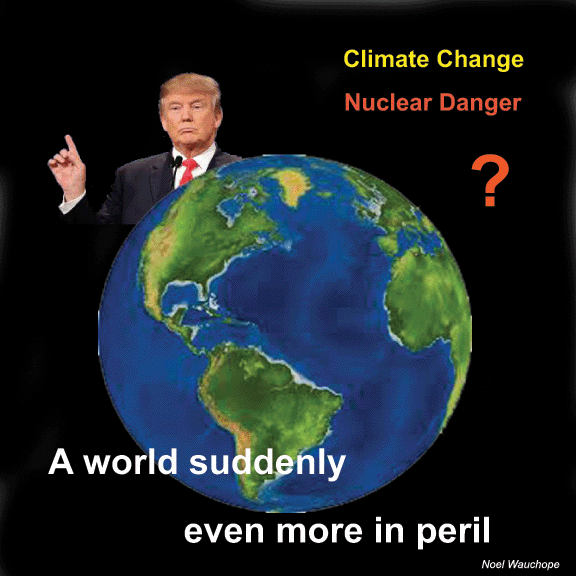
Like President Donald Trump, the Pentagon’s new nuclear policy document sees a dark and threatening world. It argues that potential U.S. adversaries such as China, North Korea, and Russia are rapidly improving their nuclear capabilities and gaining an edge over the United States. But rather than laying out a plan to halt this slide into a more dangerous world and working to decrease reliance on nuclear weapons, the Nuclear Posture Review (NPR) hastens its rise by accepting the reasoning of U.S. adversaries and affirmatively embracing nuclear competition.
The central claim of the Nuclear Posture Review is that the United States must expand its reliance on nuclear weapons to protect the country and its allies—a complete reversal of the Obama administration’s effort to reduce reliance. To this end, the NPR proposes not only replacing an aging nuclear arsenal but further “supplement[ing]” it with two new missiles. It expands the circumstances in which the United States would consider employing nuclear weapons to include the ambiguously termed “non-nuclear strategic attacks” against infrastructure.
The review also includes a litany of other measures that could usher in a future in which nuclear competition is commonplace: increasing capacity to produce plutonium pits in case the United States urgently needs to expand its arsenal dramatically; training conventional forces to fight alongside nuclear ones; improving the readiness of the 150 or so nuclear weapons stationed in Europe for what had been symbolic reasons; and a new distrust of arms control measures, to name a few.
Uncharacteristically, the review contains several clumsy, contradictory, and misleading statements. For example, it gives opposing standards for deciding when the 1970s-era B83 1.2 megaton gravity bomb should be retired. Even prior to the review’s release, there were concerns that Trump’s retaliatory stance would raise the possibility of a disproportionate use of nuclear force, such as against a cyberattack. General Paul J. Selva, the nation’s second-ranking military officer, was forced to deny such claims as “fundamentally untrue.” (However, in expanding the nuclear mission to include the poorly defined category of “non-nuclear strategic attacks,” the document invites such an interpretation.) This kind of confusion surrounding the issuance of nuclear threats is frankly unacceptable, especially for an administration that also sends careless statements about its nuclear posture over Twitter.
One chart is so anxious to show that U.S. adversaries are advancing faster than the United States that it lumps together a range of dissimilar systems from the large Russian arsenal, the small Chinese arsenal, and the tiny North Korean arsenal. It lists highly advanced systems together with ones that have been indefinitely delayed, and even includes North Korea’s unproven missiles. When it comes to the United States, the chart omits myriad ongoing programs that have sustained and improved the world’s most capable nuclear force, as well as all of the upcoming programs to replace these systems with new ones.
On top of a pledge to carry out the Obama administration’s plans to “sustain and replace” nearly every system in the nuclear arsenal, the review calls for two “supplements”: a new option for a low-yield sea-launched ballistic missile (SLBM) and a new sea-launched cruise missile (SLCM) in lieu of the missiles removed from the fleet in the 1990s. Both are necessary, the NPR argues, because they “will help counter any mistaken perception of an exploitable ‘gap’ in U.S. regional deterrence capabilities.” Yet the review validates this perception by scrambling to fill that gap, stating that new flexible low-yield options are “important for the preservation of credible deterrence against regional aggression.” The statement weakens the credibility of U.S. strategic forces and signals to China, North Korea, and Russia that they should expect a low-yield strike to be met with a reciprocal and limited response (which they could consider an advantageous exchange).
Moreover, by taking this position, the NPR implicitly accepts the Russian belief that the lower yield of these weapons makes them more credible and more acceptable to use in regional wars. This is wrong for three reasons: first, even “low-yield” nuclear weapons are thousands of times more destructive than the largest conventional ones and risk contaminating huge swaths of allied or enemy territory; second, it is not at all clear that an adversary would be able to quickly ascertain that a nuclear detonation was a “low-yield” strike; and third, even if it could, it may not obligingly limit its response. Under such a theory, if Russia were reckless enough to carry out a small nuclear attack, the United States would have to shock it into restraint through nuclear retaliation. In relying on nonstrategic weapons for deterrence, the NPR exhibits the same mistaken logic that it worries is taking hold in Moscow.
The review neglects to make a compelling case for the necessity of its proposed systems. The claim that deploying a new SLCM could prompt Russia to retire its banned ground-launched cruise missiles is laughable. In general, generic language about “mistaken perceptions” is a thin justification for an expensive and potentially destabilizing new system. Just as the Air Force has struggled to make the case for why a new air-launched cruise missile is needed, the NPR fails to demonstrate that there are missions that cannot be performed by the existing systems and thus, that there is a need for new ones.
The review self-consciously insists that it “is not intended to, nor does it enable, ‘nuclear war-fighting.’ ” Yet the arguments about nonstrategic weapons and the capabilities of the proposed “supplements” enable the use of nuclear weapons in a limited regional war. The low-yield SLBM is apparently designed to promptly strike small and mobile targets such as an enemy’s mobile missile launcher or forward command post. If used this way, ballistic missile submarines, which were previously used for strategic deterrence, would also be able to perform battlefield missions.
Overall, the NPR reflects an outdated and simplistic view of deterrence. It argues that nuclear weapons provide unrivaled deterrent effects, so more options mean more deterrence. Today’s military planners, however, have a far more complex and nuanced understanding of deterrence. They plan to employ a range of capabilities across different domains to create a strategic effect appropriate to the specific threat. In some circumstances, issuing a nuclear threat may be necessary to deter an attack. Yet in other situations, it may be more credible and more compelling to threaten to defend against an attack or to impose unacceptable costs in the cyber-domain, in space, with sanctions, or with conventional weapons. No matter their yield or delivery method, nuclear weapons will never be seen as a credible deterrence to the kind of low-level aggression at which Russia and North Korea have proven adept.
This is part of the reason why the Obama administration sought to reduce reliance on nuclear weapons: if an objective can be met with conventional weapons it will be a more credible threat than a nuclear one. Yet the 2018 NPR explicitly says that “non-nuclear forces…do not provide comparable deterrence effects.” This says to our allies, “Don’t be assured by our conventional cooperation; demand nuclear commitments.” And it says to our adversaries, “Don’t be deterred by our conventional posturing; we are serious only when we make a nuclear threat.”
The tension between conventional and nuclear force also arises in the review’s approach toward funding the arsenal. Top defense officials have stated frankly that the Pentagon does not have a plan to pay the expected $1.7 trillion to update and operate the arsenal over the next 30 years. That figure will create serious tensions in a Pentagon wrestling with a dizzying array of other priorities: raising the readiness of U.S. forces, building new fleets of aircraft carriers, fighters, and attack submarines, and investing more funds in future research. Yet rather than attempting to solve the problem with cost the NPR dismisses it, declaring that nuclear weapons are “an affordable priority” comprising “a small fraction” of the defense budget. The fact remains that every dollar spent on a nuclear “supplement” is one that cannot be devoted to strengthening the service members who provide essential deterrence deployed around the world every day.
Each of the NPR’s failings derives in part from the structure of the review process itself, which considers nuclear weapons in isolation from other elements of American power. As a result, the document reads less like a strategy of how best to deter threats to the United States and its allies and more like a piece of advocacy for nuclear weapons—a self-conscious defense of their utility, affordability, and an effort to expand their mission. It is less a Pentagon policy document than a memo from a powerful lobby.
Future administrations would be better served by conducting a “deterrence posture review,” to explicitly consider the cost implications of its recommendations and to develop a strategy that uses all effective capabilities to deter aggression. This effort would encourage planners to integrate different levers of American power in their deterrence planning rather than to privilege one over others.
Yet the most significant problem with Trump’s Nuclear Posture Review is the slanted view it holds of the world and the obsolete theory of deterrence and war fighting that it promotes, which is so poorly suited to today’s threats. Rather than working to reduce nuclear dangers, the nation’s nuclear policy now reflects the reasoning of U.S. adversaries and readily follows them into a more dangerous world.
Buried In Trump’s Nuclear Report: A Russian Doomsday Weapon, NPR , February 2, 2018 GEOFF BRUMFIELToday, the Trump administration released a report on the state of America’s nuclear weaponry. The assessment, known as a Nuclear Posture Review, mainly concerns U.S. nukes and missiles.
But buried in the plan is a mention of a mysterious Russian weapon called “Status-6.” On paper, at least, Status-6 appears to be a kind of doomsday device. The report refers to it as “a new intercontinental, nuclear-armed, nuclear-powered, undersea autonomous torpedo.”
“The radius of total or near-total destruction is the size of a pretty large metropolitan area, actually,” says Edward Geist, a Russia specialist at the RAND Corporation who has spent time looking at the weapon. “It’s difficult to imagine in normal terms.”……
Status-6 looks like a giant torpedo about a third the length of a big Russian submarine. According to the slide, it is nuclear-powered, meaning it can roam for months and even possibly years beneath the ocean without surfacing. Its payload is a nuclear warhead “many tens of megatons in yield,” Geist says.
That’s thousands of times more powerful than the bombs dropped at the end of World War II and more powerful than anything currently in the U.S. and Russian arsenals.
Status-6 would launch from beneath a Russian submarine. It would shoot at a depth too deep to be intercepted, and travel for thousands of miles. Upon reaching its target along the U.S. coastline, it would detonate, swallowing up whatever city happened to be nearby.
“The only possible U.S. targets are large port cities,” says Mark Schneider, a senior analyst with the National Institute for Public Policy wrote in an e-mail. “The detonation of Status-6 in any of them would essentially wipe out their population into the far suburbs.”
“The detonation would cause a very large amount of radioactive fallout,” adds Pavel Podvig, an arms control expert who runs a blog called Russian Strategic Nuclear Forces. Podvig believes the weapon could potentially bathe the entire Northeast Corridor in radioactive soot.
Status-6 would probably be used as a “third-strike” weapon of last resort. If Russia fell under attack from the U.S. and couldn’t retaliate with its missiles, it might trigger Status-6: A doomsday machine. Or at least a doomsday-ish machine.
Then again, the whole thing might be a fake.
“The drawing of this drone looks more like an enlarged drawing of a smaller torpedo,” says Podvig. In other words, it looks like the Russians may have just taken some torpedo clip-art, blown it up to terrifying size and then broadcast it on state television.
Why?
“It’s a way to get our attention,” says Geist.
Geist says that the “leak” of Status-6 was deliberate. Russia worries that U.S. missile defenses might be able to shoot down its missiles in a nuclear war. By showing a plan for Status-6, Russia is warning the U.S. that if it continues to build such defensive systems, then Russia will find another way to strike: one that can’t be intercepted.
“My read of the whole Status-6 slide leak is that the Russians were trying to send us a message,” Geist says.
Podvig agrees that the leak of Status-6 is probably just a warning shot. But the fact it appeared in the Pentagon’s newest report on nuclear weapons shows that some war planners are taking the idea seriously.
There may be some politics involved in that decision as well, says Hans Kristensen of the Federation of American Scientists. The Trump administration is pushing hard for upgrades to America’s nuclear arsenal. In his State of the Union address, the president called for making the arsenal “so strong and so powerful that it will deter any acts of aggression by any other nation or anyone else.”
Citing Status-6 helps to build the case that upgrades to American nukes are needed, Kristensen says.
Report Urges Long-Term Power Agreements for SMRs at Federal Sites , Nuclear Energy InstituteFeb. 1, 2018—A new study funded by the U.S. Department of Energy recommends that federal agencies (such as DOE and the Defense Department) be allowed to enter into 30-year power purchase agreements with utility operators of small modular reactors (SMRs).
Typically defined as reactors having a generating capacity smaller than 300 megawatts-electric, SMRs are a good fit for sites like DOE’s 17 national laboratories, the study says.
For example, the Oak Ridge National Laboratory is the largest consumer of electricity among the agency’s sites and is engaged in several critical, round-the-clock defense and research-related activities………
“Leveraging the federal government’s strong credit standing as a purchaser of the power and its continual need for baseload power is important in the development of SMRs. Federal agency purchasers can help to set the market and offer more certainty to other initial buyers,” the study says.
“By creating an authority that permits federal agencies to purchase power for up to 30 years, SMR developers will be able to use traditional financing to repay a project financed project or a long-term bond over an up to 30-year term, making the financing more affordable.”
Currently, only the Department of Defense has the authority to enter into power purchase agreements of 30 years in duration, in certain circumstances.
The study urges moving the pilot project at Clinch River forward to completion……..
Another example of collaboration between a small modular reactor developer and a national laboratory is NuScale Power, of which the Utah Associated Municipal Power Systems (UAMPS) is planning to build up to 12 at the Idaho National Laboratory. Under this project, DOE or other federal entities could enter into power purchase agreements with UAMPS or its associated utilities. ……
Another example of collaboration between a small modular reactor developer and a national laboratory is NuScale Power, of which the Utah Associated Municipal Power Systems (UAMPS) is planning to build up to 12 at the Idaho National Laboratory. Under this project, DOE or other federal entities could enter into power purchase agreements with UAMPS or its associated utilities. ……
More Premature Nuclear Unit Retirements Loom, Power Magazine, 02/01/2018 | Sonal PatelTwo more U.S. nuclear power plants are facing early retirement, joining a string of generators whose fate was determined by market conditions, political pressure, or financial stresses assailing the sector. Several others may be poised to join them.
The 647-MW Duane Arnold nuclear plant in Palo, Iowa, will likely close in 2025 after a current contract with the facility’s primary customer expires, said NextEra Energy Resources’ chief financial officer, John Ketchum, in a fourth-quarter earnings call on January 26.
“Without a contract extension, we will likely close the facility at the end of 2025 despite being licensed to operate until 2034,” Ketchum said. “As a result, during the fourth quarter, Duane Arnold’s book value and asset retirement obligation were reviewed, and an after-tax impairment of $258 million was recorded that reflects our belief it is unlikely the project will operate after 2025.” Ketchum added, however, that NextEra will continue to pursue a contract extension.
On the same day, the Toledo Blade reported that FirstEnergy Corp.’s Davis-Besse nuclear plant in Oak Harbor, Ohio, is headed for premature closure, citing James Pearson, the company’s chief financial officer. Pearson told the newspaper that no date has been set for the closure of Davis-Besse. He also reportedly said that the outlook for the company’s Perry plant in Ohio and twin-reactor Beaver Valley nuclear plant in Pennsylvania is “bleak.” FirstEnergy is intent on exiting its competitive business, but though the company may want to sell the plants, they are “probably impossible to sell in today’s market,” he reportedly said.
A Critical Condition The plants join a series of generators recently stricken by financial pressure primarily by competition from cheap natural gas, expanding renewable capacity, and lethargic power demand growth.
Early retirement has also been proposed for Clinton and Quad Cities in Illinois and for Nine Mile Point, Fitzpatrick, and Ginna in New York—but their fate appears dependent on the outcome of legal challenges to “bailout” programs to keep those plants operating for economic reasons. The states’ measures are being legally challenged by several independent power producers—including Dynegy, Eastern Generation, NRG Energy, and Calpine Corp.—and, prominently, competitive power producer trade group the Electric Power Supply Association. The consortium has long argued that the state rules interfere with Federal Energy Regulatory Commission (FERC) jurisdiction over wholesale electric rates and unlawfully interfere with interstate commerce………..
Earlier in January, California regulators approved Pacific Gas & Electric’s application to retire the Diablo Canyon plant by 2025, following a protracted battle over the generating station that pitted local economic interests against environmentalists and other opponents of nuclear power. In New York, political pressure combined with economic misgivings, also prompted plans to shut down Indian Point by 2021.
A Swath of Other Reactors May Be Troubled According to a September 2017 report from the Idaho National Laboratory (INL), several more nuclear plants are likely to retire early, stymied by an “ongoing industry wide, systemic economic and financial challenge to operating nuclear plants particularly in the deregulated markets.”
A revenue gap analysis conducted by the national laboratory for 79 of 99 operational reactors that are in a region where public wholesale electricity market prices are available suggests that 63 units would have lost money in 2016. Of those 63, 36 are merchant generators, 19 are regulated, and eight are public power generators.
INL suggests that among plants at high risk of early retirement are Davis-Besse, Three Mile Island in Pennsylvania, and Xcel Energy’s Prairie Island in Minnesota.
In line with what the company previous disclosed in bankruptcy court earlier this month, it seems that the largest chunk of the money will go to a group of hedge funds led by Boston-based Baupost Group.
According to a document filed on Monday, the Cranberry-based firm disclosed that nearly 2,400 claims totaling $111 billion have been filed against the company.
But it believes less than $9 billion will be allowed by the court. Of that, vendors, suppliers, employees and contractors who filed $6 billion in claims will likely get between $775 million and $1.16 billion, the company estimated.
The plan, which has the approval of Westinghouse, Toshiba, the unsecured creditors committee, and the Pension Benefit Guaranty Corp., must now be voted on by the unsecured creditors by March 15.
After meeting with South Korean Vice Unification Minister Chun Hae-sung in Seoul, Joseph Yun also told reporters that he sees the resumed inter-Korean talks and easing tensions after the North’s decision to join the upcoming Winter Olympics as a “good opportunity” for denuclearization efforts.
“We want to open dialogue with North Korea, we want to have a credible dialogue, a dialogue that could lead steps towards denuclearization,” he said. “That is our goal and of course President Moon has also emphasized that goal too.”
Santee Cooper is dropping two retirement plans that the state-owned utility has offered for years to its executives, part of an effort to cut costs following a multibillion-dollar nuclear fiasco and appease state lawmakers, livid the perks existed in the first place.
“Clearly, it’s a way to make sure we demonstrate we’re hearing what the folks in the Legislature are saying,” interim Santee Cooper Chief Executive Jim Brogdon told The State newspaper Thursday.
Later this month, the utility’s board is expected to vote to get rid of the two extra retirement plans, which offered some Santee Cooper executives benefits in addition to the normal retirement plan that is open to all state employees, Brogdon said.
Thirty-three Santee Cooper managers currently are enrolled in an extra pension-style plan. Nine employees are enrolled in an additional 401(k)-type plan.
Those plans pay benefits in addition to the normal state retirement plan’s payments.
Longtime Santee Cooper Chief Executive Lonnie Carter decided which employees were allowed to enroll in the two extra plans, which the utility said it offered to retain top executives.
Carter’s retirement came a month after Santee Cooper abandoned its decadelong joint effort with Cayce-based SCE&G to build two nuclear reactors in Fairfield County.
The failed project saddled Santee Cooper with $4 billion in debt, cost S.C. power customers at least $2 billion in higher bills and brought fresh scrutiny to the way the state-owned power company rewards its executives.
“The fact that they had three separate retirement plans for their executives, and the fact that the CEO chose the members of those plans, to me, was ridiculous,” said Senate Minority Leader Nikki Setzler, the Lexington Democrat who co-chaired the Senate committee that investigated the nuclear fiasco. “That is an abuse of the system.”
During a Senate hearing Thursday, Setzler told Brogdon he was pleased with the proposal to ditch the special retirement plans.
Santee Cooper’s board vote later this month would close the extra retirement plans to future executives but leave them in place for current employees and 32 retirees who already are enrolled.
Nuclear plant to close ahead of schedule, Washington Examiner, by John Siciliano | One of the oldest nuclear power plants in the country will be shutting down more than a year ahead of schedule.
Exelon, the largest nuclear utility in the country, said Friday that it would shut down the Oyster Creek power station in New Jersey in October, more than a year ahead of schedule.
The power plant decided to close early, even though it is licensed by the federal government to provide electricity through 2029. The early closure stems from costly regulations in New Jersey requiring it to install new cooling towers.
Exelon entered into an agreement with the state’s environmental regulators in 2010 to phase out the plant’s operations, after it decided that it could not justify the cost of meeting the new water cooling rules. It instead agreed to a planned phaseout in which it would close the plant in December 2019.
But on Friday, things changed, and now the company wants to close the plant more than a year earlier than under the agreement with the state. It explained that the shutdown decision was made to help employees in finding new employment, while dealing with higher maintenance cost and lower prices for electricity……….
Environmentalists and other staunch opponents of nuclear power plants welcomed the decision, pointing out that the Oyster Creek plant is the same design as the one that experienced multiple reactor core meltdowns and explosions during the 2011 Fukushima disaster in Japan.
The Oyster Creek plant is the “first and the oldest Fukushima-design nuclear reactor in the world,” a General Electric model called the Mark I, said the anti-nuclear energy group Beyond Nuclear in reacting to Exelon’s new closure timeline.
“It’s clear that Oyster Creek and the entire, aging U.S. nuclear reactor fleet is hemorrhaging financially,” said Paul Gunter, the head of the group’s reactor oversight program. “The fact that the U.S. Nuclear Regulatory Commission and the nuclear industry continue to prioritize financial margins over public safety margins is a growing concern, especially at the remaining 29 Fukushima style reactors still operating in the U.S.” http://www.washingtonexaminer.com/nuclear-plant-to-close-ahead-of-schedule/article/2647965
Fairfield County is weighing whether to sue utility SCE&G over the shutdown of a project to build to two nuclear reactors in Jenkinsville after the utility blocked county officials from assessing improvements at the site.
SCE&G shut down the nuclear project six months ago after the projected costs of building the two reactors soared from $11 billion to $14 billion to $20 billion. The shutdown put an estimated 5,000 people out of work.
Now, officials in the small rural county north of Columbia want to collect property taxes on the incomplete reactors and the land they sit on.
“They built a small city out there,” county administrator Jason Taylor said. “And that small city should be taxed.”
But that process got off to a rocky start when SCE&G last month allowed a county tax assessor access to the site on a tour bus, but didn’t let him and his team off to take measurements or other calculations needed.
The crater-scarred landscape of the Nevada Test Site. Most subsidences leave saucer-shaped craters are varying in diameter. 1995. This is the north end of Yucca Flat. Most tests have been conducted in this valley. From 1951 until 1958 119 atmospheric tests were conducted and from 1962 until 1992 more than 1,000 underground tests. Nye County, Nevada, USA. (PHoto by Galerie Bilderwelt/Getty Images)
Donald Trump Is Playing a Dangerous Game of Nuclear Poker , TIME, By W.J. HENNIGAN , 2 Feb 18 At a vast tract of uninhabited desert in southern Nevada, hundreds of moonlike craters dimple the wasteland, remnants of Cold War nuclear explosions that melted the bedrock and fused the sand to ensure that America could take part in the unthinkable: global thermonuclear war. The crowds of scientists and generals are long gone–the U.S. hasn’t tested a nuke since 1992, when then President George H.W. Bush declared a self-imposed testing moratorium. But the Nevada National Security test site is not completely abandoned. A skeleton crew of custodians oversees the long dormant facility, less than 90 miles northwest of Las Vegas, standing by to turn the lights back on if the day ever comes.
It may come sooner than many thought.
Since 1993, the Department of Energy has had to be ready to conduct a nuclear test within two to three years if ordered by the President. Late last year, the Trump Administration ordered the department to be ready, for the first time, to conduct a short-notice nuclear test in as little as six months.
That is not enough time to install the warhead in shafts as deep as 4,000 ft. and affix all the proper technical instrumentation and diagnostics equipment. But the purpose of such a detonation, which the Administration labels “a simple test, with waivers and simplified processes,” would not be to ensure that the nation’s most powerful weapons were in operational order, or to check whether a new type of warhead worked, a TIME review of nuclear-policy documents has found. Rather, a National Nuclear Security Administration official tells TIME, such a test would be “conducted for political purposes.”
The point, this and other sources say, would be to show Russia’s Vladimir Putin, North Korea’s Kim Jong Un, Iran’s Ayatullah Ali Khamenei and other adversaries what they are up against.
President Trump has not ordered such a test, but even the consideration of a show of force–by the nation that announced the atomic age by dropping nuclear weapons on Japanese cities in August 1945–marks a provocative shift from the sober, almost mournful restraint that has characterized the U.S. posture toward the weapons for decades. To prevent nuclear war and the spread of weapons to non-nuclear states, the strategy of Republican and Democratic Commanders in Chief alike has been to reduce nuclear arsenals and forge new arms-control agreements.
The Trump Administration, by contrast, is convinced that the best way to limit the spreading nuclear danger is to expand and advertise its ability to annihilate its enemies. In addition to putting the Nevada testing ground on notice, he has signed off on a $1.2 trillion plan to overhaul the entire nuclear-weapons complex. Trump has authorized a new nuclear warhead, the first in 34 years. He is funding research and development on a mobile medium-range missile. The new weapon, if tested or deployed, would be prohibited by a 30-year-old Cold War nuclear-forces agreement with Russia (which has already violated the agreement). And for the first time, the U.S. is expanding the scenarios under which the President would consider going nuclear to “significant non-nuclear strategic attacks,” including major cyberattacks………….
Rather than dissuading such efforts, arms-control experts from both political parties say, Trump’s moves will accelerate them. A new nuclear-arms race would not be limited to two superpowers seeking strategic balance in a Cold War but would include many nations, including foes in regions where hot wars are a regular occurrence. ………
Trump’s new plan also expands the President’s “first use” of nuclear weapons to circumstances that include “non-nuclear strategic attacks” against the U.S. or its allies. That could mean cyberattacks on nuclear command and control systems or civilian infrastructure, like the electricity grid or air-traffic-control system, arms-control experts have concluded. Previous Administrations limited the threat of a nuclear response to mass-casualty events, like chemical- and biological-weapon attacks. Stephen Schwartz, a nuclear weapons policy expert, said the key concern is the expansion of the nuclear umbrella to “include these new and not extreme possibilities, thus dramatically lowering the threshold for nuclear use.”
The Trump plan also takes a new, skeptical approach to nuclear arms-control agreements.
………. If Trump undoes the nuclear deal with Iran, analysts fear that Tehran will sprint for a weapon. Its regional rival Saudi Arabia could then develop its own atomic weapon, or import one from close ally Pakistan, which has its own fast-growing nuclear arsenal to counter arch-rival India’s. (Pakistan is building up its stockpile of tactical nuclear weapons.) China now has a nuclear-powered submarine, known as the Jin-class, that gives its military the ability to launch ICBMs from the sea……….. http://time.com/5128394/donald-trump-nuclear-poker/
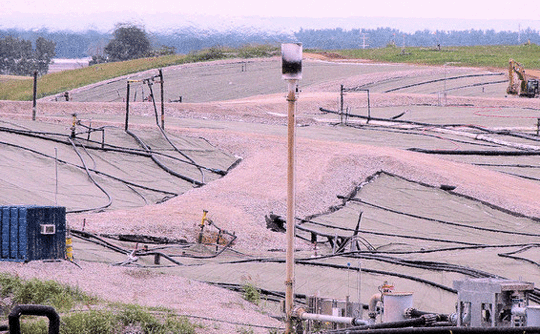
EPA orders cleanup at St. Louis nuclear waste site. What does it mean for the nation’s other toxic messes? WP, By Brady DennisFebruary 1 18, The Environmental Protection Agency on Thursday ordered a long-awaited cleanup of a Superfund site northwest of St. Louis, saying residents living near the landfill contaminated with World War II-era nuclear waste deserve action after waiting 27 years for federal regulators to issue a decision.
EPA Administrator Scott Pruitt’s decision to partially excavate tons of radioactive material from the West Lake Landfill over the next five years — at an expected cost of $236 million to the liable companies — goes beyond a 2008 solution proposed by the George W. Bush administration to cover and monitor the waste…….
Thursday’s announcement also was intended to be Exhibit A in demonstrating Pruitt’s commitment to revitalizing the agency’s Superfund program, which includes the nation’s most polluted sites, by streamlining and accelerating cleanups. But it underscored how few Superfund sites have simple answers, though nearly all of them generate intense emotions.
“We were hoping for full, 100 percent excavation. But we know that would be difficult to accomplish,” said Dawn Chapman, a founder of Just Moms STL, an activist group that has long pushed for an extensive excavation with relocation of families near the landfill.
Chapman said her group views the outcome as a hard-fought victory but one that is far from guaranteed, given the public comment and cleanup process likely to unfold over years. “We have to stay here and watch it and see it through,” she said. “I look ahead, and I see these other big battles coming. We’re not going to blink, because you can’t. … We will continue to fight to get even more [radioactive waste] removed.”
……..While the $236 million price tag of the EPA plan is significantly higher than what the firms hoped to spend, it is well below the cost, projected at nearly $700 million, of a full excavation.In a statement, Republic Services said it was “pleased that the EPA has finally ended decades of study and again is issuing a proposed plan for the site.” But the company cautioned that a final decision could take years.
What remains to be seen is whether the decision on West Lake represents how Pruitt is likely to approach other Superfund sites. In recent months, Pruitt has promised aggressive Superfund cleanups and made a public show of butting heads with corporate interests — something he has rarely done on other issues during his first year at the EPA. Yet aside from creating a list of 21 targets needing “immediate and intense” attention, as well as forming a special task force to recommend ways to expedite cleanups and “reduce the burden” on companies involved, Pruitt has explained very little about how he intends to deal with the hundreds of other toxic waste sites around the country……….
Meanwhile, the Trump administration has proposed cutting the Superfund program’s budget by 30 percent, or about $330 million annually. And while there are responsible companies that the EPA can legally force to pay for cleanups at many of the locations Pruitt has mentioned, many others are “orphan” sites where the polluters have gone bankrupt or are no longer legally liable for remedying the problem. At those, the federal government still shoulders most of the tab — and the pot of available dollars keeps shrinking. ………
North Korea: Trump administration’s ‘sloppy work’ in Nuclear Posture Review AT FIRST glance you might not see what’s wrong with this map used in Donald Trump’s nuclear review. But it has left some experts baffled. news.com.au , Debra Killalea, 1 Feb 18,
A DRAFT report of the Trump administration’s Nuclear Posture Review (NPR) has been slammed as embarrassing after featuring a graphic showing Debra Killaleaa very different looking North Korea.
The draft report, leaked two weeks ago, omits South Korea and instead shows the whole peninsula represented by the North’s flag.
Experts slammed the “sloppy work” in the report and said they hoped it would be corrected ahead of its final release tomorrow, US time.
Hans Kristensen, director of the Nuclear Information Project at the Federation of American Scientists, raised concerns about the map, tweeting the authors actually want to strengthen tailored deterrence.
The concerns over the graphic were echoed by Adam Mount, a senior fellow at the Centre for American Progress, who said the Pentagon could not release a policy document that failed to recognise South Korea.
He also slammed it as embarrassing and unforgivable, adding it was the latest in a series of “avoidable offences”.
South Korea is a major US ally with the two countries forging strong military and economic ties.
Two weeks ago, Mr Mount said the leaked review translates Mr Trump’s impulses into an order for new, more usable nuclear options. He also called it “strategically risky”.
The NPR is used to determine the role of nuclear weapons in the security strategy of the US.
‘EMBARRASSING’ ERROR
John Blaxland, Professor of International Security and Intelligence Studies and director of ANU’s Southeast Asia Institute, said the mistake was embarrassing but wasn’t worth reading too much into………
“There is a growing consensus among academic institutions and civil society organisations that the efficacy of nuclear weapons as a deterrent of state-on-state war has waned, if it ever worked effectively in the first place,” he said.
Prof Blaxland said some people argued it wasn’t the atomic weapons dropped on Japan in 1945 that led to Japan’s surrender but rather Russia’s declaration of war.
He also said the steps being proposed by the US today are likely to be extremely expensive and of dubious additional benefit…….
NO GOOD NUKE’
Critics are already warning the NPR could trigger another arms race and raise the risk of miscalculations that might spark an atomic conflict.
Beatrice Fihn, executive director of International Campaign to Abolish Nuclear Weapons (ICAN), said the Trump review raised some serious concerns.
“The risk of use for nuclear weapons has always been unacceptably high,” she said.
“The new Trump nuclear doctrine is to deliberately increase that risk. It is an all-out attempt to take nuclear weapons out of the silos and onto the battlefield.
“This policy is a shift from one where the use of nuclear weapons is possible to one where the use of nuclear weapons is likely.”
She also said there was no such thing as a good nuclear weapon.
CONCERNS GROW
The Union of Concerned Scientists has also raised some concerns about the review and has said the gap between China and the US is too wide to argue Washington is lagging behind in a significant way.
While acknowledging Beijing has made significant advances in its nuclear capabilities, it said China’s arsenal is smaller than the US had in 1950.
In a White Paper released last month, they also argue there’s little evidence China is pursuing “entirely new” nuclear capabilities.
The People for Nuclear Disarmament said the leaked NPR made global thermonuclear war more, not less, likely and global nuclear arms racing more probable.
Nuclear disarmament campaigner John Hallam said Mr Trump was looking for ways in which he could differentiate himself from, and take credit for, the immense expansion of US nuclear infrastructure initiated by former president Obama.
Mr Hallam said there is considerable continuity between the Obama and the Trump approach but there was a key difference.
“The only important difference — and it certainly is important — is that while under Obama, the direction of the US nuclear arsenal was officially down it is not officially up,” he said.
“Trump makes no bones about wanting to expand US nuclear capabilities. Never mind if they don’t need them. Never mind if it initiates an arms race or never mind if it makes an apocalypse more likely.
More radioactive contamination triggers management change at Hanford, BY ANNETTE CARY, acary@tricityherald.comJanuary 29, 2018
The Department of Energy is replacing the managers of a critical radioactive clean-up project after the continued spread of contamination on the Hanford site.
The move is intended to rebuild confidence with workers and the public and show the project is being safely managed.
on the future of the West Lake Landfill — a decision that could free the St. Louis area of the seven-decade environmental burden it has borne in America’s quest for nuclear superiority.
For Pruitt, the right decision would be costly and complicated. The wrong decision, though far cheaper and most expedient, would leave in place a radioactive nightmare that would haunt the region for generations to come. The right decision is the only decision.
At issue are thousands of tons of radioactive waste left over from secret uranium refinement carried out in St. Louis during the Manhattan Project, the 1940s effort to produce America’s first nuclear bomb. Although officials at the time were well aware of the radioactive dangers, they paid little heed to where they dumped the wastes from years of uranium processing. An uncovered, unlined pit at the West Lake landfill became the dumpsite of choice, two miles northwest of St. Louis Lambert International Airport
The landfill, uphill and less than two miles from the Missouri River, was never designed for radioactive waste and never would have met today’s federal safety guidelines. Various radioactive hot zones have been discovered in downstream watersheds, as have large cancer clusters among residents. For years, a slow-moving underground fire at an adjacent landfill is believed to be advancing toward the buried nuclear waste.
In tests conducted from 2012 to 2014, groundwater at West Lake contained unsafe levels of radioactive uranium, radium and thorium-230, along with arsenic, manganese, barium and benzene.
An exhaustive, 814-page EPA study, updated on Jan. 10, outlines the dangers and costs associated with six options Pruitt can choose from for West Lake. One option, doing nothing, is laughable. Three cheaper proposals call for partial excavation of the site at varying depths and capping the site but leaving many toxins behind. The two best options involve full excavation — one would store the waste on-site in a modern, secure containment cell, and the other would transport it offsite to a remote, federally approved storage facility.
Full excavation and removal would keep the region safest over the long term. But it’s also the most expensive option at $695 million. Capping the site would cost about $75 million but also would pose the greatest future cancer risks to farmers and residents downstream.
Pruitt has the comfort of making this decision from Washington, D.C., far from the exposure zone. We urge him to consider all who have suffered so far because of the irresponsible, lazy solutions imposed on St. Louis decades ago. If Pruitt would regard it as unacceptable for his own family to be exposed to such risks, then he must conclude that St. Louisans deserve the same consideration. This radioactive time bomb must go.
Jan 30, 2018 , COLUMBIA — A compromise being considered by state lawmakers would temporarily halt nuclear-related payments to SCANA until regulators and the state’s courts decide who should pay for the cancelled reactors at V.C. Summer.
The South Carolina House is set to amend legislation that would roll back the 2007 law that put in motion the eventual $9 billion construction failure in Fairfield County, according to three sources familiar with the amendment.