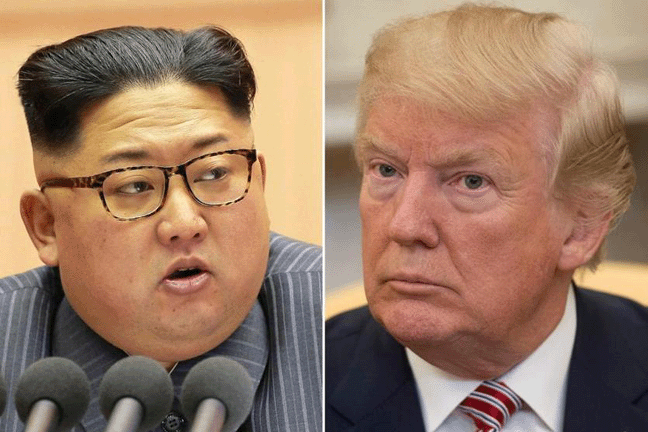
NEW YORK — Secretary of State Mike Pompeo cited progress Thursday toward salvaging a historic summit between President Trump and North Korean leader Kim Jong Un and what he called the “once in a lifetime opportunity” of ending the nuclear weapons threat from North Korea.
Following two days of talks with Kim’s right-hand aide, Vice Chairman Kim Yong Chol, Pompeo spoke as though the summit Trump had canceled last week was likely to be reinstated, but still framed it as an “expected” first meeting.
Ionizing radiation can cause cells to turn cancerous, Pakistan Observer Islamabad : It is well established that exposure to ionizing radiation can result in mutations or other genetic damage that cause cells to turn cancerous.
Now a new study led by researchers with the U.S. Department of Energy’s Lawrence Berkeley National Laboratory (Berkeley Lab) has revealed another way in which radiation can promote cancer development.
Working with cultures of human breast cells, the researchers discovered that radiation exposure can alter the environment surrounding the cells so that future cells are more likely to become cancerous.
“Our work shows that radiation can change the microenvironment of breast cells, and this in turn can allow the growth of abnormal cells with a long-lived phenotype that has a much greater potential to be cancerous,” says Paul Yaswen, a cell biologist and breast cancer research specialist with Berkeley Lab’s Life Sciences Division.
A cell’s phenotype is its full complement of observable physical or biochemical characteristics. Different cells can have phenotypes that look dramatically different or exhibit radically different behaviour even though their genetic makeup (genotype) is identical.
Signals from outside the cell can alter a cell’s phenotype by regulating (or de-regulating) the cell’s use of its genes. Studies have shown that if a cell develops a pre-cancerous phenotype, it can pass on these “epigenetic” changes to its daughters, just as it can pass on genetic mutations.
“Many in the cancer research community, especially radiobiologists, have been slow to acknowledge and incorporate in their work the idea that cells in human tissues are not independent entities, but are highly communicative with each other and with their microenvironment,” Yaswen says. “We provide new evidence that potential cancer agents and their effects must be evaluated at a systems level.”
Yaswen is the corresponding author of a paper describing this study that appears in the on-line journal Breast Cancer Research. Co-authoring the paper were Rituparna Mukhopadhyay, Sylvain Costes, Alexey Bazarov, William Hines and Mary Helen Barcellos-Hoff.
“The work we did was performed with non-lethal but fairly substantial doses of radiation, unlike what a woman would be exposed to during a routine mammogram,” says Yaswen, who is also a member of the Bay Area Breast Cancer and the Environment Research Center. “However, the levels of radiation involved in other procedures, such as CT scans or radiotherapy, do start to approach the levels used in our experiments and could represent sources of concern.”……….
This study was jointly funded the National Institute of Environmental Health Sciences (NIEHS), and the National Cancer Institute (NCI), NIH, through the Bay Area Breast Cancer and the Environment Center, and by the NASA Specialized Center of Research. https://pakobserver.net/ionizing-radiation-can-cause-cells-to-turn-cancerous-5/
Toshiba exits US nuclear project https://www3.nhk.or.jp/nhkworld/en/news/20180531_37/31 May 18 Japanese electronics maker Toshiba is walking away from a nuclear energy project in the US. The firm says it won’t take part in building or operating the nuclear plant.
There are 2 reactors on the drawing board. Toshiba executives say the project is no longer financially viable.
They say an increase in shale production has caused a fall in electricity sales.
They also point to stricter regulations introduced after the 2011 nuclear accident in Fukushima. Toshiba joined the South Texas Project in 2008. Executives were hoping to start operating the reactors around 2016 or 2017.
But the power company that’s heading up the project hasn’t started building them.
Toshiba is cutting its ties to the nuclear power business overseas.
The firm incurred massive losses through its former American nuclear subsidiary, Westinghouse.
FERC, DOJ support Illinois nuclear subsidies in court filing UTILITY DIVE,31 May 18
Dive Brief:
The Federal Energy Regulatory Commission and Department of Justice filed a joint legal brief in support of Illinois nuclear subsidies on Tuesday.
Lawyers for the two agencies wrote the zero emission credits (ZECs) for Illinois nuclear plants do not interfere with FERC’s authority to regulate wholesale power markets, as generators claimed. If the subsidies disrupt market operations, “the solution lies with the Commission, not the courts,” the agencies wrote.
The legal opinion will likely also apply to a pending court challenge against New York nuclear subsidies, as well as a New Jersey subsidy program enacted last week. The FERC opinion could also make a Supreme Court case over the subsidies less likely, analysts say.
Dive Insight:
The Tuesday amicus brief from FERC and DOJ is a blow for opponents of nuclear subsidies, who hoped the courts would throw out the recent state programs designed to keep uneconomic plants from retiring.
In their brief, filed with the U.S. Court of Appeals for the Seventh Circuit, FERC and DOJ write the Illinois program does not suffer from the “fatal defect” that doomed other state subsidy programs in the courts.
………Evaluating methods to integrate state energy policies into wholesale markets has been a focus at FERC in recent years — and also a point of contention. In March, the commission approved an ISO-New England plan to change its capacity market auctions to handle subsidized resources, but the 3-2 vote exposed divides between regulators on how to handle future cases.
TVA spokesman Scott Brooks said the federal utility is pursuing action to collect for the overcharges by the contractor. May 31st 2018, by Dave Flessner
The Tennessee Valley Authority was overcharged nearly $4.4 million by a contractor at the Watts Bar Nuclear Power Plant for construction of the Unit 2 reactor from 2013 to 2015, according to an audit released Wednesday.
TVA’s inspector general said Williams Plant Services (WPS) used labor classifications not provided in its contract for nearly $3.5 million of work at Watts Bar and another $430,322 for excessive markups, ineligible overtime and other unsupported labor costs. The contractor also improperly billed for $435,624 of temporary living allowances and travel costs, according to TVA auditors. Read more from our newspartners at the Chattanooga Times Free Press.
BRENT MARCHBANKS, 31 May 18 We must demand that congressional and state office seekers explain their position on this longstanding and crucial issue.
We should all contact Attorney General Wasden and urge him to protect the Batt deal. May 30, 2018
Since the 1940s, science has sought a way and a place to safely and permanently store nuclear waste. So far, no luck. Tons and tons of nuclear waste is “orphaned” in our own country and around the world, with no place to go.
Many Idahoans believe that the 1995 Batt agreement resolved this issue as to our state and the private companies, the U.S. and the other countries who are looking for places to send their poison.
It didn’t.
The Idaho National Laboratory (INL) and some of Idaho’s elected officials now want to open our state to 7,000 cubic meters of Hanford’s radioactive waste. Ominously, INL is anxious to “renegotiate” the Batt agreement to allow even more toxic stuff into the state.We must demand that congressional and state office seekers explain their position on this longstanding and crucial issue.
We should all contact Attorney General Wasden and urge him to protect the Batt deal.
Logan has 10 months to consider modular nuclear reactor program, HJ News.com, By Sean Dolan staff writer, 31 May 18, “……..Right now, Logan is the largest city participating in a plan to build a small modular nuclear reactor just north of Idaho Falls.
The project is still in the development phases, and Logan has several opportunities to pull out of the project, including a coming deadline in March 2019. At that point, UAMPS Chief Legal Officer Mason Baker said, UAMPS will gauge how many cities are participating and decide whether it makes good business sense to keep going. Baker said UAMPS hopes Logan will sign power contracts before the March deadline.
……“There’s all kinds of risks,” said Logan Light and Power Director Mark Montgomery. “There’s first-of-its-kind risk, there’s construction risk, there’s design risk, there’s a regulatory risk and probably other risks that I’m forgetting.”
Logan is set to participate in the nuclear reactor at 30 megawatts, which exceeds any of the city’s existing power contracts. Logan Finance Director Rich Anderson said there is always risk involved in the power business, but he is concerned with the financial risk involved in this level of participation…..Since 2016, Logan has paid UAMPS $206,000 for administration and general costs and has another $250,000 budgeted for this year. City Attorney Kymber Housley said there’s a risk that Logan could pay UAMPS hundreds of thousands of dollars for a project that might never happen.
“One of the big risks is it gets caught up in litigation,” Housley said in a Wednesday interview. “I don’t even think it’s a question of if; it’s more of a question of how many lawsuits will be brought trying to stop a nuclear plant.”
Officials with the U.S. Nuclear Regulatory Commission (NRC) plan to hold a public hearing May 31 on the safety record of the Arkansas Nuclear One power plant in Arkansas, whose two units are among three cited by the agency for poor performance and other problems in its annual assessment of the nation’s nuclear fleet.
The NRC ranks nuclear facilities in five categories, with Category 1 designating a safe-performing plant, down to Category 5, which requires a plant to close until NRC inspectors sign off on corrective actions. Victor Dricks, senior public affairs officer with the NRC, told POWER the agency has never placed a unit in Category 5……..
The Arkansas meeting is one of a number of upcoming public sessions scheduled by the NRC at plants across the country to discuss the group’s safety reports. The agency this week said it would continue with additional oversight of TVA’s Sequoyah Nuclear Power Plant in Soddy-Daisy, Tennessee, after an undisclosed security violation at the plant last fall. …….
Korea’s “Season of Summits”https://wordpress.com/read/blogs/39598748/posts/5355-29 May 18The upcoming “will they—won’t they” US-DPRK summit, either by accident or by design, has the potential to re-set the strategic atmosphere on the Korean Peninsula…but only if Washington and Pyongyang can find a convergence of common interest.
There are limitations on American action on the Korean peninsula that constrain its menu of choice vis-à-vis North Korea (DPRK). The absence of a substantive relationship between the US and North Korea limits Washington’s economic and diplomatic leverage. However, as the more powerful party with overwhelming nuclear superiority and clear capacity to deter the DPRK nuclear threat, the US does have capacity to re-set the terms of the relationship by reducing the heat in negotiations. Washington can do this by changing the focus for the negotiations.
The long game
North Korea can be deterred as a nuclear power. A peace treaty to formally end the Korean War represents the best pathway to managing regional security and ensuring the safety of the people who live in the region. Under the umbrella of a formalised peace regime, human security concerns within North Korea are more likely to be constructively addressed. Engagement and interaction is the best vehicle for this, based on an understanding of complex systems and social change processes within the DPRK.
Summits are symbols that act as markers in a much broader process of relationship-building, based on confidence-building measures and clear, achievable implementation steps. Confidence-building measures develop the relationship between negotiating parties and gradually evolve the level of trust necessary to progress to subsequent steps on the negotiation pathway.
Depth of relationships are also a source of leverage; one of the reasons why the United States has struggled to influence the DPRK is that it does not have substantive economic links through which to influence the government in Pyongyang. This lack of leverage is why US officials have argued for China to play a more substantive role in pressuring North Korea, because China has a relationship with the DPRK that it can leverage. Rightly or wrongly, the US has dealt itself out of direct influence over North Korea through its various policies of strategic isolation and maximum pressure.
We should also understand that from a complex systems perspective, relationships—be they economic, governmental, institutional, or people-to-people—create flows of information, wealth and resources in and out of the DPRK. Those flows interact with and turbo-charge social change processes already underway in the DPRK, as we have seen with such flows between the DPRK and China. The result is a change, developing over time, in the relationship between the North Korean state and its people over time through the marketisation and Yuan-isation of the economy, and proliferation of information technologies into the country.
Focusing on the wrong prize
Regardless of whether or not the US-DPRK summit ultimately goes ahead, it is concerning that the Trump administration could blow an opportunity to meaningfully change the strategic goalposts on the Korean Peninsula by focussing on the wrong prize.
The only real trinket of value that Washington has to offer Kim Jong Un is a formal treaty to conclude the Korean War. It is likely that North Korea very much wants to negotiate an agreement with the United States, but under Pyongyang’s terms. It is no revelation to long-term North Korea watchers that those terms do not include “complete, verifiable, irreversible denuclearisation” (CVID).
The problem with Trump’s insistence on CVID is that there is no mutually agreeable starting point for a discussion with North Korea on those terms. There is no outcome in which the regime willingly relinquishes its nuclear weapons program because the Kim regime is so heavily invested in nuclear weapons as the foundation of its security strategy, economic development pathway, and domestic political legitimacy.
The negotiations surrounding the summit need to find a lowest common denominator that both parties can agree on. We saw this in the inter-Korean summit where Moon and Kim settled on easy-win engagement measures and mutually-beneficial security measures as the starting point for a confidence-building pathway.
CVID is a dead-end
The US and the DPRK clearly do not trust each other, and both parties have good reasons to be guarded ahead of a “will they—won’t they” summit. Most media attention coming out of the inter-Korean summit focused on Article 3.4 of the Panmunjom Declaration, which called for “complete denuclearisation” and “a nuclear-free Korean Peninsula,” building on the call in Article 1.1 for both parties to work together on implementing the 2005 Joint Statement on denuclearisation of the Korean Peninsula and the 13 February Agreement of 2007.
However, this clause does not mean North Korea has committed to denuclearisation as that concept is understood by the Trump administration. In the wake of his second meeting with Kim Jong-un, Moon Jae-in insisted that the North Koreans are committed to denuclearisation, clearly hoping to maintain the diplomatic momentum to ensure the US-DPRK summit takes place. However, the North Korean interpretation of a nuclear-free Korea implies the full nuclear weapons relinquishment of the United States and ultimate fulfilment of the spirit of the Nuclear Non-proliferation Treaty.
North Korea’s recent demolition of tunnels at its Punggye-ri nuclear test site are a gesture of goodwill to Washington, offering up a now-obsolete facility with an eye toward the upcoming US-DPRK summit. We have seen this kind of offering before, when the North Koreans demolished the cooling tower at their Yeongbyeon reactor in 2008.
Moon Jae-in’s tactical ego-stroking comments about Trump deserving the Nobel Peace Prize aside, one can argue that South Korea does not have high confidence in the Trump administration. South Korea’s diplomatic efforts in 2018 have been geared to guiding the US into a more conciliatory position with North Korea and make it politically safer for Trump to negotiate for an agreement with Pyongyang, knowing that there are influential American officials in Trump’s ear counselling for war.
Fears of American bellicosity in Seoul are not unwarranted. American hawks view any kind of engagement with North Korea as a “loss,” as “appeasement”—one of the most juvenile and misapplied terms in the international relations lexicon—and are well aware of the difficulty of getting any negotiated deal ratified in a Republican-majority Congress (recalling the fate of the Agreed Framework). National Security Advisor John Bolton’s recent comments comparing North Korea to Libya reinforce this perception. The irony of the present moment is a deal is more likely to stick in the US if it is owned by a Republican president. Such are the ironies and opportunities of Korean Peninsula diplomacy in 2018.
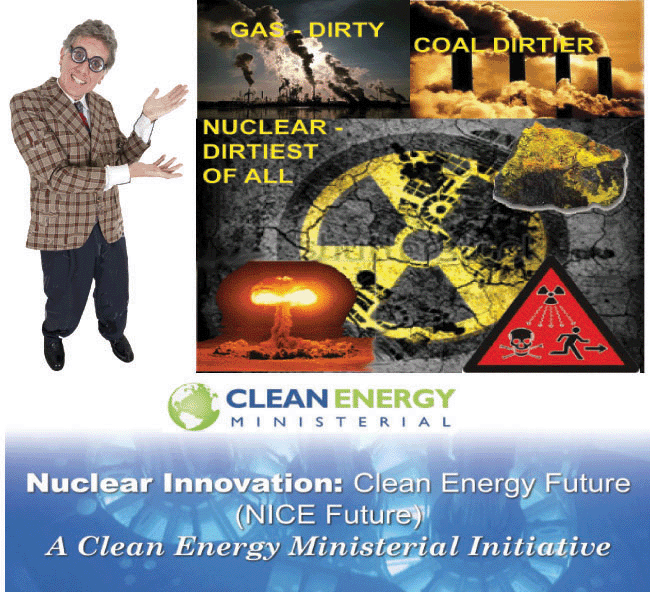
America Joins With Canada And Japan To Promote Nuclear Power, Forbes, Dave Keating , 29 May 18, “…… at a summit in Copenhagen, Denmark last week, it was clear the US is now trying a different tact.
A ‘Clean Energy Summit’ was organized bringing together energy ministers from across the world. At the event, the US launched new partnerships to promote nuclear power and coal with carbon capture and storage technology as alternatives to traditional fossil fuels……
The new nuclear partnership with Japan and Canada, was launched on Thursday. At the summit, the US was able to convince two new partners who are member states of the European Union – Poland and Romania – to join the alliance.
The partnership is called Nuclear Innovation: Clean Energy Future (NICE Future).
“Countries will need to use nuclear energy alongside other forms of clean energy to deliver a sustainable energy mix that is affordable to all and that supports economic development,” Agneta Rising, director general of the World Nuclear Association, said at the launch.
The aim of the initiative is to promote nuclear as a solution to climate change….
Separately, the US also promoted a new platform on Carbon Capture and Storage (CCS) called the Carbon Capture, Utilization and Storage Initiative that will focus on obtaining more financing for CCS demonstration projects. Such financing has been hard to come by in Europe, because investors are still sceptical about whether the technology, which stores the carbon underground rather than releasing it into the air, is viable.
The efforts may represent a new phase in America’s climate diplomacy……
Environmental campaigners, however, are having none of it. Hundreds of activists disrupted an event organized by the US government in November to promote nuclear and clean coal. They say the recent US moves are greenwashing a pro-coal agenda that is not actually interested in stopping climate change.
interim stores in places such as Fort St. Vrain could be in business not just for decades but for centuries. The nuclear-waste time bomb will keep ticking.
The 60-Year Downfall of Nuclear Power in the U.S. Has Left a Huge Mess The demand for atomic energy is in decline. But before the country can abandon its plants, there’s six decades of waste to deal with. The Atlantic , FRED PEARCE It was just another day in the life of the defunct
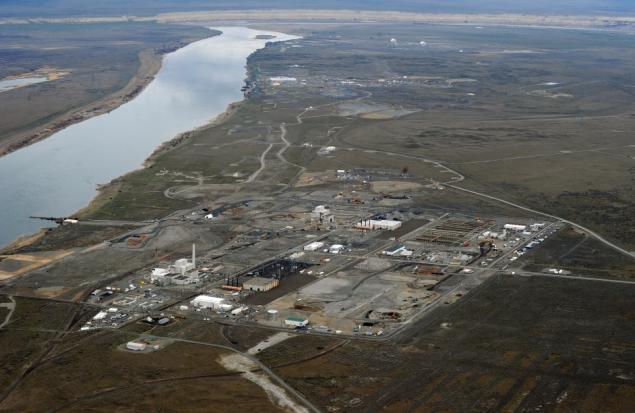
a remote part of Washington State that made most of the plutonium in America’s Cold War arsenal. On the morning ofMay 9, 2017, alarms sounded. Around 2,000 site workers were told to take cover indoors, and aircraft were banned from flying over the site for several hours. The roof of a tunnel had collapsed, exposing railcars that had been loaded with radioactive waste from plutonium production and then shunted underground and sealed in decades before.
There was other stuff down there too. Nobody quite knew what. Record keeping was poor, but the contents of the tunnels certainly included carcasses from animal radiation experiments, including a reported 18 alligators. The emergency lasted only a few hours. The integrity of the waste was restored. But it was a chilling reminder of the site’s perilous radioactive legacy.
Sprawling across 600 square miles of sagebrush semidesert, Hanford is a $100 billion cleanup burden, full of accidents waiting to happen. It is the biggest headache, but very far from being the only one, emerging in what increasingly look like the final years of America’s nuclear age.
It is 60 years since America’s first commercial nuclear power station was opened by President Dwight D. Eisenhower at Shippingport, near Pittsburgh, Pennsylvania, on May 26, 1958. But the hopes of a nuclear future with power “too cheap to meter” are now all but over. All that is left is the trillion-dollar cleanup.
Public fear and suspicion about all things nuclear grew sharply after March 1979, when the cooling system at Three Mile Island Nuclear Generating Station failed and triggered a meltdown. In the end, actual releases of radiation were minimal, but the incident left behind a reputational mess in addition to the radiological one. On the day of the accident, the United States had 140 operating nuclear reactors, with 92 under construction and 28 more awaiting official approval. In the next five years, more than 50 orders for new nuclear reactors in America were canceled. New contracts entirely dried up.
Hanford has not produced plutonium for three decades. Nobody is making new material for bombs anymore. President Trump’s plans for more weapons can be met by recycling existing plutonium stocks. And even the civil nuclear industry, which still generates a fifth of America’s electricity, is in what looks like terminal decline. With cheap natural gas and renewable solar and wind energy increasingly available, the numbers no longer add up. Nuclear power plants across the nation are being closed with years of licensed operation unused.
No new nuclear power stations have come on line in the past two decades. The only new build underway, two additional reactors at Georgia Power’s Alvin W. Vogtle plant near Waynesboro, is five years behind schedule and has seen its costs double. Its planned completion in 2022 remains uncertain.
America’s 99 remaining operational nuclear power reactors, which still deliver power to the grid, are too important to be closed overnight. But nearly half are over 40 years old. The only question is how long the regulators and accountants will allow them to keep going.
Oyster Creek in New Jersey disconnects from the grid in October with 11 years left on its license. Indian Point in New York State is to shut by 2021 due to falling revenues and rising costs. In California, Diablo Canyon is being closed by state regulators in 2025. The reactor at Three Mile Island in Pennsylvania that survived the 1979 accident will finally shut in 2019.
Shutdown is only the beginning of the end. Final closure and clearance of the sites can take decades, and the waste crisis created by decommissioning cannot be dodged. Lethal radioactive material is accumulating at dozens of power plants, military facilities, and interim stores across the country.
Some, like the train cars buried at Hanford, is evidently in a precarious situation. Much more needs urgent attention. Cleaning up and safely disposing of the residues of the nuclear adventure—much of it waste with a half-life measured in tens of thousands of years—is turning into a trillion-dollar nightmare for the nation. ………..
How did the United States reach this impasse? Back in 1982, the Nuclear Waste Policy Act established that it was the government’s job to deal with this ultimate back-end problem. The act obliged Washington to begin removing used fuel from stores and other facilities by 1998 for eventual disposal at a federal facility. In 1987, Yucca Mountain, near the former Nevada bomb-testing grounds, was chosen to be the sole such facility.In the 1990s, a five-mile tunnel was dug into the remote mountain. Then work stopped, in part because of vehement state opposition and in part because of concerns raised by geologists that a future volcanic eruption could propel buried waste back to the surface. One of President Obama’s first acts on taking office in 2009 was to formally abandon the $100 billion project. Things headed for the courts, which began awarding damages to power companies unable to make use of the nonexistent federal facility. The payouts amount to around half a billion dollars a year, and by 2022 will likely reach $29 billion.
Now President Trump wants to revive Yucca. His 2019 budget request included $120 million for the task. But the state opposition remains as strong as ever, and only $50 million was included in the final budget for Yucca-related items. Maybe Yucca Mountain will make a comeback. If not, then with no alternatives on the horizon, utilities will carry on being paid to keep spent fuel in pools next to abandoned nuclear power plants, and the interim stores in places such as Fort St. Vrain could be in business not just for decades but for centuries. The nuclear-waste time bomb will keep ticking. This piece is adapted from Pearce’s new book, Fallout: Disasters, Lies, and the Legacy of the Nuclear Age. https://www.theatlantic.com/science/archive/2018/05/the-60-year-downfall-of-nuclear-power-in-the-us-has-left-a-huge-mess/560945/
The 60-Year Downfall of Nuclear Power in the U.S. Has Left a Huge Mess The demand for atomic energy is in decline. But before the country can abandon its plants, there’s six decades of waste to deal with. The Atlantic , FRED PEARCE,
“……… The true heartland of America’s nuclear enterprise has always been Hanford. And it is the biggest and most toxic cleanup legacy too. Straddling the Columbia River, the Hanford nuclear reservation was America’s primary bomb-making factory. It was where they made the plutonium. At peak production, during the 1960s, its nine reactors irradiated 7,000 metric tons of uranium fuel annually. The intense radiation inside the reactors produced plutonium that was then extracted at five reprocessing plants. Hanford produced a total of 67 metric tons of the metal for the American arsenal, before business halted after the Cold War ended.Plutonium production was a huge task. It required much of the electricity generated at the giant Grand Coulee Dam upstream on the Columbia, the largest hydroelectric power producer in the United States. And the mess left behind is equally mind-boggling. Since production ceased, Hanford has been conducting the country’s largest-ever environmental cleanup program. The current expenditure is $2.3 billion a year. By the time it is done the bill will be more than $100 billion.
The site holds an estimated 25 million cubic feet of solid, radioactive waste. Much of it is buried in over 40 miles of trenches and tunnels, up to 24 feet deep, including the stretch that caved in last year. Elsewhere, there are two corroding cooling ponds, each the size of an Olympic swimming pool, containing some 2,000 tons of spent fuel that never got reprocessed.
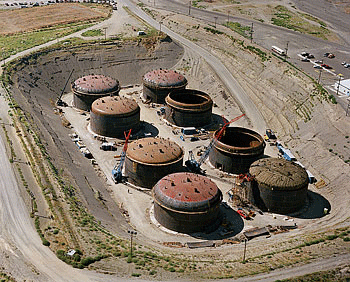
But the headline Hanford problem is the 56 million gallons of acidic and highly radioactive liquids and sludges, stored in 177 giant tanks, each up to 75 feet in diameter. They are the solvent leftovers from reprocessing, and contain around twice the total radioactivity released from the world’s worst nuclear accident to date, the 1986 explosion at the Chernobyl power station in Ukraine.
The tanks have been leaking for over half a century. Around a million gallons are slowly spreading toward the Columbia River, in a plume of contaminated soil covering 80 square miles. Protecting the river and its rich salmon habitat from the radioactive pollution is the number-one cleanup priority for the site’s custodians at the Department of Energy. To head off the flows, engineers are constantly pumping out radioactive water.
A better idea is to stop the leaks at the source by emptying the tanks and solidifying the liquids. The current aim is to heat them with glass-forming materials to create solid blocks that could one day be buried deep underground—maybe at Yucca Mountain. Work on a plant to do this began in 2002. It is currently 25 years behind schedule. Operations are not set to begin until 2036 and, once underway, would take 40 years.
At $17 billion and counting, the project is way over budget. Former plant engineers who have turned whistle-blowers believe it won’t be fit for the job and should be abandoned. They warn of a serious risk that particles of plutonium may settle out in the plant processing tanks, creating the potential for an accidental explosion with a big release of radiation.
The task at Hanford grows ever more daunting. After almost three decades, little of the waste and few of the tanks or processing plants have been cleaned up. Far away in Washington, D.C., some question the continuing money sink. It seems to some like a 21st-century pork barrel. Perhaps, critics say, it would be better to put up a fence and walk away. President Trump, while so far publicly supporting the Hanford cleanup, may privately agree. He has slashed its annual budget by $230 million, or about 10 percent.
Local environmentalists are scandalized. “We have got to clean up the site,” says Dan Serres, the conservation director of Columbia Riverkeeper, a local NGO. The tanks should be emptied and the trenches dug up. “In a hundred years, I’d hope the Native Americans have their treaty rights to this land restored,” agrees Chuck Johnson, of Physicians for Social Responsibility. But Tom Carpenter, the executive director of Hanford Challenge, who sits on an advisory board at the Hanford Concerns Council, told me: “You are never going to dig all the waste there up.” The tanks will have to be dealt with, but “most of Hanford’s waste volume-wise is going to stay put. Hanford is going to be a national sacrifice zone for hundreds of years.”
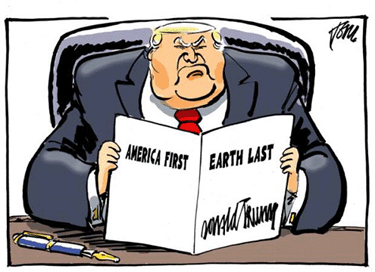
By Jackson Diehl Deputy Editorial Page Editor May 27 When May began, President Trump was presiding over diplomatic negotiations that could have delivered twin triumphs for his administration. Now, on Memorial Day, he’s reaping the wreckage of talks about Iran, and the North Korea process is in limbo. He has badly strained relations with vital U.S. allies and raised the risk of military conflicts in the Middle East and Asia. He has gone from would-be Nobel Prize winner to commander in chief of chaos.
National security adviser John Bolton and Secretary of State Mike Pompeo, the new axis of the president’s national security team, deserve some credit for this mess: Both prefer open confrontation with U.S. adversaries to the more nuanced approaches sold to Trump by their predecessors. But in essence the past month has been a decisive demonstration of Trump’s unwillingness — or, more likely, inability — to grapple with the complexities of international affairs. It’s a deficit that already is being skillfully exploited by U.S. adversaries, such as China — and it could lead to catastrophe before we get through another 2 1 / 2 years.
Trump managed to identify a couple of the most serious foreign policy challenges the country faced when he came to office. In their sole meeting, President Barack Obama warned the incoming president that North Korea and its growing nuclear program could no longer be ignored. It was evident, too, that Obama’s policy for checking Iran’s pursuit of hegemony in the Middle East was failing. Though Tehran was respecting the letter of the 2015 deal limiting its nuclear program, it had doubled down on aggression in Syria, Yemen and elsewhere, while exploiting a loophole in the pact to pursue the development of long-range missiles.
For a while, it looked like Trump’s blunt and blustering approach might produce results. Fearful that the president would shred the Iran deal, European governments worked hard to come up with a package that would answer Trump’s objections. They promised multilateral action to sanction and deter Iran’s missile production and its meddling in the Middle East, along with a mutual effort to prevent Tehran from resuming large-scale uranium enrichment when current restrictions expire in the mid-2020s.
North Korea’s Kim Jong Un, too, seemed impressed by the pressure Trump managed to focus on his regime, with the help of China. In January he launched the first diplomatic initiative of his six-plus years in power; by March he was communicating, through South Korea, the proposal of a summit with Trump, along with a vague promise of denuclearization.
Like virtually all diplomatic openings, the Iran and North Korea talks did not promise decisive victories.
Iran’s regional adventurism and the flaws in the nuclear deal could never be solved in a stroke, and experts on North Korea were virtually unanimous in predicting that Kim was unlikely to surrender his nuclear arsenal in the near term. For Trump, the challenge was to extract the most he could from the negotiations and pocket it. The result could have been partial but significant victories on both fronts: a tougher Western front against Iran, along with a reaffirmation of transatlantic cooperation; and, perhaps, a durable freeze on testing or deployment of nukes and long-range missiles by North Korea, amid negotiations on a long-term peace.
Trump instead blew up both negotiations — and the way he did so was telling. He didn’t plunge into the weeds of the deal with the Europeans and conclude that it would not be strong enough; he never seriously considered it. Senior European officials who lobbied him later said he appeared unfamiliar with its details. His sole focus, it turned out, was to satisfy a campaign promise by repudiating Obama’s principal foreign policy legacy.
Similarly, Trump never seemed to take seriously the reality that Kim was looking not for a quick deal but for a messy multistage process, with denuclearization a distant endpoint.
Trump is now saying the Korea summit may go ahead, even though there is no sign that Kim has changed his position on denuclearization. Still, the past month has taught all sides a lesson about Trump, if they didn’t know it already: He’s not up to serious negotiation. He can’t be expected to seriously weigh costs and benefits, or make complex trade-offs. He’s good at bluster, hype and showy gestures, but little else. In short, he may be the worst presidential deal maker in modern history.
The Korean nuclear roller coaster: Has time run out for a summit? Brookings, Jonathan D. Pollack Tuesday, May 29, 2018 The turbulence and drama on the Korean Peninsula over the past week defies imagination. On May 24, President Trump withdrew from his planned summit with North Korean leader Kim Jong-un, acting almost as impulsively as when he first agreed to the meeting in early March. Following a conciliatory response from Pyongyang’s senior nuclear negotiator Kim Kye-gwan, the president two days later sharply reversed course and said that the summit might still take place.
Not to be outdone, on May 26 Kim Jong-un abruptly convened a second meeting with South Korean President Moon Jae-in on the North Korean side of the truce village of Panmunjom. The next day, American and North Korean officials began to interact on the language of a possible communiqué. Separate consultations between the United States and North Korea in Singapore were expected to begin today, on May 29, with North Korea represented by Kim Jong-un’s de facto chief of staff, Kim Ch’ang-soon. Additional discussions have taken place between Chinese and North Korean officials in Beijing, perhaps connected to a possible stopover by Kim Jong-un while traveling to Singapore, which would be his third visit to China in less than two months. One of Kim Jong-un’s closest aides and a vice chairman of the Korean Workers Party Central Committee, General Kim Yong-chol, is now en route to New York, and is expected to serve as the lead point-of-contact with U.S. officials in deliberations over the Singapore meeting.
These heightened activities all suggest that the summit will indeed go forward, though there has been no formal announcement to this effect.
However, two facts remain incontestable. There is as yet no U.S.-North Korea agreement on the terms of a summit, and time is running out to reach such an understanding. An unspoken but unmistakable anxiety thus pervades these intensified political and diplomatic maneuvers. Only 10 days before President Trump’s presumed departure for Singapore, it is stunning how little remains agreed to, even in broad conceptual terms. Advocates of diplomacy argue that this is the purpose of face-to-face negotiations. But the contrasts in the language and expectations of the two leaderships remain glaring, even after two visits by Mike Pompeo to Pyongyang, first as CIA director and subsequently as secretary of state.
The fundamental issue is what the summit is supposed to be about. ……….
The 60-Year Downfall of Nuclear Power in the U.S. Has Left a Huge Mess The demand for atomic energy is in decline. But before the country can abandon its plants, there’s six decades of waste to deal with. The Atlantic , FRED PEARCE,
“……… Rocky Flats Wildlife Refuge is an oasis of prairie biodiversity covering 5,000 acres, home to prairie dogs, elk, monarch butterflies, and rare xeric grasses. It also serves as a buffer zone around the site of the largest completed nuclear cleanup to date in the United States. And David Lucas of the U.S. Fish and Wildlife Service is preparing to open it for public access in summer 2018. He’s reckoning on 150,000 visitors a year.During the Cold War, Rocky Flats was secretly machining plutonium manufactured at Hanford into some 70,000 spheres that formed the explosive heart of each weapon in Uncle Sam’s nuclear arsenal. Plutonium pollution was routine. The plant had nowhere to get rid of the day-to-day plutonium waste, which was often dumped in hastily dug landfills or sprayed onto grassland around the plant. At an outdoor compound known as pad 903, where more than 5,000 drums of waste liquids contaminated with plutonium are stored, there’s been substantial leakage. An internal memo reported that rabbits living on the site were heavily contaminated, especially in their hind feet.
A whistle-blower’s allegations about illegal late-night incineration of plutonium waste at the plant led to an FBI raid in 1989. After that—and with demand for plutonium spheres declining following the end of the Cold War—the government closed the site. A federal grand jury sat for three years to hear testimony from the FBI raid. But two days after the jury approved indictments, the Justice Department struck a deal with Rockwell Automation, the company that managed the plant. The company pleaded guilty to some minor charges, but the FBI evidence and grand jury conclusions were sealed forever.
After the cover-up came the cleanup. The core plutonium-handling areas were declared a Superfund site, qualifying for a federal decontamination, which was completed in 2005. The federal government called it “the largest and most successful environmental cleanup in history.” But in reality it was a cut-price job. The original project was estimated at $37 billion, but Congress would sanction only $7 billion. So processing buildings were demolished, but basements and 25 miles of underground tunnels and pipelines were left behind, according to LeRoy Moore, a veteran activist who sat on a public committee in the 1980s that considered the cleanup plans.
Today, the land that housed the industrial complex remains behind a sturdy fence under the control of the Department of Energy (DOE). But the large grassland buffer zone that once protected the complex from prying eyes has been released into the care of the Fish and Wildlife Service for public access.
There are two concerns. First that, as I saw on a tour with Lucas, the fenced-off core area hardly looks self-contained. Earth slips have left ugly gashes up to 300 feet wide across a former landfill site that overlooks a creek running through the wildlife refuge. The DOE’s Scott Surovchak concedes that “slumping is very common” after heavy rain. Only constant repairs, it seems, will prevent the landfills and buried contaminated buildings and pipework from being exposed.
The second concern is the safety of the buffer zone itself. Harvey Nichols, a biologist from the University of Colorado, has found that when the plant was operating snow falling nearby was often “hot.” Falling snowflakes captured tiny plutonium particles that evaded the stack filter. Just two days of snowfall could deposit about 14 million particles on every acre of the site. “There must be tens of billions of particles in the soil today,” he told me.
The Environmental Protection Agency has dismissed such concerns. In 2006 it found plutonium levels in soil samples in the buffer zone were within acceptable limits and concluded that the lands comprising the refuge are “suitable for unlimited use and unrestricted exposure.” But Moore, the activist, is unimpressed. “Prairie dogs and other critters will burrow down for several feet and bring plutonium to the surface,” he says. “Children will be exposed to plutonium. And people will start taking plutonium out into their communities on boots and cycle wheels. Why would we allow that?”
Lucas is unmoved. “We need to get people out here on the refuge. Then the fears will evaporate,” he told me. But that is just what worries his opponents. Forgetting about the plutonium is the worst thing that could happen, they say……….This piece is adapted from Pearce’s new book, Fallout: Disasters, Lies, and the Legacy of the Nuclear Age.