Trump Plan to Prop Up Coal, Nuclear Won’t Protect the Electric Grid The Trump administration says it needs to support struggling coal and nuclear plants to safeguard the grid. Experts say it’ll do the opposite. U.S. News, By Alan Neuhauser, Staff WriterJune 4, 2018 PRESIDENT DONALD TRUMP and Republican political leaders spent close to eight years accusing the Obama administration of picking winners and losers in the energy sector, but Trump’s order to the Energy Department last week to prop up failing coal and nuclear power plants does exactly what he vilified – and proposes the opposite of what’s needed to best safeguard the nation’s vulnerable electric grid, experts say.
Citing national security and defense concerns caused by the “rapid depletion of a critical part of our nation’s energy mix,” Trump on Friday directed Energy Secretary Rick Perry “to prepare immediate steps to stop the loss of these resources.”
The administration referred to coal and nuclear plants as “fuel-secure,” because they can house their fuel supplies on site, rather than relying on pipelines like natural gas plants.
Much remains unclear about the proposal, including how it will be implemented and how many plants it will seek to prop up. However, it encountered swift opposition from a broad range of energy experts, industry executives and advocates from across the spectrum. It’s also expected to face legal challenges in federal court, particularly from natural gas and renewables companies, which compete with coal and nuclear plants for market share.
Notably, a dispersed electric grid – one that relies on a diverse array of wind and solar power, in addition to natural gas, hydropower and, perhaps one day, advanced nuclear – is widely seen as far more resilient to attack or accident than one that depends on large, centralized power resources such as coal or large-scale nuclear.
The Defense Department, for example, isexpected to spend as much as $1.4 billion by 2026 on developing decentralized electric systems known as micro-grids, and the Energy Department in 2015partnered with private firms to research and develop distributed energy systems to boost the resilience for the civilian grid.
“If you really want security, you get away from all that and you decentralize the grid,” says David Bookbinder, chief counsel at the Niskanen Center, a libertarian-leaning think tank in the nation’s capital.
In particular, he continues, “residential solar is the single most secure form of power we have in the United States: It’s secure both from a fuel supply side – no one’s blocking the sun – and a distribution side: it goes from roof into your house, so there’s no problem with the transmission. That is a secure energy supply.”
Trump last year introduced a 30 percent tariff on imported solar panels, which is expected to crimp the solar industry’s growth in the coming years.
The biggest threat to the nation’s electric grid, meanwhile, isn’t believed to be an attack or accident that would take down a power plant but instead a disruption of the distribution network: the transmission lines, transformers and substations that carry electrons from the nation’s power plants to its homes and businesses.
……….”Most of the outages occur on the distribution system, which has nothing to do with the power plants connected to the system,” says John Larsen, director in the energy and climate practice at Rhodium Group, a research firm. “That’s not to say the loss of power from a particular plant doesn’t cause a loss of power here and there. But the vast majority of power outages occur elsewhere in the system.”
The Federal Energy Regulatory Commission, which oversees electricity markets,reached a similar conclusion in January, after the Trump administration made what was then its first attempt to subsidize struggling coal and nuclear plants.
FERC Commissioner Richard Glick, a Trump appointee, wrote in an opinion concurring with the agency’s decision to reject the administration’s proposal that “if a threat to grid resilience exists, the threat lies mostly with the transmission and distribution systems, where virtually all significant disruptions occur.”
The administration’s latest attempt to prop up coal and nuclear plants is expected to face similar challenges. The White House, in a memo made public last week, cited Section 202(c) of the Federal Power Act, as well as the Defense Production Act, which authorizes the Energy Department to nationalize parts of the nation’s electric sector during wartime……….
Justice Action Bulletin: Opposition to pipeline project, nuclear weapons, NCR , Jun 5, 2018., by Maria Benevento
MINNESOTA — Hundreds of faith leaders led by Minnesota Interfaith Power & Light and the Minnesota Poor People’s Campaign oppose Enbridge Energy’s proposed Line 3 pipeline project in northern Minnesota, warning that the project threatens the local environment and the Anishinaabe indigenous people, Twin Cities Pioneer Press via AP reported June 2.
This week, the group will deliver a letter to the state Public Utilities Commission and to Gov. Mark Dayton expressing their concerns, including the risks continued dependence on fossil fuels poses to the global climate.
Local indigenous people and other groups have opposed the project for months; a gathering of Midwest Catholic Workers held a retreat in Duluth during early April focusing on the issue which culminated in nonviolent civil disobedience at a pipeline storage yard.
MINNESOTA — Hundreds of faith leaders led by Minnesota Interfaith Power & Light and the Minnesota Poor People’s Campaign oppose Enbridge Energy’s proposed Line 3 pipeline project in northern Minnesota, warning that the project threatens the local environment and the Anishinaabe indigenous people, Twin Cities Pioneer Press via AP reported June 2.
This week, the group will deliver a letter to the state Public Utilities Commission and to Gov. Mark Dayton expressing their concerns, including the risks continued dependence on fossil fuels poses to the global climate.
Local indigenous people and other groups have opposed the project for months; a gathering of Midwest Catholic Workers held a retreat in Duluth during early April focusing on the issue which culminated in nonviolent civil disobedience at a pipeline storage yard.
LINCOLN, MASSACHUSETTS — Faith-based activists were among about 40 people who participated in a May 27 protest against nuclear weapons at the gate of Hanscom Air Force Base in Lincoln, Massachusetts, which resulted in six arrests, the Nuclear Resister reported May 28 from Massachusetts Peace Action.
The Program Executive Office for a program known as Nuclear Command, Control and Communications (NC3) is located at Hanscom. The program works on improving the communications system that would be used by the U.S. in case of nuclear war.
Massachusetts Peace Action organized the event, which included a flash mob where participants froze for two minutes in front of a Minuteman Statue and a march from Lexington Battle Green to Hanscom.
As they attempted to deliver an anti-nuclear weapons letter to the base commander, John Bach of Arlington and Cambridge Friends Meeting, John Schuchardt of the House of Peace in Ipswich, Pat Ferrone of St. Susanna Parish in Dedham, Laura Evans of Unitarian Universalist Society of Rockport, Jerald Ross of Chelmsford, First Parish Bedford, and Dan McLaughlin of Cambridge were arrested for trespassing.
WASHINGTON — Art Laffin, Mike Walli, and Dominican Srs. Ardeth Platte and Carol Gilbert — all part of the Dorothy Day Catholic Worker in Washington, D.C. — were among hundreds of people nationwide to be arrested May 29, the day after Memorial Day, as part of a Poor People’s Campaign day of action focused on gun violence and militarism.
According to an email report from Laffin May 20, at the action in Washington, about 150 people processed to the Russell Senate Office Building and went to Sen. Mitch McConnell’s office with a folded American flag “in remembrance of the U.S. war dead and the countless victims of U.S warmaking and violence worldwide.” The group also left carnations and offered reflections and information about U.S. war and gun violence.
Other faith leaders that were arrested for “Crowding, Obstructing, or Incommoding” after refusing to disperse include the Rev. Nelson Johnson, Joyce Johnson, Poor People’s Campaign co-chair the Rev. Liz Theoharis, the Rev. William Lamar IV, the Rev. Chuck Booker, Shane Claiborne, Jean Stokan, Bob Cooke, Mary Liepold, Paki Wieland and members of the group “About Face —Veterans Against the War.”
The protesters could choose to pay a fine of $50 or request a court day to be arraigned. Walli, Platte, Gilbert and Laffin will be arraigned in D.C. Superior Court June 27.
Heller maintains fight to exclude Nevada’s Yucca Mountain as federal nuclear dump site, By
Ripon Advance News Service | June 5, 2018 U.S. Sen. Dean Heller (R-NV) hailed a federal appeals court decision rejecting a Texas petition that sought to compel a licensing decision on the proposed Yucca Mountain nuclear waste storage project in Nevada.
“A nuclear waste repository at Yucca Mountain has the potential to inflict immeasurable harm on the health and safety of Nevadans and our economy, and that’s why I’m pleased with the Fifth Circuit Court of Appeals’ decision today to grant Nevada’s motion to dismiss,” Sen. Heller said after the court issued the ruling on June 1.
The U.S. Court of Appeals for the Fifth Circuit Court granted a motion filed by Nevada to dismiss the Texas lawsuit, which alleged that the federal government had ignored a 2012 deadline to complete the licensing process for the proposed Yucca Mountain nuclear waste repository site.
……… The U.S. Department of Energy (DOE) has spent an estimated $8 billion studying the site and constructing an exploratory tunnel beneath Yucca Mountain – which is pretty much all that exists there now, according to the office. DOE estimates costs could reach $97 billion to construct and operate a repository at the site. Moreover, because no railroad exists to transport waste to the site, one would have to be built through Nevada to the mountain site. The estimated price tag could top $3 billion, according to the EYCMI Office.
Thus far, no federal funds have been allocated for the DOE’s proposed Yucca Mountain site, where proponents think burying the waste combined from 131 different U.S. sites would be the safest bet, while opponents of the plan say the desert mountain’s underground site isn’t a viable option to host a nuclear waste repository because the area is prone to earthquakes and even volcanic activity, according to the ECYMI Office.
……… Sen. Heller, who has been fighting to exclude the Nevada site as the nation’s main location for the permanent disposal of spent nuclear fuel, most recently led successful efforts to ensure that the U.S. Senate excluded the proposed $30 million provision to store defense nuclear waste at Yucca Mountain from the National Defense Authorization Act (NDAA) for Fiscal Year 2019, H.R. 5515…..https://riponadvance.com/stories/heller-maintains-fight-exclude-nevadas-yucca-mountain-federal-nuclear-dump-site/
A slate of lawsuits seeking refunds for South Carolina Electric & Gas ratepayers can go forward, the state Court of Appeals says.
SCE&G had tried to have four cases tied to its failed nuclear project tossed, arguing the courts shouldn’t decide how much electricity-users pay for service. Ratepayers sued for lower bills and refunds after the costly expansion of the V.C. Summer Nuclear Station crumbled, saying they shouldn’t pay for a project that won’t produce power.
The fire, which was put out by midnight, was likely started by lightning and driven by blustery winds. It didn’t burn any buildings at Hanford or any areas where radioactive waste is stored.
Still, Hanford spokespeople said the fire is a good wakeup that the fire season has started in earnest. They’re concerned about tall dried grasses and brush from last year’s wet conditions — and this year’s drier conditions.
Hanford workers have been clearing firebreaks along highways that run through the 586-square-mile reservation.
Last summer, there were two large fires that burned across the Hanford Reach National Monument, BLM, state and private ground near the desert nuclear reservation. The East Saddle Mountain Fire was 17,465 acres and the Silver Dollar Fire burned 30,909 acres.
Mattis Warns of Bumpy Road to US, North Korea Nuclear Summit Military.com The Associated Press 3 Jun 2018 By Lolita C. Baldor SINGAPORE — It will be a “bumpy road” to the nuclear negotiations with North Korea later this month, Defense Secretary Jim Mattis warned Sunday, telling his South Korean and Japanese counterparts they must maintain a strong defensive stance so the diplomats can negotiate from a position of strength.
Mattis was speaking at the start of a meeting with South Korean Defense Minister Song Young-moo and Japanese Defense Minister Itsunori Onodera on the final day of the Shangri-La Dialogue security conference. He said allies must remain vigilant.
…….. Plans are moving forward for a nuclear weapons summit between President Donald Trump and North Korean leader Kim Jong Un on June 12 in Singapore. And Mattis repeated the U.S. position that North Korea will only receive relief from U.N. national security sanctions when it demonstrates “verifiable and irreversible steps” to denuclearization…….https://www.military.com/daily-news/2018/06/03/mattis-warns-bumpy-road-us-north-korea-nuclear-summit.html
It wasn’t that long ago that Pennsylvania policymakers proclaimed that the market is best suited to determine which energy technologies should move Pennsylvania forward.
Remember when nuclear power generators embraced the marketplace and were betrothed to electric deregulation after they received a $9 billion engagement ring?
Now two nuclear corporations, Exelon and FirstEnergy, are suing ratepayers for a divorce.
Hold on to your wallets.
Turns out that a handful of politicians and their donors know what’s best for Pennsylvania ratepayers. Alimony is going to be in the billions.
Welcome to this century’s version of corporate socialism. In September 1974, Three Mile Island Unit 1 became operational.
But it was behind schedule and over budget. Four years later, in December 1978, Three Mile Island Unit 2 came online: three times over budget and five years behind schedule.
No private equity was invested in the construction of TMI. Only cost overruns and delays. TMI was built and paid for by ratepayers. Sticker shock: $1.1 billion.
Then came the bailouts. Bailout No. 1: After 90 days of operation, TMI-2 melted down. Ratepayers once again came to the rescue. Under Gov. Dick Thornburgh’s plan, TMI-2 received $987 million to defuel the melted core from 1981 to 1993.
How did TMI show gratitude? Not only does TMI-2 pay no taxes, but the school district and the county had to return about $1 million in 2005 after the company appealed the tax assessment.
Great partner to the community!
In 1996, the Pennsylvania Legislature passed the Electricity Generation Customer Choice and Competition Act. The law restructured the electricity utility industry, separating the generation of electricity from its distribution and transmission.
Pennsylvanians were free to choose the source of their electricity from any qualifying provider, but ownership and operation of the utility wires remained with regulated monopolies.
Once those customers were free to choose a more affordable source of electricity, the utilities’ expensive nuclear power could not compete in the new retail generation market.
There was one huge problem — utilities were saddled with nuclear power plants that were burdened with enormous debt because of cost overruns. That debt was secured by the wallets of the utilities’ previously captive customers.
Bailout No. 2: TMI-1 was part of the $9 billion deregulation bailout that took consumers a decade to pay off from 1999 to 2009. Keep in mind, these payments were meant to help nuclear power generators transition to competitive markets.
Now they are back for more!
It turns out that TMI is the most uneconomical reactor in the state.
It lost $300 million to $800 million over the last five years despite the deregulation bailout.
If consumers already paid to build the nuclear plants, and then paid off the debt on the nuclear plants, why does TMI need yet another bailout?
What happened to all the money collected from consumers under the Competitive Transition Charge over 10 years?
Bailout No. 3?
If the bailout in New Jersey cost $300 million a year, how much is the bailout going to cost Pennsylvania, which has three times the amount of nuclear capacity? This includes three nuclear facilities with six reactors that continue to clear auction and remain profitable.
Rather than asking for another bailout, TMI should commit to finally cleaning up TMI-2 — a de facto high-level radioactive waste site in the middle of the Susquehanna River — and deploy its 525 employees to decontaminate and decommission TMI-1.
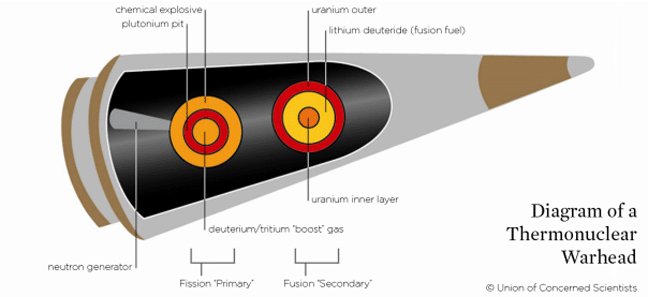
Santa Fe, NM & Columbia, SC – Two key U.S. Department of Energy documents on future production of plutonium “pits” for nuclear weapons, not previously released to the public, fail to justify new and upgraded production facilities at both the Los Alamos National Laboratory (LANL) in New Mexico and the Savannah River Site (SRS) in South Carolina.
The report reveals that the initial cost estimate for these new and upgraded facilities at both sites is $10 billion by 2030, and around $46 billion in total life cycle costs. Plutonium pits are the fissile cores of nuclear weapons. Cost overruns are the rule for major projects undertaken by the National Security Administration (NNSA), the semi-autonomous nuclear weapons agency within DOE, so the costs are likely to rise yet more, according to Nuclear Watch New Mexico and Savannah River Site Watch.
NNSA’s Pu Pit Production Engineering Assessment, originally marked Unclassified Controlled Nuclear Information, was finalized on April 20, 2018. The 293-page document was obtained by Nuclear Watch and is being released so that the public may be fully informed about the agency’s misguided pursuit of new plutonium pit production facilities for future new-design nuclear weapons. The new NNSA Administrator has called future plutonium pit production her highest priority. But the Engineering Assessment fails to answer the most crucial question: why are at least 80 plutonium pits per year needed to begin with?
As background, on May 10, 2018, NNSA announced in a one-page statement:
To achieve DoD’s [Department of Defense] 80 pits per year requirement by 2030, NNSA’s recommended alternative repurposes the Mixed Oxide Fuel Fabrication Facility at the Savannah River Site in South Carolina to produce plutonium pits while also maximizing pit production activities at Los Alamos National Laboratory in New Mexico. This two-prong approach – with at least 50 pits per year produced at Savannah River and at least 30 pits per year at Los Alamos – is the best way to manage the cost, schedule, and risk of such a vital undertaking.
Nuclear Watch also obtained NNSA’s 14-page Plutonium Pit Production Engineering Assessment (EA) Results. That summary document, dated May 2018, relied on the Trump Administration’s 2018 Nuclear Posture Review for claiming the need for expanded plutonium pit production. However, that high-level review failed to state any concrete justification for the alleged pit need. Moreover, Congress is balking at funding any new pit production facilities at SRS, primarily because Sen Lindsey Graham (R-SC) vociferously opposes repurposing the MOX facility, now undergoing termination, and the New Mexico congressional delegation opposes any pit production outside of the Los Alamos Lab.
The Engineering Assessment details that NNSA analyzed four pit production options, one in the Mixed Oxide (MOX) Fuel Fabrication Facility at SRS and three options at Los Alamos. NNSA chose the most expensive combination, repurposing the MOX facility and increasing pit production at LANL to 30 pits per year. Los Alamos is currently authorized to produce 20 pits per year, but has failed to achieve even that because of ongoing nuclear criticality safety issues (moreover, LANL proposed to produce all 80 pits per year, which NNSA rejected). SRS has never produced pits, raising new nuclear risks at that site and concern about new waste streams.
The Engineering Assessment makes clear that “moderate risks” in the option of repurposing the MOX plant at SRS includes any failure to quickly terminate the MOX project, due to subsequent delays in closing out the project and terminating contracts. Likewise, the report affirms a longheld concern that there is a “very high probability for incomplete construction records/as-built drawings” for the MOX project. On May 10, DOE began congressionally sanctioned termination of the bungled MOX project, but it is being opposed in last-ditch, desperate attempts by Senator Lindsey Graham and the State of South Carolina. The Engineering Assessment makes explicitly clear that terminating the MOX program is the crucial prerequisite for plutonium pit production at SRS and that “some work [on repurposing the MOX plant] can be completed during MOX closeout,” contrary to both the wishes of Congress and requirements of the National Environmental Policy Act.
Expanded plutonium pit production is NOT needed to maintain the safety and reliability of the existing nuclear weapons stockpile, according to Nuclear Watch. In fact, no pit production for the existing nuclear weapons stockpile has been scheduled since 2011, and none is scheduled for the future. Up to 15,000 “excess” pits and another 5,000 in “strategic reserve” are already stored at DOE’s Pantex Plant near Amarillo, TX. In 2006 independent experts found that pits last a least a century1 (they currently average 40 years old). A 2012 follow-on study by the Livermore Lab found that the “graceful aging of plutonium also reduces the immediate need for a modern highcapacity manufacturing facility to replace pits in the stockpile.” 2
Future pit production is for speculative future new designs being pushed by the nuclear weapons labs, so-called Interoperable Warheads for both land- and sub-launched missiles that the Navy does not support. 3 Moreover, as the Engineering Assessment makes clear, future pits will NOT be exact replicas of existing pits. This could have serious potential consequences because heavily modified plutonium pits cannot be full-scale tested, or alternatively could prompt the U.S. to return to nuclear weapons testing, which would have severe international proliferation consequences.
The Engineering Assessment also explicitly links raising the administrative limit on plutonium at LANL’s “Rad Lab” to expanded pit production. This contradicts a recent draft environmental assessment in which NNSA claimed that re-categorizing the Rad Lab as a Hazard Category-3 nuclear facility was necessary only to maintain basic analytical chemistry capabilities, while omitting any reference whatsoever to expanded plutonium pit production.
The Engineering Assessment briefly outlines what could be a major vulnerability to NNSA’s pit production plans, that is the agency’s future compliance (or not) with the National Environmental Policy Act (NEPA). The Assessment states that if “compliance is delayed, [this] extends the schedule, increases costs, and/or delays production.” Both Nuclear Watch and SRS Watch assert that the law requires that major federal proposals be subject to public review and comment before a formal decision is made. Arguably, a formal decision to raise production to 80 pits or more per year necessitates a new or supplemental nation-wide programmatic environmental impact statement (PEIS), which the new dual-site decision strongly buttresses. Follow-on site-specific NEPA documents will then be necessary, with full public participation and hearings. All of this could introduce substantial delays to NNSA’s plutonium pit production plans.
“While it’s clear that the bungled MOX project is unworkable from technical and cost perspectives and must rapidly be terminated, there is no justification to convert the abandoned facility to a nuclear bomb production plant,” said Tom Clements, director of SRS Watch. “We agree that money must now be spent closing and securing the MOX building, but not on the new, unauthorized pit mission. Spending taxpayer funds to now begin conversion of the MOX plant to pit production, as is indicated in the pit report, is premature and can’t even be considered until Congress approves the NNSA approach for new facilities and an environmental impact review with public participation takes place,” added Clements.
Jay Coghlan, Nuclear Watch Director, commented, “NNSA has already tried four times to expand plutonium pit production, only to be defeated by citizen opposition and its own cost overruns and incompetence. We realize that this fifth attempt at a new pit plant is the most serious yet, but we remain confident it too will fall apart. The enormous financial and environmental costs of new nuclear bomb factories and the fact that expanded plutonium pit production is simply not needed for the existing nuclear weapons stockpile will doom this effort. We think the American public will reject new-design nuclear weapons, which is what this expanded pit production decision is really all about.”
TerraPower’s Nuclear Reactor Could Power the 21st Century. The traveling-wave reactor and other advanced reactor designs could solve our fossil fuel dependency IEEE Spectrum, By Michael Koziol 3 June 18, “…. ..In a world defined by climate change, many experts hope that the electricity grid of the future will be powered entirely by solar, wind, and hydropower. Yet few expect that clean energy grid to manifest soon enough to bring about significant cuts in greenhouse gases within the next few decades. Solar- and wind-generated electricity are growing faster than any other category; nevertheless, together they accounted for less than 2 percent of the world’s primary energy consumption in 2015, according to the Renewable Energy Policy Network for the 21st Century.
To build a bridge to that clean green grid of the future, many experts say we must depend on fission power. ………several U.S. startups are pushing new reactor designs they say will address nuclear’s major shortcomings. In Cambridge, Mass., a startup called Transatomic Power is developing a reactor that runs on a liquid uranium fluoride–lithium fluoride mixture. In Denver, Gen4 Energy is designing a smaller, modular reactor that could be deployed quickly in remote sites.
In this cluster of nuclear startups, TerraPower, based in Bellevue, Wash., stands out because it has deep pockets and a connection to nuclear-hungry China. Development of the reactor is being funded in part by Bill Gates, who serves as the company’s chairman. And to prove that its design is viable, TerraPower is poised to break ground on a test reactor next year in cooperation with the China National Nuclear Corp. …….
“There are multiple levels of problems with the traveling-wave reactor,” says Arjun Makhijani, the president of the Institute for Energy and Environmental Research. “Maybe a magical new technology could come along for it, but hopefully we don’t have to rely on magic.” Makhijani says it’s hard enough to sustain a steady nuclear reaction without the additional difficulty of creating fuel inside the core, and notes that the techniques TerraPower will use to cool the core have largely failed in the past…….
The TWR will be able to use depleted uranium, which has far less U-235 and cannot reach criticality unassisted. TerraPower’s solution is to arrange 169 solid uranium fuel pins into a hexagon. When the reaction begins, the U-238 atoms absorb spare neutrons to become U-239, which decays in a matter of minutes to neptunium-239, and then decays again to plutonium-239. When struck by a neutron, Pu-239 releases two or three more neutrons, enough to sustain a chain reaction.
It also releases plenty of energy; after all, Pu-239 is the primary isotope used in modern nuclear weapons. But Levesque says the creation of Pu-239 doesn’t make the reactor a nuclear-proliferation danger—just the opposite. Pu-239 won’t accumulate in the TWR; instead, stray neutrons will split the Pu-239 into a cascade of fission products almost immediately.
In other words, the reactor breeds the highly fissile plutonium fuel it needs right before it burns it, just as Feinberg imagined so many decades ago. Yet the “traveling wave” label refers to something slightly different from the slowly burning, cigar-style reactor. In the TWR, an overhead crane system will maintain a reaction within a ringed portion of the core by moving pins into and out of that zone from elsewhere in the core, like a very large, precise arcade claw machine.
To generate electricity, the TWR uses a more complicated system than today’s reactors, which use the core’s immense heat to boil water and drive a steam turbine to generate usable electricity. In the TWR, the heat will be absorbed by a looping stream of liquid sodium, which leaves the reactor core and then boils water to drive the steam turbine.
But therein lies a major problem, says Makhijani. Molten sodium can move more heat out of the core than water, and it’s actually less corrosive to metal pipes than hot water is. But it’s a highly toxic metal, and it’s violently flammable when it encounters oxygen. “The problem around the sodium cooling, it’s proved the Achilles’ heel,” he says.
Makhijani points to two sodium-cooled reactors as classic examples of the scheme’s inherent difficulties. In France, Superphénix struggled to exceed 7 percent capacity during most of its 10 years of operation because sodium regularly leaked into the fuel storage tanks. More alarmingly, Monju in Japan shut down less than a year after it achieved criticality when vibrations in the liquid sodium loop ruptured a pipe, causing an intense fire to erupt as soon as the sodium made contact with the oxygen in the air. “Some have worked okay,” says Makhijani. “Some have worked badly, and others have been economic disasters.”
Today, TerraPower’s lab is filled with bits of fuel pins and reactor components. Among other things, the team has been testing how molten sodium will flow through the reactor’s pipes, how it will corrode those pipes, even the inevitable expansion of all of the core’s components as they are subjected to decades of heat—all problems that have plagued sodium-cooled reactors in the past. TerraPower’s engineers will use what they learn from the results when building their test reactor—and they’ll find out if their design really works.
The safety of the TerraPower reactor stems in part from inherent design factors. Of course, all power reactors are designed with safety systems. Each one has a coping time, which indicates how long a stricken reactor can go on without human intervention before catastrophe occurs. Ideas for so-called inherently safe reactors have been touted since the 1980s, but the goal for TerraPower is a reactor that relies on fundamental physics to provide unlimited coping time.
The TWR’s design features some of the same safety systems standard to nuclear reactors. In the case of an accident in any reactor, control rods crafted from neutron-absorbing materials like cadmium plummet into the core and halt a runaway chain reaction that could otherwise lead to a core meltdown. Such a shutdown is called a scram.
TerraPower plans to break ground on its test reactor next year in China. If all goes well, this reactor will be operational by the mid-2020s. But even if TerraPower’s reactor succeeds wildly, it will take 20 years or more for the company to deploy large numbers of TWRs. Thus for the next couple of decades, the world’s utilities will have no choice but to rely on fossil fuels and conventional nuclear reactors for reliable, round-the-clock electricity.
Fission will probably not be the final answer. After decades of always being 30 years away, nuclear fusion may finally come into its own. Societies will be able to depend on renewables more heavily as storage and other technologies make them more reliable……….
NRDC 1st June 2018 The Trump Administration has made no secret of its desire to prop up coal
and nuclear plants for political purposes and today the White House made it abundantly clear. At the same time, a leaked draft memo unveiled last night repackages a previously rejected idea to bail out coal and nuclear plants, this time arguing that they are needed to protect national security.
The memo proposes that the U.S. Department of Energy (DOE) issue an order requiring electricity grid operators to purchase, for two years, electricity from expensive and uncompetitive coal and nuclear facilities that would otherwise retire. Neither the White House nor DOE have owned up to the memo or its contents.
But White House Press Secretary Sarah Huckabee Sanders stated today that stopping coal and nuclear retirements remains a priority for President Trump, and that he has directed DOE Secretary Rick Perry “to prepare immediate steps to stop the loss of these resources, and looks forward to his recommendations.” https://www.nrdc.org/experts/john-moore/coal-and-nuclear-bailout-memo-recycled-idea-new-hat
“Unfortunately, impending retirements of fuel-secure power facilities are leading to a rapid depletion of a critical part of our nation’s energy mix, and impacting the resilience of our power grid,” the White House said in a statement.
The Trump administration has been preparing to invoke emergency powers granted under Cold War-era legislation to order regional grid operators to buy electricity from ailing coal and nuclear power plants. There have been meetings this week at the Cabinet deputies’ level and at the National Security Council.
According to the draft memo, the Energy Department would exercise its emergency authority to order grid operators to give preference to plants “that have a secure on-site fuel supply” and that “are essential to support the Nation’s defense facilities, critical energy infrastructure, and other critical infrastructure.” Only coal and nuclear plants regularly keep fuel on site.
The Energy Department would also establish a “Strategic Electric Generation Reserve.” The memo added that “federal action is necessary to stop the further premature retirements of fuel-secure generation capacity.” The emergency rules would be a “prudent stopgap measure” that would last two years while the Energy Department did further study.
“President Trump believes in total energy independence and dominance, and that keeping America’s energy grid and infrastructure strong and secure protects our national security, public safety and economy from intentional attacks and natural disasters,” the White House said.
The idea of declaring an emergency under the Defense Production Act of 1950 (used by President Harry S. Truman for the steel industry) and Section 202 of the Federal Power Act has been promoted by the chief executives of the coal-mining firm Murray Energy and the Ohio utility FirstEnergy, both of whom have contributed heavily to Trump’s political activities.
Robert Murray presented a proposal to Energy Secretary Rick Perry in March 2017, the month Perry took office. And on April 2 of this year, FirstEnergy appealed for emergency help after a subsidiary operating ailing power plants filed for bankruptcy protection.
The Federal Energy Regulatory Commission, an independent agency, unanimously rejected an earlier proposal by the Energy Department that would have favored coal and nuclear plants.
In a recent appearance at a Washington Post Live event, FERC Chairman Kevin McIntyre said that using the emergency powers was “perhaps not the most obvious fit.”
He said using that section of the Federal Power Act “tees off the concept of continuance of a war in which the United States is involved as being kind of the baseline circumstance that would justify a DOE order to certain types of facilities to either begin operating or continue operation.”
Environmental groups, natural-gas producers, and Republicans and Democrats who have pushed for greater competition in electricity markets all condemned the latest signal that the administration might be moving closer to imposing the Energy Department’s plan.
They noted that the coal and nuclear power plants that would benefit have failed to compete against natural gas, solar and wind. Many of the plants have operated far longer than anticipated when they were built.
“Uneconomic, dirty coal plants retiring does not represent a national security risk,” Michael Panfil, director of federal energy policy and senior attorney with the Environmental Defense Fund, wrote on his blog. “If Trump chooses to bail out these failing coal plants, he’ll be forcing Americans to pay for dirty energy that pollutes our environment and makes people sick.”
Katie Bays of Height Capital Markets, an investment research firm, wrote in a commentary: “If DOE proceeds as the memo suggests, a selection of coal and nuclear plants, ostensibly those at risk of retirement, would receive subsidized payments . . . under a stitched-together ‘Frankenstein’s monster’ of federal authorities. Above all, the subsidy would be a major victory for FirstEnergy as it negotiates with bondholders over the value of coal and nuclear plants owned by its bankrupt FirstEnergy Solutions subsidiary.”
FirstEnergy’s top lobbyist last year was Jeff Miller, who was campaign manager for the presidential campaign of Perry, now energy secretary. Trump attended a private dinner with Miller and a handful of political advisers in early April.
Trump wants to manipulate regulation to force a taxpayer bailout of pollution-based energy companies. Coal baron Robert Murray recently donated to Trump’s reelection efforts and is already seeing his investment pay off.
The Trump administration is preparing a massive bailout of the pollution-causing industry, specifically those who donated millions to support his campaign.
Bloomberg reports that Trump officials are planning to push grid operators to buy electricity from coal and nuclear plants that are out of sync with the move toward cleaner, more reliable energy. The outlet notes that the move would be an “unprecedented intervention into U.S. energy markets.”
A leaked memo Department of Energy, now under the control of secretary Rick Perry (former governor of Texas), shows plans to invoke emergency authority to give an excuse for the scheme.
The memo claims “Federal action is necessary to stop the further premature retirements of fuel-secure generation capacity.”
Sara Chieffo, vice president of Government Affairs for the League of Conservation Voters, slammed the proposal in a statement to Shareblue Media.
“The Trump administration is once again bending over backwards to prop up dying, dirty energy sources instead of building the clean energy economy our communities need and deserve,” Chieffo said.
If the bailout advances, some of the biggest beneficiaries would be polluters who invested massively to install Trump in the White House.
These figures include coal baron Robert Murray. Murray is the head of Murray Energy Corporation, one of the largest independent operators of coal mines in the country. His company has a horriblesafety record and multiple injuries to miners as a result.
He, like Trump, calls climate change “a total hoax.”
Murray recently donated $1 million to America First Action, the administration’s designated pro-Trump super PAC pushing for his reelection.
Before that Murray spent over $300,000 backing Trump in 2016 and donated $300,000 to Trump’s poorly attended inauguration.
Murray has been involved in direct meetings with Perry designed to implement changes in an “action plan” he presented to the administration. The plan was a list of changes to policy and regulations that would benefit the coal industry directly.
Trump has often been a booster of coal polluters. During the campaign he echoed fellow Republicans and their fraudulent claims that President Barack Obama was waging a “war on coal.” Trump recently said he had ended the “war on beautiful clean coal” with moves to ease environmental legislation.
Clean energy has been on the rise in America, and as Lara Ettenson, a senior scientist at the Natural Resources Defense Council recently wrote, clean energy “is the driving force behind job growth” in the energy industry.
Pollutant-based power sources like coal are the past, and the only way the operators in the industry like Murray can continue to be propped up is through a bailout like the one Trump is planning.
Trump wants taxpayer money to be used to keep his top patrons in business, while continuing to churn out toxic gases into the environment. He’s engineering a bailout of his cronies, and money for his re-election is likely to come rolling in if he has his way.
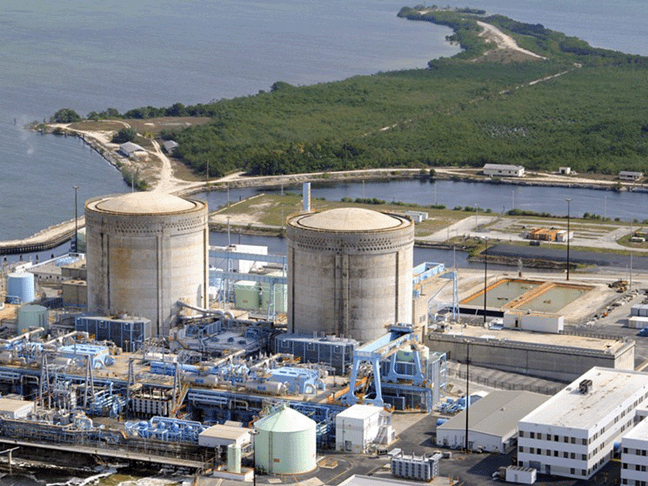
FPL, speakers clash on plan to run Turkey Point nuclear plant to 2053, Palm Beach Post ByCharles Elmore– Palm Beach Post Staff Writer 1 June 18
Opinions are splitting faster than atoms when it comes to Florida’s oldest nuclear power plant, Turkey Point.
To hear officials working for Juno Beach-based Florida Power & Light tell it, the plant hums along as a money-saving, greenhouse gas-trimming success story that deserves federal regulatory blessing to have its oldest reactor turn 80 years old on the job in 2052. A second reactor would reach the milestone a year later. That would rank among the longest tenures in the nation and double the average of less than 40 years.
But the request for a 20-year extension represents something else entirely to scores of environmentalists, activists, students and others who traveled from places such as West Palm Beach and Boca Raton for a chance to speak at a public meeting near the plant south of Miami.
They see a plant with an outdated canal cooling system threatening fragile ecosystems and water supplies, and a candidate to become the unwanted sequel to Japan’s Fukushima nuclear disaster. They say Turkey Point is in no shape to get an octogenarian’s operating license without big changes to protect South Florida’s environment and guard against threats such as rising seas and stronger hurricanes.
In public hearings, U.S. Nuclear Regulatory Commission officials are weighing those and other points of view.
Public comments can be filed by June 21. An agency decision is expected by October 2019.
“I have a stake in the outcome of this process,” said Laura Stinson, 20, a senior at Florida Atlantic University in Boca Raton, who is pursuing a degree in marine biology. She said it is “imperative these canals be closed” in favor of another solution such as cooling towers, which she and others argue present lower risk for introducing heated water, high salt concentrations, and other disruptions into surface and ground water systems.
Laura Reynolds, a consultant in West Palm Beach for the Southern Alliance for Clean Energy, said FPL must be held to account for a “massive pollution plume” that “has built up under the plant for 45 years.”
……Turkey Point’s two nuclear units began commercial operation in 1972 and 1973, and would operate to 2052 and 2053 under the proposal.
Comment on Turkey Point
Got comments on the plan for the Turkey Point nuclear plant to continue to operate for 80 years? Tell the Nuclear Regulatory Commission by June 21. Include Docket ID NRC-2018-0101 with your comment, via the regulations.govwebsite.
Major challenges remain for nuclear transportation in America
Perhaps the most pressing issue is nuclear waste and in particular, excess plutonium, most of which remains at Amarillo’s Pantex plant and will need to be moved to secure disposal facilities in the years to come.
public fears endure about whether moving such materials can ever truly be “safe.”
The Secret ‘White Trains’ That Carried Nuclear Weapons Around the U.S. History, BRIANNA NOFIL 31 May 18 At first glance, the job posting looks like a standard help-wanted ad for a cross-country trucker. Up to three weeks a month on the road in an 18-wheel tractor-trailer, traveling through the contiguous 48 states. Risks include inclement weather, around-the-clock travel, and potentially adverse environmental conditions. But then the fine print: Candidates should have “experience in performing high-risk armed tactical security work…and maneuvering against a hostile adversary.”
The U.S. government is hiring “Nuclear Materials Couriers.” Since the 1950s, this team of federal agents, most of them ex-military, has been tasked with ferrying America’s 6,800 nuclear warheads and extensive supply of nuclear materials across the roads and highways of the United States. America’s nuclear facilities are spread out throughout the country, on over 2.4 million acres of federal real estate, overseen by the Department of Energy (DOE)—a labyrinth of a system the Bulletin of the Atomic Scientists called “highly scattered and fragmented…with few enforceable rules.”
Some sites are for assembly, some are for active weapons, some are for chemicals, some are for mechanical parts. What this means in practice is that nuclear materials have to move around—a lot.
For as long as the United States has had nuclear weapons, it has struggled with the question of how to transport America’s most destructive technology throughout the country without incident. “It’s the weak link in the chain of nuclear security,” said Dr. Edwin Lyman of the Union of Concerned Scientists.
Today the United States relies almost entirely on million-dollar, Lockheed Martin tractor-trailers, known as Safeguard Transporters (SGTs) and Safe Secure Trailers (SSTs) to move nuclear material. But from the 1950s through the 1980s, the great hope for safe transit was so-called “white trains.”
These trains looked entirely ordinary, except for a few key details. They featured multiple heavily armored boxcars sandwiched in between “turret cars,” which protruded above the rest of the train. The turrets had slit windows through which armed DOE guards peered out, prepared to shoot if they needed to defend the train. Some guards had simple rifles, while others reportedly had automatic machine guns and hand-grenade launchers. Known in DOE parlance “safe, secure railcars,” or SSRs, the white trains were highly resistant to attack and unauthorized entry. They also offered “a high degree of cargo protection in event of fire or serious accident,” the DOE assured a wary Congress in 1979.
…….. Today’s nuclear infrastructure—much of which is focused on decommissioning rather than building weapons—is reliant on Safeguard Transporters and their armed drivers. Much like the rest of the America’s nuclear arsenal, many of the trucks are antiquated; about half of the SSTs are over 15 years old. The trucks, which log over three and a half million miles each year, are accompanied by unmarked escort vehicles and their only easily recognizable feature is their U.S. Government license plates.
Transportation of nuclear materials is currently overseen by the Office of Secure Transportation (OST), an agency that has attracted only minimal attention in the years since the fall of the Soviet Union. But a 2017Los Angeles Times investigation suggested problems may lurk beneath the surface. OST is understaffed, with the average courier working about 75 hours a week. Turnover is extremely high. In 2010, a DOE investigation found “widespread alcohol problems” within the agency, including incidents that occurred while couriers were on secure transportation missions. The DOE conceded that these episodes “indicate a potential vulnerability in OST’s critical national security mission.”
Major challenges remain for nuclear transportation in America. Plans to “modernize” America’s nuclear arsenal, supported by both the Obama and Trump administrations, mean that weapons will be taking more trips than ever on American roads. Beginning in 2010, around one thousand W76 warheads traveled from Bangor, Washington back to Amarillo, Texas, for upgrades to extend the life of the weapon by 30 years—a massive undertaking, entirely dependent on the OST’s fleet of Safeguard Transporters. Perhaps the most pressing issue is nuclear waste and in particular, excess plutonium, most of which remains at Amarillo’s Pantex plant and will need to be moved to secure disposal facilities in the years to come.
Whether waste or weapons, trains or trucks, the United States has been remarkably fortunate in avoiding major transportation mishaps. Since the days of the white trains, the government has insisted that nuclear materials are being moved across the American landscape in the safest possible way, persisting through crashes, fires, and interfering nuns. Yet public fears endure about whether moving such materials can ever truly be “safe.”
Now That Xcel Won’t Get Its Nuclear Bill, What’s Next? Bulletin of the Atomic Scientists JESSICA COLLINGSWORTH, POLICY ANALYST, CLEAN ENERGY | JUNE 1, 2018 Earlier this month the Xcel Nuclear Plant Costs Bill (SF3504/HF3708) passed the Senate but failed to pass through the Minnesota House. The bill created a system of approving nuclear plant repair costs for Xcel Energy that would have circumvented the normal process of the Minnesota Public Utilities Commission (MN PUC) and left ratepayers to shoulder potentially excessive costs of keeping Xcel’s nuclear plants running.
……So now that the Xcel nuclear bill didn’t pass, what’s next, and what does this all mean for Minnesota’s clean energy future? Trying to keep Xcel’s nuclear fleet in the blackXcel’s nuclear fleet is struggling to stay profitable in the face of cheaper alternatives (like renewable energy and natural gas) and looming upkeep costs. Xcel estimates it will need at least $1.4 billion dollars in repairs over the next 17 years for its Monticello and Prairie Island nuclear plants. To provide certainty that Xcel would be able to recover those costs from ratepayers, they introduced legislation that would have allowed the company to get upfront approval from the PUC for its future nuclear expenses instead of approval after those investments have been made (how it works currently). The legislation would have provided certainty for Xcel that they would be able to recover these maintenance costs from ratepayers.
This is a bad deal for ratepayers because the legislation dilutes the PUC’s authority, and attempts to bypass the PUC’s current process for reviewing costs to determine if they’re prudent. That’s why UCS opposed the bill: it was an attempt to avoid the existing regulatory review process and shift financial risk from Xcel’s shareholders to ratepayers. This is not the first legislative attempt to dilute the power of the MN PUC.
Maintaining the current process for approving costs is important
Xcel is due to file their next Integrated Resource Plan (IRP), also known as their 15-year business plan, in February 2019. The IRP process allows for a comparison of electricity options to make sure consumers are getting the most bang for their ratepayer bucks. The IRP process is where Xcel will detail how they plan to generate and supply power to their customers over the next 15 years, including any expected expenses to keep its nuclear plants up and running.
A successful IRP includes evaluation of existing resources, a robust economic analysis of different supply-side and demand-side options under a range of scenarios and assumptions, including future environmental costs and fuel prices, opportunities for stakeholder engagement, adequate reporting requirements, and a robust set of criteria of which to base approval or denial of utility plans to spend ratepayer dollars.
It’s important to keep the current process because it protects ratepayers from excessive charges. By separating out the nuclear plant upkeep costs, we’re not comparing them to other options that would maintain a reliable and affordable energy supply for less cost to ratepayers. The legislation would have pre-approved these costs, meaning any cost overruns due to mismanagement by Xcel would have been automatically passed on to ratepayers. To protect Minnesota consumers, it’s important to keep the robust IRP process and maintain the PUC’s authority to scrutinize Xcel’s expenditures……..https://blog.ucsusa.org/jessica-collingsworth/xcel-nuclear-bill-whats-next