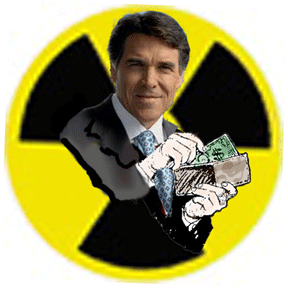
If the change is made, members of Congress will unburden themselves of a controversial vote and escape accountability for the potentially grave consequences. Instead, the matter will be unilaterally decided by Secretary of Energy Rick Perry, who can draw on whatever expertise he gained as … governor of Texas.
We also fundamentally disagree with the Board’s belief in the utility of limited nuclear use. There is no such thing as a limited nuclear war, and the United States should be seeking to raise the threshold for nuclear use, not blur that threshold by building additional so-called low-yield weapons.
Now the Senate is all that stands in the way of letting Rick Perry decide whether or not to fundamentally change the geopolitical balance of nuclear weapons.
A republic demands that the people’s representatives decide such matters. As a young House leadership page in the late 1970s, Jonathan Turley, the esteemed law professor, stood listening as passionate arguments stretched into the wee hours. “It was one of the most profound experiences of my life,” he said. “I came away with a deep respect for members on both sides who spoke honestly and directly about the consequences and the issues behind that type of weapon. I thought, this is a pretty great place where we debate whether we should do something, not just whether we could do something, and what implications it has for the world. That’s a debate that I think you should always want.”
Today a strikingly similar question arises: Should the United States develop a low-yield nuclear warhead to match a similar weapon developed by the Russians, as the Trump administration proposes to do? Would doing so lower the threshold for nuclear war, as many more experienced hands warn? Would it trigger a new arms race that ultimately sees more nuclear weapons held by more countries?
At present, Congress must decide what course to pursue. The Trump administration is constrained from developing a new, low-yield nuclear weapon without the approval of the representatives that citizens elected. So long as the decision remains with Congress, opportunities for a robust public debate will present themselves, and any American can write to their senators and representatives to influence the vote, then hold them responsible for it in future elections.
But strong efforts are underway to strip away those basic mechanisms of accountable republican government, as Senator Gary Peters warned Wednesday during a noteworthy aside in a Senate subcommittee hearing on a different matter.
In his words:
Today the Senate is starting debate on the National Defense Authorization Act for 2019. The bill that was before us includes a provision that will allow the Secretary of Energy to pursue development of a low-yield nuclear weapon without first receiving specific authorization from Congress. I voted against this provision as a member of the Armed Services Committee. It literally strikes from current law a requirement that a new, low-yield nuclear weapon be “specifically authorized by Congress.” And it replaces it with a provision that will allow the Secretary of the Energy to decide on his own whether or not to go forward.
The provision that was struck is a limitation that Congress put in place about 15 years ago to ensure that the legislature and not the executive branch would make such a highly consequential decision. … if members of Congress think our arsenal needs a low-yield nuclear weapon then we should debate it, we should authorize it, and do it in full view of the American people as existing law requires. Instead some are trying to change the rules to allow the executive branch to make this decision without Congressional approval. I think that’s fairly clear.
If the change is made, members of Congress will unburden themselves of a controversial vote and escape accountability for the potentially grave consequences. Instead, the matter will be unilaterally decided by Secretary of Energy Rick Perry, who can draw on whatever expertise he gained as … governor of Texas.
… the Defense Science Board recommends “a more flexible nuclear enterprise that could produce, if needed, a rapid, tailored nuclear option for limited use.” We strongly believe that there is no such thing as the limited use of nuclear weapons or limited nuclear war. In fact, the Board’s recommendation reminds us of an effort by the Bush Administration to build a new nuclear weapon specifically designed to destroy deeply buried enemy targets. That program, named the Robust Nuclear Earth Penetrator, or a nuclear “bunker buster,” was halted by the leadership of former Republican Congressman David Hobson in 2005.
The only role of nuclear weapons is to deter their use by others and we are aware of no evidence demonstrating that new nuclear weapons are needed to preserve or enhance deterrence. Our nation’s security is better protected by investments in advanced conventional weapons, not new nuclear weapons.
We also fundamentally disagree with the Board’s belief in the utility of limited nuclear use. There is no such thing as a limited nuclear war, and the United States should be seeking to raise the threshold for nuclear use, not blur that threshold by building additional so-called low-yield weapons.
We strongly agree with Deputy Secretary Work’s testimony last year when he stated: “anyone who thinks they can control escalation through the use of nuclear weapons is literally playing with fire. Escalation is escalation, and nuclear use would be the ultimate escalation.”
Additionally, as you know, U.S. nuclear capabilities are already highly credible, flexible, and lethal. The arsenal includes lower-yield weapons that can produce more “limited” effects, including the B61 gravity bomb, which is being modernized at an estimated cost of as much as $10 billion.
If congressional Republicans think otherwise, they should debate the matter before the public and put a vote behind their rhetoric, rather than sidestepping the merits, shirking accountability, and ceding what ought to be a legislative decision to a member of the executive branch. Using the appropriations process to sneakily decide a matter of this consequence is a dereliction of duty unworthy of the Framers. Yet this fight is already lost in the House.
The Union of Concerned Scientists put it this way in an update to their members:
… the full House passed its version of the NDAA on May 24th, in the process rejecting—in a surprisingly close and but mostly partisan vote—an amendment sponsored by Rep. John Garamendi (D-CA) and Rep. Earl Blumenauer (D-OR) that proposed fencing half of the funding for the low-yield warhead. This funding would have been held until the secretary of defense submitted a report to Congress assessing: the effect of the new warhead on strategic stability, ways to reduce the risk of miscalculation associated with it, and how to preserve the survivability of subs that would carry it, should it ever be launched.
The House rejected it by a vote of 226 to 188, largely along party lines, with seven Democrats voting against the amendment and five Republicans voting for it.
Now the Senate is all that stands in the way of letting Rick Perry decide whether or not to fundamentally change the geopolitical balance of nuclear weapons.
Outcome aside, how can anyone defend that process?
The spending bill, which includes appropriations for military construction and other federal departments, contains $267 million to restart the licensing process to open the Yucca Mountain nuclear repository in Nye County, about 90 miles northwest of Las Vegas.
An amendment to strip that spending from the bill died on a voice vote.
The amendment was filed by Rep. Ruben Kihuen and supported by Rep. Dina Titus and Rep. Jacky Rosen, all Nevada Democrats.
A Senate spending bill approved last month does not include funding for Yucca Mountain.
Differences in the two bills must be reconciled by a House-Senate conference committee.
In 2015, ninety-two American missile officers were suspended because they had been cheating, taking drugs, or sleeping in the missile silos. These men are employed to guard and to operate 150 nuclear missiles at F.E. Warren Air Force Base in Wyoming which constitutes one-third of the 400 Minuteman 3 missiles that stand “on hair trigger alert” 24 hours a day in silos which are scattered across the northern Great Plains.
Two officers aged between 22 and 27 are in charge of each missile silo, and each man is armed with a pistol to shoot the other if one shows signs of deviant behaviour.
The missile silos are equipped with antiquated equipment including floppy disks and telephones that often don’t work. Each Minuteman 3 missile contains three hydrogen bombs, almost 50 times the explosive power of the Hiroshima bomb. The officers in charge of these deadly weapons are clearly expected to follow strict behavioural standards at all times.
During the investigation, fourteen airmen had allegedly been using cocaine. Other drugs involved were ecstasy, cocaine, LSD and marijuana. All in all roughly one hundred officers were involved in the cheating scandal in 2015 and 2016.
Airman 1st Class Nickolos A. Harris, said to be the leader of the drug ring, testified that he had no trouble obtaining LSD and other drugs from civilian sources and he pleaded guilty to using and distributing LSD plus ecstasy, cocaine and marijuana.
A side note – because LSD had showed up so infrequently in drug tests across the military, in December 2006 the Pentagon eliminated LSD screening from standard drug-testing procedures.
In more episodes of gross malfeasance, 2013 Vice Admiral Timothy Giardina, the head of the U.S. Strategic Command, was sacked for illegal gambling while Major General Michael Carey, a man in charge of all of the 450 intercontinental ballistic missile silos, was dismissed after a visit to Moscow when he became inebriated and insisted on singing in Russian night clubs, while cavorting with inappropriate women.
Considering all of these facts among many others, it is amazing to me that we are still here having not been incinerated in a global nuclear holocaust. Suffice it to
Nuclear power plant legislation signed into law, June 8th, 2018, by Fulton Sun JEFFERSON CITY — Last week, 77 bills were signed into law including one regarding nuclear power plant security.
Rep. Travis Fitzwater’s bill strengthens security measures at nuclear power plants in Missouri and defines specifically what armed nuclear security guards can do to provide protection at those facilities.
House Bill 1797 specifies the level of physical force nuclear security guards can use while guarding a nuclear power plant; protects certain nuclear power plant employers from civil liability in carrying out their duties; and increases the penalties associated with trespassing at a nuclear power plant………
Commonly known as the Nuclear Power Plant Security Guard Act, the legislation faced little opposition in the state House and Senate. …….. To read the bill in its entirety, visit house.mo.gov/bill.aspx?bill=HB1797&year=2018&code=R.
Trump: ‘I don’t think I have to prepare very much’ for North Korea nuclear summit
It’s about ‘attitude’ not ‘preparation,’ the president said of upcoming talks on Tuesday with North Korean leader Kim Jong Un in Singapore. by Jonathan Allen and Dartunorro Clark / Jun.08.2018
WASHINGTON — President Donald Trump said Thursday that he doesn’t need to study for his upcoming nuclear summit with North Korean leader Kim Jong Un.
“I think I’m very well prepared. I don’t think I have to prepare very much,” Trump told reporters at the White House Thursday as he posed for photos with Japanese Prime Minister Shinzo Abe. “This isn’t a question of preparation. It’s a question of whether or not people want it to happen, and we’ll know that very quickly.”
Trump is planning to travel to Canada on Friday for a two-day meeting with the Group of Seven industrial nations that is likely to focus heavily on trade issues before heading to Singapore for his historic sit-down with Kim…….
the president said he has not removed the U.S. sanctions against North Korea going into the meeting and is willing to walk out of the talks if they aren’t going well.
“All I can say is I’m totally prepared to walk away,” Trump said. “If you hear me saying we’re going to use maximum pressure, you’ll know the negotiation did not do well.”
Trump added that he is also prepared to ramp up sanctions on North Korea if the negotiations fall apart.
……..Pompeo downplayed comments made by Trump’s personal lawyer, Rudy Giuliani, earlier this week, that Kim had gotten “on his hands and knees and begged” for the summit after Trump abruptly canceled it last month. “I think it was a bit in jest,” Pompeo said of those remarks. “We’re moving forward and focused on the serious issues…Rudy doesn’t speak for the administration when it comes to this negotiation.”
Here’s why Trump’s new strategy to keep ailing coal and nuclear plants open makes no sense The Conversation. James Van Nostrand, Director, Center for Energy and Sustainable Development; Professor of Law, West Virginia University,
President Donald Trump recently ordered Energy Secretary Rick Perry to take “immediate steps” to stop the closure of coal and nuclear power plants.
And according to a draft memo that surfaced the same day, the federal government may establish a “Strategic Electric Generation Reserve” to purchase electricity from coal and nuclear plants for two years.
Both proposals, which have garnered little support, are premised on these power plants being essential to national security. If implemented, the government would be activating emergency powers rarely tapped before for any purpose.
Based on my four decades of experience as a utility regulatory attorney and law professor, I can see why this proposal has caused much controversy, partly because of how energy markets work.
No credible evidence
To be sure, these industries are in trouble.
The share of U.S. power derived from coal has fallen from about one-half in 2000 to less than one-third in 2017. ……
The share of power generated by nuclear reactors, despite holding steady at about one-fifth of the national grid since 2000, is about to slide. More than 1 in 10 of the nation’s nuclear reactors are likely to be decommissioned by 2025. If completed, the only two large-scale ones under construction will cost far more than originally planned.
But are experts worried about any electricity shortages or outages between now and 2025? Well, no. Other alternatives, mainly natural gas, wind and solar energy are poised to keep filling the gaps created in recent years by other coal plant closures.
Disregarding the findings of its own study, the agency proceeded to ask the Federal Energy Regulatory Commission, an independent federal agency known as FERC that regulates energy rates and policies, for permission to subsidize coal and nuclear plants. The agency unanimously rejected that proposal.
More recently, PJM Interconnection – the nation’s biggest grid operator – declared that its power supply is not in jeopardy and that there is no reason to take this anticipated policy move.
The North American Reliability Corporation, the federal entity responsible for power reliability, has reached similar conclusions.
Unprecedented intrusion
In short, there is no emergency that justifies this unprecedented intrusion into the electricity markets that would warrant forcing taxpayers and utilities to pay a premium to keep coal and nuclear plants online.
But the Trump administration appears to be arguing that a provision known as Section 202(c) of the Federal Power Act and the Defense Production Act grant the secretary of energy the power to nationalize parts of the power sector during wartime or amid other emergencies.
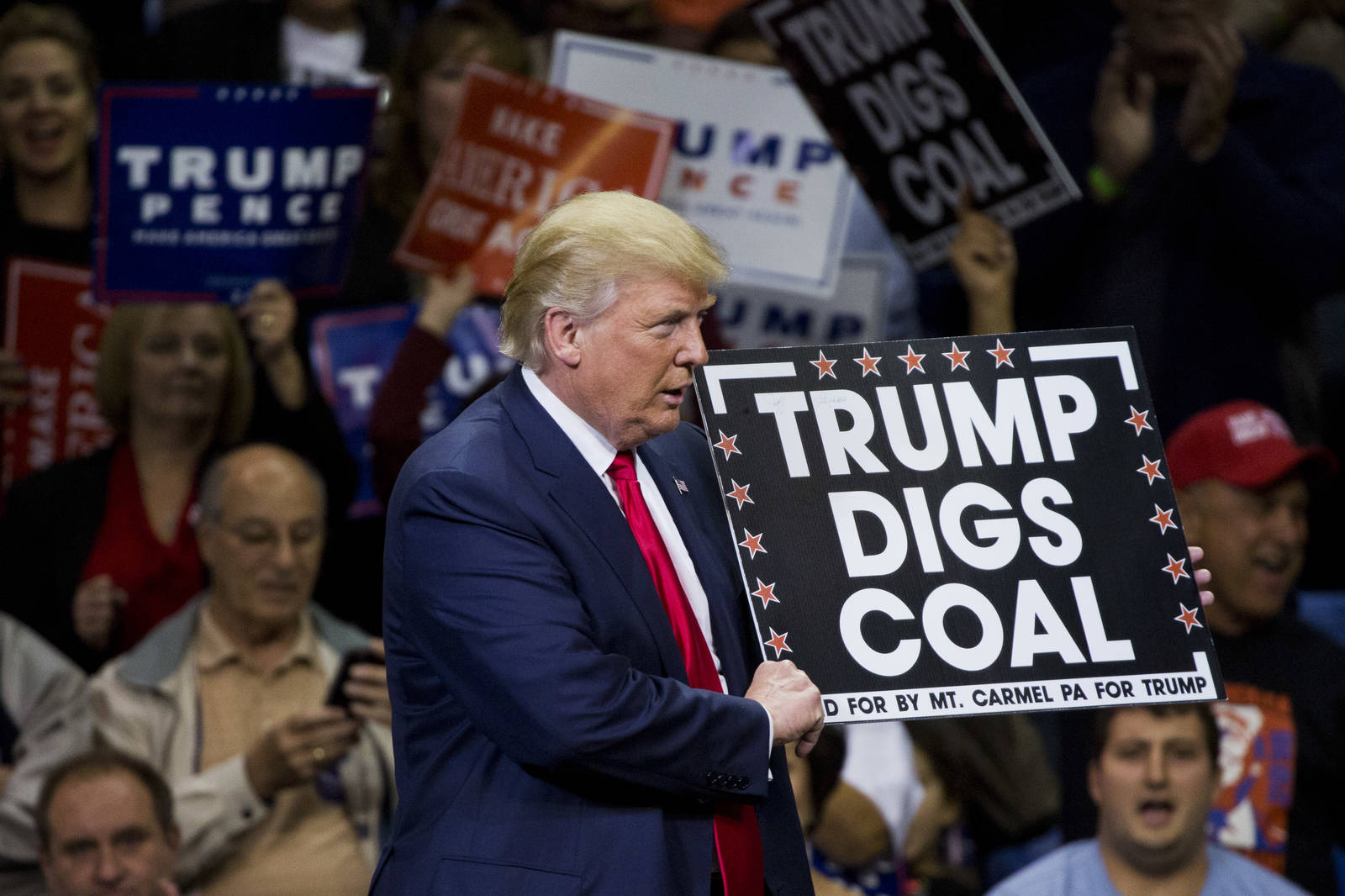
I believe that the sole rationale for this new policy is as a way for Trump to keep his campaign promise to revive the ailing coal industry.
Most likely, nuclear reactors are included in the proposal because that industry is increasingly unable to compete. Also, some companies, on the brink of bankruptcy, have stepped up their lobbying.
In many cases, the power generated by coal andnuclear power plantssells at prices that are too low to cover operating costs. The federal government does not typically intervene in wholesale electricity markets, other than to enforce rules intended to ensure that the competition is fair.
Because it would override the results of competition, I have no doubt that the Trump administration’s proposals would mark a radical intervention by the government into the electricity markets.
Winners and losers
Shareholders of the energy companies that own money-losing coal and nuclear plants stand to gain if this policy gets implemented because they are unable to compete in the wholesale power markets without this kind of assist.
Officials at the Waste Isolation Pilot Plant in southern New Mexico confirmed this week that processing and handling resumed June 2.
In disposing the waste, seven 55-gallon (208-liter) drums are wrapped together in a tight formation to go deep inside the ancient salt formation where the repository is located. The idea is that the shifting salt will eventually entomb the waste.
Work was halted when employees found one drum wasn’t aligned with the others that made up the waste package. The package was eventually repacked and disposed of underground.
Officials say no radiation was released and no injuries were reported.
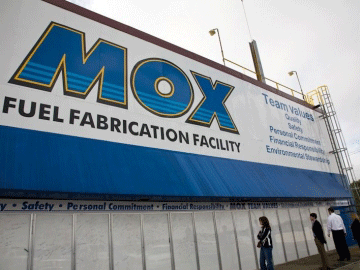
At the Savannah River Site, the future of the Mixed Oxide Fuel Fabrication Facility is in jeopardy after a report last month by the National Nuclear Safety Administration recommended the facility be repurposed to produce plutonium pits while also maximizing pit production activities at Los Alamos National Laboratory in New Mexico.
Fifty pits per year would be produced at SRS and 30 per year at Los Alamos, the report said, and “is the best way to manage the cost, schedule, and risk of such a vital undertaking.”
The MOX project arose from an agreement between the U.S. and Russia to dispose of 68 metric tons of weapons-grade plutonium. The material would be enough to create about 17,000 nuclear weapons. But the project has been beset by years of delays and cost overruns, over which the state has several times sued the federal government.
South Carolina’s legislators said the plan to re-purpose the MOX facility is premature considering shipment of diluted plutonium to the Waste Isolation Pilot Plant hasn’t been fully vetted.
Judge’s ruling keeps over-budget nuclear project from being shut down, BY SAMMY FRETWELL sfretwell@thestate.com June 07, 2018
A judge on Thursday stopped the federal government from suspending construction of a nuclear fuel factory at the Savannah River Site atomic weapons complex near Aiken.
The ruling by U.S. District Judge Michelle Childs damages federal efforts to walk away from the over-budget and behind-schedule mixed oxide fuel project, which has been on the drawing boards for more than two decades and is currently under construction. The mixed oxide fuel plant would turn excess weapons grade plutonium into fuel for commercial nuclear reactors.
The U.S. Department of Energy has been trying in recent years to suspend the project, saying it is expensive and no longer necessary to dispose of the plutonium. The latest federal plan is to ship excess plutonium, a key ingredient in nuclear bombs, to a New Mexico site for disposal.
Childs’ order temporarily halts the federal shutdown process until arguments can be heard in court over whether to keep the effort going. ……..
Savannah River Site Watch’s Tom Clements, an opponent of the MOX project, said he was disappointed in the judge’s ruling Thursday. Clements says the project isn’t necessary.
“The judge doesn’t understand what deep trouble the project is in,’’ he said, noting that building the MOX project doesn’t necessarily mean South Carolina will get rid of all surplus plutonium at SRS.
The project is about $12 billion over budget and years behind schedule, but employs hundreds of people who would be out of work if the project shuts down, boosters say. It has been touted as a way to provide new missions for SRS.
The Lobbying Bills Attached to FirstEnergy’s Coal and Nuclear Emergency Action
The bankrupt business has spent hundreds of thousands of dollars on lobbying so far this year. GTM, EMMA FOEHRINGER MERCHANTJUNE 05, 2018
In the month following its declaration of bankruptcy and its request for an emergency orderto support coal and nuclear plants, FirstEnergy Solutions spent hundreds of thousands of dollars on lobbying, documents show.
Lobbying filings show a bill of $230,000 for FirstEnergy Solutions with top lobbying firm Akin Gump Strauss Hauer & Feld so far in 2018. In total, FirstEnergy spent about $750,000 on activities with the firm, billed under work on “energy regulation” as well as federal and state government affairs. FirstEnergy did not work with Akin Gump in 2017.
“The court filing includes fees for all services provided to FirstEnergy Solutions, including restructuring advice, corporate advice, regulatory advice, etc. The lobbying report includes only fees for lobbying services,” said a FirstEnergy Solutions spokersperson. “FirstEnergy Solutions has not engaged Akin Gump in connection with the 202(c) application or with advocating for relief under any other federal statute.”
Akin Gump’s invoice for May 30 through April 30, which it filed as part of FirstEnergy Solutions’ bankruptcy proceeding, shows that the firm billed for time spent in communication with members of Congress and in calls with the Department of Energy and the White House regarding FirstEnergy’s Section 202(c) request.
The lawmakers Akin Gump contacted hail from coal states including Pennsylvania, Ohio and West Virginia. Among those lobbying for FirstEnergy on behalf of the firm Sam Olswanger, a former staff member for Republican Representative Daniel Webster of Florida, who has roots in West Virginia.
The Energy and Policy Institute, a renewable energy advocacy organization, annotated the recent filing and argued it showed the “high-priced campaign” FirstEnergy has waged to secure emergency assistance for coal and nuclear. It’s a market intervention that many in the energy industry, particularly the clean energy space, vehemently oppose.
……Between 2008 and 2017, FirstEnergy Corp. spent an annual average of about $2.05 million on lobbying. Its spending hasn’t dipped below $1.8 million since 2011.
This year, Akin Gump seems to have found an audience with the administration. On Thursday, Bloomberg reported that the administration is preparing to use Section 202 of the Federal Power Act and the Defense Production Act to “stop the further premature retirements of fuel-secure generation capacity” from coal and nuclear.
And Akin Gump isn’t the only one working on the coal and nuclear bailout. Jeff Miller, a former adviser to Rick Perry who maintains close ties to the Trump administration, has signed clients including FirstEnergy Solutions parent company FirstEnergy Corp. since moving to Washington and founding his lobbying firm Miller Strategies last year.
In a Q1 2018 filing, Miller noted that his firm was lobbying the Energy Department, the Executive Office of the President and the U.S. House of Representatives on “issues related to grid resilience” for FirstEnergy.
In addition to the $330,000 FirstEnergy paid Miller in 2017 and so far in 2018, according to filings, the firm has also received $60,000 each from the Nuclear Energy Institute and Southern Company. A $110,000 lobbying filing for Pacific Electric & Gas mentions issues such as “climate resilience” that Miller’s firm brought before the Department of Energy, Executive Office of the President, and the U.S. House of Representatives.
While it’s not unusual for a company to hire lobbyists to pursue its interests in the halls of influence, Miller’s previous ties to the Trump administration are worth noting. As the Associated Press has reported, Miller ran Perry’s presidential campaign just two years ago and helped him through his confirmation process as Energy Secretary……. https://www.greentechmedia.com/articles/read/firstenergy-coal-and-nuclear-request-lobbying#gs.1Yq=Pus
Oyster Creek, the oldest of New Jersey’s four nuclear power plants, will shut down Sept. 17, but some of its main buildings will remain standing for nearly six decades at the Ocean County site.
The company also said it had chosen a method that will span 60 years to complete the dismantling of the plant, versus beginning immediately.
Exelon had originally planned to shutter Oyster Creek in 2019 then, this past February, moved the date up to this October. That’s now going to be mid-September at the end of the station’s current fuel cycle, according to Suzanne D’Ambrosio, spokeswoman for Oyster Creek said Tuesday.
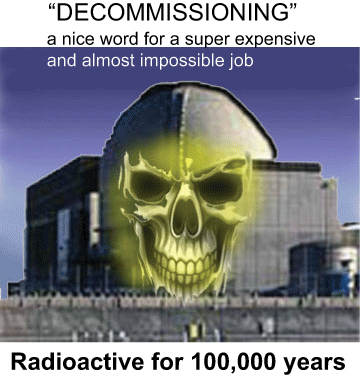
According to the report Exelon filed with the NRC, it has chosen to put the plant into long-term storage — a method known as SAFSTOR — and take advantage of the NRC’s rules on decommissioning plants which allow a company up to 60 years to raze a facility. “The SAFSTOR option is the most economical and radiologically safe plan for decommissioning,” D’Ambrosio said. “It allows for normal radioactive decay, produces less waste and exposes our workers to lower levels of radiation.”
Once it stops producing electricity Sept. 17, the process of moving the radioactive fuel from the reactor core to a spent fuel storage pool begins, something Exelon says should be done by Sept. 30.
In the coming years work will begin to remove some smaller buildings at the site, according to the report. The radioactive spent fuel rods will eventually be removed from the fuel pool and be placed in dry storage casks, a task Exelon says will be done by 2024.
The site will be maintained for 50-plus years until Exelon begins removing the larger components at the site beginning in June 2075 and wrapping up by December 2077, according to its report.
Some of the larger sections of the plant may actually be barged from near the site, according to the report.
The decommissioning is expected to cost the utility about $1.4 billion, Exelon says.
Environmentalists who have long been critical of the 620-megawatt plant, said they are glad to see it close.
“Oyster Creek has been a safety threat to Ocean County, polluting Barnegat Bay, and killing thousands of fish over the years,” said Jeff Tittel, director of the New Jersey Sierra Club. “Shutting down the Oyster Creek plant will reduce the algae blooms, improve fish populations and help restore the overall ecosystem of the Barnegat Bay.”
Idaho was the nation’s nuclear waste dump until Gov. Phil Batt in 1995 negotiated an end to the practice, by limiting the time nuclear waste can stay in Idaho. But that agreement is now at risk, says the Snake River Alliance, Idaho’s nuclear watchdog. … people are expected to turn out Friday at the Twin Falls Visitor Center in opposition of the U.S. Department of Energy’s plan to ship 7,000 cubic meters of nuclear waste from Hanford, Wash., to Idaho National Laboratory, a nuclear research site near Arco on top of the Eastern Snake Plain Aquifer.
The DOE plans to ship the waste to INL for assessment before permanent disposal at nation’s waste isolation pilot project (WIPP) in New Mexico. The 1995 Nuclear Waste Settlement Agreement established a one-year in-and-out rule, limiting nuclear waste’s time in Idaho to just 12 months.
But WIPP has been disabled by two underground accidents, slowing the flow of nuclear waste materials into the waste disposal, Wendy Wilson, executive director of Snake River Alliance, said Wednesday.
“The waste from Hanford could be stranded in Idaho in violation of the nuclear waste settlement agreement,” Wilson said.
The alliance is launching its statewide Don’t Waste Idaho campaign at 1:30 p.m. Friday at the Twin Falls Visitor Center. Petitions asking Idaho Gov. C.L. “Butch” Otter and Attorney General Lawrence Wasden to oppose the DOE’s plans will be available to sign.
Also, a no-host dinner is planned for 6:30 p.m. Saturday at Rock Creek Restaurant in Twin Falls.
NIRS 6th June 2018 The controversial Trump Administration plan to nationalize the nuclear
energy marketplace could cost U.S. consumers up to $17 billion a year in
artificially high electricity bills, with the prospect of extensive
coal-fired power plant subsidies potentially doubling that figure.
Further, the bailouts of nuclear and coal could trip up America‘s renewables
industry, leaving the U.S. even further behind in the global race for clean
energy technology development and deployment, according to three experts
participating in a news conference today.
Today, the Nuclear Information & Resource Service (NIRS) updated and expanded the nuclear bailout costs
estimated in its November 2016 report that concluded that federal handouts
for nuclear alone could add up to $280 billion to electricity bills by
2030. A bailout of coal-fired power plants would leave ratepayers and
taxpayers holding the bag for even more. NIRS estimates that the current
Trump bailout scheme could cost consumers $8-$17 billion for just the
nuclear element and as much again for coal subsidies. https://www.nirs.org/press/experts-nuclear-bailout-could-cost-up-to-17-billion-a-year-and-destroy-renewables-industry-in-u-s/
How Kim Jong Un and Trump Differ on Denuclearization. Bloomberg , By David Tweed and Kanga Kong
Donald Trump and Kim Jong Un are preparing to meet face-to-face in Singapore on June 12, a prospect that seemed unthinkable just a year ago when the leaders of the U.S. and North Korea were exchanging insults and threats. The main topic will be denuclearization, but they appear to have different ideas of what that means and how long it might take. Overcoming those differences will be key to reaching a historic outcome.
1. What is the U.S. stance on denuclearization?
The U.S. wants to see “complete, verifiable and irreversible denuclearization” of the Korean Peninsula. Known in the arms-control world as “CVID,” this would involve dismantling North Korea’s nuclear program and stripping Kim of the ability to make nuclear bombs in the future.
2. What does denuclearization mean for North Korea?
North Korea in April committed to work toward “complete denuclearization,” without elaborating on what that meant. In 2016, a government spokesman called for “the denuclearization of the whole Korean peninsula and this includes the dismantlement of nukes in South Korea and its vicinity.” More recently, North Korea has framed its willingness to get rid of nuclear weapons in more of a global context, implying that it will do so in concert with established nuclear powers like the U.S., China and Russia.
3. Does the U.S. have nuclear weapons on the peninsula?
The U.S. hasn’t stationed them in South Korea since 1992, but it does provide a so-called nuclear umbrella that guarantees the safety of allies South Korea and Japan. Kim may ask the U.S. to remove the nuclear bombers it has stationed in Guam and cease patrols by its nuclear-armed submarines. The U.S. would be unlikely to agree to any measures that would leave its allies vulnerable.
4. What about the time frame for removing nuclear weapons?
Speed is crucial for the U.S. to avoid a lengthy process that provides sanctions relief for North Korea as well as time to advance its nuclear program even further. Even so, North Korea has made it clear it will not accept the so-called Libya model proposed by U.S. National Security Adviser John Bolton under which the regime ships its nuclear arsenal out of the country in return for security guarantees and sanctions relief. ……….https://www.bloomberg.com/news/articles/2018-06-04/how-kim-jong-un-and-trump-differ-on-denuclearization-quicktake
The bankrupt business has spent hundreds of thousands of dollars on lobbying so far this year., EMMA FOEHRINGER MERCHANTJUNE 05, 2018
In the month following its declaration of bankruptcy and its request for an emergency orderto support coal and nuclear plants, FirstEnergy Solutions spent hundreds of thousands of dollars on lobbying, documents show.
Lobbying filings show a bill of $230,000 for FirstEnergy Solutions with top lobbying firm Akin Gump Strauss Hauer & Feld so far in 2018. In total, FirstEnergy spent about $750,000 on activities with the firm, billed under work on “energy regulation” as well as federal and state government affairs. FirstEnergy did not work with Akin Gump in 2017.
Akin Gump’s invoice for May 30 through April 30, which it filed as part of FirstEnergy Solutions’ bankruptcy proceeding, shows that the firm billed for time spent in communication with members of Congress and in calls with the Department of Energy and the White House regarding FirstEnergy’s Section 202(c) request.
The lawmakers Akin Gump contacted hail from coal states including Pennsylvania, Ohio and West Virginia. Among those lobbying for FirstEnergy on behalf of the firm Sam Olswanger, a former staff member for Republican Representative Daniel Webster of Florida, who has roots in West Virginia.
The Energy and Policy Institute, a renewable energy advocacy organization, annotated the recent filing and argued it showed the “high-priced campaign” FirstEnergy has waged to secure emergency assistance for coal and nuclear. It’s a market intervention that many in the energy industry, particularly the clean energy space, vehemently oppose.
The White House, the Department of Energy and FirstEnergy did not respond to request for comment regarding the filing.
Between 2008 and 2017, FirstEnergy Corp. spent an annual average of about $2.05 million on lobbying. Its spending hasn’t dipped below $1.8 million since 2011.
This year, Akin Gump seems to have found an audience with the administration. On Thursday, Bloomberg reported that the administration is preparing to use Section 202 of the Federal Power Act and the Defense Production Act to “stop the further premature retirements of fuel-secure generation capacity” from coal and nuclear.
And Akin Gump isn’t the only one working on the coal and nuclear bailout. Jeff Miller, a former adviser to Rick Perry who maintains close ties to the Trump administration, has signed clients including FirstEnergy Solutions parent company FirstEnergy Corp. since moving to Washington and founding his lobbying firm Miller Strategies last year.
In a Q1 2018 filing, Miller noted that his firm was lobbying the Energy Department, the Executive Office of the President and the U.S. House of Representatives on “issues related to grid resilience” for FirstEnergy.
In addition to the $330,000 FirstEnergy paid Miller in 2017 and so far in 2018, according to filings, the firm has also received $60,000 each from the Nuclear Energy Institute and Southern Company. A $110,000 lobbying filing for Pacific Electric & Gas mentions issues such as “climate resilience” that Miller’s firm brought before the Department of Energy, Executive Office of the President, and the U.S. House of Representatives.
While it’s not unusual for a company to hire lobbyists to pursue its interests in the halls of influence, Miller’s previous ties to the Trump administration are worth noting. As the Associated Press has reported, Miller ran Perry’s presidential campaign just two years ago and helped him through his confirmation process as Energy Secretary.
He has also contributed to the campaign coffers of Greg Pence, Mike Pence’s brother, who just won a congressional primary in Indiana. The president of America First Action, a pro-Trump super PAC (political action committee), also confirmed to the AP that Miller works with the group as a volunteer.
On Friday, after Bloomberg broke the news that the administration was planning to move forward with plans to prop up coal and nuclear, President Trump asked Perry to draw up recommendations to do so.
During a Tuesday conference in Washington, D.C. hosted by the Energy Information Administration, the Department of Energy spoke for the first time since the memo release. Comments from Undersecretary of Energy Mark Menezes indicate DOE is sticking to the administration’s script.
“The president rightly views grid resilience as a national security issue,” he said, adding that closing nuclear and coal plants means “we’re losing more than grid resiliency; we’re losing energy security.”
How many billions-with-a-“b” of your tax dollars is the federal government willing to waste on bad nuclear decisions? It’s in the tens of billions already, with the meter in overdrive.
There’s the $15 billion already plowed into the Yucca Mountain storage site, about 100 miles northwest of Las Vegas, Nev., since 1987. The project has yet to take a thimble of nuclear waste, having been abandoned since 2010. There’s the $4 billion Mixed-Oxide Fuel Fabrication Facility, or MOX, at the Department of Energy’s Savannah River Site. MOX was designed to transform weapons-grade plutonium into commercial reactor fuel as part of a disarmament deal with the Russians. It’s more than a decade old, was supposed to open in 2016, is barely 70 percent complete and is over budget – cost estimates have skyrocketed from $1.4 billion to $17 billion.
And now there’s the multibillion plan to split the job of making plutonium pits between Los Alamos National Laboratory and a re-purposed MOX facility. As the National Nuclear Security Administration unveiled the pit production plan, U.S. Secretary of Energy Rick Perry executed a waiver to terminate MOX construction. MOX would now have to be revamped to churn out 50 pits by 2030, even though a nuclear pit has never been produced in South Carolina and there are questions of whether the complex work is even possible in the Palmetto State’s humidity. LANL would get an estimated $3 billion makeover to expand its production line, even though it has never made more than 11 pits a year and has made exactly zero since 2011; it has to crank out 30 under the new deal.
And that nuclear waste that was destined for MOX? It would end up headed to – wait for it – the Waste Isolation Pilot Plant near Carlsbad in a “dilute and dispose” operation. New Mexico never signed up for this level of waste. South Carolina lawmakers, who want MOX and its 2,000 jobs to remain, say “DOE says it now wants to pursue ‘dilute and dispose,’ but that plan was already considered and rejected…. this could lead to the permanent orphaning of at least 34 metric tons of weapons grade plutonium, enough for thousands of warheads.”
Yes, on one hand, it makes sense to find another mission for MOX – in 10 years, a utility has yet to come forward and say it wants to buy what MOX was ultimately supposed to be selling. And it is certainly politically expedient to throw a multibillion-dollar nuclear job-creator bone to South Carolina – after all, that’s where the head of the U.S. Senate resides.
But on the other, there are real questions about whether the U.S. really needs 80 new pits for an estimated $1.4 trillion-with-a-“t.” The magic 80 number comes from an Obama-era vast weapons modernization make-work plan, and Trump is expected to up that ante. Yet, the United States already has 12,000 spare pits and in storage those “have credible minimum lifetimes in excess of 100 years,” according to an independent advisory panel cited in The Economist. Making pits also produces a lot of waste, and as mentioned above, the nation can’t dispose of the metric tons it already has – more than 70,000 metric tons of used reactor fuel is in temporary facilities in 39 states and 55 metric tons of surplus weapons-grade plutonium is in bunkers at the Energy Department’s Pantex warhead assembly-disassembly plant outside Amarillo and in an old reactor building at the Savannah River Site.
N.M. Democratic Sens. Tom Udall and Martin Heinrich, and Reps. Michelle Lujan Grisham and Ben Ray Luján are saying “instead of wasting billions of dollars exploring the construction of a new facility that will likely never be completed somewhere else, the Department of Energy should immediately move forward with the new, modular plutonium facilities at Los Alamos – as originally endorsed by both Congress and the Nuclear Weapons Council.” And LANL director Terry Wallace says “this commitment by the government to expand our plutonium mission reiterates the critical role we play in ensuring the nation’s security.”
There’s something to be said for going with what you know, and the nation knows LANL can build pits. But there are also billions of reasons to take a hard, unbiased look at what the nation truly needs to keep its nuclear deterrence vibrant.
And what is just expensive and dangerous busy work.