Federal nuclear weapons plants getting capability to disable drones,https://www.knoxnews.com/story/news/local/tennessee/2018/06/14/federal-nuclear-weapons-plants-getting-capability-disable-drones/702654002/Staff and Wire reports June 14, 2018
Federal nuclear weapons facilities are getting systems to disable drones or any other unauthorized unmanned aircraft systems flying over restricted airspace.
Officials at the Los Alamos National Laboratory say they’re testing a new system that could serve as a model for other federal installations, the Los Alamos Monitor reported Wednesday.
The technology is coming to the federal government’s Y-12 National Security Complex in Oak Ridge, Tennessee, a spokesman said.
“The Y-12 National Security Complex and its sister site at the Pantex Plant near Amarillo, Texas, are among the national security facilities around the nation where this capability will be employed,” said Steve Wyatt, a spokesperson for the National Nuclear Security Administration (NNSA), told the USA TODAY NETWORK -Tennessee on Thursday.. “At this point, we have no further comment.”
The airspace over the New Mexico lab received an additional no drone zone designation by the Federal Aviation Administration.
All airspace over the laboratory is protected right now against unauthorized drone or UAS flights (unmanned aircraft systems),” said Michael Lansing, head of the lab’s security operations. “We can detect and track a UAS and if it poses a threat we have the ability to disrupt control of the system, seize or exercise control, confiscate, or use reasonable force to disable, damage or destroy the UAS.”
The lab worked with the National Nuclear Security Administration and the FAA to implement the system. The NNSA received authorization from Congress last year to implement enhanced security measures to protect its sites from drones.
“Implementation guidance by NNSA focuses on high-level actions to be taken to detect, identify, track and mitigate drones that pose a threat to NNSA covered facilities,” said Lewis Monroe, director of NNSA’s Office of Security Operations and Programmatic Planning.
The lab’s Counter-UAS program will serve as a blueprint for other programs planned for the Pantex Plant in Texas, the Y-12 facility in Tennessee and the National Nuclear Security Site in Nevada.
The NNSA has defined drone activity as threatening “if unabated, could inflict or otherwise cause physical harm to a person; inflict or otherwise cause damage to property or systems; interfere with the operational mission of a covered facility or asset; conduct unauthorized surveillance or reconnaissance; or result in unauthorized access to, or disclosure of, classified or otherwise lawfully protected information.”
June 15, 2018
Posted by Christina Macpherson |
safety, USA, weapons and war |
Leave a comment
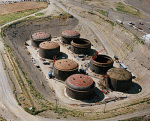 Hanford watchdog warns against closing underground tanks http://www.tri-cityherald.com/news/local/hanford/article212957659.html, BY ANNETTE CARY, acary@tricityherald.com, RICHLAND, WA , 14 June 18
A Hanford watchdog group is objecting as the Department of Energy takes the first step toward a plan to fill underground, radioactive waste storage tanks with concrete-like grout and leave them permanently in place. The C Tank Farm, which would be closed first, has not had enough radioactive waste removed to have tanks filled with grout, said Tom Carpenter, executive director of Seattle-based Hanford Challenge.
“This would be a serious setback for the cleanup at Hanford if the DOE is allowed to turn Hanford into the nation’s high-level nuclear waste dump,” Carpenter said. “This will be challenged.”
Geoffrey Fettus, a senior attorney at the Natural Resources Defense Council, said that “the people of the Pacific Northwest deserve better, and we’ll be there with them opposing this unsound and unsafe effort.”
June 15, 2018
Posted by Christina Macpherson |
USA, wastes |
Leave a comment

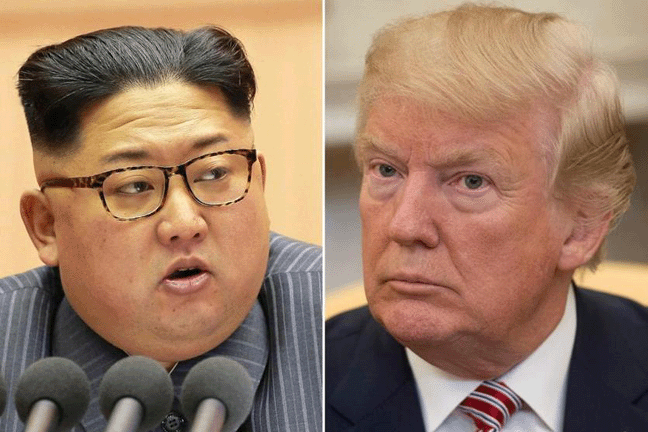
North Korean leader Kim Jong Un provides guidance on a nuclear weapons program in this undated photo released by North Korea’s Korean Central News Agency (KCNA) in Pyongyang September 3, 2017. KCNA via REUTERS
The Guardian view on Trump in Singapore: a huge win – for North Korea https://www.theguardian.com/commentisfree/2018/jun/12/the-guardian-view-on-trump-in-singapore-a-huge-win-for-north-korea 13 June 18
Editorial A confident leader strode into the Singapore summit and won. Kim Jong-un went with a plan, gave little and left with plenty: bolstered status and diplomatic leverage, lavish praise from the US president, the promise of an end to US-South Korean military drills – and, surely, a growing confidence that North Korea is doing well at this game. A meeting supposed to effect a breakthrough on denuclearisation looked “more like a big welcome party to the nuclear-armed club”, in the acid but accurate words of one observer.
Better than war, for sure. But since it was Donald Trump who raised that spectre, giving him credit for dispelling it would be like calling a man a life-saver when second thoughts stay his hand from murder. The US president handed over gift after gift in exchange for the inflation of his ego. He does not know or does not care that his country went home poorer than it came. The language in the joint statement was weaker than in previous agreements– the very significant difference being that the North is now much further advanced in its nuclear programme. There was not even a pledge that either side “shall” take action; just the assertion that North Korea will “commit to working towards” denuclearisation, which it sees as a general, not unilateral, process.
In return Mr Trump axed the drills with, it seems, no warning to Seoul (or even US forces). Worse, he described them as “provocative” and “inappropriate”, not just giving the North what it wanted, but suggesting it was right to demand it. He added that he hoped to withdraw US troops from South Korea at some point – further undermining the long alliance.
Mr Trump’s recounting of the meeting would have been laughable were it not so shocking. He explained to the North Koreans that they could have “the best hotels in the world” on the beaches they use for artillery drills. He presented Mr Kim with a Hollywood-style movie trailer laying out the choice before him, complete with growling voiceover. He described the 100,000 or more North Koreans held in prison camps as “one of the big winners” of the meeting, though not even the vaguest assurance was extracted on their behalf. While finding time for another crack at Canada’s Justin Trudeau, he called Mr Kim “a very talented man” who wants to do the right thing and loves his country. He praised him for “running it tough” (quite the euphemism for a dictatorship with human rights atrocities which the UN calls unparalleled in the modern world). And the comprehensive, verifiable, irreversible denuclearisation on which the US was to insist? Ah: “There was no time!” to cover that. But he would be surprised if the North Koreans hadn’t begun already. Mr Trump thinks that the two sides probably have a rough transcript capturing all this, but does not need to verify anything because “I have one of the great memories of all time”. No satirist would dare to invent this.
Hope for the best but don’t expect much progress in lower-level talks next week; nor at meetings at the White House or in Pyongyang, mooted by the US president. China has already implied that it may be time to relax sanctions; South Korea and Russia have hinted that they are similarly minded. Even Mr Trump acknowledged that in six months’ time it may emerge that the North Koreans are not taking action (adding, in a startling moment of candour, that “I will find some sort of excuse” rather than admit that).
“He trusts me and I trust him,” Mr Trump boldly declared of Mr Kim. But if the US president is so naive, surely the North Korean leader cannot be. In so far as the US president has any enduring belief, it appears to be that disruption is a good in and of itself: that throwing everyone else off-balance must benefit the world’s only superpower, as one official has suggested (his colleague had a cruder characterisation). Withdrawal from the Iran deal proved that America’s enemies cannot rely upon its word. The G7 and Singapore summits demonstrated that allies cannot either. But Tuesday’s meeting also showed that Americans have reason to be wary. They too cannot count upon Mr Trump to live up to his promises.
June 13, 2018
Posted by Christina Macpherson |
North Korea, politics international, USA |
Leave a comment
 Singapore summit: Donald Trump and Kim Jong-un document released after historic meeting http://www.abc.net.au/news/2018-06-12/donald-trump-and-north-korea-leader-statement-after-meeting/9861688–June 12, 2018, Sentosa Island
The text from the document signed by Donald Trump and Kim Jong-un has been made available. Here it is in full:
President Donald J Trump of the United States of America and Chairman Kim Jong-un of the State Affairs Commission of the Democratic People’s Republic of Korea (DPRK) held a first, historic summit in Singapore on June 12, 2018.
President Trump and Chairman Kim Jong-un conducted a comprehensive, in-depth, and sincere exchange of opinions on the issues related to the establishment of new US-DPRK relations and the building of a lasting and robust peace regime on the Korean Peninsula.
President Trump committed to provide security guarantees to the DPRK, and Chairman Kim Jong-un reaffirmed his firm and unwavering commitment to complete denuclearisation of the Korean Peninsula.
Convinced that the establishment of new US-DPRK relations will contribute to the peace and prosperity of the Korean Peninsula and of the world, and recognising that mutual confidence-building can promote the denuclearisation of the Korean Peninsula, President Trump and Chairman Kim Jong-un state the following:
- The United States and the DPRK commit to establish new US-DPRK relations in accordance with the desire of the peoples of the two countries for peace and prosperity.
- The United States and the DPRK will join their efforts to build a lasting and stable peace regime on the Korean Peninsula.
- Reaffirming the April 27, 2018 Panmunjom Declaration, the DPRK commits to work towards complete denuclearisation of the Korean Peninsula.
- The United States and the DPRK commit to recovering POW/MIA remains, including the immediate repatriation of those already identified.
Having acknowledged that the US-DPRK summit — the first in history — was an epochal event of great significance and overcoming decades of tensions and hostilities between the two countries and for the opening of a new future, President Trump and Chairman Kim Jong-un commit to implement the stipulations in this joint statement fully and expeditiously.
The United States and the DPRK commit to hold follow-on negotiations led by the US Secretary of State, Mike Pompeo, and a relevant high-level DPRK official, at the earliest possible date, to implement the outcomes of the US-DPRK summit.
President Donald J Trump of the United States of America and Chairman Kim Jong-un of the State Affairs Commission of the Democratic People’s Republic of Korea have committed to cooperate for the development of new US-DPRK relations and for the promotion of peace, prosperity, and security of the Korean Peninsula and of the world.
June 13, 2018
Posted by Christina Macpherson |
North Korea, politics international, USA |
Leave a comment
Fast Company 5th June 2018 , People across the U.S. tell their own stories of how wind and solar have
changed their lives and benefitted the diverse regions where they live.
“After I lost my job, I had about three days of sulking, and then I got
up and decided to listen to some of my co-workers’ advice to look into
wind turbines,” he said in Reinventing Power: America’s Renewable
Energy Boom, a new film (to be widely released this summer) from the Sierra
Club about the energy revolution in America.
He now works as a turbine engineer, and the wind industry is helping the state climb out of its deep
recession. Bruce’s circumstances are not unusual: In the U.S., jobs in
sectors that have traditionally boosted the economy are disappearing. Coal
is environmentally damaging and expensive to mine. Car companies are
looking at an eventual slow-down in sales. Across both sectors and many
more, automation is putting people out of work.
Renewable energy is poised to step up where these older sectors are falling behind. Wind and solar
employ over 800,000 people across the country, and are some of the
fastest-growing industries. As these resources scale, they’re becoming
economically viable–solar is around 50% cheaper than coal–and
wide-scale adoption of wind and solar could help curb America’s carbon
emissions. And they’re adaptable across a range of communities:
Reinventing Power traces the establishment of the country’s first
offshore wind farm near the tiny Rhode Island community of Block Island and
delves into community solar programs in Austin and wind power on Northern
Cheyenne Indian Reservation in Montana and a farm in North Carolina, The
film also follows the retraining of former coal miners and auto workers for
jobs in renewables throughout the U.S.
https://amp.fastcompany.com/40580983/this-new-doc-shows-how-renewable-energy-recharges-communities
June 13, 2018
Posted by Christina Macpherson |
renewable, USA |
Leave a comment
http://www.yakimaherald.com/news/local/how-empty-are-hanford-s-nuclear-waste-tanks-not-enough/article_a26eb296-6e4d-11e8-80f5-9b57fab51cec.html Annette Cary Tri-City Herald , 12 June 15
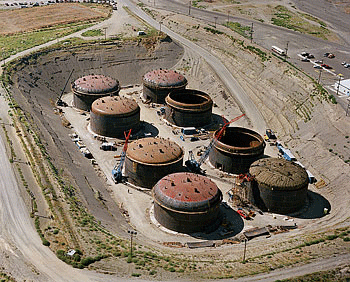
RICHLAND, Wash. — A Hanford watchdog group is objecting as the Department of Energy takes the first step toward a plan to fill underground, radioactive waste storage tanks with concrete-like grout and leave them permanently in place.
The C Tank Farm, which would be closed first, has not had enough radioactive waste removed to have tanks filled with grout, said Tom Carpenter, executive director of Seattle-based Hanford Challenge.
“This would be a serious setback for the cleanup at Hanford if the DOE is allowed to turn Hanford into the nation’s high-level nuclear waste dump,” Carpenter said. “This will be challenged.”
Geoffrey Fettus, a senior attorney at the Natural Resources Defense Council, said that “the people of the Pacific Northwest deserve better, and we’ll be there with them opposing this unsound and unsafe effort.”
DOE has completed a draft evaluation of the waste remaining in the C Tank Farm, concluding that radioactive waste has been removed to the extent possible and that the remaining waste, if grouted in place, would meet requirements for disposing of it as low-level radioactive waste.
The draft evaluation is a step toward classifying the waste as low-level to allow it to be left in place as tanks are filled with grout and then covered with an above-ground cap to prevent precipitation from infiltrating.
An all-day meeting is planned starting at 9 a.m. Monday at the Richland Public Library to explain the draft document and its findings. A public comment period started June 4.
DOE worked steadily to empty most of the waste in the 16 tanks of C Tank Farm from 2003 until late 2017.
The federal court-enforced consent decree requires DOE to get as much radioactive waste from the tanks as possible, with an overall goal of getting an average of 99 percent of waste removed from the 149 single-shell tanks at Hanford.
It is roughly the equivalent of a little less than an inch of waste if it were spread evenly across the bottom of a tank.
In the C Tank Farm, about 96 percent of the volume of the waste was removed, according to DOE.
The 16 tanks held 1.8 million gallons of mostly sludge and salt cake when retrieval of solids began. They now hold an estimated 64,000 gallons of waste.
DOE was required to use up to three different technologies at each tank until each technology was no longer able to remove waste under the terms of the federal court-enforced consent decree.
Technologies included various methods to spray high-pressure streams of liquid on the waste within the enclosed tanks and move it toward a pump for removal, different vacuuming systems, and soaking hardened waste in water or a caustic chemical.
Much of the remaining waste is difficult to retrieve safely without exposing workers to radiation or damaging the walls and floor of the tanks, which already are prone to leaking. Some of the remaining waste is clinging to the walls of the tank.
Hanford Challenge is not proposing that workers be put in harm’s way, Carpenter said.
In 10 to 20 years, there could be better technology to retrieve remaining waste, provided the tanks have not already been filled with grout to make that impossible, he said.
In the meantime, the solid waste in the tanks could be monitored and DOE could focus on the more pressing issue of removing waste from its other leak-prone, single-shell tanks, Carpenter said. Just one tank in addition to the 16 C Farm tanks has been emptied to regulatory standards.
Grout has not been shown to effectively contain nuclear waste for periods of more than 100 years, according to Hanford Challenge. Water can infiltrate grout, and grout can break down quickly in the presence of caustic materials such as nuclear waste, it said.
Plutonium would reach the groundwater and then the Columbia Point at some point in the future, Carpenter said.
The draft proposal would challenge the consensus that Hanford’s tank waste should be vitrified, or immobilized in glass, according to Hanford Challenge.
“Hanford is proposing shortcuts to the cleanup that will save money, but will in the end further damage the environment and impact human health and safety and future generations,” Carpenter said.
DOE said in its announcement of the draft report and public meeting that “closing the emptied tanks would be a significant achievement in DOE’s Hanford cleanup mission. DOE has a record of safely and successfully closing emptied underground waste tanks at the Savannah River Site in South Carolina and the Idaho National Laboratory.”
Public comment will be accepted through Sept. 7 at WMACDRAFTWIR@rl.gov. It also can be mailed to Jan Bovier; DOE Office of River Protection; P.O. Box 450, MSIN H6-60; Richland, WA 99354.
For more information on the report, click on the revolving banner at www.hanford.gov.
Further steps in the regulatory process will be required before the C Tank Farm is closed.
DOE will have to make a decision on whether tanks could be filled with grout or must be dug up. The Washington state Department of Ecology, a Hanford regulator, also would have to agree that tanks could be grouted.
June 13, 2018
Posted by Christina Macpherson |
USA, wastes |
Leave a comment
 In the Trump Administration, Science Is Unwelcome. So Is Advice.
As the president prepares for nuclear talks, he lacks a close adviser with nuclear expertise. It’s one example of a marginalization of science in shaping federal policy. NYT By Coral Davenport 9 June 18
WASHINGTON — As President Trump prepares to meet Kim Jong-un of North Korea to negotiate denuclearization, a challenge that has bedeviled the world for years, he is doing so without the help of a White House science adviser or senior counselor trained in nuclear physics.
Mr. Trump is the first president since 1941 not to name a science adviser, a position created during World War II to guide the Oval Office on technical matters ranging from nuclear warfare to global pandemics. As a businessman and president, Mr. Trump has proudly been guided by his instincts. Nevertheless, people who have participated in past nuclear negotiations say the absence of such high-level expertise could put him at a tactical disadvantage in one of the weightiest diplomatic matters of his presidency.
“You need to have an empowered senior science adviser at the table,” said R. Nicholas Burns, who led negotiations with India over a civilian nuclear deal during the George W. Bush administration. “You can be sure the other side will have that.”
The lack of traditional scientific advisory leadership in the White House is one example of a significant change in the Trump administration: the marginalization of science in shaping United States policy.
There is no chief scientist at the State Department, where science is central to foreign policy matters such as cybersecurity and global warming. Nor is there a chief scientist at the Department of Agriculture: Mr. Trump last year nominated Sam Clovis, a former talk-show host with no scientific background, to the position, but he withdrew his name and no new nomination has been made.
These and other decisions have consequences for public health and safety and the economy. Both the Interior Department and the National Oceanic and Atmospheric Administration have disbanded climate science advisory committees. The Food and Drug Administration disbanded its Food Advisory Committee, which provided guidance on food safety.
Government-funded scientists said in interviews that they were seeing signs that their work was being suppressed, and that they were leaving their government jobs to work in the private sector, or for other countries.
After Mr. Trump last year withdrew from the Paris climate agreement, the international pact committing nations to tackle global warming, France started a program called “Make Our Planet Great Again” — named in reference to Mr. Trump’s slogan, “Make America Great Again” — to lure the best American scientists to France. The program has so far provided funding for 24 scientists from the United States and other countries to do their research in France…….https://www.nytimes.com/2018/06/09/climate/trump-administration-science.html
June 11, 2018
Posted by Christina Macpherson |
politics international, USA |
Leave a comment
“CANADA, FRANCE, GERMANY, ITALY, JAPAN THE UK AND THE EUROPEAN UNIONREAFFIRM THEIR STRONG COMMITMENT TO IMPLEMENT THE PARIS AGREEMENT, THROUGH AMBITIOUS CLIMATE ACTION”
“PRESIDENT TRUMP’S WRECKING BALL APPROACH TO INTERNATIONAL DIPLOMACY LEFT HIM UTTERLY ISOLATED AT THE G7 SUMMIT,”

Six of the G7 Commit to Climate Action. Trump Wouldn’t Even Join Conversation. https://insideclimatenews.org/news/10062018/g7-summit-climate-change-communique-trump-allies-estranged-germany-france-canada
Trump skipped the formal climate discussions, had the U.S. negotiators promote fossil fuels instead, and then renounced the group’s official communique. BY STAFF, INSIDECLIMATE NEWS JUN 10, 2018
President Donald Trump’s disdain for action on climate change, along with his other demands and behavior, left the United States estranged from its closest allies following the weekend summit of the Group of Seven major industrial democracies.
Trump skipped the G7’s formal discussions on the global warming crisis. And in the summit’s communique, the United States refused to join in common statements by the other six nations reaffirming their commitment to the Paris climate agreement, which he wants to abandon. In turn, none of them signed onto unilateral U.S. language pushing development of fossil fuels. And in the end, Trump renounced the whole communique in a Twitter tirade.
The governments of France and Germany said afterward that they and the European Union stood by the communique.
“Let’s be serious and worthy of our people,” the French presidency said in a statement quoted by AFP. “International co-operation cannot be dictated by fits of anger and throwaway remarks.”
“WE HAVE SEEN THIS WITH THE CLIMATE AGREEMENT OR THE IRAN DEAL,” DEUTSCHE WELLE REPORTED GERMAN FOREIGN MINISTER HEIKO MAAS SAYING ON SUNDAY. “IN A MATTER OF SECONDS, YOU CAN DESTROY TRUST WITH 280 TWITTER CHARACTERS.”
THE RUPTURE ON CLIMATE CHANGE, WHICH HAS BEEN BUILDING EVER SINCE TRUMP DECLARED THAT THE UNITED STATES WOULD PULL OUT OF PARIS, WAS OVERSHADOWED IN THE MAINSTREAM PRESS BY CONFLICTS OVER INTERNATIONAL TRADE AND RELATED ISSUES, AND BY PERSONAL CLASHES, ESPECIALLY BETWEEN HIM AND PRIME MINISTER JUSTIN TRUDEAU, THE HOST OF THE GATHERING.
COMMITTED TO PARIS, CARBON-NEUTRAL ECONOMY
IN THE COMMUNIQUE’S SECTION ON CLIMATE CHANGE, EVERY MEMBER EXCEPT THE UNITED STATES STOOD TOGETHER IN SUPPORTING THE PARIS CLIMATE AGREEMENT AND PROMISING TO WORK WITH ONE ANOTHER, LOCAL GOVERNMENTS, BUSINESSES AND THE PUBLIC TO DEAL WITH GLOBAL WARMING.
“CANADA, FRANCE, GERMANY, ITALY, JAPAN THE UK AND THE EUROPEAN UNIONREAFFIRM THEIR STRONG COMMITMENT TO IMPLEMENT THE PARIS AGREEMENT, THROUGH AMBITIOUS CLIMATE ACTION; IN PARTICULAR THROUGH REDUCING EMISSIONS WHILE STIMULATING INNOVATION, ENHANCING ADAPTIVE CAPACITY, STRENGTHENING AND FINANCING RESILIENCE AND REDUCING VULNERABILITY; AS WELL AS ENSURING A JUST TRANSITION, INCLUDING INCREASING EFFORTS TO MOBILIZE CLIMATE FINANCE FROM A WIDE VARIETY OF SOURCES,” THE COMMUNIQUE STATES.
THE LEADERS, MINUS THE U.S., ALSO COMMITTED TO REDUCE AIR AND WATER POLLUTION AND GREENHOUSE GAS EMISSIONS TO REACH A GLOBAL CARBON-NEUTRAL ECONOMY DURING THE SECOND HALF OF THE CENTURY.
THE COMMUNIQUE SAYS THEY ALSO FOCUSED ON, AMONG OTHER THINGS:
- ENERGY TRANSITIONS THROUGH MARKET-BASED CLEAN ENERGY TECHNOLOGIES;
- “THE IMPORTANCE OF CARBON PRICING, TECHNOLOGY COLLABORATION AND INNOVATION TO CONTINUE ADVANCING ECONOMIC GROWTH AND PROTECT THE ENVIRONMENT AS PART OF SUSTAINABLE, RESILIENT AND LOW-CARBON ENERGY SYSTEMS”;
- FINANCING TO IMPROVE ADAPTATION TO CLIMATE CHANGE; AND
- CONCRETE ACTIONS TO PROTECT THE HEALTH OF THE WORLD’S OCEANS. THE SIX ENDORSED THE CHARLEVOIX BLUEPRINT FOR HEALTH OCEANS, SEAS AND RESILIENT COASTAL COMMUNITIES AND (WITH THE EXCEPTION OF JAPAN) THE G7 OCEAN PLASTICS CHARTER.
U.S. GOES ITS OWN WAY: PROMOTING FOSSIL FUELS
U.S. NEGOTIATORS WROTE THEIR OWN PARAGRAPH FOR THE CLIMATE SECTION THAT FOCUSED ON PROMOTING THE BURNING OF FOSSIL FUELS.
“THE UNITED STATES WILL ENDEAVOUR TO WORK CLOSELY WITH OTHER COUNTRIES TO HELP THEM ACCESS AND USE FOSSIL FUELS MORE CLEANLY AND EFFICIENTLY,” IT SAID. “THE UNITED STATES BELIEVES IN THE KEY ROLE OF ENERGY TRANSITIONS THROUGH THE DEVELOPMENT OF MARKET-BASED CLEAN ENERGY TECHNOLOGIES AND THE IMPORTANCE OF TECHNOLOGY COLLABORATION AND INNOVATION TO CONTINUE ADVANCING ECONOMIC GROWTH AND PROTECT THE ENVIRONMENT AS PART OF SUSTAINABLE, RESILIENT AND CLEAN ENERGY SYSTEMS.”
THIS RESEMBLES LANGUAGE THAT THE TRUMP ADMINISTRATION HAS OFFERED BEFORE, BUT THAT OTHER PARTIES TO THE PARIS AGREEMENT DON’T EMBRACE, AND NONE OF THE OTHER SIX NATIONS SIGNED ON TO IT.
IT’S MORE COMMON FOR OTHER NATIONS, WHETHER RICH OR POOR, TO CALL FOR ACHIEVING SUSTAINABLE DEVELOPMENT ON PATHWAYS THAT SIMULTANEOUSLY BRING DOWN CARBON DIOXIDE EMISSIONS RAPIDLY ENOUGH TO STAVE OFF THE WORST RISKS OF CLIMATE CHANGE, WHICH WILL HURT THE POOREST NATIONS THE MOST.
‘WRECKING BALL APPROACH TO DIPLOMACY’
PRESIDENT TRUMP’S WRECKING BALL APPROACH TO INTERNATIONAL DIPLOMACY LEFT HIM UTTERLY ISOLATED AT THE G7 SUMMIT,” WROTE ALDEN MEYER, DIRECTOR OF STRATEGY AND POLICY AT THE UNION OF CONCERNED SCIENTISTS. “LEADERS FROM THE OTHER SIX COUNTRIES DIDN’T EVEN TRY TO PAPER OVER THEIR STRONG DISAGREEMENTS WITH TRUMP ON TRADE, CLIMATE CHANGE AND OTHER IMPORTANT ISSUES.
THEY ARE JOINED BY THOUSANDS OF MAYORS, GOVERNORS, BUSINESS LEADERS AND OTHERS WHO ARE MOVING FORWARD WITH AMBITIOUS CLIMATE ACTION AND PURSUING THE TREMENDOUS ECONOMIC DEVELOPMENT AND JOB CREATION BENEFITS THAT CLEAN ENERGY TECHNOLOGIES PROVIDE. AS COMMUNITIES ACROSS THE U.S. CONFRONT THE COSTLY AND HARMFUL IMPACTS OF CLIMATE CHANGE, IT’S THESE LEADERS—NOT PRESIDENT TRUMP—WHO ARE ACTING IN THE TRUE ECONOMIC, ENVIRONMENTAL AND NATIONAL SECURITY INTERESTS OF THE AMERICAN PEOPLE.”
THIS YEAR’S G7 STATEMENT ON CLIMATE CHANGE WAS MORE EXTENSIVE THAN THE2017 COMMUNIQUE‘S. LAST YEAR, A SINGLE PARAGRAPH STATED THAT THE U.S. WAS REVIEWING ITS POLICIES AND WAS “NOT IN A POSITION TO JOIN THE CONSENSUS.” THE OTHER LEADERS SAID ONLY THAT THEY RECOGNIZED THE PROCESS UNDERWAY IN THE U.S. AND THAT THEY REAFFIRMED THEIR COMMITMENT TO THE PARIS AGREEMENT.
“AMERICA—UNTIL NOW—HAD LED ON CLIMATE,” EDF PRESIDENT FRED KRUPP WROTE AFTER THIS WEEK’S G7 MEETING. “TODAY OUR PRESIDENT DOESN’T EVEN CARE ENOUGH TO BE PRESENT. WE ALL MUST WORK TO RESTORE THE USA TO A LEADERSHIP POSITION.”
GREENPEACE, MEANWHILE, PUT PRESSURE ON THE OTHER NATIONS: “THE JOINT COMMITMENT TO CLIMATE ACTION FORGED IN PARIS REMAINS AT THE TOP OF THE GEOPOLITICAL AGENDA DESPITE THE U.S. ADMINISTRATION’S REPEATED ATTEMPTS TO DEMOLISH IT,” EXECUTIVE DIRECTOR JENNIFER MORGAN WROTE. “G6 LEADERS NOW HAVE TO DEMONSTRATE THEIR COMMITMENT IN PRACTICE.”
June 11, 2018
Posted by Christina Macpherson |
climate change, politics international, USA |
Leave a comment
Both leaders land in Singapore as US seeks to manage expectations, Ft.com Bryan Harris and Stefania Palma in Singapore and Demetri Sevastopulo in Los Angeles
Kim Jong Un and Donald Trump landed in Singapore on Sunday in preparation for their historic summit, even as US officials sought to manage expectations for Tuesday’s much-heralded meeting. Once pitched as the final stage of a landmark denuclearisation deal, the meeting is increasingly being spun as just the beginning of a process of engagement between the two bitter adversaries. “I feel that Kim Jong Un wants to do something great for his people,” said Mr Trump as he departed Canada en route for the south-east Asian city state. “There’s a good chance it won’t work out. There’s probably an even better chance it will take a period of time.” The aim of the summit on Tuesday is to see if Mr Kim and Mr Trump could establish a level of chemistry and trust that would provide impetus for further negotiations between Washington and Pyongyang, according to one senior US official.
Joseph Yun, the state department’s former point-man on North Korea, echoed the sentiment, saying it was clear that high-level meetings between US and North Korean officials in recent days had reduced expectations on the American side. “Gone is the talk of all-in-one big bang and denuclearisation. The magic word seems to be process and progress,” said Mr Yun, adding that it would still be important to have a “substantive result” from the summit. Mr Trump said in advance of his arrival that he would know “within the first minute” of the meeting whether Mr Kim was “serious”. He added that he could make such a judgment based on “my touch, my feel — that’s what I do”……….
Washington is seeking CVID — the complete, verified and irreversible dismantlement of the North’s nuclear programme — a process that experts believe could take years, potentially even a decade. https://www.ft.com/content/99901e74-6c5b-11e8-92d3-6c13e5c92914
June 11, 2018
Posted by Christina Macpherson |
politics international, USA |
Leave a comment
 Trump’s nuclear bailout could cost consumers up to $17 billion each year https://inhabitat.com/trumps-nuclear-bailout-could-cost-consumers-up-to-17-billion-each-year/ The Trump Administration is taking unprecedented steps to bail out failing nuclear and coal power plants, effectively nationalizing the American energy market with potentially drastic consequences for the renewable energy industry and the American consumer. According to an updated report from the Nuclear Information and Resource Service (NIRS), the Trump Administration’s plan could result in artificially high electricity prices. The planned subsidies for nuclear power plants alone could increase the overall cost of electricity in the U.S. by up to $17 billion each year; the subsidies for coal plants would add even more. This skewing of the American energy market, which has recently seen significant progress made by wind and solar energy, could also result in the decline of renewable energy in the U.S.
“By pushing for a nationwide bailout for nuclear power and coal, the
Trump administration is rushing headlong into an energy buzz saw, and they don’t even seem to know it,” NIRS executive director Tim Judson said in a statement. It should come as no surprise to those who have followed President Trump that he would take steps to support coal and nuclear power at the expense of renewable energy. What is surprising is the heavy-handedness with which his administration is attempting to directly subsidize failing businesses, thereby ignoring the Republican Party’s long-held belief in the supremacy of a market free from government intrusion. By doing so, Trump could decimate the
renewable energy industry, which employs more American workers than coal and nuclear combined.
The administration claims that it must act to save failing coal and nuclear plants in the interest of national security. Not everyone is buying that excuse. “The Administration’s warnings of dire effects from power shortages caused by shortages of reliable and resilient generation are contradicted by all of the bodies with actual responsibility for assuring adequate supplies,” said former member of the U.S. Nuclear Regulatory Commission Peter A. Bradford. “There are no state or federal energy regulators petitioning DOE for these measures. Indeed, those who have spoken clearly have said that such steps are unnecessary. … As was said in the run-up to the 2003 invasion of Iraq, the facts are being fixed around the desired end result.”
In order to enact its bailout policies, the Trump Administration has three options: Congressional action, review and approval by the Federal Energy Regulatory Commission or a formal National Security Council assessment. While the bailouts are likely to be delayed for the foreseeable future, if they even occur, the Trump Administration’s decision to subsidize failing power plants at the expense of American industry and consumer well-being makes its priorities quite cle
June 11, 2018
Posted by Christina Macpherson |
politics, USA |
1 Comment
By Rebecca Moss, The Santa Fe New Mexican , 10 June 18,
Despite a lengthy record of safety violations, the University of California will continue its 75-year legacy of running Los Alamos National Laboratory, the U.S. Department of Energy and National Nuclear Security Administration announced Friday.
A management partnership that includes the university, research and development nonprofit Battelle Memorial Institute and Texas A&M University, the alma mater of Energy Secretary Rick Perry, will be paid $2.5 billion annually to run Los Alamos, the birthplace of the atomic bomb. They’re calling their partnership Triad National Security LLC.
The contract could be worth upward of $25 billion over the next decade, with hundreds of millions of dollars more in performance-based bonus fees. Six other corporations will join the team in support roles……..
This is the second time the University of California has effectively maintained control over the laboratory despite concerns about serious mismanagement. In 2003, and again in 2015, the National Nuclear Security Administration said it would seek a new management contractor for the New Mexico lab following significant security breaches, costly accidents and injured employees.
The current management team, which also includes defense contractor Bechtel, amassed more than $110 million in fines and withheld bonuses because of health and safety issues. An electrical accident in 2015 left a worker hospitalized for over a month, and waste packaging errors led to a drum burst in 2014 at the Waste Isolation Pilot Plant in Carlsbad, exposing workers to radiation. The accident caused the storage facility to shut down for nearly three years…….
This is a pivotal time for the lab. Los Alamos is expected to take on new nuclear work, building up to 30 plutonium pits per year. Producing the softball-sized plutonium metal cores, which trigger a reaction inside a nuclear weapon, is dangerous work, and Los Alamos has struggled to safely build even a single stockpile-ready pit in recent years.
Critics of the lab questioned how the university emerged as a winner once again and how any serious overhaul of the lab’s problems can occur if part of the existing leadership remains in place. Even the federal government called for a “
culture change” at Los Alamos when it solicited bidders for the new lab contract last year.
June 11, 2018
Posted by Christina Macpherson |
safety, USA |
Leave a comment
Breathtaking Power Grab: Trump Orders Uneconomical Coal and Nuclear Plants Not to Close, Lays Plans for Taxpayers to Bail Out Coal and Nuclear Industry https://www.citizen.org/media/press-releases/breathtaking-power-grab-trump-orders-uneconomical-coal-and-nuclear-plants-not
Statement of Tyson Slocum, Director, Public Citizen’s Energy Program
Note: President Donald Trump today directed U.S. Secretary of Energy Rick Perry to stop the closure of coal and nuclear plants, which are closing because renewable energy has become cheaper. In addition, a draft White House memo outlines a plan to bail out coal and nuclear plants using the U.S. Department of Energy’s emergency powers and a Cold War-era law that permits it to nationalize parts of the power sector.
President Donald Trump’s actions are a breathtaking abuse of authority and another indication that the president – whose daily knee-jerk actions show neither thought nor policy knowledge – is heavily influenced by extremist corporations and industries. Trump is imagining a crisis that doesn’t exist. This is a power grab, literally.
Ordering the National Security Council to “prepare immediate steps” to assist Energy Secretary Rick Perry in crafting a bailout for uneconomic coal and nuclear power plants is an outrageous attack on hardworking Americans, the environment and the climate.
The 41-page White House memo outlines a strategy to force consumers and taxpayers to pay for direct purchases of electric power from failing coal and nuclear power plants through the establishment of a “Strategic Electric Generation Reserve.”
Last month, Public Citizen submitted a letter [PDF] to Perry opposing any effort to bail out these power plants and demanding transparency in the federal government’s consideration of such a bailout.
America’s coal and nuclear power plants have been rendered uneconomic because of the combination of cheaper renewables and gas, and flat power demand. There is no national security or reliability crisis stemming from the retirement of such facilities. Public Citizen will fight this outrageous bailout through all legal, legislative and regulatory means available.
June 10, 2018
Posted by Christina Macpherson |
politics, USA |
Leave a comment
https://inhabitat.com/26000-tons-of-radioactive-waste-sits-at-the-bottom-of-lake-powell/ Located on the Arizona–Utah border, Lake Powell serves the drinking water needs of 40 million people in the Southwest while welcoming over 3 million recreational visitors every year. However, what lies beneath may give pause to those who depend on the lake. OZY reports that silt on the lake bed covers 26,000 tons of radioactive waste. A remnant from the mid-century uranium boom in the American West, the radioactive stockpile is not thought to be particularly dangerous. Still, even trace amounts can increase the risk of anemia, fractured teeth, cataracts and cancer – dangers which can become more threatening if Lake Powell suffers an extended drought.
At the moment, Lake Powell seems safe. “The uranium mill tailings produce a sandy waste that contains heavy metals and radium, which is
radioactive, but these tailings have been down there since around the 1950s, with several feet of sediment placed over top of them and the water used as a moderator, or a shield,” Phil Goble, uranium mill and radioactive materials section manager for the Utah Department of Environmental Quality, told
OZY. However, the radioactive waste is not entirely benign, particularly if conditions change. “The tailings could potentially become a problem if Lake Powell gets to a very, very low water level or if the
lake is drained, and the tailings are exposed,” Goble said. “In this case, if someone were to dig down and expose those tailings, or the wind blows them, or people use the spot for recreational use of off-road vehicles, then there could be a health hazard.”
Lake Powell is a manmade lake carved from the surrounding red rock canyon and has not been completely full since the late 1990s. In the early years of the 2000s, it suffered a serious
drought in which water levels dropped nearly 100 feet, or one-fifth of the lake’s full depth. Given the increased threat of climate change-related drought, it is not so difficult to imagine a situation in which Lake Powell’s water level drops enough to expose the radioactive waste to the surface environment. In the meantime, scientists are monitoring the lake while locals are encouraged to keep drinking from and playing in the beautiful body of
water.
June 10, 2018
Posted by Christina Macpherson |
USA, water |
Leave a comment
Donald Trump Is Reportedly Skipping The G7 Climate Meeting & It’s No Surprise, Elite Daily By Hannah Golden 9 June 18, The annual Group of 7 (G7) summit of world leaders was just kicking off on Friday afternoon, but for the U.S. president, the conference will be cut short. President Donald Trump is reportedly skipping the G7 climate meetings, the White House announced, per CNN. The announcement came Thursday amid a contentious series of exchanges on trade with his foreign counterparts on Twitter.
The summit — this year held in Canada — begins June 8 and continues through the weekend. This year’s program includes working sessions on oceans, climate change, and clean energy.
The G7 summits began in the 1970s as an informal meeting of the world’s most advanced economies to discuss issues facing them. The U.S. has always been a central fixture in the event, making the president’s decision to forego the meetings a notable one.
Trump reportedly pulled out of the climate meeting following a day of salty Twitter exchanges with French President Emmanuel Macron and Canadian Prime Minister Justin Trudeau. “The American President may not mind being isolated, but neither do we mind signing a 6 country agreement if need be,” tweeted Macron on June 7, referring to recent international policy moves by Trump. “Because these 6 countries represent values, they represent an economic market which has the weight of history behind it and which is now a true international force.”
That Trump decided to leave his international counterparts high and dry on the meeting is no surprise. Just over a year ago, the president pulled out of the international Paris climate accord, setting off a wave of criticism and straining diplomatic leverage. Trump also formally left the Joint Comprehensive Plan of Action (JCPOA), also called the Iran nuclear deal, in May.
Washington Post economic policy reporter Damian Paletta summed up Trump’s drama with world leaders in advance of the summit, showing that it was already making out to be a tense affair……..
……..Trump will be leaving early Saturday prior to the climate portion, CNN reports, and an aide is said to be filling in for him at the meetings.https://www.elitedaily.com/p/donald-trump-is-reportedly-skipping-the-g7-climate-meeting-its-no-surprise-9343750
June 9, 2018
Posted by Christina Macpherson |
climate change, politics international, USA |
1 Comment
“Given the instability in the world and in this White House, provoking nuclear brinksmanship is beyond reckless.”June 08, 2018 Jon Queally, staff writer
Lamenting the defeat of her amendment to defund the Pentagon’s $65 million program for so-called “low-yield” nuclear weapons in a House’s appropriations bill on Thursday, Rep. Barbara Lee (D-Calif) warned of the existential threat these weapons represent as they fuel a new arms race in an increasingly dangerous world.
“There is no such thing as a small nuclear weapon,” Lee declared after the amendment was defeated in a 241 to 177 vote—along mostly partisan lines—in the GOP-controlled House. The full roll call is here.
“Spending $65 million on a low-yield nuclear weapon – with unprecedented submarine-launch capability – heightens the risk of nuclear war,” Lee added. “We should be de-escalating tensions with our allies, not provoking a new nuclear arms race.”
Overall the spending in question involves the 2019 Energy and Water appropriations bill, which covers the nation’s nuclear weapons program, including an estimated $44.7 billion for annual funding—nearly $9 billion more than requested by the president.
Lee’s amendment called for cutting all $65 million for the W76-2 warhead—a 100 kiloton nuclear weapon, which is more than six times more powerful than the bomb dropped on Hiroshima—and transferring those funds to a government nuclear nonproliferation account.
As Defense News reports, “The Pentagon’s Nuclear Posture Review calls for two nuclear designs: a low-yield variant of the W76 on Trident II missiles aboard America’s nuclear submarines and a potential new sea-launched nuclear cruise missile.”
The nonproliferation fund, Lee said, operates a program that “is critical to reducing the spread of nuclear weapons here at home and abroad. Instead of sinking more money into nuclear weapons that don’t enhance our national security, we should be preventing the proliferation of nuclear material and enforcing the treaties and arms control agreements on the books.”
She added, “Given the instability in the world and in this White House, provoking nuclear brinksmanship is beyond reckless. Congress should be building peace and diplomacy, not inviting a miscalculation with nuclear consequences.”
June 9, 2018
Posted by Christina Macpherson |
politics, USA, weapons and war |
Leave a comment