But even as reactors shut down and communities eye former nuclear sites for redevelopment, a big problem remains: Despite more than 50 years of laws, regulations, lawsuits, and debates, the U.S. has no long-term repository for nuclear waste—nor even much of a plan for one.
A second Hanford radioactive waste tunnel in danger of collapse
 Second Hanford radioactive tunnel collapse expected. And it could be more severe, August 28, 2018 RICHLAND, WA
The possible collapse of a second Hanford tunnel storing radioactive waste is both more likely than thought a year ago and the effects potentially more severe, according to Hanford officials.
The risk of failure, based on Department of Energy nuclear safety standards, has increased from “unlikely” to “anticipated,” and the potential severity has been increased from “low” to “moderate,” according to the ranking.
The severity of the possible collapse is still not ranked as “high,” but it would be a significant event with the potential for the airborne release of radioactive particles, said Dan Wood, chief operating officer of the CH2M Hill Plateau Remediation Co., a Hanford contractor.
After the partial collapse in May 2017 of the older of two tunnels storing radioactive waste at Hanford’s PUREX processing plant, an initial structural analysis of the second and longer tunnel was conducted.
The analysis concluded that the second tunnel, built in 1964, needed to be stabilized.
But concerns increased after a video inspection of the interior of the tunnel was done this spring, Wood said. At a hearing Monday night, he explained the risks posed by the nuclear reservation’s second tunnel……..
The first tunnel, which is 360 feet long and stores eight railcars loaded with contaminated equipment, was filled with grout by November 2017. Ecology allowed the grouting under emergency conditions without a public hearing.
A second public hearing is planned at 6:30 p.m. Sept. 5 at the University of Washington Center for Urban Horticulture, 3501 NE 41st St., Seattle. https://www.tri-cityherald.com/news/local/hanford/article217470425.html
The way that Donald Trump could start a nuclear war
 Here’s how Donald Trump could start a nuclear war, Quartz, By Tim Fernholz, August 28, 2018 The more you know about nuclear weapons, the more worried you might be.
Jeffrey Lewis is an arms control expert and analyst of the high-stakes diplomacy conducted around North Korea’s nuclear program. He is also so worried about the future that he wrote a book explaining how easily Donald Trump could stumble into nuclear war.
The 2020 Commission Report on the North Korean Nuclear Attacks Against the United States, published by HMH on Aug. 7, is a work of speculative fiction that draws on deep factual knowledge. It is framed as the report of future government commission investigating a nuclear conflict that has left 1.4 million Americans dead, with Lewis acting as its rapporteur.
While Trump’s well-documented impulsiveness and shoddy policymaking process weigh heavily, Lewis does not depict the president’s character recklessly launching nuclear missiles at rivals. Instead, the reality depicted in The 2020 Commission demonstrates how the assumptions of all parties—the South Korean government, Kim Jong Un’s totalitarian state, and the US government—leave perilously little room for error.
Far more readable than your average government report, the story is centered on an all-too-believable scenario and I will avoid spoilers. By and large, the public—and perhaps many lawmakers—believe that North Korea cannot yet attack the US with a nuclear weapon, that US air defenses could stop it, and that clear, timely communication between all parties is possible. But three key factors at the heart of the story are also likely to be true in real life:
- North Korea likely has nuclear weapons capable of striking not just South Korea and Japan, but also the US, contrary to claims by government officials that the country does not yet have a “reliable” way to launch its weapons.
- The US missile defense system is unlikely to stop any nuclear missiles launched at the US, and the US military has little ability to prevent the launch of missiles from North Korea ahead of time.
- The lack of clarity around each country’s motivation, particularly the psychology of Kim Jong Un, leaves a grey area ripe for nuclear actors to mis-interpret each other’s signals of deterrence.
- Nor, perhaps, do many Americans understand the nature of the nuclear threat against them, which Lewis depicts by drawing on graphic eye-witness testimony from the Hiroshima attacks.
- Earlier in 2018, Trump said North Korea was no longer a nuclear threat after he held a summit with Kim. The summit produced no lasting agreement. Before and since, Lewis predicted that Trump would use any positive signals to declare that he had solved the problem of North Korea’s nuclear threat, and that North Korea would not give up its nuclear weapons. When these two realities collide, Lewis warned, Trump will have to lose face, or blame the North Koreans—a recipe for increasing tension. ……..https://qz.com/1370887/a-book-predicts-trumps-nuclear-war-with-north-korea/
Slow death of nuclear power, leaving stranded radioactive trash

 Radioactive waste stranded as U.S. shifts from nuclear energy, Lack of a long-term repository leaves communities as de facto storage sites, Chemical and Engineering News, by Jeff Johnson, special to C&EN, AUGUST 28, 2018
The U.S. appears to be witnessing the slow death of nuclear power. Plants are aging out and retiring, and their place in the electricity marketplace is being captured by cheaper, simpler, and less controversial sources—particularly natural gas plants and renewable energy sources such as wind and solar.
A decade ago, more than 120 reactors generated electricity in the U.S., and the nuclear power industry and federal regulators were heralding a nuclear power renaissance. Today, however, operating reactors have dropped to 98. Twelve more reactors have committed to shutting down by 2024, according to Nuclear Regulatory Commission (NRC), which regulates nuclear power generators.
The rest of the current reactors will also likely close over the next two decades as they reach their expected lifetimes. Two power plants remain under some level of construction, half of the number planned a year ago.
As reactors shut down, radioactive spent fuel from decades of electricity production remains in pools and casks on the plant sites, much to the chagrin of nearby residents and civic leaders. They want the waste gone and the land put to productive use.
Al Hill is the mayor of Zion, Ill., a 25,000-resident community on the shore of Lake Michigan, 45 miles north of Chicago. In 1973, two reactors at Zion Nuclear Power Station began generating power for the region and operated until 1998. Since then, the plant has been successfully decommissioned, and by the end of this year, most concrete structures and the reactor cores will be hauled to low-level radioactive disposal sites, Hill says. However, 64 5-meter-tall, 150-metric-ton waste canisters will remain, lined up like giant bowling pins on a concrete slab 90 m from the lakeshore……….
It wasn’t supposed to be this way. Under the 1982 Nuclear Waste Policy Act, a U.S. geologic repository was to be operating by 1998. That act called for the creation of two waste repositories, one each in the eastern and western parts of the U.S. It also laid out a process to examine and select potential waste sites from several candidates. In 1987, however, Congress amended the law, modifying it in such a way that only Yucca Mountain in Nevada could qualify as a geological waste repository. The law was nicknamed the “screw Nevada bill.”
The state has opposed hosting a radioactive waste repository at Yucca Mountain from the start, notes geologist Allison Macfarlane, who served as NRC head from 2012–14 and before that was a member of a special blue-ribbon committee that examined the site-selection process. Some geologists, Native American tribes, and environmental organizations have also opposed a Yucca Mountain repository. Nevertheless, geologic site studies, pilot plant construction, and policy planning slowly advanced.
But while campaigning for president in Nevada in 2008, Barack Obama promised to cancel the site. When elected, he followed through and killed Yucca, then created the 15-member commission that included Macfarlane. The commission did not reconsider the geological suitability of Yucca Mountain as a waste repository. Rather, it spent two years examining the site selection process. It ultimately recommended a total overhaul of the site assessment and selection process, including having the process led by a “single-purpose federal corporation” instead of the Department of Energy. The commission also recommended a “consent-based” process with incentives offered to encourage communities and states to accept the waste.
Commission members pointedly said the Yucca Mountain approach had been a “top-down, federally mandated solution” that was forced onto a community and eventually would fail. …….
“I don’t get the sense that nuclear waste is a high priority for the Trump administration,” former NRC head Macfarlane says. “There is no real group to put pressure to resolve the waste issue, except the people living near the shutdown sites. The nuclear industry is struggling right now, and they aren’t likely to pour money into this, and Congress appears willing to let it be.” Macfarlane still supports a consent-based approach for repository selection and would not comment on the suitability of Yucca Mountain as a repository
Meanwhile, NRC spokesperson McIntyre notes that two companies, Holtec International and Interim Storage Partners, are pursuing consolidated interim storage facilities and have applied for NRC licenses. The two sites are near one another in the southwest on both sides of the border between Texas and New Mexico.
Operations would be years away, McIntyre adds, and would require a complex—and also controversial—transportation plan to move the huge casks of radioactive material through much of the U.S.
Also, NRC is nearly ready to publicly release a proposed regulation to speed the decommissioning process. The regulation is needed, McIntyre says, because decommissioning is likely to become much more common and does not hold the same risks as an operating plant. Communities are watching closely for changes that might threaten safety, Hill says.
The regulation will have far-reaching impact, McIntyre notes, since the decommissioning process can legally take up to 60 years and will affect some 80 communities. But spent fuel removal will remain on hold, stored in casks or pools, until transportation and long-term repository issues are addressed. https://cen.acs.org/energy/nuclear-power/Radioactive-waste-stranded-US-shifts/96/web/2018/08
Nuclear waste stuck on California beach with nowhere to go
 HOW A NUCLEAR STALEMATE LEFT RADIOACTIVE WASTE STRANDED ON A CALIFORNIA BEACH, Nuclear waste is all dressed up with nowhere to go, The Verge By hen I got to the San Onofre State Beach about 60 miles north of San Diego, the red sun of fire season was sandwiched on the horizon between a layer of fog and the sea. Surfers floated in a line off the shore. It looked like any other California beach — except for the row of signs that warned “Nuclear Power Plant Exclusion Area,” and the twin reactor domes rising above the bluffs.
On the beach, perspectives on the plant ranged from resignation to frustration. “It’s part of the landscape now,” said one man walking his dog. A woman who was roasting marshmallows in the sand with her family said it’s eerie to see the plant when she’s out surfing: “You turn around and take a wave, and you just see these nuclear boobs staring out at you.” Her husband wondered what will happen with the spent nuclear fuel now that the plant is no longer operating. “No citizen wants it here permanently, but nobody wants to take it,” he said. “So we’re just in a really hard spot. What are you supposed to do with it?”
All those containers of fuel left behind mean that no one can use the land for anything else. And the problem is widespread: spent fuel from commercial reactors is scattered across roughly 80 sites in 35 different states, according to the Government Accountability Office. It wasn’t supposed to be like this: for decades, the plan has been to bury highly radioactive nuclear waste underground. (There were also proposals to bury the waste in the ocean or shoot it into the sun — but those weren’t as practical, according to a report by the Blue Ribbon Commission on America’s Nuclear Future.)
Should Santee Cooper executives have told investors about V.C. Summer nuclear plant project failing?
During nuclear audit, Santee Cooper executives faced a question: ‘Disclose or not’
 By Thad Moore tmoore@postandcourier.com
- Two years before their nuclear ambitions foundered, Santee Cooper’s top executives and lawyers got on the phone to talk about a top-to-bottom study of their $9 billion plant project, one that would later cast serious doubts about its viability.
- They hadn’t gotten results yet, but the utility wasn’t expecting a positive review: They had demanded an audit by the engineering and construction giant Bechtel Corp. to show just how far off track the V.C. Summer nuclear plant project had gone. They wanted to use it as leverage to get their partner, South Carolina Electric & Gas, to hire professional help.
- But while they waited for the audit’s findings, someone asked a pivotal question, one that would come to define the fallout from the project’s failure:
- Do we need to tell our investors about this?
- Their conversation is just one piece of evidence that federal investigators will consider as they sift through tens of thousands of subpoenaed records, probing South Carolina’s nuclear debacle for potential criminal wrongdoing. Through a Freedom of Information Act request, The Post and Courier obtained the trove of documents that Santee Cooper handed over to the U.S. Securities and Exchange Commission, including handwritten notes about the phone call………. https://www.postandcourier.com/business/during-nuclear-audit-santee-cooper-executives-faced-a-question-disclose/article_ee13b992-a7de-11e8-87d7-2ba1c923965f.html

Nobody wants to pay the $4.7 Billion Nuclear Bill for South Carolina’s abandoned nuclear project

The $4.7 Billion Nuclear Bill That No One Wants to Pay Utility and South Carolina lawmakers clash over who should pick up the costs of abandoned project, WSJ By Mengqi Sun, 26 Aug 18
Aug. 25, 2018 The primary owner of a power plant with two partially built nuclear reactors in South Carolina walked away from the $9 billion project last summer because of high construction costs and delays. Now no one wants to pay for it.
The utility overseeing the Virgil C. Summer plant is asking ratepayers across the Palmetto State to shoulder its construction expenses of $4.7 billion, citing a law passed last decade. But local lawmakers are trying to force South Carolina Electric and Gas Co to pick up more of the tab. … (subscribers only) https://www.wsj.com/articles/the-4-7-billion-nuclear-bill-that-no-one-wants-to-pay-1535194801
Exelon teaching kids about nuclear power – conflict of interest?
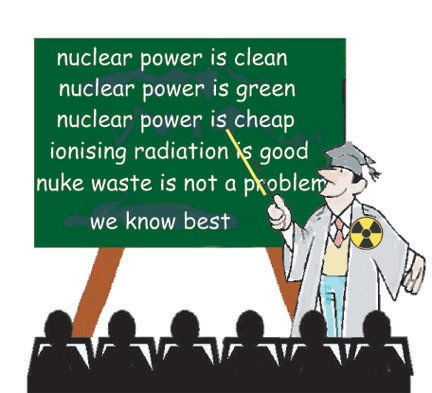 Exelon welcomes community to learn about nuclear power, Watertown Daily Times By DEBRA J. GROOM
“This is cool,” he said.
Dominick, 6, a first-grader at Hastings-Mallory Elementary School, visited the Exelon Generation nuclear plant site Tuesday with his grandmother Diane Giamartino as part of the annual Community Information Night. Nearly 200 people showed up to learn more about what the company does at its three Oswego nuclear plants and the different types of jobs available in the nuclear industry.
There were two buildings filled with “cool” things to see, according to Dominick.
In the first building, visitors could watch a 3D printer turn out these spinning toys that Dominick and other children could take home. The small plastic devices were made of one piece of plastic, but had parts that would spin in different directions……..
Dominick saw even more “cool” stuff in the other Exelon building — especially the nuclear plant control room simulator used by employees. The control room is the brain of the plant, a place filled with various lights and readings on a huge control-room board that supervisors, senior reactor operators and reactor operators keep their eyes tuned to 24 hours a day to ensure all systems in the plant are operating correctly.
Jill Lyon, speaking for Exelon, said the Community Information Nights have been held since 2014 to help area residents learn more about what goes on at the plants.http://www.watertowndailytimes.com/news04/exelon-welcomes-community-to-learn-about-nuclear-power-20180826
USA emergency measures include preparations for nuclear attacks on 60 U.S. cities
 The Hill 24th Aug 2018 The Federal Emergency Management Agency (FEMA) is updating emergency
management plans to include plans for potential nuclear detonations in 60
U.S. cities. An agency official told BuzzFeed News that the agency is
shifting plans away from the likelihood of a terrorist detonating a smaller
nuclear device and toward the possibility of a state actor detonating a
military-grade nuclear weapon.
http://thehill.com/policy/national-security/403481-fema-updates-us-nuclear-disaster-plans
Why bother with an underground bunker? USA tests Upgraded ‘Earth-Penetrating’ Nuclear Bomb
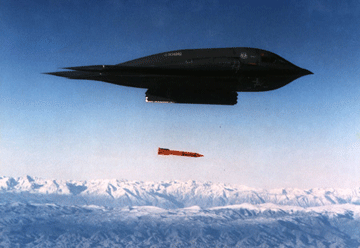
US Air Force Tests Upgraded ‘Earth-Penetrating’ Nuclear Bomb, Sputniik News, 24.08.2018 The US Air Force sent out a B-2 stealth bomber to deploy an upgraded B61-12 nuclear bomb recently in an effort to review the weapon’s accuracy and ability to carry out its various attack options.
According to Warrior Maven, the latest upgrades enable the nuclear bomb to be able to carry out “earth-penetrating attacks, low-yield strikes, high-yield attacks, above surface detonation and bunker-buster options,” giving the Air Force a five-in-one kind of deal.
“The main advantage of the B61-12 is that it packs all the gravity bomb capabilities against all the targeting scenarios into one bomb,” Hans Kristensen, director of the Nuclear Information Project, told the website. “That spans from very low-yield tactical ‘clean’ use with low fallout to more dirty attacks against underground targets.”
“A nuclear weapon that detonates after penetrating the earth more efficiently transmits its explosive energy to the ground, thus is more effective at destroying deeply buried targets for a given nuclear yield. A detonation above ground, in contrast, results in a larger fraction of the explosive energy bouncing off the surface,” Kristensen added, noting that the B-2 bomber presently carries nuclear bombs of the models B61-7, B61-11 and B83-1.
However, the B61-12 nuclear bomb won’t be the only piece of military equipment to receive a facelift. The B-2 bomber, first introduced in the 1980s, is expected to see upgrades to its Defensive Management System, hardware used to help the bomber recognize and deter enemy air defenses, Warrior Maven reported. The US Air Force operates an estimated 20 B-2 bombers. Its next-generation competition is the B-21 Raider.
The latest test, conducted at an undisclosed area, follows news in late June that the Department of Energy’s National Nuclear Security Administration (NNSA) and the US Air Force tested two B61-12 bombs on June 9 at the Tonopah Test Range in Nevada……..
The life extension program is part of a joint effort to preserve the critical elements of the US nuclear triad, a three-pronged military structure consisting of land-launched missiles, nuclear missile-armed submarines and strategic aircraft with nuclear bombs and missiles. ……https://sputniknews.com/military/201808241067454740-earth-penetrating-nuclear-bomb-tested/
Donald Trump has directed the secretary of state, Mike Pompeo, to delay a planned trip to North Korea
 Trump orders Pompeo to delay nuclear North Korea talks due to lack of progress https://www.theguardian.com/us-news/2018/aug/24/trump-pompeo-delay-nuclear-north-korea-talks-lack-of-progress
‘I do not feel we are making sufficient progress’
Trump suggests US-China trade dispute may be to blame, Guardian, Martin Pengelly, 24 Aug 18, Donald Trump has directed the secretary of state, Mike Pompeo, to delay a planned trip to North Korea, the president tweeted on Friday, “because I feel we are not making sufficient progress with respect to the denuclearisation of the Korean Peninsula”.
Trump met Kim Jong-un in Singapore in June, after months of abuse and threats between the two leaders and the US-led imposition of tough sanctions against Pyongyang.
Trump claimed the Singapore summit was a success, after he signed a joint statement which said in part: “President Trump committed to provide security guarantees to the DPRK, and Chairman Kim Jong-un reaffirmed his firm and unwavering commitment to complete denuclearization of the Korean peninsula.”
North Korea has returned to the US remains of soldiers killed in the Korean war, which was fought between 1950 and 1953 and has never formally ended. But critics have said the Singapore statement achieved nothing concrete and progress has been slow.
On Friday, at the end of a week in which the International Atomic Energy Agency said North Korea was still developing nuclear weapons, Trump made a striking U-turn.
Some of the blame rested with China, he said, “because of our much tougher Trading stance”.
Trump’s imposition of tariffs on steel and other imports has touched off an intensifying trade war with Beijing.
Trump added: “I do not believe they are helping with the process of denuclearization as they once were (despite the UN Sanctions which are in place).
“Secretary Pompeo looks forward to going to North Korea in the near future, most likely after our Trading relationship with China is resolved.”
Pompeo, formerly CIA director, has played a leading role in talks with North Korea, meeting Kim twice on three visits to Pyongyang. On Thursday, he appointed a senior Ford executive, Steven Biegun, to be his special envoy. The two men would visit the country next week, Pompeo said.
A senior White House official told Reuters Trump asked Pompeo not to go to North Korea during a meeting at the White House on Friday afternoon.
Trump tweeted: “I would like to send my warmest regards and respect to Chairman Kim. I look forward to seeing him soon!”
In response, Kelly Magsamen, vice-president for national security and international policy at the Center for American Progress and a former Pentagon and White House adviser on Asia, tweeted that Trump was “undermining his own leverage again. Not to mention his [secretary of state] and new envoy”.
“It’s fine to not send the secretary due to lack of progress,” she wrote, “but don’t then also talk about how you are eager to meet with [Kim] and how China is thwarting you.”
Trump left the White House on Friday for Ohio, where he was due to visit a hospital and speak at a Republican dinner. He did not respond to shouted questions about North Korea.
Plutonium remains in the ground below proposed Rocky Flats national wildlife refuge
 Guardian 22nd Aug 2018 The nation’s newest national wildlife refuge, filled with swaying prairie
grass and home to a herd of elk, is slated to open next month just outside
Colorado’s largest city.
But seven Denver metro area school districts
have already barred school-sanctioned field trips to the preserve. A top
local health official says he would probably never hike there.
And a town is suing over what the soil might contain. “The threat posed by
contamination at Rocky Flats and its effect on visiting children appears to
be an issue of dispute amongst experts,” Lisa Flores, a Denver public
schools board of education member, told the Guardian.
“Until we have definitive assurances of child safety, we will exercise an abundance of
caution.” The 2,119-hectare (5,237-acre) Rocky Flats national wildlife
refuge, due to open this autumn, sits on land surrounding what once was a
nuclear weapons production facility. From 1951 to 1989, the Rocky Flats
Plant manufactured plutonium triggers – grapefruit-size spheres that,
when compressed by explosives, catalyze a nuclear reaction. Though the
area, about 20 miles north-west of Denver, has been cleaned up and declared
safe by the government, plutonium remains in the ground where the facility
once stood.
https://www.theguardian.com/environment/2018/aug/22/new-us-refuge-rocky-flats-plutonium-toxic
The nuclear modernization program is not sustainable economically- Kristensen
The modern nuclear arsenal: A nuclear weapons expert describes a new kind of Cold War, WP, By Jenny Starrs, Video editor.
“…………KRISTENSEN: The current modernization program, to the best we can see, is not sustainable economically. It’s not that the United States couldn’t pay for all of those
“…………KRISTENSEN: The current modernization program, to the best we can see, is not sustainable economically. It’s not that the United States couldn’t pay for all of those
modernizations if it really wanted to, of course it could. But it would have to take that money from somewhere else. So we’d have to cut some conventional programs and use that money on nuclear instead. And that’s a huge dilemma inside military planning.
So what’s happening now is that there are so many warning signs already that in the ’20s, the cost of the nuclear modernization program is going to force cuts elsewhere in the defense budget, if you want to pay for it. So right now there are people who are out saying, well, why don’t we adjust the nuclear modernization program now, so we don’t have to make these catastrophe cuts later in that may mess up a program or create confusion about our posture and all these types of things.
But we have a very die-hard nuclear advocacy group or community right now that, every time they go to Congress and testify about the nuclear modernization program, it’s like, “Oh no, this is the only one, this is all we can do. Oh no, we can pay for it, it’s only a small portion of defense budget.” They just keep perpetuating this and all the warning signs are out that there are going to be some nasty adjustments that have to be made. https://www.washingtonpost.com/news/checkpoint/wp/2018/08/24/the-modern-nuclear-arsenal-a-nuclear-weapons-expert-describes-a-new-kind-of-cold-war/?utm_term=.fba7f776436e
Minnesota community concerned about nuclear waste storage dangers
Cautious optimism surrounds nuclear waste storage progress in Minnesota, Duluth News Tribune, RED WING, Minn. 24 Aug 18 — Federal lawmakers voiced optimism Thursday, Aug. 23, about progress toward relocating the country’s radioactive waste to a permanent repository, though the community living closest to spent nuclear fuel in Minnesota has its doubts.
“Until we actually see it start moving, we won’t be 100 percent optimistic,” Prairie Island Tribal Council President Shelley Buck said about the more than two dozen dry storage casks holding spent nuclear fuel at Xcel Energy’s Prairie Island nuclear plant. The waste has been building up for years a few hundred yards away from the Prairie Island Indian Community.
The proximity of the storage casks, combined with the potential for flooding on the Mississippi River and derailment of an oil train that could block the only evacuation route off the island, puts the existence of the tribal community at risk, Buck said.
She made the comments during a roundtable discussion at the nuclear plant attended by U.S. Reps. Jason Lewis, R-Minnesota, and John Shimkus, R-Illinois, as well as representatives from the city of Red Wing, Prairie Island Indian Community and Xcel Energy.
Shimkus, who sits on the House Energy and Commerce Committee, sponsored a bill directing the Department of Energy to begin a program to consolidate and temporarily store the country’s spent nuclear fuel while a permanent storage facility is developed at Yucca Mountain, about 90 miles northwest of Las Vegas in the Nevada desert.
The bill, H.R. 3053, passed in the House by a vote of 340-72 in May. It has been referred to the U.S. Senate Committee on Environment and Public Works.
Shimkus said he believes the bill would pass by the same ratio or better as it did in the House if it goes before the Senate for a vote.
Another hurdle is budget appropriations to fund Yucca Mountain licensing work.
Local storage, national issue.……..
Nevada lawmakers and residents have long opposed the Yucca Mountain plan, along with conservation groups, groups opposed to nuclear energy and those concerned about the safety of transporting nuclear waste across the country.
Lewis, who represents Minnesota’s 2nd Congressional District which is home to Prairie Island nuclear plant, said the issue extends beyond his constituents.
“This is a national issue,” Lewis said, noting nuclear waste is being stored at 121 locations across 39 states.
Xcel Energy also owns a nuclear plant in Monticello.
Ratepayers who benefited from nuclear energy had been paying into a government fund to finance the repository project to the tune of about $40 billion over 35 years, according to a House Energy and Commerce Committee report. Legal proceedings have since ceased the collection of funds. The federal government also is on the hook for lawsuits over the failure to dispose of nuclear waste.“We don’t have a choice but to get something done,” Lewis said. “And we are as close as we have ever been.” http://duluthnewstribune.com/business/energy-and-mining/4490010-cautious-optimism-surrounds-nuclear-waste-storage-progress
Small Modular Nuclear Reactors could be a costly mistake for Idaho utility
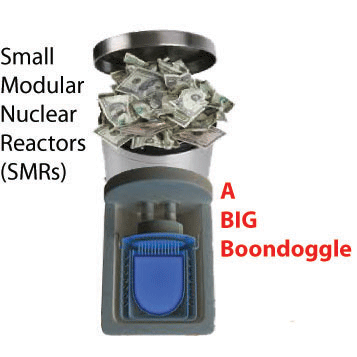 Murray Power looks to tap into nuclear energy Murray Journal By Shaun Delliskave|s.delliskave@mycityjournals.com Aug 23, 2018 Murray Power is moving forward with plans to tap into the nation’s first small nuclear modular reactor (SMR)—but not without opposition. Murray Power has, so far, committed $15,000 towards NuScale Power’s reactor, which is in development at the Idaho National Laboratory in Idaho Falls.Murray’s main power supplier belongs to the Utah Associated Municipal Power Systems (UAMPS) consortium, consisting of several municipally owned power systems in Utah. Murray City has subscribed to a portion of the nuclear plant’s capacity through its partnership with the UAMPS organization…….
NuScale Power is based out of Corvallis, Oregon and recently completed the Phase 1 review of its design certification application by the U.S. Nuclear Regulatory Commission (NRC). NuScale’s reactor is the first and only SMR to ever undergo an NRC review. …….
Diane Turner, chair of the Murray City Council, is leery about Murray’s interest in a reactor using unproved technology. “I have concerns about Murray committing funds to a new energy form that has not yet been proven and is likely to cost billions of dollars. It is my understanding that our initial investment is not that high. However, it is my concern that as we get further into the commitment it will cost much more.”
Watchdog groups have also expressed concerns regarding the new reactor. HEAL Utah, an advocacy group that promotes renewable energy to protect public health and the environment from dirty, toxic and nuclear energy threats, attended a recent city council committee-of-the-whole meeting to advocate for cleaner renewable investments in power and to express their concerns. They argued that renewable energy is more cost-effective and proven technologies already exist……..
radioactive waste generated by reactors remains toxic for thousands of years. The NuScale reactor has space to store waste for 60 years. Nuclear reactors also draw significantly from water resources.
This is one reason for Council Chair Turner’s reservations. “I don’t know that it is in Murray’s best interest to invest in nuclear rather than making further investments in renewable energy that has been determined to be more environmentally and fiscally sound.” http://www.murrayjournal.com/2018/08/23/179014/murray-power-looks-to-tap-into-nuclear-energy
U.S. army increasing its investment and use of solar power
FT 24th Aug 2018 The US Army has increased its investments in solar power and is eyeing
further opportunities to work with the private sector to develop projects,
despite the Trump administration’s scepticism about renewable energy.
Michael McGhee, who leads the US Army’s Office of Energy Initiatives, told
the Financial Times that installing solar panels at army bases could
improve resilience against attacks or natural disasters, and provide
cost-effective electricity supplies.
https://www.ft.com/content/7c23057e-a3cc-11e8-8ecf-a7ae1beff35b
1 This Month





PLEASE OPPOSE HR 8255 AND S.3639 – bills would accelerate satellite deployment, with no environmental review or safeguards – https://ncstd5li.quorum.us/campaign/169331/
To see nuclear-related stories in greater depth and intensity – go to https://nuclearinformation.wordpress.com
-
Archives
- October 2026 (19)
- September 2026 (339)
- August 2026 (330)
- July 2026 (355)
- June 2026 (287)
- May 2026 (306)
- April 2026 (356)
- March 2026 (251)
- February 2026 (267)
- January 2026 (308)
- December 2025 (358)
- November 2025 (359)
-
Categories
- 1
- 1 NUCLEAR ISSUES
- business and costs
- climate change
- culture and arts
- ENERGY
- environment
- health
- history
- indigenous issues
- Legal
- marketing of nuclear
- media
- opposition to nuclear
- PERSONAL STORIES
- politics
- politics international
- Religion and ethics
- safety
- secrets,lies and civil liberties
- spinbuster
- technology
- Uranium
- wastes
- weapons and war
- Women
- 2 WORLD
- ACTION
- AFRICA
- Atrocities
- AUSTRALIA
- Christina's notes
- Christina's themes
- culture and arts
- Events
- Fuk 2022
- Fuk 2023
- Fukushima 2017
- Fukushima 2018
- fukushima 2019
- Fukushima 2020
- Fukushima 2021
- general
- global warming
- Humour (God we need it)
- Nuclear
- RARE EARTHS
- Reference
- resources – print
- Resources -audiovicual
- Weekly Newsletter
- World
- World Nuclear
- YouTube
-
RSS
Entries RSS
Comments RSS

