nuclear-news

The News That Matters about the Nuclear Industry Fukushima Chernobyl Mayak Three Mile Island Atomic Testing Radiation Isotope

Call to White House to oppose Saudi Arabia’s threat to acquire nuclear weapons

White House Should State Opposition to Saudi Threat to Acquire Nuclear Weapons http://www.ipsnews.net/2018/05/white-house-state-opposition-saudi-threat-acquire-nuclear-weapons/

WASHINGTON DC, May 16 2018 (IPS– We are deeply disappointed by the counterproductive response from the Trump administration to the statements from senior Saudi officials threatening to pursue nuclear weapons in violation of their nonproliferation commitments. 

We call on the White House to immediately reiterate the longstanding, bipartisan policy of the United States that it will actively work against the spread of nuclear weapons to any country, friend or foe.

President Donald Trump’s reckless decision to violate the Joint Comprehensive Plan of Action (JCPOA), which has blocked Iran’s pathways to nuclear weapons and put in place a robust monitoring system to detect and deter cheating, has not only opened the door to an expansion of Iran’s capability to produce bomb-grade nuclear material, but it has increased the risk of a wider nuclear arms race in the Middle East, which is already home to one nuclear-armed state.

Saudi Arabia’s foreign minister Adel Al-Jubeir told CNN May 9, that his country, which, like Iran, is a party to the 1968 nuclear Nonproliferation Treaty (NPT), stands ready to build nuclear weapons if Iran restarts its nuclear program.

Al-Jubeir also praised Trump’s decision to abandon the Iran nuclear deal and seek to reimpose sanctions on firms and business engaging in legitimate commerce with Iran.

Asked what his country will do if Iran restarts its nuclear program, he told CNN’s Wolf Blitzer that “we will do whatever it takes to protect our people. We have made it very clear that if Iran acquires a nuclear capability, we will do everything we can to do the same.”

Asked to clarify whether that means the kingdom will work to acquire its own nuclear capability, al-Jubeir replied, “That’s what we mean.”

This follows similar comments by Saudi Crown Prince Mohammed bin Salman in a March 15 interview with CBS News that Saudi Arabia will quickly follow suit if Iran acquires nuclear weapons.

When asked May 9 whether Saudi Arabia would “have the administration’s support in the event that that occurred,” White House Press Secretary Sarah Huckabee Sanders said:

“Right now, I don’t know that we have a specific policy announcement on that front, but I can tell you that we are very committed to making sure that Iran does not have nuclear weapons,” she stated.

The administration’s nonresponse to Prince Salman’s threat in March and Sanders’ weak response May 9 amounts to an irresponsible invitation for mischief.

They imply that Trump administration would look the other way if Saudi Arabia breaks its NPT commitments to pursue nuclear weapons.

It is bad enough that the Trump administration, by violating the 2015 Joint Comprehensive Plan of Action, has threatened the NPT regime by opening the door for Iran to expand its nuclear capacity.

President Trump and his advisors must not compound that error by swallowing their tongues when another NPT member state in the region threatens to pursue the bomb.

We call on the White House to immediately clarify that it is the longstanding policy of the United States, as an original party to the NPT:

…not to in any way to assist, encourage, or induce any non-nuclear-weapon State to manufacture or otherwise acquire nuclear weapons …” and “… to pursue negotiations in good faith on effective measures relating to cessation of the nuclear arms race at an early date and to nuclear disarmament ….”

We also call on the U.S. Congress to reject any proposed agreement with Saudi Arabia that permits U.S. nuclear cooperation if Saudi Arabia seeks to or acquires sensitive uranium enrichment or plutonium separation technology which can be used to produce nuclear weapons.

May 22, 2018 Posted by | politics, politics international, USA | Leave a comment

America expands is nuclear arsenal as it demands that Iran and North Korea have no nuclear weapons

As U.S. Demands Nuclear Disarmament, It Moves to Expand Its Own Arsenal, NYT. By David E. Sanger and William J. Broad, May 14, 2018

WASHINGTON — For the White House, these have been dramatic days for nuclear disarmament: First President Trump exited the Iran deal, demanding that Tehran sign a new agreement that forever cuts off its path to making a bomb, then the administration announced a first-ever meeting with the leader of North Korea about ridding his nation of nuclear weapons.

But for the American arsenal, the initiatives are all going in the opposite direction, with a series of little-noticed announcements to spend billions of dollars building the factories needed to rejuvenate and expand America’s nuclear capacity.

The contrast has been striking. On Thursday evening, hours after Mr. Trump announced that his meeting with Kim Jong-un, the North Korean leader, would take place on June 12 in Singapore, the Pentagon and the Energy Department announced plans to begin building critical components for next-generation nuclear weapons at the Savannah River Site in South Carolina.

The idea is to repurpose a half-built, problem-ridden complex that was originally intended to turn old nuclear weapons into reactor fuel to light American cities. Now the facility will be used to revitalize America’s aging nuclear weapons, and to create the capacity to make many hundreds more.

…… While it is possible that the American buildup is part of a negotiating strategy, offering Mr. Trump something he can trade away before it gets started, the White House has made clear, in both statements and strategy, that it envisions the reduction of nuclear weapons as a one-way street.

….. President Barack Obama argued that the United States could not urge other countries to give up nuclear programs while expanding its own. But many of his own aides later said they wished he had done far more to reduce America’s arsenal, arguing that it could safely drop below the number the Russians deployed.

Now Mr. Trump is heading in the other direction. The United States has dramatically stepped up the effort to overhaul the existing arsenal and prepare for the day when it might once again be enlarged. Unless the New Start Treaty is renewed for five years, any limits on the American and Russian arsenals will expire in February 2021, just days after Mr. Trump would enter his second term.

In the meantime, the American government is doing all it can to make clear it is preparing for an era of nuclear buildup.

…….. Los Alamos is to make 30 pits per year, and the South Carolina plant 50. That setup, the Energy and Defense Departments said, will improve “the resiliency, flexibility and redundancy of our nuclear security enterprise by not relying on a single production site.” But it also signals a return to production of new weapons, even as Mr. Trump is withdrawing from the 2015 deal with Iran in part because of “sunset provisions” that he says will eventually allow Tehran to do the same.

The federal rationale for making up to 80 pits a year is hidden in layers of secrecy but turns on stated fears that the plutonium fuel at the heart of American weapons will deteriorate with age, eventually rendering them useless.

Whether that fear is justified is a matter of debate. In 2006, a federal nuclear panel found that the plutonium pits aged far better than expected, with most able to work reliably for a century or more.

That judgment led critics to contend that the federal government was seeking a new generation of nuclear pits for reasons not of national security but of saber-rattling.

“No new pits are needed for any warhead,” Greg Mello, the executive director of the Los Alamos Study Group, a private organization in Albuquerque that monitors the nation’s nuclear complex and opposes expansion, said recently. “There are thousands of pits stockpiled for possible reuse.”

The Pentagon’s Nuclear Posture Review, published in February, called for the new capability to produce plutonium pits. It also called on Congress to approve the new low-yield nuclear weapons.

Last week, the full House Armed Services Committee endorsed the Nuclear Posture Review, but with Democrats overwhelmingly voting against it.

“We have to have a credible deterrence, but I think the Nuclear Posture Review goes way beyond credible nuclear deterrence,” said Representative Adam Smith of Washington, the top Democrat on the committee, warning that “we could stumble into a nuclear war.” https://www.nytimes.com/2018/05/14/world/trump-nuclear-savannah-river.html

May 22, 2018 Posted by | politics international, USA | Leave a comment

Beware John Bolton, serial killer of nuclear agreements. He is shooting us all in the foot.

The Path of Broke Nuclear Agreements, Yahoo News, Tom Z. Collina, Catherine Killough, Philip Yun The National Interest•May 20, 2018    Unlike North Korea today, Iran does not possess a single nuclear weapon. By trashing the Iran deal, President Trump risks turning Iran into North Korea.

The Path of Broke Nuclear Agreements

President Donald Trump, at the urging of National Security Advisor John Bolton, has withdrawn from the Iran nuclear agreement, putting the future of the deal in jeopardy. Trump did this despite the fact that Iran is in compliance with the deal, that the deal has served to shrink Iran’s nuclear program and keep it away from a bomb, and that it has prevented another costly war in the Middle East.

Just how bad will things get with Iran now that Trump has acted? Hard to say, but we can see the writing on the wall: Tehran could restart its nuclear program and edge closer to building a bomb. This would lead to increased calls from the right to—once again—stop Iran from acquiring nuclear capability, by military force if necessary. Trump is already indicating that things are heading in that direction. Just one day after breaking out of the Iran deal, Trump warned of “very severe consequences” if Iran resumes its nuclear program.

To fully understand the risks of the Trump administration abandoning the Iran deal, one need only recall what happened in North Korea after Bolton, then in the Bush administration as an under secretary of state, did his part to kill another landmark nuclear deal—the Agreed Framework.

In 1994, the North Korean regime threatened to go nuclear for the first time. To prove the point, Pyongyang expelled all international inspectors and made preparations to extract weapons-grade plutonium from its Yongbyon research reactor. The risks of a conventional conflict—even then— were high because the Clinton Administration was seriously considering military intervention in case diplomacy failed. An unprecedented meeting between former president Jimmy Carter and North Korean leader Kim Il-sung eventually led to the first U.S.-North Korea nuclear deal, the Agreed Framework.

Though only four pages long, the Agreed Framework served a similar purpose to the 159-page Iran agreement: to prevent a state from developing nuclear weapons. And, though neither agreement was perfect, the Agreed Framework—like the Iran deal thus far—proved successful, preventing the North from producing dozens more nuclear weapons worth of fissile material. For nearly a decade, the North readmitted international inspectors, stopped producing plutonium and shelved plans to build two large reactors.

……. Instead of working to improve the Agreed Framework by adding additional, stronger measures to what already existed, the Bush administration chose to back out of the agreement in 2002. Since that time, North Korea has consistently shocked the world with the speed, sophistication, and fulfillment of its nuclear ambitions.

……. Now, it is difficult to conceive of North Korea relinquishing a nuclear arsenal it has worked for two decades to achieve. But in 1994, long before North Korea tested its first bomb, the North did not have nuclear weapons to give up. Since then, the chance of convincing North Korea to give up its nuclear program has become less likely and more costly.

That history begs the question: What would North Korea look like today had we kept the Agreed Framework and built on it, rather than throwing it away?

Unlike North Korea today, Iran does not possess a single nuclear weapon, only the theoretical capability to one day produce them. By trashing the Iran deal, President Trump risks turning Iran into North Korea.

John Bolton was a central player in withdrawing U.S. support from the North Korea deal in 2002 and from the Iran deal now. History has shown that abandoning the North Korea deal made the problem worse, not better. Similarly, we can expect that the Iran crisis will now get worse, not better, as Tehran resumes its nuclear program and Trump responds with military threats.

Beware John Bolton, serial killer of nuclear agreements. He is shooting us all in the foot.

Philip Yun is Executive Director of Ploughshares Fund, a San Francisco-based peace and security foundation. He was a member of a government working group that managed U.S. policy and negotiations with North Korea under President Clinton and was part of the U.S. delegation that traveled to North Korea with Secretary of State Madeleine Albright in 2000.

Tom Collina is the Director of Policy at Ploughshares Fund. He has over 25 years of Washington, DC experience in nuclear weapons, missile defense and nonproliferation issues.

Catherine Killough is the Roger L. Hale Fellow at Ploughshares Fund, focusing on North Korea’s nuclear and missile development, inter-Korean relations, the US alliance system in East Asia, and the transnational politics of Asia.

Image: Unlike North Korea today, Iran does not possess a single nuclear weapon. By trashing the Iran deal, President Trump risks turning Iran into North Korea.     https://www.yahoo.com/news/path-broke-nuclear-agreements-235800375.html

May 22, 2018 Posted by | politics international, USA | Leave a comment

Walter Pincus warns U.S. Congress to be sceptical of Pentagon’s call to fund a new nuclear weapon

The Pentagon is seeking money for a new nuclear weapon. Congress should be skeptical.   https://www.washingtonpost.com/opinions/the-pentagon-is-seeking-money-for-a-new-nuclear-weapon-congress-should-be-skeptical/2018/05/18/d13fe766-59e4-11e8-8836-a4a123c359ab_story.html?utm_term=.e44ec44d91b4 By Walter Pincus May 18  Walter Pincus is a former Washington Post reporter and columnist covering national security issues.

Top Pentagon officials are telling some pretty tall tales in seeking congressional support for a new, low-yield, nuclear warhead to put on a long-range, submarine-launched ballistic missile.

Gen. John E. Hyten, commander of U.S. Strategic Command, gave the most unusual rationale when he testified on March 20 before the Senate Armed Services Committee.

The stated purpose of this new weapon is to deter the Russians from using any of their low-yield nuclear weapons — something Russian President Vladimir Putin has often threatened to do if he ever found himself being overwhelmed by NATO conventional forces, presumably in Western Europe.

The United States and its NATO allies already have about 200 low-yield nuclear bombs deployed in Europe. But Hyten and Pentagon officials say an additional weapon is needed to deter Putin’s first use of his tactical nukes, because the aircraft that would deliver our bombs, stealthy as they may be, might not be able to get through Russian defenses.

That’s where the new submarine-launched weapon would come in.

In Hyten’s presentation, should the Russians initiate the use of tactical nukes on the battlefield, the United States would launch one or two low-yield weapons from submarines, not toward the battlefield, where allies might be threatened, but toward targets in Russia.

Here’s the most interesting part: How are the Russians going to know the warheads on those incoming missiles are low-yield, and not — like most nuclear warheads delivered by our submarine-launched ballistic missiles — 10 times more powerful than the bombs used to strike Hiroshima and Nagasaki?

Hyten’s initial response to that question was to tell the senators that from launch to detonation some 30 minutes would elapse.

He then explained: “If somebody does detect that launch, they would see a single missile or maybe two missiles coming. They will realize it is not an existential threat to their country and, therefore, they do not have to respond with an existential threat.” By “existential threat” Hyten essentially meant a full-scale first strike by hundreds of U.S. warheads, designed to knock out Russia’s ability to respond and perhaps survive as a nation.

In short, Hyten suggested that Putin — or his successor — would wait 30 minutes for the incoming one or two U.S. missiles to hit Russian targets before deciding whether to launch a major nuclear response back at the United States.

Why does Hyten suggest that?

His answer was surprising: “That is what I would recommend if I saw that coming against the United States.”

Has any prior STRATCOM commander, or any other U.S. senior government official, announced publicly the United States would ride out any nuclear attack before responding?

Hyten went on to explain, “If we do have to respond, we want to respond in kind and not further escalate the conflict out of control.”

He described the new warhead as a “deterrence weapon first, and then a response weapon . . . to keep the conflict from escalating worse. It actually makes it harder for an adversary to use [a nuclear] weapon in the first place and if it does use it, it allows you to respond appropriately.”

Hyten added, “The key is a rational actor. A rational actor is the basis of all deterrent policy.”

Defense Secretary Jim Mattis made a simpler claim for developing the new warhead in testimony on May 9 before the Senate Appropriations defense subcommittee. He described the scenario Hyten used: Russia, facing defeat in a conventional battle, “would escalate to a low-yield nuclear weapon knowing that our choice would be . . . to either respond with a high-yield [nuclear weapon] or surrender — in other words, frankly suicide or surrender, because a nuclear exchange between Russia and the United States would be a disaster for this planet.”

Suicide or surrender are hardly the only choices, and Mattis should know better.

That same day, May 9, Rep. Adam Smith (Wash.), ranking Democrat on the Armed Services Committee, offered the more traditional understanding of how to deter the Russian low-yield nuclear weapon threat. It came during markup of the fiscal 2019 defense authorization bill.

Smith said, “We don’t create this notion that we can just exchange nuclear weapons and as long as they are small it will be okay. It won’t be okay.” Instead, he suggested, the response to the Russians should be, “We have over 4,000 nuclear weapons, and if you launch one, we will launch ours back at you. And we are not going to sit there and be concerned to make sure that ours isn’t bigger than yours when you started this.”

The Washington state congressman added, “If we send that message, that is a very sufficient deterrent.”

The full House Armed Services Committee ended up authorizing $65 million for development of the new low-yield, sub-launched missile and sent the measure on for an eventual vote by the full House. Meanwhile, the Senate Armed Services Committee has scheduled taking up the measure the week of May 21 where it may face more opposition than it did in the House committee. It should.

May 22, 2018 Posted by | USA, weapons and war | Leave a comment

Missouri legal case – claim that cancer caused by Manhattan Project

Woman claims Manhattan Project caused her cancer https://stlrecord.com/stories/511423482-woman-claims-manhattan-project-caused-her-cancer, by Amanda Thomas | May 20, 2018, ST. LOUIS – A Florissant woman has filed a lawsuit against a biopharmaceutical company and chemical-producing corporation for alleged negligence related to the disposal of “hazardous, toxic, and radioactive materials” near residential neighborhoods in St. Louis County.

Terry L. Williams filed a complaint on May 16 in U.S. District Court for the Eastern District of Missouri against Mallinckrodt LLC and the Cotter Corporation, alleging the defendants violated the Atomic Energy Act of 1954.

According to the complaint, Williams alleges she has suffered physical injury, pain and suffering because of annual exposure to radiation when she engaged in frequent outdoor recreational activities in and around Coldwater Creek, HISS and SLAPS sites.

The lawsuit notes that the nation began a top-secret project to build the first atomic bomb during World War II and the Army created the Manhattan Engineering District (MED) to carry out the work of the “Manhattan Project.” After the war, the nation formed the Atomic Energy Commission (AEC) to continue its nuclear research and some of the work was performed in the St. Louis area.

“Under contracts with the MED and/or the AEC, the Destrehan Street Refinery and Metal Plant (which later became Mallinckrodt Chemical Works) processed natural uranium into uranium oxide, trioxide, and metal uranium at a facility in downtown St. Louis,” the complaint said.

According to the complaint, Mallinckrodt caused the release of radiation into the environment along haul routes in northern St. Louis County between 1942 and 1957. The complaint alleges that Mallinckrodt’s actions led to the contamination of “the air, soil, surface water, and groundwater along the haul routes.”

It is alleged in court documents, “Mallinckrodt’s acts and omissions between approximately 1942 and 1957 proximately caused plaintiff to suffer the injuries described in this complaint.”

The complaint notes that the affected sites in St. Louis County have elevated levels of radium, thorium and uranium in groundwater and soils. The Environmental Protection Agency reportedly found that direct contact with or accidental ingestion of contaminated soils and groundwater near those sites may pose health risks to individuals.

Williams requests a trial by jury and is seeking punitive damages.

May 22, 2018 Posted by | Legal, USA | Leave a comment

Mox plutonium reprocessing plant has been a huge waste of U.S. taxpayers’ money

Another SC nuclear boondoggle could soon meet its end. This time it’s $7B in taxpayer money wasted, Post and Courier By Andrew Brown abrown@postandcourier.com , – May 20, 2018 

      COLUMBIA — It’s a familiar story in South Carolina: Nuclear contractors fail to produce a reliable schedule, start construction with just a fraction of design finished, and let pipes and other material corrode in storage under the watch of government agencies.

The abandonment of two nuclear reactors at the V.C. Summer Nuclear Station generated headlines and riled state lawmakers since last summer, but 90 miles south, a similar scenario played out at the Savannah River Site near Aiken.

The federal government has likely squandered more than $7 billion as they watched a project fall decades behind schedule and its final cost increase by 12 times the initial estimates. And, like V.C. Summer, the plug is being pulled. The parallels don’t end there: The debacles also shared two of the same contractors.

  • The Savannah River project has not faced the same anger and scrutiny as the abandonment of the two nuclear reactors in Fairfield County — likely because the inflated cost of the complex project is being distributed to federal taxpayers across the country instead of 1.6 million electric customers in South Carolina.

    For more than a decade, the U.S. Department of Energy and its private contractors have tried to build the plant to turn Cold War-era nuclear weapons into fuel that could be used in nuclear power plants. It’s known as MOX, short for mixed oxide fuel fabrication.

    The project became a federal priority around the turn of the century, and was intended to be a cornerstone of the United States’ effort to reduce its aging stockpiles of nuclear weapons.

    But for more than four years, it has been on the federal chopping block. In federal studies and congressional testimony reviewed by The Post and Courier, government officials laid out a long list of problems with the contractors and the project in general. Two presidential administrations have tried to put an end to the costly undertaking.

    Each time, however, South Carolina’s powerful congressional delegation revived the project, siding with the contractors who disputed the findings of independent consultants and federal agencies.

    Now, it may be too late. Congress gave U.S. Energy Secretary Rick Perry the power in March to put an end to the 11-year construction effort, and the federal agency is already taking action.

    Earlier this month, President Donald Trump’s administration released an alternative proposal to deal with the 34 metric tons of weapons-grade plutonium that was set to be processed at the site. They estimated it will cost less than half of what it would take to finish the MOX facility and turn the plutonium into commercial fuel.

    The new plan calls for mixing the plutonium with another material, not revealed by the federal government, and storing it below the New Mexico desert. Buried with it could be the second major nuclear project to be cancelled in South Carolina in less than a year.

    ……..the companies have sunk billions into the facility that has risen out of the surrounding pines. But many of the circumstances that drove federal officials to approve the project, including the deal with Russia, have changed.So, too, have the projections for the final cost of the facility. It now stands at roughly $17 billion.

    A ‘horror story’ for taxpayers? 

    U.S. Rep. Jim Cooper took direct aim as he opened a congressional oversight hearing in the fall of 2015.

    “I am worried that, as we enter the month of October and head toward Halloween, that really the subject of this hearing is a horror story for the American taxpayer,” said Cooper, a Democrat from Tennessee.

    By that time, the contractors’ forecasted price tag for the facility had jumped by more than six times the estimates from 2002. The Department of Energy estimated the cost to be even higher, and President Barack Obama’s administration was pushing to end construction altogether.

  • …..John MacWilliams, an Associate Deputy Secretary of Energy, told the federal lawmakers one of the biggest problems was that construction began with only 20 to 25 percent of the design for the MOX facility complete.

    “Immature design is one of the biggest problems we face,” said MacWilliams, who led a special team that reviewed the project’s management.

    MacWilliams also reported that around a quarter of the rebar, pipes, electrical wiring and other material that was initially installed had to later be torn back out and replaced — slowing construction and increasing the cost of labor.

    Like V.C. Summer, federal officials reported materials being ruined because parts were ordered years before they were ever needed. The contractors reportedly didn’t have a “resource loaded” schedule that tied together supplies and construction work. Fifty percent of the piping that was manufactured as of 2016 was unusable due to corrosion and design changes, a report by the U.S. Army Corps of Engineers found. “This pattern of early procurement is systemic,” the report said.

    “I think it’s clear that although there is blame to go around on all sides the contractors from the very beginning misled the Department and for that matter the U.S. government,” MacWilliams told The Post and Courier last week.

  • ……..Existing facilities at Savannah River are already capable of diluting the plutonium, but the federal government also wants to install new equipment to speed up the work that’s expected to continue for the next three decades. The full price tag for the process, according to a new Department of Energy analysis, could equal another $19.9 billion.

    By comparison, federal officials say it would take another $48 billion to complete the construction of the MOX facility, as well as finish the work of turning the plutonium into fuel.

    “The MOX project is not viable and needs to be terminated,” said Tom Clements, an advocate that runs Savannah River Site Watch, who has monitored the project for years. “It’s a huge waste of money.”……https://www.postandcourier.com/business/another-sc-nuclear-boondoggle-could-soon-meet-its-end-this/article_e7096912-590a-11e8-b88a-a76a2bf0e36e.html

May 22, 2018 Posted by | reprocessing, USA | Leave a comment

Ballot initiative could shut down Phoenix-area nuclear plant

Santa Fe New Mexican, By Faith Miller | Cronkite News, May 19, 2018  “……. If the Clean Energy for a Healthy Arizona initiative appears on the ballot in November, voters will decide the plant’s future. The initiative calls for 50 percent of Arizona’s electrical energy to come from renewable sources, mostly solar and wind, by 2030. Nuclear power would be hit hardest among sources of power in Arizona, because Palo Verde — the nation’s largest power producer — could not operate at levels low enough to satisfy the initiative’s requirements.

      Supporters of the initiative, including Sandy Bahr of the Sierra Club’s Grand Canyon chapter, argue that the long-term benefits outweigh the immediate costs.

“Here in Arizona, solar is a great resource that we have that we should be utilizing more of,” Bahr said. “And I think the public gets that, the voters get that, and they’re very supportive of it. That’s why the utilities are trying so hard to create confusion and to create fear and try and undermine it.”

Because generating nuclear energy produces radioactive waste and involves mining and processing uranium, a nonrenewable resource, nuclear isn’t classified as renewable.

…….“From the perspective of someone who wants clean, sustainable, renewable energy, nuclear power doesn’t cut it,” Bahr said.

Supporters of the Clean Energy initiative must get nearly 226,000 signatures by July 5 to get it on the November ballot. Backers include the Arizona Asthma Coalition and the Natural Resources Defense Council. http://www.santafenewmexican.com/news/ballot-initiative-could-shut-down-phoenix-area-nuclear-plant/article_3eba46db-0ca5-5f45-8696-09ab40b0b1e6.html

May 22, 2018 Posted by | politics, USA | Leave a comment

Trump will “decimate” North Korea unless Kim agrees to denuclearise the Korean peninsula.

Trump threatens Kim with ‘decimation’ if deal not struck, SMH, 19 May 18    WashingtonUS President Donald Trump has threatened North Korean leader Kim Jong-un with “decimation”, unless Kim agrees to denuclearise the Korean peninsula.

With the June 12 US-North Korea summit at stake and plenty of statements flying from both sides, Trump gave Kim two options: reach an agreement to denuclearise and remain in power or suffer the fate of Libyan leader Muammar Gaddafi, who was overthrown and murdered by rebels who were supported by a NATO bombing campaign in 2011.

If you look at that model with Gaddafi, that was a total decimation. We went in there to beat him. Now that model would take place if we don’t make a deal, most likely,” Trump told reporters prior to his meeting with NATO Secretary General Jens Stoltenberg at the White House on Thursday, US time. …..https://www.smh.com.au/world/asia/trump-threatens-kim-with-decimation-if-deal-not-struck-20180518-p4zg3z.html


May 19, 2018 Posted by | politics international, USA | Leave a comment

Minot Air Force Base loses explosives on North Dakota road

Minot Air Force Base loses explosives on North Dakota road –The security forces of the 91st Missile Wing are responsible for protecting the intercontinental ballistic missile silos that Minot Air Force Base operates across the Great Plains. | 15 May 2018 | The Air Force is offering $5,000 for leads on the whereabouts of a box of explosive grenade rounds that its personnel accidentally dropped [!?!] on a road in North Dakota while traveling between two intercontinental ballistic missile silos — the facilities scattered across the U.S. heartland that stand ready to launch nuclear warheads at a moment’s notice. Airmen from the 91st Missile Wing Security Forces team were traveling on gravel roads May 1 in North Dakota when the back hatch of their vehicle opened and a container filled with the explosive ammunition fell out, according to a statement from Minot Air Force Base. On May 11, the Air Force sent more than 100 airmen to walk the entire six-mile route where the grenades were probably lost, according to a statement from the local Mountrail County sheriff. But two weeks after it was lost, the box of explosives still hasn’t been found.

May 19, 2018 Posted by | incidents, USA | Leave a comment

SCE and G ‘s secrecy over financial records regarding failed V.C. Summer nuclear construction project.

More secrecy at SCE&G? Utility won’t give up V.C. Summer records, state agency says, The State, BY SAMMY FRETWELL, sfretwell@thestate.com, May 17, 2018 

A state agency says SCE&G is refusing to give up records that could be used to justify rolling back monthly power bills the utility charges customers for the failed V.C. Summer nuclear construction project.

The state Office of Regulatory Staff says it needs the records to better understand what went wrong with the failed effort to build two reactors in Fairfield County, northwest of Columbia.

According to Regulatory Staff, the information being withheld by SCE&G includes:

▪ Summaries of auditors’ reports.

▪ A 2016 estimate of the cost to complete the nuclear construction project.

▪ Records given to the FBI and other law enforcement agencies, investigating possible criminal fraud in the construction project.

▪ Meeting notes about the Bechtel report, a study that outlined massive problems with the project at least two years before SCE&G publicly revealed them.

“Many responses do not appear to comply in good faith’’ with laws requiring SCE&G to give up records, Regulatory Staff lawyer Jenny R. Pittman wrote in a May 9 letter obtained Thursday by The State.

Regulatory Staff is seeking the documents as part of its legal effort to roll back the $27-a-month charge that SCE&G continues to charge its residential customers for the bungled nuclear plant. The state Public Service Commission is expected to hold hearings on that issue late this year as well as Dominion Energy’s proposed buyout of SCE&G’s parent, SCANA.

………SCE&G’s refusal to release records to Regulatory Staff is the latest skirmish in a growing battle over documents that regulators and lawyers say they need to review. Attorneys for Friends of the Earth and the Sierra Club, which have cases before the PSC seeking to roll back SCE&G’s rates, also have been rebuffed by the utility in their requests for records.

Bob Guild, a lawyer for the two environmental groups, said Thursday that SCE&G’s reluctance to work with the Office of Regulatory Staff isn’t surprising. The utility doesn’t want regulators, or the public, to see potentially damning information, he said……..http://www.thestate.com/news/local/article211324814.html

May 19, 2018 Posted by | secrets,lies and civil liberties, USA | Leave a comment

A New ‘Screw Nevada’ Bill Passes the House

A New ‘Screw Nevada’ Bill Passes the House

On Thursday, May 10, the  U.S. House of Representatives approved the Nuclear Waste Policy Act of 2018 – HR 3053 – by a vote of 206 to 179, with 94 Democrats and 85 Republicans voting ‘Nay.’

Now, what some Nevadans have dubbed, ‘The Screw Nevada Bill 2.0,’ will go to the Senate, perhaps in this Session.

According to the Las Vegas Sun, just as with the first attempt to push it as the national high-level radioactive waste repository, opposition in Nevada continues to be strong.

In a letter to House leaders, the Las Vegas Metro Chamber of Commerce made the quite logical point that,

Nevada is ranked by the U.S. Geological Survey as the fourth most active seismic area in the United States. The potential for seismic activity in the region raises serious questions about the logic and prudence of storing nuclear waste at Yucca Mountain. Seismic activity in the region is another reason why Yucca Mountain is not a feasible or practical site for the storage of nuclear waste.

And in their own letter to the House, Las Vegas business owners made it clear that,

We stand with the many concerned citizens, small-business operators and bipartisan members of the Nevada delegation in staunch opposition to any attempt to restart the repository licensing process and will work tirelessly to ensure that radioactive waste is never stored anywhere near the world’s entertainment capital in Las Vegas.

The Shimkus Bill

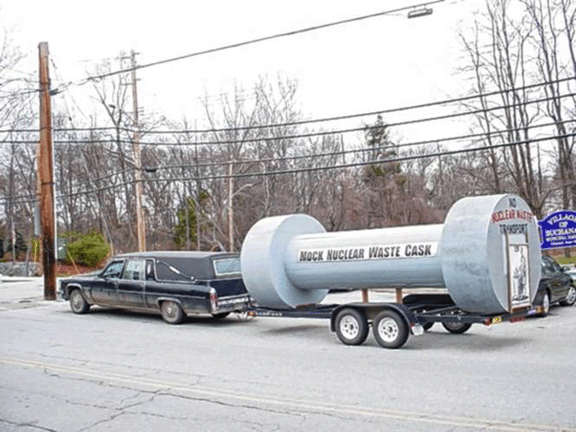
Named for its author, Illinois Rep. Congressman John Shimkus, the legislation seeks to renew the licensing and funding process to re-open Yucca Mt., and authorize a so-called Centralized Interim Storage (CIS) program that would trigger massive, on-going shipments of high-level radioactive wastes on the country’s poorly-maintained network of highways, bridges and rail lines, through major population centers, for many years to come.

Grassroots nuclear safety advocacy groups have variously dubbed the plan ‘Mobil Chernobyl’ and ‘the Fukushima Freeway.’  Each of the 10,000 plus shipments would contain roughly the same amount of radioactive Cesium as was released by Chernobyl, and as much plutonium as was in the Hiroshima bomb.

To some, it may seem ironic that, as China moves ahead on its ‘One Belt, One Road’ initiative, known as the ‘New Silk Road’ – a trade and transport network across Eurasia, Africa and beyond – forces in the U.S. are hard at work to establish a network of ’new nuke roads’ all across America.

Revisiting the Sad, Silly Saga of Yucca Mountain

In Nevada, just across the California border, sits a volcanic formation called Yucca Mountain.  It’s in a region of ongoing volcanic and earthquake activity, on land long held sacred – and still claimed as tribal land according to the 1863 Treaty of Ruby Valley – the Western Shoshone and the Southern Paiute.  Largely composed of a porous material called volcanic tuff, the mountain is permeable to water penetration and sits in close proximity to an aquifer extensively used by regional inhabitants – both native American and white – for their drinking and agricultural water supplies.

Yucca is located about 90 miles northwest of Las Vegas in what’s called the Great Basin, south of the Nevada Test and Training Range in the Nevada National Security Site, where over a hundred atmospheric and underground nuclear bomb tests were carried out for decades.  It is, in large part, already a national nuclear ‘sacrifice area.’

In the government’s search for permanent deep geological repositories in which to bury the country’s energy and weapons waste that it pledged to take possession of and responsibility for, the government’s original goal was to identify and ‘scientifically characterize’ at least two sites, one east, one west of the Great Divide.

As the process played out over the years, however, it came to be more one of politics than of science.  Of the nation’s 99 licensed, operating reactors, less than a dozen are West of the Mississippi.  The so-called ‘NIMBY’ or ‘Not In My Backyard’ syndrome kicked in big time.  Eventually just three potential sites were identified, all in the west: in Texas, Washington and Nevada – with the latter being at the time the state with the least political clout.

Thus, in 1987, came to be passed the first, now infamous “Screw Nevada” bill.

Though Nevada has no nuclear power plants of its own, its Yucca Mountain site became the sole target for waste from all the nation’s nuclear energy and weapons-producing states.  Millions of dollars were spent in an attempt to justify ‘scientifically’ a site that had actually been chosen politically.

But then, for a while at least, the political balance of power changed.  Enter Nevada Senator Harry Reid.

As an erstwhile Democratic power broker, Reid secured a pre-election promise from then-candidate Obama to shutter the Yucca project in return for electoral support.  Once in the White House, President Obama actually kept his promise.  In 2009, the project was effectively terminated: its staff scattered to other employment, its equipment sold off, its infrastructure allowed to sink into desuetude, the site effectively abandoned.  Just a big, expensive hole in the volcanic tuff, a monument to the nation’s on-going nuclear follies.

Then the political balance of power picture changed again with Senator Reid’s retirement and the GOP/Trump ascendancy.

Back in 2014 the unashamedly ‘captive regulatory agency,’ the Nuclear Regulatory Commission (NRC), had set the stage for a potential Yucca revival by releasing a long-delayed report concluding that the Department of Energy had “demonstrated compliance with NRC regulatory requirements” that would limit leakage from the repository for the long-term.

A New York Times headline of the day trumpeted, “Calls to use Yucca Mountain as a nuclear waste site, now deemed safe.” Rep. Congressman John Shimkus – from the nation’s most densely nuclearized state, Illinois – exulted, “Today’s report confirms what we’ve expected all along: Nuclear waste stored under that mountain, in that desert, surrounded by federal land, will be safe and secure for at least a million years.”

The Distinguished Gentleman from Illinois then introduced H.R 3053, the Nuclear Waste Policy Amendments Act of 2018, which passed the House today.

Close analysis of the Shimkus Bill reveals that, if passed in its present form, it will:

  – Preempt or jeopardize existing federal, state and local water and air rights, and rights to oversight, input, transparency, and other rights, including congressional oversight.

  – Remove storage and transport safety requirements needed to prevent radioactive leaks.

  – Provide inadequate funding to transport and store nuclear fuel waste.

  – Make federal reimbursement for nuclear waste storage discretionary instead of mandatory.

  – Allow ownership of nuclear fuel waste to be transferred to the Department of Energy (DOE) at existing nuclear utility sites, making them vulnerable to insufficient funding for nuclear waste storage. Current DOE nuclear waste sites have repeatedly leaked radiation into groundwater and air partly because of this.  https://sanonofresafety.org/

Once upon some indefinite future date, when Yucca is deemed ready to take all that waste from ‘interim’ sites, it is slated to be moved again, for ‘permanent isolation’ in the site’s volcanic tuff.

There are many problems with this rosy scenario, of which more below.  But chief among them, according to many critics – including former NRC Commissioner Victor Gilinsky – is that “The NRC staff did not explain, and no one in the media seems to have caught on, that its favorable conclusion reflected the Energy Department’s pie-in-the-sky design for Yucca Mountain—not the repository as it is likely to be configured.

In his 2014 article in the Bulletin of Atomic Scientists, ‘Yucca Mountain redux,’ Gilinsky explains,

The [actual] likely repository configuration doesn’t come close to meeting NRC requirements.  The key design element in question is something the Energy Department calls a “drip shield.” This is a kind of massive, corrosion-resistant titanium alloy mailbox that is supposed to sit over each of the thousands of waste canisters in Yucca Mountain’s underground tunnels. In NRC’s definition, it is designed “to prevent seepage water from directly dripping onto the waste package outer surface.”

The name drip shield itself is a giveaway that there is a water problem at Yucca Mountain. There is indeed a lot more water, and it is flowing faster, than the Energy Department imagined when it picked the site, which is why it added the drip shield to the original design. Without the titanium shields, dripping water would corrode the waste canisters placed in the repository and release radioactive waste, and the moving underground water would carry it to the nearby environment.

Using the corrosion data in the Energy Department’s license application, one can calculate that this corrosion would take not the “million years” cited by Mr. Shimkus, but about 1,000 years.

Nonetheless, the NRC-approved DOE plan – in an apparent attempt to make up-front costs more palatable to Congress – does not call for the installation of the ‘drip shields’ until a hundred years have passed.

Gilinsky concludes, “If you look more closely into the situation, you can’t escape the conclusion that it is highly implausible that the drip shields will ever be installed. In fact, as a practical matter, it may not even be physically possible to install them.”

Pie-in-the-Underground

Will the DOE, or the US government even exist in a hundred years?  Will the know-how, institutional memory, technology, manufacturing base and funding still be available at that distant date to build the necessary infrastructure to allow robots to enter the highly radioactive, probably geologically degraded and possibly collapsed repository tunnels to perform the intricate operations required to install hypothetical ‘drip shields’ that have not as yet even been designed or fabricated?

And what deadly, irremediable leakage into the environment will by then have occurred?

Ian Zabarte, spokesperson for the Western Shoshone, calls this environmental racism.

Meanwhile, the bureaucratic, technological, budgetary and political impediments to actually restarting the project are legion, and sure to delay any real progress for years, if not decades.

Based on its record, there’s no use expecting the Nuclear Regulatory Commission (NRC) to act in the interest of public safety.  Gilinsky points out that,

A truly independent regulatory agency—one truly representing the public interest—would not have been silent on the low likelihood that drip shields will ever be installed and would have insisted on getting the Energy Department’s calculations on what happens if the drip shields don’t get installed. What it comes down to is this: The NRC is going along with a shell game to advance the political fortunes of the Yucca Mountain project.

CIS – A Nuclear Shell Game – Fighting ‘Fukushima Freeway’

So just imagine, if you dare, the following proposed harebrained scenario known as ‘Consolidated Interim Storage’ or CIS:

For decades to come, ultra-heavy shipments of thousands of metric tons of high-level radioactive waste will become a common daily occurrence on America’s already rickety roads, railways and collapsing bridges, headed for the Southwest.

They will pass un-announced – but probably easily identified by those who know what to look for – through our nation’s towns and densely populated urban areas, vulnerable to human error, accidents and terrorist attacks.

Their deadly radiation fields – extending for a yard in every direction – will shower train passengers and motorists, unlucky enough to share those routes and be close enough, with DNA and immune system damage.

The shipment carriers will pull into gas stations, truck stops and roadside rest areas, exposing the luckless families, children and pregnant women nearby using those same facilities.

Then, if they do manage to reach their temporary, ‘interim’ waste consolidation sites without catastrophe, they will eventually hit the road again, on their way to the mythical Yucca repository.

Local Opposition

Eighty percent of Nevada residents and elected officials strongly oppose this Yucca reboot plan.  As before, their legal and technical opposition will prevent the plan from going forward for many years.  Additionally, a new railroad line would need to be built through several mountain ranges at great expense.  Will Congress provide the funding?

But, what might be more immediately enabled, are two proposed ‘interim storage facilities’ currently seeking NRC license approval on either side of the New Mexico-Texas border.  A few politicians are promoting these sites as ‘good for the local economy,’ but public opposition is strong among those who know about the plan – including the region’s growers, dairy ranchers and especially oil men for whom the region is a fracking and drilling cash cow.

Both proposed sites are in what locals call ‘Nuclear Alley,’ just down the road from the Urenco uranium enrichment plant and the infamous Waste Isolation Pilot Project (WIIP), site of the recent nuclear ‘cat litter’ explosion.

If approved as part of the Shimkus Bill’s Consolidated Interim Storage provision, these ‘parking lot’ dumps could well become the nation’s de facto permanent radioactive waste depository, in the very likely event that Yucca never gets built.

More on that in future articles, except to note that the dire implications of CIS and its ‘Fukuishima Freeway’ failed to be acknowledged in the House’s approval of HR 3053.

For more, check out the Nuclear Information and Resource Service’s Don’t Waste America page.

James Heddle is a filmmaker and writer who co-directs EON – the Ecological Options Network with Mary Beth Brangan.  Their forthcoming documentary SHUTDOWN: The California-Fukushima Connection is now in post-production.  He can be reached at  jamesmheddle@gmail.com

May 18, 2018 Posted by | politics, USA | Leave a comment

Trump administration’s incoherence threatens success of nuclear summit with North Korea

White House chaos is the reason North Korea talks are faltering, not a fickle dictator  Quartz, Heather Timmons,  16 May 18 

We have been here before. North Korea, a weaponized family-run dictatorship, seems close to an agreement with Western powers to disarm—only for things to fall apart before that happens.

North Korea is reconsidering holding a summit with Donald Trump, a senior diplomat said May 14. Past deals with the West—in 1985, 1995, and 2005—have also fallen apart.

But if Trump and Kim Jong-un fail to get a deal, or even meet, this time around, the Trump administration’s incoherent and rapidly shifting messaging will be as much to blame as the fickleness of North Korean leaders, a Korean peninsula expert says.

…….. The problem is, it’s impossible to tell whether Trump and his administration have any strategic plan on North Korea, or if they’re just “winging it,” he said. Bolton has said he wants a preemptive strike(paywall), while Pompeo, Guase says, is twisting in the wind: “One day he’s offering a compromise, the next day he’s taking the hardline.” Trump, meanwhile, is likely to listen to whoever he spoke to last.

The National Security Council, the White House, and State Department didn’t immediately respond to requests for comment. The White House said Wednesday morning that the turnaround was “fully expected,” despite the fact that Trump last week announced a date for his meeting with Kim, calling it a “special moment for World Peace.”

Later in the day, Trump gave what has become his standard reply on North Korea: “We’ll see what happens.” https://qz.com/1279476/north-korea-talks-are-faltering-because-of-white-house-chaos-not-kim-jong-un/

May 18, 2018 Posted by | politics international, USA | Leave a comment

Donald Trump is being manipulated by both Kim Jong Un and his own security adviser John Bolton

On North Korea, Trump is getting played by both sides, WP,     May 16

Since the moment he agreed on a whim to a summit between himself and Kim Jong Un, President Trump has been almost giddy about the breakthrough he’s about to achieve, even musing about his upcoming Nobel Peace Prize.

But like everything about being president, it’s turning out to be more complicated than Trump understands. Today he’s getting a reminder:

North Korea is rapidly moving the goal posts for next month’s summit between leader Kim Jong Un and President Trump, saying the United States must stop insisting it “unilaterally” abandon its nuclear program and stop talking about a Libya-style solution to the standoff.

The latest warning, delivered by former North Korean nuclear negotiator Kim Gye Gwan on Wednesday, fits Pyongyang’s well-established pattern of raising the stakes in negotiations by threatening to walk out if it doesn’t get its way.

This comes just hours after the North Korean regime cast doubt on the planned summit by protesting joint air force drills taking place in South Korea, saying they were ruining the diplomatic mood.

The North Koreans actually have this in common with Trump, who also likes to use threats to walk away as a negotiating tactic………

Trump… has been hyping the possibility of an agreement that results in North Korea giving up its nuclear weapons to an almost absurd degree, given how often these kinds of deals have failed in the past. He clearly wants a “win” he can proclaim as something he accomplished when no other president could. And Kim will use that desire against him.

What does Kim want? Economic assistance and an end to sanctions, obviously. He also wants a summit alongside the leader of the global hegemon, which would grant him enormous prestige. That’s something the United States has withheld from North Korea in the past, but Trump has already granted it. And above all, Kim wants to ensure his own survival and that of his regime.

Which is why most everyone except Trump seems to realize that there is no way Kim is going to give up his nuclear weapons, which he sees — quite rationally — as a guarantee against foreign invasion or a move to depose him.

Here’s where we see how Trump is being played from the other side, most specifically by his new national security adviser, John Bolton. Bolton, who has long advocated that we start bombing North Korea at the earliest possible opportunity, made a point of saying publicly that we should look as a model to the arrangement made with Libya in 2003, in which it gave up its nuclear weapons program in exchange for sanctions relief and a reintegration into the international community.

Which, if you knew nothing about anything, might sound perfectly fine. But to the North Koreans, there’s almost nothing more provocative you could say than bringing up Libya. North Korean officials regularly cite the experience of Libya as precisely the reason they won’t give up their nuclear weapons. Moammar Gaddafi did so, and what happened to him? He was deposed and killed. The same fate befell Saddam Hussein.
……. Given his desire for a military strike, it seems at least possible, and perhaps likely, that Bolton is trying to plant the seeds of doubt that will ultimately result in a breakdown of talks, after which he can say to the president, “Well, sir, we tried. But you see how unreasonable they are. We have no choice but to strike now.”

……. it’s entirely possible Trump will make some kind of agreement in which the North Koreans pledges to do something that costs them little — curtailing future missile tests, leaving the size of their arsenal where it is now — and which they might renege on anyway, just so he can say he got a win and tell everyone he’s the greatest negotiator in history. North Korea, like everyone else in the world, is realizing not just that this isn’t true, but also that Trump actually believes it — and that as a result, it won’t be that hard to manipulate him. https://www.washingtonpost.com/blogs/plum-line/wp/2018/05/16/on-north-korea-trump-is-getting-played-by-both-sides/?utm_term=.0f959b7bcd80


May 18, 2018 Posted by | politics, USA | Leave a comment

US could use canceled MOX plutonium fuel plant to make new nuclear weapons

MOX got nixed. Now it could be the pits  https://beyondnuclearinternational.org/2018/05/16/mox-got-nixed-now-it-could-be-the-pits/   

May 18, 2018 Posted by | USA, weapons and war | Leave a comment

Union of Concerned Scientists says USA government was right to end the MOX nuclear reprocessing program

Energy Department Makes the Right Decision to Kill MOX Program https://www.ucsusa.org/press/2018/energy-department-makes-right-decision-kill-mox-program#.Wv35qjSFPGh  Statement by Edwin Lyman, Union of Concerned Scientists WASHINGTON (May 14, 2018)—Late last week, the Department of Energy (DOE) submitted a report to Congress documenting that an alternative method to dispose of U.S. excess weapons plutonium would be less than half the cost of the current plan to use it as mixed oxide (MOX) fuel for nuclear reactors. By certifying that finding, Secretary of Energy Rick Perry will have the legal authority next month to stop construction of the MOX facility at the Savannah River Site in South Carolina. The Union of Concerned Scientists (UCS), which obtained the report and publicly released it, has long called for canceling the MOX program because it would make it easier for terrorists to gain access to fissile material that could be used to make a nuclear weapon.

Instead of finishing the half-built MOX facility, the Trump administration—like the Obama administration before it—proposes to dilute 34 tons of plutonium from retired U.S. nuclear weapons with an inert substance and dispose of it at the deep underground Waste Isolation Pilot Plant in New Mexico. According to the DOE report, this “dilute and dispose” process would cost at most $19.9 billion, 40 percent of $49.4 billion cost of continuing the MOX program.

Below is a statement by Edwin Lyman, a UCS senior scientist.

“Energy Secretary Perry made the right decision to terminate the misguided MOX program. Ironically, while the program was intended to reduce the risks posed by the large US stockpile of plutonium from dismantled nuclear weapons, it would make this material more vulnerable to theft. The alternative approach—dilute and dispose—will be far safer and more secure than MOX.

“While the MOX program has gone well over-budget, we now know that the dilute and dispose process will be far cheaper. According to DOE’s comprehensive report the cost of diluting and disposing of 34 metric tons of U.S. excess plutonium will be less than half the remaining cost of the MOX program. This finding allows the DOE to waive the wasteful congressional requirement that it must continue to build the MOX plant. As a bonus, the agency can begin the dilute and dispose process much sooner.

“The dilute and dispose approach will not only be cost-effective, it also will provide sustainable employment at the Savannah River Site for decades to come. The DOE report estimates that the project will require more than 400 full-time employees through its completion date in the late 2040s. Secretary Perry’s decision to kill MOX is a victory for US taxpayers, national security, and South Carolina workers.”

May 18, 2018 Posted by | reprocessing, USA | Leave a comment