ATLANTA (AP) — The Latest on budget overruns in construction of a Georgia nuclear power facility U.S.News 24 Sept 18
The nation’s only major nuclear power plant under construction appears to still be alive after the owners voted to push forward despite another multibillion-dollar cost overrun.
But Oglethorpe Power says they’re only willing to move forward with the construction of two new reactors at the Vogtle nuclear power plant near Waynesboro, Georgia if cost-control measures are implemented.
It is unclear how the other utilities that own a stake in the project will respond to the conditions.
The Municipal Electric Authority of Georgia and Georgia Power, the other two primary owners of the project, had previously said they’re willing to move forward.
The project is billions of dollars over budget and years behind schedule.
A similar project in South Carolina died in July 2017 when the V.C. Summer plant was abandoned after going billions of dollars over budget.The board of a Georgia utility has voted to continue the expansion of a nuclear power plant that’s years behind schedule and billons of dollars over budget.
The Municipal Electric Authority of Georgia’s board voted unanimously Monday to continue building two new reactors at the Vogtle nuclear power plant near Waynesboro.
That leaves one co-owner, Oglethorpe Power, left to decide whether to move forward or abandon the project.
A third owner, Georgia Power, already indicated it’s ready to push forward.
The critical votes came after a new $2.3 billion cost increase was recognized, bringing the total estimated cost to $27 billion. That triggered a clause in the ownership agreement where 90 percent of ownership needs to agree to forward.
A down vote from Oglethorpe Power could sink the project. Oglethorpe Power is expected to vote on it later this week…….https://www.usnews.com/news/best-states/georgia/articles/2018-09-24/the-latest-georgia-nuclear-plant-gets-tentative-up-vote
September 26, 2018
Posted by Christina Macpherson |
business and costs, USA |
Leave a comment
Colorado wildlife refuge at old nuclear plant is open – for now, Euro News, By Reuters• last 25/09/2018 By Keith Coffman, ROCKY FLATS, Colo. (Reuters) – “….Rocky Flats National Wildlife Refuge since it opened on Sept 15.
The unique prairie ecosystem, is home to 239 wildlife species, ranging from elk and mule deer to black bears, cougars, numerous bird species, and monarch butterflies, Lucas said.
It’s unclear how long the refuge will remain open.
Five environmental and community activist groups have sued the government, arguing the Rocky Flats refuge should be closed until more testing is done. A judge last month rejected their request to delay the opening while the lawsuit is heard.
The suit is pending in Denver federal court.
The Rocky Flats plutonium plant had a history of fires, and radioactive spills during its 37 years in operation before shutting down permanently in 1989 during a criminal investigation into environmental violations.
Now that it’s a refuge, its 10.2 miles (16.4 km) of trails are open to naturalists, hikers, cyclists and equestrians. About 1,300 acres (526 hectares) immediately surrounding the old production facility is permanently closed off to the public……
REMNANT PLUTONIUM
In the lawsuit, pending before U.S. District Judge Philip Brimmer, opponents of the refuge argue that a $7.7 billion Superfund cleanup overseen by the Environmental Protection Agency was flawed and a new environmental study should be conducted.
“Our case will clearly demonstrate that the government does not have an up-to-date assessment of risks to the environment and human health from allowing unlimited public visits to the refuge,” Randall Weiner, an attorney for the coalition, told Reuters.
Human activity could stir up remnant plutonium, which if ingested by refuge visitors or residents downwind can cause cancer, Weiner said………
Rocky Flat’s demise began in 1989, when FBI agents and EPA investigators raided the plant based on a whistleblower’s tip that contractors were illegally disposing of hazardous materials.
The contractor at the time, Rockwell International Corp., pleaded guilty to violating environmental laws and paid $18.5 million in fines. In 2015, Rockwell and the plant’s previous contractor, Dow Chemical Co., paid $375 million to 12,000 homeowners downwind from the plant after a federal jury found the companies were liable for devaluing their properties due to plutonium releases.
It is unknown when Judge Brimmer will rule on the current lawsuit, but it may not end the controversy. The losing party could appeal and a lawsuit filed by the nearby town of Superior seeking to close the refuge is in its early stages. https://www.euronews.com/2018/09/25/colorado-wildlife-refuge-at-old-nuclear-plant-is-open-for-now
September 26, 2018
Posted by Christina Macpherson |
legal, USA |
Leave a comment
US and Russia to discuss nuclear weapons treaty extension in October https://www.ft.com/content/b26d62fe-c0a1-11e8-95b1-d36dfef1b89a, Henry Foy in Moscow
Russia and the US will hold talks on a potential extension to the New START nuclear weapons treaty in Geneva in October, a Russian official said on Tuesday. The future of bilateral treaties that govern the use of nuclear weapons and ballistic missiles is one of the most critical issues in US-Russia relations. Experts have warned that the recent breakdown in relations between Washington and Moscow could jeopardise longstanding agreements on so-called ‘strategic stability’ that were designed to prevent nuclear armageddon.
New START, a 2010 agreement that limits the number of nuclear warheads held by both countries, expires in February 2021. Separately, both capitals have accused the other of breaching the 1987 INF Treaty, which limits the use of long-range missiles. “It is absolutely realistic to reach an agreement on an extension [to New START], if there is political will on the part of the American side. There are readiness from the Russian side,” said Vladimir Yermakov, director of the department of non-proliferation and arms control at the Russian foreign ministry. “We have given suggestions on how to do this, and in a couple of weeks we will meet in Geneva within the framework of a bilateral advisory commission,” he added, in comments reported by local newswires.
The US and Russia possess 13,300 nuclear warheads between them, according to the Stockholm International Peace Research Institute, 92 per cent of the world’s stockpile. New START’s terms allow for a five-year extension, and experts have suggested that writing a whole new agreement would not be possible before its expiry. Regarding the INF Treaty, Mr Yermakov said Russia was “ready to discuss any issues relating to the treaty with our American partners, in any format.” Mr Yermakov added that there was “not a very big possibility” of Russian signing any brand new arms control agreements in the next few years.
September 26, 2018
Posted by Christina Macpherson |
politics international, Russia, USA, weapons and war |
Leave a comment

 Last U.S. Nuclear Project Faces `Jeopardy’ as Owners Mull Exit, Bloomberg, By Mark Chediak, Margaret Newkirk, and Ari Natter, September 24, 2018,
-
Costs of Southern’s Vogtle project have doubled to $28 billion
-
orida utility seeking to cancel contract to buy Vogtle power
The only nuclear power plant under construction in the U.S. is facing stiff headwinds, as two minority owners are mulling whether to pull out of the $28 billion project led by
Southern Co.Vogtle’s primary municipal co-owners, Oglethorpe Power Corp. and Municipal Electric Authority of Georgia, are scheduled to vote Monday whether to move forward with construction on the Vogtle plant in Georgia after Southern’s Georgia Power utility disclosed in August that costs had increased by $2.3 billion.
As the vote looms, a Florida utility is suing to get out of a contract to buy electricity from the plant. Georgia lawmakers, meanwhile, called this week for a price cap on the project.
If one of the major parties decides not to continue, that could put the project in serious jeopardy,” said Kit Konolige, an analyst for Bloomberg Intelligence.
The Vogtle decision comes at a critical time for the U.S. nuclear industry. Existing reactors are struggling to compete with cheap natural gas and renewables, and efforts to build new ones have all but dried up. Cost overruns forced Scana Corp. to abandon a half-built project in South Carolina last year, leaving Southern and its partners as the only companies left building reactors in the U.S……….https://www.bloomberg.com/news/articles/2018-09-21/last-u-s-nuclear-project-faces-jeopardy-as-owners-mull-exit
September 24, 2018
Posted by Christina Macpherson |
business and costs, USA |
Leave a comment
 Utility begins restoring power to only nuclear plant to shut down during Hurricane Florence https://www.washingtonexaminer.com/policy/energy/utility-begins-restoring-power-to-only-nuclear-plant-to-shut-down-during-hurricane-florence, by Josh Siegel September 20, 2018 Utility company Duke Energy is restoring power at Brunswick nuclear plant in North Carolina after the site closed because of Hurricane Florence, with one reactor in service and the other set to restart soon.
Shannon Brushe, a Duke spokeswoman, confirmed to the Washington Examiner that it returned power Thursday to one of two units at the 1,978-megawatt Brunswick nuclear plant near Wilmington.
Duke had shut down the two reactors as a precaution before Florence hit. It was the only nuclear plant to close in either North or South Carolina because of the storm.
Over the weekend, Duke workers had limited access to the Brunswick plant because of flooding.
The Nuclear Regulatory Commission said Monday that the plant was completely surrounded by water, with no way in or out of the facility.
Duke issued an emergency alert to the nuclear watchdog commission on Saturday, called an “unusual event” notice, which is the lowest emergency alert that the power plant is required to issue.
Roads in and out of the power plant’s 1,200-acre campus were impassable, making it impossible to relieve the Duke Energy and federal NRC staff stationed at the plant to ride out Hurricane Florence.
But a NRC spokesperson told the Washington Examiner on Thursday that there is now “adequate access to the plant and no other concerns related to flooding at the Brunsw
As of 5:30 p.m. Wednesday, 114,000 Duke customers — most of them in North Carolina — remained without power.
September 22, 2018
Posted by Christina Macpherson |
climate change, USA |
Leave a comment

Activists rally against nuclear waste transport, By JOSHUA SOLOMON
Staff Writer,Greenfield Recorder September 21, 2018 GREENFIELD — In a lot of ways it was like a party, celebrating the accomplishments of the past few years: The closures of the Vermont and Rowe nuclear plants. ……..The theme of the night? The high-level nuclear power plant waste being stored in Rowe and Vernon, Vt., must go — but only once the right and final safe place for it is decided.
“I haven’t bothered you for three or four years at this point,” leader of CAN and Rowe resident Deb Katz said. “But we’ve come back to our community to say: We need to be involved again. And I wish it wasn’t so.”
Katz and CAN just begun a tour of New England, and after spending their first two nights in Vermont, they came to Greenfield Thursday. On Friday, they will take the tour to the Statehouse on Beacon Hill.
Currently, the anti-nuclear activists are rallying against a bill that could allow for the high-level nuclear waste in Rowe and Vernon, Vt., to be shipped in canisters across the country to Texas or New Mexico. It would place the waste in what CAN is calling “parking lots” that are seen as more temporary holdings than anything else, but could be pitched as helping tthe economy in these regions in the Southwest of the country.
“Why shouldn’t we just say ‘yes, wow. Thank you so much’? The trouble is this is a really bad idea,” Katz said. “We all want the waste off the site, but we want it done right. And we want it done once.” ………
At the moment there isn’t a distinct solution on where to move the high-level nuclear waste, but Katz and fellow lead organizer Chris Williams of Vermont advovated for more science to figure out the best solution to storing waste that remains toxic for thousands of years.
“It took a lot of hard science to create this mess,” Williams said. “To get rid of this stuff properly, we’re going to have to apply real science and not just political expediency.”
The goal is to look to scientists to find the place for “deep geological storage,” Williams said.
Preaching to find a better, scientific solution was organizer and activist Kerstin Rudek from the Peoples Initiative, based out of Germany, where her neighbors have faced similar issues.
“It’s an international thing,” Rudek said, pointing to the lack of answers of what to do with the nuclear waste and the need for answers. “It’s not just a local thing.”
The meeting, which Williams described as a “little more lively than your usual nuclear waste meeting,” also included the speaker Leona Morgan, from the Navajo Nation and an Albuquerque, N.M. resident.
“It’s great news when we hear a nuclear power plant has been shut down, but it makes me nervous because it makes the push for these false solutions even harder,” Morgan said.
She described the political climate in New Mexico as pitching to residents that moving the nuclear waste there would be good for their economy, creating jobs, but ignoring the will of the residents who might be affected by it most.
“I’m here tonight to tell you we don’t want it,” Morgan said. “We don’t want this waste.”………
You can reach Joshua Solomon at: jsolomon@recorder.com 413-772-0261, ext. 264 https://www.recorder.com/Anti-nuclear-group-CAN-advocated-for-one-final-location-for-waste-at-tour-event-at-Hawks—Reed-20333471
September 21, 2018
Posted by Christina Macpherson |
opposition to nuclear, safety, USA, wastes |
2 Comments
 Nuclear power’s weapons link: Cause to limit, not boost exports https://thebulletin.org/2018/09/nuclear-powers-weapons-link-cause-to-limit-not-boost-exports/By Victor Gilinsky, Henry Sokolski, September 20, 2018 The criticism that supporters of US nuclear exports have found most difficult to counter has been that their wares give an importing country a big leg up on getting a bomb. For decades the exporters’ response has been to pretend this was not so. Now comes Michael Shellenberger, a prominent nuclear power advocate, who casts all this aside. Yes, he writes, there is a strong link between nuclear electricity and weapons, and in fact most countries that built nuclear power plants did so with weapons at least partly in mind. But this is not so much a confession as a sales pitch. He thinks the weapons potential of nuclear power plants actually prevents war—the weapons shadow cast by nuclear plants itself deters enemies—and that this attribute should be exploited as a sales advantage by US nuclear exporters.
Shellenberger’s assessment of the nuclear power-weapons link is important rhetorically because it comes from the nuclear side of the house. He has been celebrated by the nuclear industry and the conservative press as one of the new breed, “pro-technology,” environmental activists who joined the nuclear ranks and are not afraid to do battle with their colleagues over nuclear power. So, his admission about the closeness of civilian and military nuclear technology—realistically what lawyers call a declaration against interest—carries a certain weight and may convince people who have up to now resisted the notion.
But Shellenberger goes on. He was always a bit unrestrained in his advocacy of nuclear power, and in speaking of nuclear weapons he surpasses himself. In an earlier piece, he presents an anecdotal case on why nuclear weapons were a cure-all for world conflict.
He said if only “weak” France had nuclear weapons in 1940 then “strong” Germany would not have attacked. But what if Germany was the one with the bomb?
He also points to India and Pakistan: They had three large wars before they armed themselves with nuclear weapons but none afterwards, only “border skirmishes” with relatively low casualties. And if such conflicts got out of hand and led to nuclear weapon use, well, not to worry—Shellenberger cites an academic “expert” who claims that the nuclear conflict would surely be contained at the “tactical” level. In truth, of course, no one has any idea.
That the presence of nuclear weapons has reduced the frequency of war is an arguable proposition. But one only has to consider the experience of the Cuban Missile Crisis to realize it comes at the price of gambling on nuclear war. Most people have forgotten about them, but our nuclear forces are still on alert, and their use is not ruled out. The “experts” speak of deployment for deterrence only, but deterrence is predicated on use in certain circumstances.
All these inescapable uncertainties apparently got swept away in Shellenberger’s mind by the “Eureka” moment he describes in the latest article: Based on a paper by a couple of political science professors, he asserts that a nuclear power program itself provides a significant level of “deterrence-related” benefits—“a bomb isn’t even required.” He says that when he thought of this, he almost fell off his chair. Why, he wondered, was this fact “not being promoted as one of nuclear power’s many benefits?”
One reason is that it’s a ridiculous proposal based on half-baked ideas.
But there is a serious side to this too. Unfortunately, his views, foolish as they are, are not so different from primitive views privately held in high official and semi-official nuclear circles. It is useful to bring them out of hiding, and we have to thank Shellenberger for that.
Take the Bush Administration’s 2005 nuclear deal with India. It tore a gaping hole in the Non-Proliferation Treaty and yet was described as promoting nonproliferation. Is there anyone so foolish as to believe that hypocrisy? Or to doubt that India’s interest in the arrangement was mainly fortifying its nuclear weapons? And wasn’t the notion of supporting India as a strategic foil to China at the core of US interest?
Consider also the current administration’s efforts to negotiate a nuclear agreement with Saudi Arabia to facilitate nuclear exports to that country. One doesn’t even have to speculate about the Saudis’ interest in bombs—the Crown Prince famously made that clear. And from the US side, it is also clear that a reason to put nuclear technology in the hands of the Saudis is to frighten Iran.
The immediate nuclear issue now is what controls, if any, our government should impose on the proposed US-Saudi nuclear cooperative agreement. The sensible course from the security point of view, which Secretary of State Pompeo has publicly backed, is to make sure Saudi Arabia will not have the capacity to produce nuclear explosives—a controlling condition called the gold standard. But the Saudis are pushing back on that—for obvious reasons—and their supporters in the administration would like to relax the export controls that would apply, in part to get the business but also to have another stick to shake at Iran.
We should have none of this. It has been settled US policy for decades that we don’t want more countries with nuclear weapons or countries threatening to make them. Where we haven’t been consistent in applying that policy regarding nuclear power exports, we need to make corrections, not by exporting more, but less.
September 21, 2018
Posted by Christina Macpherson |
spinbuster, USA, weapons and war |
1 Comment
 Cost of Georgia nuclear plant draws scrutiny from lawmakers, https://business.financialpost.com/pmn/business-pmn/cost-of-georgia-nuclear-plant-draws-scrutiny-from-lawmakers Financial Post, The Associated Press, Ben Nadler, 21 Sept 18, ATLANTA — A group of ranking Georgia lawmakers is sounding the alarm about cost overruns from construction at a nuclear power plant near Augusta.
The two additional reactors being built at Plant Vogtle, approximately 30 miles (50 kilometres) south of Augusta, are years behind schedule and billions of dollars over budget. The lawmakers said they want a “cost cap” established to protect Georgians from getting gouged on their electricity bills.
In August, the plant’s owners, which include Georgia Power, Oglethorpe Power Corporation and Municipal Electric Authority of Georgia, learned that the plant would require an additional $2.3 billion, bringing the total cost estimate to $27 billion.
That new overage initiated a clause in the ownership agreement where ninety per cent of ownership must agree to move forward. A down vote from any one of those organizations would mean the multibillion-dollar project is abandoned.
Georgia Power’s parent company, Southern Company, pledged that its shareholders would absorb its share of the costs. That leaves Oglethorpe Power and MEAG with a decision: pay up or pull out.
The letter lawmakers sent Wednesday was signed by 20 members of the Georgia General Assembly, including Rep. Terry England, chairman of the House appropriations committee, and Sen. Butch Miller, president pro tempore of the Senate. It said that unlike Georgia Power, the other organizations “don’t have the luxury of shareholders to absorb these additional costs and will have to increase rates even higher.”
They asked the owners to “ensure prior to voting in support of moving forward … that a cost cap is established to protect all Georgia electric ratepayers from this and future overruns.”
But Gov. Nathan Deal took a different stance. A day before the lawmaker’s letter was sent, Deal sent a letter to Oglethorpe Power encouraging completion of the project.
“Given the project’s critical economic impact to the State of Georgia, I strongly encourage (the project’s) co-owners to continue work and complete the construction,” Deal said. “I am counting on the project co-owners to follow through on the commitments you made to the citizens of Georgia, ratepayers and myself.”
The plug was pulled on a similar project in neighbouring South Carolina in July 2017 when the V.C. Summer plant was abandoned after going billions of dollars over.
September 21, 2018
Posted by Christina Macpherson |
business and costs, politics, USA |
Leave a comment

Beyond Nuclear 20th Sept 2018 , The two-unit coastal Brunswick nuclear power station in South Port, NC was
powered down to zero power shortly in advance of the September 14th arrival
Hurricane Florence with Category 1 winds (sustained < 75 mph), storm surge
and torrential rainfall. Operators maintained the Brunswick units in “hot
standby” (reactor cooling water at 212O F and capable of steam powering
onsite turbines for emergency electricity) to provide an added measure of
power supply for reactor safety and cooling systems in the event of loss of
offsite power and backup emergency diesel generators.
However, throughout the storm, Duke Energy reported that the nuclear power station was in
“stable” condition and never lost offsite electricity power from the
grid providing primary power to safety systems and cooling.
A low-level emergency was declared September 15th when the reactor site was completely
surrounded by rising flood waters making it inaccessible by road. Two
shifts of workers were already housed onsite and supplied in advance for
the storm’s duration. Offsite access by road to the Brunswick units was
restored on September 18th and the “Unusual event” emergency was
terminated.
The continued flooding has damaged many of the bridges and
roads within the ten-mile radius that encompasses the radiological
evacuation planning zone for the Brunswick nuclear power station. As the
flooding recedes, the Federal Emergency Management Agency (FEMA) will
assess the damage to the infrastructure and will provide its recommendation
to the U.S. Nuclear Regulatory Commission (NRC) before Brunswick is allowed
to restart.
http://www.beyondnuclear.org/nuclear-reactors-whatsnew/2018/9/20/brunswick-nuclear-plant-remains-shut-down-following-hurrican.html
September 21, 2018
Posted by Christina Macpherson |
climate change, USA |
Leave a comment
Even if the optimism of the scientists and engineers is well-founded, it will still take almost two more decades for the vitrification plant to run at full bore. So it may be 2047—or later—before the ghosts of plutonium are finally laid to rest.

illustration by Abigail Malate, Staff Illustrator, American Institute of Physics
|
Plutonium Waste Continues to Haunt Nuclear Site https://www.laboratoryequipment.com/news/2018/09/plutonium-waste-continues-haunt-nuclear-site 09/20/2018 – by Valerie Brown, Inside Science Nearly 30 years ago, the state of Washington and two federal agencies agreed to clean up the Hanford Nuclear Reservation, a 586-square-mile chunk of sagebrush desert where the U.S. produced plutonium for nuclear weapons starting 75 years ago. In the process, half a trillion gallons of chemically toxic and radioactive waste was dumped on the ground or injected into groundwater. Some of it has reached the Columbia River. Another 56 million gallons of concentrated, radioactive sludge and crystallized salts sit corroding within 177 steel-and-concrete underground tanks.Although the tank waste is only a fraction of the total, its safe disposal is one of the site’s most urgent priorities, especially to the policymakers and residents of Washington and Oregon. Eighteen years ago, workers began constructing a plant for “immobilizing” the remaining waste by vitrifying it—a process whereby it is mixed with molten glass, cooled and encased in stainless steel canisters for long-term storage underground in an as yet undesignated location.
Today the task remains unfinished. Prominent among the reasons for this is that designing, building and operating the infrastructure to treat the waste may be the most complicated project of its kind ever attempted. And that’s because the waste itself is, well, complicated. Although plutonium is no longer being created at Hanford this most peculiar element continues to loom ghostlike over the government’s efforts to mitigate the damage its creation caused and prevent any further environmental and human risk for centuries to come. Continue reading →
|
September 21, 2018
Posted by Christina Macpherson |
- plutonium, Reference, USA |
Leave a comment
|
Duke Energy lifts emergency at Brunswick nuclear plant; relief workers start to arrive https://www.heraldsun.com/news/state/north-carolina/article218633480.html
Duke Energy began ferrying workers by boat out of the Brunswick nuclear plant Tuesday as the 1,200-acre complex, about 4 miles inland, remains largely inaccessible by land.
The Charlotte-based electric utility also notified the Nuclear Regulatory Commission on Tuesday to lift an emergency notification that Duke had filed Saturday when the Brunswick plant, 30 miles south of Wilmington, was cut off by rising water and workers could not get to the site in their cars.
Nearly 300 Duke employees, and two NRC “storm riders,” had spent days at the facility, sleeping on cots, using portable toilets and drinking bottled water because county water service is not available. Duke’s aviation service used a helicopter to bring in extra food on Monday.
Duke spokeswoman Rita Sipe said the company is bringing in fresh crews to relieve the workers on site; some hadn’t left the complex since the middle of last week. Sipe said the company would not disclose details about transporting workers by boat or discuss its plans to restart Brunswick’s twin nuclear reactors, which were untouched by flood waters.
Duke’s emergency notice alerted NRC of an “unusual event,” the lowest level of emergency at a U.S. nuclear facility, and did not indicate a threat to public safety.
The reactors were never at risk of flooding inside the facility, according to Duke and the NRC, but Duke shut them down as a precaution when Florence, then a Category 4 hurricane, approached the state.
|
|
September 21, 2018
Posted by Christina Macpherson |
safety, USA |
Leave a comment
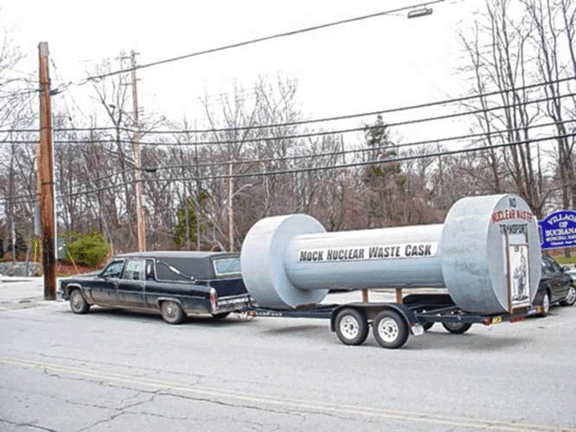
Anti-nuclear waste rally in Montpelier, 18 Sept 18 MONTPELIER, Vt. (WCAX) An anti-nuclear waste campaign visited Montpelier Tuesday night, delivering a replica radioactive waste cask. The event was organized by the “Citizens Awareness Network” as part of a multi-stop tour throughout New England.
Activists say they are responding to a bill now in the U.S. Senate that would establish Anti-nuclear waste rally in Montpelier, 18 Sept 18 MONTPELIER, Vt. (WCAX) An anti-nuclear waste campaign visited Montpelier Tuesday night, delivering a replica radioactive waste cask. The event was organized by the “Citizens Awareness Network” as part of a multi-stop tour throughout New England.
Activists say they are responding to a bill now in the U.S. Senate that would establish temporary mobile storage for high-level nuclear waste. The storage casks would travel from places like the Vermont Yankee Nuclear Power Plant and would be transported to southwestern states like Texas and New Mexico. The group’s goal is to leave the waste where it is, but better protected.
“We have to find a responsible way to deal with this waste and what the industry is trying to do is just get this waste off of their hands as quickly as possible,” said Tim Judson of the Nuclear Information and Resource Service.
“In New Mexico, we are concerned about not just our communities because of the storage, but the transport would impact everyone across the nation. Anywhere between a nuclear power plant and the waste site,” said Leona Morgan of the Nuclear Issues Study Group.
The nuclear cask will stop Wednesday night in Brattleboro at the Congregational Church.
. The storage casks would travel from places like the Vermont Yankee Nuclear Power Plant and would be transported to southwestern states like Texas and New Mexico. The group’s goal is to leave the waste where it is, but better protected.
“We have to find a responsible way to deal with this waste and what the industry is trying to do is just get this waste off of their hands as quickly as possible,” said Tim Judson of the Nuclear Information and Resource Service.
“In New Mexico, we are concerned about not just our communities because of the storage, but the transport would impact everyone across the nation. Anywhere between a nuclear power plant and the waste site,” said Leona Morgan of the Nuclear Issues Study Group.
The nuclear cask will stop Wednesday night in Brattleboro at the Congregational Church.
September 21, 2018
Posted by Christina Macpherson |
opposition to nuclear, USA |
Leave a comment
Growing Opposition Threatens Completion of Last U.S. Nuclear Plant
Primary owners of Georgia’s Vogtle power plant are set to vote on the project—already years behind schedule, billions over budget, WSJ, By Russell Gold
September 21, 2018
Posted by Christina Macpherson |
business and costs, USA |
Leave a comment
Democrats trying to ban low-yield nuclear warhead https://www.defensenews.com/congress/2018/09/20/democrats-trying-to-ban-low-yield-nuclear-warhead/
By: Joe Gould WASHINGTON – A group of Democratic lawmakers have introduced a bill to ban the Defense Department from developing a new
low-yield nuclear warhead, arguing it could fuel a dangerous arms race and hasten nuclear war.
The new warhead, for submarine-launched ballistic missiles, would also siphon money from other military needs, said Rep. Adam Smith, D-Wash., and four other lawmakers who co-sponsored the bill. Smith, the top Democrat on the House Armed Services Committee, is a frequent critic of nuclear modernization costs and an opponent of this weapon in particular.
The move comes after Congress passed, and President Donald Trump signed, an appropriations package this month that applies $65 million to the program. The money pays to modify the W76-1 warhead for the Navy’s Trident II D5 ballistic missile into a W76-2 warhead. (The measure also orders a study of the weapon’s long-term costs.)
“We should not fund President Trump’s request for new low-yield nuclear weapons. His proposal dangerously lowers the threshold to nuclear use and siphons money away from genuine military readiness needs.” Smith said in a statement.
“We already have a nuclear deterrent that is more than adequate to achieve our national security goals. Funding new, low-yield weapons would only draw us further into an unnecessary nuclear arms race and increase the risks of miscalculation.”
The bill would prohibit the research, develop, production, and deployment of a low-yield nuclear warheads for submarine-launched ballistic missiles.
Sponsored by Smith, and Reps. Ted Lieu, D-Calif.; John Garamendi, D-Calif.; Earl Blumenauer, D-Ore., and Sen. Ed Markey, D-Mass., it’s called the Hold the LYNE (Low-Yield Nuclear Explosive) Act. It’s just the latest push from Democrats in an ongoing battle.
The requirement for the weapon is part of the Trump administration’s Nuclear Posture Review—meant to deter Russia from using its own arsenal of low-yield nuclear weapons. Defense Secretary Jim Mattis and others have said Russia might attempt to use a tactical nuclear weapon to win a conventional war quickly.
The Defense Department requested $22.6 million for FY19 and $48.5 million spread over the life of the Future Years Defense Program, or FYDP, a series of projected numbers that cover through FY23, meaning the combined cost for the development in FY19 will be $87.6 million.
The lawmakers pointed to a Congressional Budget Office estimate last year that upgrading America’s nuclear weapons at $1.2 trillion over the next 30 years.
The bill has been endorsed by Arms Control Association, Global Zero, Union of Concerned Scientists, Ploughshares, Win Without War, and other nonproliferation advocates.
September 21, 2018
Posted by Christina Macpherson |
politics, USA, weapons and war |
Leave a comment
 California Gov. Brown Signs Historic Diablo Canyon Nuclear Plant Bill, https://www.powermag.com/press-releases/california-gov-brown-signs-historic-diablo-canyon-nuclear-plant-bill/Power Magazine, 09/20/2018 SACRAMENTO,
 CA – California Gov. Jerry Brown today signed into law a bill to protect the environment, workers, and local communities during the closure of California’s last nuclear plant, Diablo Canyon near San Luis Obispo.Senate Bill 1090, which had wide bipartisan support, will help to ensure that the electricity generated by the giant plant is replaced with zero-carbon options led by energy efficiency and renewable energy. The new law also mandates full funding of a $350 million employee retention program and the $85 million community impact mitigation program, which are needed to ensure that the plant is adequately staffed and essential emergency services are provided through the end of the plant’s license period in 2025.
Plant owner Pacific Gas & Electric (PG&E), citizen and environmental groups including NRDC, and labor organizations in June 2016 announced an agreement to close the two reactors by August 2025 and replace their generation with lower-cost, zero-carbon alternatives. Their joint proposal asked the California Public Utilities Commission to authorize the replacement of the electricity being generated by the plant 250 miles south of San Francisco with emissions-free options led by energy efficiency, wind and solar power, and included protections for plant workers and surrounding communities during the transition. When the CPUC rejected much of the historic joint proposal in January, supporters turned to the Legislature.
Following is a statement from Ralph Cavanagh, energy program co-director at the Natural Resources Defense Council:
“Governor Brown made climate history again today when he signed this legislation to specifically authorize that Diablo Canyon’s electricity generation be replaced with carbon-free resources like energy efficiency and wind and solar power. This groundbreaking legislation also ensures that we account for the full impact of the plant’s closure on the workers and surrounding communities.”
September 21, 2018
Posted by Christina Macpherson |
employment, USA |
Leave a comment