Nuke Expert Dana Durnford Unpacks – Linear No-Threshold (LNT) Debate
Trump’s EPA moving to loosen radiation limits, Financial Post, Ellen Knickmeyer, 2 Oct 18 WASHINGTON — The Trump administration is quietly moving to weaken U.S. radiation regulations, turning to scientific outliers who argue that a bit of radiation damage is actually good for you — like a little bit of sunlight.
The government’s current, decades-old guidance says that any exposure to harmful radiation is a cancer risk. And critics say the proposed change could lead to higher levels of exposure for workers at nuclear installations and oil and gas drilling sites, medical workers doing X-rays and CT scans, people living next to Superfund sites and any members of the public who one day might find themselves exposed to a radiation release.
The Trump administration already has targeted a range of other regulations on toxins and pollutants, including coal power plant emissions and car exhaust, that it sees as costly and burdensome for businesses. Supporters of the EPA’s new radiation guidance argue the government’s current no-tolerance rule for radiation damage forces unnecessary spending for handling exposure in accidents, at nuclear plants, in medical centres and at other sites.
…… The proposed rule would require regulators to consider “various threshold models across the exposure range” when it comes to dangerous substances.
While it does not specify that it’s addressing radiation and chemicals, an EPA news release on the rule quotes Edward Calabrese as saying it would: “The proposal represents a major scientific step forward by recognizing the widespread occurrence of non-linear dose responses in toxicology and epidemiology for chemicals and radiation and the need to incorporate such data in the risk assessment process.”
The comment period for the science regulation has ended and the agency is currently reviewing the comments. There’s no specific date for final action by the administration. The EPA declined to make an official with its radiation-protection program available.
… what’s of concern is the higher-energy, shorter-wave radiation, like X-rays, that can penetrate and disrupt living cells, sometimes causing cancer.
As recently as this March, the EPA’s online guidelines for radiation effects advised: “Current science suggests there is some cancer risk from any exposure to radiation.”
“Even exposures below 100 millisieverts” — an amount roughly equivalent to 25 chest X-rays or about 14 CT chest scans — “slightly increase the risk of getting cancer in the future,” the agency’s guidance said.
But that online guidance — separate from the rule-change proposal — was edited in July to add a section emphasizing the low individual odds of cancer: “According to radiation safety experts, radiation exposures of …100 millisieverts usually result in no harmful health effects, because radiation below these levels is a minor contributor to our overall cancer risk,” the revised policy says.
…….. The radiation regulation is supported by Steven Milloy, a Trump transition team member for the EPA who is known for challenging widely accepted ideas about manmade climate change and the health risks of tobacco. He has been promoting Calabrese’s theory of healthy radiation on his blog.
But Jan Beyea, a physicist whose work includes research with the National Academies of Science on the 2011 Fukushima nuclear power plant accident, said the EPA science proposal represents voices “generally dismissed by the great bulk of scientists.”
The EPA proposal would lead to “increases in chemical and radiation exposures in the workplace, home and outdoor environment, including the vicinity of Superfund sites,” Beyea wrote.
At the level the EPA website talks about, any one person’s risk of cancer from radiation exposure is perhaps 1 per cent, Beyea said.
“The individual risk will likely be low, but not the cumulative social risk,” Beyea said.
“If they even look at that — no, no, no,” said Terrie Barrie, a resident of Craig, Colorado, and an advocate for her husband and other workers at the now-closed Rocky Flats nuclear-weapons plant, where the U.S. government is compensating certain cancer victims regardless of their history of exposure.
“There’s no reason not to protect people as much as possible,” said Barrie.
U.S. agencies for decades have followed a policy that there is no threshold of radiation exposure that is risk-free.
The National Council on Radiation Protection and Measurements reaffirmed that principle this year after a review of 29 public health studies on cancer rates among people exposed to low-dose radiation, via the U.S. atomic bombing of Japan in World War II, leak-prone Soviet nuclear installations, medical treatments and other sources.
Twenty of the 29 studies directly support the principle that even low-dose exposures cause a significant increase in cancer rates, said Roy Shore, chief of research at the Radiation Effects Research Foundation, a joint project of the United States and Japan. Scientists found most of the other studies were inconclusive and decided one was flawed.
None supported the theory there is some safe threshold for radiation, said Shore, who chaired the review.
If there were a threshold that it’s safe to go below, “those who profess that would have to come up with some data,” Shore said in an interview.
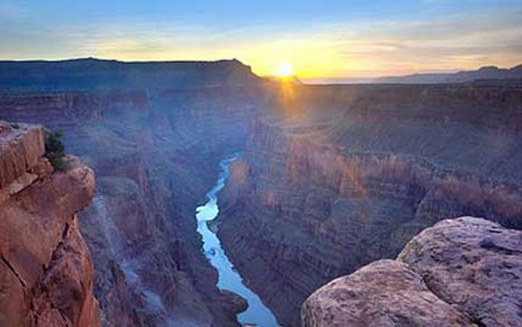
Grand Canyon uranium mining ban upheld as supreme court declines to hear challenge
Court says extraction ban is among cases it refuses to review, in victory for environmental groups and Native American communities, Guardian, Joanna Walters in New York@Joannawalters13 2 Oct 2018 The ban on new uranium mining near the Grand Canyon implemented by the Obama administration was effectively upheld on Monday when the US supreme court declined to hear a challenge from the industry.
Environmental groups and Native American communities declared victory when, on the first day of its fall season, the bench announced that the uranium extraction ban was among cases it refuses to review.
An appeals court decision from December 2017 that the ban is legal will now stay in place. Hundreds of mineral deposit claims from Canadian, British and US interests that want to seek out and exploit uranium deposits close to Grand Canyon National Park now remain on hold.
Under Barack Obama, the interior department announced in 2012 a 20-year ban on fresh mining activity, which protects a million acres of public land in the vicinity of the canyon. The ban, also known as a mineral withdrawal, has faced a series of legal challenges from commercial interests………
Hidden danger: Radioactive dust is found in communities around nuclear weapons sites, LA Times, By RALPH VARTABEDIAN SEP 28, 2018 “……….Studies by a Massachusetts scientist say that invisible radioactive particles of plutonium, thorium and uranium are showing up in household dust, automotive air cleaners and along hiking trails outside the factories and laboratories that for half a century contributed to the nation’s stockpile of nuclear weapons.
· The findings provide troubling new evidence that the federal government is losing control of at least some of the radioactive byproducts of the country’s weapons program.
· Marco Kaltofen, a nuclear forensics expert and a professor at Worcester Polytechnic Institute, said he collected samples from communities outside three lab sites across the nation and found a wide variation of particle sizes. He said they could deliver lifelong doses that exceed allowable federal standards if inhaled.
· “If you inhale two particles, you will exceed your lifetime dose under occupational standards, and there is a low probability of detecting it,” he said.
· A peer-reviewed study by Kaltofen was published in its final form in May in Environmental Engineering Science. Kaltofen, who also is the principal investigator at the nuclear and chemical forensics consulting firm Boston Chemical Data Corp., released a second study in recent weeks.
· The Energy Department has long insisted that small particles like those collected by Kaltofen deliver minute doses of radioactivity, well below typical public exposures. One of the nation’s leading experts on radioactivity doses, Bruce Napier, who works in the Energy Department’s lab system, said the doses cited by Kaltofen would not pose a threat to public health.
· Such assurances have been rejected by nuclear plant workers, their unions and activists who monitor environmental issues at nearly every lab and nuclear weapons site in the nation.
· Jay Coghlan, executive director of NuclearWatch New Mexico, cited a long history of denial about the claims of “down winders,” the residents of Western states who were exposed to radioactive fallout from atmospheric weapons testing. “We can not trust self-reporting by the Department of Energy,” he said. “I don’t accept that low levels of radioactivity have no risk.”
· Tom Carpenter, executive director of another watchdog group, the Hanford Challenge in central Washington, said as recently as last year that the Energy Department released an unknown quantity of radioactive particles during demolition of a shuttered weapons factory, the Plutonium Finishing Plant.
· After a series of three releases during 2017, the Energy Department shut down the demolition and has yet to resume it. Forty two workers were exposed in the incidents.
· “If you work in a coal mine, you go home with coal dust on you,” Carpenter said. “Same with a textile mill; you go home with cotton dust. These Hanford workers went home with plutonium dust.”
· The second study by Kaltofen, completed in August, reported that fairly high radioactivity levels were found in 30 samples from the communities around the Hanford nuclear site, near Richland, Wash. The samples found contamination on personal vehicles driven inside the Hanford site that would leave mechanics exposed if they worked around the vehicles, the report said.
· Kaltofen also reviewed an internal study in March by an Energy Department contractor, Washington River Protection Solutions, that found a calculated potential dose of 95 milliren for workers, roughly 10 times higher than the federal Environmental Protection Agency standard.
· Kaltofen said a broader independent study should look at residual contamination around Hanford. An Energy Department spokesman at the Hanford site said the office had no comment on the studies.
For his studies, Kaltofen collected samples outside the Los Alamos National Laboratory in New Mexico, the former Rocky Flats weapons plant near Denver and the Hanford site……..
Kaltofen’s sampling found some very high levels of contamination in Los Alamos’ Acid Canyon, a recreational area near a community pool and skate park………
A worker’s exposure to radioactivity, such as walking by a radioactive substance or having particles cling to clothing, is checked by monitors and badges worn by workers at plant sites. Such exposure is like a medical X-ray, which delivers a momentary dose. But inhaling a small particle of plutonium or thorium can go unnoticed by such monitors and deliver a lifetime of alpha radiation right next to lung tissue, Kaltofen said.
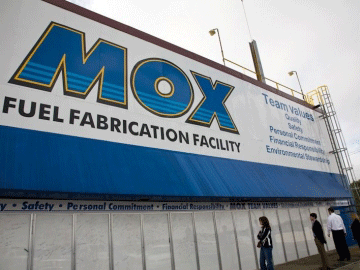
WJBF 26th Sept 2018 ,A Federal Appeals Court is set to discuss, Thursday, the future of Savannah
River Site’s MOX project. In a letter sent to a Texas congressman and
filed in court documents, the National Nuclear Security Agency says it
agrees with the decision made by Energy Secretary Rick Perry to stop the
project.
The State of South Carolina is suing the DOE saying its opinion on
the matter was never considered when Secretary Perry issued the directive
to end MOX earlier this year.
Delaware residents living within a 10-mile (16-kilometer) radius of two nuclear plants in New Jersey are eligible to receive free potassium iodide tablets from the state.
News outlets report that the Delaware Emergency Management Agency and Delaware Division of Public Health will distribute the tablets next Thursday. The tablets help protect the thyroid gland from radioactive iodine that might be ingested or inhaled during a radiation emergency.
The 10-mile radius around the Salem Nuclear Plant and Hope Creek Generating Station is referred to as the emergency planning zone.
Those who live outside the zone can obtain the tablets over-the-counter at some local pharmacies.
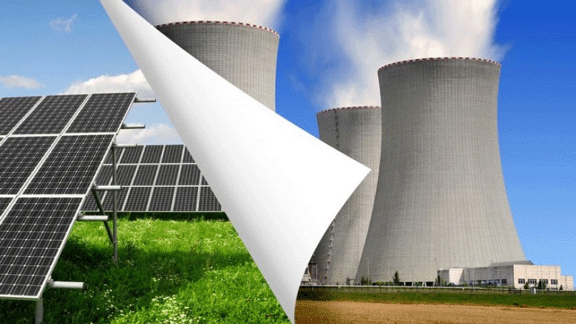
Hurricane Florence crippled electricity and coal — solar and wind were back the next day https://www.cbsnews.com/news/hurricane-florence-crippled-electricity-and-coal-solar-and-wind-were-back-the-next-day/, 25 Sept 18, Nearly two weeks afterHurricane Florence swamped North and South Carolina, thousands of residents who get power from coal-fired utilities remain without electricity.Yet solar installations, which provide less than 5 percent of North Carolina’s energy, were up and running the day after the storm, according to electricity news outlet GTM. And while half of Duke Energy’s customers were without power at some point, according to CleanTechnica, the utility’s solar farms sustained no damage.
Traditional energy providers have fared less well. A dam breach at the L.V. Sutton Power Station, a retired coal-fired power plant near Wilmington, North Carolina, has sent coal ash flowing into a nearby river. Another plant near Goldsboro has three flooded ash basins, according to the Associated Press, while in South Carolina, floodwaters are reportedly threatening pits that contain ash, an industrial waste from burning coal.
The lesson, according to environmentalists: Utilities’ vulnerability to major storms underscores the urgency of shifting to energy that it is not only clean and renewable, but also more resilient.
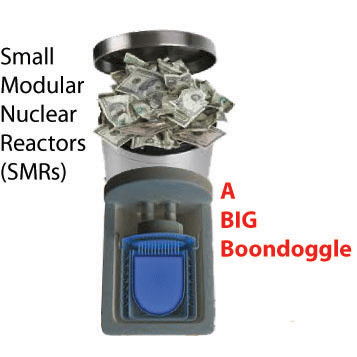
Is it worth spending $millions on a nuclear technology whose only real purpose is to train nuclear technologists?
A good announcement and a bad announcement for two nuclear-energy startups,NuScale Power takes a step toward engineering; Transatomic power shuts down. Ars Technica, MEGAN GEUSS – 9/26/2018 “…………….The old light-water reactors that serve America’s grid today create nuclear waste that’s politically impossible to dispose of. Nuclear plants with traditional reactors are also extremely expensive to build and difficult to permit.
For these reasons, many nuclear hopefuls have looked to advanced nuclear technology. Several startups have popped up, promising to make either the waste problem or the expense problem go away.
This week, two advanced nuclear-technology startups have announced major news, both good and bad for the future of advanced nuclear technology………..
Transatomic is going to close down, according to MIT Technology Review. Several years ago, the startup raised millions on promises to use spent nuclear waste as reactor fuel, as well as to “generate electricity 75 times more efficiently than conventional light-water reactors,” according to MIT Technology Review. The company later retracted that “75 times” claim after a review from MIT’s Nuclear Engineering Department found issue with it.
Instead, Transatomic revised its estimates in 2016 to say that its reactor would be able to generate more than two times as much energy per ton of mined uranium than a standard reactor.
The lost confidence made it harder for Transatomic to find funding to complete the $15 million it needed to build a prototype reactor, although it had raised about $4 million already……..
Onward to manufacturing
NuScale Power, based out of Portland, Oregon issued a press release today saying that, after 18 months of searching, it has selected manufacturing company BWX Technologies to begin engineering work that will lead to manufacturing the company’s Small Modular Reactor (SMR) design.
Phase 1 engineering and manufacturing begins today and will last until 2020, NuScale wrote, and then Phases 2 and 3—”preparing for fabrication” and “fabrication,” respectively—will continue from there……..
Small Modular Reactors don’t solve the nuclear-waste problem mentioned at the top of this article, but in theory, they might solve nuclear energy’s expense problem. Building smaller reactors that can be modularly expanded if necessary could not only keep siting, construction, and regulatory costs proportionally lower, but using the same manufacturing and construction crews to build more, smaller reactors would theoretically develop a workforce with expertise in building and installing reactors.https://arstechnica.com/science/2018/09/a-good-announcement-and-a-bad-announcement-for-two-nuclear-energy-startups/
Anti-nuclear waste tour to come through Midland, Meetings push to block a proposal to transport used nuclear fuel by train and store it in West Texas, MRT, by Matt Zdun, Texas Tribune , September 26, 2018 Organizers of the “Protect Texas from Radioactive Waste Tour” plan to travel to five Texas cities over the next week in protest of a proposed plan to store used nuclear materials in West Texas.Several Texas organizations gathered in Houston on Tuesday to kick off their “Protect Texas from Radioactive Waste Tour,” the beginning of a renewed push to block a proposal to transport used nuclear fuel by train through Texas and store it in West Texas.
The tour’s organizers said they want to make people aware of the “high risk” implications of a proposal to build and operate a facility for 40,000 metric tons of irradiated fuel rods at an existing site in Andrews County.
If approved by the Nuclear Regulatory Commission, the project by Interim Storage Partners, a joint venture between Waste Control Specialists and Orano USA, would transport nuclear waste from around the country to the consolidated site in Texas and store it until a long-term storage site becomes available, according to the venture’s website.
The Nuclear Regulatory Commission said in an August letter it would begin reviewing Interim Storage Partners’ license application and that its safety, security and environmental reviews of the proposal could conclude as early as August 2020.
Karen Hadden, the executive director of the Sustainable Energy and Economic Development Coalition, told The Texas Tribune that announcement triggered renewed opposition to the project and is one of the reasons for the tour.
The organizations involved — the Coalition of Community Organizations, Nuclear Information and Resource Services, Beyond Nuclear, the Sustainable Energy and Economic Development Coalition and Public Citizen — held a news conference by a railroad crossing in Houston, said Tom Smith, the special projects director of consumer rights advocacy group Public Citizen. Smith, who helped organize the tour, said in an interview with the Tribune that the news conference featured a 16-foot railroad container meant to replicate the transport cask that Interim Storage Partners would use to transport used nuclear fuel.
“We’re by the railroad tracks because we’re emphasizing that Texas businesses, hospitals and schools by the railroads are at high risk,” Hadden said. “It’s a bad idea to bring [nuclear waste] from around the country into Texas.”
The organizations instead want the used nuclear material to be kept at reactor sites in sturdier containers until a permanent storage site becomes available.
Smith said the proposed project presents a number of risks. A railroad accident would be disastrous, he said, because it could expose the public to harmful radiation and could cost municipalities hundreds of millions of dollars to clean up.
He also said nuclear waste on railcars running through densely populated areas like Houston, Dallas and San Antonio is at “high risk of terrorist sabotage.”…….
Smith said that after the news conference, the organizations planned to ask the Houston City Council to adopt a resolution against the proposed transportation of the nuclear material. He added that commissioners in San Antonio and Midland have already adopted similar resolutions.
Federal court upholds New York program to subsidize nuclear plants, Washington Examiner, by Josh Siegel, September 27, 2018 The U.S. Court of Appeals for the 2nd Circuit on Thursday upheld the legality of New York’s program that props up struggling nuclear plants to provide electricity without carbon dioxide emissions.
The court said the state subsidy program does not interfere with the power that the Federal Energy Regulatory Commission has over wholesale electricity markets, as charged by other electricity suppliers who filed suit, including the Electric Power Supply Association.
The three-judge panel acknowledged that New York’s program would keep nuclear plants alive, and raise costs for competitors, but said those effects were “incidental.”
……..The ruling comes a few weeks after the U.S. Circuit Court of Appeals for the 7th Circuit upheld a similar policy in Illinois………
FERC has filed amicus briefs in the cases affirming the programs do not preempt the agency’s legal authority set by the Federal Power Act.
Critics say the programs bailout failing nuclear plants in the state, that are struggling to compete with lower cost natural gas and renewables.
The Trump administration is considering a bigger, widely contested plan, on a national scale, to require grid operators to buy power from a select list of coal and nuclear plants.
Environmentalists cheered the state court rulings as a signal that courts consider states to have broad power to set clean energy goals, and to impose policies to achieve them. For example, many states have renewable portfolio standards requiring generators to obtain more and more of their electricity from clean sources.
“The 2nd Circuit’s decision rejecting a challenge to [New York’s] ZEC program may be narrowly covered as a decision affecting nuclear resources, but the much bigger reason it is major news is because it eliminates legal uncertainty for states in designing clean energy programs,” said Miles Farmer, a clean energy attorney at the Natural Resources Defense Council, in a Twitter post. https://www.washingtonexaminer.com/policy/energy/federal-court-upholds-new-york-program-to-subsidize-nuclear-plants
The Supreme Court could hear cases related to the EPA’s climate obligations and other environmental issues, Scientific American, By Mark K. Matthews, E&E News on September 27, 2018
If Senate Republicans plow ahead and confirm Brett Kavanaugh to the Supreme Court, the longtime jurist could have near-term impact on a slew of environmental cases.
Among the disputes the high court has agreed to hear this fall: a case that pits villagers from India against the World Bank in a fight over a coal plant. If the villagers prevail, it could have worldwide economic and political repercussions.
Several other climate-related issues have a decent shot, too, of getting a future date with the Supreme Court, including one closely watched fight—the “kids’ climate case”——that makes the far-reaching argument that the government must take action on global warming so as not to imperil future generations.
Kavanaugh—currently a judge on the U.S. Court of Appeals for the District of Columbia Circuit—would replace Justice Anthony Kennedy, who retired in July after three decades of service and dozens of landmark decisions.
Kennedy was often a swing vote on the ideologically divided court, and he played a key role in several major environmental cases.
The owner of what was considered to be America’s oldest nuclear power plant until its shutdown last week says it has removed the nuclear fuel from the reactor.
Chicago-based Exelon Corp. has notified the U.S. Nuclear Regulatory Commission that it removed the last of the fuel rods from the Oyster Creek Nuclear Generating Station on Tuesday.
The material was placed into a spent fuel pool where it will cool down for at least two years.
The fuel eventually will be placed into sealed concrete casks for longer-term storage on the grounds of the former plant in Lacey Township in New Jersey.
A Jupiter, Florida company, Holtec International, plans to buy the plant and move the fuel to an interim disposal site it is proposing in New Mexico.
,Fortune, By GRACE DOBUSH , 27 Sept 18, The Alvin W. Vogtle Electric Generating Plant in Georgia, the only nuclear power reactors currently under construction in the U.S., got a last-minute save last night as warring partners agreed to new funding terms.
Southern Co. subsidiary Georgia Power, which owns 45.7% of the project, will shoulder more of the costs past a certain level, and agreed to purchase future tax credits at a discounted cost from co-owners Oglethorpe Power Corp. (30%), the Municipal Electric Authority of Georgia (22.7%) and Dalton Utilities (1.6%).
Costs for the two new nuclear reactors have nearly doubled to more than $27 billion. Partners and politicians are worried the costs will trickle down to rural customers’ electric bills, but the sunk costs of halting construction would also be expensive for consumers.
The existing two reactors at Vogtle have been in operation since the 1980s. The new reactors, now expected to come online in 2021 and 2022, are five years behind schedule and $13 billion over budget. The Vogtle owners have been struggling since the designer and lead construction contractor, Westinghouse Electric Co., filed for bankruptcy in March 2017.
The Department of Energy has paid the project’s owners $5.6 billion of an $8.3 billion loan guarantee for the project. The Trump administration has promised the project another $3.7 billion if construction continues. But if the project were stopped, the DOE would demand an accelerated repayment schedule.
John Sneed, executive director of the DOE Loan Programs Office, had said in a letter to project leaders that his agency acknowledges continuing construction is a “commercial decision” but that the owners must realize Vogtle’s “profound impact on the U.S. nuclear industry.” He added: “The decision each owner makes should be made with an understanding of the ripple effect this project is already having, including job creation and the positive signal of the continued value of commercial nuclear power in our country.”……..http://fortune.com/2018/09/27/vogtle-nuclear-power-plant-construction-deal/
A nuclear startup will fold after failing to deliver reactors that run on spent fuel, MIT Technology Review, James Temple, 25 Sept 18 Transatomic Power, an MIT spinout that drew wide attention and millions in funding, is shutting down almost two years after the firm backtracked on bold claims for its design of a molten-salt reactor.
High hopes: The company, founded in 2011, plans to announce later today that it’s winding down.
Transatomic had claimed its technology could generate electricity 75 times more efficiently than conventional light-water reactors, and run on their spent nuclear fuel. But in a white paper published in late 2016, it backed off the latter claim entirely and revised the 75 times figure to “more than twice,” a development first reported by MIT Technology Review…….
The longer timeline and reduced performance advantage made it harder to raise the necessary additional funding, which was around $15 million. “We weren’t able to scale up the company rapidly enough to build a reactor in a reasonable time frame,” Dewan says.
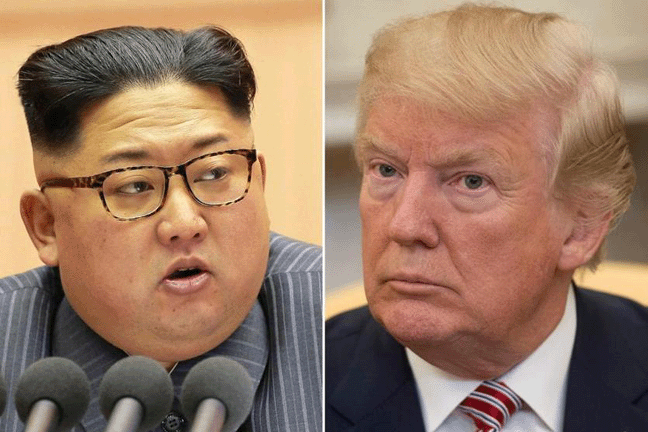
Trump preparing for 2nd summit with Kim despite little nuclear progress, abc news, By CONOR FINNEGAN
Sep 24, 2018 President Donald Trump is preparing for his second summit with North Korean leader Kim Jong Un, he said on Monday while meeting with South Korean President Moon Jae-in
While critics have warned against holding another meeting when North Korea has taken no meaningful steps toward dismantling its nuclear arsenal, Trump had nothing but praise for Kim, and U.S. Secretary of State Mike Pompeodefended the potential sit-down as something of “enormous value” but only “if we can continue to make progress and have conversations.”
Trump said that the meeting would happen “in the not too distant future,” not in Singapore but a “location to be determined.” He added that Kim had shown “tremendous enthusiasm … toward making a deal” and praised their relationship as “very good. In fact, in some ways it’s extraordinary.”
“We are in no rush. There’s no hurry. … We’ve made more progress than anybody’s made ever, frankly, with regard to North Korea,” he added.
But that kind of talk has negatively impacted the push to have North Korea denuclearize, according to diplomats and experts. By praising Kim and saying there is no rush while North Korea has taken no concrete steps to dismantle its nuclear-weapons program, he takes the pressure off North Korea……..
talks have been stuck in a deadlock over the sequencing, with the U.S. insistent that it will make no more concessions until North Korea denuclearizes — although it’s unclear how far along that process it will have to be before the U.S. responds. North Korea wants some actions, like signing a declaration to formally end the Korean War, first. ………https://abcnews.go.com/Politics/trump-preparing-2nd-summit-kim-nuclear-progress/story?id=58049260
To Secure Peace Between the Koreas, US Must Declare an End to the War, Christine Ahn, Truthout, September 24, 2018,A historic opportunity to end the seven-decade Korean War is suddenly within reach. The world witnessed world-class peacemaking between North and South Korea last week at the third inter-Korean summit in Pyongyang as North Korean leader Kim Jong Un and South Korean President Moon Jae-in declared “a Korean Peninsula free of war” and “a nuclear-free Korean peninsula.” But peacemaking between the two Koreas alone is not enough: The success of this process also rests on progress between Washington and Pyongyang, and particularly on the signing of a peace treaty to end the Korean War.
To a packed audience of 150,000 North Koreans wildly cheering on their feet on September 20 at the May Day Stadium in Pyongyang, President Moon affirmed, “We have lived together for 5,000 years and been separated for 70 years. We must live together as one people.”
At their summit, Kim and Moon announced a long list of actionable stepsthey will take to improve relations, from establishing a reunion center for divided families to reopening the Mt. Kumgang tourism center and the Kaesong industrial zone — two inter-Korean development projects from the previous Sunshine Policy years that were shut down as relations worsened between the two Koreas during the previous two hardline administrations. The defense ministers also agreed in a separate military agreement to reduce military tensions by downsizing the number of guards near the Military Demarcation Line, the border dividing North and South Korea in the De-Militarized Zone (DMZ) established by the Armistice Agreement in 1953. The Korean leaders also agreed to de-mine a village in the DMZ surrounding the border between North Korea and South Korea.
As part of the Pyongyang Declaration by the two Koreas to transform the Korean Peninsula “into a land of peace free from nuclear weapons and nuclear threats,” Kim committed to “permanently dismantle the Dongchang-ri missile engine test site” in the presence of international inspectors, and “the permanent dismantlement of the nuclear facilities in Yongbyon.” But this would depend on “corresponding measures” by the United States “in accordance with the spirit of the June 12 US-DPRK Joint Statement.”
Trump last month canceled Secretary of State Mike Pompeo’s trip to North Korea, saying North Korea had not made “sufficient progress” toward denuclearization. North Korean leaders, however, say the United States hasn’t honored its end of the Singapore Declaration in which the first two items were to improve relations and establish a peace process. Denuclearization came third, and the repatriation of the remains of US service members was a last added item.
Pyongyang has already made several concessions: It has halted missile and nuclear tests, begun to dismantle the Sohae missile launch site and destroyed the Punggye-ri nuclear test in the presence of foreign journalists, released three detained Americans, and repatriated the remains of US service members from the Korean War. The United States, meanwhile, has halted one joint military exercise after Trump’s spontaneous announcement at the press briefing following his meeting with Kim. But these joint exercises could easily be resumed.
North Korea has made clear that denuclearization will require a peace process that includes concrete steps toward a Peace Treaty, as promised in the 1953 Armistice Agreement signed by the United States, North Korea and China. James Laney, a former US ambassador to South Korea under Clinton, has argued, “A peace treaty would provide a baseline for relationships, eliminating the question of the other’s legitimacy and its right to exist. Absent such a peace treaty, every dispute presents afresh the question of the other side’s legitimacy.”
But North Korea is unlikely to unilaterally surrender its nuclear weapons without improved relations. We knew that the Clinton and Bush administrations were close to waging a pre-emptive strike on Pyongyang, but now Bob Woodward’s book Fear has also confirmed that even President Obama weighed a first strike on North Korea. Kim has seen what happened to Iraq, Libya and Iran, not to mention his own country’s experience of a devastating US bombing.
Most Americans have no idea that in just three years, the Korean War claimed over 4 million lives. TheUS dropped 635,000 tons of bombs on Korea, more than it did in the rest of the Asia-Pacific in WWII combined, and it used 33,000 tons of napalm in Korea — more than in Vietnam. Curtis LeMay, a US Air Force general in the Korean War,testified, “We burned down just about every city in North Korea and South Korea … we killed off over a million civilian Koreans and drove several million more from their homes.” The US’s indiscriminate bombing campaign leveled 80 percent of North Korean cities, killing one out of every four family members. The bombing of homes was so devastating that the regime urged its citizens to build shelter underground.
On July 27, 1953, the Korean War ended in a stalemate with a ceasefire. Military commanders from the US, North Korea and China signed the Armistice Agreement and promised within 90 days to return to negotiate a peace settlement. Sixty-five years later, we are still waiting for that Peace Treaty to end the Korean War.
A peace treaty would end the state of war between the United States and North Korea, taking the threat of a military conflict off the table. A ceasefire — a temporary truce — is what has defined the US-North Korean relationship.