nuclear-news

The News That Matters about the Nuclear Industry Fukushima Chernobyl Mayak Three Mile Island Atomic Testing Radiation Isotope

Further setback to building Bellefonte Nuclear Plant

Plan to complete Bellefonte Nuclear Plant takes another step backward Al  Alabama, 24 Oct 18 By Paul Gattis | pgattis@al.com   Developers of Bellefonte Nuclear Plant got their strongest public indication Tuesday that its much-needed potential customer in Memphis isn’t interested.

And that rebuke appears to make it more likely that the mothballed plant in northeast Alabama will continue to sit unfinished while again facing a bleak and uncertain future.

Memphis Gas, Light & Water signed a non-binding letter of intent in January to purchase power when Nuclear Development LLC completes the plant in about 2024. But now under new leadership, Memphis Light is pushing away from Bellefonte.

“Since (Memphis Light) has not completed its due diligence with respect to the Bellefonte proposal and has not yet received independent feedback on a multitude of concerns, management believes that it is premature to negotiate and commit to the terms of a (power purchase agreement),” the document said.

Without a customer, Nuclear Development has said it throws an $8.6 billion loan application with the U.S. Department of Energy into jeopardy. And given that jeopardy, Nuclear Development may decline to complete the purchase from TVA of the plant in Jackson County – which is scheduled to close by Nov. 14.

In short, the deal to purchase and complete Bellefonte appears to hinge on the agreement with Memphis. Nuclear Development said in July it had a customer but declined to identify the client.

Nuclear Development has not responded to a request for comment from AL.com concerning its talks with Memphis.

At the Memphis city council meeting Monday, Memphis Light released a four-page document outlining its concerns for going into business with an unfinished plant as its power source and made its case for why it should walk away from the proposed deal………

· The fact that Bellefonte would be about 50 years old by completion is cause for concern……..https://www.al.com/business/2018/10/plan-to-complete-bellefonte-nuclear-plant-takes-another-step-backward.html

October 25, 2018 Posted by | business and costs, USA | Leave a comment

Slow explanation about Pantex nuclear station lockdown

The Pantex nuclear weapons facility in Texas was just locked down … it took a while for them to explain why https://www.heraldsun.com.au/news/world/the-pantex-nuclear-weapons-facility-in-texas-was-just-locked-down-it-took-a-while-for-them-to-explain-why/news-story/a9d78aee41461ba3e1e10a723f962712    Jamie Seidel, News Corp Australia Network, October 24, 2018 NOTHING invokes such fear as the threat of a nuclear accident. So when a leading US manufacturer of nuclear weapons declares an ‘operations emergency’, the world sits up and pays attention. Problem is, they’re not telling us anything.

All we were told is what is contained in a simple tweet:


Pantex Plant@PantexPlan  
The Pantex Plant is experiencing an operational emergency. The Emergency Response Organization has been activated. 3:59 AM – Oct 24, 2018

Mollified much?

Not when it comes to the amount of explosive radioactive material held at the plant, near Carson County, Texas.

Pantex is where the US nuclear arsenal is both constructed and disassembled.

New devices are built.

Old devices are broken down for safe disposal.

Naturally, it’s a high security site. And safety precautions are well established.

Local media reported “an unexpected event at the plant”.

But not what that unexpected event was.

“At this time, there appears to be no offsite impact and no need for the public to take any action.”

Those are calming words. To a point.

“The Pantex onsite response effort is being conducted by the Emergency Response Organization, a highly-trained group of employees with detailed knowledge of plant operations and emergency response procedures. These employees represent plant functions such as security, logistics, safety, medical response, radiological assessment, firefighting, operations and public information.”

That’s not so calming.

Security? Medical response? Radiological assessment?

The local sheriff closed local roads close to the eastern edge of the extensive facility.

Then, out of nowhere, it was all over. Perhaps.


Pantex Plant@PantexPlant Replying to @PantexPlant

The security event at Pantex has ended without incident. Thanks to the Carson County Sheriff and @AmarilloPD for their quick response.

4:47 AM – Oct 24, 201

Only later was an official explanation given.

A ‘routine’ inspection had sparked a bomb scare.

Security guard dogs had ‘sniffed out’ something suspicious.

“Pantex identified a potential concern with a vehicle in the … administrative building parking lot,” a statement reads. “As a precaution, all employees were sheltered in place.”

Interestingly, while employees were told to seek safety, surrounding inhabitants — equally at risk from nuclear fallout — were not.

“The vehicle was inspected for any prohibited items. After searching the vehicle, it was determined there were no prohibited items or explosives, and the emergency event was resolved without incident.”

Lucky for the locals.

The Carson County, Texas, plant has a history of problems. In 2015, it was reported ‘hundreds’ of employees had fallen ill with radiation related sicknesses since it was established in the 1950s.


October 25, 2018 Posted by | incidents, USA | Leave a comment

Trump threatens to build up U.S. nuclear arsenal against China, Russia

 https://www.reuters.com/article/us-usa-nuclear-trump-arsenal/trump-threatens-to-build-up-us-nuclear-arsenal-against-china-russia-idUSKCN1MW2N4

WASHINGTON (Reuters) OCTOBER 23, 2018, – President Donald Trump warned on Monday that the United States intended to build up its arsenal of nuclear weapons to pressure Russia and China. Speaking to reporters, Trump repeated his contention that Russia was not abiding by the 1987 Intermediate-Range Nuclear Forces Treaty, which he has threatened to abandon.

October 23, 2018 Posted by | politics international, USA, weapons and war | Leave a comment

Gorbachev, experts baffled by U.S. withdrawal from nuclear weapons deal

  Euro News, By Alexander Smith with NBC News World News•   22/10/2018

A piece of reckless brinkmanship that could spark an arms race between NATO and Russia in Europe, or a hardball negotiating strategy that might push Moscow into keeping its longstanding promises on nuclear weapons?President Donald Trump was widely criticized this weekend when he announced his intention to scrap a landmark nuclear weapons agreement signed by President Ronald Reagan and Soviet leader Mikhail Gorbachev in 1987. The deal was designed to keep ground-based nuclear missiles out of Europe.Trump said that Russia has for years been violating the Intermediate-range Nuclear Forces Treaty, or INF.He’s not the first president to make this allegation. President Barack Obama said much the same.Many experts agree that Moscow continues to break the rules and flout the pact, but despite that some say ripping up the agreement is a bad idea.

These skeptics range from Sen. Rand Paul, R-Ky., to Gorbachev himself, with the Nobel laureate telling Russia’s Interfax news agency Sunday that Trump’s decision was “very strange” and not the work of “a great mind.”The White House’s decision to pull out, so this argument goes, will only allow Moscow to continue its current actions without having to maintain the pretense of compliance. Meanwhile, Russia, which also accuses the U.S. of violating the agreement, can point the finger at the U.S. as the one responsible for the INF’s failure.The 1987 agreement bans ground-based nuclear and conventional missiles that can strike between 300 miles to 3,400 miles.”One concern is that in the medium-term there may be the temptation to return intermediate-range missiles, potentially including nuclear weapons, to Europe,” said Karl Dewey, an analyst at Jane’s by IHS Markit, an open-source defense intelligence provider based in London…….. https://www.euronews.com/2018/10/22/will-trump-s-withdrawal-nuclear-treaty-spark-arms-race-or-n922731

October 23, 2018 Posted by | EUROPE, politics international, USA | Leave a comment

U.S. EPA removes a uranium safety regulation, in interests of mining profits

US EPA withdraws Obama administration uranium safety regulation Mining Technology, By JP Casey, 23 Oct 18
The US Environmental Protection Agency (EPA) has withdrawn a uranium safety proposal introduced in the last days of the Obama administration that would have introduced tighter regulation for uranium mill tailings to minimise the dangers of uranium extraction.

Uranium mill tailings are sandy materials produced as a by-product of uranium mining, which contain radioactive elements. The US Nuclear Regulatory Commission (NRC) states that only waste products produced by surface operations, such as in-situ recovery and ion exchanges, can be considered mill tailings, unlike waste materials left behind underground when ore bodies are depleted.

As a result, mill tailings can pose a threat to people, animals and the environment in the vicinity of a uranium mine, with water sources particularly vulnerable to surface waste.

Uranium operations in the US are governed by the Uranium Mill Tailings Radiation Control Act, which places responsibility for the regulation and disposal of mining waste with individual states, rather than the NRC.

The Obama-era proposition sought to give the NRC greater authority over tailings regulation and removal, and would have addressed an imbalance in the number of states that regulate their own waste and those which rely on the NRC for guidance.

Currently, just 13 states defer to the NRC for tailing regulation……

October 23, 2018 Posted by | business and costs, health, Uranium, USA | Leave a comment

Concerns about aging nuclear plants in USA Democratic areas

October 23, 2018 Posted by | decommission reactor, politics, USA | Leave a comment

Trump administration about to force American public to subsidize nuclear and coal plants

A nuclear October surprise? https://thehill.com/opinion/energy-environment/412413-a-nuclear-october-surprise, BY TIM JUDSON, 10/21/18  The Trump administration has been plotting for many months to seize power over the electrical generation sector by executive order, and despite widespread opposition and infighting that set the effort back this week, analysts say President Trump is personally invested in the idea, and that he and Energy Secretary Perry remain committed to ordering a bailout of failing coal and nuclear plants.

It wouldn’t exactly nationalize the industry or impose martial law. But the administration has invoked false national security claims and inappropriate “emergency” powers to claim the right to upend the market and force ratepayers and taxpayers to subsidize nuclear and coal plants against their will.  It would commandeer their money to prop up aging, unsafe, uncompetitive plants that should, and otherwise would, shut down.

Throughout the summer the administration signaled that soon, likely before the midterm election, Trump would issue a Section 202(c) emergency order imposing a two-year moratorium on nuclear and coal plant closures, ostensibly for the Department of Energy to study the ramifications of letting them close.

Meanwhile, grid operators would be required to buy electricity from struggling coal and nuclear plants, creating the equivalent of tariffs guaranteeing large profits for nuclear and coal plants. Grid managers would be forced to buy power from them, even though it’s more expensive than other sources of electricity, including renewables and efficiency.

The Electricity Consumers Resource Council has argued against the plan. Ratepayers are a captive market, so utilities are supposed to shop around for cheaper electricity on their behalf. A Trump executive order would prevent that, on the specious theory letting uncompetitive nuclear plants close threatens electrical grid reliability and national security, so consumers should get a big rate hike to keep them open.

While in effect over the next two years, such an order could preempt closure of uncompetitive nuclear plants, including those already scheduled to close. It might also delay or derail nuclear plant closures scheduled more than two years out, including New York’s Indian Point.

The Heritage Foundation opposes the Trump plan and points out there is no evidence that subsidizing aging nuclear plants helps grid reliability or national security. Keeping them open actually increases risks of radiological accidents and cyberattacks. But there’s plenty of evidence subsidies help nuclear plant owners.

Over the last year, owners ramped up spending on lobbying and pushed through billion-dollar state subsidies to guarantee large profits at public expense, first in New York ($7.6 billion) and Illinois ($2.4 billion), then in New Jersey ($3.6 billion) and Connecticut (estimated up to $3 billion).  They are now aiming at Pennsylvania and other states. They argue they deserve subsidies for fighting climate change, by supplying “clean energy” with “zero emissions.”

In fact, these aging plants are dirty and dangerous. Propping them up worsens climate change by undermining growth of renewables and efficiency measures. Owners got their subsidies anyway, after threatening state politicians with the fallout from closing their plants early.

By my calculation, most of the windfall is going to the largest US nuclear operator, Exelon. New York and Illinois subsidies accounted for about 60 percent of its profit growth this year. New Jersey and other state subsidies will swell it further. A Trump executive order would transfer yet more wealth from ratepayers to Exelon and other nuclear owners.

Is all this even legal? We’re about to find out. There are a slew of lawsuits waiting to challenge Trump’s executive order from consumer advocates and non-nuclear/non-coal generators. Many grounds for challenging it exist.

Since there is no energy or national security emergency, invoking them in a Section 202(c) order misapplies the Federal Powers Act and the Defense Production Act.  Trump’s order would be unprecedented, anti-competitive, government interference in power markets. It’s a federal mandate forcing individuals and businesses to pay for uneconomical power they don’t want. Those in New York and other states already coughing up billions for state nuclear subsidies will be subject to double jeopardy from this new federal surcharge, even if they object to subsidizing nuclear power and try to opt out through renewables-only purchasing programs.

There’s a fundamental question of whether nuclear subsidies serve the public interest, or whether they violate due process and the public trust.

In New York and other states, subsidies were rammed through with only perfunctory public input. Tens of thousands of New Yorkers filed complaints after they were passed. A lawsuit in New York State Supreme Court (Matter of Hudson River Sloop Clearwater v. NYS Public Service Commission, Albany County, 7242-16) is the first to challenge state subsidies on such fundamental, public interest grounds.

The organization I lead is a plaintiff in that case, which is also the last remaining legal challenge to state nuclear subsidies still standing, since federal suits asking the more technical question of whether state subsidies interfere with federal regulation of wholesale electricity markets were struck down. The NYS Supreme Court case survived motions to dismiss, and will soon go into evidentiary hearings. That means the question of whether New York’s nuclear subsidies are unfair, illegal or improper will finally get adjudicated in court.

The suit can’t reverse nuclear subsidies already established in Illinois and other states, but it could end them in New York and deter new states from adopting them.

t may also provide a glimpse of how lawsuits against a Trump executive order could get traction. Nuclear subsidies via government fiat contradict the public will, severely distort markets, and misapply the law. Executive overreach extended so far is ripe for remedy in court.

Tim Judson is the Executive Director of the Nuclear Information and Resource Service (NIRS), one of the plaintiffs in the New York lawsuit.

October 22, 2018 Posted by | business and costs, politics, USA | Leave a comment

5 things to know about threatened US-Russia nuclear weapons deal

October 22, 2018 Posted by | history, politics international, Russia, USA, weapons and war | Leave a comment

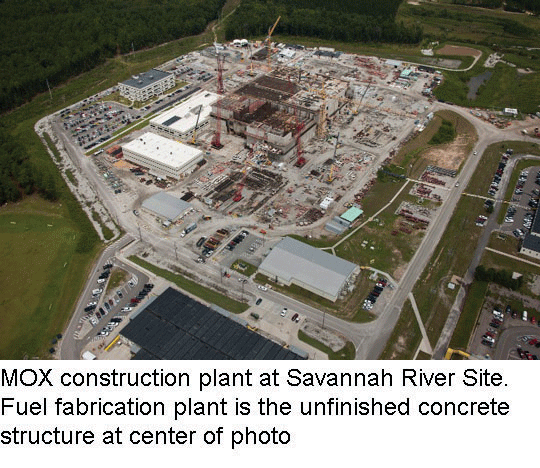
USA’s failed Mixed Oxide (MOX) Fuel Fabrication Plant costs taxpayers over $1 million daily

October 22, 2018 Posted by | business and costs, technology, USA | 2 Comments

Hanford given more time to empty leak-prone radioactive waste tank

Hanford wants more time to empty leak-prone radioactive waste tank. Here’s the new deadline, Tri City Herald, BY ANNETTE CARY, acary@tricityherald.com, 18, 2018 , RICHLAND, WA 

The Department of Energy will have more time to empty some of Hanford’s leak-prone underground waste storage tanks under an order issued in federal court.

Judge Rosanna Malouf Peterson agreed to a request by the state of Washington and DOE to give DOE until the end of 2026 to empty radioactive and hazardous chemical waste from nine more single-shell tanks.

It is an extension from March 31, 2024. A second deadline to keep work on pace to meet that milestone also has been extended.

DOE has another six months — until June 2021 — to have the first two tanks of the nine emptied.  New court-enforced consent decree deadlines for retrieving the waste from tanks and treating it at the $17 billion vitrification plant under construction were set by Malouf Peterson in 2016………https://www.tri-cityherald.com/news/local/hanford/article220235380.html

October 22, 2018 Posted by | USA, wastes | Leave a comment

National security adviser John Bolton urging Trump to withdraw from Russian nuclear arms treaty

John Bolton pushing Trump to withdraw from Russian nuclear arms treaty, Exclusive: national security adviser recommends ending intermediate-range nuclear forces treaty over alleged Russia violations, Guardian,  Julian Borger , 20 Oct 18, John Bolton is pushing for the US to withdraw from a cold war-era arms control treaty with Russia, in the face of resistance from others in the Trump administration and US allies, according to sources briefed on the initiative.Bolton, Donald Trump’s third national security adviser, has issued a recommendation for withdrawal from the 1987 intermediate-range nuclear forces treaty (INF), which the US says Russia has been violating with the development of a new cruise missile.


Withdrawal from the treaty, which would mark a sharp break in US arms control policy, has yet to be agreed upon by cabinet and faces opposition from within the state department and the Pentagon. A meeting on Monday at the White House to discuss the withdrawal proposal was postponed.

The INF faces a congressionally imposed deadline early next year. An amendment in the 2019 defence spending bill requires the president to tell the Senate by 15 January whether Russia is in “material breach” of the treaty, and whether the INF remains legally binding on the US.

Bolton, who has spent his career opposing arms control treaties, is seeking to shrug off the traditional role of national security adviser as a policy broker between the agencies, and become a driver of radical change from within the White House.

Former US officials say Bolton is blocking talks on extending the 2010 New Start treaty with Russia limiting deployed strategic nuclear warheads and their delivery systems. The treaty is due to expire in 2021 and Moscow has signaled its interest in an extension, but Bolton is opposing the resumption of a strategic stability dialogue to discuss the future of arms control between the two countries.

The US has briefed its European allies this week about the proposal, sounding out reactions. The briefing alarmed UK officials who see the INF as an important arms control pillar. The treaty marked the end of a dangerous nuclear standoff in 1980s Europe pitting US Pershing and cruise missiles against the Soviet Union’s SS-20 medium-range missiles.

The US alleges Russia is now violating the treaty with the development and deployment of a ground-launched cruise missile, known as the 9M729. Moscow insists the missile does not violate the range restrictions in the INF and alleges in return that a US missile defence system deployed in eastern Europe against a potential Iranian threat can be adapted to fire medium-range offensive missiles at Russia.

The National Security Council (NSC) declined to comment on the fate of the INF………

Bolton’s meeting with his Russian counterpart, Nikolai Patrushev, in Geneva in August, was expected to give the final green light to the dialogue, but Bolton is said to have blocked it. He is due to visit Moscow next week, when the Kremlin said he may meet Vladimir Putin.

(pic DANBY/BDN) The New York Times reported on Friday that Bolton intended to use his Moscow trip to inform Russian leaders of the administration’s plans to exit the INF agreement. Under the terms of the treaty, withdrawal would take six months.

In remarks in Sochi on Thursday, Putin appeared to suggest that Russia would adopt a “no first use” policy on nuclear weapons.

“We have no concept of a pre-emptive strike,” he told a conference. “[W]e expect to be struck by nuclear weapons, but we will not use them first,” he said.

A meeting of Nato defence ministers earlier this month in Brussels issued a joint statement saying the INF “has been crucial to Euro-Atlantic security and we remain fully committed to the preservation of this landmark arms control treaty”………

“The decision has been taken in the NSC [National Security Council] that the US should withdraw, and they are trying to persuade other parts of the administration. There has been no formal Trump decision yet,” said Hans Kristensen, the director of the nuclear information project at the Federation of the American Scientists. “Very little good will come of this, other than another round of nuclear escalation with Russia.”  ………https://www.theguardian.com/us-news/2018/oct/19/john-bolton-russia-nuclear-arms-deal-trump-lobbying

October 20, 2018 Posted by | politics, politics international, USA | Leave a comment

U.S. nuclear power stations were the original target for the 9/11 terrorist attacks

60,000 tons of dangerous radioactive waste sits on Great Lakes shores, Keith Matheny, Detroit Free Press
Oct. 19, 2018   “………The original 9/11 idea

In August 2002, al-Jazeera reporter Yosri Fouda got an anonymous call offering him an incredible interview with two of the biggest fugitives from justice on the globe: al-Qaida leaders Khalid  Sheikh Mohammed, the so-called mastermind of the 9/11 terrorist attacks, and Ramzi bin al-Shibh.

Wrote London’s The Guardian about Fouda’s account at the time: “After two days in a run-down hotel (in Karachi, Pakistan), he was passed through a chain of people before being blindfolded, put in a car (trunk) and driven to an apartment building. He was taken to a flat strewn with laptop computers and mobile phones and occupied by two men whom he recognized as Bin al-Shibh and Mohammed.

Among the things Fouda said he learned in his interview: That the initial targets for what became the Sept. 11, 2001, terrorist attacks included two, unspecified U.S. nuclear power plants.

“It was decided to abandon nuclear targets for the moment,” Fouda said Mohammed explained to him. “I mean for the moment,” Mohammed added.

Al-Qaida leaders feared an attack on U.S. nuclear facilities “might get out of hand,” Fouda said he was told.

Noted Kamps of the nonprofit Beyond Nuclear, “We’re relying on the moral restraint of a terrorist organization not to attack nuclear plants.”

That startling revelation was later amplified in the 9/11 Commission’s report, which not only noted Mohammed’s account, but that 9/11 ringleader and hijacker Mohammed Atta, in July 2001 meetings with Bin al-Shibh in Spain, “mentioned he had considered targeting a nuclear facility he had seen during familiarization flights near New York.”

The plan was ultimately scuttled because Atta “thought a nuclear target would be difficult because the airspace around it was restricted, making reconnaissance flights impossible and increasing the likelihood that any plane would be shot down before impact,” the 9/11 Commission report states.

Edwin Lyman of the Union of Concerned Scientists said the nuclear facility in question was probably Indian Point in New York, about 25 miles north of New York City. In an ironic twist, the supposed heightened security measures that discouraged Atta from a nuclear plant strike don’t exist, Lyman said.

“In fact, there was no such protection,” he said. “There is no no-fly-zone around nuclear plants.”

It’s still not an outright prohibition. After 9/11, the Federal Aviation Administration issued a “notice-to-airmen” stating: “In the interest of national security and to the extent practicable, pilots are strongly advised to avoid the airspace above, or in proximity to such sites as power plants (nuclear, hydro-electric, or coal), dams, refineries, industrial complexes, military facilities and other similar facilities. Pilots should not circle as to loiter in the vicinity over these types of facilities.”

Personnel at nuclear plants “voluntarily report to us and to local law enforcement whenever they see a plane loitering in the vicinity,” NRC spokesman David McIntyre told the Free Press. “Such pilots may be greeted by local law enforcement upon landing and further advised not to fly over or loiter over a plant.”

The policy also applies for remote-controlled drones, McIntyre said……. https://www.freep.com/story/news/local/michigan/2018/10/19/nuclear-waste-great-lakes/1417767002/


October 20, 2018 Posted by | safety, USA | Leave a comment

US nuclear missiles in Italy, as well as their bombs?

 http://www.voltairenet.org/article203557.html

As we might have expected, the de facto abandon of the Intermediate-Range Nuclear Forces Treaty (INF Treaty) – concluded between Washington and Moscow at the end of the Cold War – has now rebooted the competition. Except that this time, it’s even more complicated, since the United States violated the Treaty first, while they were already violating the Non-Proliferation Treaty (NPT). Meanwhile, Russia has discreetly forged ahead with its technological progress while pretending to allow the problem to drag on.

 | ROME (ITALY) | 19 OCTOBER 2018 he B61-12, the new US nuclear bomb which replaces the B-61 deployed in Italy and other European countries, will begin production in less than a year. The announcement was made officially by the National Nuclear Security Administration (NNSA). It reveals that the revision of the final project has now been completed with success, and the qualification stage will begin this month at the Pantex Plant in Texas. Production will be authorised to begin in September 2019.

In March 2020, the first unit of production will begin fabricating a series of 500 bombs. As from that time, in other words in about a year and a half, the United States will begin the anti-Russian deployment in Italy, Germany, Belgium, Holland and probably certain other European countries, of the first nuclear bomb in their arsenal with a precision guidance system. The B61-12 is designed with penetrating capacity, built to explode underground in order to destroy bunkers housing command centres.

Since Italy and the other countries, in violation of the Non-Proliferation Treaty, are offering the USA the bases, the pilots and the aircraft for the deployment of the B61-12, Europe will soon be exposed to a greater risk as the front line of the developing nuclear confrontation with Russia.

An even more dangerous situation appears at the same moment – the return of the Euromissiles, meaning the nuclear missiles which are similar to those deployed in Europe in the 1980’s by the USA, with the official aim of defending against Soviet missiles. This category of ground-based nuclear missiles of intermediate range (between 500 and 5,500 km) were eliminated with the INF Treaty of 1987. But in 2014, the Obama administration accused Russia of having experimented with a cruise missile (# 9M729) whose category was forbidden by the Treaty. Moscow denied that the missile violated the INF Treaty and, in turn, accused Washington of having installed in Poland and Romania launch ramps for interceptor missiles (elements of the « shield »), which could be used to launch cruise missiles bearing nuclear warheads.

The accusation aimed by Washington at Moscow, which is not supported by any evidence, enabled the USA to launch a plan aimed at once again deploying in Europe ground-based intermediate-range nuclear missiles. The Obama administration had already announced in 2015 that « faced with the violation of the INF Treaty by Russia, the United States are considering the deployment of ground-based missiles in Europe ». This plan was confirmed by the Trump administration – in fiscal year 2018, Congress authorised the financing of a « programme of research and development for a cruise missile which could be launched from a mobile road base ».

The plan is supported by the European allies of NATO.  The recent North-Atlantic Council, at the level of Europe’s Defence Ministers, which was attended for Italy by Elisabetta Trenta (M5S), declared that the « INF Treaty is in danger because of the actions of Russia », which it accused of deploying « a disturbing missile system which constitutes a serious risk for our security ». Hence the necessity that « NATO must maintain nuclear forces which are stable, trust-worthy and efficient » (which explains why the members of the Alliance rejected en bloc the United Nations Treaty for the prohibition of nuclear weapons).

So the grounds are being laid for a European deployment, on the borders of Russian territory, of ground-based intermediate-range US nuclear missiles. It’s as if Russia were deploying in Mexico nuclear missiles pointed at the United States. Manlio Dinucci

Translation
Pete Kimberley

Source
Il Manifesto (Italy)

October 20, 2018 Posted by | EUROPE, USA, weapons and war | Leave a comment

Risk of nuclear war between USA and China “not as implausible” no, as it was in the past

October 20, 2018 Posted by | China, politics international, USA, weapons and war | Leave a comment

November hearing on “Who will pay for the failed SCE and G nuclear project?

SCE&G regulatory trial: Who will pay for the failed nuclear project? The State, BY FRANK KNAPP JR., October 19,

October 20, 2018 Posted by | Legal, USA | Leave a comment