The Future Of Pilgrim Nuclear Power Station: Radioactive Waste And Many Questions By Sarah Mizes-Tan WGBH,
February 12, 2019 LISTEN Pilgrim Nuclear Power Station To Close In May
Built in 1972 on the shores of Cape Cod Bay, Pilgrim Nuclear Power Station has been the subject of controversy and concern for decades. Now it’s scheduled to close in the next few months. This is part three of a three-part series on the plant as it heads towards permanent shutdown in mid-2019. Read parts one andtwo.
Pilgrim Nuclear Power Station is nearly 50 years old. It’s moving toward a permanent shutdown in four months, but there are still concerns about safety. When a nuclear power plant closes, it leaves radioactive waste, and a lot of unanswered questions……..
As the plant ages, nuclear opponents are increasingly worried that an accident similar to the one in this drill could lead to a nuclear meltdown. Harwich resident Diane Turco, a longtime critic of the plant, is concerned that the consequences of a nuclear explosion would have far-reaching effects. She has overlaid an image of the radioactive plume generated after the 2011 Fukushima Daiichi plant explosion on a map of New England.
“We superimposed that data over Pilgrim, and you can see where it goes,” she said.
The plume she points to would stretch from Long Island to Maine. And though the plant is closing soon, the risk for a nuclear meltdown still remains, even after it’s stopped generating power. One morning, Turco visited the plant to point out what she’s really worried about: the dry cask storage units, a cluster of concrete cylinders sitting next to the plant.
“We should not be able to be here. If somebody had bad intent, there’s the dry casks right there,” she said.
She’s worried that the casks, which contain radioactive material from the reactor, are too easily accessible and unprotected. An attack on the casks could result in a nuclear explosion.
“You could jump over here and be over there in two minutes,” she said. She pointed out a lack of security surveillance of the road passing by the storage casks.
To add to existing concerns, Entergy is now looking to sell the power plant to Holtec, a company that specializes in nuclear decommissioning — basically, shutting nuclear power plants down. It’s the same company that manufactured the dry cask storage cylinders that Turco pointed out. The company claims that it can decommission Pilgrim Nuclear in less time and for less money than Entergy is able to……https://www.wgbh.org/news/local-news/2019/02/12/the-future-of-pilgrim-nuclear-power-station-radioactive-waste-and-many-questions
February 16, 2019
Posted by Christina Macpherson |
USA, wastes |
Leave a comment
|
Is there a way to save the ‘fraying’ nuclear consensus in Congress? Defense News By: Aaron Mehta 15 Feb 19, WASHINGTON — Following the 2010 Nuclear Posture Review, which called for long-term investment in modernizing America’s nuclear arsenal, Congress seemed to strike a general consensus on nukes: New investments in weapons would go hand in hand with arms reduction efforts such as the New START treaty.
It wasn’t perfect, and not everyone was on board. But on the whole, the balance allowed the investments in new bombers, nuclear warheads, long-range missiles and intercontinental ballistic missiles to go through with little challenge from Democrats, while ensuring New START would receive support from Republicans.
Years later, the landscape looks very different, which could have major consequences as the Trump administration attempts to push its own priorities from the Nuclear Posture Review through a Democratic-controlled House………
The nuclear consensus was rocked early in the Trump administration, with President Donald Trump declaring after less than a month in office that the agreement was “a one-sided deal” and a “bad deal,” and pledged that “if countries are going to have nukes, we’re going to be at the top of the pack.”
The situation only got rockier with the January 2018 release of the Nuclear Posture Review, which called for the creation of two new nuclear capabilities — a low-yield warhead for submarine-launched ballistic missiles and a submarine-launched nuclear cruise missile — that Democrats quickly denounced as the start of a new arms race.
The situation doesn’t appear to have improved for advocates of nuclear spending in the wake of November’s elections, which saw Democrats take the House and several veteran members of the Senate Armed Services Committee be replaced.
John Harvey, who as principal deputy assistant secretary of defense for nuclear, chemical and biological defense programs from 2009-2013 was one of the key authors of the 2010 NPR, said at the summit that he sees little change in the SASC’s stance toward modernization, as new members are largely in favor of the development plan. ………
“You should make clear that extending New START and continued Democrat support for modernization are a package. [Tell them] you can’t have one without the other,” Harvey said. Second, renew efforts to engage Russia on arms control initiatives that are in America’s security interests, including attempts to reduce “the large disparity of U.S. and Russian nonstrategic nuclear weapons and more productive dialogue on strategic stability.” ……….https://www.defensenews.com/smr/nuclear-arsenal/2019/02/14/is-there-a-way-to-save-the-fraying-nuclear-consensus-in-congress/
|
|
February 16, 2019
Posted by Christina Macpherson |
politics, USA, weapons and war |
Leave a comment
— Gina G. Scala, Sandpaper, Feb 13, 2019, Opponents of an interim spent nuclear fuel repository proposed by Holtec International, the Camden-based company seeking to jump start the Oyster Creek Nuclear Generating Station decommissioning should a license transfer be granted by the feds, say the company is putting the cart before the horse when it comes to seeking approval for the southeast New Mexico site. In fact, Caroline Reiser, a fellow with Emory Law School’s Turner Environment Law Clinic who appeared on behalf of Beyond Nuclear at an Atomic Safety and Licensing Board legal proceeding last month, called the application illegal.
“This adjudicatory body does not have the authority to review a license application that is based on an illegal premise,” she said during the first day of a two-day legal proceeding on the application. “Although Holtec presents it as an alternative, the mere inclusion of the Department of Energy as an option to be responsible for spent nuclear fuel transported to and stored at the proposed facility is illegal.”
Citing the Nuclear Waste Policy Act, Reiser said the federal government cannot take title to privately produced spent nuclear fuel until a final repository is operational.
“The law is clear,” she said. “There is no dispute that no final repository is operational, let alone even licensed; thus Holtec’s application is based on an illegal presumption, and application should be dismissed.”
Indeed, the DOE unceremoniously rejected its own plans for a federal repository at Yucca Mountain in Nevada almost a decade ago. It was the same site the DOE selected in 2002 as its long-term solution for housing spent nuclear fuel from the nation’s commercial nuclear power plants as well as U.S. Navy reactors.
“The interim repositories are viewed as a storage bridge until a permanent repository is opened,” Neil Sheehan, Nuclear Regulatory Commission public information officer for Region 1, said recently. “At this point, it is not clear when, or if, that will occur.”
He said the federal agency isn’t actively reviewing the Yucca Mountain application because more funding to do so is needed.
“We need to conduct a hearing on the proposal,” Sheehan said.
In the meantime, Reiser said Holtec’s application attempts to skirt the issue of who may legally own nuclear waste it proposes to store.
“The Nuclear Waste Policy Act is Congress’ comprehensive scheme for the interim storage and permanent disposal of high-level radioactive waste generated by civilian nuclear power plants,” she said. “It is the result of brilliant and wise balancing on the part of Congress that establishes distinct responsibilities for the federal government and private generators regarding spent fuel with the ultimate goal that nuclear waste will end up underground in a permanent repository.”………..
Holtec and its opponents had until Feb. 11 to provide additional information for consideration. There is no time frame for a decision from the ASBL on the proceedings.
Three administrative judges from the NRC’s Atomic Safety and Licensing Board presided over the session. The board may hold adjudicative hearings on major licensing actions by the NRC, but is independent of the NRC staff. A board’s rulings may be appealed to the commission, a five-member board that sets NRC policy.
gscala@thesandpaper.net https://thesandpaper.villagesoup.com/p/legality-of-holtecs-interim-spent-fuel-repository-application-called-into-question/1800897
February 16, 2019
Posted by Christina Macpherson |
USA, wastes |
Leave a comment
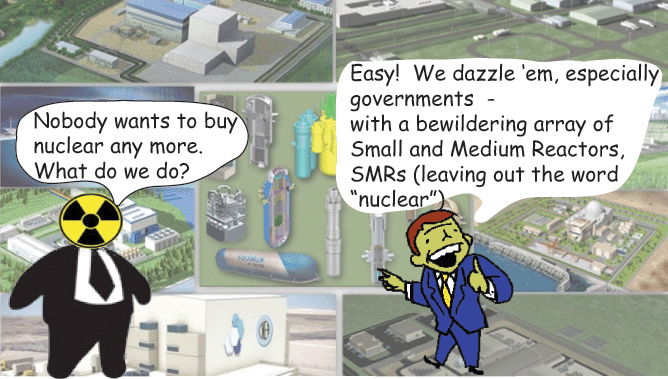
U.S. Nuclear Energy Industry Asks Washington For Help In International Expansion, Oil Price, By Irina Slav – Feb 13, 2019 Executives from major U.S. nuclear energy companies met with President Trump yesterday to ask for the administration’s help in expanding abroad, Bloomberg reports, citing sources in the know.
It seems U.S. nuclear plant builders feel left out of an international race that could be very profitable.
“There is competition around the globe, and we want to be part of it,” Bloomberg quoted the chief executive of Exelon Corp., Chris Crane, as saying.
The help that the industry is seeking from the government involves “financial assistance” to make their products more competitive with other companies that are already receiving financial support from the governments, notably Russian and Chinese companies, but also French reactor builders. All these are also on an international expansion drive.
“The United States needs to maintain a leadership position,” Exelon’s Crane told media…… The U.S. nuclear industry is hard pressed to find new markets as local power plants age and become uncompetitive with renewable energy installations, following the path of coal-powered plants. Since the domestic market seems to be saturated with nuclear plants, the only viable option is expanding abroad.
Also, approval for new reactor technology would come in handy. The industry is working on next-generation reactors as well as smaller, modular nuclear reactor technology–but these need to be approved at the highest level before joining the competition. https://oilprice.com/Latest-Energy-News/World-News/US-Nuclear-Energy-Industry-Asks-White-House-for-Help-In-International-Expansio.html
February 14, 2019
Posted by Christina Macpherson |
politics, USA |
Leave a comment
 Nuclear watchdogs warn against blurring energy, military uses at Ohio fuel plantNuclear watchdogs warn against blurring energy, military uses at Ohio fuel plant, Energy News, BY Kathiann M. Kowalski, 13 Feb 19,
Combining the capability to make fuel for nuclear reactors and material for weapons undercuts nonproliferation efforts, critics say.
A planned nuclear fuel plant in Ohio could help enable the nation’s next wave of carbon-free electricity, a fleet of small reactors providing continuous power to the grid.
The U.S. Department of Energy fuel facility would be unique in part because it could also produce material for use in nuclear weapons. That crosses a potentially dangerous line, nuclear watchdog groups say — one that could undercut efforts to prevent the spread of nuclear weapons.
The Department of Energy announced plans last month to contract with Centrus Energy Corp.’s American Centrifuge Operating subsidiary to reopen a nuclear fuel plant in Piketon, Ohio, about 70 miles south of Columbus where Appalachia’s foothills start rising from sprawling farmland.
The new project would likely resemble an earlier pilot program there that ended in 2015, but with various updates and technical fixes. It would also require U.S.-only sources, in lieu of some foreign components and technology.
Dual uses envisioned
DOE is proposing the company as the sole source for the work, and the agency’s notice suggests the demonstration project’s fuel could be used for both civilian and military purposes.
On the civilian side, the project’s fuel would be used for research and development of next-generation nuclear reactors. Designs for those smaller reactors call for fuel known as HALEU, which stands for high assay low-enriched uranium.
HALEU can have between 5 and 20 percent of uranium’s U-235 isotope. That’s the form that undergoes fission readily. In contrast, most U.S. commercial reactors use fuel with 3 to 5 percent U-235. Natural uranium is about 99 percent U-238.
On the defense side, HALEU could be used for small mobile reactorsto power on-the-go military operations. Beyond that, DOE’s requirement for U.S.-only technology could also let the plant’s fuel be used to make tritium. That radioactive isotope of hydrogen is used innuclear weapons.
Foreign policy fears
The possible crossover uses for the Piketon plant’s fuel could conflict with the country’s positions on nuclear nonproliferation.
The United States signed the Nuclear Non-Proliferation Treaty in1968 in hopes of curbing the risk of global nuclear war. The treaty recognizes the rights of countries to use nuclear power for peaceful purposes but forbids countries that didn’t already have nuclear weapons from building or obtaining them. Supplemental treaties apply to transfers of goods and technology and other matters.
Those treaties account for the “U.S.-only” requirement for any facility or technology that would produce nuclear fuel that could be used for the country’s nuclear weapons program. But critics see a problem in blurring the lines of civilian and military uses of Piketon’s fuel.
“Our entire nonproliferation endeavor where our reactors are concerned has been to prevent our civilian programs from being used in support of military bomb-making programs,” said Peter Bradford, a former member of the Nuclear Regulatory Commission who later taught at Vermont Law School. “One of the pillars of that undertaking has been to keep them separate in the U.S.”
An exception has been the irradiation of rods in a light-water reactorat the Tennessee Valley Authority, using “U.S.-only” fuel. Tritium is then extracted from those rods at DOE’s Savannah River Site.
A dual use for the Piketon plant would expand the fuel supply for those or similar operations. But it would also add another site blending civilian and military uses of nuclear technology…………
Conceptually, I think that is a very bad image for the U.S. to project at this point when the U.S. is trying to dissuade other countries from building their own facilities,” said Edwin Lyman, acting director of the Union of Concerned Scientists’ Nuclear Safety Project. ……
“The proposed demonstration is very good news for the entire U.S. nuclear industry,” said Centrus Energy spokesperson Jeremy Derryberry. “If America wants to be competitive in supplying the next generation of nuclear reactors around the world, we need an assured, American source of high-assay low-enriched uranium to power those reactors. We stand ready to work with the department to get the proposed project underway as quickly as possible.” The Nuclear Energy Institute likewise hailed the news. …….
However, Piketon isn’t the only option for supplying smaller, new nuclear reactors. “There is actually an enrichment facility in the United States in New Mexico that would be capable of supplying any civilian nuclear power plant,” said Lyman at the Union of Concerned Scientists……..
That “midnight-hour resurrection” of production at Piketon raises “a lot of questions about not only the viability of the project, but the need for it, and the consequences of getting it restarted at this point after this has been shut down for three years,” Lyman said.
“The plan and the intent have been to clean the Piketon plant up and to deal with all the radioactive contamination there,” Judson said. “This is a step in the wrong direction.” https://energynews.us/2019/02/13/midwest/nuclear-watchdogs-warn-against-blurring-energy-military-uses-at-ohio-fuel-plant/
February 14, 2019
Posted by Christina Macpherson |
politics, USA, weapons and war |
Leave a comment
National debt hits new milestone, topping $22 trillion, abc 22 now, by MARTIN CRUTSINGER, AP Economics WriterWednesday, February 13th 2019 WASHINGTON (AP) — The national debt has passed a new milestone, topping $22 trillion for the first time.
The Treasury Department‘s daily statement showed Tuesday that total outstanding public debt stands at $22.01 trillion. It stood at $19.95 trillion when President Donald Trump took office on Jan. 20, 2017.
The debt figure has been accelerating since the passage of Trump’s $1.5 trillion tax cut in December 2017 and action by Congress last year to increase spending on domestic and military programs.
The national debt is the total of the annual budget deficits. The Congressional Budget Office projects that this year’s deficit will be $897 billion — a 15.1 percent increase over last year’s imbalance of $779 billion. In the coming years, the CBO forecasts that the deficit will keep rising, top $1 trillion annually beginning in 2022 and never drop below $1 trillion through 2029. Much of the increase will come from mounting costs to fund Social Security and Medicare as the vast generation of baby boomers continue to retire.
The Trump administration contends that its tax cuts will eventually pay for themselves by generating faster economic growth. That projection is disputed by many economists…….https://abc22now.com/news/nation-world/national-debt-hits-new-milestone-topping-22-trillion
February 14, 2019
Posted by Christina Macpherson |
business and costs, politics, USA |
Leave a comment

CEOs Ask Trump to Help Them Sell Nuclear Power Plants Abroad, Bloomberg, By Jennifer A Dlouhy, Ari Natter, and Jennifer Jacobs, February 13, 2019, Executives say they compete with China, Russia and France, Thriving nuclear development key to U.S. security, they say
U.S. nuclear energy developers on Tuesday met with President Donald Trump and asked for help winning contracts to build power plants in the Middle East and elsewhere overseas……..
……..The push comes as developers seek U.S. government approval of next-generation advanced and small modular nuclear reactors — and the administration’s help in selling their products to the world. The International Atomic Energy Agency predicts that some 554 gigawatts of nuclear electric generating capacity will come online by 2030, a 42 percent increase over current levels.
The White House meeting included representatives from a range of nuclear developers, including NuScale Power LLC, TerraPower LLC, Westinghouse Electric Co. LLC and General Electric Co, as well as suppliers Centrus Energy Corp. and Lightbridge Corp. and other companies. It was initiated by Jack Keane, a retired Army general and the co-founder of IP3 International, a company that has advocated American nuclear power development in the Middle East, according to two people familiar with the session.
The executives sought to enlist Trump in their bid to make U.S. nuclear power more competitive globally, such as with financing assistance to vie against subsidized companies. Russia, China and France are also seeking to build nuclear plants overseas……….
The developers argued that U.S. national security would be jeopardized if the country cedes its role as a chief developer of civilian nuclear power plants. As the domestic nuclear fleet ages — and the prospects for building a new wave of plants diminish — exporting the technology globally is a way to ensure a robust and thriving U.S. brain trust on nuclear power.
……..One possibility: A directive laying out U.S. nuclear power development as a chief national security goal.
Also on the table: Efforts to secure agreements to share U.S. nuclear technology with Middle East nations, including Jordan and Saudi Arabia. While negotiations for a so-called 123 agreement with Saudi Arabia were damaged after the killing of columnist Jamal Khashoggi at the Saudi consulate in Istanbul, an agreement with Jordan is also a possibility.
Some nuclear executives also expressed concerns about a raft of policies designed to boost their competitors generating renewable power. The industry representatives meeting with Trump promised to come back in a few months with more concrete ideas.
Separately Tuesday, a bipartisan group of senators introduced legislation that would require any nuclear sharing agreement between Saudi Arabia and the U.S. meet the so-called “gold standard” barring enrichment and reprocessing of uranium.
The White House has vowed to help the nuclear power industry, which is struggling to compete with electricity from cheaper natural gas and renewables, but the administration so far hasn’t been able to formulate a plan to do so.
IP3 International is backed by several prominent national security figures, including Keane, whom Trump has considered as a possible defense secretary.
Michael Flynn, Trump’s former national security adviser who pleaded guilty to making false and fraudulent statements to the FBI, has been linked to IP3 and was accused of failing to disclose private travel and meetings tied to a plan by Russia and Saudi Arabia to build nuclear plants while seeking a government security clearance.
Representatives of IP3 did not respond to a request seeking comment. A NuScale representative referred questions about the meeting to the U.S. Nuclear Infrastructure Council, which didn’t immediately respond to a request for comment. A spokeswoman for the White House declined to comment.
— With assistance by Alyza Sebenius https://www.bloomberg.com/news/articles/2019-02-12/trump-said-to-meet-with-nuclear-developers-looking-globally
February 14, 2019
Posted by Christina Macpherson |
politics, USA |
Leave a comment
RRStar.com By Georgette Braun , 13 Feb 19, Staff writer , BYRON — Exelon’s Byron nuclear generating station could close as early as mid-2022 because of financial risk, some two decades earlier than its planned retirement.
The company said in a Feb. 8 filing with the Securities and Exchange Commission that the Byron plant and two others — Braidwood and Dresden — are showing “increased signs of economic distress which could lead to an early retirement in a market that does not currently compensate them for their unique contribution to grid resiliency and their ability to produce large amounts of energy without carbon and air pollution.”
Crain’s Chicago Business said the earliest the Byron plant could close would be mid-2022, the same for Braidwood, and as early as 2021 for Dresden. https://www.rrstar.com/news/20190213/byron-nuclear-plant-could-close-in-three-years-two-decades-earlier-than-its-planned-retirement
February 14, 2019
Posted by Christina Macpherson |
business and costs, USA |
Leave a comment
Compelo 12 th Feb 2019 , California-based Deep Isolation claims to have the answer to the world’s
spent nuclear fuel problem, with more than 30 countries playing host to a
growing stockpile of radioactive waste. Based out of California, the
company has developed technology it claims can solve a problem its CEO
Elizabeth Muller argues is second only to climate change in terms of its
environmental severity. Capitalising on advances in drilling technology,
the solution involves storing the spent nuclear fuel in corrosion-resistant
canisters and placing them in drillholes deep beneath the earth at sites
near where the waste was produced so as to minimise costs.
https://www.compelo.com/energy/news/deep-isolation-spent-nuclear-fuel/
February 14, 2019
Posted by Christina Macpherson |
USA, wastes |
Leave a comment
Update old definitions about nuclear waste to speed safe cleanup https://www.seattletimes.com/opinion/update-old-definitions-about-nuclear-waste-to-speed-safe-cleanup/ February 10, 2019 How can we expect to effectively address this problem if we aren’t even willing to accurately define it? By Robert Thompson and Carl Adrian
The U.S. Department of Energy recently released new estimates for the cost of cleaning up the Hanford nuclear site in central Washington state. That number could now reach a staggering $677 billion, with active cleanup ending in the year 2079. Under this scenario the federal government would spend, on average, more than $11 billion dollars every year for 60 years.
As leaders in the Tri-Cities — the community closest to and most impacted by the Hanford site — we believe that the United States simply must find a way to effectively address this problem at a price that taxpayers can afford. One clear step in the right direction is to begin managing the waste based on its actual contents and risks rather than an arbitrary definition developed decades ago.
To summarize, DOE is responsible for the cleanup of waste left over from decades of nuclear-weapons production, including approximately 53 million gallons in underground tanks at Hanford. Federal laws passed in 1954 and 1982 guide the agency’s management of this waste but do not clearly specify how the waste should be categorized. Rather than making a determination, the agency simply decided in the early 1980s to manage much of our nation’s defense nuclear waste as high-level, requiring the highest standards, regardless of the actual amount of radioactivity it contains or risk it poses.
DOE is now considering moving away from this well-intentioned, but overly costly and inaccurate approach. Instead of arbitrarily making decisions based solely on the origin of the waste, agency officials are proposing to manage this waste based on its actual physical characteristics. This is the same method that countries like France and Germany use to guide their waste-management decisions, and would bring the U.S. closer to international standards established by the International Atomic Energy Agency.
Why does this matter? A risk-based approach would allow DOE to manage, treat and dispose of defense waste in a manner that accurately reflects its contents and the potential risks it poses to human health and the environment. Doing so could reduce cleanup costs by tens of billions of dollars, and has the potential to significantly speed up remediation efforts at Hanford and elsewhere.
DOE has been accused of proposing this change in order to save money and shirk its responsibilities, but this new approach would not mean that the federal government can simply walk away from its cleanup obligations. The federal government has committed to many billions of dollars’ worth of remediation work at Hanford and elsewhere, and budget shortfalls mean that important cleanup projects often don’t get started soon enough, or take too long to complete.
Treating waste based on its actual contents would allow DOE to direct the resources they save toward other important cleanup efforts that would otherwise languish, potentially for years to come. It could also open up pathways to get some waste out of Washington state more quickly. These waste streams would otherwise remain at Hanford for many more years, or even permanently.
In their letter to DOE opposing this proposed change, Gov. Jay Inslee and Attorney General Bob Ferguson stated, “our communities deserve to be heard on this dangerous idea.” We find it frustrating that in this case the governor and AG aren’t listening to the community that is most directly impacted by Hanford cleanup.
We do not feel that it is a dangerous idea and, to the contrary, believe that it will allow other important cleanup work at the Hanford site to happen faster.
Ultimately, there is high-level defense nuclear waste at Hanford and elsewhere that does need to be treated and disposed of in a deep geological repository. It is some of the most challenging and expensive material that our country has to address. We should not, however, delay cleanup progress and waste taxpayer funds by unnecessarily managing lower-level waste, which scientists agree can be safely disposed at permitted sites, in the same manner. After all, how can we expect to effectively address this problem if we aren’t even willing to accurately define it?
The Tri-City community wants the Hanford site remediated as quickly and effectively as possible, but we see no need to make an already difficult job even harder. Our hope is for DOE to meaningfully engage with the appropriate regulatory bodies, including the Washington State Department of Ecology, to determine, in a technically justified manner, that more waste can be managed as low-level.
Importantly, this will require the state government and our elected officials to keep an open mind and make a genuine effort to reach a reasonable consensus. If they are successful, it will open the door for faster, less costly remediation outside of Washington state while still allowing the work to be accomplished safely and responsibly.
We can then turn our attention and resources to other high-priority cleanup efforts at Hanford, and we will all be better off for it.
Robert Thompson is mayor of the City of Richland, the city closest to the Hanford site.
Carl Adrian is president of the Tri-City Development Council, which has advocated for the Tri-Cities on Hanford-related matters since 1963.
February 12, 2019
Posted by Christina Macpherson |
Reference, USA, wastes |
Leave a comment
 ANOTHER EXPERT CASTS DOUBT ON NEED FOR NJ TO SUBSIDIZE NUCLEAR PLANTS, NJ Spotlight, TOM JOHNSON | FEBRUARY 11, 2019
Economist also disputes PSEG’s contention that South Jersey plants will have to close within three years unless given subsidies. New Jersey should hold off awarding ratepayers’ subsidies to nuclear power plants until a federal agency decides whether to boost energy prices under a pending proposal from the regional grid operator, according to an independent economist.
The Independent Market Monitor for PJM urged a state agency to hold off a decision on granting subsidies to PSEG Nuclear and Exelon Generation who are seeking financial incentives — dubbed zero emission certificates — to keep three nuclear units in South Jersey from closing.
In a heavily redacted filing with the state Board of Utilities, Joseph Bowring, who oversees the competitiveness of the PJM market, also disputed the contention that the plants will have to close within three years unless given the subsidies. His rationale echoed the contention of an earlier filing by Stefanie Brand, director of the state Division of Rate Counsel.
“PSEG overstates its need for subsidies of Hope Creek and Salem I and Salem II units,’’ Bowring said. “PSEG understates forward energy revenues, understates capacity revenues, overstates costs and overstates the risk.’’
Decision expected in April
Bowring and Brand are the only two intervenors in the case that have been granted access to the companies’ financials, which will determine whether PSEG and Exelon are awarded the zero emission certificates. The subsidies are projected to cost ratepayers up to $300 million annually, if approved by the BPU.
The agency is expected to make a decision in the case in April. Nuclear power plants across the country have closed prematurely because of failing economics. Some states, including Illinois and New York, have approved similar financial incentives to avert shuttering nuclear units……….
Power suppliers also are opposed
In a separate filing by the PJM Providers Group, a coalition of power suppliers opposed to the subsidy, also urged the BPU to reject a subsidy it said “is not necessary and would serve nothing more than to pad the coffers of the plant owners and their shareholders.’’
A consultant retained by the group, Paul Sotkiewicz, a former PJM chief economist, projected the plants will make profits between $377-$477 million every year for the
February 12, 2019
Posted by Christina Macpherson |
business and costs, USA |
Leave a comment
 Microanalysis of Particle-Based Uranium, Thorium, and Plutonium in Nuclear Workers’ House Dust Mary Ann Liebert Publishers , Marco Kaltofen
:4 Feb 2019
Abstract
Scanning electron microscopy and energy dispersive X-ray analysis (SEM/EDS), a technique not routinely used to detect radiation, was used to identify radioactive particulate matter in house and environmental dust. The study focused on elements that are necessarily radioactive, including thorium, plutonium, americium, and uranium. Seventy-nine dust and 31 soil and sediment samples were collected from the Hanford Nuclear Reservation, Los Alamos National Laboratory, the former Rocky Flats Plant in Colorado, and from homes of workers or abutters of these nuclear facilities. Dusts containing percent levels of uranium, plutonium, americium, and both mineral and metallic thorium were detected outside of radiation-controlled areas. These radioactive dusts are a potential source of internal radiation exposure to nuclear site workers, or to their families via secondary contamination. Uranium and thorium-containing particles were fingerprinted as either natural minerals or processed industrial particles, based on elemental composition of the microparticles. Activities of individual uranium-, thorium-, or plutonium-bearing dust particles varied by five orders of magnitude, ranging from <0.005 mBq (millibecquerel) to 2,270 mBq. Hanford workplace dusts also had up to 564 ± 24 Bq/kg of137Cs. SEM/EDS techniques reliably detected environmental radioactivity in samples that had barely detectable results by gamma spectrometry. The technique was able to definitively show that thorium, plutonium, and uranium from nuclear facilities could be found in general population settings outside of radiation protection zones…………..
Conclusions
Dusts in this study contained radioactive particles of uranium, thorium, plutonium, and americium. This study found monazites, uranium mineral, and Th-P-REE particles that were likely of natural origin and industrial (plutonium-containing, metallic or metal oxide) radioactive microparticles.
Dust in the homes of workers and neighbors of Hanford, Los Alamos, and the former Rocky Flats nuclear facility contained radioactive microparticles connected to these sites. This creates potential radiation exposures outside of radiological protection zones. Given the small respirable size of these radioactive microparticles, they are a potential source of internal exposure from inhalation or ingestion.
SEM/EDS coupled with gamma spectroscopy and autoradiography proved a useful technique for distinguishing the origins of particulate-based radioisotopes that have both industrial and natural sources. Micron-sized radioactive industrial particles were detected in samples that had gross activity levels that were near background. This is an especially useful tool for nuclides, such as uranium and thorium, which have both natural and industrial sources. SEM/EDS distinguished metallic (more likely industrial) versus mineral (more likely natural or mining-related) forms of these elements by determining the complete elemental composition of each particle. https://www.liebertpub.com/doi/10.1089/ees.2018.0036?utm_source=sfmc&utm_medium=email&utm_campaign=EES+FP+Feb+8+2019&d=2%2F8%2F2019&mcid=83805056&
February 12, 2019
Posted by Christina Macpherson |
environment, USA |
Leave a comment
 Are Washington’s ‘Advanced’ Reactors a Nuclear Waste?
Congress needs to look hard at the rationale for a fast reactor program.https://nationalinterest.org/feature/are-washington%E2%80%99s-advanced-reactors-nuclear-waste-43797, by Victor Gilinsky Henry Sokolski
Late last year, the Energy Department (DOE), began work on a new flagship nuclear project, the Versatile Test Reactor (VTR), a sodium-cooled fast reactor. If completed, the project will dominate nuclear power research at DOE. The department’s objective is to provide the groundwork for building lots of fast-power reactors. This was a dream of the old Atomic Energy Commission, DOE’s predecessor agency. The dream is back. But before this goes any further, Congress needs to ask, what is the question to which the VTR is the answer? It won’t be cheap and there are some serious drawbacks in cost, safety, but mainly in its effect on nonproliferation.
Congress has to ask hard questions: Is there an economic advantage to such reactors? Or one in safety? Or is it just what nuclear engineers, national laboratories, and subsidy-hungry firms would like to do?
The answer of DOE’s Idaho National Laboratory, which would operate the reactor, is cast in terms of engineering and patriotic goals, not economic ones: “US technological leadership in the area of fast reactor systems . . . is critical for our national security. These systems are likely to be deployed around the globe and U.S. leadership in associated safety and security policies is in our best national interest.” In other words, we need to build fast reactors because DOE thinks other people will be building them, and we need to stay ahead.
In the 1960s, when the Atomic Energy Commission concentrated on fast reactors (“fast” because they don’t use a moderator to slow down neutrons in the reactor core), it argued with a certain plausibility that uranium ore was too scarce to provide fuel for large numbers of conventional light-water reactors that “burned” only a couple percent of their uranium fuel. Fast reactors offered the possibility, at least in principle, of using essentially all of the mined uranium as fuel, and thus vastly expanding the fuel supply. To do this you operate them as breeder reactors—making more fuel (that is, using excess neutrons available in fast reactors to convert inert uranium to plutonium) than they consume to produce energy. The possibility of doing so is the principal advantage of fast reactors.
But we then learned there are vast deposits of uranium worldwide, and at the same time many fewer nuclear reactors were installed than were originally projected, so there is no foreseeable fuel shortage. Not only that, the reprocessing of fuel, which is intrinsic to fast reactor operation, has turned out to be vastly more expensive than projected. Finally, by all accounts fast reactors would be more expensive to build than conventional ones, the cost of which is already out of sight. In short, there is no economic argument for building fast reactors.
When it comes to safety, sodium-cooled fast reactors operate under low pressure, which is an advantage. But fast reactors are worrisome because, whereas a change in the configuration of a conventional nuclear core—say, squeezing it tighter—makes it less reactive, the corresponding result in a fast reactor is to make it more reactive, potentially leading to an uncontrolled chain reaction.
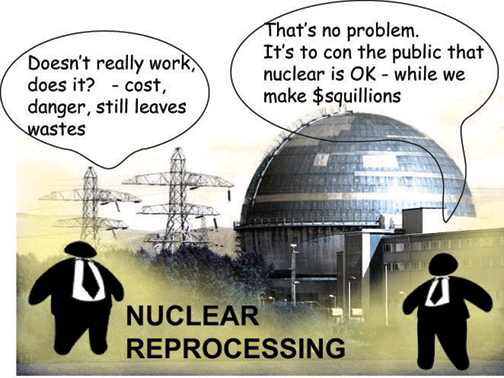
With regard to nonproliferation, the issue that mainly concerns us is that the fast reactor fuel cycle depends on reprocessing and recycling of its plutonium fuel (or uranium 233 if using thorium instead of uranium). Both plutonium and uranium 233 are nuclear explosives. Widespread use of fast reactors for electricity generation implies large quantities of nuclear explosives moving through commercial channels. It will not be possible to restrict such use to a small number of countries. The consequent proliferation dangers are obvious. And while it is doubtful the U.S. fast reactor project will lead to commercial exploitation—few, if any, projects from DOE ever do—U.S. pursuit of this technology would encourage other countries interested in this technology, like Japan and South Korea, to do so.
One should add that one of the claims of enthusiasts for recycling spent fuel in fast reactors is that it permits simpler waste management. This is a complicated issue, but the short answer is that rather than simplifying, reprocessing and recycling complicate the waste disposal process.
With all these concerns, and the lack of a valid economic benefit, why does the Energy Department want to start an “aggressive” and expensive program of fast reactor development? It’s true that so far only exploratory contracts have been let, on the order of millions of dollars (to GE-Hitachi). But the Department is already leaning awfully far forward in pursuing the VTR. It estimates the total cost to be about $2 billion, but that’s in DOE-speak. We’ve learned that translates into several times that amount.
But beyond that, the nuclear engineering community, and the wider community of nuclear enthusiasts, have never given up the 1960s AEC dream of a fast breeder-driven, plutonium-fueled world. Such reactors were to have been deployed by 1980 and were to take over electricity generation by 2000. It didn’t even get off the ground, in part because of AEC managerial incompetence, but mainly because it didn’t make sense.
After the 1974 Indian nuclear explosion and the realization that any country with a small reactor and a way to separate a few kilograms of plutonium could make a bomb, proliferation became a serious issue. In 1976 President Gerald Ford announced that we should not rely on plutonium until the world could reliably control its dangers as a bomb material. The plutonium devotees never accepted this change. Jimmy Carter froze construction of an ongoing fast-breeder prototype, the Clinch River Reactor, about three time the size of the proposed VTR. Ronald Reagan tried to revive it but, as its rationale thinned and its cost mounted, Congress shut it down in 1983. The plutonium enthusiasts thought they got their chance under George W. Bush with a fast reactor and a reprocessing and recycling program under of the rubric of Global Nuclear Energy Partnership. But it was so poorly thought out it didn’t go anywhere. More or less the same laboratory participants are now pushing the VTR.
The DOE advanced reactor program has many irons in the fire, mostly in the small reactor category. But do not be misled. They are mostly small potatoes without much future. Only the fast reactor project is the real thing, bureaucratically, that is. Although at this point DOE has only contracted for conceptual design, the follow-up will cost many millions and take many years. Nothing attracts national laboratories, industrial firms, and Washington bureaucracies as much as the possibility of locking into a large multiyear source of funding.
Congress needs to look hard at the rationale for a fast reactor program. This means getting into the details. At a Senate Appropriations hearing last month on advanced reactors, Sen. Dianne Feinstein said rather plaintively, “We cast the votes, and cross our fingers hoping nothing bad will happen.” That’s not good enough.
Victor Gilinsky is program advisor for the Nonproliferation Policy Education Center (NPEC) in Arlington, Virginia. He served on the Nuclear Regulatory Commission under Presidents Ford, Carter, and Reagan. Henry Sokolski is executive director of NPEC and the author of Underestimated: Our Not So Peaceful Nuclear Future (second edition 2019). He served as deputy for nonproliferation policy in the office of the U.S. secretary of defense in the Cheney Pentagon.
February 11, 2019
Posted by Christina Macpherson |
Reference, reprocessing, USA |
Leave a comment
 Report: Trump Inaugural Committee Under Investigation for Possible Finance Crime, Slate By MOLLY OLMSTEAD, DEC 13, 2018 “………..Prosecutors also asked for documents from Tennessee developer Franklin Haney, the Journal reported. Haney made a $1 million donation to the inaugural committee and, in April, hired Cohen to help him obtain a $5 billion loan from the U.S. government, among other funding, for a pair of nuclear reactors in Alabama. Prosecutors asked him for documents related to any correspondence with members of the committee. ……
This investigation opens another possible route of inquiry into potentially criminal behavior by those in Trump’s orbit during the campaign and transition period. https://slate.com/news-and-politics/2018/12/trump-inaugural-committee-federal-investigation.html
February 11, 2019
Posted by Christina Macpherson |
politics, secrets,lies and civil liberties, USA |
Leave a comment