Secret Underground Nuclear City In The Arctic | A Potential Threat
WW3 FEARS: Pentagon’s secret underground tunnels of MOBILE NUCLEAR bases REVEALED THE US government built a fully-functioning mobile nuclear base below the ice ofGreenland in preparation for war, it was revealed during a documentary. https://www.express.co.uk/news/world/1084951/ww3-fears-pentagon-mobile-nuclear-base-greenland-sptIn 1960, the United States ran a highly publicised project known as Camp Century on the island to study the feasibility of working below the ice. However, declassified files show it was actually a cover-up for a top-secret Cold War programme. Project Iceworm was the code name for the United States Army’s mission to build a network of mobile nuclear missile launch sites.
The ultimate objective was to place medium-range missiles under the ice — close enough to strike targets within the Soviet Union.
YouTube series “The Real Secrets of Antarctica” revealed how the project came to light in January 1995.
The 2017 documentary detailed: “Some very interesting disclosures were declassified about US military installations in Greenland which took place in the 1960s.
“They fed the American people a highly publicised story about advances in research and building an underground city below Greenland called Camp Century.
Only later did the truth about Project Iceworm surface.
“The Pentagon was attempting to put in place mobile nuclear launching sites to utilise thousands of miles of tunnels.”
Project Iceworm was to be a system of tunnels 2,500 miles in length, used to deploy up to 600 nuclear missiles, that would be able to reach the Soviet Union in case of nuclear war.
The missile locations would be under the cover of Greenland’s ice sheet and were supposed to be periodically changed.
A total of 21 trenches were cut and covered with arched roofs within which prefabricated buildings were erected.
These tunnels also contained a hospital, a shop, a theatre, and a church and the total number of inhabitants was around 200.
From 1960 until 1963 the electricity supply was provided by means of the world’s first mobile nuclear reactor, named PM-2A.
Water was supplied by melting glaciers and tested to determine whether germs were present, including tests for the plague virus.
However, just three years after it was built, ice core samples taken by geologists demonstrated that the glacier was moving much faster than anticipated and would destroy the tunnels and planned launch stations in about two years.
The facility was evacuated in 1965, and the nuclear generator removed.
Project Iceworm was canceled, and Camp Century closed in 1966.
Feds sue Hanford contractor, claiming kickbacks and lies defrauded taxpayers out of millions, Tri City Herald , BY ANNETTE CARY, FEBRUARY 08, 2019 RICHLAND, WA
The Department of Justice filed a civil lawsuit Friday against Hanford contractor Mission Support Alliance, accusing it of defrauding the federal government out of tens of millions of taxpayer dollars.
Also named in the lawsuit are former Mission Support Alliance President Frank Armijo, Lockheed Martin Corp. and Lockheed Martin Services Inc……….
The Justice Department is accusing Mission Support Alliance of using half-truths, omissions, kickbacks and outright lies before its purchase by Leidos to get the Department of Energy to consent to a $232 million subcontract to a company with which it had ownership ties.
Lockheed Martin Corp. was a principal owner of Mission Support Alliance in 2010, when Mission Support Alliance awarded a subcontract for information technology services at Hanford to Lockheed Martin Services Inc.
The lawsuit alleges that from 2010 to 2015 the defendants misrepresented billing rates charged to DOE, the effort estimated to be needed to complete work and the anticipated additional profit for the subcontractor.
“Defendants’ fraud allowed them to obtain grossly inflated and improper additional profit on the subcontract,” the Justice Department said in a news release.
The lawsuit said that estimates of costs for payment rates were inflated in some cases by basing them on far more employees to perform work than Lockheed Martin Services Inc. included in its internal budget.
In some cases DOE was billed by both Mission Support Alliance and Lockheed Martin Services Inc. for the same labor, the lawsuit said.
‘GROSSLY INFLATED PRICING’ CLAIMS
The profit paid for Lockheed Martin Services Inc. work was in addition to money Lockheed Martin Corp. was already earning on the same work through its partial ownership of Mission Support Alliance, according to the Justice Department.
DOE repeatedly made clear that the subcontractor, Lockheed Martin Services Inc., could not earn profit on top of what its owner was already being paid through Mission Support Alliance, the lawsuit said.
Armijo, and Rich Olsen, the Mission Support Alliance chief financial officer, also worked on behalf of Lockheed Martin Corp. and misused their positions at Hanford to help Lockheed Martin Corp. obtain grossly inflated pricing, the Justice Department alleged.
In addition to serving at times as the Mission Support Alliance president, Armijo also was a vice president of Lockheed Martin Corp., the lawsuit said.
HANFORD OFFICIALS ALLEGEDLY PAID KICKBACKS
The Justice Department said some employees, including Armijo, told DOE that the subcontractor’s pricing did not contain any additional profit for the subcontract for the same work on which Lockheed Martin Corp. was already earning profit through its ownership of Mission Support Alliance.
The millions of dollars that Armijo and other employees were paid in cash and stock as part of an incentive program amounted to kickbacks for improperly using their Mission Support Alliance positions to provide favorable treatment for Lockheed Martin Corp., the Justice Department alleges. ………https://www.tri-cityherald.com/news/local/hanford/article226014785.html
Central to the meeting in Vietnam is what the U.S. might offer Kim in return for concrete steps to relinquish his nuclear arsenal, WSJ, By Andrew Jeong andTimothy W. Martin, Feb. 8, 2019 SEOUL—The U.S. special envoy for North Korea concluded three days of nuclear-disarmament talks in Pyongyang ahead of the second summit between President Trump and North Korean leader Kim Jong Un, scheduled for this month in Vietnam, expressing confidence that “real progress” was possible if both sides remain committed…….(subscribers only) https://www.wsj.com/articles/u-s-envoy-voices-optimism-ahead-of-north-korea-nuclear-summit-11549684347
How the Green New Deal Almost Went Nuclear on Its First Day, Yahoo Finance, Ari Natter and Jennifer A. Dlouhy, Bloomberg, February 9, 2019 — As Democrats unveiled their ambitious Green New Deal to fight climate change on Thursday, a controversy erupted over the role of nuclear power that threatened to undermine the whole effort.
A fact sheet distributed by the office of progressive newcomer Alexandria Ocasio-Cortez, a Democratic representative from New York, said there was no room in the nation’s all renewable-energy future for nuclear plants.
But the reference caught many off guard and back-peddling ensued.
Giselle Barry, a spokeswoman for Senator Ed Markey, a Massachusetts Democrat who is the Green New Deal’s lead Senate backer, disowned the fact sheet and said Markey’s office wasn’t consulted before it was sent out. “We did not draft that fact sheet,” she said.
The stumble irked potential supporters. It also illustrated the political challenges ahead as supporters of the Green New Deal struggle to build consensus on issues that divide environmentalists as well as lawmakers.
Markey sought to do damage control at a midday press conference, emphasizing the proposed resolution doesn’t address specific energy technologies. Language on nuclear power “is not part of this legislation,” he said. “The resolution is silent on any individual technology that can move us to a solution.”
The plan, in the form of a non-binding resolution, weaves together what had been a hodgepodge of progressive proposals and aspirations into a single initiative. It sets a goal of shifting the nation to 100 percent “clean, renewable, and zero-emission energy sources,” within 10 years “to achieve net-zero greenhouse gas emissions through a fair and just transition for all communities and workers.”
The proposal has gathered 60 co-sponsors in the House but has little chance of gaining support in the Republican-controlled Senate, let alone being signed into law by President Donald Trump.
House Speaker Nancy Pelosi, who hasn’t explicitly thrown her support behind the Green New Deal, didn’t appear at the unveiling. She described the plan at another event as “one among many” ways to address climate change.
Some of the biggest climate champions in the Senate, including Sheldon Whitehouse, a Democrat from Rhode Island who delivers frequent floor speeches on the urgent need to act, were notably absent from the news conference unveiling the Green New Deal. For any effort to succeed, it will need support from long-time environmental policy advocates in Congress as well as the ardent activists that have rallied behind Ocasio-Cortez’s vision.
The scale and ambition of the initiative also presents problems. Ocasio-Cortez has pitched it not just as an environmental solution but also a World-War II-style “mobilization” against income inequality and social injustice.
That invites criticism that the whole gambit is socialism run amok. The Chamber of Commerce slammed the proposal in a statement that invoked “failed socialist policies.”
Opposition on the left emerged over the plan’s failure to eventually ban fossil fuels, the leading source of the carbon dioxide emissions linked to global warming.
Friends of the Earth president Erich Pica praised the resolution as “a good first step,” but said it was incomplete. “By failing to expressly call for an end of the fossil fuel era, the resolution misses an opportunity to define the scope of the challenge,” Pica said…………https://finance.yahoo.com/news/green-deal-almost-went-nuclear-090000153.html
https://www.rt.com/usa/451098-hanford-nuclear-lockheed-lawsuit/10 Feb, 2019 Contractors involved in a multibillion decontamination effort at the notorious Hanford nuclear site have been accused of defrauding US taxpayers, according to a lawsuit against Mission Support Alliance and Lockheed Martin.
MSA has a 10-year, $3.2 billion contract with the Department of Energy (DOE) to support the decontamination effort at the decommissioned nuclear production complex known as the Hanford Site. Allowed to pick subcontractors for the nation’s largest and most expensive environmental cleanup at its own discretion, MSA abused its authority and awarded “improper favorable treatment” for kickbacks, the Justice Department claimed this week.
The lawsuit alleges that Lockheed Martin Corporation (LMC) and Lockheed Martin Services Inc. (LMSI) paid more than $1 million to executives of MSA – which was conveniently co-owned by another Lockheed subsidiary at the time – in order to secure a $232 million subcontract to provide management and technology support at the Washington state nuclear site from 2010-2016.
The services were provided at “inflated rates” and in some cases the DOE was even billed twice, by both MSA and Lockheed, for the same work. In addition, the suit accuses Jorge Francisco Armijo, who served as both the Vice President of LMC and President of MSA, of abusing his authority for financial gain by his simultaneously held posts.
“Where Congress has allocated money for specific purposes, we will not tolerate unlawful conduct by contractors who seek to enhance their profits at the expense of taxpayers,” said Assistant Attorney General Jody Hunt of the Department of Justice’s Civil Division.
Lockheed immediately denied the allegations of being involved in the corruption scheme, rejecting any notion that the “corporation or its executives engaged in any wrongdoing.” MSA also brushed aside the accusations, claiming that the company “stands behind” their employees.
The 586-square-mile former nuclear research facility was used to produce plutonium for the nuclear bomb in the Manhattan Project. After over four decades of nuclear fuel production, the site was closed down in 1987, requiring an extensive clean-up of solid and liquid wastes left from the weapons production processes.
The fate of one of the world’s most dangerous atomic reactors is now in the hands of California governor Gavin Newsom.
His vital decision is whether to order cheap, simple, structural tests at Diablo Canyon Unit One, which is currently shut for refueling. Please call him and ask him to do so at (916) 445-2841 and/or sign our moveon.org petition, and contact me at solartopia.org. You may also FAX him: at (916)558-3160 or write him at the Capitol in Sacramento, CA 95814.
Like all things nuclear, the legal situation is complicated, but the economic and safety issues are not.
Diablo Canyon’s owner, Pacific Gas & Electric, is bankrupt.
PG&E is also on legal probation, having been convicted of various felonies for killing eight San Bruno residents in an avoidable 2010 gas explosion. PG&E’s pipes blew up because the company deferred maintenance to save itself some money.
PG&E did the same to northern California power lines that ignited at least 17 fires in which scores died and a thousand homes burned.
The company has been sued for billions, forcing the bankruptcy. Its probation officer, Federal Judge William Alsup, recently asked PG&E’s president, should I “let you keep killing people?”
The rise and demise of the Clinch River Breeder Reactor, Bulletin of the Atomic Scientists, By Henry Sokolski, February 6, 2019This year marks the 36th anniversary of the termination of the Clinch River Breeder Reactor Project, a federally funded commercial demonstration effort. In the very early 1980s, it was the largest public-works project in the United States. Japan, South Korea, China, France, Russia, and the United States are now all again considering building similar plants. For each, how and why Clinch River was launched and killed is a history that speaks to their nuclear future. This history involves more than cost benefit analysis. For the public and political leadership, facts and arguments rarely close an initial sale of a large government-funded, high-tech commercialization program. Nor do they generally goad officials to abandon such projects. Such acts are fundamentally political: Fears and hopes drive them. Certainly, to understand why the US government launched and subsequently killed Clinch River requires knowledge not just of what the public and its political leadership thought, but also of how they felt.
Unwarranted fears of uranium’s scarcity fueled interest in fast-breeder reactors. …….in 1945, uranium 235, a fissile uranium isotope that can readily sustain a chain reaction, was believed to be so scarce, it was assumed there was not enough of it to produce nuclear electricity on a large scale. Scientists saw the answer in fast-breeder reactors………
The Atomic Energy Commission publicly promoted their commercialization with confident, cartoonish optimism. In one publication, the commission asked the upbeat question: “Johnny had three truckloads of plutonium. He used three of them to power New York for a year. How much plutonium did Johnny have left?” The answer: “Four truckloads.”
Unfortunately, this pitch glossed over two stubborn facts. First, because plutonium is so much more toxic and difficult to handle than uranium, it is many times more expensive to use as a reactor fuel than using fresh uranium. Second, because plutonium fast-breeder reactors use liquid metal coolants, such as liquid sodium, operating them safely is far more challenging and expensive than conventional reactors.
When private industry tried in the early 1960s to operate its own commercial-sized fast-breeder, Fermi I, the benefits were negative. Barely three years after Fermi 1 came online, a partial fuel meltdown in 1966 brought it down. It eventually resumed operations before being officially shut down in 1972.
These facts, however, are rarely emphasized. Those backing breeders—whether it be in 1945, 1975, or today—focus not on reliability and economics, but rather that we are about to run out of affordable uranium. For the moment, of course, we are not. Uranium is plentiful and cheap as is enriching it. This helps explain why the United Kingdom, France, Germany, Japan, and the United States, no longer operate any commercial-sized fast-breeder reactors and are in no immediate rush to build new ones………
When the Atomic Energy Commission argued the case for building a breeder reactor in the late 1960s and early 1970s, it projected 1,000 reactors would be on line in the United States by the year 2000 (the real number turned out to be 103) and that the United States would soon run out of affordable uranium. Also, by the mid-1960s, the commission needed a new, massive project to justify its continued existence. Its key mission, to enrich uranium for bombs and reactors, had been completed and was overbuilt. The commission was running out of construction and research projects commensurate with its large budget. A breeder-reactor- commercialization program with all the reprocessing, fuel testing, and fuel fabrication plants that would go with it, seemed a worthy successor.
But the most powerful political supporter of Clinch River, then-President Richard Nixon, focused on a different point. Nixon saw the project less as a commercial proposition than as a way to demonstrate his power to secure more votes by providing government-funded jobs while at the same time affirming his commitment to big-science, engineering, and progress……….
the Energy Department videotaped safety tests it had conducted of how molten sodium might react once it came in contact with the reactor’s concrete containment structure. Concrete contains water crystals. Molten sodium reacts explosively when it comes in contact with oxygen, including oxygen contained in water. What the test demonstrated and the video showed was concrete exploding when it came in contact with liquid sodium.
This set off waves of worry at the department………
Just weeks before the final vote, the Congressional Budget Office released its financial assessment of the Energy Department’s last ditch effort to use loan guarantees to fund the project. Even under the most conservative assumptions, the budget analysts determined that the loan guarantees would only increase the project’s final costs. This helped push the project over a political cliff. The final Senate vote: 56 against, 40 for. All of the 16 deciding votes came from former Clinch River supporters.
No commercial prospects? Militarize. Nixon backed numerous science commercialization projects like Clinch River, including the Space Shuttle Program and the supersonic transport plane……… While the Space Shuttle Program won congressional support, the envisioned satellite contracts never materialized. The program became heavily dependent on military contracts. Finally, our national security depended upon it.
Although Clinch River never was completed, as its costs spiraled, it too attracted military attention. …….
Essentially, it didn’t matter when you asked–1971 or 1983—Clinch River was always another seven years and at least another $2.1 billion away from completion. ……
With Clinch River, what we now know, we may yet repeat. Fast-reactor commercialization projects and support efforts, such as Argonne National Laboratory’s Small Modular Fast Reactor, the US-South Korean Pyroreprocessing effort, the Energy Department’s Virtual (Fast) Test Reactor, France’s Astrid Fast Reactor Project, the PRISM Reactor, the TerraPower Traveling Wave reactor, India’s thorium breeder, Russia’s BN-1200, China’s Demonstration Fast-Breeder Reactor, continue to capture the attention and support of energy officials in Japan, China, Russia, South Korea, France, the US, and India. None of these countries have yet completely locked in their decisions. How sound their final choices turn out to be, will ultimately speak to these governments’ credibility and legitimacy.
In the case of Clinch River, the decision to launch the program ultimately rested on a cynical set of political calculations alloyed to an ideological faith in fast reactors and the future of the “plutonium economy.” Supporters saw this future clearly. As a nuclear engineer explained to me in 1981 at Los Alamos National Laboratory, the United States technically could build enough breeder reactors to keep the country electrically powered for hundreds of years without using any more oil, coal, or uranium. When I asked him, though, who would pay for this, he simply snapped that only fools let economics get in the way of the future.
This argument suggests that the case for fast reactors is beyond calculation or debate, something mandatory and urgent. That, however, never was the case, nor is it now. Instead, the equitable distribution of goods, which is a key metric of both economic and governmental performance (and ultimately of any government’s legitimacy and viability), has always taken and always must take costs into account. In this regard, we can only hope that remembering how and why Clinch River was launched and killed will help get this accounting right for similar such high-tech commercialization projects now and in the future. https://thebulletin. org/2019/02/the-rise-and- demise-of-the-clinch-river- breeder-reactor/?utm_source= Bulletin%20Newsletter&utm_ medium=iContact%20email&utm_ campaign=ClinchRiver_February6
The Nuclear Regulatory Commission has proposed to have a $7,250 fine levied Concerns over the operation of a nuclear reactor at the Denver Federal Center has one arm of the federal government proposing to fine another and a reactor supervisor has been reassigned with his access revoked.
The Nuclear Regulatory Commission has proposed to have a $7,250 fine levied against the U.S. Geological Survey for “research reactor violations,” according to an NRC news release dated Tuesday.
The NRC carried out two separate investigations of the TRIGA (Training, Research, Isotopes, General Atomics) nuclear reactor, which is used for research, and found violations associated with staffing and training requirements, the release stated.
One investigation was completed on Jan. 18, 2018, the other on June 12, 2018, according to a notice of violation letter which identified the supervisor as Brycen Roy.
Roy, who was reached Friday night by phone, declined comment.
The USGS has “implemented corrective actions,” according to the release, but not before “pausing reactor operations to allow for an assessment of the violations and the operational culture of the reactor organization.”
One violation involved “deliberately falsified documentation showing that reactor operators had completed required training, when in fact the training never took place,” the NRC said. The supervisor presented “false documentation” to an NRC inspector, according to the release
A second investigation found that the supervisor “violated staffing requirements by performing certain reactor tests without a second qualified person present, as required by NRC regulations.”
The USGS can dispute the violation and penalty, or could agree to third-party mediation, the release stated.
The Denver Federal Center, a 623-acre campus which houses 28 agencies in 44 buildings, is surrounded by Lakewood. It’s west of Kipling Street, south of West 6th Avenue and north of West Alameda Avenue.
An inadequate focus on researching and understanding the role of the environment in cancer prevention is a failure for public health.Laura N. Vandenberg 8 Feb 19,
In his 2019 State of the Union address on Tuesday night, President Trump called for $500 million over the next 10 years to fund research on childhood cancers.
Such funding is crucial to continue tackling the devastating disease. However, missing from the State of the Union—and most other conversations about tackling cancer—is a focus on prevention, specifically the need to research, understand and communicate the role environmental exposures play in cancer risk.
The numbers on cancer incidence and deaths are complex. Although childhood cancer mortality rates have dropped considerably from the 1960s, data from the American Cancer Society shows that incidence rates have increased 0.6 percent per year since 1975.
In this way, childhood cancers are like several others. Between 2005 and 2014, yearly cancer incidence rates rose for several types: thyroid cancer by 4 percent; invasive breast cancer by 0.3 percent in black women; leukemia by 1.6 percent; liver cancer by 3 percent; oral and pharynx cancers by 1 percent in Caucasians; pancreatic cancer by 1 percent in Caucasians; colon cancer by 1.4 percent in individuals younger than 55 years of age; rectal cancer by 2.4 percent in individuals younger than 55; and melanoma by 3 percent in individuals aged 50 and older.
While these cancer rates have increased, overall rates of cancer deaths have started to fall. In fact, since the 1990s, improved detection and treatment, as well as decreased smoking rates, have contributed to significant reductions in cancer mortality.
Reduced deaths from cancer are a great public health victory. These statistics prove that public health interventions like educational programs designed to curb smoking can have dramatic effects.
They also suggest that investments in improved detection and diagnosis are money well spent. A focus on treatments has also improved quality of life for cancer patients and their likelihood of remission.
But where is the call for better cancer prevention? As rates of numerous cancers continue to rise, the failure to identify the causes of cancer remains a disappointment for public health officials and researchers alike.
We know that environmental factors can contribute to cancer risk. Some, like smoking, are avoidable. Others are lifestyle factors that people can change like drinking less alcohol, decreasing consumption of processed meats, using protection from the sun, and increasing exercise.
Yet, other environmental factors like exposures to chemicals in the environment, including endocrine disruptors, have received little attention. While some NIH-funded programs like the Breast Cancer and Environment Research Program have worked to identify chemicals in the environment that promote cancer, funding for cancer prevention initiatives has stagnated.
Despite the limited resources invested in studies of environmental risk factors for cancer, we know enough to take action on some chemicals of concern.
For example, communities contaminated with perfluorinated chemicals, several of which are known to cause cancer, have demanded attention from government officials in addition to asking for more research.
Individuals living in these communities have the right to know how they are being exposed, and what their risks might be – for cancer and other diseases.
It is great that cancer research was raised in the President’s State of the Union speech, and that the difficulties associated with caring for a family member with cancer was mentioned in Stacey Abrams’ rebuttal.
But a failure to focus on prevention, a failure to acknowledge the role of the environment in causing cancer, and a failure to allocate funds to prevention research, are all failures for public health.
Dr. Vandenberg is an Associate Professor of Environmental Health Sciences at the University of Massachusetts Amherst School of Public Health and Health Sciences. Her work on endocrine disrupting chemicals has been funded by the National Institutes of Health including the BCERP program, which focuses on the environmental causes of breast cancer
SSFL impasse – State disapproves of DOE’s final environmental study , Simi Valley Acorn, February 08, 2019, By Melissa Simon, melissa@theacorn.com State officials overseeing the cleanup at the Santa Susana Field Lab are criticizing a federal agency’s proposal to address contamination on its portion of the former rocket engine testing site. On Jan. 28, the California Department of Toxic Substances Control issued a letter accusing the U.S. Department of Energy of reneging on a 2010 cleanup agreement promising to remove all contamination in its part of the 2,850-acre field lab.
SSFL was used for 50 years in the development of ballistic missiles, rockets and space shuttle equipment. A partial nuclear meltdown occurred in Area IV in 1959, but it wasn’t made public until decades later. The DOE is responsible for removing soil and groundwater contamination in Area IV and the northern buffer zone.
“DOE ignores that its preferred alternative is inconsistent with the (agreement which) clearly defines DOE’s obligation to clean up soils in Area IV to background levels, or reporting limits if no background value exists, on a point-by-point basis,” DTSC officials said in the letter.
The state agency said it intends to hold the U.S. Department of Energy accountable to the requirements of the previous agreement, which involves a more thorough cleanup of the property.
The letter also requested that DOE extend the 30-day comment period, which closed at the end of January, through March 1 to allow more “meaningful public participation and opportunity for comment.”
The letter is in response to the Department of Energy’s final environmental study, which was released Dec. 18.
In the study, the federal agency called for the removal of the remaining buildings in Area IV—a radioactive materials handling facility and a hazardous waste management facility—and recommended a combination of treatment and monitoring to deal with the groundwater. It also proposed a “risk-based” soil cleanup plan, in which any contaminant found is removed. Environmentalists have argued in favor of removing much more soil………..
Five activist groups lobbying for complete site remediation, meaning they want to see the property restored to what it was before SSFL was built, voiced their objections the same day DTSC issued its letter.
The Natural Resources Defense Council, Physicians for Social Responsibility, Southern California Federation of Scientists, Committee to Bridge the Gap, and the Rocketdyne Cleanup Coalition all sent letters Jan. 28 accusing the DOE of breaching the legally binding 2010 agreement and violating fundamental environmental laws.
Denise Duffield, spokesperson for Physicians for Social Responsibility, told the Simi Valley Acorn this week that the DOE’s final study is an “unconscionable breach of its commitment to clean up all of its contamination at SSFL.”
DOE, Duffield asserts, wants to leave behind 98 percent of contamination and just “walk away from remediating much of the contaminated groundwater.”
“Polluters do not get to decide how much of their contamination they get to clean up,” she said. “Also, the (study) fails to take into account the devastating Woolsey fire, which started at and burned much of the contaminated SSFL in November.”
Duffield said her group wants local, state and federal officials to lean on the DOE to revise its final study……..
Across this nuclear triad, the takeaway for investors is, there’s a lot of money on the table up for grabs………Definitely going to be a bullish sign for these defense contractors going forward.
The $500 Billion Push to Modernize the Nuclear Triad, Cold War-era technology is due for replacement, but the cost is out of this world.,Motley Fool Staff, (the_motley_fool), Feb 5, 2019 .
On this segment of Industry Focus: Energy,The Motley Fool’s Nick Sciple and Fool.com contributor Lou Whiteman discuss a Congressional Budget Office report that estimates the U.S. needs to invest nearly $500 billion to modernize its nuclear weapon systems. That includes new submarines, bombers, and rockets, as well as the systems that support them.
A full transcript follows the video…..
Lou Whiteman “……..The CBO just updated a study on the triad. They determined almost $500 billion, $494 billion, needs to be spent in the next 10 years on nuclear triad modernization. That’s up considerably, 20% or more, from their 2017 estimate. Part of that is, we have a road map for some of this spending. Part of it is, now, we’re getting into the years where hopefully, those investments will be made. So, some of that increase was expected. But it’s a massive amount, half $1 trillion is going to go into new bombers, new subs, new rockets, new warheads to put on them, plus all the support. It’s a huge area. The details, some of them have to be worked out, but it’s almost guaranteed revenue for some of these companies, the lucky winners of these, because it’s a huge priority for the United States…….
Sciple: Let’s talk about some of these items. Northrop Grumman is developing a new bomber, the B-21. The number that I saw is, between now and 2028, the Pentagon is expected to spend $49 billion on that program. Can you talk about the significance of that aircraft for Northrop Grumman, as well as for our defense arsenal as a country?
Whiteman: That’s the keystone project for Northrop Grumman. They won that bomber. It’s been a slow road……. This is a huge expense. They’re doing their best to modernize it. It’s replacing an aircraft that isn’t that old…….
Whiteman: Naval is a big part of the bull story on General Dynamics ……….
Whiteman: ………The Minuteman is our go-to rocket. It needs to be replaced. That’s the only part of this triad that we don’t know who the eventual winner is. It’s going to be a big deal for either Northrop or Boeing.
………Sciple: Across this nuclear triad, the takeaway for investors is, there’s a lot of money on the table up for grabs………Definitely going to be a bullish sign for these defense contractors going forward.
SOUTH CAROLINA SPENT $9 BILLION TO DIG A HOLE IN THE GROUND AND THEN FILL IT BACK IN, The Intercept, Akela LacyFebruary 6 2019
THE OBJECTION RAISED most frequently when it comes to a Green New Deal is its cost. It’s preposterous; it’s too expensive; we just can’t afford it.
But before scoffing at the prospect of the wealthiest nation in the history of the world funding such a project, it’s worth taking a look at what one of the country’s poorest states was recently able to spend.
South Carolina, in a bid to expand its generation of nuclear power in recent years, dropped $9 billion on a single project — and has nothing to show for it.
The boondoggle, which was covered widely in the Palmetto State press but got little attention nationally, sheds light on just how much money is genuinely available for an industrial-level energy transformation, if only the political will were there.
There are no firm figures tied to a Green New Deal, but former Green Party presidential candidate Jill Stein’s proposed version of the project would have cost between $700 billion and $1 trillion. The new plan, being crafted with the help of progressive groups like the Sunrise Movement and pushed to the top of the House legislative agenda by Alexandria Ocasio-Cortez and other progressives, promises more substantial change on a much shorter schedule. In addition to moving the U.S. to 100 percent renewable energy in 10 years, upgrading all residential and industrial buildings for energy efficiency, and eliminating greenhouse gases from manufacturing and agriculture, it includes a jobs guarantee and a recognition of the rights of tribal nations. Ocasio-Cortez and Massachusetts Sen. Ed Markey are planning to introduce legislation for the plan this week, Axios reported.
In South Carolina, lawmakers greenlighted a multibillion-dollar energy project and stuck utility customers with the tab. “In the private sector,” former Nuclear Regulatory Commissioner Gregory Jaczko told The Intercept, “you would never be able to justify this.”
The saga, and related nuclear project failures, calls into question the role of new nuclear energy production in the effort to decarbonize the economy. New plants, Jaczko said, take too long to build for the urgency of the climate crisis and simply aren’t cost effective, given advances in renewable energy. “I don’t see nuclear as a solution to climate change,” Jaczko said. “It’s too expensive, and would take too long if it could even be deployed. There are cheaper, better alternatives. And even better alternatives that are getting cheaper, faster.”
The Nuclear Boondoggle
It started in 2008. SCE&G and Santee Cooper announced plans to add two nuclear reactors to the V.C. Summer Nuclear Station in Jenkinsville, South Carolina, ……….
Left With the Tab
Thanks to a state law passed in 2007, residents in South Carolina are footing the bill for a massive failed nuclear reactor program that cost a total of $9 billion. Analysts say that corporate mismanagement and poor oversight means residents and their families will be paying for that failed energy program — which never produced a watt of energy — for the next 20 years or more.
South Carolina Attorney General Alan Wilson has since called parts of the law, the Base Load Review Act, “constitutionally suspect,” and state senators have voted to overturn it — but that wouldn’t necessarily get ratepayers off the hook for paying for the failed project.
The two South Carolina companies, South Carolina Electric & Gas and Santee Cooper, a state-owned utility, spent $9 billion on a plan to build two nuclear reactors and eventually canceled it due to a series of cost miscalculations and corporate buyouts that left one construction company bankrupt and sent shockwaves all the way to Japanese tech giant Toshiba.
……….because nuclear power involves heavier upfront capital costs and financing charges, Jaczko explained, states looking to revive nuclear power tried to bypass those extra costs by passing laws allowing companies to save money by recovering the cost of financing the projects during the period of construction.
“Even the law that was written in South Carolina envisioned the fact that the project could get canceled. But of course everybody promised that that wouldn’t happen,” Jaczko said……..
For conservatives and corporate-friendly Democrats, the idea of spending absurd amounts of money on a comprehensive national plan to wean the economy off dirty energy and create sustainable jobs is out of the question. It’s an idea much easier to swallow when its stated purpose is corporate profit, as in South Carolina. Or at the federal level, national defense. President Donald Trump signed into law last summer a $717 billion defense bill, up from $600 billion in 2016, and around $300 billionin 2000. In December the president tweeted that U.S. military spending was “Crazy!”
For scale, the national deficit for fiscal year 2019 is just shy of $1 trillion. Of the $4.4 trillion federal budget, military spending across agencies makes up close to $800 billion. The federal government spent about $1.1 trillion on health care in 2018. The latest government shutdown cost the U.S. an estimated $11 billion, the Congressional Budget Office reported. Trump requested $5.7 billion for a border wall, and Republicans in the House found it.
But $9 billion and zero nuclear reactors later, ratepayers in South Carolina have no say after their legislators played with the state’s resources and lost. If one state can throw away $9 billion on a project that never happened, legislators in Washington will have a difficult time claiming that they can’t find federal dollars to finance a plan that 81 percent of registered voters support.
“We can pay for a Green New Deal in the same way we pay for — whether it’s wars, or tax cuts, or any of the other great social programs that we have,” Greg Carlock told The Intercept. He’s a senior adviser at Data for Progress, where he authored a report outlining policy proposals for the Green New Deal. Unlike Ocasio-Cortez, Carlock says he disagrees with the argument that you have to tax the wealthy, or the middle class, to pay for a Green New Deal. Instead, he argues, Congress should just authorize new spending, like it does for everything else………
Investing in clean energy, sustainable jobs, and a basic standard of health care would actually save money in the long run — tens to hundreds of billions of dollars per year, according to a climate assessment released under the Trump administration this year. The argument that the money isn’t there just doesn’t hold up.
“Any politician whose first question about the Green New Deal is how to pay for it isn’t taking seriously the millions who will die if we fail to take action on the scale scientists say we need,” Stephen Hanlon, communications director for the Sunrise Movement, said in a statement to The Intercept.
“What we are talking about is a putting millions of people to work so they can buy food for their families, etc. This is the greatest investment in the American economy in generations, and that kind of investment pays substantial dividends,” Hanlon said.
“We will pay for this the same way we paid for the WWII (sic) and the original New Deal: deciding it’s a priority as a nation and that we can’t afford not to take action.”
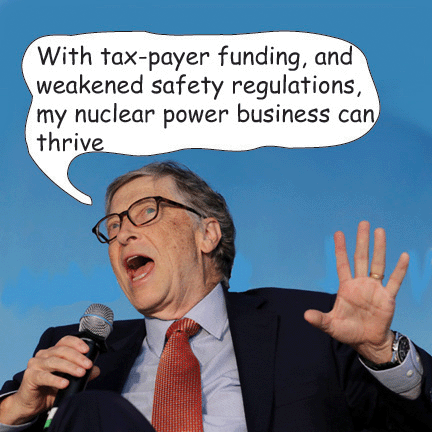
Nuclear power is so uneconomical even Gates can’t make it work without billions from taxpayers.
JOE ROMMFEB 4, 2019Nuclear power is so uneconomical that even Bill Gates, who is worth $90 billion, can’t make it work without massive taxpayer funding.
Gates has been going around Capitol Hill in recent weeks trying “to persuade Congress to spend billions of dollars over the next decade… for a pilot of his company’s never-before-used technology, according to congressional staffers,” the Washington Post reported.
“This plea for federal largesse from a decabillionaire illustrates why further nuclear subsidies make no sense,” energy and finance expert Greg Kats writes in a forthcoming article for GreenBiz.com shared with ThinkProgress. Kats served as director of finance for the Department of Energy’s (DOE) Office of Energy Efficiency and Renewable Energy in the mid-1990s. (Disclosure: The author of this piece worked with Kats at the time as DOE acting assistant secretary.)
The reality is that nuclear power is so uneconomical that existing U.S. nuclear power plants are bleeding cash — and in many places it’s now cheaper to build and run new wind or solar farms than to simply run an existing nuclear power plant.
Saving the existing unprofitable nuclear plants would require a subsidy of at least $5 billion a year, according to an analysis last July by the Brattle Group.
So, given existing plants are so uneconomic, it’s no shock that building and financing an entire new fleet of nuclear plants is wildly unaffordable — especially since a new nuclear plant can cost $10 billion or more.
The nuclear industry has effectively priced itself out of the market for new power plants, at least in market-based economies. That’s why nuclear power’s share of global power generation has dropped to around 11 percent — its lowest level in decades.
The November “Cost of Energy Analysis 2018” by the financial firm Lazard Ltd makes clear just how untenable nuclear power is.
Even worse for nuclear, the price of electricity from new renewable plants and new nuclear plants have been headed in opposite directions for this entire decade.
Lazard reports that since 2010, the cost of wind power has dropped by 66 percent, the cost of solar power has dropped 83 percent, but the cost of nuclear power has increased by more than 50 percent.
The average lifecycle cost of electricity from new nuclear plants is now $151 per megawatt-hour, or 15.1 cents per kilowatt-hour (c/kWh). Meanwhile it is 4.3 c/kWh for utility scale solar and 4.2 c/kWh for wind. By comparison, the average price for electricity in the United States is under 11 cents per kWh.
Gates and his company, TerraPower, are working on so-called small modular reactors (SMRs), which use unproven next-generation technology and would be much smaller than current nuclear plants. Gates claims that this technology is needed in order to help drive down the price of nuclear power.
But the reality is that an SMR “worsens” the cost problem, as physicist M.V. Ramana explained in a December 2017 analysis.
“Larger reactors are cheaper on a per megawatt basis,” Ramana pointed out, “because their material and work requirements do not scale linearly with generation capacity.” In short, bigger reactors deliver cheaper power than smaller ones — that’s why the industry has kept scaling up the size over the years.
Yet in 2016, a major study by South Australia’s nuclear royal commission concluded that both large nukes and SMRs “consistently deliver strongly negative NPVs” (net present values) for both 2030 and 2050 — even for the strong climate action scenario. In other words, both large and small nuclear plants are projected to be unprofitable even in a future where carbon pollution has a high price.
Even the nuclear-friendly French — who get 70 percent of their power from nuclear — can’t build an affordable, on-schedule next generation power plant. Last summer, for instance, the French utility EDF announced another delay and cost over-run for what would be the country’s first “third-generation” pressurized water reactor. Power magazine reported the price tag has “ballooned to €10.9 billion (USD $12.75 billion), triple the original budget.”
As for Gates’ TerraPower, analysts looking at the company’s specific design approach say the technology is just not ready for primetime. Last year, a major Massachusetts Institute of Technology report by nuclear power experts concluded such designs “require advances in fuel and materials technology to meet performance objectives.”
The company itself told the Washington Post in an email that it “has been researching new steel alloys.” But such alloys would need to be tested for years if not decades to prove they can withstand the intense bombardment of neutrons over the lifetime of the reactor.
The reality is that next generation nuclear power is still at the research phase. It is far from ready for a pilot that would be so expensive that even the world’s second richest man (after Amazon’s Jeff Bezos) isn’t willing to finance it himself, but has to go begging for federal money.
Gates asserted in a year-end blog post that “Nuclear is ideal for dealing with climate change, because it is the only carbon-free, scalable energy source that’s available 24 hours a day,”
But in fact, battery storage costs have plummeted this decade some 80 percent, meaning that we can increasingly use wind power when it isn’t windy and solar power when it isn’t sunny.
In places like Colorado, both wind power with storage and solar power with storage are vastly cheaper than new nuclear plants. Indeed, new Colorado wind farms with batteries already provide power at the same price as just running existing nuclear power plants.
Certainly, the climate crisis demands that we pursue all practical and economical approaches to cutting carbon pollution. And even some environmental groups are in favor of keeping existing nuclear plants running longer.
But as Kats explained, right now, new nuclear power plants are just far too expensive. What’s more, major investments in multibillion-dollar pilots and reactors could actually take away funds from clean energy technologies that would reduce vastly more
That’s not to say we shouldn’t keep investing in nuclear power research in the hope that someday it becomes affordable.
But given that we must make deep cuts in carbon pollution this decade to even have a chance of avoiding catastrophic climate change, we must focus the vast majority of our money today on vastly more affordable carbon-cutting technologies.
The Cost to Clean Up America’s Cold War Nuclear Waste Jumps to $377 Billion, The bill for a half century of nuclear weapons production is growing fast. https://www.popularmechanics.com/military/weapons/a26145608/nuclear-waste-cleanup-cost-377-billion/By Kyle Mizokami.Feb 5, 2019. The United States developed and built tens of thousands of nuclear weapons during the Cold War. A new report by the General Accounting Office (GAO) estimates the total cleanup cost for the radioactive contamination incurred by developing and producing these weapons at a staggering $377 billion, a number that jumped by more than $100 billion in just one year.
Most people think of the U.S. Department of Energy (DoE) and think of oil rigs, coal mines, solar energy panels, and wind farms. While the DoE does handle energy production—including nuclear power—it also handles the destructive side of nuclear energy. A large part of the DoE’s portfolio over the past several decades has been the handling of nuclear weapons research, development, and production. The DoE’s Office of Environmental Management (EM) is responsible for cleaning up radioactive and hazardous waste left over from nuclear weapons production and energy research at DoE facilities.
In 1967 at the height of the U.S.–Soviet nuclear arms race, the U.S. nuclear stockpile totaled 31,255 weapons of all types. Today, that number stands at just 6,550. Although the U.S. has deactivated and destroyed 25,000 nuclear weapons, their legacy is still very much alive. Nuclear weapons were developed and produced at more than one hundred sites during the Cold War. Cleanup began in 1989, and the Office of Environmental Management has completed cleanup at 91 of 107 nuclear sites, Still, according to the GAO, “but 16 remain, some of which are the most challenging to address.” Those sites include Lawrence Livermore National Laboratory in California, the Hanford site in Washington, and the Nevada National Security Site.
The Department of Energy’s cleanup responsibilities are a tall order and include, “(1) storing and treating about 90 million gallons of radioactive and hazardous waste located in nearly 240 large underground tanks at three sites across the country; (2) remediating millions of cubic meters of soil and more than 1 billion gallons of groundwater; (3) preparing and disposing of 2,400 metric tons of spent nuclear fuel and about 21 metric tons of surplus highly enriched uranium materials; and (4) deactivating and decommissioning about 1,700 excess facilities, some of which are highly contaminated.”
In 2017, the GAO estimated its Environmental Management office’s “environmental liability” at $268 billion. That number ballooned to $377 billion in 2018. That includes radioactive tank waste treatment, soil and groundwater remediation, the cost of closing and decommissioning older facilities, nuclear waste management, and the cost of disposing of surplus nuclear material—including plutonium, uranium, and spent fuel rods from nuclear power plants.
By far the most expensive site to clean up is the Hanford site, which manufactured nuclear material for use in nuclear weapons during the Cold War. In 2017, the DoE estimated site cleanup costs at $141 billion.
What’s driving cost growth? Cleaning up nuclear weapons and dealing with radioactive materials in particular is extremely complex. Not only is it expensive work to begin with, accidents happen, regulations change, cleanup “remedies” change, project-management issues crop up, and the scope of a project could suddenly grow as officials get a grasp on the problem.
Meanwhile, the Department of Energy is underfunding cleanup operations. Between 2011 and 2017, the Department of Energy spent $41.4 billion on cleanup costs. During that same time, the GAO estimates the EM’s “environmental liability grew by almost $105 billion, from $163 billion to $268 billion.” (That doesn’t even include the $109 billion spike between 2017 and 2018.) That’s the equivalent of taking one step forward and then being pushed seven steps back.
The Department of Energy’s job cleaning up nuclear waste is underfunded and will take decades more to complete. The Hanford site, for example, needs $4 billion a year to hit cleanup milestones but is only receiving $2.5 billion. What’s more, if arms-control treaties continue to unravel, the U.S. could act to boost its nuclear stockpile, adding to the DoE’s environmental woes.
Nuclear power in Utah? Senators say ‘yes, please,by Michael Locklear, February 5th 2019 , SALT LAKE CITY (KUTV) — State lawmakers are considering a non-binding resolution welcoming nuclear power to Utah, although opponents are concerned about the radioactive waste it would generate.
The resolution, sponsored by Republican Sen. Curt Bramble of Provo, was passed out of a Senate committee on Monday.
It “recognizes that advanced nuclear technology is a safe, resilient, and environmentally sustainable energy resource.”……..
Utah Associated Municipal Power Systems, working with a company called NuScale, is planning a nuclear facility to be built in Idaho. It’s now moving through the regulatory process. Construction could begin in 2026. ………
Michael Simpson, the chair of the University of Utah’s metallurgical engineering department said nuclear power is cleaner, but he raised concerns about the cost and the nuclear waste.
“The state of Utah should be wary of starting a project to build a nuclear reactor if there’s no place for them to send the fuel,” Simpson said.
“It really is incredibly poisonous stuff,” said Michael Shea of the environmental nonprofit HEAL Utah, “and even if they can store it within the site itself, there’s still a lot of potential for contamination or accidents.” ………
A spokeswoman for Rocky Mountain Power said the utility had no plans to build a nuclear facility, with a statement that reads: “Our most recent Integrated Resource Plan (2017 IRP) included a cost analysis that reflected nuclear generation to be more costly than other resources. However, we are always evaluating emerging technologies to support future needs.”