nuclear-news

The News That Matters about the Nuclear Industry Fukushima Chernobyl Mayak Three Mile Island Atomic Testing Radiation Isotope

  • Home
  • 1 This Month
  • ACTION !
  • Disclaimer
  • Links
  • PAGES on NUCLEAR ISSUES

Iranian Foreign Minister Mohammad Javad Zarif accuses USA of hypocrisy over plannned nuclear technology sales to Saudi Arabia

Zarif decries ‘US hypocrisy’ over planned nuclear sale to Saudis
Neither human rights or a burgeoning nuclear programme are a real concern for the US, Iran’s foreign minister says. Aljazeera, 21 Feb 19, Iranian Foreign Minister Mohammad Javad Zarif accused the US of hypocrisy for allegedly attempting to sell nuclear technology to Saudi Arabia while Washington tries to wreck Iran’s nuclear programme.

Zarif’s comment on Twitter on Wednesday came after reports the administration of President Donald Trump is trying to bypass US Congress to advance the sale of nuclear power plants to Saudi Arabia.

“Day by day it becomes clearer to the world what was always clear to us: neither human rights nor a nuclear program have been the real concern of the US,” Zarif wrote.

“First a dismembered journalist; now illicit sale of nuclear technology to Saudi Arabia fully expose #USHypocrisy,” Zarif added, referring to the killing of Saudi writer Jamal Khashoggi at the hands of Saudi agents, and the new report by a US congressional committee on the planned technology sale. …….

Mohammad Ali Shabani, Iran Pulse Editor at Al-Monitor, said he doubted the US would sell uranium-enrichment technology to Saudi Arabia and, therefore, Riyadh would not have the capability to develop a nuclear weapon.

“However, the sidestepping of America’s own laws to facilitate sales of nuclear power plants puts the Trump administration’s broader credibility under question,” Shabani told Al Jazeera.

‘Terrorist attack’

Tensions between Washington and Tehran – bitter foes since Iran’s 1979 revolution – have intensified since  Trump withdrew the US from the Joint Comprehensive Plan of Action (JCPOA), better known as the Iran nuclear deal, under which it scaled back its uranium enrichment programme and promised not to pursue nuclear weapons.

In exchange for the deal signed in 2015 in Vienna with six world powers – the US, UK, France, Germany, Russia, China and the European Union – international sanctions were lifted allowing Iran to sell its oil and gas worldwide.

Trump reimposed sanctions with the aim of slashing Iranian oil sales and choking its economy in order to curb its ballistic missile programme and activities in the Middle East, especially in the conflicts in Syria and Yemen.

Iranian President Hassan Rouhani said on Wednesday Iran-US relations are at a new low and sanctions imposed by the Trump administration targeting Tehran’s oil and banking sectors amounted to “a terrorist attack”.

“The struggle between Iran and America is currently at a maximum. America has employed all its power against us,” Rouhani was quoted as saying in a cabinet meeting by the state broadcaster IRIB.

“The US pressures on firms and banks to halt business with Iran is 100 percent a terrorist act,” he said.

The International Atomic Energy Agency (IAEA) has repeatedly confirmed Tehran has been meeting its nuclear commitments fully.

‘Khashoggi cover-up’

The Trump administration has faced additional congressional opposition due to concerns about the role of Saudi Crown Prince Mohammed bin Salman (MBS) in the murder of Jamal Khashoggi……. https://www.aljazeera.com/news/2019/02/zarif-decries-hypocrisy-planned-nuclear-sale-saudis-190220100506949.html

February 21, 2019 Posted by Christina Macpherson | Iran, politics international, Saudi Arabia, USA | Leave a comment

Global weapons trade, war profiteers, booming, in the era of Donald Trump

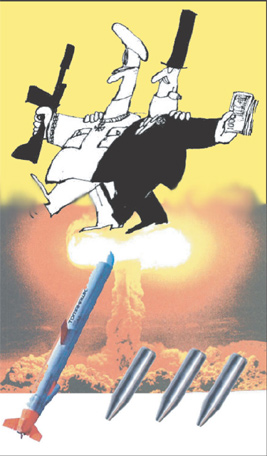
The Arms Trade Is Intensifying Under Trump, Peter Castagno, Truthout, February 20, 2019 The revolving door between public officials and defense contractors has long distorted U.S. foreign policy to serve war profiteers at the expense of the public interest and basic humanitarian norms. From U.S. weaponry ending up in the hands of ISIS, to supplying arms fueling civil conflict and therefore contributing to the world’s worst humanitarian catastrophe in Yemen, the lack of oversight on arms deals has enabled human rights atrocities.The global arms trade is experiencing its greatest boom since the Cold War, fueled by horrific wars in the Middle East and revitalized power rivalries among China, Russia and the United States. In their most recent report, the Stockholm International Peace Research Institute revealed a 44 percent increase in arms sales from 2002 to 2017. The United States is the world’s biggest arms exporter by far, holding 34 percent of total market share — a 58 percent lead on Russia, its closest competitor. From 2017 to 2018, U.S. arms sales to foreign governments increased 33 percent, in part due to the Trump administration’s diminished legal restraints on supplying foreign militias…..

Before entering the White House, Trump asserted his belief in a “lifetime restriction” on top defense officials working for private defense contractors after their public service. Two years later, the Project on Government Oversight released a detailed analysis of the defense sector, revealing 645 instances of federal employees working for the 20 largest Pentagon contractors in fiscal year 2016, the latest year with complete data. Of the 645 instances of former public servants transitioning to work for private defense corporations, 90 percent were hired to work as lobbyists, where they seek to influence public policy to benefit their private employers.

Trump Cabinet Conflicts

After the resignation of Gen. James Mattis, Deputy Secretary of Defense Patrick Shanahan filled the post as interim head of the Defense Department. Before joining the Trump administration, Shanahan spent three decades working for Boeing — a blatant conflict of interest for the person responsible for overseeing federal contracts with private defense contractors. Col. Lawrence Wilkerson, Colin Powell’s former chief of staff, called Shanahan “a living, breathing product of the military-industrial complex,” and asserted that “this revolving door keeps the national security elite very small, and very wealthy, and increasing its wealth as it goes up the chain.”

One egregious example of that revolving door is Heather Wilson, who has been secretary of the Air Force since 2017. In 2015, Lockheed Martin paid a $4.7 million settlement to the Department of Justice after the revelation it had used taxpayer funds to hire lobbyists for a $2.4 billion contract. One of the lobbyists was former New Mexico Representative Wilson, ranked as one of the “most corrupt members of Congress” by the nonprofit government watchdog group Citizens for Responsibility and Ethics in Washington. Wilson was later confirmed as Air Force secretary in the Senate by a 76-22 vote.

Mark T. Esper, the secretary of the Army, worked as vice president of government relations for Raytheon before joining the Trump administration in 2017. The Hill recognized Esper as one of Washington’s most powerful corporate lobbyists in 2015 and 2016, where he fought to influence acquisition policy and other areas of defense bills. Esper’s undersecretary, Ryan McCarthy, is a former Lockheed executive.

Armament Industry’s Influence on Foreign Policy

The Trump administration’s commitment to advancing arms sales is not only apparent in the legion of officials with severe conflicts of interests occupying the cabinet, but also through directives in official arms export policy. The State Department’s updated Conventional Arms Transfer (CAT) Policy Implementation Plan was released in November 2018 and detailed loosened restrictions on the sale of drones and other weapons, new financing options for countries who can’t afford U.S. weaponry, and aims to put pressure on diplomats to put arms deals at the forefront of their mission. Rachel Stohl, an arms trade expert with the Stimson Center, described the updated policy, saying, “If you read between the lines, it could be a green light for the U.S. to sell more with less restraint.”

A glaring example of the arms industry’s influence on State Department policy is demonstrated by a September 20, 2018, report from The Wall Street Journal. According to the report, Secretary of State Mike Pompeo was convinced to continue support for the Saudi campaign in Yemen for the sake of a $2 billion arms deal with U.S.-based defense contractor Raytheon. The State Department’s legislative affairs staff, who influenced Pompeo’s decision, is led by Assistant Secretary of State Charles Faulkner, a former Raytheon lobbyist……..

A real debate on the arms trade is nearly absent from public conversation because the industry can only thrive in secrecy and duplicity………

After Trump pulled out of the Joint Comprehensive Plan of Action, commonly known as the Iran nuclear deal, defense companies enjoyed an immediate boost to their stock. This is because demand in the arms trade surges alongside geopolitical instability. Heightened volatility encourages higher arms sales, and the dissemination of weapons to despotic regimes increases volatility, creating a vicious cycle further entrenched by a revolving door of defense contractors who influence public policy to benefit private weapons manufacturers……… https://truthout.org/articles/the-arms-trade-is-intensifying-under-trump/

February 21, 2019 Posted by Christina Macpherson | business and costs, USA, weapons and war | Leave a comment

William Happer, a climate sceptic, to be appointed to USA’ s White House climate change panel

White House climate change panel to include man who touted emissions, Guardian, Emily Holden in Washington, 21 Feb 2019

William Happer, a physicist who has suggested higher levels of carbon dioxide are beneficial, would be on committee,  The White House is planning to assess how climate change impacts national security and will involve a prominent doubter of the scientific consensus that manmade warming is putting the US at risk.

Donald Trump’s staff have drafted an executive order to establish a Presidential Committee on Climate Security, according to reports from the Washington Post and New York Times. It would include senior aide William Happer, a Princeton physicist who has suggested – in conflict with the vast majority of climate scientists – that higher levels of carbon dioxide are beneficial.

A recent assessment from the national intelligence director, Daniel Coats, called climate change a significant security risk, the Post noted……

Donald Trump’s staff have drafted an executive order to establish a Presidential Committee on Climate Security, according to reports from the Washington Post and New York Times. It would include senior aide William Happer, a Princeton physicist who has suggested – in conflict with the vast majority of climate scientists – that higher levels of carbon dioxide are beneficial.

A recent assessment from the national intelligence director, Daniel Coats, called climate change a significant security risk, the Post noted…….Donald Trump’s staff have drafted an executive order to establish a Presidential Committee on Climate Security, according to reports from the Washington Post and New York Times. It would include senior aide William Happer, a Princeton physicist who has suggested – in conflict with the vast majority of climate scientists – that higher levels of carbon dioxide are beneficial.

A recent assessment from the national intelligence director, Daniel Coats, called climate change a significant security risk, the Post noted.

…….In 2017, Happer told the Scientist that climate change research has become a “cult movement” https://www.theguardian.com/environment/2019/feb/20/white-house-climate-change-national-security-panel

February 21, 2019 Posted by Christina Macpherson | climate change, USA | Leave a comment

Tough times ahead for America’s nuclear industry

U.S. Nuclear Has A Tough Road Ahead https://oilprice.com/Alternative-Energy/Nuclear-Power/US-Nuclear-Has-A-Tough-Road-Ahead.html By Tim Daiss – Feb 19, 2019, The United States nuclear industry is in a tough spot. It’s unpopular with the public due to high-profile disasters like 1979’s Three Mile Island meltdown, and its bottom line has been hit hard by the rise of ultra-cheap domestic shale oil and gas as well as a nearly plateaued post-recession demand for electricity. Some states, including New York, New Jersey, and Illinois have approved financial packages to revive their failing nuclear industries, and now Pennsylvania could be the next if they can push past a plague of doubt.Pennsylvania is a hard sell for nuclear support as the home of the United States’ most famous nuclear disaster at the Three Mile Island site in Dauphin County 40 years ago. The nuclear industry has continued to function, however, in Pennsylvania in the intervening decades–in fact, it’s the second biggest nuclear power state in the country–it hasn’t been until the recent surge of cheap domestic fossil fuels thanks to the boom of production in the Permian Basin that the sector has hit a rough patch that they are unable to surmount on their own.

Even the notorious Three Mile Island plant itself remains in operation today. It has survived four decades of being synonymous with everything that’s wrong with nuclear in the United States, until now. The Chicago-based owner of the plant, Exelon Corp., has announced that the plant will finally be closing its door on September 30th of this year unless the state of Pennsylvania can pull it out of its financial hole. The Three Mile plant would soon be followed by Beaver Valley nuclear power plant in western Pennsylvania and two nuclear plants in Ohio, which Ohio-based owner FirstEnergy Corp. said they will close within the next three years if Pennsylvania can’t pass a financial package to save them.

In light of this newfound hardship, over the past few years industry leaders in Pennsylvania have been working diligently to rouse support for a financial package like those approved in other nearby states to keep the floundering industry afloat. While nuclear support packages have been approved in New York, New Jersey, and Illinois, the path has not been laid clear for Pennsylvania to follow–those already-approved initiatives have been mired in legal appeals debate between federal energy regulatory authorities, and general outcry against a rise in electricity prices for consumers.

The already-socially-sticky-situation is only made more politically complex by the ongoing litigation surrounding nuclear bailout packages, making the decision to push any such financial package in Pennsylvania a particularly precarious one. “Anything that Pennsylvania does is going to be subject to a degree of policy and legal uncertainty,” said University of Pennsylvania’s Christina Simeone, director of policy and external affairs at the Kleinman Center for Energy Policy.

Further complicating the issue, the contentious and divisive topic of nuclear energy’s future has recently entered the national spotlight with a new fervor thanks to the Democratic party’s newly unveiled Green New Deal. Although the official bill itself makes no mention at all of nuclear (a striking omission in and of itself), a fact sheet released alongside the bill, made public by Representative Alexandria Ocasio-Cortez, states outright and in no uncertain terms that the Democrats’ Green New Deal “will not include investing in new nuclear power plants.”

The debates on the national stage as well as on a state level, such as what’s happening in Pennsylvania, are indicative of a larger issue: in a world with rising temperatures and populations and declining reserves of traditional fossil fuels, is the United States willing to follow in the footsteps of other world powers and make politically unpopular moves in order to confront our new energy reality? So far, in Pennsylvania at least, the answer seems to be a resounding “we don’t know.” By Haley Zaremba for Oilprice.com

February 21, 2019 Posted by Christina Macpherson | business and costs, politics, USA | Leave a comment

Nuclear kickback scheme in tickets for sports events

Contractor used Masters and NASCAR tickets in failed nuclear plant kickback scheme, Nick Bromberg

Yahoo Sports, Feb 21, 2019, A contractor involved with a failed nuclear power plant construction project allegedly made some nice cash in a kickback scheme that involved tickets to sporting events. And, like most alleged illegal kickback schemes, the contractor got caught.

According to a court filing in a lawsuit filed by the United States Government, Wise Services Inc. submitted nearly 500 fake invoices during construction of a Savannah River nuclear facility. The South Carolina project was ended in 2018 and won’t be finished.

The government said in the suit that the kickbacks for the submission of fake invoices to project manager CB&I AREVA MOX Services LLC included tickets to the Masters, NASCAR races and college football events. And even Yeti coolers!…..https://sports.yahoo.com/contractor-used-masters-nascar-tickets-failed-nuclear-plant-kickback-scheme-164311675.html

February 21, 2019 Posted by Christina Macpherson | secrets,lies and civil liberties, USA | Leave a comment

Bailout tax: Profitable corporations need to come clean on nuclear energy

Penn Live, Feb 19 By Eric Epstein, Maureen Mulligan and David Hughes, guest contributors

It is the duty of state legislators to draft laws that respond to the needs of the districts that they represent. Some electric utility companies that own low or unprofitable nuclear plants want Pennsylvania lawmakers to enact legislation that will provide subsidies to utilities that own and operate uneconomical nuclear power plants.

Proponents of a nuclear bailout tax frequently argue that these subsidies are necessary for grid reliability and to meet statewide greenhouse gas emissions goals, and that plant closures would create economic hardships in the communities where they operate. While these are all important priorities, the measures the nuclear power industry is proposing would not produce the proclaimed results.

PJM Interconnection, the regional power grid operator responsible for grid reliability for 65 million customers in 21 states including Pennsylvania and the mid-Atlantic region, has published multiple studies making it clear that closing these plants would not affect grid reliability. The lights will continue to shine if uneconomical nuclear power plants retire, thanks in part to increased solar and wind generation coming online throughout the state.

An analysis by the Nuclear Information and Resource Service (NIRS) provides evidence that “continuing to operate these plants does nothing to reduce greenhouse gas emissions from current levels.” In fact, more cost-effective, economically productive and environmentally benign options are available.

As multiple studies have proved, despite the mythology, nuclear power is not a carbon-free source of energy. Greenhouse gases are emitted in all stages of the life cycle of a nuclear reactor: construction, operation, fuel production, dismantling and waste disposal. In addition, nuclear plants routinely vent some of the deadliest gases known to exist.

And, of course, there is the issue of what to do with the dangerous radioactive waste. Nuclear power is an old and expensive technology. Subsidizing aging, unprofitable reactors on the verge of retirement anyway diverts large financial resources from investments in new technologies and infrastructure and slows renewable energy growth that is driving down emissions without seeking a handout.

The analysis by NIRS highlights that potential job losses can be addressed without making electricity ratepayers pay more to bail out the owners of these uneconomical plants. In fact, the increased energy costs to manufacturers — some of the biggest energy users in the commonwealth — as a result of a nuclear bailout could lead to job losses and lack of economic growth in the state that are the same or worse than a plant closure. …….https://www.pennlive.com/opinion/2019/02/bailout-tax-profitable-corporations-need-to-come-clean-on-nuclear-energy-opinion.html

February 21, 2019 Posted by Christina Macpherson | business and costs, politics, USA | Leave a comment

Pressure on California’s Governor Newsom to Inspect Aged Diablo Canyon Nuclear Unit One Before it Re-Fuels

Hollywood Stars, Grassroots Activists, State Senator, Mayor & Major Organizations Ask Gov. Newsom to Fully Inspect Aged Diablo Canyon Nuclear Unit One Before it Re-Fuels

FEBRUARY 19, 2019 / HARVEY 

Contact: Mimi Kennedy (315) 246-7333; Harvey Wasserman (614) 738-3646 – solartopia@gmail.com; Myla Reson (310) 663-7660  – myla.reson@gmail.com

Dear Gov. Newsom,

We join hundreds of other Californians, including Sen. Ben Allen and San Luis Obispo Mayor Heidi Harmon, who are calling, writing, faxing and e-mailing, asking that you take action at Diablo Canyon to protect our safety and economic future. Under PG&E’s current bankruptcy and criminal proceedings, your position gives you wide ranging powers to act.

Diablo Unit One is now shut for refueling. We feel that given the evidence of embrittlement, it is very important to halt the loading of new fuel into the reactor until the public resolution of seven critical issues:

  1. Diablo One was last tested for EMBRITTLEMENT in 2003; it can now be easily tested while Unit One is shut.
  2. Diablo One’s key components must be tested for CRACKING, easily done now with ultra-sound.
  3. PG&E has DEFERRED ITS MAINTENANCE at Diablo since at least 2010.
  4. Nuclear Regulatory Commission site inspector Michael Peck, among many others, has doubts that Diablo can withstand a credible earthquake.
  5. Serious questions remain about how PG&E intends to handle Diablo’s RADIOACTIVE WASTES.
  6. US Rep. Salud Carbajal has joined many others in questioning the COMPETENCE of the bankrupt, criminally-convicted PG&E to manage these two very large reactors in his home district.
  7. Studies show Diablo’s POWER IS NOT NEEDED, and in fact impedes the use of renewables here in California.

We ask that BEFORE DIABLO ONE REFUELS you subject these and other critical issues to open public scrutiny. The decision on Diablo’s future must be made by you in conjunction with the Legislature, the CPUC, state agencies, the courts and the public.

We thank you very much for giving this your serious consideration. We feel this is an exciting and crucial opportunity for you to continue your groundbreaking leadership in bringing more safety, responsibility, and wise energy policy to all Californians. Let us keep showing the way to a safer (and more sustainable) energy future.

Signatories (partial list):………

Separate petitions, resolutions & other supporting letters & documents are from: …….  http://solartopia.org/hollywood-stars-grassroots-activists-state-senator-mayor-major-organizations-ask-gov-newsom-to-fully-inspect-aged-diablo-canyon-nuclear-unit-one-before-it-re-fuels/

Attachments area

February 19, 2019 Posted by Christina Macpherson | safety, USA | Leave a comment

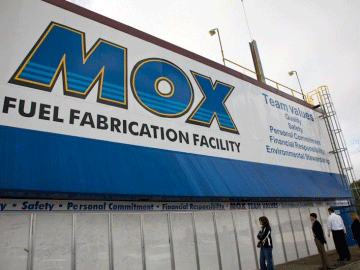
U.S. Dept. of Justice sues CBand I AREVA MOX Services for false claims

Dept. of Justice 14th Feb 2019 The Department of Justice announced today that the United States has filed suit against CB&I AREVA MOX Services LLC (MOX Services) and Wise Services Inc. under the False Claims Act and the Anti-Kickback Act in connection with a contract between MOX Services and the National Nuclear Security
Administration relating to the design and operation of the MOX Fuel
Fabrication Facility (MFFF) at the NNSA Savannah River Site in Aiken, South
Carolina.
MOX Services is a South Carolina Limited Liability Corporation with headquarters in Aiken, South Carolina. Wise Services, which  subcontracted with MOX Services, is an Ohio corporation with headquarters in Dayton, Ohio. Under the MOX Contract, MOX Services agreed to design, build, operate (and ultimately decommission) the MFFF.
The MFFF is designed to transform weapons-grade plutonium into mixed oxide fuel rods that may be irradiated in commercial nuclear power plants.
In performing the MOX Contract, MOX Services entered into a series of subcontracts with Wise Services between 2008 and 2016. Each of these subcontracts provided for
Wise Services to supply labor, materials, equipment, and supervision for unplanned construction activities (e.g. general labor, plumbing, electrical, carpentry) deemed necessary to support MOX Services’ efforts at the MFFF.
The government’s complaint alleges that Wise Services falsely claimed reimbursement under its subcontracts with MOX Services for construction materials that did not exist, and that in turn MOX Services knowingly submitted $6.4 million in claims to NNSA for the fraudulent charges submitted by Wise Services. The complaint further alleges that Wise Services’ Senior Site Representative Phillip Thompson paid kickbacks to MOX Services officials with responsibility for the subcontracts to improperly obtain favorable treatment from MOX Services. On Feb. 27, 2017, Mr. Thompson entered a guilty plea on charges of conspiring to commit theft of government funds.
https://www.justice.gov/opa/pr/united-states-files-false-claims-act-lawsuit-connection-mox-fuel-fabrication-facility 

February 18, 2019 Posted by Christina Macpherson | secrets,lies and civil liberties, USA | Leave a comment

America must renew the progress in the the nuclear non-proliferation treaty: ‘first use’ of nuclear weapons is madness

My Turn: The madness of the nuclear first-use option,  https://www.concordmonitor.com/No-first-use-of-nuclear-weapons-23490452 By RAY PERKINS Jr. For the Monitor, 2/15/2019 It seems Mike Moffett (Monitor Opinion, Feb. 11,) “ ‘No first use’ policy increases likelihood of war”) not only needs some historical refreshment, he also ignores the legal and moral dimensions of nuclear weapons use and the problems of our first-use option as opposed to a wiser no-first-use policy.

Some history: Moffett says that “first use” ended World War II. That was hardly the principal cause of Japan’s surrender.

Most historians now attribute the end to the Soviet entry on Aug. 8. That immoral and illegal first use was also unnecessary. I’ve made the case in this paper many times, but I’ll merely quote Gen. Dwight Eisenhower, the supreme allied commander): “Japan was ready to surrender, and there was no need to use that awful thing.” Virtually all the top military leaders agreed.

But apart from its illegal and immoral despicability “common to Dark Age barbarians” (as Adm. William Leahy put it), that first use alienated our Soviet ally and started a long and dangerous Cold War.

What Moffett doesn’t say is that the first-use option, while not necessitating first use, does require preparation and willingness to do it. In a time of crisis, Nation X, knowing that Enemy Y has the first-use option and fearing imminent first use from Y, may pre-empt with the strike first – better to use ’em than lose ’em. This is equally dangerous with nukes kept on “hair trigger” alert, which first-use nuke nations do (but not the no-first-use nations: India, China and North Korea). It’s a recipe for an accidental nuclear launch.

–We’ve long held first use, even during the 1980s when the Soviets (and China) espoused a no-first-use policy. It was a main driver of the dangerous and often nearly catastrophic super power arms race. There were hundreds of nuclear accidents and near misses, some after the Cold War ended, as we now know from Eric Schlosser’s shocking 2014 book, Command and Control. By pure luck we survived decades of military inattention to nuclear safety and our (still ongoing) deference to the “we’re falling behind” cries of the dollar-seeking military-industrial-complex. (We are the world’s No.1 arms merchant, with many undemocratic customers.) For some frighteningly close calls see my review of Schlosser’s book: bit.ly/2SCQUO5.

First use has also been used by every president since Harry Truman as a threat to force concessions, as Daniel Ellsberg (nuke adviser to the Pentagon and several presidents in the 1960s and ’70s) has pointed out, with many examples in his recent Doomsday Machine.

Moffett also says Ronald Reagan showed “wisdom” by retaining the first-use option. Eventually Reagan wised up, but not until Mikhail Gorbachev (Nobel Peace Prize, 1990) came along in the mid-1980s. Earlier Reagan had little understanding of nukes. In fact he and his vice president, George H.W. Bush, were both insisting that a nuclear war was survivable and winnable.

By 1986, Reagan and Gorbachev, at their first summit, nearly agreed to the abolition of all nukes. But Reagan’s “Star Wars” (a proposed anti-ballistic missile system then outlawed by treaty and thought to be “pie in the sky”) killed the deal. But in 1987 we fortunately got the INF Treaty destroying 3,000 medium-range missiles – a treaty the United States is threatening to leave.

Moffett said our local leftists should “leave defense policy to national security and military experts.”

Surely Moffett knows that many such experts are today advocating exactly what the “local leftists” are – urging our state Legislature to urge Congress and the president to adopt no first use and halt funds for new low-yield nukes. They include: Gen. Lee Butler (Air Force), commander of Strategic Air Command (1984-1991) and first of the Strategic Command (1991-1994); Gen. James Cartwright (USMC), commander of the Strategic Command (2004-07) and vice chair of the Joint Chiefs of Staff (2007-2011); Secretary of State George Shultz (under Reagan); and Secretary of Defense William Perry (under Bill Clinton).

There are moral problems with nukes and even with nuclear deterrence of any form. Even deterrence (with no first use) requires the preparation for possible use and a willingness to use nukes “if necessary.” As such, all nuclear deterrence runs the risk of nuclear war and the killing of millions of innocent human beings or worse, given the possibility of nuclear winter. As science knows, but apparently not the Pentagon, even a small nuclear exchange – for example, India versus Pakistan, each firing 50 low-yield weapons – could bring on a 10-year nuclear winter and global famine killing over a billion people (2014 study by Physicians for Social Responsibility). Such a risk is morally unacceptable – a concern central to creating the Nuclear Non-Proliferation Treaty in 1968 – now with 189 parties and as important as ever.

The Non-Proliferation Treaty (Art. 6) requires a swift end to the nuclear arms race and the bringing to conclusion a treaty for “general and complete disarmament under strict and effective international control.” In 1996 the World Court rendered an opinion on the legality of nuclear weapons, saying: “The threat or use of nuclear weapons would generally be contrary to the rules of international law applicable in armed conflict.”

Meeting our treaty obligations will be a very long and difficult journey. But we must recover the progress that slowed soon after the end of the Cold War and recently threatens to stop – or worse.

In the meantime, the United States can encourage the non-proliferation treaty’s many non-nuke parties to show that the United States is still serious about its treaty obligations. We N.H. folks – as many other states are doing – can and should take the small but positive steps to support our state government to urge Congress and the president to adopt a no-first-use pledge, and to decline funding for any new costly and “more usable” low-yield nukes.

(Ray Perkins Jr. of Concord is professor of philosophy, emeritus, at Plymouth State University and vice chairman of the Bertrand Russell Society board of directors.)

February 16, 2019 Posted by Christina Macpherson | Reference, USA, weapons and war | 1 Comment

Nuclear Regulatory Commission removes a critical safety regulation

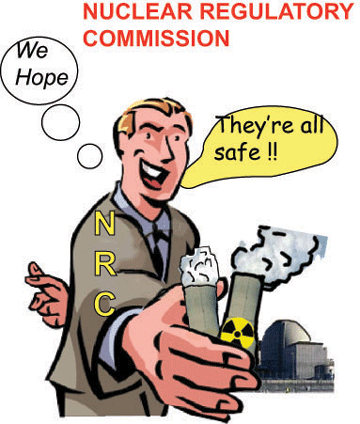
NRC Guts a Critical Safety Regulation, Recklessly Disregarding the Critical Lessons of the Fukushima Disaster https://www.ucsusa.org/press/2019/nrc-guts-critical-safety-regulation-recklessly-disregarding-critical-lessons-fukushima?fbclid=IwAR0-uToPAgtkdHj4rZ9dqJ5n7skVycU6y5UxjG_a_12lt7ZLhIwKCHfwZSM#.XGdxVOQzbGg– January 24, 2019  Decision Will Leave U.S. Nuclear Plants Dangerously Vulnerable to Major Floods and Earthquakes

WASHINGTON  —The Nuclear Regulatory Commission’s (NRC) Republican majority, in a 3-2 vote, approved a stripped-down version of a rule originally intended to protect U.S. nuclear plants against extreme natural events, such as the massive earthquake and tsunami that triggered meltdowns at the Fukushima Daiichi nuclear plant in Japan in March 2011.

The commission majority struck a provision from the draft final rule the NRC staff recommended in December 2016 requiring plant owners to protect their facilities from the real-world hazards they face today instead of “design-basis” hazards that were estimated using now-obsolete information and methodologies when the plants were built decades ago.

The commission majority’s act will leave unresolved how the NRC will address new information showing that plants may experience bigger floods and earthquakes than they are now required to withstand. It is possible that the commission will not require all plant owners whose facilities face greater hazards to make structural upgrades.

“Nearly eight years after the Fukushima accident, the NRC continues to disregard a critical lesson: Nuclear plants must be protected against the most severe natural disasters they could face today—not those estimated 40 years ago,” said Dr. Edwin Lyman, senior scientist and acting director of the Nuclear Safety Project at the Union of Concerned Scientists.

After Fukushima, an NRC task force recommended that the NRC “order licensees to reevaluate the seismic and flooding hazards at their sites … and if necessary, update their design basis and SSCs [structures, systems and components] important to safety to protect against the updated hazards.”

To date, the NRC has only implemented the first part of the recommendation: Owners have reevaluated seismic and flooding hazards. What they found is not reassuring. For instance, the flooding reevaluations revealed that roughly two-thirds of U.S nuclear plants face hazards beyond what they were originally designed to handle, including higher flood levels from  extreme precipitation, upstream dam failure and storm surge. The reevaluated flood height for local intense precipitation for the Palisades plant in Michigan, for example, was more than 25 feet higher than the level considered in the plant’s original design. Similar concerns were identified in many seismic risk evaluations.

Despite these findings, the NRC failed to implement the second part of the task force recommendation to require plant owners to strengthen their defenses against greater hazards. The rule that was approved today was originally intended to close that gap. The commission majority’s action today removed that requirement and will simply maintain the uncertain—and inadequate—status quo.

“The NRC must require plant owners to upgrade their facilities based on the best current information, the most realistic analyses, and the potentially devastating impacts of increased flooding from climate change,” said Dr. Lyman. “Failing to do so will leave some nuclear plants dangerously unprepared and needlessly invite disaster.”

February 16, 2019 Posted by Christina Macpherson | climate change, safety, USA | Leave a comment

Chicago to go 100% renewable energy by 2035

The Windy – or maybe that should be nuclear – City will go 100% renewable https://www.pv-magazine.com/2019/02/15/the-windy-or-maybe-that-should-be-nuclear-city-will-go-100-renewable/

Chicago may be the largest city in the U.S. to commit to 100% renewable energy and has set a 2035 target date. The famous city’s long association with nuclear power says a lot about the future of clean energy Statesside.

FEBRUARY 15, 2019 CHRISTIAN ROSELUND From pv magazine USA.

Chase Tower is one of the tallest skyscrapers to dominate Chicago’s skyline. But it is not the building’s height, at 869 feet, which makes it prominent but rather what’s in it: the headquarters of Exelon, the largest owner and operator of nuclear power plants in the United States.

However, despite there being 11 nuclear reactors in operation in the state of Illinois, Chicago is moving to a different power source: renewable energy. Yesterday, Chicago Mayor Rahm Emanuel unveiled the Resilient Chicago plan, which with action number 38 commits to “transition to 100% clean, renewable energy in buildings community-wide by 2035”. The deadline for all city government buildings to be powered solely by renewables, first established in 2017, has been brought forward to 2025.

The policy has been introduced as part of environmental group the Sierra Club’s “Ready for 100” campaign, and Chicago is the largest city to join the effort to date. (Editor’s note: While Los Angeles Mayor Eric Garcetti has announced his city is on a path to 100% renewable energy, it is not clear if the formal goal is 100% renewable or 100% zero-carbon, and LA is not included in the Sierra Club’s Ready for 100 list.)

The language of the Resilient Chicago text says “clean, renewable energy”, and the Sierra Club does not include nuclear as part of its Ready to 100 campaign. The new policy is a particularly interesting move for Emanuel, once considered one of the more pro-nuclear politicians in the Democratic Party, and a man who brokered the deal that created Exelon.

Were Chicago to include nuclear in a 2035 target, it would require either buying power from existing plants instead of investing in new generation, or starting new nuclear plants within six years. Given the high cost of nuclear compared to wind and solar, few decision makers are contemplating that option.

The City of Chicago and stakeholders will have until December next year to come up with a plan to meet the city’s new mandate.

Community solar, electric buses

And there are a number of other clean energy commitments among the 50 action points in the wide-ranging Resilient Chicago report. Chicago plans to complete the electrification of its bus fleet by 2040, and the city is also making a push for community solar.

Action 37 states the city will “promote greater access to community solar”, by supporting the Illinois Power Agency’s community incentive programs and by incentivizing community solar through voluntary programs, with the Chicago Renewable Energy Challenge highlighted.

Since the passage of the Future Energy Jobs Act in the Illinois General Assembly, Chicago has seen a boom in community solar, with 1.8 GW of projects applying for block grants in just the last two weeks, more than ten times the amount the state had planned for in its block grant program.

February 16, 2019 Posted by Christina Macpherson | renewable, USA | Leave a comment

Lockheed Martin Sued for Fraud over Washington Nuclear Site

 https://www.insurancejournal.com/news/west/2019/02/15/518025.htm

February 15, 2019 The U.S. Justice Department is accusing Lockheed Martin Corp. of using false records and making false statements to bill the Energy Department for tens of millions of dollars in unauthorized profits and fees at the Hanford Nuclear Reservation in Washington.

The federal civil lawsuit was filed last week in U.S. District Court in Eastern Washington.

The Seattle Times says the lawsuit also accuses Lockheed Martin of using federal money to pay millions of dollars in kickbacks.

Hanford is located near Richland, Washington, and for decades made plutonium for nuclear weapons. The site is now involved in a massive cleanup effort that costs more than $2 billion per year.

The lawsuit covers the period from 2010 to 2015.

Lockheed Martin denied the allegations and said it will defend itself vigorously.

February 16, 2019 Posted by Christina Macpherson | legal, USA | Leave a comment

The massive costs of USA’s stranded canisters of nuclear wastes

These dumpsters of old nuclear waste are costing taxpayers a fortune https://www.bostonglobe.com/metro/2019/01/31/these-dumpsters-old-nuclear-waste-are-costing-you-billions/lw7aIpcWOhmn3ThjeqEnVP/story.html

They were supposed to be hauled away decades ago. They’re still here.

By Joshua Miller GLOBE STAFF  JANUARY 31, 2019

ROWE — The nuclear plant deep in the woods of this Western Massachusetts town stopped producing power 27 years ago when George H.W. Bush was still president. It was dismantled, piece by piece. Buried piping was excavated. Tainted soil was removed. But nestled amid steep hills and farmhouses set on winding roads, something important was left behind.

Under constant armed guard, 16 canisters of highly radioactive waste are entombed in reinforced concrete behind layers of fencing. These 13-foot-tall cylinders may not be much to look at, but they are among the most expensive dumpsters in the country, monuments to government inaction.

Lawyers for Rowe’s defunct plant and long-dismantled reactors in
Maine and Connecticut are poised to march into a federal courtroom in coming weeks and, for the fourth time in recent years, extract a huge sum of taxpayer money to cover ongoing security and maintenance costs. Taxpayers have already ponied up $500 million as a result of lawsuits filed by the plants’ owners, and they are poised to pay $100 million more this time.

Nationally, the US government’s failure to keep its vow to dispose of spent nuclear fuel and other high-level waste is proving staggeringly expensive. So far, the government has paid out more than $7 billion in damages for violating its legal pledge to begin hauling away nuclear waste by 1998.

And costs are expected to soar as more of the nation’s aging reactors close permanently: Pilgrim Nuclear Power Station in Plymouth, for instance, is slated to go offline by June. Eventually, the remaining staff may have the sole job of safeguarding the radioactive detritus.

By the Department of Energy’s own optimistic estimates, the government will be forced to cough up a whopping $28 billion more in taxpayer funds as a result of litigation in coming years.

Long before the 35-day partial government shutdown crippled Washington, the dug-in debate over where to dump the nation’s civilian nuclear waste set the radioactive standard for government dysfunction. For more than 60 years, government officials have tried to solve the problem, but plan after plan has collapsed amidst nationwide cries of “Not in my backyard!” So far, all officials have to show for the work is an enormous $10 billion-plus hole in Nevada that will probably never be used.

Instead of consolidating waste in one place, it has left material that is toxic for thousands of years at scores of current and former civilian nuclear plants. Neighbors fear the waste will stay permanently, siphoning money from other needs, thwarting redevelopment, and eventually posing a safety risk.

Senator Edward J. Markey, a longtime nuclear skeptic, said lingering nuclear waste tends to focus the attention of nearby cities and towns on a simple question: “When is this problem going to be solved? Or am I going to have a nuclear waste site in my community for the rest of my family’s life?”

The promise of nuclear power burned bright in 1960 when the Yankee Atomic Electric Co. first fired up its reactor in Rowe. But, even then, proponents of the new power source knew they were creating a problem: the super-hot, super-radioactive uranium fuel rods left over from generating power. Most plants dumped them in deep pools of water, but that was only a temporary solution

By the early 1980s, as waste accumulated, Congress made this pledge: The Department of Energy would haul away nuclear plants’ spent fuel and other high-level waste starting by 1998 and the owners would pick up the tab, in part through a fee in customers’ electric bills.

The law was supposed to jump-start a scientific process to choose the best repository for waste. But not-in-my-backyard politics repeatedly got in the way. Who, after all, wants a national nuclear waste dump buried nearby forever?

Congress later zeroed in on a remote desert site called Yucca Mountain in Nevada, about 75 miles from Las Vegas.

But Nevada didn’t want the nation’s spent nuclear fuel either, and the state’s top politician, senator Harry Reid, the majority leader from 2007 to 2015, strongly opposed the plan. After the United States spent more than $10 billion drilling down into and studying the site, the Obama administration effectively killed Yucca around 2010. Congress has not restarted funding for the effort.

Proposals to create a consolidated repository to store the waste for an interim period in New Mexico and West Texas are moving forward. But those, too, face huge hurdles.

Meanwhile, electric ratepayers from New England, home to seven current and former nuclear power plants, have paid what is now an estimated $3 billion with interest into the fund to dispose of nuclear waste.

But the account has not brought its intended benefit.

Even with strong support for a permanent fix from the nuclear power industry, environmentalists, and local officials, Congress has remained deadlocked on a final resting place for spent fuel and other highly radioactive waste.

So nuclear plants continue to keep the waste on hand. And they continue to get reimbursed for payroll, security, supplies, and more, because the courts have found the government is in partial breach of its contract to haul away the waste.

In a twist, the government’s payments can’t come from that nuclear waste fund, a federal court ruled. Instead, it is taken from a separate pool of taxpayer dollars for court judgments and settlements of lawsuits against the government.

The latest suit from Yankee Rowe and the two other fully shuttered New England plants in Wiscasset, Maine, and Haddam, Conn., is set to soon go to trial and cost taxpayers more than $100 million.

And it probably won’t be the last lawsuit. Company officials say each plant spends about $10 million a year safeguarding its waste and maintaining corporate structures solely for that task.

Meanwhile, soon-to-close Pilgrim is getting ready to follow in Yankee Rowe’s footsteps, moving its remaining spent fuel from cooling pools to huge concrete cylinders, known as dry cask storage, by 2022.

So far, across the country, there haven’t been any serious accidents with the casks, according to the Nuclear Regulatory Commission. But as the time frame for their use stretches out indefinitely, no one can be sure how long before the waste poses a threat.

The uncertainty also is forcing plant operators to plan for longer-term issues including climate change and rising sea levels. Officials at Pilgrim, which is oceanfront property, said last year that the plant will move its current cylinders to higher ground and place new ones there, too.

The NRC believes the casks should be safe for years to come, licensing their use for up to 40 years at a time.

The agency has ruled that, with proper inspection and maintenance, casks could last more than 100 years before the waste would have to be transferred to a new steel canister and concrete shell.

But Allison M. Macfarlane, a former NRC chairwoman, said there’s no guarantee the infrastructure will be in place to monitor them for safety.

“That assumes our institutions are robust and will last hundreds of years and I think that’s a poor assumption based on no evidence whatsoever,” Macfarlane said in the midst of the partial federal shutdown.

That is why, experts insist, a permanent subterranean repository like the one planned for Yucca Mountain is the only real solution.

“You should really put it underground where the risk is much lower and you don’t have to worry about institutional failures,” said MIT researcher Charles W. Forsberg, a chemical and nuclear engineer.

In the meantime, communities that host closed and closing nuclear plants face yet another cost: prime real estate that’s potentially locked up for generations.

State Senator Viriato M. deMacedo of Plymouth said, “We have a mile of oceanfront property where that plant is. Once it closes, it will never be able to be used as long as those spent fuel rods are there.”

Some still hope that politicians will find a final graveyard for the nuclear waste, and the bucolic valley where Yankee Rowe stood and the beach where Pilgrim stands are redeveloped.

But, after three generations of failed efforts to permanently dispose of the waste, another vision is more likely. Plymouth, where the Pilgrims made the West’s first permanent mark in New England, could be home to its last: 61 gigantic casks of nuclear waste forever overlooking the sea.


February 16, 2019 Posted by Christina Macpherson | USA, wastes | Leave a comment

Focus now on Pennsylvania, in the nuclear industry’s battle to get tax-payer funding

Pennsylvania Is Newest Nuclear Subsidy Battleground, Power Magazine, 02/14/2019 | Sonal Patel, Pennsylvania, the nation’s second-largest nuclear power-producing state, is now definitively a battleground for nuclear power subsidies. 

Last week, in two memos that were circulated in the state House and Senate, seven lawmakers signaled they would soon introduce legislation that would update a 2004 state law—the Alternative Energy Portfolio Standards (AEPS)—to include nuclear power. The law currently requires that 18% of electricity sold should come from renewable sources by 2021, including at least 0.5% of solar photovoltaic power. …….

The memo specifically cites concerns about Beaver Valley and Three Mile Island, which, barring legislative remedy, will shut down soon because they cannot compete with cheaper sources of generation in PJM Interconnection’s wholesale electricity market.

FirstEnergy Solutions Banks on Reforms

FENOC, a subsidiary of FirstEnergy Solutions (FES) that sought bankruptcy protection in March 2018, last year notified PJM Interconnection it would shutter Beaver Valley in 2021 (as well as two Ohio plants, the single-unit 908-MW PWR at the Davis-Besse Nuclear Power Station in Oak Harbor by 2020, and the single-unit 1,268-MW BWR at the the Perry Nuclear Power Plant in Perry in 2021). At the time, a company executive said, “Though the plants have taken aggressive measures to cut costs, the market challenges facing these units are beyond their control.”…….

Pennsylvania Could Be Newest Victory for Exelon

Meanwhile, Exelon in May 2017 announced it would shutter Three Mile Island in September 2019 unless policy reforms are enacted in Pennsylvania. Industry observers, however, point out that the gambit is similar to one employed in Illinois to help enact the Future Energy Jobs Act in December 2016 (it went into effect in June 2017), keeping Exelon’s Clinton and Quad Cities plants running. Exelon also strongly backed New York’s Clean Energy Standard, a measure that became effective in April 2017, to preserve the at-risk Nine Mile Point, FitzPatrick, and Ginna reactors in upstate New York. And in 2018, New Jersey also enacted zero-emission credits (ZECs) to bolster profitability of the Hope Creek plant, which is owned by PSEG, and Salem, whose output Exelon owns jointly with PSEG. 

As financial documents Exelon filed on Feb. 8 show, the New York and Illinois ZEC measures have proven beneficial for the company, whose 32.7 GW generation portfolio comprises a 20.3 GW nuclear fleet—the largest in the nation. In 2017, Exelon recorded ZEC revenues from New York and Illinois of $343 million. For the full year of 2018, Exelon Generation recorded a net income of $370 million, while adjusted operating earnings for 2018 soared to $1.3 billion (its net income was $2.7 billion in 2017, and adjusted operating earnings were $989 million).

The company noted that 2018 adjusted operating earnings reflect “the favorable impacts of New York and Illinois ZEC revenue (including the impact of ZECs generated in Illinois from June 1, 2017 through Dec. 31, 2017), increased capacity prices, tax savings related to the [2017 Tax Cuts and Jobs Act], realized gains on nuclear decommissioning trust (NDT) funds and decreased nuclear outage days, all of which were partially offset by lower realized energy prices and the absence of earnings from Exelon Generation Texas Power due to its deconsolidation in the fourth quarter of 2017.”……..

Widening ZEC Horizons

If Pennsylvania backs nuclear subsidies, it will become the fifth state in the U.S. to do so on a statewide basis. Along with Illinois, New York, and New Jersey, in 2017, Connecticut also enacted legislation to allow Dominion’s Millstone nuclear plant to become eligible for a state procurement process for ZECs, upon certification of financial need. ……..

The nation’s 98 licensed nuclear power reactors at 59 sites in the U.S. generate about 20% of the nation’s power. However, the nuclear sector is facing severe financial pressure from cheaper power produced by natural gas plants, growing supplies of renewables, and stagnant electricity demand. Between 2013 and 2018, seven U.S. reactors were permanently shuttered, and 12 others are planned for closure through the mid-2020s. Dismal economics have stymied plans to build up to 30 new U.S. reactors, which were announced over the past 10 years. Only two reactors are under construction today—at Plant Vogtle in Georgia, which continues to face major challenges.   https://www.powermag.com/pennsylvania-is-newest-nuclear-subsidy-battleground/?pagenum=1

February 16, 2019 Posted by Christina Macpherson | politics, USA | Leave a comment

USA’s nuclear command, control and communications network (NC3) is vulnerable to electronic attacks and interference.

Report: Updating the military’s nuclear communications systems a complex and expensive challenge, Space News, by Sandra Erwin — February 14, 2019 Early warning and communications satellites that support the NC3 system are vulnerable to electronic attacks and interference.WASHINGTON — A new report released on Thursday on Capitol Hill makes the case for billions of dollars in investments in the nation’s nuclear command, control and communications network known as NC3.

The report was co-produced by the Air Force Association’s Mitchell Institute and the MITRE Corporation. It cautions that while the United States is investing in a new generation of nuclear missiles, submarines and bombers, it will lack a “credible nuclear deterrent if it does not also possess a nuclear command and control system that provides ‘no fail’ communications to nuclear forces in a future environment that will include unique threats and challenges.”

MITRE senior vice president William LaPlante, one of the authors of the report, said the NC3 system today works fine but it needs to transition to a new architecture so it can be integrated with the cutting-edge nuclear platforms that the Pentagon is developing such as the Columbia-class ballistic missile submarine and the B-21 stealth bomber. The problem essentially is that these are 21st century weapon systems whereas NC3 still uses technology from the 1970s.

The NC3 system includes warning satellites and radars; communications satellites, aircraft, and ground stations; fixed and mobile command posts; and the control centers for nuclear systems.

The report says the early warning and communications satellites that support the NC3 system are vulnerable to electronic attacks and interference. Satellite constellations such as the Space Based Infrared System and the Defense Support System are the basic tactical warning systems of the NC3 enterprise. The 1970s-vintage DSP satellites will be out of service in a few years. The newer SBIRS satellites are more advanced but the Pentagon worries that they could be targeted with counterspace weapons.

When SBIRS was conceived, the thinking was that satellites in higher geosynchronous orbits were off limits to attack. “Today, however, space, even in the geosynchronous realm, is no longer a sanctuary,” the report cautions. “Space congestion increasingly puts U.S. national security space assets at risk and has the potential to create radio interference for data transmitted to and from these assets. But most disturbing and profound is the end of space as a sanctuary domain — space is likely to be a battleground.”

The same concerns apply to communications satellites. ……. https://spacenews.com/report-updating-the-militarys-nuclear-communications-systems-a-complex-and-expensive-challenge/

February 16, 2019 Posted by Christina Macpherson | safety, USA | Leave a comment

« Previous Entries     Next Entries »

1 This Month

PLEASE OPPOSE HR 8255 AND S.3639 – bills would accelerate satellite deployment, with no environmental review or safeguards – https://ncstd5li.quorum.us/campaign/169331/

​To see nuclear-related stories in greater depth and intensity – go to https://nuclearinformation.wordpress.com

  • Categories

    • 1
      • Arclight's Vision
    • 1 NUCLEAR ISSUES
      • business and costs
        • employment
        • marketing
      • climate change
      • culture and arts
      • ENERGY
        • renewable
          • decentralised
          • energy storage
      • environment
        • oceans
        • water
      • health
        • children
        • psychology – mental health
        • radiation
        • social effects
        • women
      • history
      • indigenous issues
      • Legal
        • deaths by radiation
        • legal
      • marketing of nuclear
      • media
        • investigative journalism
        • Wikileaks
      • opposition to nuclear
      • PERSONAL STORIES
      • politics
        • psychology and culture
          • Trump – personality
        • public opinion
        • USA election 2024
        • USA elections 2016
      • politics international
      • Religion and ethics
      • safety
        • incidents
      • secrets,lies and civil liberties
        • civil liberties
      • spinbuster
        • Education
      • technology
        • reprocessing
        • Small Modular Nuclear Reactors
        • space travel
      • Uranium
      • wastes
        • – plutonium
        • decommission reactor
      • weapons and war
        • Atrocities
        • depleted uranium
      • Women
    • 2 WORLD
      • ANTARCTICA
      • ARCTIC
      • ASIA
        • Burma
        • China
        • India
        • Indonesia
        • Japan
          • – Fukushima 2011
          • Fukushima 2012
          • Fukushima 2013
          • Fukushima 2014
          • Fukushima 2015
          • Fukushima 2016
          • Fukushima continuing
        • Malaysia
        • Mongolia
        • North Korea
        • Pakistan
        • South Korea
        • Taiwan
        • Turkey
        • Vietnam
      • EUROPE
        • Belarus
        • Bulgaria
        • Denmark
        • Finland
        • France
        • Germany
        • Greece
        • Ireland
        • Italy
        • Kazakhstan
        • Kyrgyzstan
        • Russia
        • Spain
        • Sweden
        • Switzerland
        • UK
        • Ukraine
      • MIDDLE EAST
        • Afghanistan
        • Egypt
        • Gaza
        • Iran
        • Iraq
        • Israel
        • Jordan
        • Libya
        • Saudi Arabia
        • Syria
        • Turkey
        • United Arab Emirates
      • NORTH AMERICA
        • Canada
        • USA
          • election USA 2020
      • OCEANIA
        • New Zealand
        • Philippines
      • SOUTH AMERICA
        • Brazil
    • ACTION
    • AFRICA
      • Kenya
      • Malawi
      • Mali
      • Namibia
      • Niger
      • Nigeria
      • Somalia
      • South Africa
    • Atrocities
    • AUSTRALIA
    • Christina's notes
    • Christina's themes
    • culture and arts
    • Events
    • Fuk 2022
    • Fuk 2023
    • Fukushima 2017
    • Fukushima 2018
    • fukushima 2019
    • Fukushima 2020
    • Fukushima 2021
    • general
    • global warming
    • Humour (God we need it)
    • Nuclear
    • RARE EARTHS
      • thorium
    • Reference
      • Reference archives
    • resources – print
    • Resources -audiovicual
    • Weekly Newsletter
    • World
    • World Nuclear
    • YouTube
  • Pages

    • 1 This Month
    • ACTION !
    • Disclaimer
    • Links
    • PAGES on NUCLEAR ISSUES
      • audio-visual news
      • Anti Nuclear, Clean Energy Movement
        • Anti Nuclear movement – a success story
          • – 2013 – the struggle for a nuclear-free, liveable world
          • – 2013: the battle to expose nuclear lies about ionising radiation
            • Speakers at Fukushima Symposium March 2013
            • Symposium 2013 Ian Fairlie
      • Civil Liberties
        • – Civil liberties – China and USA
      • Climate change
      • Climate Change
      • Economics
        • – Employment
        • – Marketing nuclear power
        • – Marketing Nuclear Power Internationally
        • nuclear ‘renaissance’?
        • Nuclear energy – the sick man of the corporate world
      • Energy
        • – Solar energy
      • Environment
        • – Nuclear Power and the Tragedy of the Commons
        • – Water
      • Health
        • Birth Defects in the Chernobyl Radiation Affected Region.
      • History
        • Nuclear History – the forgotten disasters
      • Indigenous issues
      • Ionising radiation
        • – Ionising radiation – medical
        • Fukushima FACT SHEET
      • Media
        • Nuclear Power and Media 2012
      • Nuclear Power and the Consumer Society – theme for December 2012
      • Peace and nuclear disarmament
        • Peace on a Nuclear Free Earth
      • Politics
        • – Politics USA
      • Public opinion
      • Religion and ethics
        • -Ethics of nuclear power
      • Resources – print
      • Safety
      • Secrets and lies
        • – NUCLEAR LIES – theme for January 2012
        • – Nuclear Secrets and Lies
      • Spinbuster
        • 2013 nuclear spin – all about FEAR -theme for June
        • Spinbuster 1
      • Technology
        • TECHNOLOGY Challenges
      • Wastes
        • NUCLEAR WASTES – theme for October 2012
        • – Plutonium
      • Weapons and war
      • Women
  • Archives

    • September 2026 (339)
    • August 2026 (330)
    • July 2026 (355)
    • June 2026 (287)
    • May 2026 (306)
    • April 2026 (356)
    • March 2026 (251)
    • February 2026 (267)
    • January 2026 (308)
    • December 2025 (358)
    • November 2025 (359)
    • October 2025 (375)
  • Categories

    • 1
      • Arclight's Vision
    • 1 NUCLEAR ISSUES
      • business and costs
        • employment
        • marketing
      • climate change
      • culture and arts
      • ENERGY
        • renewable
          • decentralised
          • energy storage
      • environment
        • oceans
        • water
      • health
        • children
        • psychology – mental health
        • radiation
        • social effects
        • women
      • history
      • indigenous issues
      • Legal
        • deaths by radiation
        • legal
      • marketing of nuclear
      • media
        • investigative journalism
        • Wikileaks
      • opposition to nuclear
      • PERSONAL STORIES
      • politics
        • psychology and culture
          • Trump – personality
        • public opinion
        • USA election 2024
        • USA elections 2016
      • politics international
      • Religion and ethics
      • safety
        • incidents
      • secrets,lies and civil liberties
        • civil liberties
      • spinbuster
        • Education
      • technology
        • reprocessing
        • Small Modular Nuclear Reactors
        • space travel
      • Uranium
      • wastes
        • – plutonium
        • decommission reactor
      • weapons and war
        • Atrocities
        • depleted uranium
      • Women
    • 2 WORLD
      • ANTARCTICA
      • ARCTIC
      • ASIA
        • Burma
        • China
        • India
        • Indonesia
        • Japan
          • – Fukushima 2011
          • Fukushima 2012
          • Fukushima 2013
          • Fukushima 2014
          • Fukushima 2015
          • Fukushima 2016
          • Fukushima continuing
        • Malaysia
        • Mongolia
        • North Korea
        • Pakistan
        • South Korea
        • Taiwan
        • Turkey
        • Vietnam
      • EUROPE
        • Belarus
        • Bulgaria
        • Denmark
        • Finland
        • France
        • Germany
        • Greece
        • Ireland
        • Italy
        • Kazakhstan
        • Kyrgyzstan
        • Russia
        • Spain
        • Sweden
        • Switzerland
        • UK
        • Ukraine
      • MIDDLE EAST
        • Afghanistan
        • Egypt
        • Gaza
        • Iran
        • Iraq
        • Israel
        • Jordan
        • Libya
        • Saudi Arabia
        • Syria
        • Turkey
        • United Arab Emirates
      • NORTH AMERICA
        • Canada
        • USA
          • election USA 2020
      • OCEANIA
        • New Zealand
        • Philippines
      • SOUTH AMERICA
        • Brazil
    • ACTION
    • AFRICA
      • Kenya
      • Malawi
      • Mali
      • Namibia
      • Niger
      • Nigeria
      • Somalia
      • South Africa
    • Atrocities
    • AUSTRALIA
    • Christina's notes
    • Christina's themes
    • culture and arts
    • Events
    • Fuk 2022
    • Fuk 2023
    • Fukushima 2017
    • Fukushima 2018
    • fukushima 2019
    • Fukushima 2020
    • Fukushima 2021
    • general
    • global warming
    • Humour (God we need it)
    • Nuclear
    • RARE EARTHS
      • thorium
    • Reference
      • Reference archives
    • resources – print
    • Resources -audiovicual
    • Weekly Newsletter
    • World
    • World Nuclear
    • YouTube
  • RSS

    Entries RSS
    Comments RSS

Site info

nuclear-news
Blog at WordPress.com.
Privacy & Cookies: This site uses cookies. By continuing to use this website, you agree to their use.
To find out more, including how to control cookies, see here: Cookie Policy
  • Subscribe Subscribed
    nuclear-news
    Join 2,063 other subscribers

    Have a WordPress.com account? Log in now.

  • nuclear-news
    View site in Reader
    Manage subscriptionsSign upLog in
    Report this content
    Collapse this bar
Loading Comments...