nuclear-news

The News That Matters about the Nuclear Industry Fukushima Chernobyl Mayak Three Mile Island Atomic Testing Radiation Isotope

  • Home
  • 1 This Month
  • ACTION !
  • Disclaimer
  • Links
  • PAGES on NUCLEAR ISSUES

Idaho closure of nuclear-waste treatment plant to affect Hanford

 https://www.seattletimes.com/seattle-news/u-s-to-shut-down-idaho-nuclear-waste-processing-project/December 8, 2018 With the Idaho treatment  not be economically feasible to bring in radioactive waste from other states.

The U.S. Department of Energy in documents made public this week said the Advanced Mixed Waste Treatment Project that employs 650 workers will end next year.

Officials said workers are wrapping up processing 85,000 cubic yards of radioactive waste at the department’s 890-square-mile site that includes the Idaho National Laboratory.

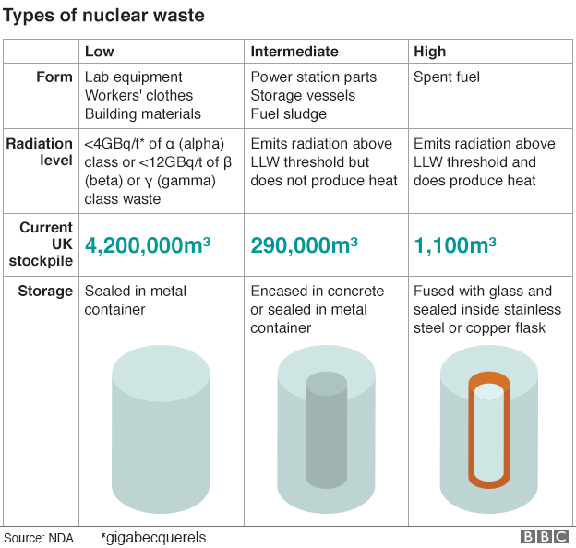
A $500 million treatment plant handles transuranic waste that includes work clothing, rags, machine parts and tools that have been contaminated with plutonium and other radioactive elements. The U.S. Nuclear Regulatory Commission says transuranic wastes take much longer to decay and are the most radioactive hazard in high-level waste after 1,000 years.

The Energy Department said that before the cleanup began, Idaho had the largest stockpile of transuranic waste of any of the agency’s facilities. Court battles between Idaho and the federal government culminated with a 1995 agreement requiring the Energy Department to clean up the Idaho site.

The Idaho treatment plant compacts the transuranic waste, making it easier to ship and put into long-term storage at the Waste Isolation Pilot Plant in New Mexico.

Federal officials this year floated the idea of keeping the $500 million treatment plant running in Idaho with waste from other states — mostly radioactive waste from the former nuclear weapons production area in Hanford.

With the Idaho treatment plant scheduled to shut down, it’s not clear how the transuranic waste at Hanford and other sites will be dealt with.

The Energy Department “will continue to work to ensure a path forward for packaging and certification of TRU (transuranic) waste at Hanford and other sites,” the agency said in the email to the AP.

Local officials and politicians generally supported the idea because of the good-paying jobs. The Snake River Alliance, an Idaho-based nuclear-watchdog group, said it had concerns the nuclear waste brought to Idaho would never leave.

A 38-page economic analysis the Department of Energy completed in August and released this week found “it does not appear to be cost effective due to packaging and transportation challenges in shipping waste” to Idaho.

“As work at the facility will continue into 2019, no immediate workforce impacts are anticipated,” the agency said in an email to The Associated Press on Friday. The Energy Department “recognizes the contribution of this facility and its employees to DOE’s cleanup mission and looks forward to applying the knowledge gained and experience of the workforce to other key activities at the Idaho site.”

The agency said it would also consider voluntary separation incentives for workers.

December 10, 2018 Posted by Christina Macpherson | USA, wastes | Leave a comment

Public health and safety endangered by weakening The Defense Nuclear Facilities Safety Board (DNFSB)

Nuclear safety groups criticize DOE order https://www.abqjournal.com/author/mhayden, BY MADDY HAYDEN / JOURNAL STAFF WRITER, , December 8th, 2018 SANTA FE, N.M. — Nuclear safety watchdog groups around the country are calling on the Department of Energy to rescind an order they fear will limit the board tasked with overseeing operations at some of the nation’s nuclear facilities and ultimately negatively affect safety at such facilities.

The Defense Nuclear Facilities Safety Board (DNFSB) has itself raised concerns over Order 140.1, “Interface with the Defense Nuclear Facilities Safety Board,” put into place by the DOE in April.

The board held a second public hearing on the order in Washington, D.C., on Nov. 28.

The DNFSB was created by Congress in 1988 to provide oversight and provide information to the public on safety issues at some DOE nuclear facilities.

“We are deeply concerned that Order 140.1 constrains crucial oversight activities of the DNFSB and thereby endangers public health and worker safety,” said Kathy Crandall Robinson of the Alliance for Nuclear Accountability during the late-November hearing.

Chief among the concerns with the order, which the DOE says is aimed at “clarifying” the roles of the department and DNFSB, is language that limits formal DNFSB oversight to issues of public safety as those beyond facility boundaries.

The order, Robinson said, “threatens to send us on a glide path back to a careless era as if this were a time when safety concerns and dangers at nuclear weapons facilities are shrinking.”

“They are not,” she added, citing plans to ramp up plutonium pit production at Los Alamos National Laboratory.

Lydia Dennett of the non-partisan Project on Government Oversight expressed concerns over the reasoning behind the order’s implementation, namely that the decision was possibly driven by government contractors.

“This policy makes it easier for contractors to hide any information they don’t want to come to light,” she said.

The order stipulates the DNFSB may not talk to contractor employees without getting authorization from management and DOE, according to the Alliance for Nuclear Accountability.

The Alliance for Nuclear Accountability represents more than 30 organizations located near DOE and National Nuclear Security Administration sites around the country, including the Albuquerque-based Southwest Research Information Center.

Don Hancock of the Southwest Research and Information Center pointed out in a news release sent by the alliance a 2011 DNFSB report that identified fire hazards at the Waste Isolation Pilot Plant in southeast New Mexico.

Three years later, an underground fire caused the temporary closure of the facility.

Contact the writer.

December 10, 2018 Posted by Christina Macpherson | safety, USA | Leave a comment

USA Energy Dept extends period for public comment on classification of High Level nuclear waste

Public gets more time to consider controversial radioactive waste issue https://www.tri-cityherald.com/news/local/hanford/article222835225.html, BY TRI-CITY HERALD STAFF, December 08, 2018 RICHLAND, WA 

The Department of Energy has agreed to extend the public comment period on its proposal to loosen its interpretation of what it considers high level radioactive waste.

The 60-day public comment period, which was set to end Dec. 10, has been extended until Jan. 9

The extension came at the urging of Sen. Ron Wyden, D-Ore., and 75 organizations across the nation, including Hanford Challenge, Columbia Riverkeeper, Heart of America Northwest and the Natural Resources Defense Council.

Defining less of the nation’s nuclear waste as high level could speed up environmental cleanup at places like the Hanford nuclear reservation and save billions of dollars.

It could give DOE more flexibility on how it deals with some of the 56 million gallons of waste stored in underground tanks.

The Energy Communities Alliance — which includes Hanford Communities, a coalition of local government near the Hanford Site — supports the proposal.

But critics like Hanford Challenge say it also could mean more toxic waste would be allowed to remain in the ground at Hanford.

Comments may be emailed to HLWnotice@em.doe.gov.

December 10, 2018 Posted by Christina Macpherson | USA, wastes | Leave a comment

U.S. preparing to wreck the Strategic Arms Reduction Treaty (START)?

U.S. Preparing Grounds to Scrap Key Nuclear Treaty, Lavrov Says, Bloomberg, By Stepan Kravchenko, December 7, 2018, NATO rejected Russian offer to discuss INF accord, Lavrov says. Huawei official’s arrest shows U.S. ‘arrogance,’ minister says

The U.S. is preparing to wreck the Strategic Arms Reduction Treaty (START), a key accord with Russia on limiting nuclear weapons, Russian Foreign Minister Sergei Lavrov said.

“I have the impression that they are preparing the ground to destroy this document as well,” following the U.S. decision to withdraw from another nuclear accord, the Intermediate-Range Nuclear Forces Treaty, Lavrov told a televised press conference in Milan on Friday after a meeting of OSCE foreign ministers. Russia has repeatedly sent proposals to the U.S. to begin talks on extending the START agreement but has received no response so far, he said.

The New START treaty signed in 2010, which followed on from a 1991 agreement, is due to expire in 2021. Under the accord, Russian and U.S. arsenals are restricted to no more than 1,550 strategic warheads on no more than 700 deployed strategic missiles and bombers. U.S. National Security Adviser John Bolton said during a visit to Moscow in October that Washington “does not have a position that we’re prepared to negotiate” on a new START treaty, adding that there’s “plenty of time” before the deal expires…….https://www.bloomberg.com/news/articles/2018-12-07/u-s-preparing-grounds-to-scrap-key-nuclear-treaty-lavrov-says

December 8, 2018 Posted by Christina Macpherson | politics international, USA, weapons and war | 1 Comment

If USA dumps the Intermediate-Range Nuclear Forces Treaty (INF) – Putin threatens arms race

Putin threatens arms race if US dumps nuclear treaty https://www.theguardian.com/world/2018/dec/05/putin-threatens-arms-race-if-us-dumps-nuclear-treaty – Andrew  Roth in Moscow

Russia would also build new medium-range missiles if the US were to do so, says president

Vladimir Putin has threatened that Russia will develop new missiles banned by the intermediate-range nuclear forces treaty if the US exits the pact and pursues an arms buildup of its own.

The Russian president’s remarks came one day after the US secretary of state, Mike Pompeo, said Moscow was in “material breach” of the cold war-era treaty and issued a 60-day ultimatum for Russia to correct the alleged violations. Otherwise, he said, the US would quit the 1987 accord, considered a milestone in reducing the threat of a nuclear war in Europe.

In Moscow on Wednesday, Putin told journalists the US had provided “no evidence” of Russian violations, and threatened an arms race if the US sought to develop new medium-range missiles after exiting the treaty.

“Apparently, our American partners believe that the situation has changed so drastically that the US should also have such weapons,” Putin said in remarks carried by the Interfax news service. “What response is our side to give? A simple one: then we’ll do the same.”

The arms treaty, signed by Ronald Reagan and Mikhail Gorbachev, banned ground-launched missiles with a range between 500-5,500km. The US and Nato have said that tests of a new Russian cruise missile, designated 9M729, violate the treaty.

The US effort to exit the treaty was spearheaded by John Bolton, Donald Trump’s hawkish national security adviser.

According to a leaked memo published by the Washington Post, Bolton has ordered the Pentagon to “develop and deploy ground-launched missiles at the earliest possible date”.

While it would take a substantial length of time to develop an entirely new missile, existing medium-range weapons in the US arsenal, such as sea-launched Tomahawk cruise missiles, could be adapted for ground launch more quickly, arms experts said.

However, Nato allies would have to agree unanimously to have any new missile deployed in Europe.

The standoff comes amid a buildup of Russian and Nato forces in Europe, including nuclear forces. Nato claims that Russia has deployed nuclear-capable missiles to Kaliningrad, and on Wednesday the Russian military confirmed it had deployed powerful new anti-ship missiles to Crimea following last month’s maritime clash with Ukraine.

December 6, 2018 Posted by Christina Macpherson | politics international, Russia, USA, weapons and war | Leave a comment

Witness: Flynn said Russia sanctions would be ‘ripped up’

By Tom Hamburger / The Washington Post

Posted at 9:33 PM Updated at 9:33 PM

WASHINGTON — As President Donald Trump delivered his inaugural address on the steps of the U.S. Capitol in January, his new national security adviser, Michael Flynn, sent a text to a former business associate telling him that a plan to build nuclear power plants in the Middle East in partnership with Russian interests was “good to go,” according to a witness who spoke with congressional investigators.

Flynn had assured his former associate that U.S. sanctions against Russia would immediately be “ripped up” by the Trump administration, a move that would help facilitate the deal, the associate told the witness.

The witness provided the account to Rep. Elijah Cummings of Maryland, the ranking Democrat on the House Oversight and Government Reform Committee, who detailed the allegations in a letter Wednesday to the panel’s chairman, Rep. Trey Gowdy, Republican of South Carolina.

Cummings did not identify the witness, whom he described as a whistleblower. But he asked Gowdy to issue a subpoena to the White House for documents related to Flynn, saying the committee has “credible allegations” that Flynn “sought to manipulate the course of international nuclear policy for the financial gain of his former business partners.”

Robert Kelner, an attorney representing Flynn, declined to comment. White House lawyer Ty Cobb said, “I respectfully decline to comment on anonymous information which impacts the special counsel investigation.” He was referring to the ongoing inquiry on Russian interference in the 2016 presidential campaign.

http://www.providencejournal.com/news/20171206/witness-flynn-said-russia-sanctions-would-be-ripped-up

December 4, 2018 Posted by arclight2011part2 | secrets,lies and civil liberties, USA | Leave a comment

Dark money, so-called “independent” Nuclear Matters, Georgia’s Public Service Commission and regulatory capture

The fight over a Georgia nuclear plant shows we need to ban dark money https://www.theguardian.com/commentisfree/2018/dec/03/the-fight-over-a-georgia-nuclear-plant-shows-we-need-to-ban-dark-money, Jon Ossoff

More than $1m of industry funding is being funnelled into a runoff election to decide who pays for a power company’s botched project – shareholders or the people?

This is a convoluted tale of secret corporate money in politics, the capture of regulators by those they are meant to regulate, incompetence, and greed.

We learned this week that more than $1m in dark money – secretly sourced political spending – is pouring into Tuesday’s runoff election for Georgia’s Public Service Commission (PSC).

The PSC is powerful; by setting rates it determines how much Georgians pay for electricity each month, and among its mandates is to safeguard the public interest by regulating Georgia’s energy industry.

But PSC elections have tended to fly under the radar, and they’ve long been dominated by candidates vetted and approved by Georgia Power – Georgia’s monopoly energy company – and its owner, the Southern Company.

So what’s with all the dark money this time around?

There are four key players in this drama: the Southern Company, which owns Georgia Power; a political committee called “Georgians for a Better Future”; a lobbying group called Nuclear Matters; and a powerful trade group called the Nuclear Energy Institute.

Spending these unprecedented sums in support of the incumbent Republican commissioner, Chuck Eaton, is “Georgians for a Brighter Future”, established just weeks ago for the specific purpose of intervention in our PSC runoff, in which Eaton faces a vigorous challenge from the Democratic rising star Lindy Miller.

Just three weeks into its existence, “Georgians for a Brighter Future” has been lavishly and swiftly funded for this mission by Nuclear Matters, the Washington-based “non-profit” that lobbies for the nuclear energy industry.

Thanks to America’s corrupted campaign finance laws, Nuclear Matters’ funders are secret. But the likely sponsors are not hard to establish. Nuclear Matters itself is an arm of the Nuclear Energy Institute, the nationwide nuclear industry’s trade association (we used to call them cartels), funded in part by the Southern Company.

Georgia Power’s CEO, Paul Bowers, is on Nuclear Matters’ board of directors. Former Georgia PSC chairman and diligent industry servant Stan Wise sits on its “advocacy council”. So does University of Georgia professor David Gattie, who provides consistent academic cover for Georgia Power’s business agenda and has not to my knowledge disclosed whether he receives industry funding.

Wise, according to reporting in The Atlanta Journal-Constitution, “resigned [from the PSC] earlier this year but hung on to his post long enough to join Eaton and three other members in green-lighting Georgia Power’s plan to continue construction on two new nuclear reactors at Plant Vogtle, a project now running five years behind schedule with billions of dollars in cost overruns.”

Here the purpose of this dark money assault on Georgia voters becomes clearer.

Plant Vogtle is Georgia Power’s – and therefore the Southern Company’s – nuclear power station in eastern Georgia. In 2013 the Southern Company began construction of two new reactors at Vogtle, backed by $8.3bn in federal loan guarantees.

Then the Southern Company proceeded to botch the project. Now years behind schedule and billions over budget, we face a classic political dilemma: who will pay? Georgia Power, the Southern Company, and their shareholders? Or Georgia Power’s customers – the people?

Not surprisingly, the Southern Company is determined that Georgia’s energy consumers – “ratepayers” – should pay for billions in cost overruns. Under our country’s perverse rules of corporate governance, this is, I suppose, rational. The alternative is that their shareholders and executives take a haircut.

Enter Democrat Lindy Miller, the first-time candidate, who fought her way against the odds into this runoff. Miller is no opponent of nuclear energy and she supports continued construction of Plant Vogtle to deliver cheap energy to Georgia without massive greenhouse gas emissions. She just doesn’t think Georgia ratepayers should pay for the Southern Company’s gross failure to meet a budget or a schedule.

It seems that’s just not acceptable to the Southern Company. As with the investment bankers and rating agencies who were bailed out despite their responsibility for the 2008 financial crisis, the Southern Company wants the public to bear the cost of its malpractice.

So we see this massive, 11th-hour political intervention in support of Eaton, the Southern Company’s chosen candidate. Why? Because he will reliably vote to saddle Georgia’s teachers, firefighters, veterans, retirees and working families with higher energy bills to bail out his powerful benefactors.
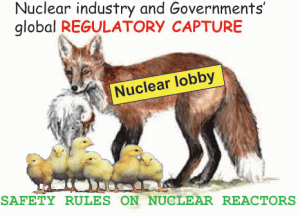
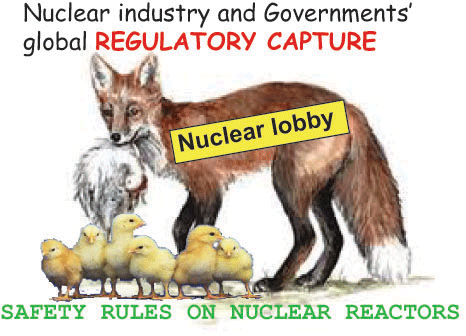
This story presents a microcosm of much that is wrong with American politics. The Southern Company’s dominance of Georgia’s PSC is what policy nerds call “regulatory capture”. With a relatively modest investment of millions, this multibillion-dollar industry is attempting to buy a seat on the public body that regulates it, even though Georgia law nominally forbids regulated entities from funding candidates for regulatory offices.

This money, like so much political spending, is laundered through a series of lobby groups and “non-profits” to obscure its origins and the agenda behind it. Dark money political spending, which is meant to mislead the public and serves only the interests of concentrated corporate power, should be banned by Congress and state legislatures.

It’s worth recalling that the Southern Company in its present form was born of trust-busting action ordered by the United States Congress. In 1947, its parent company, Commonwealth & Southern Energy, was dissolved by the Securities and Exchange Commission under the anti-trust authority of the Public Utility Holding Company Act. So the Southern Company as we know it now was born, ironically, of anti-trust action.

Fast-forward 71 years. Unrestrained corporate consolidation is once again crushing consumers and competitors in nearly every major sector of the US economy, while behemoth firms and trade groups wield virtually limitless political power. The Southern Company, the monopoly power giant, would force citizens to subsidize its own inefficiency, and they’re using their financial and political muscle to buy this seat on the PSC and evade financial responsibility.

There are good arguments for scale in energy production. But perhaps it’s time to revisit the anti-trust victories of the early 20th century.

And ban dark money now.

December 4, 2018 Posted by Christina Macpherson | secrets,lies and civil liberties, USA | Leave a comment

Link between 1979 Three Mile Island nuclear accident and thyroid cancer cases

New PSU study links 1979 TMI accident to thyroid cancer

Brett Sholtis, bsholtis@ydr.com York Daily Record,   June 12, 2017 A new Penn State College of Medicine study has found a link between the 1979 Three Mile Island accident and thyroid cancer cases in southcentral Pennsylvania.

The study marks the first time the partial meltdown can be connected to specific cancer cases, the researchers have said.

The findings may pose a dramatic challenge to the nuclear energy industry’s position that radiation released had no impact on human health.

The study was published Monday in the medical journal Laryngoscope, one day before Exelon Corp. announced that Three Mile Island would close in 2019. It’s likely to come as another blow to a nuclear power industry already struggling to stay profitable.

Exelon officials declined to comment on the findings, pointing out that it doesn’t own the damaged reactor and wasn’t running the plant during the accident…….

thyroid cancer caused by low-level radiation has a different “mutational signal” than most thyroid cancer, Goldenberg said. He and his colleagues used molecular research that had been pioneered after the Chernobyl nuclear disaster to find that genetic signal. …..

The next step is to expand the study by tapping into resources from other regional hospitals, he said.

The study contradicts conclusions about Three Mile Island held by many nuclear energy proponents, including the Nuclear Regulatory Commission. …… https://www.ydr.com/story/news/2017/05/31/psu-study-links-1979-tmi-accident-thyroid-cancer/358027001/

December 4, 2018 Posted by Christina Macpherson | health, USA | Leave a comment

What will ratepayers have to pay to resolve fight over failed V.C. Summer nuclear project?

Dominion wants a deal to end the SC nuclear fight. Here’s what it could cost ratepayers. By Andrew Brown abrown@postandcourier.com, Dec 3, 2018   COLUMBIA — For 15 days, South Carolina’s utility regulators reviewed testimony and sorted through mountains of evidence on the failed V.C. Summer nuclear project in order to decide how much S.C. Electric & Gas customers should pay for two unfinished reactors.

But as the high-stakes hearing wrapped up last week, the utility regulators were asked to consider one more thing.

Dominion Energy wanted the commissioners to review a new offer that would allow the Virginia-based energy company to seal its proposed takeover of SCE&G’s parent, SCANA Corp. It was the third plan Dominion pitched to regulators.

  • Less than four days later, SCANA announced another deal — this time with several law firms that were suing the company in a class action lawsuit on behalf of SCE&G ratepayers. That legal settlement threw support behind Dominion’s plans in the state Public Service Commission and is contingent upon the regulators giving the utilities what they want.
  • With a decision from regulators due by Dec. 21, here’s some explanation of what this dual settlement offer could mean for ratepayers, who have already dumped more than $2 billion into the abandoned nuclear project and who face paying more in the future.
  • What does Dominion’s latest offer in the Public Service Commission include? 
  • The initial plan from Dominion called for the average SCE&G ratepayer to receive a roughly $1,000 refund check but required customers to pay another $3.8 billion for the reactors.
  • Dominion has since offered to do away with the refund checks if the utility commissioners don’t like the idea. Instead, the company offered to further reduce how much customers pay for the abandoned reactors moving forward.
  • Under the more recent plan, residential and business ratepayers would be required to pay another $2.3 billion for the reactors over the next two decades. ………
  • What other plans are the state’s utility regulators considering? 
  • The Office of Regulatory Staff is sticking to its plan. Customers will still have to pay for the reactors moving forward, due to the 2007 state law that allowed SCE&G to charge customers in advance for the project.
  • But under the utility watchdog’s plan, the average residential ratepayers would kick in a little more than $5 per month for the failed project.
  • Overall, all SCE&G’s customers will pay back $1.7 billion over the next two decades under that plan, according to the Office of Regulatory Staff. ……..
  • What does the new settlement in the class action lawsuit do? 
  • The press release announcing the pending legal settlement mentioned $2 billion in rate relief for SCE&G customers. But that money was already part of the deal that Dominion put forward in the Public Service Commission.
  • In reality, SCANA and the trial attorneys representing SCE&G ratepayers plan to settle the high-stakes case for $115 million, which matches the money set aside in golden parachutes for SCANA executives let go after the Dominion sale, and whatever money can be made from the sale of several SCANA properties, including an office in downtown Charleston.
  • ………… https://www.postandcourier.com/business/dominion-wants-a-deal-to-end-the-sc-nuclear-fight/article_93463a28-f3e5-11e8-b9bd-9b4df318cd08.html

December 4, 2018 Posted by Christina Macpherson | business and costs, USA | Leave a comment

Massive problem of USA’s high level nuclear waste – scientists struggling for a solution

US nuclear waste dump capacity a challenge https://www.news.com.au/world/breaking-news/us-nuclear-waste-dump-capacity-a-challenge/news-story/69f13410922c5570e187c9e529a54ffd

If the plan were to be approved, the US Energy Department has estimated that it would take 31 years to dilute and dispose of the of weapons-grade plutonium.

The lack of space at the US government’s only underground nuclear waste repository is among several challenges identified by a group of scientists and other experts who are looking at the viability of disposing of weapons-grade plutonium at the desert location.

The National Academies of Sciences, Engineering, and Medicine released a preliminary report on the US government’s plan, which calls for diluting 34 metric tons of plutonium and shipping it to the Waste Isolation Pilot Plant in southern New Mexico.

The purpose of the work would be to satisfy a nonproliferation agreement with Russia.

Another challenge, the scientists say, would be getting officials in that country to approve of the dilution of the materials.

The pact between the two countries was initially based on a proposal for turning the surplus plutonium into fuel that could be used for commercial nuclear reactors. That project, beset by years of delays and cost overruns, was cancelled earlier this year.

The review of the plan that calls for shipping the plutonium to New Mexico was requested by Congress. A final report from the National Academies is expected mid 2019.

The US Energy Department’s Office of Environmental Management has demonstrated that diluting the plutonium is possible by working with a separate batch of material. However, citing a lack of information, the scientists did not study the agency’s ability to scale up that process to handle the 34 metric tons that are part of the nonproliferation agreement.

If the plan were to be approved, the Energy Department has estimated that it would take 31 years to dilute and dispose of all 34 metric tons.

The work would involve four sites around the US – the Pantex Plant in West Texas, the Savannah River Site in South Carolina, Los Alamos National Laboratory in northern New Mexico and the Waste Isolation Pilot Plant.

The panel of scientists found that the agency doesn’t have a well-developed plan for reaching out to those host sites and stressed that public trust would have to be developed and maintained over the life of the project.


December 3, 2018 Posted by Christina Macpherson | USA, wastes | Leave a comment

Delay in compensation for NUCLEAR LAB EMPLOYEES WITH RADIATION-LINKED CANCERS

NUCLEAR LAB EMPLOYEES WITH RADIATION-LINKED CANCERS HAVE BEEN FORCED TO WAIT YEARS FOR POTENTIAL BENEFITS  At the Los Alamos National Laboratory in New Mexico, workers are still waiting for answers about who is liable for sicknesses they say were caused by radiation from the lab. REBECCA MOSS PACIFIC STANDARD, Nov 30, 2018 

Ten years ago, a security guard at Los Alamos National Laboratory submitted a petition to the federal government seeking compensation and benefits for his fellow lab workers who were sick with cancer and believed that radiation at the lab was to blame.

Andrew Evaskovich’s petition took advantage of a process put in place by Congress in 2000 that allowed groups of workers to secure benefits if they could show that they worked at a nuclear facility, that they had a cancer linked to radiation, and that lab managers failed to accurately keep track of their exposures over time.

Under the law, the National Institute for Occupational Safety and Health, a federal agency that makes recommendations on work-related injuries and illnesses, had six months to review Evaskovich’s petition and recommend whether it should be approved or denied.

A decade later, Evaskovich and his colleagues are still waiting for a final answer. Continue reading →

December 3, 2018 Posted by Christina Macpherson | employment, USA | Leave a comment

Deal to purchase Bellefonte Nuclear Power Plant is off

By WAFF 48 Digital Staff | November 30, 2018 JACKSON COUNTY, AL (WAFF) – The deal for Tennessee valley Authority to sell the partially completed Bellefonte Nuclear Power Plant in Jackson County has been derailed. Officials with Nuclear Development say they’ve been told by TVA they will not close on the deal.

Nuclear Development was set to purchase the property for over $110 million.

The future of the plant has been in question for decades.

The final date to close on the sale has passed, and TVA informed Nuclear Development late Thursday that the deal was off. An extension was granted by TVA but Nuclear Development officials stated on Friday that TVA would not grant another.

According to TVA, Nuclear Development had not acquired a license to own a nuclear plant.

TVA’s official statement is as follows:

“On Nov. 30, 2018, the parties were unable to complete the sale of the Bellefonte property after Nuclear Development’s lack of progress in meeting its legal obligations related to future ownership of the site. Nuclear Development did not complete the necessary NRC license transfer prior to the closing date as required by the Atomic Energy Act………http://www.waff.com/2018/11/30/deal-purchase-bellefonte-nuclear-power-plant-is-off/

December 3, 2018 Posted by Christina Macpherson | business and costs, USA | Leave a comment

Exposing The Pentagon’s Massive Accounting Fraud

The Pentagon’s Massive Accounting Fraud Exposed, How US military spending keeps rising even as the Pentagon flunks its audit. The Nation , By Dave Lindorff, NOVEMBER 27, 2018 In November 15, Ernst & Young and other private firms that were hired to audit the Pentagon announced that they could not complete the job. Congress had ordered an independent audit of the Department of Defense, the government’s largest discretionary cost center—the Pentagon receives 54 cents out of every dollar in federal appropriations—after the Pentagon failed for decades to audit itself. The firms concluded, however, that the DoD’s financial records were riddled with so many bookkeeping deficiencies, irregularities, and errors that a reliable audit was simply impossible………..
Now, a Nation investigation has uncovered an explanation for the Pentagon’s foot-dragging: For decades, the DoD’s leaders and accountants have been perpetrating a gigantic, unconstitutional accounting fraud, deliberately cooking the books to mislead the Congress and drive the DoD’s budgets ever higher, regardless of military necessity. DoD has literally been making up numbers in its annual financial reports to Congress—representing trillions of dollars’ worth of seemingly nonexistent transactions—knowing that Congress would rely on those misleading reports when deciding how much money to give the DoD the following year, according to government records and interviews with current and former DoD officials, congressional sources, and independent experts.

“If the DOD were being honest, they would go to Congress and say, ‘All these proposed budgets we’ve been presenting to you are a bunch of garbage,’ ” said Jack Armstrong, who spent more than five years in the Defense Department’s Office of Inspector General as a supervisory director of audits before retiring in 2011.

The fraud works like this. When the DoD submits its annual budget requests to Congress, it sends along the prior year’s financial reports, which contain fabricated numbers. The fabricated numbers disguise the fact that the DoD does not always spend all of the money Congress allocates in a given year. However, instead of returning such unspent funds to the US Treasury, as the law requires, the Pentagon sometimes launders and shifts such moneys to other parts of the DoD’s budget.

Veteran Pentagon staffers say that this practice violates Article I Section 9 of the US Constitution, which stipulates that

No Money shall be drawn from the Treasury, but in Consequence of Appropriations made by Law; and a regular Statement and Account of the Receipts and Expenditures of all public Money shall be published from time to time.

Among the laundering tactics the Pentagon uses: So-called “one-year money”—funds that Congress intends to be spent in a single fiscal year—gets shifted into a pool of five-year money. This maneuver exploits the fact that federal law does not require the return of unspent “five-year money” during that five-year allocation period.

The phony numbers are referred to inside the Pentagon as “plugs,” as in plugging a hole, said current and former officials. “Nippering,” a reference to a sharp-nosed tool used to snip off bits of wire or metal, is Pentagon slang for shifting money from its congressionally authorized purpose to a different purpose. Such nippering can be repeated multiple times “until the funds become virtually untraceable,” says one Pentagon-budgeting veteran who insisted on anonymity in order to keep his job as a lobbyist at the Pentagon.

The plugs can be staggering in size. In fiscal year 2015, for example, Congress appropriated $122 billion for the US Army. Yet DoD financial records for the Army’s 2015 budget included a whopping $6.5 trillion (yes, trillion) in plugs. Most of these plugs “lack[ed] supporting documentation,” in the bland phrasing of the department’s internal watchdog, the Office of Inspector General. In other words, there were no ledger entries or receipts to back up how that $6.5 trillion supposedly was spent. Indeed, more than 16,000 records that might reveal either the source or the destination of some of that $6.5 trillion had been “removed,” the inspector general’s office reported.

In this way, the DoD propels US military spending higher year after year, even when the country is not fighting any major wars, says Franklin “Chuck” Spinney, a former Pentagon whistle-blower. Spinney’s revelations to Congress and the news media about wildly inflated Pentagon spending helped spark public outrage in the 1980s. “They’re making up the numbers and then just asking for more money each year,” Spinney told The Nation. The funds the Pentagon has been amassing over the years through its bogus bookkeeping maneuvers “could easily be as much as $100 billion,” Spinney estimated.
Indeed, Congress appropriated a record amount—$716 billion—for the DoD in the current fiscal year of 2019. That was up $24 billion from fiscal year 2018’s $692 billion, which itself was up $6 billion from fiscal year 2017’s $686 billion. Such largesse is what drives US military spending higher than the next ten highest-spending countries combined, added Spinney. Meanwhile, the closest thing to a full-scale war the United States is currently fighting is in Afghanistan, where approximately 15,000 US troops are deployed—only 2.8 percent as many as were in Vietnam at the height of that war…………

As things stand, no one knows for sure how the biggest single-line item in the US federal budget is actually being spent. What’s more, Congress as a whole has shown little interest in investigating this epic scandal. The absurdly huge plugs never even get asked about at Armed Services and Budget Committee hearings.

One interested party has taken action—but it is action that’s likely to perpetuate the fraud. The normally obscure Federal Accounting Standards Advisory Board sets the accounting standards for all federal agencies. Earlier this year, the board proposed a new guideline saying that agencies that operate classified programs should be permitted to falsify figures in financial statements and shift the accounting of funds to conceal the agency’s classified operations. (No government agency operates more classified programs than the Department of Defense, which includes the National Security Agency.) The new guideline became effective on October 4, just in time for this year’s end-of-year financial statements.

So here’s the situation: We have a Pentagon budget that a former DOD internal-audit supervisor, Jack Armstrong, bluntly labels “garbage.” We have a Congress unable to evaluate each new fiscal year’s proposed Pentagon budget because it cannot know how much money was actually spent during prior years. And we have a Department of Defense that gives only lip service to fixing any of this. Why should it? The status quo has been generating ever-higher DoD budgets for decades, not to mention bigger profits for Boeing, Lockheed, and other military contractors.

The losers in this situation are everyone else. The Pentagon’s accounting fraud diverts many billions of dollars that could be devoted to other national needs: health care, education, job creation, climate action, infrastructure modernization, and more. Indeed, the Pentagon’s accounting fraud amounts to theft on a grand scale—theft not only from America’s taxpayers, but also from the nation’s well-being and its future……… https://www.thenation.com/article/pentagon-audit-budget-fraud/

December 1, 2018 Posted by Christina Macpherson | politics, USA, weapons and war | Leave a comment

The danger of nuclear war through irrational decision-making by Donald Trump

America’s greatest danger: Nuclear war decision-making by Donald Trump https://thehill.com/opinion/white-house/418509-americas-greatest-danger-nuclear-war-decision-making-by-donald-trump

BY LOUIS RENÉ BERES, OPINION CONTRIBUTOR — 11/28/18  An inappropriate or irrational nuclear command decision by President Donald Trump is plainly conceivable. Nothing accurate can ever be said about the true probability of such a scenario, but it is not an unfounded worry.

Might this American president become subject to various forms of psychological debility? On 14 March 1976, in response to my specific query, I received a letter from General (USA/ret.) Maxwell Taylor, a former Chairman of the U.S. Joint Chiefs of Staff, concerning nuclear risks of U.S. presidential decisional irrationality. Most noteworthy, in this handwritten response, is the straightforward warning contained in the closing paragraph. Ideally, cautioned Taylor, presidential irrationality is a problem that should be dealt with during an election, and not later on: “As to dangers arising from an irrational American president, the best protection is not to elect one.”

There are assorted structural protections built into any presidential order to use nuclear weapons, including substantial redundancy. Nonetheless, virtually all of these reassuring and mutually reinforcing safeguards could become operative only at the lower or sub-presidential nuclear command levels.

The safeguards do not apply to the Commander-in-Chief.

This means there likely exist no permissible legal grounds to disobey any presidential order to use nuclear weapons. In principle, certain very senior individuals in the designated military chain of command could sometime choose to invoke applicable “Nuremberg Obligations,” but any such last-minute invocation would almost surely need to yield to considerations of U.S. domestic law.

Should an American president operating within a bewildering chaos of his own making issue an irrational or seemingly irrational nuclear command, the only way for the Secretary of Defense, the Chairman of the Joint Chiefs, the National Security Adviser, and several possible others to effectively obstruct this order would be illegal “on its face.” Under the very best of circumstances, such informal safeguards might somehow manage to work for a time, but accepting the unrealistic assumption of “best case scenario” is hardly a rational or sensible path to nuclear security.

It follows that we Americans ought to ask for more predictable and promising institutional impediments to any debilitated president.

The United States is already navigating in uncharted waters.

While President Kennedy did engage in personal nuclear brinkmanship with the Soviet Union back in October 1962, he had calculated his own odds of a consequent nuclear war as “between one out of three and even.” This seemingly precise calculation, corroborated both by JFK biographer Theodore Sorensen, and by my own later private conversations with former JCS Chair Admiral Arleigh Burke (my colleague and roommate at the Naval Academy’s Foreign Affairs Conference of 1977) suggests that President Kennedy was either irrational in imposing his Cuban “quarantine” or that he was wittingly acting out certain untested principles of “pretended irrationality.”

JFK operated with serious and manifestly capable strategic advisors.

The most urgent threat of a mistaken or irrational presidential order to use nuclear weapons flows not from any “bolt-from-the-blue” nuclear attack – whether Russian, North Korean, or American – but from an uncontrollable escalatory process. Back in 1962, Soviet premier Nikita Khrushchev “blinked” early on in the “game,” thereby preventing mutual and irrecoverable nuclear harms. Now, however, any escalatory initiatives undertaken by President Trump could express very unstable decision-making processes.

Donald Trump should understand the unprecedented risks of being locked into an escalatory dynamic. Although this president might be well advised to seek escalation dominance in selected crisis negotiations with determined adversaries, he would also need to avoid catastrophic miscalculations.

Whether we like it or not, and at one time or another, nuclear strategy is a bewildering game that President Donald Trump will have to play. To best ensure that this easily-distracted president’s strategic moves will be rational, thoughtful, and cumulatively cost-effective, it will first be necessary to enhance the formal decisional authority of his most senior military and defense subordinates.

At a minimum, the Secretary of Defense, Chairman of the Joint Chiefs of Staff, the National Security Advisor, and one or two others in appropriate nuclear command positions should immediately prepare to assume more broadly collaborative and secure judgments in extremis atomicum.

The only time for clarifying such indispensable preparations is now.

Louis René Beres, Ph.D. Princeton, is emeritus professor of international law at Purdue University. He is the author of 12 books and several hundred articles dealing with nuclear strategy and nuclear war. His newest book is “Surviving Amid Chaos: Israel’s Nuclear Strategy” (Rowman & Littlefield, 2016; 2nd ed. 2018)

December 1, 2018 Posted by Christina Macpherson | politics international, USA, weapons and war | Leave a comment

U.S. Congress could stop the endless wars

Will Congress Stop the Endless Wars?  Mike Ludwig, Truthout, November 30, 2018  Lawmakers in both parties had plenty of reasons to advance a Senate resolution this week that would end the United States’ participation in Yemen’s bloody civil war. Death is rapidly spreading across Yemen, where the Saudi-led coalition fighting against Houthi rebels is blocking the flow of food and aid, leaving up to 14 million people on the brink of the world’s worst famine in over a century. Bombs made in the US have been found alongside dead civilians.Then there is President Trump, who appears all too eager to defend the Saudi royal family, even after his own intelligence agents concluded that Saudi Crown Prince Muhammad bin Salman was likely behind the brutal killing and dismemberment of Saudi dissident and journalist Jamal Khashoggi.

Sen. Bernie Sanders of Vermont, who introduced the resolution back in February, said the legislation is certainly about addressing famine, bloodshed and Trump’s troubling embrace of Saudi monarchs. It’s also about Congress reasserting its constitutional authority over when and where the US makes war overseas. This has major implications for the peace movement, which is calling on Sanders to become a leading voice against US militarism.

The US military supplies the Saudi coalition with military equipment, intelligence and targeting assistance, and only recently agreed to stop refueling the Saudi warplanes bombarding Yemen. Congress never authorized participation in the civil war, even as the Obama administration began leveraging military assistance to the Saudis back in 2015. Speaking on the Senate floor on Wednesday, Sanders made this clear as he urged his colleagues to bring the resolution out of committee.

“It is a vote … that says that the United States Senate respects the Constitution … and understands that the issue of war making, of going to war, putting young men and women’s lives at stake, is something determined by the US Congress, not the president of the United States,” Sanders said.

The Senate voted 63-37 to advance the resolution on Wednesday, just months after tabling the measure with a solid majority that included several Democrats. The resolution invokes the War Powers Resolution of 1973, which compels the president to remove US forces from overseas military operations that are not authorized by Congress. A vote to pass the legislation is expected next week, and the antiwar movement now has a hard-fought victory in its sights.

“It’s enormous. This is the first time in the Senate’s history that they have ever gotten this far in invoking the War Powers Resolution,” said Hassan El-Tayyab, a peace activist and co-director of Just Foreign Policy who lobbied Congress on Yemen, in an interview.

The Constitution places the power to declare war with Congress, not the White House, but Congress has not declared war since World War II. From Vietnam to Afghanistan and Iraq, a succession of presidents led US troops into major foreign wars and a long list of other conflicts, rapidly expanding the size of the military and the power of the Oval Office along the way. Each time, these presidents sidestepped Congress. Today, the US has an estimated 800 military bases outside the 50 states, and US troops have regularly engaged in military operations in a long list of countries across the world. ……… https://truthout.org/articles/will-congress-stop-the-endless-wars/

December 1, 2018 Posted by Christina Macpherson | politics, USA, weapons and war | Leave a comment

« Previous Entries     Next Entries »

1 This Month

of the week– Nuclear Reactor Information Task Force

14 May – online event From Bombs to Data Centres: the Face of Nuclear Colonialism

​To see nuclear-related stories in greater depth and intensity – go to https://nuclearinformation.wordpress.com

  • Categories

    • 1
      • Arclight's Vision
    • 1 NUCLEAR ISSUES
      • business and costs
        • employment
        • marketing
      • climate change
      • culture and arts
      • ENERGY
        • renewable
          • decentralised
          • energy storage
      • environment
        • oceans
        • water
      • health
        • children
        • psychology – mental health
        • radiation
        • social effects
        • women
      • history
      • indigenous issues
      • Legal
        • deaths by radiation
        • legal
      • marketing of nuclear
      • media
        • investigative journalism
        • Wikileaks
      • opposition to nuclear
      • PERSONAL STORIES
      • politics
        • psychology and culture
          • Trump – personality
        • public opinion
        • USA election 2024
        • USA elections 2016
      • politics international
      • Religion and ethics
      • safety
        • incidents
      • secrets,lies and civil liberties
        • civil liberties
      • spinbuster
        • Education
      • technology
        • reprocessing
        • Small Modular Nuclear Reactors
        • space travel
      • Uranium
      • wastes
        • – plutonium
        • decommission reactor
      • weapons and war
        • Atrocities
        • depleted uranium
      • Women
    • 2 WORLD
      • ANTARCTICA
      • ARCTIC
      • ASIA
        • Burma
        • China
        • India
        • Indonesia
        • Japan
          • – Fukushima 2011
          • Fukushima 2012
          • Fukushima 2013
          • Fukushima 2014
          • Fukushima 2015
          • Fukushima 2016
          • Fukushima continuing
        • Malaysia
        • Mongolia
        • North Korea
        • Pakistan
        • South Korea
        • Taiwan
        • Turkey
        • Vietnam
      • EUROPE
        • Belarus
        • Bulgaria
        • Denmark
        • Finland
        • France
        • Germany
        • Greece
        • Ireland
        • Italy
        • Kazakhstan
        • Kyrgyzstan
        • Russia
        • Spain
        • Sweden
        • Switzerland
        • UK
        • Ukraine
      • MIDDLE EAST
        • Afghanistan
        • Egypt
        • Gaza
        • Iran
        • Iraq
        • Israel
        • Jordan
        • Libya
        • Saudi Arabia
        • Syria
        • Turkey
        • United Arab Emirates
      • NORTH AMERICA
        • Canada
        • USA
          • election USA 2020
      • OCEANIA
        • New Zealand
        • Philippines
      • SOUTH AMERICA
        • Brazil
    • ACTION
    • AFRICA
      • Kenya
      • Malawi
      • Mali
      • Namibia
      • Niger
      • Nigeria
      • Somalia
      • South Africa
    • Atrocities
    • AUSTRALIA
    • Christina's notes
    • Christina's themes
    • culture and arts
    • Events
    • Fuk 2022
    • Fuk 2023
    • Fukushima 2017
    • Fukushima 2018
    • fukushima 2019
    • Fukushima 2020
    • Fukushima 2021
    • general
    • global warming
    • Humour (God we need it)
    • Nuclear
    • RARE EARTHS
      • thorium
    • Reference
      • Reference archives
    • resources – print
    • Resources -audiovicual
    • Weekly Newsletter
    • World
    • World Nuclear
    • YouTube
  • Pages

    • 1 This Month
    • ACTION !
    • Disclaimer
    • Links
    • PAGES on NUCLEAR ISSUES
      • audio-visual news
      • Anti Nuclear, Clean Energy Movement
        • Anti Nuclear movement – a success story
          • – 2013 – the struggle for a nuclear-free, liveable world
          • – 2013: the battle to expose nuclear lies about ionising radiation
            • Speakers at Fukushima Symposium March 2013
            • Symposium 2013 Ian Fairlie
      • Civil Liberties
        • – Civil liberties – China and USA
      • Climate change
      • Climate Change
      • Economics
        • – Employment
        • – Marketing nuclear power
        • – Marketing Nuclear Power Internationally
        • nuclear ‘renaissance’?
        • Nuclear energy – the sick man of the corporate world
      • Energy
        • – Solar energy
      • Environment
        • – Nuclear Power and the Tragedy of the Commons
        • – Water
      • Health
        • Birth Defects in the Chernobyl Radiation Affected Region.
      • History
        • Nuclear History – the forgotten disasters
      • Indigenous issues
      • Ionising radiation
        • – Ionising radiation – medical
        • Fukushima FACT SHEET
      • Media
        • Nuclear Power and Media 2012
      • Nuclear Power and the Consumer Society – theme for December 2012
      • Peace and nuclear disarmament
        • Peace on a Nuclear Free Earth
      • Politics
        • – Politics USA
      • Public opinion
      • Religion and ethics
        • -Ethics of nuclear power
      • Resources – print
      • Safety
      • Secrets and lies
        • – NUCLEAR LIES – theme for January 2012
        • – Nuclear Secrets and Lies
      • Spinbuster
        • 2013 nuclear spin – all about FEAR -theme for June
        • Spinbuster 1
      • Technology
        • TECHNOLOGY Challenges
      • Wastes
        • NUCLEAR WASTES – theme for October 2012
        • – Plutonium
      • Weapons and war
      • Women
  • Archives

    • May 2026 (102)
    • April 2026 (356)
    • March 2026 (251)
    • February 2026 (268)
    • January 2026 (308)
    • December 2025 (358)
    • November 2025 (359)
    • October 2025 (376)
    • September 2025 (257)
    • August 2025 (319)
    • July 2025 (230)
    • June 2025 (348)
  • Categories

    • 1
      • Arclight's Vision
    • 1 NUCLEAR ISSUES
      • business and costs
        • employment
        • marketing
      • climate change
      • culture and arts
      • ENERGY
        • renewable
          • decentralised
          • energy storage
      • environment
        • oceans
        • water
      • health
        • children
        • psychology – mental health
        • radiation
        • social effects
        • women
      • history
      • indigenous issues
      • Legal
        • deaths by radiation
        • legal
      • marketing of nuclear
      • media
        • investigative journalism
        • Wikileaks
      • opposition to nuclear
      • PERSONAL STORIES
      • politics
        • psychology and culture
          • Trump – personality
        • public opinion
        • USA election 2024
        • USA elections 2016
      • politics international
      • Religion and ethics
      • safety
        • incidents
      • secrets,lies and civil liberties
        • civil liberties
      • spinbuster
        • Education
      • technology
        • reprocessing
        • Small Modular Nuclear Reactors
        • space travel
      • Uranium
      • wastes
        • – plutonium
        • decommission reactor
      • weapons and war
        • Atrocities
        • depleted uranium
      • Women
    • 2 WORLD
      • ANTARCTICA
      • ARCTIC
      • ASIA
        • Burma
        • China
        • India
        • Indonesia
        • Japan
          • – Fukushima 2011
          • Fukushima 2012
          • Fukushima 2013
          • Fukushima 2014
          • Fukushima 2015
          • Fukushima 2016
          • Fukushima continuing
        • Malaysia
        • Mongolia
        • North Korea
        • Pakistan
        • South Korea
        • Taiwan
        • Turkey
        • Vietnam
      • EUROPE
        • Belarus
        • Bulgaria
        • Denmark
        • Finland
        • France
        • Germany
        • Greece
        • Ireland
        • Italy
        • Kazakhstan
        • Kyrgyzstan
        • Russia
        • Spain
        • Sweden
        • Switzerland
        • UK
        • Ukraine
      • MIDDLE EAST
        • Afghanistan
        • Egypt
        • Gaza
        • Iran
        • Iraq
        • Israel
        • Jordan
        • Libya
        • Saudi Arabia
        • Syria
        • Turkey
        • United Arab Emirates
      • NORTH AMERICA
        • Canada
        • USA
          • election USA 2020
      • OCEANIA
        • New Zealand
        • Philippines
      • SOUTH AMERICA
        • Brazil
    • ACTION
    • AFRICA
      • Kenya
      • Malawi
      • Mali
      • Namibia
      • Niger
      • Nigeria
      • Somalia
      • South Africa
    • Atrocities
    • AUSTRALIA
    • Christina's notes
    • Christina's themes
    • culture and arts
    • Events
    • Fuk 2022
    • Fuk 2023
    • Fukushima 2017
    • Fukushima 2018
    • fukushima 2019
    • Fukushima 2020
    • Fukushima 2021
    • general
    • global warming
    • Humour (God we need it)
    • Nuclear
    • RARE EARTHS
      • thorium
    • Reference
      • Reference archives
    • resources – print
    • Resources -audiovicual
    • Weekly Newsletter
    • World
    • World Nuclear
    • YouTube
  • RSS

    Entries RSS
    Comments RSS

Site info

nuclear-news
Blog at WordPress.com.
Privacy & Cookies: This site uses cookies. By continuing to use this website, you agree to their use.
To find out more, including how to control cookies, see here: Cookie Policy
  • Subscribe Subscribed
    • nuclear-news
    • Join 2,102 other subscribers
    • Already have a WordPress.com account? Log in now.
    • nuclear-news
    • Subscribe Subscribed
    • Sign up
    • Log in
    • Report this content
    • View site in Reader
    • Manage subscriptions
    • Collapse this bar

Loading Comments...