America’s nuclear lobby spending up big to get $millions in State subsidies
 In a Time of Cheap Fossil Fuels, Nuclear Power Companies Are Seeking — and Getting — Big Subsidies In a Time of Cheap Fossil Fuels, Nuclear Power Companies Are Seeking — and Getting — Big Subsidies
Illinois and New York have approved hundreds of millions of dollars in clean-energy incentives for nuclear power companies. New Jersey, Pennsylvania and Maryland could be next. Pro Publica by Talia Buford, April 17, 19“……….It would be a “safety net” for the company’s nuclear operations in New Jersey, Izzo said. ([Ralph Izzo, chairman, president and CEO of energy company PSEG] It would not, he emphasized, be “a bailout.” On Thursday, regulators in New Jersey are scheduled to decide whether PSEG has shown that it needs the subsidies, which would be paid for through a surcharge on all customer bills in the state. If the Board of Public Utilities approves the requests, New Jersey would join two other states, Illinois and New York, in giving nuclear power plants hundreds of millions of dollars in order to stay competitive in the wholesale energy market. The campaign for the subsidies took to the pages of the state’s largest newspaper, The Star-Ledger, this week. A full-page ad on Monday signed by the employees of the Salem and Hope Creek plants, and another on Tuesday, signed by eight former New Jersey governors, praised the subsidy plan and warned of the consequences of not acting. ………..In recent years, the nuclear power industry has ramped up efforts to cultivate influence with legislators and alliances with environmentalists. The industry’s gains thus far haven’t been easy, or cheap. In New Jersey, PSEG spent nearly $4 million over the course of 2017 and 2018 lobbying the Legislature on the nuclear subsidies. By comparison, groups lobbying on marijuana legalization, the other big issue of the last two legislative sessions, spent $1.7 million, according to the state Election Law Enforcement Commission……… In each state, the push for subsidies has come after warnings that the plants would have to close. But critics of the programs say that in many instances, the plants are profitable, and the companies are using scare tactics to bully legislators into subsidizing shareholder profits. “They rattled their saber many times,” said Abe Scarr, state director of Illinois Public Interest Research Group, a consumer organization that opposed the subsidies. “Regardless of whether it was a bluff or not, certainly their threats were a ploy to build pressure on Illinois decision makers.” Threatening to close plants in the name of shareholder profits is a tactic Stefanie Brand, director of the New Jersey Division of Rate Counsel, a state-appointed advocate for utility customers, said she hadn’t seen before. “It’s a level of coercion that is really unprecedented,” Brand said………https://www.propublica.org/article/in-a-time-of-cheap-fossil-fuels-nuclear-power-companies-are-seeking-and-getting-big-subsidies |
|
U.S. Supreme Court rejects challenge to nuclear subsidy
Supreme court denies challenge to NY nuclear subsidy, Houston Chronicle, April 15, 2019 WASHINGTON – The U.S. Supreme Court rejected a power industry trade group’s petition to challenge New York state’s plan to reduce greenhouse gas emissions through the subsidization of nuclear power plants.
The Electric Power Supply Association claimed in a lawsuit that the New York Public Service Commission had violated federal law requiring power rates be “just and reasonable” when they elected to award $7 billion in rate increases through their zero emissions credit program.
After that argument was rejected by the Second Circuit Court of Appeals, the group applied to the Supreme Court for relief in January. As is customary, the Supreme Court’s justices offered no explanation on their decision not to hear the case. …….https://www.houstonchronicle.com/business/energy/article/Supreme-court-denies-challenge-to-NY-nuclear-13768307.php
North Dakota prohibits nuclear waste dumping in the state
U.S.nuclear bailouts – Exelon and the death of competitive energy markets
 Lowman S. Henry: Exelon and the death of competitive energy markets, The Phoenix, By Lowman S. Henry Columnist, Apr 17, 2019, Lowman S. Henry: Exelon and the death of competitive energy markets, The Phoenix, By Lowman S. Henry Columnist, Apr 17, 2019,
|
|
Extradition of Julian Assange must be opposed. USA govt wants to silence all reports of govt atrocities
 I’ve been told that Julian Assange is in favour of nuclear power – with the suggestion that we should not support him. Also that his revelations about Hilary Clinton helped to get the abominable Trump elected.
But does this matter? Assange revealed the truth. And what will happen to the next whistlebower, perhaps one that reveals the corruption in the nuclear industry?
 Whatever you think of Julian Assange, his extradition to the US must be opposed, Owen Jones, Guardian, 12 Apr 19, States that commit crimes in foreign lands depend on at least passive acquiescence. This is achieved in a number of ways. One is the “othering” of the victims: the stripping away of their humanity, because if you imagined them to be people like your own children or your neighbours, their suffering and deaths would be intolerable. Another approach is to portray opponents of foreign aggression as traitors, or in league with hostile powers. And another strategy is to cover up the consequences of foreign wars, to ensure that the populace is kept intentionally unaware of the acts committed in their name.
It is Manning who is the true hero of this story: last month, she was arrested for refusing to testify to a grand jury investigating WikiLeaks, placed in solitary confinement for four weeks, and now remains imprisoned. We must demand her freedom.
These leaks revealed some of the horrors of the post-9/11 wars. One showed a US aircrew laughing after slaughtering a dozen innocent people, including two Iraqi employees of Reuters, after dishonestly alleging to have encountered a firefight. Other files revealed how US-led forces killedhundreds of civilians in Afghanistan, their deaths otherwise airbrushed out of existence. Another cable, which exposed corruption and scandals in the court of Zine al-Abidine Ben Ali, the western-backed then-dictator of Tunisia, helped fuel protests, which toppled him……..
Assange must answer the allegations of sexual assault in Sweden without the threat of extradition to the US………. That Swedish case must be entirely disentangled from the US extradition attempt. And while opposing Assange’s rightwing libertarian politics is perfectly reasonable, it is utterly irrelevant to the basic issue here of justice……….
Assange’s extradition to the US must be passionately opposed. It is notable that Obama’s administration itself concluded that to prosecute Assange for publishing documents would gravely imperil press freedom. Yes, this is a defence of journalism and media freedom. But it is also about the attempt to intimidate those who expose crimes committed by the world’s last remaining superpower. The US wishes to hide its crimes so it can continue to commit them with impunity: that’s why, last month, Trump signed an executive order to cover up civilian deaths from drones, the use of which has hugely escalated in Afghanistan, Somalia, Yemen and Pakistan.
Silence kills, because a public that is uninformed about the slaughter of innocent people by their own government will not exert pressure to stop the killing. For the sake of stopping crimes yet to be committed, this extradition – and the intentionally chilling precedent it sets – must be defeated. https://www.theguardian.com/commentisfree/2019/apr/12/julian-assange-extradition-wikileaks-america-crimes
Trump and South Korea’s Moon Jae-in meet, as USA-North Korea stalemate continues
 Trump, South Korea’s Moon look for way to curb North Korea nuclear weapons, Syracuse.co, By The Associated Press,12 Apr 19, WASHINGTON (AP) — President Donald Trump’s meeting with South Korean President Moon Jae-in comes amid uncertainty over whether the leader of North Korea is considering backing out of nuclear negotiations or restarting nuclear and missile tests.
Trump, in his first meeting with Moon since the unsuccessful U.S. summit with Kim in Hanoi, said the U.S. wants to keep economic sanctions in place to pressure Kim to denuclearize. But Trump said he retains good relations with Kim and didn’t rule out a third summit or taking steps to ease food or other shortages in the repressive nation.
“We want sanctions to remain in place,” Trump said Thursday at the White House. “I think that sanctions right now are at a level that’s a fair level.”
Moon, for his part, has called for an easing of sanctions, including those holding back joint economic projects between North and South Korea. But he didn’t speak to the sanctions issue as he and Trump spoke with reporters at the start of their talks.
……… Negotiations on Pyongyang’s nuclear program appear to be stalled, and there is uncertainty over whether Kim is considering backing out of talks or restarting nuclear and missile tests. The Korean Central News Agency on Thursday said that at a party meeting on Wednesday, Kim stressed “self-reliance” in his country to “deal a telling blow to the hostile forces” that “go with bloodshot eyes miscalculating that sanctions can bring” North Korea “to its knees.”
Moon said it’s important to maintain the “momentum of dialogue” and express a positive outlook to the international community that a “third U.S.-North Korea summit” will be held.
…….. Trump walked away from making a deal with Kim at their meeting in late February. Trump said Kim was asking for sanctions relief without wanting to fully dismantle all his nuclear weapons programs. There is ongoing debate over whether harsh sanctions can pressure Kim to denuclearize or will keep him away from the negotiating table.
……… North Korea’s Deputy Foreign Minister Choe Son Hui said last month that Kim would soon make clear his post-Hanoi position. She said her country might pull out of the nuclear negotiations with the United States, citing a lack of corresponding steps to some disarmament measures North Korea took last year. She also hinted that Kim was considering whether to continue the talks and his moratorium on nuclear and missile tests. https://www.syracuse.com/politics/2019/04/trump-south-koreas-moon-look-for-way-to-curb-north-korea-nuclear-weapons.html
USA Dept of Labor’s program changes delay health care for Cold War nuclear workers (hoping they die first?)
Department of Labor adds dozens of steps that may delay healthcare for Cold War nuclear workers https://www.knoxnews.com/story/news/health/2019/04/12/cold-war-nuclear-workers-say-red-tape-delaying-critical-medical-care/3399814002/
The program provides medical care to former nuclear and uranium mine workers who were exposed to radiation and other toxic substances without their knowledge was established by Congress in 2000.
New rule changes to the program — called the Energy Employees Occupational Illness Compensation Program — will increase the nine-step home health care preauthorization process to 36 steps, said Emily Baker, a spokeswoman for Professional Case Management, a home care provider for nuclear and uranium workers. Those additional steps could add two months to the process, she said.
Baker said the changes also prevent health care providers from helping patients submit the paperwork.
The Department of Labor has not responded to requests made Thursday and Friday for information regarding the purpose of the changes.
Professional Case Management sued the Department of Labor last month to try to stop the changes from going into effect, and more than 2,000 wrote and called the Department to protest the changes, according to the provider.
“These sick people can’t navigate all this red tape,” said Harry Williams, a 73-year-old former Oak Ridge nuclear security officer who helped lobby for the program’s creation.
“We’re old and dying and sick and they expect us to accurately fill out and navigate all these forms and send them to the right places by ourselves. It’s wrong to put these workers through that after all we sacrificed.”
Williams, a military veteran, went to work in 1976 at the K-25 Gaseous Diffusion Plant in Oak Ridge because it offered good pay and benefits.
He stayed there until 1994, when he moved to the Y-12 National Security Complex. Two years later he had to go on disability.
“I never realized I was being poisoned all the time I was working in Oak Ridge,” he said. “If someone had told me how hazardous it was I never would have worked there.
Harris has chronic beryllium disease, an incurable illness common among nuclear workers who inhaled dust or fumes of beryllium, a material that was commonly used at Y-12 and less often at K-25.
Harris said he developed heart disease, asthma, sinusitis and hypothyroidism because of the disease.
He has diabetes, has had six heart attacks, and has brain lesions he believes are also related to his work at the Oak Ridge nuclear sites. “I’m fortunate because I’ve never smoked or drank and have stayed fairly active with this illness, but I’ve been sick for a long time,” Harris said.
Revised Ohio nuclear ‘bailout’ bill ould still exclude wind and solar from clean air credits
|
Revised Ohio nuclear ‘bailout’ bill raises more questions, ENERGY NEWS, 13 APR 19, John Funk,, An updated version of the bill would still exclude wind and solar from clean air credits, while allowing payments to unspecified “reduced emissions resources.”
COLUMBUS — Republican lawmakers in the Ohio House introduced legislation Friday that would provide subsidies for two Ohio nuclear power plants owned by FirstEnergy Solutions, while at the same time defunding decade-old renewable energy and efficiency programs. The bill also includes language to allow funds collected from ratepayers to “reduce the emissions from other generating technologies that can be readily dispatched to satisfy demand in real time,” without specifying what technologies that could include. The Ohio Clean Air Program created by the proposed legislation would provide an annual subsidy for any power plant producing zero carbon dioxide emissions at the rate of $9.25 for every megawatt-hour produced. While the word “nuclear” does not actually appear anywhere in the bill, this designation would include nuclear plants and potentially some wind and solar installations. But solar farms would have to be able to generate at least 50 megawatts (MW) in order to participate, and only wind farms between 5 MW and 50 MW could qualify. A spokeswoman for the office of House Speaker Larry Householder (R-Glenford) acknowledged that there are currently no solar farms that large in operation in Ohio, but that three have been approved and another six very large solar projects are pending………. Bill leaves many questions unansweredThe legislation proposes to create two categories of power plants — a “clean energy resource” and a “reduced emissions resource.” The first category would be defined as not producing any carbon dioxide, the latter describing power plants that have made, or will make, “significant contributions” to “minimizing emissions.” The legislation does not specify what those terms mean, and leaves the details to the Ohio Air Quality Development Board, which must develop and administer the program. The bill would expand the OARDC, whose members are currently appointed by the governor, to include four state legislators……. The company, FirstEnergy Solutions, which has just been dealt a setback in a federal bankruptcy court ruling rejecting its agreement holding parent FirstEnergy Corp. harmless for future environmental problems, has told the Nuclear Regulatory Commission that it would close all three of its nuclear plants by the fall of 2021. Davis-Besse is the first plant it would close, by May 31, 2020. ……. ‘Nothing more than another bailout tax’Clean energy advocates immediately condemned the legislation. “The bill announced today is nothing more than another bailout tax for failing nuclear plants paid for on the back of hardworking Ohioans,” said Trish Demeter, vice president of Energy Policy at the Ohio Environmental Council. “The proposed bill would dismantle one of the only state policies that reliably deliver electric bill savings to customers, decrease air pollution and create new jobs in Ohio,” she added in a prepared release. Daniel Sawmiller, Ohio energy policy coordinator at the Natural Resources Defense Council, said “Ohio urgently needs to update its energy policies to match the national trend towards cleaner, cheaper and more reliable renewable energy and programs that reduce the amount of energy wasted in our homes and businesses.” Sawmiller also predicted that the legislation would eventually cost ratepayers more. “Eliminating the energy efficiency standard will result in higher electric bills as consumers would be forced to pay for energy that is unnecessarily wasted. This increases the output of Ohio’s generation stations, thereby increasing air emissions if we aren’t creating a path for significant renewable energy growth. “It’s also important to keep in mind, the energy efficiency industry accounts for around 70 percent of Ohio’s clean energy jobs.” The American Petroleum Institute was also sharply critical, calling the bill “nothing short of a taxpayer-funded bailout of failing nuclear power plants.”…….. https://energynews.us/2019/04/12/us/revised-ohio-nuclear-bailout-bill-raises-more-questions/ |
|
The untold story of the campaign to smear Julian Assange
This prospect prompted the UN Working Group on Arbitrary Detention and 33 EU parliamentarians to issue strongly worded statements to both the UK and Ecuadorian governments in December last year, warning against facilitating the prosecution of a journalist, editor and publisher for “publishing the truth”. The statements demanded Assange’s “immediate release, together with his safe passage to a safe country”, and reminded the UK of its “binding” legal obligations to secure freedom for Assange.
A critical task for propagandists such as those waging a psychological war on Wilkileaks, then, is to feed audiences material that supports official narratives and exclude that which does not. Since its inception, the smear campaign against Julian Assange and Wikileaks has been remarkably concerted and consistent in that regard.
With the new year, however, news broke that the International Monetary Fund (IMF) had offered Ecuador a $10 billion bailout in return for handing Julian Assange over to the United States. This bounty came on top of earlier US pressures and inducements, reportedly including increased oil exports, military co-operation and another $1.1 billion in IMF loans, with the US representative of the IMF instructing Ecuador that it must “resolve” its relationship with Julian Assange in order to receive the IMF money.
Australian Barrister Greg Barns has called it the blackmailing of a nation. News website 21st Century Wirecalled it “one of the biggest international bribery (or extortion) cases in history.”
While there is “not a single shred of evidence that any of [Wikileaks’] disclosures caused anyone harm”, writes journalist and author Nozomi Hayase, what Wikileaks did do in 2010 was expose thousands of previously unreported civilian deaths in Iraq and Afghanistan. These deaths included the nonchalant gunning down of children, journalists and their rescuers, and other “indiscriminate violence… torture, lies [and]bribery”, writes Chris Hedges. According to Pentagon Papers whistleblower Daniel Elsberg, the leaks exposed “a massive cover-up over a number of years by the American authorities”.
Julian in ‘critical danger’, new rules ‘torture’ – Assange mother *AUDIO*
The Psychology Of Getting Julian Assange, Part 2: The Court Of Public Opinion And The Blood-Curdling Untold Story, New Matilda, By Dr Lissa Johnson February 25, 2019 In her ongoing special investigation into the detention of Julian Assange, Dr Lissa Johnson turns to the art of smear, and how to corrupt a judicial system.
On Friday 14th February, the Editor in Chief of news website Consortium News, Joe Lauria, visited Sydney to host a ‘Politics in the Pub’ event: Whistleblowing, Wikileaks and the Future of Democracy. The event took place in anticipation of upcoming rallies to free Assange…….
. It is imperative that we pressure the Australian government to make sure its citizen, Julian Assange, is protected from the lawlessness of the American Empire.” Continue reading
Ohio’s FirstEnergy Nuclear Bailout Bill designed to cut funding from renewables and energy efficiency
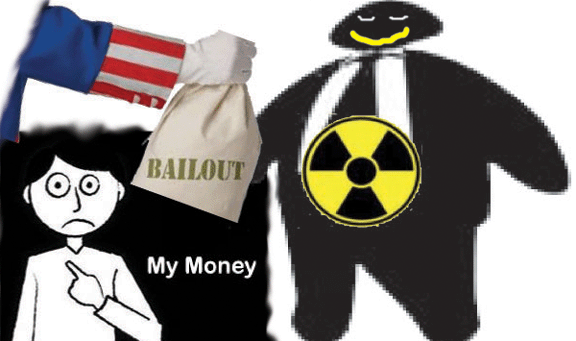 Ohio’s FirstEnergy Nuclear Bailout Bill Could Undermine Funding for Renewables and Efficiency https://www.greentechmedia.com/articles/read/ohios-firstenergy-nuclear-bailout-bill-could-also-undermine-renewables-effi#gs.4ijvjd Ohio’s FirstEnergy Nuclear Bailout Bill Could Undermine Funding for Renewables and Efficiency https://www.greentechmedia.com/articles/read/ohios-firstenergy-nuclear-bailout-bill-could-also-undermine-renewables-effi#gs.4ijvjd
The draft “clean air” bill would keep bankrupt utility’s nuclear plants open—but drain money from renewables and efficiency programs. Last week, Energy News Network released draft legislation (PDF) being circulated by majority leaders in Ohio’s Republican-controlled House of Representatives, primarily aimed at rescuing two nuclear power plants — the Davis-Besse plant near Toledo and the Perry plant near Cleveland, which bankrupt utility FirstEnergy Solutions has threatened to close by 2021. The draft bill would add a maximum surcharge of $2.50 per month to every residential customer’s bill, a $20 per month surcharge to every commercial customer’s bill and a $250 monthly charge to every industrial customer’s bill, to raise roughly $300 million a year. Of that, about $180 million would go to subsidize FirstEnergy’s two nuclear plants, according to analysis reported by Energy News Network. The remaining $120 million would be available to resources that are deemed by the newly created board of political appointees to meet the fund’s criteria. But the newly created board would operate with more secrecy than a regular public utilities commission proceeding. And while the draft bill doesn’t use the word “nuclear,” its criteria for which emissions-reducing technologies are allowed to claim a piece of the new pot of money would appear to exclude most of the carbon-neutral energy resources now available, besides nuclear power. Tailor-made for nuclearFirst, the draft bill would require any qualifying resource to “exclusively” obtain compensation from the wholesale energy markets run by mid-Atlantic grid operator PJM and overseen by the Federal Energy Regulatory Commission — a feature met by FirstEnergy’s nuclear plants, but not by energy efficiency, rooftop solar, or other non-wholesale forms of carbon-free energy. Second, the bill would exclude any facility that receives “state tax exemptions, deferrals, exclusions, allowances, payments, [or] credits, including production tax credits and investment tax credits” — the same federal tax credits provided to wind and solar, respectively. And third, it would bar any municipal utility or rural electric cooperatives. The release of the draft legislation prompted a legislative aide of one of the bill’s sponsors, Republican state Rep. Jamie Callender, to tell Cleveland.com that much of the text was out of date, with a new version “still in a state of flux.” The aide declined to say what would differentiate the newer version of the bill from the draft version obtained last week. The bailout bill comes at a difficult time for FirstEnergy, which has announced plans to close nuclear and coal-fired power plants in Ohio and Pennsylvania if it does not receive additional state or federal support. Last week, Bankruptcy Judge Alan Koschik, who is overseeing the utility’s case in the U.S. Bankruptcy Court of the Northern District of Ohio, rejected FirstEnergy’s proposal to get out of bankruptcy more quickly in part by indemnifying parent company FirstEnergy Corp. from paying any future costs for environmental cleanup at its power plant sites. “Opt-in” to support renewablesOhio’s plan stands in stark contrast to the nuclear incentive programs that have been rolled out in states including Connecticut, New Jersey, New York and Illinois. While these states have largely built their nuclear support programs on the foundation of existing state clean energy and carbon reduction policies, Ohio’s plan would actually undermine existing payment structures for the state’s relatively mild clean energy and efficiency goals. The draft bill would do this by declaring that Ohio’s existing monthly charges for renewable energy, energy efficiency and peak demand reduction are now “opt-in” rather than “opt-out” charges on residential and commercial customers’ utility bills. Today, these charges appear on every home and business electric bill, with only large industrial customers having the opportunity to opt out of them. But the draft legislation would flip this arrangement on its head, doing away with the monthly charges unless the utility customer sends “written notice of intent to opt in” to pay the extra fees. The vast body of utility experience shows that switching programs from opt-out to opt-in leads to a drastic reduction in participation rates, since few people will choose to pay more every month, even if they support the services the surcharges pay for. These numbers are likely to be winnowed even further if opting in requires written and mailed-in applications, rather than simpler on-bill, over-the-phone or online options. FirstEnergy Solutions bankruptcy rumbles onFirstEnergy Solutions filed for Chapter 11 bankruptcy protection in March 2018, after failing to convince the U.S. Department of Energy to issue an emergency declaration that would have forced grid operators and utilities to pay out-of-market prices to its coal and nuclear power plants. While FirstEnergy and the Trump administration have argued the plants are critical to keep the regional power grid stable, multiple studies from PJM indicate the closures won’t affect grid reliability. Many coal and nuclear power plants are struggling to remain competitive. Such plants have been closing at a record rate amid a flood of cheap electricity from natural gas and renewables, as well as continued gains in end-user efficiency. Pennsylvania lawmakers are also considering a bill that would increase utility bills by about $1.77 per household per month to raise about $500 million per year, largely to support two nuclear power plants that owners FirstEnegy and Exelon have said they will be forced to close in the coming years without state support. That bill has drawn fire from consumers and environmental groups for potentially allowing still-profitable nuclear power plants to receive incentives, while not addressing the state’s relatively low ranking in terms of the share of its electricity coming from wind, solar and other carbon-free resources. |
|
U.S Secretary of State Mike Pompeo says that Russia complies with the New START nuclear arms control treaty
|
Pompeo: Russia complying with nuclear treaty that’s up for renewal , The Hill 10 Apr 19, Secretary of State Mike Pompeo said Wednesday that Russia is largely in compliance with the New START nuclear arms control treaty with the United States, but indicated the Trump administration is looking at expanding the scope of the pact as renewal talks begin.“There are some arguments on the edges each, but largely they have been compliant,” Pompeo told the Senate Foreign Relations Committee. “Both the Russians and the United States have been compliant. We’re at the very beginning of conversations about renewing that. If we can get the deal right, if we can make sure it fits 2021 and beyond, President Trump has made very clear that if we can get a good solid arms control agreement, we ought to get one.”
The New START Treaty caps the number of nuclear warheads the United States and Russia can deploy at 1,550 each. There are also limits on the number of deployed intercontinental ballistic missiles (ICBM), submarine-launched ballistic missiles and heavy bombers equipped for nuclear warheads, as well as the number of deployed and nondeployed launchers. The Obama-era treaty expires in 2021, but there is an option to extend it another five years. Arms control advocates are worried Trump will let New START expire after he withdrew from a separate arms control treaty with Russia. Advocates warn that for the first time in decades the two biggest nuclear powers might not have limits on their nuclear arsenals. The other treaty, known as the Intermediate-Range Nuclear Forces (INF) Treaty, banned the United States and Russia from having nuclear and conventional ground-launched ballistic and cruise missiles with ranges between 300 and 3,400 miles. Trump announced in February he was starting the six-month process to withdraw from the INF Treaty after years of Russian violations. Current and former officials broadly agree Russia is in violation of the INF agreement, but there have been no similar accusations regarding New START. Still, in 2017, Trump called New START a “one-sided deal” that was “just another bad deal” made by former President Obama. At Wednesday’s hearing, Republicans touted the benefits of New START……. https://thehill.com/policy/defense/438217-pompeo-russia-complying-with-nuclear-treaty-up-for-renewal |
|
Nuclear energy and Price Anderson Act – too risky for insurance companies – just too dangerous
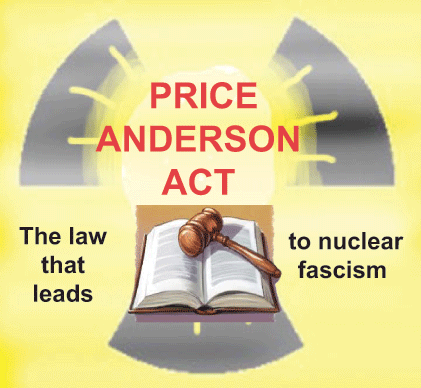
Should the U.S. Revive Nuclear Energy?, NYT Len Charlap, 10 Apr 19, Princeton, N.J. I will support nuclear power the day after the Price-Anderson Nuclear Industries Indemnity Act is repealed. If insurance company actuaries consider nuclear power to be so dangerous that they cannot compute premiums that the industry can afford, then that industry is not economically viable. If the government (i.e., taxpayers) has to cover the industry with catastrophic insurance, then the government should own the reactors and provide nonprofit energy.
We were lucky at Three Mile Island. We were minutes away from a complete meltdown that given the plant’s location would have killed thousands and done billions in damage. Investigations of Three Mile Island showed that, like the Deepwater Horizon disaster, extremely dangerous processes cannot be allowed to remain in control of people whose first responsibility is profit or return to shareholders…. https://www.nytimes.com/2019/04/09/opinion/letters/nuclear-energy.html
Indian Point nuclear station shut down for nearly two weeks: electricity maintained by gas and renewables
|
Behind the scenes, though, something occurred that made all that possible. In the days after Indian Point powered down — a rare occurrence prompted by a malfunction in one reactor and scheduled spring maintenance in the other — the state’s electric grid pivoted. With an assist from the grid’s overseers, the state’s energy resources shifted in a way that could offer a preview of what’s to come in the years ahead when Indian Point is scheduled to shut down for good…….. Nuclear power generated by three upstate plants decreased to 2,711 megawatts on March 18 from 4,240 megawatts on March 13, the data show. On just two of the seven days, the contribution from solar and wind power was more than 1,000 megawatts. “Natural gas is filling the gap,” said Darren Suarez, who keeps track of the state’s daily energy mix for the Business Council of New York state. “It’s the largest dispatchable resource that’s available at that point in time and we’d expect it to fill the gap.”…… those who monitor the state’s fuel mix say Indian Point’s shutdown provided a rare opportunity for a glimpse at what lies ahead unless renewable sources of power gain a larger percentage of the state’s energy mix. A snapshot in time taken from NYISO’s real-time dashboard, which is updated every five minutes, offers some insight into the state’s current fuel mix. For example, on April 1, wind and solar contributed about 6.5 percent of the state’s energy mix while another renewable, hydropower, was at 28.43 percent, NYISO data show. New York has the largest hydroelectric plant east of the Rockies in Niagara Falls……. Transmission of power problemGrid watchers say in order to add more renewables to the downstate grid, the state will need to resolve a transmission bottleneck that prevents upstate power from getting down into the Lower Hudson Valley and points south……… https://www.poughkeepsiejournal.com/story/news/2019/04/10/indian-point-shutdown-natural-gas-filled-nuclear-energy-gap/3417635002/ |
|

Pompeo avoids questions on ending waivers permitting Iran’s ongoing nuclear work
|
Pompeo Won’t Commit to Shutting Down Iran’s Contested Nuclear Work
Pompeo avoids questions on ending waivers permitting Iran’s ongoing nuclear work Washington Free Beacon, BY: April 10, 2019 Secretary of State Mike Pompeo would not commit to ending a series of waivers issued by the Trump administration that have permitted Iran to engage in some its most contested nuclear work, including at a secretive military site that once housed the Islamic Republic’s nuclear weapons program. In an exchange with Sen. Ted Cruz (R., Texas), Pompeo declined to commit to canceling the disputed waivers, which have sparked an inter-administration battle, as first reported by the Washington Free Beacon. The issue of these waivers—which have been granted to Iran so that it can continue its lucrative oil trade, as well as nuclear research work—has generated a growing rift between Iran hawks on Capitol Hill and within the administration and Pompeo’s State Department. Sources have identified those in the State Department as the reason several policies that have kept the landmark Iran nuclear deal on life support have continued, despite President Donald Trump’s decision to walk away from the pact. Cruz and other Iran policy hawks have gone on record in recent weeks, including in interviews with the Free Beacon, to demand that Pompeo stop issuing both the oil and nuclear waivers. Multiple sources inside and outside the administration have described to the Free Beacon a widening fight between those U.S. officials who aim to keep the nuclear deal alive and those who see an opportunity to tighten the noose on Tehran and potentially collapse its hardline ruling regime……. The issue of these waivers—which have been granted to Iran so that it can continue its lucrative oil trade, as well as nuclear research work—has generated a growing rift between Iran hawks on Capitol Hill and within the administration and Pompeo’s State Department. Sources have identified those in the State Department as the reason several policies that have kept the landmark Iran nuclear deal on life support have continued, despite President Donald Trump’s decision to walk away from the pact…….. https://freebeacon.com/national-security/pompeo-wont-commit-to-shutting-down-irans-contested-nuclear-work/ |
|
Mesothelioma Compensation Center to the rescue of nuclear workers affected by mesothelioma
Mesothelioma Compensation Center Now Offers to Make Certain That a Nuclear Power Worker with Mesothelioma or Asbestos Exposure Lung Cancer Gets Accelerated Compensation with The Help of Attorney Erik Karst and His Colleagues at Karst von Oiste, Mesothelioma Compensation Center
PR NewswireApr 10, 2019, NEW YORK, The Mesothelioma Compensation Center is incredibly passionate about making certain that a person who was exposed to asbestos at any type of nuclear power plant and now has mesothelioma or asbestos exposure lung cancer receives the very best possible financial compensation. The group recommends the law firm of Karst von Oiste to assist people like this because they so much experience with power plants and asbestos exposure that would have occurred at these types of facilities as they would like to discuss at 800-714-0303. www.karstvonoiste.com
Rather than offering a free book about mesothelioma or asbestos exposure lung cancer the Mesothelioma Compensation Center offers direct access to attorney Erik Karst the founding partner of the law firm Karst von Oiste. The law firm of Karst von Oiste is one of the nation’s leading legal experts on mesothelioma or asbestos exposure lung cancer.
If the family of a nuclear power worker or a Navy Veteran who was exposed to asbestos on a nuclear submarine or aircraft carrier is concerned about compensation, they are urged to call the Mesothelioma Compensation Center anytime at 800-714-0303 for direct access to attorney Erik Karst for answers to questions about compensation and or how the compensation process works. http://MesotheliomaCompensationCenter.Com……
Rather than offering a free book about mesothelioma or asbestos exposure lung cancer the Mesothelioma Compensation Center offers direct access to attorney Erik Karst the founding partner of the law firm Karst von Oiste. The law firm of Karst von Oiste is one of the nation’s leading legal experts on mesothelioma or asbestos exposure lung cancer.
If the family of a nuclear power worker or a Navy Veteran who was exposed to asbestos on a nuclear submarine or aircraft carrier is concerned about compensation, they are urged to call the Mesothelioma Compensation Center anytime at 800-714-0303 for direct access to attorney Erik Karst for answers to questions about compensation and or how the compensation process works. http://MesotheliomaCompensationCenter.Com https://www.prnewswire.com/news-releases/mesothelioma-compensation-center-now-offers-to-make-certain-that-a-nuclear-power-worker-with-mesothelioma-or-asbestos-exposure-lung-cancer-gets-accelerated-compensation-with-th
1 This Month
26 September – International Day for the Total Elimination of Nuclear Weapons





PLEASE OPPOSE HR 8255 AND S.3639 – bills would accelerate satellite deployment, with no environmental review or safeguards – https://ncstd5li.quorum.us/campaign/169331/
To see nuclear-related stories in greater depth and intensity – go to https://nuclearinformation.wordpress.com
-
Archives
- September 2026 (323)
- August 2026 (330)
- July 2026 (355)
- June 2026 (287)
- May 2026 (306)
- April 2026 (356)
- March 2026 (251)
- February 2026 (267)
- January 2026 (308)
- December 2025 (358)
- November 2025 (359)
- October 2025 (375)
-
Categories
- 1
- 1 NUCLEAR ISSUES
- business and costs
- climate change
- culture and arts
- ENERGY
- environment
- health
- history
- indigenous issues
- Legal
- marketing of nuclear
- media
- opposition to nuclear
- PERSONAL STORIES
- politics
- politics international
- Religion and ethics
- safety
- secrets,lies and civil liberties
- spinbuster
- technology
- Uranium
- wastes
- weapons and war
- Women
- 2 WORLD
- ACTION
- AFRICA
- Atrocities
- AUSTRALIA
- Christina's notes
- Christina's themes
- culture and arts
- Events
- Fuk 2022
- Fuk 2023
- Fukushima 2017
- Fukushima 2018
- fukushima 2019
- Fukushima 2020
- Fukushima 2021
- general
- global warming
- Humour (God we need it)
- Nuclear
- RARE EARTHS
- Reference
- resources – print
- Resources -audiovicual
- Weekly Newsletter
- World
- World Nuclear
- YouTube
-
RSS
Entries RSS
Comments RSS

