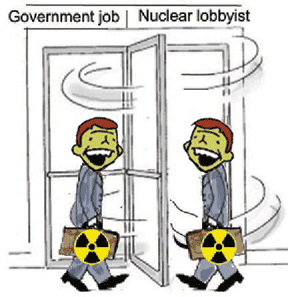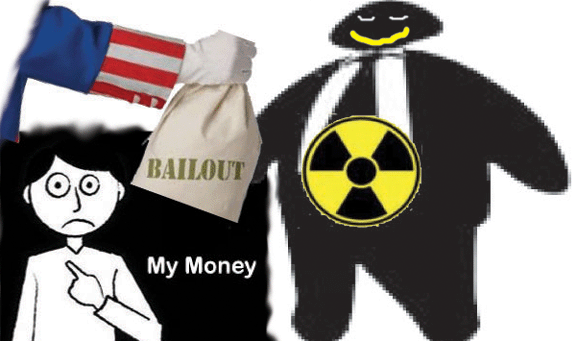
MOUNTING U.S. STOCKPILES of nuclear wastes – with nowhere to go
|
“…………MOUNTING U.S. STOCKPILES The United States is also struggling to support its own nuclear industry at home, with aging reactors shuttering, new projects elusive due to soaring costs, and an ongoing political stalemate over a permanent solution for mounting nuclear waste stockpiles. The United States produces some 2,000 metric tons of nuclear waste each year, which is currently stored in pools or in steel casks at the nation’s roughly 60 commercial nuclear power plants across 30 states. The federal government designated Nevada’s Yucca Mountain as the sole permanent U.S. nuclear waste repository decades ago to solve the problem, spending about US$13 billion on the project, but it has never opened due to local opposition. Thomas Countryman, the State Department’s top arms control officer during the Obama administration, said the government should make headway on the domestic problem before helping other countries. “The primary issue on this front … is not that the U.S. can’t offer a low-volume option to potential buyers; rather it’s that the U.S. still has no option for disposing of its own spent fuel,” he said. Edwin Lyman, a nuclear expert at the Union of Concerned Scientists, said NNSA should be less concerned about volume of waste and more concerned about the dangers that make it hard to store. “It’s not the volume of the nuclear waste that’s the issue, but the radioactivity and heat it gives off as well as the fact that it remains dangerous for hundreds of thousands of years,” he said. (Reporting by Timothy Gardner; Editing by Richard Valdmanis and Brian Thevenot) Source: Reuters https://www.channelnewsasia.com/news/technology/exclusive–us-to-offer–black-box–nuclear-waste-tech-to-other-nations-11046762
|
|
Renewable energy getting a boost after the failure of VC Summer Nuclear Plant expansion
|
Utility customers on the hook for the project had received nine unique electricity bill increases, equal to about $27/month, a factor in South Carolina to having the highest average monthly bills in the United States. As part of the fallout, the parties involved are being pushed hard by politicians and voters to change their ways. On November 30th, general council of the South Carolina Electric & Gas Company (SCANA), also representing Dominion Energy, notified the Public Service Commission of South Carolina, that it supports a certain set of renewable energy supporting policies as part of the ongoing negotiations. The policies are focused on renewables and energy storage gaining consistent access to the market. The regulations mainly aim to create a consistent set of variables – avoided costs, ten year PPAs, hourly pricing, consistent interconnection standards – that will allow developers of solar power projects to better model probability of successful projects. This is not the first time that failed nuclear power plants have been followed by solar. The above images [on original] are of the 1 MW solar power plant that is running at the Chernobyl Nuclear Power plant in Ukraine. The large structure in the background is the $1.5 billion 31,000 ton concrete sarcophagus to cover the still burning nuclear melt down. The Phipps Bend Nuclear Power Plant in Surgoinsville, Tennessee sat abandoned since it was cancelled in 1981, 36 years ago. As of July 5, 2017 it began generating solar electricity as United Renewable Energy completed a 1 MW solar power plant (main article image) When Duke Energy Florida cancelled the Levy Nuclear Plant at a cost of $800 million in already collected fees from consumers, the electric utility announced plans to satiate the public with 700 MWac of solar power, plus at least 50 MW of grid-tied batteries, grid modernization projects, and 500 electric vehicle charging areas. |
|
USA Congress Democrats and Republicans want strict controls on any nuclear deal with Saudi Arabia
Lawmakers Want a Greater Say as U.S. Seeks a Saudi Nuclear Deal, Members of Congress from both parties demand that an agreement to sell Riyadh civilian nuclear technology be based on stringent controls, WSJ . By Michael R. Gordon, Dec. 16, 2018
The Trump administration’s push to sell civilian nuclear technology to Saudi Arabia is emerging as the next battleground in the struggle between the White House and Congress over U.S. policy toward Riyadh following the killing of journalist Jamal Khashoggi.
The debate over Riyadh’s nuclear ambitions intensified last week after Energy Secretary Rick Perry brushed aside congressional appeals that nuclear talks be suspended because of Mr. Khashoggi’s killing and traveled to Saudi Arabia, where he accentuated the role American companies could play in helping the country establish a nuclear energy program.
…….But the CIA assessment that Saudi Crown Prince Mohammed bin Salman likely ordered Mr. Khashoggi’s killing has fueled concerns in Congress that the Saudi leader is too ruthless to be entrusted with nuclear technology. Saudi Arabia has repeatedly said the crown prince had no knowledge of the operation.
Lawmakers of both parties are demanding a deal be based on the most stringent nonproliferation controls. And some are now pushing legislation that would give Congress more of a say by requiring that a nuclear accord with Saudi Arabia be approved by the Senate and the House of Representatives.
“Before Khashoggi, I would say our chances were quite modest,” said Rep. Brad Sherman, a California Democrat, referring to prospects of House legislation he is drafting. “Now I would have to say our chances are better than 50-50.”
An identical measure is being prepared in the Senate by Sens. Ed Markey (D., Mass.) and Marco Rubio (R., Fla.), though the prospects for winning approval are likely to be more challenging.
The prospective nuclear deal comes amid a broader debate over Saudi policy, including a Senate vote last week to halt U.S. support for the Saudi-led coalition that is fighting in Yemen.
Even since the Trump administration signaled its interest in a nuclear agreement with Saudi Arabia last year, there has been debate about proliferation controls that should be imposed under an accord authorizing the transfer of U.S. nuclear technology, known as a 123 agreement.
……..Nuclear experts have also said that it would be important for Saudi Arabia to agree to the “Additional Protocol,” a formal arrangement with the International Atomic Energy Agency that provides for far-reaching inspections. The Saudis have been resisting that step, former officials who have been tracking the talks say. A spokeswoman for the Saudi embassy didn’t respond to a request for comment..
……..Under current law, a nuclear cooperation agreement with Saudi Arabia would go forward unless congressional opponents backed a joint resolution against it. That means that two-thirds of the lawmakers would need to oppose the accord so Congress could overcome a potential veto.
Mr. Sherman’s new bill aims to put nuclear accord skeptics in a more favorable position by requiring the administration to win approval from both the Senate and the House. That means a simple majority in one legislative chamber would be enough to block the agreement…….https://www.wsj.com/articles/lawmakers-want-a-greater-say-as-u-s-seeks-a-saudi-nuclear-deal-11544990606
USA government will appease murderous Saudi Arabia regime – or maybe not?
US Nuclear Energy Policy & Khashoggi Murder: Appeasement Or Threat? Clean Technica, December 12th, 2018 by Tina Casey
The horrific murder of journalist Jamal Khashoggi last October continues to fester, and some of the blowback has been falling on the shoulders of the US tech sector. Rightfully so, considering the connection between Saudi wealth, Japan-based SoftBank, and Silicon Valley A-listers. Meanwhile, US President* Donald Trump has dismissed evidence that Saudi Crown Prince Mohammed bin Salman was directly responsible for the crime, but a recent nuclear energy announcement could indicate that someone in Trump’s cabinet is stirring the pot.
Khashoggi Or Not, Trump Administration Still Sharing Nuclear Energy Love With Saudi Arabia…
There is also a nuclear weapons angle to the story, but for now lets focus on the nuclear energy angle.
Despite its vast solar and wind resources, Saudi Arabia has expressed a growing interest in building a fleet of power plants fueled by nuclear energy.
CleanTechnica has been among those taking note, though not in any particular depth — until earlier this week, when the US Department of Energy released a readout of Energy Secretary Rick Perry’s recent visit with the Saudi Minister of Energy, as well as the CEO of Saudi Aramco and other officials.
The readout hit the Intertubes just about the time word leaked out that there is now a written transcript of the audiotape that recorded the last minutes of Khashoggi’s life.
Anyone — even those who do not speak Arabic — can now read and understand the last words that Khashoggi screamed out in the course of his murder.
So, was the readout yet another example of Secretary Perry tone deafness? Or was it yet another one of his curiously timed missives that undercut White House policy even while seeming to affirm it.
Here, you do the math. This is where the readout deals with the visit to Saudi Arabia (Perry also went to Qatar on the same trip):
…the Secretary expressed that the United States continues to view Saudi Arabia as an important ally, particularly in the energy space. Perry and Al-Falih spoke about last week’s OPEC announcement of production cuts and Perry reiterated the need for stable supply and market values. They also discussed the 2018 increase in Saudi oil production and the impact it has had on world markets in the wake of the Iran sanctions.
And, here’s the summary message (emphasis added):
Secretary Perry underscored the message that he carries all over the world: any nation seeking to develop a truly safe, clean, and secure nuclear energy program should turn to American companies who have the ability to provide the technology, knowledge, and experience that are essential to achieving that goal.
The US nuclear energy industry is in a state of near collapse, domestically speaking. As with coal power, the only hope for growth is to export the technology elsewhere…but the readout makes it clear there are standards to be met.
Or Not
The readout is not particularly startling in and of itself, though there is a lot to chew on between the lines.
What really sticks out is the summary message. It could be read in two different ways.
Number one, Secretary Perry was blithely pitching the US nuclear energy industry to the Saudi government, ignoring — as per White House policy — the latest revelations about the Khashoggi murder.
That would be consistent with the Rick Perry, who toes the Trump line on a whole host of other issues, inside and outside of the energy space.
Number two relates to the other Rick Perry — the one who has consistently pushed for the Department of Energy’s scientific and renewable energy missions, even when (or perhaps especially when) those missions clash with Trump’s anti-science, pro-coal rhetoric.
In this scenario, the nuclear message is not a pitch. It’s practically the opposite: a reminder that the US holds the nuclear energy cards.
To be clear, the US doesn’t hold all the nuclear energy cards, but it does hold enough of them to make trouble. Earlier this fall, for example, the Trump administration announced new restrictions on nuclear technology exports to China. Though some have downplayed the impact, that’s gotta hurt.
As applied to the Saudi government, Perry could wield the authority of his agency under its nonproliferation mission as a stick, not a carrot.
Or, maybe not. If you apply Occam’s razor to the readout, it is just what it is: a message that, Khashoggi or not, it’s business as usual between Saudi Arabia and the US.
What do you think? Drop us a note in the comment thread! ………… https://cleantechnica.com/2018/12/12/us-nuclear-energy-policy-khashoggi-murder-appeasement-or-threat/
Saudi Arabia, the Khashoggi murder case: the nuclear connections with Terra Power, Bill Gates, Breakthrough etc
US Nuclear Energy Policy & Khashoggi Murder: Appeasement Or Threat? Clean Technica, December 12th, 2018 by Tina Casey “…………..The Nuclear Energy Connection
Either way, that brings us around to the idea that the corporate world needs to step up and press for meaningful action on the Khashoggi case, since the White House is falling down on the job.
In particular, the tech sector is feeling the pressure not only because of its financial ties to Saudi Arabia, but also because of the high profile of its biggest players.
That brings us right back around to the nuclear energy angle, where the US nuclear company TerraPower has been making waves.
TerraPower was formed back in 2006 and crossed the CleanTechnica radar during COP 2015, when it popped up in relation to a newly launched investor umbrella organization called the Breakthrough Energy Coalition.
Breakthrough is a tech incubator with a focus on clean energy and rapid decarbonization, and nuclear energy makes the cut.
As a global organization, Breakthrough can provide TerraPower with a platform for pitching its technology overseas — a key consideration, given the morbid state of demand for new nuclear power plants here in the US.
So far TerraPower has been focusing on foreign markets, particularly China, for its new technology.
If all of this is beginning to ring some bells, that’s where the tech and Silicon Valley connections kick in.
Microsoft’s Bill Gates is financial backer of TerraPower and chairman of its board.
Gates is also the chair of the Breakthrough Coalition’s Breakthrough Energy Ventures, where you’ll find a host of other familiar top-dollar investors with an interest in decarbonization including Jeff Bezos, Richard Branson, Vinod Khosla, and Michael Bloomberg.
Saudi Arabia is represented among Breakthrough members through Prince Alwaleed bin Talal, who is Chairman of Alwaleed Philanthropies and a supporter of Gates’s “giving pledge.”
Saudi Arabia is also represented among the 24 countries (including the EU) that support the Mission Innovation clean energy initiative, which is in turn receives considerable support from Breakthrough, so there’s that.
Not for nothing, but as of last August the Department of Energy has supported a TerraPower molten salt reactor project with $28 million in cost-shared funds.
When Will The Silicon Valley Crickets Stop Chirping And Start Acting?
All this is by way of saying that when it comes to the Saudi government, the Khashoggi murder, and the cash flow, all roads lead back to Silicon Valley and the US tech sector.
The New York Times raised a red flag on Saudi financial ties to Silicon Valley last year. Among other developments since then, Tesla has been ramping up its profile in the country, and Google has expressed interest in building data centers there.
Perhaps it’s not fair for the tech sector to take all the heat, but on the other hand these are the guys who promised to make life better for millions if not billions of people all over the world. More is expected of them than, say, the CEO of a local pest control company.
The Trump family’s financial ties with Saudi Arabia seem to be the driving force behind Trump’s response to the Khashoggi murder, and now it seems those same ties have silenced the US tech sector.
The fact is that the Khashoggi murder is not going away. New details about the murder are emerging on a regular basis, and even Trump’s Republican allies have finally stirred into action.
In the latest development, today the US Senate is reportedly set to debate cutting off US support for the Saudi-lead war in Yemen. The measure has been linked directly to outrage over the country’s role in the Khashoggi killing.
Meanwhile, CleanTechnica is reaching out to TerraPower for comment, so stay tuned for more on that.
Follow me on Twitter. https://cleantechnica.com/2018/12/12/us-nuclear-energy-policy-khashoggi-murder-appeasement-or-threat/
Amazon planning to run a “global brain” for the Pentagon.
To understand the implications of JEDI, we must realize that the information being gathered and sorted will inevitably be used for the targeting and killing of not only opposing government-based military forces, but also nongovernmental individuals and groups who are viewed as political or potential military threats by the US.
The transfer of a massive amount of military information into a privately owned and built cloud, as will happen with the creation of JEDI, raises the possibility that the owner or owners of that cloud will — because of their knowledge of the cloud structure, capabilities and content — become more powerful than military and elected officials.
“Alexa, Drop a Bomb”: Amazon Wants in on US Warfare, Nick Mottern, Truthout https://truthout.org/articles/alexa-drop-a-bomb-amazon-wants-in-on-us-warfare/December 16, 2018
Amazon is seeking to build a global “brain” for the Pentagon called JEDI, a weapon of unprecedented surveillance and killing power, a profoundly aggressive weapon that should not be allowed to be created.
Founded in 1994 as an online book seller, Amazon is now the world’s largest online retailer, with more than 300 million customers worldwide, and net sales of $178 billion in 2017.
Amazon has built a vast, globally distributed data storage capacity and sophisticated artificial intelligence programs to propel its retail business that it hopes to use to win a $10 billion Pentagon contract to create the aforementioned “brain” that goes by the project name Joint Enterprise Defense Infrastructure, a moniker obviously concocted to yield the Star Wars acronym — JEDI.
As of the October 12, 2018, deadline for submitting proposals for JEDI, Amazon is the betting favorite for the contract, which will go to just one bidder, in spite of protests by competitors, chief among them Microsoft and IBM. The Pentagon appears likely to select a winner for the contract in 2019.
Jedi Powers? Continue reading
UK’s Sellafield nuclear reprocessing – a financial black hole for the Nuclear Decommissioning Authority
Sellafield boss warns on nuclear clean-up, Guardian, Adam Vaughan@adamvaughan_uk, 16 Dec 2018
Falling revenues from waste reprocessing have led to a financial black hole for the Nuclear Decommissioning Authority The government body given the job of cleaning up Britain’s old nuclear power stations has warned that taxpayers will have to help plug a looming multimillion-pound gap in its finances left by shrinking revenues.
David Peattie, chief executive of the Nuclear Decommissioning Authority, said revenues would fall more than 10% annually in coming years due to the end of an era of nuclear waste reprocessing. One plant ceased operations in November and another will stop in two years.
The group has a £3bn annual budget to clean up 17 old nuclear sites around the UK, but earns £1bn a year from services including repurposing spent nuclear fuel. “I don’t think we can fill the hole completely,” Peattie said.
He hopes to offset some of the losses by making better use of the NDA’s fleet of four ships that operate out of Barrow-in-Furness, Cumbria. The ships were used to bring spent fuel from as far afield as Japan back to the UK for reprocessing.
Peattie also hopes to secure more non-nuclear work such as the non-food cargo it handles for Tesco using its rail business, which runs around 100 locomotives. The rail unit transports waste from nuclear power stations to be stored at the NDA’s biggest and most costly site, Sellafield in Cumbria.
The final bill could also be reduced, said Peattie if the public accepted that not all old nuclear facilities would be returned to a pristine field of “buttercups and daisies”.
The legacy of the industrial revolution means people already tolerate “industrial clutter” in parts of the countryside, he said……. https://www.theguardian.com/environment/2018/dec/16/taxpayers-face-extra-nuclear-cleanup-cost
The mad plan to store nuclear waste on the beach
https://beyondnuclearinternational.org/2018/12/16/the-mad-plan-to-store-nuclear-waste-on-the-beach/, December 16, 2018
An accident at the California storage site would leave residents nowhere to run, By Diane RayOn August 9, 2018, standing tall and looking the part of the hero, David Fritch stepped up to the lectern at a Community Engagement Panel meeting between the owner of a now shuttered nuclear power plant and local residents concerned about the beachfront disposal of nuclear waste. “I may not have a job tomorrow,” he began, “But that’s fine. I made a promise to my daughter.”
Fritch introduced himself as an experienced nuclear power plant safety worker, sent around the country to oversee safety at various sites. He then reported what the Nuclear Regulatory Commission (NRC) called a “near miss” incident at the radioactive waste storage facility of the local nuclear power plant.
On August 3, 2018, a 100,000 pound thin-wall cask filled with deadly irradiated nuclear fuel got caught on a flange while being lowered into the steel-lined concrete vault of the waste storage site, known as an ISFSI (independent spent fuel storage installation). The cask got stuck on a ¼” guide ring for about an hour over an 18-foot drop.
“It was a bad day…. And you haven’t heard about it,” said Fritch. “And that’s not right.”
It was “a bad day” at a place where close to 3.6 million pounds of high level irradiated commercial nuclear fuel are being rushed into the sands of a fragile bluff, one and a half feet above the mean high tide, 108 feet from the sea, near an active earthquake fault, in a tsunami inundation zone, behind an inadequate sea wall.
It was another “bad day” at the long troubled and now closed San Onofre Nuclear Generating Station (SONGS) and its radioactive waste burial site on San Onofre State Beach, the iconic birthplace of California surf culture.
Coastal scientist and engineer, Rick Wilson of the Surfrider Foundation called it the worst waste site possible. Charles Langley, Director of Public Watchdogs and co-author of Radiological Regulatory Failure, called it insane: “Due to the danger from corrosion,” said Langley, “you never put nuclear waste next to salt and water.”
The ISFSI opened on January 31, 2018 to public opposition from Orange County citizens groups concerned about nuclear safety, including San Onofre Safety, Public Watchdogs, and Residents Organized for a Safe Environment (ROSE).
Fritch explained to a stunned audience that the two-man loading team handling the incident did not know that this was the second serious cask loading incident. “Public safety should be first and it is not,” Fritch said. “Behind the gate, it is not.”
Mandated by the NRC to report a nuclear incident in writing within an hour, Southern California Edison waited 42 days to issue their report, having informed the NRC three days after the incident via a “courtesy phone call.” Forced to issue a response, the NRC subsequently concurred with Fritch’s account, admitting to the possibility of: “a load drop event,…[in which the cask] could have fallen 18 feet into the storage vault if it had slipped off the inner ring assembly.”
How serious would the potential outcome have been had that nuclear waste cask fallen? Tom English, environmental engineer and former Presidential nuclear waste policy advisor, and local colleagues at UCSD and at the Samuel Lawrence Foundation, concluded that a cask could have “hit the concrete floor with the explosive energy larger than two sticks of dynamite.” They noted that based on the NRC’s own analysis of a similar dropped cask of slightly different dimensions, there was a 28 percent chance following a drop event that local residents would have needed to evacuate.
How can such a rate be acceptable in a highly populated area, they wondered? In a failure scenario caused by a steep drop of a cask, the air ducts could be damaged: “Water,” warned English, “would have to pour into the hole to cool the reaction and prevent or control a meltdown….As at Fukushima…the enveloping water would instantly become radioactive steam and require the evacuation of millions of people.”
Who would coordinate evacuation? Not the Marines standing guard across the freeway from SONGS nor any part of the federal government, which has opted out of any emergency or evacuation planning now that the nuclear plant is closed. Not by the state of California which has not come through with any comprehensive plan.
But even if there were government plans in place, nuclear emergency plans on paper are unlikely to be workable in real life. A serious accident could compromise the abutting rail line and freeway, the adjacent Marine Corps Base Camp Pendleton, the Pacific Ocean, vast treasures of land and wildlife, and a state that is ranked as the world’s fifth largest economy.
By the end of 2019, Edison plans to house 73 radioactive waste casks on the shoreline site. Along with an older ISFSI on site housing 51 thin-wall casks about 100 feet further up the beach, SONGS will become the largest commercial irradiated fuel burial site in the nation. Each thin-wall cask weighs about 100,000 pounds, bolted shut and loaded with pez like pellets of uranium. “The amount of radioactive isotope, cesium 137, contained within each cask is equivalent to one Chernobyl accident worth of escaped radiation in the event of a through leak into the atmosphere,” English told me.
Fritch’s allegation of an earlier cover-up of a loading event at the ISFSI was verified by Nina Babiarz of Public Watchdogs in a sworn affidavit, and confirmed by the NRC in a Webinar on November 8, 2018, according to Langley.
n the Ripley’s Believe It Or Not of the story, there was yet another near-miss at the ISFSI. Edison disclosed at a Community Engagement Meeting on March 21, 2018 that a four-inch bolt, used to secure a shim needed to circulate cooling helium within the nuclear waste cask, had fallen off, discovered right before the cask was to be filled and buried. Loading had been halted for 10 days but was once more underway.
Local nuclear safety advocates were horrified. What about the first four casks of the same model, already in the vault? Did they share the flaw, which could lead to overheating of the irradiated waste? The NRC declared it had made its inspection and found everything in order. However, no technology presently exists to inspect the interior of this model of thin-wall cask entombed in concrete.
Why would anyone rush to bury high-level radioactive waste on a state beach with high seismic and corrosion risks? In the opinion of Langley, there are two reasons: First, that Edison chose the old footprint of SONGS former Unit I to sidestep superfund cleanup costs and accelerate NRC approval (claiming the NRC suggested the beachfront site); Second, by dumping the waste onto public land, Edison sprints to the finish line, potentially also dumping liability for any future nuclear accident in a legal maneuver called “bona vacantia,” or legally ownerless. Public land equals public liability.
Fritch has since left the nuclear industry. SONGS’ Chief Nuclear Officer responsible for managing the ISFSI, Tom Palmisano, has stepped down. The NRC writes that it suspects that all thin-wall casks “in the storage vaults may have had metal to metal contact” between the cask being lowered and the storage vault. There is only ½” of clearance between the cask walls and the vault lining. The NRC acknowledged: The thin-wall casks “ tend to bump against the shelf while being loaded into the vault…”.
This raises the probability that all 29 thin-wall casks in the vault sustained damage to their exteriors, potentially accelerating cracking and leaking. At the time of the near drop incident last August, a 30th filled cask turned up locked in limbo, unable to be returned to the spent fuel pool or to be buried in the damaged vault. It remains stranded in a building, stored within a transfer cask. However, transfer casks are not intended to provide an indefinite radiation barrier for thin-wall casks but are only approved by the NRC for brief usage, protecting workers during transfer operations.
Neither Edison, the subcontractor, Holtec, nor the NRC will release information about how they can maintain a safe temperature for the stranded cask. The NRC states only that the cask is being kept sufficiently cool. Nuclear safety advocates are not reassured, particularly since the NRC is leaving it up to Edison as to whether they choose to resume loading operations into the clearly defective model of vault, the Holtec Hi-Storm UMAX.
Safety advocates consider this example, as well as the NRC’s pervasive pattern of lax oversight in all the near miss incidents cited in this article, as the very definition of a “captured agency,” a proverbial fox minding a hen house. Donna Gilmore, Director of San Onofre Safety and frequent intercessor with the NRC, concludes: “Congress and the President should mandate the NRC enforce safety standards…and force the NRC to stop misleading them about the safety of systems they approve.”
Public Watchdogs and San Onofre Safety advocate for immediate closure of the beachfront ISFSI. They propose loading the irradiated fuel into thick-wall casks that are 10 to 19.75 inches thick and stored in hardened buildings. This variant of cask, most commonly used around the world and which withstood the earthquake and tsunami at Fukushima, can be inspected and repaired to prevent leaks and explosions. These two groups then propose moving the sturdier casks across the freeway onto higher and drier ground at Camp Pendleton. Bonus: the marines stand guard.
Nuclear safety advocates recognize, however, that the plan suggested above is a “least worst” option, by no means 100% safe. At San Onofre, as elsewhere, the problem of safely, securely, and permanently storing high-level radioactive waste is yet to be solved. Without vigilant citizen oversight and advocacy, in the hands of the nuclear industry, the “least worst” option will never be achieved.
“For nuclear disaster at San Onofre,” concludes Langley, “you don’t even need an earthquake or a tsunami, you just need the nuclear industry.” And its lapdog regulator, too.
Diane Ray became an anti-nuclear activist in the late 1970s, working with Safe ‘n Sound against nuclear plant construction at Shoreham, Long Island, NY. Shoreham never opened. Ray is a member of Public Watchdogs.
Headline photo is a Google Earth shot of the SONGS ISFSI just steps from the shoreline.
Editor’s Note: Beyond Nuclear supports moving the SONGS radioactive waste off the shoreline and onto Camp Pendleton. We also support HOSS — Hardened On-Site Storage. HOSS mandates that: Irradiated fuel must be stored as safely as possible as close to the site of generation as possible; HOSS facilities must not be regarded as a permanent waste solution, and thus should not be constructed underground and the waste must be retrievable; The facility must have real-time radiation and heat monitoring for early detection of problems with containers; The overall objective of HOSS should be that the amount of releases projected in even severe attacks should be low enough that the storage system would be unattractive as a terrorist target; Placement of individual canisters that makes detection difficult from outside the site boundary. Read more about HOSS.
Radioactive fallout killed up to 690,000 Americans from 1951 to 1973.
In the 1950s, the U.S. government downplayed the danger of radioactive fallout, asserting that all radioactivity was confined to the Nevada test site. Despite this, a national estimate attributed 49,000 cancer deaths to nuclear testing in the area.
But the results of new research suggest that this number is woefully inaccurate. Using a novel method, and today’s improved understanding of radioactive fallout, Keith Meyers from the University of Arizona discovered that U.S. nuclear testing was responsible for the deaths of at least as many — and likely more — as those killed by the nuclear bombs in Hiroshima and Nagasaki.
Specifically, between 340,000 and 690,000 Americans died from radioactive fallout from 1951 to 1973.
At least 340,000 Americans died from radioactive fallout between 1951
and 1973 https://bigthink.com/politics-current-affairs/new-estimate-deaths-from-us-nuclear-tests?rebelltitem=2#rebelltitem2 Domestic nuclear testing wreaked havoc on thousands of families. MATTHEW DAVIS 14 December, 2018
- Hiroshima and Nagasaki resulted in the deaths of hundreds of thousands. But new research shows that domestic U.S. nuclear tests likely killed more.
- The new research tracked an unlikely vector for radioactive transmission: dairy cows.
- The study serves as a reminder of the insidious and deadly nature of nuclear weapons.
When we think of nuclear disasters, a few names probably come to mind. There’s the Chernobyl disaster, which killed around 27,000 people, although estimates are fuzzy. After Fukushima, there were no deaths due to radiation poisoning, but this event occurred relatively recently, and radiation poisoning often kills slowly over decades. When the U.S. dropped atomic bombs on Hiroshima and Nagasaki, estimates put the death toll at around 200,000 people, but again, exact numbers are difficult to calculate.
One name that almost certainly didn’t come to mind is Nevada. When the Soviet Union detonated their first atomic bomb in 1949, the U.S. was shocked into action. America’s prior nuclear testing had been carried out in the Pacific, but it was logistically slow and costly to conduct tests there. In order to maintain dominance over the growing Soviet threat, the U.S. selected a 1,375 square-mile area in Nye County, Nevada.
This was an ideal spot for several reasons. It was closer than Bikini Atoll. The weather was predictable and very dry, reducing the risk that radioactive fallout would be dispersed by rainstorms. It was sparsely populated. There was an understanding that there would be some amount of risk posed to nearby civilians, but it was deemed acceptable at the time. The trouble is, our understanding of radioactive fallout was still in its infancy. It was a catch-22; the only way to learn more was to test nuclear weapons.
In the 1950s, the U.S. government downplayed the danger of radioactive fallout, asserting that all radioactivity was confined to the Nevada test site. Despite this, a national estimate attributed 49,000 cancer deaths to nuclear testing in the area.
But the results of new research suggest that this number is woefully inaccurate. Using a novel method, and today’s improved understanding of radioactive fallout, Keith Meyers from the University of Arizona discovered that U.S. nuclear testing was responsible for the deaths of at least as many — and likely more — as those killed by the nuclear bombs in Hiroshima and Nagasaki. Specifically, between 340,000 and 690,000 Americans died from radioactive fallout from 1951 to 1973.
Prior studies generally looked at the areas surrounded the Nevada test site and estimated the deaths caused by fallout from the area. This number was relatively low, owing to the dry, predictable weather mentioned earlier. However, the bulk of the deaths were actually dispersed throughout the country, primarily in the Midwest and Northeast regions. These deaths were caused by an unfortunate synergy between meteorology, radiation, and — perhaps oddly enough — cows.
Out of all the radioactive elements produced by a nuclear explosion, iodine-131 was the biggest killer. I-131 has an eight-day half-life, tends to accumulate in the thyroid gland, and emits beta and gamma radiation. While alpha radiation is generally weak and doesn’t penetrate material very well, beta and gamma radiation are highly energetic and shoot through clothing and flesh, ripping up DNA as it goes along.
Prior studies had examined the radioactive fallout dispersed by low-altitude winds, which would generally settle around the Nevada test site. However, a significant amount of I-131 was caught up in high-altitude winds. These winds carried the radioactive particles to other regions of the U.S., where it mixed with rain clouds.
The now-radioactive rain fell onto the grasslands in the Midwest and Northeast. Then, cows ate the now-radioactive grass. The cows then produced radioactive milk. Dairy practices during the study period were different than they are today — most people drank milk that had recently been extracted from local cows.
Thanks to a National Cancer Institute database that contains broad data on radiation exposure, Meyers was able to track the amount of I-131 found in local milk and compare this with the number and nature of deaths on a county level. In this way, Meyers was able to determine that a significant number of these deaths were due to drinking poisoned milk. These civilians would have had no idea that the milk they were drinking had been irradiated by nuclear explosions hundreds of miles away.
Ironically, the area around the Nevada test site didn’t have this problem. Although they too drank fresh milk from local cows, they imported hay from other parts of the country. Since their cows weren’t eating irradiated hay, the local Nevadans took in significantly less radioactive material than their less-fortunate, distant countrymen.
Although our understanding of radiation and nuclear fallout is much improved since the dawn of the nuclear age, the study serves as a warning of the insidious nature of nuclear weapons. Containing nuclear fallout is challenging, even when you know where all of the vectors of radioactive transmission are. The complexity and intertwining nature of our ecological and social systems means that words like “clean,” “precise,” or “surgical” will likely never apply to nuclear weapons.
USA’s absolute dilemma over radioactive trash – used nuclear fuel
What to do with used nuclear fuel, from Illinois to California https://thebulletin.org/2018/12/what-to-do-with-used-nuclear-fuel-from-illinois-to-california/ By Jeff Terry, December 14, 2018 The largest operator of nuclear power plants in the United States, Exelon, closed two nuclear reactors in the city of Zion, Illinois in 1998 because of low demand, which in turn led to poor operating economics. Ever since, these two pressurized water reactors have sat unused on the Lake Michigan shoreline just north of Chicago. Exelon contracted the company EnergySolutions to decontaminate and decommission the site, and this fall it announced it was nearly done, with demolition of the two structures almost complete.
These two closed reactors have been a thorn in Zion’s side since they shut down 20 years ago. The city lost $18 million in annual property tax revenue when the plants closed, and the shortfall had to be made up by local businesses and residents. Beyond the financial loss, the city can’t use the site for parkland, redevelopment, or anything else. But now that decontamination and decommissioning are nearly complete, Zion should be able to reclaim the land and convert it to beneficial use—right?
Not just yet. There is still spent nuclear fuel at the Zion site—bundles of rods of uranium dioxide pellets contained within Zircaloy metal claddings. These used fuel assemblies have been placed in large cylindrical concrete containers, which will be stored at the site on a 3,000 square-meter pad, an area just larger than half a football field. There they will remain in limbo due to the Nuclear Waste Policy Act of 1982. That year, in its infinite wisdom, the US Congress enacted a law saying that “the generators and owners of high-level radioactive waste and spent nuclear fuel have the primary responsibility to provide for, and the responsibility to pay the costs of, the interim storage of such waste and spent fuel until such waste and spent fuel is accepted by the Secretary of Energy in accordance with the provisions of this Act.” In other words, the power plant owner—in this case Exelon—has to hang on to the waste until the Energy Department agrees to accept it. The problem is that the Energy Department won’t accept it, because it has never arrived at an acceptable political solution for dealing with used nuclear fuel. Back in the late eighties, Congress designated Yucca Mountain in Nevada as the nation’s nuclear waste repository, but it has been the subject of political battles ever since, leaving the United States with no place for long-term disposal of nuclear waste.
Other countries have dealt with this problem. France reprocesses used nuclear fuel rods, extracting usable uranium and plutonium and immobilizing the leftover radioactive waste in hunks of glass. Finland has created the Onkalo repository for disposal in metal canisters deep underground. But since the US Energy Department doesn’t have a plan for nuclear waste, it is destined to sit at the Zion site for years, if not decades. A similar fate will likely befall the used fuel stored at other closed nuclear plants around the country, like the San Onofre Nuclear Generating Station in California. As in Zion, the San Onofre plant is located on prime waterfront real estate that local and state government would like to see available for public use as soon as possible.
n general, the US Nuclear Regulatory Commission and nuclear scientists would prefer to come up with a long-term solution to nuclear waste, meaning one that will last for thousands of years. The Yucca Mountain site was supposed to serve that purpose. But they also recognize that short-term or “interim” storage—good for up to 100 years—may be required. The Energy Department and private companies have floated proposals to use temporary sites around the country for short-term consolidated storage of waste from the current fleet of nuclear reactors. For example, Interim Storage Partners has proposed a consolidated storage site for Andrews County, Texas. Just over a decade ago, the American Physical Society released a comprehensive report, “Consolidated Interim Storage of Commercial Spent Nuclear Fuel,” saying that while it tends to prefer a long-term solution, it does recognize that “Consolidated storage could facilitate the decommissioning of sites with reactors that have been shut down.”
There are many closed nuclear plants in the United States that will undergo decontamination and decommissioning, but the Zion plant is an unusual situation, having nearly reached the point at which the land is entirely recoverable except for the lingering issue of used fuel. It is unreasonable to expect cities and towns to deal with land they can’t use, yet can’t collect tax on. Unfortunately, the problems Zion is about to face are just a harbinger of what is likely to happen around the country.
Proposed interim consolidated waste storage sites will probably face lawsuits from non-governmental organizations that don’t like the idea of nuclear waste being stored at temporary locations. Cities and citizens will also likely object to used nuclear fuel being moved along interstate shipping routes, and sue to stop that from happening. Governors will complain about radioactive materials being shipped into their states. This will all increase the amount of time Zion will have to act as a de facto interim waste storage site, without any of the benefits of being an official storage site, such as the potential to attract jobs in waste disposal and possibly enrichment or reprocessing.
There is, though, another potential option. The used fuel at Zion can be stored on only 3,000 square meters of land, an amount that could easily be found at either of the two Energy Department facilities in Illinois, the Argonne National Laboratory and the Fermi National Accelerator Laboratory, both located west of Chicago. It should be possible to move the waste from Zion to either of these sites. No interstate shipping would be required. Either site could store the waste in the same storage casks, on a similar pad. Neither Argonne nor Fermilab are expected to close, and even if they did unexpectedly, it would be decades before the land could be reclaimed for other purposes, which would give plenty of time for the waste to be moved again.
Both of these Energy Department facilities have experience handling radioactive materials. Both have strong research groups focused on radiation damage. They have the expertise to monitor and perform research on any potential degradation of the dry concrete storage containers. In terms of land use, security, and availability of expert staff, Illinoisans would be far better off with the waste stored at one of these sites than sitting in Zion on the shore of Lake Michigan.
Storing the waste in this way would even offer a research advantage. The Energy Department could fully study and document the process of taking ownership of the used fuel. It would end up with a model of safe transportation, storage, and monitoring that could be used to finally establish a process for the spent fuel sitting at other American commercial nuclear reactors. Even if the federal government fails to come up with a final disposition site, California could follow the Illinois model, transferring waste from closed nuclear plants like San Onofre to Energy Department sites within the state, or potentially even Defense Department facilities.
As EnergySolutions has now demonstrated in Zion, the private sector has the ability to decontaminate and decommission closed reactor sites. These places can be returned to public use, but only if the Energy Department finally takes title to the used nuclear fuel as it was obligated to do 20 years ago. We are about to have a restored site that cannot be fully used by the local community due to used fuel. It could easily take more than 10 years for interim storage to open elsewhere, and cities and towns should not have to serve as nuclear waste storage sites in the meantime. The Energy Department should consider moving used fuel to its own facilities within the same state.
Space travel enthusiasts show their ignorance of ecology and the dangers of Plutonium 238
I do not have time at the moment to really think about this one, – But – a couple of lovely sentences just leaped out at me:
Plutonium-238 is very special for the fact that it’s a material that poses virtually no danger to anyone unless you do something insane
we have to put our illogical fears aside
That’s from this absolute hymn to Plutonium 238 – Forbes 13 Dec 18 – NASA Doesn’t Have Enough Nuclear Fuel For Its Deep Space Missions
Trump and Putin could save The Intermediate-Range Nuclear Force Treaty, and it’s worth saving
Landmark nuclear treaty can still benefit US, NATO and Russia security. They should delay action for six months and negotiate ways to show compliance. The Intermediate-Range Nuclear Force Treaty — a key part of the post cold war nuclear system of controls and restraint — is on life support. President Donald Trump announced his desire to withdraw from the 1987 INF pact in October, citing Russian cheating and a desire to deploy missiles against China as motives. German Chancellor Angela Merkel reportedly convinced Trump this month to hold off on withdrawal for at least two months so the NATO alliance could act in a more united fashion to either bring Russia back into compliance or show it was trying.
As officials who helped negotiate the last two major strategic arms control agreements, we believe there is a deal to save the treaty and ensure its benefits can continue. This will require creative, serious and genuine negotiations by Washington and Moscow. We know firsthand, however, that negotiating with Russia can lead to surprising and positive results. Such engagement is desperately needed now, and could save a critical part of the post-Cold War arms control system that benefits American security
There’s no doubt that Russia violated INF Treaty The INF Treaty signed by President Ronald Reagan and General Secretary Mikhail Gorbachev bans the US and Russia from having land-based missiles with ranges from 500-5500 kilometers. The Treaty helped end the cold war and paved the way for reductions in strategic nuclear weapons. Banning these weapons gave leaders in Russia, Europe and America more time to make decisions in a crisis, and the treaty is worth saving if all sides can show there are fully complying with the deal.
There is no real question that Russia has violated the INF treaty. The United States has been sure of this since 2013 and has been increasingly clear about how Russia has violated the deal. Russia tested its 9M729 cruise missiles from a mobile fixed launcher to a distance of over 500 KM — something allowed by the treaty — and then later tested the same system from a ground-mobile launcher, making the missile a ground-launched system under the terms of INF.
Russia denies the 9M729 missile violates INF and instead accuses the United States of violating the INF by deploying the Mark-41 missile launcher as part of NATO missile defenses in Europe. The Mk-41 on shore is used to launch missile defense interceptors, but is used by the U.S. Navy on ships to launch offensive missiles. Russia claims this violates INF. Washington says the Mk-41 launcher for NATO’s defense is physically capable of holding canisters to launch offensive missiles like the Tomahawk cruise missile, but the land-based variant deployed in NATO is not equipped with firing software. Washington claims this makes the launcher legal, but this explanation gives Moscow little comfort.
For five years, the two countries have tried to get the other to admit their violation. That approach has failed and the treaty is now at risk of disappearing. The only way to save it — something both countries say they want — is for both to go beyond what the treaty requires to assure the other that it is in compliance.
Over the last year, former officials and experts from Russia and the United States have met privately to explore what an extra transparency regime might look like. Russian former military officials have said that the 9M729 should be made available for both inspection and even taken apart for American inspectors to determine if it can travel over 500km. While not an official Russia government offer, it seems unlikely that former officials would suggest such a thing without a sense that it might be possible.
The INF Treaty is beneficial and worth saving
Former American officials, for their part, have said NATO missile defense sites could be made available for visits by Russian officials to show no offensive missiles deployed on site. Other more extreme steps might be to modify the Mk-41 launcher so that it cannot physically hold or launch offensive missiles.
This deal is worth official exploration. Trump and Russian President Vladimir Putin should pledge not to take any unilateral steps on the INF Treaty — including withdrawal — for at least six months. They should send senior officials from their militaries, the State and Defense departments, and the White House and Kremlin to negotiate on a continual basis to see if such a deal is technically feasible. The teams should be directed to produce a draft deal for both presidents and for NATO — whose security is most at risk and whose members will need to agree to steps providing transparency over NATO missile defense sites — in three months for official consideration.
Trying to save the INF treaty can have important benefits for the United States and its NATO allies. Now that the US has publicly released details of Russia violations, European NATO states may be able to bring more pressure on Russia to come back into compliance. If in the end, Russia’s violations cannot be reversed, making these efforts will show it is a lack of political will, and not technical problems, that led to the treaty’s demise. This will in itself help NATO allies as they wrestle with how to manage security and stability in a post-INF world.
Treaties should only remain in force if they benefit American and allied security, and sometimes treaties outlive their usefulness. But the INF still can protect these interests, and Russian security as well, if all sides are prepared to show that they remain in compliance.
Richard Burt is for the former ambassador to Germany and led the 1991 START Agreement talks. Ellen Tauscher is the former undersecretary of state for arms control and international security and oversaw negotiation of the New START Treaty. Both are members of the Nuclear Crisis Group based in Washington.
Transport of nuclear wastes to USA’s Waste Isolation Pilot Plant is stalled while maintenace work is on
US Nuclear Repository Turns Focus to Maintenance Projects https://www.usnews.com/news/best-states/new-mexico/articles/2018-12-14/us-nuclear-repository-turns-focus-to-maintenance-projects Work to dispose of tons of radioactive waste from defense sites around the United States will be put on hold next month so maintenance can be done at the federal government’s only underground nuclear waste repository. CARLSBAD, N.M. (AP) — Work to dispose of tons of radioactive waste from defense sites around the United States will be put on hold next month so maintenance can be done at the federal government’s only underground nuclear waste repository.
Officials at the Waste Isolation Pilot Plant announced during a meeting Thursday that the three-week work stoppage will begin Jan. 7.
The maintenance will include work on electrical substations and the refurbishing of areas where waste is stored until it’s taken below ground to be disposed of in rooms carved from an ancient salt formation.
The facility receives between five and 10 shipments weekly. That’s not expected to increase much until a new $135 million ventilation system is installed.
Repository managers say they’ve made progress this year but that air quality remains an issue.
PG and E needs $1.6 billion more to decommission Diablo Canyon — and it’ll come from your bill,
PG&E needs $1.6 billion more to decommission Diablo Canyon — and it’ll come from your bill Tribune BY KAYTLYN LESLIE 14 Dec 18 PG&E needs to collect $1.6 billion from ratepayers by 2025 to pay for Diablo Canyon nuclear power plant’s closure, according to new filings with the state.
For a typical residential customer, this would translate to about $1.98 more on your bill, though the exact amount would vary depending on usage.
In its Nuclear Decommissioning Cost Triennial Proceedings, filed on Thursday, the company said it expects the total cost of decommissioning Diablo Canyon to be about $4.8 billion — up from the $3.8 billion it estimated in its last triennial report in 2015. https://www.sanluisobispo.com/news/local/environment/article223058625.html
-
Archives
- May 2026 (102)
- April 2026 (356)
- March 2026 (251)
- February 2026 (268)
- January 2026 (308)
- December 2025 (358)
- November 2025 (359)
- October 2025 (376)
- September 2025 (257)
- August 2025 (319)
- July 2025 (230)
- June 2025 (348)
-
Categories
- 1
- 1 NUCLEAR ISSUES
- business and costs
- climate change
- culture and arts
- ENERGY
- environment
- health
- history
- indigenous issues
- Legal
- marketing of nuclear
- media
- opposition to nuclear
- PERSONAL STORIES
- politics
- politics international
- Religion and ethics
- safety
- secrets,lies and civil liberties
- spinbuster
- technology
- Uranium
- wastes
- weapons and war
- Women
- 2 WORLD
- ACTION
- AFRICA
- Atrocities
- AUSTRALIA
- Christina's notes
- Christina's themes
- culture and arts
- Events
- Fuk 2022
- Fuk 2023
- Fukushima 2017
- Fukushima 2018
- fukushima 2019
- Fukushima 2020
- Fukushima 2021
- general
- global warming
- Humour (God we need it)
- Nuclear
- RARE EARTHS
- Reference
- resources – print
- Resources -audiovicual
- Weekly Newsletter
- World
- World Nuclear
- YouTube
-
RSS
Entries RSS
Comments RSS