nuclear-news

The News That Matters about the Nuclear Industry Fukushima Chernobyl Mayak Three Mile Island Atomic Testing Radiation Isotope

  • Home
  • 1 This Month
  • ACTION !
  • Disclaimer
  • Links
  • PAGES on NUCLEAR ISSUES

Low-flying choppers monitoring radiation in Atlanta (fears of nuclear terrorism?)

Low-flying choppers monitoring radiation https://wtkr.com/2019/01/27/low-flying-choppers-monitoring-radiation/JANUARY 27, 2019, BY CNN WIRE ATLANTA, GA (WGCL) – If you’re in downtown Atlanta or around Buckhead for the Super Bowl Experience or regular business, you might see some low-flying helicopters over the area.

The choppers are from the U.S. Department of Energy and are serving a specific purpose.

The Department of Energy’s National Nuclear Security Administration, or NNSA, is conducting the low-altitude flights as part of security operations for Super Bowl LIII. The choppers will measure naturally occurring background radiation, according to the NNSA.

The measurement of naturally occurring radiation will establish baseline levels and is considered a normal part of security and emergency preparedness, according to the NNSA. The agency said it was making the public aware of the flights to avoid any panic or alarm.

The helicopters, Bell 412 choppers, will fly in a grid pattern over the areas at 150 feet or higher at a speed of approximately 80 miles per hour, according to the Department of Energy. Flyovers will occur only during daylight hours and should take roughly three hours to complete per area scanned.

February 2, 2019 Posted by Christina Macpherson | safety, USA | Leave a comment

Washtenaw County’s preparations – in the event of a nuclear disaster

Here’s what could happen in a nuclear disaster in Washtenaw County, By Ryan Stanton | ryanstanton@mlive.com ANN ARBOR, MI , 1 Feb 19, – As Ann Arbor considers calling on the state and federal governments to better prepare for nuclear disaster, county officials note there already are some emergency plans in place.

Washtenaw County does not stockpile potassium iodide as some city officials are calling for in a proposed resolution, said Dave Halteman, the county’s emergency services director.

But in the event of an incident such as a meltdown at the Fermi 2 nuclear power plant in southeast Michigan, the county would reach out to the state’s Emergency Operations Center to initiate access to a national pharmaceutical stockpile through the Centers for Disease Control and Prevention.

“This plan has been in place for many years and the CDC stockpiles these pharmaceuticals in strategic locations all over the country,” Halteman said.

“However, given the potential time lapse in getting access to the national stockpile, I will continue to monitor Ann Arbor’s initiative to see how it might work on a county level.”

City Council will consider a resolution Monday, Feb. 4 calling for strengthening local emergency planning by stockpiling nonprescription potassium iodide in communities within 50 miles of the Fermi 2 plant, which is roughly 30 miles from Ann Arbor along Lake Erie.

The resolution would direct the city’s lobbying team to advocate to the state and U.S. Nuclear Regulatory Commission to provide the same level of KI protection to residents here as Canadian authorities provide to Ontario residents within 50 miles of the Fermi 2 plant.

The American Thyroid Association has called for pre-distribution of potassium iodide, also known as KI, to households within a 10-mile radius of nuclear power plants such as Fermi 2, and stockpiling it in public facilities such as schools, hospitals, clinics, post offices and police and fire stations in up to a 50-mile radius.

Timely ingestion of KI can reduce the effects of radiation and help prevent thyroid cancer in the event of a nuclear fallout, notes the resolution sponsored by Council Members Anne Bannister, D-1st Ward, and Chip Smith, D-5th Ward.

Without a local stockpile, it could take eight to 12 hours for CDC supplies to arrive, depending on the event, said Cindra James, the county’s public health preparedness administrator.

In some cases, it could be sooner based on local supplies, James said, noting the federal government has caches stockpiled “at various unknown locations that we aren’t privy to,” but those supplies can be accessed depending on need.

As far as potential evacuation of the county if there was a nuclear disaster, there’s no specific plan, but the county would coordinate with the state police and local law enforcement to close roads leading toward any hazard and redirect traffic away from the affected area, Halteman said.

The county’s outdoor warning sirens also would be activated followed by an emergency alert system message to inform the public via the media of the hazard and what actions to take, he said.

“We would also reach out to our transportation partners here in Washtenaw County to assist moving those without transportation,” he said, noting that could include the Ann Arbor Area Transportation Authority and local school bus systems.

“Certainly the response would be scaled up or down to accommodate the size of the evacuation area,” Halteman said…….. https://www.mlive.com/news/ann-arbor/2019/02/heres-what-could-happen-in-a-nuclear-disaster-in-washtenaw-county.html

February 2, 2019 Posted by Christina Macpherson | safety, USA | Leave a comment

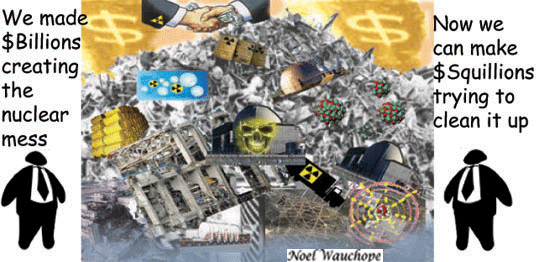
Rapidly climbing costs to USA tax-payers for nuclear waste cleanup – rose by $100 billion in one year!

America’s Chernobyl’: Inside The Most Toxic Place In The Nation | TODAY


Cost to taxpayers to clean up nuclear waste jumps $100 billion in a year https://www.nbcnews.com/news/all/cost-taxpayers-clean-nuclear-waste-jumps-100-billion-year-n963586 , 30 Jan 19, An Energy Department report shows the projected cost for long-term nuclear waste cleanup overseen by DOE jumped $100 billion in just one year.  Jan. 29, 2019, By Laura Strickler, WASHINGTON — The estimated cost of cleaning up America’s nuclear waste has jumped more than $100 billion in just one year, according to a DOE report — and a watchdog warns the cost may climb still higher.

The Energy Department’s projected cost for cleanup jumped from $383.78 billion in 2017 to $493.96 billion in a financial report issued in December 2018.

A government watchdog and DOE expert said the new total may still underestimate the full cost of cleanup, which is expected to last another 50 years. “We believe the number is growing and we believe the number is understated,” said David Trimble, director of the Government Accountability Office’s Natural Resources and Environment team.

The cost was calculated by the accounting firm KPMG under contract to DOE.

Eighty percent of the increase comes from new projections of the costs of cleaning up radioactive waste and hazardous chemicals at the Hanford site in southeastern Washington.

The 586-square-mile site, home to nine former production reactors and processing facilities, produced plutonium for America’s nuclear arsenal during the Cold War.

Cleaning up Hanford has already cost taxpayers $170 billion over 30 years, but government auditors say the most challenging parts of the clean-up work are yet to be done.

Still not cleaned up are 56 million gallons of what the DOE’s inspector general has described as “hazardous and highly radioactive waste.” The rise in projected cost is due to updated estimates for building and running a waste treatment plant, including “operating costs, tank farm retrieval and closure costs” at the site, according to the report. The report also refers to changes in “technical approach or scope” and “updated estimates of projected waste volumes.”

Trimble of the GAO believes the Energy Department “does not have a coherent strategic plan on how to address its cleanup mission.”

A spokesperson for the Energy Department said in an emailed statement that the office that oversees the cleanup is “committed to making progress on the ground at Hanford, and mitigating the years of escalating liabilities at the site.”

The spokesperson said DOE expects more cost increases “and is working with regulators and stakeholders on best options to treat and dispose of radioactive waste.”

Energy Secretary Rick Perry has proposed a reclassification of the radioactive waste at Hanford to make its disposal less expensive, a suggestion opposed by environmental groups in the Pacific Northwest.

In mid-December, DOE issued a financial report with a signed letter from U.S. Energy Department Secretary Rick Perry on the fourth page. Perry’s letter lists the agency’s accomplishments and describes the agency’s environmental cleanup activities. He cited the completion of an underground project at Hanford, but does not mention the projected increase in costs to taxpayers.

“PLAGUED WITH MISMANAGEMENT”

For decades, government auditors have raised serious concerns about the lack of clear goals for the site and long term problems with the cleanup.

A 2018 report from the DOE’s inspector general rolled up 38 investigations the IG had conducted on the environmental management efforts at Hanford.

The IG concluded Hanford has been “plagued with mismanagement, poor internal controls, and fraudulent activities, resulting in monetary impacts totalling hundreds of millions of dollars by the various contractors at the site.”

Bechtel, one of the large government contractors that manages site cleanup, was part of a group of contractors that paid a $125 million settlement in 2016, the largest settlement ever obtained by the agency’s inspector general.

The U.S. had alleged Bechtel improperly used federal taxpayer dollars to fund a multi-year lobbying effort in Congress to continue the funding of its contract.

Under the final settlement agreement, Bechtel National Inc. admitted no wrongdoing.

In response to the recent Energy Department report Bechtel spokesperson Fred deSousa notes that the waste treatment plant they are building in Hanford is “the most complex project of its kind in the world.” DeSousa also told NBC in his statement that the project has gone through multiple independent reviews resulting in changes to its contract. “Today the project is bigger, more robust, and has more stringent operating and safety margins,” he said.

The new Democratic chair of the House Energy and Commerce Committee says the committee will increase its oversight of Hanford.

“It is essential that DOE better manage and oversee its contractors to ensure that taxpayers, workers and the environment are being protected” said Rep. Frank Pallone, Jr., D-N.J. “The Committee will continue to have questions for DOE as to whether cleanup efforts at Hanford and other sites are being properly managed.”

January 31, 2019 Posted by Christina Macpherson | business and costs, USA, wastes | 2 Comments

Bill to prevent nuclear first strike without congressional approval introduced by U.S. Democrats

Dems reintroduce bill to prevent nuclear first strike without congressional approval,  https://thehill.com/policy/defense/427546-dem-lawmakers-reintroduce-bill-to-prevent-president-from-launching-nuclear

BY OWEN DAUGHERTY – 01/29/19 Rep. Ted Lieu (D-Calif.) and Sen. Ed Markey (D-Mass.) on Tuesday announced that they will reintroduce a bill that would stop the president from being able to launch a first strike nuclear attack without first having congressional approval.

At a press conference announcing the legislation, Lieu said the bill is needed because President Trump is “unpredictable and rash.”

“Trump’s brand is to be unpredictable and rash, which is exactly what you don’t want the person who possesses the nuclear football to be,” Lieu said, according to a press release. “We introduced this bill under the Obama administration but Trump’s presidency has highlighted just how scary it is that any president has the authority to launch a nuke without congressional consultation.”

The statement cited a Trump tweet from January 2018 that taunted North Korea over the size of his nuclear button.

“Will someone from his depleted and food starved regime please inform him that I too have a Nuclear Button, but it is a much bigger & more powerful one than his, and my Button works!” Trump wrote, referring to North Korean leader Kim Jong Un.

Markey added in the statement that no president “should have the power to launch a first use nuclear first strike absent such an attack without explicit Congressional approval.”

Lawmakers in the past, including Lieu and Markey, have introduced similar legislation, but it has stalled in Congress.

The legislation, called the Restricting First Use of Nuclear Weapons Act of 2019, will be introduced by Lieu in the House and Markey in the Senate.

January 31, 2019 Posted by Christina Macpherson | politics, USA, weapons and war | Leave a comment

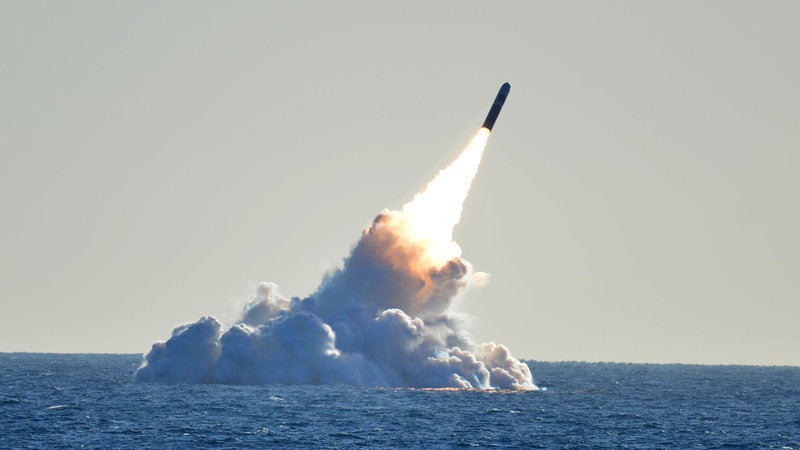
New, powerful, submarine-launched nuclear weapon begins production in USA


Trump Administration Begins Production Of A New Nuclear Weapon, NPR, January 28, 2019 “….The weapon is a variant of the Navy’s primary submarine-launched nuclear weapon, the W76-1. That warhead is a “strategic weapon,” meaning it makes a very big boom. The W76-1 is believed to have a yield of around 100 kilotons, according to Hans Kristensen, director of the nuclear information project at the Federation of American Scientists, an arms control advocacy group. By contrast, the bomb dropped on Hiroshima had a yield of about 15 kilotons.

The Energy Department would not provide details about the W76-2, but it’s believed to have a yield of around 5 to 7 kilotons, Kristensen says. That smaller yield is probably created by removing or disabling the secondary stage of the W76-1. The secondary is designed to deliver a large thermonuclear blast triggered by a much smaller nuclear weapon known as the primary. Removing or disabling the secondary while leaving the primary would, in effect, create a smaller weapon………..

Kristensen worries the new warhead could actually make nuclear war far more likely. For one thing, he says, the W76-2 will be launched on the same Trident missile used to launch the much larger W76-1. “It’s not like the Russians are going to be sitting there saying, ‘Well, let’s wait to see this one detonate first. Oh, it’s a small mushroom cloud! Well, in that case…'”

And even if they did wait, he says, it would not change the fact that the U.S. would have used a nuclear weapon, however small, in a conflict. “A nuke is a nuke,” he says. “Once it’s used, the gloves are off.”

The National Nuclear Security Administration says its first production unit of the new weapon is underway. It is on track to deliver a small number of weapons to the Navy by October of this year. https://www.npr.org/2019/01/28/689510716/trump-administration-begins-production-of-a-new-nuclear-weapon

January 31, 2019 Posted by Christina Macpherson | USA, weapons and war | Leave a comment

Nuclear reactor at Fort Belvoir to be decommissioned

 By: fox5dc.com staff , Anjali Hemphill, FOX 5 DC, 29 Jan 19, AN 29 2019 FORT BELVOIR, Va. (FOX 5 DC) – Tucked away on the Fort Belvoir army base, the SM-1 nuclear reactor was fully operational for many years, but now there’s a plan to take it all down and build over it.

Stepping into the former nuclear power  plant is like a blast from the past. It’s been virtually untouched since the day it was deactivated back in the 1970s. The plan now is to tear it down and haul it away………http://www.fox5dc.com/news/local-news/nuclear-reactor-at-fort-belvoir-to-be-decommissioned

January 31, 2019 Posted by Christina Macpherson | decommission reactor, USA | Leave a comment

Security guards kill man at Nevada Nuclear Test Site

Official: Man killed at nuclear site failed to drop object https://news3lv.com/news/local/official-man-killed-at-nuclear-site-failed-to-drop-object by The Associated Press  MERCURY, Nev. (AP) 30 Jan 19,  — An aggressive man was killed by officers at a U.S. nuclear security site in Nevada after refusing orders to drop a cylindrical object, authorities said Tuesday.

Investigators declined immediate comment on whether the object was a weapon.

The incident began when the unidentified man failed to stop Monday evening at the security gate at the Nevada National Security Site, located 70 miles (112 kilometers) north of Las Vegas, according to Darwin Morgan, spokesman for the National Nuclear Security Administration.

Morgan said the trespasser drove 8 miles (13 kilometers) with officers in pursuit before he parked and approached them with the object in his hand. Deputies and site officers fired at him when he ignored their verbal commands, Morgan said.

The man died at the property formerly known as the Nevada Test Site.

The FBI has been notified and no additional information has been released, Nye County sheriff’s Lt. David Boruchowitz said.

Nevada is currently involved in a legal battle with the U.S. Energy Department to block the shipment of a metric ton of weapons-grade plutonium to the site from South Carolina.

Government scientists conduct tests simulating nuclear explosions at the 1,360-square mile (3,522-square kilometer) site in Nevada that is larger than the state of Rhode Island.

January 31, 2019 Posted by Christina Macpherson | incidents, USA | 1 Comment

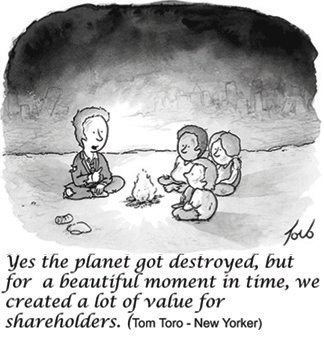
AS USA Prepares to Withdraw From INF Treaty – the Threat of Nuclear War Grows

Nuclear Threat Grows as US Prepares to Withdraw From INF Treaty https://truthout.org/articles/nuclear-threat-grows-as-us-prepares-to-withdraw-from-inf-treaty/Today, there are nine nuclear nations and the risks are incalculable. But is anyone paying attention? LAUREN WALKER  BY Jon Letman,  January 29, 2019

With the US poised to begin its withdrawal the landmark Intermediate-Range Nuclear Forces (INF) treaty on February 2, there’s been an uptick in media focus on arms control and the nuclear weapons, even as the US public remains largely disengaged.

The INF treaty, signed by the US and Soviet Union in 1987, led to the elimination of nuclear and non-nuclear ground-launched ballistic and cruises missiles with a range of roughly 310 to 3,410 miles (500 to 5,500 km). Since 2013, however, the US has accused Russia of violating the treaty at least 30 times, pointing to Russia’s SSC-8 ground-launched cruise missile as posing “significant risks to Euro-Atlantic security.” Meanwhile, Russia denies violating the INF.

In December, US Secretary of State Mike Pompeo issued an ultimatum: the US would “suspend [treaty] obligations” in 60 days if Russian compliance could not be verified.

“Russia’s lawless conduct,” Pompeo warned, “will not be tolerated in the realm of arms control or anywhere else.”

Pompeo also expressed concern that INF non-compliant weapons (China, North Korea and Iran are not INF signatories) were being used to “threaten and coerce the United States and its allies in Asia.”

Russia counters that rocket launchers used by the Aegis Ashore system at a US naval base in Romania and slated for deployment in Poland and Japan could be used offensively and are in breach of the INF, charges flatly rejected by the United States.

With the INF teetering on the brink of collapse, many wonder if the New START treaty, which President Donald Trump called “one sided” and a “bad deal” will be the next to fall. In 2017, Trump told Reuters, “if countries are going to have nukes, we’re going to be at the top of the pack.”

INF’s demise comes as nuclear weapons arsenals are being “modernized,” non-nuclear weapons development is accelerating, and concerns of system vulnerability are on the rise. Arms control experts and world leaders worry that without INF, new weapons development could accelerate and expand.

In Honolulu, the East-West Center, a non-partisan educational institution, hosted an international gathering of visiting nuclear arms researchers, academics and reporters three days before the one-year anniversary of a ballistic missile warning scare that terrified many residents in Hawaii on January 13, 2018.

One of the speakers, David Santoro, director and senior fellow for nuclear policy at the Pacific Forum, said, “I think it’s very clear now that … the nuclear problem is coming back with a vengeance.”

“For a very long time we thought that this was a thing of the past — something we had to deal with during the Cold War,” Santoro said.

He warned that if the US withdraws from INF, extending the New STARTtreaty will be much more difficult, adding, “We have to extend New START by 2021, otherwise arms control between the US and Russia is gone.”

Denny Roy, a senior fellow at the East-West Center, said that as the US and China compete vigorously in the areas of security and economics, “We’ve even seen this competition intensify to the point where the gloves seem to be off,” he said, pointing to a shift under the Trump administration by characterizing China not as a partner-competitor, but as an unambiguous adversary. He also pointed to a bolder stance by Chinese President Xi Jinping in calling for an end to US strategic pre-eminence in global governance.

Roy said the US shouldn’t take for granted what he called China’s “minimal deterrent posture” which he described as being limited to second strike capability not developed to intimidate the US.

Roy suggested the US should avoid policy steps that would “provoke China into trying to compete as vigorously in the area of numbers of nuclear weapons as China competes with the United States in lots of other areas.”

China still has a relatively low number of nuclear weapons (less than 300) compared with both the US and Russia, each with well over 6,000. According to the Stockholm International Peace Research Institute (SIPRI), nine nations maintain more than 14,400 nuclear weapons.

“I think we are going to see increasing competition in other areas which will impact the nuclear relationship between [China and the US],” Santoro added. “There are a number of flashpoints that we need to worry about increasingly today,” pointing to Taiwan and the South China Sea as two examples.

According to Santoro, the nuclear weapons climate has become more complicated as what was once a “two-player game” has morphed into a “multi-player game.” He points to “severe nuclear competition” between India and Pakistan threatening potentially negative consequences for China’s defense strategy, which in turn affects the US-Russia nuclear relationship.

Santoro also mentioned the standoff between the US, NATO and Russia over the 2014 annexation of Crimea where, according to hacked European diplomatic cables reported by The New York Times, Russia is suspected of housing nuclear weapons.

For a country like North Korea, which is in a militarily weaker position than not just the US, but South Korea too, Santoro said nuclear weapons are “almost irresistibly desirable,” noting that from North Korea’s perspective, nuclear weapons are the one thing that ensures its survival.

“No other conventional capability or political arrangement can do it,” Santoro said. “They have seen what has happened to Iraq [and] Libya and constantly mention these cases as evidence that they need the ‘magic’ of nuclear weapons.”
On January 24, the Bulletin of the Atomic Scientists’ Science and Security Board announced the “Doomsday Clock” would remain at two minutes to midnight in 2019, a reflection that concerns go well beyond nuclear weapons.

Newly manufactured US low-yield “mini nukes,” precision-guided munitions, AI-enabled fully autonomous weapons, advanced cruise missiles, and the spread of sophisticated (but potentially vulnerable) missile defense systems around the world, and expanding into space and cyber domains come into play in the nuclear realm. Meanwhile, Russia, China and the US are pursuing their own hypersonic weapons.

On January 17, when the Trump administration unveiled its Missile Defense Review (video), Acting Secretary of Defense Patrick Shanahan delivered a stark warning about the defense capabilities of Russia, China, North Korea and Iran saying, “These threats are harder to see, harder to track, and harder to defeat.” Speaking directly to the four countries, he said, “We see what you are doing and we’re taking action.”

That action includes investing in ground and sea-based missile defenses with more interceptors, new kill vehicles, and improved coverage of priority regions like the Indo-Pacific. Shanahan, a former Boeing senior vice president of supply chain and operations, said, “We are focused on new capabilities for new threats,” referring to hypersonic weapons, space-based sensors and directed energy for boost phase missile intercept.

He went on to say the Missile Defense Review “includes a policy shift towards greater integration of offensive and defensive capabilities because missile defense necessarily includes missile offense” [italics added].

Cascading Crises

Today, with the speed of communications, an accident in judgment based on intentionally leaked or false information that spreads quickly through open sources like social media could easily create a situation that has cascading effects.

Jaclyn Kerr, an affiliate at Stanford University’s Center for International Security and Cooperation, expressed alarm about this risk while speaking to a group of journalists at the East-West Center, asking:

What if these effects have repercussions that cause catastrophe-type-level events that weren’t expected, like critical infrastructure damage — something was an implant in a network but it goes awry and leads to something actually failing and loss of life. But there’s no way to assess whether that was intentional or not, and that leads to a military attack in a different domain, conventional or otherwise, and it spirals out of control and nobody trusts the information coming from the other side because it’s an environment of disinformation.

She imagines new types of escalation dynamics not seen before.

For example, imagine a message sent in error (or intentionally) warning that New Delhi or Islamabad was moments away from a nuclear attack. The warning time for missiles launched between India and Pakistanwould be much shorter than the 20-30 minutes it would take for an ICBM to travel between Eurasia and North America.

Imagine a head of state who is irrational, impetuous and prone to making critical decisions based on cable television news and social media posts being “triggered” by a widely circulated (but unconfirmed) report of a spike in radiation coinciding with a seismic event in Ukraine, or an incident in the South China Sea, or the Taiwan Straits or the Baltic Sea. Or the Persian Gulf. Or Kashmir….

All of these scenarios and countless other mundane, but more likely events, such as a compromised weapons, energy, or other critical system, underscore the threats we face in 2019.

Faster, Smaller and More Complex

Andrew Futter, associate professor of International Politics at University of Leicester, looks at nuclear and conventional weapons and worries what could go wrong and how complexity can undermine safety.

“It worries me when I hear about modernization programs … the comingling of nuclear and conventional weapons,” Futter said, warning about the outcomes of technology driving human behavior, rather than the opposite. “Just because we can build things, doesn’t necessarily mean we should,” he said.

Most nuclear weapons states, Futter noted, prioritize being able to usethe weapons over keeping them safe, and with weapons on a permanent state of high alert and closely linked to warning systems, it creates a context where accidents may occur.

“We’re living in a nuclear climate where we have less and less time to do most things and we still have a lot of systems that are very tightly coupled between warning and use,” Futter said.

The January 2018 Hawaii ballistic missile scare, Futter contends, was merely a continuation of something that has gone on for a long time, citing a history of nuclear scares. The difference was, he suggested, that today identifying and diagnosing errors with potentially catastrophic results requires doing so in much smaller, more complex, faster-moving digitized systems.

This growth of newer, faster, more complicated systems, the modernization of nuclear and conventional weapons, and the deterioration of arms-control treaties like the INF, stand in sharp contrast to the low level of awareness of the threats by the American public, which is largely ignorant about nuclear issues, according to Alex Wellerstein, a historian of science at the Stevens Institute of Technology.

Wellerstein, creator of the popular Nuke Map, an online authoritative tool that offers a visual simulation of how a nuclear detonations of varying sizes would impact anywhere in the world, said, “Americans’ perceptions of nuclear threats have just been continuously going down.” One reason for this, he suggested, is a lack of nuclear weapons coverage outside of specialized news sources other than in times of crisis.

“There are a lot of nuclear threats out there. They don’t just occur during crisis periods and yet, the American approach to these things in the general public is, ‘Oh my god, crisis period — I care about it!” followed immediately by, “Oh good, we don’t have to think about it anymore again (until the next crisis period),” he said.

Others have expressed similar concerns, noting the lack of inclusion of nuclear weapons-related issues in American public education and the media.

Wellerstein pointed out that, owing in part to a decades-old aura of secrecy surrounding nuclear weapons, many people have a sense they aren’t well-informed on nuclear issues, with some Americans admitting they deliberately avoid nuclear weapons-related news.

In a world where nuclear issues are rapidly evolving, Wellerstein said he expects that “in a few years people are going to be in a whole new world without realizing it, and I think it’s going to be a rude shock when that finally hits home.”

Mourning Armageddon

In Hawaii, where the January 13, 2018, ballistic missile warning scare is still fresh in people’s minds, many recalled the event on the one-year anniversary, but quickly turned their attention elsewhere. One Oahu resident, a musician named Makana, saw the false alarm as an opportunity to reflect on the broader threat of nuclear war. While on a goodwill tour to Russia last October, he performed in school, clubs and elsewhere in Moscow and St. Petersburg.

During the tour he attended a meeting at the Russian Diplomatic Academy of the Russian Foreign Ministry just as Trump was announcing plans to withdraw from the INF treaty. Makana recalled one Russian general thundering, “End of INF treaty! This is very bad!” Recounting the incident, Makana described how, in his own naiveté, he replied, “I have an idea. We should make a BFF treaty,” to which Russians who understood the reference (“Best Friends Forever”) broke into laughter.

On the same visit, Makana visited a recently declassified Russian foreign ministry nuclear bunker. One hundred sixty feet below central Moscow, the bomb shelter was dark and eerie but, Makana noticed, had excellent acoustics.

On the spot, the musician created and recorded a song about the threat of nuclear war, releasing it as a video entitled Mourning Armageddon on the anniversary of the Hawaii missile alert scare.

At the end of the video, Makana cranks a hand-held air raid siren in the dim light. Pausing, he surveys the grim, tomb-like surroundings, breathes a heavy sigh, and says, “It’s a time machine to a place I hope never materializes.”
January 31, 2019 Posted by Christina Macpherson | USA, weapons and war | 1 Comment

Donald Trump proud of fundamentally misunderstanding climate change?

Independent 29th Jan 2019 , Donald Trump has again appeared to fundamentally misunderstand climate
change by suggesting extreme cold weather in the US is evidence global
warming does not exist. “In the beautiful Midwest, wind chill temperatures
are reaching minus 60 degrees, the coldest ever recorded,” Mr Trump tweeted
late on Monday evening. “In coming days, expected to get even colder.
People can’t last outside even for minutes.

What the hell is going on with Global Waming (sic)? Please come back fast, we need you!” he added
sarcastically. Experts were quickly forced to correct the president online,
including the National Oceanic and Atmospheric Administration, a
government research agency which simply tweeted the statement, “Winter
storms don’t prove global warming isn’t happening.” It follows a number of
recent tweets by the president expressing gleeful disregard for the
scientific consensus that holds human carbon emissions responsible for
recent global temperature increases.
https://www.independent.co.uk/news/world/americas/us-politics/trump-twitter-climate-change-global-warming-us-weather-polar-vortex-cold-a8751641.html

January 31, 2019 Posted by Christina Macpherson | climate change, USA | Leave a comment

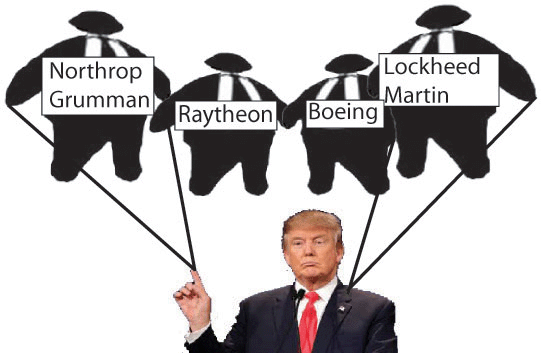
Oh goody! It’s a rosy time coming for investors, (such as Donald Trump) in nuclear weapons!

What It Would Cost to Modernize the U.S. Nuclear Arsenal — and Who Would Benefit, Yahoo Finance Lou Whiteman, The Motley Fool, Motley Fool, January 28, 2019  The United States would have to spend $494 billion over the next decade to enact its plan to modernize its nuclear arsenal, a figure that highlights the opportunity before contractors as the Pentagon seeks ways to pay for one of its top priorities. The total, which comes from a biannual report put out by the Congressional Budget Office (CBO), is 23% higher than the $400 billion price tag in the 2017 estimate. It comes at a delicate time for the Pentagon, which, after enjoying two years of steady budget increases, is facing a much less certain fiscal 2020 allocation.

……..Here’s who stands to benefit from the push to renew the nuclear triad.

Next-generation bombers

Northrop Grumman (NYSE: NOC) in late 2015 beat a team including Boeing (NYSE: BA) and Lockheed Martin to design and build a new long-range bomber. The Pentagon is expected to purchase at least 100 aircraft, with deliveries expected to begin in the mid-2020s and extend for a decade.

The plane, now known as the B-21, has been a near-casualty of Congressional budget battles in recent years, but the Pentagon continues to spend upwards of $2 billion per year on development. Overall, the CBO expects the Pentagon to spend $49 billion on bomber acquisition between now and 2028, which would easily make the B-21 Northrop’s most important platform……….

America’s most important deterrent

The Columbia-class submarine, designed to take over for the Ohio-class ballistic missile sub and house the nation’s stockpile of Trident sub-launched ballistic missiles, features a stealth electric drive propulsion system and improved maneuverability. The sub, to be built by General Dynamics’ (NYSE: GD) Electric Boat subsidiary with support from Huntington Ingalls (NYSE: HII), is due to be operational by 2028 to ensure second-strike capability should the U.S. be hit by a catastrophic attack………

A new rocket competition

The only major piece of the triad renewal still up for grabs is the task of replacing the nation’s arsenal of intercontinental ballistic missiles. …….In August 2017, the Air Force awarded Boeing and Northrop Grumman $349 million and $329 million, respectively, to develop competing new designs, with a goal of selecting a winner next year. The government is expected to spend more than $60 billion on ICBMs over the next decade, meaning the award would be a needle-mover for the eventual winner.

The stakes are also high for the two potential manufacturers of the solid-propellant rocket engines that will be used to power the missiles. Northrop brought one of the two contenders in-house last year with its $9.2 billion deal for Orbital ATK. The other, Aerojet Rocketdyne (NYSE: AJRD), has warned the Air Force and lawmakers it needs to win at least part of this procurement to remain a viable supplier.

Given the Pentagon’s priority to nurture a healthy and competitive supply base, it would not be a surprise to see both Aerojet and the former Orbital business split the ICBM engine award.

How to invest

…….for long-term investors who have seen defense holdings battered by near-term budget concerns, the longer timeline should provide some peace of mind. https://finance.yahoo.com/news/cost-modernize-u-nuclear-arsenal-163400604.html

January 29, 2019 Posted by Christina Macpherson | business and costs, USA, weapons and war | 1 Comment

North Korea’s Nukes and the ‘Forgotten War’

Hampton Sides, author of a new book about a turning point in the Korea war, explores the state of the Koreas and Trump’s forthcoming visit.  Interview, Bloomberg, By Tobin Harshaw, January 28, 2019,

“……It is a cliche that the so-called police action in Korea from 1950 to 1952 is America’s “forgotten war.” But, like most cliches, there is a lot of truth to it. American ignorance about the Korean War is a shame, and not only because it devalues the sacrifices of those who fought in it. With North Korea’s nuclear arsenal now threatening the U.S. mainland (not to mention Hawaii, Japan and the folks on the southern end of the peninsula), and President Donald Trump and Kim Jong Un set to meet again next month, a little historical perspective might be helpful.

………. HS: Be mindful of the fact that North Korea’s fear and loathing of the U.S., however warped it seems, does have legitimate historical roots. During the Korean War, the U.S. bombed that country back to the Stone Age: Every building, every bridge, every village. The stated goal was to not leave a single brick standing upon another brick. That air campaign was gratuitous and cruel. We killed hundreds of thousands of civilians. We’re a country that has a habit of bombing people and then wondering why those people hate us. As we parse the madness that is the Kim regime, we should always keep in mind that this underlying history of “terror from above” figures into that madness.

Kim strikes many as a lunatic, but his nuclear strategy has actually been quite rational and effective in achieving his goals. So coaxing him to give up his nukes will take some extremely creative and forceful negotiating. The Hermit Kingdom desperately needs many, many things from the outside world — food, medicines, capital, technology, expertise and so on, and Kim knows this. A big question is whether he would really allow his own people to benefit in any meaningful way from the flow of goods and amenities that a removal of sanctions would usher in. Another question is whether he’d actually allow outside experts to come in and closely monitor his regime’s nuclear compliance. Caveats aside, we can only hope the talks continue. I’m highly skeptical of Trump’s much-avowed skills as a deal-maker, but a deal is certainly in the interest of the whole wide world.

……….. HS: It was repeatedly said during the 2016 campaign that Douglas MacArthur is Trump’s “favorite general.” I don’t get the sense that Trump reads history — or anything else, for that matter — but it’s a telling detail. Because with Douglas MacArthur you had a grandiose and vainglorious autocrat who had surrounded himself with sycophants and yes-men. He was a colorful and interesting character — in narrative terms, a gift that keeps on giving. But he was a thoroughgoing narcissist. It was said that he didn’t have a staff; he had a court. He didn’t want to hear inconvenient information. He didn’t like experts — he was the expert. He was in love with the vertical pronoun. It was all about him.This sounds extremely familiar to me.

………. Of course, Korea should never have been divided in the first place — drawing that line created one of the great geopolitical tragedies of modern times. Many thousands of families were torn apart and never allowed to see each other again. Historically speaking, there’s no difference between northern and southern Korea. It’s one country, one language, one culture, one people.

Or at least it was. After more than 70 years of living apart, a reunification, if by some miracle it ever happened, would be a wrenching and doubtless violent process. It’s not clear how a brainwashed and traumatized people from an impoverished police state integrates into the dynamic capitalist society that is modern South Korea. Still, I believe it’s destined to happen one day.https://www.bloomberg.com/opinion/articles/2019-01-27/korean-war-in-current-events-from-the-1950s-to-a-nuclear-north

January 29, 2019 Posted by Christina Macpherson | history, North Korea, politics international, USA | Leave a comment

USA hoping to profit from nuclear power, by exporting waste clean-up technology

US to Offer Nuclear Waste Technology to Other Countries https://learningenglish.voanews.com/a/us-to-offer-nuclear-waste-technology-to-other-countries/4758652.html  Susan Shand.  The U.S. Department of Energy’s nuclear security office is developing a project to help other countries deal with nuclear waste. The information comes from two sources who spoke to the Reuters news agency. They asked not to be named because of the sensitivity of the issue.The sources say the plan aims to keep the United States competitive against other countries that are developing their own waste technology. For example, both Russia and France offer services to take care of nuclear waste.

Dov Schwartz is the spokesman for the National Nuclear Security Administration. He confirmed the group is thinking about how to help other countries reduce nuclear waste. However, Schwartz did not give details.

The NNSA also declined a Reuters request for an interview with Brent Park, who is leading the effort.

What would the technology do?

The unnamed sources say the technology could involve crushing, heating or sending an electric current through nuclear waste to reduce its size.

The machinery to do so would be put in a “black box” the size of a shipping container. It would be sent to other countries with nuclear energy programs; however, it would remain owned and operated by the United States, the sources said.

The sources did not name countries to which the service would be offered. They also did not say where the waste would be stored after it is run through the equipment. But they said they were worried the processes could increase the risk of dangerous materials reaching militant groups or nations unfriendly to the United States.

Former U.S. President Jimmy Carter banned nuclear waste reprocessing in 1977. The reprocessing opens pure amounts of uranium and plutonium, both of which could be used to make nuclear bombs.

NNSA spokesperson Dov Schwartz said the plans under consideration do not involve reprocessing. But he did not say what technologies could be used.

Concerns

The government of U.S. President Donald Trump has made promoting nuclear technology abroad a high priority. The U.S. Energy Secretary, Rick Perry, visited Saudi Arabia this month for talks on a nuclear energy deal with the kingdom. And the American business Westinghouse hopes to sell nuclear power technology to countries from Saudi Arabia to India.

But a top arms control officer during the Obama administration questions the direction of the Trump government. Thomas Countryman said the U.S. should improve its ability to get rid of its own nuclear waste before helping other countries.

A nuclear expert at the Union of Concerned Scientists also expressed some doubt about the NNSA plan. Edwin Lyman said NNSA should not be focused so much on reducing the size of nuclear waste. Instead, it should be concerned about the dangers of nuclear waste that make it hard to store.

Lyman said even a small amount of nuclear waste gives off radioactivity and heat. It “remains dangerous for hundreds of thousands of years,” he said.

January 29, 2019 Posted by Christina Macpherson | business and costs, USA, wastes | Leave a comment

Activists vow to stop Holtec’s nuclear waste plan for New Mexico

‘Deadly, toxic business’: New Mexico will reject nation’s nuclear waste, activists vow, Orange County Register, 27 Jan 19

Plan to keep waste at reactor sites is working fine, they say

In Southern California, the greatest hope for removing highly radioactive nuclear waste from the quake-prone coast might be those private, temporary storage sites that need licenses from the federal government to open.

But in New Mexico — where Holtec International wants to build such a site that could store waste from San Onofre, Diablo Canyon and scores of other commercial reactors — locals vow to do everything in their power to keep the state from becoming America’s biggest nuclear waste dump.

“The rush is on by the Nuclear Regulatory Commission to grant Holtec a license before the people realize we’re being sacrificed for another government nuclear experiment,” said Noel Marquez, an artist and member of the Alliance for Environmental Strategies.

“We’re having to research, for ourselves, the long-term consequences of this deadly, toxic business. We’re being targeted for environmental injustice.”

The passionate show-of-force came Tuesday, the day before the NRC’s three-judge Atomic Safety and Licensing Board heard oral arguments from project opponents in Albuquerque. The aim is to figure out which groups have standing with the NRC to oppose the Holtec project, but legal challenges to the plan are under way in other courts as well.

Below the radar, the NRC’s plan for temporarily storing nuclear waste is actually working pretty well, said Terry Lodge, an attorney for opponents: “They are storing waste at nuclear reactor sites, relatively uneventfully and not particularly expensively,” he said.

That, to many Californians near the shuttered San Onofre and Diablo Canyon plants, is exactly the problem.

‘Entire project is illegal’

Those familiar with America’s nuclear waste wars may be experiencing Yucca Mountain deja vu.

New Mexico, like Nevada, has no commercial nuclear reactors. Many New Mexicans, like many Nevadans, don’t want to become the nation’s nuclear dump. But New Mexicans, unlike Nevadans, have a different legal argument to make.

Congress’ Nuclear Waste Policy Act of 1982 forbids permanent waste storage on the Earth’s surface, and  —  given the federal government’s decades-long paralysis in finding a permanent, deep geologic repository —  Holtec’s temporary facility could well wind up being a permanent one, they say.

“The entire project is illegal,” said Diane Curran, an attorney representing the group Beyond Nuclear. If New Mexicans “step up and say, ‘We’ll take it in our above-ground facility,’ I’m really afraid you’ll have it forever —  a shallow graveyard for the nation’s nuclear waste.”

At a press briefing Tuesday, opponents raised the specter of cracked and damaged fuel canisters and/or rods; of dangers related to transporting canisters from all corners of the country to New Mexico by road or rail; and of the “geologic unsuitability” of the Southeastern New Mexico site, where there are underground caves, sinkholes from mining and brine that could corrode the storage containers. They also painted Holtec as an opportunistic player trying to maximize its profits and eliminate all risk.

Holtec is in some hot water with the NRC for redesigning spent fuel canisters used at San Onofre without notifying the NRC and following proper procedures…….https://www.ocregister.com/2019/01/23/deadly-toxic-business-new-mexico-will-reject-nations-nuclear-waste-activists-vow/?fbclid=IwAR0sCI-yT4Dgf6W27ejxWdySCC9Rses5q4WcXCyc4niYXLGFb2AIHg9qEws

January 28, 2019 Posted by Christina Macpherson | USA, wastes | 1 Comment

It makes sense to exclude Nuclear, Fossils With Carbon Capture,and Biofuels from the Green New Deal

Why Excluding Nuclear, Fossils With Carbon Capture, & Biofuels From The Green New Deal Makes Financial & Climate Sense, Clean Technica  January 24th, 2019 , By Mark Z. Jacobson & Mark A. DelucchiThe Green New Deal and multiple proposed laws and resolutions in the U.S. House (HRes.540, HR.3314, HR.3671) and Senate (SRes.632, S.987) call for the United States to move entirely from fossil fuels to clean, renewable electricity and/or all energy. A new bill was just introduced by Rep. Ted Lieu (D-Los Angeles County) and Rep. Jimmy Gomez (D-CA), calling for the U.S. to produce 100 percent of its electric power from renewables by 2035.

Recently, though, some vocal advocates have pushed back, claiming that the only way prices will stay low with large amounts of renewables on the power grid is to use nuclear power, fossil fuels with carbon capture, and biofuels, which they claim are “zero carbon.”

Here is why nuclear, fossils with CCS, and biofuels should be excluded.

All three technologies are opportunity costs. They raise costs to consumers and society, slow solutions to global warming and air pollution by increasing carbon and emissions relative to clean, renewables (thus are not zero carbon), and/or create risks that clean, renewables don’t have.

For example, onshore wind and utility PV are now the cheapest forms of electricity in most countries, including the U.S. New nuclear today costs 4 to 6 times that of new solar or wind to produce the same electricity. Further, a nuclear plant takes 5 to 17 years longer between planning and operation than does a solar or wind farm.

Thus, every dollar spent on nuclear results in 1/5th the energy production and 5 to 17 years more coal and gas burning than if wind or solar were installed instead. This delay and lower energy production from new nuclear condemns millions more to die from air pollution, which today kills 4 to 9 million people worldwide.

By choosing to build several nuclear plants a decade ago that have yet to operate, China suffered an increase in its overall CO2 emissions by 1.4 percent between 2016 and 2017 rather than seeing a decrease of 3.4 percent if it had spent the money on wind and solar instead.

Given that many 100% renewable policies call for a full transition of electricity by 2035, and given the financial and time requirements of nuclear, it is all but impossible for any more than a few new nuclear plant to be in place in by then.

In terms of emissions, nuclear is not zero carbon. A new plant emits 9 to 37 times the carbon emissions over its life as onshore wind, partly due to the fossil fuels used in mining and refining uranium continuously and building the facility but more because coal and gas plants are emitting during the long planning-to-operation time of a nuclear plant.


Evaluation of Nuclear Power as a Proposed Solution to Global Warming, Air Pollution, and Energy Securit
y

Just as importantly, according to the Intergovernmental Panel on Climate Change, there is “robust evidence and high agreement” that nuclear power raises concerns about weapons proliferation, core meltdown, creation and storage of radioactive waste, and land-use degradation from mining. Wind and solar power do not have these concerns.

Next, neither coal nor natural gas with carbon capture and sequestration (CCS) is remotely close to zero carbon. For example, the Petra Nova project in Texas combines a coal plant with CCS. However, a natural gas plant was built just to run the CCS equipment, and when accounting for the actual efficiency, natural gas combustion emissions, CO2 combustion emissions, and methane leaks from mining the gas, the plant reduces only 22 percent of the carbon it was designed to over 20 years – at an additional cost of $4,200/MW. That same investment could have been spent on wind and solar to replace the entire coal plant and 100% of its emissions.

Evaluation of Coal and Natural Gas With Carbon Capture as Proposed Solutions to Global Warming, Air Pollution, and Energy Security

Adding CCS to coal plants also increases air pollution and land degradation by about 25 percent. Finally, the captured CO2 is used for enhancing oil recovery, causing even greater damage to climate and health. Thus, CCS represents an enormous opportunity cost compared with developing wind or solar.

Finally, biofuels for transportation and electricity cause substantial air pollution, climate-relevant emissions, land degradation, and water drawdown compared with truly clean, renewables such as wind and solar………..https://cleantechnica.com/2019/01/24/why-excluding-nuclear-fossils-with-carbon-capture-biofuels-from-the-green-new-deal-makes-financial-climate-sense-realitycheck/

January 26, 2019 Posted by Christina Macpherson | climate change, politics, USA | Leave a comment

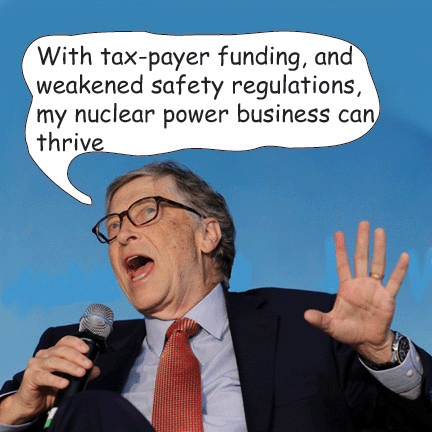
Bill Gates urging U.S. Congress to spend $billions of tax-payer money for developing new nuclear reactors

Bill Gates comes to Washington — selling the promise of nuclear energy, WP, By Steven Mufson, January 25 

Bill Gates thinks he has a key part of the answer for combating climate change: a return to nuclear power. The Microsoft co-founder is making the rounds on Capitol Hill to persuade Congress to spend billions of dollars over the next decade for pilot projects to test new designs for nuclear power reactors.

Gates, who founded TerraPower in 2006, is telling lawmakers that he personally would invest $1 billion and raise $1 billion more in private capital to go along with federal funds for a pilot of his company’s never-before-used technology, according to congressional staffers…….

 Gates said in his year-end public letter. “The problems with today’s reactors, such as the risk of accidents, can be solved through innovation.” …..

But many nuclear experts say that Gates’s company is pursuing a flawed technology and that any new nuclear design is likely to come at a prohibitive economic cost and take decades to perfect, market and construct in any significant numbers.

Lawmakers are listening to him. Through the Energy Department, Congress approved $221 million to help companies develop advanced reactors and smaller modular reactors in fiscal 2019, above the budget request. But Gates and TerraPower, which received a $40 million Energy Department research grant in 2016, are looking for more. …….

Edwin Lyman, a nuclear expert at the Union of Concerned Scientists, said TerraPower is one of many companies that is raising the public’s hopes for advanced nuclear reactor designs even though they’re still on the drawing boards and will remain unable to combat climate change for many years.

“We think the vendors of advanced nuclear power designs are saying they can commercially deploy them in a few years and all over the world,” Lyman said. “We think that is counterproductive because it is misleading the public on how fast and effective these could be.” ……

Many nuclear power experts say that the technology Gates is promoting — called a “traveling wave reactor” — does not work as advertised, at least not yet. “These designs . . . require advances in fuel and materials technology to meet performance objectives,” a Massachusetts Institute of Technology report said last year.

TerraPower has changed key elements of its design and has still not resolved critical problems, experts say……

critics say TerraPower has been stumbling over a handful of obstacles.

First, TerraPower has discovered that the traveling wave didn’t travel so well and that it would not evenly burn the depleted uranium in the “candle.” Second, and partly as a result, it needed to change the design to reshuffle the fuel rods — and do that robotically while keeping the reactor running. Third, it has struggled to find a metal strong enough to protect the fuel rods from a bombardment of neutrons more intense than those commonly used in reactors — and for a much longer period of time…….

In many ways, TerraPower’s design resembles fast breeder reactors. Fast breeders have faster moving neutrons, the subatomic particles that trigger fission.

Allison Macfarlane, former chairman of the Nuclear Regulatory Commission, said earlier versions of fast breeder reactors have turned in a “dismal performance.” The United States built two small reactors at a government laboratory in Idaho, Japan built a commercial unit called Monju, and France built two called Phenix and Superphenix — and all of them have been shut down.

………TerraPower has also been working with the Energy Department on another reactor. If it moved ahead, it could obtain federal funds for 60 percent of the cost of a test reactor, Burkey said. That design would rely on molten salt as both coolant and fuel. TerraPower believes an advanced molten salt reactor could be more efficient and produce less waste than current models.

However, that technology was examined in different countries 60 years ago — and abandoned. Lyman said the molten salt was “highly corrosive, so you need special materials for the reactor. That’s an engineering problem they still have to confront.” ……  https://www.washingtonpost.com/national/health-science/bill-gates-comes-to-washington–selling-the-promise-of-nuclear-energy/2019/01/25/4bd9c030-1445-11e9-b6ad-9cfd62dbb0a8_story.html?noredirect=on&utm_term=.115327089881

January 26, 2019 Posted by Christina Macpherson | politics, spinbuster, USA | Leave a comment

« Previous Entries     Next Entries »

1 This Month

of the week– Nuclear Reactor Information Task Force

14 May – online event From Bombs to Data Centres: the Face of Nuclear Colonialism

​To see nuclear-related stories in greater depth and intensity – go to https://nuclearinformation.wordpress.com

  • Categories

    • 1
      • Arclight's Vision
    • 1 NUCLEAR ISSUES
      • business and costs
        • employment
        • marketing
      • climate change
      • culture and arts
      • ENERGY
        • renewable
          • decentralised
          • energy storage
      • environment
        • oceans
        • water
      • health
        • children
        • psychology – mental health
        • radiation
        • social effects
        • women
      • history
      • indigenous issues
      • Legal
        • deaths by radiation
        • legal
      • marketing of nuclear
      • media
        • investigative journalism
        • Wikileaks
      • opposition to nuclear
      • PERSONAL STORIES
      • politics
        • psychology and culture
          • Trump – personality
        • public opinion
        • USA election 2024
        • USA elections 2016
      • politics international
      • Religion and ethics
      • safety
        • incidents
      • secrets,lies and civil liberties
        • civil liberties
      • spinbuster
        • Education
      • technology
        • reprocessing
        • Small Modular Nuclear Reactors
        • space travel
      • Uranium
      • wastes
        • – plutonium
        • decommission reactor
      • weapons and war
        • Atrocities
        • depleted uranium
      • Women
    • 2 WORLD
      • ANTARCTICA
      • ARCTIC
      • ASIA
        • Burma
        • China
        • India
        • Indonesia
        • Japan
          • – Fukushima 2011
          • Fukushima 2012
          • Fukushima 2013
          • Fukushima 2014
          • Fukushima 2015
          • Fukushima 2016
          • Fukushima continuing
        • Malaysia
        • Mongolia
        • North Korea
        • Pakistan
        • South Korea
        • Taiwan
        • Turkey
        • Vietnam
      • EUROPE
        • Belarus
        • Bulgaria
        • Denmark
        • Finland
        • France
        • Germany
        • Greece
        • Ireland
        • Italy
        • Kazakhstan
        • Kyrgyzstan
        • Russia
        • Spain
        • Sweden
        • Switzerland
        • UK
        • Ukraine
      • MIDDLE EAST
        • Afghanistan
        • Egypt
        • Gaza
        • Iran
        • Iraq
        • Israel
        • Jordan
        • Libya
        • Saudi Arabia
        • Syria
        • Turkey
        • United Arab Emirates
      • NORTH AMERICA
        • Canada
        • USA
          • election USA 2020
      • OCEANIA
        • New Zealand
        • Philippines
      • SOUTH AMERICA
        • Brazil
    • ACTION
    • AFRICA
      • Kenya
      • Malawi
      • Mali
      • Namibia
      • Niger
      • Nigeria
      • Somalia
      • South Africa
    • Atrocities
    • AUSTRALIA
    • Christina's notes
    • Christina's themes
    • culture and arts
    • Events
    • Fuk 2022
    • Fuk 2023
    • Fukushima 2017
    • Fukushima 2018
    • fukushima 2019
    • Fukushima 2020
    • Fukushima 2021
    • general
    • global warming
    • Humour (God we need it)
    • Nuclear
    • RARE EARTHS
      • thorium
    • Reference
      • Reference archives
    • resources – print
    • Resources -audiovicual
    • Weekly Newsletter
    • World
    • World Nuclear
    • YouTube
  • Pages

    • 1 This Month
    • ACTION !
    • Disclaimer
    • Links
    • PAGES on NUCLEAR ISSUES
      • audio-visual news
      • Anti Nuclear, Clean Energy Movement
        • Anti Nuclear movement – a success story
          • – 2013 – the struggle for a nuclear-free, liveable world
          • – 2013: the battle to expose nuclear lies about ionising radiation
            • Speakers at Fukushima Symposium March 2013
            • Symposium 2013 Ian Fairlie
      • Civil Liberties
        • – Civil liberties – China and USA
      • Climate change
      • Climate Change
      • Economics
        • – Employment
        • – Marketing nuclear power
        • – Marketing Nuclear Power Internationally
        • nuclear ‘renaissance’?
        • Nuclear energy – the sick man of the corporate world
      • Energy
        • – Solar energy
      • Environment
        • – Nuclear Power and the Tragedy of the Commons
        • – Water
      • Health
        • Birth Defects in the Chernobyl Radiation Affected Region.
      • History
        • Nuclear History – the forgotten disasters
      • Indigenous issues
      • Ionising radiation
        • – Ionising radiation – medical
        • Fukushima FACT SHEET
      • Media
        • Nuclear Power and Media 2012
      • Nuclear Power and the Consumer Society – theme for December 2012
      • Peace and nuclear disarmament
        • Peace on a Nuclear Free Earth
      • Politics
        • – Politics USA
      • Public opinion
      • Religion and ethics
        • -Ethics of nuclear power
      • Resources – print
      • Safety
      • Secrets and lies
        • – NUCLEAR LIES – theme for January 2012
        • – Nuclear Secrets and Lies
      • Spinbuster
        • 2013 nuclear spin – all about FEAR -theme for June
        • Spinbuster 1
      • Technology
        • TECHNOLOGY Challenges
      • Wastes
        • NUCLEAR WASTES – theme for October 2012
        • – Plutonium
      • Weapons and war
      • Women
  • Archives

    • May 2026 (92)
    • April 2026 (356)
    • March 2026 (251)
    • February 2026 (268)
    • January 2026 (308)
    • December 2025 (358)
    • November 2025 (359)
    • October 2025 (376)
    • September 2025 (257)
    • August 2025 (319)
    • July 2025 (230)
    • June 2025 (348)
  • Categories

    • 1
      • Arclight's Vision
    • 1 NUCLEAR ISSUES
      • business and costs
        • employment
        • marketing
      • climate change
      • culture and arts
      • ENERGY
        • renewable
          • decentralised
          • energy storage
      • environment
        • oceans
        • water
      • health
        • children
        • psychology – mental health
        • radiation
        • social effects
        • women
      • history
      • indigenous issues
      • Legal
        • deaths by radiation
        • legal
      • marketing of nuclear
      • media
        • investigative journalism
        • Wikileaks
      • opposition to nuclear
      • PERSONAL STORIES
      • politics
        • psychology and culture
          • Trump – personality
        • public opinion
        • USA election 2024
        • USA elections 2016
      • politics international
      • Religion and ethics
      • safety
        • incidents
      • secrets,lies and civil liberties
        • civil liberties
      • spinbuster
        • Education
      • technology
        • reprocessing
        • Small Modular Nuclear Reactors
        • space travel
      • Uranium
      • wastes
        • – plutonium
        • decommission reactor
      • weapons and war
        • Atrocities
        • depleted uranium
      • Women
    • 2 WORLD
      • ANTARCTICA
      • ARCTIC
      • ASIA
        • Burma
        • China
        • India
        • Indonesia
        • Japan
          • – Fukushima 2011
          • Fukushima 2012
          • Fukushima 2013
          • Fukushima 2014
          • Fukushima 2015
          • Fukushima 2016
          • Fukushima continuing
        • Malaysia
        • Mongolia
        • North Korea
        • Pakistan
        • South Korea
        • Taiwan
        • Turkey
        • Vietnam
      • EUROPE
        • Belarus
        • Bulgaria
        • Denmark
        • Finland
        • France
        • Germany
        • Greece
        • Ireland
        • Italy
        • Kazakhstan
        • Kyrgyzstan
        • Russia
        • Spain
        • Sweden
        • Switzerland
        • UK
        • Ukraine
      • MIDDLE EAST
        • Afghanistan
        • Egypt
        • Gaza
        • Iran
        • Iraq
        • Israel
        • Jordan
        • Libya
        • Saudi Arabia
        • Syria
        • Turkey
        • United Arab Emirates
      • NORTH AMERICA
        • Canada
        • USA
          • election USA 2020
      • OCEANIA
        • New Zealand
        • Philippines
      • SOUTH AMERICA
        • Brazil
    • ACTION
    • AFRICA
      • Kenya
      • Malawi
      • Mali
      • Namibia
      • Niger
      • Nigeria
      • Somalia
      • South Africa
    • Atrocities
    • AUSTRALIA
    • Christina's notes
    • Christina's themes
    • culture and arts
    • Events
    • Fuk 2022
    • Fuk 2023
    • Fukushima 2017
    • Fukushima 2018
    • fukushima 2019
    • Fukushima 2020
    • Fukushima 2021
    • general
    • global warming
    • Humour (God we need it)
    • Nuclear
    • RARE EARTHS
      • thorium
    • Reference
      • Reference archives
    • resources – print
    • Resources -audiovicual
    • Weekly Newsletter
    • World
    • World Nuclear
    • YouTube
  • RSS

    Entries RSS
    Comments RSS

Site info

nuclear-news
Create a free website or blog at WordPress.com.
Privacy & Cookies: This site uses cookies. By continuing to use this website, you agree to their use.
To find out more, including how to control cookies, see here: Cookie Policy
  • Subscribe Subscribed
    • nuclear-news
    • Join 2,102 other subscribers
    • Already have a WordPress.com account? Log in now.
    • nuclear-news
    • Subscribe Subscribed
    • Sign up
    • Log in
    • Report this content
    • View site in Reader
    • Manage subscriptions
    • Collapse this bar

Loading Comments...