A spokesperson for the Kremlin was blasé about the Nyonoksa explosion, stating that “accidents happen.” Yes, they do, but nuclear-powered cruise missile programs don’t just happen. They represent dangerous and unnecessary choices to goose a nation’s theoretical military supremacy, incentivizing other nations to follow suit, risks be damned. The arms control regimes that once moderated U.S. and Russian decisions are already crumbling, and another big one—the New Strategic Arms Reduction Treaty, or New START—may expire in 2021. What exactly transpired in the White Sea on August 8 may remain fuzzy, but what is becoming increasingly clear is the risk to life associated with a new generation of nuclear arms proliferation between the U.S. and Russia. With ultranationalist leaders and weapon fetishists in control of Washington and Moscow, buttressed by military yes-men and mercenary defense contractors, there’s little to stand in the way of a new, irrationally exuberant buildup of bizarre new nuclear forces.
Trump on climate change- USA companies’ profits more important. He is expert on environment

Trump’s climate session no-show, ABC News, 27 Aug 19
A $US20 million ($29.5 million) pledge to battle wildfires raging across the Amazon is being seen as one of the few solid agreements to come out of the meeting — but it appears to have come about with little input from Mr Trump.
“The President had scheduled meetings and bilaterals with Germany and India, so a senior member of the administration attended in his stead,” press secretary Stephanie Grisham said in a statement.
CNN and the Guardian reported Mr Trump appeared to be unaware of when the climate session would be held when asked by reporters. He thought it had not happened yet…..
The US president up-ended last year’s G7 summit in Canada, walking out of the meeting early and disassociating himself from the final communique having initially endorsed the document. …..
World leaders’ closing remarks
US President Donald Trump: …….
- On climate change: “We are the number one energy producer in the world. It is tremendous wealth — I am not going to lose that wealth on dreams, on windmills, which frankly are not working that well.”
- “I want the cleanest water on Earth, I want the cleanest air on Earth … I think I know more about the environment than most people.” https://www.abc.net.au/news/2019-08-27/trump-ready-to-meet-irans-president-to-solve-nuclear-impasse-g7/11451490
Donald Trump’s idea – use nuclear bombs to stop hurricanes from hitting the United States
 https://amp.axios.com/trump-nuclear-bombs-hurricanes-97231f38-2394-4120-a3fa-8c9cf0e3f51c.html
Jonathan Swan, Margaret Talev, 26 Aug 19, President Trump has suggested multiple times to senior Homeland Security and national security officials that they explore using nuclear bombs to stop hurricanes from hitting the United States, according to sources who have heard the president’s private remarks and been briefed on a National Security Council memorandum that recorded those comments.
Behind the scenes: During one hurricane briefing at the White House, Trump said, “I got it. I got it. Why don’t we nuke them?” according to one source who was there. “They start forming off the coast of Africa, as they’re moving across the Atlantic, we drop a bomb inside the eye of the hurricane and it disrupts it. Why can’t we do that?” the source added, paraphrasing the president’s remarks.
Asked how the briefer reacted, the source recalled he said something to the effect of, “Sir, we’ll look into that.”
Trump replied by asking incredulously how many hurricanes the U.S. could handle and reiterating his suggestion that the government intervene before they make landfall.
The briefer “was knocked back on his heels,” the source in the room added. “You could hear a gnat fart in that meeting. People were astonished. After the meeting ended, we thought, ‘What the f—? What do we do with this?'”
Trump also raised the idea in another conversation with a senior administration official. A 2017 NSC memo describes that second conversation, in which Trump asked whether the administration should bomb hurricanes to stop them from hitting the homeland. A source briefed on the NSC memo said it does not contain the word “nuclear”; it just says the president talked about bombing hurricanes.
The source added that this NSC memo captured “multiple topics, not just hurricanes. … It wasn’t that somebody was so terrified of the bombing idea that they wrote it down. They just captured the president’s comments.”
The sources said that Trump’s “bomb the hurricanes” idea — which he floated early in the first year and a bit of his presidency before John Bolton took over as national security adviser — went nowhere and never entered a formal policy process.
White House response: A senior administration official said, “We don’t comment on private discussions that the president may or may not have had with his national security team.”
A different senior administration official, who has been briefed on the president’s hurricane bombing suggestion, defended Trump’s idea and said it was no cause for alarm. “His goal — to keep a catastrophic hurricane from hitting the mainland — is not bad,” the official said. “His objective is not bad.”
“What people near the president do is they say ‘I love a president who asks questions like that, who’s willing to ask tough questions.’ … It takes strong people to respond to him in the right way when stuff like this comes up. For me, alarm bells weren’t going off when I heard about it, but I did think somebody is going to use this to feed into ‘the president is crazy’ narrative.”
Trump called this story “ridiculous” in a Monday tweet from the G7 summit. He added, “I never said this. Just more FAKE NEWS!”
The big picture: Trump didn’t invent this idea. The notion that detonating a nuclear bomb over the eye of a hurricane could be used to counteract convection currents dates to the Eisenhower era, when it was floated by a government scientist.
The idea keeps resurfacing in the public even though scientists agree it won’t work. The myth has been so persistent that the National Oceanic and Atmospheric Administration, the U.S. government agency that predicts changes in weather and the oceans, published an online fact sheet for the public under the heading “Tropical Cyclone Myths Page.”
The page states: “Apart from the fact that this might not even alter the storm, this approach neglects the problem that the released radioactive fallout would fairly quickly move with the tradewinds to affect land areas and cause devastating environmental problems. Needless to say, this is not a good idea.”
About 3 weeks after Trump’s 2016 election, National Geographic published an article titled, “Nuking Hurricanes: The Surprising History of a Really Bad Idea.” It found, among other problems, that:
Dropping a nuclear bomb into a hurricane would be banned under the terms of the Peaceful Nuclear Explosions Treaty between the U.S. and the former Soviet Union. So that could stave off any experiments, as long as the U.S. observes the terms of the treaty.
Atlantic hurricane season runs until Nov. 30.
Long history of misguided suggestions to nuclear bomb hurricanes

|
The idea has evidently surfaced multiple times in the administration, as Swan outlined, including during a hurricane preparedness briefings at the White House. “I got it. I got it. Why don’t we nuke them?” the president evidently interrupted, according to Swan’s source. “They start forming off the coast of Africa, as they’re moving across the Atlantic, we drop a bomb inside the eye of the hurricane and it disrupts it. Why can’t we do that?” Even in a White House system engineered to respond quickly and authoritatively to a president’s whims, questions, or orders, no one knew what to do with an idea so obviously batty. As one source reportedly told Swan, “You could hear a gnat fart in that meeting. People were astonished. After the meeting ended, we thought, ‘What the f—? What do we do with this?’” (Trump denied the reports in a tweet Monday.) The truth, though, is that Donald Trump’s apparent brainstorm—as terrible an idea as it is—actually has a long history. Seventy years ago, it was at the forefront of American scientific thought. What makes Trump’s embrace of nuking hurricanes unique is that, broadly speaking, no policymaker has seriously considered it a good idea since the days that the 73-year-old president was wearing diapers. The bombing of Hiroshima and Nagasaki—when the US unleashed a destructive technology more powerful than anything in history—at first spurred unbridled excitement over the power of the atom…… Engineers dreamed of the day when nuclear engines would replace gasoline-powered automobiles, when a lump of Uranium-235 the size of a vitamin pill would power the family car for years at a time. In those heady early years of the atomic age, many scientists imagined a world where humans could routinely use nuclear weapons to cleave the earth and remake its climate. Decades before climate change became a major concern, one book, Almighty Atom: The Real Story of Atomic Energy, suggested using atomic weapons to melt the polar ice caps, gifting “the entire world a moister, warmer climate.” Thought experiments exploded over how harnessing the power of the atom would finally unleash humans’ ability to control and reshape their environment through geo-engineering. “For the first time in the history of the world, man will have at his disposal energy in amounts sufficient to cope with the forces of Mother Nature,” ……. One of the first tourist attractions in Las Vegas was the chance to wake up early, stand outside your hotel, and watch the flash and mushroom cloud from the bombs rolling into the sky. The after-effects of radiation—the invisible and inescapable poison spread by nuclear explosions—became clear soon enough. With that awareness, early atomic enthusiasm waned, particularly as bombs leapt from nuclear to thermonuclear, the atomic bomb’s power of kilotons—that is, a thousand tons of TNT—growing to the hydrogen bomb’s megatons, the equivalent of a million tons of TNT….. nuking hurricanes entered the conversation. According to International Spy Museum historian Vince Houghton, whose book Nuking the Moon details wacky military and intelligence schemes, an American meteorologist named Jack Reed, one of the nation’s earliest hurricane hunters, appears to be the first to seriously consider bombing a hurricane. His calculations held that maybe one or two 20-megaton bombs might be able to deflect a hurricane from land. He called for a test of the theory, but found it embraced by precisely zero policymakers …. Reed’s idea would actually now be prohibited under international law by the Peaceful Nuclear Explosions Treaty. Yet the appeal of nuking hurricanes has never really gone away. The issue is such a MacGuffin that NOAA has dedicated a webpage to debunking it: “During each hurricane season, there always appear suggestions that one should simply use nuclear weapons to try and destroy the storms,” the weather service writes. “Apart from the fact that this might not even alter the storm, this approach neglects the problem that the released radioactive fallout would fairly quickly move with the tradewinds to affect land areas and cause devastating environmental problems. Needless to say, this is not a good idea.” The idea has enough staying power that the meteorologists at NOAA even took on the underlying science, pointing out that there’s little evidence that even a successfully placed atomic bomb would do anything to alter a hurricane’s formation —the systems are simply too large, too strong, and most of all, a nuclear explosion wouldn’t affect the underlying dynamics, …… Even for Donald Trump, launching 80 nukes a year seems extreme https://www.wired.com/story/nuking-hurricanes-polar-ice-caps-climate-change/ |
|
Santee Cooper officially cancels contract to end dispute over nuclear parts
The Green New Deal – Bernie Fraser

|
The Green New Deal, The climate crisis is not only the single greatest challenge facing our country; it is also our single greatest opportunity to build a more just and equitable future, but we must act immediately. Bernie Fraser, Climate change is a global emergency. The Amazon rainforest is burning, Greenland’s ice shelf is melting, and the Arctic is on fire. People across the country and the world are already experiencing the deadly consequences of our climate crisis, as extreme weather events like heat waves, wildfires, droughts, floods, and hurricanes upend entire communities, ecosystems, economies, and ways of life, as well as endanger millions of lives. Communities of color, working class people, and the global poor have borne and will bear this burden disproportionately. The scientific community is telling us in no uncertain terms that we have less than 11 years left to transform our energy system away from fossil fuels to energy efficiency and sustainable energy, if we are going to leave this planet healthy and habitable for ourselves, our children, grandchildren, and future generations. As rising temperatures and extreme weather create health emergencies, drive land loss and displacement, destroy jobs, and threaten livelihoods, we must guarantee health care, housing, and a good-paying job to every American, especially to those who have been historically excluded from economic prosperity. As President, Bernie Sanders Will Avert Climate Catastrophe and Create 20 Million JobsAs president, Bernie Sanders will launch the decade of the Green New Deal, a ten-year, nationwide mobilization centered around justice and equity during which climate change will be factored into virtually every area of policy, from immigration to trade to foreign policy and beyond. This plan outlines some of the most significant goals we have set and steps we will take during this mobilization, including:
|
|
MEDIA MATTERS finds that mainstream news is practically ignoring Amazon fires
 The Notre Dame fire garnered wall-to-wall cable news coverage. The Amazon fires are barely breaking through. https://www.mediamatters.org/msnbc/notre-dame-fire-garnered-wall-wall-cable-news-coverage-amazon-fires-are-barely-breaking LIS POWER 23 Aug 19
The current fires raging in the Amazon aren’t garnering anywhere near the same level of coverage on cable news, despite the effects the wildfires will have on the global environment.
As noted in The Washington Post, the Amazon “serves as the lungs of the planet by taking in carbon dioxide,” and the European Union’s Copernicus Climate Change Service is warning that “the fires have led to a clear spike in carbon monoxide emissions as well as planet-warming carbon dioxide emissions, posing a threat to human health and aggravating global warming.”
Despite the serious implications, the Amazon fires haven’t gotten even close to the amount of coverage Notre Dame’s fire received. So far, coverage has peaked at 11 segments that mention the fires per day on cable news networks combined — as opposed to around 150 segments a day that mentioned the cathedral fire during the peak of Notre Dame coverage — according to Media Matters’ internal database. Additionally, the coverage has often come via short headline reads or passing mentions rather than thorough, in-depth analysis about the events and global consequences.
The disparity in coverage is glaring and raises serious questions about cable news priorities when it comes to covering our environment.
Media Matters’ internal database includes weekday cable news programming on CNN, Fox News, and MSNBC between the hours of 6 a.m. and midnight. Segments are coded in near-real time by analysts for pertinent information. We searched our database for segments during the week of April 15 that included “Notre Dame” in the segment notes and segments during the week of August 18 that included “Amazon” in the segment notes.
Massachusetts Attorney General objects to transfer of the Pilgrim Nuclear Power Station license to Holtec
 Regulators approve nuclear transfer over governor, AG protests, MASS LIVE, By Colin A. Young / STATE HOUSE NEWS SERVICESTATE HOUSE, BOSTON, AUG. 23, 2019…..Despite the objections of Attorney General Maura Healey, the Baker administration and local advocacy groups, federal regulators approved the transfer of the Pilgrim Nuclear Power Station license to a company that plans to decommission the plant on an “accelerated basis.” Regulators approve nuclear transfer over governor, AG protests, MASS LIVE, By Colin A. Young / STATE HOUSE NEWS SERVICESTATE HOUSE, BOSTON, AUG. 23, 2019…..Despite the objections of Attorney General Maura Healey, the Baker administration and local advocacy groups, federal regulators approved the transfer of the Pilgrim Nuclear Power Station license to a company that plans to decommission the plant on an “accelerated basis.”
Entergy, which bought the Plymouth plant from Boston Edison in 1999, is selling it to Holtec International, and the Nuclear Regulatory Commission has been reviewing the requested license transfer since last year. The NRC approved the transfer Friday, announcing that Holtec International will be the owner of the plant and that its subsidary Holtec Decommissioning International will serve as the decommissioning operator. The NRC said its order approving the license transfer is effective immediately but that the transfer will not actually take place until the sale of the plant is finalized. The transfer includes the dry cask spent fuel storage installation at Pilgrim.
……… The approval comes as Attorney General Maura Healey, Gov. Charlie Baker’s energy and environment secretariat and members of the state’s Congressional delegation mounted an effort to block the transfer until the NRC held a full hearing on concerns over Holtec’s ability to safely decommission the nuclear plant, the company’s financial stability and its alleged involvement in a kickback scheme.
“The Commonwealth does not believe that Holtec has met the NRC’s financial and technical qualification requirements for license transfer approval,” Healey’s office wrote to the NRC this week. “Indeed, the Commonwealth has serious concerns about Holtec’s financial and technical capacity to complete the work at Pilgrm. At a minimum, this history requires a heightened degree of scrutiny by the NRC and its Staff.” ……..
On Friday, Healey’s office said it will review the options it still has to rectify what it called a “misguided decision” by the federal regulators. “We are deeply disappointed in the NRC’s misguided decision to approve the license transfer and trust fund exemption requests, and its failure to meaningfully consult with our state prior to doing so. We continue to have serious concerns about Holtec’s financial capacity, technical qualifications, and judgment to safely and properly clean up the site, and store and manage Pilgrim’s spent nuclear fuel,” Healey spokeswoman Chloe Gotsis said. “We are reviewing all of our available options to ensure the health, safety and interests of our residents and the environment are protected.” U.S. Sen. Edward Markey, who sits on a Congressional committee with jurisdiction over the NRC, said the agency “is abdicating any responsibility for protecting public health and safety with its rushed and uninformed license transfer for the Pilgrim nuclear power plant.” “The opaque process that disregarded local resident and state input reflects the Commission’s choice to prioritize industry timelines over due diligence and transparency. Holtec’s math on how it will pay for decommissioning does not add up. Holtec’s unwillingness to even negotiate an agreement with local stakeholders — the ones who will be living next door to nuclear waste for years to come — is unacceptable,” Markey said. “I have repeatedly called on Holtec to be a good neighbor and for the Commission to be a good regulator, but those calls of concern were ignored.”
The Baker administration said it “believes the Nuclear Regulatory Commission staff should not have made the decision to approve the license transfer prior to the Commission ruling on the concerns raised by the administration and Attorney General.” “Both offices remain deeply committed to ensuring the Pilgrim Nuclear Power station is decommissioned in a manner that protects the safety of the public and environment,” Energy and Environmental Affairs spokeswoman Katie Gronendyke said. Late Thursday, four state senators and six state representatives — Sens. Viriato deMacedo, Julian Cyr, John Keenan and Patrick O’Connor along with Reps. William Crocker, Josh Cutler, Dylan Fernandes, Sarah Peake, Kathleen LaNatra and Tim Whelan — issued a statement in support of Healey and the administration. They asked the NRC to give the issue a full hearing before acting on the license transfer application……… https://www.masslive.com/news/2019/08/regulators-approve-nuclear-transfer-over-governor-ag-protests.html |
|
White House new system guidelines for nuclear power in space includes weapons grade materials
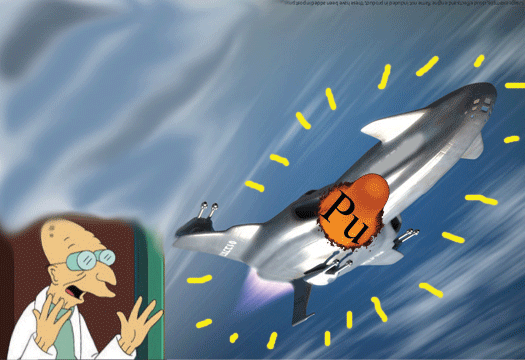 White House Overhauls Launch Approval Process for Nuclear Spacecraft, AIP, 23 Aug 19, The White House has announced a new launch authorization process for spacecraft that use nuclear-powered systems, instituting a tiered framework that delegates decision-making for less risky missions and provides explicit guidance on acceptable risk levels……
The least risky missions fall in Tier 1, where the director of the sponsoring agency can approve the launch. In Tier 2, an interagency review process is triggered, though the sponsoring agency director maintains authority over the launch decision. The memo directs NASA to establish a standing Interagency Nuclear Safety Review Board to perform this function, which formerly was handled by an ad hoc committee empaneled on a mission-by-mission basis.
Spacecraft that use fission reactors automatically fall in at least Tier 2, and the memo requires NASA to identify additional safety guidelines for “safe non-terrestrial operation of nuclear fission reactors, including orbital and planetary surface activities.”
Tier 3 missions require presidential authorization, which for non-defense missions is delegated to the OSTP director, who may opt to forward the decision to the president. Due to nuclear nonproliferation considerations, missions that use highly enriched uranium automatically fall in Tier 3.
The memo also establishes a set of safety guidelines that apply to spacecraft across all tiers. It specifies that the probability a launch accident would result in any individual receiving a total effective dose between 0.025 rem and five rem should be no greater than 1 in 100. The probability for exposures between five rem and 25 rem should not exceed 1 in 10,000, and above 25 rem the probability should not exceed 1 in 100,000. For comparison, the average effective doseindividuals receive from natural background radiation in the U.S. is about 0.3 rem per year, and the Nuclear Regulatory Commission’s dose limit for radiation workers is five rem per year…….
According to a 2015 study, the U.S. has launched 47 nuclear power systems and hundreds of heater units on 31 missions since 1961. The most recent scientific missions to employ an RPS were New Horizons, a Pluto fly-by mission launched in 2006, and the Mars Curiosity Rover, launched in 2011. The follow-on Mars 2020 Rover and the recently selected Dragonfly rotorcraft mission to Saturn’s moon Titan are currently the only two approved NASA spacecraft in development that will use an RPS.
The relatively infrequent use of nuclear systems on spacecraft is in part attributed to the complexity and cost of the safety review process, which generally has limited them to flagship-class missions. Low availability of plutonium for civilian uses has also constrained the mission cadence…….
NASA has recently emphasized the potential value of fission reactors for human deep space exploration missions. At the National Space Council meeting this week, NASA Administrator Jim Bridenstine said nuclear thermal propulsion technologies could significantly reduce transit time to Mars. He also pointed to other potential applications, such as using fission to power a space-based laser that could deflect asteroids and deorbit space debris.
NASA is also exploring how nuclear reactors could meet the power demands of planetary bases. One such concept, called Kilopower, could provide up to 10 kilowatts per reactor using highly enriched uranium. Bridenstine visited members of the Kilopower team this week at NASA’s Glenn Research Center.
The concept is not without critics. Rep. Bill Foster (D-IL), a former Fermilab physicist who advocates using alternatives to highly enriched uranium, pressedBridenstine on the subject at a hearing this year.
“A future where every space-faring nation has a big inventory of weapons-grade material to service the reactors that they are using all over the Moon and all over Mars is not a very safe space environment,” Foster said. “There will be some small performance compromises in going with low enriched non-weapons grade material, but I really urge you to look hard at keeping alive the prospect of having an international collaboration to develop workable non weapons grade-based materials that the whole world will use.” …….https://www.aip.org/fyi/2019/white-house-overhauls-launch-approval-process-nuclear-spacecraft
USA’s nuclear regulators concerned about possibility of an electromagnetic pulse attack
|
Feds fear EMP ‘meltdown’ of nuclear power plants, Washington Examiner, by Paul Bedard August 23, 2019 The federal government’s new focus on preventing disaster in a natural or terrorist electromagnetic pulse attack is drawing attention to a lack of testing and preparation at the nation’s nuclear power plants, where a resulting meltdown could cause radiation deaths. |
|
|
Public Should Comment on New “WIPP Forever” Strategic Plan
 Public Should Comment on New “WIPP Forever” Strategic Plan, http://nuclearactive.org/ August 22nd, 2019 The Waste Isolation Pilot Plant (WIPP) is the nation’s first geologic disposal site for radioactive and hazardous waste. https://wipp.energy.gov/ But WIPP should not be the only repository. For decades, federal laws and state agreements and permits have established a limited mission for both the amount of waste allowed and how long the site can operate. Other repositories are necessary since the nation has no plans to stop production of nuclear weapons that generate the plutonium waste. Other repositories also are required for commercial spent fuel and military high-level wastes.
In recent years, officials with the Department of Energy (DOE) have discussed various ideas to keep WIPP open for at least 50 years – twice as long as the original schedule – and to expand the types and amounts of waste. One reason for the “WIPP Forever” plan is to avoid telling Congress and the public that it is time to develop other repositories – since no state is asking for those dump sites.
DOE announced the upcoming release of a Draft Five-Year Strategic Plan and public comment meetings in Santa Fe on Monday, August 26th from 3 to 5 pm at the Hotel Santa Fe, and in Carlsbad on Wednesday, August 28th from 10:30 am to 12:30 pm at the Skeen-Whitlock Building. While WIPP officials acknowledge that more informed public comment happens if the draft plan is released several days in advance, the document may not be available until just before the Santa Fe meeting.
Thus, what exactly is in the five-year plan is uncertain. But it likely will presume that WIPP continues to operate until at least 2050 and the amount of waste totals at least thirty percent more than the legal limit of 175,564 cubic meters. It will certainly include adding at least one new shaft and numerous underground disposal rooms beyond those ever included in past designs. That additional space is for plutonium-contaminated waste previously designated for WIPP that doesn’t fit because of the underground contamination that makes some areas of the underground unusable. The Plan also could include tons of weapons-grade plutonium and high-level waste that has always been prohibited by federal law and the state permit.
Don Hancock, of Southwest Research and Information Center, said, “Whatever the specifics of the WIPP Strategic Plan, the public can tell DOE that we do not agree with operating WIPP forever. People can also tell State officials to enforce the legal limits on the amount and types of waste and set a closing date so that DOE and Congress know that it’s time to plan for either long-term storage at generator sites or new repositories in other states.” http://www.sric.org/
Trump signs off on plan to launch nuclear spacecraft
Trump signs off on plan to launch nuclear spacecraft, New York Post, By Marisa Schultz, August 20, 2019, WASHINGTON — President Trump on Tuesday signed a presidential memorandum outlining new procedures to launch nuclear power systems into outer space.
Trump directed the Department of Transportation to issue public guidelines within a year for commercial companies seeking a license to launch spacecraft with nuclear systems. …..
The federal government and private companies have been eyeing nuclear-powered space exploration and nuclear reactors to fuel missions to the moon, Mars and beyond.
Nuclear propulsion could cut the nine-month trip to Mars in half, the Houston Chronicle reported Tuesday, after the sixth meeting of the National Space Council. Vice President Mike Pence attended the Virginia meeting and touted accomplishments of Trump’s renewed focus on space exploration.
“Our moon-to-Mars mission is on track, and America is leading in human space exploration again,” Pence said. https://nypost.com/2019/08/20/trump-signs-off-on-plan-to-launch-nuclear-spacecraft/
Burevestnik, SKYFALL nuclear weapons – “of course, it’s a dick-measuring contest,”
 next superpower arms race will be even more foolish than the last one. New Republic , By August 22, 2019, The United States and Russia are entering a new arms race, and the costs aren’t just monetary. On August 8, Russian civilians around the remote village of Nyonoksa found themselves downwind of a military nuclear propulsion experiment gone wrong in the White Sea, just outside the Arctic Circle. According to the Russian ministry of defense, a liquid propellant rocket engine had gone awry and exploded.
The exact sort of weapon Russia may have been testing is unknown, but the balance of evidence points to a probable culprit: the Burevestnik nuclear-powered cruise missile. Nuclear nonproliferation expert Jeffrey Lewis and his team of researchers out in Monterey, California, have done much of the work in compiling this evidence, which includes the presence of a nuclear fuel carrier ship that was known to have been involved in recovery efforts after a previous failed test of the missile. Known in NATO countries as the SSC-X-9 SKYFALL, the Burevestnik’s atomic propulsion is said by Russian state media to give the missile “almost unlimited range, non-predictable trajectory and high air defense penetration capacity.”……..
In the end, much of what may be driving investment and research on this weapon—beyond Putin’s chest-thumping—may be the sprawling and influential Russian defense bureaucracy. (Overspending on exotic military systems is not an exceptionally American trait.)
That’s the shaky strategic logic behind it. But the common-sense logic, as the radioactive Nyonoksa explosion shows, is even less kind. If a nuclear-powered cruise missile sounds exotic and a little dangerous, that’s because it is. Missiles go boom—usually intentionally, but often enough not—and whatever nuclear power source they might be using onboard wouldn’t be immune.
There’s still little consensus among American experts about how exactly the Burevestnik might leverage nuclear power for propulsion. If you thought nuclear fission weapons were complex, nuclear rocket propulsion is more arcane and mysterious still. In the 1950s and 1960s, U.S. scientists drafted fanciful plans to give missiles nuclear engines, on the assumption that they’d be able to fly longer and farther than any weapon yet conceived. But the Americans eventually gave up; the technical challenges and environmental risks weren’t worth it. The Russians haven’t given up just yet, but they may someday…..
For the Russian leadership, a weapon like Burevestnik is a prestige project, a way to set Moscow apart from its competition……
Of course, Donald Trump couldn’t stomach another head of state flaunting his fancy rocket. The president tweeted on August 12 that the United States has “similar, though more advanced, technology.” As nuclear chemist Cheryl Rofer observed, this was a rare tweet by Trump’s standards: one that criticized Russia. “And of course, it’s a dick-measuring contest,” Rofer added. (Trump’s done this before, chiding North Korean dictator Kim Jong Un on Twitter over the size of his “nuclear button.”) To the extent he grasps the salient issues, it’s likely the president has already asked Pentagon officials why the United States doesn’t have a nuclear-propelled cruise missile of its own.
A folly, endangering us all, If Trump ends another nuclear treaty
If Trump ends another nuclear treaty, it will be the height of folly, by Michèle Flournoy and Kingston Reif, August 19, 2019 Michèle Flournoy is co-founder and managing partner of WestExec Advisors. She served as the Under Secretary of Defense for Policy from February 2009 to February 2012. Kingston Reif is the director for Disarmament and Threat Reduction Policy at the Arms Control Association.
(CNN)During his first two and a half years in office, President Donald Trump and his administration have laid waste to numerous international agreements originally designed to strengthen US security, bolster US alliances, and constrain US adversaries. The toll has been particularly high with respect to deals concerning nuclear arms control and nonproliferation.
Over the past 14 months, the administration has withdrawn from the 2015 Iran nuclear deal and abandoned the 1987 Intermediate Range Nuclear Forces (INF) Treaty. Both of these valuable agreements have been discarded without a viable plan to replace them.
Now the administration is signaling that it might jettison yet another nuclear pact, the2010 New Strategic Arms Reduction Treaty (New START) with Russia. Doing so would be the height of folly and would deal a significant blow to US national security. With the US withdrawal from the INF Treaty having just taken effect on Aug. 2, New START will be the only remaining agreement constraining the size of the world’s two largest nuclear arsenals. Were New START to disappear, for the first time in nearly half a century there would be no legally binding limits on American or Russian nuclear stockpiles. The risk of unconstrained US-Russian nuclear competition, and of even more tense bilateral relations, would grow.
New START also includes a comprehensive monitoring and verification regime to ensure compliance. But the agreement is set to expire on Feb. 5, 2021. Under its terms, it can be extended by up to five years if both presidents agree.
In an appearance before an activist group this summer, however, US National Security Advisor John Bolton, who before joining the administration calledNew START an “execrable deal,” said that while no decision has been made, he thinks an extension is “unlikely.”
Grand space travel plans – to rescue USA’s collapsing nuclear industry?
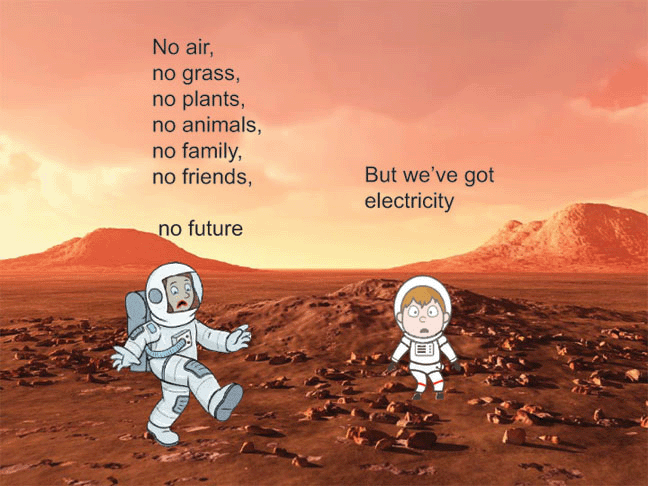
US plans to send nuclear reactors to space, Rt.com 19 Aug, 2019 Despite the nuclear industry stumbling in the domestic United States, the country is looking to put nuclear reactors on Mars and the Moon.
While the nuclear energy industry is struggling to stay afloat in the United States, bogged down by public and political mistrust, crushing nuclear waste-maintenance costs, and a market flooded by cheap natural gas, the country has grand plans for nuclear power outside of its domestic borders. Way outside.
In just a few short years from now, the United States will be shipping nuclear reactors to the moon and Mars. According to team members from the Kilopower project, a collaborative venture from NASA and the United States Department of Energy, nuclear energy is just a few years from heading into the space age.
“The Kilopower project is a near-term technology effort to develop preliminary concepts and technologies that could be used for an affordable fission nuclear power system to enable long-duration stays on planetary surfaces,” says NASA’s “Space Technology Mission Directorate.” In layman’s terms, the focus of the Kilopower project is to use an experimental fission reactor to power crewed outposts on the moon and Mars, allowing researchers and scientists to stay and work for much longer durations of time than is currently possible. …..
[ NASA says] The potential of this demonstration would be to “pave the way for future Kilopower systems that power human outposts on the Moon and Mars, enabling mission operations in harsh environments and missions that rely on In-situ Resource Utilization to produce local propellants and other materials.”
While this is not the first time that nuclear energy is being used to power pursuits into the final frontier, the Kilopower project is a much more ambitious and powerful project than any of its predecessors. According to Space.com, “nuclear energy has been powering spacecraft for decades. NASA’s Voyager 1 and Voyager 2 probes, New Horizons spacecraft, and Curiosity Mars rover, along with many other robotic explorers, employ radioisotope thermoelectric generators (RTGs), which convert the heat thrown off by the radioactive decay of plutonium-238 into electricity.” ….. https://www.rt.com/business/466790-us-space-nuclear-reactors/
Nuclear monitoring stations went mysteriously quiet after Russian missile facility explosion
1 This Month
26 September – International Day for the Total Elimination of Nuclear Weapons





PLEASE OPPOSE HR 8255 AND S.3639 – bills would accelerate satellite deployment, with no environmental review or safeguards – https://ncstd5li.quorum.us/campaign/169331/
To see nuclear-related stories in greater depth and intensity – go to https://nuclearinformation.wordpress.com
-
Archives
- September 2026 (313)
- August 2026 (330)
- July 2026 (355)
- June 2026 (287)
- May 2026 (306)
- April 2026 (356)
- March 2026 (251)
- February 2026 (267)
- January 2026 (308)
- December 2025 (358)
- November 2025 (359)
- October 2025 (375)
-
Categories
- 1
- 1 NUCLEAR ISSUES
- business and costs
- climate change
- culture and arts
- ENERGY
- environment
- health
- history
- indigenous issues
- Legal
- marketing of nuclear
- media
- opposition to nuclear
- PERSONAL STORIES
- politics
- politics international
- Religion and ethics
- safety
- secrets,lies and civil liberties
- spinbuster
- technology
- Uranium
- wastes
- weapons and war
- Women
- 2 WORLD
- ACTION
- AFRICA
- Atrocities
- AUSTRALIA
- Christina's notes
- Christina's themes
- culture and arts
- Events
- Fuk 2022
- Fuk 2023
- Fukushima 2017
- Fukushima 2018
- fukushima 2019
- Fukushima 2020
- Fukushima 2021
- general
- global warming
- Humour (God we need it)
- Nuclear
- RARE EARTHS
- Reference
- resources – print
- Resources -audiovicual
- Weekly Newsletter
- World
- World Nuclear
- YouTube
-
RSS
Entries RSS
Comments RSS

