Senator Chris Van Hollen on Gorging at the Nuclear Buffet Table
 REMARKS: Gorging at the Nuclear Buffet Table Arms Control Association, May 2019
By Sen. Chris Van Hollen “…….we gather here at another urgent moment. It has been important work all along, but we are in an urgent moment now. Because with the Trump administration, all signs indicate that we’re jettisoning, we’re abandoning what has been a bipartisan tradition of recognizing that we need to modernize our nuclear forces, we need to modernize our triad, we need to make sure its survivable and resilient, but that we should do it within the framework of an arms control architecture that leads to predictability, stability, and transparency. That has been an important formula even as relations between the United States and the Soviet Union, now Russia, have gone up and down. We have still maintained that conversation, we have still maintained that structure, and that structure has helped keep the peace.
No evidence for this, but a Republican lawmaker says Russia has nuclear weapons in Venezuela
|
GOP Rep. says Russia has nuclear weapons in Venezuela but offers no evidence, Roll Call, Griffin Connolly, 1 May 19,
Rep. Mario Díaz-Balart made the comments in a Fox News segment with host Tucker Carlson. Rep. Mario Díaz-Balart asserted Tuesday that Russia might already have nuclear missiles stationed in Venezuela as that country’s political turmoil continues to churn in the wake of a disputed presidential election. Díaz-Balart, a longtime Florida Republican, provided no evidence to support his claim…… “Are you saying the Russians will put nuclear missiles in Venezuela?” Carlson asked in a follow-up question. “What I am suggesting is that they are already there,” Diaz-Balart said. The Florida congressman did not provide any evidence to support that suggestion. The Russian military flew and landed a nuclear-capable bomber in Venezuela in 2018, but there have been no reports or claims that they have outfitted such aircraft with nuclear bombs or transported nuclear missiles to the country…… “Are you saying the Russians will put nuclear missiles in Venezuela?” Carlson asked in a follow-up question……. https://www.rollcall.com/news/russia-already-has-nuclear-bombs-in-venezuela-gop-rep-suggests-sans-evidence |
|
|
Southern Company says – no more nuclear projects after the costly Vogtle project in Georgia
|
Georgia Power’s parent: After Vogtle, no new nuclear until maybe 2040, AJC, 3 May 19, Georgia Power’s parent company is the only utility constructing nuclear power reactors in the United States, and it doesn’t plan to do it again anytime soon.
It probably will be in the 2030s or 2040s before Atlanta-based Southern Company attempts another nuclear construction project, Southern CEO Tom Fanning told analysts Wednesday. ……. on Wednesday, Fanning told analysts that his administration won’t embark on more nuclear. …..
Liz Coyle, the executive director of Georgia Watch, a consumer advocacy group that has long warned about the Vogtle’s ballooning costs, questions whether ratepayers should fund another nuclear project incorporating new reactor designs. “What we don’t want to see is Georgia once again being made the guinea pig … for unproven technologies that end up taking much longer to build and at a significantly higher cost than other forms of generation,” she said……… https://www.ajc.com/business/georgia-power-parent-after-vogtle-new-nuclear-until-maybe-2040/ADjetBmiCnISHQIOP10uvJ/
|
|
|
Exelon welcomes Pennsylvania Governor joining nuclear front group the “US Climate Alliance”

Pennsylvania joins US Climate Alliance, WNN, 1 May 19, Pennsylvania Governor Tom Wolf has joined the US Climate Alliance, a bipartisan coalition of governors committed to reducing greenhouse gas emissions. Exelon, which owns the Limerick, Peach Bottom and Three Mile Island nuclear power plants in the state, welcomed the move…..
Extradition of Julian Assange Threatens Us All
|
|
|

Private Companies Pitch New Ways To Store USA’s piling up nuclear wastes
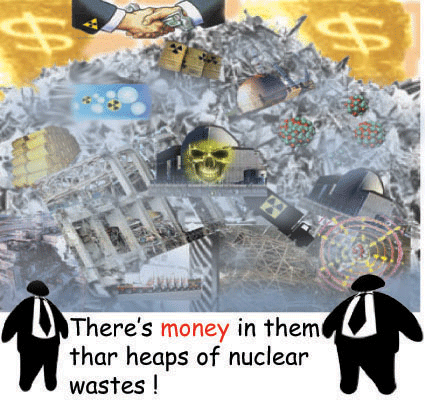 As Nuclear Waste Piles Up, Private Companies
  Pitch New Ways To Store It, NPR, JEFF BRADY 1 May 19, Congress is once again debating how to dispose of the country’s growing inventory of nuclear waste. Sen. John Barrasso, R-Wyo., is proposing legislation that would jump-start licensing hearings for the Yucca Mountain nuclear waste storage site in Nevada. The Trump administration also is asking Congress for money to resume work on that decades old project.But that may not end local opposition or a longstanding political stalemate. And in the meantime, nuclear plants are running out of room to store spent fuel.
Running out of room
The Peach Bottom Atomic Power Station in south-central Pennsylvania illustrates the problem. It’s one of 80 sites, across dozens of states, where nearly 80,000 metric tons of waste from power plants is stored where it was generated, at taxpayer expense.
Spent fuel removed from the Peach Bottom reactor is first stored in racks in a big pool. It’s surrounded by a bright yellow plastic barrier and signs that read “Caution: Radiation Area.”
“They are under about 22 feet of water,” says reactor engineering manager Mark Parrish. “They are continuously being cooled, as they still have some amount of decay heat even after they’ve operated in the reactor.”
The spent fuel stays here for seven to 10 years while it cools.
Once it’s safe to remove the spent fuel from the pool, it’s stored outside in white metal casks that look like big hot water heaters. They are lined up on a concrete base behind razor wire and against a hillside near the power plant.
Currently there are 89 casks at Peach Bottom with room for three more, says Pat Navin, site vice president for Exelon, the company that partially owns and operates the power plant.
“That is 40 years worth of spent fuel stored over there currently and it’s less than the size of a football field,” says Navin. “Probably half a football field.”…….
without a permanent disposal site, Navin says they’re going to run out of room. So they’re expanding the temporary storage to hold all the waste generated through the 60 years the plant is licensed to operate…..
Private companies propose their own storage plans
As the waste piles up, private companies are stepping in with their own solutions for the nation’s radioactive spent fuel. One is proposing a temporary storage site in New Mexico, and another is seeking a license for a site in Texas.
But most experts agree that what’s needed is a permanent site, like Yucca Mountain, that doesn’t require humans to manage it.
“Institutions go away,” says Edwin Lyman, acting director of the Nuclear Safety Project at the Union of Concerned Scientists. “There’s no guarantee the owner will still be around for the duration of time when that waste remains dangerous, which is tens or hundreds of thousands of years.”
 A California company says it has a viable plan for permanent storage. Deep Isolation wants to store spent fuel in holes drilled at least 1,000 feet underground in stable rock formations. The company says the waste would be separate from groundwater and in a place where it can’t hurt people.,,,,,,
Regulators require retrieval, because new technology could develop to better deal with the spent fuel. And the public is less likely to accept disposal programs that can’t be reversed, according to the International Atomic Energy Agency.
Proving the waste can be retrieved may be the easy part. The bigger challenge is federal law, which doesn’t allow private companies to permanently store nuclear waste from power plants.
Current law also says all the waste should end up at Yucca Mountain in Nevada. By contrast, Deep Isolation’s technology would store waste at sites around the country, likely near existing nuclear power plants.
“I just don’t see how there would be political support from every other state, other than Nevada, for changing the law, so that spent nuclear fuel could stay in your state forever,” says Lyman.
Despite the law, all that waste in dozens of states is staying put for now. https://www.npr.org/2019/04/30/716837443/as-nuclear-waste-piles-up-private-companies-pitch-new-ways-to-store-it
Even USA’s conservative groups are objecting to subsidising Ohio’s nuclear power stations
 Conservative Groups Voice Objections, Concerns With Nuclear Subsidies Bill https://www.statenews.org/post/conservative-groups-voice-objections-concerns-nuclear-subsidies-bill, By ANDY CHOW 2 May 19 The energy bill that would bail out nuclear plants while repealing the state’s green energy standards on utilities is collecting a variety of opponents that don’t usually take the same side, Conservative Groups Voice Objections, Concerns With Nuclear Subsidies Bill https://www.statenews.org/post/conservative-groups-voice-objections-concerns-nuclear-subsidies-bill, By ANDY CHOW 2 May 19 The energy bill that would bail out nuclear plants while repealing the state’s green energy standards on utilities is collecting a variety of opponents that don’t usually take the same side,
Conservative groups have joined environmental groups in voicing their objections to the energy bill, HB6, albeit for different reasons. Micah Derry with Americans for Prosperity Ohio says the bill, which could dole out more than $150 million to Ohio’s two nuclear plants, is an unfair bailout. Derry goes on to say this bills like this one gives capitalism a bad name. Policies that have led to hundreds of thousands of students on university campuses across the United States to believe that capitalism is a fraud, a fake, and a failure. It is because they’ve been told, and observed that such cronyism and corporate welfare is actually capitalism,” Derry says. The conservative Buckeye Institute and the Ohio Chamber of Commerce also have concerns with the nuclear subsidies but do support a repeal of the alternative energy standards. |
|
NuScale’s 12 Small Modular Nuclear Power units will cost $3 billion
 NuScale Gains Potential Financial Backing for Worldwide SMR Deployment, Power , 05/01/2019 | Sonal Patel NuScale Power, the front-runner in the race to commercialize small modular reactors (SMRs), has bagged another major backer that could broaden its nuclear supply chain base and expand its financial standing.
On April 29, NuScale signed a memorandum of understanding (MOU) with Doosan Heavy Industries and Construction (DHIC), a South Korean–based engineering, procurement, and construction contractor with a wide global network, that supports deployment of NuScale’s Power Module worldwide. “The relationship includes DHIC, a member of the Doosan Group, and potential Korean financial investors, which, commensurate to final due diligence, plan to make a cash equity investment in NuScale,” NuScale said on Monday. …..
That project, which is to be built at a 890-square-mile site at the Department of Energy’s (DOE’s) Idaho National Laboratory near Idaho Falls, will feature a plant comprising a dozen 60-MWe modules. NuScale anticipates the first module could be operational by 2026 and full plant would be operational by 2027.
However, NuScale’s design certification application, which it submitted to the the Nuclear Regulatory Commission (NRC) in December 2016 covers 50-MWe modules. The company increased the module’s capacity to 60-MWe in June 2018, citing optimization through advanced testing and modeling tools. The breakthrough would boost the power capacity of the 12-module UAMPs facility from 600 MWe to 720 MWe, it said. ….
According to NuScale, the first 12-module facility, even at 684 MWe (net), could cost up to $3 billion to build. ……https://www.powermag.com/nuscale-gains-potential-financial-backing-for-worldwide-smr-deployment/
U.S. Dept of Energy pledges to remove plutonium from Nevada
Energy Department says it will remove plutonium from Nevada, abc,By SCOTT SONNER, ASSOCIATED PRESS, U.S. Energy Secretary Rick Perry is pledging to expedite the removal of weapons-grade plutonium secretly hauled to Nevada last year as the state and Trump administration remain locked in a court battle about whether the shipment was legal.
Risk of catastrophic Hanford tunnel collapse prevented as tunnel is stabilised
|
Radioactive waste tunnel at Hanford stabilized after fears of a possible ‘catastrophic’ collapse, Tri City Herald, BY ANNETTE CARY, APRIL 29, 2019 The second Hanford PUREX plant tunnel storing highly radioactive waste has been stabilized to prevent a collapse.
Work to fill the tunnel with concrete-like grout began in early October and was completed at the end of last week. Local government officials are relieved. “We experienced a horrible winter with a massive amount of snow,” said Pam Larsen, executive director of Hanford Communities, a coalition of local governments, at a recent meeting of the Hanford Advisory Board. “The tunnel could have collapsed,” she said. “It would have been catastrophic for our regional economy.” Concerns about the second PUREX tunnel were raised after the first tunnel partially collapsed in spring 2017. An unusually wet winter may have contributed to the collapse. Filling the second tunnel with grout is a temporary measure to prevent a possible collapse and release of radioactive particles into the air, with plans to clean up the waste in the tunnel to be made in the future…… About 40,000 cubic yards of grout, or 4,000 truckloads, were needed to fill the tunnel, which is 1,700 feet long. It holds 28 rail cars loaded with obsolete and failed equipment that is contaminated with highly radioactive waste from the past production of plutonium at Hanford for the nation’s nuclear weapons program. When the first tunnel partially collapsed, thousands of Hanford workers were ordered to take cover and the Tri-Cities-area anxiously waited for information until it was determined that there had been no release of radioactive particles. The soil topping the tunnel fell into the breach, covering the waste……. Hanford watchdogs were concerned that grouting might become a permanent solution, with the radioactive waste left in the ground permanently. “Opponents raised legitimate concerns, but in the end those concerns did not outweigh the potential environmental and safety threats that could have been posed had the tunnel collapsed and exposed its highly radioactive contents,” Ecology officials said in a statement Monday….. In both tunnels, grout was added in layers, with each layer allowed to set before the next layer was added. But the second tunnel was five times longer, requiring changes to procedures and equipment as grout was added every 100 feet along the tunnel…….https://www.tri-cityherald.com/news/local/hanford/article229789389.html |
|
Nuclear bailout could help “old” technology at the expense of “new nuclear”

|
Daily on Energy: Utility group CEO says popular nuclear energy bill could be a bailout in disguise https://www.washingtonexaminer.com/policy/energy/daily-on-energy-utility-group-ceo-says-popular-nuclear-energy-bill-could-be-a-bailout-in-disguise
|
|
USA’s Nuclear Regulators look to New Mexico desert For Temporary Waste Storage Facility
 Nuclear Regulators Search For Temporary Storage Facility In New Mexico, NPR, April 30, 2019 NATHAN ROTT Nuclear Regulators Search For Temporary Storage Facility In New Mexico, NPR, April 30, 2019 NATHAN ROTT
|
|
|
How bailout of Pennsylvania nuclear plants would cost consumers billions,
|
Pennsylvania and New Jersey lawmakers are preparing to push up your monthly electricity bill … in order to shovel subsidies to failing nuclear-power plants. Consumers like you are projected to pay billions in higher electricity bills over the next decade — killing jobs and shrinking your savings in the bargain. What’s driving this? For the past few years, natural-gas pipelines have delivered cheap fuel, shrinking the cost of generating electricity. It is now cheaper to make electricity with natural gas than with any other fossil fuel. That’s a big win for consumers and manufacturers. But it is bad news for nuclear-power plant operators, whose generating costs are often higher than the market price for power. So now nuclear-power operators hope to persuade lawmakers that taxpayers should bail them out. And their plan, backed by a pile of lobbying dollars, is working. The New Jersey Board of Public Utilities awarded “zero-emissions certificates” on April 18 to three state nuclear plants, all owned and operated by investor-owned utility Public Service Enterprise Group. That’s a subsidy of some $300 million per year. Those subsidies will be paid by surcharges on consumer electric bills. The Newark Star-Ledger summed it up best: “For PSEG, a windfall. For us, the shaft.” And Pennsylvania is not far behind the Garden State. Pennsylvania state Rep. Thomas Mehaffie, a Republican, has introduced a bill that would offer subsidies to the Keystone state’s five nuclear plants. He says the plan will cost some $500 million per year — raising utility bills roughly $21.24 per home per year. The real cost will be much higher, critics say, pointing to estimates of more than $60 per year per household. The battle is not over yet in Pennsylvania. Lawmakers in Harrisburg are getting an earful from the AARP and consumer groups. State regulators also believe the Pennsylvania bailout proposal is misguided. Public Utility Commissioner Andrew Place sent a memo to members of the state Senate saying that “this bill, in its current form, is far from the least cost mechanism to achieve these goals.” No kidding. In fact, the subsidy plan is so broadly written that it would also fund nuclear plants, like Beaver Valley Nuclear Station, that are not actually losing money. What’s clear is that utilities are getting what they paid for. In New Jersey, PSEG reportedly spent some $2.4 million lobbying for subsidies in 2017. In Pennsylvania, the company that owns the struggling Three Mile Island plant — Exelon — reportedly tripled its lobbying expenditures since 2016, spending $1.78 million in 2018. While the nuclear-power industry can’t seem to make money off its failing plants, it has certainly figured out how to squeeze a return on investment from its lobbyists and its campaign contributions. The hard truth is that plain-old competition is killing the dinosaur utilities. Thanks to natural gas, U.S. manufacturers enjoy lower industrial kilowatt per-hour prices than all of the other 35 countries in the Organisation for Economic Co-operation and Development, except Norway. That is a huge advantage for factories in Pennsylvania and elsewhere. Subsidies just slow the inevitable. No bailout can change the reality that nuclear plants are whales beached by high insurance and regulatory costs. Their losses should provoke soul-searching among shareholders and far-reaching reforms of current management — not a cry for government bailouts…….. https://www.mcall.com/opinion/mc-opi-pennsylvania-nuclear-industry-bailout-20190501-hjzucrrqm5hovcunhj7dencnly-story.html |
|

UK govt resisting calls to declare ‘climate emergency’
|
Business Green 1st May 2019 , The government is today expected to resist fresh calls for it to declare a’climate emergency’, after Michael Gove indicated that more agreement was
across government before Defra could back a formal ‘climate emergency’. Gove yesterday met with representatives from the Extinction
Rebellion group who later described themselves as “disappointed” at the lack of firm commitments from the Environment Secretary on how he plans to accelerate the UK’s decarbonisation efforts. The group expressed frustration at the government’s continued failure to declare a ‘climate emergency’ and insisted that their campaign of peaceful civil disobedience would continue. Later today the High Court is expected to rule on whether a
legal challenge against the government’s approval for Heathrow expansion can proceed, while tomorrow the CCC will present its long awaited recommendations on whether the UK should adopt a net zero emission target. The Committee is widely expected to call for a new 2050 target, fuelling speculation the government could look to amend the Climate Change Act before the summer in order to get the new goal onto the statute book as quickly as possible. |
|
Curious contradictions on climate change in USA – Denial and Reality

|
The Last Time There Was This Much CO2, Trees Grew at the South Pole, Dahr Jamail, Truthout, 29 April 19, “……….Denial and RealityWhile this certainly comes as no surprise, yet another report came out highlighting how oil and gas giants are spending millions of dollars in their ongoing effort to lobby their paid politicians to block policies aimed at addressing climate disruption. The giant fossil fuel companies are spending an average of $200 million annually to weaken and/or oppose legislation aimed at addressing climate disruption. BP led the way in spending with $53 million, followed by Shell ($49 million), ExxonMobil ($41 million), Chevron and Total ($29 million each). Meanwhile, as per usual, President Donald Trump has signed executive orders to speed up oil and gas pipeline projects, making it harder for states to block construction projects due to environmental concerns. Yet, as the White House is actively denying climate disruption and working as hard as it can to promote fossil fuel use, the U.S. military is planning and preparing for dealing with the vast impacts of ongoing climate disruption. “People are acting on climate not for political reasons, but [because] it really affects their mission,” Jon Powers, an Iraq War veteran who served as the federal chief sustainability officer who is now president and chief executive of the investment firm CleanCapital, told The Washington Post. “With the military, it’s now ingrained in the culture and mission there, which I think is the biggest change over the last 10 years.” Meanwhile, a federal climate disruption study panel and advisory group that was disbanded by the Trump administration due to it not having enough members “from industry,” recently released a report warning that the muddled political response to very clear climate science is putting Americans at risk. “We were concerned that the federal government is missing an opportunity to get better information into the hands of those who prepare for what we have already unleashed,” Richard Moss, a visiting scientist at Columbia University, who previously chaired the federal panel and is a member of the group who released the report, told The Guardian. “We’re only just starting to see the effects of climate change, it’s only going to get much worse. But we haven’t yet rearranged our daily affairs to adapt to science we have.” With each passing month, the impacts of runaway climate disruption continue to intensify. And as they do, so must our awareness of what is happening across the planet, and our resolve to take action to address it – especially since most governments around the world are failing to meet these challenges.https://truthout.org/articles/the-last-time-there-was-this-much-co2-trees-grew-at-the-south-pole/
|
|

1 This Month

of the week– Nuclear Reactor Information Task Force

14 May – online event From Bombs to Data Centres: the Face of Nuclear Colonialism
To see nuclear-related stories in greater depth and intensity – go to https://nuclearinformation.wordpress.com
-
Archives
- May 2026 (82)
- April 2026 (356)
- March 2026 (251)
- February 2026 (268)
- January 2026 (308)
- December 2025 (358)
- November 2025 (359)
- October 2025 (376)
- September 2025 (257)
- August 2025 (319)
- July 2025 (230)
- June 2025 (348)
-
Categories
- 1
- 1 NUCLEAR ISSUES
- business and costs
- climate change
- culture and arts
- ENERGY
- environment
- health
- history
- indigenous issues
- Legal
- marketing of nuclear
- media
- opposition to nuclear
- PERSONAL STORIES
- politics
- politics international
- Religion and ethics
- safety
- secrets,lies and civil liberties
- spinbuster
- technology
- Uranium
- wastes
- weapons and war
- Women
- 2 WORLD
- ACTION
- AFRICA
- Atrocities
- AUSTRALIA
- Christina's notes
- Christina's themes
- culture and arts
- Events
- Fuk 2022
- Fuk 2023
- Fukushima 2017
- Fukushima 2018
- fukushima 2019
- Fukushima 2020
- Fukushima 2021
- general
- global warming
- Humour (God we need it)
- Nuclear
- RARE EARTHS
- Reference
- resources – print
- Resources -audiovicual
- Weekly Newsletter
- World
- World Nuclear
- YouTube
-
RSS
Entries RSS
Comments RSS
 nuclear-news