Facing a nasty pro nuclear campaign, Ohio’s anti nuclear group hope for a federal court decision to delay nuclear bailout
Anti-nuclear bailout group fails to make deadline for referendum https://www.cincinnati.com/story/news/politics/elections/2019/10/21/anti-nuclear-bailout-effort-miss-deadline-submit-signatures/4052255002/ Jessie Balmert, Cincinnati Enquirer Oct. 21, 2019 COLUMBUS – Opponents of Ohio’s $1 billion bailout of two nuclear plants say they didn’t gather enough signatures to block the law by the Monday deadline.
Their only hope: a federal court decision that could give them more time to collect signatures.
Ohioans Against Corporate Bailouts spokesman Gene Pierce wouldn’t say how many signatures the group collected, but it wasn’t enough to put the issue before voters in November 2020.
Ballot groups often collect more than the required number in anticipation of some being tossed out because of duplicates, illegible signatures and other problems.
That means House Bill 6 will take effect at midnight. The law imposes a new fee of 85 cents per month for residential customers on Ohioans’ electric bills starting in 2021.
Those fees are expected to raise about $150 million a year for FirstEnergy Solutions’ plants – money the company says it needs to keep the doors open. Another $20 million from those fees will pay for solar energy companies.
The runup to Monday’s deadline has been one of the nastiest campaigns in recent Ohio history. The nuclear plants’ owner, FirstEnergy Solutions, and its allies deployed a variety of tactics to block the referendum from making the ballot ranging from anti-Chinese advertisements to petition signature blockers.
“Nuclear bailout supporters of House Bill 6 have stooped to unprecedented and deceitful depths to stop Ohioans from exercising their constitutional rights to put a bailout question on the ballot for voters to decide,” Pierce said in a news release.
Ohioans Against Corporate Bailouts had to submit at least 265,774 valid signatures from at least 44 of Ohio’s 88 counties to put the bill to a vote next year. The group failed to submit those signatures by Monday’s deadline.
The group has asked a federal court judge for more time to collect signatures because initial steps in the process, such as collecting 1,000 valid signatures and having ballot language approved as accurate, ate into its 90-day window.
A hearing on that request is set for Tuesday afternoon. U.S. District Court Judge Edmund Sargus will make a decision after hearing arguments from both sides.
On Monday, Ohioans for Energy Security submitted signatures to Rep. Jamie Callender, R-Concord Township, calling for a ban on foreign control of the state’s energy grid. Callender said he hopes to put that issue before voters.
“That’s kind of scary that someone who didn’t like America, who didn’t like our way of life could cause a lot of damage and a lot of havoc by randomly shutting down a plant that they had controlling interest in,” Callender said. “It could bring the grid down.”
The operators of Ohio’s electric grid say they are “vigilant” about the grid’s security. The federal government can block projects if foreign investment poses a national security risk.
For example, President Trump has halted two foreign acquisitions, citing national security concerns, since 2017: Lattice Semiconductor Corporation by a Chinese investment firm and telecom company Qualcomm by Singapore-based Broadcom.
Columbus bureau chief Jackie Borchardt contributed reporting.
High levels of uranium in some Navajo women and infants near old uranium mining sites
 US official: Research finds uranium in Navajo women, babies, https://apnews.com/334124280ace4b36beb6b8d58c328ae3?fbclid=IwAR2UqarRiUTIPwnRCA_DGkjKuahfFO4T_l9iFrXxb1P8qL5AnmrTc1m61W8By MARY HUDETZ, October 8, 2019, ALBUQUERQUE, N.M. (AP) — About a quarter of Navajo women and some infants who were part of a federally funded study on uranium exposure had high levels of the radioactive metal in their systems, decades after mining for Cold War weaponry ended on their reservation, a U.S. health official Monday.
The early findings from the University of New Mexico study were shared during a congressional field hearing in Albuquerque. Dr. Loretta Christensen — the chief medical officer on the Navajo Nation for Indian Health Service, a partner in the research — said 781 women were screened during an initial phase of the study that ended last year.
Among them, 26% had concentrations of uranium that exceeded levels found in the highest 5% of the U.S. population, and newborns with equally high concentrations continued to be exposed to uranium during their first year, she said.
The research is continuing as authorities work to clear uranium mining sites across the Navajo Nation.
“It forces us to own up to the known detriments associated with a nuclear-forward society,” said U.S. Rep. Deb Haaland, who is an enrolled member of Laguna Pueblo, a tribe whose jurisdiction lies west of Albuquerque.
The hearing held in Albuquerque by U.S. Sen. Tom Udall, Haaland and U.S. Rep. Ben Ray Lujan, all Democrats from New Mexico, sought to underscore the atomic age’s impact on Native American communities.
The three are pushing for legislation that would expand radiation compensation to residents in their state, including post-1971 uranium workers and residents who lived downwind from the Trinity Test site in southern New Mexico.
The state’s history has long been intertwined with the development of the nation’s nuclear arsenal, from uranium mining and the first atomic blast to the Manhattan project conducted through work in the once-secret city of Los Alamos. The federal Radiation Exposure Compensation Act, however, only covers parts of Nevada, Arizona and Utah that are downwind from a different nuclear test site.
During the hearing, Haaland said one of her own family members had lost his hearing because of radiation exposure. At Laguna Pueblo, home to her tribe, the Jackpile-Paguate Mine was once among the world’s largest open-pit uranium mines. It closed several decades ago, but cleanup has yet to be completed.
“They need funds,” Haaland said. “They job was not completed.”
David Gray, a deputy regional administrator for the U.S. Environmental Protection Agency, said the mine illustrates uranium mining and milling’s lingering effects on Indian Country.
On the Navajo Nation, he said, the EPA has identified more than 200 abandoned uranium mines where it wants to complete investigation and clean up under an upcoming five-year plan, using settlements and other agreements to pay for the work that has taken decades.
Udall, who chaired the hearing, acknowledged federal officials had shown progress but that the pace of cleanup has proven frustrating for some community members.
“They feel an urgency,” Udall said. “They feel that things need to happen today.”
In her testimony, Christensen described how Navajo residents in the past had used milling waste in home construction, resulting in contaminated walls and floors.
From the end of World War II to the mid-1980s, millions of tons of uranium ore were extracted from the Navajo Nation, leaving gray streaks across the desert landscape, as well as a legacy of disease and death.
While no large-scale studies have connected cancer to radiation exposure from uranium waste, many have been blamed it for cancer and other illnesses.
By the late 1970s, when the mines began closing around the reservation, miners were dying of lung cancer, emphysema or other radiation-related ailments.
“The government is so unjust with us,” said Leslie Begay, a former uranium miner who lives in Window Rock, an Arizona town that sits near the New Mexico border and serves as the Navajo Nation capital. “The government doesn’t recognize that we built their freedom.”
Begay, who said he has lung problems, attended the hearing with an oxygen tank in tow. The hearing held in the Southwest was especially meaningful for him after traveling in the past to Washington to advocate for himself and others, he said.
Associated Press reporter Felicia Fonseca in Flagstaff, Arizona, contributed to this report.
USA campaign in Count the Nuclear Weapons Money global movement

|
Four New Mexico Count the Nuclear Weapons Money Events, http://nuclearactive.org/ October 17th, 2019 In less than seven days, CCNS will join with other peace, disarmament, climate and social justice activists across New Mexico to count out one trillion dollars in one million dollar bills at four planned events in Taos, Santa Fe, Socorro, and Los Alamos as part of the global Count the Nuclear Weapons Money campaign. One trillion dollars is the amount proposed for the U.S. nuclear weapons budget over ten years.
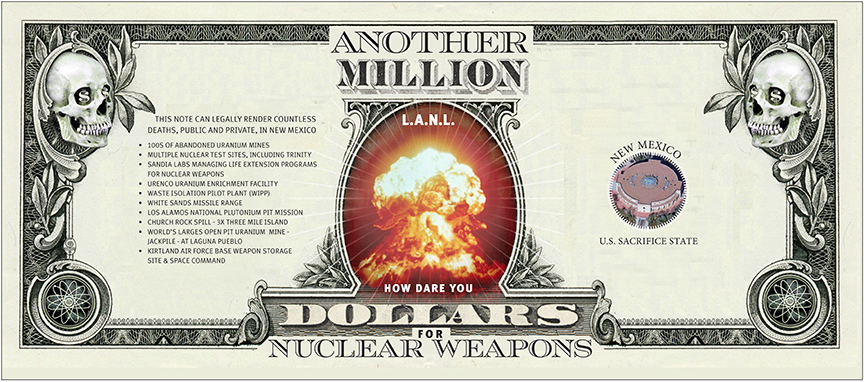 The campaign’s goal is to demonstrate the scale of a one trillion dollar investment and how it could be devoted to peace and humanitarian needs, rather than the threat of nuclear annihilation. The scale will be profound in terms of time, the number of bills, the number of people counting the money by hand, and the impact of seeing people around the world counting the money. The events will be live-streamed so people can learn what benefits this money could bring if re-directed to climate protection, just transitions, and sustainable development goals.
The campaign will begin on Thursday, October 24th and continue through Wednesday October 30th, during the United Nations’ Disarmament Week. Volunteers are needed! To sign up, contact CCNS at ccns@nuclearactive.org or by phone at 505 986-1973. On Thursday, October 24th, New Mexico’s Opening Ceremony will take place in Taos from 3 to 5 pm. It will coincide with the Opening Ceremony in New York City. For more information and to volunteer, please contact Suzie at (575) 770-2629. On Friday, October 25th, we will gather at the State Capitol to bring attention to two existential threats – the climate crisis and nuclear weapons. There will be a counting event and an opportunity to present a letter to Governor Michelle Lujan Grisham. On Saturday, October 26th, we will gather in the Socorro Plaza Gazebo from 2 to 4 pm to count 2.4 billion dollars – the amount provided to Downwinders and Uranium Workers under the Radiation Exposure Compensation Act since 2000. Despite being overexposed to radiation from the first atomic test at the Trinity Site on July 16, 1945, the Trinity Downwinders have never been included in the compensation program. https://www.trinitydownwinders.com/home On Monday, October 28th, we will gather in Los Alamos from 2:30 to 4:30 pm to count 13 billion dollars, the amount proposed to modernize the nuclear weapons complex at Los Alamos National Laboratory. The event will coincide with colleagues counting outside of major banking institutions invested in nuclear weapons work. Participants will urge divestment. For more information and to volunteer to count the money, please contact CCNS at (505) 986-1973. To learn more about the Campaign, go to http://www.nuclearweaponsmoney.org/count-the-money/ |
|
Missouri Commission Wants Legislators To Scrap Nuclear Plant-Funding Law, St
Missouri Commission Wants Legislators To Scrap Nuclear Plant-Funding Law, St Louis Public Radio By SHAHLA FARZAN • OCT 17, 2019 The Missouri Air Conservation Commission is asking state legislators to repeal a decades-old law that controls how companies fund new nuclear power plants.
The Construction Work in Progress law, passed by Missouri voters in 1976, prohibits utility companies from charging customers to cover the cost of building power plants until the facilities are up and running.
The commission unanimously passed a resolution Thursday calling the law an “intractable roadblock” for nuclear power in Missouri. Opponents say the governor-appointed commission is overstepping its bounds.
Ed Smith, policy director for the Missouri Coalition for the Environment, said he was “in shock” after the vote.
“We have people who are unelected telling elected people how to set energy policy for the state of Missouri,” said Smith, who submitted a letter in opposition to the resolution. “That is best left in the legislative arena, not for the commissioners to pick and choose winners.”
Commissioner Ron Boyer introduced the resolution on Aug. 29, six weeks after he wrote an op-ed for the Missouri Farm Bureau in support of nuclear power. …….
Smith said the commission is ignoring the financial risks of building new nuclear power plants. He cited the failed V.C. Summer nuclear project near Jenkinsville, South Carolina, which cost ratepayers $2 billion and resulted in an FBI investigation.
“Not only is nuclear a dangerous power source, it’s dangerous to consumers when plants are being built,” he said.
Geoff Marke, chief economist for the Missouri Office of Public Counsel, submitted a memo to the commission Oct. 16 calling a repeal of the law “wholly unnecessary,” arguing it would shift the financial risk of building new power plants onto the shoulders of ratepayers…….. https://news.stlpublicradio.org/post/missouri-commission-wants-legislators-scrap-nuclear-plant-funding-law#stream/0
How America was prepared to kill billions with nuclear weapons on Russia and China
America Would Have Killed Billions Nuking Russia and China in Nuclear War https://nationalinterest.org/blog/buzz/america-would-have-killed-billions-nuking-russia-and-china-nuclear-war-89731
A very real cold war horror story.
But it turns out that had global nuclear war erupted during the early 1960s, it would have been the Russians and Chinese who would have reverted to living like the Flintstones.
The report included questions and answers regarding the various nuclear targeting options. These ranged from attacks on enemy nuclear and conventional forces while minimizing collateral damage to enemy cities, to attacking cities as well as military forces on purpose. This latter option would have been “in order to destroy the will and ability of the Sino-Soviet Bloc to wage war, remove the enemy from the category of a major industrial power, and assure a post-war balance of power favorable to the United States.”
The answer was that Pentagon war plans already included the destruction of cities as a way to destroy the urban and industrial backbone. “This should result in greater population casualties in that a larger portion of the urban population may be placed at risk.”
This was because of China’s rural society at the time. “Thus, the attack of a large number of place names [towns] would destroy only a small fraction of the total population of China. The rate of return for a [nuclear] weapon expended diminishes after accounting for the 30 top priority cities.”
Note that while annihilating one-third of China’s population was deemed uneconomical, the U.S. military took it for granted that the Soviet Union and China would be destroyed as viable societies.
Interestingly, Russia and China would be reduced to the level of Conan the Barbarian—but not Albania. “Should there be capability to withhold all attacks in Albania, Bulgaria and Romania?” asks the document.
The answer was that “the capability should exist to withhold attacks against Soviet satellites (either individually or collectively).” Other documents state that potential nuclear targets included the Sino-Soviet bloc—but not Yugoslavia.
Michael Peck is a contributing writer for the National Interest. He can be found on Twitter and Facebook. This first appeared in September 2018.
USA has 90 old nuclear reactors unreinforced and unsupervised
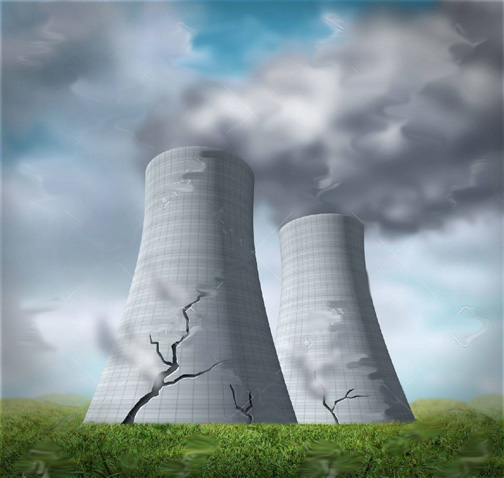 Dr W. 20 Oct 19, Anyone of dozens of reactors, in america could explode in the next year because they are embrittled deteriorating , more than 20 or 30 yers old and completely unsupervised.
Waterford in La was damaged by massive flooding from the Midwest USA and 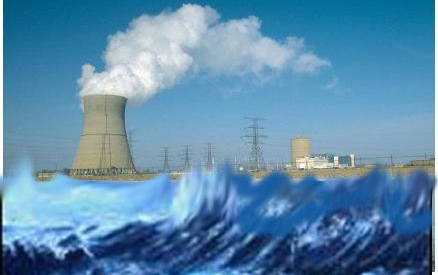 the last Hurricane.
8 reactors in Florida, Tennessee and Georgia could go with the Tropical storm currently pounding them, since hurricane Michael.
 Diablo Canyon was severely damaged by a 7.0 earthquake in southern california in the last few months. It was damaged, embrittled and crumbling before that.
STP has no backuup . It has a cracked fuel pool.
Brunswick in carolina has damaged containment multiple leaks and no access to aome areas, after hurricane maria.
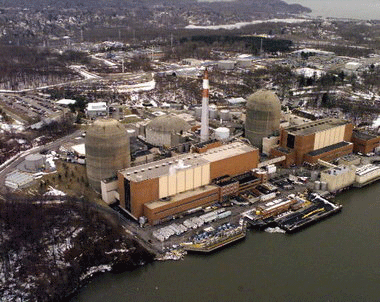 Indian point is at the brink of melltdown by New York City because it is so old and it has had so many transformer fires. It continues to leak tritium like a sieve by New York City.
Davis Besse, Fermi, Oyster Creek all have holes in their containtment.
All 90 shitty old reactors unreinforced and unsupervised under fuko the clown, and the brain damaged coked-out fairy Rick Perry. The other 6 in flood and earthquake zones along with th 90 other, very old death machines. Fuko is refusing to cleanup santa susana and hanford now. Fuko is responsible for Davis Besse fuko is allowing radioactive food to come from Japan. Fuko is responsible for the nuclear catastrophes at santa susana and idaho nuclear laboratory, in the past two years . Fuko is responsible for the nuclear explosion in russia recently by abrogating nuclear arms treaties and massively escalating nuclear arms proliferations and a new nuclear arms race.. Fuko is responsible for upcoming nuclear catastrophe in the USA in the next 6 months.
Final push for anti-nuclear signatures before Ohio’s nuclear bailout referendum


|
Anti-Nuclear Bailout Group Making Final Push For Signatures Before Monday’s Deadline https://www.statenews.org/post/anti-nuclear-bailout-group-making-final-push-signatures-mondays-deadline
By ANDY CHOW 18 Oct 19, Petitioners are giving one last push into the drive that would put Ohio’s nuclear bailout law before voters. The referendum effort must file enough valid signatures, 265,774, by Monday afternoon in order to qualify for next year’s ballot.
Opponents of the law say it’s a corporate bailout for FirstEnergy Solutions. They’re also against the coal subsidies and the cuts to green energy policies. That’s why they want to put the law on the ballot for a potential repeal. Among those opponent organizers is Rachael Belz, executive director of Ohio Citizen Action, which advocates for community involvement and corporate responsibility. Belz says they’re planning an all-out blitz to gather last-minute signatures around the state. “I feel optimistic. We’re gonna push as hard as we can up until the last minutes to make sure that this gets on the ballot,” says Belz Pro-nuclear bailout groups will continue to have their own canvassers out trying to get people not to sign the petition along with ads against the referendum. There are other looming issues. The anti-bailout group leading the charge, Ohioans Against Corporate Bailouts, has filed a lawsuit in federal court asking a judge to extend their time. The group argues a requirement for them to file paperwork about their petitioners made them vulnerable against their opposition. Ohioans Against Corporate Bailouts also says in the lawsuit that it took too long for the Ohio Attorney General’s Office to approve the petition language, so they’re asking for an additional 90 days. Pro-nuclear bailout groups have filed a case in the Ohio Supreme Court arguing that the new bailout law creates a tax, and is therefore immune to a referendum attempt. |
|
Nuclear shill Rick Perry switching from DOE Secretary to Small Nuclear Reactor Salesman

Perry to Resign as DOE Secretary, With Nuclear Weapon Programs on 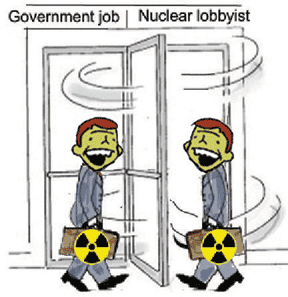 Autopilot, OCTOBER 18, 2019, BY DAN LEONE,Rick Perry on Thursday announced his resignation as the Donald Trump administration’s first secretary of energy after more than two-and-a-half years on the job. In a published letter to President Donald Trump, Perry said he would resign “later this year”…(subscribers only) https://www.exchangemonitor.com/perry-resign-doe-secretary-nuclear-weapon-programs-autopilot/
Energy Wire 17th Oct 2019, Energy Secretary Rick Perry will head back to Europe next week as part of an effort to boost the U.S. advanced nuclear industry’s ability to export its technologies across the globe.
https://www.eenews.net/energywire/2019/10/17/stories/1061299145
Anti nuclear activism revival in Washington

 Fear of a new nuclear arms race revives hotbed of anti-nuclear action, President Trump’s plans for escalation kick off a new chapter in Washington’s long history with nuclear proliferation and resistance. CrossCut, by Kevin Knodell. October 18, 2019, As worries of nuclear war resurface and new concerns about the health impacts of America’s atomic arsenal emerge, Washington state’s long-lived but largely dormant anti-nuclear movement is again raising its voice.
On Sept. 29, Washington Physicians for Social Responsibility held a town hall on Washington’s history with nuclear weapons that brought together anti-war, environmental and Indigenous rights activists. Activists marched on the Federal Building in Seattle the following day to protest Trump’s nuclear policies.
“We’re a little more alarmed than in the past, so we’re working hard to affect Congress and also working to build a movement of people,” said Dr. Joe Berkson with Washington Physicians for Social Responsibility. “The issue is the new nuclear arms race. There’s an expansion, the current administration wants to expand into new nuclear weapons and redo the whole nuclear weapons arsenal for a large amount of money, and we are opposed to that.”
On Sept. 29, Washington Physicians for Social Responsibility held a town hall on Washington’s history with nuclear weapons that brought together anti-war, environmental and Indigenous rights activists. Activists marched on the Federal Building in Seattle the following day to protest Trump’s nuclear policies.
“We’re a little more alarmed than in the past, so we’re working hard to affect Congress and also working to build a movement of people,” said Dr. Joe Berkson with Washington Physicians for Social Responsibility. “The issue is the new nuclear arms race. There’s an expansion, the current administration wants to expand into new nuclear weapons and redo the whole nuclear weapons arsenal for a large amount of money, and we are opposed to that.”
Berkson and others hope to draw on that history to broaden the conversation about nuclear weapons from the abstract fears of nuclear war to the tangible impacts the weapons have had on communities and on the environment. Activists hope to give new life to anti-nuclear activism in Washington.
“We’ve focused a lot of times on the environmental issues but now we’re really looking to hit home with the health issues,” said Twa-le Abrahamson of the Spokane Tribe.
Spokane and Yakama people have dealt with the radioactive contamination from Hanford that has poisoned their lands and, activists say, caused health problems for tribal members living on their reservations.
Abrahamson noted Trump administration has made deep cuts to cleanup efforts at Hanford and moved to roll back regulations on nuclear waste handling.
“We get some impacts on the daily. And our water has been contaminated forever, so forever we’ll have transportation of that waste,” she said. “Nobody talks about that. They want to act like that’s a history, but we have that going through our communities.”
For years, anti-nuclear activists have continuously protested against the U.S. Navy’s ballistic missile submarines stationed at Naval Base Kitsap-Bangor, which some nuclear weapons watchdogs believe houses 1,300 nuclear warheads. Berkson claimed the base, located near Hood Canal, is home to about one-third of America’s nuclear arsenal and is the third-largest cache of nuclear weapons in the world.
But the actual numbers — and locations — of America’s nuclear weapons are hard to nail down.
“It is U.S. government policy that we can neither confirm nor deny the presence or absence of nuclear weapons at any general or specific location” said Sheila Murray, a spokesperson for Navy Region Northwest, noting that for safety and security the information is tightly guarded.
Activists argue that those weapons and other large military facilities make Western Washington an attractive target for strikes by rival nuclear powers. As Trump and North Korean dictator Kim Jong Un traded insults, some Seattleites worried that the city would be in Kim’s crosshairs.
New fears of nuclear conflict have spurred a wave of activism among younger Americans. Jeanelle Sales, a University of Washington student with the campus chapter of Beyond the Bomb, became active after a nuclear false alarm in her home state of Hawaii. The thought that her friends and family could have been caught in the blast terrified her. “It was a major wake up call for me,” she said.
Among the activists’ concerns is the Trump administration’s keen interest in tactical or “low yield” nuclear warheads that are easier to deploy and which produce smaller explosions. The fear among activists is that these weapons could make a nuclear strike much more likely……https://crosscut.com/2019/10/fear-new-nuclear-arms-race-revives-hotbed-anti-nuclear-action
Ohio’s Fascist Pro-Nuke Attack on Democracy Comes Due on Monday
By Harvey Wasserman, 18 Oct 19A terrifying series of gestapo-style assaults, petiton buying, bribery, mass media manipulation and systematic intimidation has smacked into the attempt of Ohio citizens to repeal a billion-dollar bailout for two dangerously failing atomic reactors on Lake Erie.The unprecedented assault threatens the referendum process in Ohio and across the nation.It also threatens to keep on line two very old, dangerously decayed reactors where melt-downs and explosions could forever contaminate the Great Lakes region and more. (For a full explanation, hear this one-hour discussion at:The story may end Monday, October 21, when signatures are due to qualify an anti-nuclear referendum for the fall 2020 ballot.It begins with the July passage by the gerrymandered Ohio Legislature of HB6, a massive bailout scheme designed to subsidize the Perry and Davis-Besse nukes, plus two fifty-year-old coal burners, one of them in Indiana. HB6 does support ten small solar facilities. But it also kills an extremely popular, effective energy efficiency program along with larger subsidies for wind and solar energy in general.The bailout is vehemently opposed by a large majority of Ohioans, including most of its usually pro-corporate media. Commercial, industrial and environmental groups did mount a massive campaign meant to stop the bill from passing. But with help from Democrats in both houses, the Legislature narrowly approved the bailouts.Almost immediately, a referendum was filed for repeal. With 265,000 signatures due by October 21, Ohioans Against Corporate Bailouts began hiring canvassers.Ohio’s GOP Secretary of State delayed the process as long as possible. He waiting a full 20 days before turning down the first petition submission. He then waited another 20 to certify the second.But as soon as the referendum supporters began gathering signatures, pro-nuke forces attacked with a fascist assault unlike any other in US history.First they began running an astonishing wave of TV ads claiming the referendum was a plot by Chinese Communists to take over Ohio’s electrical grid. The ads feature (they are still running!) hordes of goose-stepping Chinese soldiers, sinister footage of China’s dictator, shuttered US factories, and more.Accompanied by high-gloss mass mailings, the pro-nuke forces are also running saturation radio ads warning Ohioans to shun all signature gatherers lest they be tracked by sinister communists out to ruin their lives and credit. A toll-free number is offered to those willing to call in the location of any repeal supporters.But the pro-nuke gestapo has also leapt from mere media manipulation to physical intimidation. When the referendum-gatherers hit the streets, they were confronted by industry “blockers” to tangibly prevent them from doing their job. In one case (as filmed on a security camera) a blocker smacked the cell phone out of the hands of a signature gatherer as he tried to photograph her. Gatherers have widely reported close-up verbal assaults. In some cases as many as three paid blockers have surrounded a single signature gatherer to prevent anyone from coming near to signing a petition.Because many of the signature gatherers are hired employees, they’re required to register contact information with the state. The pro-nuke mob has assaulted them with threatening phone calls. In some cases they’ve reportedly offered substantial cash payments and airline tickets if they leave the state. One signature gatherer reported being offered $2500 (!) for the day’s accumulated sign-up sheets, which would presumably then be shredded.Under the circumstances, many now wonder if the pro-referendum forces have been able to accumulate the required 265,000 signatures, plus the many more needed for a traditional cushion. The Republican Secretary of State is certain to discard as many signatures as he can, especially with the micro-managed scrutiny of the nuclear industry.The ramifications of such an outcome are staggering. It could signal the death of the popular referendum, a cornerstone of the democratic process.It could also mean two old, uncompetitive, uninsured, un-inspected crumbling atomic reactors highly likely to explode will continue to threaten the entire Great Lakes region for years to come.————-Harvey Wasserman’s People’s Spiral of US History is at solartopia.org. His California Solartopia show is broadcast at KPFK/Pacifica-90.7FM in Los Angeles. The Green Power & Wellness Show is podcast at prn.fm.
8-10 years for Southern California Edison to demolish San Onofre Nuclear Generating Station

The permit will allow Edison contractors to begin removing major structures at the facility, located on an 85-acre chunk of Marine Corps Base Camp Pendleton owned by the Department of the Navy. SONGS is home to 3.55 million pounds of used-up nuclear fuel, between the Pacific and Interstate 5…..
Ultimately, the federal government has the final say about where used-up commercial nuclear fuel should go. But since a permanent site has not been found, nuclear waste at plants like SONGS have been piling up for decades. …….
A provision within the commission’s vote added a special condition to the permit concerning the demolition of two spent fuel pools where used-up nuclear waste is stored.
Under the provision, Edison will not get rid of the pools until it funds an independent third-party review of an inspection and maintenance plan regarding the condition of canisters in dry storage and forwards the findings to the Coastal Commission. Edison also agreed to start the plan by March 31, 2020 — seven months earlier than scheduled.
In return, the commission agreed to not sit on the report and vote on a recommendation by Coastal Commission staff by July 2020.
The proposed demolition of the pools at Units 2 and 3 dominated much of the discussion that dragged out for most of the day.
While fuel inside a nuclear reactor typically loses its efficiency after about four to six years, it is still thermally hot and emits a great deal of radiation. To keep the fuel cool, nuclear plant operators place the used-up waste in a metal rack and lower it into a deep pool of water, typically for at least five years. Once cooled, the fuel is often transferred to a dry storage facility.
Some speakers supported removal of the pools but others insisted they must remain to make sure the canisters holding the waste can be retrieved and inspected.
While fuel inside a nuclear reactor typically loses its efficiency after about four to six years, it is still thermally hot and emits a great deal of radiation. To keep the fuel cool, nuclear plant operators place the used-up waste in a metal rack and lower it into a deep pool of water, typically for at least five years. Once cooled, the fuel is often transferred to a dry storage facility.
Some speakers supported removal of the pools but others insisted they must remain to make sure the canisters holding the waste can be retrieved and inspected………
The dismantlement will be carried out by a general contractor selected in December 2016 — a joint venture of AECOM and Energy Solutions called SONGS Decommissioning Solutions. The decommissioning will be paid for by $4.4 billion in existing trust funds, The money has been collected from SONGS customers and invested in dedicated trusts. According to Edison, customers have contributed about one-third of the trust funds while remaining two-thirds has come from investments by the company.
Some of the work can begin before the waste transfers are completed, provided they are “geographically separate from locations where fuel storage and transfer operations occur,” Dobken said.
After transfers were suspended for a little more than one year after the August 2018 incident involving the 50-ton canister, Edison resumed moving canisters in July. Workers have moved 35 canisters to dry storage thus far, with 38 more to go. Transfer operations are expected to be completed by mid-2020…….
SONGS is far from the only nuclear plant with waste on-site. About 80,000 metric tons of used commercial fuel has piled up at 121 sites in 35 states because the federal government has not found a repository where it can be stored. Federal authorities were supposed to begin taking custody of spent fuel in 1998. https://www.sandiegouniontribune.com/business/energy-green/story/2019-10-17/coastal-commission-oks-permit-to-begin-dismantlement-at-san-onofre-nuclear-plant
A single bird grounds America’s Navy ‘Doomsday’ plane
Navy ‘Doomsday’ plane built to withstand nuclear attack grounded after striking single bird, By JESSICA SCHLADEBECK, NEW YORK DAILY NEWS |OCT 18, 2019 The Navy’s “Doomsday Plane,” designed to withstand even a nuclear attack, suffered millions of dollars in damages after striking a single bird as it practiced a landing maneuver earlier this month at a Maryland air station.
The E-6B Mercury was supposed to only touch down momentarily before immediately taking off again from the Patuxent River Naval Air station – but a bird was sucked into one of the plane’s four engines while it attempted the “touch and go” move, according to Military.com….. https://www.nydailynews.com/news/national/ny-bird-strike-navy-plane-nuclear-attack-grounds-20191018-c5jhcnyoufa2nf2ryaxb3bupo4-story.html
Jane Fonda arrested with Sam Waterston in climate change protest
“We can do this!” Waterston, 78, said during the protest. “We need something to push for that’s as big as the problem.”
“This is an ongoing action to draw attention and a sense of urgency to the climate crisis,” Fonda said before her arrest. “Make no mistake, change is coming, whether we like it or not. Change is coming by disaster, or change is coming by design.”
The actors were seen with zip ties around their wrists by police following a demonstration in Washington, D.C, in front of the Library of Congress.
“We can do this!” Waterston, 78, said during the protest. “We need something to push for that’s as big as the problem.”
“This is an ongoing action to draw attention and a sense of urgency to the climate crisis,” Fonda said before her arrest. “Make no mistake, change is coming, whether we like it or not. Change is coming by disaster, or change is coming by design.”
The actors were seen with zip ties around their wrists by police following a demonstration in Washington, D.C, in front of the Library of Congress. …… https://www.msn.com/en-au/news/world/jane-fonda-arrested-with-sam-waterston-in-climate-change-protest/ar-AAIZPb1?ocid=spartandhp
America’s Nuclear Doomsday Submarines
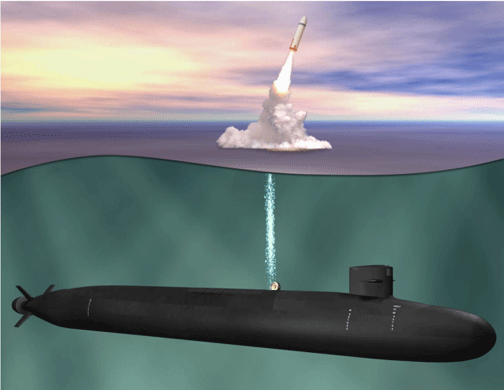 Meet the Ohio-Class: America’s Nuclear Doomsday Submarines, National Interest, by Sebastien Roblin 16 Oct 19,”………. The most deadly of the real-life kaiju prowling the oceans today are the fourteen Ohio-class ballistic-missile submarines, which carry upwards of half of the United States’ nuclear arsenal onboard. Meet the Ohio-Class: America’s Nuclear Doomsday Submarines, National Interest, by Sebastien Roblin 16 Oct 19,”………. The most deadly of the real-life kaiju prowling the oceans today are the fourteen Ohio-class ballistic-missile submarines, which carry upwards of half of the United States’ nuclear arsenal onboard.
If you do the math, the Ohio-class boats may be the most destructive weapon system created by humankind. Each of the 170-meter-long vessels can carry twenty-four Trident II submarine-launched ballistic missiles (SLBMs) which can be fired from underwater to strike at targets more than seven thousand miles away depending on the load.
As a Trident II reenters the atmosphere at speeds of up to Mach 24, it splits into up to eight independent reentry vehicles, each with a 100- or 475-kiloton nuclear warhead. In short, a full salvo from an Ohio-class submarine—which can be launched in less than one minute—could unleash up to 192 nuclear warheads to wipe twenty-four cities off the map. This is a nightmarish weapon of the apocalypse. ………. https://nationalinterest.org/blog/buzz/meet-ohio-class-americas-nuclear-doomsday-submarines-88386
|
|
Risks of nuclear transportation
|
Safer nuke shipments? Critics split on whether tech has cut nuclear transportation risk, reno gazette journal, Scott Sonner, Associated Press Oct. 14, 2019 “…… Today, radioactive shipments are hauled in double-walled steel containers inside specialized trailers that undergo extensive testing and are tracked by GPS and real-time apps.But whether shipping technology has evolved enough to be deemed safe depends on whom you ask.
The Trump administration’s revival of a decades-old plan to move the nation’s most dangerous radioactive waste to a remote spot in the Nevada desert has reignited a long-running fight in the courts and Congress over how to safely get the hazardous remnants of decades of bomb-making and power generation to a permanent resting place. “It seems to me, that part of the gist of the government’s argument is that, ‘We’ve been doing this a long time. We know what we are doing. You have to trust us,’” noted U.S. District Judge Miranda Du who’s considering a lawsuit Nevada filed against the Energy Department over waste being sent there. For its part, the government says there are no safety concerns………. But there have been close calls, said Robert Halstead, an analyst who has studied the dangers of transporting radioactive waste for 35 years and is head of Nevada’s Agency for Nuclear Projects. A truck crash in 1971 killed a driver and propelled a cask full of nuclear waste into a ditch in Tennessee. The container was damaged, but no radioactive material leaked. More recently a Tennessee contractor revealed earlier this year it may have mislabeled low-level nuclear waste – items such as contaminated equipment or workers’ clothing – that potentially was sent to Nevada over six years without the proper safeguards. The Energy Department responded by announcing in July it will review all radioactive waste packaging and shipping. Perhaps the greatest point of disagreement is whether the “rigorous testing” is rigorous enough. It would be dangerous and expensive to run tests involving explosions, fire or other hazards on a real cask of spent nuclear fuel. So it’s never been done in the United States. “What isn’t clear is: ‘What are the conditions under which the package would fail?” said Edwin Lyman, head of the nuclear safety project at the Union of Concerned Scientists, who has studied the hazards of nuclear shipments for 25 years. There’s enough high-level nuclear waste awaiting disposal in the U.S. to fill a football field 65 feet deep. Few states want to house it within their borders. To solve the long-time problem, the Trump Administration has revived a decades-old plan to move the nation’s most dangerous radioactive waste from around the country to a site 90 miles northwest of Las Vegas, the Yucca Mountain Nuclear Waste Repository. It was proposed to hold 77,000 tons of highly radioactive spent nuclear fuel in a maze of tunnels bored into an ancient volcanic ridge. Nevada doesn’t want it. The state and its congressional delegation have been fighting the project and other attempts to store nuclear waste in Nevada for decades, and the Yucca Mountain project was shelved in 2010 under pressure from then-Senate Democratic Majority Leader Harry Reid of Nevada and President Barack Obama. U.S. Rep. Dina Titus, a Nevada Democrat who helped defeat a GOP-led effort to restore funding to Yucca Mountain last May, called it “the latest attempt to force nuclear waste down Nevada’s throats.” Meanwhile, the state has sued the federal government over the half metric ton of plutonium secretly shipped from South Carolina to the Nevada National Security Site. That site is separate from but close to the Yucca Mountain site. While U.S. leaders battle over where to ship the nuclear waste, the government says it has upgraded transportation containers and the way it hauls the material………..https://www.rgj.com/story/news/2019/10/14/critics-split-whether-tech-has-cut-nuclear-transportation-risk/3978815002/ |
|
1 This Month
26 September – International Day for the Total Elimination of Nuclear Weapons





PLEASE OPPOSE HR 8255 AND S.3639 – bills would accelerate satellite deployment, with no environmental review or safeguards – https://ncstd5li.quorum.us/campaign/169331/
To see nuclear-related stories in greater depth and intensity – go to https://nuclearinformation.wordpress.com
-
Archives
- September 2026 (305)
- August 2026 (330)
- July 2026 (355)
- June 2026 (287)
- May 2026 (306)
- April 2026 (356)
- March 2026 (251)
- February 2026 (267)
- January 2026 (308)
- December 2025 (358)
- November 2025 (359)
- October 2025 (375)
-
Categories
- 1
- 1 NUCLEAR ISSUES
- business and costs
- climate change
- culture and arts
- ENERGY
- environment
- health
- history
- indigenous issues
- Legal
- marketing of nuclear
- media
- opposition to nuclear
- PERSONAL STORIES
- politics
- politics international
- Religion and ethics
- safety
- secrets,lies and civil liberties
- spinbuster
- technology
- Uranium
- wastes
- weapons and war
- Women
- 2 WORLD
- ACTION
- AFRICA
- Atrocities
- AUSTRALIA
- Christina's notes
- Christina's themes
- culture and arts
- Events
- Fuk 2022
- Fuk 2023
- Fukushima 2017
- Fukushima 2018
- fukushima 2019
- Fukushima 2020
- Fukushima 2021
- general
- global warming
- Humour (God we need it)
- Nuclear
- RARE EARTHS
- Reference
- resources – print
- Resources -audiovicual
- Weekly Newsletter
- World
- World Nuclear
- YouTube
-
RSS
Entries RSS
Comments RSS

