U.S. Air Force mulls getting hypersonic nuclear weapons
US Air Force may have accidentally revealed interest in hypersonic nuke, Defense News By: Valerie Insinna 19 Aug 20, WASHINGTON — The U.S. Air Force has issued, and quietly revoked, a solicitation to industry seeking technologies that would support a hypersonic glide vehicle capable of traversing intercontinental ranges, potentially signaling the military’s interest in a hypersonic nuclear weapon.
According to an Aug. 12 request for information first reported by Aviation Week, the Air Force Nuclear Weapons Center sought ideas for potential upgrades to intercontinental ballistic missiles, including a “thermal protection system that can support [a] hypersonic glide to ICBM ranges.”
The items listed as potential ICBM upgrades were all marked “unclassified/for official use only,” which notes information that — while not secret — is not normally released to the public. The RFI was then withdrawn after Aviation Week began inquiring about it, the report noted.
Asked about the RFI on Wednesday, Lt. Gen. Richard Clark, the Air Force’s deputy chief of staff for strategic deterrence and nuclear integration, said the service’s next-generation ICBMs — known as the Ground Based Strategic Deterrent — will not be available as a hypersonic variant when it is fielded in the late 2020s…………
As the sole bidder in the GBSD competition, Northrop Grumman is expected to win an estimated $85 billion over the life of the program. A contract award is slated to occur by September, although Northrop CEO Kathy Warden said in April that she expected a decision this month. https://www.defensenews.com/smr/nuclear-arsenal/2020/08/19/the-air-force-might-be-eyeing-a-hypersonic-nuclear-weapon/
Joe Biden will ,be just as pro nuclear as Trump- maybe worse?

|
Nuclear proponent James Conca, writing in that generally pro nuclear publication, Forbes, is jubilant that the Democrats, under Joe Biden , will be staunchly pro nuclear : “The idea that Republican Administrations are pro-nuclear and Democratic ones are anti-nuclear is one of those enduring myths……. nuclear has no real constituency.
……. That said, there has been some recent political and legislative movement on nuclear energy, including passage of the Nuclear Energy Leadership Act, Lifting of the Prohibition on Nuclear Funding, adoption of the Democrat’s America’s Newest Climate Plan that includes nuclear, and DOE’s funding of the Advancing Nuclear Research initiative and the Advanced Reactor Demonstration Project.
The [ Biden] Plan calls for “leveraging the carbon-pollution free energy provided by existing sources like nuclear and hydropower.” The Plan also calls to “Create a Advanced Research Projects Agency on Climate, a new, cross-agency ARPA-C to target affordable, game-changing technologies to help America achieve our 100% clean energy target, including… advanced nuclear reactors …..
Many are questioning how much Biden’s VP choice, Kamala Harris, supports his plan for nuclear. In one of the few insights into her thoughts on the subject, when she was asked d “Do you support the use of nuclear energy?” she answered, “Yes, temporarily while we increase investment into cleaner renewable alternatives.”
Not the most ringing endorsement, but now that she is hooked up with the ticket, it’s likely she will endorse Biden’s plan. The Democratic Party Platform, still in draft form, also calls for a technology-neutral approach, including new and existing nuclear, so again, she is likely to adopt that as well. ….. So expect an up-turn in nuclear energy in a Biden-Harris Administration. https://www.forbes.com/sites/jamesconca/2020/08/17/what-will-a-biden-harris-administration-do-for-nuclear-energy/#1ca07b4a1dd9 |
|
USA’s nuclear weapons – not the best way to protect Taiwan
|
Do US Nuclear Weapons Help Protect Taiwan?, Union of Concerned Scientists
GREGORY KULACKI, CHINA PROJECT MANAGER AND SENIOR ANALYST | AUGUST 17, 2020, In an earlier post I explained there is a risk the United States and China could go to war over Taiwan. The United States is prepared to use nuclear weapons to win that war. Some believe that helps protect Taiwan. But does it?
Shall we play a game?At the end of the 1983 movie War Games, a massive US Department of Defense computer plays out every possible nuclear war scenario looking for a way to win. All of them lead to the same dismal end; a global nuclear holocaust. The computer concludes nuclear war is “a strange game” where “the only winning move is not to play.” Six months after the movie was released, US President Ronald Reagan told a joint session of Congress, “A nuclear war cannot be won and should never be fought.” He repeated it many times afterwards, including in a speech at Fudan University in Shanghai. Unfortunately, US war gamers never let go of the idea that a nuclear war can be won, especially if the adversary is China. I can understand why. China has a few hundred nuclear weapons. The United States has thousands. The United States also has what are called tactical, non-strategic or low-yield nuclear weapons that China does not have. Some US officials argue if the United States used these low-yield nuclear weapons it would be difficult for China to retaliate without risking escalation to a full scale nuclear war: a war China would lose because its arsenal is so small. They seem to believe China would be unwilling to take that risk even though China has promised to retaliate if attacked with any type of nuclear weapon. Limited nuclear warThe reason the US war planners think about using nuclear weapons in a Taiwan war is because the United States might lose a conventional fight. They worry China’s conventional forces cannot be stopped without nuclear weapons. This isn’t a new concern. President Eisenhower faced a similar choice during the Taiwan Strait Crisis of the 1950s. …….
Past and prologueToday, the rapid deterioration of US-China relations, disturbing changes in Chinese policy towards Hong Kong and a provocative visit of a US official to Taiwan suggest a new crisis is brewing. As talk of a new Cold War with China increases, a careful look back at the old one may be helpful. ……..
history suggests more nations may be willing to support a US military effort to defend Taiwan if the United States took the option to start a nuclear war off the table. It may seem counterintuitive, but canceling plans to reintroduce US tactical nuclear weapons into Asia and declaring the United States would never use nuclear weapons first, under any circumstances, may be the best way to strengthen Taiwan’s defense. https://allthingsnuclear.org/gkulacki/do-us-nuclear-weapons-help-protect-taiwan
|
|
|
Will Ohio finally be able to use its wind resources, now that the nuclear corruption is being exposed?

|
Will Ohio Finally Inherit Its Wind? https://readersupportednews.org/opinion2/277-75/64623-rsn-will-ohio-finally-inherit-its-wind?fbclid=IwAR0iFghBoz4O6r7yMYGVnrXjyQ27vmsal94R3U6STsPlmM2TWvPOriQ4IiMBy Bob Fitrakis and Harvey Wasserman, Reader Supported News, 17 August 20
 midst an astonishing billion-dollar nuke reactor corruption scandal, one of the world’s richest wind resources—the key to Ohio’s economic and ecological future—is being trashed by a single sentence. midst an astonishing billion-dollar nuke reactor corruption scandal, one of the world’s richest wind resources—the key to Ohio’s economic and ecological future—is being trashed by a single sentence.
According to the American Wind Energy Association, Ohio is being robbed of $4 billion worth of industrial development, thousands of jobs, and a wealth of cheap, emissions-free energy by a single easily-removable clause in the Ohio Code. How? In 2014, without public hearings, pro-fossil/nuke legislators slipped into law a requirement that wind turbines be sited at least 1300 feet from property lines. The previous requirement was 600 feet. There are no meaningful economic, ecological, or health/safety imperatives served by the additional set-back footage. No other state has such a requirement. But by vastly expanding the land required for turbine siting, that single sentence stopped some $4 billion in pre-approved northern Ohio wind farm development. Ohio’s “North Coast” has steady winds blowing over flat fields whose farmers desperately need the fat checks that come with turbine leasing. The region is uniquely crisscrossed with transmission lines feeding nearby urban areas where the power is consumed. Ironically, Ohio is already a leading manufacturing center for the turbine industry being blocked within its own borders. The proposed arrays are set to create thousands of jobs, save hundreds of family farms, and provide decades of reliable, clean electricity at rates far below current subsidized fossil/nuke prices. The employment created by the wind construction projects would far exceed that at the Davis-Besse and Perry reactors. The nuke bailout is now under intense fire. Because House Bill 6 has been tainted by the $60 million in bribes given House Speaker Larry Householder to grease it through the legislature, even pro-nuke governor Mike DeWine wants it rescinded. It comes in the wake of some $9 billion in “stranded cost” bailout money sucked up by Ohio’s nukes starting in 1999. But if HB6 goes away as promised, DeWine and pro-reactor legislators will likely introduce a new, slightly altered bailout. As a popular concession, they might drop the previously included handout for two coal burners or avoid attacking Ohio’s highly successful energy efficiency programs. But the one move that could completely revamp Ohio’s energy future would be to restore its wind setback to levels commonly accepted nearly everywhere else. Opening Ohio’s energy markets to cheap wind power would undercut subsidized, fossil/nuke-inflated electric rates, restore the jobs deleted by shutting the reactors, and spur long-term economic growth as virtually nothing else would. Will Ohio’s safe energy movement grab the opportunity to make all that happen? Bob Fitrakis & Harvey Wasserman have co-authored numerous books on election protection and the environment appearing at www.freepress.org along with Bob’s Fitrakis Files. Harvey’s People’s Spiral of US History awaits Trump’s departure at www.solartopia.org, where his Solartopia! Our Green-Powered Earth also resides. |
|
Nuclear waste should no longer be exempt from environmental laws
 How Bedrock Environmental Law Can Break the Nuclear Waste
  Logjam, https://news.bloomberglaw.com/environment-and-energy/insight-how-bedrock-environmental-law-can-break-the-nuclear-waste-logjam Geoffrey Fettus, NRDC 17 Aug 20
The 30-year battle over nuclear waste disposal at Yucca Mountain in Nevada shows it’s time for the Atomic Energy Act to be amended. Geoffrey Fettus, senior attorney for the Natural Resources Defense Council, says Congress should pass legislation to end the exemption of nuclear waste from hazardous waste and other bedrock environmental laws.
For more than 30 years, Congress and the federal government have tried again and again to shove our nation’s spent nuclear fuel down a hole at Yucca Mountain, Nev. It’s time to use our foundational environmental laws get out of this seemingly impenetrable maze.
Congress should amend the Atomic Energy Act to remove exemptions from environmental laws for radioactive waste, a proposal that got an important boost from the House Select Committee on Climate Crisis as it called for a task force of federal, state, local, and tribal officials to study the implications of this idea.
Earlier this year, President Trump bowed to reality and abandoned efforts to force the radioactive waste on Nevada, the Yucca mirage finally dissipated. What’s clear now is that trying to force Nevada, or Utah, or New Mexico, or Tennessee (or any other state) to take the entirety of the nation’s most toxic nuclear waste won’t work. Continuing down that path will get us nowhere.
Instead of seeing recalcitrant states as the problem, what if we acknowledge the reality that they must be a key part of the solution for nuclear waste?
Feds Have Exclusive Jurisdiction Over Radioactive Materials
Remarkably, our bedrock environmental laws don’t cover nuclear waste, and they should. The Atomic Energy Act started the nuclear industry and was enacted years before our key pollution safeguards were established.
Crucially, and mostly for nuclear weapons reasons, the AEA gave the federal government exclusive jurisdiction over all radioactive materials, including radioactive waste. When Congress enacted our foundational environmental laws decades later, each of them included an exemption that excludes radioactive waste except in limited or marginal ways.
This is the original sin that must be rectified.
To explain this pernicious problem, when Congress considered nuclear waste in its precedent setting 1982 Nuclear Waste Policy Act, it just accepted the AEA’s sole federal authority and nuclear waste’s exclusion from environmental law as the way of the world. Only a few years later, for the sake of political expedience, Congress cut short a well thought out siting process and required the Yucca Mountain repository as the only option.
This was supposed to expedite the process, but not surprisingly, it exploded in controversy and eventually ground to a halt. And now it has finally, truly, died. But nuclear waste remains just as toxic and problematic as ever.
If nuclear waste were covered by environmental laws, i.e., without the current exemptions that limit EPA and state authority, protective federal health and welfare standards can combine with state-level decision-making over where and how the waste could be stored within its borders.
Amending the AEA and removing the provisions that exempt nuclear waste from our hazardous waste and water laws would give us our best chance to garner public acceptance for a process to find safe, technically sound storage sites for toxic nuclear waste—waste that will remain dangerous to human health for hundreds of thousands of years.
Why This Can Work
Consider how things could change if environmental laws could operate as intended.
Under regular environmental law (that covers pollution of air, water, land), the EPA sets strong standards commensurate to the harm of the pollutant. States can then assume the management of that program (or leave it to the EPA) and set additional, stricter standards if they wish.
A state can have strong regulatory authority to set terms for how much waste it might dispose of, how the facility will operate, and the requisite power to enforce those protective standards and protect its citizens—all things it cannot do now for radioactive waste.
To be clear, the standards for high-level radioactive waste will need to be special and extraordinarily protective, and the rulemaking for those standards will be quite a technical ordeal. But, there’s no getting around doing that hard work; Congress tried to take a short cut and it failed.
Once those standards are in place, the EPA and the states can, as in other instances, share the necessary roles of guarding public safety and welfare from radioactive waste. This institutional framework allows for both scientific defensibility of potential sites and, importantly, public acceptance of the process.
The Task Falls to Congress
For far too long many members of Congress and officials in Washington fought any efforts like this as they sought the quick fix of Yucca. Now there’s evidence of change. The ambitious report from the House Select Committee on Climate Crisis included this key recommendation:
Congress should establish a task force comprised of federal, state, local, and tribal officials to study the implications of amending the Atomic Energy Act to remove exemptions from environmental laws for spent fuel and high-level waste, while maintaining federal minimum standards.
Lawmakers should pick up this recommendation, create just such a task force, and move forward with this plan. Will this work? Yes—but it will take both hard work and time.
One thing I can guarantee is that the current approach isn’t working and won’t ever work. No single state is going to willingly accept the entirety of the nation’s nuclear burden without any way to protect their citizens; we have decades of evidence for this proposition. No amount of stomping of feet in the halls of Congress can change that.
Author Information
Geoffrey Fettus is a senior attorney for the Natural Resources Defense Council’s climate and clean energy program in Washington, D.C. He litigates in federal courts and testifies before Congress on the beginning and end of the nuclear fuel cycle. Prior to joining the NRDC, he was a staff attorney at the New Mexico Environmental Law Center and an assistant attorney general in New Mexico’s Office of the Attorney General.
U.S. Senator Harris and Rep Ocasio-Cortez introduce Bill on climate harm
 Reuters 6th Aug 2020, U.S. Senator Kamala Harris and Representative Alexandria Ocasio-Cortez on
Thursday introduced legislation to beef up federal accountability for
pollution in minority communities disproportionately harmed by climate
change. Harris, a leading contender to be Democratic presidential candidate
Joe Biden’s running mate, was running in the Democratic primary last year
when she first floated the Climate Equity Act with Ocasio-Cortez.
Nothing is more expensive than nuclear power
 Readers sound off on the costliness of nuclear power, By VOICE OF THE PEOPLE, NEW YORK DAILY NEWS |AUG 15, 2020
Manhattan: Re “The inconvenient truth: We need nuclear” (op-ed, Aug. 10): Nothing is more expensive than nuclear power. Estimates for the cleanup of Japan’s 2011 Fukushima disaster range as high as $300 billion, albeit total removal of radioactivity from that land, and ocean, is impossible. In Japan, as everywhere, the costs of such disasters are born by the taxpayer, not the utility companies: There is no such thing as a $300 billion insurance policy.
US open to nuclear agreement with Russia before including China
Top arms envoy indicates shift in Washington’s position on trilateral talks, Nikkei Asian Review, RYO NAKAMURA, Nikkei staff writerAugust 16, 2020
WASHINGTON — The U.S. may move forward with a nuclear agreement with Russia first in a bid to apply pressure on Beijing to sign a weapons treaty, Washington’s top arms control negotiator said, despite characterizing China as an “urgent threat.”
Marshall Billingslea, the special presidential envoy for arms control, spoke with Nikkei days before traveling to Vienna to meet Russian Deputy Foreign Minister Sergei Ryabkov on Monday and Tuesday for discussions on brokering an accord. Washington had been keen to strike a trilateral agreement with Moscow and Beijing, but is now open to a bilateral agreement with Russia first.
“That is, I think, a very prudent approach, particularly because we may be able to agree to something with Russia that would be the framework which we would want China to join,” Billingslea said in a phone interview on Friday.
The Vienna meeting, which Washington also invited China to, will focus on a successor to the New Strategic Arms Reduction Treaty. That accord, also known as New START, was signed in 2010 and expires in February. In addition to nuclear warheads, the treaty limits the deployment of land-based intercontinental ballistic missiles, strategic bombers and submarine-launched ballistic missiles.
The Trump administration has sought a new treaty with three conditions: it includes China, adds restrictions on all types of nuclear weapons and strengthens and verification.
The U.S. has been particularly adamant about Beijing’s participation, but China has so far refused…….. https://asia.nikkei.com/Editor-s-Picks/Interview/US-open-to-nuclear-agreement-with-Russia-before-including-China
Trump Hints about Meeting With Putin to Discuss Nuclear Treaty
|
Trump Hints to Meeting With Putin to Discuss Nuclear Treaty, Hamodia, By Sara Marcus Sunday, August 16, 2020 WASHINGTON –
President Donald Trump discussed the possibility of holding a meeting with Russian President Vladimir Putin before the November 3 election. NBC News reported that aides have researched potential opportunities for the two men to meet, with one possibility as early as next month in New York. The summit would be to discuss mutual constraints on nuclear weapons. One possibility would be by extending New START, a nuclear arms treaty between the two countries that is set to expire in 202 ……… People familiar with the discussions in the administration said President Trump hopes to impress with a very public showing of his ability to make a deal…….The Helsinki summit brought President Trump plenty of attention, but much of it was negative and he was accused of being manipulated by Putin. https://hamodia.com/2020/08/16/trump-hints-meeting-putin-discuss-nuclear-treaty/
|
|
Even with $1.4 billion government subsidy, NuScam’s nuclear station is still a dodgy prospect

The NuScale SMR plant is designed to be built with up to a dozen 60-MW reactor modules.
UAMPS is seeking other utilities throughout the West to purchase hundreds of megawatts of the $6 billion project’s output, but no utility has agreed to such a purchase.
Utah Taxpayer Association Vice President Rusty Cannon said UAMPS members currently committed to the project should withdraw from it because of the risks.
“The development of untried new designs is no place for small utilities with no nuclear construction experience to risk their customers’ money,” former NRC Commissioner Peter Bradford said during the briefing.
the first module is now expected to be operational in June 2029. Previously NuScale had targeted commercial operation of at least one reactor module in 2027.
|
Municipal power group awaits $1.4 billion from DOE for Idaho nuclear plant, https://www.spglobal.com/platts/en/market-insights/latest-news/electric-power/081320-municipal-power-group-awaits-14-billion-from-doe-for-idaho-nuclear-plant Author, Michael McAuliffe , Editor Keiron Greenhalgh 14 Aug 20, HIGHLIGHTS Utah Associated Municipal Power Systems (UAMPS) members face September decision on project Startup of first unit delayed to 2029 from 2027 Odds of members agreeing to go forward 50/50: muni Washington — A Utah municipal power association is expecting an influx of $1.4 billion in federal funds for the small modular reactor plant it is looking to build in Idaho, but association members are still deciding whether to go forward with the 720-MW project and the completion date has recently slipped, officials said. Continue reading |
Survey finds that U.S. Democrats and Republicans both want to phase out land-based nuclear missiles
|
Democrats And Republicans Agree: Phase Out Land-Based Nuclear Missiles https://www.forbes.com/sites/matthewkorda/2020/08/12/democrats-and-republicans-agree-phase-out-land-based-nuclear-missiles/#74441be7109d Matt Korda I write about the nexus between nuclear weapons, climate change, and injustice. Although Democrats and Republicans increasingly seem worlds apart, when it comes to nuclear weapons issues, they’re actually much closer than one might think.
According to a new report by the Program for Public Consultation at the University of Maryland, 61 percent of Americans–including both Democratic and Republican majorities–are in favor of phasing out the United States’ aging fleet of 400 intercontinental ballistic missiles. This finding is highly noteworthy, as it runs in direct contrast to the Pentagon’s current plan of spending approximately $100 billion to buy a brand-new generation of ICBMs by 2030. The survey, entitled “Common Ground of the American People,” is a compilation of studies conducted over the past five years, collecting data from nearly 86,000 individuals throughout the polling process. It specifically aimed to place the respondents into the shoes of a policymaker: respondents were first given an issue briefing, and were then asked to evaluate arguments for and against various policy proposals, before finally offering their recommendations.
The survey’s unique methodology is highly illuminating, because it allows readers of the report to see which arguments were deemed to be most or least convincing, and by whom. For example, Republicans preferred a proposal to phase out ICBMs while maintaining the same number of deployed warheads, while Democrats preferred a proposal to phase out ICBMs and reduce the arsenal to a lower number of deployed warheads.
The main takeaway though, is that–regardless of how the ICBM phase-out takes place–69 percent of Democrats and 53 percent of Republicans agree that the land-based leg of the nuclear triad should be eliminated entirely.
It makes sense that both Democrats and Republicans would agree on phasing out ICBMs: they are outdated, destabilizing, and very expensive. Intercontinental ballistic missiles are largely relics of the Cold War, when the United States and the Soviet Union alike feared a “bolt-from-the-blue” nuclear attack. At the time, it was believed that both countries having large land-based nuclear arsenals would prevent each other from launching a massive surprise attack. However, in today’s multipolar nuclear environment, the likelihood of such an attack is extremely slim, and so ICBMs no longer hold much strategic value. Given the abundance of more flexible options in the U.S. arsenal, U.S. Strategic Command would certainly turn to nuclear bombers or submarines–not ICBMs–in the event of a low-level nuclear crisis.
Additionally, the inherent vulnerability of the ICBM fleet actually creates a psychological pressure to launch them during a nuclear crisis, before an adversary’s missiles can wipe them out. This is why siloed ICBMs–like those deployed across the United States––are commonly referred to as “use ‘em or lose ‘em” weapons. In the event of a false alarm, accident, or miscalculation, this pressure to “use ‘em” could inadvertently trigger a nuclear war. No other nuclear weapon in the US nuclear arsenal comes with this kind of destabilizing psychological pressure. ……
Perhaps knowing this, the Pentagon argues that ICBMs are necessary as a “hedge” in case technological advances suddenly render the United States’ nuclear-armed submarines vulnerable. However, the 2018 Nuclear Posture Review admits that “When on patrol, [ballistic missile submarines (SSBNs)] are, at present, virtually undetectable, and there are no known, near-term credible threats to the survivability of the SSBN force.” This condition is likely to continue as US submarines get even quieter, thus making these fears seem relatively exaggerated. On top of this, replacing the ICBMs with brand-new missiles would be extremely expensive. The latest estimate for the Ground-Based Strategic Deterrent, as the replacement program is called, totals approximately $100 billion. In reality, these costs are expected to rise, given that the contract will be sole-sourced to Northrop Grumman NOC -0.7% after Boeing BA -2.6% pulled out of the competition last year. The chairman of the House Armed Services Committee has called this development “very troubling,” and the sole-source contract has since triggered a Federal Trade Commission investigation into Boeing’s allegations that Northrop Grumman was engaging in anti-competitive behavior.
Given these underlying programmatic and strategic concerns––in addition to the new survey demonstrating that both Democrats and Republicans want to phase out ICBMs entirely––why is this $100 billion project still moving forward? In the midst of an election, a recession, and a devastating pandemic, it seems like common sense to delay the program at the very least.
However, a robust lobbying effort by weapons contractors has impeded public scrutiny of the program. Northrop Grumman––the only bidder for the ICBM replacement contract––spent more than $162 million on lobbying between 2008 and 2018, with the bulk of the contributions going to members of the “ICBM Caucus”––a coalition of Senators from states where ICBMs are deployed. In 2018, this lobbying effort helped kill an amendment to the National Defense Authorization Act which called for a feasibility study on extending the life of the current ICBM force, rather than rebuilding it from scratch. This has had the effect of suppressing public debate over the future of the ICBMs; without studies like this one, the public is being asked to blindly swallow the pro-ICBM claims of those that would materially benefit from their replacement.
The University of Maryland’s report offers a new tool to push back against the “business” of nuclear policy. The survey suggests that corporate lobbying and “special interests” are alienating the public from their elected representatives, and dividing the two political parties even further. Therefore, treating its respondents as neutral “policymakers” clearly demonstrates that without the presence of moneyed interests, Democrats and Republicans agree on much more than one might think. And in this particular instance it is clear: majorities from both parties want to phase out intercontinental ballistic missiles.
|
|
Biden Condemns Trump’s Nuclear Plans, (but he himself supports nuclear power)
 Uranium Week: Biden Condemns Trump’s Nuclear Plans, Fn ArenaAug 11 2020 Uranium Week: Biden Condemns Trump’s Nuclear Plans, Fn ArenaAug 11 2020
Presidential nominee Joe Biden has reiterated his objection to President Trump’s nuclear energy plan. FN Arena By Mark Woodruff
Presidential nominee Joe Biden used Twitter last week to declare he would create a clean energy economy that will generate “millions of well-paying union jobs ..….without jeopardising the places we hold dear.” Biden was responding to President Trump’s recent plan to mine uranium around the Grand Canyon. To achieve this, the President would need to lift the current 20-year ban on new mining in the area. In a further statement he also reiterated condemnation for President Trump’s nuclear energy plan, released in April this year, which outlined the creation of a US$150m uranium reserve in the coming decade. Last month, according to the Washington Post, Joe Biden unveiled a proposal to transform the nation’s energy industry and significantly reduce the United States’ reliance on fossil fuels and the 15-year timeline for 100% clean electricity standard.
However, unlike some of his Democratic primary opponents, Biden backs nuclear power, according to energyworld.com. https://www.fnarena.com/index.php/2020/08/11/uranium-week-biden-condemns-trumps-nuclear-plans/
|
|

Hazards in U.S, government’s plans for more locations for low level nuclear wastes
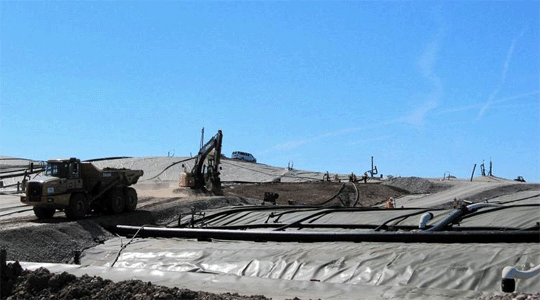
Feds Propose More Sites For Nuke Waste Storage (Not Disposal) Forbes , Ed Hirs 12 Aug 20,
The Nuclear Regulatory Commission (NRC) is proposing that more locations around the country be used to dispose of very low level radioactive waste. This proposal has raised the ire of environmentalists and nuclear waste storage proponents alike…….
Bad actors can make a considerable profit at the expense of public health. As the United Steelworkers union noted in their public comment urging the NRC against the ruling: “[the ruling]…requires workers with little to no training to handle contaminated material leading to a greater probability of mishandling or improper disposal; and the proposed rule lack[s] requirements to monitor surrounding soil and ground water from any exempt waste location to ensure there is no increase of radiological contamination outside of the potential dumping sites.”
Safe disposal does not equal safety when materials remain active for generations. To improve safety landfills need to keep records for generations, and to deal with low-level contamination appropriately. Over time landfills become golf courses, sources of methane for electricity generation, and mines for reclaiming metal. These activities result in exposure to radiation that future generations must be prepared for. This means meticulous record keeping, which is unlikely to be present across multiple changes of ownership and decades of time.
What the NRC proposes is an expansion of opportunities for things to go wrong. In the past this approach has given us names that remain infamous today: think Love Canal. Brio Refinery. Savannah River and DuPont. It gave us the remains of leaded gasoline.
Water supplies are particularly vulnerable. Historically, the dictum of chemists has been “dilution is the solution.” That works for chemicals. It does not work for radiation, which is being generated continuously.
The current system is better than what is being proposed. Expanding the opportunities for things to go wrong is a step backwards. If the proposal is adopted, today’s laxity and profits will become tomorrow’s health problems and remediation expenses. If we care about coming generations we should leave well enough alone. https://www.forbes.com/sites/edhirs/2020/08/11/hazardous-nuclear-waste-storage-its-not-disposal/#2086a6624ad3
What about Vermont Yankee’s nuclear waste? Or dealing with it?
What about Vermont Yankee’s nuclear waste? Or dealing with it?
High-Level Nuclear Waste (HLNW) is a byproduct of nuclear power plants and is extremely dangerous for thousands of years. The Vermont Yankee Nuclear Power Plant, in Vernon, has been shut down since 2014 and the HLNW it produced over the years of operation has been transferred into stainless steel and concrete dry casks stored onsite. Currently, our federal government has not come up with a permanent site to store HLNW safely over time.
NorthStar, the corporation which now owns Vermont Yankee, wants to transport that waste to a Centralized “Interim” Storage (CIS) site that it owns in Texas. To transport this waste is a dangerous proposition since an accident would likely result in great damage to the environment and the life forms in the surrounding area. We should only move the material once to a permanent repository. Also, if Vermont Yankee’s HLNW is allowed to be transported across the country on our highways, railways and waterways to a temporary open-air storage site, such a precedent would likely result in thousands of shipments across the country as other nuclear plants are shut down during the coming four decades.
Communities in the Southwest are speaking out in opposition to accepting our toxic waste. As members of the Vermont Yankee Decommissioning Alliance (VYDA), we support their concerns and are against the transportation and interim storage of Vermont Yankee’s waste at a CIS. We feel it is safer to keep our waste within our state in monitored, hardened, onsite storage in stainless steel and concrete dry casks while a scientifically-based permanent storage site is located.
For the above reasons, join us in contacting U.S. Rep. Peter Welch and urge him to vote against any bill that would authorize Centralized Interim Storage of High-Level Nuclear waste? https://www.timesargus.com/opinion/commentary/famette-rice-and-the-nuclear-waste/article_436e1a1b-deb3-5b6a-87a9-228cfb16afbc.html
Audrey Famette lives in Montpelier. Nancy Rice lives in Randolph Center.
Fort Worth doesn’t need dangerous nuclear waste rolling through on Tarrant rail line
|
Fort Worth doesn’t need dangerous nuclear waste rolling through on Tarrant rail lines https://www.star-telegram.com/opinion/opn-columns-blogs/other-voices/article244891627.html BY PEGGY HENDON AND LINDA HANRATTY
AUGUST 12, 2020The Nuclear Regulatory Commission is considering licensing two different facilities to store the nation’s high-level nuclear waste. One would be at the existing low-level storage facility in Andrews County, Texas. The second, known as the Holtec site, would be between Carlsbad and Hobbs, New Mexico. Why should Tarrant County be concerned? Most of the uranium waste from nuclear power plants is located east of the Mississippi River. Union Pacific Railroad appears to be the most likely carrier of the high-level nuclear waste casks, although any commercial rail lines could be used. Union Pacific tracks run through the middle of the county, just south of downtown Fort Worth and just north of Arlington’s City Hall and library, traversing neighborhoods of all kinds. Fort Worth’s medical district and the TCU and UT-Arlington campuses are within 1.5 miles of the tracks. A second Union Pacific rail line runs north toward Denton from Tower 55, a major railroad intersection just southeast of downtown Fort Worth. A large Union Pacific railyard lies southwest of downtown Tower 55 holds vital national and international significance, connecting freight and passenger travel between the East and West coasts, Southeast, Midwest, Gulf Coast, Mexico, and Canada. More than 100 trains pass through Tower 55 each day. Interim Storage Partners, which operates the Andrews County site, has asked to have 45 days to move low-level waste from Vermont. The rail cars carrying the high-level radioactive waste would sit at the Fort Worth rail yard, across from Colonial Country Club. These nuclear waste cars are readily identifiable, given their huge dumbbell-like shape, size and weight, which makes them a potential target for terrorist attacks. High-level radioactive waste is one of the most dangerous substances on earth, consisting of irradiated fuel rods that have been inside nuclear reactors. Exposure to unshielded nuclear waste is lethal. One railcar would carry more plutonium than was in the bomb dropped on Nagasaki. If the Nuclear Regulatory Commission approves either or both licenses, thousands of rail shipments of deadly, high-level radioactive waste could move through Tarrant County for more than 20 years, risking accidents leaks, and terrorist actions. Transport of massive amounts of high-level waste in thousands of shipments across the country is unprecedented. A 2019 report of the U.S. Nuclear Waste Technical Review Board found that there is a substantial lack of data regarding potential damage of spent nuclear fuel during transport. Many rails are only designed to carry 143 tons per car. The loaded casks for this waste weigh 210 tons or more. It is unclear whether tracks in Tarrant County would handle such weight. And accidents can happen. A cask carrying low-level waste that was headed to Andrews caught fire in the Chicago area in June. A better alternative would be to leave high-level waste at existing nuclear plants until a permanent repository is found to bury cannisters underground. The repository should be owned by the federal government, not a private entity. One radioactive railway accident in Tarrant County could contaminate our region and harm thousands of lives, posing substantial health risks and seriously impacting future economic growth. Resolutions opposing consolidated interim storage of this waste and its transport through heavily populated communities have been passed by Bexar, Dallas, Nueces, El Paso and Midland Counties and the cities of San Antonio, Midland and Denton, as well as the Midland Chamber of Commerce. Tarrant County, along with the cities of Fort Worth and Arlington, should also oppose the transportation of high-level nuclear waste through our communities and advise our federal representatives and the Nuclear Regulatory Commission of our serious concerns. Our lives and economic well-being may depend upon preventive action now. Peggy Hendon is president of the League of Women Voters of Tarrant County. Linda Hanratty is the group’s environmental chairwoman. |
|
-
Archives
- October 2026 (129)
- September 2026 (339)
- August 2026 (330)
- July 2026 (355)
- June 2026 (287)
- May 2026 (306)
- April 2026 (356)
- March 2026 (251)
- February 2026 (267)
- January 2026 (308)
- December 2025 (358)
- November 2025 (359)
-
Categories
- 1
- 1 NUCLEAR ISSUES
- business and costs
- climate change
- culture and arts
- ENERGY
- environment
- health
- history
- indigenous issues
- Legal
- marketing of nuclear
- media
- opposition to nuclear
- PERSONAL STORIES
- politics
- politics international
- Religion and ethics
- safety
- secrets,lies and civil liberties
- spinbuster
- technology
- Uranium
- wastes
- weapons and war
- Women
- 2 WORLD
- ACTION
- AFRICA
- Atrocities
- AUSTRALIA
- Christina's notes
- Christina's themes
- culture and arts
- Events
- Fuk 2022
- Fuk 2023
- Fukushima 2017
- Fukushima 2018
- fukushima 2019
- Fukushima 2020
- Fukushima 2021
- general
- global warming
- Humour (God we need it)
- Nuclear
- RARE EARTHS
- Reference
- resources – print
- Resources -audiovicual
- Weekly Newsletter
- World
- World Nuclear
- YouTube
-
RSS
Entries RSS
Comments RSS

