Extreme weather causes emergency shutdown of nuclear plant in Iowa
|
‘Derecho’ storm causes Cargill plant closure, emergency shutdown of nuclear plant in Iowa
The storm caused crop damage and outages throughout the Midwest Star Tribune,
By Mike Hughlett Star Tribune, AUGUST 12, 2020 — A violent storm that tore through Iowa on Monday caused an emergency shutdown at a nuclear power plant near Cedar Rapids.
The storm packing hurricane-force winds tore across the Midwest, compounding troubles for a U.S. farm economy already battered by extreme weather, the U.S.-China trade war and most recently, the disruption caused to labor and consumption by the COVID-19 pandemic. Grain silos were ripped apart, and Minnetonka-based Cargill and Archer Daniels Midland closed crop-processing plants in Cedar Rapids. The Duane Arnold nuclear plant lost its connection to the electricity grid. At about 1 p.m., the plant in Palo, 11 miles northwest of Cedar Rapids, declared an “unusual event” — an indication of a safety threat, according to a report posted Tuesday by the U.S. Nuclear Regulatory Commission (NRC). An unusual event is the lowest of four levels of emergency conditions under NRC regulations. While the Duane Arnold plant is not now producing electricity, it does have power to run its emergency systems. The plant is stable and is using a backup power source at this time,” Duane Arnold’s majority owner and operator, Florida-based NextEra Energy Resources, said in a statement. The storms damaged the plant’s cooling towers, which are used in electricity production to cool steam after it exits the turbine, NextEra said. The cooling towers are not part of the safety systems used to cool the reactor and other critical components……. David Lochbaum, former director of the Union of Concerned Scientists’ nuclear safety project, said that loss of off-site power at nuclear power plants — usually due to storms — happens about four to five times a year in the U.S. Iowa’s 45-year-old Duane Arnold plant, which is a little smaller than Xcel Energy’s nuclear plant in Monticello, is due to shut down later this year………. |
|
California’s Wildfires Are 500 Percent Larger Due to Climate Change
 California’s Wildfires Are 500 Percent Larger Due to Climate Change California’s Wildfires Are 500 Percent Larger Due to Climate Change
“Each degree of warming causes way more fire than the previous degree of warming did. And that’s a really big deal.” The Atlantic, ROBINSON MEYERJULY 16, 2019 ” …….. Californians may feel like they’re enduring an epidemic of fire. The past decade has seen half of the state’s 10 largest wildfires and seven of its 10 most destructive fires, including last year’s Camp Fire, the state’s deadliest wildfire ever.A new study, published this week in the journal Earth’s Future, finds that the state’s fire outbreak is real—and that it’s being driven by climate change. Since 1972, California’s annual burned area has increased more than fivefold, a trend clearly attributable to the warming climate, according to the paper. The trend is dominated by fires like the Mendocino Complex Fire—huge blazes that start in the summer and feed mostly on timberland. Over the past five decades, these summertime forest fires have increased in size by roughly 800 percent. This effect is so large that it is driving the state’s overall increase in burned area. Why are summertime forest fires so much more likely? Because climate change has already redefined the seasons in Northern California. Since the early 1970s, summers in Northern California have warmed by about 2.5 degrees Fahrenheit (1.8 degrees Celsius) on average. A few degrees may not sound like much, but heat has an exponential relationship with forest fire. “Each degree of warming causes way more fire than the previous degree of warming did. And that’s a really big deal,” Park Williams, a climate scientist at Columbia University and an author of the paper, told me. Every additional increment in heat in the environment speeds up evaporation, dries out soil, and parches trees and vegetation, turning them into ready fuel for a blaze. For that reason, Williams said, hot summers essentially overpower anything else happening in Northern California. Even during a wet year, an intense heat wave can choke forests so that it is as though the rain never fell…….. https://www.theatlantic.com/science/archive/2019/07/climate-change-500-percent-increase-california-wildfires/594016/ |
|
|
North Dakota shows how to deter any plan for nuclear waste dumping

The Legislature passed a bill into law in 2019 that prohibits the disposal of high-level radioactive waste in North Dakota. For the rules to even take effect, “the first thing you have to do is get that law overturned or thrown out,” State Geologist Ed Murphy said.
Regulators prep for an industry few want: nuclear waste disposal, Bismarck Tribune, 10 Aug, 20
The state Industrial Commission approved the regulations in late July, as well as new rules surrounding deep geothermal wells, another industry that does not exist in North Dakota but could emerge one day.
The waste disposal rules spell out all the steps an entity would have to go through if it were to propose storing “high-level radioactive waste” in North Dakota. Such waste is highly radioactive material generated from the reprocessing of spent nuclear fuel, for example, and it requires permanent isolation……
The Legislature passed a bill into law in 2019 that prohibits the disposal of high-level radioactive waste in North Dakota. For the rules to even take effect, “the first thing you have to do is get that law overturned or thrown out,” State Geologist Ed Murphy said.
“We were writing rules for a program that, by law, is prohibited,” he said.
Roers said the thinking behind establishing the rules in light of the ban is that if the federal government were ever to try to trump North Dakota’s prohibition, it might still agree to follow the regulations established by the state.
If the entity wanted to move forward with a project, it would then need a “facility permit,” which would prompt a similar vetting process. Officials would have up to a year to decide whether to issue a permit.
Before granting a permit, the operator would need to deposit at least $100 million in a new state fund.
“The half-lives of some of the radioactive waste will be dangerous much longer than any sign, monument, or avoidance structures would remain unless they are maintained in perpetuity,” the regulations state. “This money is to be used to ensure the passive institutional controls are maintained for thousands of years.”
If a facility were to make it through the permitting process, it would have to pay an annual operating fee of at least $1 million to the state. It also would need to provide monthly reports on activities at the site and comply with reclamation rules when the site is no longer in use.
Documents regarding the location and depth of the site, as well as details about the half-life of the radioactive waste buried there, must be stored in local, state and national archives — an effort to ensure they last in perpetuity in case the information is needed hundreds or thousands of years down the road, Murphy said.
While counties cannot outright impose a ban on the disposal of the materials, any project would need to adhere to local zoning regulations as to the size, scope and location of the site.
Murphy said the state examined the regulations of 13 other states in developing its rules…………..
The new rules for high-level radioactive waste and deep geothermal energy have one final hurdle to clear before they become official — they will go to a legislative Administrative Rules Committee for approval. ….. https://bismarcktribune.com/news/state-and-regional/regulators-prep-for-an-industry-few-want-nuclear-waste-disposal/article_5afd3c76-9ac1-556f-be69-50f6c9811642.html
Nuclear fuel canisters all stored at decommissioned San Onofre nuclear station in California
The latest milestone brings the spent fuel roads one step closer to relocation at an off-site facility. Currently, however, no such federally licensed facility exists…… https://www.power-eng.com/2020/08/10/nuclear-fuel-canister-all-stored-at-decommission-san-onofre-nuclear-station-in-california/
Army finally tearing down Fort Belvoir’s nuclear plant
Nuclear watchdog opposes any agreement that would transfer ownership of Three Mile Island Unit
Nuclear watchdog opposes any agreement that would transfer ownership of Three Mile Island Unit 2 https://lancasteronline.com/news/local/nuclear-watchdog-opposes-any-agreement-that-would-transfer-ownership-of-three-mile-island-unit-2/article_20c1bc76-d8cb-11ea-9431-97c468d34a2b.html, SEAN SAURO | Staff Writer – 10 Aug 20,
-
- And signs point to a settlement between state and federal regulators, and FirstEnergy, the power company that now owns the unit that partially melted down in 1979.
At least that’s what Dauphin County-based nuclear watchdog Eric Epstein said he suspects. Epstein said he opposes any kind of agreement that would advance the plan, which he worries could threaten radioactive disaster.
“We will not agree to allow Three Mile Island to become a radioactive waste site,” Epstein said. “An island in a river is the worst place for it.”
Spokespeople speaking on the behalf of the state Department of Environmental Protection and the U.S. Nuclear Regulatory Commission did not provide details about the negotiations.
“Regarding a settlement, DEP is evaluating the motion and will reach a decision soon,” DEP spokesman Neil Shader said. “More information will be available once a decision is reached.”
FirstEnergy spokeswoman Jennifer Young said much the same.
“FirstEnergy continues to work with the DEP as well as the NRC to address questions relevant to the license transfer and decommissioning plans for TMI-2,” she said. “Details of the settlement agreement are confidential.”
Last fall, Unit 2’s owners at FirstEnergy announced they planned to transfer ownership of all related licenses and assets to a subsidiary of Utah-based EnergySolutions, which would eventually dismantle the reactor.
The transfer must be approved by the Nuclear Regulatory Commission, and it’s to that commission that Epstein of the Harrisburg-based Three Mile Island Alert raised concerns, urging that the transfer not be approved before they are addressed.
Specifically, he worried about the environmental threats of leaving radioactive waste on the island, which is situated in the Susquehanna River just north of Conoy Township near the Dauphin-Lancaster counties line. That’s in addition to fears that rate-payer funded accounts will not have enough money to cover the cost of decommissioning.
Similar concerns were included in a letter sent earlier this year from DEP Secretary Patrick McDonnell to federal regulators.
But now, Epstein worries that DEP officials will settle, undermining those fears, though he admits he hasn’t been a part of ongoing discussions — a point of contention.
“I don’t know how you build public confidence by excluding the public,” he said.
Regardless of what may come from negotiations, Epstein said his organization plans to continue advocating for safety “by any legal means,” appealing decisions if necessary.
Inhumanity, racism, sheer immorality, in the decisions to nuclear bomb Hiroshima and Nagasaki

|
The decision 75 years ago to use atomic bombs was fuelled not by strategy but by sheer inhumanity “If we’d lost the war, we’d all have been prosecuted as war criminals.” So said Curtis LeMay after America obliterated Hiroshima and Nagasaki with two atomic bombs in August 1945. LeMay was no bleeding-heart liberal. The US air force chief of staff who had directed the assault over Japan in the final days of the Second World War, he believed in the use of nuclear weapons and thought any action acceptable in the pursuit of victory. Two decades later, he would say of Vietnam that America should “bomb them back into the stone ages”. But he was also honest enough to recognise that the incineration of Hiroshima and Nagasaki was not regarded as a war crime only because America had won the war. Last week marked the 75th anniversary of the world’s first nuclear attacks. And while Hiroshima has become a byword for existential horror, the moral implications of the bombings have increasingly faded into the background. Seventy-five years ago, LeMay was not alone in his verdict. “We had adopted an ethical standard common to the barbarians of the Dark Ages,” Fleet Admiral William Leahy, chair of the chiefs of staff under both presidents Roosevelt and Truman, wrote in his autobiography, I Was There. Dwight Eisenhower, too, had, as he observed in the memoir The White House Years, “grave misgivings” about the morality of the bombings. Almost as soon as the bombs had dropped, however, attempts began to justify the unjustifiable. On 9 August, the day of the Nagasaki bombing, the US president, Harry Truman, broadcast to the nation, claiming that “the first atomic bomb was dropped on Hiroshima, a military base… because we wished… to avoid the killing of civilians”. In fact, more than 300,000 people lived in Hiroshima, of whom up to 40% were killed, often in the most grotesque fashion. Many commentators, including Truman, have also argued that without the bombings, hundreds of thousands, perhaps millions, of US troops would have been killed in any invasion of Japan. What the casualty figures may have been is in the realm of speculation and estimates vary widely. Most Allied military leaders did not, however, see the necessity for the bombings of Hiroshima and Nagasaki. Chester W Nimitz, the commander in chief of the US Pacific fleet, insisted that they were “of no material assistance in our war against Japan”. Eisenhower agreed that they were “completely unnecessary” and “no longer mandatory as a measure to save American lives”. General Douglas MacArthur, supreme commander of the southwest Pacific area, saw “no military justification for the dropping of the bomb”. The official Strategic Bombing Surveys in 1946 concluded that “Japan would have surrendered even if the atomic bombs had not been dropped”. There is evidence that the Americans had been preparing to use the A-bomb against the Japanese as early as 1943 and that, in the words of General Leslie R Groves, director of the Manhattan Project, the US nuclear weapon programme, “the target… was always expected to be Japan”. It’s an attitude that may have been driven by the different ways in which the Allies saw their enemy in Europe and in Asia. Germans were depicted as brutal and savage, but the bigotry was restrained to some extent by the fact that they were European and white. The Japanese, however, were particularly despised because they were non-white. As the historian John Dower observes in his pathbreaking book, War Without Mercy, the Pacific war was especially brutal because both sides saw the conflict “as a race war” that was “fuelled by racial pride, arrogance and rage”. It was common for western diplomats to refer to the Japanese as “monkeys” and “yellow dwarf slaves”. A former marine, Andrew Rooney, observed that US forces “did not consider that they were killing men. They were wiping out dirty animals.” Truman himself wrote: “When you have to deal with a beast you have to treat him as a beast.” “The entire population of Japan is a proper military target,” wrote Colonel Harry F Cunningham, an intelligence officer of the US Fifth Air Force. “There are no civilians in Japan.” The deliberate firebombings of Japanese cities are believed to have killed some 350,000 civilians. Against this background, the bombings of Hiroshima and Nagasaki become more explicable. The Japanese too were vicious, cruel and racist. But Japanese attitudes and atrocities are well known; those of the Allies are often forgotten, because they were the “good guys”. So much so that simply to question the morality of the bombings now can be deemed unpatriotic. When, 25 years ago, Washington’s National Air and Space Museum planned an exhibition to mark the 50th anniversary of the end of Second World War, part of which put the bombings in historical context, it faced fierce criticism from politicians and veterans. It was forced to rework the exhibition and its director, Martin Harwit, had to resign. He later reflected: “Those who in any way questioned the bomb’s use were, in this emotional framework, the enemies of America.” At a time when Black Lives Matter protests have thrust the history of slavery and of empire into public debate, it is striking that there remains such historical amnesia about Hiroshima and Nagasaki. We seem much less aware today of the sheer inhumanity and moral indefensibility of the bombings than even the military hawks were at the time. In the 2003 documentary The Fog of War, Robert McNamara, the former US defence secretary who had been LeMay’s military aide during the Second World War, reflected on the question of war crimes: “LeMay recognised that what he was doing would be thought immoral if his side had lost. But what makes it immoral if you lose and not immoral if you win?” That’s not just a historical question. It’s as relevant today, and to today’s wars, as it is about the destruction of Hiroshima and Nagasaki. History may be written by the victors, but morality should not be defined solely by them. |
|
“The Good Energy Collective” – a new nuclear front group getting the nuclear lobby into USA government
 US / New Policy Group Calls For Nuclear-Specific Staff In White House https://www.nucnet.org/news/new-policy-group-calls-for-nuclear-specific-staff-in-white-house-8-4-2020 By David Dalton, 6 August 2020
It said advanced nuclear energy should be integrated into climate legislation and incentives should be similar to those for renewables, including loan guarantees, production and investment tax credits, access to public land, and federal power purchase agreements.
The nuclear industry should create new business and finance models for new nuclear technologies and ensure a “robust commercialisation pathway” to bring advanced reactor designs to market.
“Nuclear energy will be needed to reach ambitious climate goals, but we must first reconstruct the technology for a new era complete with modern, socially-grounded approaches,” the Good Energy Collective said.
“Smart policies and better nuclear governance can help quickly shift the sector to a new, more sustainable pathway. Better governance will require a step-change by the administration, congress, and the nuclear industry.”
Nuclear crime seems to have actually still been worth it for South Carolina fraudsters
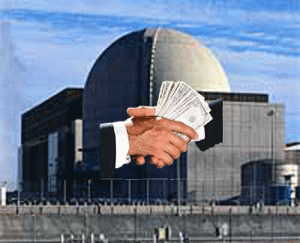 Executive admits fraud in fleecing ratepayers and shareholders https://wordpress.com/read/feeds/72759838/posts/2851460855 By Linda Pentz Gunter

“It looks like crime might well pay after all.”
That was the weary and only slightly tongue-in-cheek conclusion drawn by longtime anti-nuclear campaigner, Tom Clements recently, after a former South Carolina nuclear utility executive pled guilty to fraud in federal court.
Clements is the director of Savannah River Site Watch, but his activism has, for decades, extended well beyond the perimeter of that vast nuclear site.
For years, Clements and others have followed — and attempted to stand in the way of — the forced march of South Carolina ratepayers toward nuclear fiasco. When it finally unraveled in late July, there was only cautious cause for celebration.
On July 23, Stephen Byrne, the former COO of SCANA, the South Carolina utility originally in charge of the construction of two new nuclear reactors in the state, pled guilty in a massive nuclear conspiracy that defrauded ratepayers, deceived regulators and misled shareholders.
Byrne is charged with lying about progress on two Westinghouse AP 1000 reactors under construction — and since abandoned — at the V.C. Summer site, where costs ballooned to more than $9 billion.
The lies — or “intentional misrepresentations” as court documents described them — were necessary to make the case that the two new reactors would be finished on time, thereby qualifying the company for $1.4 billion in future federal tax credits.
But when Clements did the math, Byrne still came out ahead. “One of the court filings says Byrne earned $6.3 million from 2015-2017,” Clements said. “The project originally started with a filing with the SC Public Service Commission in 2008 and ended in July 2017. His plea agreement says he will pay a $1 million fine, though the judge could make it higher.”
So yes, crime still pays.
And so did South Carolina ratepayers. They were bilked of at least $2 billion until the project faltered and finally collapsed. A class action law suit and decisions by judges will see millions returned to ratepayers.
Ironically, the Nuclear Energy Institute, the industry’s lobbying group, gave Byrne the opportunity to explain exactly how ratepayers could be fleeced in advance to save money. In this 2012 NEI video, Byrne describes how Construction Work in Progress (CWIP) would allow the utility to collect funds from ratepayers in advance rather than waiting for construction completion — which has now, of course, not happened, even though customers paid for two new reactors that failed to materialize.
Byrne, who began cooperating with investigators about two years into the now three year-long investigation, could face jail time and a fine, but will likely testify against his co-conspirators to reduce his punishment.
For the time being, the judge has let him go home without even requiring he post the $25,000 bond. Sentencing could be years down the road. Clements believes Byrne “should face prison time” and that he “must fully reveal the criminal role of others in the conspiracy that has been so disastrous for ratepayers.”
Two other top SCANA executives could also be in the FBI’s crosshairs by now — former CEO Kevin Marsh and former chief financial officer Jimmy Addison.
Early warning signals of trouble to come sounded in February 2020, when Byrne and Marsh were charged with civil fraud by the Securities and Exchange Commission (SEC). The agency said the pair “lied and deceived shareholders, regulators, and the public regarding the construction of two new nuclear units at the V.C. Summer site, which the company abandoned amid massive cost overruns in July 2017,” according to reporting in Energy and Policy.
The thoroughly duped — or possibly hopelessly biased — S.C. Public Service Commission, had earlier “allowed SCE&G to raise its electric rates nine times to finance the doomed V.C. Summer Nuclear Station project,” reported the Charlotte Observer.
But by January 2019, the PSC had changed its mind, saying that “SCE&G intentionally misled the commission about a failing nuclear reactor construction project to win electric rate hikes.”
Clements joined other protesters outside the Columbia, SC courthouse where Byrne pled guilty to his offenses. “As he scurried into the federal courthouse, Byrne refused to tell us if he would apologize for his crime against ratepayers,” Clements said.
He, along with other South Carolina activists, and with support of Friends of the Earth, had consistently opposed the state law (CWIP, described in the NEI video), that had allowed the utility to fleece ratepayers in advance of completion of the reactors. The groups had also contested approval of the two-reactor project before the SC PSC since 2008.
As Clements watched Byrne enter the courthouse, finally forced to face up to his crimes, he basked, for a brief moment, in the glow of the celebratory light at the end of the tunnel.
“I’m glad there is going to be a little bit of justice,” Clements told the Post and Courier. And in an email, he wrote: “Nukes bring fraud, graft and corruption wherever they go. The next charges here will be more serious, I think.”
The Post and Courier described the nuclear debacle as “one of the worst economic calamities in South Carolina history”.
But while there may eventually be a day of reckoning — and sentencing — until then, South Carolina ratepayers could keep right on paying.
That is because, when SCANA went bankrupt over the Summer debacle, Dominion Energy took over. Dominion, says Clements, “will file a rate-hike request next month and the cost to ratepayers for the nuclear construction debacle will go up.”
Nuclear blackmail in Illinois — Beyond Nuclear International

Ratepayers robbed of renewables as well as cash
Nuclear blackmail in Illinois https://wordpress.com/read/feeds/72759838/posts/2851460456
Exelon stranglehold on energy legislation runs long and deep
By David Kraft, 9 Aug 20
The recent Illinois lobbying corruption scandal involving Exelon Corporation, its subsidiary Commonwealth Edison and Democratic House Speaker, Michael Madigan, demonstrates the extent to which nuclear “power” is about more than electrons.
The FBI arrests of the Ohio House Speaker and five others in a $60 million bribery/corruption scheme; the $10 billion Exelon nuclear bailout in New York; the questionable circumstances surrounding Exelon’s 2016 PepCo merger; and the South Carolina $9 billion SCANA fraud case, suggest that this may be a national pandemic.
All of this was summarized nicely in a recent New York Times opinion column, “When Utility Money Talks,” (8/2/20).
However, the situation in Illinois with Exelon, and its subsidiary ComEd, has been longstanding and particularly egregious.
For decades, Exelon’s stranglehold on Illinois energy legislation, in cooperation with the currently investigated Mr. Madigan, has stuck Illinois with more reactors (14) and high-level radioactive waste (>11,000 tons) than any other state. It has also severely stifled expansion of renewable energy and energy efficiency, and hampered the Illinois energy transformation to renewables needed to deal with the worsening climate crisis.
For decades, the Illinois environmental community has seen renewables expansion thwarted because no significant renewable energy buildout could occur without concessions to either Exelon or ComEd, and without Speaker Madigan’s approval. The most recent instance was the 2016 $2.35 billion bailout of three uncompetitive Exelon reactors.
This “nuclear blackmail” politics has forced environmentalists wanting to see new legislation pass that would expand renewables, into a reluctant and grudging alliance with Exelon, but on Exelon’s terms, with capacity market “reform” rewarding both renewables and ten of the company’s operating reactors.
If passed in its presently proposed form, this new legislation would provide yet another nuclear bailout under the disguise of “market-based reform.”
To ratchet up the pressure to enact this nuclear prop-up even more, Exelon CEO Chris Crane, in Exelon’s 2Q quarterly earnings call with analysts, once again dangled the prospect of closing up to six reactors if this market-based-bailout is not granted in 2021.
Under the current ongoing FBI corruption investigation, this reluctant alliance of necessity has turned disastrous, given the political toxicity of any current association with either ComEd or Exelon.
It is just and reasonable that ComEd executives (and the so-called “bad apples” who “retired” already), should be penalized and prosecuted for their misdeeds, even if they are reportedly “cooperative.”
However, a $200 million “settlement” penalty for a $34 billion corporation, which for decades has gouged billions from Illinois ratepayers through admittedly corrupt illegal practices, is a slap on the wrist.
Further, the $200 million penalty agreement provides no restitution for the decades-long societal damage done via nuclear pay-for-play.
Illinois rate payers deserve restitution from these and any predatory, corrupt companies that would engage in such activities. This may require explicit legislation. How can one logically or ethically assert that ill-gotten gains (e.g., the 2016 $2.35 billion nuclear bailout) are still “good for the public” when bribery and corruption were used to get them?
Last Fall, a spokesperson for Illinois Gov. JB Pritzker stated, “The governor’s priority is to work with principled stakeholders on clean energy legislation that is above reproach.” Gov. Pritzker – your moment of truth has arrived.
We urge the governor and the legislature to begin the restitution process by repealing the $2.3 billion 2016 nuclear bailout. Further, and as others like Crain’s Joe Cahill have suggested, Crane must step down completely from all functions at Exelon.
The legislature should also enact explicit utility ethics legislation, with transparent oversight of utility contracting and philanthropic giving activities, to insure that this kind of corrupt behavior is not repeated.
And if Crane’s threat of imminent reactor closure is true, then community just-transitions legislation to protect those negatively impacted communities should be a priority of the legislature.
As NEIS has maintained — and advocated since 2014 — it’s the reactor communities (and equally adversely affected coal mining and power plant communities) that need state support and bailouts when plants are threatened with closure, not profitable private corporations like Exelon.
Finally, we support the FBI’s continued investigation into the activities of Speaker Madigan, his associates, and other legislators if necessary, to ferret out the remaining political corruption that has abetted this corporate larceny.
This is the only way to send a significant and lasting message that nuclear pay-for-play in Illinois is over.
David Kraft is the director of Nuclear Energy Information Service
No. The U.S. did not need to drop a second nuclear bomb on Japan
 Did the U.S. Need to Drop a Second Atomic Bomb on Japan? NEWSWEEK, BY DAVID BRENNAN ON 8/9/20 “……… The atomic bombings of Hiroshima and Nagasaki together killed somewhere between 129,000 and 226,000 people, the vast majority of them civilians. Then, it was argued that the bombs were the only way to defeat the forces of Imperial Japan, which were fighting tooth and nail for every inch of Japanese territory against the Allies……… Did the U.S. Need to Drop a Second Atomic Bomb on Japan? NEWSWEEK, BY DAVID BRENNAN ON 8/9/20 “……… The atomic bombings of Hiroshima and Nagasaki together killed somewhere between 129,000 and 226,000 people, the vast majority of them civilians. Then, it was argued that the bombs were the only way to defeat the forces of Imperial Japan, which were fighting tooth and nail for every inch of Japanese territory against the Allies………This has remained the dominant view through most of the post-war era, even with the shifting debate on whether the bombings constituted war crimes. …….
But not everyone agrees that the bombs were necessary. Miyako Taguchi is the daughter of two atomic bomb survivors—known as hibakusha—who lived in Nagasaki at the end of the war. Now living in New York, she told Newsweek that she grew up some 30 minutes walk from ground zero.
Even as a child she felt nervous about the incident and recalled how big a role it played in Nagasaki’s culture and story. Taguchi even remembers how the city’s hot, humid summer days would make her think of the unimaginable heat of an atomic blast and how it must have felt for those caught in it. As she got older, Taguchi said she better understood what happened to her family’s home town and the horrors that befell them—horrors that her family members were reluctant to recall. As the anniversary approaches each year, she said these feelings resurface. Taguchi told Newsweek that the bombing was “inhuman,” regardless of arguments about the lives that the attacks hypothetically saved elsewhere. When hearing people advocate for the bombs, Taguchi said she struggles to control her temper. ……. by explaining her family’s experience Taguchi said she hopes she can make some people reconsider their assumption that the attack was necessary. “It’s very difficult to change other people’s minds,” she said, especially when they know little about what really happened on that fateful day….. the Soviet Union declared war on Japan at midnight on August 8, 1945—hours before Nagasaki was destroyed. More than the atomic bombs, the Soviet entry into the war against Japan was the final nail in Tokyo’s coffin, according to Tsuyoshi Hasegawa—a Japanese-American historian who is an expert in Soviet Russian and Japanese history. Hasegawa noted that Japanese leaders were seeking Soviet mediation for talks with the U.S. during the closing stages of the war, even after the first atomic bomb killed tens of thousands of people in Hiroshima. “The Hiroshima bomb did not change Japanese policy to seek mediation,” Hasegawa told Newsweek. “So in that sense that was not the decisive factor… I would say that the Soviets entering the war was a more decisive factor.” “The Soviet Union was the last hope for the Japanese government to terminate the war,” he added. “That hope was totally dashed.” Had the Soviets not entered the war, “I think the Japanese government would have continued to seek mediation from Moscow.” Emperor Hirohito took the “sacred decision” to surrender early in the morning of August 10, military and political leaders having met throughout August 9 following the Soviet entry into the war. The emperor informed citizens of the surrender on August 15. Hasegawa said that the Nagasaki bomb did not dominate the emperor’s decision, as the full extent of the damage and casualties were not known until August 10. The Nagasaki explosion was contained in the Urakami Valley, protecting the parts of the city spread across the nearby hills including the city’s civil defence headquarters which sent out the first reports of the explosion. “The extent of the damage of Nagasaki was not properly reported to Tokyo throughout August 9,” Hasegawa said. Another theory for both atomic bombs is that while they were not necessarily needed to defeat Japan, U.S. leaders wanted to show the Soviet Union what their weapons of mass destruction could do……… Hasegawa said the accepted history of the atomic bombs in the U.S.—and much of the Western world—argues that both bombs were necessary to bring Japan to its knees. It gained popularity and acceptance, he believes, for psychological reasons. “The use of atomic bombs really, really bothered the conscience of Americans—it’s a psychological factor,” he said. “They really wanted to believe that what we did, the terrible thing that we did was necessary.” Hasegawa also said that the prevailing history of the war has been too U.S.-centric, allowing American explanations to take root with little challenge. Many American scholars treat the Soviet Union factor as a sort of “side show,” he said, and write the history of the atomic bombs with little attention given to the Japanese decision making process. https://www.newsweek.com/second-atomic-bomb-hiroshima-1523608 |
|
|
Las Vegas Sun presents numerous arguments against nuclear testing in Nevada
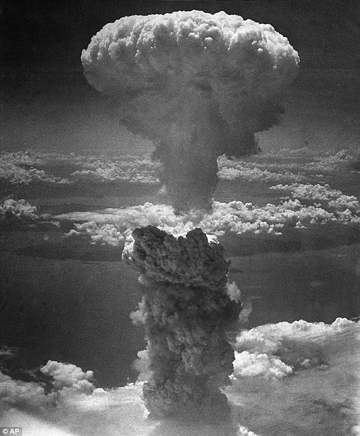 When it comes to nuclear tests in Nevada, numbers just don’t add up, https://m.lasvegassun.com/news/2020/aug/09/when-it-comes-to-nuclear-tests-in-nevada-numbers-j/ Sunday, Aug. 9, 2020
On the anniversary of a meaningful day in history, we present this argument opposing the Trump administration’s idea of resuming live testing of nuclear weapons near Las Vegas.
75: Years ago, to the day, when the last atomic bomb was dropped in anger.
110,000-210,000: Estimated death toll of the bombs dropped on Hiroshima and Nagasaki on Aug. 6 and Aug. 9, 1945, respectively.
2,000-plus: Nuclear tests that have been conducted since the end of World War II by the U.S., Russia and six other countries.
1,021: Number of detonations that occurred in 928 tests conducted in Nevada, with some tests involving more than one device.
100: Number of above-ground detonations in Nevada from 1951 to 1962.
65: In miles, the distance between Las Vegas and the Nevada Test Site (now the Nevada National Security Site).
74: Yield, in kilotons, of the largest above-ground device detonated at the Nevada Test Site, which occurred in 1957. The bomb delivered the equivalent of 74,000 tons of TNT.
35: Combined yield, in kilotons, of the bombs dropped on Hiroshima and Nagasaki.
5: Number of men who were positioned below a nuclear explosion in July 1957 for a government film designed to prove to the public that above-ground testing was safe. The film was part of a larger, years-long campaign to convince Nevadans and our neighbors not to worry about the effects of testing.
11,000: Number of cancer deaths stemming from above-ground testing in Nevada, as estimated by the Centers for Disease Control and Prevention in a 2003 report. That number is disputed, however, with some researchers saying the death toll may have been many times that based on how far the fallout would have traveled. One study estimated the minimum number of dead at 145,000.
1.3: Yield, in megatons, of the largest detonation at the site, part of the “Boxcar” underground test of 1968. That’s the equivalent of 1.3 million tons of TNT.
20: According to one estimate, the above-ground tests in Nevada sent 20 times more radioactive material into the atmosphere than was released during the Chernobyl catastrophe.
$2 billion: Amount Congress would eventually pay to Nevadans and downwinders exposed to radiation from test blasts.
1.6 trillion: Gallons of groundwater contaminated by radiation from below-ground tests, according to one estimate. That equates to 16 years worth of Nevada’s allotment of water from the Colorado River.
28: Years that have passed since the United States placed a moratorium on nuclear testing.
0: Number of detonations currently needed to ensure that stockpiled nuclear weapons are safe, secure, reliable and effective. Modern computers and physics equipment have made live testing unnecessary.
0: Number of Southern Nevada’s congressional delegates who support resumption of nuclear testing at the site. Sens. Catherine Cortez Masto and Jacky Rosen, and Reps. Dina Titus, Susie Lee and Steven Horsford, all spoke out in opposition. In a prepared statement, Rosen said Nevadans “do not want to return to a time when the ground shook and radiation exposure was a fact of life,” and that “any actions that could place Nevadans’ health and safety at risk should be off the table.”
0: Number of tests that would be allowed at the site under legislation introduced by Titus and recently approved by the House. “I did not introduce this ban lightly, but it was necessary to prevent President Trump from recklessly threatening Nevadans’ health and potentially restarting a global arms race,” Titus said in a prepared statement.
0: The number of reasons we can find to support Trump’s plan.
Purpose of nuclear bombing of Nagasaki? to test a new weapon – an immoral purpose
 Harry Truman and the nuclear bombs dropped on Hiroshima and Nagasaki, Frank Jackson, 9 Aug 20 Whether the bombing of Hiroshima or the entry of the Soviet Union into the war was the crucial event in causing the Japanese surrender can never be conclusively settled (Hiroshima at 75: bitter row persists over US decision to drop the bomb, 5 August). However, very little is said about the motives for the second bomb, on Nagasaki three days later. Few argued that it was necessary to reinforce the message of Hiroshima. Rather, the military and scientific imperative was to test a different bomb design – “Fat Man”, an implosion type using plutonium, as opposed to the uranium of Hiroshima’s “Little Boy”. To my mind that, destroying a mainly civilian city for such reasons, makes it even more of a war crime, if that is possible, than the bombing of Hiroshim.a
Former co-chair, World Disarmament Campaign https://www.theguardian.com/world/2020/aug/07/harry-truman-and-the-nuclear-bombs-dropped-on-hiroshima-and-nagasaki
Trump administration keen for nuclear power, – so is Joe Biden
 Trump Administration Pivots To Nuclear Energy, Finds Lever Against China, Russia, Forbes, Dipka Bhambhani, 9 Aug 20, Trump Administration Pivots To Nuclear Energy, Finds Lever Against China, Russia, Forbes, Dipka Bhambhani, 9 Aug 20, Expanding U.S. commercial nuclear power abroad could become the Trump administration’s strongest lever against Chinese hegemony and Russian expansion in the global market. The U.S. Department of Energy, which is leading the national initiative, is on an aggressive timeline—five to seven years—to bring new advanced nuclear reactors for electric power to the international market. A senior Energy Department official told Forbes it’s a matter of national security……. a year ago, President Trump asked his Energy Secretary, Dan Brouillette, to assemble a nuclear energy working group to find ways to expand the U.S. nuclear energy industry in an effort to compete globally. ……
This May, DOE released Restoring America’s Competitive Nuclear Energy Advantage, a blueprint to transform a U.S. nuclear industry notorious for massive facilities, long construction timelines, cost overruns and a sour public opinion.
Baranwal has launched the $230 million Advanced Reactor Demonstration Program (ARDP) currently calling on the U.S. private sector to apply to demonstrate they can construct smaller, more efficient, more affordable advanced reactors that can be commercially available within five to seven years. Applications are due August 12.
…..the issue is bipartisan, giving it breath to continue regardless of who wins in the presidential election in November.
For about a dozen years, the U.S. government poured money into nuclear energy research and development (R&D) at DOE’s national laboratories. Now, the U.S. government will use those existing platforms, resources, materials and expertise to help commercialize private sector innovation and bring new nuclear reactors to the world market. ……. Government Financing for Nuclear is Lining Up DOE’s blueprint tacitly instructed the U.S. Development Finance Corporation (DFC), formerly the Overseas Private Investment Corporation, to remove legacy policies that prevented it from investing in nuclear power projects overseas. A few weeks ago, DFC did just that. It said it would “prioritize support of advanced nuclear technology in emerging and frontier markets that adheres to the highest safety standards.” DOE also cited a role for the U.S. Export-Import Bank (EXIM Bank). Last November, Republican and Democratic lawmakers agreed to President Trump’s request to reauthorize the country’s export credit agency. EXIM Bank is chartered to finance and facilitate the sale of U.S.-made products for export. Forbes reported extensively on the long-term value of the reauthorization, proving useful for global nuclear energy. …… Chinese officials told Forbes the country would be willing to sign new 123 agreements with the U.S. and welcomes continued cooperation, not an adversarial relationship. China and the U.S. established a 123 agreement about two decades ago led by the DOE’s assistant secretary of international affairs in the Clinton administration, Robert Gee, now president of Gee Strategies Group in Washington. Zheng Dongdong, director of China’s Department of Energy Research, said, “Nuclear energy expansion is a global issue that should be considered with global perspective.” Zheng is also China’s assistant secretary-general of the Energy Investment Professional Committee under the Investment Association of China, an administrative arm of China’s Ministry of Civil Affairs, which promotes global investment in China. Zheng said the energy relationship with the U.S. has not always been strained. In 2007, China, the United States, France, Japan, and Russia jointly established the Global Nuclear Energy Partnership, a multilateral effort to share R&D of advanced nuclear energy technologies, adopt safe, reliable global nuclear energy power systems and promote nonproliferation. “This is a good platform and a very effective means to strengthen global nuclear energy cooperation,” Zheng said…… https://www.forbes.com/sites/dipkabhambhani/2020/08/07/trump-administration-pivots-to-nuclear-energy-finds-lever-against-china-russia/#70baa6f547b1 |
|

Nuclear testing: ‘Why do we need to start a new arms race?’
|
Nuclear testing: ‘Why do we need to start a new arms race?’
Provision in National Defense Authorization Act to ban testing, Big Country, by: Alexandra Limon Aug 7, 2020 WASHINGTON (Nexstar) — The United States has not conducted live nuclear weapons tests for 28 years. But reports indicate the Trump Administration has discussed re-starting the nuclear testing program.
That has Democrats from the areas impacted by past testing — in Nevada and Utah — pushing a provision in this year’s National Defense Authorization Act to ban new nuclear tests. “It would prevent this administration or any in the future from using funds to restart nuclear weapons testing,” said Nevada Rep Dina Titus, who introduced the bill with support from Utah’s Ben McAdams. “Thousands and thousands of Utahns have developed cancer and died from those tests. And I think it’s important that we don’t see that testing resume,” he said. The ban on live nuclear testing was included in the House version of the NDAA, but it’s unclear if it will make it into the final version. “We can test our stockpile without doing tests with yield and our scientists have been doing it for over 20 years,” Titus said. “Why do we need to start a new arms race?”……. The National Defense Authorization Act likely won’t be finalized until after the November election. https://www.bigcountryhomepage.com/news/politics/nuclear-testing-why-do-we-need-to-start-a-new-arms-race/ |
|
-
Archives
- October 2026 (129)
- September 2026 (339)
- August 2026 (330)
- July 2026 (355)
- June 2026 (287)
- May 2026 (306)
- April 2026 (356)
- March 2026 (251)
- February 2026 (267)
- January 2026 (308)
- December 2025 (358)
- November 2025 (359)
-
Categories
- 1
- 1 NUCLEAR ISSUES
- business and costs
- climate change
- culture and arts
- ENERGY
- environment
- health
- history
- indigenous issues
- Legal
- marketing of nuclear
- media
- opposition to nuclear
- PERSONAL STORIES
- politics
- politics international
- Religion and ethics
- safety
- secrets,lies and civil liberties
- spinbuster
- technology
- Uranium
- wastes
- weapons and war
- Women
- 2 WORLD
- ACTION
- AFRICA
- Atrocities
- AUSTRALIA
- Christina's notes
- Christina's themes
- culture and arts
- Events
- Fuk 2022
- Fuk 2023
- Fukushima 2017
- Fukushima 2018
- fukushima 2019
- Fukushima 2020
- Fukushima 2021
- general
- global warming
- Humour (God we need it)
- Nuclear
- RARE EARTHS
- Reference
- resources – print
- Resources -audiovicual
- Weekly Newsletter
- World
- World Nuclear
- YouTube
-
RSS
Entries RSS
Comments RSS

