Senators Warn Trump Saudi-Chinese Uranium Plant Risks Spread of Nuclear Weapons
 Senators Warn Trump Saudi-Chinese Uranium Plant Risks Spread of Nuclear Weapons, WSJGroup of Democratic and Republican lawmakers request briefings on the matter, in letter to the president, By Warren P. Strobel, Aug. 19, 2020 , WASHINGTON—A bipartisan group of U.S. senators warned President Trump on Wednesday that Saudi Arabia’s undeclared nuclear and missile programs pose a serious threat to efforts to stop the spread of nuclear weapons in the region and requested briefings on the subject.
The letter follows a Wall Street Journal report earlier this month that the Saudis, with Chinese help, had constructed a facility for extracting uranium yellowcake from uranium ore, an advance in the oil-rich kingdom’s drive to master nuclear technology, according to Western officials.
“Saudi Arabia is positioning itself to develop the front-end of the [nuclear] fuel cycle. These technologies, if unchecked, would give Riyadh a latent capacity to produce fissile material for nuclear weapons,” Sen. Chris Van Hollen (D., Md.), along with two other Democratic and three Republican senators, wrote in a letter to the president.
The Saudi Energy Ministry earlier this month categorically denied having built a uranium ore facility in the area of northwest Saudi Arabia described by some of the Western officials. It said that extraction of minerals—including uranium—is a key part of the country’s economic diversification strategy.
Manufacturing uranium yellowcake, a milled form of uranium ore, is a relatively early step in the nuclear cycle. It takes multiple additional steps and technology to process and enrich uranium sufficiently for it to power a civil nuclear energy plant. At very high enrichment levels, uranium can fuel a nuclear weapon……. (subscribers only) https://www.wsj.com/articles/senators-warn-trump-saudi-chinese-uranium-plant-risks-spread-of-nuclear-weapons-11597860000
See this How the climate crisis is already harming America – photo essay
 How the climate crisis is already harming America – photo essay
The damage rising temperatures bring is been seen around the country, with experts fearing worse is to come, Guardian , by Oliver Milman in New York, with photographs compiled by Gina Lachman 21 Aug 20
Climate change is not an abstract future threat to the United States, but a real danger that is already harming Americans’ lives, with “substantial damages” to follow if rising temperatures are not controlled.
This was the verdict of a major US government report two years ago. The Trump administration’s attitude to climate change was perhaps illustrated in the timing of the report’s release, which was in the news dead zone a day after Thanksgiving.
The report was the fourth National Climate Assessment (NCA), and is seen as the most authoritative official US snapshot of the impacts of climate change being seen already, and the estimate of those in the future.
It is the combined work of 13 federal agencies, and it warns how climate-related threats to Americans’ physical, social and economic wellbeing are rising, and will continue to grow without additional action.
Here we look at the regions of the US where it describes various impacts, with photography from these areas showing people and places in the US where climate change is very real.
If there was a ground zero for the climate crisis in the US, it would probably be located in Alaska. The state, according to the national climate assessment, is “ on the front lines of climate change and is among the fastest warming regions on Earth”.Sign up to the Green Light email to get the planet’s most important stories
Since the early 1980s, Alaska’s sea ice extent in September, when it hits its annual minimum, has decreased by as much as 15% per decade, with sea ice-free summers likely this century. This has upended fishing routines for remote communities that rely upon caught fish for their food.
The thinning ice has seen people and vehicles collapse into the frigid water below, hampering transport routes.Roads and buildings have buckled as the frozen soils underneath melt. Wildfires are also an increasing menace in Alaska, with three out of the top four fire years in terms of acres burned occurring since 2000. The state’s residents are grappling with a rapidly changing environment that is harming their health, their supply of food and livelihoods.
Last year was the hottest year on record in Alaska, 6.2F warmer than the long-term average.
North-east – snowstorms, drought, heatwaves and flooding…………
Northern Great Plains – flash droughts and extreme heat………
Midwest – heavy rains and soil erosion……
South-east – flooding in Louisiana………
Southern Great Plains – Hurricane Harvey……
South-west – drought in the Colorado river basin reduced Lake Mead by more than half since 2000…….
North-west – wildfire increases and associated smoke…..
Hawaii and Pacific islands – coral bleaching….….
Caribbean – hurricanes…. https://www.theguardian.com/us-news/2020/aug/20/climate-crisis-environment-america
Growing national opposition to Holtec plan for ‘temporary’ storage of nuclear wastes near Carlsbad, New Mexico

Nationwide opposition of a nuclear waste storage facility proposed to be built near Carlsbad and Hobbs continued its call for the licensing process for the project to be suspended during the COVID-19 pandemic and that the federal Nuclear Regulatory Commission deny the application altogether.
Holtec International proposed to build the site to store high-level spent nuclear fuel rods transported to southeast New Mexico from generator sites across the county.
Many of the rods are already stored in cooling pools near the generator sites, which supporters of the project said were unsafe as many are located near large bodies of water or densely populated areas.
The concept of Holtec’s consolidated interim storage facility (CISF) was to temporarily store the spent fuel in a remote location while a permanent repository was developed.
Such a facility to permanently store the waste does not exist in the U.S.
The idea faced opposition from New Mexico Gov. Michelle Lujan Grisham and State Land Commissioner Stephanie Garcia Richard along with other state lawmakers.
And during a Thursday public hearing held by the NRC, numerous nuclear watchdog groups from around the country voiced their opposition.
The NRC announced last week it would hold four such online hearings including Thursday’s with others scheduled for Aug. 25, 26 and Sept. 2 to solicit public comments on the Commission’s recently released environmental impact statement (EIS).
The EIS released earlier this year found the project would have minimal environmental impacts during the construction, operation and decommissioning of the facility.
The EIS was required for the first phase of Holtec’s plan for 500 cannisters to be stored, but the NRC also considered the company’s expressed intention to apply for future permits for 19 additional phases for a total of 10,000 cannisters of nuclear waste.
Leona Morgan of the Nuclear Issues Study Group based in Albuquerque said the online hearing process was unjust as many New Mexicans live without adequate internet or phone service to participate in electronic hearings.
While she called for the NRC to reject Holtec’s application, citing safety and environmental risks to the region of the facility and communities along the transportation routes, Morgan also questioned the hearing process itself as it continued during the global pandemic.
Leona Morgan of the Nuclear Issues Study Group based in Albuquerque said the online hearing process was unjust as many New Mexicans live without adequate internet or phone service to participate in electronic hearings.
While she called for the NRC to reject Holtec’s application, citing safety and environmental risks to the region of the facility and communities along the transportation routes, Morgan also questioned the hearing process itself as it continued during the global pandemic.
The Nuclear Issues Study Group, which held a continued presence during the past three public hearings held this year, and NRC’s scoping meetings held in 2018, would boycott the rest of the proceedings, Morgan said.
“There are a large portion of our state that lives without phone or internet service. Our organization is boycotting the rest of these proceedings. It is a sham. There is no reason to rush this process except to line the pockets of shareholders,” she said.
“We see this as a violation of our rights to submit our public comments under the National Environmental Policy Act. And it violates environmental justice. We can’t even verify that the NRC is sitting before us.”
More:Nuclear waste site near Carlsbad opposed by indigenous groups during public hearing
John LaForge, of nuclear watchdog group Nukewatch of Wisconsin also voiced his opposition to the project and ongoing proceedings, pointing to widespread opposition in New Mexico and among Tribal nations.
He demanded public hearings be held in up to 40 states other than New Mexico that could be impacted by the transportation of waste.
“There is no compelling reason at this time for these meetings to be rushed. I opposed this plan due to the governors of New Mexico and of 20 tribal nations,” LaForge said. “With these online meetings, it is apparent to me that the NRC has no interest in the public’s concerns. The people of New Mexico have said no.”
He also criticized the EIS as the NRC noted in the report it would expect no radiation release should there be an accident at the facility.
“In its review, the NRC said it assume in an accident there would be no release of radiation,” LaForge said. “That is alarming and preposterous.”
Petuuche Gilbert of the Acoma Coalition for a Safe Environment based in the Acoma Pueblo near Albuquerque also questioned the EIS as it only considered the environmental impacts of the project for 40 years and only within a 50 mile radius.
“We believe the analysis needs to go beyond the 40 year possibility of storing the waste. We all know the nuclear waste and radioactivity extends beyond that limited timeframe. It really needs to go on for hundreds or thousands of years,” Gilbert said.
“You have the possibility of accidents that could occur along the transportation corridors. The cumulative analysis is limited only to a 50 mile radius. It really needs to be more.”
Adrian Hedden can be reached at 575-628-5516, achedden@currentargus.com or @AdrianHedden on Twitter.
California: 10,849 lightning strikes spark more than 367 fires
|
More than 300,000 acres burned in three days as resource-depleted Calif. battles blazes 10,849 lightning strikes spark more than 367 firesBy Amy Graff, SFGATE, August 19, 2020 In the grips of a rare summer weather pattern marked by blistering heat and violent thunderstorms, California has seen hundreds of wildfires sparked by lightning strikes erupt into monstrous conflagrations that are tearing through a parched landscape and swallowing homes.
Cal Fire spokesperson Jeremy Rahn spoke to the extreme conditions at a Wednesday press briefing and said in the last three days the state experienced a “historic lightning siege” with 10,849 lightning strikes starting more than 367 fires in three days. In all, these fires have burned 300,000 acres, he said. More than 69,000 federal, state and local personnel are battling flames. “Firefighting resources are depleted as new fires continue to ignite,” Rahn said. The state has requested 375 fire engines from other states as well as hand crews as the demand for resources has surpassed availability. Nearly all available private firefighting aircraft in the Western U.S. have been hired and assigned to the incidents. “The size and complexity at which these incidents are burning is challenging all aspects of emergency response,” Rahn said. “It’s important that the community heeds the warnings of law enforcement and remain prepared to evacuate at a moment’s notice.” The greater San Francisco Bay Area is seeing some of the most severe wildfire conditions. Police and firefighters went door-to-door before dawn Wednesday in a frantic scramble to warn residents to evacuate as fire encroached on Vacaville, a city of about 100,000 between San Francisco and Sacramento. At least 50 structures were destroyed, including some homes, and 50 damaged. “This is an incredibly emotional and stressful time for most of us who’ve endured a number of wildfires over the last few years,” said Sonoma County Sheriff Mark Essick.
Ash and smoke filled the air in San Francisco, which is surrounded by wildfires burning in multiple counties to the north, east and south. The LNU Lightning fire is made up of several fires burning in five counties north of San Francisco, including in Vacaville, and had consumed 72 square miles as of Wednesday morning (186 square kilometers)………… In the East San Francisco Bay, a cluster of 20 separate lightning-sparked fires called the SCU Lightning complex was threatening about 1,400 structures in rugged terrain with dense brush. The fires have torched 133 square miles (344 square kilometers). To the south of San Francisco in San Mateo and Santa Cruz counties, about 22,000 people were ordered to evacuate because of a fire burning in dense wooded parkland that threatened communities, Cal Fire spokesman Jonathan Cox said. About 22 fires are part of the complex and most had been burning in relatively remote, dense brush until strong winds overnight Tuesday pushed them into more populated areas, merging some of the fires together. Resources are strapped, he said, given the number of fires burning in California. “We’re in the unfortunate position where firefighters are going to be spending several days out on the fire line,” he said. “It’s grueling, it’s exhausting.” Christopher Godley, Sonoma County’s emergency management director, also conceded that resources are thin. “It’s difficult to second guess what the fire commanders are doing with their aircraft. But it’s not like last year when we saw just a huge wealth of resources flowing into the county,” he said. “It is what it is.” The cluster of wine country fires threatens an area that only last year grappled with another massive blaze that forced 200,000 to flee — a task made more complicated this year because of the pandemic. The Associated Press contributed to this story. https://www.sfgate.com/bayarea/article/California-fires-2020-lightning-total-acreage-15496403.php?utm_campaign=CMS&fbclid=IwAR19z_-L1kTTmmf0btDiMiWwRUk0FaiXAjwGg5Bb5VQ59catMA6cfpZWJkc  |
|
As climate extreme weather impacts grow, American nuclear reactors are threatened
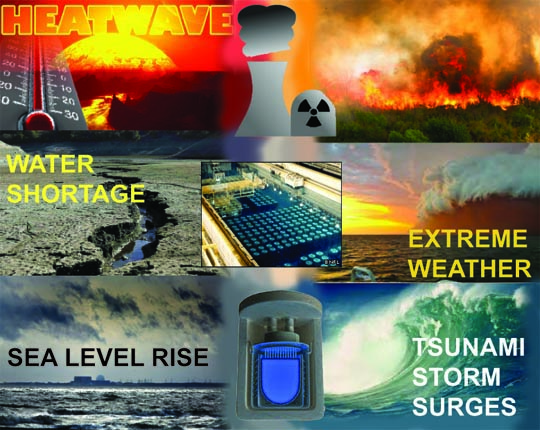 Mounting Climate Impacts Threaten U.S. Nuclear Reactors, Scientific American, Higher temperatures, rising flood risks and increased water stress mean facilities need to take additional resiliency measures, By Avery Ellfeldt, E&E News on August 20, 2020
Soaring temperatures, intensified flood risks and heightened water stress will threaten 57 U.S. nuclear plants over the next 20 years, forcing operators to take additional resiliency measures, according to a new report.
“The consequences of climate change can affect every aspect of nuclear plant operations—from fuel handling and power and steam generation to maintenance, safety systems and waste processing,” said the analysis, which was published yesterday by Moody’s Investors Service.
Analysts used data from Four Twenty Seven, a Moody’s affiliate that provides climate risk intelligence, to examine threats to operating nuclear plants.
“It looks like almost all plants see some kind of climate risk worsening over the next 20 years,” said David Kamran, the report’s author.
The study also underscored that the nuclear sector’s vulnerability to regional climate risks in large part depends on plants’ proximity to water.
Because nuclear generation facilities rely on external water sources for cooling, the vast majority are situated near rivers, lakes and oceans. That exposes them to flooding and storm surges, which can damage critical equipment.
The Four Twenty Seven data show 37 gigawatts of U.S. nuclear capacity is overly exposed to flood risk.That includes plants along the East and Gulf coasts, which are likely to grapple with rising sea levels and intensifying hurricanes in the decades to come. Storm-related rainfall, the reports adds, could “inundate” nuclear facilities and “damage transmission lines or substations, hindering a plant’s ability to deliver power.”
Facilities in the Midwest and South Florida, meanwhile, are more likely to suffer from higher temperatures that have the potential to reduce plants’ ability to generate power. The generation process involves creating steam, which is then cooled and condensed into liquid for reuse.
“If the temperature of incoming water to cool and condense steam is too high, or if the temperature of the discharge water is too high, power plants can be forced to curtail production or shut down temporarily,” the report says.
Facilities in the Rocky Mountain region, near the Colorado River and in California, on the other hand, are projected to face water scarcity, spiking uncertainty about having long-term access to necessary water supplies……. https://www.scientificamerican.com/article/mounting-climate-impacts-threaten-u-s-nuclear-reactors/
City of Logan cuts its losses, withdraws from risky NuScam “small” nuclear reactor project
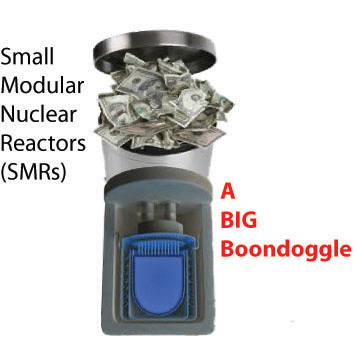 Logan withdraws from risky nuclear power project, Cache Valley
  Daily Charlie Schill August 19, 2020 LOGAN – Members of the Logan City Council voted Tuesday to end the city’s partnership in an increasingly expensive nuclear power project.
As a member of the Utah Associated Municipal Power Systems (UAMPS), Logan City owned a partial interest in a first-of-its-kind nuclear plant proposed to be constructed at the Idaho National Laboratory.
Faced with Sept. 15 deadline to ante up more funding for the risky project, both Mark Montgomery, the city’s light and power director, and Logan Finance Director Richard Anderson recommended that Logan withdraw from the Carbon Free Power Project…….
Montgomery told city council members that Logan had invested about $400,000 in the Small Modular Reactor (SMR) project since 2017. If the city had opted to continue its participation in the project into its initial licensing phase through 2023, the price tag would have been another $654,000.
In early August, the Utah Taxpayers Association urged all Utah cities to reconsider their participation in the SMR project due to its potential for out–of-control costs………
In the original CFPP proposal, the U.S. Department of Energy was to foot the bill for the development of the project’s first module. After pledging up to $1.4 billion for those expenses, federal officials have since backed out of that agreement, leaving UAMPS holding the bag for the project’s first-of-its-kind risks.
Montgomery added that estimated cost of the project have also escalated since 2017, jumping from $3.6 billion to $6.1 billion as of July of this year……… https://www.cachevalleydaily.com/news/archive/2020/08/19/logan-withdraws-from-risky-nuclear-power-project/#.X0BMOOgzbIU
Debate rages on for nuclear waste facility proposed near Carlsbad, more hearings scheduled
|
Debate rages on for nuclear waste facility proposed near Carlsbad, more hearings scheduled
Adrian Hedden, Carlsbad Current-Argus, 20 Aug 20, A project to build a temporary storage facility for high-level nuclear waste in southeast New Mexico will continue to be debated as the federal Nuclear Regulatory Commission scheduled four more public hearings to solicit public feedback on the proposal.Holtec International’s proposed consolidated interim storage facility (CISF) would temporarily hold spent nuclear fuel rods at the surface in an area near the Eddy-Lea county line…….. opponents continued to question the safety of the project and its plan to transport spent nuclear fuel from generators across the county and the legality of opening a temporary storage facility when the U.S. lacks a permanent repository for high-level nuclear waste…… The hearings were planned to be held online on Aug. 20 from 4 to 7 p.m., Aug. 25 from noon to 3 p.m., Aug. 26 from 4 to 7 p.m. and Sept. 2 from 9 a.m. to noon. Previously, the NRC held public meetings on the EIS on June 23 and July 9. Written comments were to be accepted until Sept. 22 via email to Holtec-CISFEIS@nrc.gov, via mail to the Office of Administration, Mail Stop: TWFN-7-A60M, ATTN: Program Management, Announcements and Editing Staff, U.S. Nuclear Regulatory Commission, Washington, DC or online to the federal government’s rulemaking page at regulations.gov using docket ID NRC-2018-0052………… Project debated by New Mexico officials, nuclear industry leadersNew Mexico Gov. Michelle Lujan Grisham and state officials voiced continued disapproval of the project, with Lujan Grisham writing a letter to President Donald Trump to voice her opposition last month. Lujan Grisham cited concerns the project could imperil the environment in New Mexico and threaten to disrupt local agriculture and extraction industries in the southeast region of the state…….. https://www.currentargus.com/story/news/local/2020/08/20/debate-rages-nuclear-waste-facility-proposed-near-carlsbad/5604978002/ |
|
U.S. Democratic Party not really interested in reducing the bloated military spending

War, Peace and the Democrats, Common Wonders, Wednesday, August 19th, 2020 By Robert C. Koehler
 “There’s something happening here/What it is ain’t exactly clear . . .”
Or is it? “……………………………Yes, there are progressive, antiwar Democrats out there, gaining power, getting elected to office, almost winning presidential primaries — scaring the bejesus out of the Democratic establishment — but the party itself still stands firmly in the middle of nowhere, fully in favor of empathy and compassion and yet, somehow, fully supportive of the endless wars most of its own voters hate and utterly unwilling to challenge the bloated and ever-expanding defense budget.Citing the analysis of William Hartung and Many Smithberger, the Milwaukee Independent described that budget thus: “As of 2019, the annual Pentagon base budget, plus war budget, plus nuclear weapons in the Department of Energy, plus military spending by the Department of Homeland Security, plus interest on deficit military spending, and other military spending totaled $1.25 trillion . . .”
Indeed, as Alexander Sammon points out in the American Prospect, Democratic majorities were crucial this summer to the defeat of three separate bills, introduced by progressive Democrats, to reduce military spending and/or undo the militarization of police departments. These included amendments in both the Senate and the House to the National Defense Authorization Act, diverting 10 percent of the Department of Defense budget to health care, education and jobs; as well as a Senate proposal to end the 1033 Program, which allows the Pentagon to transfer military gear to the police. The amendment’s defeat in the House was especially an outrage, Sammon notes, in that the Dems hold a majority in the House and could have passed it.
“If Democrats are going to enact anything that resembles their own agenda,” Sammon writes, “they’re going to have to aim way higher than cutting defense to near Obama-era highs. Taking military spending not to pre-Trump but to pre-9/11 levels should be a starting point. Democratic voters abhor the War on Terror; it’s what helped deliver Obama the presidency back in 2008. It’s incumbent on Joe Biden to deliver on that preference, not just to end engagements in Iraq and Afghanistan but to bring an end to the bloated defense budgets of the War on Terror era. His silence on the proposal even in the thick of a campaign against Trump sends a troubling message.”
Climate, weather extremes, threaten nuclear reactors, and costs of preparing for them are increasing
Dozens of US nuclear power plants at risk due to climate change: Moody’s, S and P Global, Author Steven Dolley Washington Editor, Keiron Greenhalgh 19 Aug 20
37 GW of nuclear capacity at risk from flooding
48 GW at risk from heat, water stress
Merchant plants have fewer options to recover mitigation costs
Washington — Dozens of US nuclear power plants, comprising nearly half the country’s operational nuclear generating capacity, “will face growing credit risks” in the next 10 to 20 years due to flooding, hurricanes, heat stress and other predicted impacts of climate change, Moody’s Investors Service said in a report Aug. 18.
“The consequences of climate change can affect every aspect of nuclear plant operations – from fuel handling and power and steam generation to maintenance, safety systems and waste processing,” the report said, noting that “the severity of these risks will vary by region, with the ultimate credit impact depending on the ability of plant operators to invest in mitigating measures to manage these risks.”
Moody’s did not specify mitigation measures that are being, or should be, taken.
Water cooling needs expose plants to the risk of flooding, sea-level rise and hurricanes, and “about 37 gigawatts (GW) of US nuclear capacity [have] elevated exposure to flood risk,” Moody’s said.
Also, the report noted, “rising heat and water stress can have an adverse impact on plant operations,” with “about 48 GW of nuclear capacity [having] elevated exposure to combined rising heat and water stress.”
“Regulated or cost-based nuclear plants,” comprising about 55 GW of capacity in the US, “face elevated heat and water stress across most locations, with moderate to high risk of floods, hurricanes, and sea level rise for certain coastal plants,” Moody’s said. However, it added: “The credit impact of these climate risks is likely to be more modest for operators of these nuclear plants, relative to market-based plants, because they have the ability to recoup costs through rate recovery mechanisms.”
By contrast, “market-based plants,” with a total of about 44 GW of capacity, “face elevated heat stress and more water stress than regulated/cost-based plants, with fewer plants at risk of floods and hurricanes,” it said.
The highest risk, or “red flag,” category includes plants that are “highly exposed to historical and/or projected risks, indicating high potential for negative impacts,” Moody’s said.
According to the report, five plants with a combined capacity of about 9.1 GW are in the red flag category for floods. Some 13 plants with a combined capacity of about 23.8 GW were found to be at red-flag risk for heat stress. The categories of hurricanes, sea level rise and water stress each had one plant expected to be at red-flag risk.
Because some US nuclear units “are seeking to extend their operations by 20, or even 40 years,” Moody’s said, “operators will have to consider these risks when implementing resilience measures.”………. https://www.spglobal.com/platts/en/market-insights/latest-news/electric-power/081820-dozens-of-us-nuclear-power-plants-at-risk-due-to-climate-change-moodys
Climate change a problem for nuclear waste dumps
 Climate change included in nuclear waste study, Dryden now, August 2020 by Mike Aiken
 Experts with the Nuclear Waste Management Organization are adjusting their forecasts for the Ignace area, so they include the possibility of more rainfall. The adjustment will allow for climate change, including the possibility of extreme weather and increased flooding.
“This is the first time this modelling work has been done for a potential repository location and any assessment of sites for the safe storage of used nuclear fuels must take into account the potential future impact of climate change on its infrastructure,” said Kelly Liberda, who is a senior engineer with Golder Associates, who are working on the site selection process.
“While it’s difficult to project the extent to which precipitation could fluctuate in specific geographic areas, the NMWO is taking steps to anticipate the most likely scenarios,” Liberda added.
Based on a multi-model assessment of publicly available data, the Golder Associates study found that both one-day probable maximum precipitation and one-day rainfall events in the Ignace study area are projected to increase in the 2050s and 2080s. …….
Global heating now posing physical and financial risks to U.S. nuclear reactors
|
A new report from Moody’s shows that a warming world may cause more service disruptions in the US. Climate change—particularly intense heat—is advancing so rapidly that it poses physical as well as credit risks to America’s aging nuclear fleet, a new report from Moody’s Investors Service finds. “Our plants are fairly hardened to severe weather,” said David Kamran, a projects and infrastructure analyst at Moody’s and the lead author of the report. “But climate change is moving quickly.” ……… in 2011, the US Nuclear Regulatory Commission asked domestic plants to conduct their own assessments of risks from climate change and other natural hazards. A 2019 Bloomberg review of correspondence between the commission and owners of 60 plants concerning those assessments found that 54 of their facilities weren’t designed to handle the flood risk they now face. ……. The new report is the result of an analysis conducted by Four Twenty Seven Inc, a climate risk data company Moody’s acquired last year. The group evaluated the potential effects of heat stress, water stress, hurricanes, flooding, and rising sea levels on 57 US nuclear power plants over the next 20 years. It found that while a handful of plants—including Cooper Nuclear Station in Nemaha, Neb. and Prairie Island in Goodhue, Minn.—face severe risk from floods, far more either will face or already face “red flag” conditions from heat. Nuclear plants are cooled by water, and in times of intense heat and drought, water resources can become either too warm or too scarce, forcing shutdowns. This has already happened, and not just in the South: in 2012, Dominion Energy Inc’s Millstone nuclear plant in Waterford, Conn. The report predicts that nuclear plants in the Rocky Mountain states, the Colorado River region, and California face the highest levels of water stress risk going forward. …… the report was meant to highlight the extent of the environmental pressures plants will have to adapt to withstand if they want to operate consistently in the coming decades. Resisting those stresses is potentially expensive— even more expensive than the plants have currently estimated, he said: “In certain cases they will need to make investments to further reinforce their plants and they need to have money in their cap-ex funds to do that.” https://www.livemint.com/news/world/nuclear-plants-face-more-heat-risk-than-they-re-prepared-to-handle-11597848362280.html |
|

Bill McKibben not sure that Kamala Harris will be strong on addressing climate change
|
We’re in the Kamala Harris era now, and so far, so good. Of the four people on the major-party Presidential tickets, she appears to be the most energetic and normal………. Listening to Joe Biden speak, I feel a constant mild apprehension about what may emerge; Harris relaxes me.
Given the very real possibility that she’ll be at or near the pinnacle of our politics for somewhere between four and sixteen years, it’s worth asking how she will handle the gravest crisis that looms over our planet. That’s not the same as asking if she should be elected, because, on climate issues, a shrink-wrapped pallet of frozen Ore-Ida French fries would be a vast improvement on the incumbent. But it’s going to take an unflinching, unrelenting effort to transform America’s energy system and lead a similar process globally. Is she committed to that?
Her defenders point to a number of powerful statements that she made over the course of her Presidential primary campaign. She’d eliminate the filibuster to pass a Green New Deal. She’d tell the Department of Justice to investigate oil and gas companies. ………
Harris has been particularly outspoken about environmental injustice: just six days before she got the V.P. nod, she joined Alexandria Ocasio-Cortez to introduce the Climate Equity Act, which, as the Times explained, “would create a dedicated Office of Climate and Environmental Justice Accountability within the White House and require the federal government to rate the effect that every environmental legislation or regulation would have on low-income communities.”
If there’s a rub, it’s that, to date, she hasn’t been that eager to really stand up to power on this issue. ……. What will she do if she becomes Vice-President? I imagine that her courage will depend on the climate movement’s success in eroding the political power of the oil companies. The weaker the fossil-fuel conglomerates become, the less scary they are. (Oil barons understand this, which is why they’re spending large sums to reëlect Trump). My guess is that Harris is a run-of-the mill politician, who will go where the footing is easiest. ………. (Note to Joe Biden.) The Sunrise Movement—the group of under-thirties who organized the sit-in at House Speaker Nancy Pelosi’s office that served as a coming-out party for the Green New Deal—produced a YouTube video for Markey last week, which may be my favorite political ad of all time. (Watch till the end for one of the best knife twists in campaign history). If Markey wins, he will go back to the Senate a national progressive hero; more to the point, he will have demonstrated that truly taking on climate change can pay off politically. That lesson won’t be lost on anyone, Harris included. ………. Obvious but important: a new study from Climate Central found that as temperatures rise, so does demand for air-conditioning. It projects that, by 2050, demand for air-conditioning will rise in the United States by fifty-nine per cent—and far more than that around the world. That is why we need highly efficient air-source heat pumps, which also cool air, and why we need enormous amounts of renewable electricity to power it all. …… Scoreboard ⬇️ Big number on the board this week: a hundred and thirty degrees Fahrenheit (54.4 degrees Celsius), which is the highest reliably recorded temperature ever on planet Earth. It happened over the weekend, in California’s Death Valley, which is also the place where the nominal Earth temperature record of a hundred and thirty-four degrees Fahrenheit was set, in 1931. That number, though, has been disputed ever since, and the great weather historian Christopher Burt published a lengthy investigation, in 2016, proving it could not have happened. For now, a hundred and thirty degrees is the mark—but don’t expect it to last. ……..Extraordinarily bad fire news from across the planet. In the Amazon, fires are burning at a rate not seen for a decade. In Siberia, fires may be burning at a rate we’ve never previously seen—and the heating, drying region may be on the verge of moving into a new and extreme “fire regime.” In Colorado and elsewhere in the American West, this year’s fire season has begun in earnest. The forests surrounding Hanging Lake—one of the state’s premier tourist sites—almost burned. The fourteen-year-old climate activist Haven Coleman reports via Twitter: “Even inside my house it’s hazy. . . . Feels like I’m being cornered, trapped. Stuck home since there’s covid everywhere, but NOW my home is becoming unbreathable. Everything sucks. Ugh.” Indeed. By midweek, evacuations were under way in California, where fires were threatening the city of Vacaville and other parts of Napa and Sonoma. …….The two-thousands were, officially, the hottest decade on record, up 0.39 degrees Celsius from the previous decade, which is a huge change in ten years’ time. It’s an urgent reminder that the next decade may be our final chance to take serious climate action A new study in Nature confirms that the effect of the pandemic on the planet’s temperature was negligible—greenhouse-gas emissions fell, but much of the smog that tends to cool the planet also disappeared. “These results highlight that without underlying long-term system-wide decarbonization of economies, even massive shifts in behaviour, only lead to modest reductions in the rate of warming,” the authors wrote. They also, however, noted some good news: “Pursuing a green stimulus recovery out of the post-covid-19 economic crisis can set the world on track for keeping the long-term temperature goal of the Paris Agreement within sight.” |
|

NuScam’s not so small nuclear reactors need $1.4 billion subsidy, and might not be so safe
 Smaller, cheaper [?] reactor aims to revive nuclear industry, but design problems raise safety concerns, Science, By Adrian Cho, Aug. 18, 2020 Engineers at NuScale Power believe they can revive the moribund U.S. nuclear industry by thinking small. Spun out of Oregon State University in 2007, the company is striving to win approval from the U.S. Nuclear Regulatory Commission (NRC) for the design of a new factory-built, modular fission reactor meant to be smaller, safer, and cheaper than the gigawatt behemoths operating today. But even as that 4-year process culminates, reviewers have unearthed design problems, including one that critics say undermines NuScale’s claim that in an emergency, its small modular reactor (SMR) would shut itself down without operator intervention.The issues are typical of the snags new reactor designs run into on the road to approval, says Michael Corradini, a nuclear engineer at the University of Wisconsin, Madison. “I don’t think these things are show-stoppers.” However, M. V. Ramana, a physicist who studies public policy at the University of British Columbia, Vancouver, and has been critical of NuScale, says the problems show the company has oversold the claim that its SMRs are “walk-away safe.” “They have given you the standard by which to evaluate them and they’re failing,” Ramana says.
Passive safety?
Normally, convection circulates water—laced with boron to tune the nuclear reaction—through the core of NuScale’s reactor (left). If the reactor overheats, it shuts down and valves release steam into the containment vessel, where it conducts heat to a surrounding pool and condenses (center). The water flows back into the core, keeping it safely submerged (right). But the condensed water can be low in boron, and reviewers worried it could cause the reactor to spring back to life………..
NuScale’s likely first customer, Utah Associated Municipal Power Systems (UAMPS), has delayed plans to build a NuScale plant, which would include a dozen of the reactors, at the Department of Energy’s (DOE’s) Idaho National Laboratory. The $6.1 billion plant would now be completed by 2030, 3 years later than previously planned, says UAMPS spokesperson LaVarr Webb. ……… The delay will give UAMPS more time to develop its application for an NRC license to build and operate the plant, Webb says. The deal depends on DOE contributing $1.4 billion to the cost of the plant, he adds.
……… A NuScale reactor—which would be less than 25 meters high, hold about one-eighth as much fuel as a large power reactor, and generate less than one-tenth as much electric power—would rely on natural convection to circulate the water
……….. In March, however, a panel of independent experts found a potential flaw in that scheme. To help control the chain reaction, the reactor’s cooling water contains boron, which, unlike water, absorbs neutrons. But the steam leaves the boron behind, so the element will be missing from the water condensing in the reactor and containment vessel, the NRC’s Advisory Committee on Reactor Safeguards (ACRS) noted. When the boron-poor water re-enters the core, it could conceivably revive the chain reaction and possibly melt the core, ACRS concluded in a report on its 5–6 March meeting.https://www.sciencemag.org/news/2020/08/smaller-cheaper-reactor-aims-revive-nuclear-industry-design-problems-raise-safety
Biggest bribery and money-laundering bust in Ohio history, but the crooked pro nuclear law still stands!
 Opinion: How bad nuclear plant bailout legislation got passed
Now the law is forcing Ohio taxpayers to cough up $1.3 billion in subsidies to prop up two aging nuclear plants – quashing cheaper natural gas and zero-emissions renewables like wind and solar. It also memorialized taxpayer subsidies for ailing coal plants – including, because Householder and his alleged co-conspirators were apparently feeling neighborly, for a coal plant across the border in Indiana.
But let’s not lose sight of FirstEnergy. The opaque electric utility had already long shirked accountability for its actions, cloaking itself in expendable subsidiaries and opposing virtually any measure to improve Ohio’s air and water, which the utility has long been responsible for befouling. This time, to protect its toxic nuclear and coal assets, the company apparently happily engaged in what even the scheme’s conspirators allegedly openly referred to as “pay to play,” buying Ohio lawmakers for a song compared to the $1.3 billion the utility now stands to skim from Ohioans’ pockets.
We have yet to see how many more dominoes fall. There’s Sam “The Randazzler” Randazzo, the supposed ex-lobbyist and current public utilities commission chair, who seems to have much to answer for in the scheme. And FirstEnergy, it appears, didn’t stop at allegedly buying Ohio politicians. Even after the law passed, it spent another $38 million in an apparent dark-money campaign to make sure it’d stopped Ohio’s vital transition to a clean energy economy – the prospect of thousands of new clean jobs, not to mention saving the Earth, apparently not enough when compared to FirstEnergy profit margins and executives’ Christmas bonuses
Even as the feds continue following the money, we know what must happen: Gov. DeWine, who unenthusiastically signed the bill, is now calling for its repeal – a crucial first step toward righting this eye-popping wrong. As we now know, courtesy of the FBI and Justice Department, supporting these ailing power plants was nothing more than a successful bid to line executives’ pockets – and, it seems, buy the house speaker a vacation home in Florida. As we continue to learn who knew what when, erasing this law will clear the way for cleaner, far cheaper, truly market-competitive resources like natural gas and renewables to power our homes and businesses.
Ohioans deserve better – more honest politicians, truly transparent electricity providers, cleaner air and water. Repealing this law, and holding our officials to account, is the way to get there.
Jigar Shah is president of Generate Capital, a San Francisco-based finance company that builds, owns and operates renewable energy infrastructure.
High financial risks in nuclear power – from global heating
Climate change poses high credit risks for nuclear power plants, Moody’s says, https://www.reuters.com/article/us-moody-s-powerplants/climate-change-poses-high-credit-risks-for-nuclear-power-plants-moodys-says-idUSKCN25E2A5 (Reuters) Reporting by Diptendu Lahiri in Bengaluru; Editing by Steve Orlofsky, 19 Aug 20
– Credit risks associated with climate change for nuclear power plant operators in the United States will rise over the next 10 to 20 years, Moody’s Investor Service said on Tuesday.Climate change can affect every aspect of nuclear plant operations like fuel handling, power and steam generation, maintenance, safety systems and waste processing, the credit rating agency said.
However, the ultimate credit impact will depend upon the ability of plant operators to invest in mitigating measures to manage these risks, it added.
Close proximity to large water bodies increase the risk of damage to plant equipment that helps ensure safe operation, the agency said in a note.
Moody’s noted that about 37 gigawatts (GW) of U.S. nuclear capacity is expected to have elevated exposure to flood risk and 48 GW elevated exposure to combined rising heat and water stress caused by climate change.
Nuclear plants seeking to extend their operations by 20, or even 40 years, beyond their existing 40-year licenses face this climate hazard and may require capital investment adjustments, Moody’s said.
“Some of these investments will help prepare for the increasing severity and frequency of extreme weather events.”
-
Archives
- October 2026 (129)
- September 2026 (339)
- August 2026 (330)
- July 2026 (355)
- June 2026 (287)
- May 2026 (306)
- April 2026 (356)
- March 2026 (251)
- February 2026 (267)
- January 2026 (308)
- December 2025 (358)
- November 2025 (359)
-
Categories
- 1
- 1 NUCLEAR ISSUES
- business and costs
- climate change
- culture and arts
- ENERGY
- environment
- health
- history
- indigenous issues
- Legal
- marketing of nuclear
- media
- opposition to nuclear
- PERSONAL STORIES
- politics
- politics international
- Religion and ethics
- safety
- secrets,lies and civil liberties
- spinbuster
- technology
- Uranium
- wastes
- weapons and war
- Women
- 2 WORLD
- ACTION
- AFRICA
- Atrocities
- AUSTRALIA
- Christina's notes
- Christina's themes
- culture and arts
- Events
- Fuk 2022
- Fuk 2023
- Fukushima 2017
- Fukushima 2018
- fukushima 2019
- Fukushima 2020
- Fukushima 2021
- general
- global warming
- Humour (God we need it)
- Nuclear
- RARE EARTHS
- Reference
- resources – print
- Resources -audiovicual
- Weekly Newsletter
- World
- World Nuclear
- YouTube
-
RSS
Entries RSS
Comments RSS

