Systemic corruption in the American nuclear industry

Big money, nuclear subsidies, and systemic corruption, Bulletin of the Atomic Scientists, By Cassandra Jeffery, M. V. Ramana | February 12, 2021
The “largest bribery, money-laundering scheme ever perpetrated against the people and the state of Ohio” came to light during an unexpected press conference in July 2020 in Columbus. Speaking haltingly and carefully, US Attorney for the Southern District of Ohio David DeVillers announced “the arrest of Larry Householder, Speaker of the House of the state of Ohio and four other defendants for racketeering. The conspiracy was to pass and maintain a $1.5 billion bailout in return for $61 million in dark money.”
Unravelling an intricate web of alleged illegal activities used to launder money, DeVillers broke down the complicated modus operandi of “Company A.” With a gentle smile on his face, he said, “everyone in this room knows who Company A is, but I will not be mentioning the name of Company A because of our regulations and rules. They have not, and no one from that company has as of yet, been charged”.
Company A is FirstEnergy Solutions, a fact most Ohians had been aware of long before the July 2020 press conference. FirstEnergy, now called Energy Harbour, is one of Ohio’s largest utility corporations. For years, the firm lobbied to get a subsidy to continue operating its unprofitable nuclear plants and maintain its revenue flow. When lobbying efforts failed to produce subsidies, it resorted to bribery to gain legislative support for House Bill 6, 2019 legislation that forces state consumers to pay into something called “the Ohio Clean Air Fund.” The green language is a smoke screen for the real purpose: to siphon nearly $150 million annually to FirstEnergy to keep its Perry and Davis-Besse nuclear power plants and two coal-fired power plants operating, while simultaneously gutting Ohio’s renewable energy standards. Also gone were the state’s energy efficiency programs, which had saved consumers and corporations millions of dollars. When citizens tried to organize a referendum to repeal the bill, FirstEnergy indulged in various dirty tactics to thwart this democratic opposition.
Ohio is not alone in its nuclear energy corruption. Also in July 2020, Commonwealth Edison (ComEd), a subsidiary of Exelon, was charged with bribery to “Public Official A” in Illinois. Though not named, the filing makes it clear that “Public Official A” is Illinois House Speaker Michael Madigan, who has denied wrongdoing. ComEd has agreed to pay a $200 million fine to resolve this case. Exelon also finds itself at the centre of another ongoing investigation by the United States Securities and Exchange Commission. The focus of the investigation is reportedly Anne Pramaggiore, a former Exelon CEO who stepped down from the company and from his post chair of the Federal Reserve Bank of Chicago. As in Ohio, the corruption charges relate to lobbying for state subsidies and special treatment of nuclear power plants.
Three other states—New Jersey, Connecticut, and New York—have implemented similar subsidies (although, to date, no allegations of wrongdoing related to them have been made public). Changes in the economics of electricity markets are threatening the profitability of nuclear power plants, a shifting reality driving a demand for these financial bailouts. As the New Jersey-based energy company Public Service Enterprise Group (PSEG) explained in October 2020, across the nation “nuclear plants continue to struggle economically to survive. Since 2018, three nuclear plants have closed in the eastern US, all for economic reasons, and the impact has had a ripple effect.”
Changing economics of electricity generation. These “economic reasons” have to do with an ongoing massive transformation of the energy sector. Over the last decade, the cost of renewables like solar and wind have dropped substantially; these renewables can generate electricity at much lower costs than fossil fuels and, especially, nuclear power. In the United States, unsubsidized wind power costs fell by 71 percent between 2009 and 2020, whereas unsubsidized utility scale solar energy costs declined by 90 percent during the same period. Nuclear energy costs increased by 33 percent between 2009 and 2020. The International Energy Agency has dubbed solar energy “the new king of electricity” and foresees it dominating future deployment in the electricity sector for decades.
The major beneficiaries of the subsidies for nuclear plants are large corporations: PSEG in New Jersey and Dominion in Connecticut, besides Exelon and FirstEnergy. These, and other electrical utility companies in the United States, have historically invested primarily in nuclear reactors and fossil fuel plants. Thanks to the changing economics of electricity, these companies are finding it harder to maintain their profits while operating the older power plants that are now more expensive as sources of electricity.
These companies and various associated organizations have engaged in extensive lobbying and large-scale propaganda campaigns to get governments pass legislation that makes consumers pay more for the electricity they use. In that sense, what has resulted would be better described as corporate welfare than as subsidies. The subsidies have improved these companies’ financial situation, which in turn contributes to their clout in state and national policy making and their ability to fund advocacy efforts—and even to pay politicians tidy sums of money. The larger significance of the political power these large utilities have amassed is their ability to block transition to a fully renewable and more environmentally sustainable energy system.
Financial subsidies. Subsidies take different forms in different states. In New York and Illinois, utility companies are required to purchase a specific amount of zero-emission credits from authorized nuclear generating stations, all of which are owned and operated by Exelon Corporation. Purchasing contracts in both states will be in effect for 10 to 12 years, and utility companies are mandated to tack on the cost to consumer bills. Over in New Jersey, “each electric public utility” is required to purchase “Nuclear Diversity Certificates” from nuclear power plants, with consumers paying for these programs through higher utility bills.
The deal that Dominion Energy struck in Connecticut was different, taking the form of a contract that requires the state’s two electric distribution utilities to purchase about 50 percent of the electricity output of Dominion’s Millstone nuclear generating plant for 10 years. Millstone houses two operational nuclear reactors. In all of these cases, the annual financial benefits to these large corporations run in to the hundreds of millions of dollars.
The modus operandi was developed by multiple stakeholders and publicly released in 2016 in the form of a toolkit by the American Nuclear Society (ANS). Produced by a special committee consisting of senior nuclear officials, the toolkit outlined “a variety of policy pathways to support the current nuclear fleet and prevent early retirement.” The states mentioned above have implemented polices that incorporate one or more of the strategies outlined in the ANS toolkit, including amalgamations of low-carbon portfolio standards and mandated purchase of nuclear energy. The toolkit even went so far as to suggest that state government entities could acquire nuclear power plants or suspend collecting taxes, but these suggestions have not been implemented so far.
Building political support. While the American Nuclear Society led the policy-development charge, the Nuclear Energy Institute (NEI)—the nuclear industry’s lobbying arm—reinforced the advocacy message on the ground. The NEI’s 2017 report outlined specific plans and efforts instituted around the same time as many of these nuclear bailouts were pushed through state legislatures. Substantial resources were funnelled toward lobbying efforts aimed at key political and public actors. NEI’s deliberate intention, as outlined in the 2017 report, was to build political support to “avoid placing additional financial burden on US nuclear plants.”
Large-scale media dissemination, educational campaigns, relationship-building with regulatory bodies, think tanks, and policy institutions, and direct political lobbying are some of the tactics outlined in the report. Not all of the tactics aimed at subsidies; some were aimed at lowering expenses for nuclear companies by finding ways to lessen their environmental obligations. For example, the NEI managed to terminate annual fees charged to nuclear generating plants for hazardous material cleanup, which made taxpayers liable for these costs. The NEI took full credit for this shift: “After targeting the House and Senate Appropriations Committees, NEI successfully prevented reimplementation of a $200 million annual fee placed on the industry.”
The NEI also tried to influence the appointment of officials to oversight bodies, including the Nuclear Regulatory Commission (NRC), declaring that it “shared names of potential candidates with the Trump administration and worked with member companies to urge Congress to communicate with the White House the need to nominate and confirm commissioners.” The NRC is the agency tasked with overseeing safety, and in 2017, the NEI proudly announced that it had “worked with the House Appropriations Committee to again reduce the NRC’s budget.”
The institute took credit for engaging “across the Ohio state government to support enactment of zero-emission nuclear credit legislation,” for convening “meetings with the governor’s staff on the value of nuclear energy,” and for testifying “at legislative hearings on the issue.” Not surprisingly, NEI’s efforts were supported by large cash payments allegedly provided by FirstEnergy.
The power game. Many energy companies are actively involved in local or state-level lobbying. In recent years, Illinois has been a site of intense lobbying by Exelon and its subsidiary, Commonwealth Edison (ComEd), primarily to get more and more subsidies from the state. “At least two dozen former Illinois state lawmakers have lobbied on behalf of ComEd or Exelon since 2000,” according to Illinois Policy, an independent public policy organization. Exelon’s hold on Illinois decision-making has been characterized by David Kraft of the Nuclear Energy Information Service as “nuclear blackmail,” a result of politics that “forced environmentalists wanting to see new legislation pass that would expand renewables, into a reluctant and grudging alliance with Exelon, but on Exelon’s terms.”
The process works as follows. Every so often, Exelon or ComEd would declare that one or more of their nuclear plants are no longer profitable and threaten to shut the plants down within a year. The threats have tended to be successful; lobbyists can argue, with some truth on their side, that a shutdown will lead to job losses and a cut in tax revenue, also leaving Illinois with an energy shortage that may increase reliance on carbon-based sources.
The same strategy was used successfully in New York, Connecticut, and New Jersey, where state officials described the process in colorful terms like “highway robbery” and “ransom.” The nuclear sector has extensively resorted to this kind of power politics, even using it in regard to nuclear plants that eventually shut down, such as the Vermont Yankee Nuclear Power Station.
Money begets money. The effects of enacting laws that favor nuclear energy firms are clear from the financial status of these corporations. Exelon share prices increased from $34.63 on April 1, 2017 to a high of $50.95 exactly two years later, while Dominion’s stock price grew from $64.19 on May 1, 2018 to $83.70, as of November 6, 2020. Similar increases have been recorded by FirstEnergy and PSEG.
Apart from stock owners, the other major beneficiaries from the utility business are, of course, executives in these companies. CEOs like Dominion’s Thomas Farrell and Exelon’s Christopher Crane are among the highest paid executives in the electrical generation and utility industry………..
Dealing with corruption, legal and illegal. The crimes that people like Larry Householder and Michael Madigan are accused of committing are shameful; they are, however, just examples of the apparent systemic corruption that seems to permeate the nuclear industry.
While the actions taken against these individuals have captured headlines, the picture painted in the media still misses the mark on less egregious, everyday forms of political action. Lobbying by deep-pocketed industries and other efforts to capture regulators are pernicious but often go unremarked, in part because under the rules that govern politics in the United States, such actions are often legal. Addressing these problems with the urgency they require will necessarily involve confronting the economic and political system that privileges profits and capital over people and the environment.https://thebulletin.org/2021/02/big-money-nuclear-subsidies-and-systemic-corruption/
U.S. rioters did get close to Mike Pence and his ‘nuclear football’

How Close Did the Capitol Rioters Get to the Nuclear “Football”?
The video of Mike Pence shown during the impeachment revealed something startling about the nuclear chain of command. Slate, BY FRED KAPLAN, FEB 11, 2021 Among the many startling videos shown at Wednesday’s impeachment trial documenting the Jan. 6 insurrection at the Capitol, there was one clip that was so brief, subtle, and beside the immediate point that the House managers didn’t highlight it—but it was nevertheless hugely enlightening.
It revealed that, like the president, the vice president is routinely escorted by a military aide who carries a satchel containing the codes that allow him to launch a nuclear attack.The pertinent clip shows Vice President Mike Pence and his family being rushed out of the Capitol to escape the rioters, who, it turns out, were determined to kill him for certifying the Electoral College votes and thus betraying Donald Trump. Following Pence was an Air Force officer carrying two bags, one of which looked a lot like the nuclear satchel, also known as the Football or the Black Bag…………..
During some administrations, a military aide with a Football accompanied the vice president only on out-of-town trips. But a former White House official told me that a military aide with a satchel was always close to Joe Biden when he was Barack Obama’s vice president. Presumably (though nobody has told me this), a military aide carries a satchel close to Kamala Harris too……………
As for the prospect of a rogue veep, there’s probably nothing to worry about. It’s worth noting what’s in the satchel. Contrary to popular culture, there is no “button” to push, nor is there an indented surface that matches the president’s (or vice president’s) palm. What’s actually in the satchel—which is said to weigh 45 pounds—is a card (sometimes called the “biscuit”) citing phone numbers to call and a passcode that authenticates the identity of the caller, some encrypted communication gear to make the call, and a book describing all of the preapproved nuclear attack options and how the president would go about ordering each one. This book used to be a rather heavy tome called the SIOP Execution Handbook (the SIOP, standing for Single Integrated Operational Plan, is the nuclear war plan) or, at various times, the Gold Book or the Black Book. When Carter first leafed through the book, he told the officers who supplied it, “I’m pretty smart, and I don’t understand any of this.” So the operations division of the Pentagon’s Joint Staff condensed the complicated book into a stack of laminated cards (“like a menu at Wendy’s,” as one officer described them) inscribed in very clear language.
To launch a nuclear attack, the president (or the vice president) would transmit the coded message to a one-star general and his staff in the National Military Command Center, located on the Pentagon’s ground floor, who would in turn pass the order on to the missile and bomber crews, who would launch the attack. That’s it. There is no red button, but there are also no other officials involved in the chain of command. (Other officials are supposed to consult and confer, but they don’t have the ultimate say.)
If the vice president ordered an attack (something that the officer carrying the Football would have to allow), the officers in the Pentagon would know whether the authentication code belonged to the president or the vice president. They would also know whether the president was still alive and in command. If he was, they would know that the vice president’s order was not legitimate.
What about the mob? What could they do, had they grabbed the Football? First, it’s very unlikely that they could have grabbed it. The Secret Service agents around Pence would almost certainly meet any such attempt with deadly force. There would have been a dozen or more dead rioters scattered on the bloodied floor near the staircase where Pence, his family, and his entourage had gathered. If the mob’s survivors kept mauling and overpowering Pence and the others, they might not have thought to grab the Football, which is locked in a metal case tucked inside an ordinary-looking satchel. Even if they had grabbed the satchel, bashed the lock, and opened the case, they wouldn’t have known what to do with the stuff inside. Had they figured it out, the officers in the Pentagon would have known the signals were coming from an unauthorized source.
Could the mob have taken the Football and sold it to the Russians or some other adversary? It would be worth millions of dollars. Despite the militias’ self-image as “patriots,” it’s not out of would be worth millions of dollars. Despite the militias’ self-image as “patriots,” it’s not out of the question. According to a U.S. District Court affidavit, Riley June Williams, the Pennsylvania woman accused of breaching the Capitol and stealing Pelosi’s laptop on Jan. 6, intended to give the computer “to a friend in Russia, who then planned to sell the device to SVR, Russia’s foreign intelligence service.”……….
The nuclear bomb may be out of mind for many people in the post–Cold War era, but it is never out of sight—and its loaded trigger is constantly a mere few steps away from the one person with sole authority to destroy the planet. https://slate.com/news-and-politics/2021/02/nuclear-football-vice-president-pence.html
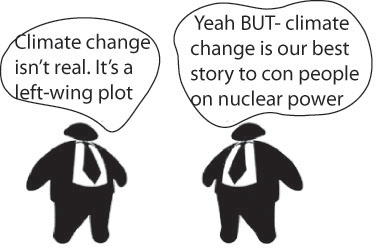
Busting the propaganda that the nuclear industry wants to reduce carbon emissions
Big money, nuclear subsidies, and systemic corruption, Bulletin of the Atomic Scientists, By Cassandra Jeffery, M. V. Ramana | February 12, 2021 ”………..Material interests and policy interests.
The most common argument used by these companies and those who support nuclear subsidies is the need to fight climate change. There are two problems with this argument.
First, it is based on the false idea that nuclear power, if shut down, will necessarily be replaced by fossil fuel plants. A June 2016 decision by Pacific Gas and Electric (PG&E) demonstrates the invalidity of this assumption. PG&E will close the last two nuclear power plants in California (the Diablo Canyon units) by 2024 and 2025, replacing the lost electrical capacity “with a cost-effective, greenhouse gas free portfolio of energy efficiency, renewables and energy storage.” This move to renewables is more cost-effective today than it was in 2016 because of declining costs of renewables and energy storage. As Matthew McKinzie of the Natural Resources Defense Council argued at that time, the decision “shows that given sufficient time to prepare, retiring nuclear capacity can transition smoothly to a mix of energy efficiency measures; clean, renewable resources; and energy storage without any role for fossil fuels – an outcome that can be optimal for the environment, the market, and the reliability of the electric grid.” At a larger scale, Germany has shown that it is possible to retire nuclear plants and reduce emissions at the same time.
The second problem is the assumption that corporations owning nuclear plants are primarily interested in rapidly reducing emissions. Many utilities have large fossil fuel investments— investments that suggest a shutdown won’t be happening anytime soon. This suggestion seems especially true with natural gas plants. Although utilities often describe natural gas as clean (for example, Exelon describes its fleet as powered by “clean burning natural gas”), the climate implications of continued natural gas use are substantial. Exelon, the company with the most nuclear plants in the country, also owns and operates, along with its subsidiaries, 11 oil-fired power plants, five dual-fuel (natural gas and oil-powered) power stations, and 10 natural gas-based power plants throughout North America. In addition to its four nuclear power plants, Dominion owns 17 power plants fueled by natural gas and 14 power plants fueled by coal or oil. The company’s estimate of carbon dioxide emissions from its power plants is around 40 million metric tons in 2018, roughly the same level as in 2012. Likewise, PSEG owns just two nuclear power plants, but the company owns or has a stake in 10 fossil fuel generating plants with one more natural gas powered plant under construction.
With such large stakes in fossil fuel-based power plants, it is clear that these utilities are not about to switch immediately to renewables—or even to nuclear power—and give up on years and years of future profits that they and their shareholders are hoping for. In all of the states that offered nuclear subsidies, and elsewhere, the utilities have tried to hold back the deployment of renewables in more or less obvious ways. US utilities are not alone. Studies show that electric utilities around the world have “hindered the transition of the global electricity sector towards renewables, which has to date mostly relied on non-utility actors (such as independent power producers) for expanding the use of renewables.”
Rather than adapting to the necessity of building up renewables, these utilities resort to tactics that have been used in the past to justify nuclear power plant construction. As former Nuclear Regulatory Commission member Peter Bradford listed at the beginning of the so-called nuclear renaissance, these include “subsidy, tax breaks, licensing shortcuts, guaranteed purchases with risks borne by customers, political muscle, ballyhoo, and pointing to other countries (once the Soviet Union, now China) to indicate that the US is ‘falling behind.’”…. https://thebulletin.org/2021/02/big-money-nuclear-subsidies-and-systemic-corruption/
Los Alamos National Laboratory not alert to the increasing danger of wildfires
 Audit raises concerns about wildfire risks at U.S. nuclear lab https://www.pbs.org/newshour/science/audit-raises-concerns-about-wildfire-risks-at-u-s-nuclear-labScience Feb 10, 2021 By — Susan Montoya Bryan, Associated Press
ALBUQUERQUE, N.M. (AP) — One of the nation’s premier nuclear laboratories isn’t taking the necessary precautions to guard against wildfires, according to an audit by the U.S. Energy Department’s inspector general.
The report comes as wildfire risks intensify across the drought-stricken U.S. West. Climatologists and environmentalists have been warning about worsening conditions across the region, particularly in New Mexico, which is home to Los Alamos National Laboratory and where summer rains failed to materialize last year and winter precipitation has been spotty at best.
The birthplace of the atomic bomb, Los Alamos has experienced hundreds of millions of dollars in losses and damage from major wildfires over the last two decades. That includes a blaze in 2000 that forced the lab to close for about two weeks, ruined scientific projects, destroyed a portion of the town and threatened tens of thousands of barrels of radioactive waste stored on lab property.
Watchdog groups say the federal government needs to take note of the latest findings and conduct a comprehensive review before the lab ramps up production of key plutonium parts used in the nation’s nuclear arsenal.
“The threat and risks of wildfire to the lab and northern New Mexico will continue to increase because of climate warming, drought and expanded nuclear weapons production,” said Jay Coghlan, director of the group Nuclear Watch New Mexico.
The audit released this month found that cutting back vegetation along power lines and other measures to reduce the risk of catastrophic fires were not always done, increasing the potential for another devastating fire like the Cerro Grande Fire in 2000.
Federal auditors said not all fire roads were maintained to ensure safe passage for firefighters and equipment responding to blazes on lab property.
The audit also cited federal policy that requires a comprehensive, risk-based approach to wildfire management — something the inspector general’s office said had not been developed by the contractor that manages the lab for the U.S. government. It also pointed to a lack of oversight by Energy Department field staff.
“Without documenting planning and preparedness activities, there was no assurance that all prevention and mitigation options were considered and that the site was fully prepared for wildland fire events,” the audit says.
The report included photos that depicted overgrown areas. In Los Alamos Canyon, for example, specialists indicated there were about 400 to 500 trees per acre. Auditors said the ideal number should be 40 to 50 trees per acre.
Lab spokesman Peter Alden Hyde said that since the audit was conducted in late 2018 and early 2019, the lab has adopted “an aggressive approach” to wildfire management on its 39-square-mile (101-square-kilometer) campus. That has included thinning vegetation along access routes, improving fire roads and recently removing thousands of trees downed by wind storms.
“We continue to review our wildfire and forest health plans and have already implemented most of the recommendations the Department of Energy offered to improve our efforts to protect the public, the environment and the laboratory,” he said.
It was not immediately clear how many acres were thinned during the last year or whether the lab had any major projects planned for 2021.
The merging of the economic and the political power of big nuclear corporations
 Big money, nuclear subsidies, and systemic corruption, Bulletin of the Atomic Scientists, By Cassandra Jeffery, M. V. Ramana | February 12, 2021, ”………… the long-term impact of legislation that favors nuclear energy firms involves the great economic and political power that these large utilities possess. To better understand the basis of the economic power of these corporations, we analyzed financial data from electric utilities listed on the New York Stock Exchange (NYSE) between 1970 and 2019 on the standard Compustat database.
The first trend that is evident is one of increasing market concentration. From the 1970s through to the mid-1990s, there were roughly 80 to 85 companies listed in this sector on the NYSE. By 2000, that number had dropped to 56. The reason was a series of mergers and acquisitions through which large companies absorbed smaller companies. For example, Commonweath Edison became part of Unicom in 1994. Unicom and the Philadelphia Electric Company merged in 2000 to form Exelon. Similar mergers and acquisitions have continued, and by 2019 there were only 36 utility companies operating in the United States.
Measured through their market capitalization values, these 36 corporations are not equal. By and large, the corporations with the largest market cap values are the ones that own nuclear plants. Exelon is a good example, owning 17 of the 94 nuclear units that are operating in the United States as of November 2020. In 2019, Exelon’s average market capitalization was $44.3 billion. But Exelon is by no means the largest utility. Nextera Energy ($118 billion), Dominion ($69 billion), Duke ($67 billion), and American Electric ($47 billion) dominate the industry in terms of market capitalization. All of these five companies had a higher market capitalization in 2019 than the largest utility that did not own nuclear plants: Sempra Energy ($44.1 bn).
Over the last six years, when there have been no mergers or acquisitions among these companies, 11 out of the 14 companies that own nuclear assets have consistently held market capitalization values well above the median (based on 36 companies in all). Two of the remaining three hover near the median value, sometimes higher, sometimes lower. (The one remaining utility, El Paso, was recently bought out by JP Morgan, and will no longer be a publicly traded company.) On the whole, companies with nuclear plants have recorded larger market capitalization values than the median of 22 utilities that don’t own nuclear assets.
The legislative means used to take money away from electricity consumers and bail out economically failing nuclear plants owned by these large corporations helps further their market power, as illustrated by Dominion’s value rising from $49.5 billion in 2018 to $69.4 billion in 2019. While it is well known that wealthy corporations have a lot of political power, it seems from these examples that the converse might also be true: The political power enjoyed by these large corporations is at the root of their economic power. Indeed, as political economists Jonathan Nitzan and Shimshon Bichler have argued at length, the standard economic concept of capital symbolizes “organized power writ large,” challenging the conventional division between politics and economics. The various bills passed in state legislatures offer a political assurance to investors that revenues for these utilities are assured for the foreseeable future, which naturally translates into higher stock prices and market capitalizations.………https://thebulletin.org/2021/02/big-money-nuclear-subsidies-and-systemic-corruption/
Mike Pence’s ‘nuclear football’ was potentially at risk during Capitol riot
|
Mike Pence’s ‘nuclear football’ was potentially at risk during Capitol riot https://www.theguardian.com/us-news/2021/feb/12/mike-pence-nuclear-football-capitol-riot Footage from 6 January shows mob was within 30 metres of Pence and air force officer carrying briefcase with nuclear codes Julian Borger in Washington, Sat 13 Feb 2021
The dramatic footage of the 6 January insurrection shows the mob was within 30 metres of Mike Pence, when he made his escape. But there was a chilling detail that even the House prosecutors missed. With the then vice-president on that terrifying day, was an air force officer carrying the “football”, a large black briefcase carrying nuclear launch codes.
The codes in the vice-president’s football are not activated unless the president is dead or incapacitated. But the implications of it falling into the hands of rioters are still chilling. “If the mob had seized Pence’s nuclear football, they may not have been able to order an actual launch but the public may not have known that,” Tom Collina, director of policy at the Ploughshares Fund disarmament advocacy group, said. “Parading the nuclear button around would have caused widespread panic and chaos as authorities scrambled to respond.” The secret service bodyguards around Pence would most likely have defended the suitcase with deadly force, but if the pro-Trump mob had managed to seize it, they would have come away, not just with the codes used to identify the vice-president and authenticate his orders, but also the encrypted communications equipment used to make the call to the National Military Command Center in the Pentagon. Most damaging of all, they would have all the nuclear attack options instantly available around the clock to the US commander-in-chief. That list of options used to be in a weighty handbook, but according to Fred Kaplan, author of The Bomb: Presidents, Generals, and the Secret History of Nuclear War, it has been condensed over the decades into a series of laminated cards, “like a menu at Wendy’s”, as one officer put it to Kaplan. Not only would disclosure of that menu represent one of the worst security breaches imaginable, the encrypted communication equipment would tell an adversary a lot of how the US would respond to a major attack. “They could glean all sorts of information about its structure and technology so it’s very significant,” said Hans Kristensen, director of the nuclear information project at the Federation of American Scientists. Nuclear experts have questioned whether this cold war relic that provides such an obvious target for adversaries and terrorists, is still necessary. But the Trump era has also shone a bright light on the question of whether one individual should continue to have sole authority to launch the US nuclear arsenal. Collina, co-author of The Button, a book on the presidency and nuclear weapons, said: “Of course the even bigger danger was that Trump had his own football that could have been used to end civilization as we know it.” In other words, perhaps the only thing scarier than the football being surrounded by a mob is the thought of Trump being alone with it. |
|
|
American media and politicians, including Biden, in the grip of the war profiteers
Who Are the Ultimate War Profiteers? A U.S. Air Force Veteran Removes the Veil, Covert Action Magazine By Christian Sorensen, February 10, 2021 “………….The most well-known industry pressure comes in the form of lobbying both political parties and funding their congressional campaigns (with extra focus on members of pertinent committees, such as Armed Services, Intelligence, Appropriations, and Foreign Relations)
This produces tangible results. As Steven Semler of the non-corporate Security Policy Reform Institute calculated, Democratic votes on the National Defense Authorization Act
correlate strongly with the campaign cash members accepted from the war industry. On average, House Democrats who voted for the NDAA accepted four times the amount of war industry cash as those who voted against it. In the Senate, Democrats who cast supporting votes took in six times as much industry cash.
Warmonger-In-Chief
 The Executive Branch is not exempt. Rapacious financiers—including hedge fund chiefs and venture capitalists—top the list of donors to the Biden Administration, though dark money groups prevent a full understanding of the overall campaign finance picture. Between July and September at least 67 billionaires and their spouses made contributions of more than $100,000 to committees supporting Joe Biden and the Democratic Party, according to records filed with the Federal Election Commission.
Biden’s campaign received over $9 million from Donald Sussman, CEO of Palmora Partners, a multi-billion dollar hedge fund, which has more than 260,000 shares in Raytheon, a preeminent weapons manufacturer and supplier of weapons to Saudi Arabia, which recently won a $100 million contract for Afghan Air Force training.
Another of Biden’s top donors, Jim Simons, who gave over $7 million, founded Renaissance Capital, which owns 1.2 million shares in Raytheon worth over $75 million, and 130,000 shares in Lockheed Martin worth $50 million.
Big Tech is positioned prominently among donors to the Biden inauguration celebration. Biden has been clear on the campaign trail that he does not intend to cut the military budget, even going so far as stating, “I’ve met with a number of my advisors and some have suggested in certain areas the budget is going to have to be increased.” Biden’s advisors are part and parcel of the military-industrial-congressional complex. Cozying up to wealthy donors, Biden infamously assured them that “nothing would fundamentally change” in a Biden presidency. https://covertactionmagazine.com/2021/02/10/who-are-the-ultimate-war-profiteers-a-u-s-air-force-veteran-removes-the-veil/
Corporate Media Kool-aid
Corporate media prevent the public from understanding the nature of the problem. A handful of business interests owns media outlets in the United States. Profit drives corporate media. U.S. corporate media (e.g. CNN, MSNBC, FoxNews) share the same business model: air what attracts the highest ratings in order to get more advertising revenue.
Corporate media air info-tainment, designed not to inform or foster critical thinking. Informing the public is not a priority. Maintaining the existing economic order is.
To the extent that corporate media air any information at all, the information reflects the opinions of the ruling class and the dogma of Corporate America.
Politically conditioning the U.S. public, corporate media never blame the military-industrial-congressional complex or capitalism for any of the problems in the world. Aiming for high ratings and lucrative advertising revenue, corporate media self-censor and taper the spectrum of acceptable foreign policy debate. War corporations purchase advertisements on corporate “news” shows to further confine the debate. Corporate pundits and newscasters do not speak out against advertisers.
Corporate media hire career militants (e.g. former CIA Director John Brennan, MSNBC; former CIA Deputy Director Mike Morrell, CBS News; retired General Jack Keane, FoxNews) who further confine the debate. Retired generals and admirals regularly contribute to all forms of corporate media, often without disclosing existing ties to war corporations or financial investments in war.
The Smith-Mundt Modernization Act of 2012 allowed government to increase its propaganda in corporate media. Drawing funding from the wealthy donor class and large corporate interests, National Public Radio is similarly confined. NPR’s new CEO as of September 2019 is John Lansing, who recently led U.S. propaganda at the U.S. Agency for Global Media.
Other industry pressure comes in the form of funding and running pressure groups [e.g. National Defense Industrial Association (NDIA), Aerospace Industries Association (AIA), Association of the United States Army (AUSA)] to dominate the Pentagon, administer arms fairs, and push favorable policies; funding think tanks to keep the narrative neoliberal and pro-war; recruiting retired generals and admirals (e.g. Dunford at Lockheed Martin, Mattis at General Dynamics, Winnefeld at Raytheon) to leverage their knowledge for financial gain; and flooding the Pentagon’s civilian offices with corporate executives (e.g., Esper and then Austin, Secretary of Defense; Lord, Undersecretary for Acquisition and Sustainment; McCarthy, Secretary of the Army). …………
Christian Sorensen is an Air Force veteran and author of the new book entitled Understanding the War Industry. See CAM’s review of the book: Wars R Us: A Review of Christian Sorensen’s New Book. https://covertactionmagazine.com/2021/02/10/who-are-the-ultimate-war-profiteers-a-u-s-air-force-veteran-removes-the-veil/
Catastrophic’ Nuclear Power Accidents ‘Highly Likely’ If US Reactors Are Extended For 100 Years.
Catastrophic’ Nuclear Power Accidents ‘Highly Likely’ If US Reactors Are Extended For 100 Years. Sputnik News, 10 Feb 21, Nuclear reactors in the United States were originally only certified to be operated for a maximum of 40 years. However, the Nuclear Regulatory Commission has been extending their operating time beyond that and is now considering doing so, yet again, this time up to 100 years.
Professor Karl Grossman is an award-wining investigative journalist. He authored Cover Up: What You Are Not Supposed to Know About Nuclear Power and Power Crazy and is the writer and presenter of television programmes on nuclear power. Grossman tells Sputnik that “nuclear power plants in the US were never seen as operating beyond 40 years” and that plans to extend their operating licences for more than twice that amount of time is incredibly dangerous. Every day a nuclear power plant operates the intense radiation embrittles (i.e. weakens) the metal in the reactor. “If the reactor is embrittled and cracks”, Grossman says, quoting a nuclear engineer-turned whistleblower, “it’s game over”.
Sputnik: You recently co-authored an article with journalist Harvey Wasserman calling on President Joe Biden to “inspect” the US’ “embrittled reactors”. Explain what exactly an embrittled reactor is.
Professor Karl Grossman: As Arnold “Arnie” Gundersen, a nuclear engineer with more than 44 years of experience in the nuclear industry, who became a whistleblower and is now chief engineer at Fairewinds Associates, described embrittlement in a nuclear power plant to my co-author of the article, Harvey Wasserman:
“When exposed to radiation, metal becomes embrittled and eventually can crack like glass. The longer the radiation exposure, the worse the embrittlement becomes. A nuclear reactor is just like a pressure cooker and is a pot designed to hold the radioactive contents of the atomic chain reaction in the nuclear core”, continued Gundersen, whose experience includes being a licensed Critical Facility Reactor Operator. “And metals in reactors are exposed to radiation every day a plant operates”……….
Sputnik: Why do you think that embrittled reactors are “at the top of the list of nuclear power concerns”?
Professor Karl Grossman: There are numerous major concerns regarding nuclear power plants.
But embrittlement is on the top of the list because nuclear power plants in the US were never seen as operating beyond 40 years—because of embrittlement.
That’s why the operating licenses originally issued by the US government for the plants were limited to 40 years. After 40 years, they were considered to be unsafe to run—because of embrittlement…….
virtually all operating atomic reactors are producing electricity at much higher base costs than solar and wind.
So the Nuclear Regulatory Commission is seeking to try to bail out the nuclear industry—to keep it going—by allowing nuclear power plants to operate for 100 years.
The US Nuclear Regulatory Commission has been staunchly pro-nuclear through the years, captured by the nuclear industry, indeed nicknamed the Nuclear Rubberstamp Commission for doing whatever the US nuclear industry wants it to do…….
, in extending the operating licenses for nuclear power plants for decades, the US Nuclear Regulatory Commission is also allowing them to be “uprated”—to run hotter and harder to generate more electricity and to further increase the likelihood of a nuclear power plant disaster.
The bottom line: a nuclear power plant catastrophe is being invited……..
Sputnik: What exactly is it that Joe Biden or his administration can do to address these issues?
Professor Karl Grossman: Biden must step in and order the inspection for embrittlement of US nuclear power plants. The old, decrepit nuclear power plant fleet in the US—with embrittled metal components—must be inspected. And with embrittlement and other likely age-induced problems, they must be shut down.
Biden must act to prevent what would constitute nuclear suicide in the United States.
Last month, Biden announced a climate change agenda transitioning the US towards renewable energy. But taking action against fossil fuel is not enough. Nuclear power plants are also engines of global warming. The claim of the nuclear industry that atomic energy is “carbon free” is a lie. The “nuclear fuel chain” which includes uranium mining, milling and fuel enrichment is carbon intensive, and nuclear power plants themselves emit Carbon-14, a radioactive form of carbon.
Sputnik: Can these embrittled reactors simply be replaced in order to safely extend the life of the power plant?
Professor Karl Grossman: It makes no sense to replace these deadly machines when here today [we have] safe, clean, green, renewable energy—led by solar and wind.
Nuclear power plants make no sense economically. Consider the only two nuclear power plants now under construction in the US, Vogtle 3 and 4 costing $30 billion for the two and the price still rising, and solar and wind being able to producing electricity at a lower cost—and be put into operation far more rapidly. And there are additional safe, green, cost-effective, clean, renewable energy sources—energy, most importantly, that we can live with.
Sputnik: Is there a realistic alternative to extending the lives of nuclear power plants?
Professor Karl Grossman: The realistic alternative is to shut down all 94 nuclear power plants now in the US and move ahead fully implementing the use of safe, green, cost-effective clean, renewable energy technologies. And this should be emulated in countries all over the world with nuclear power plants.
Three decades ago the Union of Concerned Scientists published a book titled Renewables Are Ready. Now renewables are more than ready to power the world. https://sputniknews.com/analysis/202102101082010676-catastrophic-nuclear-power-accidents-highly-likely-if-us-reactors-are-extended-for-100-years/
Wall Street: the Ultimate War Profiteers

Wall Street: the Ultimate War Profiteers
Wall Street plays the foundational role in the war industry by outright owning war corporations……
Big Finance sits at the top of the war industry by purchasing most shares of war corporations and by owning war corporations. Insatiable demand for profit places immense structural pressure on the Pentagon and Capitol Hill for sky-high U.S. military and intelligence budgets, broad deployment of troops overseas, and the opening up of governmental jobs to corporations. …………
Wars must be created and expanded, and military bases, through which to route goods and services, must be established and entrenched to satisfy investors. Notwithstanding, ending the wars first requires addressing the embedded profit motive, otherwise it is business as usual.
Who Are the Ultimate War Profiteers? A U.S. Air Force Veteran Removes the Veil, Covert Action Magazine By Christian Sorensen February 10, 2021
While war corporations, or so-called “defense contractors,” make billions in profits, Wall Street is the ultimate beneficiary of today’s nonstop wars. The prosaic nature of war profiteering—far from the work of a shadowy cabal—is precisely why the collusion is so destructive and should be outlawed.
The U.S. ruling class deploys the military for three main reasons: (1) to forcibly open up countries to foreign investment, (2) to ensure the free flow of natural resources from the global south into the hands of multinational corporations, and (3) because war is profitable. The third of these reasons, the profitability of war, is often lacking detail in analyses of U.S. imperialism: The financial industry, including investment banks and private equity firms, is an insatiable force seeking profit via military activity.
The war industry is composed of corporations that sell goods and services to the U.S. government and allied capitalist regimes around the world. Investment banks and asset management firms hold most shares of every major public war corporation.
The best-known financial firms holding the stock of war corporations include: Vanguard Group, BlackRock, State Street, JPMorgan Chase, Wells Fargo, and Wellington Management Continue reading
Nuclear Rubberstamping Commission to weaken rules on radioactive trash
 “It’s not cotton candy”

Meanwhile, the Nuclear Regulatory Commission may soon consider new regulations that would allow WCS and other commercial sites to accept a higher level of nuclear waste than Texas currently allows.
The WCS facility is permitted to accept Class A, B, and C nuclear waste — categories that fall below high-level material like spent nuclear fuel. But certain material, much of it generated by the decommissioning of nuclear power plants, falls into what experts call a gray area between the lower-level categories and spent nuclear fuel. It has an equally ambiguous name: “Greater than Class C.”
“These are some of the most dangerous materials in the world,” “It’s not cotton candy.”
”an effort over many years to make it look less threatening, and to sneak it in as less hazardous,”
 West Texas is on track to get even more nuclear waste — thanks to the federal government. A hazardous waste disposal company in Andrews County wants to handle more dangerous levels of nuclear waste. Federal agencies are pondering new rules that could allow more of it to come to Texas. Texas Tribune, BY ERIN DOUGLAS FEB. 10, 2021 To get rid of eight gallons of water, the U.S. Department of Energy spent $100,000.
It’s little more than half a tank of gasoline in a midsize car, but the radioactive shipment from South Carolina to a West Texas company last fall marked one change that could lead to more nuclear waste traveling to Texas — waste that, until recently, was considered too dangerous to be disposed of.
Much of the public debate surrounding Waste Control Specialists’ hazardous waste facility in Andrews County, on the New Mexico border, has focused on the company’s plans, with a partner, to store the riskiest type of nuclear waste: the spent fuel rods from nuclear power plants, which can remain dangerously radioactive for hundreds of thousands of years.
Scientists agree that spent nuclear fuel should be stored deep underground, but the U.S. still hasn’t located a suitable site. Interim Storage Partners — a joint venture of Waste Control Specialists and Orano USA, a subsidiary of one of the world’s biggest nuclear power companies — proposed bringing the spent fuel to a 332-acre site next to the WCS facility in Andrews County until a permanent storage site is found.
If the plan succeeds, it would be a big expansion for Waste Control Specialists, which has been disposing of the nation’s low-level nuclear waste — including tools, building materials and protective clothing exposed to radioactivity — for a decade. Interim Storage Partners’ website says it expects to get the federal approval for spent nuclear fuel storage, a major step in the plan, this year.
The idea still faces significant legal hurdles and stiff opposition from environmental groups, local oil companies, some residents and Texas Gov. Greg Abbott, who wrote to federal regulators last year asking them to deny the license application, stating that the proposal presents a “greater radiological risk than Texas is prepared to allow.”
The federal government and the companies involved say radioactive spills during transportation or storage that expose people or the environment to radiation are very unlikely to occur, but opponents fear human error, mechanical failures or geological changes could result in groundwater contamination.
But while the slow-moving plan is wrapped in political turmoil, lower-profile changes and proposals from federal agencies are giving Waste Control Specialists another avenue to accept more radioactive waste than it does today.
The wastewater that traveled from an old South Carolina nuclear weapons facility more than 1,000 miles in three truckloads in late September was an example: It was the first shipment made after a 2019 U.S. Department of Energy decision to reinterpret how different levels of radioactive waste are classified, allowing it to be disposed of at a commercial facility.
The decision lets the DOE categorize waste based on its properties and hazard level rather than how it was created, and allows radioactive waste from nuclear weapons production and government-sponsored nuclear energy research to be shipped to commercial sites such as the one in Texas, rather than indefinitely stored at a government site.
“They did this eight gallons as a sort of test,” said Tom Clements, the director of Savannah River Site Watch, an advocacy group that monitors the DOE’s site in South Carolina, a nuclear national security complex where materials for nuclear weapons were produced until 1991 at the end of the Cold War. “It is the foot in the door to taking more material to WCS.”
And the federal Nuclear Regulatory Commission is also considering new rules that could give Waste Control Specialists a green light to pursue bringing more dangerous radioactive waste to its commercial facility than currently allowed by state law.
The company is already permitted to accept low-level nuclear waste in Andrews County. The plan to build a facility to store spent nuclear fuel, the most dangerous kind, would bring what’s considered high-level nuclear waste. In addition, NRC staff recommended in October that the agency consider allowing commercial facilities like WCS to accept materials that fall into a third danger level between those two categories.
“The floodgates may be opening [in Texas],” Clements said.
That’s exactly what many environmentalists and local opponents feared after the hazardous waste facility was built in 1995. At the time, a company official told the community that it had no plans to expand to radioactive waste disposal.
“This is one of the difficulties of a community or state agreeing to one type of waste facility, because it can be changed on you,” said Rodney Ewing, a scientist and professor in nuclear security at Stanford University. “If it’s judged to be safe, that becomes the rationale for accepting more waste.”……………
Radioactivity in West Texas Continue reading
U.S. Dept of Justice gets the resignation of attorney who launched Ohio nuclear corruption probe
|
U.S. Attorney Who Launched Ohio Nuclear Bailout Bribery Probe Resigns https://radio.wosu.org/post/us-attorney-who-launched-ohio-nuclear-bailout-bribery-probe-resigns#stream/0
By JO INGLES The U.S. Attorney for the Southern District of Ohio has submitted his resignation. David DeVillers is one of 56 U.S. Attorneys appointed by former President Trump asked to resign by the Biden administration’s Department of Justice.
DeVillers said in a written statement that he had hoped to stay on as U.S. Attorney until his successor was appointed. He urged the next U.S. Attorney to be just, apolitical, aggressive and impactful. “It is with a heavy heart that I announced my resignation,” DeVillers wrote. “I have been a prosecutor for my entire career, and it was my wish to remain a prosecutor until the end of my career, but that is not to be.” DeVillers, who was appointed by Trump in 2019 to replace outgoing U.S. Attorney Benjamin Glassman, was heading up several high-profile cases throughout the state. He made a splash last summer by announced racketeering charges against five individuals, including then-Ohio House Speaker Larry Householder, accusing them of funneling $60 million in bribes from a utility company in exchange for securing the passage of a nuclear bailout law. So far, two defendants and the dark money group Generation Now have pleaded guilty in the $60 million conspiracy. Householder has pleaded not guilty and remains in the Ohio legislature after winning reelection in November. DeVillers last year announced corruption cases against three current and former members of Cincinnati City Council, who are accused of taking bribes in exchange for favorable votes on development projects. One, Tamaya Dennard, was sentenced to 18 months in prison after pleading guilty to honest wire fraud. And in Columbus, DeVillers was coordinating the federal criminal and civil rights investigation into the killing of Casey Goodson Jr. by a Franklin County Sheriff’s Deputy, and another civil rights probe of the killing of Andre Hill by a since-fired Columbus Police officer. “While it was my hope to continue on for a few more months to finish some of the work we have started, I am absolutely certain that the AUSAs and investigators working for the people of the Southern District of Ohio will bring this work to a successful and just closure,” DeVillers said. The U.S. Attorney for the Northern District of Ohio, Justin Herdman, resigned last month. |
|
Opposition to more nuclear waste in Texas – unlikely alliance of environmental groups and oil companies
West Texas is on track to get even more nuclear waste — thanks to the federal government,Texas Tribune, BY ERIN DOUGLAS FEB. 10, 2021 “………..Nuclear debate in Texas The nuclear power industry prides itself on operating no-emissions plants without burning fossil fuels like coal and natural gas, which create the greenhouse gas emissions that contribute to climate change. By locating in the Permian Basin, one of the most productive oil fields in the world, Waste Control Specialists has found itself in a political fight against fossil fuel interests that its customers often compete with.
Elaine Magruder is co-owner of an Andrews County ranch where her family has raised cattle and pumped oil since 1893. She’s also a member of a coalition of Permian Basin landowners and oil and gas operators that oppose radioactive waste storage and disposal in Andrews County. The coalition is led by Fasken Oil and Ranch, which owns thousands of acres in Andrews County.
Magruder says she’s worried that a transportation accident could expose local residents to radioactive material and disrupt oil and gas operations. She also worries that a leak at the facility could allow radioactive material to seep into the ground, contaminating area drinking water. The facility is near the Ogallala Aquifer of the Great Plains, which provides drinking water for millions in the West………….
Ewing, the Stanford University nuclear security professor, said the larger risk is environmental contamination due to the facility’s proximity to the aquifer — a concern shared by some other nuclear scientists and geologists.
This unlikely alliance of environmental groups and oil companies has Abbott on its side. In November, the governor sent a letter urging the Nuclear Regulatory Commission to deny the application for storing spent nuclear fuel in Andrews County, arguing in part that the proposed facility “imperils America’s energy security” by making the region an even greater possible terrorism target than it is today due to its oil and gas reserves………… https://www.texastribune.org/2021/02/10/nuclear-waste-government-rules/
Financial and environmental uncertainties made UK Planning inspectorate reject Wylfa nuclear project
Nuclear Engineering International 8th Feb 2021The UK Planning inspectorate on 4 February released its report on the WylfaNewydd project on Anglesey for which energy company Horizon – a subsidiaryof Hitachi – had needed approval of the Development Consent Order (DCO)
to allow the project to go ahead.
However, in their 906-page report, the
government appointed planning inspectors recommended that the project
should be rejected, citing a number of expert concerns. The application has
since been withdrawn after Hitachi, decided that the plant was too
expensive to build without government funding, and Horizon subsequently
failed to find any other backers for the project.
On funding, the inspectorate’s report said that “despite the Applicant’s commitment
to continued dialogue with UK Government, there remains “considerable
uncertainty regarding the overall funding for the proposal and the extent
to which the private sector alone can, or is prepared to accept, the
business risk to fund it”.
The planning inspectors’ report said there
was a lack of scientific evidence put forward by developers to demonstrate
that the Arctic and Sandwich tern (seabird) populations around the Cemlyn
Bay area would not be disturbed by construction. There were fears that
these birds would abandon the Bay as a result. It also raised wider
concerns over the general impact on Cemlyn Bay, the Cae Gwyn site of
special scientific interest and Tre’r Gof.
America’s new $100Billion missiles are intended both for attack, and as a target.
Housed in permanent silos spread across America’s high plains, they are intended to draw fire to the region in the event of a nuclear war, forcing Russia to use up a lot of atomic ammunition on a sparsely populated area.
how little some nuclear weapons programs have to do with national defense.!
 Why is America getting a new $100 billion nuclear weapon?, https://thebulletin.org/2021/02/why-is-america-getting-a-new-100-billion-nuclear-weapon/?utm_source=Newsletter&utm_medium=Email&utm_campaign=MondayNewsletter022021&utm_content=NuclearRisk_NewWeapon_02082021 By Elisabeth Eaves, February 8, 2021 merica is building a new weapon of mass destruction, a nuclear missile the length of a bowling lane. It will be able to travel some 6,000 miles, carrying a warhead more than 20 times more powerful than the atomic bomb dropped on Hiroshima. It will be able to kill hundreds of thousands of people in a single shot.
The US Air Force plans to order more than 600 of them.
On September 8, the Air Force gave the defense company Northrop Grumman an initial contract of $13.3 billion to begin engineering and manufacturing the missile, but that will be just a fraction of the total bill. Based on a Pentagon report cited by the Arms Control Association Association and Bloomberg News, the government will spend roughly $100 billion to build the weapon, which will be ready to use around 2029.
To put that price tag in perspective, $100 billion could pay 1.24 million elementary school teacher salaries for a year, provide 2.84 million four-year university scholarships, or cover 3.3 million hospital stays for covid-19 patients. It’s enough to build a massive mechanical wall to protect New York City from sea level rise. It’s enough to get to Mars.
One day soon, the Air Force will christen this new war machine with its “popular” name, likely some word that projects goodness and strength, in keeping with past nuclear missiles like the Atlas, Titan, and Peacekeeper. For now, though, the missile goes by the inglorious acronym GBSD, for “ground-based strategic deterrent.” The GBSD is designed to replace the existing fleet of Minuteman III missiles; both are intercontinental ballistic missiles, or ICBMs. Like its predecessors, the GBSD fleet will be lodged in underground silos, widely scattered in three groups known as “wings” across five states. The official purpose of American ICBMs goes beyond responding to nuclear assault. They are also intended to deter such attacks, and serve as targets in case there is one.
Under the theory of deterrence, America’s nuclear arsenal—currently made up of 3,800 warheads—sends a message to other nuclear-armed countries. It relays to the enemy that US retaliation would be so awful, it had better not attack in the first place. Many consider American deterrence a success, pointing to the fact that no country has ever attacked the United States with nuclear weapons. This argument relies on the same faulty logic Ernie used when he told Bert he had a banana in his ear to keep the alligators away: The absence of alligators doesn’t prove the banana worked. Likewise, the absence of a nuclear attack on the United States doesn’t prove that 3,800 warheads are essential to deterrence. And for practical purposes, after the first few, they quickly grow redundant. “Once you’ve dropped a couple of nuclear bombs on a city, if you drop a couple more, all you do is make the rubble shake,” said Air Force Maj. Gen. (Ret.) Robert Latiff, a Bulletin Science and Security Board member who, early in his career, commanded a unit of short-range nuclear weapons in West Germany.
|
Deterrence is the main argument for having a nuclear arsenal at all. But America’s land-based missiles have another strategic purpose all their own. Housed in permanent silos spread across America’s high plains, they are intended to draw fire to the region in the event of a nuclear war, forcing Russia to use up a lot of atomic ammunition on a sparsely populated area. If that happened, and all three wings were destroyed, the attack would still kill more than 10 million people and turn the area into a charred wasteland, unfarmable and uninhabitable for centuries to come. The GBSD’s detractors include long-time peace activists, as you’d expect. But many of the missile’s critics are former military leaders, and their criticism has to do with those immovable silos. Relative to nuclear missiles on submarines, which can slink around undetected, and nuclear bombs on airplanes—the two other legs of the nuclear triad, in defense jargon—America’s land-based nuclear missiles are easy marks. Because they are so exposed, they pose another risk: To avoid being destroyed and rendered useless—their silos provide no real protection against a direct Russian nuclear strike—they would be “launched on warning,” that is, as soon as the Pentagon got wind of an incoming nuclear attack. But the computer systems that warn of such incoming fire may be vulnerable to hacking and false alarms. During the Cold War, military computer glitches in both the United States and Russia caused numerous close calls, and since then, cyberthreats have become an increasing concern. An investigation ordered by the Obama administration in 2010 found that the Minutemen missiles were vulnerable to a potentially crippling cyberattack. Because an error could have disastrous consequences, James Mattis, the former Marine Corps general who would go on to become the 26th US secretary of defense, testified to the Senate Armed Services Committee in 2015 that getting rid of America’s land-based nuclear missiles “would reduce the false alarm danger.” Whereas a bomber can be turned around even on approach to its target, a nuclear missile launched by mistake can’t be recalled. William J. Perry, secretary of defense during the Clinton administration (and the chair of the Bulletin’s Board of Sponsors), argued in 2016 that “[w]e simply do not need to rebuild all of the weapons we had during the Cold War” and singled out the GBSD as unnecessary. Replacing America’s land-based nuclear missiles, he wrote, “will crowd out the funding needed to sustain the competitive edge of our conventional forces, and to build the capabilities needed to deal with terrorism and cyber attacks.” Russia has about 4,300 nuclear warheads, the only arsenal on par with America’s, and is also trading up for new weapons. Yet as Perry pointed out, “If Russia decides to build more than it needs, it is their economy that will be destroyed, just as it was during the Cold War.” China—a bigger long-term threat to the United States than Russia, in the eyes of many national security analyses—seems to understand that excessive spending on nuclear weapons would be self-sabotage. Even if, as the Pentagon expects, Beijing doubles the number of nuclear warheads in its arsenal—now estimated at less than 300—it will still have far fewer than either the United States or Russia. For many and perhaps most Americans, nuclear weapons are out of sight and mind. That $100 billion to replace machines that would, if ever used, kill civilians on a mass scale and possibly end human civilization is just another forgotten subscription on auto-renew. But those who do think about the GBSD mostly don’t want it. In a survey of registered voters conducted in October 2020 by the Federation of American Scientists, 60 percent said they would prefer other alternatives to the new missile, ranging from refurbishing the Minutemen to scrapping nuclear weapons altogether. Those results echo a 2019 voter survey, conducted by the Program for Public Consultation at the University of Maryland, that asked if the government should phase out its fleet of land-based nuclear missiles. Sixty-one percent of respondents—53 percent of Republicans and 69 percent of Democrats—said yes. Which all leads to one question: Given the expense, doubtful strategic purpose, and lack of popularity, why is Washington spending so much to replace the Minuteman III? The answers stretch from the Utah desert to Montana wheat fields to the halls of Congress. They span presidential administrations and political parties. They come from airmen and farmers and senators and CEOs. The reasons for the GBSD are historical, political, and to a significant extent economic. In a country where safety net programs are limited and health insurance is a patchwork, and where unemployment remains at nearly double the pre-pandemic rate, many people in the states where the new missile will be built and based see it as a lifeline. Their elected officials take campaign donations from defense companies, to be sure, but are also trying to deliver jobs in a political environment that has been hostile to government spending on anything but defense. Defense is the safety net where other options are few. A lot of people, even some of those whose livelihoods depend on them, would like to see the number of nuclear weapons gradually reduced until they’re gone. The United States stands no chance of making them disappear, though, until more people understand why they happen—and how little some nuclear weapons programs have to do with national defense. |
Republican lawmaker reintroduces Bill to repeal Ohio’s corrupt nuclear bailout law
 Ohio Lawmaker Reintroduces Bill To Repeal Nuclear Bailout Ohio Lawmaker Reintroduces Bill To Repeal Nuclear Bailout  Law https://radio.wosu.org/post/ohio-lawmaker-reintroduces-bill-repeal-nuclear-bailout-law#stream/0 Law https://radio.wosu.org/post/ohio-lawmaker-reintroduces-bill-repeal-nuclear-bailout-law#stream/0
By ASSOCIATED PRESS 8 Feb 21, • A bill to repeal a bailout of two aging nuclear power plants at the heart of a federal $60 million bribery probe has been re-introduced in the Ohio House by its Republican sponsor.
State Rep. Laura Lanese (R-Grove City) introduced a repeal bill last week similar to the one she introduced last year. That died after some fellow Republicans in the GOP-controlled House disagreed on whether a repeal was necessary. “A full repeal of House Bill 6 would protect consumers from predatory pricing, restore our renewable energy policy, and instill public confidence in the legislative process,” Lanese said in a statement. The legislation known as HB6 was signed into law by GOP Gov. Mike DeWine in 2019. The Justice Department accused five individuals, including former Republican House Speaker Larry Householder, of shepherding $60 million in energy company money for personal and political use in exchange for passing the law and then derailing an attempt to place a rejection of the bailout on the ballot. Two of those five have pleaded guilty, and a plea deal has also been reached with a nonprofit that authorities believe was used to funnel payments from the scheme. Householder, who pleaded not guilty to the rackteering charges, was removed as Speaker over the summer but won re-election to his House seat in November. |
|
-
Archives
- October 2026 (112)
- September 2026 (339)
- August 2026 (330)
- July 2026 (355)
- June 2026 (287)
- May 2026 (306)
- April 2026 (356)
- March 2026 (251)
- February 2026 (267)
- January 2026 (308)
- December 2025 (358)
- November 2025 (359)
-
Categories
- 1
- 1 NUCLEAR ISSUES
- business and costs
- climate change
- culture and arts
- ENERGY
- environment
- health
- history
- indigenous issues
- Legal
- marketing of nuclear
- media
- opposition to nuclear
- PERSONAL STORIES
- politics
- politics international
- Religion and ethics
- safety
- secrets,lies and civil liberties
- spinbuster
- technology
- Uranium
- wastes
- weapons and war
- Women
- 2 WORLD
- ACTION
- AFRICA
- Atrocities
- AUSTRALIA
- Christina's notes
- Christina's themes
- culture and arts
- Events
- Fuk 2022
- Fuk 2023
- Fukushima 2017
- Fukushima 2018
- fukushima 2019
- Fukushima 2020
- Fukushima 2021
- general
- global warming
- Humour (God we need it)
- Nuclear
- RARE EARTHS
- Reference
- resources – print
- Resources -audiovicual
- Weekly Newsletter
- World
- World Nuclear
- YouTube
-
RSS
Entries RSS
Comments RSS

