Relicensing Turkey Point nuclear station – a striking example of a dangerous action in climate change times

 With climate change, aging nuclear plants need closer scrutiny. Turkey Point shows why. https://thebulletin.org/2020/09/with-climate-change-aging-nuclear-plants-need-closer-scrutiny-turkey-point-shows-why/ By Caroline Reiser , September 14, 2020
Last December, two nuclear reactors at Florida’s Turkey Point Nuclear Generating Station, located 25 miles south of Miami, became the first reactors in the world to receive regulatory approval to remain operational for up to 80 years, meaning reactors that first came online in the 1970s could keep running beyond 2050.
The ages of the Turkey Point reactors are not unusual; of the 95 reactors currently licensed to operate in the United States, only five are less than 30 years old, while more than half are 40 or more years old. The Turkey Point reactors are a bellwether, just the first of possibly many aging nuclear reactors that will seek permission to stay online well into the middle of the century. Not long after the December decision, in March 2020, the US Nuclear Regulatory Commission granted two more reactors, located in Pennsylvania, the same extensions that it gave Turkey Point.
In pursing these extensions, the US commercial nuclear industry and its supporters collide with the realities of the aging US nuclear fleet and climate science projections. Existing safety and environmental requirements fail to provide the oversight necessary to ensure communities and the environment are protected. As nuclear reactors receive permission to operate for twice as long as originally envisaged, and in a world that, because of climate change, is drastically different from the one they were built for, the insufficiency of the existing regulatory framework is daunting.
A 40-year lifespan? At the beginning of its commercial nuclear power program, the United States designed and licensed reactors with a 40-year projected lifetime. Once the 40-year license is set to expire, regulations require the reactor owner to apply for a renewed license in order to continue operating for an additional 20 years. What the regulations don’t make clear, however, is the number of times a reactor license can be renewed. What Turkey Point received last year was not its first, but its second extension—what regulators call a subsequent renewed license. Continue reading
The coronavirus pandemic and the increased safety risks for nuclear reactors

Nuclear Alert: NRC & Nuke Safety In the Time of COVID-19 https://www.fairewinds.org/demystify/nuclear-alert-nrc-amp-nuke-safety-in-the-time-of-covid-19 September 14, 2020 By The Fairewinds Crew
First off, we would like to preface this by saying that the world simply cannot afford a meltdown or nuclear disaster on top of the already traumatic times wrought by Pandemic 2020.
Did you know that nuclear plants close for scheduled refueling every 18-months, meaning that 1/3 of the operating reactors are off-line each spring and fall? For the record, more than three dozen reactors had planned to do so in Spring 2020. The Nuclear Regulatory Commission (NRC) defines this rather temporary closing as an outage. During these outages, used-up nuclear fuel is replaced, and critical safety inspections are performed.
You may remember, that in early May, Maggie wrote extensively about the numerous safety risks to all of us if the nuclear industry continued operating these reactors during the COVID-19 Pandemic without implementing critical safety protocols and procedures. Along with 86 other organizations from all over the U.S., Fairewinds Energy Education nonprofit cosigned a letter to Vice President Pence and the COVID-19 Task Force detailing significant safety risks that must be addressed. You can read more about that letter and the increased safety hazards here. To date, we have received no response!
When the COVID-19 Pandemic began in late February, atomic reactor operators and owner corporations begged the NRC for special exemptions from regulatory requirements to implement critical safety and security inspections for up to two years! And, in an extreme example of regulatory capture, the NRC has approved all the corporate requested safety inspection delays, handing them out like candy to eager Trick-or-Treaters on Halloween! We know you have heard this before from the Crew at Fairewinds Energy Education, however, let us emphasize again that the federal laws [called statutes] that authorize the NRC, chartered it to protect ‘public health and safety’. Letting the industry continue to ignore critical safety inspections risks public health and safety!
During the past decade, the success in the growth of renewables has caused the nuclear industry to fight tooth and nail to keep operating even though nuclear power plants are much more expensive to operate than sustainable energy sources, and nukes charge much higher rates to consumers. Additionally, the risk of a disaster or other calamity has increased dramatically due to the old age of all current U.S. operating reactors. Instead of moving to solar and wind and shutting down these decrepit reactors, the energy and utility corporations are trying to reduce their higher operating costs by laying off employees and pushing the people remaining to work harder to save money and continue stockholder profit earnings.
Rather than slowing down these Spring refueling outages and allowing more time for inspections and repairs due to the extra burden the COVID-19 Pandemic has put on their employees and contractors, America’s nuclear monopoly has decided to risk ‘public health and safety’ – you remember what the federal law states – by reducing the amount of safety inspections the staff at each reactor was scheduled to perform. We agree that squeezing three or more people into a confined space for an inspection could be a recipe for COVID-19 transmission. However, slowing the inspection down and using fewer people at a time means having the reactor offline [shutdown] for a longer amount of time. In other words, the truth is that any operating schedule delay reduces each corporation’s profits.
Most atomic power reactors earn $1Million dollars in revenue every day. In addition, vice presidents, plant managers, and other corporate functionaries are on special bonus plans equivalent to between 40 and 70% of their salaries in a special year-end bonus. Such huge sums create a unique incentive for nuclear corporate executives to keep the outages as short as possible. When a vice president earns about $500,000, they will receive a $350,000 year-end bonus for meeting corporate goals, especially a short outage. We tend to notice that bonuses of that size cloud one’s judgment. Furthermore, we are reminded of Upton Sinclair when he so aptly said, “it is difficult to get a man to understand something, when his salary depends on his not understanding it.”
Is the risk of a disaster and a major radiation release to the surrounding community worth the extra millions of dollars earned by the corporate owner for starting these reactors up too soon? We don’t believe so.
Despite there being an abundance of available electricity without even using the atomic chain-reaction, the nuclear power operators and their corporate owners as well as the nuclear industry lobby are claiming that delayed testing will not cause a disaster and no nearby communities will be damaged or deal with the radioactive exposure to its residents.
Safety risks obviously increase because critical inspections are being delayed.
Fires show climate change an existential threat, says Biden
Fires show climate change an existential threat, says Biden
14 Spt 20, Dense smog from US bushfires that have burnt more than 2 million hectares and killed 31 people smothers the West Coast, as presidential challenger Joe Biden warns climate change is becoming an existential issue. … (Subscribers only)
Opinion poll shows unpopularity of nuclear power in the USA.
 Nuclear Energy Among the Least Popular Sources of Power in the U.S., Polling Shows
Nearly half of U.S. adults oppose increasing the country’s number of nuclear energy facilities, Morning Consult, BY LISA MARTINE JENKINS, September 9, 2020
- 1 in 3 adults think the U.S. should keep current nuclear plants online but not build any new facilities.
- 16% believe the U.S. should keep existing nuclear plants operational and build new reactors.
- 29% view nuclear energy favorably and 49% view it unfavorably, making it the most unpopular energy source other than coal.
But new Morning Consult data shows that 21 percent of U.S. adults believe that the country should both stop constructing new nuclear energy facilities and halt current production, while 33 percent agree that new construction should be stopped but think that existing sites should continue producing energy.
Sixteen percent believes that the country should build more reactors, and just 6 percent says that the country should keep current plants running, build more reactors and promote civil nuclear programs abroad (as the United States has done most recently with Poland).
The Aug. 24-27 survey polled 2,200 U.S. adults and has a margin of error of 2 percentage points.
The survey results come as the Trump administration pushes the development of nuclear energy both domestically and internationally, investing especially in the development of advanced technology in order to speed nuclear’s adoption amid carbon emission reduction goals coming due.
And Democratic presidential nominee Joe Biden has also expressed interest in developing advanced technology and leveraging existing nuclear capabilities as part of his wider energy plan released in June. (When contacted by Morning Consult, the Biden campaign did not provide information on the former vice president’s views on nuclear beyond what is included in the publicly available plan.)
And while the popular progressive platform the Green New Deal makes no specific mention of nuclear energy, one of its sponsors, Rep. Alexandria Ocasio-Cortez (D-N.Y.), said last year that it “leaves the door open on nuclear.”
But even with its political support, when compared with other energy sources nuclear seems to have a bad rap among the general public. As compared with a number of energy sources, coal was the only option respondents regarded less favorably than nuclear, with 24 percent viewing coal favorably and 58 percent unfavorably.
Nuclear energy’s net favorability — the favorable share minus the unfavorable share — is similarly underwater, at minus 20 points; this is nearly 70 points below that of natural gas, a fossil fuel whose emissions contribute to climate change. Zero-emission sources such as solar and wind topped the list, with net favorabilities of 76 and 65 points, respectively. ………
Overall, the survey found that more U.S. adults oppose increasing the number of nuclear facilities in the United States than support doing so, ………..
Overall, the survey found that more U.S. adults oppose increasing the number of nuclear facilities in the United States than support doing so… https://morningconsult.com/2020/09/09/nuclear-energy-polling/
In 2017, USA considered plans to attack North Korea using nuclear weapons
|
US reviewed plans to use nuclear weapons on North Korea, strike leadership https://www.nknews.org/2020/09/us-reviewed-plans-to-use-nuclear-weapons-on-north-korea-strike-leadership/
Amid growing tensions in 2017, U.S. brushed up on plans to attack North Korea using nuclear weapons
Chad O’Carroll September 14, 2020 The United States reviewed plans to strike North Korea with as many as 80 nuclear weapons and updated leadership strike plans during the first year of Trump’s presidency, according to veteran journalist Bob Woodward’s new book, “Rage.”Woodward’s book reveals that, as tensions between North Korea and the U.S. sharpened in 2017 over Pyongyang’s testing of advanced missile technologies, then-Secretary of Defense Jim Mattis grew anxious about the possibility of nuclear war. Woodward cited direct interview material and informed sources to make these claims.Mattis did not think Trump would launch a preemptive strike on North Korea, but when tensions were
|
|
Seabrook nuclear power plant’s license extension upheld, with conditions
Seabrook nuclear power plant’s license extension upheld, with conditions, By Angeljean Chiaramida, 14 Sep 20, news@seacoastonline.com
SEABROOK – After nearly a year of analysis, the Atomic Safety and Licensing Board upheld the operating license amendment to NextEra Energy’s nuclear power plant in Seabrook.
The board in its 207-page ruling Friday, Sept. 11, however, imposed four additional conditions to address further on the alkali-silica reaction (ASR) concrete degradation issues within the plant’s structures…….. https://www.seacoastonline.com/news/20200914/seabrook-nuclear-power-plantrsquos-license-extension-upheld-with-conditions
U.S. seeks to lower Russian uranium imports to boost U.S. nuclear industry
The Commerce Department and Rosatom initialed the draft amendment to the 1992 Russian Suspension Agreement to prevent
Nuclear power is not climate-effective, simply because of comparative costs and delays

 This is a thorough analysis of the costs and time delays of nuclear power, as compared with those of energy efficiency and renewables. It does show that in the fight to stop climate change, the push for nuclear is a wasteful distraction.
My only problem with this argument is that it seems to imply that, apart from its exorbitant costs and delays, nuclear power might be effective. Not so!
Nuclear reactors make climate change worse, September 13, 2020 by beyondnuclearinternational
Being carbon-free does not establish climate-effectiveness, By Amory B. LovinsMost U.S. nuclear power plants cost more to run than they earn. Globally, the World Nuclear Industry Status Report 2019 documents the nuclear enterprise’s slow-motion commercial collapse—dying of an incurable attack of market forces. Yet in America, strong views are held across the political spectrum on whether nuclear power is essential or merely helpful in protecting the Earth’s climate—and both those views are wrong. In fact, building new reactors, or operating most existing ones, makes climate change worse compared with spending the same money on more-climate-effective ways to deliver the same energy services. Those who state as fact that rejecting (more precisely, declining to bail out) nuclear energy would make carbon reduction much harder are in good company, but are mistaken. If you haven’t heard this view before, it’s not because it wasn’t published in reputable venues over several decades, but rather because the nuclear industry, which holds the microphone, is eager that you not hear it. Many otherwise sensible analysts and journalists have not properly reported this issue. Few political leaders understand it either. But by the end of this article, I hope you will. For the details and documentation behind this summary, please see pp. 228–256 of the World Nuclear Industry Status Report 2019. A supporting paper provides simple worked examples of how to compare the “climate-effectiveness” of different ways to decarbonize the electricity system. Nuclear power’s potential role in the global climate challenge If the nuclear one-tenth of global electricity generation displaced an average mix of fossil-fueled generation and nothing else, it would offset 4% of fossil-fuel CO2 emissions. So in an era of urgent climate concern, should nuclear power continue, shrink, or expand? In May 2020, a report by the International Energy Agency claimed that not sustaining and even expanding nuclear power would make climate solutions “drastically harder and more costly.” To check that claim, we must compare nuclear power with other potential climate solutions. Here I’ll use only two criteria—cost and speed—because if nuclear power has no business case or takes too long, we need not address its other merits or drawbacks. How should we compare different ways to provide electrical services in a carbon-constrained world? Our society built coal-fired power plants by counting cost but not carbon. Nuclear advocates defend their preference by counting carbon but not cost. But to protect the climate, we must save the most carbon at the least cost and in the least time, counting all three variables—carbon and cost and time. Costly options save less carbon per dollar than cheaper options. Slow options save less carbon per year than faster options. Thus even a low- or no-carbon option that is too costly or too slow will reduce and retard achievable climate protection. Being carbon-free does not establish climate-effectiveness. Since in reality money and time are both limited, our priorities in providing energy services must be informed by relative cost and speed. Lower cost saves more carbon per dollar. Faster deployment saves more carbon per year. We need both. Buying nuclear power displaces buying some mixture of fossil-fueled generation, renewable generation, and efficient use. Nuclear owners strive to beat coal and gas while their allies often disparage or suppress renewables. Yet most US nuclear plants are uneconomic just to run, so many are closing. To keep milking those old assets instead, their powerful owners seek and often get multi-billion-dollar bailouts from malleable state legislatures for about a tenth of the US nuclear fleet so far. Such replacement of market choices with political logrolling distorts prices, crowds out competitors, slows innovation, reduces transparency, rewards undue influence, introduces bias, picks winners, invites corruption, and even threatens to destroy the competitive regional power markets where renewables and efficiency win. Yet many political leaders think climate’s urgency demands every option, including preserving nuclear power at any cost. So what is that cost, construed in the narrowest economic terms? Costs of new nuclear power vs. competing options Costly options save less carbon per dollar than cheaper options. Slow options save less carbon per year than faster options. Thus even a low- or no-carbon option that is too costly or too slow will reduce and retard achievable climate protection. Being carbon-free does not establish climate-effectiveness. Since in reality money and time are both limited, our priorities in providing energy services must be informed by relative cost and speed. Lower cost saves more carbon per dollar. Faster deployment saves more carbon per year. We need both. Buying nuclear power displaces buying some mixture of fossil-fueled generation, renewable generation, and efficient use. Nuclear owners strive to beat coal and gas while their allies often disparage or suppress renewables. Yet most US nuclear plants are uneconomic just to run, so many are closing. To keep milking those old assets instead, their powerful owners seek and often get multi-billion-dollar bailouts from malleable state legislatures for about a tenth of the US nuclear fleet so far. Such replacement of market choices with political logrolling distorts prices, crowds out competitors, slows innovation, reduces transparency, rewards undue influence, introduces bias, picks winners, invites corruption, and even threatens to destroy the competitive regional power markets where renewables and efficiency win. Yet many political leaders think climate’s urgency demands every option, including preserving nuclear power at any cost. So what is that cost, construed in the narrowest economic terms? Costs of new nuclear power vs. competing options On 7 November 2019, the eminent 170-year-old financial house Lazard published its 13th annual snapshot of relative 2019-$ prices for different ways to generate a megawatt-hour of electricity. The analysis is authoritative though imperfect. ……. Lazard’s comparison between new electricity resources is stark:…… New nuclear plants will save many-fold less carbon per dollar than competing carbon-free resources, in proportion to their relative costs. And new reactors’ expected performance must be tempered by historical experience: of the 259 power reactors ordered in the US, by mid-2017 only 28 units or 11% had been built, were still competitive in their regional markets, and hadn’t suffered at least one outage lasting at least a year. Should existing nuclear plants keep operating? Today’s hot question, though, is not about new US reactors, which investors shun, but about the existing reactors, already averaging about a decade beyond their nominal original design life. Most now cost more to run—including major repairs that trend upward with age—than their output can earn. They also cost more just to run than providing the same services by building and operating new renewables, or by using electricity more efficiently. So let’s go step by step through an eyechart about nuclear operating costs—which exclude original construction and financing costs (all sunk and usually amortized), but include those costs that need not be paid if the plant is closed………….. closing a top-quartile-cost nuclear plant and buying efficiency instead, as utilities could volunteer or regulators require, would save considerably more carbon than continuing to run the nuclear plant. Some modern renewables too can now rival efficiency’s cost and could compete for that opportunity. Thus, while we close coal plants to save carbon directly, we should also close distressed nuclear plants and reinvest their large saved operating cost in cheaper options to save carbon indirectly. These two climate-protecting steps are not alternatives; they are complements. Replacing a closed nuclear plant with efficiency or renewables empirically takes only 1–3 years. If owners don’t give such advance notice—a common tactic to extort subsidies by making closure more disruptive—more natural gas might temporarily be burned, but then more than offset over the following years by the carbon-free substitutes. California’s biggest utility will therefore replace its well-running Diablo Canyon reactors with least-cost carbon-free resources to save money and carbon and to help the grid work better. To get these outcomes, we must track not just carbon but also money and time. Investing judiciously, not indiscriminately, saves the most carbon per dollar. What about per year? Which technologies are faster to deploy?……………. Global carbon-free electricity is now less than one-third nuclear. Counting also carbon-free production of non-electric energy—biofuels and modern renewable heat—nuclear power struggles to sustain less than one-fourth of the world’s carbon-free final energy use. Why pay more to revive it at the expense of faster and cheaper competitors? Sustaining uneconomic reactors would not only divert public funding from more climate-effective competitors but also constrain their sales and degrade the competitive markets where they thrive. Slowing and blocking the fastest and cheapest climate solutions harms climate protection. How high can US nuclear subsidies go? Meanwhile, back in the United States, the climate-effectiveness of continued nuclear operations is not discussed; the conversation focuses solely on carbon, not on cost or time. Indeed, the industry’s immense lobbying power has now hatched a brazen new way to make taxpayers or customers pay for existing nuclear plants and disadvantage their most potent supply-side competitor (modern renewable power), and reduce and retard climate protection while claiming to increase it. Rarely have so many been so deceived so thoroughly, for so long, at such cost.……..https://beyondnuclearinternational.org/2020/09/13/nuclear-reactors-make-climate-change-worse/ |
|
American TV news covers wildfires, but mostly is careful not to mention climate change
 Most wildfire coverage on American TV news fails to mention link to climate crisis
A media watchdog analysis found that just 15% of broadcast news segments over a September weekend made the connection to climate breakdown, https://www.theguardian.com/environment/2020/sep/11/american-tv-news-california-oregon-fires-climate-crisis Lois Beckett in Los Angeles and Maanvi Singh in San Francisco
Most news coverage of the wildfires raging in California, Washington and Oregon on American TV channels made no mention of the connection between the historic fires and climate crisis, according to a new analysis from Media Matters
Reviewing coverage aired over the 5-8 September holiday weekend, the progressive media watchdog group found that only 15% of corporate TV news segments on the fires mentioned the climate crisis. A separate analysis found that during the entire month of August only 4% of broadcast news wildfire coverage mentioned climate crisis.
Wildfires are raging in states across the American west, burning record acreage in California, Washington and Oregon. The wave of fires was first sparked and stoked by a spate of unusual weather in August, including rare lightning storms that hit parts of California that were vulnerable to fire because drought and heat had dried out vegetation. The fires came before low-elevation, coastal parts of the state reached peak fire season in the autumn when fierce offshore winds have driven the biggest fires in recent years.
The fires that hit Oregon in recent days were stoked by dry conditions and rare easterly winds.
Although untangling the weather conditions from climate crisis is complicated, it’s clear that overall, in recent years “fire risk is increasing dramatically because of climate change”, said Chris Field, who directs the Stanford Woods Institute for the Environment. Global heating has given rise to drier, hotter conditions and more frequent, extreme droughts that have left the landscape tinder-dry and prone to explosive blazes.
Although California’s landscape has long been prone to fire, climate crisis has “put pressure on the entire system”, Field said, throwing it out of balance and giving rise to more extreme, catastrophic events. The current fires expanding with such explosive force have burned more acreage within a few weeks than what has burned in previous years.
A consensus of research has made clear that extreme heat and drought fueled by global heating has left the American west tinder-dry and especially vulnerable to runaway fires. A 2019 study found that from 1972 to 2018, California saw a five-fold increase in the areas that burned annually. Another study estimates that without human-caused climate crisis, the area that burned between 1984 and 2015 would have been half of what it actually was. And a research paper published last month suggests that the number of autumn days with “extreme fire weather” – when the risk of wildfires is extremely high – has more than doubled over the past two decades. “Our climate model analyses suggest that continued climate change will further amplify the number of days with extreme fire weather by the end of this century,” the researchers write, “though a pathway consistent with the UN Paris commitments would substantially curb that increase.”
Climate crisis is not the only factor driving the barrage of blazes across the region. Ironically, a century of suppressing fires – extinguishing the natural, necessary fires in western forests and other wildlands to protect homes and timber – has led to an accumulation of fire-fueling vegetation. “A deficit of fire, concatenated with the effects of climate change have led us here,” said Don Hankins, a fire ecologist at California State University, Chico.
Media Matters singled out two TV news journalists who are regularly talking about the role of climate crisis: the CBS meteorologist and climate specialist Jeff Berardelli and NBC’s Al Roker.
The Media Matters analysis also noted that so far, 2020 has been the third year in a row during which corporate broadcast TV news discussed the impacts of climate crisis in fewer than 5% of wildfire segments.
Donald Trump confuses the experts with his claims about secret new nuclear weapon
 Trump remark about secret new nuclear weapon leaves experts scratching heads, Market Watch Sept. 13, 2020 Trump remark about secret new nuclear weapon leaves experts scratching heads, Market Watch Sept. 13, 2020 By Associated Press, Comment by President Trump recorded by legendary political reporter Bob Woodward fits a pattern for a president who has spoken of literally invisible fighter jets and a ‘super duper’ missile. WASHINGTON (AP) — President Donald Trump is expanding his arsenal of spectacular, but hard to explain, claims about U.S. military might.First, there were invisible airplanes. Then, a “super duper” missile. And now, a secret nuclear weapon. “I have built a nuclear, a weapon, I have built a weapon system that nobody’s ever had in this country before,” Trump said in an interview with journalist Bob Woodward for his book published this week. Some think Trump may have been talking about a nuclear warhead that was modified to reduce its explosive power. Weapons experts are puzzling over Trump’s words. Some think he may have been talking about a nuclear warhead that was modified to reduce its explosive power. Known as the W76-2, this weapon certainly is unknown to the general public — not because of secrecy or mystery but because of its obscurity. Asked by a reporter to clarify his comment, Trump on Thursday said he’d rather not. “There are systems that nobody knows about, including you, and we have some systems that nobody knows about. And, frankly, I think I’m better off keeping it that way,” he said. James Acton, a nuclear expert at the Carnegie Endowment for International Peace, said in an interview Friday that Trump may have been referring to the W76-2 warhead. Although its existence was not a secret, the timing of its first deployment was. The warhead is on the business end of a Trident II D-5 missile carried aboard Navy ballistic missile submarines. “The timing matches up,” Acton said. The Woodward interview was Dec. 5, around the time of the first W76-2 deployment, which was not announced publicly until Feb. 4. The weapon itself is not revolutionary. It’s not even the only low-yield warhead in the U.S. arsenal. It is, however, the first major addition to the strategic nuclear force in recent decades and is a departure from the Obama administration’s policy of lessening dependence on nuclear weapons in pursuit of a nuclear-free world. Joe Biden, Trump’s rival for the White House, has said the new weapon is overkill, suggesting he might shelve it if he wins in November. Acton says Trump may well have been making a garbled reference to some other weapon. “It’s clear that the president likes boasting about military capabilities and doesn’t always have the tightest grasp on the details,” he said………… https://www.marketwatch.com/story/trump-remark-about-secret-new-nuclear-weapon-leaves-experts-scratching-heads-2020-09-13 |
U.S. federal government must speed up Los Alamos nuclear waste cleanup and do it properly
 State lawmakers: Tougher tactics needed to speed Los Alamos waste cleanup, Santa Fe New Mexican , By Scott Wyland swyland@sfnewmexican.com Sep 10, 2020 The pace of Los Alamos National Laboratory’s legacy waste cleanup drew sharp criticism Wednesday from two state lawmakers who argued regulators should toughen oversight and consider suing federal agencies to spur quicker action.
The lab has made five shipments of higher-level nuclear waste this year to the Waste Isolation Pilot Plant in Carlsbad and hopes to move that number to 30 per year, with the aim of removing all of the lab’s legacy waste by 2027.federal governme
A U.S. Department of Energy official presented the figures to the state Radioactive and Hazardous Waste Committee on Wednesday.
But state Rep. Christine Chandler, D-Los Alamos, called that volume far too low, especially when compared to Idaho sending 100 to 150 waste shipments to WIPP each year.
“I frankly find that unacceptable,” Chandler said.
Chandler asked state Environment Department officials what their strategy was to prod the Department of Energy to accelerate cleanup.
We’re pushing for that progress, to not slow down at all, to make sure the cleanup continues,” replied Stephanie Stringer, director of the Environment Department’s Resource Protection Division. “So making sure that we’re pushing very, very hard and demanding a robust cleanup plan.”
Chandler said she wanted to know how the agency planned to enforce demands.
One avenue is legal action, she said. The Idaho National Laboratory is getting its nuclear waste removed at a faster rate after the state of Idaho sued the federal government……. https://www.santafenewmexican.com/news/state-lawmakers-tougher-tactics-needed-to-speed-los-alamos-waste-cleanup/article_fc9fcdc8-f211-11ea-8e9b-77b752e1c0f9.html
Unprecedented wildfires in three American states
Oregon fires put 500,000 under evacuation orders as US blazes kill 15
Unprecedented fire conditions burn more than 900,000 acres
Firefighting resources are stretched thin in three states Guardian, Jason Wilson in Portland, Maanvi Singh in Oakland and Sam Levin in Los Angeles Fri 11 Sep 2020 More than 500,000 people in Oregon were under evacuation orders on Thursday as unprecedented wildfires rage across the state, amounting to more than 10% of the population, authorities said.
Wildfires searing through the American west have killed at least 15 people, leveled entire neighborhoods and forced stretched firefighting crews to make tough decisions about where to deploy.
The situation is especially acute in Oregon where fire conditions not seen in three decades have fueled huge blazes that have killed at least three people, destroyed at least five towns and forced the evacuation of communities from the southern border to the Portland suburbs.
On Thursday night, Donald Trump approved an emergency declaration in the state, enabling federal assistance to bolster local efforts.
Oregon’s governor, Kate Brown, said on Thursday that more than 900,000 acres have burned across the state in the last several days – nearly double the amount of land that usually burns in a typical year. “We have never seen this amount of uncontained fire across the state,” Brown said……..,.
Firefighters on the west coast are tackling blazes across three states……
By Wednesday evening, that city was blanketed with smoke from fires burning around its forested south-eastern fringe, and in rural areas to the south-west.
The explosion of fires across the region were stoked by dry winds, and a record heatwave – and fueled by widespread drought, which dried out vegetation into kindling.
The early part of the week saw gusts of up to 50mph in western areas, downing trees and power lines in Portland and other cities. The rare weather, more characteristic of winter storms in the region, was accompanied by historically low relative humidity.
California, which has been battling a barrage of fires since August, has within the last few weeks seen the first, third, fourth, ninth, 10th and 18th-largest wildfires in state history, according to the National Weather Service.
Even in the midst of its dry, hot, windy fire season, California has experienced wildfires advancing with unprecedented speed and ferocity. Since the middle of August, fires in California have killed 12 people, destroyed more than 3,600 buildings, burned old growth redwoods, charred chaparral and forced evacuations in communities near the coast, in wine country north of San Francisco and along the Sierra Nevada. Authorities said the August Complex fire is now officially the largest fire on record in the state’s history, having scorched more than 736 sq miles (1,906 sq km).
In some areas of the San Francisco Bay Area and to the east in the Sacramento Valley, smoke blocked out so much sunlight on Wednesday that it dropped the temperature by 20 to 30 degrees over the previous day, according to the National Weather Service.
The US Forest Service, which had taken the unprecedented measure of closing eight national forests in southern California earlier in the week, ordered all 18 of its forests in the state closed Wednesday for public safety.
Joe Biden, if President would re-enter nuclear deal with Iran

 Biden Says Iran Closer to Nuclear Weapons Under Trump, Would Re-Enter Deal. NewsWeek, BY DAVID BRENNAN ON 9/11/20 Democratic presidential nominee Joe Biden has claimed that Iran is now closer to a nuclear weapon that it was during President Barack Obama’s administration, criticizing President Donald Trump for walking away from the nuclear deal Biden wishes to resurrect.
At a virtual fundraiser hosted by the JStreet PAC on Thursday, Biden said he would seek to re-engage with Tehran though admitted this would not be easy after four years of antagonism.
On Thursday, Biden said Trump had made an Iranian nuclear weapon more likely despite his claims to the contrary. “Iran is closer to a weapon now than we were when we left office in 2017,” he said, according to a press pool report sent out by his campaign.
The former vice president defended the JCPOA, describing it as the “most intrusive inspection regime in history.”
Trump abandoned the Joint Comprehensive Plan of Action in May 2018, claiming the deal was too lenient and fulfilling a promise that became a key part of his foreign policy campaign strategy.
Trump withdrew despite other signatories urging him to reconsider and despite the International Atomic Energy Agency confirming that Tehran was complying with the agreement.
U.S.-Iran reactions have continued deteriorating since, with the two sides launching strikes against each other and flirting with an open conflict. Trump has maintained his “maximum pressure” campaign against Tehran, seeking to undermine the regime with crippling economic sanctions.
Trump withdrew despite other signatories urging him to reconsider and despite the International Atomic Energy Agency confirming that Tehran was complying with the agreement.
U.S.-Iran reactions have continued deteriorating since, with the two sides launching strikes against each other and flirting with an open conflict. Trump has maintained his “maximum pressure” campaign against Tehran, seeking to undermine the regime with crippling economic sanctions……… https://www.newsweek.com/joe-biden-iran-closer-nuclear-weapons-under-donald-trump-re-enter-deal-153121
Nuclear waste disposal problem National Nuclear Security Administration’s elephant in the desert
|
Post-WIPP Disposal ‘Far and Away’ Biggest TRU Waste Challenge for NNSA Pit Mission, Official Says https://www.exchangemonitor.com/pit-waste-far-away-biggest-challenge-nnsa-pit-mission-official-says/
BY EXCHANGEMONITOR 11 Sept 29, Addressing the elephant in the desert, an official with the National Nuclear Security Administration (NNSA) on Wednesday warned that ongoing nuclear-weapon maintenance will require a transuranic waste disposal site that is open beyond 2050: the current,BEST-CASE AVAILABILITY FOR THE WASTE ISOLATION PILOT PLANT IN NEW MEXICO.
“From an NNSA perspective, with an enduring mission, we are going to continue to have a need to dispose of transuranic waste past 2050,” James McConnell, the Department of Energy agency’s associate administrator for safety, infrastructure, and operations, said Wednesday at the ExchangeMonitor’s virtual RadWaste Summit. “Far and away the biggest challenge for NNSA is to make sure that the disposal system for transuranic waste is robust enough to not become a choke point for our mission,” McConnell said. The Waste Isolation Pilot Plant is DOE’s only deep-underground disposal facility for transuranic waste. In order to operate the facility into the 2050s, the agency needs New Mexico to modify the site’s operating permit. As written, the permit requires the federal government to stop burying waste at the site in 2024, then spend a decade safely closing down the facility. The NNSA plans in 2024 to start casting new war-ready plutonium cores for nuclear warheads at the Los Alamos National Laboratory in New Mexico. It expects to expand production to a combined 80 pits annually at Los Alamos and the Savannah River Site in South Carolina by around 2030. The associated waste stream from the mission will one day make the nuclear weapons agency the largest generator of transuranic waste in the Department of Energy complex. That will not happen until 2038 or so, “so there’s time to figure out what this means, both in terms of management and availability of continued disposal,” McConnell said. Transuranic waste, or TRU waste, is equipment and material contaminated with elements heavier than uranium, typically plutonium. Pits are the fissile cores of nuclear weapons, and the first to be cast later this decade will be for warheads to tip the planned fleet of Ground-Based Strategic Deterrent intercontinental ballistic missiles. After starting production four years from now, the NNSA plans to produce 30 pits a year at Los Alamos starting in 2026, then 80 a year by 2030 by adding another 50 pits annually at the Savannah River Site. Either site could, at least temporarily, handle all 80 pits on its own. In that 80-pit solo configuration, Los Alamos would annually generate a mixture of roughly 400 cubic yards (about 305 cubic meters) of transuranic and mixed transuranic waste. The NNSA projects Savannah River to generate more waste than that to produce just its nominal 50 pits a year: 1,365 cubic yards (or almost 1,045 cubic meters) of transuranic waste annually. Casting 80 pits a year by using both factories would produce about 19,200 cubic yards, or some 14,680 cubic meters, of transuranic waste from 2030 to 2050, according to slides McConnell briefed at the conference. He said the NNSA, together with DOE’s Office of Environmental Management, will begin a collaborative review “in the very short coming weeks” about the future NNSA TRU waste generator sites. |
|
1 This Month
26 April – Chernobyl: Inside the Meltdown airs on National Geographic on Sunday 26th April from 4pm

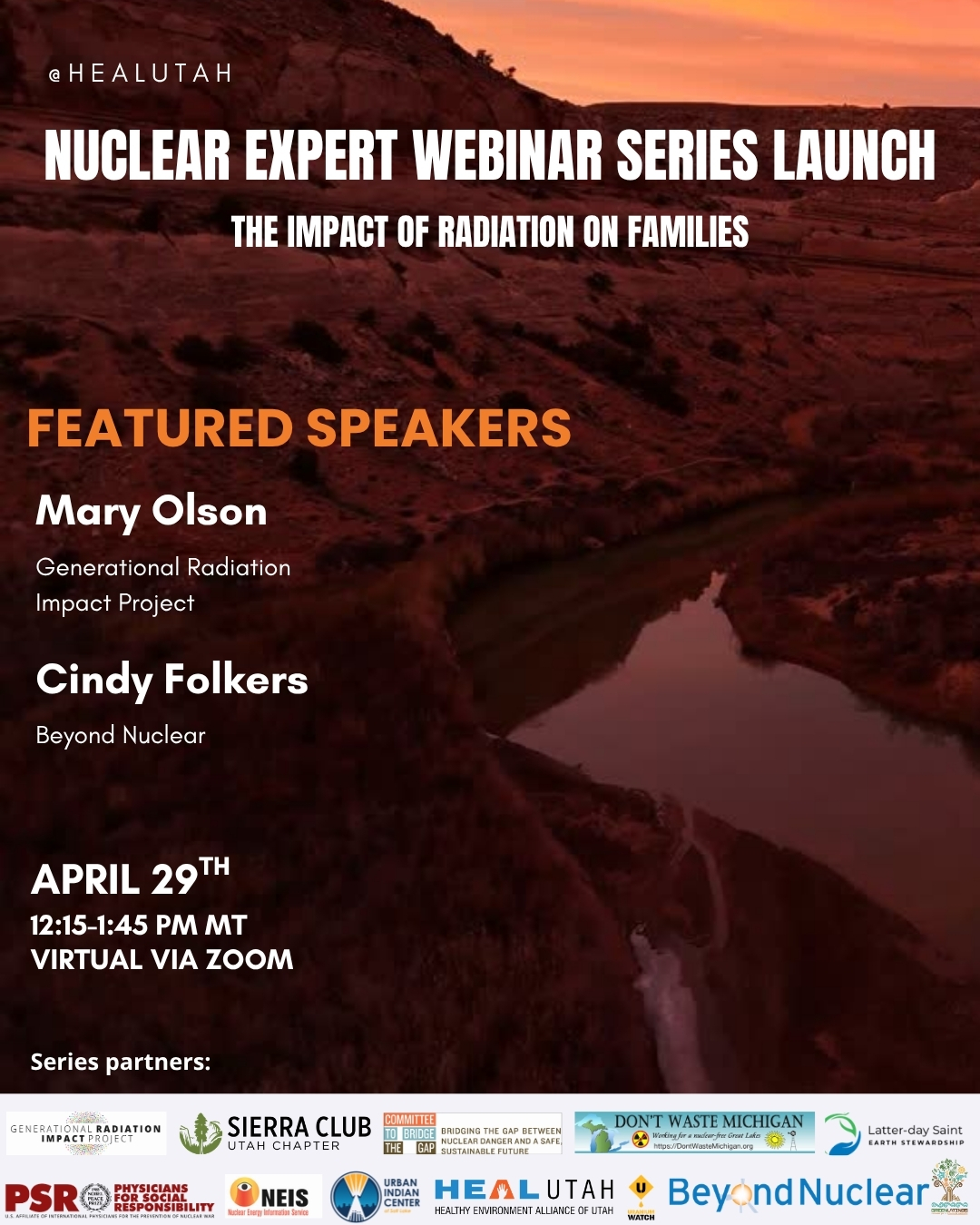
29 April – Nuclear Expert Webinar #1 – Radiation Impacts on Families with Mary Olson and Cindy Folkers
- 12:15 PM MT – 1:45 PM MT
- Location: Virtual – REGISTER TODAY

4 May -West Suburban Peace Coalition to discuss Iran war at May Educational Forum
Monday, May 4, 7:00 – 8:00 PM Central Standard Time
Title: : How Trump’s Narrative Tries to Shape the Reality of the War on Iran.
Contact Walt Zlotow, zlotow@hotmail.com 630 442 3045 for further information
14 May – online event From Bombs to Data Centres: the Face of Nuclear Colonialism

Pine Ridge Uranium is the real threat, not Tehran- Tell Burgum: Stop the Extraction.
Chernobyl: The Lost Tapes – A good documentary on Chernobyl on SBS available On Demand for the next 3 weeks– https://www.sbs.com.au/ondemand/tv-program/chernobyl-the-lost-tapes/2352741955560
To see nuclear-related stories in greater depth and intensity – go to https://nuclearinformation.wordpress.com
-
Archives
- May 2026 (25)
- April 2026 (356)
- March 2026 (251)
- February 2026 (268)
- January 2026 (308)
- December 2025 (358)
- November 2025 (359)
- October 2025 (376)
- September 2025 (257)
- August 2025 (319)
- July 2025 (230)
- June 2025 (348)
-
Categories
- 1
- 1 NUCLEAR ISSUES
- business and costs
- climate change
- culture and arts
- ENERGY
- environment
- health
- history
- indigenous issues
- Legal
- marketing of nuclear
- media
- opposition to nuclear
- PERSONAL STORIES
- politics
- politics international
- Religion and ethics
- safety
- secrets,lies and civil liberties
- spinbuster
- technology
- Uranium
- wastes
- weapons and war
- Women
- 2 WORLD
- ACTION
- AFRICA
- Atrocities
- AUSTRALIA
- Christina's notes
- Christina's themes
- culture and arts
- Events
- Fuk 2022
- Fuk 2023
- Fukushima 2017
- Fukushima 2018
- fukushima 2019
- Fukushima 2020
- Fukushima 2021
- general
- global warming
- Humour (God we need it)
- Nuclear
- RARE EARTHS
- Reference
- resources – print
- Resources -audiovicual
- Weekly Newsletter
- World
- World Nuclear
- YouTube
-
RSS
Entries RSS
Comments RSS
 nuclear-news