Biden’s illegal bombing of Iranian-backed militias in Syria jeopardises nuclear negotiations
|
Biden “Illegally” Bombs Iranian-Backed Militias in Syria, Jeopardizing Nuclear Talks with Tehran, DEMOCRACY NOW, MARCH 01, 2021 The Biden administration is facing intense criticism from U.S. progressives after carrying out airstrikes on eastern Syria said to be targeting Iranian-backed militia groups. The London-based Syrian Observatory for Human Rights reports at least 22 people died. The Pentagon called the assault a response to recent rocket attacks on U.S. forces in northern Iraq. Those attacks came more than a year after Iraq’s parliament voted to expel U.S. troops — an order ignored by both the Trump and Biden administrations.
“Very quickly the Biden administration is falling into the same old patterns of before, of responding to this and that without having a clear strategy that actually would extract us from these various conflicts and actually pave the way for much more productive diplomacy,” says Trita Parsi, executive vice president of the Quincy Institute. We also speak with California Congressmember Ro Khanna, who says President Biden’s recent airstrikes in Syria lacked legal authority. “This is not an ambiguous case. The administration’s actions are clearly illegal under the United States’ law and under international law,” says Khanna.
|
|
USA’s continuing nuclear waste debacle blamed on government contractors
 Steven Chu Blames Government Contractors For Ongoing Nuclear Waste Debacle, https://www.forbes.com/sites/jeffmcmahon/2021/02/28/steven-chu-blames-government-contractors-for-ongoing-nuclear-waste-debacle/?sh=4ec11b8131eb Steven Chu Blames Government Contractors For Ongoing Nuclear Waste Debacle, https://www.forbes.com/sites/jeffmcmahon/2021/02/28/steven-chu-blames-government-contractors-for-ongoing-nuclear-waste-debacle/?sh=4ec11b8131ebJeff McMahonSenior ContributorThe United States continues to struggle with legacy military nuclear waste, former Energy Secretary Steven Chu said, because the contractors making billions from it have opposed a better solution. “If you had a small R&D program that could find a much better, cost-effective way of doing it wouldn’t it be worth it?” Chu asked during a Stanford University webinar last month. “Okay, $6 billion—What’s a good R&D program? Ten percent? Five percent? “It was being nibbled down to $100,000,” he said of his effort to fund R&D during his tenure as Obama’s first energy secretary. “It’s like in the third or fourth decimal place because the contractors who had these huge grants didn’t want better ways, and they just wanted the billion per year coming to the State of Washington, going into Tennessee, going to South Carolina, literally, because it greased the economy.” Chu doesn’t identify the contractors by name, but major contractors in those states include Bechtel, managing the Hanford Nuclear Site in Washington; UCOR, managing cleanup at the Oak Ridge Reservation in Tennessee; and Areva, which absorbed the company that during Chu’s tenure pursued the Mixed Oxide Fuel Fabrication Facility (MFFF) designed to process waste in South Carolina. Bechtel, Areva and UCOR’s parent company, Amentum—have extensive lobbying activities recorded in disclosure forms. I was able to reach representatives from Bechtel and Areva, but they were unable to offer comment on the weekend.
Chu is a professor of physics and molecular and cellular physiology at Stanford University and was president in 2020 of the American Association for the Advancement of Science. He won the 1997 Nobel Prize in physics and is credited by President Obama with designing on a napkin the technology that capped the Deepwater Horizon oil spill. |
|
|
Lawsuit to prevent dangerous dismantling of San Onofre nuclear power station

Lawsuit looks to block dismantlement of Southern California’s San Onofre nuclear plant, Herald Mail Media Rob Nikolewski The San Diego Union-Tribune (TNS) 26 Feb 21, SAN DIEGO — An advocacy group based in Del Mar is taking the California Coastal Commission to court, looking to stop the dismantlement work underway at the now-shuttered San Onofre Nuclear Generating Station.
Officials with the Samuel Lawrence Foundation say the commission should not have granted a permit to Southern California Edison, the majority owner of the plant, to take down buildings and infrastructure at the plant.
“We felt compelled to file this lawsuit because the Coastal Commission really didn’t do what they are supposed to do as an agency to protect the public interest, to protect the environment and the coast,” said Chelsi Sparti, Samuel Lawrence Foundation associate director.
The nine-page suit has been filed in Los Angeles County Superior Court and assigned to Judge Mitchell L. Beckloff. An opposition brief from the Coastal Commission is expected to be filed in May and a trial is anticipated to begin in late June………
Among the issues Edison critics had with the permit centered on the planned demolition of two spent storage pools. Highly radioactive fuel rods were placed into the 40-feet-deep pools to be cooled before they being put into stainless steel canisters and then slowly moved to a “dry storage” facility at the north end of the plant.
Edison says the pools are not necessary now that all the canisters have been transferred to the dry storage facility but the Samuel Lawrence Foundation says the pools should remain in case something goes wrong.
“We need the ability to replace storage canisters as they degrade from age or damage,” foundation President Bart Ziegler said in a statement. “The only available facility is the spent fuel pool and the Coastal Commission is permitting the utility to destroy it.”

The storage pools have not yet been demolished.
The utility complied and last July, the commission approved the program on a 10-0 vote.
Starting in 2024, Edison agrees to inspect two spent fuel storage canisters every five years and inspect a test canister every 2 1/2 years. The program also calls for Edison to apply a metallic overlay on canisters, using robotic devices, in case canisters get scratched.
The permit, which lasts 20 years, includes a special condition that allows the commission by 2035 to revisit whether the storage site should be moved to another location in case of rising sea levels, earthquake risks, potential canister damage or other scenarios.
Despite the added measures, Coastal Commission members reluctantly approved the permit, saying their options were limited because the federal government has never opened a site where waste from commercial nuclear plants can be sent. About 80,000 metric tons of spent fuel has piled up at 121 sites in 35 states…….
The lawsuit says the commission’s decision violates the Coastal Act and “maximizes risk to life and property and threatens geologic stability along the bluffs” along the beach at San Onofre. The plant sits on an 85-acre chunk of Marine Corps Base Camp Pendleton owned by the Department of the Navy, overlooking the Pacific to its west and Interstate 5 to its east. https://www.heraldmailmedia.com/news/nation/lawsuit-looks-to-block-dismantlement-of-southern-californias-san-onofre-nuclear-plant/article_e7b541ce-cfc4-5cb9-a923-cbb8263e728e.html
Jennifer Granholm. new leader of USA’s Department of Energy gives clearly pro nuclear answers

26 Feb 21, Don Hancock of Southwest Research Information Center (SRIC) in Albuquerque, NM, has extracted Granholm’s answers to questions from U.S. Senators on nuclear weapons, nuclear power, and radioactive waste, during her confirmation to become President Biden’s Energy Secretary.
Jennifer Granholm becomes U.S. Energy Secretary: the nuclear lobby is pleased, but not certain
Granholm becomes US energy secretary, WNN 26 February 2021 Jennifer Granholm has been sworn as the 16th US secretary of energy. ….. Maria Korsnick, president and CEO of the US Nuclear Energy Institute, said Granholm will play a pivotal role…….
Judi Greenwald, executive director of the Nuclear Innovation Alliance, said the think tank is looking forward to working with Granholm and her team on the development, demonstration and deployment of the advanced nuclear reactors …
Granholm made no mention of nuclear power……in the article, nor in a video address released to coincide with the swearing-in…… https://www.world-nuclear-news.org/Articles/Granholm-becomes-US-Energy-Secretary
Yakama Nation, state of Washington and environmental groups call on Jennifer Granholm to reconsider nuclear waste rule

|
Coalition Calls on DOE to Reconsider Nuclear Waste Rule February 26, 2021 WASHINGTON – The Yakama Nation, state of Washington and environmental groups joined together in an unprecedented request to the Department of Energy today that it rescind a harmful Trump-era regulation that could allow millions of gallons of radioactive waste to be abandoned at the Hanford Site.
Remediating and removing this toxic waste, which is a legacy of the early U.S. nuclear bomb program, is essential to protecting the Yakama people – and millions more who live downstream along the Columbia River basin. “This rule lays the groundwork for the Department to abandon significant amounts of radioactive waste in Washington state precipitously close to the Columbia River, which is the lifeblood of the Pacific Northwest,” the letter says. This creates “a long-term risk of harm to the residents of the Pacific Northwest and the natural resources critical to the region.” The Energy department’s 2019 so-called “interpretative rule” ignores the science that underpins the Nuclear Waste Policy Act, and gives the department unilateral authority to redefine dangerous high-level radioactive waste as something else – with no opportunity for input, oversight, or consent by state regulators or the public. The letter was sent to Energy Secretary Jennifer Granholm and signed by: The State of Washington Department of Ecology, Washington Attorney General’s Office, Confederated Tribes and Bands of the Yakama Nation, NRDC (Natural Resources Defense Council), Hanford Challenge, and Columbia Riverkeeper. “This rule lays the groundwork for the Department to abandon significant amounts of radioactive waste in Washington state precipitously close to the Columbia River, which is the lifeblood of the Pacific Northwest,” the letter says. This creates “a long-term risk of harm to the residents of the Pacific Northwest and the natural resources critical to the region.” The Energy department’s 2019 so-called “interpretative rule” ignores the science that underpins the Nuclear Waste Policy Act, and gives the department unilateral authority to redefine dangerous high-level radioactive waste as something else – with no opportunity for input, oversight, or consent by state regulators or the public. The letter was sent to Energy Secretary Jennifer Granholm and signed by: The State of Washington Department of Ecology, Washington Attorney General’s Office, Confederated Tribes and Bands of the Yakama Nation, NRDC (Natural Resources Defense Council), Hanford Challenge, and Columbia Riverkeeper. |
|
Jennifer Granholm seems more muted in her support for nuclear, compared to previous Energy Secretaries
Recent USA Energy Secretaries in USA have been strong promoters of the nuclear industry. Up until January 2021 it was Dan Brouillette, very keen on nuclear power. The two Energy Secretaries before that , Rick Perry, Ernest Moniz pretty well used the job as if they were employees of the nuclear industry
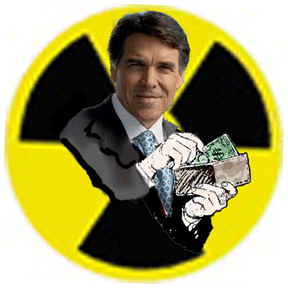

In that context, Biden’s new pick for Energy Secretary, Jennifer Granholm, seems much more muted in her support for nuclear
Jennifer Granholm’s nuke priorities remain hazy, https://www.postandcourier.com/aikenstandard/news/jennifer-granholms-nuke-priorities-remain-hazy/article_2c6c6f36-6240-11eb-9f33-b745c10da3cf.html By Colin Demarest cdemarest@aikenstandard.com Feb 3, 2021
-
- In written testimony provided to a Senate panel Wednesday, the new president’s pick to lead the Department of Energy said she would prioritize, among other things, American safety and security.
Doing so, Jennifer Granholm explained in a single paragraph, would mean focusing on the department’s offensive-and-defensive arm, the National Nuclear Security Administration, as well as the cleanup of Cold War artifacts – pockets of toxic waste, for example, trapped at sprawling installations like the Savannah River Site south of Aiken.
During her confirmation hearing this week, before the Senate Energy and Natural Resources Committee, the latter was discussed at decent length; the Hanford Site in Washington, notoriously difficult and expensive to remediate, was brought up several times, and Granholm pledged not to kick the can down the road. Some might argue such remarks are a rite of passage for Energy Department executives.
In written testimony provided to a Senate panel Wednesday, the new president’s pick to lead the Department of Energy said she would prioritize, among other things, American safety and security.
Doing so, Jennifer Granholm explained in a single paragraph, would mean focusing on the department’s offensive-and-defensive arm, the National Nuclear Security Administration, as well as the cleanup of Cold War artifacts – pockets of toxic waste, for example, trapped at sprawling installations like the Savannah River Site south of Aiken.
During her confirmation hearing this week, before the Senate Energy and Natural Resources Committee, the latter was discussed at decent length; the Hanford Site in Washington, notoriously difficult and expensive to remediate, was brought up several times, and Granholm pledged not to kick the can down the road. Some might argue such remarks are a rite of passage for Energy Department executives.
The former – the National Nuclear Security Administration, its hefty budget and its myriad missions – was sparsely touched, even with Granholm cracking open the door.
The disconnect, though, didn’t catch observers off guard.
“Given the committee in which the confirmation hearing took place and the fact that she’s not yet up to speed on nuclear weapons issues, it’s no surprise that Gov. Granholm was not asked about key NNSA issues,” said Tom Clements, the director of Savannah River Site Watch, an organization that monitors a host of energy- and nuclear-related issues. “I assume she is receiving briefings on NNSA matters and will soon be fully conversant and able to make informed, sound decisions.”
The committee that handled Granholm’s nomination has jurisdiction over nuclear waste, not nuclear weapons – exactly why Sens. Maria Cantwell of Washington and Ron Wyden of Oregon broached Hanford and why Sen. Catherine Cortez Masto of Nevada railed against Yucca Mountain.
“I wouldn’t want to read the tea leaves too much,” said Marylia Kelley, the executive director of Tri-Valley CAREs, which tracks Lawrence Livermore National Laboratory and the nuclear-weapons complex, more broadly. “I do know that after the hearing I was left with questions.”
The hearing Wednesday, shy of three hours, served as a digestible introduction to Granholm, a two-time governor of Michigan, auto-industry adept and clean-energy advocate. The conversation was heavy on energy sources and fuels, climate change and job losses, a major concern for some lawmakers as President Joe Biden signs a flurry of environmental executive orders. Kelley, though, is anxious to see where the nominee stands on nuclear-weapons issues: new warheads, new cores, modernization spending and the like. Such topics are a rarity on governors’ desks.
“I am hopeful that our new energy secretary will bring a set of skills that will help her make difficult decisions under pressure in a logical and organized fashion,” Kelley said. She later added: “Of course, from my organization’s perspective, I will be looking toward the Energy Department being more skeptical about expanding pit production, both on the question of what we need and on the question of when we need it, and how much we’re going to spend on it and how we’re going to accomplish it. I’m looking for her to be skeptical.”
Indications of priority – what’s important, and how much – will unfurl in budget requests and related budget hearings, said Nickolas Roth, the director of the nuclear security program at the Stimson Center, headquartered in Washington, D.C.
“That’s where you usually get more into the weeds on this kind of stuff,” Roth said. His hope, he explained, “is that the Biden administration will look for ways to curtail a very expensive nuclear-weapons modernization program” and strike a better balance with the nonproliferation portfolio.
If confirmed, Granholm would take the reins at a department very much devoted to the U.S. nuclear arsenal.
“The National Nuclear Security Administration is the largest part of the budget when you figure that environmental management is related to the nuclear weapons mission,” Kelley said. “It’s the lion’s share of the budget, by far.”
The Energy Department’s fiscal year 2021 budget request added to $35.4 billion; the National Nuclear Security Administration earmark totaled $19.8 billion. Of that sum, a vast majority was for weapons activities. (Daryl Kimball, the executive director of the Arms Control Association, has branded the DOE as the NWD: Nuclear Weapons Department.)
In the weeks before the 2021 blueprint was unveiled, dozens of lawmakers, including three Palmetto State Republicans, lobbied then-President Donald Trump to funnel more money to the NNSA and its weapons work. Insufficient funding, the elected officials wrote, would risk U.S. national security and embolden “anti-nuclear Democrats who oppose your effort to rebuild our military,” a red meat appeal.
Clements, who leads SRS Watch, anticipates Granholm “will make tough decisions reshaping U.S. nuclear weapons policy in a way that increases our collective security while reducing financial costs and reducing reliance on nuclear weapons.”
That remains to be seen.
Well-funded pro nuclear lobby has wishlist for Joe Biden
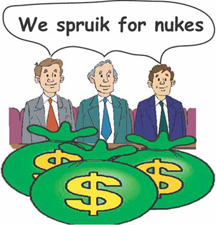



Is the Biden government going to buy these lies? Nuclear – clean? renewable?
|
Reports Envision a Leading Role for Nuclear in this Administration, JDSUPRA, 25 Feb 21, On February 16, the Nuclear Innovation Alliance (NIA) and the Partnership for Global Security (PGS) issued a report to help guide the Biden Administration in its support of nuclear amidst the President’s ambitious climate agenda. The report, U.S. Advanced Nuclear Energy Strategy for Domestic Prosperity, Climate Protection, National Security, and Global Leadership, provides detailed recommendations to promote advanced reactor development that could garner bipartisan support if implemented. It discusses federal, state-level, and international goals for advancing nuclear. The next day, February 17, the American Nuclear Society (ANS) published a report on Public Investment in Nuclear Research and Development that requests an additional $10.3B by 2030 in funding for demonstration reactors and projects aimed to streamline commercialization of advanced nuclear. While the NIA and PGS report establishes a roadmap for advanced reactor development, the purpose of the ANS report is to make a case for increased federal investment in nuclear. Here are some of the recommendations from the NIA/PGS report:
|
|
Former SCANA nuclear executive pleads guilty to fraud
 Former SC utility CEO pleads guilty to nuclear plant fraud
The utility executive who spent billions of dollars on two South Carolina nuclear plants that never generated a single watt of power pleaded guilty in two courts, By MICHELLE LIU Associated Press/Report for America, 25 February 2021, COLUMBIA, S.C. — The utility executive who spent billions of dollars on two South Carolina nuclear plants that never generated a single watt of power pleaded guilty to federal conspiracy charges Wednesday.
Former SCANA Corp. CEO Kevin Marsh will likely spend two years in prison and pay $5 million back to ratepayers, per the plea agreement prosecutors presented to U.S. District Judge Mary Geiger Lewis in Columbia.
Marsh’s formal acknowledgement of his role in the conspiracy to commit wire and mail fraud comes more than three years after the project imploded publicly and federal and state agencies began investigating.
Marsh, 65, will be free on bond as he cooperates with federal authorities until he is formally sentenced. He headed to Spartanburg in the afternoon to plead guilty on a state charge tied to the investigation. Officials said he will serve any state sentence he receives concurrently with his federal sentence.
A judge will hand down the final sentence after the investigation concludes. Prosecutors haven’t given indication of when that might be.
Marsh and other executives insisted the project to build the two reactors at the V.C. Summer site north of Columbia was on track ever since it started in 2008. The company hiked rates on customers nine times between 2009 and 2017 to help fund the project.
Prosecutors said that as the project lagged, Marsh lied repeatedly to investors, regulators and the media, claiming the reactors would be making power by a 2020 deadline to get $1.4 billion in federal tax credits needed to keep the $10 billion project from overwhelming SCANA and its subsidiary, South Carolina Electric & Gas.
An independent report commissioned by SCANA in 2015 estimated the reactors would not be finished in 22 years. Executives fought to get the estimate removed from the copy of the report shared with state-owned utility Santee Cooper, which held a 45% stake in the new reactors, prosecutors said.
Santee Cooper ended up $4 billion in debt from the project. Lawmakers are still arguing over whether to sell or reorganize the utility.
Dominion Energy of Virginia bought out SCANA in 2019 after the former Fortune 500 company was crippled by the nuclear debacle.
In December, the Securities and Exchange Commission said both SCANA and its subsidiary agreed to settle a civil lawsuit filed by the SEC in February for $137.5 million, including a $25 million civil penalty.
Former SCANA Executive Vice President Stephen Byrne pleaded guilty to federal charges similar to Marsh’s in July. He is also awaiting sentencing. AT TOPhttps://abcnews.go.com/Technology/wireStory/sc-utility-executive-plead-guilty-courts-76084865
Move in Ohio Senate to repeal nuclear bailout law
|
By ANDY CHOW • 24 Feb 21, A measure to repeal part of Ohio’s controversial nuclear power plant bailout, and stop the increase to monthly electric bills, is gaining momentum in the Ohio Senate.
The Republican-backed bill, SB44, would repeal the nuclear subsidies created through 2019’s HB6. It’s now on its way to a possible full Senate vote after being unanimously passed by the energy and public utilities committee. Investigators say a utility, believed to be FirstEnergy, funneled millions of dollars to a dark money group controlled by Rep. Larry Householder (R-Glenford). They say Householder used those funds to become House Speaker, and in return pass FirstEnergy’s legislative agenda in the form of HB6, which in part subsidized two nuclear plants formerly owned by the company. Most Democrats and several Republicans want a full repeal of HB6, which would also have the effect of reviving green energy standards that the 2019 law eliminated. However, doing away with just the nuclear subsidies seems to be the option with the most traction. The extra charge on electric bills to generate $150 million a year for Ohio’s two nuclear power plants has been stalled through a court injunction, which will remain in place while the federal investigation continues. Three defendants in the bribery case, including the dark money group Generation Now, have plead guilty to racketeering charges. |
|

NuScale’s small nuclear reactor dream – dead on arrival?
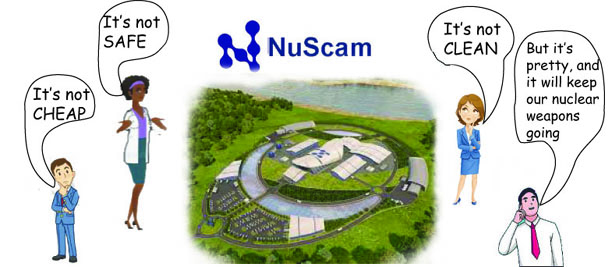
in order to make advanced reactors accessible within the next few decades—even relatively simple reactors, like NuScale’s—the government would need to provide hundreds of billions of dollars in subsidies …… the nuclear dream looks dead on arrival….
Biden’s Other Nuclear Option, Smaller nuclear reactors might be the bridge to a carbon-free economy. But are they worth it? Mother Jones, 22 Feb 21, BOYCE UPHOLT ”………..
But are these investments worth the money—and the risks? New designs or not, nuclear plants face daunting issues of waste disposal, public opposition, and, most of all, staggering costs. We must ramp up our fight against climate change. But whether nuclear is a real part of the solution—or just a long-shot bid to keep a troubled industry alive—is a debate that will come to the fore in the short window we have to overhaul the nation’s energy portfolio.
Few issues divide us as cleanly as nuclear power. According to a 2019 Pew Research Center poll, 49 percent of Americans support opening new plants, while 49 percent are opposed.
The popular argument against nuclear power can be summed up in a few names: Chernobyl. Fukushima. Three Mile Island. Nuclear dread is palpable. Some formerly pro-nuclear countries, like Germany, began phasing out plants in the wake of the 2011 disaster in Japan. The dangers begin well before nuclear fuel arrives at a plant, and persist long afterward; the rods that fuel today’s plants remain radioactive for millennia after their use. How to ethically store this waste remains a Gordian knot nobody has figured out how to cut.
The argument in favor of nuclear power boils down to the urgent need to combat climate change. [Ed, but nuclear does not really combat climate change.]
But if nuclear power is going to help us mitigate climate change, a lot more reactors need to come online, and soon. Eleven nuclear reactors in the United States have been retired since 2012, and eight more will be closed by 2025. (When nuclear plants are retired, utility companies tend to ramp up production at coal- or natural gas–fired plants, a step in the wrong direction for those concerned about lowering emissions.) Since 1970, the construction of the average US plant has wound up costing nearly three-and-a-half times more than the initial projections. Developers have broken ground on just four new reactor sites since Three Mile Island. Two were abandoned after $9 billion was.. sunk into construction; two others, in Georgia, are five years behind schedule. The public is focused on risks, but “nuclear power is not doing well around the world right now for one reason—economics,” says Allison Macfarlane, a former commissioner of the Nuclear Regulatory Commission.
Until Three Mile Island, public support was strong. Dozens of plants came online. In the 1970s, Reyes, seeing an industry full of promise, decided to pursue a degree in nuclear engineering.
……… Utah Associated Municipal Power Systems, a state-owned agency that sells electricity across six Western states aims to offer its members the choice of fully carbon-free power, sees NuScale as the best available option for undergirding its existing wind and solar plants. In 2015, UAMPS announced a plan to build 12 NuScale reactors at the federally run Idaho National Laboratory. NuScale projected total construction costs at $3 billion—nearly a third less than the most recently completed US reactor, which came online in 2016 at a cost of $4.7 billion (though it will supply more power). And the next plant should cost even less, since NuScale’s small reactors will be built on an assembly line, rather than on-site. But the price will drop only if more customers buy them. “Taxes are more popular than nuclear power,” jokes Doug Hunter, the CEO of UAMPS.
To change that perception, Hunter and his team have spent the last few years visiting towns and utility companies that buy power from UAMPS, explaining the potential role of nuclear power and the safety of NuScale’s design. His persistence paid off. By 2020, the majority had signed on to the NuScale project—though only as long as they had plenty of chances to back out if the project went south……….
Even with new technology, we will need to mine uranium—a process that has leached radioactive waste into waterways—and find somewhere to put the spent fuel. (The current practice, which persists at Trojan and will be employed at NuScale’s plants, is to hold waste on-site. This is intended to be a temporary measure, but every attempt to find a permanent disposal site has been stalled by geological constraints and local opposition.) Lloyd Marbet, Director of the non-profit Oregon Conservancy Foundation believes we need to transition away from coal and gas immediately. But he worries that nuclear is too expensive, and a new round of investment might pull money away from more effective, and cleaner, solutions. ……….
These days, he’s watching the industry creep back. A Republican state senator named Brian Boquist has proposed a bill three times that would permit city or county voters to exempt themselves from the 1980 law, allowing a nuclear facility to be built within their borders. (The bill has failed twice; the latest version is with the senate committee.) Boquist does not seem particularly committed to fighting climate change: He and other members of the Republican minority refused to show up to vote on a cap-and-trade bill in early 2020, causing the Senate to fall short of a quorum. (When Gov. Kate Brown threatened to retrieve legislators using state troopers, Boquist said to “send bachelors and come heavily armed.”)
In 2017, as the legislature debated Boquist’s first pro-nuclear bill, Marbet testified that NuScale was making “an end run around [voters] in their quest for corporate profit.” He also noted the company’s ties to the Fluor Corporation. The Texas-based multinational engineering firm that has been NuScale’s majority owner since 2011 has invested $9.9 million in campaign contributions over the past 30 years, with nearly two-thirds going toward Republican candidates. (Fluor is currently under investigation by the Securities and Exchange Commission due to allegedly sloppy accounting practices.)
Marbet admits his view of the industry is jaundiced, but his experiences make him skeptical of NuScale and its claims. He worries, too, that if small reactors take off, operators will revert to old habits, cutting corners to make a buck. He points to a draft rule approved last year by the Nuclear Regulatory Commission, over the objections of FEMA, that would reduce the size of the emergency planning zone around nuclear plants: Rather than a 10-mile-wide circle, a plant would only need an evacuation plan for the space within its fence lines. NRC commissioner Jeff Baran opposed the change, noting it is based on assumptions about small reactors, like NuScale’s, that remain on the drawing board, and might open the door to weakening safety standards for existing plants.
Old-line environmental groups like Greenpeace and the Sierra Club remain staunchly opposed to nuclear power, but politicians have been more open to it.
President Barack Obama was an outspoken proponent of nuclear’s potential. For 2020, the Senate Appropriations Committee unanimously agreed to spend more than President Trump requested on nuclear research, and the Senate is currently considering a bipartisan bill that will streamline the permitting process and establish a national uranium reserve.
Now, as part of his $2 trillion climate plan, Biden is calling for a federal research agency that would pursue carbon-free energy sources, including small reactors. Biden’s was the first Democratic Party platform in 48 years that explicitly supported an expansion of nuclear energy. His pick to lead the Department of Energy—which devotes the majority of its budget to nuclear projects—is former Michigan Gov. Jennifer Granholm, who has little experience in the field. Gina McCarthy, the former EPA administrator who is Biden’s chief domestic climate coordinator, has said that nuclear could play a key role in baseload power supply but indicated that waste disposal issues ought to be resolved before the technology is widely adopted.
A major hurdle for any advanced nuclear product is the regulatory process. NuScale spent more than $500 million developing its licensing application. The path to approval has consumed 12 years already, and it’s not over yet. In the months after my visit to NuScale, the Nuclear Regulatory Commission noted “several potentially risk-significant” questions that remain unanswered about the company’s reactor design, especially about its new version of a steam generator. Nonetheless, the NRC granted its initial approval of the design at the end of the summer; now NuScale awaits official, final certification by the commissioners, which is expected sometime this year. But further analysis of the generators will be required before a license is granted to actually build a plant.
A decade ago, NuScale suggested it might have a plant in operation by 2018. Now construction won’t begin until 2025 at the earliest. The plant at Idaho National Laboratory won’t be fully operational until 2030. Factoring in interest and other costs not included in NuScale’s $3 billion estimate, UAMPS expects a total 40-year lifetime cost of $6 billion for the plant. Some critics see this as the same old story: grand, early promises—a “dog and pony show,” as Marbet calls NuScale’s PR—followed by cost overruns and delays. Reyes intentionally used materials familiar to regulators, so as to speed along the process. But other advanced reactor designs, which use new kinds of fuel and coolant, may face an even slower and more expensive journey.
Recently, nine towns—more than a quarter of the subscribed members—pulled out of UAMPS’s project after changing their minds about their energy needs or worrying that it was becoming a financial sinkhole. (Meanwhile, one new town signed on.) The plant’s economics depend on running near full capacity, which will only happen if utilities outside of UAMPS also buy some of its power. The Department of Energy says it will chip in nearly $1.4 billion over the next nine years, which should help bring down the cost of the plant’s energy. But the projected price—$55 per megawatt-hour—is still above the current costs for solar and wind projects. And the federal money will require annual congressional approval. It’s possible that other new ideas might pop up, competing for limited dollars.
Biden’s climate plan hinges on a massive expenditure on research. What his administration will have to quickly decide, though, is how to divvy that pot. Allison Macfarlane, the former NRC commissioner, told me other industries deserve far more of our resources and attention than nuclear. Batteries, in particular, could steady out the uneven flow of renewables. They may even work better, since nuclear plants are difficult to power up or down in response to changing conditions. Once a pie-in-the-sky idea, battery storage now offers costs at least “in the ballpark” of nuclear, says Stan Kaplan, a former US Energy Information Administration analyst. Prices have dropped 70 percent in the past few years and are projected to drop another 45 percent before NuScale’s plant comes online. California—which also has a moratorium on nuclear builds—is rapidly expanding its storage capacity. Within 10 years, the niche that NuScale is aiming for might already be filled.
……. For nuclear to persist as a hedge, it all but requires government assistance, given the enormous upfront costs of R&D. Another challenge is vetting which projects have real promise. “You have all these reactor vendors pitching their wares, and making all sorts of outrageous and false claims,” says Edwin Lyman, the director of nuclear power safety with the Union of Concerned Scientists. These claims have also been the basis of lowering safety standards, which offers a large indirect subsidy for operators. There needs to be a stronger peer-review process, he says, to make sure the government is only sponsoring truly worthwhile projects.
A recent study from Princeton found that even without nuclear power, the relative cost of a decarbonized energy system in 2050 could be about the same as in 2015, which at the time was a historic low. The study found nuclear could reduce costs even further—if it becomes as cheap as its advocates hope. But Abdulla, the UC San Diego researcher, has calculated that in order to make advanced reactors accessible within the next few decades—even relatively simple reactors, like NuScale’s—the government would need to provide hundreds of billions of dollars in subsidies and substantially simplify the regulatory process. Abdulla believes nuclear energy should have been “an arrow in our quiver.” But given the economics, he says, “I fear the arrow has broken.”
 if money were no object—if we could snap our fingers and scatter reactors across the landscape—…… But if Abdulla’s numbers are right, the nuclear dream looks dead on arrival…. https://www.motherjones.com/environment/2021/02/nuclear-energy-climate-change-nuscale-green-power-uranium/
 A great article. Just one problem. The whole article runs with the assumption that nuclear power is effectively ”low carbon”. Yet this assumption is not challenged. There are several ways in which nuclear power is actually quite high carbon. Just for one comparison with reneewable energy: wind and solar power are delivered directlly to the turbines and panels – with no digging up of fuel required, no regular transport by road, rail etc. The entire nuclear fuel chain with all its steps – mining, milling, conversion, fuel fabrication, reactor, waste ponds, waste canisters , deep repositaory … all this is carbon emitting.
Ohio House and Senate wrestle with Bills about the nuclear bailout law
 Ohio Lawmakers Consider More Bills To Repeal Or Revise Nuclear Bailout Law WOSU Ohio Lawmakers Consider More Bills To Repeal Or Revise Nuclear Bailout Law WOSU
By ANDY CHOW, 22 Feb 21, Several bills have been introduced in the Ohio House and Senate to tackle the controversial nuclear power plant bailout law. The measures range from a partial repeal to a complete revoking of HB6, which is currently at the center of a $61 million federal bribery investigation.
Several bills have been introduced in the Ohio House and Senate to tackle the controversial nuclear power plant bailout law. The measures range from a partial repeal to a complete revoking of HB6, which is currently at the center of a $61 million federal bribery investigation………
While the investigation into HB6 is ongoing, some legislators say Stein’s bill doesn’t go far enough. State Rep. David Leland (D-Columbus) is proposing HB10, which eliminates the nuclear and solar subsidies, along with a measure that guaranteed a certain amount of subsidies for two coal plants.
There are other pieces of legislation, HB18 and HB57, that would repeal all of HB6, which would mean the revival of Ohio’s green energy standards. Republican leadership in the House and Senate have signaled a willingness to move on bills that address the nuclear and solar subsidies. https://radio.wosu.org/post/ohio-lawmakers-consider-more-bills-repeal-or-revise-nuclear-bailout-law#stream/0 |
|
The ”New Yorker” sinks to sloppy sentimenta praise of pro nuclear advocates
The Once-Proud New Yorker Soils Itself in Radioactive Offal https://readersupportednews.org/opinion2/277-75/67935-rsn-the-once-proud-new-yorker-soils-itself-in-radioactive-offal, By Harvey Wasserman, 21 February 21
 or decades, The New Yorker has set a high bar for journalistic excellence.
Graced by its signature brand of droll, sophisticated cartooning, the magazine’s exquisitely edited screeds have reliably delivered profound analyses of the world’s most pressing issues.
But in a breathless, amateurish pursuit of atomic energy, the editorial staff has leapt into a sad sinkhole of radioactive mediocracy.
The latest is Rebecca Tuhus-Dubrow’s shallow, shoddy “Activists Who Embrace Nuclear Power,” yet another tedious plea that we learn to love the Peaceful Atom.
For at least a century, countless scientific pioneers have exposed the murderous realities of nuclear radiation. Legendary researchers like Marie Curie, Alice Stewart, Rosalie Bertell, Helen Caldicott, John Gofman, Ernest Sternglass, Thomas Mancuso, Karl Z. Morgan, Samuel Epstein, Robert Alvarez, Arnie Gundersen, Amory Lovins, and others have issued vital warnings.
In Pavlovian opposition, the industry has rolled out an endless array of amateur “environmentalists” whose activist credentials are distinguished only by an endless love for atomic power.
Most infamous are Greenpeace veteran Patrick Moore and Berkeley-based Michael Shellenberger, both climate skeptics who share a theatrical passion for uninspected, uninsured nukes. With no credible scientific credentials, this unholy pair has conjured imaginative advocacies for companion corporate embarrassments like genetically modified food, clear-cut deforestation, and more.
With far more prestige, climate pioneer Dr. James Hanson and Whole Earth Catalogue founder Stewart Brand have brought significant gravitas to the nuclear debate.
But The New Yorker dotes on two workers at California’s Diablo Canyon. Neither is a scientist. Both claim to be “environmentalists.” One wears a lavender pendant made of uranium glass which “emits a near-negligible amount” of radiation, despite a huge body of scientific evidence warning this is a literally insane thing to do – especially for someone who might be around small children.
 The writer lauds her heroines for calling themselves “Mothers for
 Nuclear” while snubbing legendary “Mothers for Peace” activists who’ve organized locally for a half-century. While touring Diablo with her new best friends, the author coos that “we smiled as if we were at Disneyland.”
Such “Nuclear Renaissance” absurdities are very old news.
Given The New Yorker’s stellar history, we might expect a meaningful, in-depth exploration of today’s core atomic realities: no more big reactors will be built in the US, and our 90+ old plants are in deep, dangerous disarray.
Forbes long ago branded atomic power “the largest managerial failure in US history.” America’s very last two reactors (at Georgia’s Plant Vogtle) sucked up $8.3 billion in federal loan guarantees from Barack Obama plus $3.7 billion more from Donald Trump. Years behind schedule, Vogtle’s final price tag (if it ever opens) will exceed $30 billion.
South Carolina’s engineering and legal morass at V.C. Summer wasted more than $10 billion on two failed reactors. In Ohio, $61 million in utility bribes for a massive nuke bailout have shattered the state.
As for alternatives, Rebecca Tuhus-Dubrow says, “nuclear scientists, for their part, are working on smaller, more nimble nuclear reactors. There are complex economic considerations, which are inseparable from policy.”
In other words, the proposed Small Modular Reactors are already so clearly uncompetitive that only obsessive pro-nukers (like Bill Gates) think they’ll hold market value against wind and solar (which The New Yorker attacks).
Precisely as ice storms froze feedwater pipes and shut one of two reactors at the South Texas Nuclear Plant, the magazine falsely claims that atomic reactors do “not depend on particular weather conditions to operate.” Globally-warmed rivers can no longer reliably cool many French reactors. Earthquakes have dangerously damaged US-designed nukes in Ohio and Virginia. Intake pipes at Diablo and other coastal plants are vulnerable to tsunami surges. Staggering design and construction flaws (a major Diablo component was once installed backwards; boric acid ate through key parts of Ohio’s Davis-Besse) give the entire industry a Keystone Kops/Rube Goldberg aura.
Tuhus-Dubrow skims the waste issue. Dry casks at Diablo and elsewhere are generally less than an inch thick. They can’t be re-opened for inspection or maintenance, and are already cracking (more-versatile German casks are 19 inches thick).
With an average age of well over 30, US reactors face dangerous decay. After four years of Trump, and even longer as a corrupt rubber stamp, the infamously dysfunctional Nuclear Regulatory Commission has left these collapsing, uninsured jalopies virtually unregulated and uninspected.
Tuhus-Dubrow ignores the fact that (unlike Disneyland) Diablo Unit One was long ago reported to be severely embrittled. That means critical components could shatter like glass if flooded to contain a meltdown. Ensuing Chernobyl-scale steam and hydrogen explosions would spread apocalyptic radiation throughout the ecosphere.
Despite a petition signed by more than 2,000 Californians and key Hollywood A-listers, Gov. Gavin Newsom refuses to inspect Diablo’s decayed reactors.
The New Yorker says smoke coming from huge northern California fires dimmed solar panels. But those fires were caused by the gross incompetence, neglect, and mismanagement of the twice-bankrupt Pacific Gas & Electric, which runs Diablo.
PG&E is a federal felon, convicted for killing scores of Californians in avoidable explosions and fires. Tuhus-Dubrow simply ignores such slipshod mismanagement, which could prove catastrophic at a nuke as old as Diablo.
Overall, the nuke power debate has long since transcended random, folksy industry devotees who like to label themselves “green.” No serious analyst argues that, after the fiscal fiascos at V.C. Summer and Plant Vogtle, any big new reactors will ever be built in the US. Small ones are cost-prohibitive pipe dreams, especially as wind, solar, battery and LED/efficiency technologies continue to advance.
The question of how long America’s 90+ jalopy nukes can run until the next one explodes remains unanswered … and utterly terrifying.
Somehow, the revered New Yorker has polluted its pages with a pro-nuke fantasy while missing this most critical atomic issue.
Let’s hope it corrects the deficiency before the next Chernobyl lays waste to our own nation.
Harvey Wasserman’s Solartopia! Our Green-Powered Earth is at www.solatopia.org, along with The People’s Spiral of US History.
Nuclear weapons — they’re illegal
|
Nuclear weapons — they’re illegal https://www.santafenewmexican.com/opinion/my_view/nuclear-weapons-theyre-illegal/article_5238752a-5ad4-11eb-932c-2ff8ea90b754.html,By Jay Coghlan, 21 Feb21,
Jan. 22 will go down in history as the day when the tide turned against nuclear weapons. That was the day when theTreaty on the Prohibition of Nuclear Weapons went into effect, signed by 122 countries. It specifically prohibits nations from developing, testing, using or threatening to use nuclear weapons and assisting others in doing so. It reinforces existing international law obligating all states not to test, use or threaten to use nuclear weapons. What immediate impact will it have here, given that the Los Alamos National Laboratory is the birthplace of nuclear weapons and now sole producer of plutonium pit triggers for the expanding U.S. stockpile? The brutally honest answer is no impact, not immediately.
But think about it. Nuclear weapons are now internationally illegal, just as horrendous chemical and biological weapons of mass destruction have long been. But nuclear weapons are the worst WMDs, potentially killing millions more while causing radioactive fallout and famine-inducing nuclear winter. Ask your New Mexican congressional members to explain why nuclear weapons shouldn’t be internationally banned just like chemical and biological WMDs, all of which cause agonizing, indiscriminate suffering and death. Predictably, our politicians and self-interested nuclear weapons labs will point to the sacred cow of “deterrence.” But we need to honestly examine exactly who needs to be deterred when the U.S. is the only country to have used nuclear weapons and our presidents have repeatedly threatened to use them again (for example, Nixon in Vietnam). Furthermore, we just had an arguably deranged president with the sole authority to start nuclear war. The fact is that the U.S. and the Soviet Union/Russia have always had a hybrid of deterrence and nuclear war fighting capability that could overkill the planet many times over. That is why both sides have thousands of nuclear weapons, many on hair trigger alert, instead of the few hundred needed for just deterrence. That is why the U.S. has a $1.5 trillion, so-called “modernization” program to completely rebuild all nuclear warheads and acquire new missiles, submarines and bombers to deliver them. You may be skeptical of a ban treaty, but ask yourself: What have nukes done to protect you from global pandemics and climate change? What are the odds of nuclear war caused by false warnings (as has happened many times) or cyber hacking? How reliable will exorbitantly expensive new nuclear weapons be when they can’t be tested because of the global testing moratorium? Or worse yet may prompt the U.S. back into testing, thereby accelerating the new arms race? It may seem like an impossible dream to abolish nuclear weapons. But that’s what was once said about the abolishment of slavery. We can learn from the Martin Luther Kings, the Harriet Tubmans, the John Lewises that it can be done. Whereas the nuclear weapons ban treaty will have little if any immediate effect on New Mexico’s two nuclear weapons labs, it will be a game changer. Remember that when your congressional members pitch expanding nuclear weapons production as jobs programs; you can respond that they are illegal. Tell them they should show visionary leadership and moral courage by helping to create cleanup and green energy jobs instead. Nuclear weapons are now internationally illegal. The U.S. was among the last major countries to abolish slavery but did so in the end. To modify MLK’s famous quote: “The arc of the moral universe is long, but it bends towards [the] justice” of abolishing nuclear weapons. This ban treaty is the beginning of that end and should be celebrated as such. Jay Coghlan with Nuclear Watch New Mexico has been working on nuclear weapons issues for more than 30 years. For more see nukewatch.org.
|
|
Lies in Texas, as Republicans blame renewable energy for cold weather traumas
|
Pressenza 19th Feb 2021, Forget Ted Cruz, What’s Really Missing in Texas Is the Green New Deal. While Republican Sen. Ted Cruz of Texas is under fire for fleeing to Cancún for a vacation as his constituents endure devastating power outages as well as food and water shortages due to rare winter weather, climate campaigners are pointing to the compounding crises in the Lone Star state as proof of the need for a Green New Deal.
As dozens of people have died and millions have spent days without electricity, some right-wing news outlets and lawmakers—including GOP Texas Gov. Greg Abbott, who’s facing calls to step down—have lied about the state’s power problems, blaming renewable energy, even though the outages are largely tied to issues with gas, coal, and nuclear facilities. Abbott even claimed Tuesday on Fox News that “this shows how the Green New Deal would be a deadly
deal for the United States of America.” |
-
Archives
- October 2026 (112)
- September 2026 (339)
- August 2026 (330)
- July 2026 (355)
- June 2026 (287)
- May 2026 (306)
- April 2026 (356)
- March 2026 (251)
- February 2026 (267)
- January 2026 (308)
- December 2025 (358)
- November 2025 (359)
-
Categories
- 1
- 1 NUCLEAR ISSUES
- business and costs
- climate change
- culture and arts
- ENERGY
- environment
- health
- history
- indigenous issues
- Legal
- marketing of nuclear
- media
- opposition to nuclear
- PERSONAL STORIES
- politics
- politics international
- Religion and ethics
- safety
- secrets,lies and civil liberties
- spinbuster
- technology
- Uranium
- wastes
- weapons and war
- Women
- 2 WORLD
- ACTION
- AFRICA
- Atrocities
- AUSTRALIA
- Christina's notes
- Christina's themes
- culture and arts
- Events
- Fuk 2022
- Fuk 2023
- Fukushima 2017
- Fukushima 2018
- fukushima 2019
- Fukushima 2020
- Fukushima 2021
- general
- global warming
- Humour (God we need it)
- Nuclear
- RARE EARTHS
- Reference
- resources – print
- Resources -audiovicual
- Weekly Newsletter
- World
- World Nuclear
- YouTube
-
RSS
Entries RSS
Comments RSS

