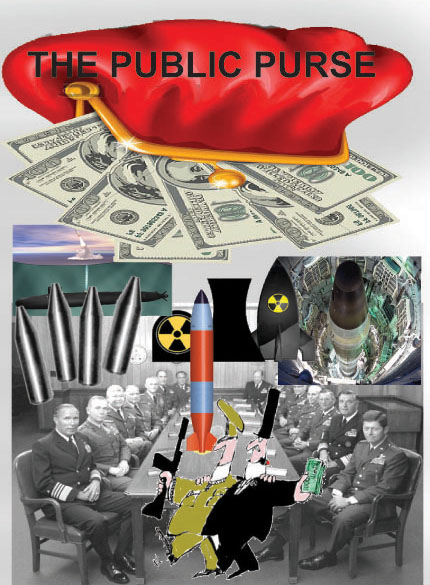
USA’s $634Billion nuclear weapons budget

CBO: US nuclear arsenal to cost $634B over 10 years, https://thehill.com/policy/defense/555142-cbo-us-nuclear-arsenal-to-cost-634b-over-10-yearsBY REBECCA KHEEL – 05/24/21 Updating and maintaining the U.S. nuclear arsenal over the next 10 years is projected to cost $634 billion, the Congressional Budget Office (CBO) said in a report published Monday.
The cost estimate for the nuclear forces from 2021-2030 represents a 28 percent increase compared to the last CBO 10-year cost estimate two years ago.
About half of the $140 billion increase comes from the fact that the new estimate now includes 2029 and 2030 when nuclear modernization is expected to be further along and “more expensive,” CBO said.
Of the CBO’s $634 billion estimates, about $551 billion is what would be needed to fulfill the Defense and Energy departments’ current nuclear plans. The remaining $83 billion is what CBO projects could be cost overruns based on how much costs have grown for similar programs in the past, according to the report.
Of the $551 billion, about $188 billion is projected to go toward modernizing nuclear weapons and their delivery systems, the report said.
The United States is in the midst of plans to modernize all three legs of the nuclear triad that the Government Accountability Office has projected could cost $1.7 trillion over 30 years. The triad refers to delivering nuclear weapons by sea, air and land.
“Over the coming years, the Congress will need to make decisions about what nuclear forces the United States should field in the future and thus about the extent to which the nation will continue to modernize its nuclear forces,” the CBO report said.
The report could also inform the Biden administration’s expected review of U.S. nuclear policy and programs, with CBO noting “the Biden Administration is widely expected to undertake a nuclear posture review to determine the nuclear policies and forces it will pursue.”
The new CBO estimate is likely to fuel calls from some Democrats to curb the costly nuclear modernization plans, which were largely started during the Obama administration. In particular, some Democrats have frequently targeted plans to replace aging intercontinental ballistic missiles (ICBM), arguing it would be more cost-efficient to extend the life of the current arsenal.
Earlier Monday, a group of Democrats in the Senate and House, led by Sen Ed Markey (Mass.) and Rep. Earl Blumenauer (Ore.), introduced a bill to cut $73 billion from the nuclear budget.
The bill, dubbed the Smarter Approach to Nuclear Expenditures (SANE) Act, would do that by barring the development of new ICBMs, air-launched cruise missiles and submarine-launched cruise missiles. It would also cap the number of Columbia-class submarines the Pentagon can buy at eight, cut the existing ICBM fleet from more than 400 to 150 and reduce deployed strategic warheads from about 1,500 to 1,000.
Another former Westinghouse executive pleads guilty to lying in South Carolina nuclear power scandal
3rd official to plead guilty in SC nuclear debacle, https://www.wistv.com/2021/05/24/rd-official-plead-guilty-sc-nuclear-debacle/ By Associated Press| May 24, 2021
COLUMBIA, S.C. (AP) – Court documents show a former official for the contractor hired to build two South Carolina nuclear reactors that were never completed will plead guilty to lying to federal authorities.
Carl Churchman was the Westinghouse Electric Co. project director for the failed plant that cost ratepayers and investors billions of dollars.
Authorities say Churchman lied about whether he communicated with utility executives on completion dates for the reactors.
Utility executives swore construction was on track to keep regulators approving rate increases and maintain support from investors, even though the project fell behind.
Two top-level executives have already pleaded guilty in the multi-year federal fraud investigation.
Senator Markey and Rep. Blumenauer introduce Bill to cut $73 billion from USA’s bloated nuclear weapons budget.
SENATOR MARKEY AND REP. BLUMENAUER ANNOUNCE LEGISLATION TO CUT $73 BILLION FROM BLOATED NUCLEAR WEAPONS BUDGET United States slotted to spend $1.5 – $2 trillion on upgrading its nuclear arsenal over the next thirty years
Washington (May 24, 2021) – Senator Edward J. Markey (D-Mass.) and Congressman Earl Blumenauer (OR-03) today reintroduced the Smarter Approach to Nuclear Expenditures (SANE) Act, which would cancel or reduce nuclear weapons programs over the next decade and generate at least $73 billion in cost savings. This legislation would restore budget sanity and advance U.S. national security by cutting redundant and destabilizing nuclear programs, and factoring in affordability analysis into programs, a course of action recommended by the Government Accountability Office.
Upgrading and maintaining nuclear warheads and their associated infrastructure through FY2046 is anticipated to cost $1.7 trillion, adjusted for inflation, forcing tradeoffs in other areas of the U.S. discretionary budget.“President Biden can create a future safe from nuclear weapons, not for them, by stopping production of unnecessary nuclear weapons acquisition programs,” said Senator Markey. “The United States can deter our adversaries and reassure our allies without making an insane investment in nuclear weapons overkill, including capabilities that may invite rather than prevent a nuclear exchange. While President Trump’s actions tilted the ‘Doomsday Clock’ towards midnight, President Biden has a chance to build back a better nuclear weapons policy that does more with less. We must bring the same energy in arresting the climate crisis to reducing another existential threat – that posed by nuclear weapons – and that begins with smart cuts to our nuclear arsenal.”
“These disastrous weapons will never be the answer to solving our complex and ever-changing national security threats,” said Rep. Blumenauer. “We should not be investing trillions of dollars of our budget on an outdated and irresponsible nuclear arsenal. There are far more important programs and initiatives that will actually help and protect the American people. This legislation will put us on the path towards a safer, nuclear-free future.” A copy of the SANE Act can be found HERE. The legislation is co-sponsored by Senator Bernie Sanders (I-Vt.) and Representatives Jared Huffman (CA-02), Jim McGovern (MA-02), Eleanor Holmes Norton (DC), Peter DeFazio (OR-04), and Jan Schakowsky (IL-09).
CBO estimates that the current plans for nuclear modernization would cost $494 billion through FY2028; the proposed cuts to these plans could reduce those estimates by at least $73 billion over the same number of years. The Smarter Approach to Nuclear Expenditures (SANE) Actwill prohibit the fielding of so-called “low-yield” warheads, prohibit space-based missile defense, remove the nuclear mission from the F-35 and reduce the purchase of Columbia-class submarines from 12 to eight, cut the existing ICBM fleet from over 400 to 150, and reduce deployed strategic warheads from approximately 1,500 to 1,000 – saving at least $13.6 billion.
Additionally, the bill would:
Cancel the development of a new air-launched cruise missile and an associated warhead life extension program – saving $13.3 billion.Cancel the development of new ICBMs and a new nuclear warhead – saving at least $13.6 billion.Cancel the development of a new submarine-launched cruise missile – saving $9 billion.Limit the plutonium pit production target to 30 per year – saving $9 billion.Prohibit funding for a nuclear processing facility – saving $2.6 billion.Retire the B83-1 megaton bomb as previously planned – saving $4.4 billion.
Prohibit development of the new W-93 warhead – saving $7.5 billion (half of the estimated total acquisition cost according to NNSA).
The legislation is endorsed by Beyond the Bomb, Massachusetts Peace Action, the Ploughshares Fund, Peace Action, Friends Committee on National Legislation, and the Arms Control Association……………https://www.markey.senate.gov/news/press-releases/senator-markey-and-rep-blumenauer-announce-legislation-to-cut-73-billion-from-bloated-nuclear-weapons-budget
United States considered nuclear strike on China over Taiwan in 1958, classified documents reveal
United States considered nuclear strike on China over Taiwan in 1958, classified documents reveal https://www.scmp.com/news/world/united-states-canada/article/3134511/united-states-considered-nuclear-strike-china-over
The US also assumed that the Soviet Union would aid China and retaliate with nuclear weapons, according to the documents
Former military analyst Daniel Ellsberg is famous for his 1971 leak to US media of a top-secret Pentagon study on the Vietnam war known as the Pentagon Papers
US military planners pushed for nuclear strikes on mainland China in 1958 to protect Taiwan from an invasion by Communist forces, classified documents posted online by Daniel Ellsberg of The Pentagon Papers television show.
US planners also assumed that the Soviet Union would aid China and retaliate with nuclear weapons – a price they deemed worth paying to protect Taiwan, according to the document, first reported by The New York Times.
Former military analyst Ellsberg posted online the classified portion of a top-secret document on the crisis that had been only partially declassified in 1975.
Ellsberg, now 90, is famous for his 1971 leak to US media of a top-secret Pentagon study on the Vietnam war known as the Pentagon Papers.
llsberg told the Times that he copied the top-secret Taiwan crisis study in the early 1970s, and is releasing it as tensions mount between the United States and China over Taiwan.
Had an invasion taken place, General Nathan Twining, the chairman of the Joint Chiefs of Staff at the time, “made it clear that the United States would have used nuclear weapons against Chinese airbases to prevent a successful air interdiction campaign,” the document’s authors wrote.
If this did not stop an invasion, then there was “no alternative but to conduct nuclear strikes deep into China as far north as Shanghai,” the document said, paraphrasing Twining.
In the event, US president Dwight D Eisenhower decided to rely initially on conventional weapons.
The 1958 crisis ended when Communist forces halted artillery strikes on islands controlled by Taiwan, leaving the area under the control of Nationalist forces under Chiang Kai-shek.
China considers Taiwan to be a rebel province that will one day return to the mainland’s fold, by force if necessary.
Washington has recognised Beijing since 1979, but maintains relations with Taipei and is its most important military ally.
In recent months the Chinese air force has increased incursions into Taiwan’s air defence identification zone.
The 1958 crisis ended when Communist forces halted artillery strikes on islands controlled by Taiwan, leaving the area under the control of Nationalist forces under Chiang Kai-shek.
China considers Taiwan to be a rebel province that will one day return to the mainland’s fold, by force if necessary.
Washington has recognised Beijing since 1979, but maintains relations with Taipei and is its most important military ally.
In recent months the Chinese air force has increased incursions into Taiwan’s air defence identification zone.
Changes to Waste Isolation Pilot Plant could hide plan to expand this nuclear waste facility.
New Mexico weighs changes to permit for nuclear waste dump CARLBAD, N.M. (AP) 23 May 21, — U.S. officials are pushing state regulators to clear the way for a new ventilation shaft to be built at the federal government’s nuclear waste repository in southern New Mexico, but watchdog groups say modifying the Waste Isolation Pilot Plant’s permit to allow for the construction could open the door to expansion.
The state Environment Department’s Hazardous Waste Bureau held a virtual hearing over the past week to gather comments on the proposed permit change. A final decision is anticipated in mid-October.
Ventilation has been an issue since 2014, when a radiation release contaminated parts of the underground facility and forced an expensive, nearly three-year closure, delayed the federal government’s cleanup program and prompted policy changes at national laboratories and defense-related sites across the U.S.
Officials with the U.S. Energy Department have said the new shaft is needed to repair a “crippled” ventilation system, the Carlsbad Current-Argus newspaper reported………
The proposal is supported by leaders from the nearby city of Carlsbad, where many of the plant’s employees live.
……………… Cynthia Weehler, a Santa Fe resident and representative of activist group Stop Forever WIPP, argued the utility shaft was indicative of the Energy Department gradually expanding the repository using individual projects rather than proposing the overall goal of altering the facility’s mission to extend its lifetime.
She said that if New Mexico approves the permit, it would seem to be “colluding” with the Energy Department “to relabel a new mission and a future expansion.”
“It will lead us to an operation we didn’t consent to,” Weehler said. https://apnews.com/article/nm-state-wire-new-mexico-nuclear-waste-business-science-171b011df1d62d4a433b78f8c03e1760
The dark legacy of a nuclear meltdown – The Santa Susana Field Laboratory.

Newsletter: The dark legacy of a nuclear meltdown, and what it means for climate change L.A. Times, By SAMMY ROTH. STAFF WRITER MAY 20, 2021
”………………The Santa Susana Field Laboratory.
Despite growing up in Los Angeles, until recently I knew next to nothing about Santa Susana, which is nestled in the Simi Hills west of the San Fernando Valley. As my L.A. Times colleagues have chronicled, it was a nuclear reactor and rocket engine test facility for decades, and the site of a partial nuclear meltdown in 1959. Today more than 700,000 people live within 10 miles.
Santa Susana is an incredibly toxic site.
And the parties responsible for the long legacy of radioactive waste and other contaminants — namely Boeing, NASA and the federal Department of Energy — have done hardly anything to clean it up.
“That work was supposed to be completed by 2017. Yet much of it has not even started,” columnist Michael Hiltzik wrote last year.
Santa Susana is also the subject of a new documentary, “In the Dark of the Valley,” which is making the rounds on the film festival circuit. It’s a gut-wrenching story about children living near the field lab who have been diagnosed with cancer, and whose mothers have banded together to demand a full cleanup, in hopes that other families won’t suffer like theirs have.
The film focuses on Melissa Bumstead, whose daughter Grace Ellen was diagnosed with a rare and aggressive form of leukemia at age 4. Bumstead started a Change.org petition that has garnered more than 700,000 signatures, calling on politicians including Gov. Gavin Newsom to compel Boeing and the federal agencies to live up to their long-unfulfilled promises.
“I’m not going to stop. So we’ll just have to find out who has more endurance, me or them,” she says in the film’s closing moments. “The thing that’s heartbreaking is that it’s just going to continue. But it’s the kids who have to suffer, and it’s the parents who have to bury them.”
…. there’s been research suggesting that Santa Susana may pose a serious health risk to people nearby.
In 1997, UCLA scientists reported that field lab workers exposed to higher doses of radiation from 1950 through 1993 were more likely to die of cancer. A decade later, University of Michigan researchers found that people living within two miles of the site had been diagnosed with thyroid, bladder and other cancers at a 60% higher rate than people living more than five miles away.
The scope of the contamination far exceeds a single meltdown more than 60 years ago.
Daniel Hirsch — a retired UCLA and UC Santa Cruz lecturer whose students originally uncovered the meltdown, which was hidden from public view for two decades — says there were several accidents at the field lab, worsened by a lack of containment domes for the nuclear reactors. There were shockingly unsafe waste disposal practices too. For years, workers used rifles to shoot barrels of toxic chemicals to make them ignite or explode. Radioactive waste was also routinely burned in open-air pits, Hirsch said.
This was completely illegal. They weren’t supposed to be doing it,” he said
Hirsch runs the anti-nuclear group Committee to Bridge the Gap, and he’s been trying to get Santa Susana cleaned up for more than 40 years. His concerns include the continued presence of cancer-causing chemicals that can seep into groundwater, or be flushed down into the San Fernando and Simi valleys during rainstorms — or become airborne during a wind-driven wildfire.
That was a major worry during the 2018 Woolsey fire, which was ignited by a Southern California Edison electrical line at the field lab. State officials said the wildfire smoke wasn’t any more dangerous to breathe than usual, but Hirsch had a hard time believing that.
“They set up the air monitor two days after the fire,” he said.
……….. Hirsch and many local residents say Boeing and the federal government have repeatedly tried to weasel out of their commitments. And the Department of Toxic Substances Control hasn’t put up much of a fight, critics say. In January, for instance, the agency agreed to confidential talks with Boeing to resolve a dispute over the extent of the cleanup.
Another wrinkle is NASA’s recent decision to nominate the entire field lab for inclusion in the National Register of Historic Places, citing its Native American cave drawings and archaeological relics. Critics fear the historic designation is a thinly veiled attempt by NASA to shirk some of its cleanup obligations, a charge the space agency denies, as my colleague Louis Sahagún reported.
…… I was definitely jarred by Hirsch’s response when I told him I had hiked in the Simi Hills, within a few miles of the Santa Susana Field Lab, and asked whether he would feel safe doing the same. He didn’t hedge. He told me he would not.
“Every area around the site has been found to have contamination,” he said. https://www.latimes.com/environment/newsletter/2021-05-20/long-legacy-nuclear-meltdown-climate-change-boiling-point
Senator Bernie Sanders unveils Bill to force Pentagon to pass audit, citing “fraud” and “waste”
Sanders Unveils Bill to Force Pentagon to Pass Audit, Citing “Fraud” and “Waste” BY Sharon Zhang, Truthout 21 May 21,
Sen. Bernie Sanders (I-Vermont) has introduced a bipartisan bill that would require the Pentagon to pass audits beginning in fiscal year 2022 — or face fines. The Pentagon has never passed an audit.
The bill would impose a 1 percent fine on any military and Department of Defense agencies that fail to pass their audits. Sanders introduced the Audit the Pentagon Act of 2021 with Democratic Sen. Ron Wyden of Oregon and Republican Senators Chuck Grassley of Iowa and Mike Lee of Utah on Wednesday.
“The Pentagon and the military industrial complex have been plagued by a massive amount of waste, fraud, and financial mismanagement for decades. That is absolutely unacceptable,” Sanders said in a statement. The bill comes just after a Budget Committee hearing that Sanders held last week on the subject of the Pentagon’s budget “abuse.”
……… In 1990, Congress began requiring all government agencies to be audited by the Government Accountability Office. Since 2013, every other agency has been able to pass their audits — except, indeed, the Pentagon.
“The Defense Department remains the only federal agency in the United States that has been unable to pass an independent audit, despite the fact that the Pentagon consumes more than half of the nation’s discretionary budget and controls assets in excess of $3.1 trillion, or roughly 78 percent of the entire federal government,” reads the Sanders press release on the new bill.
The Defense Department was subject to its first ever agency-wide audit in 2018. It failed that audit, and the subsequent two audits it faced. Senator Grassley, at the time of the agency’s first audit, sharply criticized it for “26 years of hard-core foot-dragging [that] shows that internal resistance to auditing the books runs deep.”………….. https://truthout.org/articles/sanders-unveils-bill-to-force-pentagon-to-pass-audit-citing-fraud-and-waste/?eType=EmailBlastContent&eId=38e75c75-15fe-4ef5-9150-0ebccd5fbf3a
Renewable energy cheated in uneasy coalition with Exelon nuclear, in Illinois

How Pay-to-Play Politics and an Uneasy Coalition of Nuclear and Renewable Energy Led to a Flawed Illinois Law, Inside Climate News
State lawmakers are running out of time to fix 2016 clean energy legislation.
By Dan Gearino, Inside Climate News and Brett Chase, Chicago Sun-TimesMay 21, 2021This article is the result of a partnership between Inside Climate News and the Chicago Sun-Times.
CHICAGO—Just over five years ago, the Illinois Legislature passed a plan that aimed to build a solar power industry from scratch while saving thousands of jobs at two struggling nuclear plants.
The Future Energy Jobs Act brought together environmental groups, the owner of the nuclear plants—Exelon Corp., unions and consumer advocates. The result was a plan marrying nuclear subsidies with support for renewable energy that purported to create tens of thousands of solar power jobs as well as put the state on track to move away from fossil fuels and meet its pre-existing target of having 25 percent renewable energy by 2025.
But the law sputtered from the start and now state leaders are racing to meet a May 31 legislative deadline to fix some of its biggest problems, like the impending loss of more than $300 million in funding for renewable energy programs.
But the law sputtered from the start and now state leaders are racing to meet a May 31 legislative deadline to fix some of its biggest problems, like the impending loss of more than $300 million in funding for renewable energy programs. The 2025 target is far out of reach, the jobs expectations went unmet and the solar industry is laying off workers as promised funding dries up.
Exelon emerged as a clear winner, receiving $2.3 billion in ratepayer-funded subsidies over a decade for its two plants. It is now demanding even more money and threatening to close two other nuclear plants if it doesn’t get it.
“Exelon continues to get $235 million a year, while the solar support has been stripped away,” said Howard Learner, executive director of the Chicago-based Environmental Law and Policy Center and a critic of the state’s nuclear bailout. “Illinois could’ve been a Midwest solar energy leader.”
Making the current scramble even more complicated is a federal bribery probe of Exelon and its Chicago utility subsidiary, Commonwealth Edison. Prosecutors say ComEd gave cash, jobs and contracts to associates of former House Speaker Michael Madigan with the hope he would shape the legislation to the company’s liking.
Gov. J.B. Pritzker has said that Exelon will not dictate the terms of the current debate over how to fix the state’s energy law. But the company and its close allies in organized labor nonetheless have immense power in the Legislature.
Exelon is seeking subsidies for its four Illinois nuclear plants that didn’t get help in the 2016 law, and is saying that the Byron and Dresden nuclear plants will close without this aid.
Meanwhile, solar companies are laying off workers following the abrupt end of incentive funding tied to the 2016 law.
Supporters of the law talked about a boom in solar jobs, but the actual gains have been modest. Illinois went from 3,480 solar jobs in 2015, the 14th highest number in the country, to 5,259 jobs in 2020, which ranked 13th, according to the Solar Foundation.
While there were few new solar jobs, there has been a surge in the small-scale solar projects the law was designed to encourage, with more than 20,000 projects completed. But solar remains a blip in Illinois’ energy landscape, providing less than 1 percent of the state’s electricity generation in 2020.
Solar and wind energy have grown in Illinois, but renewable sources are only about 7.5 percent of the state’s electricity consumption, which is far short of the pace needed to reach the target of 25 percent by 2025…….
While there were few new solar jobs, there has been a surge in the small-scale solar projects the law was designed to encourage, with more than 20,000 projects completed. But solar remains a blip in Illinois’ energy landscape, providing less than 1 percent of the state’s electricity generation in 2020.
Solar and wind energy have grown in Illinois, but renewable sources are only about 7.5 percent of the state’s electricity consumption, which is far short of the pace needed to reach the target of 25 percent by 2025……..
A Nuclear Bailout Takes Shape
In 2016, Exelon was threatening to close the Clinton and Quad Cities power plants and wanted the Illinois General Assembly to pass a law that would require local utilities, including ComEd, to charge consumers for a 10-year subsidy for the plants.
The idea had the strong backing of Exelon’s allies in organized labor, but it was difficult to get lawmakers to agree to raise utility bills.
At the same time, environmental groups, clean energy business groups and environmental justice advocates had their own proposals.
Madigan, a Democrat who was the longtime speaker of the House, made clear that any clean energy proposals needed to go through Exelon and get added to their nuclear bailout, according to those closely involved with the process. Madigan, through a spokeswoman, declined to comment.
“Being able to pass clean energy legislation was conditioned by the speaker to reach agreement with ComEd and Exelon and labor,” said Jen Walling, executive director of the Illinois Environmental Council, which led the push for renewable energy provisions.
Walling, whose group represents more than 90 environmental and community groups across Illinois, said the political reality forced the environmental advocates to work with Exelon.
Pat Quinn, a Democrat who was governor from 2009 until he lost his bid for re-election in 2014, said the process was unseemly but typical for Exelon.
Exelon wanted “the renewable people to literally crawl to them,” Quinn said. “As long as they could hold up the renewables and the progressive stuff, they’d get more for themselves.”
Federal prosecutors later said that Exelon subsidiary ComEd’s actions at that time were more than just hardball politics. The company was part of a pay-to-play environment for energy legislation in the state, with ComEd giving cash, contracts and jobs to people connected to Madigan, according to a federal complaint. The investigation has led to indictments and a deferred prosecution agreement with ComEd.
ComEd’s Breymaier said the company has “substantially strengthened oversight and controls of its lobbying and hiring,” among other steps to prevent actions like those described by prosecutors………… https://insideclimatenews.org/news/21052021/how-pay-to-play-politics-and-an-uneasy-coalition-of-nuclear-and-renewable-energy-led-to-a-flawed-illinois-law/
A trillion reasons to scrutinize the US plan for more than $1.5 trillion spend on nuclear weapons

500,000,000,000 reasons to scrutinize the US plan for nuclear weapons. Bulletin of the Atomic Scientists, By Kingston Reif, Mandy Smithberger | May 21, 2021 The public debate about the future of the US nuclear arsenal is largely a controversy about strategy. But the outcome also has major implications for dollars and cents. The United States plans to spend more than $1.5 trillion over the next several decades to sustain and upgrade its nuclear delivery systems, associated warheads, and supporting infrastructure. The biggest bills for this effort, which are slated to hit over the next 10 to 15 years, pose a growing threat to other military and security priorities amid what most experts believe will be flat defense budgets,
The cost of ongoing programs to buy new fleets of ballistic missile submarines, long-range bombers, and intercontinental ballistic missiles has generated the most attention.
Meanwhile, the exploding price tag of the National Nuclear Security Administration’s long-term plan to sustain and modernize the nuclear warheads and production facilities—now an exorbitant $505 billion—flies under the radar.
Now more than ever it’s important to scrutinize the National Nuclear Security Administration, which is a semiautonomous agency of the Energy Department. Most of the agency’s budget goes to contractors, though their contract mismanagement has repeatedly landed them on the Government Accountability Office’s high-risk list. Some projects have significantly exceeded initial cost estimates—in one case nearly eight times more than the initial price tag. While cost breaches of this magnitude at the Defense Department would have triggered a review that might have cancelled the programs, the National Nuclear Security Administration was able to waste billions with no threat of closure.
The agency’s past failures to complete major projects on time and on budget raise questions about its ability to execute a workload that has grown to unprecedented post-Cold War heights. Since the end of the Obama administration, the National Nuclear Security Administration weapon-activity spending has grown by roughly 70 percent. Last year, the agency requested a multibillion-dollar boost while sitting on $8 billion in unspent funds from past years.
Against this backdrop, nuclear-weapon hawks in Congress successfully pushed through a consequential change last year that gave the Pentagon much greater influence over the development of the National Nuclear Security Administration’s budget. This power grab will not only make it harder to rein in increasingly out-of-control agency spending but put other Energy Department national security programs at greater risk. As Congress moves to write annual defense authorization and appropriations legislation this summer, lawmakers should take steps to undo the Pentagon’s expanded authority and institute reforms in an attempt to reign in wasteful spending at the National Nuclear Security Administration.
Recent budget history of the National Nuclear Security Administration. This story begins in February 2020 when the Trump administration prepared its fiscal year 2021 budget request for the National Nuclear Security Administration. It requested $15.6 billion for the nuclear-weapon activities account, a staggering increase of $3.1 billion, or 25 percent, from the fiscal year 2020 appropriations and $2.8 billion more than planned a year earlier. The dramatic increase was propelled in part by cost overruns in programs inherited by the Trump administration and the cost of the additional capabilities the administration proposed………….
If executed as written, the new law effectively makes the Nuclear Weapons Council the decision authority for the National Nuclear Security Administration’s budget. As a result, the energy secretary and the Office of Management and Budget will have reduced leverage in the development of the budget. It will also make it difficult for the president to overrule the council without getting into a messy public spat with congressional nuclear hawks about why they are going against the advice of the Pentagon.
Contrary to Inhofe’s conspiratorial claims, the main problem in need of a solution isn’t that the Defense Department is being cut out of the development of the National Nuclear Security Administration’s nuclear modernization budget or that better coordination is needed. The central problem is that the agency’s nuclear modernization budget is skyrocketing.
The growth of the agency’s weapon-activity budget almost defies belief. Projected spending on nuclear-weapon activities has risen to $505 billion, according to the agency’s 25-year plan published last December. That represents a staggering increase of $113 billion from the 2020 version of the plan.
$113 billion. In one year.
This kind of stunning growth illustrates what critics of the National Nuclear Security Administration’s excessive plans have been warning about for years: low-balled cost estimates, an inexecutable program, damaging opportunity costs, and a significant agency credibility deficit. The mounting price tag and impracticality of the scope of and scheduled goals for many of the agency’s nuclear warhead and infrastructure replacement efforts merit far greater scrutiny than Congress has provided to date.
Needed now: National Nuclear Security Administration budget reform and oversight. The Nuclear Weapons Council does not need expanded authority. Quite the opposite in fact.
……………… If Congress allows Pentagon leaders to add their own spending priorities to other agencies’ budgets without any requirement to propose offsets, spending on nuclear weapons will likely go in only one direction: up.
Instead of giving the Pentagon more free rein, Congress should roll back the Nuclear Weapons Council’s expanded powers and seek greater oversight of how the body generates requirements for the arsenal and for the National Nuclear Security Administration.
………. The National Nuclear Security Administration has a long history of mismanaging its significant resources. In response, Congress should offer reform and oversight, not a blank check to steal resources from other national security priorities. https://thebulletin.org/2021/05/500000000000-reasons-to-scrutinize-the-us-plan-for-nuclear-weapons/
Biden must end sanctions against North Korea — and finally end the Korean War
Biden Must End Sanctions Against North Korea — and Finally End the Korean War Simone Chun, Truthout 21 May 21, Noam Chomsky recently argued that the Biden administration’s foreign policy remains committed to maintaining U.S. global hegemony through sanctions and nuclear weapons. Nowhere else in the world is this more evident than in the Korean Peninsula, where the U.S. is pressuring its “ally” South Korea into the front lines of a long-simmering confrontation with China, and where a nuclear standoff between the U.S. and an increasingly isolated North Korea remains a real possibility.
On the early morning of May 13, residents of the central farm town of Seongju, South Korea, joined in protest against the deployment of the latest battery of the U.S. Terminal High Altitude Area Defense (THAAD) missile defense system in their backyard. Chained together to form a human barrier, they physically blocked the road to the nearby U.S. base. Two thousand South Korean police forcibly dispersed them — the second time in a month they had clashed with residents protesting the missile system — injuring dozens, including women and elderly farmers.
In the wake of the ensuing public relations fiasco, South Korea’s Defense Minister reportedly admitted that the forcible removal of the villagers blocking the base was in response to a request by U.S. Secretary of Defense Lloyd J. Austin III. The South Korean government had hoped that acceding to Austin’s request would help secure President Joe Biden’s support for resuming the inter-Korean peace process.
The timing of this incident, just a week before South Korean President Moon Jae-in’s planned May 21 visit to Washington for his first summit with Biden, may foreshadow what is to come. Moon believes it is time to take action on North Korea, and is expected to press Biden to engage in diplomacy with Pyongyang. Nevertheless, in spite of the fact that the stalled denuclearization talks with the North are expected to top the summit’s agenda, odds of a breakthrough at this point seems slim.
Biden will likely tout the U.S.-South Korea alliance, which is the cornerstone of U.S. regional containment policy, and whose framework, according to historian Bruce Cumings, is based on two pillars: isolating North Korea from the rest of the world while pressuring South Korea to serve as a forward base for the U.S.’s ongoing East Asian operations. This “alliance” reduces South Korea to the status of an occupied frontline outpost, saddling it with the burgeoning cost of supporting the massive U.S. military presence on its soil, depriving it of the authority to craft independent state policy and subordinating its military to U.S. command in the event of conflict. Framed by the neocolonial subtext that favors maintenance of this one-sided status quo, inter-Korean diplomacy is dismissed as a high-risk endeavor, leaving the two Koreas in a state of perpetual war.
……….. Biden’s policy amounts to little more than a repackaging of the failed approaches of previous U.S. administrations toward Pyongyang. There has been no mention of security guarantees for North Korea, implementing a peace treaty to end the 70-year-old war or reassessing sanctions that primarily target the civilian sector
In fact, in spite of North Korea’s unilateral 2018 moratorium suspending nuclear weapons tests, Washington has not only refused to reciprocate, but has added hundreds of more brutal sanctions against the North…………… https://truthout.org/articles/biden-must-end-sanctions-against-north-korea-and-finally-end-the-korean-war/?eType=EmailBlastContent&eId=38e75c75-15fe-4ef5-9150-0ebccd5fbf3a
Senator Bernie Sanders Pushes resolution to stop $735 million in US military sales to Israel
Sanders Pushes Resolution Halting $735 Million in US Military Sales to Israel, BY Chris Walker, Truthout. 20 May 21,
Sen. Bernie Sanders (I-Vermont) has drafted a congressional resolution that would disallow the sale of $735 million in precision-guided missiles to Israel.
The draft document by Sanders, first reported on by The Washington Post, would block the planned sale of Joint Direct Attack Munitions (JDAMs) and small diameter bombs — both of which are considered “smart” bomb technology that allows them to track their targets — from the U.S. to Israel.
“At a moment when U.S.-made bombs are devastating Gaza, and killing women and children, we cannot simply let another huge arms sale go through without even a Congressional debate,” Sanders said in a statement…….
The resolution from Sanders comes as demonstrations across the U.S. have called on lawmakers to hold Israel accountable for bombing civilians in Gaza and repressing protests against the forced displacement of Palestinians in Jerusalem.
The massive weapons sale to Israel was planned before recent escalation of Israeli airstrikes in Gaza.
The resolution that Sanders is planning to submit to the Senate is similar in scope to a bill that Rep. Alexandria Ocasio-Cortez (D-New York) and other progressive lawmakers also introduced in the House of Representatives on Wednesday.
“The United States should not be rubber-stamping weapons sales to the Israeli government as they deploy our resources to target international media outlets, schools, hospitals, humanitarian missions and civilian sites for bombing. We have a responsibility to protect human rights,” Ocasio-Cortez said on Twitter about her legislation.
The U.S. sends billions of dollars in weapons and aid to Israel each year. Since 1948, that assistance has totaled around $146 billion, and since 2006 has been almost exclusively “in the form of military assistance,” the Congressional Research Service said…….https://truthout.org/articles/sanders-pushes-resolution-halting-735-million-in-us-military-sales-to-israel/?eType=EmailBlastContent&eId=38e75c75-15fe-4ef5-9150-0ebccd5fbf3a
U.S. Pentagon hypes up the ”China threat”, in its deceptive propaganda to get more $billions from Congress

we can expect to be bombarded with Pentagon and industry propaganda on China’s growing air and naval capabilities—requiring, it will be stated, hundreds of billions of dollars in added spending.
Costs for the new intercontinental missile are currently estimated at $100 billion ($10 billion more than a few years ago) and are sure to rise in the years ahead if full-scale production is approved by Congress.
The Pentagon Inflates the Chinese Nuclear Threat in a Push for New Intercontinental Missiles. Every US military service is seeking more money than before, and each one is touting the importance of their weapons in overcoming the Chinese military threat. The Nation, By Michael T. Klare , 19 May 21,
This year, as in every year, the Department of Defense will seek to extract budget increases from Congress by highlighting the severe threats to US security posed by its foreign adversaries. Usually, this entails a litany of such perils, ranging from a host of nation-state adversaries to nonstate actors like ISIS and Al Qaeda. This year, however, the Pentagon is focusing almost entirely on just one threat in its funding appeals: The People’s Republic of China. Sensing that a majority in Congress—Democrats as well as Republicans—are keen to display their determination to blunt China’s rise, senior officials are largely framing the military budget around preparation for a possible conflict with that country. “The Department will prioritize China as our number one pacing challenge and develop the right operational concepts, capabilities, and plans to bolster deterrence and maintain our competitive advantage,” Secretary of Defense Lloyd Austin declared on March 4.
From the Pentagon’s perspective, this means portraying every budgetary item—from Army tanks and Navy ships to Air Force jets and ballistic missiles—in terms of their utility in fighting the Chinese military, the People’s Liberation Army (PLA). Every US military service is seeking more money than before (as they always do), and each one is touting the importance of their weapons in overcoming the Chinese military threat. But this year, after a series of rising budgets during the Trump administration, defense appropriations are expected to remain flat (at a nonetheless colossal $715 billion), meaning that any increase in spending on any given weapons system—be it a major warship, aircraft, or missile—is likely to come at the expense of increases in others. The result, not surprisingly, is a contest among the services to magnify the vital importance of their pet projects in overpowering the PLA.
This means that we can expect to be bombarded with Pentagon and industry propaganda on China’s growing air and naval capabilities—requiring, it will be stated, hundreds of billions of dollars in added spending on new fighter jets, submarines, and surface ships. Although China’s military capabilities still lag far behind those of US forces in terms of their technical proficiency—China’s two aircraft carriers, for example, can launch only a dozen or so combat jets, compared to the 75-plus deployed on America’s 11 carriers—but the PLA has nonetheless acquired many new ships and planes, so promoters of US weaponry have some real data to cite when making their claims of growing Chinese military prowess.
“The PRC maintains the world’s largest naval force, which has tripled in size over the past two decades,” said Adm. Philip S. Richardson on March 21 (while not revealing that most of those ships are coastal frigates with little utility in a conflict with the US Navy). For the advocates of a buildup in US nuclear forces, however, it is hard to justify such claims, and so they have been forced to make wildly exaggerated claims about China’s nuclear capabilities.
This is an especially critical year for America’s nuclear weapons boosters, as plans for modernization of the US strategic “triad”—land-based intercontinental ballistic missiles (ICBMs), sea-launched ballistic missiles (SLBMs) and their submarine platforms, and long-range bombers—are all scheduled to move from the research and development phase to full-scale production. Funds have already been appropriated for a new bomber, the B-21 Raider, and for a new SLBM-carrying submarine, the Columbia class, and now the Pentagon wants to begin work on a new ICBM, which it calls, in its typically obfuscating way, the Ground-Based Strategic Deterrent, or GBSD. Costs for the new intercontinental missile are currently estimated at $100 billion ($10 billion more than a few years ago) and are sure to rise in the years ahead if full-scale production is approved by Congress.
While nuclear modernization enjoys strong support in Congress, questions have been raised about the need for the GBSD, especially given the competition for funds from other favored programs, such as the F-35 fighter and the Los Angeles–class attack submarine, and the fact that an alternative exists in terms of refurbishing the Pentagon’s existing fleet of 400 Minuteman-III ICBMs. Some in Congress have also suggested that land-based missiles would be highly vulnerable in the event of an enemy preemptive strike and that the nation enjoys more-than-adequate deterrence to such attack with its undetectable fleet of missile-carrying submarines. For example, Senator Ed Markey of Massachusetts and Representative Ro Khanna of California have introduced the Investing in Cures Before Missiles (ICBM) Act, which would divert funds from GBSD procurement to development of a universal coronavirus vaccine, while also extending the life of Minuteman missiles. “With all of the global challenges we face,” Khanna declared, “the last thing we should be doing is giving billions to defense contractors to build missiles we don’t need to keep as a strong nuclear deterrence.”
In response to these challenges, the nuclear lobby has gone all-out in touting the threat posed by China’s nuclear capabilities, even though these hardly come close to those possessed by the United States or its principal nuclear adversary, the Russian Federation. According to the latest (and most authoritative) data from the Stockholm International Peace Research Institute, China possesses 320 nuclear warheads in total—none of which is believed to be deployed at present on its ICBMs, SLBMs, or bombers. By comparison, Russia has 6,375 warheads in its stockpile, of which 1,575 are currently deployed on weapons systems, and the United States has 5,800 warheads, with 1,750 deployed. China is said to be increasing the size of its nuclear stockpile, in part because it is replacing some older, single-warhead ICBMs with newer, multiple-warhead versions, but its progress in this direction has been slow and no analyst, inside or outside of government, predicts an increase that will bring the Chinese arsenal anywhere close to those possessed by Russia and the United States………..
Congress members should avoid being swayed by unfounded claims about China’s expanding nuclear arsenal. Of course, any Chinese nuclear weapons—like any nuclear weapons anywhere—pose a threat to US and global security, but we need not embark on a new nuclear arms race simply to overcome an over-hyped increase in Chinese capabilities. https://www.thenation.com/article/politics/pentagon-china-nuclear/
Yet more delays in USA’s costly, troubled Vogtle nuclear project

Westport News 18th May 2021, Georgia Power Co. said Tuesday that delays in completing testing means the
first new unit at its Vogtle plant is now unlikely to start generating
electricity before January at the earliest. The unit of Atlanta-based
Southern Co. had in recent years been aiming to complete the first unit in
November, but officials told investors last month that it would probably be
finished in December. Company officials said Tuesday that testing began in
late April, would take three weeks longer than expected and is unlikely to
be completed before late June, adding more time to construction and
startup.
White House environmental justice advisers express opposition to nuclear
White House environmental justice advisers express opposition to nuclear, carbon capture projects, The Hill
BY RACHEL FRAZIN – 05/17/21 The White House Environmental Justice Advisory Council expressed opposition to nuclear and carbon capture projects as well as projects that expand capacity for fossil fuel production in a report issued Friday.
The volunteer advisory council listed such projects as among “examples of the types of projects that will not benefit a community,” in a set of recommendations issued to the White House.
The recommendations issued by the council, which is made up of leaders in the environmental justice movement, are meant to advise the Biden administration, but don’t necessarily reflect administration policy.
In fact, the opposition appears to be somewhat at odds with policies the administration has backed, like President Biden’s promotion of a carbon capture tax credit in his infrastructure plan.
The report did not specify why the advisory panel considers such projects not to be beneficial, but opponents have raised concerns about nuclear waste. …….. https://thehill.com/policy/energy-environment/553927-white-house-environmental-justice-advisors-expresses-opposition-to
Alabama hospital installs radiation-free spine imaging tool
Alabama hospital installs radiation-free spine imaging tool https://www.beckersspine.com/orthopedic-a-spine-device-a-implant-news/item/51800-alabama-hospital-installs-radiation-free-spine-imaging-tool.htmlAlan Condon – Birmingham, Ala.-based Princeton Baptist Medical Center reportedly is the first hospital in the state to implement the Flash navigation system for spine and cranial procedures, CBS affiliate WIAT reported May 14.
Designed by 7D Surgical, Flash uses visible light to create a 3D image for spine surgical navigation, eliminating patient and staff exposure to intraoperative radiation, according to the company.
The technology was approved for neurologic surgery in 2016 but since has expanded to spine surgery.
The Flash system costs $500,000, compared to other navigation systems on the market that run up to $1.2 million, according to 7D Surgical.
7D Surgical is expected to be acquired by SeaSpine this quarter.
-
Archives
- October 2026 (112)
- September 2026 (339)
- August 2026 (330)
- July 2026 (355)
- June 2026 (287)
- May 2026 (306)
- April 2026 (356)
- March 2026 (251)
- February 2026 (267)
- January 2026 (308)
- December 2025 (358)
- November 2025 (359)
-
Categories
- 1
- 1 NUCLEAR ISSUES
- business and costs
- climate change
- culture and arts
- ENERGY
- environment
- health
- history
- indigenous issues
- Legal
- marketing of nuclear
- media
- opposition to nuclear
- PERSONAL STORIES
- politics
- politics international
- Religion and ethics
- safety
- secrets,lies and civil liberties
- spinbuster
- technology
- Uranium
- wastes
- weapons and war
- Women
- 2 WORLD
- ACTION
- AFRICA
- Atrocities
- AUSTRALIA
- Christina's notes
- Christina's themes
- culture and arts
- Events
- Fuk 2022
- Fuk 2023
- Fukushima 2017
- Fukushima 2018
- fukushima 2019
- Fukushima 2020
- Fukushima 2021
- general
- global warming
- Humour (God we need it)
- Nuclear
- RARE EARTHS
- Reference
- resources – print
- Resources -audiovicual
- Weekly Newsletter
- World
- World Nuclear
- YouTube
-
RSS
Entries RSS
Comments RSS

