Key witness in Julian Assange case admits to lies in indictment

A major witness in the United States’ Department of Justice case against Julian Assange has admitted to fabricating key accusations in the indictment against the Wikileaks founder. STUNDIN, Bjartmar Oddur Þeyr Alexanderssonbjartmar@stundin.is, Gunnar Hrafn Jónssonritstjorn@stundin.is 26 June 21,
The witness, who has a documented history with sociopathy and has received several convictions for sexual abuse of minors and wide-ranging financial fraud, made the admission in a newly published interview in Stundin where he also confessed to having continued his crime spree whilst working with the Department of Justice and FBI and receiving a promise of immunity from prosecution.
The man in question, Sigurdur Ingi Thordarson, was recruited by US authorities to build a case against Assange after misleading them to believe he was previously a close associate of his. In fact he had volunteered on a limited basis to raise money for Wikileaks in 2010 but was found to have used that opportunity to embezzle more than $50,000 from the organization. Julian Assange was visiting Thordarson’s home country of Iceland around this time due to his work with Icelandic media and members of parliament in preparing the Icelandic Modern Media Initiative, a press freedom project that produced a parliamentary resolution supporting whistleblowers and investigative journalism.
The United States is currently seeking Assange’s extradition from the United Kingdom in order to try him for espionage relating to the release of leaked classified documents. If convicted, he could face up to 175 years in prison. The indictment has sparked fears for press freedoms in the United States and beyond and prompted strong statements in support of Assange from Amnesty International, Reporters without borders, the editorial staff of the Washington Post and many others.
US officials presented an updated version of an indictment against him to a Magistrate court in London last summer. The veracity of the information contained therein is now directly contradicted by the main witness, whose testimony it is based on.
No instruction from Assange
The court documents refer to Mr Thordarson simply as “Teenager” (a reference to his youthful appearance rather than true age, he is 28 years old) and Iceland as “NATO Country 1” but make no real effort to hide the identity of either. They purport to show that Assange instructed Thordarson to commit computer intrusions or hacking in Iceland.
The aim of this addition to the indictment was apparently to shore up and support the conspiracy charge against Assange in relation to his interactions with Chelsea Manning. Those occurred around the same time he resided in Iceland and the authors of the indictment felt they could strengthen their case by alleging he was involved in illegal activity there as well. This activity was said to include attempts to hack into the computers of members of parliament and record their conversations.
In fact, Thordarson now admits to Stundin that Assange never asked him to hack or access phone recordings of MPs. His new claim is that he had in fact received some files from a third party who claimed to have recorded MPs and had offered to share them with Assange without having any idea what they actually contained. He claims he never checked the contents of the files or even if they contained audio recordings as his third party source suggested. He further admits the claim, that Assange had instructed or asked him to access computers in order to find any such recordings, is false.
Nonetheless, the tactics employed by US officials appear to have been successful as can be gleaned from the ruling of Magistrate Court Judge Vanessa Baraitser on January 4th of this year. Although she ruled against extradition, she did so purely on humanitarian grounds relating to Assange’s health concerns, suicide risk and the conditions he would face in confinement in US prisons. With regards to the actual accusations made in the indictment Baraitser sided with the arguments of the American legal team, including citing the specific samples from Iceland which are now seriously called into question.
Other misleading elements can be found in the indictment, and later reflected in the Magistrate’s judgement, based on Thordarson’s now admitted lies. One is a reference to Icelandic bank documents. The Magistrate court judgement reads: “It is alleged that Mr. Assange and Teenager failed a joint attempt to decrypt a file stolen from a “NATO country 1” bank”………..
On the FBI radar
Thordarson’s rogue acts were not limited to communications of that nature as he also admits to Stundin that he set up avenues of communication with journalists and had media pay for lavish trips abroad where he mispresented himself as an official representative of WikiLeaks………………………. https://stundin.is/grein/13627/key-witness-in-assange-case-admits-to-lies-in-indictment/
New Mexico leaders oppose Holtec nuclear waste site proposal

The opposition contended the project posed too much risk and could upend other major industries in the region like agriculture …
”This leaves us extremely concerned that ‘interim’ storage sites …. will become the country’s de facto permanent nuclear waste storage facilities. We cannot accept that result.”
New Mexico leaders oppose Holtec International nuclear waste site proposed near Carlsbad, Adrian HeddenCarlsbad Current-Argus 6 Jul 21, New Mexico’s top Democrat political leaders voiced their opposition to a proposed storage facility for nuclear waste to be built near Carlsbad and Hobbs, warning the U.S. Department of Energy that the site could become a perpetual dumping ground as a permanent repository does not exist.
Holtec International applied for a 40-year license to build a consolidated interim storage facility (CISF) at a remote location near the Eddy-Lea county line, through the federal Nuclear Regulatory Commissions (NRC) in 2017.
The company signaled it planned to file for subsequent licenses to continue to operate the facility during 20 phases which would total more than 100,000 metric tons of waste when complete.
The site would be designed to hold spent nuclear fuel rods, brought in via rail from nuclear power plants around the country, on a temporary basis while a permanent repository is built….
The opposition contended the project posed too much risk and could upend other major industries in the region like agriculture and fossil fuels.
In the July 2 letter, New Mexico Democrat U.S. Sens. Martin Heinrich and Ben Ray Lujan, U.S. Rep. Melanie Stansbury (D-NM) and New Mexico Gov. Michelle Lujan Grisham said Holtec’s proposal contained no plan for permanent disposal of the waste and thus risked leaving it in New Mexico forever.
Lujan Grisham was a frequent critic of the project since its inception, calling the proposal “economic malpractice” for the risk she said it posed to other industries.
The lawmakers also opposed a similar proposal to expand a facility owned by Waste Control Specialists in Andrews, Texas along that state’s western border with New Mexico, to also hold the spent fuel.
“We are strongly opposed to the interim storage of spent nuclear fuel (SNF) and high-level waste (HLW) in New Mexico. There is currently no permanent disposal strategy for SNF and HLW in place at the Department of Energy,” the letter read.
“This leaves us extremely concerned that ‘interim’ storage sites with initial 40-year leases, like one proposed for (the NRC) licensing in New Mexico, will become the country’s de facto permanent nuclear waste storage facilities. We cannot accept that result.”
New Mexico had already seen the impacts of radiation exposure, the letter read, resulting from uranium mining and other activities in the state………….. https://www.currentargus.com/story/news/local/2021/07/06/new-mexico-leaders-oppose-holtec-nuclear-waste-site-near-carlsbad/7872429002/
Residents of Andrews County, Texas, speak out against plan for high level nuclear waste dump.

Andrews County commissioners hear from public on nuclear waste proposal, –Caitlin Randle, MRT.com/Midland Reporter-Telegram July 6, 2021, ANDREWS,
During a packed special meeting of the Andrews County Commissioners’ Court on Tuesday, residents spoke out against plans by the company Waste Control Specialists to store high-level nuclear waste.Andrews County Judge Charlie Falcon said he called the meeting to discuss whether the court should pass a resolution stating their opposition to the storage of high-level waste in the county.
….. Several residents said they were against bringing high-level waste to the community and asked the commissioners to pass a resolution opposing the project. Some also said they were angry at WCS, which currently operates a low-level waste site in Andrews, for promising that they would never store high-level waste then going back on that promise………..
Julie Stevenson, who said she was a nurse and lifelong Andrews resident, spoke to the court about the medical side effects from exposure to radiation. She said low-level radiation poisoning is akin to receiving 100 to 150 X-rays, while mid-level exposure can cause your gastrointestinal tract to shut down.
“High-level, you will die within three days,” she said. “I don’t want to take that risk for my children. I’m sure you have a lot of geologists speaking with you … but they’re looking at charts, graphs, they’re not looking at my 7-year-old son and my 87-year-old grandfather……… https://www.mrt.com/news/local/article/Andrews-County-commissioners-hear-from-public-on-16297025.php
The all-American story of the twin horrors climate change and nuclear weapons
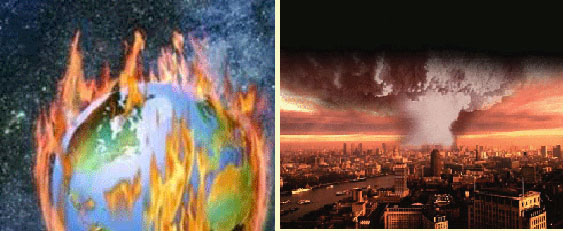
An All-American Horror Story
SCHEERPOST, BY MODERATOR July 5, 2021, An All-American Horror StoryThree-quarters of a century of nuclear follies — and that’s just for starters. By Tom Engelhardt / TomDispatch. Yes, once upon a time I regularly absorbed science fiction and imagined futures of wonder, but mainly of horror. What else could you think, if you read H.G. Wells’s War of the Worlds under the covers by flashlight while your parents thought you were asleep? Of course, that novel was a futuristic fantasy, involving as it did Martians arriving in London to take out humanity. Sixty-odd years after secretly reading that book and wondering about the future that would someday be mine, I’m living, it seems, in that very future, however Martian-less it might be. Still, just in case you hadn’t noticed, our present moment could easily be imagined as straight out of a science-fiction novel that, even at my age, I’d prefer not to read by flashlight in the dark of night.
I mean, I was barely one when Hiroshima was obliterated by a single atomic bomb. In the splintering of a moment and the mushroom cloud that followed, a genuinely apocalyptic power that had once rested only in the hands of the gods (and perhaps science-fiction authors) became an everyday part of our all-too-human world. From that day on, it was possible to imagine that we — not the Martians or the gods — could end it all. It became possible to imagine that we ourselves were the apocalypse. And give us credit. If we haven’t actually done so yet, neither have we done a bad job when it comes to preparing the way for just such a conclusion to human history.
Let’s put this in perspective. In the pandemic year 2020, 76 years after two American atomic bombs left the cities of Hiroshima and Nagasaki in ashes, the world’s nuclear powers actually increased spending on nuclear weapons by $1.4 billion more than they had put out the previous year. And that increase was only a small percentage of the ongoing investment of those nine — yes, nine — countries in their growing nuclear arsenals. Worse yet, if you happen to be an American, more than half of the total 2020 “investment” in weaponry appropriate for world-ending scenarios, $37.4 billion to be exact, was plunked down by our own country. (A staggering $13.3 billion was given to weapons maker Northrop Grumman alone to begin the development of a new intercontinental ballistic missile, or ICBM, the one thing our thoroughly troubled world obviously needs.) In all, those nine nuclear powers spent an estimated $137,000 a minute in 2020 to “improve” their arsenals — the ones that, if ever used, could end history as we know it.
In the Dust of the History of Death
Imagine for a second if all that money had instead been devoted to creating and disseminating vaccines for most of the world’s population, which has yet to receive such shots and so be rescued from the ravages of Covid-19, itself a death-dealing, sci-fi-style nightmare of the first order. But how could I even think such a thing when, in the decades since this country dropped that first atomic bomb on Hiroshima, it’s learned its atomic lessons all too well? Otherwise, why would its leaders now be planning to devote at least $1.7 trillion over the next three decades to “modernizing” what’s already the most modern nuclear arsenal on the planet?…………
Consider it an irony of the first order, then, that U.S. leaders have spent years focused on trying to keep the Iranians from making a single nuclear weapon, but not for a day, not for an hour, not for a second on keeping this country from producing ever more of them and the delivery systems that would distribute them anywhere on this planet. In that light, just consider, for instance, that, in 2021, the U.S. is preparing to invest more than $100 billion in producing a totally new ICBM, whose total cost over its “lifespan” (though perhaps the correct word would be “deathspan”) is already projected at $264 billion — and that’s before the cost overruns even begin. All of this for a future that… well, your guess is as good as mine.
Or consider that, only recently, the American and Russian heads of state, the two countries with by far the biggest nuclear arsenals, met in Geneva, Switzerland, and talked for hours, especially about cyberwar, while spending little appreciable time considering how to rein in their most devastating weaponry and head the planet toward a denuclearized future.
And keep in mind that all of this is happening on a planet where it’s now commonplace scientific knowledge that even a nuclear war between two regional powers, India and Pakistan, could throw so many particulates into the atmosphere as to create a nuclear winter on this planet, one likely to starve to death billions of us. In other words, just one regional nuclear conflict could leave the chaos and horror of the Covid-19 pandemic in the unimpressive dust of the history of death………….
While it’s seldom thought of that way, climate change should really be reimagined as the equivalent of a slow-motion nuclear holocaust……….
there was no mushroom cloud, but rather a “cloud” of greenhouse gases forming over endless years beyond human vision. Still, let’s face it, on this planet of ours, not in 2031 or 2051 or 2101 but right at this very moment, we’re beginning to experience the equivalent of a slow-motion nuclear war.
In a sense, we’re already living through a modern slo-mo version of Hiroshima, no matter where we are or where we’ve traveled. At this moment, with an increasingly fierce megadrought gripping the West and Southwest, the likes of which hasn’t been experienced in at least 1,200 years, among the top candidates for an American Hiroshima would be Phoenix (118 degrees), Las Vegas (114 degrees), the aptly named Death Valley (128 degrees), Palm Springs (123 degrees), and Salt Lake City (107), all record temperatures for this season. A recent report suggests that temperatures in famed Yellowstone National Park are now as high or higher than at any time in the past 20,000 years (and possibly in the last 800,000 years). And temperatures in Oregon and Washington are already soaring in record fashion with more to come, even as the fire season across the West arrives earlier and more fiercely each year. As I write this, for instance, California’s Big Sur region is ablaze in a striking fashion, among growing numbers of western fires. Under the circumstances, ironically enough, one of the only reasons some temperature records might not be set is that sun-blocking smoke from those fires might suppress the heat somewhat. ………
In this desperately elongated version of nuclear war, everything being experienced in this country (and in a similar fashion around the world, from Australia’s brutally historic wildfires to a recent heat wave in the Persian Gulf, where temperatures topped 125 degrees) will only grow ever more extreme, even if, by some miracle, those nuclear weapons are kept under wraps. After all, according to a new NASA study, the planet has been trapping far more heat than imagined in this century so far. In addition, a recently revealed draft of an Intergovernmental Panel on Climate Change report suggests that our over-heating future will only grow worse in ways that hadn’t previously been imagined. Tipping points may be reached — from the melting of polar ice sheets and Arctic permafrost (releasing vast amounts of methane into the atmosphere) to the possible transformation of much of the Amazon rain forest into savannah — that could affect the lives of our children and grandchildren disastrously for decades to come. And that would be the case even if greenhouse-gas releases are brought under control relatively quickly.
Once upon a time, who could have imagined that humanity would inherit the kinds of apocalyptic powers previously left to the gods or that, when we finally noticed them, we would prove eerily unable to respond? Even if another nuclear weapon is never used, we stand capable, in slow-motion fashion, of making significant parts of our world uninhabitable — or, for that matter, if we were to act soon, keeping it at least reasonably habitable into the distant future.
Imagine, just as a modest start, a planet on which every dollar earmarked for nuclear weapons would be invested in a green set of solutions to a world growing by the year ever warmer, ever redder, ever less inhabitable. https://scheerpost.com/2021/07/05/an-all-american-horror-story/
Need for a USA”no first use” of nuclear weapons policy – the concern of regional U.S. allies
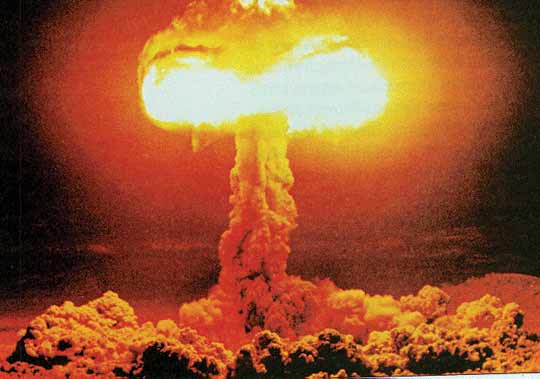
In our lead article this week, Van Jackson makes a compelling case for the United States to establish a no-first use policy on nuclear weapons. This would entail a pledge from Washington that its nuclear arsenal would not be used as a means of warfare except in the event that it was first subject to a nuclear attack by an adversary. While there is already some momentum behind such a policy amongst Democrats, Biden has taken no concrete steps towards implementing it and it has yet to be legislated by Congress.
No-first use nuclear policy. https://www.eastasiaforum.org/2021/07/05/no-first-use-nuclear-policy/ Author: Editorial Board, ANU, 5 July 21,
Since the election of Joe Biden in 2020, much of the world has breathed a collective sigh of relief as we have witnessed what appears to be a return to ‘pre-Trump normalcy’ in the United States. One of the greatest foreign policy challenges that faces the Biden administration, however, is recovering US credibility in Asia, which was severely undermined by his predecessor Donald Trump.
From the standpoint of US allies in the region, a concerning aspect of Trump’s rise to the presidency was his loose talk about nuclear weapons and apparent openness to utilising them against adversaries. While most allies have long emphasised the immense benefits of the US security guarantee and its attendant nuclear umbrella, Trump’s rise to power rendered alliance relationships potential liabilities.
These concerns among allies in the region were significantly elevated in 2017, when Trump began to entertain the prospect of launching a pre-emptive — albeit non-nuclear — strike against North Korea. He supposedly even went so far as to order an evacuation of US servicemen and their families from Seoul — an injunction that was ultimately not carried out by US officials in South Korea. His apparent willingness to engage in conflict with a nuclear-armed North Korea was reinforced rhetorically as he threatened ‘fire and fury’ against Kim Jong-un’s regime.
These developments had US allies (and non-allies alike) in the region beleaguered by the prospect of nuclear war in the region. Their concerns were reinforced by Trump’s predilection to appoint family members — with little to no foreign policy expertise — as official advisors. The notion that a US-initiated conflict with North Korea, entailing probable commitment by American allies, might be informed in part by the likes of Ivanka Trump and Jared Kushner was a severe indictment of alliance management.
The election of Joe Biden allayed some of the concerns of US allies. But the fact that Trump received over 70 million votes in the election and may run again for president in 2024 means that his tenure cannot be easily viewed as an unfortunate aberration.
What can Biden do during his presidency to restore confidence among American allies in the region, and restore US credibility in the aftermath of the Trump administration?
In our lead article this week, Van Jackson makes a compelling case for the United States to establish a no-first use policy on nuclear weapons. This would entail a pledge from Washington that its nuclear arsenal would not be used as a means of warfare except in the event that it was first subject to a nuclear attack by an adversary. While there is already some momentum behind such a policy amongst Democrats, Biden has taken no concrete steps towards implementing it and it has yet to be legislated by Congress.
Jackson outlines three common arguments that are cited against a non-first use nuclear policy: China, Russia and North Korea would never believe in the veracity of no-first use declarations; it would encourage uncertainty among adversaries as to whether the United States could use nuclear weapons against them; and there would also be concerns among American allies about the implications of a no-first use policy for US extended nuclear deterrence and Washington’s ability to deter threats on their behalf.
Yet Jackson argues that, ‘ … the world is no longer unipolar. The old bargain — Washington does arms-racing so allies don’t — makes no sense in a world where US politics is depressingly awry. Allied nuclear proliferation poses its own risks, but it may be a better alternative to US nuclear preponderance and presidential first-use launch authority’.
As the region becomes increasingly volatile, a policy of US restraint on the use of nuclear weapons has acquired new urgency. The advent of the Biden administration has done little to alleviate US–China tensions; Biden’s China policy so far appears to be a continuation of that of the Trump administration. Meanwhile, prospects of a cross-Strait crisis continue to rise and progress on the denuclearisation of North Korea remains elusive. These political tensions have been aggravated by economic destabilisation in the region that has been fuelled by the COVID-19 crisis.
These developments have spawned new concerns about conflict and the role of US alliances in the region. Some analysts believe that such conflict would have potential to evolve into nuclear war. Given that the US-led alliance network is premised on the maintenance of regional peace and security, it behoves Washington to clarify that it will not employ first use of nuclear weapons.
This is important for the Biden government. It is also important for the future US administrations that could see the likes of Trump with a finger back on the nuclear button.
The EAF Editorial Board is located in the Crawford School of Public Policy, College of Asia and the Pacific, The Australian National University.
Time for US nuclear strategy to embrace no first use
Time for US nuclear strategy to embrace no first use
https://www.eastasiaforum.org/2021/07/04/time-for-us-nuclear-strategy-to-embrace-no-first-use/ 4 July 2021Author: Van Jackson, Victoria University of Wellington
It was one of the most potent lessons of the Cold War — nukes are good for deterring others from using nukes, but not much else. Weapons capable only of spasmodic mass violence are too crude as a credible tool of coercion in most circumstances.
If the United States seeks only deterrence, but not political advantage from nuclear weapons, then adopting a no-first use nuclear policy is not just low-risk — it’s necessary.
Most of the leading candidates campaigning for the 2020 Democratic presidential nomination publicly endorsed a no-first use policy. Legislation requiring it has growing support in the US Congress. Indeed, it is difficult to imagine any scenario where the United States gains from using nuclear weapons before an adversary, especially when Washington’s conventional arsenal has global reach.
A no-first use nuclear policy would therefore be honest nuclear policy. No sane president would use nuclear weapons before an adversary did, except perhaps out of tragic misperception. But since the Trump presidency, the imperative of a no-first use policy has grown more urgent.
Only a fool would trust in US strategic competence after the decision-making of the Trump era. Trump was a symptom not an anomaly of US politics today. He has spawned many imitators in the Republican Party, who traffic in conspiracy theories and promote antagonistic, militaristic and racialised foreign policies to score domestic political points.
Who wants to entrust a candidate of the far right with the authority to launch nuclear weapons? No first use is the most meagre of many measures needed to restrain US presidential authority in the nuclear realm.
While US President Joe Biden has spoken favourably about a no-first use policy in the past, his administration’s nuclear thinking is so far mostly indistinguishable from that of the Trump era. In the past four years, the United States has withdrawn from most arms control agreements, expanded investments in hypersonic glide vehicles, advanced development of low-yield ‘tactical’ nuclear weapons, threatened nuclear use in the most gratuitous ways, and committed to a US$1.5 trillion nuclear modernisation plan.
Why, then, would preserving a first-use nuclear option be a good idea, especially when the context is not one of US restraint but rather an uninhibited US arms build-up? Opponents of no first use offer three justifications.
First, nuclear advocates claim that China, Russia and North Korea won’t believe no-first use declarations. Yet the fact that it sometimes pays to deceive in statecraft does not repudiate a no-first use policy. If adversaries assume the worst about US nuclear planning, what’s the harm in claiming they need not worry about US nukes unless they use theirs?
If the credibility of a pledge is a priority, Washington can strengthen it through additional changes. Legislation constraining presidential authority is one mechanism, so is eliminating the ICBM component of the nuclear triad, re-entering arms control agreements abandoned during the Trump years, and curbing investments in intermediate-range ground-launched missiles and ‘tactical’ nuclear warheads. When multiple signals are combined with a common message — especially costly and hand-tying signals — the context in which judgments are made changes and declarations become credible.
Second, an ambiguous policy encourages enemy uncertainty about whether the United States could use nuclear weapons against them. This is supposed to keep adversaries from using nuclear weapons against the United States or its allies. But in what scenarios do Washington’s enemies think it will use nuclear weapons first when the United States has conventional munitions with global reach?
If a credible threat of nuclear retaliation cannot deter China, Russia or North Korea, why would an ambiguous US nuclear policy? US nuclear threats will not keep aggressors from making land grabs, threat-making or invading neighbouring territory. The notion that the United States should keep enemies guessing about its intentions on nuclear strategy imports battlefield logic into peacetime circumstances.
If the United States really saw fit to make nuclear first-use threats in conflict, shifting from no-first use to a declaratory policy of ambiguity would be better for ‘keeping the enemy guessing’. There is no peacetime deterrence gained from allowing the fog of war to shroud geopolitics at all times.
The third argument is that allies reliant on US extended nuclear deterrence would worry about Washington’s ability or willingness to deter threats on their behalf. So, what? No ally is in it just for the nukes. Because allies’ fears of abandonment or entrapment can never be fully mollified, the United States must be cautious about being held hostage to them.
In extremis, the absence of US extended deterrence for Japan, South Korea or Australia could mean them going nuclear. But the old bargain — Washington does arms-racing so allies don’t — makes no sense in a world where US politics is depressingly awry. Allied nuclear proliferation poses its own risks, but it may be a better alternative to US nuclear preponderance and presidential first-use launch authority.
While the arguments against a no-first use policy don’t add up on their merits, reasonable people have long debated these points. But circumstances have changed dramatically. Nuclear policy must reconsider giving a potentially unhinged or fascistic president the discretion to launch nuclear weapons before America’s enemies do.
If the aim is to make US foreign policy less reliant on nuclear weapons over time while minimising risks of nuclear war, adopting no first use is the least the United States can do to make a down payment on a saner world.
Van Jackson is Senior Lecturer in International Relations and Defence & Strategy Fellow at the Centre for Strategic Studies, Victoria University of Wellington. He is also a Senior Associate Fellow at the Asia-Pacific Leadership Network for Nuclear Non-Proliferation and Disarmament. He was previously a strategist and policy adviser in the Office of the US Secretary of Defense.
Further developments for space warfare planning
Space Force’s new delta organizations will help the service keep up with growing launch cadence C4ISRNET, By Nathan Strout 30 June 21
CAPE CANAVERAL SPACE FORCE STATION, Fla. — The U.S. Space Force is reorganizing its launch organizations, and while the change may not have immediate impacts, operators believe the new structure prepares the service for the coming moment when it is launching satellites daily.In April, the Space Force announced it would start a new field command called Space Systems Command to replace the main space acquisitions organization it took over from the U.S. Air Force: the Space and Missile Systems Center. As part of that restructuring, it’s unifying its entire launch enterprise — launch operations, range operations and acquisitions — and putting that under the SSC deputy commander, who will be known as the Assured Access to Space leader within the force………
All of those changes are expected to take place this summer, after Congress approves a general to lead the new field command………….
While those changes may not have a large impact on launch operations today, said Eno, they will become increasingly important as the Space Force increases the number of launches it conducts. Cape Canaveral expects more than 50 launches this year, driven largely by commercial launches — SpaceX’s Starlink launches in particular — and that number is set to continue growing……….https://www.c4isrnet.com/battlefield-tech/space/2021/06/16/space-forces-new-delta-organizations-will-help-the-service-keep-up-with-growing-launch-cadence/
Serious questions about government funding Bill Gates’new confidence-trick, the NATRIUM nuclear reactor

Can we be sure that we will not end up with plutonium-fueled reactors coupled with reprocessing?
Dangerous Decisions about Advanced Nuclear Reactors Could Lead to New Threats https://portside.org/2021-06-27/dangerous-decisions-about-advanced-nuclear-reactors-could-lead-new-threats
Congress should have answers to tough questions before giving the Energy Department’s Advanced Reactor Development Program additional funding. June 27, 2021 Victor Gilinsky, Henry Sokolski
The Department of Energy’s recently launched Advanced Reactor Demonstration Program (ARDP) is slipping by without any close Congressional oversight, which is unfortunate as there are some serious questions that should be answered, including ones related to national security. The program was launched with an award of $160 million to TerraPower for its Natrium design and X-energy for its Xe-100. Each is to build a full-scale nuclear reactor within the next seven years, one that could be duplicated and sold commercially. While not a huge sum, it is intended to be the down payment on over $3 billion, a sum that is supposed to be cost-shared by the companies, with more for other projects.
At a March 25 Senate Energy Committee hearing on “advanced” reactors, executives of the two companies described a future with almost unlimited opportunities worldwide for their reactors, hundreds, maybe thousands. They got an enthusiastic reception from both sides of the aisle, summed up by Chairman Joe Manchin’s (D-WV) final observation that while wind and solar power were OK, “nuclear really does the job.” No one asked how the reactors will be fueled. Will they be fueled with nearly highly enriched uranium, or with plutonium? And what will be the security consequences of selling and encouraging reactors fueled with such fuels around the world?
Despite the enthusiasm for new technology, the “advanced” label is misplaced. These are re-engineered versions of old designs, some over fifty years old. “Advanced small modular reactors” trips off the tongues of people who think they are talking about the nuclear future, whereas in fact, they are talking about reviving the past.
“Small” is also an inaccurate label. Yes, there are lots of projects for small reactors, but they are a sideshow, for niche applications. The real action, the main ring, concerns larger units. TerraPower’s CEO, Chris Levesque, told the senators at the March 25 hearing that the company was pursuing a 300-megawatt (electric) unit because that was what today’s market would accept. But as it gained experience, TerraPower anticipated “growing Natrium output back up to gigawatt scale,” the size of current large light water reactors. The obvious conclusion is that TerraPower doesn’t think the smaller units would be economic, despite the current ballyhoo about the economic advantages of such units. Levesque thought there was a market for hundreds of the large units domestically and more abroad. As much of the talk was on competing with Russia and China, it is clear that the nuclear industry business plan centers on exporting the technology around the world.

Above – a different model – NuScale, but see the person indicated – this ”small” reactor is not small

The Natrium reactor TerraPower has promised to build with DOE funds is not, as many people think, the highly advertised “traveling wave” reactor design that TerraPower pursued when started by Bill Gates. That idea involved the active (fissioning) reactor region slowly “traveling” from the center of the reactor core over the life of the reactor, “breeding” plutonium from uranium and fissioning it in place, therefore with no need for reprocessing. That Bill Gates was assumed to be a shrewd investor boosted the company’s credibility. The traveling wave idea didn’t work, but TerraPower retained the label for a different design, apparently because it aids marketing.
The Natrium reactor is a scaled-up version of a General Electric design for a small sodium-cooled, plutonium-fueled fast breeder reactor (natrium is German for sodium, and “fast” means it relies on energetic neutrons). This is the reactor the nuclear enthusiasts have wanted to build since Congress canceled the Clinch River Fast Breeder Reactor in 1983. The Atomic Energy Commission, the DOE’s predecessor agency, pushed the liquid metal fast breeder (LMFBR) reactors in the 1970s as the energy solution in what was thought to be a uranium-poor world. But it turned out we live in a uranium-rich world so the expensive LMFBR made no economic sense.
It also made no sense to flood the world with untold tons of plutonium when a few kilograms is enough for a bomb. That’s why Presidents Gerald Ford and Jimmy Carter made it U.S. policy to discourage commercializing of plutonium-fueled reactors. Enthusiasts tried but failed to revive fast reactors as part of the second Bush administration’s Global Nuclear Energy Partnership program. It appears they are trying again.

TerraPower’s CEO told the senate hearing that the Natrium reactor would be fueled with uranium enriched to just short of 20 percent U-235 (a level that America is trying to prevent Iran from enriching to). It’s the borderline between low and highly enriched uranium. That choice seems to be related to DOE’s interest in developing a large enrichment market for the DOE-created Centrus Corporation, which is a story in itself.

Widespread use of reactors in this mode would dramatically increase demand for enriched uranium. Will 20 percent enriched uranium remain the preferred fuel for Natrium, or will it revert to plutonium with reprocessing to meet foreign customer interest? (The original GE design included an onsite reprocessing plant.) So configured, the reactor would make and reuse massive quantities of material that could be used to create a bomb. Recently, the Senate armed Services Committee raised this worry with regard to China’s fast reactor program. Congress should nail down the answer to this key question with regard to DoE’s programs.
There is a natural tendency to loosen the financial reins on projects that fall into the research and development category. But the two ARDP projects are prototypes for the commercial market. Congress should have answers to tough questions before giving the Energy Department’s ARDP additional funding. A good start would be to ask: Can we be sure that we will not end up with plutonium-fueled reactors coupled with reprocessing?
Old cracked infrastructure – the Florida building collapse – a warning for old cracked nuclear reactors.

embrittlement, pipe cracking, component degradation, technical obsolescence, an aging workforce, rampant incompetence, and worse define the reality of virtually every operating atomic reactor, here and around the planet.
Collapsed Florida Condo Sends a Giant Nuke Warning https://readersupportednews.org/opinion2/277-75/70146-rsn-collapsed-florida-condo-sends-a-giant-nuke-warning, By Harvey Wasserman, Reader Supported News, 28 June 21 he horrifying collapse of a south Florida condo should alarm us all about the next reactor catastrophe.
The owners of that 13-story condo were warned years ago that it could implode. They were apparently getting ready for repairs, but in the interim did nothing.
The owners of America’s 93 licensed reactors have been warned for decades that they could both implode and explode. They have also done nothing.
More than 150 people may have died in this avoidable Florida disaster. The death toll from the next avoidable reactor disaster could stretch into the millions, with property damage in the trillions, a blow from which our economy and ecosystems might never recover.
South Florida authorities have now ordered inspections of large buildings over forty years old. Nearly all US reactors – including four on the ocean in South Florida – are also now around forty years old.
They all must be immediately shut for rigorous inspection. To wait is to invite a radioactive version of what just happened to that condo.
The argument is not about nuclear power. It’s about basic sanity.
The industry is currently pushing “new” designs based on fusion, thorium, breeder technologies, molten salt, small modular, and more. None have been proven safe or effective in fighting climate chaos. Nor can they compete with renewables. None have a reasonable prospect of coming online before being completely left in the radioactive dust by accelerating advances in wind, solar, batteries, and LED efficiency.
All are certain to consume huge quantities of public money, pouring into private pockets (like those of Bill Gates) before failing utterly.
But they pale in importance alongside the 93 US reactors (there are some 430 worldwide) now plummeting toward certain catastrophe.
None of these reactors can get private liability insurance against an apocalyptic disaster. Most were designed in the pre-digital 1950s and ‘60s. Many were built with inferior materials and understanding.
Critical welds at California’s Diablo Canyon, for example, contain metal components long since banned. But Unit One continues to operate.
Critical concrete at New Hampshire’s Seabrook and Ohio’s Davis-Besse is crumbling. Fort Calhoun in Nebraska was flooded. Intake pipes at South Texas froze. Reactors in Ohio and Virginia have been damaged by earthquakes. Diablo is surrounded by earthquake faults set to deliver seismic shocks which a Nuclear Regulatory Commission resident inspector has said it can’t withstand. The owners of San Onofre want to bury their high-level wastes ONE HUNDRED FEET from the tide line. Meaningful evacuation planning is nonexistent at sites where nearby population centers have exploded since the original siting approval.
All these old reactors contribute to climate chaos with emissions of heat, radiation, and carbon. They suck up billions of gallons of precious water, then dump it or evaporate it with chemical, radioactive, and thermal pollution. In every case, our planet would benefit from their shutdown.
Virtually all US reactors are almost certainly embrittled, meaning emergency cooling water poured into the core to quell a meltdown would shatter critical components, resulting in apocalyptic hydrogen and possibly fission explosions, as at Chernobyl and Fukushima.
To put it most simply: no embrittled reactor has a workable set of brakes. Yet states like California, and the NRC itself, refuse to conduct relatively cheap and simple open inspections.
Thus embrittlement, pipe cracking, component degradation, technical obsolescence, an aging workforce, rampant incompetence, and worse define the reality of virtually every operating atomic reactor, here and around the planet.
So when we look in horror at that collapsed south Florida condo, with all those innocent souls buried in the rubble, we must remember that later today, parallel pictures could show a mega-hot runaway reactor spewing Chernobyl/Fukushima levels of radiation throughout the ecosphere.
Thankfully, the Solartopian realities of fast-accelerating wind, solar, battery, and efficiency technologies give us the leeway to shut them all NOW.
Let’s do it before it’s too late!!
Harvey Wasserman co-convenes the weekly Election Protection 2024 ZOOM. His People’s Spiral of US History is at www.solartopia.org.
The Pentagon drums up its full-spectrum dominance with the story of the ”China threat”
Countering the “China Threat”–At What Price? The Pentagon is upgrading its full-spectrum dominance, with China as the primary target. Organising Notes, the Global Network Against Weapons & Nuclear Power in Space.By Koohan Paik-Mander 27 June 21

In early June 2021, in a classified directive to Pentagon officials, U.S. Secretary of Defense Lloyd Austin slammed the former Trump administration for talking big but never taking action to counter “the China threat.”
Austin made it clear that things would be different under President Biden. His “tough guy” rhetoric strikes just the right tone for a massive, costly, military-infrastructure overhaul that would render the conventional warfare of the twentieth century unrecognizable: more nukes, fewer troops, and an omnipotent 5G network.
The goal of this overhaul is to give the United States and its allies the ability to summon, at once, unmanned military forces to rain terror down on any spot in the world—a swarm of drones, hypersonic missiles, submarine torpedoes, and bombers—all with the ease of calling an Uber.
This game-changing metamorphosis of how wars are fought is already underway. It’s called the JADC2 (Joint All-Domain Command & Control), a globally networked, cloud-based command center, overseen by the recently anointed U.S. Space Force.
It was for this that the Space Force was created—not as a jokey Trump trifle.
However, targeting China with this new paradigm for mass destruction will not bring about global security. Even if it were to somehow not culminate in a nuclear conflict, the ecological and climate costs of commanding war from outer space would be devastating. And yet, ever-more-mammoth military preparations are being staged in ever-more-numerous locations on Earth.
President Biden is in lockstep with Austin’s anti-China mission. Much of Biden’s $715 billion Pentagon budget request for 2022 is for investment in hypersonic weapons, artificial intelligence, micro-electronics, 5G technology, space-based systems, shipbuilding and nuclear “modernization” (read: expansion). The request seeks $28 billion to “modernize” the nuclear triad (the ability to launch nukes from land, sea, and air). The budget also includes the largest research-and-development request—$112 billion—in the history of the Pentagon.
Imagine that kind of support for healthcare.
Each line item is a deadly weapon, which, discretely, already carries terrifying implications. But, taken together, as part of the JADC2—an integrated, multi-dimensional system with machines responsible for pulling the trigger—the whole is far more chilling than the sum of the parts.
Among the types of missiles on Biden’s wish-list are some whose range exceeds the limits in the Intermediate-Range Nuclear Forces (INF) Treaty of 1987. But the INF Treaty is no longer in effect, after President Trump withdrew the United States from the agreement in August 2019, just four months before the creation of the Space Force. That means that Biden and Austin are now free to spend taxpayer money on these perilous weapons
Policy analyst Michael Klare has observed that this year’s budget subordinates all perceived threats to a single bogeyman-du-jour: China. War with China, specifically, means more nukes, long-range missiles, and unmanned weapons. These weapons are not just to be used by the United States, but are also for export to allies as well—much to the financial gain of weapons industrialists like Lockheed Martin and Raytheon.
For example, a declassified U.S. Department of Defense report from 2018 provides a directive to sell more arms to India, to “enhance India’s status as a Major Defense Partner,” and to “support India’s membership in the Nuclear Supplier’s Group.” The essence of the Pentagon’s massive global vision is to construct, from the ground up, a hard and soft infrastructure upon which the newly created Space Force can operate.
Just as the continent-spanning interstate highway system was laid during the 1950s to ensure a profitable future for the automobile industry, this new infrastructure—comprised of 5G, artificial intelligence, rocket launchpads, missile tracking stations, satellites, nukes, and internet-connected fleets of unmanned ships, jets, subs, hypersonic, and other craft—will ensure a reliably profitable assembly-line output of arms for the weapons industry.
In tandem with the military infrastructure will come a continued expansion of associated security infrastructure, such as increased surveillance and data collection of every individual on the planet. As a former board member at Raytheon, Lloyd Austin is perfectly positioned to pull this off. In fact, during his first three months as defense secretary, he awarded over $2.36 billion in contracts to the missile manufacturer he once faithfully served………..
China Threat = Yellow Peril
The Pentagon has a billion dollars a year to spend on public relations, and vilifying China has become Lloyd Austin’s top priority. He paints a picture of urgency so dire that it seems the only way to meet the challenge is to fund his comprehensive Weapons New Deal.
Once the new military infrastructure is fully in place, the Space Force will be equipped to dominate the planet. Until now, the INF Treaty’s cap on missile range prevented the implementation of this vision, given the hemispheric distance between China and the United States. Now that the treaty is no longer in effect, however, the Indo-Pacific theater is the ideal geography to debut this new way of warfare that relies on satellites to deliver strikes clear to the opposite side of the planet.
Thousands of satellites are already in place; thousands more will follow, thanks to private efforts by the likes of Elon Musk and Jeff Bezos. The United States is currently working through the UN to standardize 5G internationally. Algorithms are now being written to remove human decision-making from warfare. Pacific reefs have already been dredged, forests razed, and protestors arrested on islands encircling China to make way for destroyer berths and rocket launchpads—nodes of the global war infrastructure.,,,,,,,,,,,,,,,,,,
peace activist Sung-Hee Choi. [ in South Korea] points out that the THAAD system is made by Lockheed Martin and the associated radar is manufactured by Raytheon, where Austin previously served on the board. Choi adds that she is nervous about the intensifying military tension in her country and in northeast Asia: “I think recent anti-Asian hate is like a preparation for war against North Korea and China, just like when the Bush administration exploited anti-Muslim sentiments just before the invasions of Afghanistan and Iraq.”…….
Pacific Pivot and the First Island Chain
Military planners have been nurturing this Rubicon moment with China for at least a decade, beginning when Obama announced his “Pacific Pivot” toward Asia. Since then, communities in the Asia-Pacific region have been confronted with elaborate, ecocidal preparations for full-scale war with China. Natural resources have been destroyed to construct a globe-sweeping, networked infrastructure of missile deployment and satellite tracking.
That was the first phase of laying the groundwork for 21st century warfare. Biden’s current request for funding will expand this strategic rebalance of military forces into its second phase……………………http://space4peace.blogspot.com/2021/06/countering-china-threatat-what-price.html
U.S. militarisation of the Pacific

Countering the “China Threat”–At What Price? The Pentagon is upgrading its full-spectrum dominance, with China as the primary target. Organising Notes, the Global Network Against Weapons & Nuclear Power in Space.By Koohan Paik-Mander 27 June 21
”…………………. to accommodate the JADC2, Joint All-Domain Command and Control (JADC2) even more expansive swaths of the ocean are being set aside for year-round military exercises.
The most egregious example is the MITT (Mariana Islands Training and Testing), a plan to transform over a million square miles of biodiverse ecosystems into the largest-ever range complex for bombing and firing practice. The impacted area would be larger than the states of Washington, Oregon, California, Idaho, Nevada, Arizona, Montana, and New Mexico combined.
The largest multinational open-ocean military exercises in history will take place here, home to 26 species of cetaceans. The navy itself estimates that its activities will maim or kill over 81,000 whales and dolphins per year. And that doesn’t count the ecological casualties anticipated in other existing exercise ranges, such as those around Hawaii, California, Alaska, Australia, in the Sea of Japan, and in the Bay of Bengal.
For their part, thousands of residents of the Marianas are protesting the plan to turn their ancestral archipelago into a year-round war zone. Large portions of Guam and Tinian would become dedicated firing ranges, placed right next door to towns and neighborhoods. Practice-bombing on the islet of Farallon de Medinilla, a migratory-bird hotspot, will increase from 2,150 strikes a year to 6,000 strikes a year. And most tragically, the whole of the astonishingly pristine island of Pagan is slated to undergo perpetual full-spectrum assaults from air, land, and sea. The island is expected to endure continuous bombing from mortars and missiles, its wildlife damaged by sonar, torpedoes, hand grenades, reef-crushing amphibious landing practice, and countless experimental detonations. Because of the colonial status of the Mariana islanders, they have not been able to legally demand transparency and accountability from the U.S. government…………http://space4peace.blogspot.com/2021/06/countering-china-threatat-what-price.html
The U.S. Nuclear Weapons Program Left ‘a Horrible Legacy’ of Environmental Destruction and Death Across the Navajo Nation
The U.S. Nuclear Weapons Program Left ‘a Horrible Legacy’ of Environmental Destruction and Death Across the Navajo Nation Inside Climate News, By Cheyanne M. Daniels, Amanda Rooker, June 27, 2021
Navajo uranium miners have died of lung cancer and other respiratory illnesses. They weren’t told of the risks, and they want compensation for radiation exposure continued.
”…………… Despite the stunning beauty of the 27,000-square-mile Navajo Nation, which encompasses parts of Arizona, New Mexico and Utah, the land is marred by a toxic history: a “horrible legacy” of uranium mining and processing that began in 1944, with the U.S. nuclear weapons program and has slowly killed Navajo miners and their families, littered the land with 523 abandoned mines and tainted pristine aquifers with radioactive ore and the dry air with radioactive dust.
Harrison, 70, and his father Phil Harrison Sr., were both uranium miners. Harrison worked in the mines for only three months, but his father worked there for 20 years and died at 44 from lung cancer. The 1990 Radiation Exposure Compensation Act presumes that an increased incidence of lung cancer and other respiratory illnesses among the miners was caused by large doses of radiation and other airborne hazards they were exposed to.
The Navajo fought for years to have this law enacted. To date, $2.5 billion in benefits have been paid out to 37,000 claimants—uranium miners and so-called “downwinders” affected by nuclear weapons testing in the 1950s and 1960s at the Nevada Test Site, 65 miles northwest of Las Vegas.
Now, with the law scheduled to “sunset” in July 2022, another reckoning is at hand, as Harrison and other Navajo activists, downwinders, Catholic leaders and peace and environmental organizations like the Union of Concerned Scientists lobby Congress to extend the act and add new beneficiaries. Those include all uranium miners who have come down with cancer or respiratory illnesses since 1972 and thousands of additional downwinders in Nevada and Arizona.
“The tragic legacy of uranium mining on the Navajo Nation continues to this day, perhaps to an extent that would not have occurred if it weren’t taking place in a rural American Indian community,” Navajo Nation President Jonathan Nez told a House Judiciary subcommittee in March. In prior testimony, he referred to the Navajo’s “horrible legacy,” and said that “past uranium activity has devastated Navajo families, traditions, and our Mother Earth.”
With the Biden administration making environmental racism a top priority, and pressure building to extend the radiation compensation act, an international campaign is gaining momentum to make “ecocide”—systematic and longlasting environmental devastation—a crime, like genocide, before the Internaitonal Criminal Court in the Hague.
The United States is not among the 123 member nations of the court and thus would not be subject to sanction for environmental destruction in America, should ecocide eventually become a crime, in a process that could take seven years or more. But ecocide’s champions say that making it an international crime would have a powerful moral impact by associating environmental destruction with genocide, crimes against humanity and war crimes that are an affront to humanity at large.
In their 1995 book “Ecocide of Native America: Environmental Destruction of Indian Lands and Peoples,” Donald A. Grinde Jr. and Bruce E. Johansen wrote that Kerr-McGee opened the first uranium mine on the Navajo Nation in 1948:
“There were no taxes at the time, no health, safety or pollution regulations, and few other jobs for the many Navajos recently home from service in World War II,” they wrote. “Labor was cheap. Thirty years after mining began, an increasing number of deaths from lung cancer made evident the fact Kerr-McGee had held miners’ lives as cheaply as their labor. As Navajo miners continued to die, children who played in water that had flowed over or through abandoned mines and tailing piles came home with burning sores.”
In their 1995 book “Ecocide of Native America: Environmental Destruction of Indian Lands and Peoples,” Donald A. Grinde Jr. and Bruce E. Johansen wrote that Kerr-McGee opened the first uranium mine on the Navajo Nation in 1948:
“There were no taxes at the time, no health, safety or pollution regulations, and few other jobs for the many Navajos recently home from service in World War II,” they wrote. “Labor was cheap. Thirty years after mining began, an increasing number of deaths from lung cancer made evident the fact Kerr-McGee had held miners’ lives as cheaply as their labor. As Navajo miners continued to die, children who played in water that had flowed over or through abandoned mines and tailing piles came home with burning sores.”
………Harrison points into the distance, where a few houses can be seen. “Probably around 300 miners from this area alone have passed on from lung disease or lung cancer,” Harrison said. “The fathers are gone from this area. … So it’s just the widows and the kids.”…………….. https://insideclimatenews.org/news/27062021/nuclear-weapons-navajo-nation-uranium-mining-environmental-destruction-health/
Radioactive Waste Contaminates the Land and Water
The U.S. Nuclear Weapons Program Left ‘a Horrible Legacy’ of Environmental Destruction and Death Across the Navajo Nation Inside Climate News, By Cheyanne M. Daniels, Amanda Rooker, June 27, 2021 ”……………Radioactive Waste Contaminates the Land and Water
Uranium is recovered from the earth in two ways. The first is conventional mining of the ore, in which miners dig the rock out of open pits that strip away the topsoil. The second, which is the most common extraction method in the United States, pumps chemicals into groundwater to dissolve uranium from the rock, known as “situ leaching.”
After the extraction, the ore is taken to mills, where it is crushed, ground up and dissolved to be solidified, dried and packaged.
Regardless of the extraction method, mining and milling uranium leaves behind radioactive waste that contaminates water and the land, according to the Environmental Protection Agency. Waste from open pit mines is often left in piles outside the mine, while tailings from the milling process remain radioactive and contain hazardous chemicals.
“Wind can blow radioactive dust from the wastes into populated areas and the wastes can contaminate surface water used for drinking. Some sites also have considerable groundwater contamination,” according to the EPA website.
The EPA is conducting water studies at three areas on the reservation that have been affected by historical mining to “inform future investigations and potential cleanups by EPA and private parties.”
The Journal of Contemporary Water Research & Education said in a June 2020 study that while high concentrations of uranium and arsenic may be found naturally in some areas, contamination is “especially troublesome on the Navajo Nation, where past (uranium) mining activity may have contaminated water supplies.”
Out of 82 unregulated wells sampled for the study, nine exceeded the maximum contaminant level for drinking water standards for uranium and 14 exceeded standards for arsenic. Because of these contaminants, a study published by the Journal of Vacuum Science & Technology in March 2020 found that nearly 30 percent of Navajo homes had to rely on hauling water to meet their needs.
The lack of drinking water affects not only the Navajo living on the reservation, but their livestock and land usability, as well.
The EPA began investigating the effects of the uranium mines in the Cove region in January 2015, after a settlement from Tronox, a company spun off from Kerr-McGee in 2006, provided almost $4.4 billion for cleanup of more than 50 abandoned uranium mines. Forty-two of the mines are on or near the Navajo Nation, which received $45 million in the settlement, and 32 are in the Cove area, where more than 7 million tons of ore were mined, according to the EPA.
The funds allowed for the assessment and cleanup of 230 of the 523 abandoned uranium mines across the reservation, which is ongoing. In the Northern Abandoned Uranium Mine Region, where the Cove Chapter is located, 121 of the 229 mines are targeted in the cleanup process.
Kerr-McGee was among the companies that extracted a total of 30 million tons of uranium ore from the Navajo land from 1944 until 1986. In his testimony in March before the House Judiciary Subcommittee on the Constitution, Civil Rights and Civil Liberties, Nez, the Navajo Nation president, said that “not a single one” of the 523 abandoned mines on Navajo lands “has been cleaned up properly.” https://insideclimatenews.org/news/27062021/nuclear-weapons-navajo-nation-uranium-mining-environmental-destruction-health/
NASA wants to increase allowable radiation exposure for astronauts – women affected most.
“As missions go deeper into space, we need to communicate why astronauts are being asked to take on that risk and offer explicit ethical justifications. This report offers a framework for accomplishing that,”

Report backs NASA proposal to change astronaut radiation exposure limits, Space News, by Jeff Foust — June 25, 2021 WASHINGTON — A National Academies committee has endorsed a NASA proposal to change the radiation exposure limits the agency sets for its astronauts but cautioned that the revised limit is still insufficient for human Mars missions.
The June 24 report by a committee established by the National Academies and sponsored by NASA backs the agency’s proposal to set a single lifetime radiation exposure limit for astronauts, rather than different limits based on age and gender.
Currently, lifetime exposure limits range from 180 millisieverts for a 30-year-old woman to 700 millisieverts for a 60-year-old man. Those limits are based on models intended to set a limit of no more than a 3% risk of radiation exposure-induced death (REID) at the 95% confidence level.
NASA proposed changing that to a limit of about 600 millisieverts, regardless of age or gender. That limit is based on the mean 3% risk of REID for a 35-year-old woman, the most conservative case but measured to a different standard than the earlier calculation.
The change, the committee noted, will allow more opportunities for female astronauts given the higher radiation limits. “Taken together, the proposed standard creates equality of opportunity for spaceflight with the trade-offs of somewhat higher allowable exposure to radiation for a subset of astronauts (primarily women) and limiting exposures below otherwise acceptable doses for others (primarily older men),” the committee’s report stated………
While the revised levels will increase flight opportunities for many NASA astronauts, the levels are still more conservative than many other space agencies. Roscosmos, the European Space Agency and the Canadian Space Agency all set lifetime exposure limits of 1,000 millisieverts for their astronauts and cosmonauts, without any age or gender differences. The Japanese space agency JAXA does have age and gender differences, varying between 500 and 1,000 millisieverts.
Even those higher levels fall short of projected radiation exposures for round-trip Mars missions, which the report noted would exceed 1,000 millisieverts. Any astronauts who fly on a Mars mission would need a waiver to NASA’s radiation exposure limits, which raises ethical questions. “NASA should develop a protocol for waiver of the proposed space radiation standard that is judicious, transparent, and informed by ethics,” the committee recommended.
“As missions go deeper into space, we need to communicate why astronauts are being asked to take on that risk and offer explicit ethical justifications. This report offers a framework for accomplishing that,” said Julian Preston of the U.S. Environmental Protection Agency, vice-chair of the committee, in a statement.https://spacenews.com/report-backs-nasa-proposal-to-change-astronaut-radiation-exposure-limits/
California’s Pacific Gas and Electric Company (PG and E) settles over nuclear plant’s environmental violations.
California company agrees to 5.9-mln-dollar settlement over nuclear plant’s environmental damage http://www.xinhuanet.com/english/northamerica/2021-06/25/c_1310027301.htm, Xinhua| 2021-06-25 Editor: huaxia LOS ANGELES, — California’s Pacific Gas and Electric Company (PG&E) has agreed recently on a 5.9-million-U.S.-dollar settlement for once-through cooling water discharges from its Diablo Canyon nuclear power plant.
The settlement, reached with the Central Coast Regional Water Quality Control Board, was the result of a thorough Water Board investigation into alleged violations stemming from the plant’s use of water from the Pacific Ocean in its cooling system since 1985 and was officially filed on May 25 with the San Luis Obispo Superior Court.
According to Thursday’s report by Cal Coast News, the nuclear power plant takes in water from sea to condense steam after it passes through two electrical generators in a process called “once-through cooling” and the used water is then released back into the ocean.
Under the power plant’s local permit, public water was allowed to be piped from nearby sea area into the ocean, but environmentalists argued the discharge of water into the ocean harmed marine life.
Ailene Voisin, spokesperson for the Central Coast Regional Water Quality Control Board, estimated the thermal discharge to be about 20 degrees Fahrenheit (11.1 degrees centigrade) above the ambient ocean temperature in that area and that alterations to the nearby ecosystem “are well-documented and well-understood,” yet with “no feasible technological alternatives or modifications.”
Another problem was that the induction system that pumps water from Diablo Canyon into the power plant also sucked up an estimated 1.5 billion fish larvae per year, causing disruptions to the reproductive cycle of local fish.
The Water Board said in a press release on June 18 that the settlement funds received from PG&E would be used for water quality projects that benefit the region. In addition to the settlement, the release indicated that PG&E had also been making yearly payments to mitigate the issues from their overheated discharges.
-
Archives
- October 2026 (112)
- September 2026 (339)
- August 2026 (330)
- July 2026 (355)
- June 2026 (287)
- May 2026 (306)
- April 2026 (356)
- March 2026 (251)
- February 2026 (267)
- January 2026 (308)
- December 2025 (358)
- November 2025 (359)
-
Categories
- 1
- 1 NUCLEAR ISSUES
- business and costs
- climate change
- culture and arts
- ENERGY
- environment
- health
- history
- indigenous issues
- Legal
- marketing of nuclear
- media
- opposition to nuclear
- PERSONAL STORIES
- politics
- politics international
- Religion and ethics
- safety
- secrets,lies and civil liberties
- spinbuster
- technology
- Uranium
- wastes
- weapons and war
- Women
- 2 WORLD
- ACTION
- AFRICA
- Atrocities
- AUSTRALIA
- Christina's notes
- Christina's themes
- culture and arts
- Events
- Fuk 2022
- Fuk 2023
- Fukushima 2017
- Fukushima 2018
- fukushima 2019
- Fukushima 2020
- Fukushima 2021
- general
- global warming
- Humour (God we need it)
- Nuclear
- RARE EARTHS
- Reference
- resources – print
- Resources -audiovicual
- Weekly Newsletter
- World
- World Nuclear
- YouTube
-
RSS
Entries RSS
Comments RSS

